Magnetic Field and Earth's Magnetism — Competition Zone
Class 12 - Nootan Physics
Competition Zone — Multiple Choice Questions
Question 1
A 250-turn rectangular coil of length 2.1 cm and width 1.25 cm carries a current of 85 μA and subjected to a magnetic field of strength 0.85 T. Work done for rotating the coil by 180° against the torque is :
9.1 μJ
4.55 μJ
2.3 μJ
1.15 μJ
Answer
None of the given options is exactly correct; W ≈ 9.48 μJ
Reason — Work done in turning the coil through 180° from its stable position is W = mB(cos 0° − cos 180°) = 2mB, where m = NIA.
Note: The textbook keys 9.1 μJ because of an arithmetic slip in its printed working; 9.1 μJ is only the option nearest to the correct value, 9.48 μJ.
Question 2
A magnetic needle of magnetic moment 6.7 × 10⁻² Am2 and moment of inertia 7.5 × 10⁻⁶ kg m2 is performing simple harmonic oscillations in a magnetic field of 0.01 T. Time taken for 10 complete oscillations is :
8.76 s
6.65 s
8.89 s
6.98 s
Answer
6.65 s
Reason — The needle performs S.H.M. with period T=2πmBI, where I is its moment of inertia.
T=2π6.7×10−2×0.017.5×10−6=2π×0.1058T=0.665s
Time for 10 oscillations = 10T = 6.65 s.
Question 3
If θ1 and θ2 be the apparent angles of dip observed in two vertical planes at right angles to each other then the true angle of dip θ is given by :
cot2 θ = cot2 θ1 + cot2 θ2
tan2 θ = tan2 θ1 + tan2 θ2
cot2 θ = cot2 θ1 − cot2 θ2
tan2 θ = tan2 θ1 − tan2 θ2
Answer
cot2 θ = cot2 θ1 + cot2 θ2
Reason — If one plane makes angle α with the magnetic meridian, the other makes (90° − α). Using tanθ′=cosαtanθ for each plane,
The dipole moment of a circular loop carrying a current I, is m and the magnetic field at the centre of the loop is B1. When the dipole moment is double by keeping the current constant, the magnetic field at the centre of loop is B2. The ratio B2B1 is :
2
21
2
3
Answer
2
Reason — m = IπR2. Doubling m at constant I makes the new radius R′ = 2 R. Since B=2Rμ0I∝R1,
B2B1=RR′B2B1=2
Question 5
A square loop is carrying a steady current I and the magnitude of its magnetic dipole moment is m. If this square loop is changed to a circular loop and it carries the same current, the magnitude of the magnetic dipole moment of circular loop will be :
π4m
π3m
π2m
πm
Answer
π4m
Reason — For the square of side a, m = Ia2 and the wire length is 4a. Bent into a circle, 2πr = 4a, so r=π2a.
m′=Iπr2=Iπ(π2a)2=π4Ia2m′=π4m
Question 6
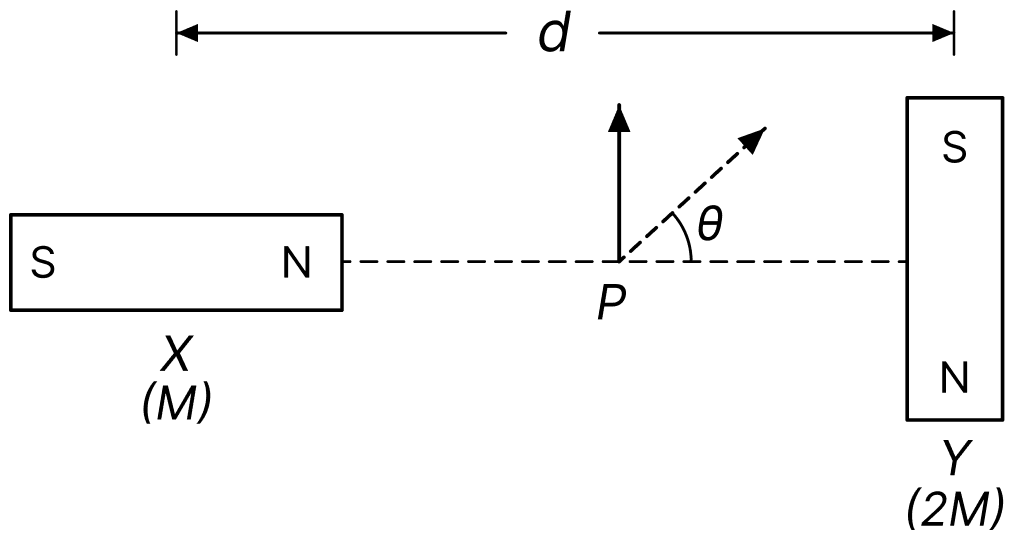
Two magnetic dipoles X and Y are placed at a separation d, with their axes perpendicular to each other. The dipole moment of Y is twice that of X. A particle of charge q is passing, through their mid-point P, at angle θ = 45° with the horizontal line, as shown in figure. What would be the magnitude of force on the particle at that instant? (d is much larger than the dimensions of the dipole)
2(4πμ0)(2d)3m×qv
(4πμ0)(2d)32m×qv
(4πμ0)(2d)3m×qv
0
Answer
0
Reason — P is an axial point of X, so the field of X at P is (4πμ0)(2d)32m, horizontal, from S to N of X. P is an equatorial point of Y (moment 2m), so the field of Y at P is (4πμ0)(2d)32m, opposite to the moment of Y, i.e., vertically upward. The two equal, perpendicular fields give a resultant at 45° to the horizontal, which is along the velocity of the particle. Hence F = qvB sin 0° = 0.
Question 7
A rectangular coil (dimension 5 cm × 2.5 cm) with 100 turns, carrying a current of 3 A in the clockwise direction is kept centered at the origin and in the X-Z plane. A magnetic field of 1 T is applied along X-axis. If the coil is tilted through 45° about Z-axis, then the torque on the coil is :
0.55 Nm
0.27 Nm
0.38 Nm
0.42 Nm
Answer
0.27 Nm
Reason — m = NIA = 100 × 3 × (5 × 10-2 × 2.5 × 10-2) = 0.375 A m2. In the X-Z plane, mis along the Y-axis; after tilting through 45° about the Z-axis it makes 45° with B(X-axis).
τ=mBsin45∘=0.375×1×0.707τ≈0.27Nm
Question 8
At some location of earth the horizontal component of earth's magnetic field is 18 × 10-6 T. At this location, magnetic needle of length 0.12 m and pole strength 1.8 Am is suspended from its mid-point using a thread, it makes 45° angle with horizontal in equilibrium. To keep this needle horizontal, the vertical force that should be applied at one of its ends is :
3.6 × 10⁻⁵ N
6.5 × 10⁻⁵ N
1.3 × 10⁻⁵ N
1.8 × 10⁻⁵ N
Answer
6.5 × 10⁻⁵ N
Reason — The freely suspended needle rests along the earth's field, so the angle of dip is 45° and BV = BH tan 45° = 18 × 10-6 T. When the needle is horizontal, BH acts along it (no torque), while BV acts on the poles (strength qm) to give a couple qmBV × l. Balancing it with a vertical force F at one end, about the mid-point,
F×2l=qmBVlF=2qmBV=2×1.8×18×10−6F≈6.5×10⁻⁵N
Question 9
An insulating thin rod of length l has a x linear charge density ρ(x)=ρ0lx on it. The rod is rotated about an axis passing through the origin (x = 0) and perpendicular to the rod. If the rod makes n rotations per second, then the time averaged magnetic moment of the rod is :
4πnρl3
nρl3
πnρl3
3πnρl3
Answer
4πnρl3
Reason — An element dx at distance x carries charge dq=ρ0lxdx. Rotating n times per second, it forms a loop of current n dq and area πx2, so dm=lnπρ0x3dx.
A magnetic compass needle oscillates 30 times per minute at a place where the dip is 45° and 40 times per minute where the dip is 30°. If B1 and B2 are respectively the total magnetic field due to the earth at the two places, then the ratio B2B1 is best given by :
1.8
2.2
0.7
3.6
Answer
0.7
Reason — A compass needle oscillates in the horizontal plane under BH = B cos θ, so T=2πmBcosθI and the frequency f satisfies f2 ∝ B cos θ.
At a point A on the earth's surface the angle of dip, δ = +25°. At a point B on the earth's surface the angle of dip, δ = −25°. We can interpret that :
A is located in the northern hemisphere and B is located in the southern hemisphere.
A and B are both located in the southern hemisphere.
A and B are both located in the northern hemisphere.
A is located in the southern hemisphere and B is located in the northern hemisphere.
Answer
A is located in the northern hemisphere and B is located in the southern hemisphere.
Reason — The angle of dip is zero at the magnetic equator, positive in the northern hemisphere (north end of the needle dips down) and negative in the southern hemisphere (south end dips down).
Question 12
A small bar magnet placed with its axis at 30° with an external field of 0.06 T experiences a torque of 0.018 Nm. The minimum work required to rotate it from its stable to unstable equilibrium position is :
9.2 × 10⁻³ J
6.4 × 10⁻² J
7.2 × 10⁻² J
11.7 × 10⁻³ J
Answer
7.2 × 10⁻² J
Reason — From τ = mB sin θ, m=0.06×sin30∘0.018 = 0.6 A m2. Work from stable (θ = 0°) to unstable (θ = 180°) equilibrium is W = mB(cos 0° − cos 180°) = 2mB.
W=2×0.6×0.06W=7.2×10⁻²J
Question 13
A wire of length L metre carrying a current of I ampere is bent in the form of circle. Its magnetic moment is :
4πIL2 Am2
4IL2 Am2
4IπL2 Am2
π2IL2 Am2
Answer
4πIL2 Am2
Reason — The circumference is L = 2πR, so R=2πL.
M=IπR2=Iπ(2πL)2M=4πIL2
Question 14
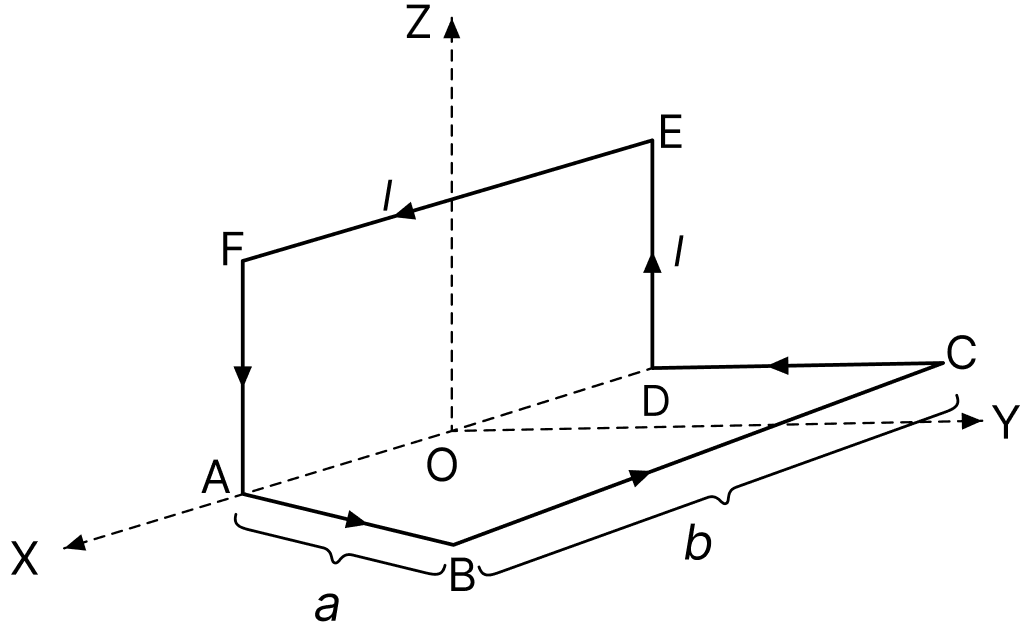
A wire carrying current I is bent in the shape ABCDEFA as shown, where rectangle ABCDA and ADEFA are perpendicular to each other. If the sides of the rectangles are of lengths a and b, then the magnitude and direction of magnetic moment of the loop ABCDEFA is :
abI, along (5j^+52k^)
2abI, along (2j^+2k^)
abI, along (2j^+2k^)
2abI, along (5j^+52k^)
Answer
2abI, along (2j^+2k^)
Reason — The loop ABCDEFA is equivalent to loops ABCDA and ADEFA (the currents along AD and DA cancel), each of area ab carrying current I. By the right-hand rule, ABCDA (in the X-Y plane) has moment abI k^ and ADEFA (in the X-Z plane) has moment abI j^.
M=abIj^+abIk^M=2abI(2j^+2k^)
Question 15
A charged particle going around in a circle can be considered to be a current loop. A particle of mass m carrying charge q is moving in a plane with speed v under the influence of magnetic field B. The magnetic moment of this moving particle :
−2B2mv2B
2B2mv2B
−2πB2mv2B
−B2mv2B
Answer
−2B2mv2B
Reason — The particle moves in a circle of radius R=qBmv, forming a current 2πRqv. Its magnetic moment is 2πRqv×πR2=2qvR, directed opposite to B.
M=2qv(qBmv)(−BB)M=−2B2mv2B
Question 16
A uniform conducting wire of length 12a and resistance 'R' is wound up as a current carrying coil in the shape of
(i) an equilateral triangle of side 'a'.
(ii) a square of side 'a'.
The magnetic dipole moments of the coil in each case respectively are :
4 Ia2 and 3 Ia2
3Ia2 and 3 Ia2
3 Ia2 and Ia2
3 Ia2 and 4 Ia2
Answer
3Ia2 and 3 Ia2
Reason — Triangle: each turn uses 3a, so N = 3a12a = 4 and area = 43a2, giving m1 = NIA = 4I×43a2=3Ia2. Square: each turn uses 4a, so N = 3 and m2 = 3 × I × a2 = 3 Ia2.
Question 17
A bar magnet of length 14 cm is placed in the magnetic meridian with its north pole pointing towards the geographic north pole. A neutral point is obtained at a distance of 18 cm from the center of the magnet. If BH = 0.4G, the magnetic moment of the magnet is : (1G = 10-4T)
28.80 JT-1
2.880 JT-1
2.880 × 10³ JT-1
2.880 × 10² JT-1
Answer
2.880 JT-1
Reason — With the north pole pointing geographic north, the neutral points lie on the equatorial line, where the field of the magnet equals BH. Here l = 7 cm = 0.07 m, r = 0.18 m and BH = 0.4 × 10⁻⁴ T.
At an angle of 30° to the magnetic meridian, the apparent dip is 45°. Find the true dip.
tan−131
tan−13
tan−123
tan−132
Answer
tan−123
Reason — From tanθ′=cosαtanθ with θ′ = 45° and α = 30°,
tanθ=tan45∘×cos30∘tanθ=23
Question 19
Choose the correct option.
True dip is always greater than the apparent dip.
True dip is less than the apparent dip.
True dip is not mathematically related to apparent dip.
True dip is always equal to apparent dip.
Answer
True dip is less than the apparent dip.
Reason — Apparent dip θ′ and true dip θ are related by tanθ′=cosαtanθ. Since cos α < 1 in any plane other than the meridian, tan θ′ > tan θ, i.e., θ′ > θ.
Question 20
The vertical component of the earth's magnetic field is 6 × 10⁻⁵ T at any place where the angle of dip is 37°. The earth's resultant magnetic field at that place will be : (Given tan 37° = 43)
8 × 10⁻⁵ T
6 × 10⁻⁵ T
5 × 10⁻⁴ T
1 × 10⁻⁴ T
Answer
1 × 10⁻⁴ T
Reason — From tanθ=BHBV, BH=436×10−5 = 8 × 10⁻⁵ T.
BE=BH2+BV2=(8×10⁻⁵)2+(6×10⁻⁵)2BE=1×10⁻⁴T
Question 21
Two bar magnets oscillate in a horizontal plane in earth's magnetic field with time-periods of 3s and 4s respectively. If their moments of inertia are in the ratio of 3 : 2, then the ratio of their magnetic moments will be:
2 : 1
8 : 3
1 : 3
27 : 16
Answer
8 : 3
Reason — From T=2πMBI, M ∝ T2I in the same field.
M2M1=I2I1×(T1T2)2=23×(34)2M2M1=38
Question 22
A magnet hung at 45° with magnetic meridian makes an angle of 60° with the horizontal. The actual value of the angle of dip is :
tan−1(23)
tan−1(6)
tan−1(32)
tan−1(21)
Answer
tan−1(23)
Reason — From tanθ′=cosαtanθ with θ′ = 60° and α = 45°,
tanθ=tan60∘×cos45∘=3×21tanθ=23
Question 23
A compass needle of oscillation magnetometer oscillates 20 times per minute at a place P of dip 30°. The number of oscillations per minute become 10 at another place Q of 60° dip. The ratio of the total magnetic field at the two places (BQ : BP) is :
3 : 4
4 : 3
3 : 2
2 : 3
Answer
3 : 4
Reason — The needle oscillates under BH = B cos θ, so f2 ∝ B cos θ.
At a certain place the angle of dip is 30° and the horizontal component of earth's magnetic field is 0.5 G. The earth's total magnetic field (in G), at that certain place, is :
31
21
3
1
Answer
31
Reason — From BH = BE cos θ,
BE=cos30∘0.5=230.5BE=31G
Question 25
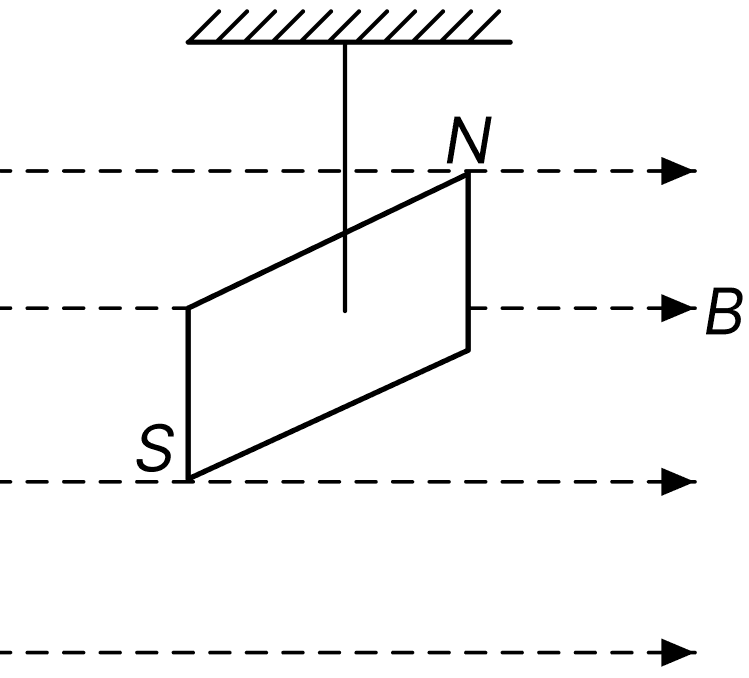
In a uniform magnetic field of 0.049 T, a magnetic needle performs 20 complete oscillations in 5 seconds as shown. The moment of inertia of the needle is 9.8 × 10⁻⁶ kg m2. If the magnitude of magnetic moment of the needle is x × 10-5 A-m2; then the value of 'x' is :
5π2
128π2
50π2
1280π2
Answer
1280π2
Reason — Time period T=205 = 0.25 s. From T=2πmBI, m=BT24π2I.
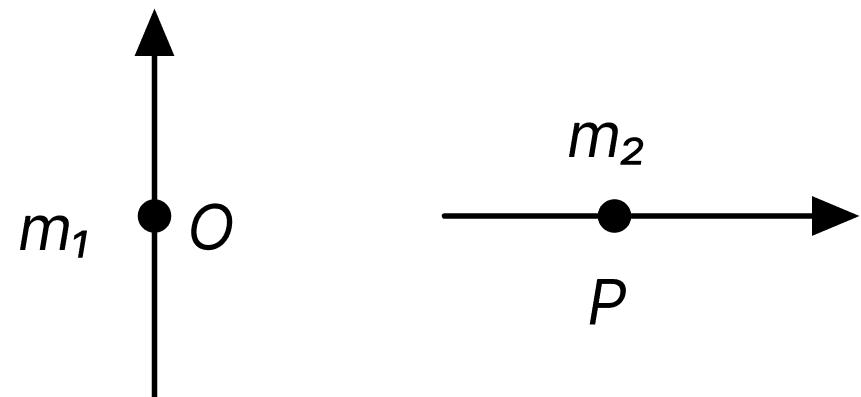
Two short magnetic dipoles m1 and m2 each having magnetic moment of 1 A-m2 are placed at point O and P respectively. The distance between OP is 1 metre. The torque experienced by the magnetic dipole m2 due to the presence of m1 is ............... × 10-7 Nm.
Answer
Given,
m1 = m2 = 1 A m2
OP = r = 1 m
From the figure, m1 at O points perpendicular to OP, and m2 at P points along OP. So P lies on the equatorial (broad-side-on) line of m1, where the field of m1 is B1=4πμ0r3m1, directed opposite to m1.
B1=10−7×131B1=1×10⁻⁷T
B1 is perpendicular to m2, so the torque on m2 is τ = m2B1 sin 90°.
τ=1×1×10−7×1τ=1×10⁻⁷Nm
Hence, the torque is 1 × 10⁻⁷ Nm, so the required value is 1.
Question 2
In a uniform magnetic field, the magnetic needle has a magnetic moment 9.85 × 10⁻² A/m2 and moment of inertia 5 × 10⁻⁶ kg m2. If it performs 10 complete oscillations in 5 seconds then the magnitude of the magnetic field is ............... mT. [Take π2 as 9.85]
Answer
Given,
Magnetic moment, M = 9.85 × 10⁻² A m2
Moment of inertia, I = 5 × 10⁻⁶ kg m2
Time period, T=105 = 0.5 s
π2 = 9.85
For a magnetic needle oscillating in a uniform field, T=2πMBI, so B=MT24π2I.
Hence, the magnitude of the magnetic field is 8 mT.
Note: The unit of magnetic moment printed in the question as A/m2 should read A m2.
Question 3
A compass needle oscillates 20 times per minute at a place where the dip is 30° and 30 times per minute where the dip is 60°. The ratio of total magnetic field due to the earth at two places respectively is x4. The value of x is ............... .
Answer
Given,
f1 = 20 oscillations per minute, θ1 = 30°
f2 = 30 oscillations per minute, θ2 = 60°
The compass needle oscillates in the horizontal plane under BH = B cos θ, so T=2πmBcosθI and f2 ∝ B cos θ.
The magnetic potential due to a magnetic dipole at a point on its axis situated at a distance of 20 cm from its centre is 1.5 × 10⁻⁵ Tm. The magnetic moment of the dipole is ............... A-m2. (Given : 4πμ0 = 10-7 TmA-1)
Answer
Given,
Magnetic potential, V = 1.5 × 10⁻⁵ T m
Distance from centre, r = 20 cm = 0.2 m
4πμ0 = 10-7 T m A-1
The magnetic potential at an axial point of a short magnetic dipole is V=4πμ0r2M, so M=(4πμ0)Vr2.
M=10−71.5×10−5×(0.2)2=10−76×10−7M=6Am2
Hence, the magnetic moment of the dipole is 6 A m2.