
The horizontal component of the earth's magnetic field at a place is times its vertical component there. Find the value of the angle of dip at that place. What is the ratio of the horizontal component to the total magnetic field of the earth at that place?
Answer
Given,
- BH = BV
If θ is the angle of dip, then .
The horizontal component is related to the total field BE by BH = BE cos θ.
Hence, the angle of dip is 30° and the ratio of the horizontal component to the total magnetic field is : 2.
Find expression for magnetic dipole moment of electron orbiting around the nucleus.
Answer
Let an electron of mass me and charge −e revolve with speed v in a circular orbit of radius r about the nucleus. The revolving electron is a minute current-loop and so behaves like a magnetic dipole.
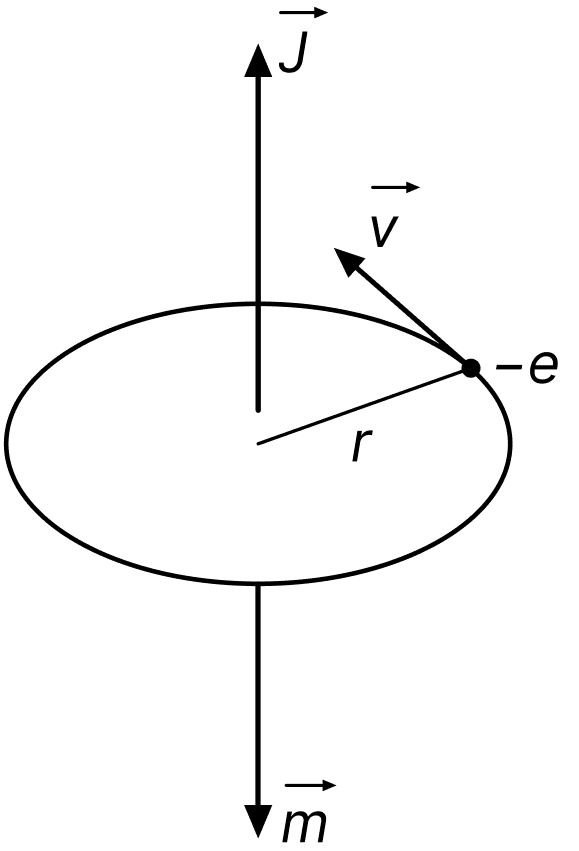
Current due to the electron : The period of revolution is , so the current is
Magnetic dipole moment : The area of the orbit is A = πr2. Hence
Relation with angular momentum : The orbital angular momentum of the electron is
Dividing (ii) by (iii),
The ratio is the gyromagnetic ratio of the electron. Since the electron is negatively charged, the current is opposite to its motion, so is directed opposite to :
In the hydrogen atom, , so . For n = 1, m = 9.27 × 10⁻²⁴ A m2 (the Bohr magneton).
Hence, the magnetic dipole moment of the orbiting electron is , directed opposite to its orbital angular momentum.
A magnetic needle free to rotate in a vertical plane parallel to the magnetic meridian has its North tip down at 60° with the horizontal. The horizontal component of the earth's magnetic field at the place is known to be 0.4 G. Determine the magnitude of the earth's magnetic field and the place.
Answer
Given,
- Angle of dip, θ = 60°
- BH = 0.4 G
Since the needle rotates in the magnetic meridian, the angle its north tip makes with the horizontal is the angle of dip. The horizontal component is BH = BE cos θ.
Hence, the magnitude of the earth's magnetic field at the place is 0.8 G (= 0.8 × 10⁻⁴ T).
State the SI unit of the magnetic moment of a magnet, indicating its direction.
Answer
The SI unit of magnetic moment is ampere-metre2 (A m2), which is the same as joule per tesla (J T-1).
Magnetic moment is a vector. Its direction is along the magnetic axis of the magnet, from the south pole to the north pole.
Derive an expression for the magnetic field at a point on the axis located at a distance x from the centre of a magnetic dipole of length 2l and magnetic moment M.
Answer
Consider a magnetic dipole NS of magnetic length 2l and pole strength qm, so that its magnetic moment is M = qm × 2l. Let P be a point on its axis at a distance x from the centre O, on the side of the north pole.
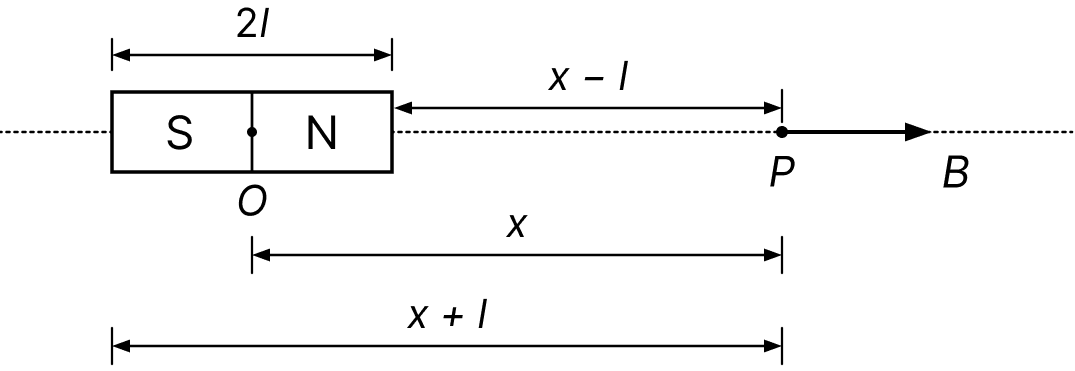
Distance of P from N = (x − l), and from S = (x + l).
Field due to the north pole : directed away from N, along NP,
Field due to the south pole : directed towards S, along PS,
Since BN > BS, the resultant field at P is along NP, i.e., in the direction S → N:
For a short dipole (l << x), l2 may be neglected in comparison with x2:
Hence, the magnetic field at an axial point is , directed along the axis from the south pole to the north pole.
A helium nucleus completes one round of a circle of radius 0.8 m in 2s. Find magnetic field at the centre of circle.
Answer
Given,
- Charge on helium nucleus, q = 2e = 3.2 × 10⁻¹⁹ C
- Radius of the circle, r = 0.8 m
- Time for one revolution, T = 2 s
The revolving nucleus is equivalent to a circular current-loop carrying current .
The magnetic field at the centre of a circular loop is .
Hence, the magnetic field at the centre of the circle is 1.256 × 10⁻²⁵ T.
What is the angle of dip at a place where the horizontal and vertical components of the earth's magnetic field are equal?
Answer
45°.
Explanation:
The angle of dip θ is given by . When BV = BH, tan θ = 1, so θ = 45°.
The horizontal component of the earth's magnetic field at a place is B and angle of dip is 60°. What is the value of vertical component of the earth's magnetic field at that place?
Answer
B.
Explanation:
From , with BH = B and θ = 60°,
State the SI unit of magnetic dipole moment.
Answer
Ampere-metre2 (A m2), or equivalently joule per tesla (J T-1).
What is the angle of dip at a place where the horizontal component (BH) and vertical component (BV) of earth's magnetic field are equal:
- 130°
- 60°
- 45°
- 90°
Answer
45°
Reason — The angle of dip θ satisfies . With BV = BH, tan θ = 1, so θ = 45°.
Define angle of dip.
Answer
The angle of dip at a place is the angle which the direction of the earth's magnetic field makes with the horizontal, in the magnetic meridian at that place.