
A small magnetic needle of magnetic moment 4.8 × 10⁻² J T-1 is placed at 30° with a uniform external magnetic field of magnitude 3.0 × 10⁻² T. What is the magnitude and direction of the torque acting on the needle?
Answer
Given,
Magnetic moment of the needle, m = 4.8 × 10⁻² J T-1
Magnetic field, B = 3.0 × 10⁻² T
Angle between and , θ = 30°
The magnitude of the torque acting on a magnetic dipole placed in a uniform magnetic field is
Substituting the given values,
In vector form , so the torque acts perpendicular to the plane containing and . It tends to rotate the needle so as to bring its magnetic moment along .
Hence, the torque on the needle is 7.2 × 10⁻⁴ J, directed perpendicular to the plane of and such that it tends to bring the needle along .
A short bar-magnet of magnetic moment 0.9 J T-1 placed with its axis at 45° with a uniform external magnetic field experiences a torque of magnitude 0.063 J. Find the strength of the magnetic field. What orientation of the bar-magnet corresponds to the stable equilibrium in the magnetic field?
Answer
Given,
Magnetic moment, m = 0.9 J T-1
Angle between the axis and the field, θ = 45°
Torque, τ = 0.063 J
Strength of the magnetic field :
The torque acting on the magnet is
so that
Orientation for stable equilibrium :
The potential energy of the magnet is U = −mB cos θ. It is minimum (U = −mB) at θ = 0°, where the torque mB sin θ is also zero. Hence the magnet is in stable equilibrium when its magnetic moment is parallel to .
Hence, the strength of the magnetic field is 0.099 T, and the orientation of zero torque with the magnet parallel to the field (θ = 0°) corresponds to stable equilibrium.
A bar-magnet placed in a uniform magnetic field of 0.3 T, with its axis at 30° to the field, experiences a torque of 0.06 N m. Find the magnetic moment of the bar-magnet.
Answer
Given,
Magnetic field, B = 0.3 T
Angle between the axis and the field, θ = 30°
Torque, τ = 0.06 N m
The torque acting on a bar-magnet in a uniform magnetic field is
Therefore,
Hence, the magnetic moment of the bar-magnet is 0.4 A m2.
A short bar-magnet of magnetic moment = 0.32 J T-1 is free to rotate in the plane of a uniform external magnetic field of 0.15 T. What orientations of the magnet would correspond to its (i) stable and (ii) unstable equilibrium? What is the potential energy of the magnet in the magnetic field in each case?
Answer
Given,
Magnetic moment, m = 0.32 J T-1
Magnetic field, B = 0.15 T
The potential energy of a magnet whose moment makes an angle θ with is
In both the orientations below the torque mB sin θ is zero, so the magnet is in equilibrium.
(i) Stable equilibrium :
The potential energy is minimum when is parallel to (θ = 0°). This is the stable equilibrium.
(ii) Unstable equilibrium :
The potential energy is maximum when is anti-parallel to (θ = 180°). This is the unstable equilibrium.
Hence, (i) for parallel to (stable equilibrium) U = −mB = −0.048 J, and (ii) for anti-parallel to (unstable equilibrium) U = +mB = +0.048 J.
A bar-magnet of magnetic moment 1.5 A m2, when suspended perpendicular to a magnetic field, is acted upon by a couple of 0.24 N-m.
(a) What is the magnitude of the magnetic field?
(b) What will be the change in the potential energy of the magnet in coming from this position to the position of steady equilibrium?
(c) If this magnet is equivalent to a current-carrying coil of 100 turns having a surface area of 150 cm2, then what will be the current in the coil?
Answer
Given,
Magnetic moment, m = 1.5 A m2
Magnet perpendicular to the field, θ = 90°
Couple (torque), τ = 0.24 N-m
Number of turns of the coil, N = 100
Area of the coil, A = 150 cm2 = 150 × 10-4 m2
(a) Magnitude of the magnetic field :
The torque on the magnet is τ = mB sin θ. With θ = 90°,
so that
(b) Change in the potential energy :
The potential energy of the magnet is U = −mB cos θ. In the given position θ = 90°, and in the position of steady (stable) equilibrium θ = 0°.
Therefore, the change in the potential energy is
The negative sign shows that the potential energy decreases.
(c) Current in the equivalent coil :
The magnetic moment of a current-carrying coil of N turns and area A is m = NIA. Therefore,
Hence, (a) the magnetic field is 0.16 T, (b) the potential energy decreases by 0.24 J, and (c) the current in the coil is 1.0 A.
The magnetic moment of a short bar-magnet is 4.0 Am2. Find the magnetic field at 5.0 cm from the centre of the magnet on its axis. If the magnetic field at a point situated on the equatorial line of this magnet be 0.05 T, then what is the distance of that point from the magnet?
Answer
Given,
Magnetic moment, m = 4.0 A m2
Distance of the axial point, r1 = 5.0 cm = 0.05 m
Field at the equatorial point, B2 = 0.05 T
= 10-7 N A-2
Field on the axis :
For a short bar-magnet, the magnetic field at an axial (end-on) point distant r from its centre is
Substituting the values,
Distance of the equatorial point :
At an equatorial (broad-side-on) point distant r from the centre,
Therefore,
Hence, the magnetic field on the axis is 6.4 × 10⁻³ T, and the point on the equatorial line is 2.0 cm from the centre of the magnet.
Two small magnets are placed along a straight line at a distance of 20 cm from each other and their north poles are facing each other. If their magnetic moments be 0.20 and 0.40 J T-1, then find the magnetic field at the middle-point between them.
Answer
Given,
Magnetic moments, m1 = 0.20 J T-1 and m2 = 0.40 J T-1
Distance between the magnets = 20 cm
Distance of the middle-point from each magnet, r = 10 cm = 0.10 m
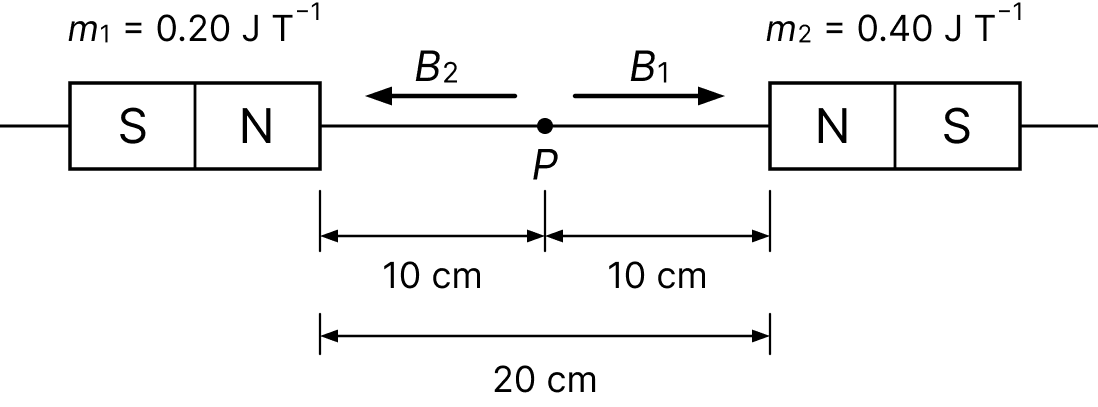
The two magnets lie along the same straight line, so the middle-point P lies on the axis of each magnet. For a short magnet, the field at an axial point is
and it is directed along the axis from the south pole to the north pole, that is, away from the north pole on the side of the north pole.
Field due to each magnet :
Resultant field :
As the north poles face each other, B1 at P points away from the first magnet (towards the second) and B2 points away from the second magnet (towards the first). The two fields are opposite, so
Hence, the magnetic field at the middle-point is 4.0 × 10⁻⁵ T, directed along the line towards the magnet of moment 0.20 J T-1.
Two mutually perpendicular lines are drawn on a table. Two small magnets, whose magnetic moments are 0.108 and 0.192 J T-1, are placed on these lines. If the distance of the point of intersection of these lines be respectively 30 and 40 cm from these magnets, then find the resultant magnetic field at the point of intersection.
Answer
Given,
Magnetic moments, m1 = 0.108 J T-1 and m2 = 0.192 J T-1
Distances of the point of intersection O, r1 = 30 cm = 0.30 m and r2 = 40 cm = 0.40 m
Each magnet lies with its axis along its own line, so the point of intersection O is an axial (end-on) point of both the magnets.
For a short magnet, the field at an axial point is
Field due to each magnet :
Resultant field :
B1 is along the first line and B2 along the second, so the two fields are mutually perpendicular. The resultant field is
The question does not state which way the poles of the magnets point, so only the magnitude of the resultant field is fixed; its direction depends on the orientations of the two magnets.
Hence, the resultant magnetic field at the point of intersection is 1.0 × 10⁻⁶ T.
The horizontal component of earth's magnetic field at a place is times the vertical component. What is angle of dip at that place?
Answer
Given,
- Horizontal component, BH = BV
If θ is the angle of dip, then
Substituting BH = BV,
Hence, the angle of dip at that place is 30°.
If the ratio of the horizontal component of earth's magnetic field to the resultant magnetic field at a place is , what is the angle of dip at that place?
Answer
Given,
If θ is the angle of dip, the horizontal component of earth's magnetic field is
Therefore,
Hence, the angle of dip at that place is 45°.
A magnetic needle free to rotate in a vertical plane parallel to the magnetic meridian has its north tip pointing down at 60° with the horizontal. The horizontal component of earth's magnetic field is 0.3 × 10⁻⁴ Wb/m2. Find the vertical component and total magnetic field of earth.
Answer
Given,
Angle of dip, θ = 60°
Horizontal component, BH = 0.3 × 10⁻⁴ Wb/m2
The needle rotates in the magnetic meridian, so the angle its axis makes with the horizontal is the angle of dip.
Vertical component :
Therefore,
Total magnetic field :
Therefore,
Hence, the vertical component of earth's magnetic field is 0.52 × 10⁻⁴ Wb/m2 and the total magnetic field is 0.60 × 10⁻⁴ Wb/m2.
A magnetic needle free to rotate about the vertical direction (compass) points 3.5° west of the geographic north. Another magnetic needle free to rotate in a vertical plane parallel to the magnetic meridian (dip needle) has its north tip pointing down at 18° with the horizontal. The horizontal component of earth's magnetic field at the place is 0.40 G. Find the magnitude and direction of the earth's magnetic field at the place. (tan 18° = 0.325)
Answer
Given,
Angle of declination, α = 3.5° (west of geographic north)
Angle of dip, θ = 18°
Horizontal component, BH = 0.40 G
tan 18° = 0.325
The compass sets itself in the magnetic meridian, so the magnetic meridian is 3.5° west of the geographic meridian. The dip needle, rotating in the magnetic meridian, gives the angle of dip θ = 18°.
Vertical component :
Therefore,
Magnitude of :
Direction of : lies in the magnetic meridian, and since the north tip of the dip needle points down, it is inclined downward at the angle of dip.
Hence, the earth's magnetic field at the place is 0.42 G. It acts in the magnetic meridian, which is 3.5° west of the geographic meridian, and points 18° below the horizontal.
A short bar-magnet is placed with its north pole pointing north. The neutral point is 10 cm away from the centre of the magnet. If BH = 0.4 G, calculate the magnetic moment of the magnet.
Answer
Given,
Distance of the neutral point from the centre, r = 10 cm = 0.10 m
BH = 0.4 G = 0.4 × 10⁻⁴ T
At a neutral point, the magnetic field due to the magnet is exactly neutralised by the horizontal component of earth's magnetic field.
With the north pole pointing north, the field of the magnet on its axis is directed towards the north, along BH, so no neutral point can lie there. On the equatorial line, the field of the magnet is directed from N to S, that is, towards the south, opposite to BH. Hence the neutral point lies on the equatorial line, where
Therefore,
Hence, the magnetic moment of the magnet is 0.4 A m2.
The magnetic moment of a small magnet is 4.8 A m2. It is kept in earth's magnetic field in magnetic meridian with its north pole pointing towards geographical south. The neutral points are situated at a distance of 30 cm from the centre of the magnet. Calculate the horizontal component of the earth's magnetic field.
Answer
Given,
Magnetic moment, m = 4.8 A m2
Distance of the neutral points from the centre, r = 30 cm = 0.30 m
With the north pole pointing towards geographical south, the field of the magnet on its axis is directed from S to N of the magnet, that is, towards the south. This is opposite to BH, which points towards the north. Hence the neutral points lie on the axis of the magnet, where
Substituting the values,
Hence, the horizontal component of the earth's magnetic field is 3.56 × 10⁻⁵ T, that is, about 0.36 G.
Note: The textbook prints 0.35 G. The computed value 0.356 G rounds to 0.36 G; the printed figure is truncated.
A small bar-magnet is placed in a horizontal plane with its axis in the magnetic meridian. Neutral points are obtained on its equatorial line at 12.5 cm from the centre of the magnet. The earth's magnetic field at the place is 0.38 G and the angle of dip is zero.
(a) Find the total magnetic field on the axis of the magnet at 12.5 cm from the centre of the magnet.
(b) Locate the neutral points when the magnet is turned around by 180°.
Answer
Given,
Distance of the neutral points from the centre, r = 12.5 cm
Earth's magnetic field, BE = 0.38 G
Angle of dip, θ = 0°
Since the angle of dip is zero,
The neutral points lie on the equatorial line, where the field of the magnet (directed from N to S) is opposite to BH. So the north pole of the magnet points towards the north, and at the neutral points
(a) Total field on the axis at 12.5 cm :
At an axial point at the same distance r, the field of the magnet is
This field is directed from S to N of the magnet, that is, towards the north, along BH. Therefore, the total field is
(b) Neutral points when the magnet is turned by 180° :
On turning the magnet through 180°, its north pole points towards the south. Now the field of the magnet on its axis is directed towards the south, opposite to BH, while on the equatorial line it is along BH. The neutral points therefore shift to the axis. If they are at a distance r' from the centre,
Comparing Eqs. (i) and (ii),
Hence, (a) the total magnetic field on the axis at 12.5 cm is 1.14 G, and (b) the neutral points lie on the axis of the magnet at 15.7 cm from its centre.