
A double convex thin lens made out of glass (refractive index, n = 1.5) has both radii of curvature of magnitude 20 cm. Incident light rays parallel to the axis of the lens will converge at a distance L cm such that :
- L = 10
- L = 20
- L = 40
- L =
Answer
L = 20
Reason — For a double convex lens, R1 = + 20 cm and R2 = − 20 cm. By the lens maker's formula,
Rays parallel to the axis converge at the second focus, so L = 20.
If in a plano-convex lens the radius of curvature of the convex surface is 10 cm and the focal length of the lens is 30 cm, the refractive index of the material of the lens will be :
- 1.5
- 1.66
- 1.33
- 3
Answer
1.33
Reason — For a plano-convex lens one surface is plane, so the lens maker's formula reduces to
A point-source of light is placed at a distance of 2f from a converging lens of focal length f. The intensity of light on the other side of the lens is maximum at a distance :
- f
- between f and 2f
- 2f
- more than 2f
Answer
2f
Reason — With u = − 2f, the lens formula gives
All the rays from the point-source converge at this image point, so the intensity is maximum at a distance 2f.
An object is placed at a distance of 5 cm more than the focal length f of a convex lens. Its real image is formed at a distance 3f beyond the focus. The focal length f of the lens is :
- 5 cm
- 10 cm
- 15 cm
- 20 cm
Answer
15 cm
Reason — Here u = − (f + 5) and v = f + 3f = 4f. From the lens formula ,
A double convex lens of glass (n = 1.5) has a focal length of 10 cm in air. When immersed in a liquid of refractive index 3.0, the lens will behave as :
- converging lens of focal length 10 cm
- diverging lens of focal length 10 cm
- converging lens of focal length 30 cm
- converging lens of focal length cm
Answer
diverging lens of focal length 10 cm
Reason — The refractive index of glass with respect to the liquid is
From the lens maker's formula,
The negative focal length shows that the lens behaves as a diverging lens.
A symmetric double convex lens of power 4 D is cut in two halves by a plane perpendicular to the principal axis. The power of each half is :
- 2 D
- 4 D
- 8 D
- zero
Answer
2 D
Reason — Each half is a plano-convex lens with one curved surface of the same radius R. For the full lens and each half,
so f' = 2f and the power of each half is = 2 D.
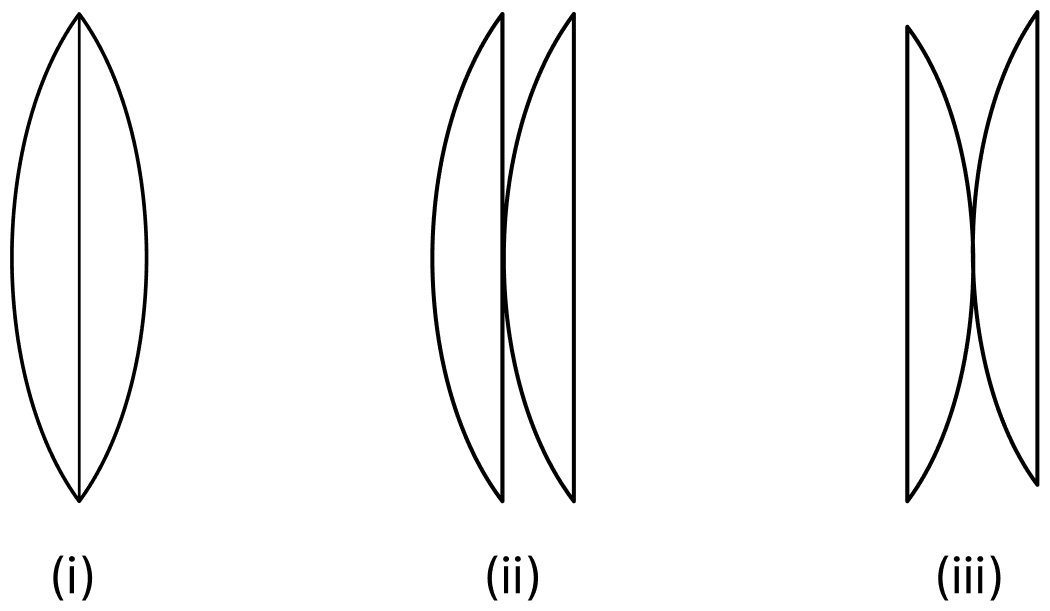
Two identical plano-convex lenses can be combined in three ways, as shown. The ratio of the focal lengths of these combinations will be :
- 2 : 2 : 1
- 1 : 1 : 1
- 1 : 2 : 2
- 2 : 1 : 1
Answer
1 : 1 : 1
Reason — Reversing a lens does not change its focal length, so each plano-convex lens has the same focal length f' in every arrangement. In each case the two thin lenses are in contact (the air between them in (iii) has no focusing effect), so
for all three combinations. Hence the focal lengths are equal.
A lens of power + 2 D is placed in contact with a lens of power - 1 D. The combination will behave like :
- a divergent lens of focal length 50 cm
- a convergent lens of focal length 50 cm
- a divergent lens of focal length 100 cm
- a convergent lens of focal length 100 cm
Answer
a convergent lens of focal length 100 cm
Reason — For lenses in contact,
The positive focal length shows that the combination is convergent.
Two thin lenses are in contact and the focal length of the combination is 80 cm. If the focal length of one lens is 20 cm, then the power of the other lens will be :
- 1.66 D
- 4.00 D
- -1.00 D
- -3.75 D
Answer
-3.75 D
Reason — With f = 0.80 m and f1 = 0.20 m, for thin lenses in contact
A window is provided in the middle of a wall. Its image is obtained on the opposite wall at a distance 'd' from it using a lens. If the window and its image are of the same size, then the focal length of the lens used is :
Answer
Reason — The image is formed on a wall, so it is real and the lens is convex. A real image of the same size is formed when the object is at 2f and the image at 2f on the other side. The distance between the window and its image is then
In the figure shown, a point object O is placed in air. A convex spherical boundary (R = 1 m) separates two mediums. AB is the principal axis. Refractive index above AB is 1.6 and below AB is 2.0.
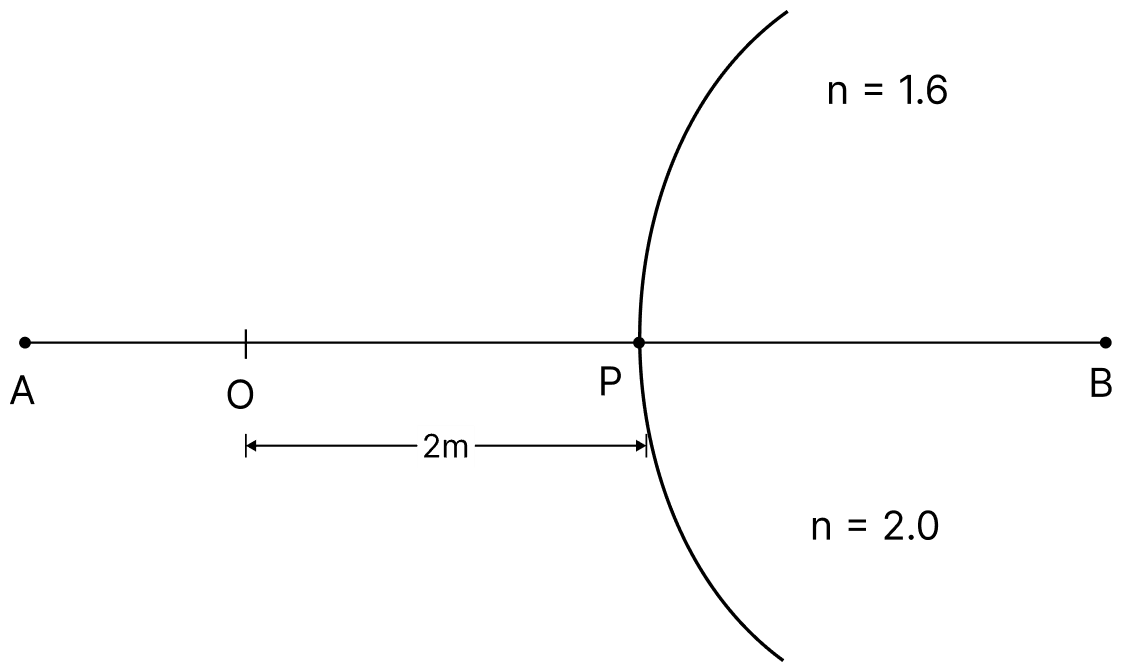
The separation between the images formed due to refraction at the spherical surface is :
- 10 m
- 12 m
- 14 m
- 16 m
Answer
12 m
Reason — Here u = − 2 m, R = + 1 m and n1 = 1. Using for each half of the surface :
Above AB (n2 = 1.6) :
Below AB (n2 = 2.0) :
Separation between the images = 16 − 4 = 12 m.
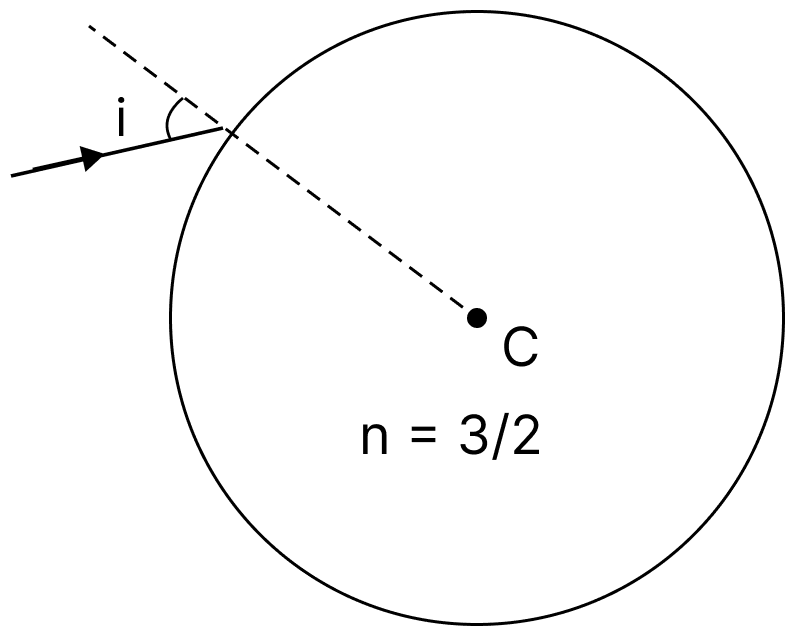
A ray of light is incident on a solid glass sphere of refractive index . Ray will not come out of the sphere, if angle of incidence i is :
- 0°
- 30°
- 60°
- 90°
Answer
90°
Reason — If the ray is refracted into the sphere at angle r, the two radii at the points of entry and exit are equal, so the ray strikes the second surface also at angle r, where sin i = n sin r. Since sin r = can at most equal , r can never exceed the critical angle C (sin C = ). Only for i = 90° does r become equal to C; the ray then meets the second surface at the critical angle and grazes along it without coming out.
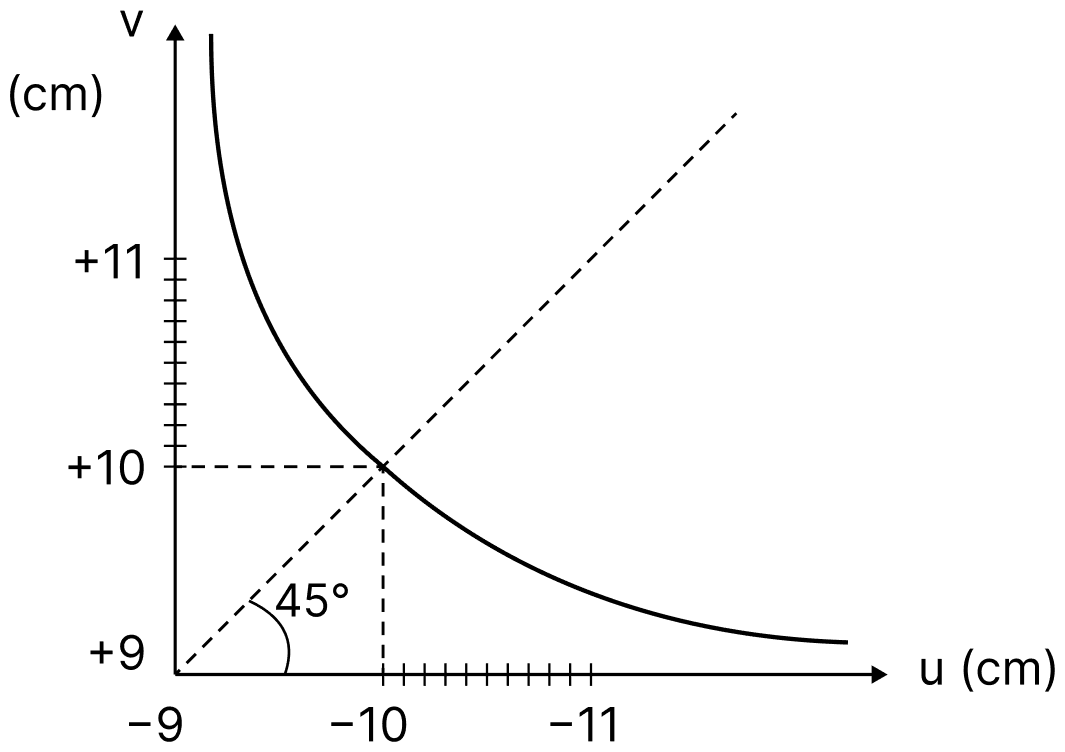
The graph between object distance u and image distance v for a lens is given below. The focal length of the lens in cm is :
- 5 ± 0.1
- 5 ± 0.05
- 0.5 ± 0.1
- 0.5 ± 0.05
Answer
5 ± 0.05
Reason — The 45° line v = − u cuts the curve at u = − 10 cm, v = + 10 cm. From the lens formula,
Each unit on both axes is divided into 10 parts, so Δu = Δv = 0.1 cm. Differentiating the lens formula,
For the maximum error the magnitudes add :
Hence f = (5 ± 0.05) cm.
A point object is placed at a distance of 20 cm from a thin plano-convex lens of focal length 15 cm. The plane surface of the lens is now silvered. The image created by the system is at :
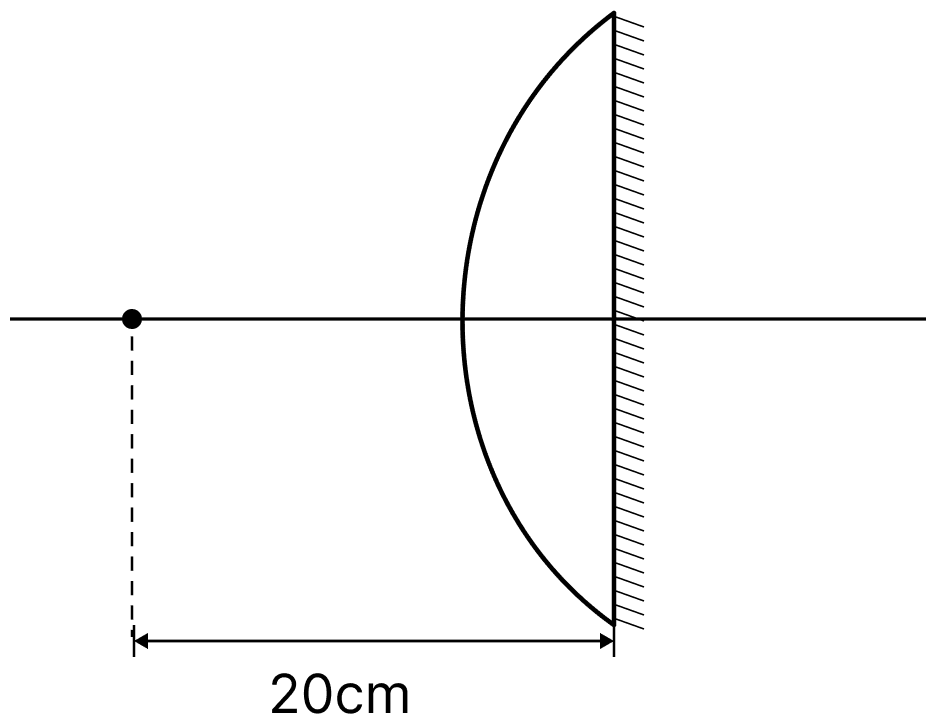
- 60 cm to the left of the system
- 60 cm to the right of the system
- 12 cm to the left of the system
- 12 cm to the right of the system
Answer
12 cm to the left of the system
Reason — On silvering, the lens behaves as a mirror with . For the plane silvered face fm = ∞, so fnet = = 7.5 cm, and the system acts as a concave mirror of focal length − 7.5 cm.
With u = − 20 cm, the mirror formula gives
The image is 12 cm to the left of the system.
The focal length of a thin biconvex lens is 20 cm. When an object is moved from a distance of 25 cm in front of it to 50 cm, the magnification of its image changes from m25 to m50. The ratio is :
- 6
- 4
- 2
- 0.5
Answer
6
Reason — Using m = with f = 20 cm,
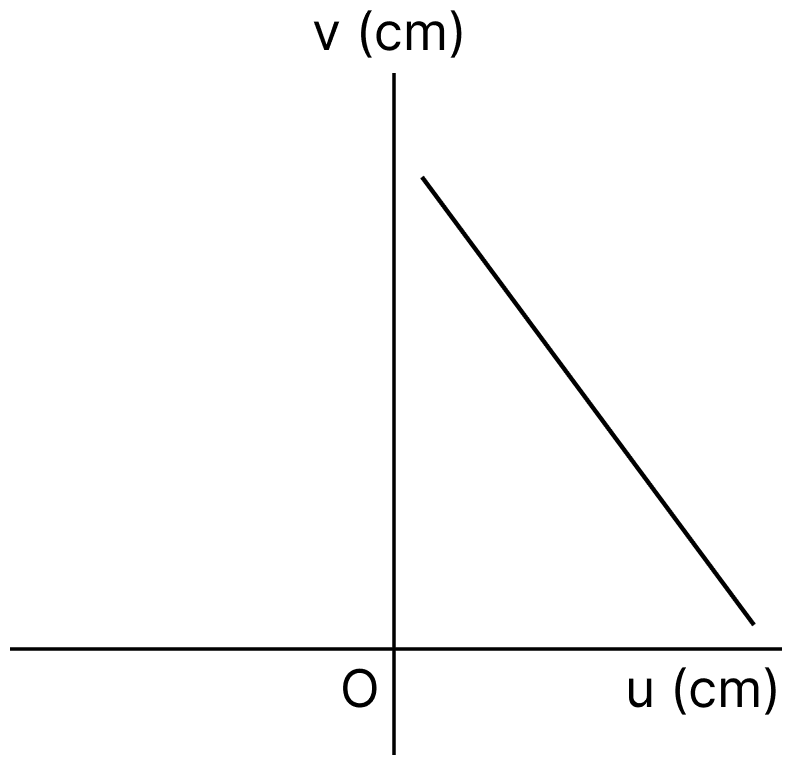
A student measures the focal length of a convex lens by putting an object pin at a distance u from the lens and measuring the distance v of the image pin. The graph between u and v plotted by the student should look like :
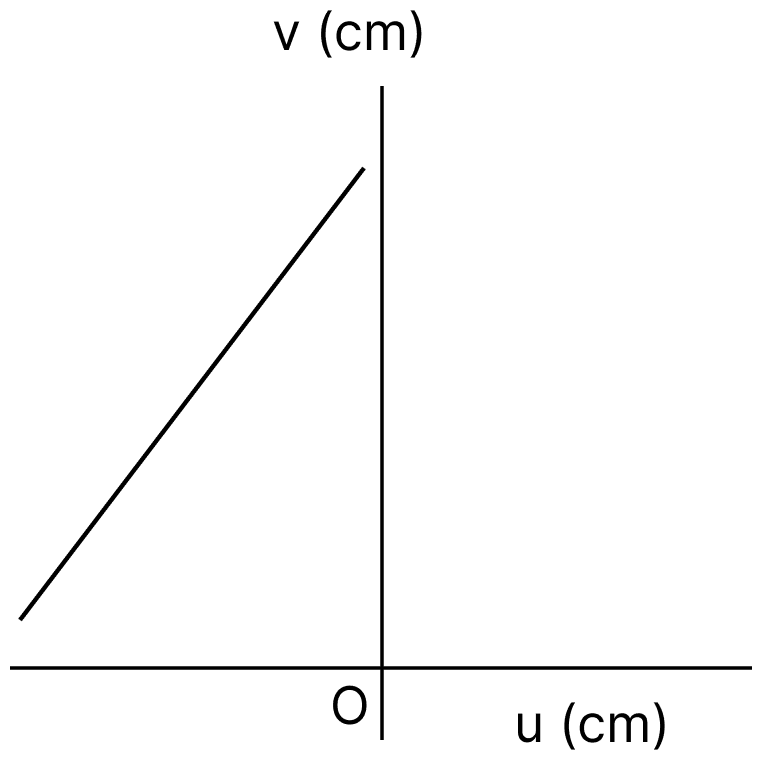
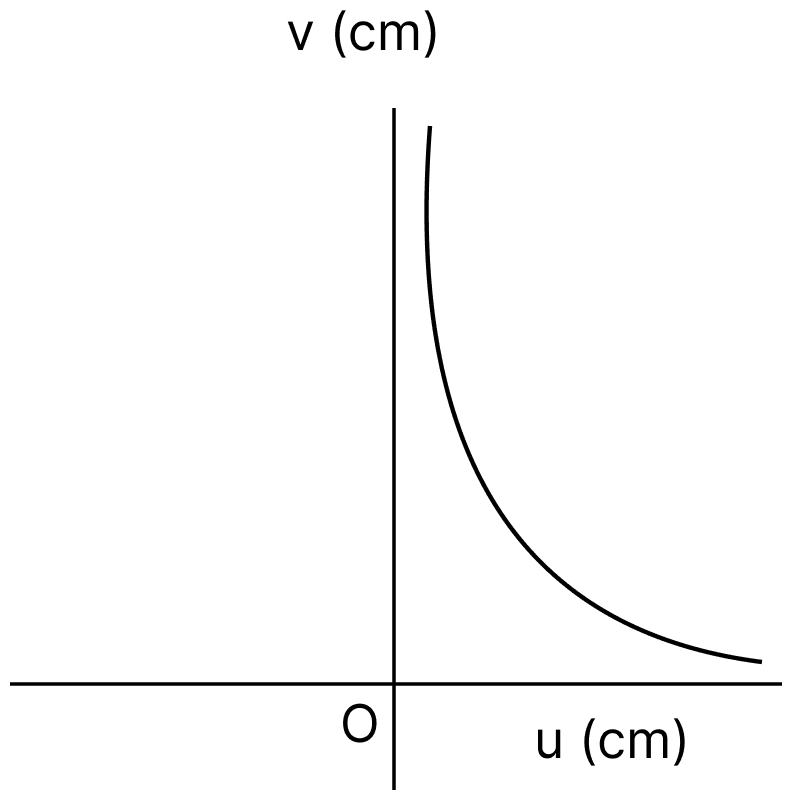
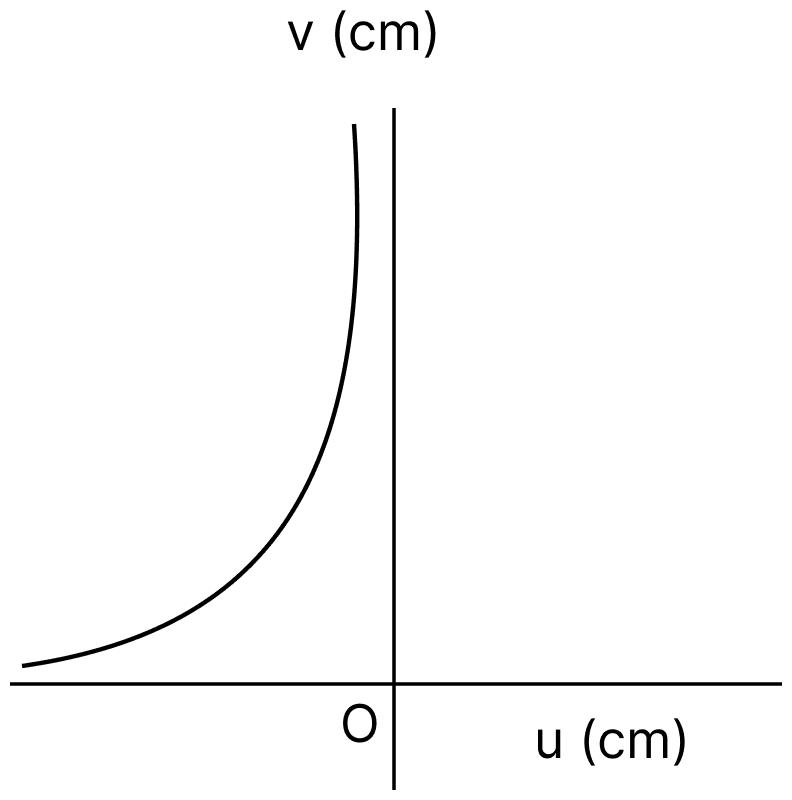
Answer
Reason — For real images formed by a convex lens, u is negative and v is positive, so the graph lies in the second quadrant. From , v → ∞ as u → − f and v → f as u → − ∞. The graph is therefore a hyperbola with asymptotes u = − f and v = + f, which is the graph shown in option 3.
Two identical glass rods S1 and S2 (refractive index = 1.5) have one convex end of radius of curvature 10 cm.

They are placed with the curved surfaces at a distance d as shown in the figure, with their axes (shown by the dashed line) aligned. When a point source of light P is placed inside rod S1 on its axis at a distance of 50 cm from the curved face, the light rays emanating from it are found to be parallel to the axis inside S2. The distance d is :
- 60 cm
- 70 cm
- 80 cm
- 90 cm
Answer
70 cm
Reason — At the curved face of S1 (glass to air, n1 = 1.5, n2 = 1, u = − 50 cm, R = − 10 cm) :
At the curved face of S2 (air to glass, R = + 10 cm) : the rays are parallel inside S2, so v' = ∞ and this image must lie at the first focus of the surface :
Hence d = 50 + 20 = 70 cm.
Two identical thin plano-convex lenses (refractive index = 1.5) each having radius of curvature of 20 cm are placed with their convex surfaces in contact at the centre. The intervening space is filled with oil of refractive index 1.7. The focal length of the combination is :
- -25 cm
- -50 cm
- 50 cm
- -20 cm
Answer
-50 cm
Reason — Each glass plano-convex lens :
The oil forms a double concave lens (R1 = − 20 cm, R2 = + 20 cm) :
For the three lenses in contact,
Formation of real image using a biconvex lens is shown in the figure :
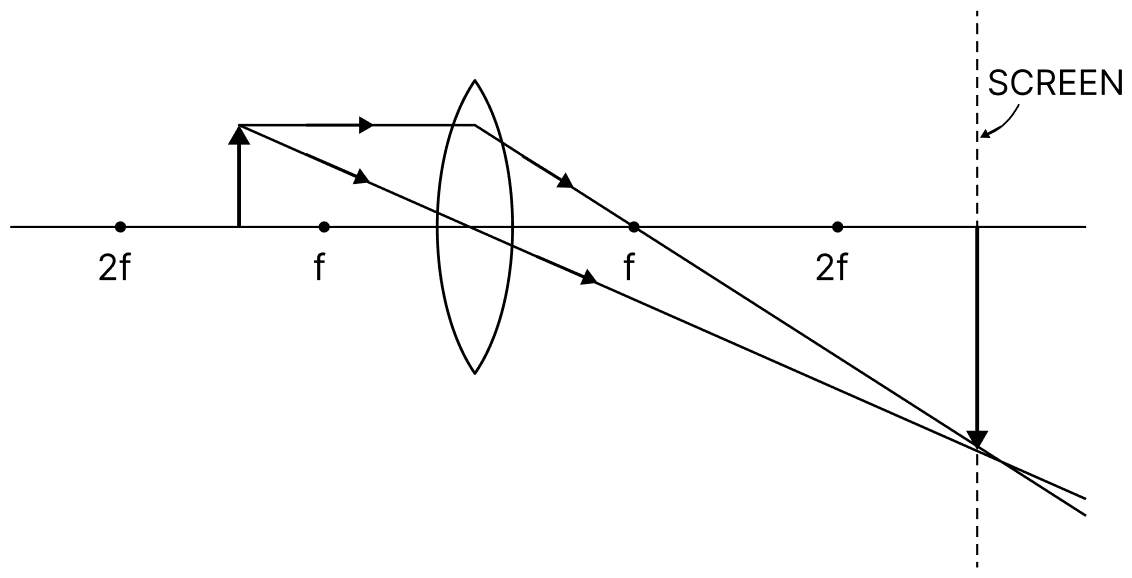
If the whole set-up is immersed in water without disturbing the object and the screen position, what will one observe on the screen?
- Image disappears
- No change
- Erect real image
- Magnified image
Answer
Image disappears
Reason — In water the refractive index of glass relative to the surrounding medium decreases ( = ≈ 1.13), so the focal length of the lens increases to nearly four times its value in air. The object, which lay between f and 2f, now lies within the new focal length, so the lens forms only a virtual image and no image is obtained on the screen.
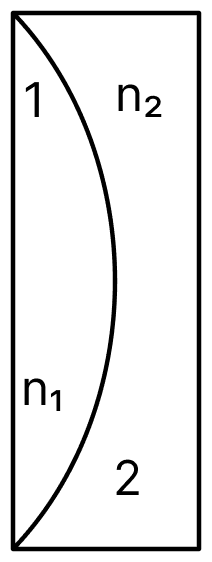
One plano-convex and one plano-concave lens of same radius of curvature 'R' but of different materials are joined side-by-side as shown in the figure. If the refractive index of the material of 1 is n1 and that of 2 is n2, then the focal length of the combination is :
Answer
Reason — For the plano-convex part 1 and the plano-concave part 2 of the same radius R,
For the two lenses in contact,
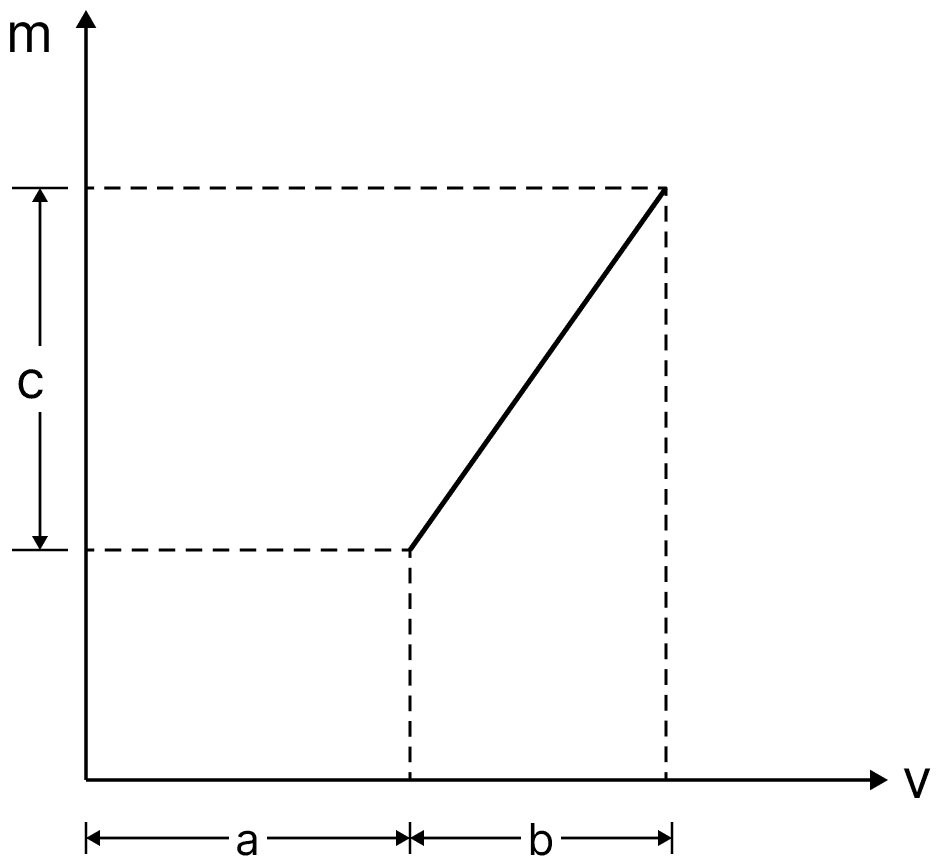
The graph shows how the magnification m produced by a thin lens varies with image distance v. What is the focal length of the lens used?
Answer
Reason — For a real, inverted image, m = is negative, while the graph shows positive values that increase with v. The graph therefore plots the magnitude of m :
Thus |m| varies linearly with v with slope . From the graph the slope is , so
A point object is placed at a distance of 60 cm from a convex lens of focal length 30 cm. If a plane mirror was put perpendicular to the principal axis of the lens and at a distance of 40 cm from it, the final image would be formed at a distance of :
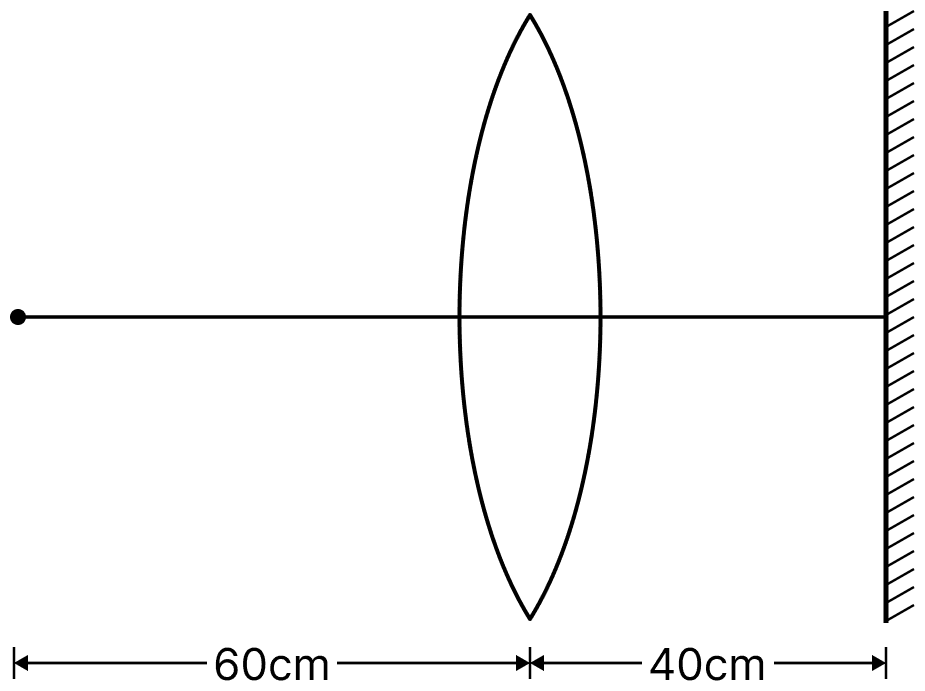
- 20 cm from the plane mirror, it would be a virtual image
- 20 cm from the lens, it would be a real image
- 30 cm from the lens, it would be a real image
- 30 cm from the plane mirror, it would be a virtual image
Answer
20 cm from the plane mirror, it would be a virtual image
Reason — Refraction by the lens (u = − 60 cm, f = + 30 cm) :
This point is 20 cm behind the mirror and acts as a virtual object for it. The plane mirror forms a real image 20 cm in front of it, that is, 20 cm from the lens.
Second refraction by the lens : the reflected rays travel back through the lens. Taking their direction as positive, u = − 20 cm and f = + 30 cm :
The final image is 60 cm from the lens on the mirror side, that is, 20 cm behind the plane mirror, and it is virtual.
State one assumption made in deriving the formula for refraction at a spherical interface.
Answer
The aperture of the spherical surface is small, so that the rays make small angles with the principal axis.
Can the optical centre of a lens be situated outside the lens?
Answer
Yes.
Explanation:
In concavo-convex and convexo-concave (meniscus) lenses, the centres of curvature of both surfaces, and hence R1 and R2, lie on the same side of the lens. Hence, from , CP1 and CP2 are also on the same side of C and the optical centre lies outside the lens, nearer the more curved surface.
Write down the lens maker's formula, using standard symbols.
Answer
Explanation:
Here f is the focal length of the lens, n is the refractive index of the material of the lens relative to the surrounding medium, and R1 and R2 are the radii of curvature of its first and second surfaces.
Under what condition is the first focal length of a lens not equal to its second focal length?
Answer
The first and the second focal lengths of a lens are not equal when the media on the two sides of the lens are different.
The image of an object, placed at a distance of 25 cm from a lens, is formed at a distance of 40 cm on the other side of the lens. If the object is placed at a distance of 40 cm from the lens, find the position of the image.
Answer
At 25 cm on the other side of the lens.
Explanation:
In the first case, u = − 25 cm and v = + 40 cm, so
In the second case, u = − 40 cm, so
A convex lens forms a virtual and magnified image of an object. Where is the object? Answer in terms of focal length.
Answer
The object is between the optical centre and the first focus of the lens, that is, at a distance less than the focal length f from the lens.
Where should an object be placed in order to form an image of the same size by a convex lens? Can it happen in case of a concave lens also?
Answer
The object should be placed at a distance 2f from a convex lens. No, this cannot happen with a concave lens, because a concave lens always forms a virtual, erect and diminished image.
In an attempt to get a picture of Zebra, a person pastes black paper leaves on the lens of his camera and takes the photo of a white horse. Will he get the picture of Zebra?
Answer
No.
Explanation:
Every part of the lens forms the complete image of the object. The black paper strips only stop part of the light, so he gets a complete photograph of the white horse with reduced brightness, not a picture of a zebra.
An object is placed at the focus of a concave lens. Where will be the image?
Answer
Midway between the lens and the focus, on the same side as the object.
Explanation:
For a concave lens of focal length − f with the object at its focus, u = − f :
What happens when a convex lens of refractive index 1.2 is immersed in a liquid of refractive index 1.3?
Answer
The convex lens behaves as a concave (diverging) lens.
Explanation:
The refractive index of the lens material relative to the liquid is , which is less than 1. Hence is negative and, from the lens maker's formula, the focal length of the lens in the liquid becomes negative.
Under what condition does a lens become invisible when immersed in a transparent liquid?
Answer
A lens becomes invisible when the refractive index of the material of the lens is equal to the refractive index of the liquid.
Explanation:
Then = 1 and , so the focal length becomes infinite. No refraction takes place at its surfaces and the lens behaves like a plane transparent plate.
Define 'power' of a lens. In what unit is it expressed?
Answer
The power (P) of a thin lens is equal to the reciprocal of its focal length (f) measured in metre, . Its SI unit is dioptre (D); the power of a lens of focal length 1 metre is 1 dioptre.
A candle is burning at a distance on one side of a glass box. A same-size image of the candle is formed on a screen kept at 20 cm on the other side of the box. What optical device is there in the box? What is its power?
Answer
A convex lens of power + 10 D.
Explanation:
A real image of the same size is formed on a screen only by a convex lens, with the object at 2f and the image at 2f on the other side. Hence
Note: The textbook prints the answer as + 20 D, which is incorrect; a same-size image at 20 cm gives 2f = 20 cm, that is, f = 10 cm and P = + 10 D.
A glass lens is immersed in water. Will its power increase or decrease?
Answer
The power will decrease.
Explanation:
In water, is less than . Hence (n − 1) decreases, the focal length increases and the power decreases.
Two lenses producing linear magnifications m1 and m2 are joined together to form a lens combination. What is the magnification m of the combination?
Answer
Explanation:
In a combination, each lens magnifies the image formed by the preceding lens, so the magnification of the combination is the product of the individual magnifications.
A virtual image is formed in space and cannot be taken on a screen. Yet when we see it, we bring it on the screen (called retina) of our eye. Is there a contradiction?
Answer
No, there is no contradiction.
Explanation:
The rays forming the virtual image actually enter the eye. The virtual image acts as an object for the convergent eye-lens, which forms a real image of it on the retina.
If you had to construct an optical fibre using the two materials, which would you prefer for the core and the cladding? X : with a refractive index of 1.4905 or Y : of refractive index of 1.337?
Answer
X (refractive index 1.4905) for the core and Y (refractive index 1.337) for the cladding.
Explanation:
Light is guided along an optical fibre by total internal reflection at the core-cladding boundary. Total internal reflection occurs only when light travels from a denser to a rarer medium, so the core must have the greater refractive index.
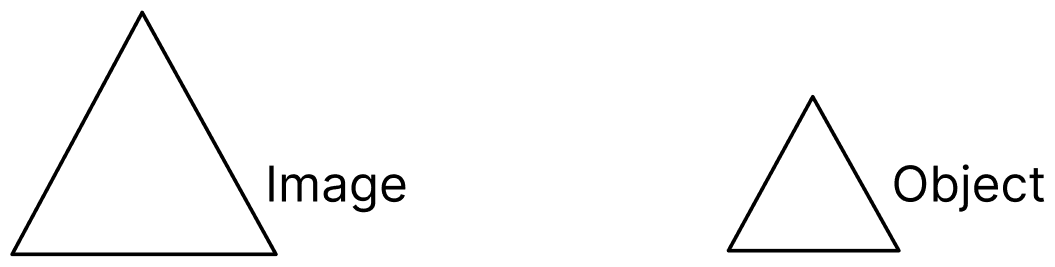
A lens forms the image of an object as shown in the figure. Identify the type of lens.
Answer
Convex lens.
Explanation:
The image is erect, larger than the object and on the same side of the lens as the object, that is, virtual and magnified. Such an image is formed only by a convex lens when the object lies between the optical centre and the focus; a concave lens always forms a diminished image.
Draw ray diagram to illustrate the formation of a real image after refraction of light at an air-glass spherical surface.
Answer
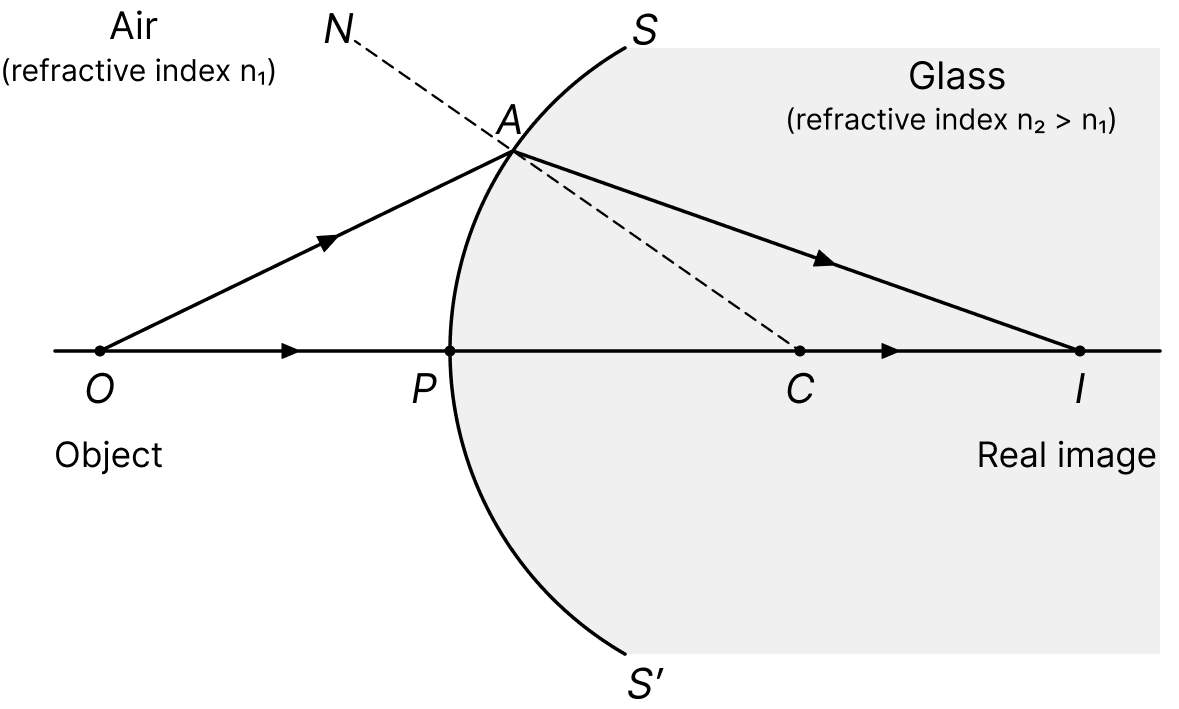
SPS' is a convex spherical surface separating air (refractive index n1) from glass (refractive index n2 > n1). P is the pole and C the centre of curvature of the surface, and O is a point-object on the principal axis in air.
The ray OP travels along the principal axis, falls normally on the surface and goes undeviated. The ray OA is refracted at A into glass, bending towards the normal CAN, and travels along AI. The two refracted rays actually meet at I on the principal axis inside the glass. Hence I is the real image of O.
What is meant by the optical centre of a lens?
Answer
If a ray of light is incident on a lens such that after refraction through the lens the emergent ray is parallel to the incident ray, then the point at which the refracted ray intersects, or appears to intersect, the principal axis is called the optical centre of the lens.
The optical centre C divides the thickness of the lens in the ratio of the radii of curvature of its surfaces, . A ray passing through the optical centre of a thin lens goes straight without any deviation or displacement.
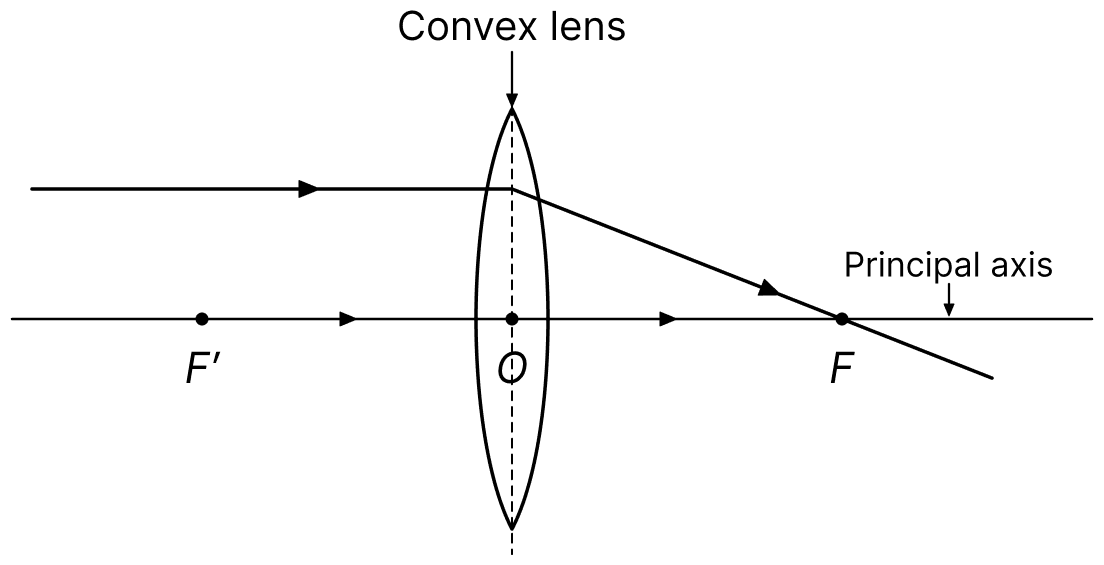
Explain the meaning of the first and the second focus of a convex lens, drawing separate ray-diagrams.
Answer
First focus : The rays starting from a fixed point F' on the principal axis of a convex lens, after refraction through the lens, become parallel to the principal axis. This point F' is called the first focus of the lens, and its distance OF' from the optical centre O is the first focal length f'.
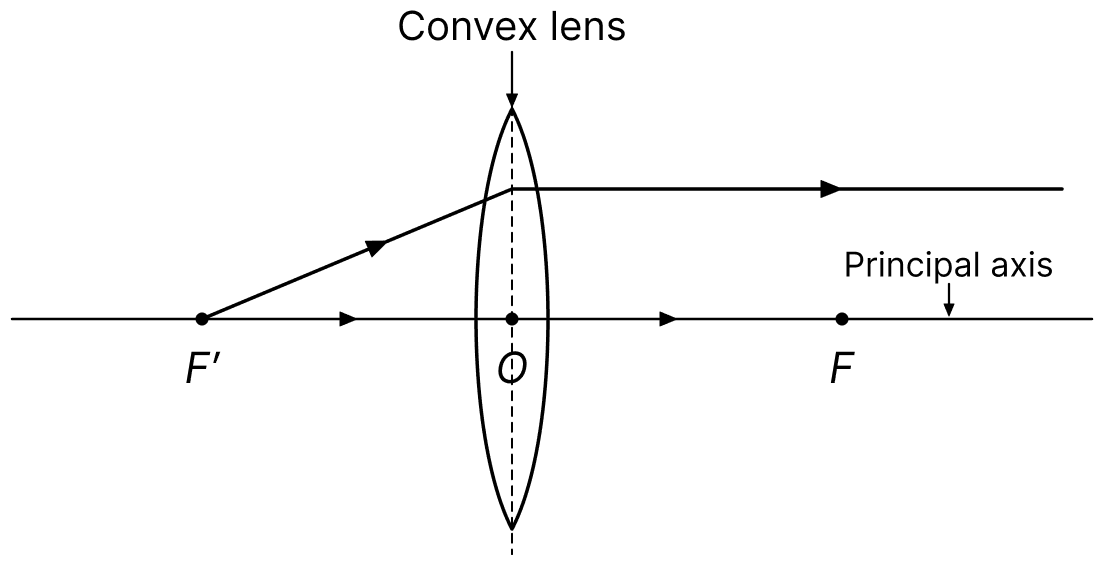
Second focus : The rays travelling parallel to the principal axis, after refraction through a convex lens, converge to a fixed point F on the axis on the other side. This point F is called the second focus (or principal focus) of the lens, and its distance OF from the optical centre O is the second (principal) focal length f.
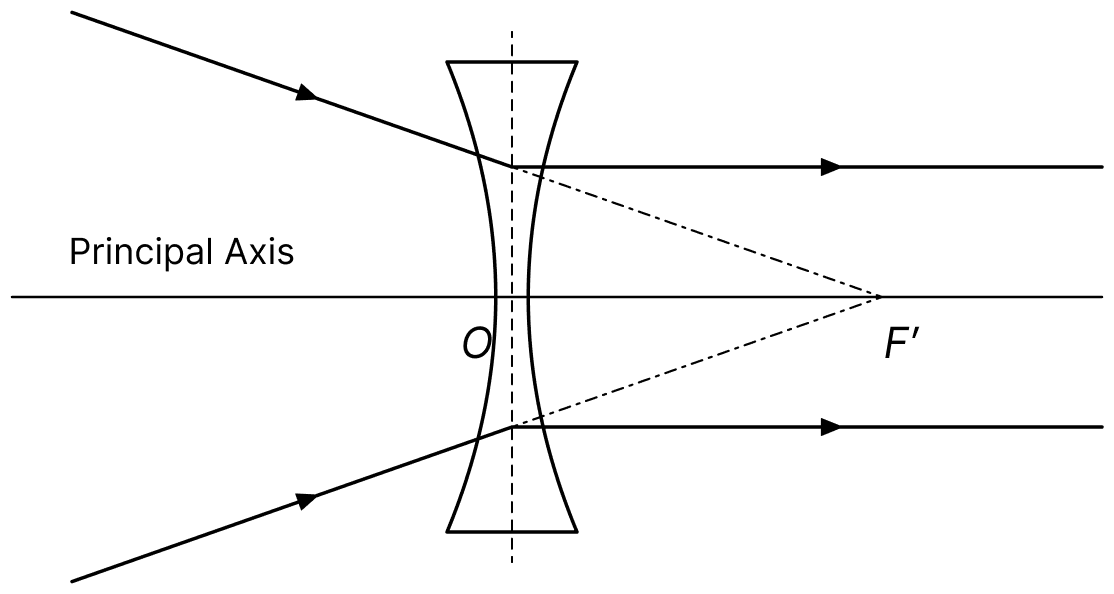
Define the first focus of a concave lens, giving a suitable ray diagram.
Answer
The first focus of a concave lens is the point F' on its principal axis such that the rays appearing to go towards F', after refraction through the lens, become parallel to the principal axis. F' lies on the side of the lens opposite to the incident light.
What is meant by the focal length of a concave lens?
Answer
The rays travelling parallel to the principal axis of a concave lens, after refraction, diverge and appear to come from a point F on the axis, called the second (principal) focus. The distance CF of this focus from the optical centre C of the lens is the focal length of the concave lens. As F lies on the same side as the incident light, the focal length of a concave lens is negative.
On what factors does the focal length of a lens depend?
Answer
From the lens maker's formula, , the focal length of a lens depends on :
(i) the radii of curvature R1 and R2 of its two surfaces,
(ii) the refractive index n of the material of the lens with respect to the medium in which the lens is placed, and
(iii) the wavelength (colour) of the light used, since n depends on the wavelength.
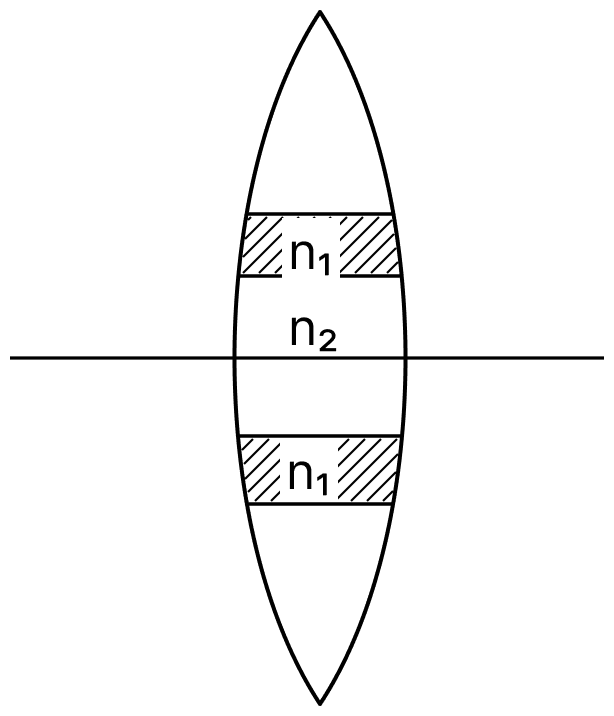
A lens is made of two different materials of refractive indices n1 and n2, as shown. A point-object is placed on the principal axis. How many images of the object will be formed by the lens (neglecting spherical and chromatic aberration)?
Answer
Two images.
Explanation:
The two parts of the lens have the same radii of curvature but different refractive indices n1 and n2. By the lens maker's formula they have two different focal lengths, so the rays passing through the n1 portions and those passing through the n2 portion converge at two different points on the axis. Hence two images are formed; the number of images of an object equals the number of materials.
How does the focal length of a lens depend on the wavelength of incident light?
Answer
As the wavelength of light increases, the refractive index n of the lens material decreases. From , a smaller value of (n − 1) gives a larger focal length. Hence the focal length of a lens increases with the wavelength; it is greater for red light than for violet light.
What are the two focal lengths of a lens? Are they equal?
Answer
A lens has two focal lengths. The first focal length f' is the distance of the first focus F' from the optical centre, and the second (principal) focal length f is the distance of the second focus F from the optical centre.
They are equal in magnitude (f = − f') when the medium on both sides of the lens is the same, such as air. When the media on the two sides of the lens are different, the two focal lengths are not equal.
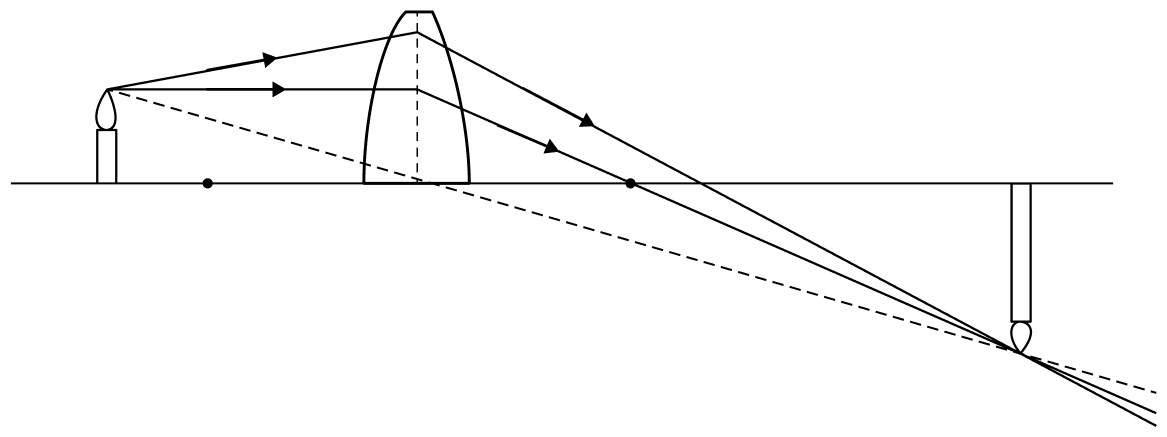
The image of a candle is formed by a convex lens on a screen. If the lower half of the lens is painted black to make it completely opaque, will still the full size of the image be obtained?
Answer
Yes.
Explanation:
The rays from each point of the candle passing through the upper (transparent) half of the lens still converge at the same image point. Hence the full image of the candle is still obtained, but as fewer rays now take part in forming it, its intensity (brightness) is less.
What will be the effect on focal length and nature of a lens when immersed in a liquid whose refractive index is less than that of the material of the lens?
Answer
The nature of the lens remains unchanged, but its focal length increases.
When the refractive index of the liquid is less than that of the lens material, is less than but still greater than 1. From the lens maker's formula,
Thus a converging lens becomes less converging and a diverging lens becomes less diverging.
A concave mirror and a concave lens are held in water. What changes, if any, do you expect in their focal lengths as compared to their values in air?
Answer
The focal length of the concave mirror remains unchanged in water, because depends only on the curvature of the mirror and not on the surrounding medium.
The focal length of the concave lens increases in water. It depends on the refractive index of the lens material relative to the surrounding medium, and is less than , so (n − 1) decreases and f increases.
Can a convex (converging) lens behave as a concave (diverging) lens in some situation? Give example.
Answer
Yes. A convex lens behaves as a concave (diverging) lens when it is placed in a medium whose refractive index is greater than that of the material of the lens.
For example, for a convex lens of glass (n = 1.50) immersed in carbon disulphide (n = 1.63), is less than 1. Hence is negative, the focal length becomes negative and the lens diverges light.
A convex lens forms the image of the sun at a distance of 10 cm. Where will the image be formed, if (i) a lens of the same power but of double the aperture is used, (ii) a lens of the same aperture but of double the power is used?
Answer
The image of the sun is formed at the second focus of the lens.
(i) At 10 cm. A lens of the same power has the same focal length; a change in aperture does not affect the focal length and only makes the image brighter.
(ii) At 5 cm. On doubling the power, the focal length is halved, = 5 cm.
A monochromatic ray of light is incident on a spherical refracting surface of refractive index n. If f1 and f2 be the first and second focal lengths of the surface, show that f2 + nf1 = 0.
Answer
For refraction from air into a medium of refractive index n at a spherical surface of radius of curvature R,
Second focal length : For u = ∞, the image is formed at the second focus, v = f2 :
First focal length : For v = ∞, the object is at the first focus, u = f1 :
Multiplying Eq. (ii) by n and adding Eq. (i),
Hence, f2 + nf1 = 0.
A thin lens has focal length f and its aperture has diameter d. It forms an image of intensity I. What will be its focal length and image intensity if the central part of the lens is blocked up to diameter of the aperture by an opaque paper?
Answer
The focal length of the lens remains f, because it depends only on the radii of curvature and the refractive index, not on the aperture.
The intensity of the image is proportional to the area of the lens through which light passes. The initial area is
After the central part of diameter is blocked, the transparent annular area is
Therefore,
Hence, the focal length remains f and the image intensity becomes I.
A lens, whose radii of curvature are different, is forming the image of an object placed on its axis. If the lens is reversed, will the position of the image change?
Answer
No.
Explanation:
On reversing the lens, the surface of radius R2 faces the incident light first and the signs of both radii are reversed, so R1' = − R2 and R2' = − R1. Then
The focal length is unchanged, so the image is formed at the same place.
The radii of curvature of both the surfaces of a convex lens are equal. Prove that the focal length of the lens will be equal to its radius of curvature, if the refractive index of the material of the lens is 1.5.
Answer
By the lens maker's formula,
For a convex lens with equal radii, R1 = + R and R2 = − R. With n = 1.5,
Hence, f = R.
A lens of focal length f forms the image of a luminous object on a screen m times large. Show that the distance of the screen from the lens is .
Answer
Multiplying both sides of the lens formula by v,
The image is formed on a screen, so it is real and inverted, and its magnification is = − m. Substituting,
Hence, the distance of the screen from the lens is f(1 + m).
Use the lens equation to explain that an object placed within the focus of a convex lens produces a virtual, enlarged image.
Answer
From the lens equation ,
For a convex lens f is positive, and for a real object u is negative. When the object is within the focus, the magnitude of u is less than f, so (u + f) is positive and uf is negative. Hence v is negative, that is, the image is formed on the same side of the lens as the object and is virtual.
The magnification is
Since (u + f) is positive and less than f, m is positive and greater than 1. Hence, the image is virtual, erect and enlarged.
Use the lens equation to explain that a concave lens produces a virtual and diminished image, independent of the location of the object.
Answer
From the lens equation ,
For a concave lens f is negative, and for a real object u is also negative. Hence uf is positive and (u + f) is negative, so v is always negative : the image is formed on the same side as the object and is virtual, whatever the value of u.
The magnification is
As u and f are both negative, the magnitude of (u + f) is always greater than that of f, so m is positive and less than 1. Hence, a concave lens always produces a virtual, erect and diminished image, independent of the location of the object.
A convex lens of glass (n = 1.50) continues to behave as a convex lens when immersed in water (n = 1.33) but behaves as a concave lens when immersed in carbon disulphide (n = 1.63). Explain.
Answer
By the lens maker's formula, the focal lengths of the lens in water and in carbon disulphide are
For a convex lens, is positive. Now,
In water is positive, so fw is positive and the lens remains convex. In carbon disulphide is negative, so fc is negative and the lens behaves as a concave lens.
What type of lens is an air bubble inside water?
Answer
An air bubble inside water behaves as a concave (diverging) lens.
Explanation:
The bubble is bounded by convex surfaces, so it is a convex lens of air placed in water. Its focal length is
where = 0.75. Thus = − 0.25 is negative, while is positive. Hence f is negative.
The refractive index of the material of a concave lens is n. It is immersed in a medium of refractive index n1. A parallel beam of light is incident on the lens. Trace the path of the emergent rays in each of the following cases :
(a) n1 > n
(b) n1 < n
(c) n1 = n
Answer
The nature of the lens is decided by the sign of in the lens maker's formula.
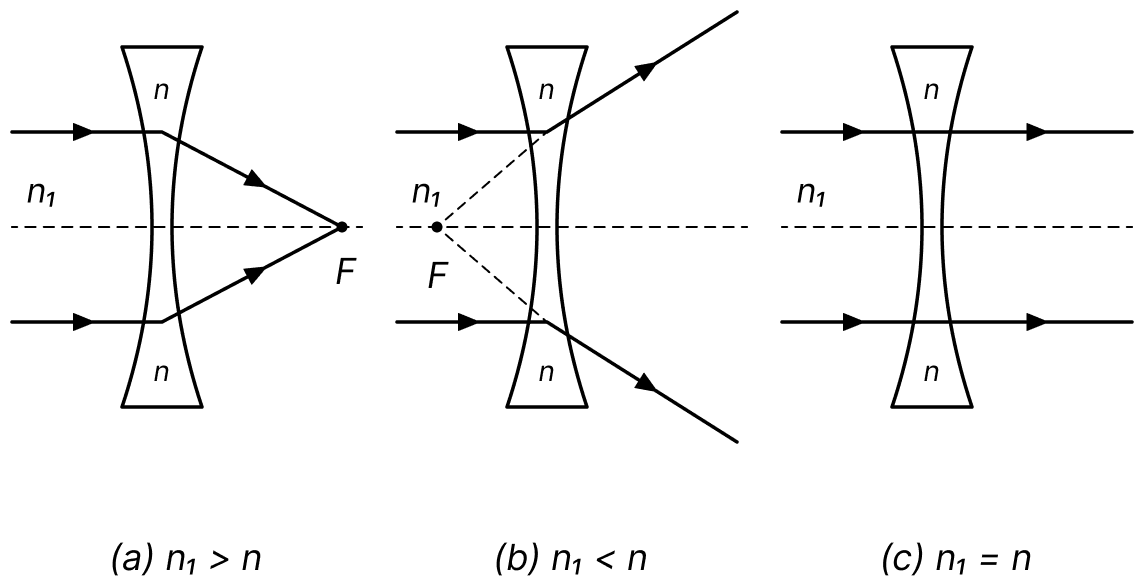
(a) n1 > n : The lens is in a medium of refractive index greater than that of its own material. is negative, so the nature of the lens is changed and the concave lens converges the incident parallel beam to a point.
(b) n1 < n : The lens is in a medium of smaller refractive index, so it behaves as a concave lens and diverges the incident parallel beam.
(c) n1 = n : = 0 and the focal length is infinite. The lens behaves as a plane plate and the parallel beam emerges as a parallel beam, undeviated.
Derive the formula for refraction of light at a (concave or convex) spherical surface. Symbols have usual meanings.
Answer
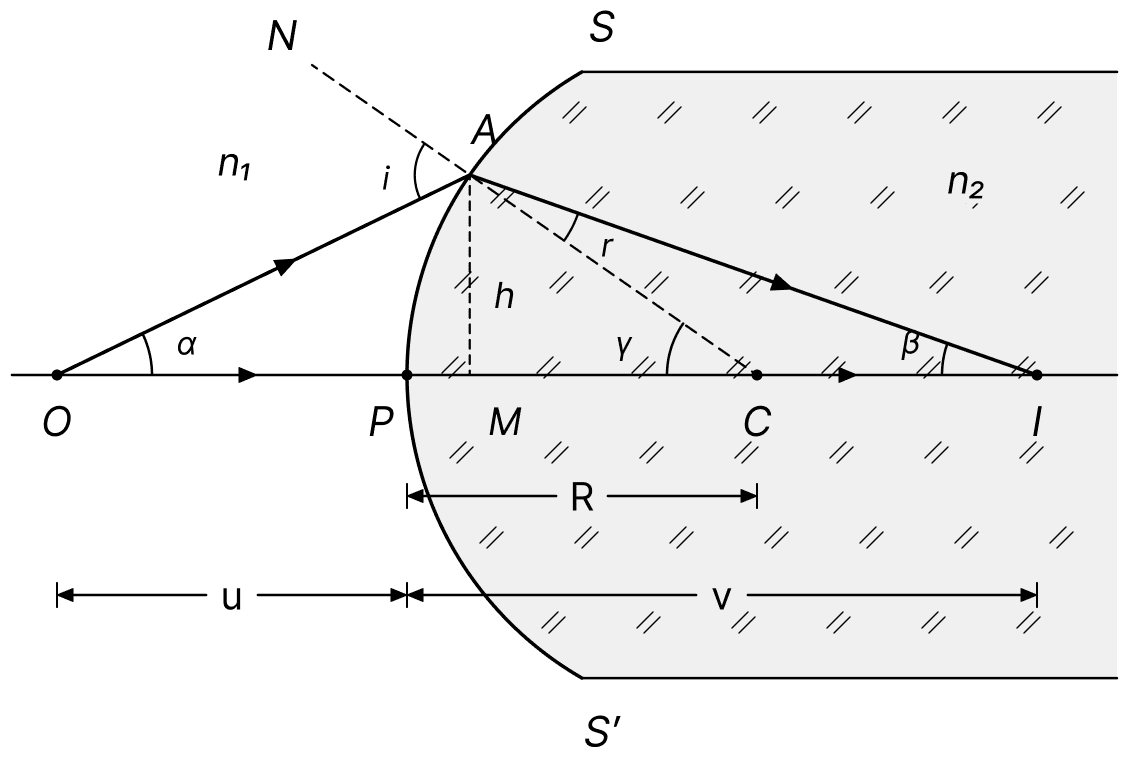
Let SPS' be a convex spherical surface separating a rarer medium of refractive index n1 from a denser medium of refractive index n2. P is the pole, C the centre of curvature and PC = R the radius of curvature of the surface.
A point-object O is placed on the principal axis. The ray OP falls normally on the surface and goes undeviated. The ray OA is refracted at A, bends towards the normal CAN and goes along AI, meeting the axis at I, the real image of O. AM (= h) is perpendicular to the axis, and α, β and γ are the angles made by OA, IA and CA with the axis. Let i = ∠OAN and r = ∠IAC.
In triangle OAC, the exterior angle
In triangle CAI,
By Snell's law, n1 sin i = n2 sin r. For a small aperture the angles are small, so
Substituting Eqs. (i) and (ii) in Eq. (iii),
As the aperture is small, M is very close to P, so
By the sign convention, PO = − u, PI = + v and PC = + R. Substituting in Eq. (iv),
Dividing by n1 and putting = n, the refractive index of the second medium with respect to the first,
For a concave surface the same steps, with R and v negative (virtual image), lead to the same relation. Hence, holds for a concave as well as a convex spherical surface.
Write down a formula for a thin lens for the dependence of its focal length on refractive index and on radii of curvature. With the help of this formula show that the focal length of a lens is increased when it is dipped in a liquid.
Answer
The focal length of a thin lens is given by the lens maker's formula,
where n is the refractive index of the material of the lens relative to the surrounding medium, and R1 and R2 are the radii of curvature of its surfaces.
Lens dipped in a liquid : Let be the refractive index of glass with respect to air and that of the liquid, which is less than . The refractive index of glass with respect to the liquid is
Since > 1, < . If fa and fl are the focal lengths in air and in the liquid,
Dividing Eq. (i) by Eq. (ii),
As < , this ratio is greater than 1, so fl > fa.
Hence, the focal length of a lens increases when it is dipped in a liquid (of refractive index less than that of the lens material), while its nature remains unchanged.
Define linear magnification produced by a lens. Derive various expressions for it in terms of object distance, image distance and focal length of the lens.
Answer
The linear magnification produced by a lens is the ratio of the size of the image formed by the lens to the size of the object, both measured perpendicular to the principal axis. It is denoted by m.
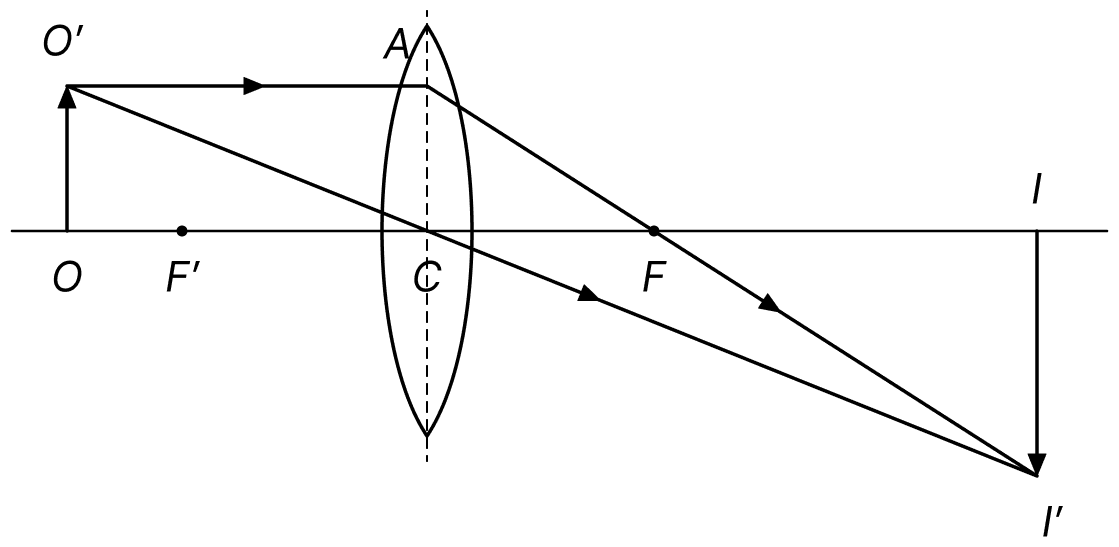
m in terms of u and v : An object OO' is placed perpendicular to the principal axis of a thin convex lens beyond its focus. The ray O'A parallel to the axis passes through the second focus F after refraction, and the ray O'C through the optical centre C goes straight. They meet at I', and II' is the real image of OO'.
The triangles CII' and COO' are similar, so
By the sign convention, OO' = + y1, II' = − y2, CO = − u and CI = + v. Then
The same result is obtained for a concave lens.
m in terms of v and f : Multiplying both sides of the lens formula by v,
m in terms of u and f : Multiplying both sides of the lens formula by u,
Hence, . m is negative for a real, inverted image and positive for a virtual, erect image.
What is meant by the power of a lens? Define dioptre and give relation between the power and the focal length of a lens.
Answer
Power of a lens : The power of a lens is a measure of its ability to bend (converge or diverge) the light rays falling on it. The power (P) of a thin lens is equal to the reciprocal of its focal length (f) measured in metre.
Dioptre : The SI unit of power is the dioptre (D). The power of a lens of focal length 1 metre is 1 dioptre.
Relation :
The smaller the focal length of a lens, the greater is its power. The power of a convex lens is positive and that of a concave lens is negative.
A student is finding focal length of a convex lens by using u-v method. The examiner gives the following instructions to the student. State whether the responses of the student, in each case, are correct or incorrect. Give a reason for your answer.
(i) EXAMINER : Image formed is blurry. Make it sharper.
STUDENT : Changes the distance between the object and the lens.
(ii) EXAMINER : Image formed is virtual and erect. Obtain a real, inverted image.
STUDENT : Decreases the distance between object and lens.
(iii) EXAMINER : Real image formed is close to the lens move it away from the lens.
STUDENT : Moves the lens farther away from the object.
Answer
(i) Response is correct.
The image is blurred because the rays are not focussed at the image pin. To get a sharp image, the distance between the object and the lens has to be changed (increased or decreased as required) until the image is focussed.
(ii) Response is incorrect.
A virtual and erect image shows that u < f. To get a real, inverted image u must be greater than f, so the student should increase, not decrease, the distance between the object and the lens.
(iii) Response is incorrect.
For a real image, as the object is moved away from the lens the image moves towards the focus, that is, closer to the lens. To move the image away from the lens, the student should decrease the distance between the object and the lens, keeping u > f.
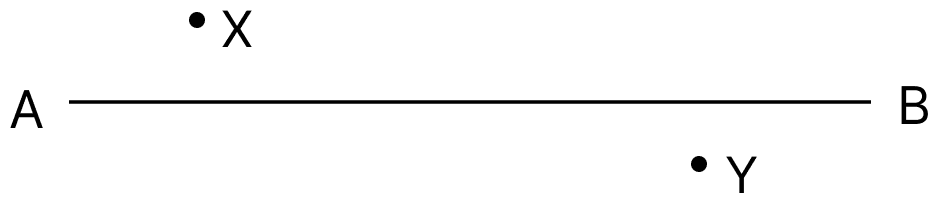
An image Y is formed of point object X by a lens whose optic axis is AB as shown in figure. Draw a ray diagram to locate the lens and its focus. If the image Y of the object X is formed by a concave mirror (having the same optic axis as AB) instead of lens, draw another ray diagram to locate the mirror and its focus. Write down the steps of construction of the ray diagrams.
Answer
Steps I : In case of a lens
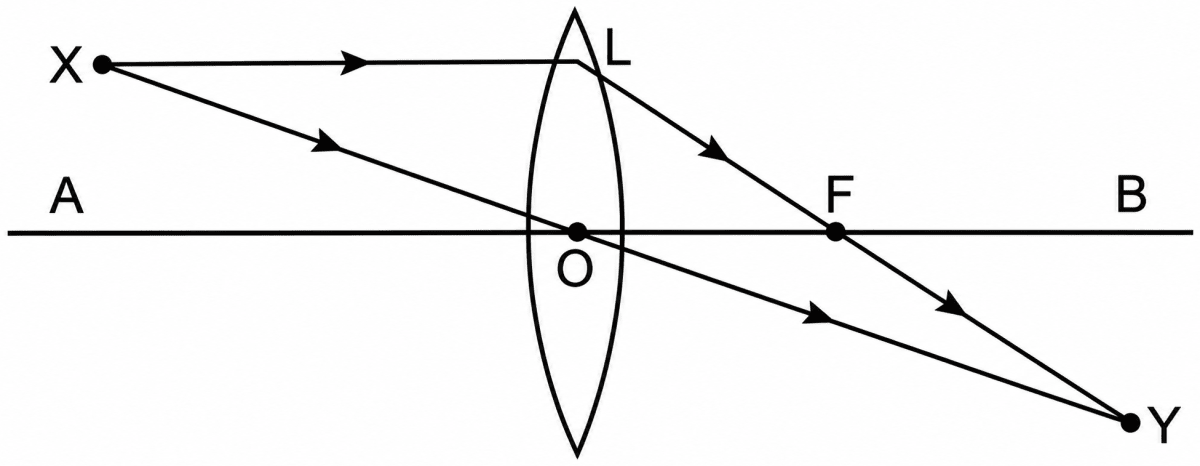
(a) Join X and Y. The point O where the line XY cuts the optic axis AB is the optical centre of the lens, because a ray through the optical centre goes undeviated. Draw the lens through O, perpendicular to AB.
(b) From X draw a line parallel to AB to meet the lens at L. Join L and Y. The point F where LY cuts AB is the focus of the lens, because a ray parallel to the axis passes through the focus after refraction.
Steps II : In case of a concave mirror
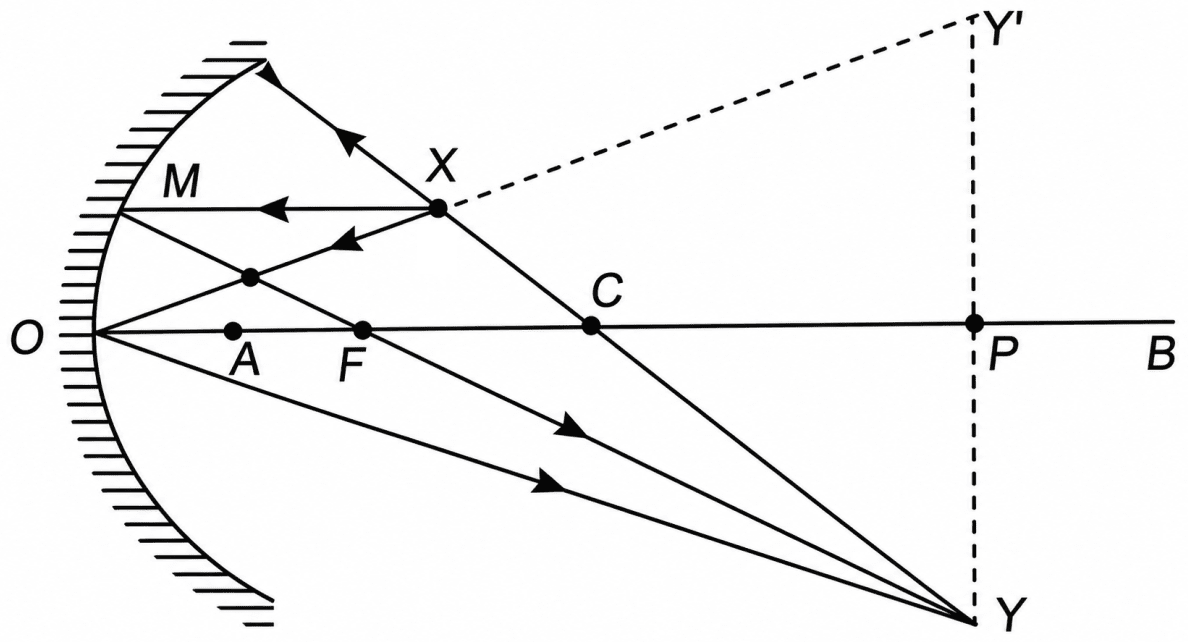
(a) From Y draw YP perpendicular to AB, meeting it at P, and extend it to Y' such that PY' = PY.
(b) Join X and Y' and extend the line to cut AB at O. O is the pole of the mirror, because a ray incident at the pole is reflected making an equal angle with the axis. Draw the mirror through O.
(c) Join X and Y. The point C where XY cuts AB is the centre of curvature of the mirror, because a ray through C retraces its path, so the object, the image and C lie on one line.
(d) From X draw a line parallel to AB to meet the mirror at M. Join M and Y. The point F where MY cuts the axis is the focus of the mirror; it is the mid-point of OC.
Note: The textbook's mirror diagram also prints a stray label F at the object point X; the focus F is the point on AB midway between O and C.
Derive the relation for a spherical surface and mention the assumptions adopted. Hence derive lens makers formula,
where, symbols have their usual meaning.
Answer
Refraction at a spherical surface :
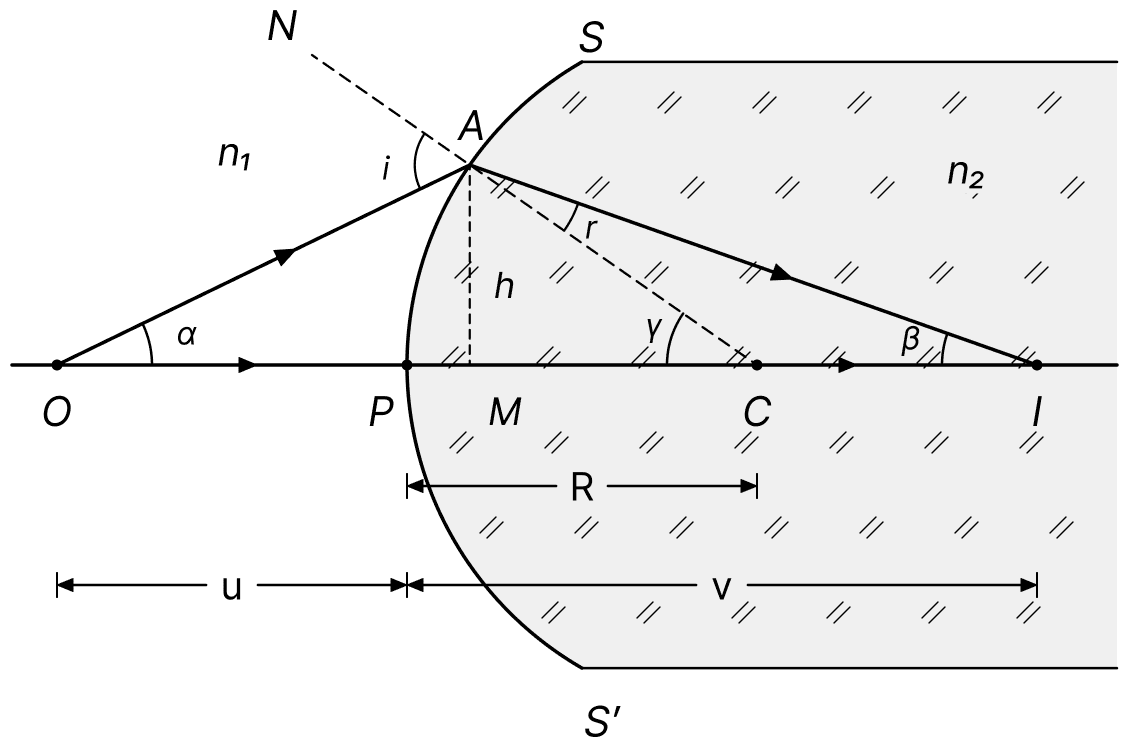
Assumptions : (i) the aperture of the surface is small, (ii) the object is a point-object placed on the principal axis, and (iii) the incident and the refracted rays make small angles with the principal axis.
Let SPS' be a convex spherical surface separating a rarer medium of refractive index n1 from a denser medium of refractive index n2, with pole P, centre of curvature C and radius of curvature PC = R. A point-object O on the principal axis sends the ray OP along the axis, which goes undeviated, and the ray OA, which is refracted at A towards the normal CAN along AI. The two rays meet at I, the real image of O. AM (= h) is perpendicular to the axis; α, β and γ are the angles made by OA, IA and CA with the axis; i = ∠OAN and r = ∠IAC.
From triangles OAC and CAI,
By Snell's law, n1 sin i = n2 sin r. As the angles are small,
Since the aperture is small, M is very close to P, and
With PO = − u, PI = + v and PC = + R, Eq. (iii) becomes
Lens maker's formula :
In addition, the lens is assumed to be thin, so that distances measured from the poles of its two surfaces may be taken as equal to the distances from its optical centre.
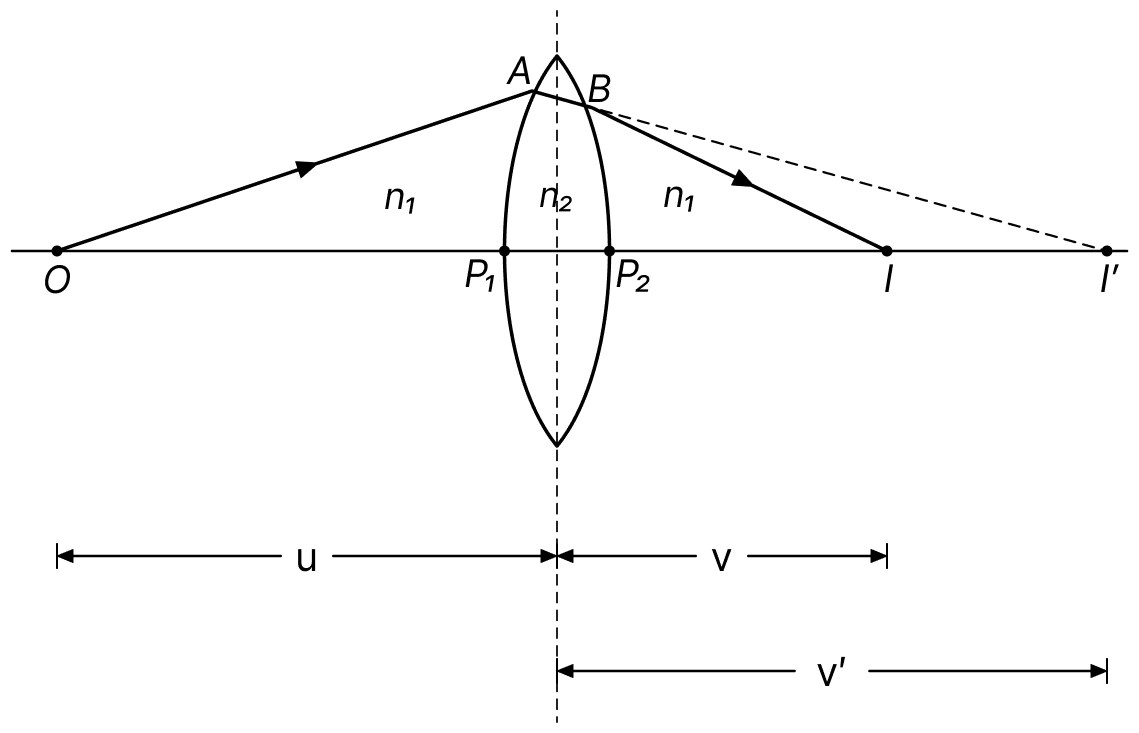
Consider a thin convex lens of refractive index n2 placed in a medium of refractive index n1. Let P1 and P2 be the poles, and R1 and R2 the radii of curvature of its first and second surfaces. A point-object O is at a distance u from the lens.
The ray OA is refracted at the first surface along AB. If the second surface were absent, it would meet the axis at I', at a distance v' from the lens. By Eq. (iv),
The ray AB is refracted at the second surface from the denser medium n2 into the rarer medium n1, and meets the axis at I, the final image, at a distance v. For this surface I' acts as a virtual object, so interchanging n1 and n2 in Eq. (iv) (the lens being thin, its thickness is neglected),
Adding Eqs. (v) and (vi),
Dividing by n1 and putting = n, the refractive index of the lens material with respect to the surrounding medium,
When the object is at infinity (u = ∞), the image is formed at the principal focus (v = f). Then Eq. (vii) gives
This is the lens maker's formula. Although derived for a convex lens forming a real image, it applies equally to a convex lens forming a virtual image and to a concave lens.
Define power of a lens. Write its unit. Deduce the relation for two thin lenses kept in contact coaxially.
Answer
Power of a lens : The power (P) of a thin lens is equal to the reciprocal of its focal length (f) measured in metre, .
Unit : The SI unit of power is the dioptre (D). The power of a lens of focal length 1 metre is 1 dioptre.
Two thin lenses in contact :
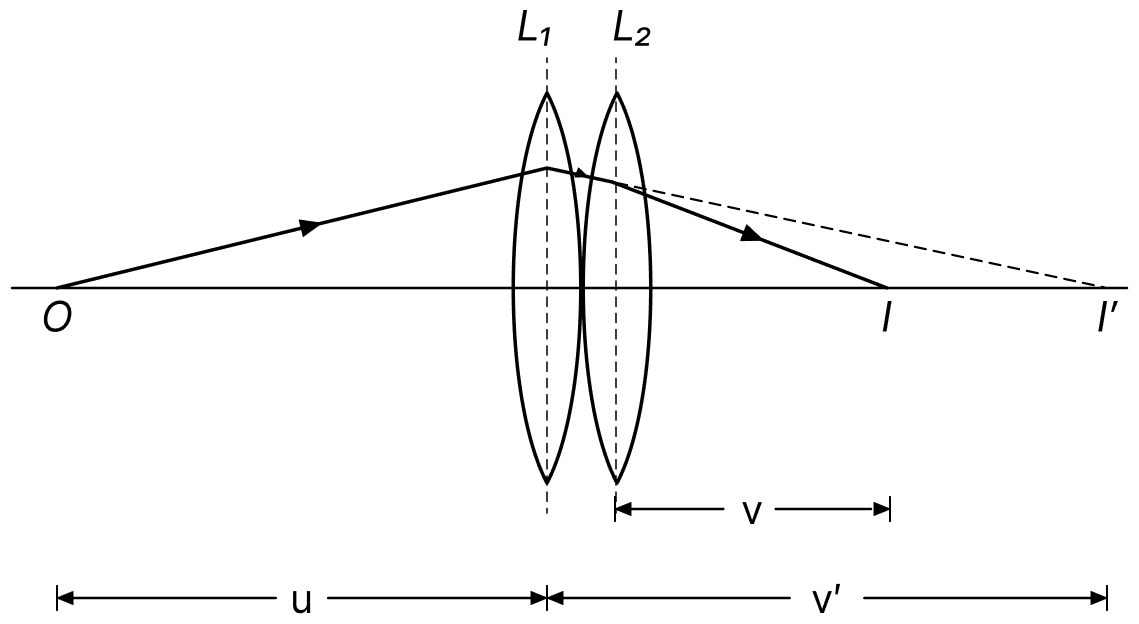
Let two thin lenses L1 and L2 of focal lengths f1 and f2 be placed in contact with a common principal axis. A point-object O is placed on the axis at a distance u from L1.
The lens L1 alone would form the image of O at I', at a distance v' from it. By the lens formula,
I' serves as a virtual object for the second lens L2, which forms the final image I at a distance v. As the lenses are thin and in contact, distances from L2 are the same as from L1, so
Adding Eqs. (i) and (ii),
If the two lenses are replaced by a single equivalent lens of focal length f which forms the image of the same object at the same place,
Comparing Eqs. (iii) and (iv),
Hence, , and in terms of power, P = P1 + P2.
Read the passage(s) and answer the following questions :
A lens is a transparent material, with regular curved surfaces, that can focus a beam of light, so that an image is formed.
The curved surfaces of lenses may be of any regular shape, like spherical, parabolic, cylindrical, etc.
There is an important point for a lens, called the optic centre. It is a point on the principal axis of the lens. If a ray of light is incident on a lens such that after refraction through the lens, the emergent ray is parallel to the incident ray, then the point at which the refracted ray intersects or appears to intersect, the principal axis is called the optical centre 'O' of the lens.
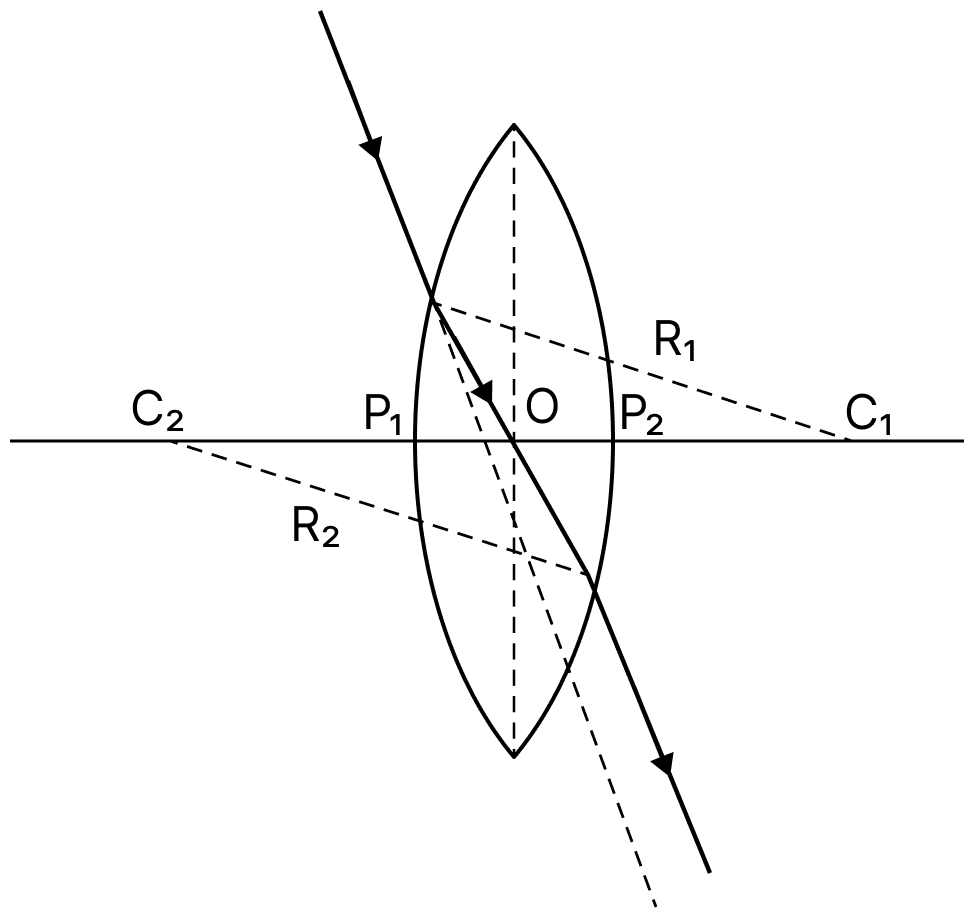
Suppose, for the first surface of the lens the pole is P1, radius of curvature is R1 and for the second surface the pole is P2, radius of curvature is R2.
If O be the optical centre of the lens, then
For a thin lens, optic centre coincides with the geometric centre of the lens.
The relation connecting the distances of the object and the images with the focal length of a lens is called Gaussian form of lens equation or simply lens formula, represented as :
where symbols have their usual meaning.
(i) In which type of lenses, optic centre O is situated at the pole of the curved surface of the lens?
(ii) If the radii of curvature of both the surfaces of a thick bi-concave or bi-convex lens are equal, where will be the optic centre of the lens?
(iii) Can we locate the optic centre somewhere outside the lens?
(iv) In which case convex lens forms a virtual and magnified image?
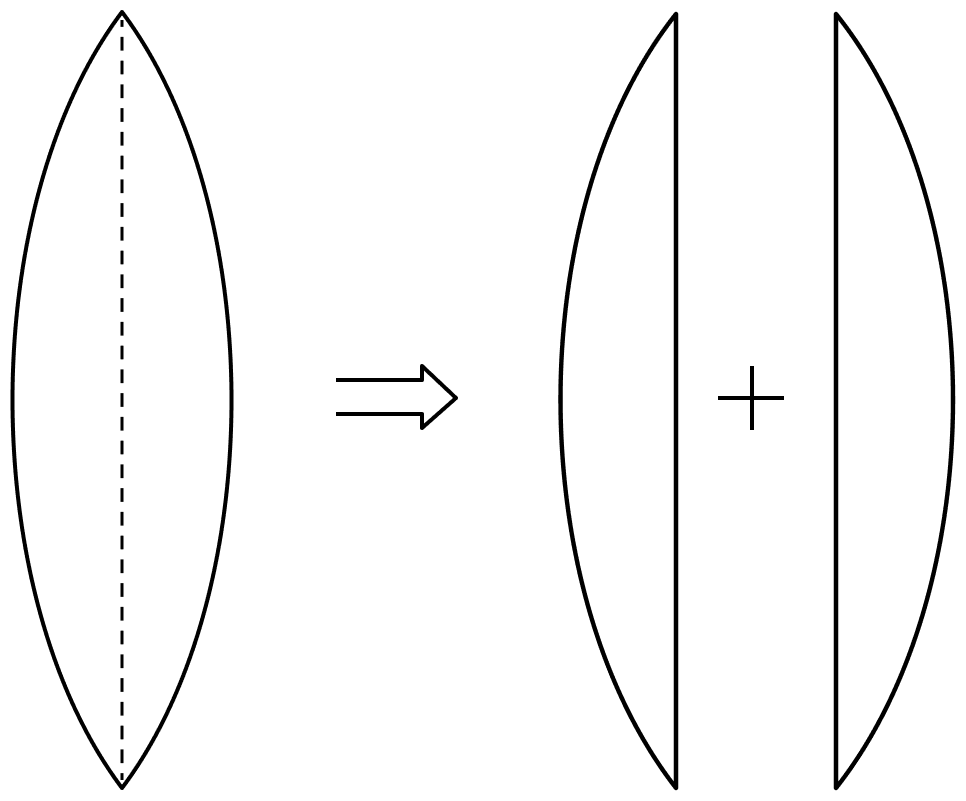
(v) When an object of height 'h' is placed at a distance 40 cm from an equiconvex lens, its image is also of the same size as of object. What is the focal length of each part, if lens is cut into two equal parts as shown in the diagram.
Answer
(i) In plano-convex and plano-concave lenses.
For the plane surface R1 = ∞, so , which gives OP2 = 0. The optical centre lies at the pole of the curved surface.
(ii) Just in the middle of the lens.
With R1 = R2, = 1, so OP1 = OP2.
(iii) Yes. In concavo-convex and convexo-concave (meniscus) lenses, the centres of curvature of both surfaces, and hence R1 and R2, are on the same side of the lens, so OP1 and OP2 are also on the same side of O. The optical centre then lies outside the lens, nearer the more curved surface.
(iv) When the object is placed between the optical centre and the focus of the convex lens.
(v) An image of the same size is formed when the object is at 2F. Hence
On cutting the equiconvex lens perpendicular to its principal axis, it gives two identical plano-convex lenses, each of focal length f1. Together in contact they make up the original lens, so
Hence, the focal length of each part is 40 cm.
Two transparent media of refractive indices n1 and n2 are separated by a spherical transparent surface. The rays of light incident on the surface get refracted into the medium of the other side. The laws of refraction are valid at each point of the spherical surface. A lens is a transparent optical medium bounded by two surfaces, at least one of which should be spherical. The focal length of a lens is determined by the radii of curvature (R1 and R2) of its two surfaces and the refractive index (n) of the medium of the lens with respect to the surrounding medium. Depending on R1 and R2 a lens behaves as a diverging or a converging lens. The ability of a lens to diverge or converge a beam of light incident on it defines its power.
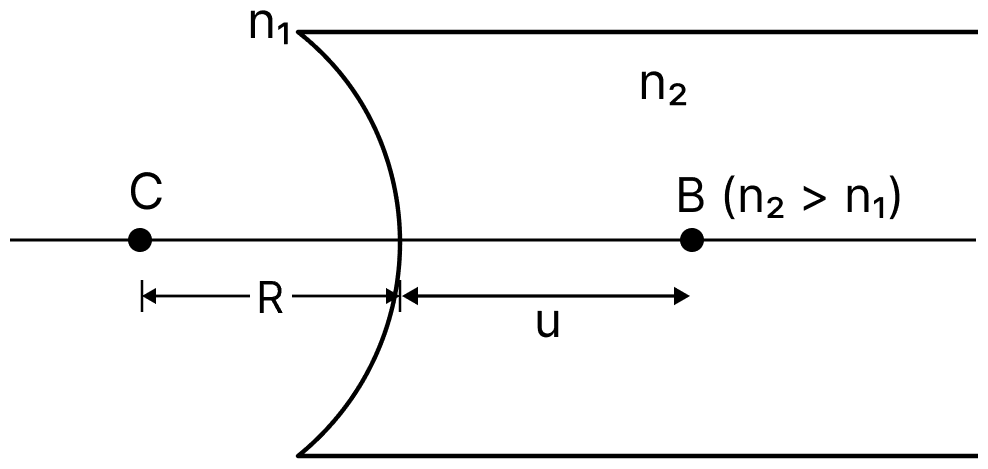
(i) An object is placed at the point B as shown in the figure. The object distance (u) and the image distance (v) are related as :
(a)
(b)
(c)
(d)
(ii) A point object is placed in air at a distance 'R' in front of a convex spherical refracting surface of radius of curvature R. If the medium on the other side of the surface is glass, then the image is :
(a) real and formed in glass
(b) real and formed in air
(c) virtual and formed in glass
(d) virtual and formed in air
(iii) An object is kept at 2F in front of an equi-convex lens. The image formed is :
(a) real and of the size of the object
(b) virtual and of the size of the object
(c) real and enlarged
(d) virtual and diminished
(iv) A thin converging lens of focal length 10 cm and a thin diverging lens of focal length 20 cm are placed coaxially in contact. The power of the combinations is :
(a) -5D
(b) +5D
(c) +15D
(d) -15D
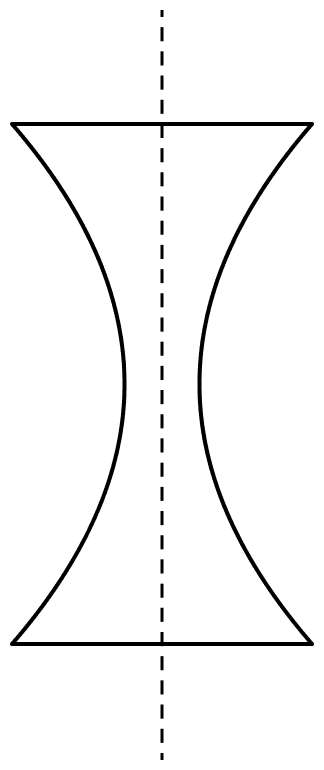
(v) An equi-concave lens of focal length 'f' is cut into two identical parts along the dotted line as shown in the figure. The focal length of each part will be :
(a)
(b)
(c) f
(d) 2f
Answer
(i)
The object at B lies in the medium of refractive index n2, so light is refracted from n2 into n1. The refraction formula therefore takes the form obtained by interchanging n1 and n2.
(ii) virtual and formed in air
With n1 = 1, n2 = n (glass) and u = − R,
For glass n is less than 2, so v is negative; for n = 1.5, v = − 3R. The image is formed on the side of the object, in air, and is virtual.
(iii) real and of the size of the object
For an object at 2F of a convex lens, the image is formed at 2F on the other side, and is real, inverted and of the same size as the object.
(iv) +5D
With f1 = + 10 cm and f2 = − 20 cm,
(v) 2f
Cutting along the dotted line, perpendicular to the principal axis, gives two identical plano-concave lenses of focal length f1. As the two together form the original lens,