
Light appears to travel in straight lines because :
- it is not absorbed by the atmosphere
- it is reflected by the upper part of the atmosphere
- its wavelength is very small
- its speed is very large
Answer
its wavelength is very small
Reason — Diffraction becomes noticeable only when the size of the obstacle, or aperture, is of the order of the wavelength. The wavelength of light (≈ 5 × 10⁻⁷ m) is very small compared with the size of ordinary obstacles and apertures, so the bending is negligible and light appears to travel in straight lines.
Though both light and sound have wave character, yet diffraction is much harder to observe in light because :
- light can travel in vacuum
- light waves are transverse
- the speed of light is very large
- the wavelength of light is very small
Answer
the wavelength of light is very small
Reason — The wavelength of sound is of the order of a metre, comparable to doors, windows and walls, so sound is easily diffracted. The wavelength of light (≈ 10-6 m) is very small compared with such obstacles, so diffraction of light is hard to observe.
In the diffraction of light of wavelength λ at a single slit of small width e, the angle θ between the central maximum and first minimum on either side is :
Answer
Reason — For the first minimum, . As θ is small, sin θ ≈ θ, so θ = λ/e.
A single-slit diffraction pattern is obtained using a beam of red light. What happens if red light is replaced by blue light?
- There is no change in the diffraction pattern
- Diffraction fringes become narrower and crowded together
- Diffraction fringes become broader and farther apart
- Diffraction fringes disappear
Answer
Diffraction fringes become narrower and crowded together
Reason — The minima lie at θ = λ/e, 2λ/e, 3λ/e, …, so the angular spread of the pattern is proportional to λ. Blue light has a shorter wavelength than red light, so the fringes become narrower and closer together.
Yellow light is used in a single-slit diffraction experiment with slit width of 0.6 mm. If yellow light is replaced by X-rays, then the observed pattern will reveal :
- that the central maximum is narrower
- more number of fringes
- less number of fringes
- no diffraction pattern
Answer
no diffraction pattern
Reason — The wavelength of X-rays (≈ 1 Å = 10-10 m) is extremely small compared with the slit width (0.6 mm). For X-rays the slit is far too wide, so no diffraction pattern is observed.
At the first minimum adjacent to the central maximum of a single-slit diffraction pattern, the phase difference between the Huygens' wavelet from the edge of the slit and the wavelet from the mid-point of the slit is :
radian
π radian
radian
radian
Answer
π radian
Reason — At the first minimum the path difference between the wavelets from the two edges of the slit is . The edge and the mid-point are apart, so their wavelets have a path difference of .
For a parallel beam of monochromatic light of wavelength λ, diffraction is produced by a single-slit whose width e is of the wavelength of light. If D is the distance of the screen from the slit, the width of the central maxima will be :
Answer
Reason — The first minima lie at θ = λ/e on either side of the centre. Hence the linear width of the central maximum is
What is meant by "diffraction of light"?
Answer
The bending of light round the corners of an obstacle, or an aperture, and its spreading into the region of geometrical shadow is called diffraction of light.
Explanation:
It is prominent when the size of the obstacle, or aperture, is comparable to the wavelength of light.
In Fraunhofer's single-slit diffraction experiment, how does semi-angular width θ of the central bright fringe depend on slit width 'e'?
Answer
θ is inversely proportional to the slit width e.
Explanation:
The semi-angular width of the central bright fringe is
So, keeping λ constant, if the slit width e is decreased, θ increases and the central bright fringe becomes wider.
What should be the order of the size of obstacle/aperture for observing diffraction of light?
Answer
The size of the obstacle/aperture should be of the order of the wavelength of light used.
In Fraunhofer diffraction, what kind of source of light is used and where is it situated?
Answer
A monochromatic source of light, situated effectively at infinity from the slit.
Explanation:
In practice the source is placed at the focus of a convex lens, so that a plane wavefront falls on the slit.
What is the condition for first minima in diffraction through a single-slit of width e?
Answer
Explanation:
Here θ is the angular position of the first minimum from the centre of the pattern. As the first minima are formed on both sides of the principal maximum, the condition is also written .
Write the formula for the width of the central maximum in Fraunhofer diffraction pattern of a single-slit as observed on a screen.
Answer
Explanation:
Here e is the width of the slit and f is the focal length of the focussing lens placed close to the slit, the screen being in its focal plane. If the screen is at a distance D from the slit, the width is .
State whether diffraction of light takes place at the two slits in the Young's interference experiment?
Answer
Yes.
Explanation:
The light waves arriving at each of the two slits are diffracted. The diffracted waves emerging from the two slits then superpose and interfere, so the interference fringes are modulated by the diffraction pattern of each slit.
Ray optics assumes that light travels in straight lines. Light, however, bends round the edges of obstacles and apertures (diffraction). Yet, ray optics correctly locates images in optical instruments. Justify the validity of ray optics.
Answer
When a light beam passes through a slit of width e, it broadens due to diffraction, and the broadening increases with distance from the slit. However, up to a certain distance, this broadening remains smaller than the width of the slit itself.
Since the wavelength of light is very small (≈ 5 × 10⁻⁷ m), a light beam can travel several metres without significant broadening even through a slit only a few millimetres wide. The apertures and obstacles in ordinary optical instruments are much larger than the wavelength of light. Hence light travels practically in straight lines and ray optics is valid.
What is Fraunhofer diffraction?
Answer
Fraunhofer diffraction is the diffraction in which the source of light and the screen are effectively at infinite distances from the diffracting slit (or obstacle).
It is obtained with two convex lenses : the source is placed at the focus of the first lens, so that a plane wavefront falls on the slit, and the second lens focusses the parallel diffracted rays on a screen placed in its focal plane.
Why is diffraction not observed when a 'wide' slit is illuminated by monochromatic light?
Answer
When the slit width e is much larger than the wavelength of light used, the angular width of the central maximum becomes very small and its intensity becomes very large. The variation of intensity in the subsidiary maxima and minima then becomes so small that they cannot be distinguished.
It is the presence of subsidiary maxima and minima that shows diffraction. Hence, diffraction is not observed with a wide slit.
Coloured spectrum is seen when we look through a muslin cloth, but not through coarse cloth. Why?
Answer
Muslin cloth is made of very fine threads which leave very fine slits between them. White light passing through these fine slits is diffracted. Each diffraction pattern has a white central maximum with coloured subsidiary maxima on either side, and the overlapping of all these patterns gives a coloured spectrum.
In coarse cloth the slits are much wider than the wavelength of light, so pronounced diffraction does not occur and no spectrum is seen.
Why is diffraction common in sound but not common in light? (or, why can sound waves be diffracted more easily than light waves?)
Answer
Diffraction of waves becomes noticeable only when the size of the obstacle, or aperture, is of the same order as the wavelength.
The wavelength of ordinary sound is of the order of a metre, which is comparable to the size of doors, windows and walls around us, so sound is easily diffracted. The wavelength of light (≈ 10-6 m) is very small compared with these obstacles and apertures, so diffraction of light is not observed in daily life.
Radio waves diffract strongly around buildings, but light waves, which are also electromagnetic waves, do not. Why?
Answer
For pronounced diffraction, the wavelength of a wave must be of the same order as the size of the obstacle.
Radio waves have wavelengths of the order of the size of buildings, so they are strongly diffracted around them. The wavelength of light waves is very small compared with the size of buildings, so light is not diffracted around them.
The diffraction of light due to a single-slit is being observed in the laboratory. What will be the effect on the diffraction pattern, if :
(i) light of smaller wavelength be used,
(ii) slit is made narrower and
(iii) another parallel slit be made close to the first slit?
Answer
The angular width of the central maximum is .
(i) As , with light of smaller wavelength the diffraction pattern becomes narrower.
(ii) As , when the slit is made narrower the diffraction pattern becomes wider.
(iii) The two slits act as coherent sources, so interference takes place. Interference fringes of the same width are then seen within the central diffraction maximum.
How is diffraction effect suppressed in Young's double-slit experiment?
Answer
In Young's double-slit experiment the two slits are made quite narrow. The central maximum of the diffraction pattern of each slit then becomes broad enough to cover the entire field of view.
The interference fringes are therefore observed against a background of almost uniform intensity of the broad central diffraction maxima of the two slits, and the diffraction effect is suppressed.
Intensity diagram for single-slit Fraunhofer diffraction is given.
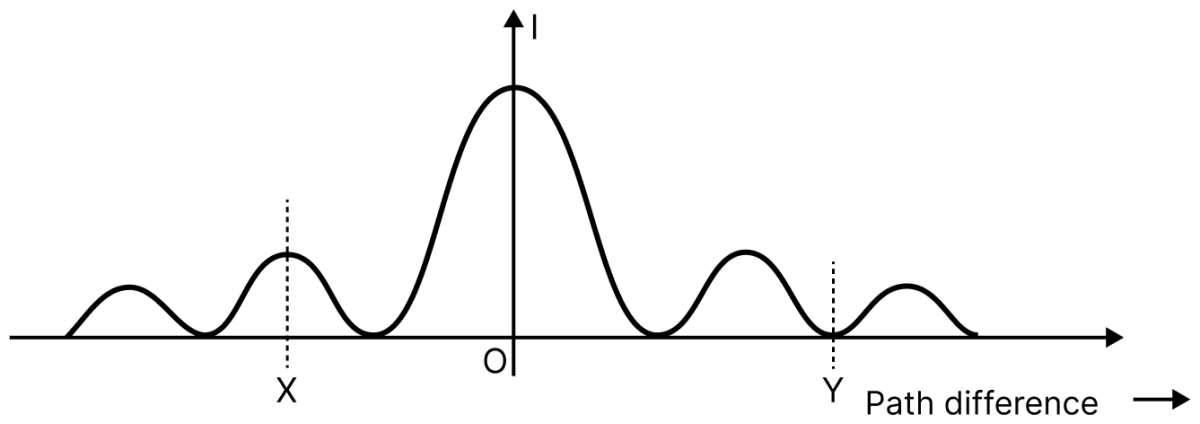
Give the values of X and Y in terms of λ and the corresponding phase difference.
Answer
X : It is the first secondary (subsidiary) maximum on the negative side of the centre.
Y : It is the second minimum on the positive side of the centre.
What is diffraction of light? Describe the diffraction of light at a single-slit.
Answer
Diffraction of light : The bending of light round the corners of an obstacle, or an aperture, and its spreading into the region of geometrical shadow is called diffraction of light. It is prominent when the size of the obstacle, or aperture, is of the order of the wavelength of light.
Diffraction at a single-slit : A parallel beam of monochromatic light of wavelength λ falls normally on a narrow slit AB of width e. The diffracted light is focussed by a convex lens L on a screen XY placed in its focal plane.
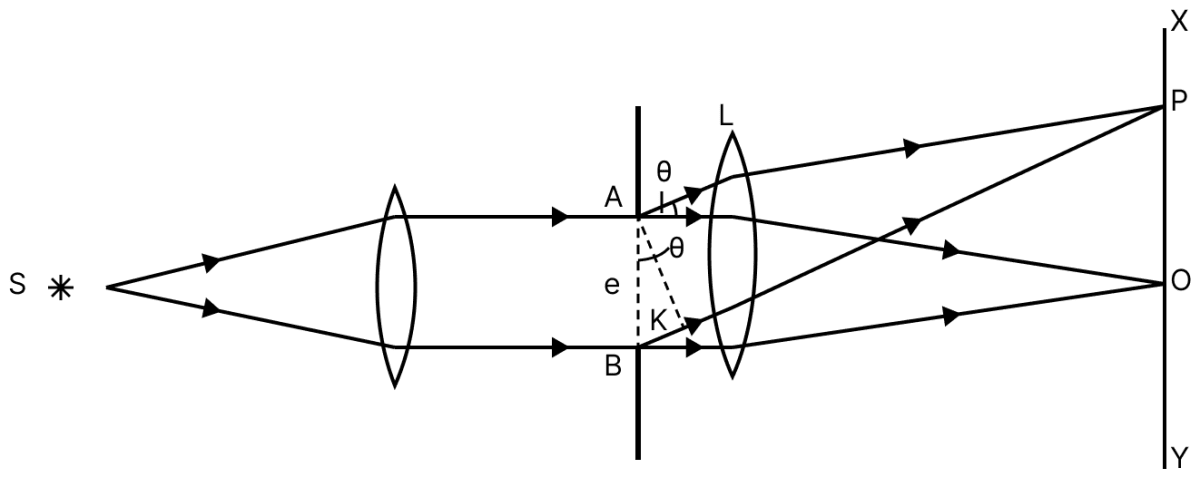
According to Huygens' principle, every part of the slit AB is a source of secondary wavelets, all in the same phase.
Central maximum : The wavelets travelling in the direction of the incident light reach the point O in the same phase. They reinforce one another and produce a central bright band, the principal maximum, at O.
Minima : The wavelets diffracted through an angle θ meet at a point P. The path difference between the wavelets from the two edges A and B is BK = e sin θ. When BK = λ, the slit can be divided into two halves such that each wavelet in the upper half has a corresponding wavelet in the lower half with a path difference of λ/2. These cancel in pairs, so P is dark. In general, the minima are formed where
Secondary maxima : Between consecutive minima, weak subsidiary (secondary) maxima are formed where
Their intensity falls off rapidly on moving away from the centre.
Hence, the diffraction pattern of a single-slit consists of a bright central maximum with alternate dark and bright bands of decreasing intensity on both sides.
Draw a labelled graph showing the variation in intensity of light with distance in a single-slit Fraunhofer diffraction experiment.
Answer
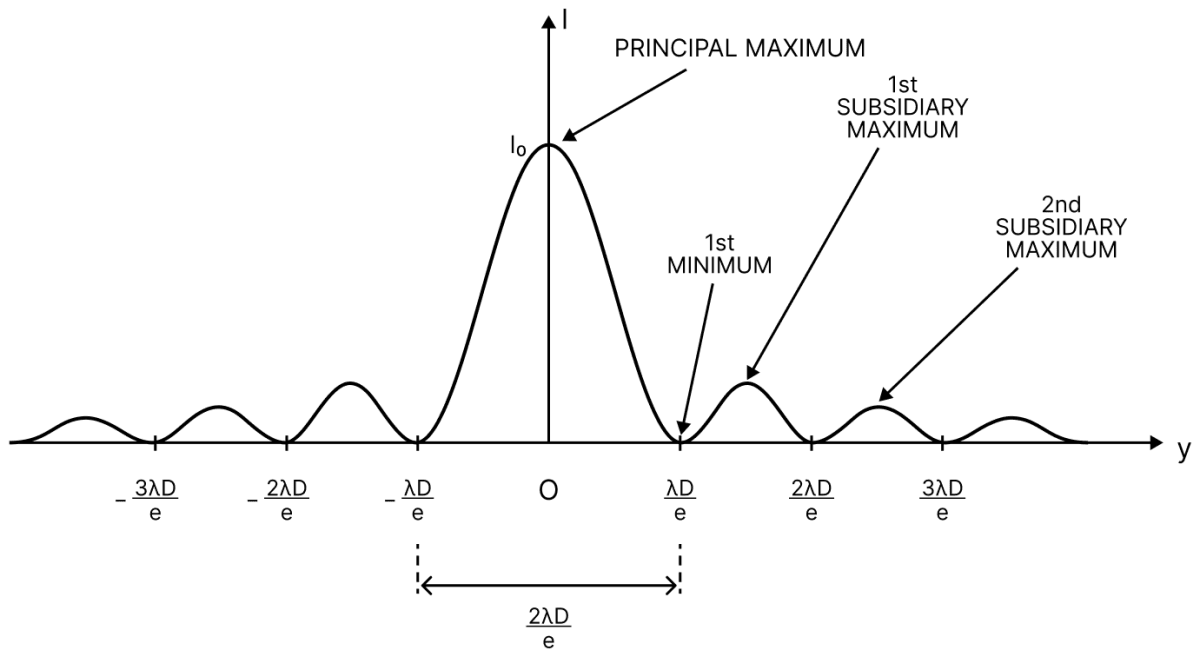
The graph is drawn with the intensity I of light on the y-axis and the distance y from the centre O of the screen on the x-axis. Its labelled features are :
- Principal maximum at y = 0, with the maximum intensity I0.
- Minima (zero intensity) at
- Secondary maxima at about , with rapidly decreasing intensity.
Here e is the slit width and D is the distance of the screen from the slit. The central maximum has a width , twice that of each secondary maximum.
Draw a labelled graph to show variation in intensity of diffracted light with angular position in a single-slit diffraction experiment.
Answer
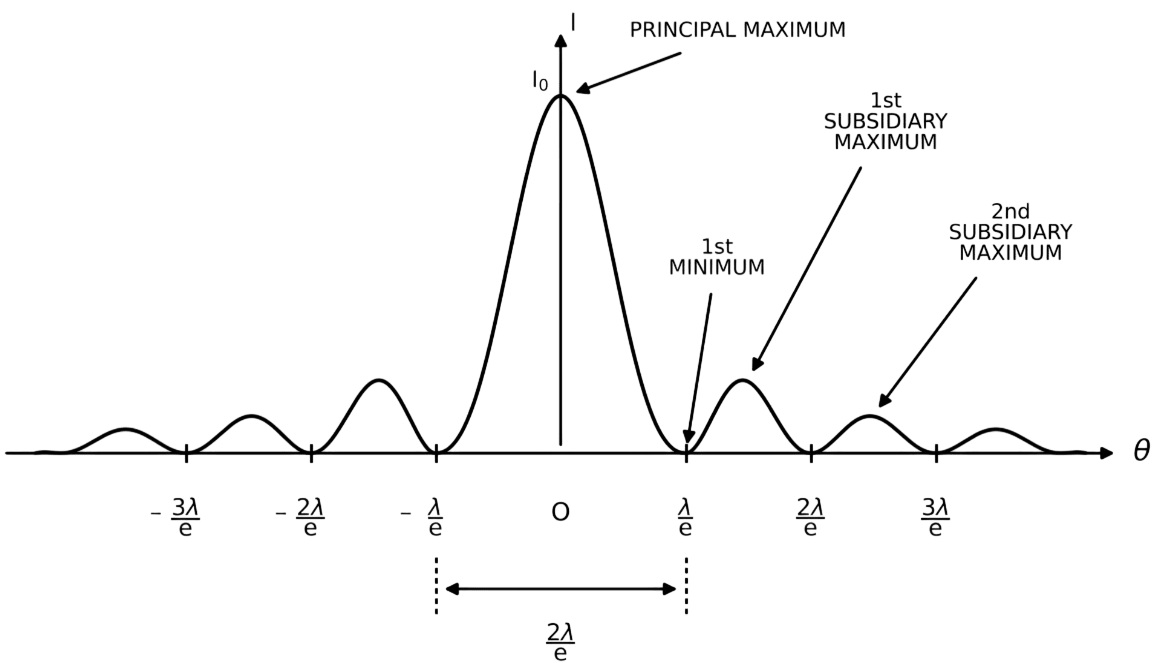
The graph is drawn with the intensity I of the diffracted light on the y-axis and the angular position θ on the x-axis. Its labelled features are :
- Principal maximum at θ = 0, with the maximum intensity.
- Minima (zero intensity) at
- Secondary maxima at about , with rapidly decreasing intensity.
Here e is the slit width. The angular width of the central maximum is .
A student is performing an experiment on single slit diffraction. The examiner gives the following instructions to the student. State whether the responses of the student, in each case, are correct or incorrect. Give a reason for your answer.
(i) EXAMINER : Increase the intensity of the diffraction bands.
STUDENT : Increases the width of the slit.
(ii) EXAMINER : Place a tiny circular obstacle in the path of light from a distant source. Describe the result of your observation.
STUDENT : A bright spot is seen at the centre of the shadow of the obstacle.
(iii) EXAMINER : Increase the linear width of the central maximum of the single slit diffraction pattern.
STUDENT : Increases the width of the slit.
Answer
(i) Correct. The intensity of the central maximum is directly proportional to the square of the slit width. Widening the slit lets more light through, so the intensity of the diffraction bands increases.
(ii) Correct. Light waves diffracted from the edge of the circular obstacle interfere constructively at the centre of its shadow, producing a bright spot there.
(iii) Incorrect. The linear width of the central maximum is
Increasing the slit width e decreases the linear width. To increase it, the student should decrease the width of the slit.
Student 1 and Student 2 conducted experiments using coherent sources of light, with Student 1 using a single-slit and Student 2 using a double-slit.
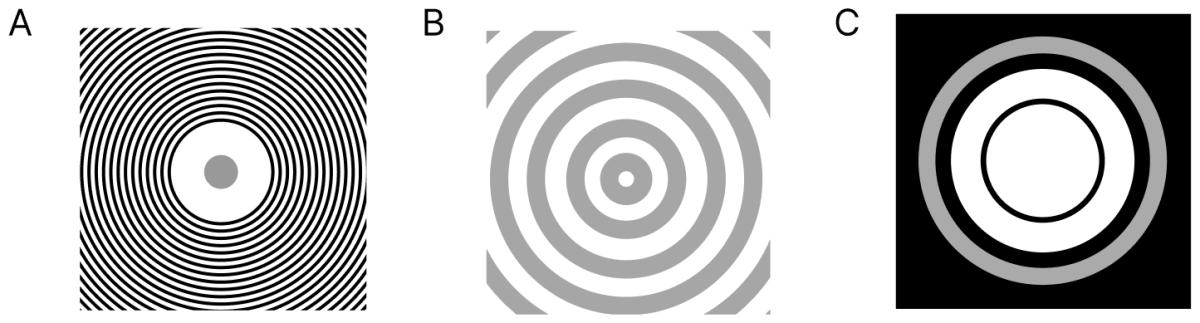
Answer the following questions.
(i) Identify the patterns resulting from Student 1 and Student 2 experiments.
(ii) Give two reasons that assisted you in recognizing the patterns.
(iii) Upon utilizing a monochromatic source of light of 500 nm wavelength, Student 1 observed that the distance between the initial minimum and the centre of the fringe matched the width of the slit. Calculate the distance of this initial minimum from the centre of the fringe, given that the screen is situated 1 m away from the slit.
(iv) Student 2 observes 10 fringes within a specific portion of the screen using the same monochromatic source of light. If he were to immerse his entire experimental setup in a liquid of refractive index , what alteration should he make to the distance of the screen to maintain the same number of fringes within the given portion?
Answer
(i) Student 1 (single-slit) : Pattern C. Student 2 (double-slit) : Pattern B.
(ii) The two reasons are :
- Width of fringes : Pattern C has a wide central maximum with fringes becoming narrower on moving outwards, as in diffraction. Pattern B has fringes of uniform width, as in interference.
- Intensity of fringes : In pattern C the central maximum is the brightest and the intensity of the successive bright fringes goes on decreasing. In pattern B all the bright fringes are nearly equally bright.
(iii) Given,
- λ = 500 nm = 5 × 10⁻⁷ m
- D = 1 m
- Distance of the first minimum from the centre, y = e (slit width)
For the first minimum, . For small θ, , so
Putting y = e,
Hence, the first minimum is 7.07 × 10⁻⁴ m (≈ 0.71 mm) from the centre of the fringe.
(iv) In the double-slit experiment the fringe width is
In a liquid of refractive index n, the wavelength becomes . The same number of fringes fits in the given portion only if β is unchanged, so with the screen distance changed to D',
With n = and D = 1 m,
Hence, the screen should be moved away from the slits so that its distance becomes times the original, i.e. m.
Define diffraction of light and name the wavefront used in Fraunhofer diffraction. Obtain the relation e sin θ = λ for first minima.
Answer
Diffraction of light : The bending of light round the corners of an obstacle, or an aperture, and its spreading into the region of geometrical shadow is called diffraction of light.
Wavefront in Fraunhofer diffraction : A plane wavefront.
Relation for the first minimum : A parallel beam of monochromatic light of wavelength λ falls normally on a slit AB of width e. The diffracted light is focussed by a convex lens L on a screen XY placed in its focal plane.
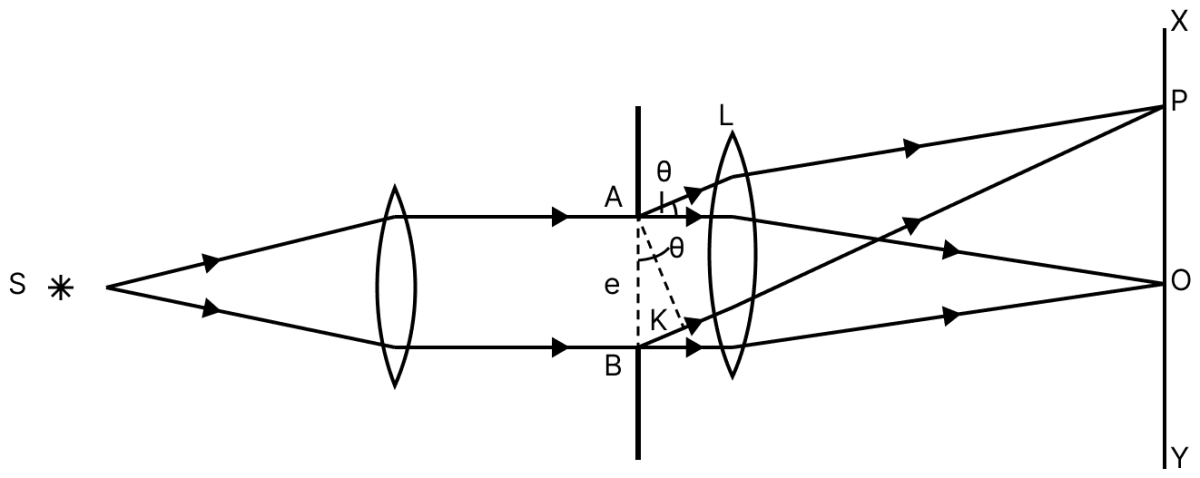
By Huygens' principle, every part of the slit is a source of secondary wavelets, all starting in the same phase. Those travelling along the incident direction meet at O in phase and form the central maximum.
Consider the wavelets diffracted through an angle θ, which are focussed at a point P. Draw AK perpendicular to BK. The optical paths from the plane AK to P are equal, so the path difference between the wavelets from the edges A and B is
Let BK = λ. Divide the slit AB into two equal halves, each containing N wavelets (1, 2, 3, …, N and N + 1, N + 2, …, 2N). The wavelets from the corresponding points of the two halves (1 and N + 1, 2 and N + 2, and so on) have a path difference of . They interfere destructively in pairs, so the point P is dark. This is the first minimum, which occurs when BK = λ.
From Eq. (i),
Hence, the first minimum is given by e sin θ = λ.
Compare interference and diffraction. Obtain the expression for half and full angular width of central maxima in diffraction pattern.
Answer
Comparison of interference and diffraction :
| Interference | Diffraction |
|---|---|
| It is due to superposition of light waves coming from two coherent sources. | It is due to interference of secondary wavelets coming from different points of the same wavefront. |
| Fringes may or may not be of the same width. | Fringes are never of the same width. |
| All bright fringes are of the same intensity. | Intensity of successive bright fringes goes on decreasing. |
| Intensity at minima is usually zero or very small, giving good contrast. | At the ideal single-slit minima the intensity is zero; subsidiary maxima are much weaker than the central maximum. |
Note: The textbook's comparison table states that the intensity at diffraction minima is never zero. This contradicts its own derivation, in which the wavelets cancel in pairs to give dark bands where e sin θ = ±mλ.
Both phenomena demonstrate the wave nature of light.
Angular width of central maximum : A parallel beam of light of wavelength λ falls normally on a slit of width e. The angular width of the central maximum is the angular separation between the first minima on its two sides.
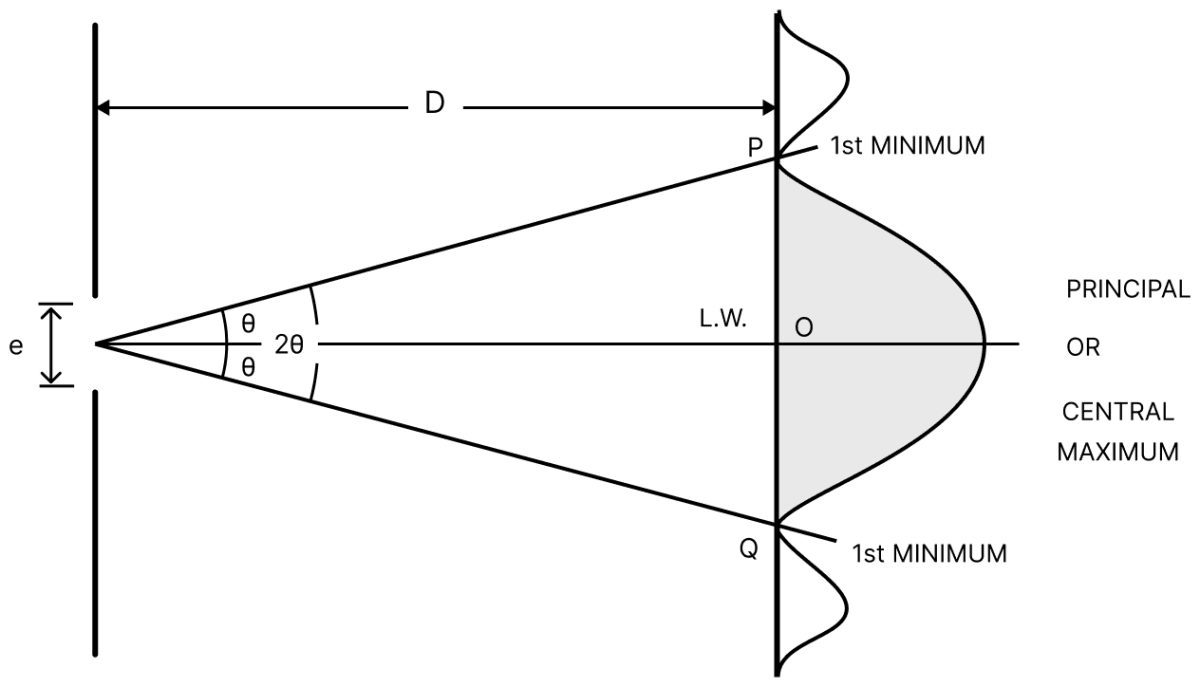
For the first minimum, the path difference between the wavelets from the two edges of the slit is e sin θ, and it must equal λ :
Half angular width : From Eq. (i),
As θ is small, sin θ ≈ θ, so
Full angular width : The central maximum extends through θ on each side, so its full angular width is
Hence, the half angular width of the central maximum is λ/e and its full angular width is 2λ/e.
Read the passage(s) and answer the following questions :
Observations show that light suffers some deviation from its straight path when it passes close to the edge of opaque obstacles or narrow slits. Some light spreads into the region of geometrical shadow. This deviation is very small, but becomes prominent when the dimensions of the obstacle or aperture is comparable to the wavelength of light.
The bending of light around corners of obstacles and spreading into geometrical shadow of an object is called diffraction.
There are two types of diffractions :
(i) Fresnel's Diffraction: The source and screen are at finite distances from the aperture, so that the wavefront is spherical or cylindrical.
(ii) Fraunhofer Diffraction : The source and screen are effectively at infinite distance from the diffracting element. It can be observed by employing two convergent lenses : One to render the incoming light parallel and the other to focus the parallel diffracted rays on the screen. Therefore, the incident wavefront is plane.
Let a collimated beam of monochromatic light of wavelength λ, produced by a point source S placed at the focus of a spherical lens L1, be incident normally on a narrow slit AB of width a as shown in the given figure. The diffracted light be focused by another convex lens L2 on the screen XY placed in the focal plane of lens L2 and perpendicular to the plane of paper. On the screen a diffraction pattern having alternate dark and bright fringes of decreasing intensity is obtained on both the sides of the central point C.
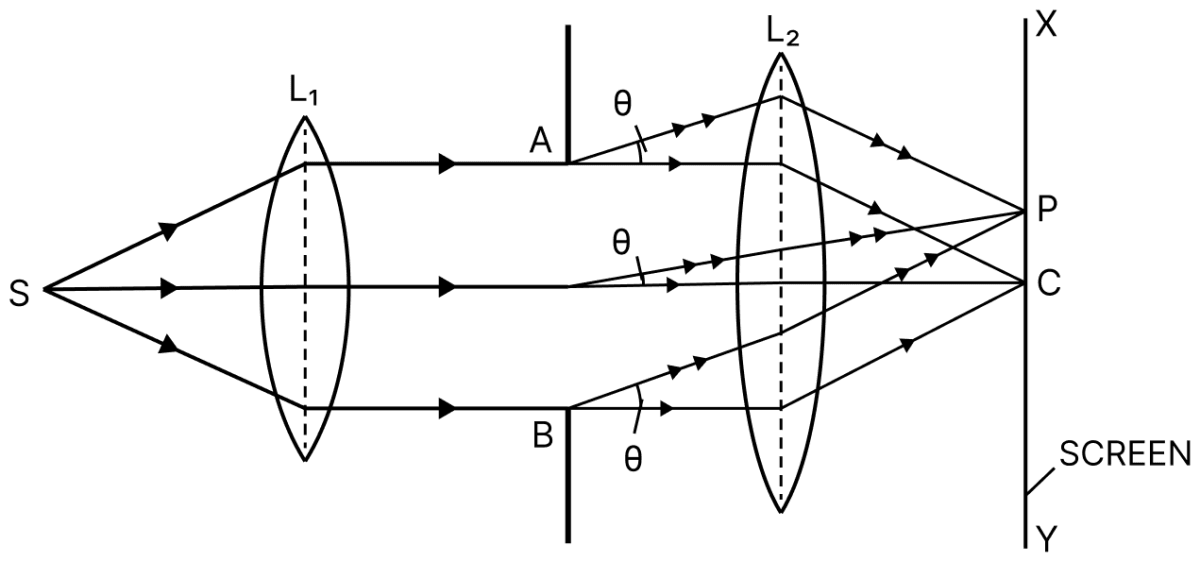
(i) State the essential condition for diffraction of light to occur.
(ii) Which type of wavefront is most suitable for observing a single-slit diffraction pattern?
(iii) At the first minimum adjacent to the central maximum of a single slit diffraction pattern, what is the phase difference between the Huygens' wavelet from the edge of the slit and the wavelet from the mid-point of the slit? Monochromatic light of wavelength λ is used in the experiment.
(iv) A diffraction pattern due to a single-slit has been obtained using a beam of red light. If red light is replaced by violet light, what will be the effect on the diffraction fringes?
(v) How is the diffraction effect suppressed in Young's double slit experiment?
Answer
(i) The size of the obstacle, or aperture, must be of the order of the wavelength of light.
(ii) A plane wavefront.
(iii) π radian. At the first minimum, the path difference between the wavelets from the two edges of the slit is . The edge and the mid-point are apart, so their path difference is , which corresponds to a phase difference of .
(iv) The diffraction fringes become narrower and crowd together, because the angular width of the central maximum, , decreases as violet light has a shorter wavelength than red light.
(v) In Young's experiment the two slits are made quite narrow, so that the central maximum of the diffraction pattern of each slit becomes broad enough to cover the entire field of view. The interference fringes are then observed against a background of almost uniform intensity of the broad central diffraction maxima of the two slits.