
The ratio of the forces between two tiny bodies with constant charges in air and in an insulating medium of dielectric constant K is :
- 1 : K
- K : 1
- 1 : K2
- K2 : 1
Answer
K : 1
Reason — In vacuum (or air) the force between two point-charges is , while in a medium of dielectric constant K it is . Dividing one by the other,
Hence the two forces are in the ratio K : 1, that is, the force decreases by a factor K when a dielectric is introduced.
The dielectric constant K of an insulator can be :
- −1
- 0
- 0.5
- 5
Answer
5
Reason — The dielectric constant is defined as , the ratio of the absolute permittivity of the material to the permittivity of free space. For all dielectrics the value of K is greater than 1, its least value being K = 1 for vacuum.
The SI unit of free-space permittivity ε0 is :
- N-m2 C-2
- N-m-2 C2
- N-1-m-2 C2
- N-1-m2 C-2
Answer
N-1-m-2 C2
Reason — From Coulomb's law,
Putting the units of charge, force and distance,
which is the same as N-1-m-2 C2. Its value is 8.85 × 10⁻¹² C2 N-1-m-2.
The ratio of the gravitational and the electrostatic forces between two electrons at some distance apart is :
- 1043
- 1039
- 10-39
- 10-43
Answer
10-43
Reason — Electrical forces are much stronger than gravitational forces. For two electrons the electrical force is 1043 times the gravitational force between them, that is,
Hence the ratio of the gravitational force to the electrostatic force is 10-43.
Which one of the following is not a unit of electric field?
- N C-1
- V m-1
- J C-1
- J C-1 m-1
Answer
J C-1
Reason — The intensity of electric field is the force per unit positive charge, , so its unit is newton/coulomb (N C-1). The same unit may also be written as volt/metre (V m-1) and as J C-1 m-1. The unit J C-1 is the volt, which is the unit of electric potential and not of electric field.
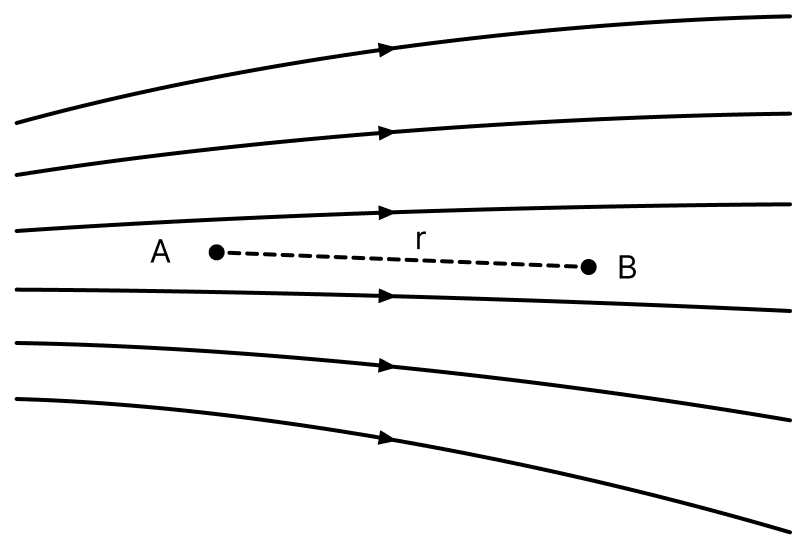
The figure shows the electric lines of force emerging from a charged body. If the electric fields at A and B are EA and EB respectively and the distance between them is r, then :
- EA > EB
- EA < EB
- EA = EB / r
- EA = EB / r2
Answer
EA > EB
Reason — The relative closeness of the electric lines of force in different regions of space indicates the relative strength of the electric field there. In the figure the lines of force are crowded together near A and are farther apart near B. Hence the field is stronger at A than at B, that is, EA > EB.
A proton and an electron are located in a uniform electric field. They will experience :
- equal forces in same direction
- forces equal in magnitude
- equal accelerations in opposite directions
- accelerations equal in magnitude
Answer
forces equal in magnitude
Reason — The force on a charge placed in an electric field is F = qE. The proton and the electron carry charges of equal magnitude e, so the magnitudes of the forces on them are the same, qE. Since their charges are of opposite sign, the two forces are oppositely directed. Their accelerations, , are unequal because the masses of the proton and the electron are very different.
The electric field intensity at a large distance x from an electric dipole is proportional to :
Answer
Reason — At a large distance from a short electric dipole, the intensity of the electric field is
In either position . On comparing the fields of a point-charge and of a dipole, the dependence is replaced by dependence.
A charge placed at a distance from an electric dipole in the end-on position experiences a force F. If the distance be doubled, the force will become :
- 2F
- F/2
- F/4
- F/8
Answer
Reason — At a point in the end-on position, at a large distance r from the dipole,
The force on a charge q placed there is F = qE, so that . If the distance is doubled,
A dipole placed in a uniform electric field at angle θ experiences :
- only a net force
- only a torque
- both a net force and a torque
- neither force nor torque
Answer
only a torque
Reason — In a uniform electric field the charge + q of the dipole experiences a force qE along the field and the charge − q an equal force qE opposite to the field. These two forces are equal and opposite, so the net translatory force on the dipole is zero. However, they act at different points and therefore form a couple whose moment is the torque
Hence the dipole experiences only a torque, which tends to align it in the direction of the field.
An electric dipole of moment placed in a uniform electric field experiences a torque which is :
- zero
Answer
Reason — The magnitude of the torque acting on a dipole of moment p placed at an angle θ to a uniform field E is τ = pE sin θ. Written in vector form this becomes
The cross product correctly gives both the magnitude pE sin θ and the direction of the torque, which is perpendicular to the plane containing and .
A charged body is moved with some velocity. While in motion :
- both the mass and the charge of the body change than that at rest
- both the mass and charge of the body do not change than that at rest
- mass is not affected but charge changes
- charge is not affected but mass changes
Answer
charge is not affected but mass changes
Reason — By the invariance property of charge, the value of a charge does not change with velocity. If a static charge q0 is moved with a velocity v, its value in the moving state remains q0. The mass, however, is a variant quantity and changes with speed according to
Hence the charge of the moving body is unaffected while its mass changes.
A glass rod is rubbed with fur and another identical glass rod is rubbed with ebonite.
- Both the glass rods acquire positive charge
- Both the glass rods will acquire negative charge
- First glass rod will acquire positive charge while the second glass rod will acquire negative charge
- First glass rod will acquire negative charge while the second will acquire positive charge
Answer
First glass rod will acquire negative charge while the second will acquire positive charge
Reason — Fur precedes glass, and glass precedes ebonite in the series. On rubbing two materials, the earlier one becomes positive and the later one negative.
Fur comes before glass, so on rubbing with fur the first glass rod gains electrons and becomes negatively charged. Glass comes before ebonite, so on rubbing with ebonite the second glass rod loses electrons and becomes positively charged.
Which of the following charge is not possible?
- 1.6 × 10⁻¹⁸ C
- 1.6 × 10⁻¹⁹ C
- 1.6 × 10⁻²⁰ C
- None of these
Answer
1.6 × 10⁻²⁰ C
Reason — By the quantisation of electric charge, the charge on a body must be an integral multiple of the elementary charge e = 1.6 × 10⁻¹⁹ C, that is, q = ± ne where n = 1, 2, 3, ... No charge is found in a fraction of e.
For 1.6 × 10⁻²⁰ C,
which is not an integer. Hence a charge of 1.6 × 10⁻²⁰ C is not possible.
Five balls numbered 1 to 5 balls suspended using separate threads. Pair (1, 2), (2, 4) and (4, 1) show electrostatic attraction, while pair (2, 3) and (4, 5) show repulsion. Therefore ball 1 must be :
- positively charged
- negatively charged
- neutral
- made of metal
Answer
neutral
Reason — Repulsion is the real test of a body being charged, while attraction may also occur between a charged body and an uncharged body because of induction.
The pairs (2, 3) and (4, 5) repel, so balls 2, 3 and balls 4, 5 are charged. Balls 2 and 4 attract each other, so they carry charges of opposite sign. Ball 1 attracts both 2 and 4, which would be impossible if ball 1 were charged, since it would then repel one of them. Hence ball 1 must be neutral, the attraction being due to electrostatic induction.
Two identical metallic spheres having charges +4q and −2q are placed with their centres r distance apart. Force of attraction between the spheres is F. If the two spheres are brought in contact and then placed at the same distance r apart, the force between them is :
- F
Answer
Reason — Initially the force of attraction between the spheres is
When two identical spheres are brought in contact, the charge is shared equally between them, so each acquires
Placing them again at the same distance r,
A charge q is placed at the centre of the line joining two equal charges Q and Q. The system of the three charges will be in equilibrium if q is equal to :
- −Q/2
- −Q/4
- +Q/4
- +Q/2
Answer
Reason — Let the two charges Q be at A and B, a distance 2a apart, with q at the mid-point. The charge q is automatically in equilibrium by symmetry, so the condition is that each charge Q must be in equilibrium.
For the charge Q at A, the repulsion due to the charge Q at B and the force due to q at a distance a must cancel,
Three charges 4q, Q and q lie in a straight line at positions 0, l/2 and l respectively. The resultant force on q will be zero, if Q is equal to :
- −q
- −2q
- −q/2
- 4q
Answer
−q
Reason — The charge q at position l experiences a force due to the charge 4q at position 0, which is at a distance l, and due to the charge Q at position , which is at a distance . By the principle of superposition, for the resultant force on q to be zero,
A soap bubble is charged negative. Its size will :
- not change
- increase
- decrease
- may increase or decrease
Answer
increase
Reason — The charge given to the soap bubble is a conductor's charge and spreads over its entire surface. Every element of this charge repels every other element, since all the charge is of the same sign. This outward electrostatic repulsion acts against the surface tension of the film, so the bubble expands and its size increases.
Two point charges A and B having values +q and −q when placed at some distance experience Coulomb force F. If 25% charge of A is transferred to B, the Coulomb force will become :
- F
Answer
Reason — Initially the magnitude of the Coulomb force is
When 25% of the charge of A is transferred to B,
The new force is
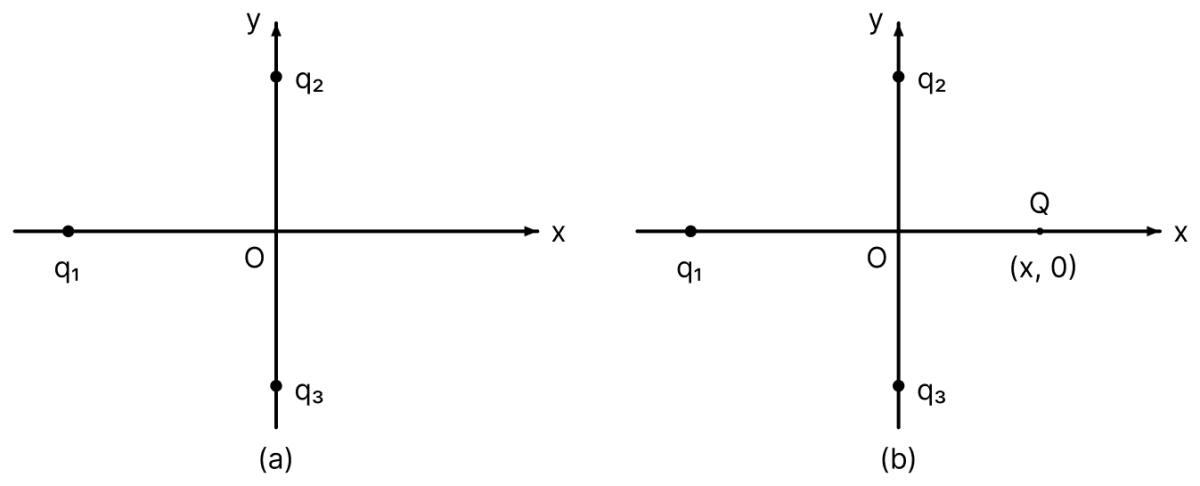
In fig. two positive charges q2 and q3 fixed along the y-axis, exert a net electric force in the + x direction on a charge q1 fixed along the x-axis. If a positive charge Q is added at (x, 0), the force on q1 :
- shall increase along the positive x-axis
- shall decrease along the positive x-axis
- shall point along the negative x-axis
- shall increase but the direction changes because of the intersection of Q with q2 and q3
Answer
shall increase along the positive x-axis
Reason — The charge q1 lies on the negative x-axis and the net force on it due to the positive charges q2 and q3 is along the + x direction. Two positive charges could attract q1 towards the origin only if q1 itself is negative.
The positive charge Q is now placed at (x, 0) on the positive x-axis, that is, on the far side of the origin from q1. It therefore attracts the negative charge q1 along the + x direction as well. By the principle of superposition this force adds to the existing one, so the force on q1 shall increase along the positive x-axis.
Five point charges each of value +Q are placed on five vertices of a regular hexagon of side L. What is the magnitude of the force on a point charge of value −Q placed at the centre of the hexagon ?
- Zero
- None of these
Answer
Reason — For a regular hexagon of side L, the distance of every vertex from the centre is also L.
If charges + Q were placed at all the six vertices, the forces exerted by them on the charge − Q at the centre would cancel in pairs, since the charges at diametrically opposite vertices are equidistant and produce equal and opposite forces. The resultant would then be zero.
Here one vertex is vacant. Hence the resultant force is simply the force that would have been exerted by the missing charge + Q, with its direction reversed, that is, directed away from the vacant vertex, towards the diametrically opposite occupied vertex,
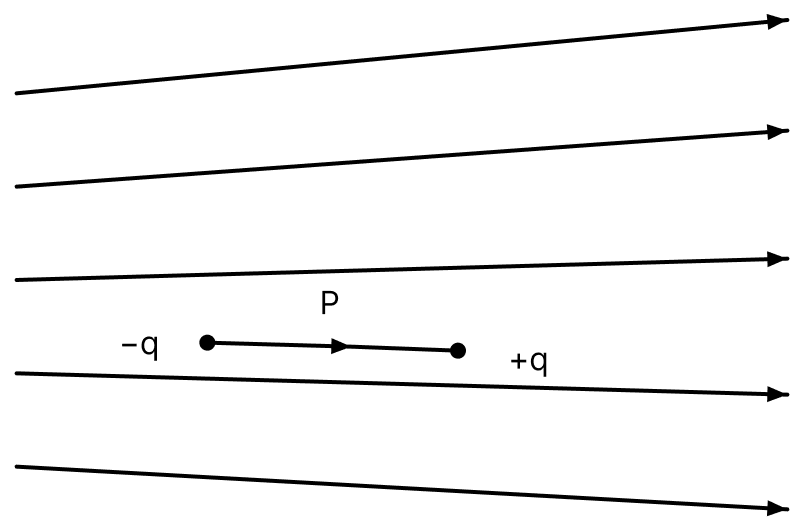
Figure below shows electric field lines in which an electric dipole P is placed as shown. Which of the following statements is correct?
- The dipole will not experience any force
- The dipole will experience a force towards right
- The dipole will experience a force towards left
- The dipole will experience a force upwards
Answer
The dipole will experience a force towards left
Reason — The field shown is non-uniform, the lines of force being crowded on the left and farther apart on the right, so that the field is stronger on the left. The dipole is placed with pointing to the right, that is, parallel to the field.
The charge − q lies in the stronger part of the field and the charge + q in the weaker part. The force on − q, directed to the left, is therefore greater in magnitude than the force on + q, directed to the right. Hence the net force on the dipole is towards the left.
A particle of charge 'q' and mass 'm' moves rectilinearly under the action of an electric field E = A − Bx where B is a positive constant and x is distance from the point where the particle was initially at the state of rest. The distance travelled by the particle till it comes to the rest is :
- 0
- 2A/B
- A/B
- B/A
Answer
Reason — The particle starts from rest at x = 0 and comes to rest again after travelling a distance d. Since the kinetic energy is zero at both ends, the total work done by the electric force over this distance is zero.
Carrying out the integration,
Two identical charged spheres suspended from a common point by two massless strings of lengths l, are initially at a distance d(d << l) apart because of their mutual repulsion. The charges begin to leak from both the spheres at a constant rate. As a result, the spheres approach each other with a velocity v. Then, v varies as a function of the distance x between the sphere, as :
- v ∝ x
- v ∝ x-1/2
- v ∝ x-1
- v ∝ x1/2
Answer
v ∝ x-1/2
Reason — For two identical charged balls hanging from a common point, with the separation x much smaller than the length l, the equilibrium condition gives
The charge leaks at a constant rate, so is a constant. Differentiating x3 ∝ q2 with respect to time,
Since ,
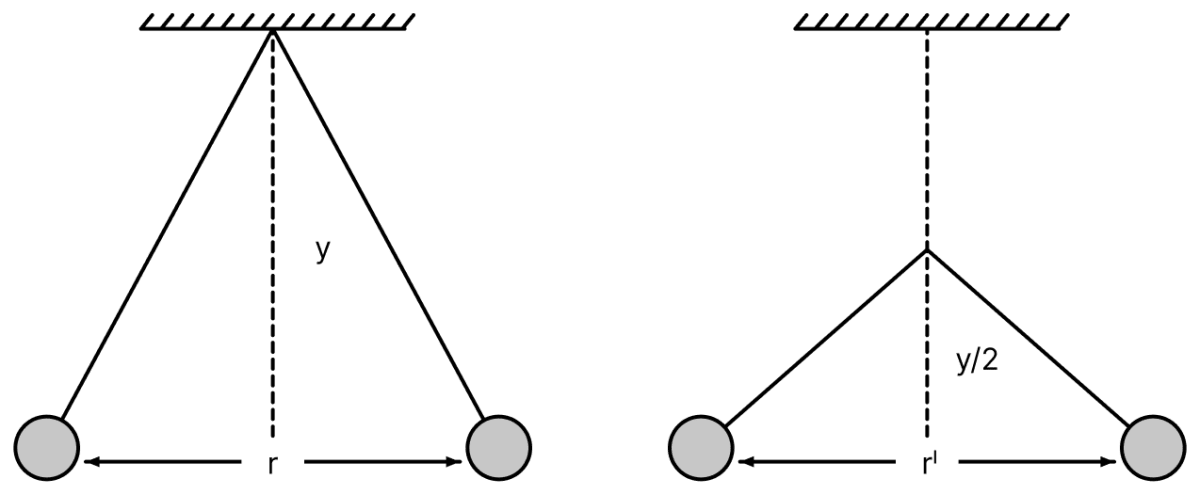
Two pith balls carrying equal charges are suspended from a common point by strings of equal length, the equilibrium separation between them is r. Now, the strings are rigidly clamped at half the height. The equilibrium separation between the balls now becomes :
Answer
Reason — Let y be the vertical distance of the balls below the point of suspension. For a small angle θ,
When the strings are clamped at half the height, y is replaced by while q and m are unchanged,
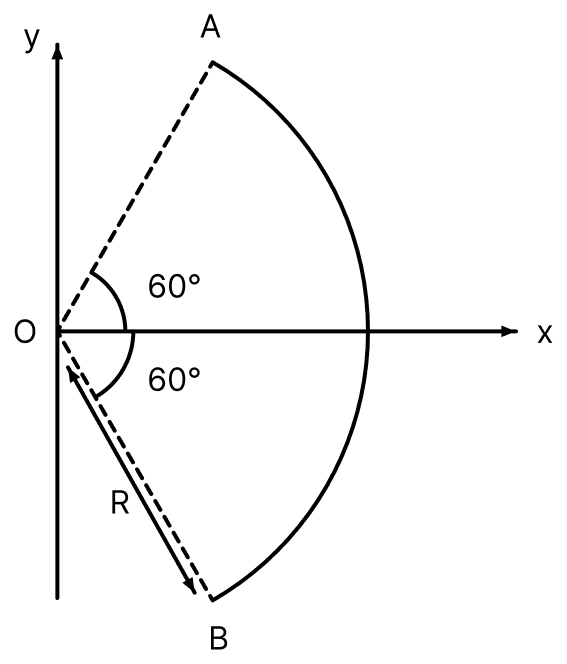
Figure shows a rod AB, which is bent in a 120° circular arc of radius R. A charge (−Q) is uniformly distributed over rod AB. What is the electric field at the centre of curvature O?
Answer
Reason — The rod is bent into an arc of radius R subtending an angle of 120° at the centre of curvature O. Its length is
so that the magnitude of the linear charge density is
For an arc subtending an angle 2α at the centre, the components perpendicular to the bisector cancel in pairs and the resultant field at the centre is
Here 2α = 120°, so α = 60° and ,
The field is directed towards the negatively charged arc, along the positive x-axis; hence it is directed along .
Three point charges +q, −2q and + q are placed at points (x = 0, y = a, z = 0), (x = 0, y = 0, z = 0) and (x = a, y = 0, z = 0), respectively. The magnitude and direction of the electric dipole moment vector of this charge assembly are :
- qa along + y direction
- aq along the line joining points (x = 0, y = 0, z = 0) and (x = a, y = a, z = 0)
- qa along the line joining points (x = 0, y = 0, z = 0) and (x = a, y = a, z = 0)
- aq along +x direction
Answer
aq along the line joining points (x = 0, y = 0, z = 0) and (x = a, y = a, z = 0)
Reason — The algebraic sum of the charges is q + (−2q) + q = 0, so the system is equivalent to an electric dipole.
The charge − 2q at the origin may be treated as two charges of − q each placed at the origin. One of them together with + q at (0, a, 0) forms a dipole of moment qa directed along + y, and the other together with + q at (a, 0, 0) forms a dipole of moment qa directed along + x.
The two component dipole moments are equal in magnitude and mutually perpendicular, so their resultant is
and it is inclined at 45° to both axes, that is, it is directed along the line joining (0, 0, 0) and (a, a, 0).
Name the basic properties of electric charge.
Answer
Additivity, conservation and quantisation of charge.
Explanation:
(i) Additivity of charge — charges add up algebraically, the positive and the negative charges cancelling each other's effect.
(ii) Conservation of charge — the total charge of an isolated system remains constant.
(iii) Quantisation of charge — the charge on a body is always an integral multiple of the elementary charge e.
Write Coulomb's formula for the force of attraction or repulsion between two point-charges.
Answer
For two point-charges q1 and q2 placed a distance r apart in vacuum (or air),
and in a medium of dielectric constant K,
where N-m2 C-2.
Does Coulomb's law of electric force obey Newton's third law of motion?
Answer
Yes.
Explanation:
The Coulomb forces exerted by two charges on each other are equal in magnitude and opposite in direction,
so they form an action-reaction pair and obey Newton's third law of motion.
Is Coulomb's law true for atomic and nuclear distances?
Answer
Yes.
Explanation:
Coulomb's law is found to hold for point-charges separated by distances ranging from very large distances down to atomic distances (~ 10-11 m) and nuclear distances (~ 10-15 m).
Define one coulomb. How many electrons will have a total charge of 1 coulomb?
Answer
One coulomb is that charge which, when placed at a distance of 1 metre from an equal and similar charge in vacuum (or air), repels it with a force of 9.0 × 10⁹ newton.
Since the charge on one electron is 1.6 × 10⁻¹⁹ C, the number of electrons carrying a total charge of 1 coulomb is
Hence, 6.25 × 10¹⁸ electrons carry a total charge of 1 coulomb.
What is meant by 'elementary charge'? What is its value?
Answer
The elementary charge is the smallest amount of free charge found in nature, of which all existing charges are integral multiples. It is denoted by e and is the magnitude of the charge on an electron.
Its value is e = 1.6 × 10⁻¹⁹ coulomb.
Which has more electrons, Fe or Fe+++? Cl or Cl-?
Answer
Fe; Cl-.
Explanation:
Fe+++ is formed by the removal of three electrons from a neutral iron atom, so Fe has more electrons. Cl- is formed by the addition of one electron to a neutral chlorine atom, so Cl- has more electrons than Cl.
State the unit of electric permittivity in terms of SI units.
Answer
C2 N-1 m-2.
Explanation:
The value of the permittivity of free space is 8.85 × 10⁻¹² C2 N-1-m-2.
Write the relation between relative permittivity εr and the absolute permittivity ε of a dielectric medium.
Answer
Explanation:
The relative permittivity is the ratio of the absolute permittivity of the medium to the permittivity of free space. It is also known as the dielectric constant K of the medium, so that we may also write . It is a dimensionless quantity.
Define 'dielectric constant' of a medium in terms of force between electric charges.
Answer
The dielectric constant of a medium is the ratio of the force between two given charges placed a certain distance apart in vacuum to the force between the same charges placed the same distance apart in that medium,
What is the dimensional formula for ?
Answer
[ML3T-4A-2].
Explanation:
From Coulomb's law, .
Taking dimensions, with [q] = [AT],
A, B and C are three charged bodies. If A and B repel each other and A attracts C, what is the nature of the force between B and C?
Answer
Attractive.
Explanation:
Since A and B repel each other, and repulsion is the real test of a body being charged, A and B carry like charges. Since A attracts C, the charge on C is opposite in sign to that on A, and hence opposite in sign to that on B as well. Therefore the force between B and C is one of attraction.
Two large conducting spheres carrying charges q1 and q2 are brought close to each other. Is the electrostatic force between them exactly given by , where r is the distance between their centres?
Answer
No.
Explanation:
Coulomb's law in this form holds only for point-charges. The spheres are large and are placed close together, so each induces a charge on the other. Because of this induction the charge distributions on the spheres no longer remain uniform, and the charges cannot be treated as though they were concentrated at the centres. Hence the force is not exactly .
The charge on a conductor is −1.6 C. How many electrons are in excess on it than normal state?
Answer
1019 excess electrons.
Explanation:
The conductor carries a negative charge, so it has an excess of electrons. For excess electrons, the quantisation relation is q = −ne,
A conductor has 2.4 × 10⁻¹⁸ C of positive charge. How many electrons are in excess or short?
Answer
A shortage of 15 electrons.
Explanation:
The conductor carries a positive charge, which means a deficiency (shortage) of electrons. The number of electrons corresponding to this charge is
If the distance between two equal point-charges is halved and their individual charges are doubled, what would happen to the force between them?
Answer
The force becomes 16 times its initial value.
Explanation:
By Coulomb's law .
On doubling each charge the numerator becomes (2q)(2q) = 4q2, and on halving the distance the denominator becomes . Hence
The force of attraction between two point-charges at a distance r apart is F. What should be the distance apart in the same medium so that the force becomes F/3? What if force becomes 3F?
Answer
For : ; for : .
Explanation:
Since , we have .
For the force to become :
For the force to become 3F :
An attracting-force of 5 N is acting between two charges of +2 μC and −2 μC placed at some distance apart. If the charges are mutually touched and placed again at the same distance, what will be the new force between them?
Answer
Zero.
Explanation:
The two charges are + 2 μC and − 2 μC, which are equal and opposite. When they are mutually touched, the charge is shared equally and each acquires
Since both the bodies are left uncharged, the new force between them is zero.
How does the force between two point-charges change, if the dielectric constant of the medium in which they are kept, increases?
Answer
The force decreases.
Explanation:
In a medium of dielectric constant K,
Write SI unit and dimensions of electric field.
Answer
N C-1; [MLT-3A-1].
Explanation:
The intensity of electric field is the force per unit positive charge, .
SI unit : newton/coulomb (N C-1), which is also written as volt/metre (V m-1).
Dimensions :
Under which condition a charged circular loop behaves as a point-charge in respect of electric field due to it?
Answer
A charged circular loop behaves as a point-charge when the point of observation lies on the axis of the loop at a distance much larger than the radius of the loop.
Explanation:
At such a distance the whole charge of the loop may be treated as concentrated at its centre, and the field falls off as , exactly as for a point-charge.
An electrostatic line of force is a continuous curve, that is, it can not have sudden breaks. Why is it so?
Answer
The electric lines of force always begin on positive charges and end on negative charges, and the tangent at any point on a line of force gives the direction of the electric field there.
If a line of force had a sudden break, the electric field would have to be zero at that place. But the field due to the combined effect of the two opposite charges cannot vanish at points lying on a line of force. Hence an electrostatic line of force must be a continuous curve without any break.
How much electric field will be produced by a point-charge of 1 C at a distance of 1 m from it in air?
Answer
9.0 × 10⁹ N C-1.
Explanation:
The intensity of the electric field due to a point-charge in air is
Substituting q = 1 C and r = 1 m,
The weight of a positively-charged particle is balanced by producing electric field between two parallel plates. State the direction of the electric field.
Answer
The electric field is directed vertically upwards.
Explanation:
The weight of the particle acts vertically downwards, so the electric force qE on it must act vertically upwards to balance the weight.
As the charge on the particle is positive, the force on it is in the direction of the field.
Electric charges of +100 μC are placed at each of the corners of a square of diagonal 2 m. What is the electric field at the centre of the square?
Answer
Zero.
Explanation:
The four equal charges of + 100 μC lie at the corners of a square, and the centre of the square is equidistant from all of them. The fields due to the charges at the two ends of either diagonal are equal in magnitude and opposite in direction, and hence cancel in pairs. Therefore the resultant electric field at the centre of the square is zero.
What is an electric dipole? Give two examples.
Answer
An electric dipole is a pair of equal and opposite point-charges placed at a short distance apart.
Examples : The HCl molecule and the H2O molecule are electric dipoles, since in each of them the centre of the positive charges and the centre of the negative charges do not coincide, although the net charge on the molecule is zero.
Write the dimensions of electric dipole moment.
Answer
The dimensions of electric dipole moment are [LTA].
Explanation:
The electric dipole moment is p = q × 2l, that is, charge multiplied by distance.
Its SI unit is coulomb-metre (C-m).
Write intensities of electric field due to an electric dipole formed by charges − q and + q, at points at a large distance r in : (i) end-on position, (ii) broad-side-on position.
Answer
(i) End-on position :
directed along the dipole axis, pointing from − q to + q.
(ii) Broad-side-on position :
directed antiparallel to the dipole moment .
Note: The printed answer gives for the broad-side-on position also. This is a misprint: the chapter's own derivation of the equatorial field gives , half the end-on value.
On going away from a point-charge, the electric field due to the charge decreases. This is also true for a small electric dipole. Does the electric field decrease at the same rate in both cases?
Answer
No, the electric field does not decrease at the same rate in the two cases.
Explanation:
For a point-charge the field falls off as the inverse square of the distance, , whereas for a short electric dipole it falls off as the inverse cube, .
Hence the field of a dipole decreases more rapidly with distance than the field of a point-charge. This happens because the fields of the two equal and opposite charges of the dipole tend to cancel each other at large distances.
The tyres of aircrafts are not made of ordinary rubber (which is an insulator) but of a special rubber which is slightly conducting. Why?
Answer
During landing, the tyres of an aircraft rub against the airstrip and become highly charged by friction.
If the tyres were made of ordinary rubber, which is an insulator, this charge would stay at the place where it is produced and would go on accumulating, which could produce a spark. Since the special rubber used is slightly conducting, the charge does not accumulate on the tyres but leaks away through them to the earth.
Vehicles carrying inflammable material usually have metallic chains touching the ground during motion. Why?
Answer
While the vehicle is in motion, its body becomes charged because of friction with the air.
If a large amount of charge accumulates on the body, it can produce a spark and the inflammable material being carried may catch fire. To prevent this mis-happening, metallic chains are hung from the vehicle so as to touch the ground, so that any charge accumulated on the vehicle continuously leaks to the earth.
How many electrons must be removed from a piece of metal to give it +1.0 × 10⁻⁷ C of charge?
Answer
An electron carries a charge of − 1.6 × 10⁻¹⁹ C. The removal of one electron from the metal leaves a charge of + 1.6 × 10⁻¹⁹ C on it.
Hence, by the quantisation of charge, the number of electrons to be removed to give the metal a charge of + 1.0 × 10⁻⁷ C is
Hence, 6.25 × 10¹¹ electrons must be removed.
A charge q is divided into two parts such that they repel each other with a maximum force when placed at a certain distance apart. How has the charge been divided?
Answer
Let the two parts be q' and (q − q'), placed a constant distance r apart. The force between them is
For F to be maximum, .
Differentiating with respect to q', keeping q and r constant,
Putting this equal to zero,
Hence, the charge q should be divided into two equal parts.
Is there any lower limit of electric force between two charges 1 m apart in vacuum?
Answer
Yes.
Explanation:
By the quantisation of charge, the smallest possible charge that can exist in the free state is the elementary charge e = 1.6 × 10⁻¹⁹ C. Hence the smallest possible electric force between two charges 1 m apart in vacuum is
Hence, the lower limit of the electric force is 2.3 × 10⁻²⁸ N.
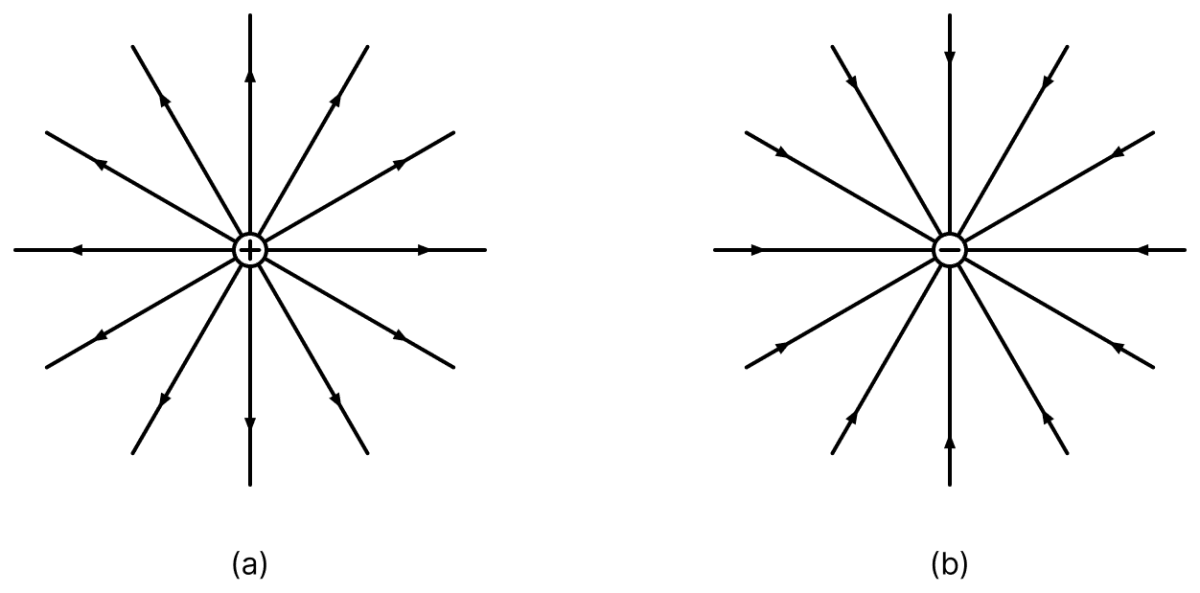
Define electric lines of force and give their two important properties. Sketch them for isolated positive and negative test-charges.
Answer
Electric line of force : An electric line of force is that imaginary smooth curve drawn in an electric field along which a free, isolated positive charge moves. The tangent drawn at any point on the line of force gives the direction of the electric field at that point.
Two important properties :
(i) Two lines of force can never intersect each other, for if they did there would be two different directions of the electric field at the point of intersection, which is impossible.
(ii) The relative closeness of the lines of force indicates the relative strength of the field — where the lines are closer the field is stronger, and where they are farther apart the field is weaker.
Lines of force for isolated test-charges : For an isolated positive charge the lines of force are straight and directed radially outwards, while for an isolated negative charge they are straight and directed radially inwards.
When we draw lines of force for two equal positive charges, the neutral point is found at the mid-point of the line joining the charges. If the two charges are unequal, then?
Answer
If the two positive charges are not equal, the neutral point will not lie at the middle of the line joining them.
At the neutral point the fields due to the two charges must be equal and opposite. If q1 and q2 are the magnitudes of the charges and r1 and r2 their respective distances from the neutral point, then
Hence the neutral point lies nearer to the smaller of the two charges.
Why do electric lines of force never intersect each other?
Answer
The tangent drawn at any point on a line of force gives the direction of the electric field at that point.
If two lines of force intersected at a point, then two tangents could be drawn at the point of intersection, which would mean two different directions of the electric field at the same point. This is impossible, since the electric field at a given point can have only one direction. Hence electric lines of force never intersect each other.
Two point-charges + q and − q are situated at a distance from each other. At what points is the resultant electric field parallel to the line joining the charges?
Answer
The resultant electric field is parallel to the line joining the two charges at :
(i) all points lying on the right bisector (the equatorial line) of the line joining the charges, where the resultant field is antiparallel to the dipole axis, and
(ii) all points lying along the axis of the line joining the two charges, where the resultant field is along the dipole axis.
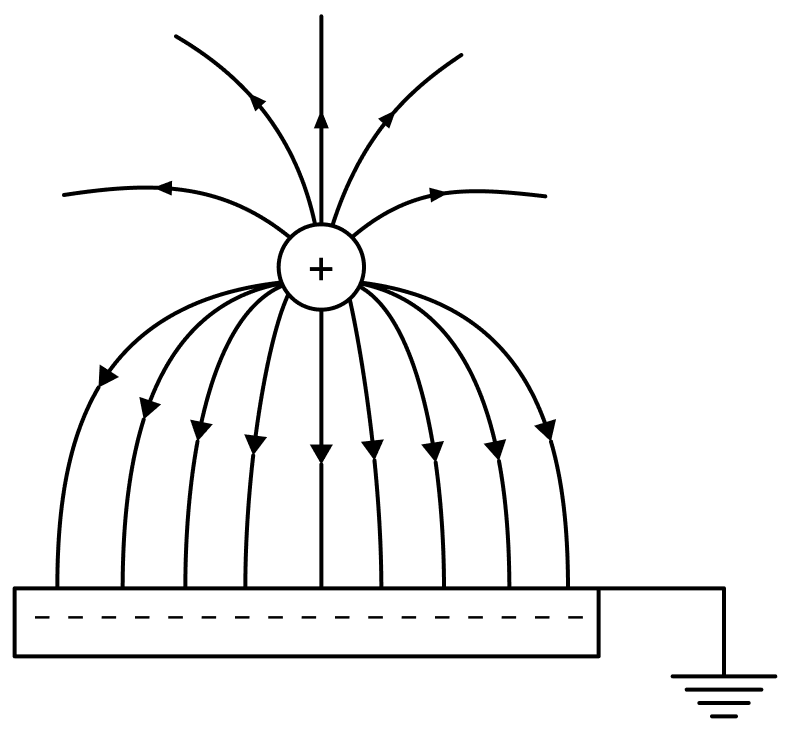
In the adjoining diagram, electric lines of force are drawn between a positively-charged ball and a large metallic plate connected to the earth. What conclusion can you draw regarding the electric-field inside and outside the plate? Will these conclusions be true for a non-metallic plate?
Answer
The lines of force do not enter the plate at all, which means that the electric field inside the metallic plate is zero.
Further, the lines of force meet the surface of the plate normally. This means that just outside the plate the electric field is normal to its surface, that is, the electric potential is uniform over the whole surface of the plate.
These conclusions are not true for a plate of non-metal, because an insulator has practically no free electrons and hence the field is not reduced to zero inside it.
A charged particle is free to move in an electric field. Will it always move along a line of force?
Answer
Not always.
Explanation:
If the electric lines of force are straight and the positive charge is released from rest, the force on it is always along the same straight line, so the charge does move along the line of force.
But if the lines of force are curved, the charge is accelerated at every point along the tangent to the line of force at that point. Because it already possesses a velocity acquired earlier, its resultant path deviates from the line of force. Hence in a curved field the charged particle does not follow the path of the line of force.
An electron and a proton are freely situated in an electric field E. Will the electric forces on them be equal? Accelerations?
Answer
Forces : The magnitudes of the charges on the electron and the proton are equal, each being e. Since F = qE, the electric forces on them, eE, are equal in magnitude but opposite in direction, because their charges are of opposite sign.
Accelerations : The accelerations are not equal, since
The electron, being much lighter than the proton, has a much greater acceleration.
Two point-charges of unknown magnitudes and signs are placed at a distance apart. The electric field is zero at a point between the charges on the line joining them. What can we conclude about the signs and the magnitudes of the charges?
Answer
Since the electric field vanishes at a point lying between the two charges, the fields there due to the two charges must be oppositely directed. This is possible only if the two charges are of the same sign.
If C is the point of zero field between A and B, then
Hence the magnitudes of the charges are in the ratio of the squares of their distances from the point of zero field.
Two point-charges of unknown magnitudes and signs are placed at a distance apart. The electric field is zero at a point, not between the charges but on the line joining them. Write two essential conditions for this to happen.
Answer
The two essential conditions are :
(i) The charges q1 and q2 must be of opposite signs, for only then can their fields be oppositely directed at a point lying outside the two charges.
(ii) The magnitude of the charge nearer to that point must be smaller than that of the other charge, so that the two fields can become equal there.
If the charges are a distance r apart and the point of zero field is at a distance x from the smaller charge q1, then their magnitudes are related by
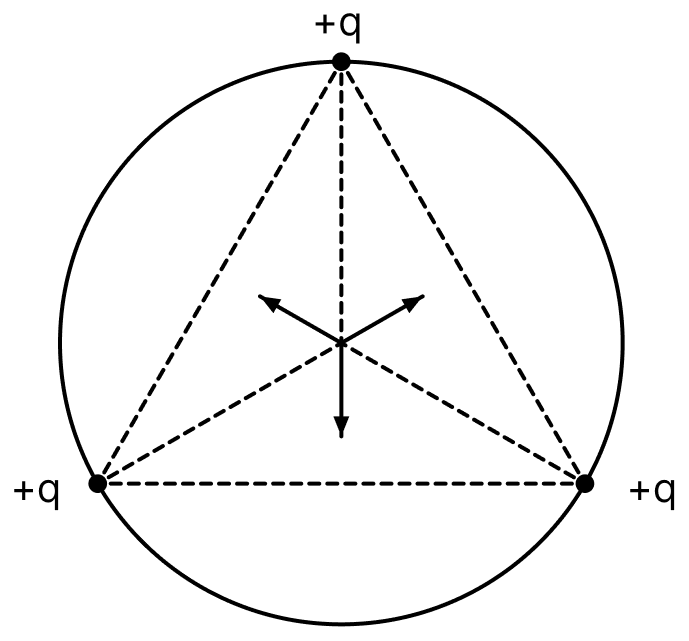
Three small spheres each having a charge + q are placed on the circumference of a circle such that they form an equilateral triangle, as shown. Find intensity of electric field at the centre of the circle.
Answer
Zero.
Explanation:
The three charges + q are equal and are placed at the corners of an equilateral triangle inscribed in the circle, so the centre of the circle is equidistant from all of them. Hence the three fields at the centre are equal in magnitude, and the angle between each pair of them is 120°.
Three equal vectors inclined at 120° to one another add up to zero. Hence the resultant intensity of the electric field at the centre of the circle is zero.
Define electric dipole moment and write its SI unit.
Answer
Electric dipole moment : The dipole moment of an electric dipole consisting of charges − q and + q separated by a small distance 2l is a vector of magnitude
Its direction is along the line joining the two charges, pointing from the negative charge towards the positive charge, that is, along the dipole axis.
SI unit : coulomb-metre (C-m).
An electric dipole is held at an angle θ in a uniform external electric field . Will there be any (i) net translatory force, (ii) torque acting on it? Explain what happens to the dipole on being released.
Answer
The uniform field exerts a force qE on the charge + q along the field and an equal force qE on the charge − q opposite to the field.
(i) Net translatory force : These two forces are equal and opposite, so the net translatory force on the dipole is zero.
(ii) Torque : The two forces do not act along the same line, so they form a couple. The torque acting on the dipole is
On being released, this restoring couple turns the dipole so as to align it parallel to the field .
An electric dipole is free to move in a uniform electric field. Explain its motion when it is placed (i) parallel to the field, (ii) perpendicular to the field.
Answer
(i) Dipole placed parallel to the field : Here θ = 0°, so the torque τ = pE sin θ is zero, and the net translatory force in a uniform field is also zero. Hence the dipole will not move; it is in the position of stable equilibrium.
(ii) Dipole placed perpendicular to the field : Here θ = 90°, so the torque is maximum, τ = pE, while the net translatory force is still zero. Hence the dipole rotates about its centre until it becomes parallel to the electric field.
An electric dipole is kept (i) parallel, (ii) perpendicular to a 'non-uniform' electric field. What will be the motion of the dipole?
Answer
In a non-uniform field the forces on the two charges of the dipole are unequal, so a net force also acts on it in addition to the torque.
(i) Dipole parallel to the field : The torque is zero, but the forces on + q and − q are unequal. Hence a resultant force acts on the dipole and it undergoes translational motion in the direction of the net force.
(ii) Dipole perpendicular to the field : Here a torque as well as a net force acts on the dipole. Hence it has both translational and rotational motion.
Sketch the electric lines of force due to point-charges (i) q < 0, (ii) q > 0.
Answer
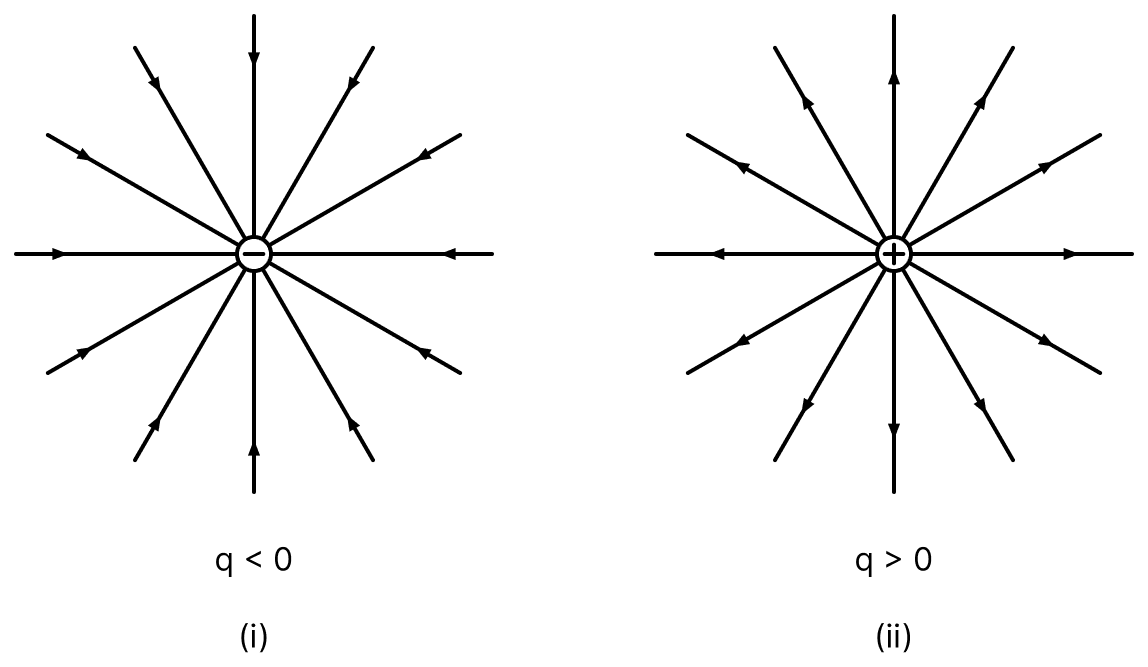
(i) For q < 0 : The lines of force are straight and are directed radially inwards, since a free positive test-charge placed in the field would move radially towards the negative charge.
(ii) For q > 0 : The lines of force are straight and are directed radially outwards, since a free positive test-charge would be repelled radially away from the charge.
Figure shows electric lines of force due to two point-charges q1 and q2 placed at points A and B respectively. Write the nature of charges.
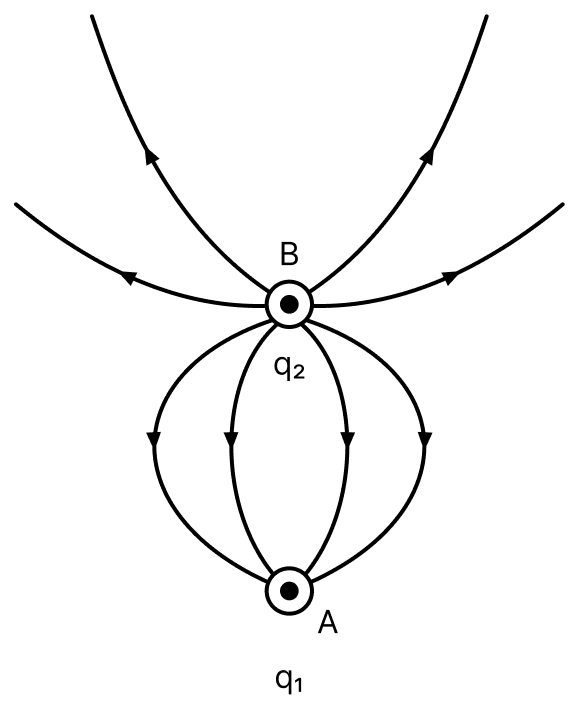
Answer
q1 is negative; q2 is positive.
Explanation:
The lines of force originate on positive charges and terminate on negative charges. In the figure the lines of force start from the charge q2 at B and end on the charge q1 at A. Hence q2 is positive and q1 is negative.
Consider the situation shown in the figure. What are the signs of q1 and q2?
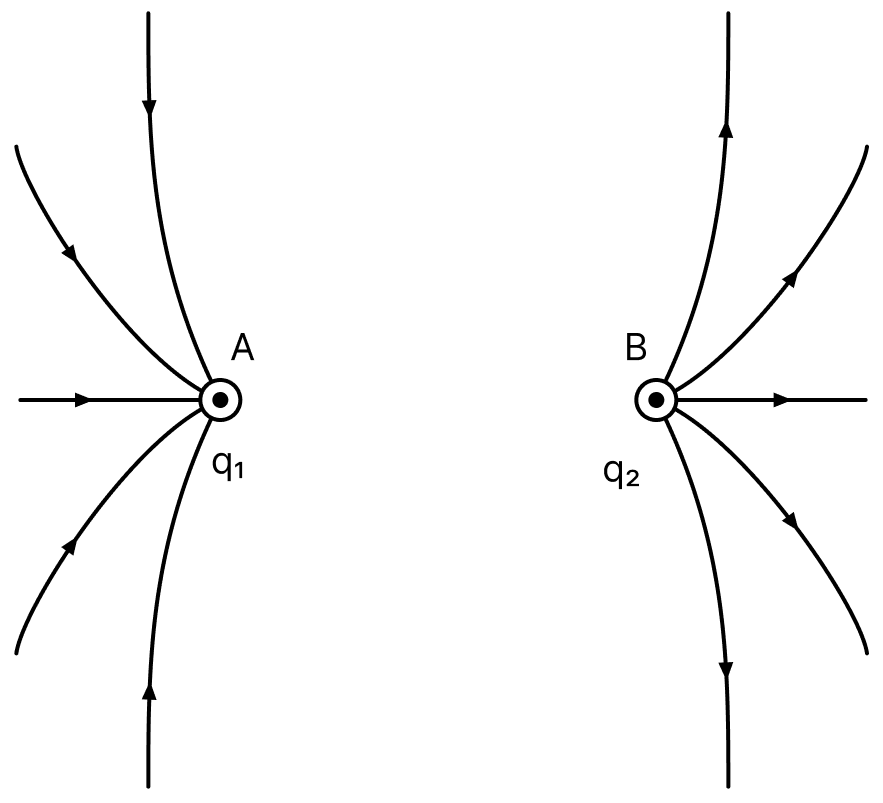
Answer
q1 is negative; q2 is positive.
Explanation:
Since the electric lines of force begin on positive charges and end on negative charges, the charge at B from which the lines of force emerge is positive, while the charge at A on which the lines of force terminate is negative.
Explain the meaning of the statement "electric charge of a body is quantised." Why can we ignore quantization of electric charge when dealing with large charges?
Answer
Quantisation of electric charge : Millikan's oil-drop experiment and many other experiments have shown that in nature electric charges are found to be made up of integral multiples of a smallest amount of charge. This smallest amount is 1.6 × 10⁻¹⁹ coulomb, denoted by e, and is the magnitude of the charge of an electron.
Hence the charge q on any body must be given by
No charge is ever found to be a fraction of e, such as 0.7e or 2.5e. In other words, electric charge exists in the form of discrete packets and not in continuous amounts, and cannot be divided indefinitely. This property is called the quantisation, or atomicity, of charge. Since e is the smallest unit of charge, it is called the elementary charge.
The charges of some natural elementary particles are
charge of electron = -e,
charge of proton = +e,
charge of -particle = +2e
Why quantisation may be ignored for large charges : The value of the elementary charge is extremely small compared with the charges met with in ordinary experiments. A charge of even one microcoulomb contains about 1013 elementary charges.
For example, nearly 3 × 10¹⁸ elementary charges flow per second at one end of a 100-watt bulb filament, and an equal number flow out at the other end. When the number of elementary charges is so enormous, the addition or removal of a few of them makes no perceptible difference. The charge then appears to vary continuously. Hence, while dealing with large charges, the quantisation of charge can be ignored and the charge treated as a continuous quantity.
State and explain (i) the law of conservation of charges, with examples, (ii) the principle of superposition as applied to electrostatic forces on a charge due to a number of charges.
Answer
(i) Law of conservation of charge : The total amount of charge in an isolated system remains constant. Charge may be transferred from one part of the system to another, but the net charge always remains the same. It means that charge can neither be created nor be destroyed.
Examples :
(a) When a glass rod is rubbed with silk, a positive charge appears on the rod and at the same time an equal negative charge appears on the silk. The net charge on the rod-silk system is zero both before and after rubbing.
(b) When an energetic γ-ray photon (charge = zero) interacts with the nuclear electric field inside an atom, it is converted into an electron (charge = − e) and a positron (charge = + e),
The net charge is zero both before and after the event.
(c) In radioactive decay the uranium nucleus (charge = + 92e) is converted into a thorium nucleus (charge = + 90e) with the emission of an α-particle (charge = + 2e),
The total charge is + 92e both before and after the decay.
(ii) Principle of superposition : Coulomb's law gives the electric force between two point-charges. If a system contains a number of interacting charges, then the net force on any one charge due to the other charges is the vector sum of all the forces exerted on it by all the other charges. The individual forces are unaffected by the presence of the other charges.
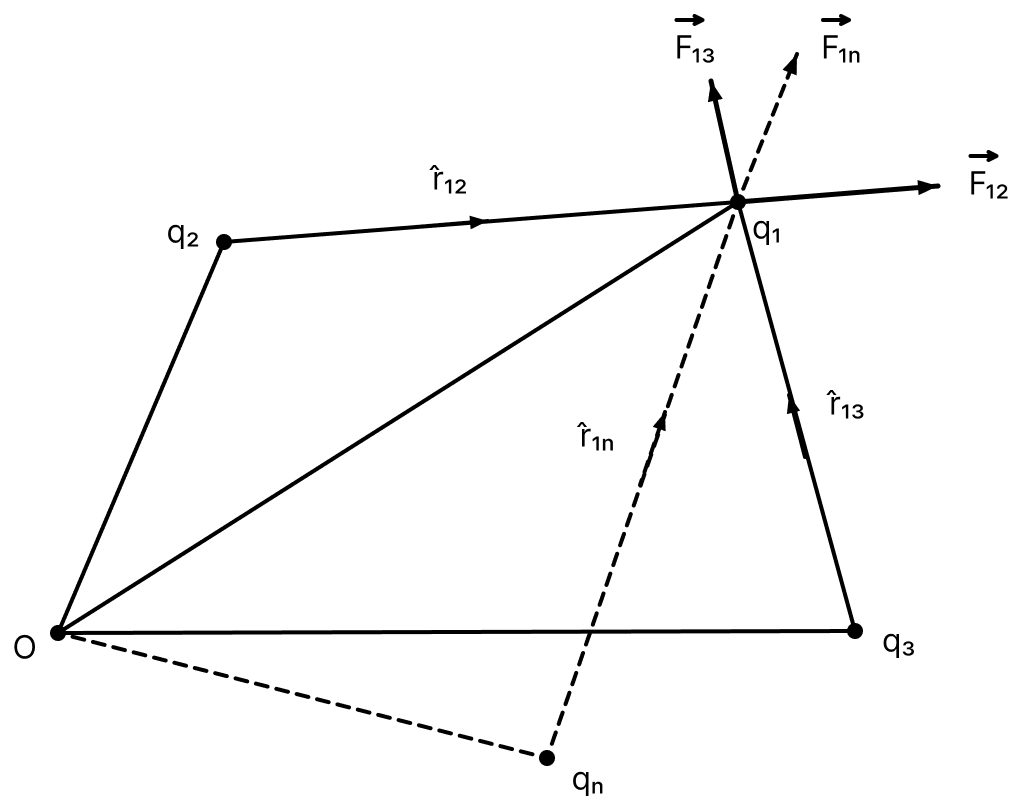
For a system of n point-charges q1, q2, ..., qn, the force on q1 due to all the other charges is
Here is the distance between and , and is the unit vector directed from towards , for .
Thus the force which two charges exert on each other is not changed by the presence of the other charges.
State Coulomb's law in electrostatics. Express it in SI units. Mention two similarities and two dissimilarities between electrostatic and gravitational interactions.
Answer
Coulomb's law : Two stationary point-charges repel or attract each other with a force which is directly proportional to the product of the charges and inversely proportional to the square of the distance between them. This force acts along the line joining the two charges.
Thus, if two point-charges q1 and q2 are situated a distance r apart,
In SI units, with force in newton, distance in metre and charge in coulomb, and the charges placed in vacuum (or air),
where ε0 = 8.85 × 10⁻¹² C2 N-1-m-2 is the permittivity of free space.
Similarities between electrostatic and gravitational interactions :
(i) Both are inverse-square forces, , the charge q playing the same role in Coulomb's law as the mass m does in the law of gravitation.
(ii) Both are central forces, acting along the line joining the two bodies, and both obey Newton's third law of motion.
Dissimilarities between electrostatic and gravitational interactions :
| Property | Electrostatic interaction | Gravitational interaction |
|---|---|---|
| Nature | It may be attractive or repulsive because charge is of two types, positive and negative. | It is always attractive because mass is of one type. |
| Effect of medium | It depends on the medium and decreases K times in a medium of dielectric constant K. | It is independent of the medium; G is a universal constant. |
Express Coulomb's law in electrostatics in vector form. What is the importance of the vector form of the law?
Answer
Coulomb's law in vector form : Let two charges q1 and q2 be placed at the points A and B with position vectors and respectively.
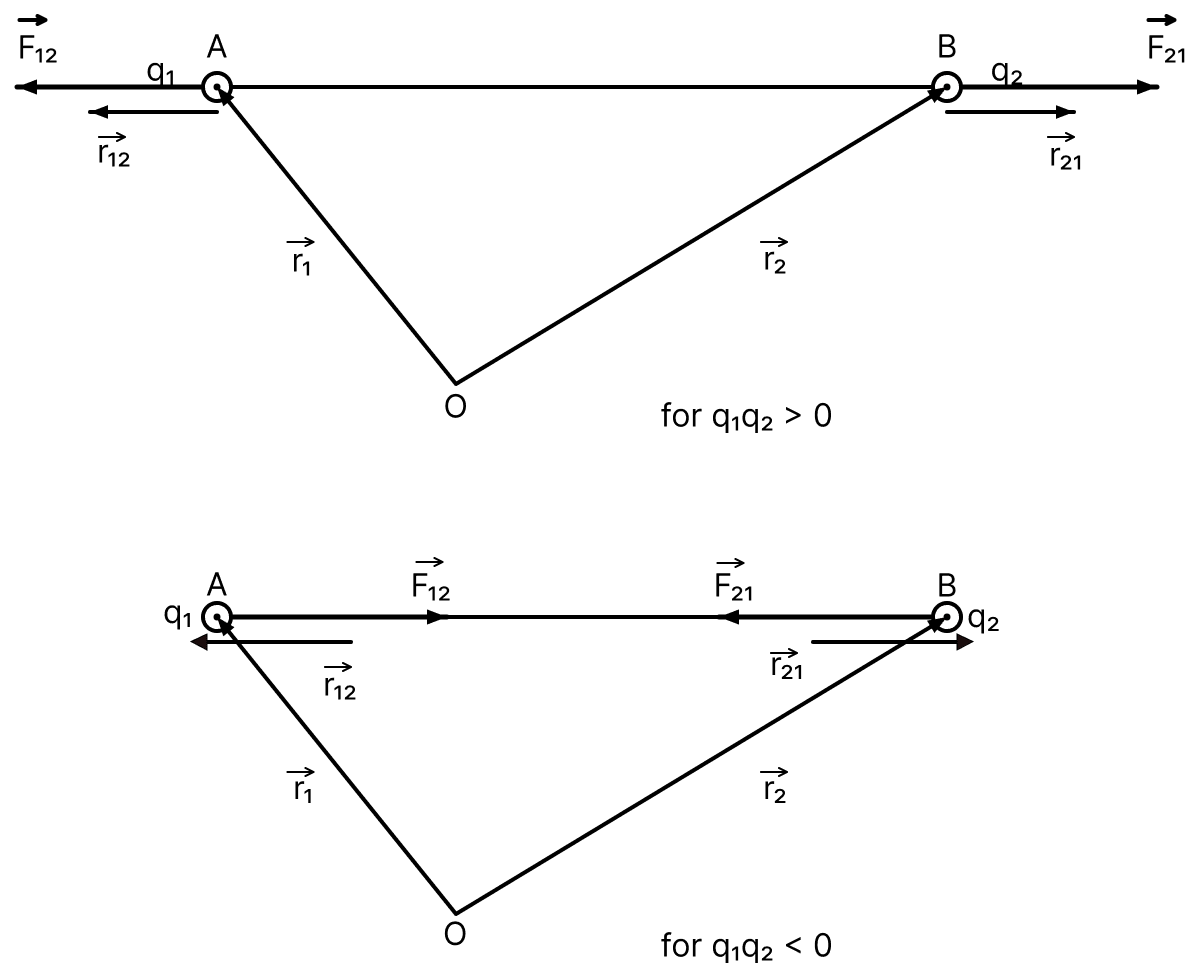
Let be the unit vector pointing from q2 towards q1 and the unit vector pointing from q1 towards q2, and let r be the distance between the charges,
Then the force on the charge q1 due to the charge q2 is
and the force on the charge q2 due to the charge q1 is
These two equations hold for all conditions of q1 and q2. If the charges are of like sign (q1q2 > 0), the forces are repulsive, and if they are of opposite sign (q1q2 < 0), the forces are attractive.
Note: The lower panel of printed Fig. 7 reverses the displacement arrows. Geometrically, must point from B to A and from A to B.
Importance of the vector form : It gives the following additional information.
(i) Since and are unit vectors in opposite directions, . It then follows from equations (i) and (ii) that
that is, the forces exerted by the two charges on each other are equal and opposite, so that Newton's third law of motion is obeyed.
(ii) The equations also express that the forces act along the line joining the two charges. That is, the electrostatic force is a central force.
Derive an expression for the intensity of electric field at a point distant r from a point charge q.
Answer
Intensity of electric field due to a point-charge :
Suppose an isolated point-charge of + q coulomb is placed at a point O in a medium whose dielectric constant is K. Let P be a point at a distance r metre from O, at which the intensity of the electric field is to be determined.
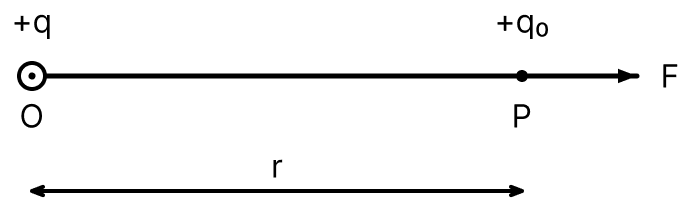
Let a test-charge q0 be placed at the point P. According to Coulomb's law, the electric force acting on q0 is
The intensity of the electric field at a point is the force experienced by a unit positive point-charge placed at that point,
Substituting the value of F,
For vacuum (or air), K = 1, so that
where N-m2 C-2.
In vector notation,
where is a unit vector pointing from the source-charge towards the point of observation.
The force on the test-charge due to the source-charge + q is a force of repulsion directed along OP. Hence the direction of at P is also along OP produced, that is, away from the charge + q. If the source-charge at O were − q, the direction of the field at P would have been along PO, that is, towards the charge.
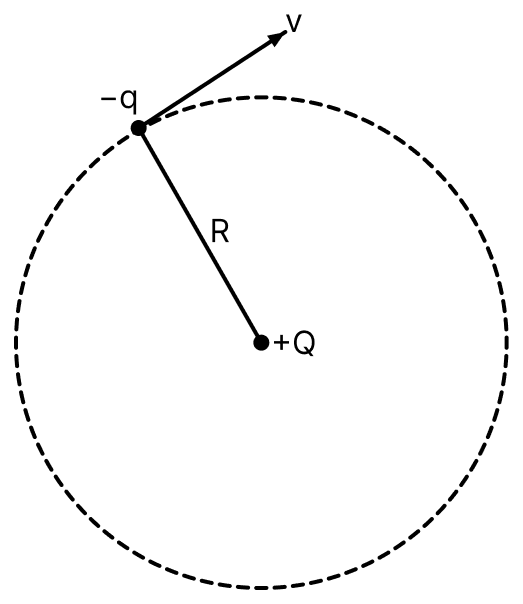
A charge −q of mass m revolves on a circular path of radius R, around a fixed point charge +Q due to electrostatic attraction. Show that its period of revolution is given by
Answer
The charge − q of mass m moves on a circular path of radius R around the fixed charge + Q. The necessary centripetal force is provided by the electrostatic force of attraction between the two charges.
Electrostatic force of attraction :
Centripetal force required :
Equating the two,
Period of revolution : The particle covers the circumference 2πR in one revolution, so
Substituting the value of v2 from equation (i),
Taking the square root,
Hence, the period of revolution is , which is the required result.
Millikan's oil-drop experiment is performed by a student. In this experiment, tiny oil drops are sprayed into a uniform electric field between a horizontal pair of oppositely charged plates. The examiner gives the requisite instructions and ask some questions to the student. State whether the responses of the student, in each case, are correct or incorrect. Give a reason for your answer.
(i) EXAMINER : If a charged oil drop of mass 1.08 × 10⁻¹⁴ kg remains stationary in an electric field of 1.68 × 10⁵ NC-1, then find the charge on the drop. (Take g = 10 m/s2) Ignore viscous force.
STUDENT : As qE = mg for stationary drop.
(ii) EXAMINER : Take a heavier oil drop. Now, to bring it in equilibrium increase the electric field strength between the plates.
STUDENT : Increases the distance between the horizontal plates without changing the source potential.
(iii) EXAMINER : Can you provide −7.2 × 10⁻¹⁹ C charge to an oil drop?
STUDENT : No, we can't provide this much charge, as it is not an integral multiple of the charge of an electron.
Answer
(i) The response of the student is correct.
Given,
- Mass of the oil drop, m = 1.08 × 10⁻¹⁴ kg
- Electric field, E = 1.68 × 10⁵ N C-1
- g = 10 m s-2
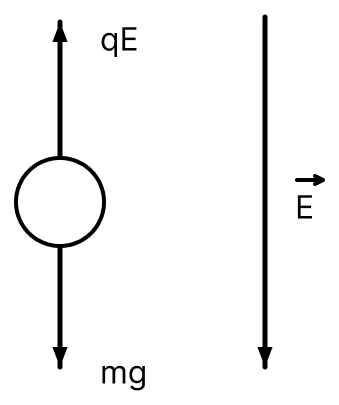
For a stationary charged oil drop the upward electric force must balance the weight of the drop,
that is, the net force on the drop must be zero. Hence
(ii) The response of the student is incorrect.
The electric field between the two parallel metal plates is
where V is the potential difference across the plates and d the separation between them. The student increases the distance d while keeping the source potential V unchanged, which decreases E instead of increasing it. To increase the field strength the plates should be brought closer together, or the source potential increased.
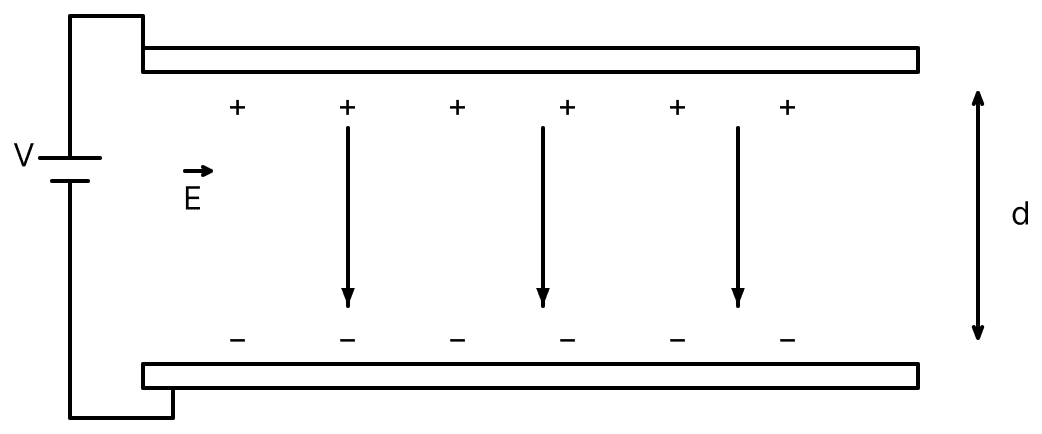
(iii) The response of the student is correct.
By the quantisation of charge, q = ± ne, where n is an integer. Here
Since n comes out to be 4.5, which is not an integer, the charge cannot be in a decimal or fraction. Hence such a charge cannot be given to an oil drop.
What is meant by electric dipole and its dipole moment? Obtain an expression for an electric field due to an electric dipole at a point on the perpendicular bisector of the dipole.
Answer
Electric dipole : An electric dipole is a pair of equal and opposite point-charges placed at a short distance apart.
Electric dipole moment : The product of one charge and the distance between the charges is called the magnitude of the electric dipole moment,
It is a vector quantity directed along the line joining the two charges, pointing from the negative charge to the positive charge. Its SI unit is coulomb-metre (C-m).
Electric field on the perpendicular bisector (broad-side-on position) :
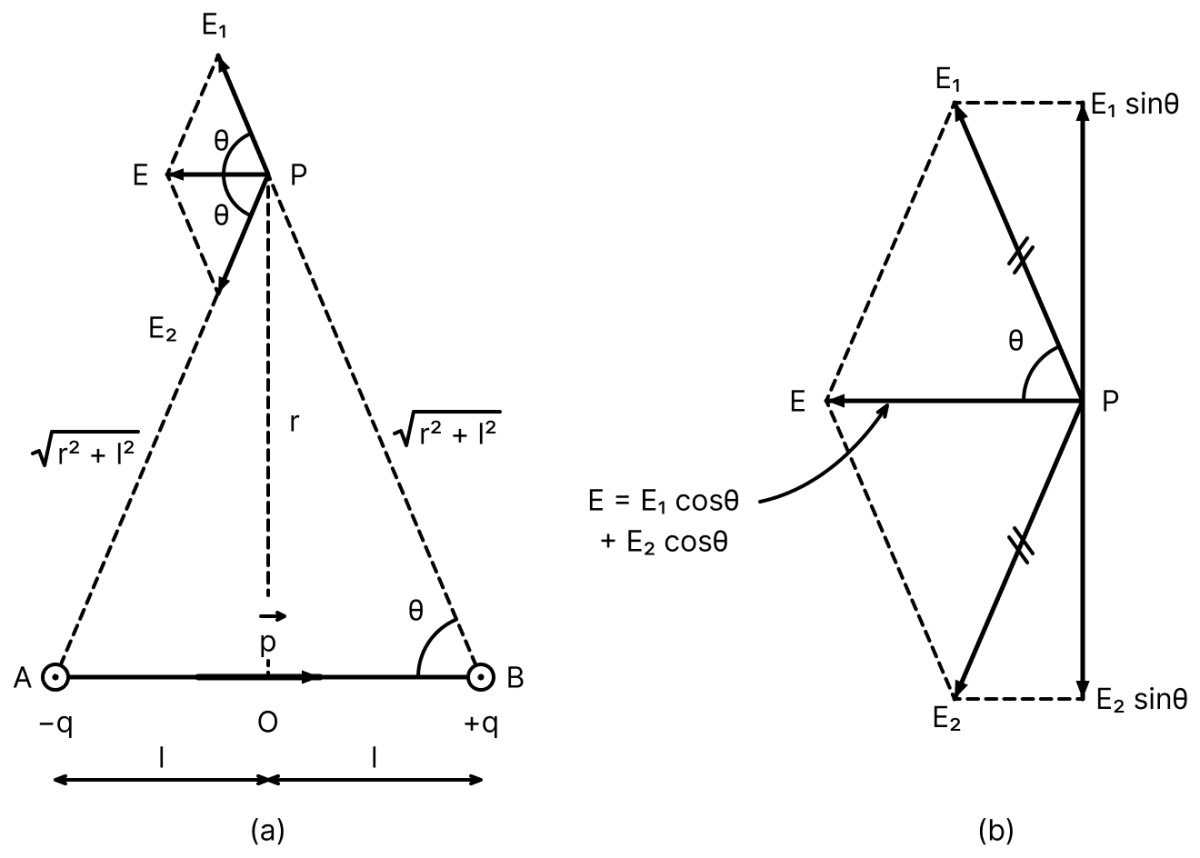
Let the dipole AB consist of charges − q and + q separated by a distance 2l, and let P be a point on the right bisector of the dipole at a distance r from its mid-point O. The distance of P from each charge is .
The magnitudes of the intensities at P due to the two charges are
The magnitudes of E1 and E2 are equal, but their directions are different. Resolving each into components parallel and perpendicular to AB, the components perpendicular to AB, E1 sin θ and E2 sin θ, are equal and opposite and hence cancel each other, while the components parallel to AB, E1 cos θ and E2 cos θ, are in the same direction and add up.
Hence the resultant intensity at P is
From the figure,
Substituting,
But 2ql = p, the electric dipole moment,
The direction of at every point of the equatorial line is antiparallel to the dipole axis.
For a short dipole, or when r >> l, the term l2 may be neglected in comparison with r2,
Electric dipole moment is vector or scalar. If it is vector show its direction and obtain an expression for an electric field due to an electric dipole at a point on the axis of the electric dipole.
Answer
Electric dipole moment is a vector quantity.
Its magnitude is p = q × 2l, the product of one charge and the distance between the charges. Its direction is along the line joining the two charges, pointing from the negative charge − q to the positive charge + q. This direction is known as the direction of the dipole axis.
Electric field at a point on the axis of the dipole (end-on position) :
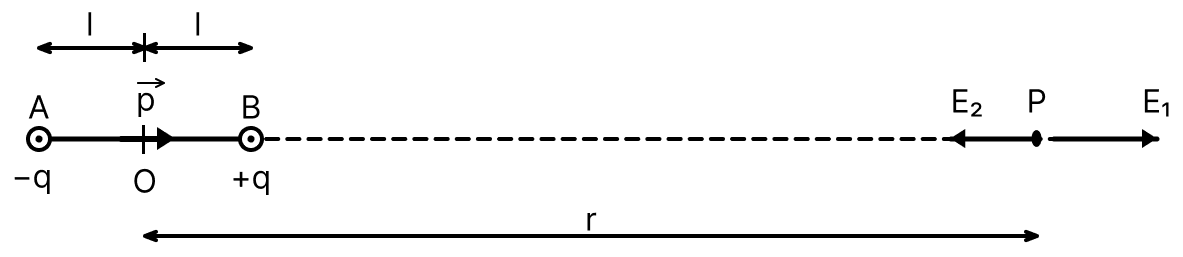
Let the dipole AB be made up of charges − q and + q separated by a distance 2l, and let P be an exterior point on the axis at a distance r from the mid-point O of the dipole, where r > l. The distance of P from + q is (r − l) and from − q is (r + l).
The magnitudes of the intensities at P due to the two charges are
E1 and E2 are along the same line in opposite directions, and E1 > E2. Hence the resultant intensity is their difference, directed along the dipole axis,
But 2ql = p, the electric dipole moment,
The direction of at every axial point outside the interval between the charges is along the dipole axis, from the negative charge towards the positive charge.
For a short dipole, or when r >> l, l2 may be neglected in comparison with r2,
Define dipole moment of an electric dipole. Show mathematically that the electric field intensity due to a short dipole at a distance r along its axis is twice the intensity at the same distance along the equatorial axis.
Answer
Dipole moment of an electric dipole : The dipole moment of an electric dipole is a vector whose magnitude is the product of one charge and the distance between the two charges,
and whose direction is along the dipole axis, from the negative charge to the positive charge.
Field of a short dipole along its axis : For a point at a distance r on the axis, the intensities due to + q and − q are oppositely directed, so that
For a short dipole, l2 is negligible compared with r2,
Field of a short dipole along its equatorial axis : For a point at the same distance r on the right bisector, the components perpendicular to the dipole axis cancel and the parallel components add up,
For a short dipole,
Comparison : Dividing equation (i) by equation (ii),
Hence, at the same distance r from a short dipole, the electric field intensity along the axis is twice the intensity along the equatorial axis, the two being oppositely directed.
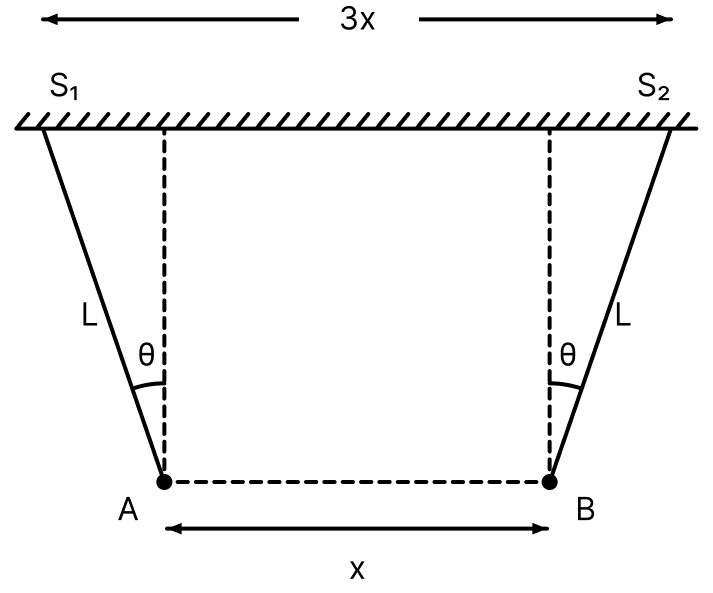
Two balls A and B of same mass M and charges +Q and −Q are suspended by two strings of same length from two different suspension points S1 and S2. At equilibrium, if S1S2 = 3x and AB = x, then show that :
(a) Tension in each string is
(b)
Answer
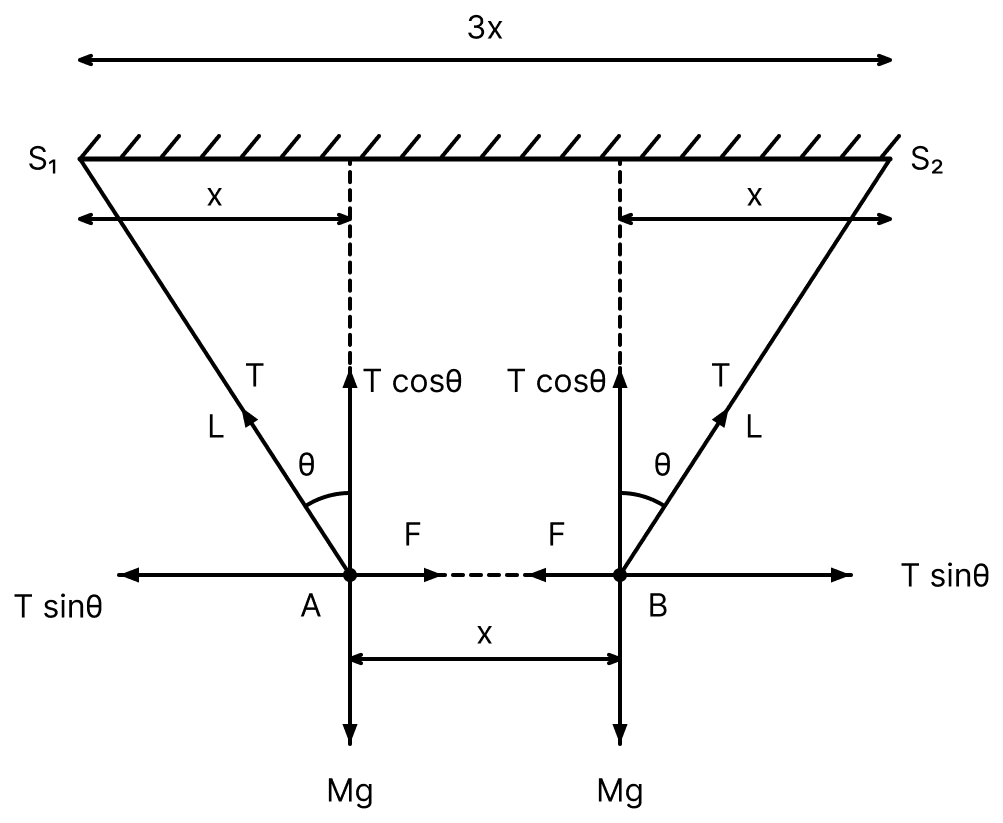
Given,
- Mass of each ball = M, charges + Q and − Q
- Length of each string = L
- Separation of the suspension points, S1S2 = 3x
- Separation of the balls, AB = x
Since the balls carry opposite charges they attract each other, so each string is drawn inwards through a horizontal distance
If θ is the angle each string makes with the vertical, then
Forces acting on the ball A :
- Weight Mg, vertically downwards
- Tension T along the string
- Electrostatic force of attraction F, horizontally towards B, where
For the equilibrium of the ball, resolving the tension into horizontal and vertical components,
(a) For the tension, substituting sin θ from equation (i) and F from equation (ii) into equation (iii),
(b) For the angle, dividing equation (iii) by equation (iv),
Hence both the required results are proved.
Figure shows a long, non-conducting, massless rod of length a, pivoted at its centre and balanced with a block of weight W at a distance 'x' from the right end. At the left and right ends of rod are attached small conducting spheres with positive charges 2q and q respectively. At distance 'd' directly below each of these spheres is a fixed sphere with positive charge Q.
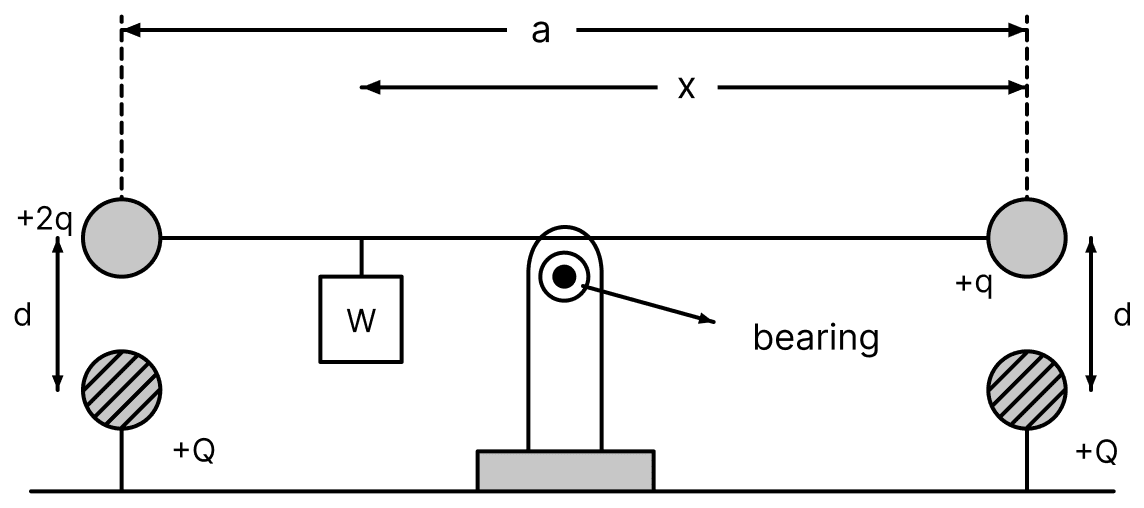
(i) Find the distance x when the rod is horizontal and balanced.
(ii) For what value of 'd' the rod exerts no vertical force on the bearing when the rod is horizontal and balanced?
Answer
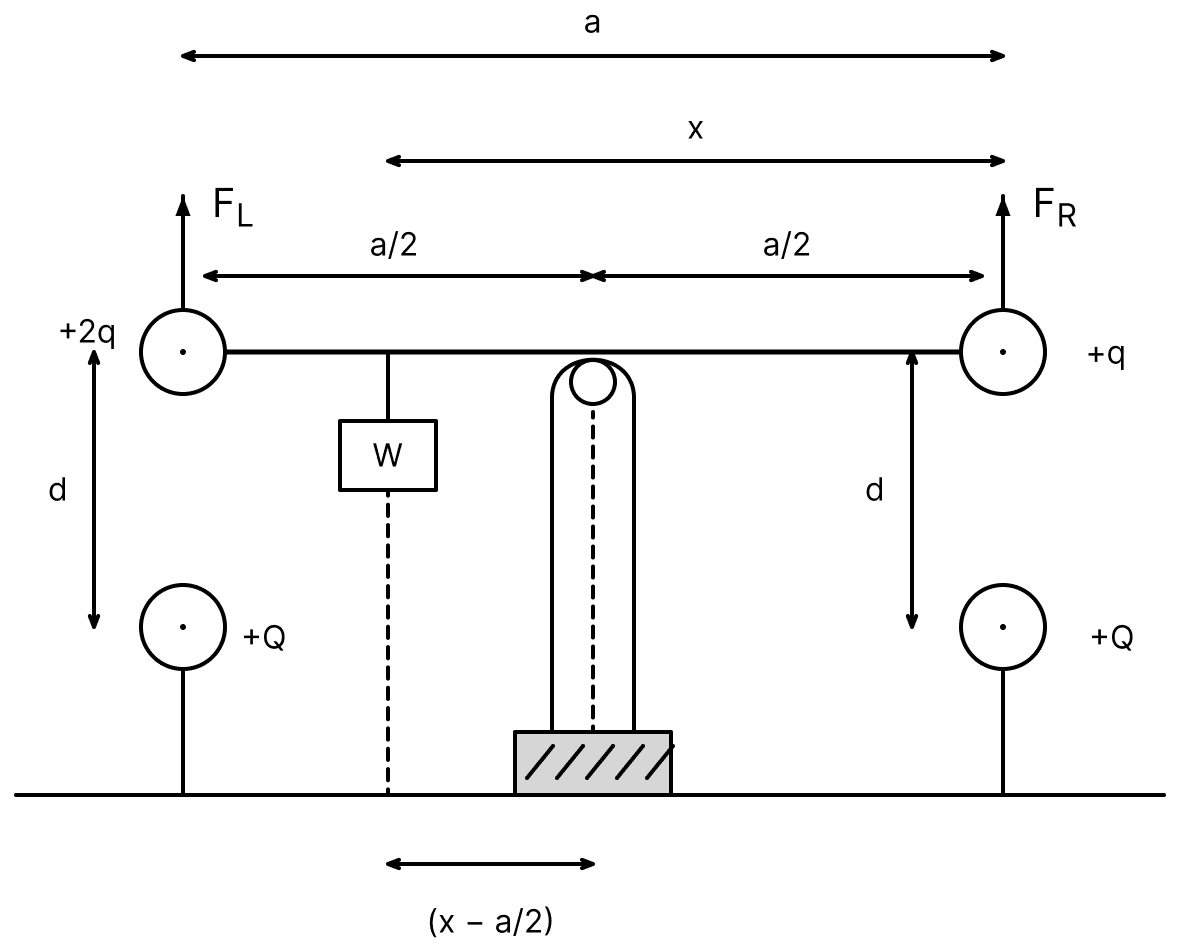
Given,
- Length of the rod = a, pivoted at its centre
- Charges at the left and right ends = 2q and q respectively
- A fixed sphere of charge + Q lies a distance d directly below each end
- The block of weight W is at a distance x from the right end
Upward electrostatic forces on the two ends : Each end-charge is repelled vertically upwards by the fixed charge + Q below it, at a distance d,
(i) Position of the block :
Since FL > FR, the charges alone tend to raise the left end, so the block must lie on the left of the pivot. Its distance from the pivot is , since it is at a distance x from the right end.
Taking moments about the pivot at the centre, each end being at a distance from it,
Substituting the forces,
(ii) Value of d for no vertical force on the bearing :
The rod is massless, so the vertical forces on it are the two upward electrostatic forces and the downward weight W of the block. If the bearing is to exert no vertical force,
The field lines for two point charges are shown as :
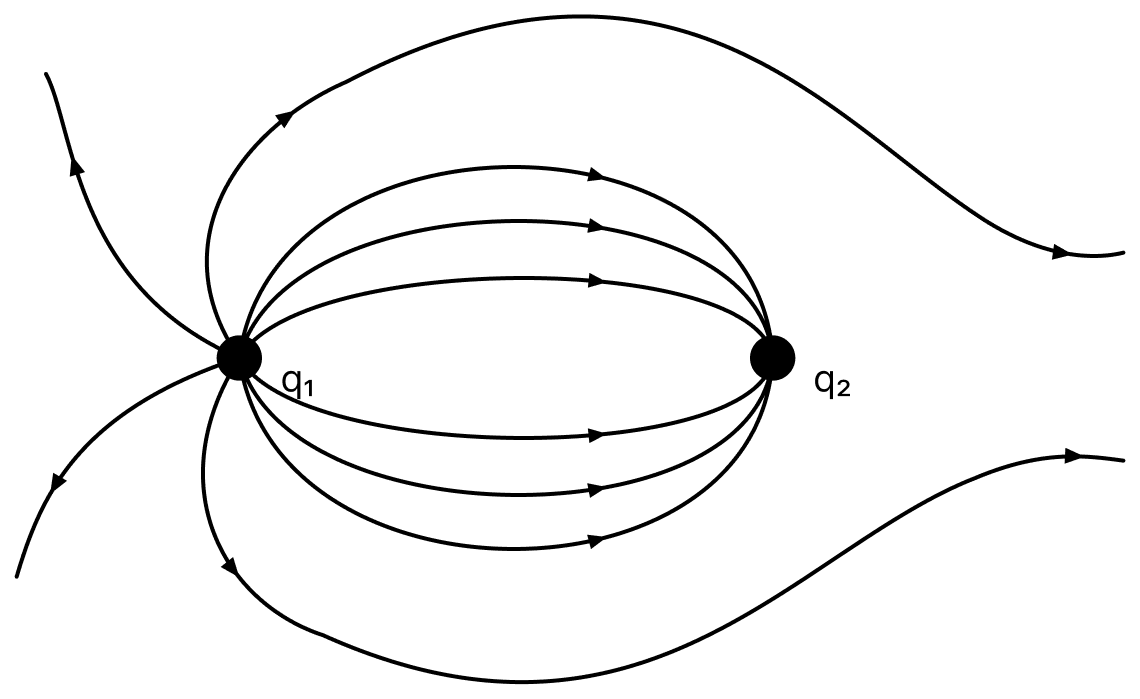
(i) Determine the ratio |q1| / |q2|.
(ii) What are the signs of q1 and q2?
(iii) If q1 and q2 are separated by a distance cm, find the position of neutral point.
(iv) Will the positive charge follow the line of force if free to move?
Answer
(i) Ratio of the magnitudes of the charges :
The number of lines of force starting from or ending on a charge is proportional to the magnitude of that charge. In the figure, twelve lines of force originate from q1 while only six of them terminate on q2, the remaining six going off to infinity. Hence
(ii) Signs of the charges :
The lines of force originate on positive charges and terminate on negative charges. The arrows in the figure point away from q1 and towards q2. Hence q1 is positive and q2 is negative.
(iii) Position of the neutral point :
Given, the separation between the charges is cm.
Since the charges are of opposite signs and |q1| > |q2|, the neutral point must lie outside the two charges, on the side of the smaller charge q2. Let it be at a distance y from q2, so that its distance from q1 is (d + y).
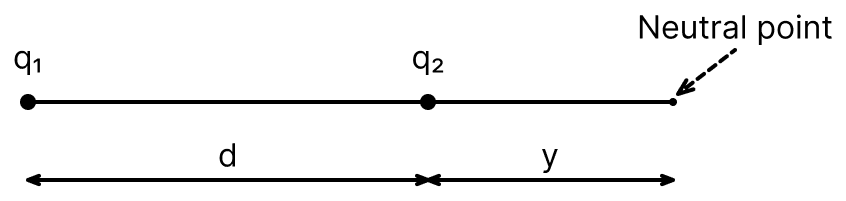
At the neutral point the two field intensities are equal in magnitude,
Hence, the neutral point lies at a distance of 5 cm from q2, on the side away from q1.
(iv) Will the positive charge follow the line of force?
No. The lines of force here are curved. A free positive charge is accelerated at every point along the tangent to the line of force at that point, but it already possesses a velocity acquired earlier. The resultant path therefore deviates from the line of force. A charged particle follows a line of force only when the lines of force are straight and the particle starts from rest.
Read the passage(s) and answer the following questions :
A system of charges form an electric dipole if the algebraic sum of its charges is zero and the centre of positive charges does not coincide with centre of negative charges. The dipole moment is defined as the total positive (or negative) charge multiplied by the distance between the centre of positive and negative charge and is directed from centre of negative charge to centre of positive charge. In a uniform electric field the torque
acts on the dipole which tends to align it such that is in the direction of .
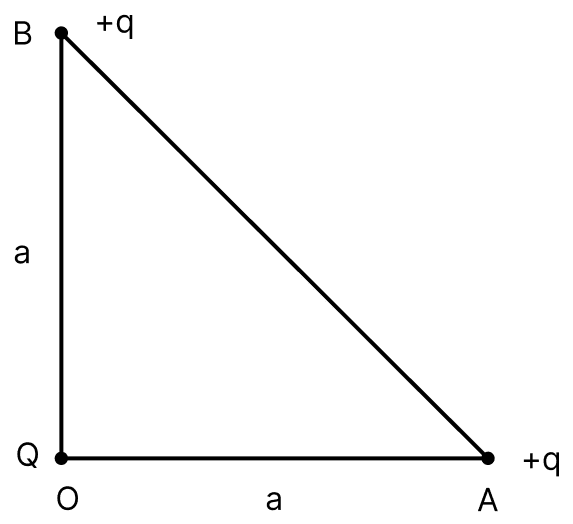
(i) Find the value of Q in terms of q so that the system, shown in the figure, is equivalent to an electric dipole. (all the charges are the point charges)
(ii) With Q as determined above, what will be electric dipole moment of the system?
(iii) Write SI unit of electric dipole moment.
(iv) What will be the net electric force on electric dipole of dipole moment in uniform electric field ?
(v) In which condition electric dipole experiences maximum torque, when placed in uniform electric field?
Answer
(i) Value of Q in terms of q :
From the figure the system consists of the charge Q at the origin O and two charges + q, one at A on the X-axis and the other at B on the Y-axis, each at a distance a from O.
A system of charges is equivalent to an electric dipole if the algebraic sum of its charges is zero. Hence
(ii) Electric dipole moment of the system :
The charge − 2q at O may be regarded as two charges of − q each placed at O. One of them together with the charge + q at A forms a dipole of moment qa directed along OA, and the other together with the charge + q at B forms a dipole of moment qa directed along OB.
The two component dipole moments are equal in magnitude and mutually perpendicular, so their resultant is
Its direction makes an angle of 45° with OA, that is, it is directed along the line joining O to the mid-point of AB.
(iii) SI unit of electric dipole moment :
The SI unit of electric dipole moment is the coulomb-metre (C-m).
(iv) Net electric force on a dipole in a uniform electric field :
In a uniform field the charge + q experiences a force qE along the field and the charge − q an equal force qE opposite to the field. These two forces are equal and opposite, so the net electric force on the dipole is zero.
(v) Condition for maximum torque :
The torque on a dipole placed in a uniform electric field is
This is maximum when sin θ = 1, that is, when θ = 90°.
Hence, the dipole experiences maximum torque, τmax = pE, when is perpendicular to .