
1 farad is equivalent to :
- 1 C/1 V
- 1 V/1 C
- 1 J/1 C
- none of these
Answer
1 C/1 V
Reason — The capacitance of a conductor is defined by the relation
so that the unit of capacitance is (unit of charge)/(unit of potential difference), that is, coulomb/volt. This unit is called the farad. Hence 1 farad is that capacitance which acquires a charge of 1 coulomb when its potential is raised by 1 volt.
The real seat of charge in a capacitor is :
- metal plates
- battery
- dielectric material
- none of these
Answer
dielectric material
Reason — A conductor cannot maintain an electric field inside it, whereas a dielectric can. The metal plates only act as the means of applying an electric field to the dielectric medium between them, and it is this medium that sustains the field. Hence the real seat of charge in a capacitor is the dielectric material.
A conductor is charged to a potential V by imparting a charge q, the variation of q with V is represented by figure :
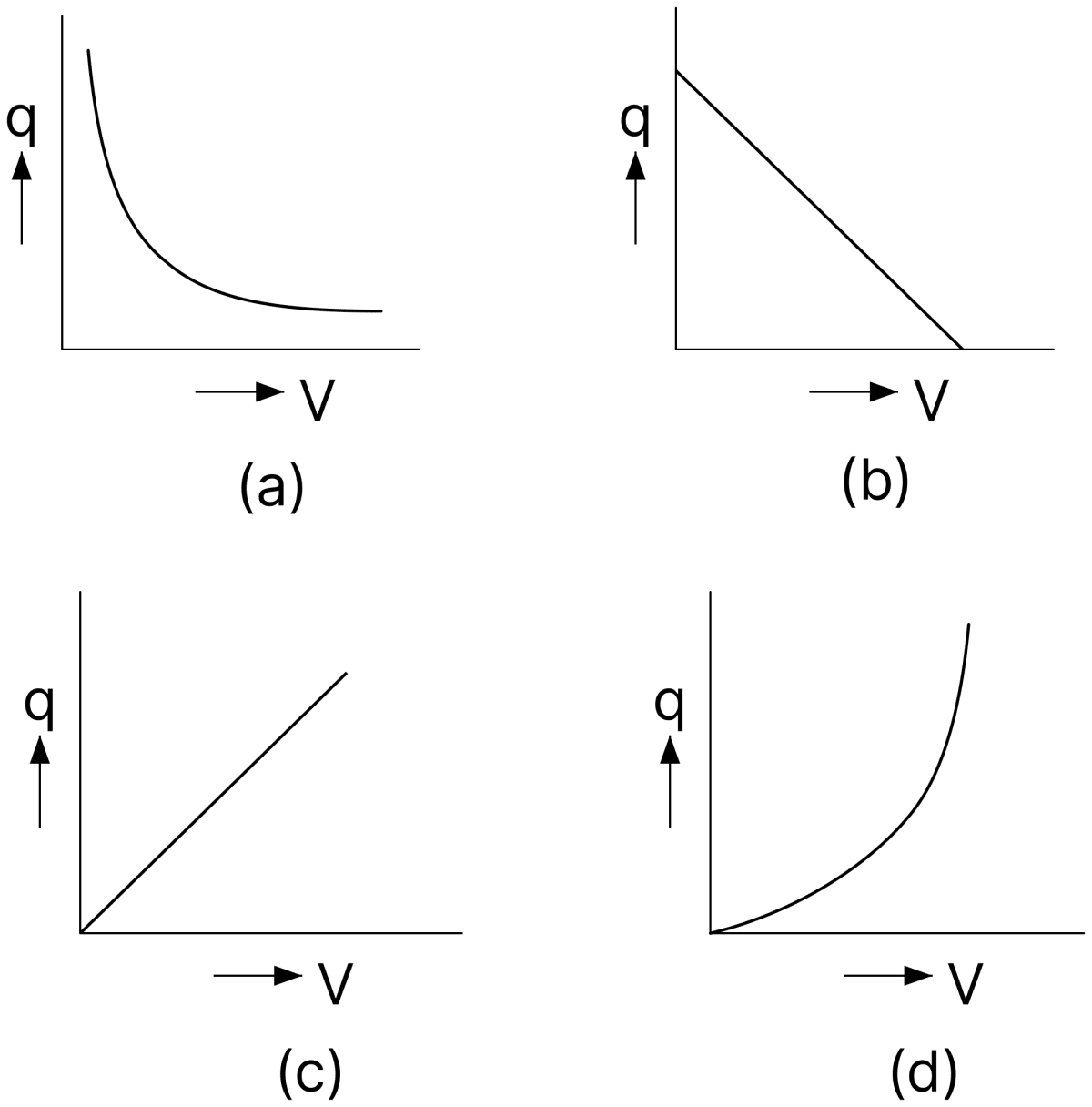
Answer
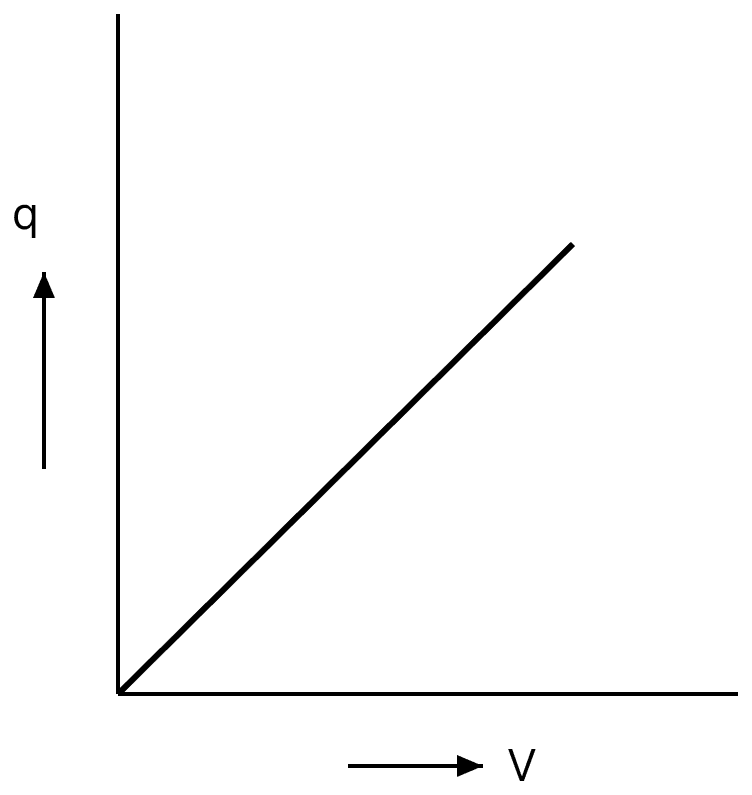
The straight line passing through the origin.
Reason — For a given conductor the capacitance C is a constant determined by its size, shape and the surrounding medium. From
the charge q is directly proportional to the potential V. Hence the graph of q against V is a straight line passing through the origin, its slope being equal to the capacitance C.
The electric field between the plates of a parallel plate capacitor remains :
- constant
- increases from positive plate towards the negative plate
- decreases from positive plate towards negative plate
- none of the above
Answer
constant
Reason — The plates of a parallel-plate capacitor carry equal and opposite charges spread uniformly, with surface charge density σ. The field between two such closely-spaced plates is
This expression contains no distance term, so the field is uniform everywhere in the space between the plates. It neither increases nor decreases as we move from one plate to the other.
The capacitance of a capacitor does not depend upon :
- size of the plates
- shape of the plates
- separation between the plates
- charge on the plates
Answer
charge on the plates
Reason — For a parallel-plate capacitor,
The capacitance is fixed by the geometry of the plates, that is, their area A (which depends on size and shape), the separation d between them, and the nature of the medium between the plates through K. On giving more charge the potential difference rises in the same proportion, so the ratio , and hence C, remains unchanged.
The factor which do not affect the capacitance of a capacitor is :
- shape of the plates
- distance between the plates
- potential difference between the plates
- nature of medium between the plates
Answer
potential difference between the plates
Reason — Capacitance is a purely geometrical property of the arrangement together with the medium between the plates,
The charge and the potential difference always change together in such a way that their ratio stays constant. Hence the potential difference does not affect the capacitance, whereas the shape of the plates, their separation and the medium between them do.
A free electron and a free proton are placed between the two oppositely charged parallel plates of a parallel-plate capacitor. Both are closer to the positive plate than the negative plate.
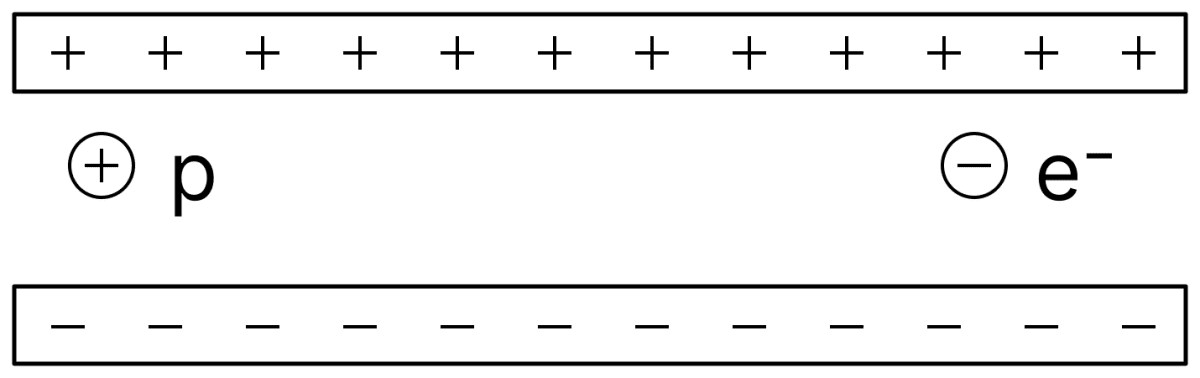
Which of the following statements is true?
I. The force on the proton is greater than the force on the electron.
II. The potential energy of the proton is greater than that of the electron.
III. The potential energy of the proton and the electron is the same.
- I only
- II only
- III and I only
- II and I only
Answer
II only
Reason — The field between the plates is uniform, and the electron and the proton carry equal magnitudes of charge. Hence the force F = qE has the same magnitude on both, only the directions being opposite, so statement I is wrong.
The potential energy of a charge at a point of potential V is U = qV. Near the positive plate the potential is high. For the proton q is positive, so U is large and positive; for the electron q is negative, so U is large and negative. Therefore the potential energy of the proton is greater than that of the electron, and statement II is correct while statement III is wrong.
Two small spheres placed first in air and then in a medium of dielectric constant K at the same distance apart are charged to the same potential. The ratio of the electrical forces between the spheres in the two cases is :
- K : 1
- 1 : K
- 1 : K2
- K2 : 1
Answer
1 : K
Reason — For a sphere of radius a, C = 4πε0a in air and CK = 4πε0Ka in the medium. Since the spheres are raised to the same potential V, the charge in the medium becomes K times that in air,
The force in a medium of dielectric constant K, for a separation r, is
In air,
and in the medium,
Hence Fair : Fmed = 1 : K.
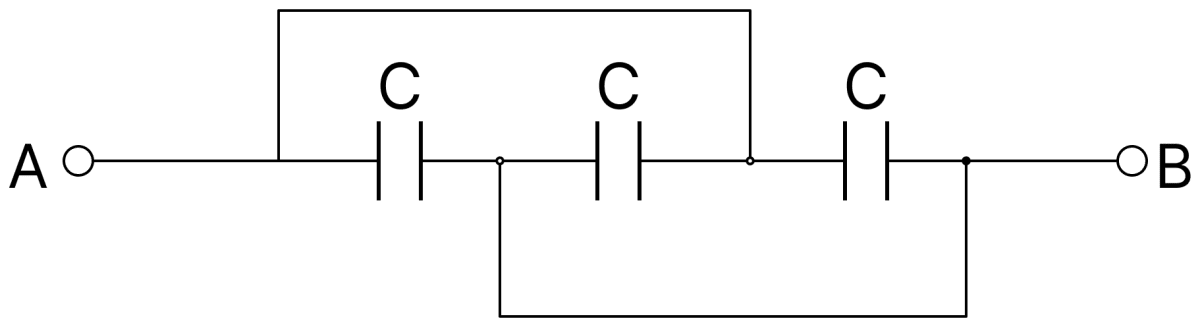
The equivalent capacitance between points A and B in the given figure would be :
- 3 C
- C/3
- 3C/2
- None of these
Answer
3 C
Reason — The upper wire joins A to the junction between the second and third capacitors, and the lower wire joins the junction between the first and second capacitors to B. Hence the first capacitor lies between A and B, the second between B and A, and the third between A and B. Thus all the three capacitors have the same potential difference across them, that is, they are connected in parallel. For a parallel combination,
The equivalent capacitance between points A and B in the given figure would be :
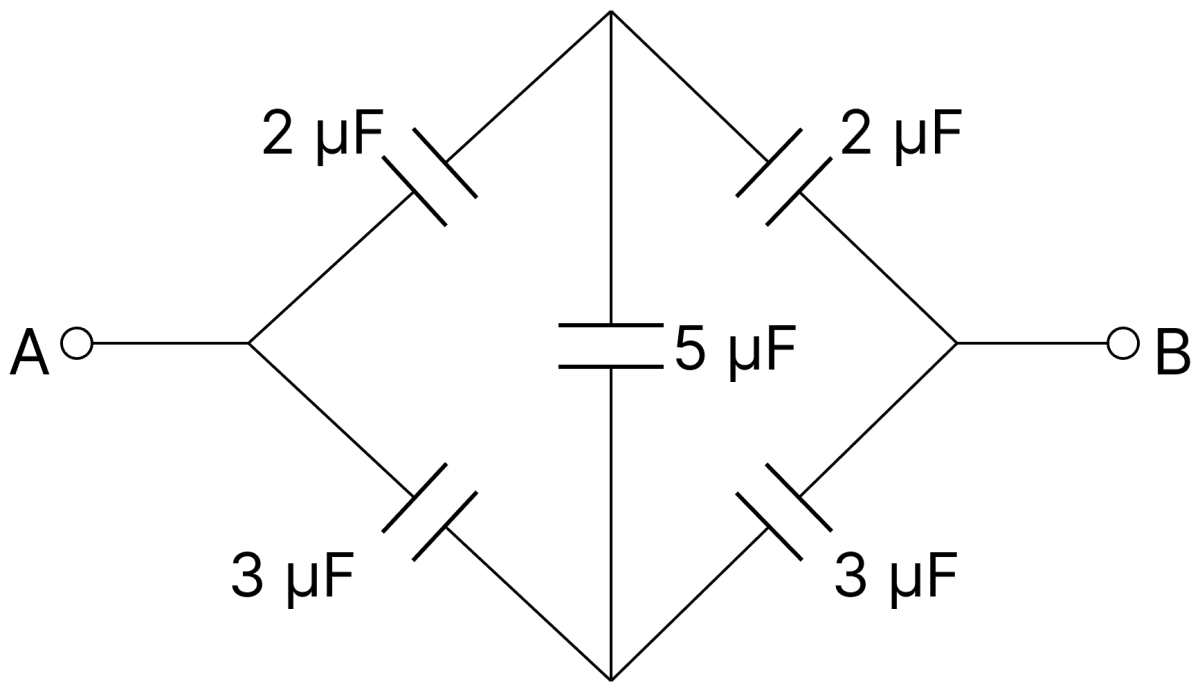
- 2.5 µF
- 15 µF
- 2.4 µF
- None of these
Answer
2.5 µF
Reason — The network is a balanced Wheatstone-type bridge, the 5 µF capacitor forming the bridge arm. Since
the two ends of the 5 µF capacitor are at the same potential, so it carries no charge and may be removed.
The two 2 µF capacitors are then in series,
and the two 3 µF capacitors are in series,
These two branches are in parallel between A and B, so
A metal plate of thickness half the plate separation is introduced between the plates of parallel plate capacitor. The capacitance :
- remains unchanged
- gets doubled
- gets halved
- becomes infinite
Answer
gets doubled
Reason — On inserting a slab of thickness t and dielectric constant K, the capacitance becomes
For a metal, K = ∞, and here . Substituting,
Hence the capacitance gets doubled.
The capacitance of a spherical conductor is 1.0 µF. Its radius will be nearly :
- 9 km
- 10 m
- 1.11 m
- 1.12 cm
Answer
9 km
Reason — For an isolated spherical conductor of radius a,
Substituting C = 1.0 µF = 1.0 × 10⁻⁶ F,
Eight mercury drops of equal radii and having equal charges combine to form a big drop. The capacitance of the big drop, as compared to a smaller drop, is :
- 2 times
- 4 times
- 8 times
- 16 times
Answer
2 times
Reason — The volume of mercury is conserved on combination, so for n = 8 small drops of radius r forming a big drop of radius R,
Since the capacitance of a sphere is C = 4πε0a, it is directly proportional to the radius. Hence
When a capacitor is charged, the work done in charging is stored as electric potential energy of the capacitor. This energy is stored in :
- the plates of the capacitor
- the medium between the plates
- partially in plates and partially in the medium
- the cloud formed around the plates
Answer
the medium between the plates
Reason — The work done by the battery in transferring charge from one plate to the other is stored as electric potential energy in the electric field set up in the space between the plates. The energy stored per unit volume of this medium, that is, the energy density, is
which is non-zero only where the field exists, namely in the medium between the plates.
On giving a charge q to a capacitor of capacitance C, the stored energy is W. If the charge is increased to 2 q, then stored energy will be :
- 2 W
- W
- 4 W
- W
Answer
4 W
Reason — The energy stored in a capacitor in terms of its charge is
For a given capacitor C is constant, so W ∝ q2. On doubling the charge,
There is an air-filled 1 pF parallel-plate capacitor. When the plates separation is doubled and the space is filled with wax, the capacitance increases to 2 pF. The dielectric constant of wax is :
- 2
- 4
- 6
- 8
Answer
4
Reason — For the air-filled capacitor,
When the separation is doubled to 2d and wax of dielectric constant K fills the gap,
Substituting C = 2 pF and C0 = 1 pF,
U0 energy is stored in a charged capacitor. When a slab of dielectric constant K is introduced in it, its energy becomes U, then :
- U = U0
- U = KU0
- U = K2U0
- U =
Answer
U =
Reason — The capacitor is charged and then the slab is introduced, the charging battery being no longer connected. Hence the charge Q on the plates remains unchanged, while the capacitance rises to KC. The energy stored is
Since K > 1, the energy decreases; the deficit appears as the work done by the capacitor in pulling the slab in.
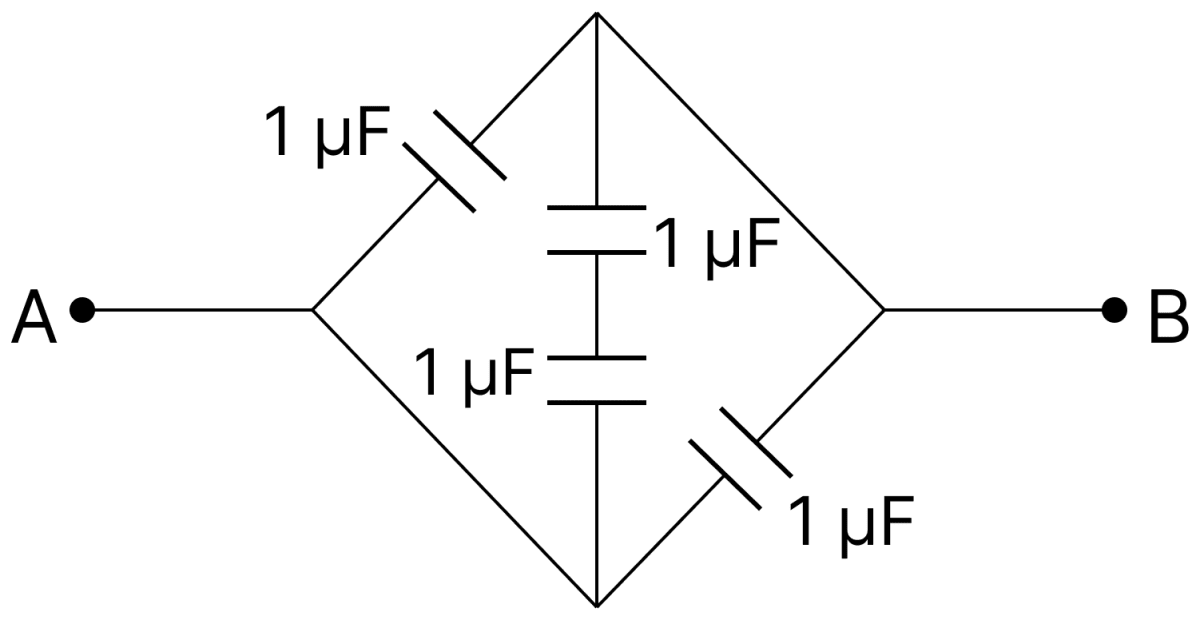
The equivalent capacitance of the capacitors shown in the figure across A and B is :
- 4 µF
- 2.5 µF
- 2 µF
- 0.25 µF
Answer
2.5 µF
Reason — In the figure the upper right arm and the lower left arm of the diamond are plain connecting wires. Hence the upper vertex is the same point as B, and the lower vertex is the same point as A.
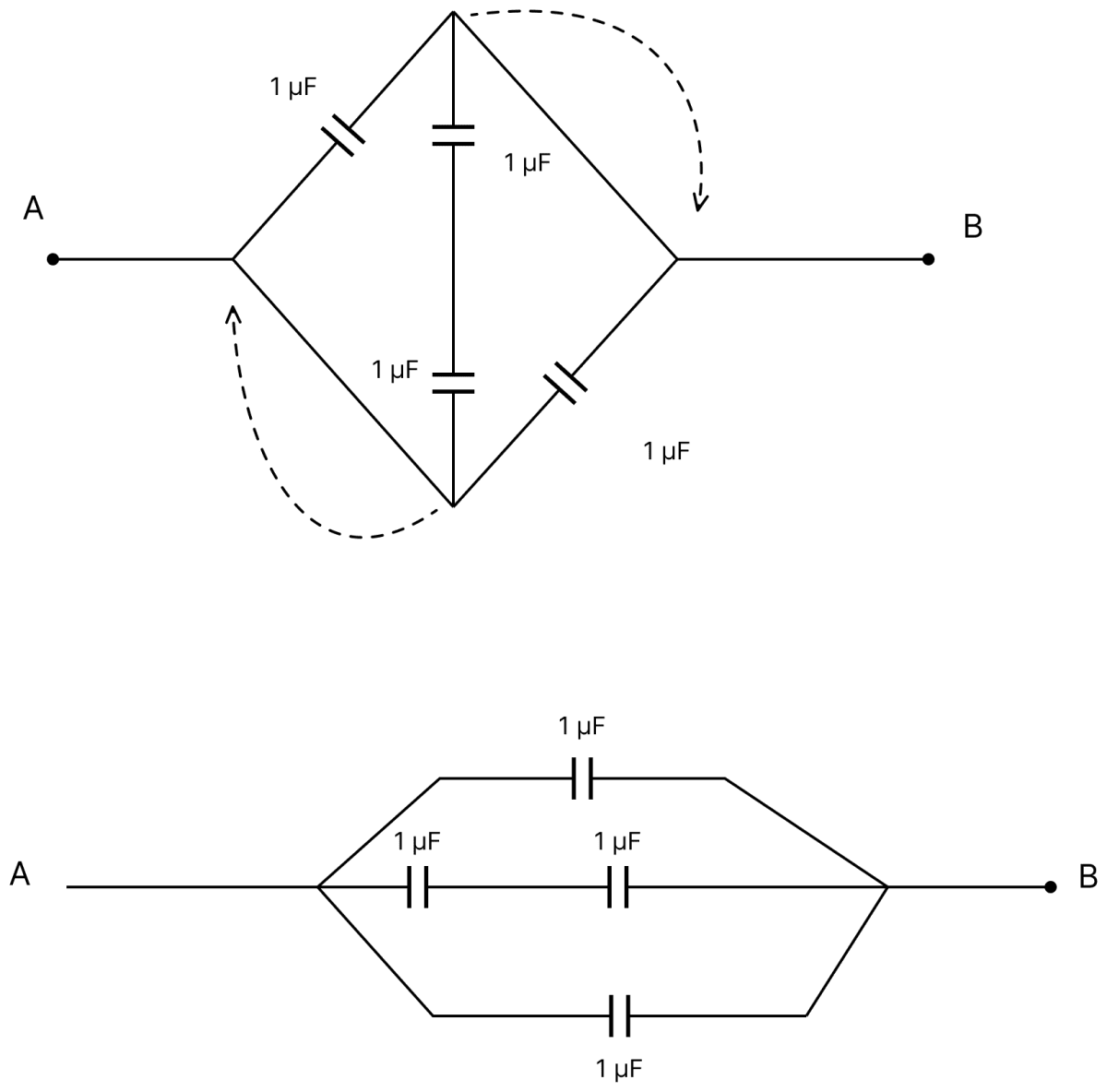
Between A and B there are then three parallel paths :
(i) the 1 µF in the upper left arm,
(ii) the 1 µF in the lower right arm,
(iii) the two 1 µF capacitors of the central branch, which are in series and give
As all three are in parallel,
Five equal capacitors connected in series have a resultant capacitance of 4 µF. The total energy stored in them when connected in parallel and charged to 400 V will be :
- 80 joule
- 16 joule
- 8 joule
- 4 joule
Answer
8 joule
Reason — For five equal capacitors of capacitance C in series,
In parallel the equivalent capacitance is
The energy stored at V = 400 V is
Three capacitors of equal capacity C are joined first in parallel and then in series. The ratio of equivalent capacities in both the cases will be :
- 9 : 1
- 6 : 1
- 3 : 1
- 1 : 9
Answer
9 : 1
Reason — For three equal capacitors,
Therefore
that is, Cp : Cs = 9 : 1.
A 10 µF capacitor is charged to 100 V and then the battery is disconnected. When it is connected in parallel to another uncharged capacitor, the common potential difference between the plates is 40 V . The capacitance of the other capacitor is :
- 15 µF
- 5 µF
- 10 µF
- 16.6 µF
Answer
15 µF
Reason — The charge on the first capacitor before sharing is
The battery is disconnected, so this charge is merely redistributed. If C2 is the second capacitance, the common potential is
Substituting V = 40 V,
A parallel plate capacitor is connected to a battery as shown in Fig. Consider two situations :
A : Key K is kept closed and plates of capacitors are moved apart using insulating handle.
B : Key K is opened and plates of capacitors are moved apart using insulating handle.

Choose the correct option(s).
- In A : Q remains same but C changes
- In B : V remains same but C changes
- In A : V remains same and hence Q changes
- In B : Both Q and V remain unchanged
Answer
In A : V remains same and hence Q changes
Reason — In situation A the key is closed, so the battery stays connected and the potential difference V across the plates remains equal to the emf of the battery. On increasing the separation the capacitance C decreases, and since Q = CV with V fixed, the charge on the plates decreases. Hence the third option is correct and the first is wrong.
In situation B the battery is disconnected, so the charge Q on the plates cannot change. The capacitance decreases and therefore increases. Hence the second and fourth options are also wrong.
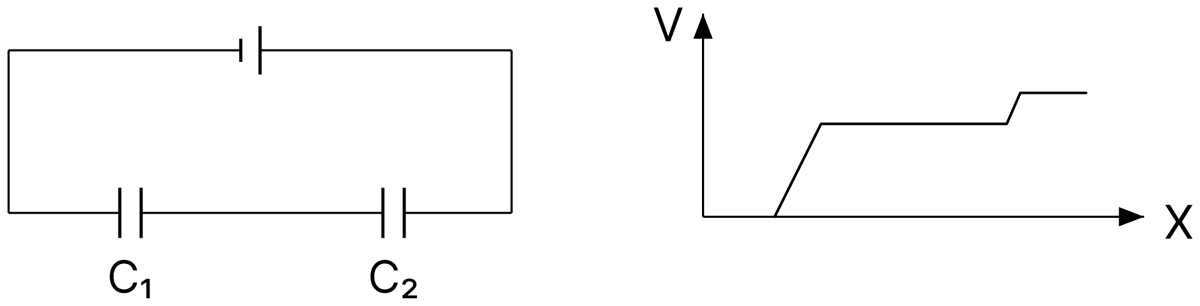
Figure shows two capacitors connected in series and joined to a battery. The graph shows the variation in Potential as one moves from left to right along the branch containing the capacitors. Then :
- C1 > C2
- C1 = C2
- C1 < C2
- insufficient information
Answer
C1 < C2
Reason — In a series combination each capacitor carries the same charge Q, and the potential difference across a capacitor is
so that V is inversely proportional to C. The graph shows a larger rise of potential across the first capacitor than across the second, that is, V1 > V2. Since Q is the same for both,
Minimum number of 8 µF and 250 V capacitors required to make a combination of 16 µF and 1000 V are :
- 32
- 16
- 8
- 4
Answer
32
Reason — Each capacitor can withstand only 250 V, so to withstand 1000 V the capacitors must be joined in series in rows of
The capacitance of one such row is
To obtain 16 µF, the number of such rows joined in parallel must be
Hence the total number of capacitors required is
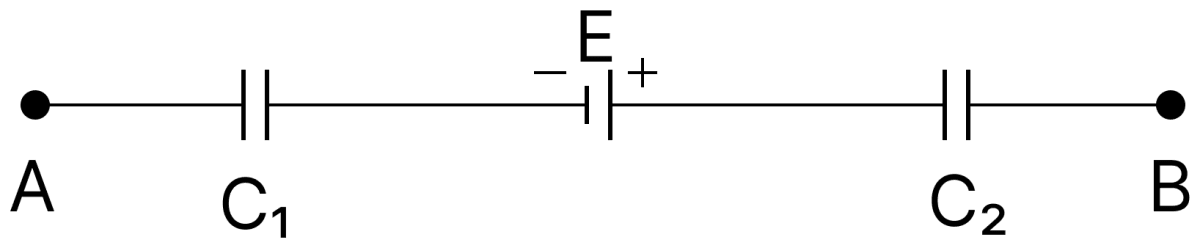
A circuit has a section AB as shown in the figure with E = 10 V, C1 = 1.0 µF, C2 = 2.0 µF and the potential difference VA − VB = 5V. The voltage across C1 is :
- zero
- 5 V
- 10 V
- 15 V
Answer
10 V
Reason — The two capacitors are in series, so each carries the same charge q. Moving along the section from A to B, the potential falls across C1 and across C2, and rises by E on crossing the cell from its negative to its positive terminal. Hence
Substituting the values,
Therefore the voltage across C1 is
Two capacitors of capacitances 3 µF and 6 µF are charged to a potential of 12 V each. They are now connected to each other with the positive plate of one joined to the negative plate of the other. The potential difference across each will be :
- 3 V
- zero
- 6 V
- 4 V
Answer
4 V
Reason — The initial charges are
Since the positive plate of one is joined to the negative plate of the other, the charges partly neutralise each other, so the net charge available for sharing is
The two capacitors are now in parallel, hence the common potential difference is
Define SI unit of capacitance. Write its dimensions.
Answer
The SI unit of capacitance is the farad (F), which is one coulomb per volt. The capacitance of a conductor is 1 farad if a charge of 1 coulomb raises its potential by 1 volt.
Its dimensions are [M-1 L-2 T4 A2].
What is a 'farad'? How many pico-farads are there in 1 farad?
Answer
A conductor has a capacitance of one farad when a charge of one coulomb given to it raises its potential by one volt.
If the plates of a charged capacitor are brought closer, what will happen to the PD between the plates?
Answer
The potential difference between the plates will decrease.
Explanation:
On bringing the plates closer, d decreases and so the capacitance increases. The charge Q on the plates is unchanged, hence is lowered.
What is the function of second plate in parallel-plate capacitor?
Answer
The second plate lowers the potential of the first plate, so that a much larger charge can be stored on the capacitor for the same potential difference.
What meaning would you give to the capacitance of a single conductor?
Answer
A single conductor may be regarded as a capacitor whose second plate is at infinity, that is, an earthed conductor placed infinitely far away.
What is the net charge on a charged capacitor?
Answer
Zero.
Explanation:
The two plates carry equal and opposite charges, +Q and −Q, so their sum is zero.
A capacitor has no charge. Is its capacitance zero?
Answer
No, its capacitance is not zero.
Explanation:
The capacitance is fixed purely by geometry, that is, by the shapes, sizes and relative positions of the plates and by the medium between them. It does not depend on whether the capacitor actually carries a charge.
Three capacitors of equal capacitances when connected in series have net capacitance C1 ; and when connected in parallel have net capacitance C2. What is the value of C1/C2?
Answer
For three equal capacitors each of capacitance C,
A variable air capacitor has n plates each of area A metre2 and the distance between two successive plates is d. Compute its capacitance.
Answer
With n plates there are (n − 1) gaps, and the arrangement is equivalent to (n − 1) capacitors joined in parallel. Hence
In a parallel-plate capacitor, the capacitance increases from 4 µF to 80 µF on introducing a dielectric medium between the plates. What is the dielectric constant (or relative permittivity) of the medium?
Answer
The dielectric constant is the ratio of the capacitance with the dielectric to that with vacuum (or air),
Will a dielectric-filled capacitor store more charge or less charge than a similar air capacitor at the same potential difference?
Answer
More charge.
Explanation:
The capacitance of a dielectric-filled capacitor is K times that of an air capacitor, and since Q = CV with V the same in both cases, the charge stored is K times larger.
Will a dielectric-filled capacitor have a higher PD or lower PD between its plates than an air-filled capacitor having the same amount of charge?
Answer
Lower PD.
Explanation:
For the same charge, , and the capacitance of the dielectric-filled capacitor is K times larger. Hence its potential difference is times that of the air capacitor.
How is dielectric constant (or relative permittivity of a dielectric) expressed in terms of capacitance?
Answer
where C is the capacitance of a capacitor filled completely with the dielectric and C0 that of the same capacitor with vacuum (or air) between the plates.
What may be a possible reason of water having a much greater dielectric constant (= 80) than say mica (= 6)?
Answer
Water molecules are polar, that is, they possess a permanent electric dipole moment. In an external field these permanent dipoles orient themselves along the field and produce a very strong polarisation, giving water a much larger dielectric constant.
What is the effect of temperature on the dielectric constant K of a dielectric?
Answer
The dielectric constant decreases with rise in temperature.
Explanation:
At higher temperatures the increased thermal agitation of the molecules disturbs the alignment of the molecular dipoles along the field, so the polarisation produced is smaller.
The capacitance of a charged conductor is C farad and its potential energy due to the charge is U. Write down the expression for the charge on the conductor.
Answer
The energy of a charged conductor is
Two copper spheres of equal radii, one hollow and the other solid are charged to the same potential. Which one does carry more charge?
Answer
Both spheres carry equal charges.
Explanation:
The charge given to a conductor resides only on its outer surface, so the capacitance C = 4πε0a depends only on the radius. The two spheres have equal radii, hence equal capacitances, and being at the same potential they carry equal charges Q = CV.
How will the electric field between the plates of a charged parallel-plate capacitor be affected, if the space between the plates is filled with a dielectric of dielectric constant 2?
Answer
The electric field will be halved.
Explanation:
On introducing a dielectric of dielectric constant K, the field is reduced by the factor K,
What is the dielectric constant of a metal? Give reason.
Answer
For a metal, K = ∞.
When a dielectric is placed in a field E0, the field inside it falls to . In a metal the field inside is zero, which is possible only if K is infinite.
A 'thin' metallic plate is placed between the parallel plates of a capacitor. What will be its effect on the capacitance? (by 'thin' is meant here that the plate is of negligible thickness).
Answer
There is no effect on the capacitance.
Explanation:
For a metal plate of thickness t, K = ∞ and
Since the plate is of negligible thickness, t → 0 and , the same as before.
Two capacitances C1 and C2 are connected in parallel. If a charge Q be given to this system, in what ratio will it be distributed on them? If the capacitances were connected in series, then?
Answer
In parallel the potential difference is common, so Q = CV gives
In series each capacitor receives the same charge Q, so the charges are in the ratio 1 : 1.
On what factors does the capacitance of a parallel-plate capacitor depend?
Answer
The capacitance of a parallel-plate capacitor is
It therefore depends on :
(i) the area A of the plates — C increases with plate area,
(ii) the separation d between the plates — C is inversely proportional to d,
(iii) the nature of the medium between the plates, through its dielectric constant K.
It does not depend on the charge given or the potential difference applied.
How can you increase the capacitance of a parallel-plate capacitor?
Answer
Since , the capacitance can be increased by
(i) increasing the area of the plates,
(ii) decreasing the separation between the plates,
(iii) filling the space between the plates with a dielectric of high dielectric constant K.
Can we give any amount of charge to a capacitor?
Answer
No.
Explanation:
As charge is given continuously to a capacitor, the potential difference across its plates, and hence the electric field between them, goes on rising. When the field exceeds the dielectric strength of the medium, the insulation of the medium breaks down. The capacitor is then discharged through the medium with sparking, and it cannot hold any further charge.
The electric potential of earth is taken zero. Why?
Answer
The earth is an extremely large conductor, so its capacitance C = 4πε0a is enormous, and may be taken as infinite. Giving or removing charge therefore produces practically no change in its potential, since . Hence the potential of the earth is treated as a constant, and it is conveniently chosen as the zero of potential.
Write formulae for equivalent capacitance of a (i) series combination, (ii) parallel combination of capacitances C1 , C2 , ..., Cn .
Answer
(i) Series combination :
(ii) Parallel combination :
What do you understand by 'dielectric constant' of a material medium?
Answer
The dielectric constant of a medium is the ratio of the absolute permittivity ε of the medium to the permittivity ε0 of free space,
Being a ratio of two permittivities, it is also called the relative permittivity εr of the medium. It is a pure number having no unit.
When a medium of dielectric constant K is introduced between the plates of a parallel-plate capacitor, how do the (i) capacitance (ii) PD between the plates change?
Answer
(i) The capacitance increases to K times its original value, C = KC0.
(ii) For a given charge on the plates, the potential difference falls to times its original value, since .
A parallel-plate capacitor having vacuum between the plates has capacitance C. What will be the capacitance when (i) the distance d between the plates is doubled, (ii) a sheet of thickness t and dielectric constant K is placed between the plates? (Assume t = d.)
Answer
(i) Since , on doubling the separation the capacitance becomes
(ii) With t = d the dielectric fills the whole space between the plates, so
What do you mean by a dielectric? Which one out of germanium, mica and carbon is a dielectric?
Answer
A dielectric is an insulating material in which all the electrons are tightly bound to the nuclei of the atoms, so that there are practically no free electrons to carry a current. When placed in an electric field, induced charges appear on the surfaces of a dielectric due to polarisation.
Out of the three, mica is a dielectric.
Name a few dielectrics commonly used in capacitors.
Answer
Paper, mica, plastic film and wax are commonly used as dielectrics in capacitors.
Explain how the introduction of a dielectric slab between the plates of a capacitor decreases the electric field (and potential difference) between the plates, and increases the capacitance.
Answer
On placing a dielectric slab of dielectric constant K in the field between the plates of a charged capacitor, the slab gets electrically polarised. The face of the slab nearer the positive plate acquires an induced negative charge, and the face nearer the negative plate an equal induced positive charge.
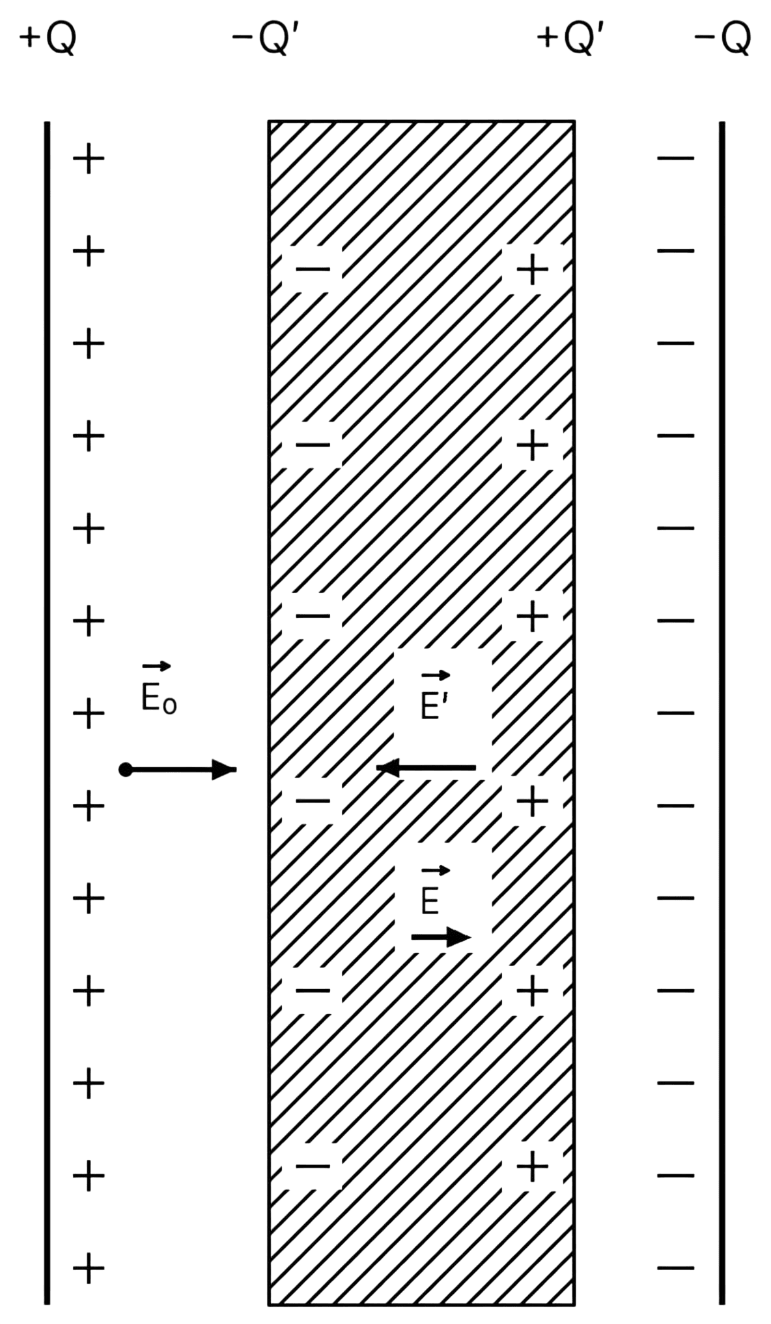
Since each induced charge is opposite in sign to the charge on the plate facing it, the induced charges produce a field E' directed against the original field E0. The effective electric field between the plates, and hence the potential difference, is therefore reduced by the factor K,
Since the charge Q on the plates is unaltered and , the capacitance increases by the factor K, that is, C = KC0.
The atmospheric electric field on earth is as high as 100 V-m-1. Why do we not get an electric shock as we move on earth?
Answer
Our body is a conductor and it remains in contact with the earth, so the body and the earth together form a single equipotential surface. Since there is no potential difference between our head and the earth, no electric field exists along the body and hence no current flows through it. Therefore we do not get an electric shock.
Suppose a man places an insulating slab on the ground and puts a large aluminium sheet on its top. Will he get an electric shock if he touches the aluminium sheet next morning?
Answer
Yes, he may get a shock.
Explanation:
The aluminium sheet and the earth act as the two plates of a large capacitor with the insulating slab as the dielectric between them. The atmospheric electric field near the surface of the earth gradually charges this capacitor overnight. By the next morning the sheet may be raised to a high potential, and on touching it the man may receive a shock, depending on the potential attained.
Show that the units C2 N-1 m-2 and F m-1 are the units of the same physical quantity. What is that physical quantity?
Answer
Starting from C2 N-1 m-2 and using and ,
Now using ,
Hence the two units are identical. They are the units of permittivity.
The potentials of two charged conductors are V1 and V2 their capacitances are C1 and C2 respectively. When these are connected by a wire, the changes in their potentials are ΔV1 and ΔV2 respectively. Prove that ΔV1 / ΔV2 = C2 / C1 .
Answer
The total charge on the two conductors before connecting is
On connecting them by a wire, charge flows until both are at the same potential; the potential of one rises by ΔV1 and that of the other falls by ΔV2. The total charge after connecting is
Charge is conserved, so Q' = Q,
A big metallic sphere is connected by a wire to an external smaller sphere. This arrangement is given some charge. (i) Which sphere will take more charge? (ii) Which will have a higher surface density of charge?
Answer
(i) Being joined by a wire, both spheres are at the same potential V. Since Q = CV and C = 4πε0a, the sphere of larger radius has the greater capacitance. Hence the bigger sphere takes more charge.
(ii) For the two spheres,
and in terms of the surface charge densities,
Equating the two expressions,
Thus σ is inversely proportional to the radius, so the smaller sphere has the higher surface density of charge.
Two charged conducting spheres of radii a and b are connected to each other by a wire. Find the ratio of electric fields at the surfaces of the spheres.
Answer
Both spheres are at the same potential V. Their capacitances are 4πε0a and 4πε0b, so if Qa and Qb are their charges,
The electric field at the surface of a sphere of radius r carrying charge Q is . Hence
We can charge a balloon to a quite high potential by rubbing to our hairs but we do not feel electric shock even if we are standing naked feet on the ground. Why?
Answer
An electric shock is felt on account of a heavy current passing through the body, not merely on account of a high voltage. The balloon has a very small capacitance, so even at a high potential the charge Q = CV stored on it is extremely small. The current that it can drive through the body to the earth is therefore very feeble, and no shock is felt.
If we hold in hand the wires connected to the plates of a charged capacitor, we feel electric shock. The shock from a 2 µF capacitor is more intense than that from a 0.02 µF capacitor, both at the same potential. Why?
Answer
At the same potential the charge stored is Q = CV, so the 2 µF capacitor holds a hundred times the charge of the 0.02 µF capacitor. On holding its wires, this much larger charge flows through the body in a very short time, producing a much larger current. Hence the shock felt is more intense.
The plates of a parallel-plate capacitor connected to a battery acquire exactly equal (and opposite) charges? Why? Will it be true when the plates are of different sizes?
Answer
When the capacitor is connected across a battery, electrons are transferred from one plate to the other until the potential difference between the plates becomes equal to the emf of the battery. Whatever negative charge is removed from one plate appears on the other, so one plate acquires +Q and the other an exactly equal −Q.
Yes, this remains true even when the plates are of different sizes, since the charge is merely transferred from one plate to the other. However, if the sizes are different, the electric field in the space between the plates will no longer be uniform.
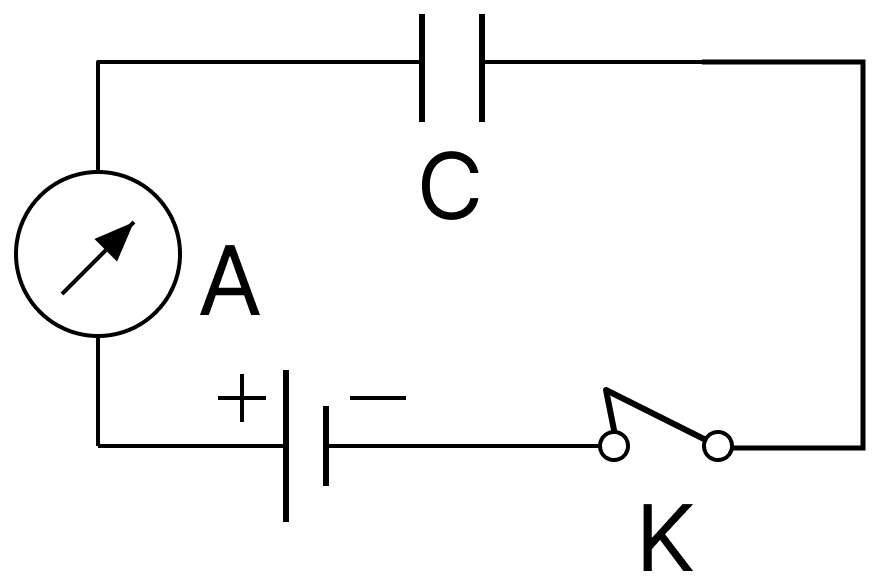
When the key K of the adjacent circuit is pressed, the needle of the ammeter A is deflected but immediately returns to the original position. Why?
Answer
On pressing the key, the capacitor C begins to charge. During the charging a current flows in the circuit, and the needle of the ammeter is deflected.
As the capacitor gets fully charged, the potential difference between its plates becomes equal to the emf of the cell, and no further charge can flow. The current therefore stops and the needle returns to its original position.
The plates of a charged capacitor are connected to a voltmeter. If the plates of the capacitor are separated further, what will be the effect on the reading of the voltmeter?
Answer
The reading of the voltmeter will increase.
Explanation:
On increasing the separation, the capacitance decreases. The charge Q on the plates is unchanged, hence the potential difference between the plates increases.
A parallel-plate capacitor is charged by a battery which is then disconnected. Then, the distance between the plates is decreased. What are the changes in (i) charge on the plates, (ii) capacitance, (iii) PD between plates, (iv) electric field between plates, (v) stored energy?
Answer
(i) The charge Q on the plates remains unchanged, since the battery has been disconnected and no extra charge can be supplied.
(ii) The capacitance increases, as and d has been decreased.
(iii) The potential difference falls, since with Q constant.
(iv) The electric field remains unchanged, because does not contain d.
(v) The stored energy decreases, since and C has increased.
Note: The textbook prints here, a misprint for .
A parallel-plate capacitor of plate area A and separation d is charged to a potential difference V. The charging-battery is then disconnected and the plates are pulled apart until their separation is 2d. Write expressions in terms of A , d and V for (i) the new potential difference, (ii) the initial and the final stored energies and (iii) the work done in increasing the separation between plates.
Answer
The initial capacitance is and the charge Q = C0V remains constant.
(i) On doubling the separation the capacitance becomes , so the new potential difference is
(ii) The initial and final energies are
(iii) The work done in pulling the plates apart is the increase in the stored energy,
Note: The textbook prints the initial energy and the work as , a misprint for .
A capacitor is connected to a battery. If we move its plates further apart, work will be done against the electrostatic attraction between the plates. What will happen to this work? What will be the effect on the energy of the capacitor?
Answer
The battery remains connected, so the potential difference V between the plates stays constant. On increasing the separation the capacitance C decreases, and hence the charge Q = CV on the plates also decreases.
The charge released from the plates passes back through the connecting wires into the battery, so a part of the energy of the capacitor is transferred to the battery. The work done in separating the plates is used up in this transference and is dissipated as heat in the connecting wires. Since with V constant and C decreased, the energy of the capacitor decreases.
Under which of the following two cases more work will be done in moving further apart the plates of a charged capacitor and why? (i) The charging-battery remains connected to the capacitor. (ii) After charging the capacitor, the battery is removed.
Answer
More work is done in the second case.
On separating the plates the capacitance goes on decreasing in both cases.
(i) With the battery connected, V remains constant, so the charge Q = CV decreases and hence the electric field between the plates also decreases. The force of attraction between the plates therefore becomes weaker as they are separated.
(ii) With the battery removed, the charge Q remains constant, so the electric field between the plates remains unchanged in spite of the increase in distance. The force of attraction stays the same throughout.
Since the opposing force is larger in the second case, more work has to be done there.
A capacitor is charged and the charging battery is removed. A slab of dielectric material is then inserted between the plates of the capacitor. How will the electric field between the plates be affected? Why?
Answer
The electric field will be weakened.
On inserting the slab, the dielectric becomes polarised and induced charges appear on its faces. The field due to these polarisation charges is opposite in direction to the field due to the charges on the capacitor plates, so the resultant field between the plates is reduced to .
A parallel-plate air capacitor is charged to a certain potential difference. A dielectric plate is then inserted in the capacitor. In order to attain the initial potential difference, the charge on the plates has to be increased to three times. Determine the dielectric constant of the plate.
Answer
Let C0 be the capacitance with air and Q0 the initial charge, so that the initial potential difference is
After inserting the dielectric plate the capacitance becomes KC0. With the charge raised to 3Q0, the potential difference is again V0,
A slab of material of dielectric constant K has the same area as the plates of a parallel-plate capacitor but has a thickness 3d/4, where d is the plate separation. How is the capacitance changed when the slab is inserted between the plates?
Answer
The capacitance before inserting the slab is
On inserting a slab of thickness and dielectric constant K,
Hence the capacitance increases by the factor .
The distance between the plates of a capacitor is d. A metal plate of thickness d/2 is placed between the plates. What will be the effect on the capacitance? Explain.
Answer
The capacitance will be doubled.
On placing the metal plate, equal and opposite charges are induced on its two surfaces facing the capacitor plates. The arrangement is then equivalent to two capacitors joined in series, the separation of the plates of each being .
Using the general formula with and K = ∞ for a metal,
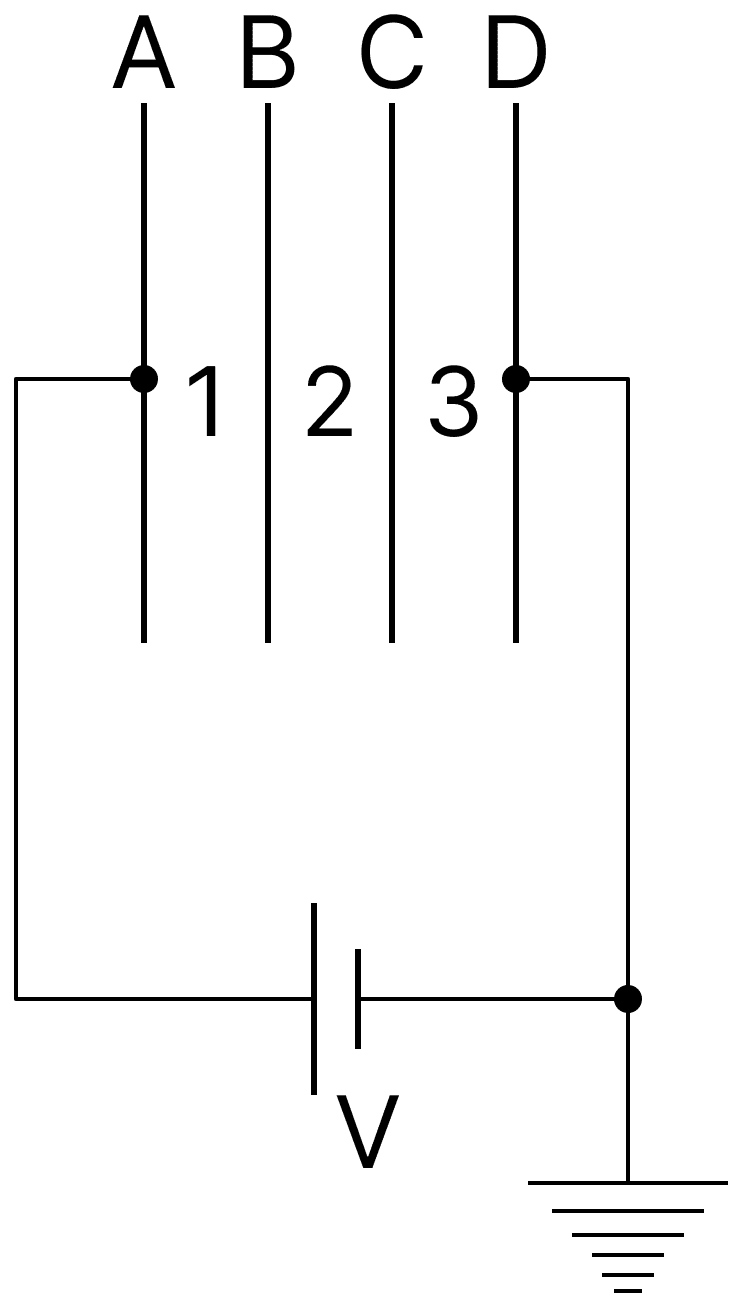
A, B, C and D are four 'thin', similar metallic parallel plates, equally separated by distance d and connected to a cell of PD V as shown. (i) Write the potentials of A, B, C and D. (ii) If B and C be connected by a wire, then what will be the potentials of the plates? (iii) How will the electric fields change in the spacings between the plates ? (iv) Will the charges on the plates A and D change?
Answer
(i) The plate A is joined to the cell and D is earthed, so their potentials are V and zero respectively. The plates B and C are unconnected and equidistant, so the potential falls uniformly across the three equal gaps. Hence
(ii) On joining B and C by a wire they come to a common potential, which by symmetry is each. The plates A and D remain at V and zero respectively.
(iii) The field between A and B rises from to . Between B and C the field becomes zero, since they are now at the same potential. Between C and D the field again rises from to .
(iv) The capacitance of the system was initially , where A is the area of each plate, and it has now increased to . Since the potential difference V is unchanged, the charges on A and D will increase.
A capacitor of capacitance C is charged up to a potential difference V. After removing the charging battery, the capacitor is connected (i) in parallel, (ii) in series with an uncharged capacitor of the same capacitance. What will be the effect on the potential difference of the first capacitor in each case?
Answer
The charge on the first capacitor is Q = CV, and it stays on the system because the battery has been removed.
(i) In parallel : The charge is shared equally between the two identical capacitors, so the first capacitor is left with . Hence its potential difference falls to
(ii) In series : No path exists for the charge on the first capacitor to redistribute, so it retains its charge Q. Hence its potential difference remains V.
Two capacitors C1 and C2 are connected in parallel. A charge Q is given to this combination. Calculate the PD across each capacitor and the charge stored.
Answer
In a parallel combination the equivalent capacitance is C1 + C2, and the potential difference is common to both,
The charges on the two capacitors are therefore
Two identical capacitors connected in parallel are charged to a potential V. They are then separated and connected in series. What will happen to the energy, potential difference and charge of the combination?
Answer
Let each capacitor have capacitance C. In parallel, each is charged to a potential V and carries a charge CV.
On separating them and joining them in series, each capacitor keeps its own charge CV. Hence :
Charge : The charge of the combination in series is CV, whereas in parallel it was 2CV. So the charge is halved.
Potential difference : The potential differences of the two capacitors now add, giving 2V. So the PD is doubled.
Energy : The energy of each capacitor is unaltered, hence the total energy remains unchanged.
n identical capacitors, each of capacitance C are connected in parallel and charged to a potential V. Write the total charge, total PD and total energy of the combination. If these are separated and connected in series, then?
Answer
In parallel : the equivalent capacitance is nC, so
In series : each capacitor retains its own charge CV, which is also the charge of the combination. The equivalent capacitance is and the potential differences add, so
An air-capacitor is charged to a potential V2. It is connected in parallel to an identical uncharged capacitor filled with a dielectric substance. If, after redistribution of charge, the potential difference of the combination be V, then what is the dielectric constant K of the substance?
Answer
Let C be the capacitance of the air capacitor and V2 the potential to which it is charged, so its charge is CV2. The dielectric-filled capacitor has capacitance KC and is initially uncharged.
On joining them in parallel the common potential difference is V, so the charges become CV and (KC)V. Since charge is conserved,
Note: The textbook's printed answer writes the initial potential as V1, giving ; the question calls it V2.
Two identical capacitors C1 and C2 are connected with a battery B, as shown. A dielectric slab is slipped between the plates of C2, the battery remaining connected. What happens to the charge, the capacitance, the potential difference and the stored energy of each capacitor?
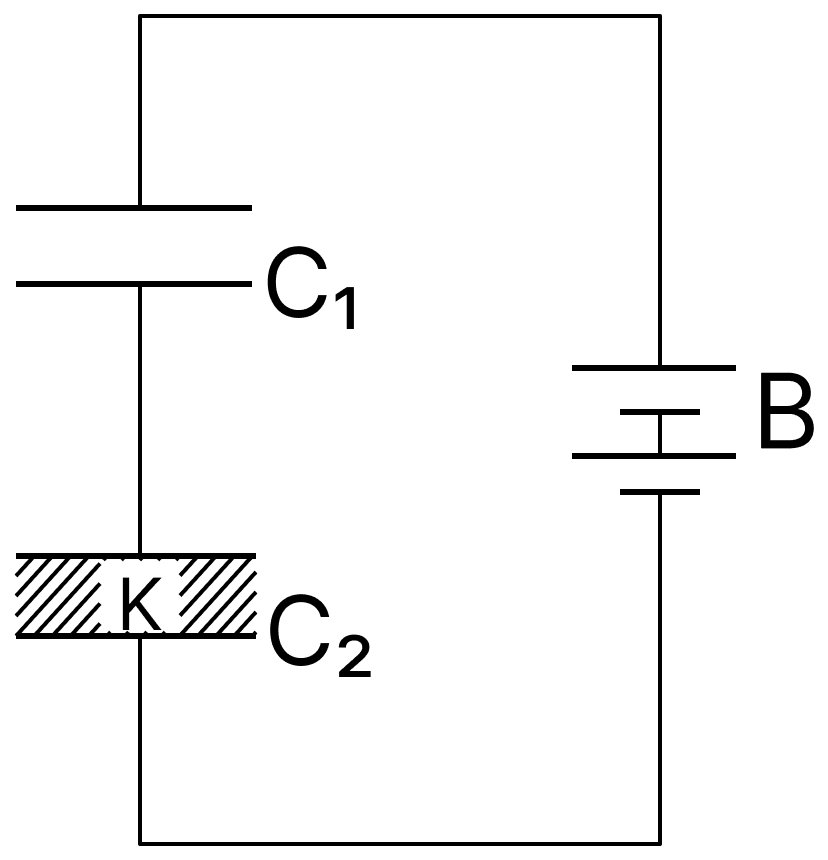
Answer
On slipping the slab, the capacitance of C2 increases, and hence the capacitance of the whole series combination also increases. The battery remains connected, so the total potential difference is constant and the charge on the combination increases. As C1 and C2 are in series, they carry equal charges, so the charge on each capacitor increases.
C1 : its capacitance is unchanged but its charge has increased, so the potential difference across it increases, and its stored energy increases.
C2 : its capacitance increases. Since the total potential difference is fixed and that across C1 has risen, the potential difference across C2 decreases, and its stored energy decreases.
There is a net increase in the energy of the combination.
Two capacitors C1 and C2 are given charges Q1 and Q2 and the charging battery is removed. They are then connected in parallel and a dielectric slab is inserted in C2. What will happen to (i) C1 and C2 (ii) Q1 and Q2 (iii) PD across the plates of the capacitors?
Answer
(i) C1 will remain the same, while C2 will increase to K times its value.
(ii) The total charge Q1 + Q2 is conserved and is shared in proportion to the capacitances. Since C2 has increased, Q2 will increase and Q1 will decrease.
(iii) The common potential difference will decrease, since the total capacitance has increased while the total charge is unchanged.
(a) The given graph shows the variation of charge q versus potential difference V for two capacitors C1 and C2. The two capacitors have same plate separation but the plate area of C2 is double than that of C1.
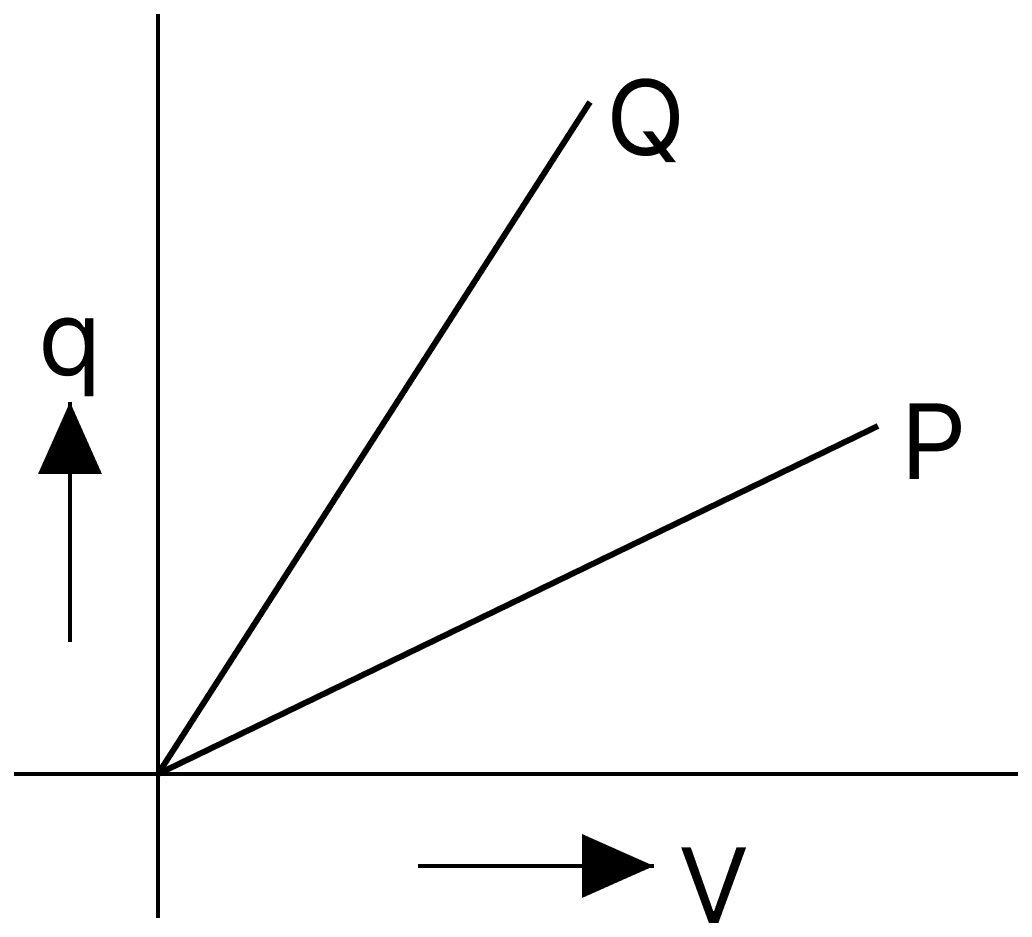
Which of the two graphs P and Q correspond to capacitors C1 and C2 and why?
(b) The given graph shows the variation of charge (q) on plates versus the potential difference (V) between the plates of two capacitors C1 and C2. Both the capacitors have the same plate area but the plate separation of C1 is twice that of C2. Which graph corresponds to C1?
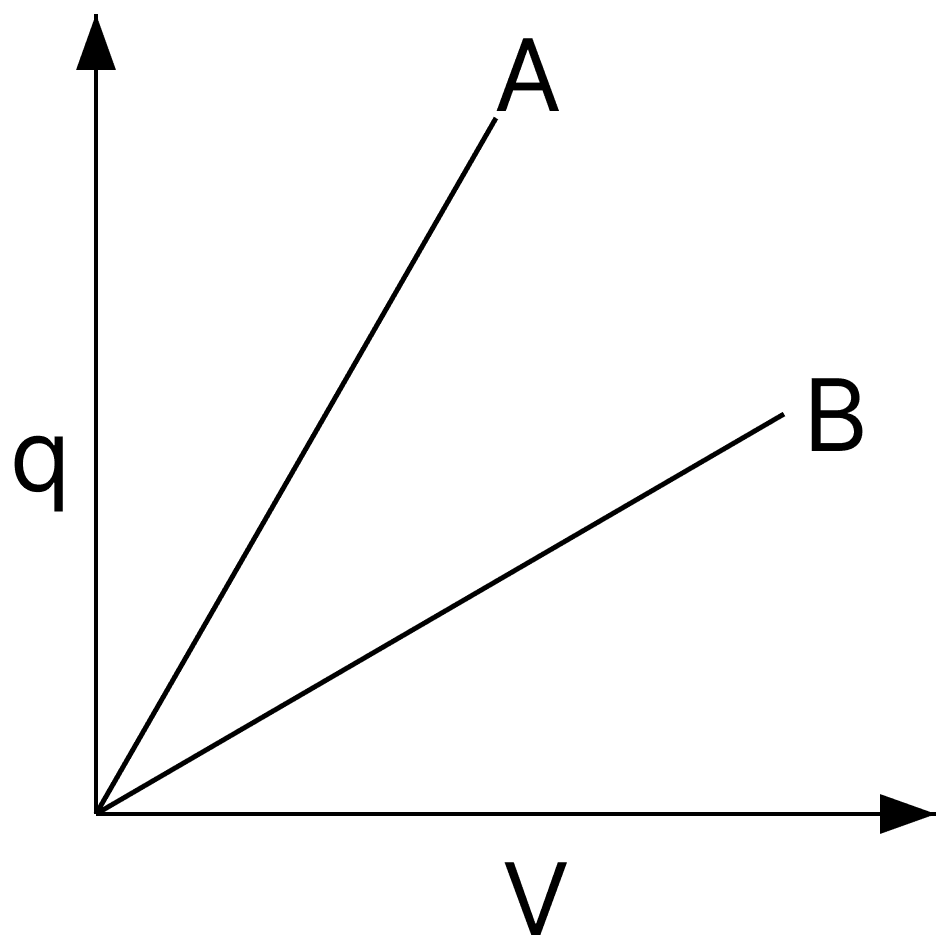
Answer
(a) Q represents C2 and P represents C1.
The slope of a q–V graph is
so the steeper line corresponds to the larger capacitance. Since
and the plate separation d is the same for both while the plate area of C2 is double that of C1, the capacitance of C2 is larger. The graph Q, having the greater slope, therefore represents C2.
(b) The graph B corresponds to C1.
Here the plate areas are equal but the separation of C1 is twice that of C2. Since C is inversely proportional to d, C1 is the smaller capacitance and must be represented by the line of smaller slope, that is, by B.
What is meant by electrical capacitance of a conductor? Derive the formula for the capacitance of an isolated metallic sphere.
Answer
Electrical capacitance : When a charge Q is given to a conductor, its potential V rises in direct proportion to the charge, that is, Q ∝ V, or
The constant C is called the capacitance of the conductor. It is the charge required to raise the potential of the conductor by unity. Its SI unit is the farad.
Capacitance of an isolated spherical conductor :
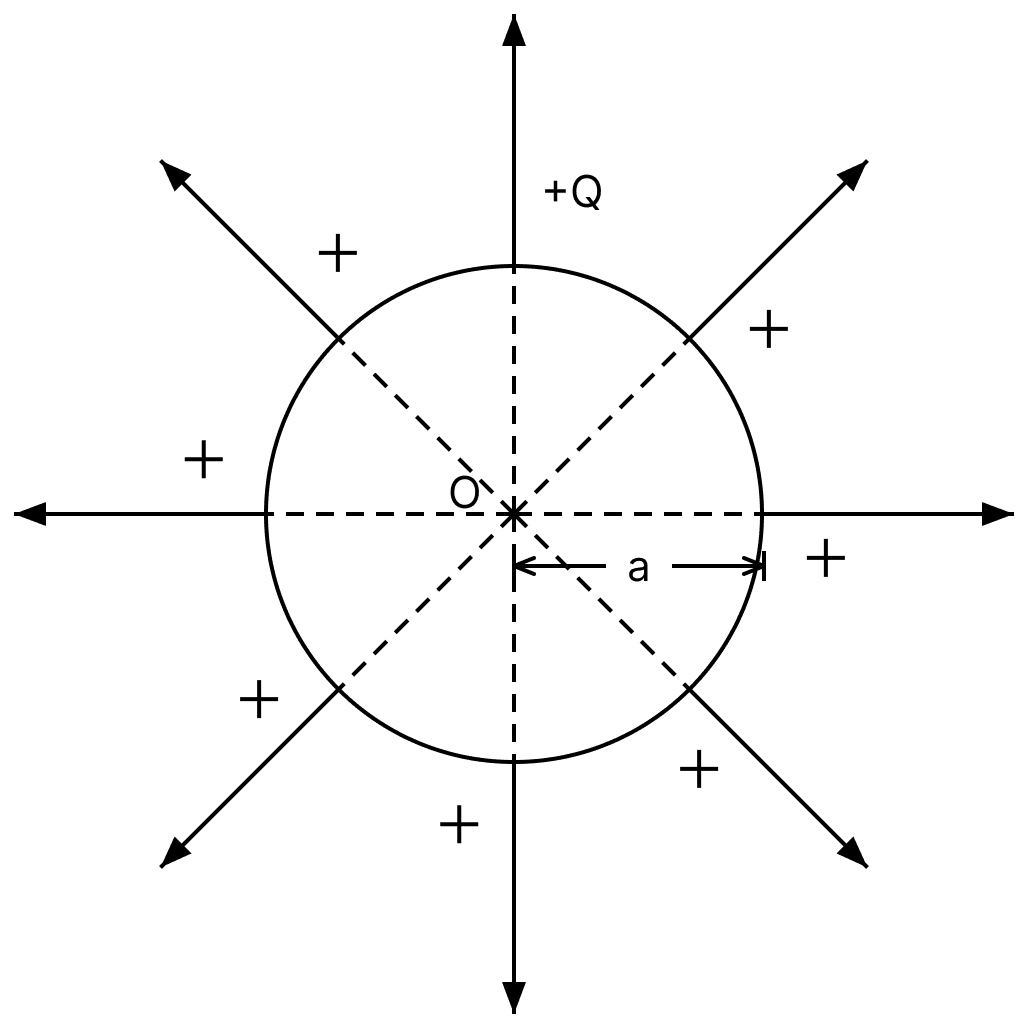
Let an isolated spherical conductor of radius a be placed in vacuum and be given a charge +Q. The charge spreads uniformly over the outer surface, so the surface density of charge is the same at every point and the lines of force appear to diverge radially from the centre. For finding the potential at the surface, the whole charge may be assumed to be concentrated at the centre O.
The potential of the sphere is therefore
By definition, the capacitance is
Substituting the value of V,
Thus the capacitance of a spherical conductor is directly proportional to its radius. The larger the radius, the greater is the charge it can hold without running up to too high a potential.
Derive an expression for the capacitance of a parallel-plate capacitor in terms of the areas of the plates and the distance between them. Assume there is a vacuum in between the plates with the electric field between the plates E = σ/ε0 .
Answer

A parallel-plate capacitor consists of two plane metallic plates, each of area A, held parallel to each other at a small distance d apart, with vacuum between them.
Let a charge +Q be given to one plate, so that a charge −Q appears on the other. If σ is the surface density of charge, then
The electric field in the space between the plates is uniform and is given by
Since the field is uniform, the potential difference between the plates is
By definition the capacitance is , so
Thus the capacitance of a parallel-plate capacitor is directly proportional to the area of the plates and inversely proportional to the distance between them.
Three capacitors of capacitances C1, C2 and C3 are connected in parallel. Derive expressions for the equivalent capacitance for each of these combinations.
Answer
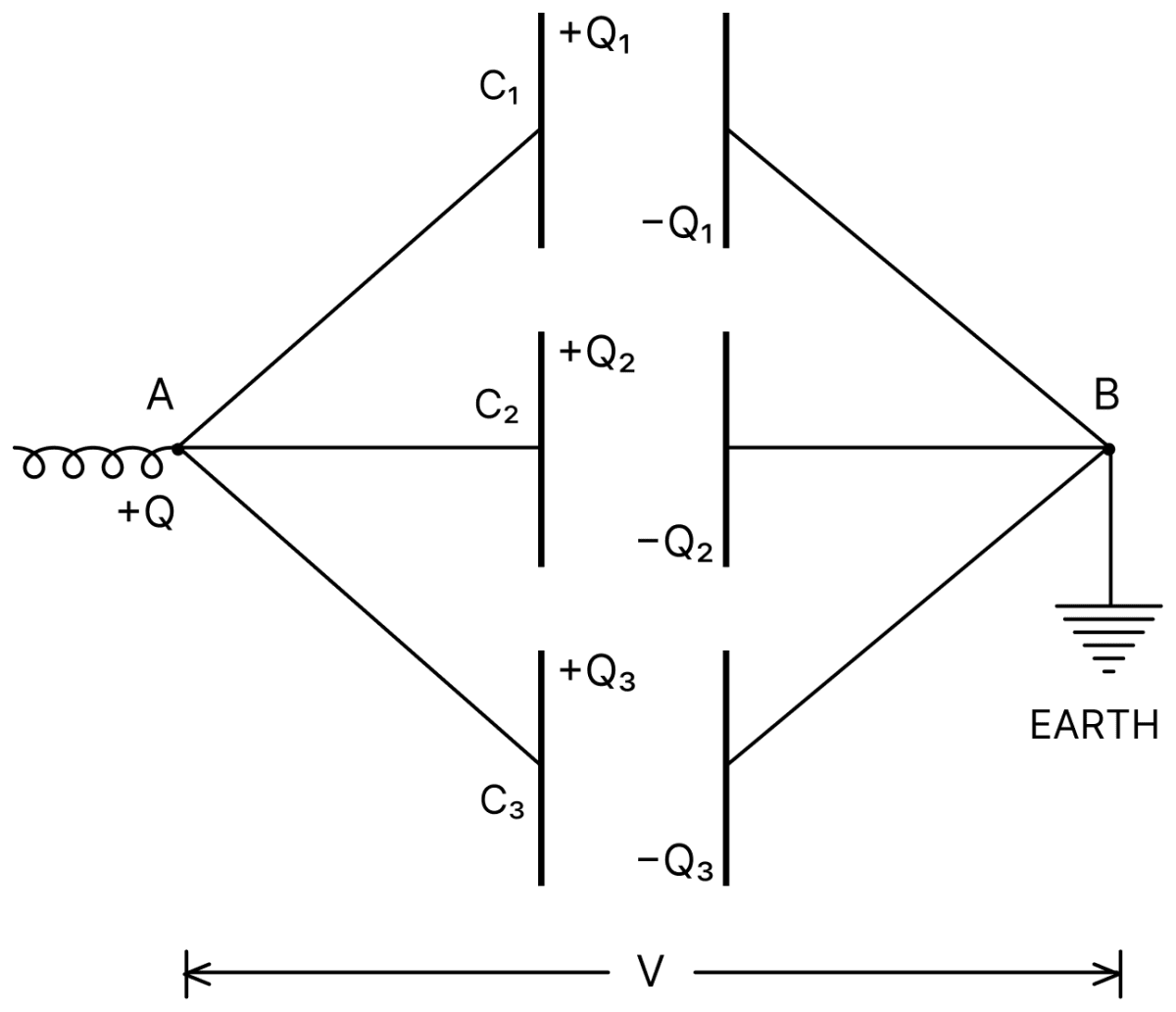
In a parallel combination the left plates of all the capacitors are joined to one point A and the right plates to another point B. Hence each capacitor has the same potential difference V across it, but the charges on them are different.
If Q1, Q2 and Q3 are the charges on the three capacitors, then
The total charge drawn from the source is
If a single capacitor of capacitance C placed between A and B takes the same charge Q at the same potential difference V, then Q = CV. Comparing,
Thus, in a parallel combination the equivalent capacitance is the sum of the individual capacitances, and it is greater than even the highest of the capacitances connected.
Obtain an expression for equivalent capacitance C, when three capacitors having capacitance C1, C2 and C3 are connected in series.
Answer
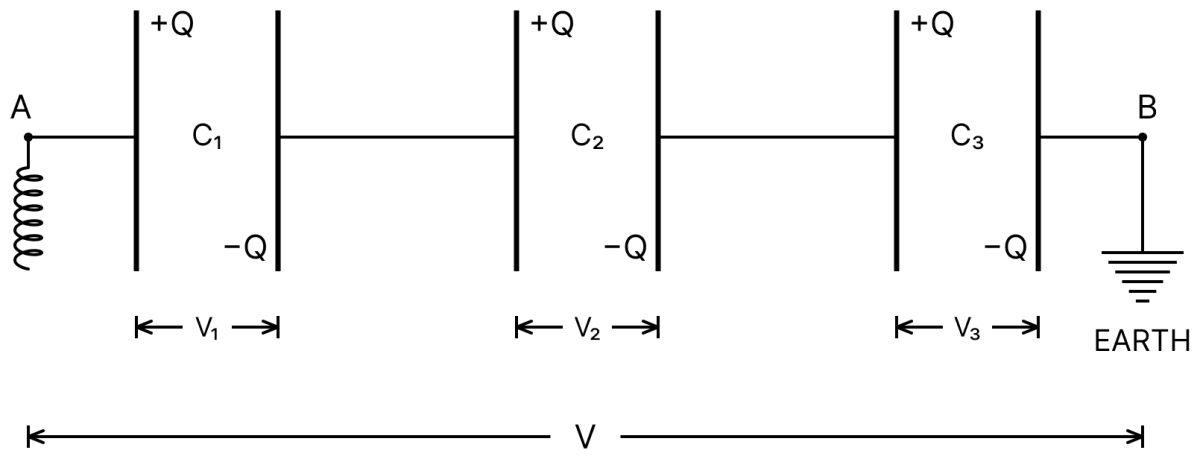
In a series combination the capacitors are joined end to end, the right plate of one being connected to the left plate of the next. When a charge +Q is given to the first plate, equal and opposite charges are induced on the plates of each capacitor by induction. Hence each capacitor carries the same charge Q, while the potential differences across them are different.
The potential differences are
If V is the total potential difference between the end points A and B, then
If a single capacitor of capacitance C placed between A and B acquires the same charge Q for the same potential difference V, then . Comparing,
Thus, in a series combination the reciprocal of the equivalent capacitance is the sum of the reciprocals of the individual capacitances, and the equivalent capacitance is smaller than even the smallest capacitance connected.
Derive an expression for the energy stored in a capacitor of capacitance C, charged to a potential V .
Answer
When a capacitor is charged, work has to be done in transferring charge from one plate to the other against the potential difference already existing between them. This work is stored as electric potential energy of the capacitor.
Let at some instant during charging the charge on the capacitor be q, so that the potential difference between the plates is
The small work done in transferring a further charge dq is
The total work done in charging the capacitor from zero charge to the final charge Q is obtained by integrating,
This work is stored as the energy U of the capacitor. Using Q = CV, it may be written in the equivalent forms
What is a dielectric? A dielectric slab of thickness t is kept between the plates of a parallel-plate capacitor separated by a distance d. Derive expression for the capacitance for t < d .
Answer
Dielectric : A dielectric is an insulating material in which the electrons are tightly bound to the nuclei of the atoms, so that it cannot conduct electricity. On applying an electric field, induced charges appear on its surfaces due to polarisation.
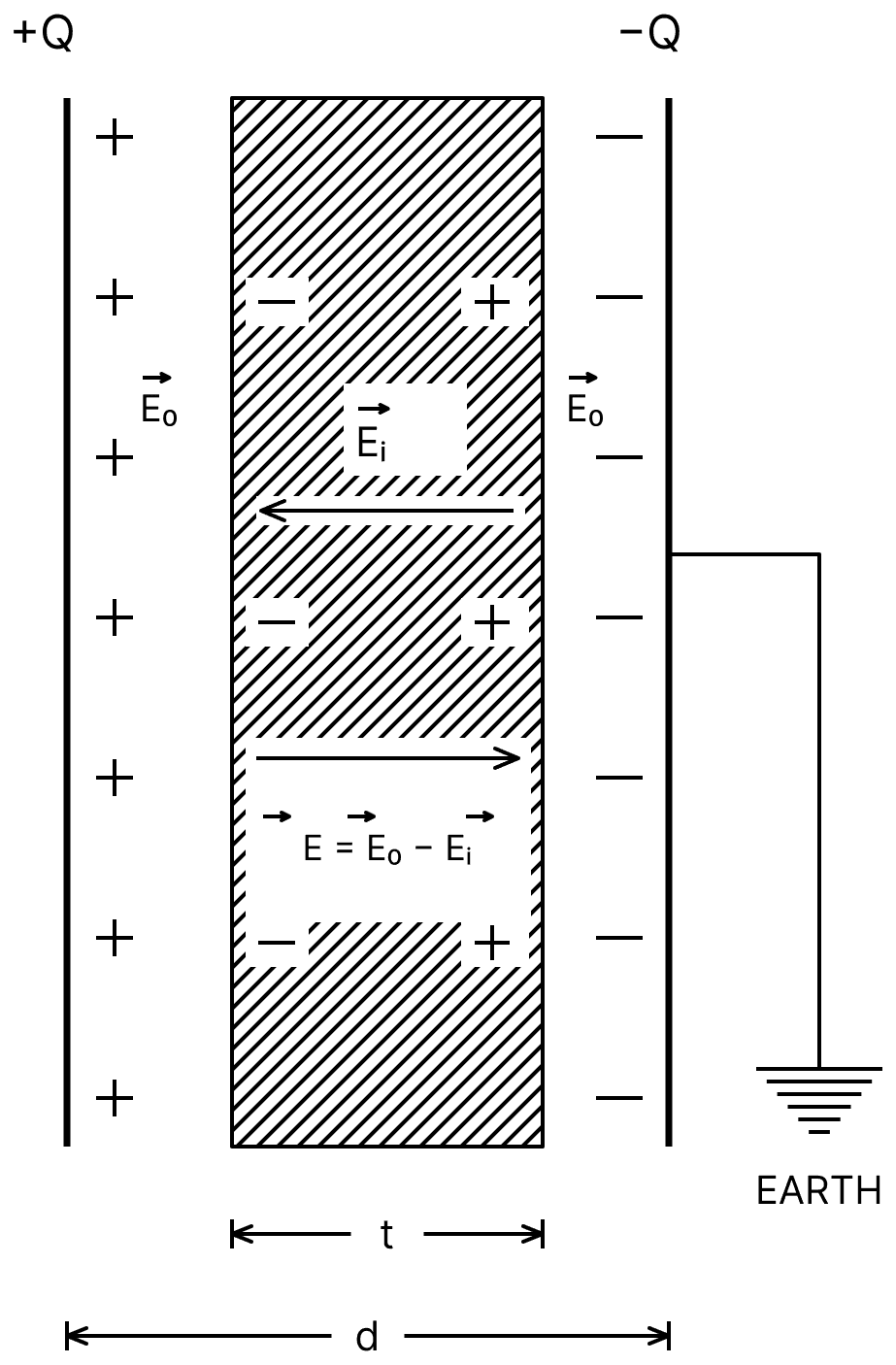
Let a slab of thickness t and dielectric constant K be placed between the plates of a parallel-plate capacitor of plate area A and separation d, where t < d.
If σ is the surface density of charge on the plates, the field in the remaining space, which contains vacuum, is
and the field inside the dielectric slab is reduced to
The potential difference between the plates is the sum of the contributions from the two regions,
Substituting ,
Hence the capacitance is
Since K > 1, the denominator is smaller than d, so the capacitance is increased by introducing the slab.
Derive the expression for the capacitance of a parallel-plate capacitor with a dielectric medium of dielectric constant K between its plates. Obtain also the expression for the energy stored in the above case.
Answer

Let the entire space between the plates, of area A and separation d, be filled with a dielectric of dielectric constant K. If σ is the surface density of charge on the plates, the field between the plates without the dielectric would be . On account of the polarisation of the dielectric, the field is reduced to
The potential difference between the plates is
Hence the capacitance is
that is, K times the capacitance of the air capacitor.
Energy stored : The energy of a charged capacitor is . Substituting the above value of C,
Derive an expression for the energy stored in a charged parallel-plate air capacitor. How does the energy stored change when the medium of air between the plates is replaced by a medium of dielectric constant K? Explain.
Answer
Energy stored in a charged air capacitor : Let at some instant the charge on the capacitor be q, so that the potential difference is . The work done in transferring a further charge dq is
Integrating from 0 to the final charge Q,
This work is stored as the energy of the capacitor,
where .
Effect of introducing a dielectric : On filling the space with a dielectric of dielectric constant K, the capacitance becomes C = KC0. Two cases arise.
(i) Charging battery disconnected : The charge Q remains constant, so
Since K > 1, the energy decreases by the factor . The deficit is accounted for by the work done by the capacitor in drawing the slab in.
(ii) Charging battery remaining connected : The potential difference V remains constant, so
and the energy increases K times, the extra energy being supplied by the battery.
Examiner asked the student to analyse the charging-discharging property of a capacitor. He gives the following instructions to the student. State whether the responses of the student, in each case, are correct or incorrect. Give a reason for your answer.
(i) EXAMINER : The capacitance of the capacitor is too low. Increase its capacitance.
STUDENT : Connects another capacitor in series with the existing capacitor.
(ii) EXAMINER : Keep the charging battery connected to the capacitor and increase its capacitance by changing the distance between the plates.
STUDENT : Decreases the distance between the plates.
(iii) EXAMINER : Take a capacitor of 20 µF, charge it fully by using charging battery. Remove the battery and insert the dielectric slab (K = 5) between the plates of the capacitor to cover the space between the plates completely. Now, find the new value of capacitance.
STUDENT : Capacitance becomes 100 µF.
Answer
(i) The response of the student is incorrect.
In a series combination the equivalent capacitance is smaller than even the smallest capacitance connected. To increase the capacitance, the second capacitor should have been connected in parallel, for which
(ii) The response is correct.
For a parallel-plate capacitor
so decreasing the distance between the plates increases the capacitance.
(iii) The response is correct.
When the dielectric completely fills the space between the plates, the capacitance becomes K times its original value,
Write the factors on which capacitance of a parallel plate capacitor depends. Obtain an expression for it. Explain the interrelationship between capacitance and potential difference between the plates of a parallel plate capacitor, when separation of plates decreases.
Answer
Factors : The capacitance of a parallel-plate capacitor depends on
(i) the area A of the plates,
(ii) the separation d between the plates,
(iii) the dielectric constant K of the medium filling the space between the plates.
Expression :
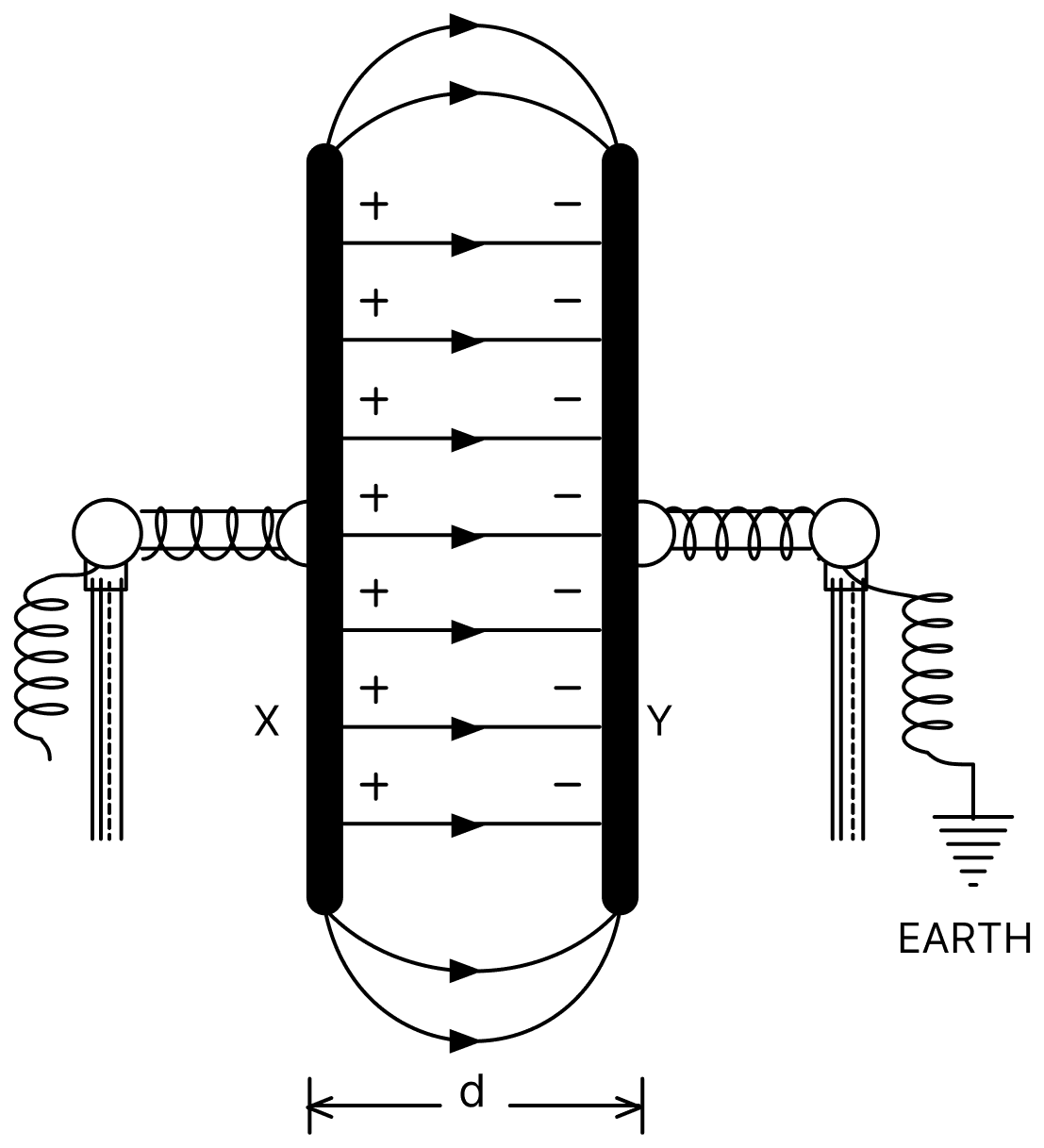
Let the plates each of area A be held a distance d apart, with vacuum between them, and let σ be the surface density of charge on them. The uniform field between the plates is
so the potential difference is
Hence
and with a dielectric of dielectric constant K filling the space, .
Interrelationship when the separation decreases : Since C is inversely proportional to d, decreasing the separation increases the capacitance. If the charge Q on the plates is kept constant, then from
the potential difference between the plates decreases in the same proportion. Thus capacitance and potential difference vary inversely with each other for a given charge.
Obtain an expression for electric energy stored in a charged parallel plate capacitor. Will energy of a parallel plate capacitor decrease or increase when it is completely filled with a medium if the charging battery (a) remains connected (b) is removed.
Answer
Expression for the energy stored : Let q be the charge on the capacitor at some instant, so that the potential difference between the plates is . The work done in transferring a further small charge dq from one plate to the other is
Integrating from q = 0 to q = Q,
This work is stored as electric potential energy,
(a) Battery remains connected : The potential difference V is fixed by the battery, and the capacitance becomes KC. Hence
The energy increases K times, the additional energy being supplied by the battery.
(b) Battery is removed : The charge Q on the plates is now fixed, and the capacitance becomes KC. Hence
The energy decreases to times its value, the loss appearing as the work done by the capacitor in pulling the dielectric slab into the gap.
What do you mean by sharing of charges, obtain an expression for energy loss when two parallel plate capacitors are connected in (i) series (ii) parallel?
Answer
Sharing of charges : When two charged capacitors are joined together by a conducting wire, charge flows from the capacitor at the higher potential to the one at the lower potential until both attain a common potential. This redistribution of charge is called sharing of charges. The total charge is conserved, but a part of the total electric potential energy is always lost, appearing as heat in the connecting wire.
Let two capacitors of capacitances C1 and C2 be charged to potentials V1 and V2 respectively.
(i) Joined in series : In a series combination each capacitor carries the same charge and no redistribution of charge takes place between them. Hence for two capacitors already charged and then joined in series with their unlike plates together, there is no sharing and no loss of energy; the equivalent capacitance is simply
and the energy of the combination is the sum of the energies of the two capacitors.
(ii) Joined in parallel : The total charge is conserved,
so the common potential is
The initial and final energies are
Substituting the value of V in Uf,
Hence the loss of energy is
Since this expression is always positive, there is always a loss of energy on sharing, and it is zero only when V1 = V2.
Define dielectric constant and obtain an expression for energy density or energy stored per unit volume of a parallel plate capacitor and also define the terms involved.
Answer
Dielectric constant : The dielectric constant K of a medium is the ratio of the absolute permittivity ε of the medium to the permittivity ε0 of free space,
Equivalently, it is the ratio of the capacitance C of a capacitor completely filled with the dielectric to the capacitance C0 of the same capacitor with vacuum between its plates, . It is a pure number and is also called the relative permittivity εr.
Energy density : For a parallel-plate capacitor of plate area A and separation d with vacuum between the plates, the energy stored is
The field between the plates is uniform, so V = Ed. Substituting,
The quantity Ad is the volume of the space between the plates, in which the electric field exists. Hence the energy stored per unit volume, called the energy density, is
If a dielectric of dielectric constant K fills the space, this becomes
Terms involved :
- u is the energy density, that is, the electric potential energy stored per unit volume of the medium.
- ε0 is the permittivity of free space, equal to 8.85 × 10⁻¹² C2 N-1 m-2.
- E is the electric field intensity in the region between the plates.
- K is the dielectric constant of the medium filling the space between the plates.
Read the passage(s) and answer the following questions :
When a capacitor is charged by connecting it to a battery, then work is done by the battery at the cost of its chemical energy. A part of the energy supplied by the battery is stored in the medium between the plates of the capacitor in the form of electric potential energy. The value of stored energy depends upon the capacitance of the capacitor and the potential to which the capacitor is charged. Mathematically
If some other charged capacitor is connected with this capacitor, there is flow of charge from one capacitor to another capacitor and there is overall loss of total potential energy. This loss of energy heats up the connecting wire.
(i) If a capacitor is charged by a battery, then find the ratio of work done by the battery and energy stored in the capacitor. Ignore the resistance of connecting wires.
(ii) If a capacitor of capacitance C is charged to potential V so that energy stored is U. With battery remains connected, a dielectric slab of dielectric constant K is introduced between the plates, then what will be the value of energy stored in the capacitor?
(iii) After charging the capacitor C upto potential V, battery is removed and then space between the plates is completely filled with dielectric of dielectric constant K, what will be the potential difference between the plates of the capacitor now?
(iv) Find the ratio of the potential differences that must be applied across the parallel and series combination of two capacitors C1 and C2 with their capacitances in the ratio 1 : 2, so that energy stored in the two cases becomes the same.
Answer
(i) The battery maintains a constant potential difference V while a total charge Q = CV is transferred. The work done by the battery is
while the energy stored in the capacitor is
Hence
The ratio is 2 : 1.
(ii) The battery remains connected, so V is constant while the capacitance rises to KC. Therefore
The energy stored becomes KU.
(iii) The battery has been removed, so the charge Q = CV is constant while the capacitance becomes KC. Hence
(iv) Let C1 = C and C2 = 2C. Then
For the energies to be equal,