
The unit of Planck's constant h is that of :
- work
- force
- linear momentum
- angular momentum
Answer
angular momentum
Reason — From the relation E = hν, Planck's constant is , so its unit is J s (= kg m2 s-1). Angular momentum L = mvr has the unit kg × m s-1 × m = kg m2 s-1, which is the same as J s.
Dimensions of Planck's constant are same as of :
- force × time
- energy × distance
- energy/time
- energy × time
Answer
energy × time
Reason — . Since is the time period, the dimensions of h are those of energy × time, that is [ML2T-1].
Green light causes emission of photoelectrons from a surface, but not the yellow light. Emission of photoelectrons will occur if the surface is illuminated by :
- red light
- infrared radiation
- blue light
- radio waves
Answer
blue light
Reason — Green light ejects photoelectrons but yellow light does not, so the threshold frequency of the surface lies between the frequencies of yellow and green light. Blue light has a higher frequency than green light, so the energy hν of its photons exceeds the work function and emission occurs. Red light, infrared radiation and radio waves all have frequencies lower than yellow light.
Highest-energy photoelectrons will be produced by :
- visible light
- X-rays
- ultraviolet light
- γ-rays
Answer
γ-rays
Reason — By Einstein's photoelectric equation, Ek = hν − W. The maximum kinetic energy of the photoelectrons increases with the frequency of the incident radiation, and γ-rays have the highest frequency among the given radiations.
The maximum energy of photoelectrons is independent of :
- frequency of incident light
- intensity of incident light
- nature of emitting surface
- all of the above
Answer
intensity of incident light
Reason — The maximum kinetic energy is Ek = hν − W. It depends on the frequency ν of the incident light and on the work function W (nature of the emitting surface), but not on the intensity of the incident light. Intensity changes only the number of photoelectrons emitted per second.
In photoelectric effect on metals, an increase in the frequency of incident radiation increases :
- work function of the metal
- threshold frequency
- velocity of emitted electrons
- rate of emission
Answer
velocity of emitted electrons
Reason — From , an increase in frequency ν increases the maximum velocity of the emitted electrons. The work function and the threshold frequency are properties of the metal, and the rate of emission depends on the intensity of the incident radiation.
The stopping potential in the context of photoelectric effect depends on the following property of incident electromagnetic radiation :
- Phase
- Intensity
- Amplitude
- Frequency
Answer
Frequency
Reason — The stopping potential is given by eV0 = hν − W. Hence V0 depends on the frequency ν of the incident radiation and not on its intensity, amplitude or phase.
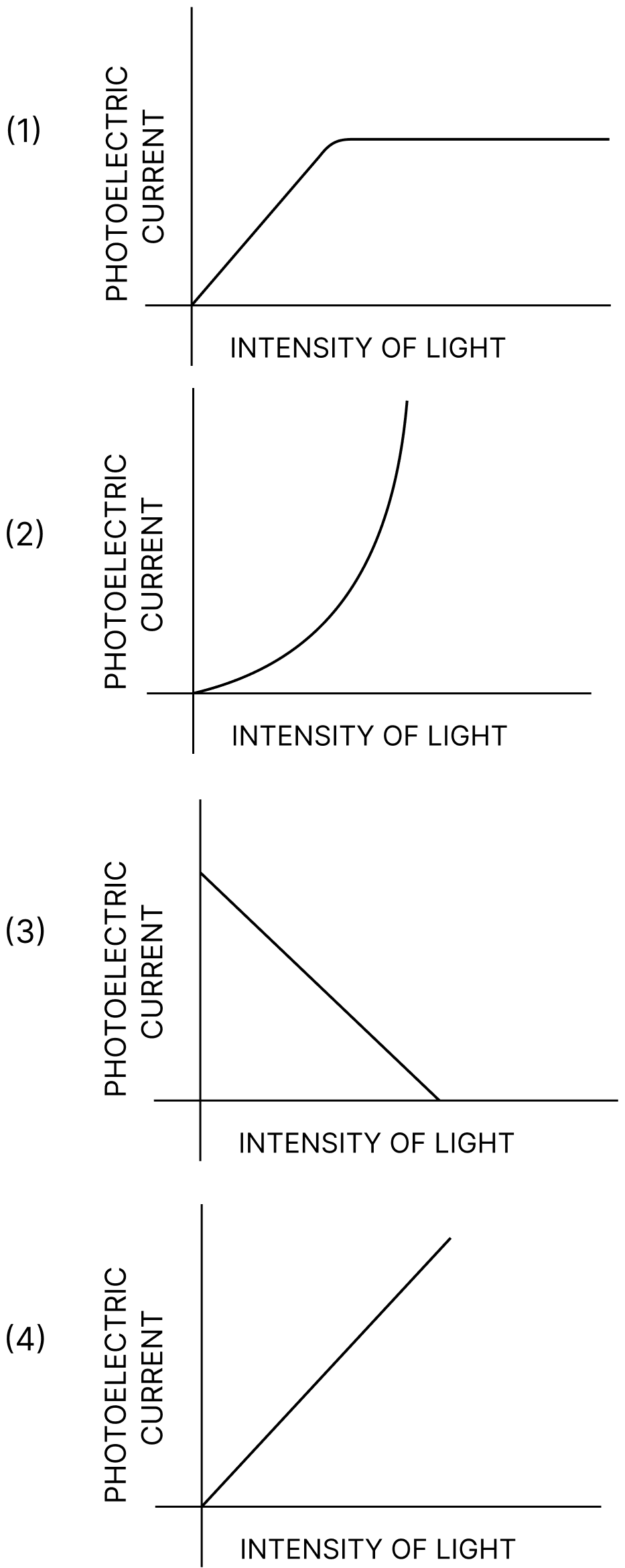
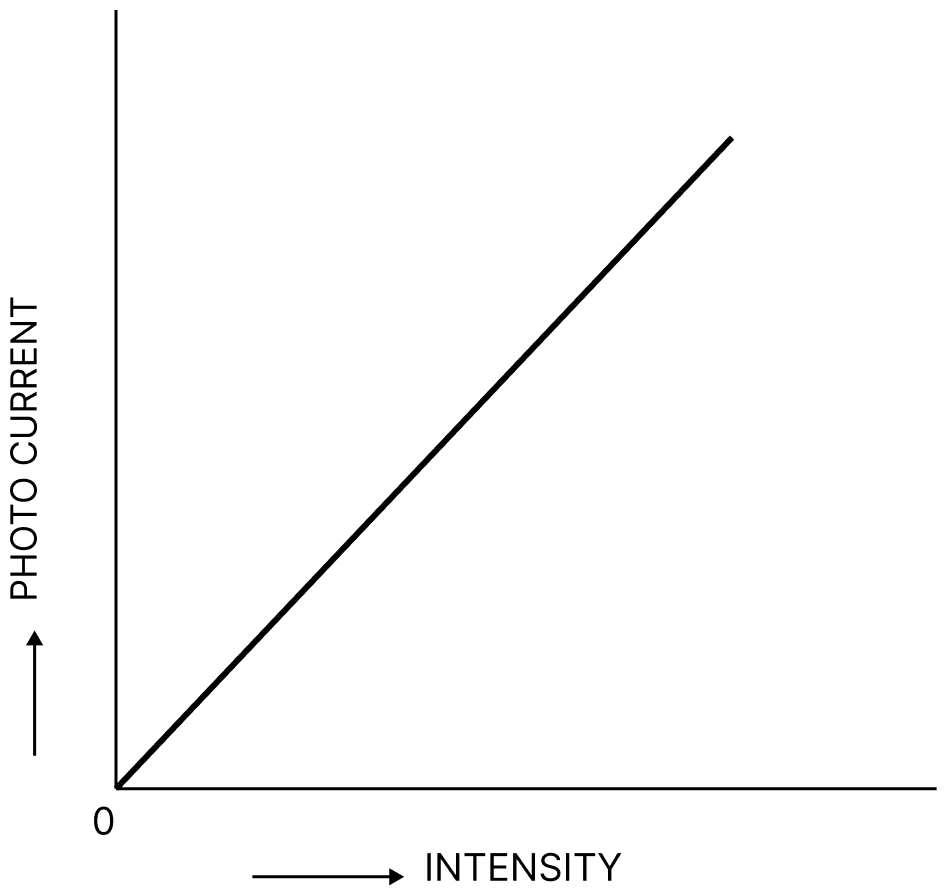
Variation of photoelectric current with intensity of light is best represented by :
Answer
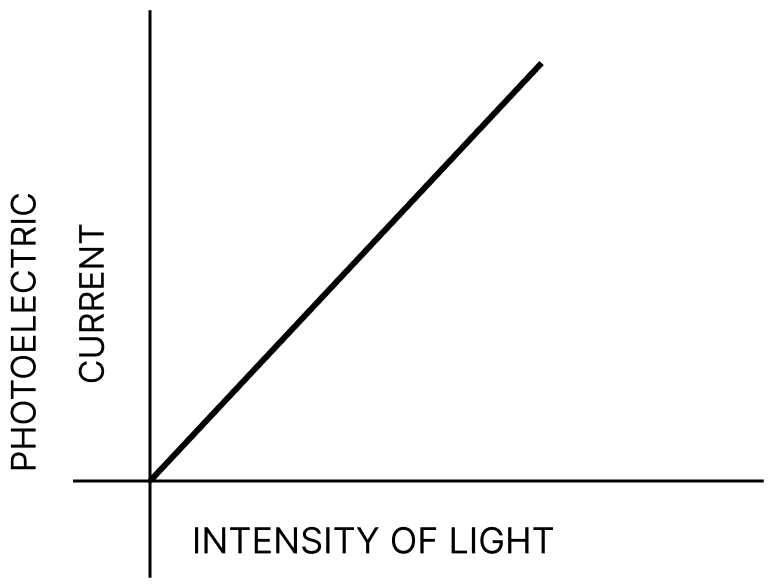
Reason — The photoelectric current, that is the rate of emission of photoelectrons, is directly proportional to the intensity of the incident light (i ∝ I). So the graph between photoelectric current and intensity is a straight line passing through the origin, as in option 4.
The wavelength of a photon needed to remove a proton from a nucleus which is bound to the nucleus with 1 MeV energy is nearly :
- 1.2 nm
- 1.2 × 10⁻³ nm
- 1.2 × 10⁻⁶ nm
- 12.0 nm
Answer
1.2 × 10⁻³ nm
Reason — The photon must supply the binding energy E = 1 MeV = 106 eV. Using ,
In a photoelectric experiment, increasing the intensity of incident light :
- increases the number of photons incident and also increases the KE of the ejected electrons
- increases the frequency of photons incident and increases the KE of the ejected electrons
- increases the frequency of photons incident and the KE of the ejected electrons remains unchanged
- increases the number of photons incident and the KE of the ejected electrons remains unchanged
Answer
increases the number of photons incident and the KE of the ejected electrons remains unchanged
Reason — The intensity of light depends on the number of photons; the energy hν of each photon depends only on the frequency. Increasing the intensity therefore increases the number of photons incident (and of photoelectrons), while Ek = hν − W, the KE of the ejected electrons, remains unchanged.
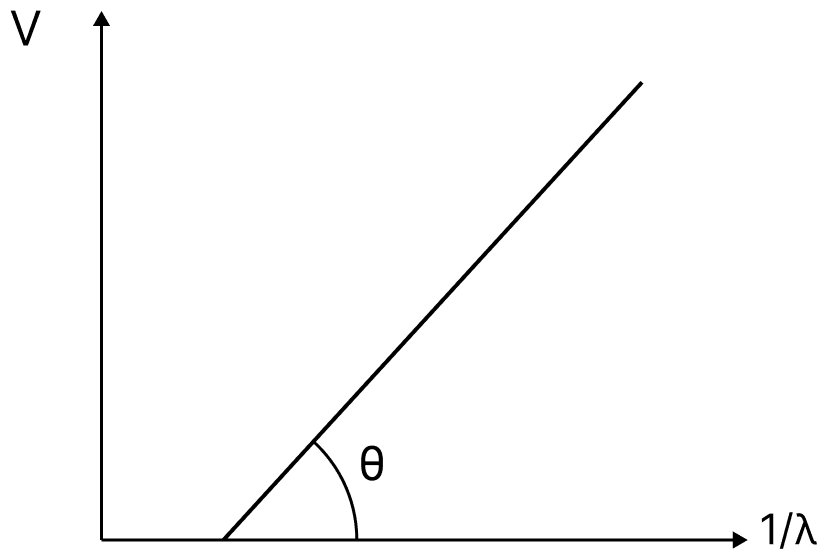
In a photoelectric effect experiment, the graph of stopping potential V versus reciprocal of wavelength obtained is shown in the figure. As the intensity of incident radiation is increased :
- slope of the straight line gets more steep
- graph does not change
- straight line shifts to left
- straight line shifts to right
Answer
graph does not change
Reason — From Einstein's equation, , so
The slope and the intercept depend only on constants and on the work function of the metal. The stopping potential does not depend on intensity, so the graph does not change.
Two identical photocathodes receive the light of frequencies f1 and f2, respectively. If the velocities of the photoelectrons coming out are v1 and v2 respectively, then :
Answer
Reason — For identical photocathodes the work function W is the same. By Einstein's photoelectric equation,
Subtracting,
Two photons, first has energy twice the other. If energy of first photon is 5 times of its work function, find the ratio of maximum velocities :
Answer
None of the given options;
Reason — Let W be the work function. The first photon has energy 5W and twice the energy of the other, so the energy of the second photon is = 2.5W. Einstein's equation gives
Dividing,
Note: The printed key gives (b) , which reverses the stated relation between the two photon energies.
Following are two statements :
Statement I: Out of microwaves, infrared rays and ultraviolet rays, ultraviolet rays are the most effective for the emission of electrons from a metallic surface.
Statement II: Above the threshold frequency, the maximum kinetic energy of photoelectrons is inversely proportional to the frequency of the incident light.
In the light of above statements, choose the correct answer from the options given below.
- Both Statement I and Statement II are true
- Statement I is true but Statement II is false
- Both Statement I and Statement II are false
- Statement I is false but Statement II is true
Answer
Statement I is true but Statement II is false
Reason — Ultraviolet rays have the highest frequency of the three, so their photons carry the largest energy hν and are the most effective in ejecting electrons; Statement I is true. Above the threshold frequency, Ek = hν − W increases linearly with frequency; it is not inversely proportional to it, so Statement II is false.
The work functions of aluminium and gold are 4.1 eV and 5.1 eV, respectively. The ratio of the slope of the stopping potential versus frequency plot for gold to that of aluminium is :
- 1.5
- 1
- 1.24
- 2
Answer
1
Reason — From eV0 = hν − W,
The slope is a universal constant, independent of the metal. Only the intercepts change with the work function, so the ratio of the slopes for gold and aluminium is 1.
In photoelectric effect,
(A) The photocurrent is proportional to the intensity of the incident radiation.
(B) Maximum kinetic energy with which photoelectrons are emitted depends on the intensity of incident radiation.
(C) Maximum K.E. with which photoelectrons are emitted, depends on the frequency of incident radiation.
(D) The emission of photoelectrons requires a minimum threshold intensity of incident radiation.
(E) Maximum K.E. of the photoelectrons is independent of the frequency of the incident radiation.
Choose the correct answer from the given options.
- B and C
- A and E
- A and C
- A and B
Answer
A and C
Reason — The photocurrent is proportional to the intensity of the incident radiation, so (A) is true. The maximum K.E. is Ek = hν − W, which depends on the frequency and not on the intensity, so (C) is true while (B) and (E) are false. There is no threshold intensity, so (D) is false.
Which of the following statements is not true about stopping potential (V0)?
- It depends on the nature of emitter material.
- It depends upon frequency of the incident light.
- It increases with increase in intensity of the incident light.
- It is times the maximum kinetic energy of electrons emitted.
Answer
It increases with increase in intensity of the incident light.
Reason — From eV0 = hν − W = Ek, the stopping potential depends on the frequency of the incident light and on the work function (nature of the emitter material), and . It does not depend on the intensity of the incident light, so statement 3 is not true.
It was found that certain metals like zinc, cadmium, magnesium, etc. are photosensitive only to ultraviolet light. However, some alkali metals such as lithium, sodium and potassium, are photosensitive even to visible light.
If ultraviolet light of the same frequency and the same intensity is incident on zinc and sodium metal, then which of the following quantities may be the same?
- Kinetic energy of the photoelectrons emitted by the two metals
- Photoelectric current flowing through the two metals
- Stopping potential
- The potential energy of the photoelectrons emitted by the two metals
Answer
Photoelectric current flowing through the two metals
Reason — Zinc and sodium have different work functions, so Ek = hν − W and hence the stopping potential differ for the two metals. With the same frequency and the same intensity, the same number of photons strike each surface per second. The photoelectric current depends on the number of photoelectrons emitted per second, so it may be the same for both metals.
Write Einstein's photoelectric equation, giving the meanings of symbols used.
Answer
Einstein's photoelectric equation is
where
- h = Planck's constant
- ν = frequency of the incident light, so hν is the energy of the photon absorbed by the electron
- W = work function of the metal (= hν0, where ν0 is the threshold frequency)
- m = mass of the electron
- vmax = maximum velocity of the emitted photoelectrons
- Ek = maximum kinetic energy of the emitted photoelectrons
On what factors do the magnitude of photoelectric current, the velocity of ejected electrons depend during photoelectric emission from a metal?
Answer
The magnitude of the photoelectric current depends on the intensity of the incident light, while the velocity of the ejected electrons depends on the frequency of the incident light (and on the work function of the metal).
'The work function of cesium is 2 eV.' Explain this statement.
Answer
It means that the minimum energy required to eject an electron from the surface of cesium is 2 eV. Hence a photon incident on cesium must have an energy of at least 2 eV for photoelectric emission to occur.
Why are alkali metals most suited for photoelectric emission?
Answer
Alkali metals have comparatively low work functions. Hence even photons of visible light, which have lower energy and are easily available, can eject photoelectrons from them.
The photoelectric threshold wavelength for sodium is 6800 Å. Explain its meaning.
Answer
It means that 6800 Å is the maximum wavelength of light that can eject photoelectrons from sodium. Light of wavelength greater than 6800 Å cannot eject photoelectrons from sodium, however intense it may be.
Is photoelectric emission possible at all frequencies? Give reason for your answer.
Answer
No. Photoelectric emission occurs only if the energy of the incident photon (E = hν) is at least equal to the work function of the metal, that is, ν ≥ ν0. For frequencies below the threshold frequency ν0, no photoelectrons are emitted whatever be the intensity of light.
What is the relation between the work function and the threshold frequency ν0 of a metal?
Answer
W = hν0
Explanation:
At the threshold frequency ν0, the whole energy hν0 of the photon is spent in ejecting the electron out of the metal, so it equals the work function W.
Define stopping potential. How is it related to the kinetic energy of photoelectrons?
Answer
The negative potential of the anode (collector plate) relative to the emitting plate at which the photoelectric current becomes zero is called the stopping potential (or cut-off potential) V0.
Since it just stops the maximum-energy photoelectrons, it is a measure of their maximum kinetic energy:
Explain, what is meant by kinetic mass of a photon?
Answer
A photon travels with the speed of light c and has energy E = hν. By the mass-energy relation E = mc2, it possesses a mass
This mass, produced due to the motion of the photon, is called its 'kinetic mass'. The rest mass of the photon is zero.
What is meant by the momentum of a photon?
Answer
The momentum of a photon is the product of its kinetic mass and its velocity c (the speed of light):
Write the formula for the energy, momentum and kinetic mass of a photon.
Answer
where h is Planck's constant, ν the frequency, λ the wavelength and c the speed of light.
Write the relation between energy and momentum of a photon.
Answer
E = pc
Explanation:
The energy of a photon is E = hν and its momentum is . Hence , or E = pc.
What are rest mass and kinetic mass of a gamma-ray photon of frequency ν?
Answer
Rest mass = zero; kinetic mass = .
Explanation:
A photon cannot exist at rest, so its rest mass is zero. Moving with the speed of light, its energy hν is equivalent to a mass m given by mc2 = hν, so .
How many photons are effective in the emission of one photoelectron? Does every photon eject a photoelectron?
Answer
One photon. No, every photon does not eject a photoelectron.
Explanation:
A photon transfers its whole energy to any one electron, so one photon is effective in emitting one photoelectron. However, electrons in the interior of the metal lose energy in collisions and may not gain sufficient energy for emission, so the number of photoelectrons emitted is quite less than the number of photons incident.
Which of the following radiations will be most effective for electron-emission from the surface of zinc?
Microwave, infrared, ultraviolet.
Answer
Ultraviolet.
Explanation:
Of the three, ultraviolet radiation has the highest frequency, so its photons have the maximum energy hν. Zinc has a high work function and is photosensitive only to ultraviolet light; the photons of microwaves and infrared rays have energies less than its work function.
It is harder to remove photoelectrically a free electron from copper than from sodium. Which metal has a greater work function? Which has higher threshold wavelength?
Answer
Copper has the greater work function; sodium has the higher threshold wavelength.
Explanation:
More energy is needed to remove an electron from copper, so its work function W is greater. Since the threshold wavelength is , the metal with the smaller work function, sodium, has the higher threshold wavelength.
Radiation of frequency 1015 Hz falls on surfaces P, Q and R. The surface P does not emit photoelectrons, Q emits photoelectrons of zero kinetic energy whereas R emits photoelectrons having kinetic energies. What conclusions would you draw?
Answer
The threshold frequency of P is higher than 1015 Hz, that of Q is equal to 1015 Hz, and that of R is lower than 1015 Hz.
Since W = hν0, the work functions are in the order WP > WQ > WR.
If the maximum kinetic energy of electrons emitted by a photo-cell is 4 eV, what is its stopping potential?
Answer
4 V
Explanation:
The stopping potential is related to the maximum kinetic energy by eV0 = Ek. With Ek = 4 eV, V0 = 4 V.
When photons of energy 5.0 eV fall on the surface of a metal, the emitted photoelectrons are stopped by a cut-off potential of 3.5 volt. What is the work function of the metal?
Answer
1.5 eV
Explanation:
The maximum kinetic energy is Ek = eV0 = 3.5 eV. From Einstein's equation, hν = W + Ek,
Some photographic plates are not affected by red light, but are immediately blackened by white light; why?
Answer
Red light has a low frequency (long wavelength), so the energy of each red-light photon, , is too small to affect the photographic plate, however intense the light may be. White light contains photons of higher frequency (such as blue and violet), whose energy is sufficient, so the plate is immediately blackened.
Electrons are emitted from a surface when green light is incident on it, but no electrons are ejected when yellow light falls on the surface. Do you expect electrons to be ejected when the surface is exposed to (i) red light (ii) blue light?
Answer
(i) No (ii) Yes
Explanation:
The threshold frequency of the surface lies between the frequencies of yellow and green light. Red light has a frequency lower than yellow light, so no electrons are ejected; blue light has a frequency higher than green light, so electrons are ejected.
Photons of energies twice and five times the work function of a metal fall successively on the metal surface. What is the ratio of the maximum velocities of photoelectrons emitted in the two cases?
Answer
1 : 2
Explanation:
By Einstein's equation, with photon energies 2W and 5W,
Dividing,
A good-quality mirror reflects about 80% of visible light incident on it. How will you find out, whether 20% of the photons have not been reflected at all or all the photons have been reflected but energy of each has been reduced by 20%?
Answer
By examining the colour (wavelength) of the reflected light. The energy of a photon is . If the energy of each photon were reduced by 20%, the wavelength of the reflected light would increase and its colour would change. Since the reflected light has the same colour as the incident light, the energy of each photon is unchanged; hence 20% of the photons have not been reflected at all.
Which of the red-light and blue-light photons has a larger momentum?
Answer
Blue-light photon.
Explanation:
The momentum of a photon is . Blue light has a shorter wavelength than red light, so a blue-light photon has a larger momentum.
If the intensity of light falling on the emitting substance of a photoelectric cell be increased, then what will be the effect on :
(i) the current flowing from the cell,
(ii) potential difference required to stop the current completely?
Answer
(i) On increasing the intensity of light, the number of photons striking the substance per second increases. Hence the number of photoelectrons emitted per second, and therefore the current flowing from the cell, increases.
(ii) The potential difference required to stop the current (the stopping potential, ) depends on the maximum kinetic energy Ek of the photoelectrons, which depends on the frequency of the incident light and not on its intensity. Hence it remains unchanged.
Yellow light incident on the cathode of a photoelectric cell is replaced by blue light and the intensity of light is also increased. The current from the cell increases and the potential difference required to stop the current completely also increases. State which effect is produced due to which change.
Answer
The increase in current is due to the increase in intensity, since a more intense beam carries more photons per second and ejects more photoelectrons.
The increase in the stopping potential difference is due to the replacement of yellow light by blue light, that is, due to the increase in frequency. Blue photons have greater energy hν, so the maximum kinetic energy Ek = hν − W of the photoelectrons increases.
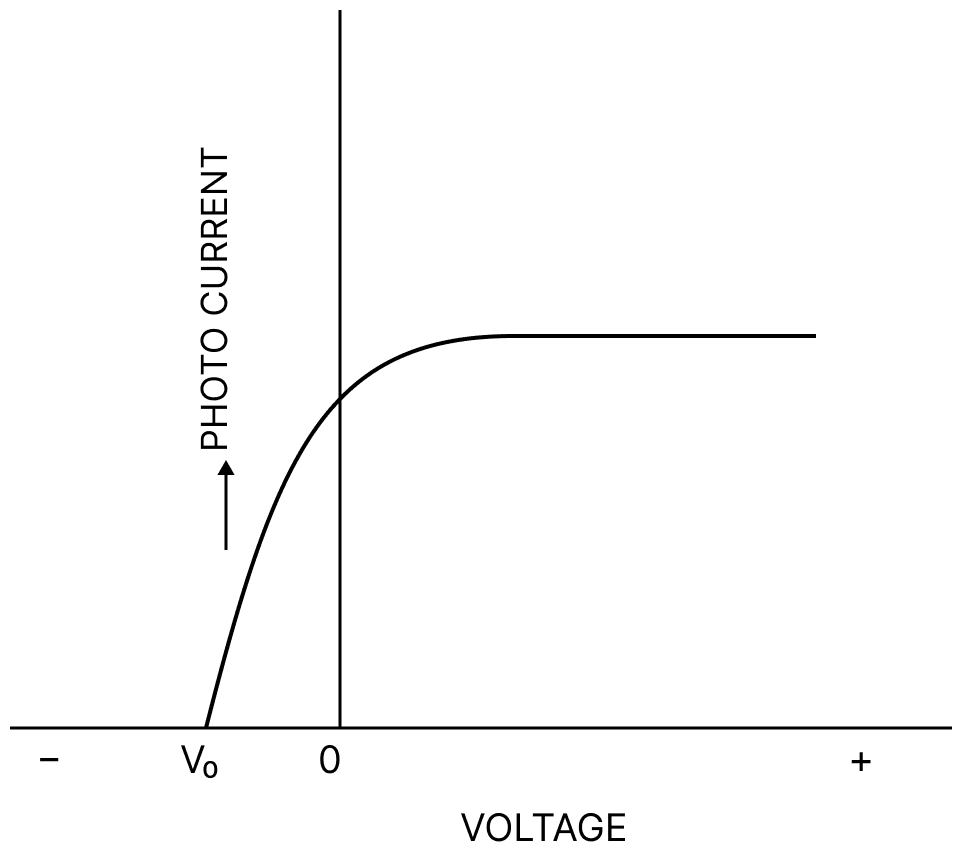
Explain the variation of photoelectric current in a phototube with :
(i) voltage across the tube and
(ii) intensity of incident radiation, with graphs.
Answer
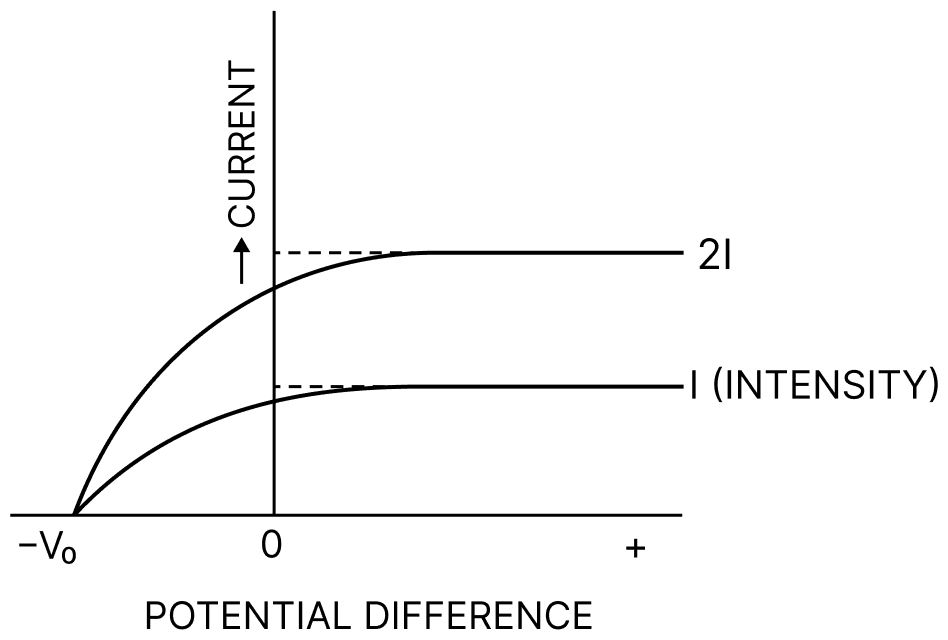
(i) Variation with voltage : At positive anode potentials the current rises and soon reaches a maximum (saturation) value, when all the photoelectrons emitted from the cathode reach the anode. When the anode is made negative relative to the cathode, an increasing number of photoelectrons fail to reach it and the current falls. At a certain negative potential, the cut-off (stopping) potential −V0, the current becomes zero.
(ii) Variation with intensity : For a given frequency, the number of photoelectrons emitted per second is directly proportional to the intensity of the incident radiation. Hence the photoelectric current increases linearly with intensity, and the graph is a straight line passing through the origin.
Explain the meaning of photoelectric work function of a metal. How does its value affect the kinetic energy of the liberated photoelectrons?
Answer
The minimum energy required to pull out an electron from the surface of a metal, without imparting any kinetic energy to it, is called the photoelectric work function W of that metal. It is related to the threshold frequency by W = hν0.
By Einstein's photoelectric equation,
For light of a given frequency ν, the greater the work function, the smaller the kinetic energy Ek of the liberated photoelectrons.
No photoelectrons can be liberated from a metal surface, if the wavelength of the incident light exceeds a certain value. Why?
Answer
The energy of a photon, , decreases as the wavelength increases. Photoelectrons are liberated only if this energy is at least equal to the work function W of the metal, that is, if λ ≤ λ0, where is the threshold wavelength.
If the wavelength exceeds λ0, the photon energy is less than the work function and no photoelectron can be liberated, however intense the light may be.
How does the stopping potential depend upon the frequency and the intensity of the incident light? Explain by drawing graph.
Answer
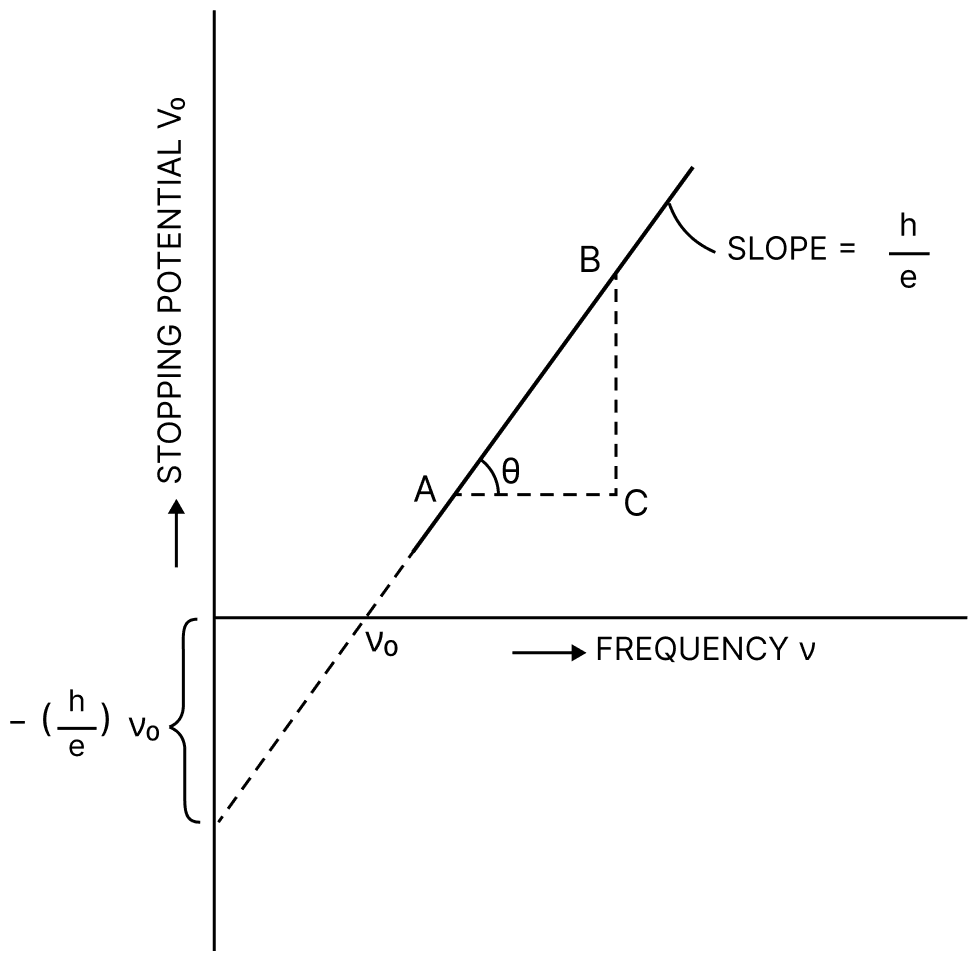
Dependence on frequency : The stopping potential V0 is a measure of the maximum kinetic energy of the photoelectrons (Ek = eV0). From Einstein's equation, eV0 = hν − hν0, so
The graph between V0 and ν is a straight line of slope , cutting the ν-axis at the threshold frequency ν0. The stopping potential increases linearly with increasing frequency.
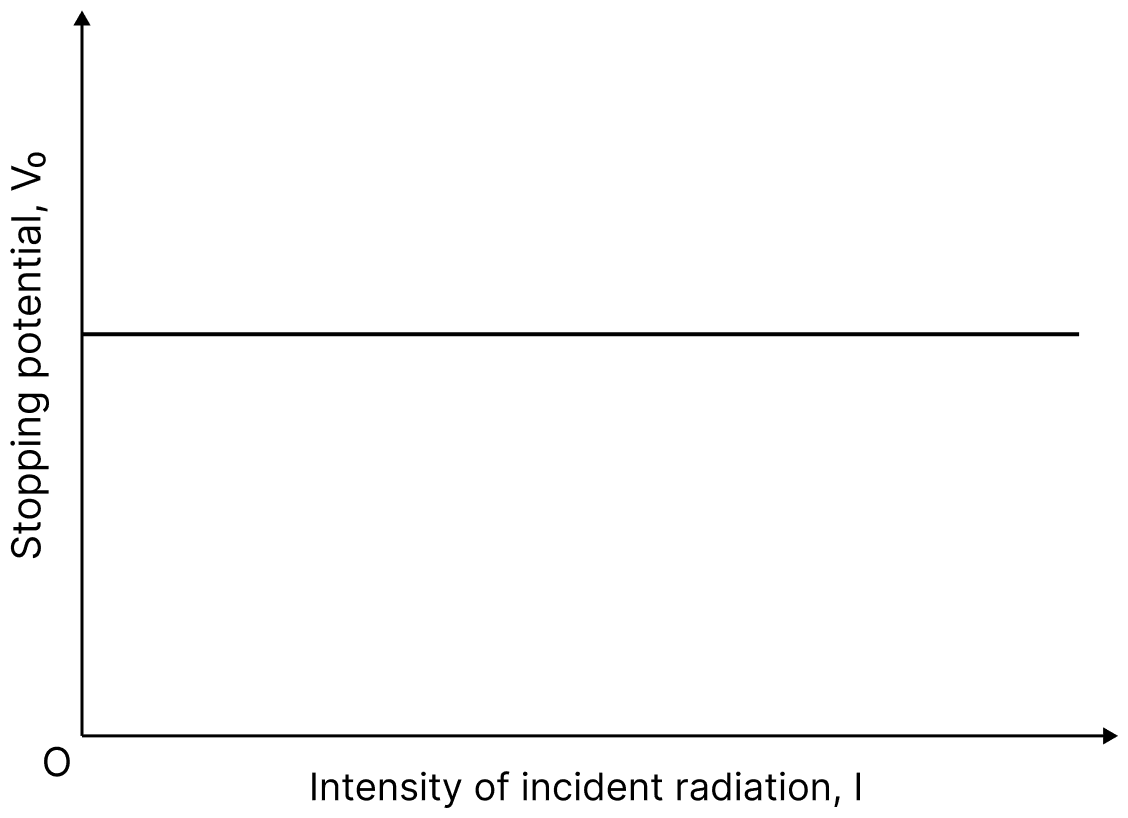
Dependence on intensity : The stopping potential does not depend on the intensity of light. So the graph between stopping potential and intensity is a straight line parallel to the intensity axis.
The work function of aluminium is 4.2 eV. If two photons, each of energy 2.5 eV are incident on aluminium surface, will photoelectric emission occur?
Answer
No, photoelectric emission will not occur.
A photon gives its whole energy to any one electron, so only one photon is effective in the emission of one photoelectron; the energies of two photons do not add up for one electron. Emission needs a photon of energy not less than the work function, 4.2 eV. Since the energy of each photon (2.5 eV) is less than 4.2 eV, no photoelectron is emitted.
In photoelectric effect experiment, as the potential difference is taken little to the positive side from −V0, why does the photoelectric current not reach its maximum value instantaneously?
Answer
The photoelectrons are emitted with different energies. All of them are not emitted from the surface of the cathode; some come from the interior and lose part of their energy in collisions on the way. At −V0 only the maximum-energy electrons are just stopped.
As the potential is taken to the positive side, the slower electrons progressively reach the anode, and those emitted from the interior with small energies need a little greater attraction to reach it. Hence the current rises gradually and reaches its maximum (saturation) value only when the anode potential is sufficient to collect all the emitted photoelectrons.
Every metal has a definite work function. Even then, when light of a single frequency (monochromatic) is incident on a metal, photoelectrons having different energies are emitted, why?
Answer
The photoelectrons are emitted not only from the surface of the metal but also from its interior. Those emitted from the surface do not lose energy in collisions and come out with the maximum kinetic energy hν − W. Those ejected from the interior lose part of their energy in collisions with the atoms of the metal on their way to the surface. Hence photoelectrons with energies ranging from zero up to the maximum value are emitted.
When monochromatic radiation of wavelength 2000 Å falls upon a nickel plate, the later acquires a positive charge. When the wavelength is increased, at 3400 Å the effect is found to cease, however intense the incident radiation may be. Explain it.
Answer
3400 Å is the threshold wavelength λ0 of nickel. The corresponding work function is
For λ = 2000 Å (< λ0), the photon energy exceeds the work function, so photoelectrons are emitted. The plate loses negative charge and acquires a positive charge.
For wavelengths longer than 3400 Å, the photon energy is less than the work function, so no photoelectrons are emitted. At exactly 3400 Å the photon energy just equals the work function; this is the limiting case, in which the photoelectrons have zero maximum kinetic energy. Increasing the intensity only increases the number of photons, not the energy of each photon, so the effect ceases however intense the radiation may be.
The work functions of Na, K, Mo and Ni are 1.92 eV, 2.15 eV, 4.17 eV and 5.0 eV respectively. Which of these metals will not give photoelectric emission for radiation of wavelength 3300 Å from a He-Cd laser source placed 1.0 m away from the photocell? What would happen if the laser be brought nearer and placed 0.5 m away?
Answer
Given,
- Work functions : W(Na) = 1.92 eV, W(K) = 2.15 eV, W(Mo) = 4.17 eV, W(Ni) = 5.0 eV
- Wavelength of radiation, λ = 3300 Å
Energy of each incident photon,
Photoelectric emission occurs only if the energy of the photon is not less than the work function. For Na and K the work functions are less than 3.76 eV, so they emit photoelectrons. For Mo (4.17 eV) and Ni (5.0 eV) the work functions exceed 3.76 eV, so no emission occurs.
When the laser is brought nearer (0.5 m), the intensity of radiation at the photocell increases, but the energy of each photon remains 3.76 eV. Mo and Ni will still not emit photoelectrons, while the photoelectric current from Na and K will increase in proportion to the intensity.
Hence, Mo and Ni will not give photoelectric emission; bringing the laser to 0.5 m does not change this, but increases the photoelectric current from Na and K.
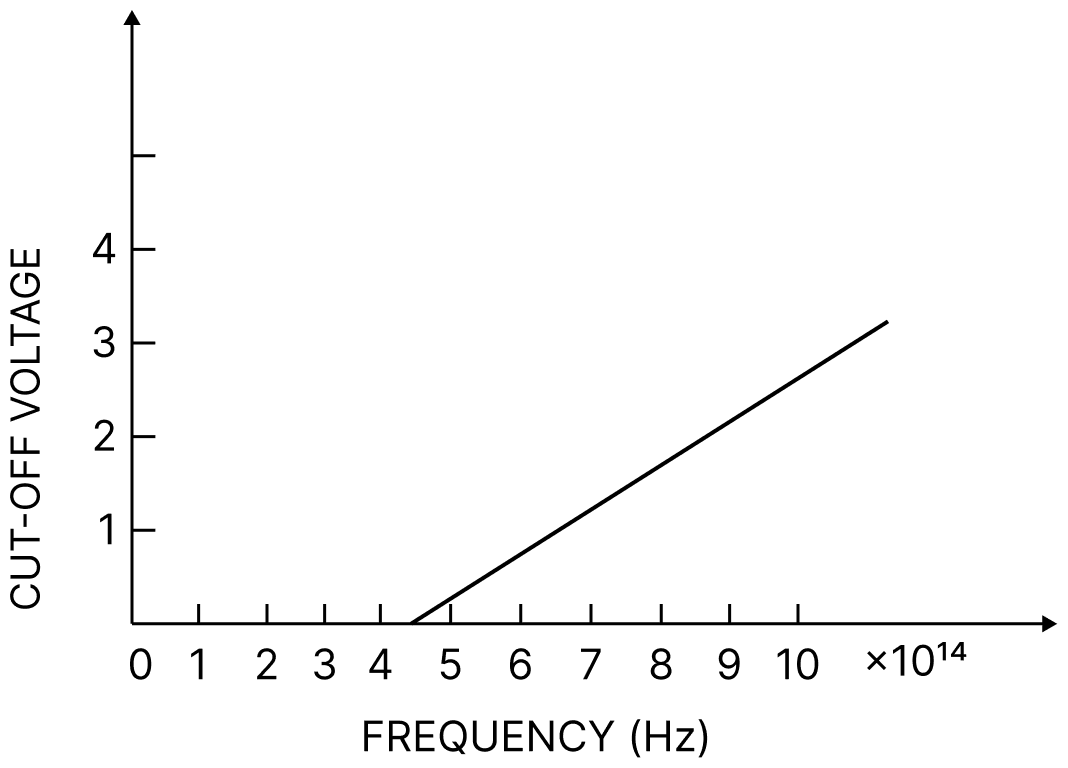
The figure shows a plot of cut-off voltage versus frequency of incident radiation for photoelectric effect in sodium. Calculate the threshold frequency and the work function of sodium. (h = 6.6 × 10⁻³⁴ J s)
Answer
Given,
- h = 6.6 × 10⁻³⁴ J s
- 1 eV = 1.6 × 10⁻¹⁹ J
Threshold frequency : The cut-off voltage becomes zero where the straight line meets the frequency axis. From the graph,
Work function :
Hence, the threshold frequency of sodium is 4.5 × 10¹⁴ Hz and its work function is 2.97 × 10⁻¹⁹ J or 1.86 eV.
The figure shows graphs between the stopping potential V0 and the frequency ν of the incident radiation on two different metal plates P and Q.
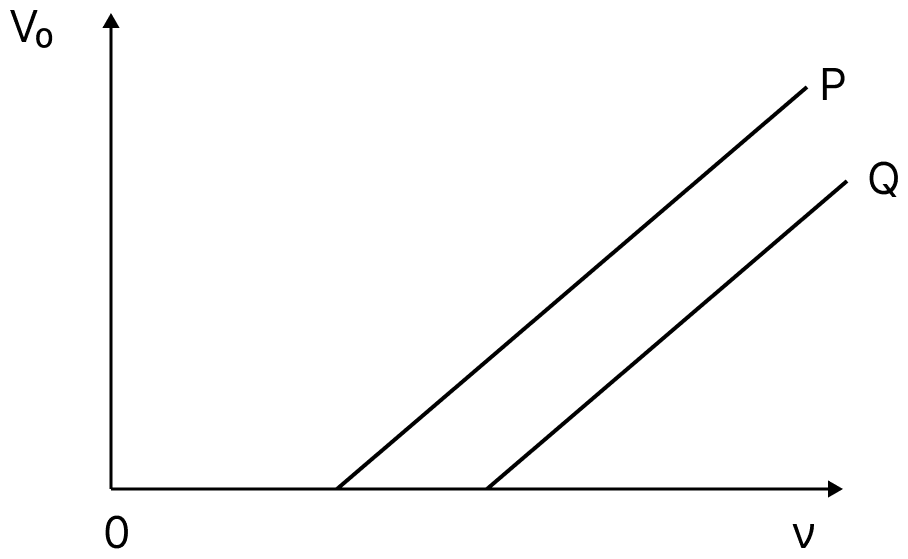
(i) Which metal, P or Q, has the greater value of work function?
(ii) What does the slope of the lines depict?
Answer
(i) The metal Q has the greater work function. The line for Q meets the frequency axis (V0 = 0) at a higher frequency, so its threshold frequency ν0 is higher, and W = hν0.
(ii) From , the slope of each line is , the ratio of Planck's constant to the electronic charge. It is a universal constant, so the lines for P and Q are parallel. Multiplying the slope by e gives Planck's constant.
Note: The textbook states that the slope is the value of Planck's constant; the slope of a V0–ν graph is h/e, and h is obtained as slope × e.
If the frequency of the incident light on the cathode of a photocell is doubled, how will the following change :
(i) kinetic energy of electrons,
(ii) photoelectric current,
(iii) stopping potential?
Explain.
Answer
(i) Kinetic energy of electrons : Initially Ek1 = hν − W. With frequency 2ν,
So the maximum kinetic energy becomes more than double.
(ii) Photoelectric current : The photoelectric current depends on the intensity of the incident light and not on its frequency, so it will not change.
(iii) Stopping potential : The stopping potential is a measure of the maximum kinetic energy (), so it also becomes more than double.
There are two sources of light A and B. The wavelength of light emitted from A is from 8000 to 11000 Å, while that from B is from 3000 to 6000 Å. The intensity of A is 4 times that of B. But when light of A falls on a metal, photoelectrons are not emitted, whereas light of B can eject photoelectrons from the same metal. Explain its reason.
Answer
Photoelectrons are emitted from a metal only when the energy of the incident photons, , is not less than the work function of the metal, that is, when the wavelength is below the threshold wavelength λ0 of the metal. The energy of a photon depends on its wavelength (frequency), not on the intensity.
The threshold wavelength of the given metal therefore lies below 8000 Å, while the wavelengths of B (3000–6000 Å) are shorter than it. The photons of B have enough energy to eject photoelectrons, but all the photons of A (8000–11000 Å) have less energy than the work function. A greater intensity only means more photons, so A cannot eject photoelectrons even though its intensity is 4 times that of B.
If light propagation takes place through photons, then why does the light arriving at the eye not appear discontinuous?
Answer
The effect of a photon on the retina persists for nearly second. If another photon arrives within this time, the combined effect appears continuous. When visible light enters the eye, an enormous number of photons (nearly 1018) strike the retina every second, so every point of the retina receives photons continuously. Hence the light does not appear discontinuous.
The graph between the stopping potential (V0) and is shown in the figure. φ1, φ2 and φ3 are work functions of metal 1, metal 2 and metal 3 respectively. Find the ratio φ1 : φ2 : φ3.
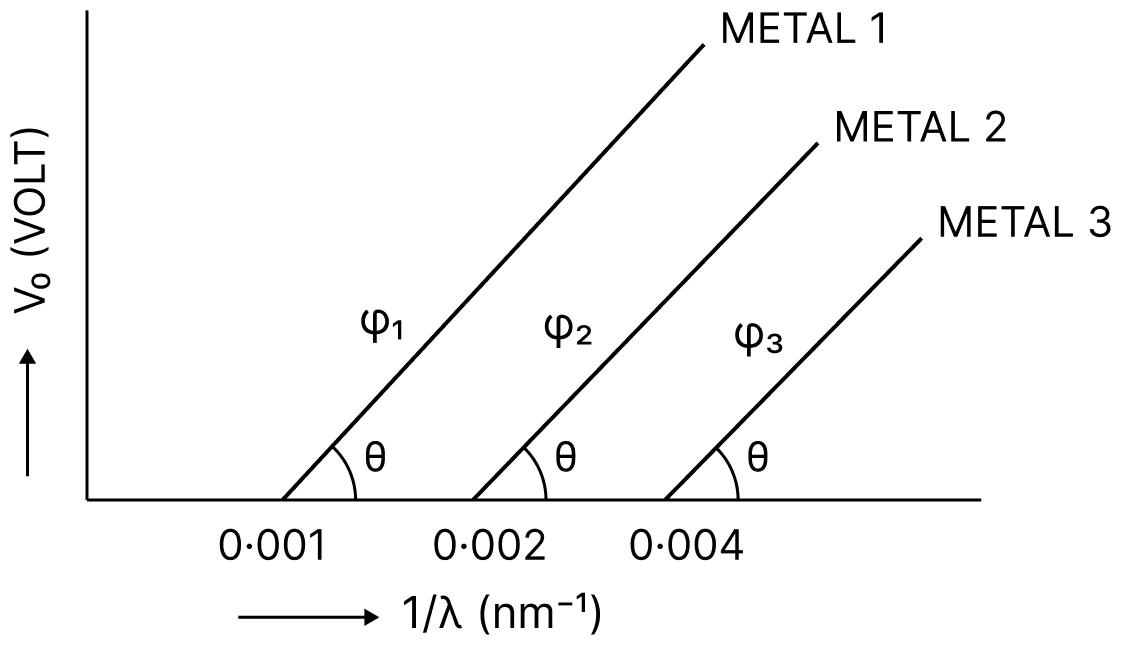
Answer
From Einstein's equation, . Where a line meets the axis, V0 = 0 and equals , so
From the graph, the intercepts on the axis are 0.001 nm-1, 0.002 nm-1 and 0.004 nm-1 for metals 1, 2 and 3. Therefore,
Hence, φ1 : φ2 : φ3 = 1 : 2 : 4.
Explain work function and threshold frequency in photoelectric emission. Give Einstein's equation for photoelectric emission. What do the symbols stand for?
Answer
Work function : The minimum energy required for the emission of a photoelectron from a metal is called the work function W of that metal. For most metals it is of the order of a few electron-volt.
Threshold frequency : The lowest frequency of light which can emit photoelectrons from a material is called its threshold frequency (or cut-off frequency) ν0. Below this frequency no photoelectrons are emitted, whatever be the intensity of light. The two are related by W = hν0.
Einstein's photoelectric equation :
where
- h = Planck's constant
- ν = frequency of the incident light (hν is the energy of the photon absorbed)
- W = work function of the metal and ν0 its threshold frequency
- m = mass of the electron and vmax the maximum velocity of the photoelectrons
- Ek = maximum kinetic energy of the emitted photoelectrons
Draw a graph between the frequency of light used for photoelectric effect and the maximum kinetic energy of the emitted photoelectrons. Explain :
(i) What does the slope of the graph represent?
(ii) How is the work function of the metal surface obtained by the graph?
(iii) What will be the effect on the nature of the graph, if the intensity of the incident light be doubled, or metal of lower work function be taken?
Answer
By Einstein's photoelectric equation, Ek = hν − W. The graph between the maximum kinetic energy Ek and the frequency ν is a straight line, which meets the ν-axis at the threshold frequency ν0 and, when extended backwards, cuts the Ek-axis at −W.
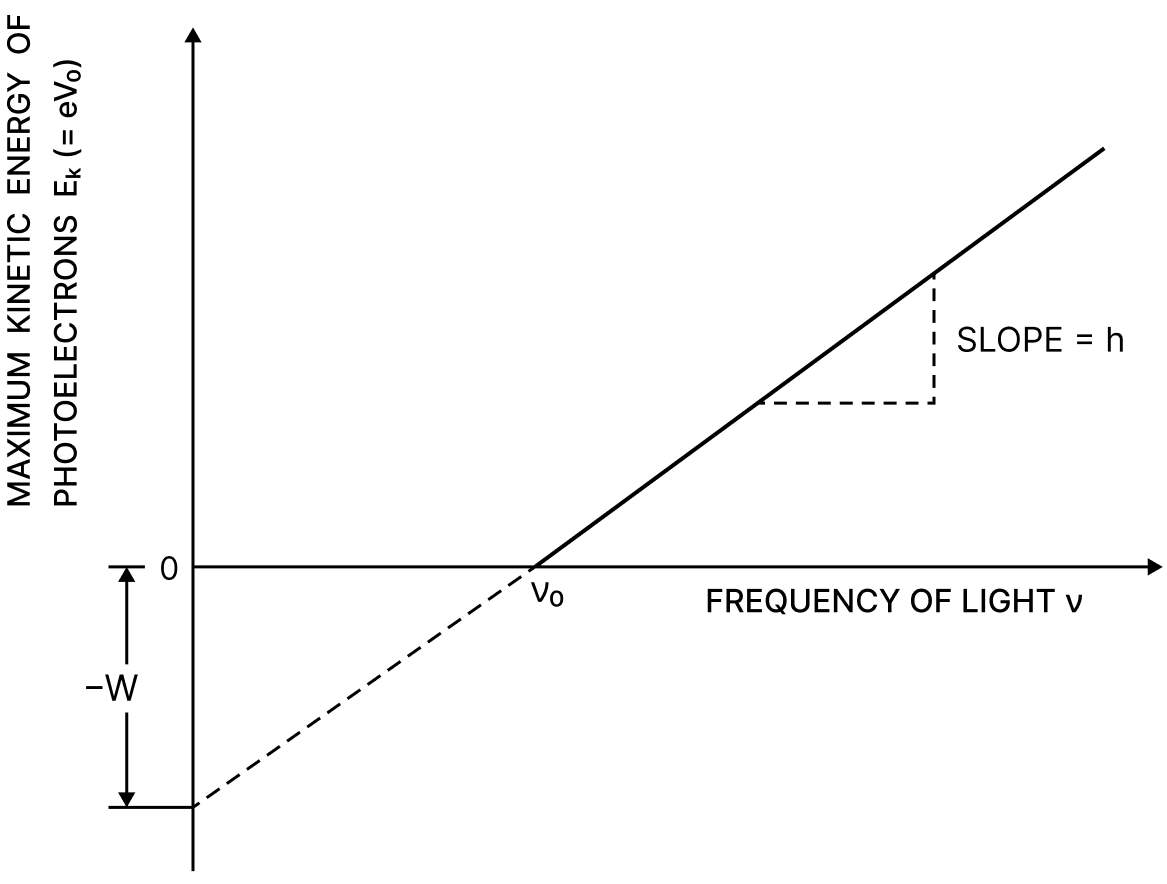
(i) Comparing Ek = hν − W with the equation of a straight line, the slope of the graph represents Planck's constant h.
(ii) The negative intercept of the straight line on the Ek-axis gives the work function: its magnitude is W. Equivalently, W = hν0, using the intercept ν0 on the ν-axis.
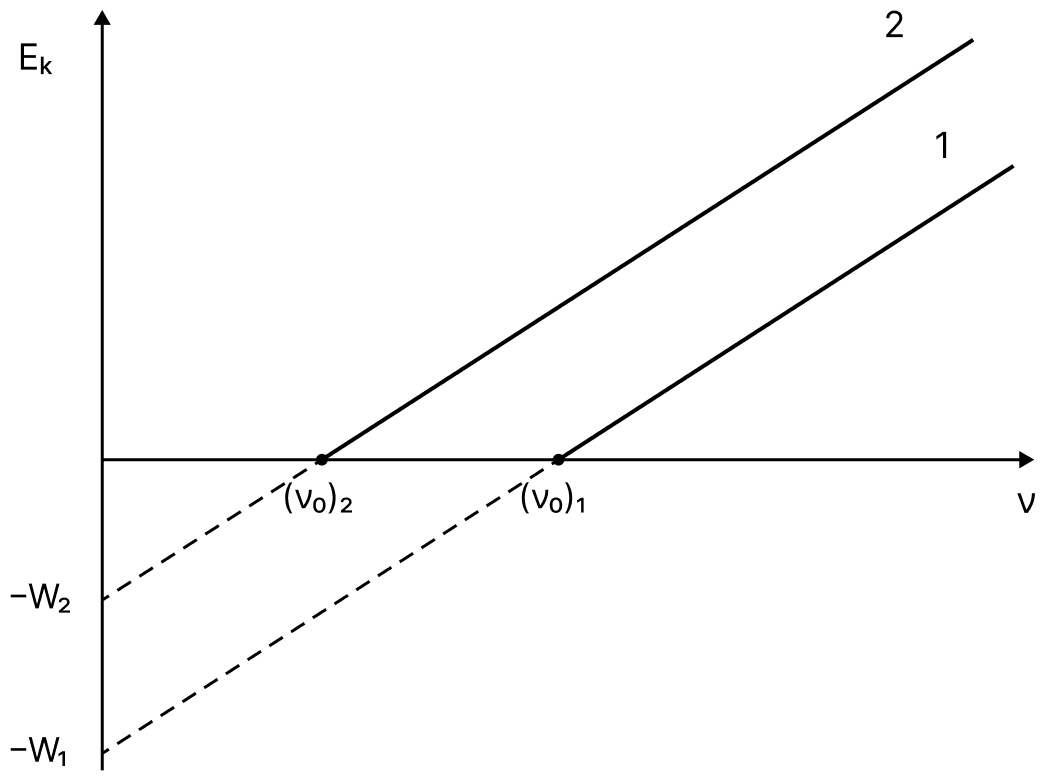
(iii) The maximum kinetic energy does not depend on intensity, so doubling the intensity has no effect on the graph. For a metal of lower work function, the slope h stays the same but ν0 and W are smaller, so the graph shifts parallel to itself towards the origin.
State the dependence of work function on the kinetic energy of the electrons emitted in a photocell. If the intensity of incident radiation is doubled, what changes occur in the stopping potential, kinetic energy of the photoelectrons and the photoelectric current?
Answer
Dependence on work function : By Einstein's equation,
For light of a given frequency, the kinetic energy of the emitted electrons decreases as the work function of the cathode metal increases; a metal of larger work function gives slower photoelectrons.
Effect of doubling the intensity : Doubling the intensity doubles the number of photons incident per second, but the energy hν of each photon is unchanged. Hence,
- the stopping potential remains unchanged;
- the maximum kinetic energy of the photoelectrons remains unchanged;
- the photoelectric current increases (it doubles, being proportional to intensity).
Note: The question's wording is reversed; the work function is a property of the metal and does not depend on the kinetic energy — it is the kinetic energy that depends on the work function, as answered above.
Establish the Einstein's equation
and explain the laws of photoelectric effect on its basis.
Answer
Establishing the equation : According to Einstein, light consists of photons, each of energy hν. When a photon falls on a metal, it transfers its whole energy hν to any one electron. A part of this energy, equal to the work function W, is used in ejecting the electron from the metal, and the rest appears as kinetic energy. Electrons ejected from the surface lose no energy in collisions and so have the maximum kinetic energy Ek. Thus,
At the threshold frequency ν0 the whole photon energy is just spent in ejecting the electron, so
Substituting Eq. (ii) in Eq. (i), with ,
Explanation of the laws :
(i) Increasing the intensity of light of a given frequency increases the number of photons striking the surface per second, so the rate of emission of photoelectrons increases in the same ratio.
(ii) The energy hν of each photon is unchanged by intensity, so by Eq. (iii) the maximum kinetic energy is independent of the intensity.
(iii) By Eq. (iii), the maximum kinetic energy increases linearly with the frequency ν.
(iv) If ν < ν0, Eq. (iii) would make the kinetic energy negative, which is impossible; so no photoelectrons are emitted below the threshold frequency, whatever be the intensity.
(v) The energy transfer is a single photon–electron collision, so the electron need not accumulate energy and emission is instantaneous, without any time-lag.
A beam of monochromatic radiation is incident on a photosensitive surface. Answer the following questions giving reasons.
(a) Do the emitted photoelectrons have the same kinetic energy?
(b) Does the kinetic energy of the emitted electrons depend on the intensity of incident radiation?
(c) On what factors does the number of emitted photoelectrons depend?
Answer
(a) No. Photoelectrons are emitted from the surface as well as from the interior of the metal. Those from the surface come out with the maximum kinetic energy hν − W, while those from the interior lose part of their energy in collisions with atoms on their way out. Hence the emitted photoelectrons have kinetic energies ranging from zero to a maximum value.
(b) No. The maximum kinetic energy is Ek = hν − W, which depends on the frequency of the radiation and the work function of the surface. Increasing the intensity only increases the number of photons, not the energy of each photon.
(c) For radiation of frequency above the threshold frequency, the number of emitted photoelectrons depends on the intensity of the incident radiation, that is, on the number of photons falling on the surface per second. It is directly proportional to the intensity.
A student is studying photoelectric effect by performing an experiment in laboratory. The examiner gives the requisite instructions and asks some questions to the student. State whether the responses of the student, in each case, are correct or incorrect. Give a reason for your answer.
(i) EXAMINER : Increase the plate current.
STUDENT : Increases the intensity of radiation falling on emitting electrode.
(ii) EXAMINER : Decrease the maximum kinetic energy of photoelectrons.
STUDENT : Decreases the intensity of incident radiation.
(iii) EXAMINER : In your experimental set up zinc plate is used as an emitter plate. First, allow UV light to fall on this zinc plate and then replace it by red light. Describe the change(s) observed.
STUDENT : Do the same as instructed by the examiner and observe that photoelectric current (plate current) disappears when red light falls on the zinc plate.
Answer
(i) The response of the student is correct. The plate current depends on the intensity of radiation falling on the emitting electrode. As the intensity is increased, more photons fall per second on the emitting electrode, more electrons are emitted per second, and the plate current increases.
(ii) The response is incorrect. The maximum kinetic energy of photoelectrons depends on the frequency of the incident radiation and not on its intensity. To decrease it, the frequency of the incident radiation should be decreased.
(iii) The response (observation) is correct. Zinc is photosensitive only to ultraviolet light. The energy of a red-light photon is less than the work function of zinc (its wavelength is greater than the threshold wavelength of zinc), so no photoelectrons are emitted and the plate current disappears.
State the phenomenon of photoelectric effect and explain the dependence of photocurrent and stopping potential on intensity and frequency.
Answer
Photoelectric effect : The phenomenon of emission of electrons from metals under the effect of light (of suitable frequency) is called the photoelectric effect. The emitted electrons are called photoelectrons and the current produced is the photoelectric current.
Dependence of photocurrent on intensity : For light of a given frequency (above the threshold), the photoelectric current, or the rate of emission of photoelectrons, is directly proportional to the intensity of the incident light. When the intensity is doubled, the saturation current is also doubled, but the current becomes zero at the same stopping potential.
Dependence of photocurrent on frequency : The saturation current does not depend on the frequency of the incident radiation, provided the frequency is above the threshold value. Below the threshold frequency ν0 no current flows, whatever be the intensity.
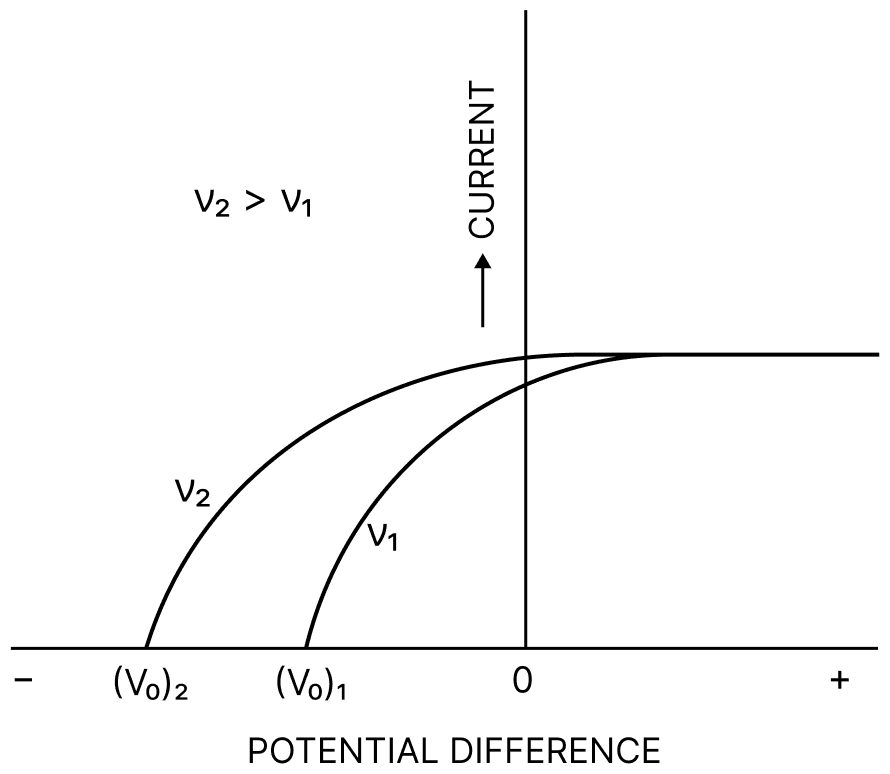
Dependence of stopping potential on intensity : The stopping potential V0 is a measure of the maximum kinetic energy of the photoelectrons (Ek = eV0). It does not depend on the intensity of the incident light.
Dependence of stopping potential on frequency : The higher the frequency of the incident light, the higher the stopping potential. From eV0 = hν − W,
so the stopping potential increases linearly with frequency; the saturation current is the same for each frequency.
Define threshold frequency, work function and cut-off potential. Draw a graph between maximum kinetic energy against frequency of light falling on a metal surface.
Answer
Threshold frequency : The lowest frequency of light which can emit photoelectrons from a material is called its threshold frequency (or cut-off frequency) ν0.
Work function : The minimum energy required for the emission of a photoelectron from a metal is called its work function W. It is related to the threshold frequency by W = hν0.
Cut-off potential : The negative potential of the collector plate (relative to the emitting plate) at which the photoelectric current becomes zero is called the cut-off potential or stopping potential V0. It stops even the maximum-energy photoelectrons, so eV0 = Ek.
Graph : From Einstein's equation Ek = hν − W, the graph between the maximum kinetic energy Ek and the frequency ν is a straight line of slope h. It meets the ν-axis at ν0, and when extended backwards it cuts the Ek-axis at −W.
Explain Einstein's theory in connection with photoelectric effect. Plot a graph between stopping potential against frequency of incident radiations and show that slope of the graph is ratio of Planck's constant and charge of electron.
Answer
Einstein's theory : In 1905, Einstein explained the photoelectric effect on the basis of Planck's quantum theory. Light travels in the form of small packets of energy called photons, each of energy hν, and the intensity of light depends on the number of photons. When a photon falls on a metal, it transfers its whole energy hν to any one electron. A part W (the work function) is used in ejecting the electron and the rest appears as its kinetic energy. For electrons ejected from the surface,
Graph of stopping potential against frequency : Since the stopping potential V0 just stops the maximum-energy photoelectrons,
From Eqs. (i) and (ii),
Since h and e are constants and ν0 is constant for a given surface, Eq. (iii) represents a straight line. It cuts the ν-axis at ν0 and, extended backwards, the V0-axis at .
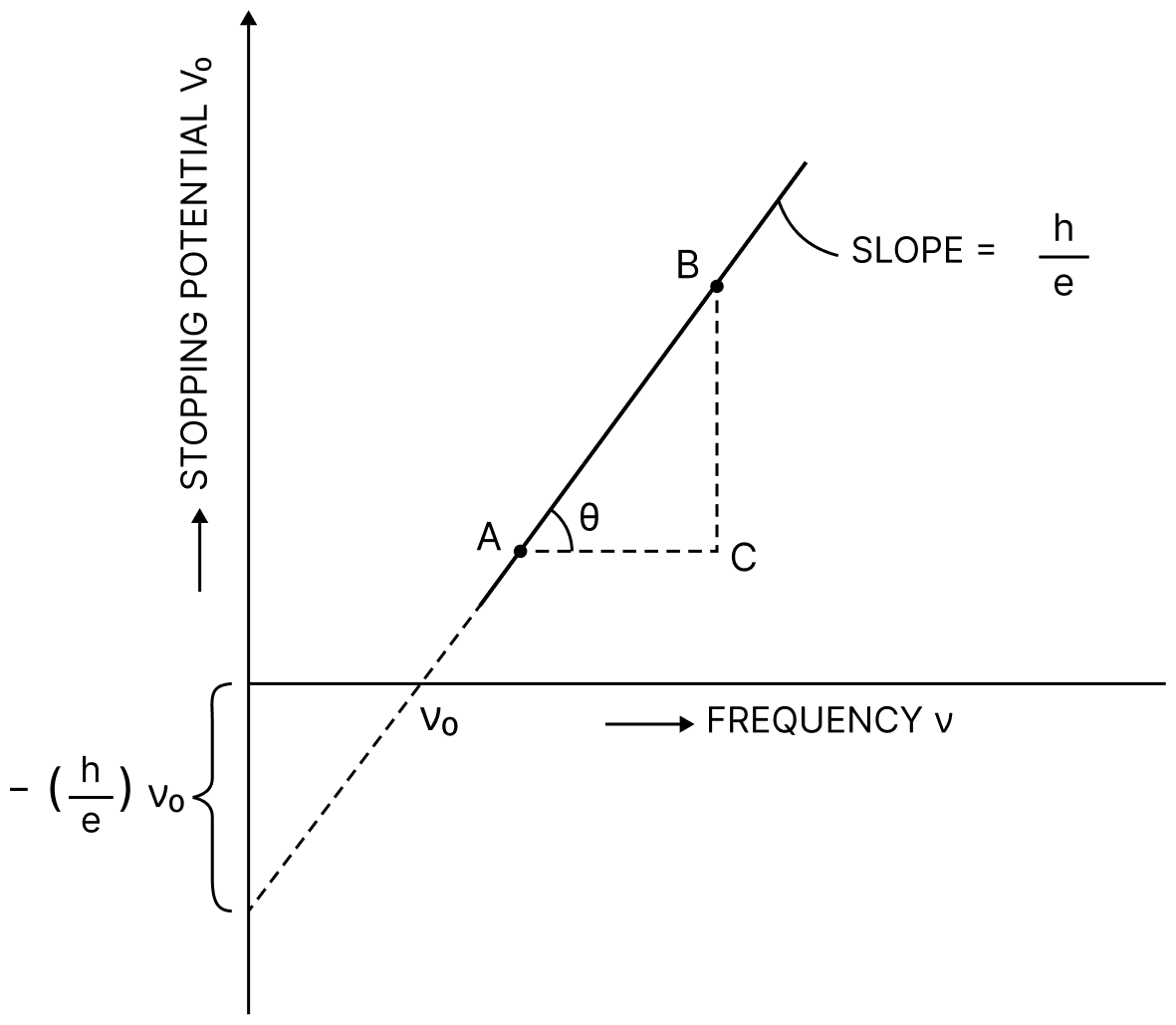
Slope : Comparing Eq. (iii) with y = mx + c, the slope of the line is
Thus the slope of the graph is the ratio of Planck's constant to the charge of the electron, and h = slope × e.
State laws of photoelectric effect and derive the relation where W is work function, h is Planck's constant, m is mass of electron, vmax is velocity.
Answer
Laws of photoelectric effect :
(i) The rate of emission of photoelectrons from a metal surface varies directly as the intensity of the incident light.
(ii) The maximum kinetic energy of the emitted photoelectrons is independent of the intensity of the incident light.
(iii) The maximum kinetic energy of the photoelectrons increases linearly with increase in the frequency of the incident light.
(iv) If the frequency of the incident light is below a certain lowest value (the threshold frequency), no photoelectron is emitted from the metal. The threshold frequency is different for different metals.
(v) The photoelectrons are emitted instantly; there is no time-lag between the incidence of light and the emission of electrons.
Derivation : According to Einstein's explanation, light consists of photons, each of energy hν, where h is Planck's constant and ν the frequency. When a photon falls on a metal, it transfers its whole energy hν to any one electron and the photon ceases to exist.
A part of this energy, equal to the work function W of the metal, is spent in ejecting the electron out of the metal, and the remaining energy is given to the electron as kinetic energy. Electrons ejected from the interior lose some energy in collisions on their way to the surface, but those ejected from the surface lose none, and so have the maximum velocity vmax and maximum kinetic energy .
By conservation of energy for these electrons,
where m is the mass of the electron. Since W = hν0, this may also be written as .
Explain the Maxwell quantum theory in connection with electromagnetic radiation and derive the relation , where λ is wavelength and p is momentum of photon by using Einstein's concept of mass-energy relation.
Answer
Quantum theory of electromagnetic radiation : According to Maxwell's electromagnetic theory, radiation is a continuous electromagnetic wave whose energy is spread uniformly over the wavefront. This picture could not explain the distribution of energy in black-body radiation or the photoelectric effect.
In 1900, Planck put forward the idea that radiation is not emitted continuously but in small packets of definite energy called quanta (later called photons). The energy of each photon is
where h is Planck's constant, ν the frequency and λ the wavelength. Radiation of frequency ν can exchange energy only in integral multiples hν, 2hν, 3hν, …. Einstein extended this idea: in interaction with matter, radiation behaves as if it is made up of particles (photons) which travel with the speed of light c, carry energy hν and momentum, and have zero rest mass.
Derivation of : A photon moving with speed c has a kinetic mass m. By Einstein's mass-energy relation,
The energy of the photon is also
Equating Eqs. (i) and (ii),
The momentum of the photon is
Hence, .
Note: The quantum theory of radiation is due to Planck (extended by Einstein); Maxwell's theory is the electromagnetic wave theory, so "Maxwell quantum theory" in the question appears to be a misprint.
Read the passage(s) and answer the following questions :
When electromagnetic radiation of a suitable frequency falls on a metallic surface, electrons are emitted from the surface. Energy of emitted photoelectrons depends only on the frequency of incident radiation and number of emitted electrons depends on the intensity of incident light. There is a lower limit of frequency called threshold frequency below which no emission of photoelectrons take place, however high the intensity of the incident radiation may be.
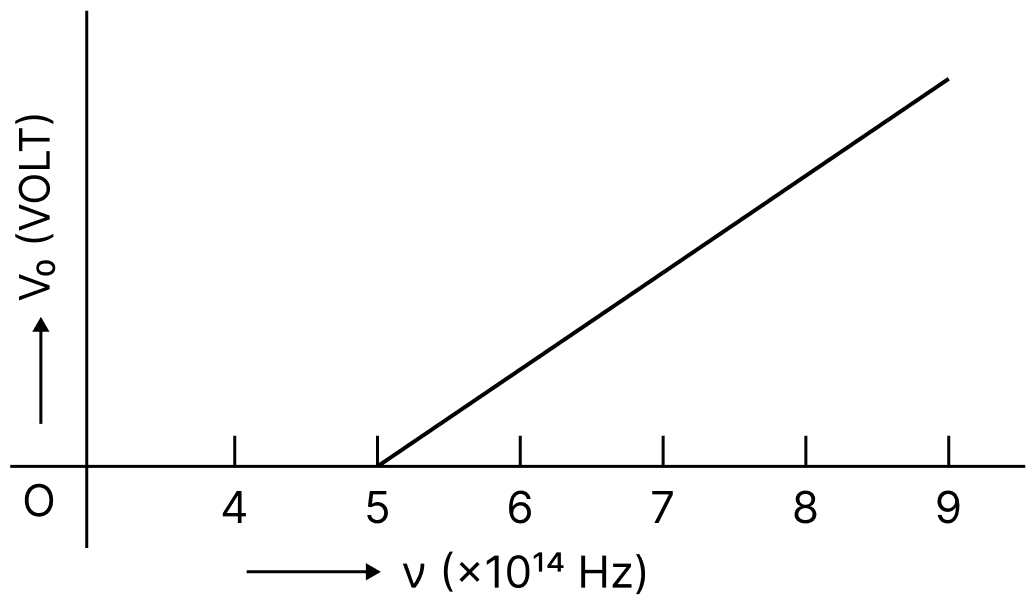
(i) For photoelectric effect in a metal, the graph of the stopping potential V0 versus frequency ν of the incident radiation is shown in the figure given below.
Calculate the value of work function of the metal in eV.
(h = 6.6 × 10⁻³⁴ J-s and e = 1.6 × 10⁻¹⁹ C)
(ii) If the slope of the graph shown above is m, what will be the relation in m, h and e?
(iii) If frequency ν of incident radiation is increased keeping intensity (I) and work function (φ0) constant, what will be the effect on stopping potential?
(iv) The maximum kinetic energy of photoelectrons emitted from a surface, when photons of energy 6 eV falls on it, is 4 eV. Find the stopping potential in volts.
Answer
(i) Work function of the metal :
Given,
- h = 6.6 × 10⁻³⁴ J s
- e = 1.6 × 10⁻¹⁹ C
From the graph, the stopping potential becomes zero at the threshold frequency
The work function is
Hence, the work function of the metal is 2.06 eV.
(ii) Relation between m, h and e :
From , the slope of the V0–ν graph is . Hence,
(iii) Effect on stopping potential :
From eV0 = hν − φ0, as the frequency ν increases (with I and φ0 constant), the kinetic energy of the photoelectrons increases. A higher stopping potential is then needed to stop them, so the stopping potential increases (linearly with ν).
(iv) Stopping potential :
The maximum kinetic energy of the photoelectrons equals eV0, so
Hence, the stopping potential is 4 V.