
Which of the following is ferromagnetic?
- Aluminium
- Quartz
- Nickel
- Manganese
Answer
Nickel
Reason — Nickel is strongly magnetised in the direction of the magnetising field and is strongly attracted by a magnet. Hence, it is a ferromagnetic substance.
Which of the following is diamagnetic?
- Cobalt
- Liquid oxygen
- Sodium
- Neon
Answer
Neon
Reason — In a neon atom all the electrons are paired with opposite spins, so the net magnetic dipole moment of the atom is zero. In a magnetic field it is feebly magnetised opposite to the field, so neon is diamagnetic.
Which of the following is repelled by an external magnetic field?
- Iron
- Cobalt
- Steel
- Copper
Answer
Copper
Reason — Copper is diamagnetic. A diamagnetic substance is feebly magnetised in a direction opposite to the magnetising field, so it is repelled by an external magnetic field.
If a diamagnetic solution is poured into a U-tube and one arm of this U-tube is placed between the poles of a strong magnet with the meniscus in a line with the field, then the level of the solution will :
- rise
- fall
- oscillate slowly
- remain as such
Answer
fall
Reason — In a non-uniform magnetic field a diamagnetic substance tends to move from the stronger to the weaker part of the field. The field is strongest between the poles, so the solution is pushed out of that region and its level in that arm is depressed.
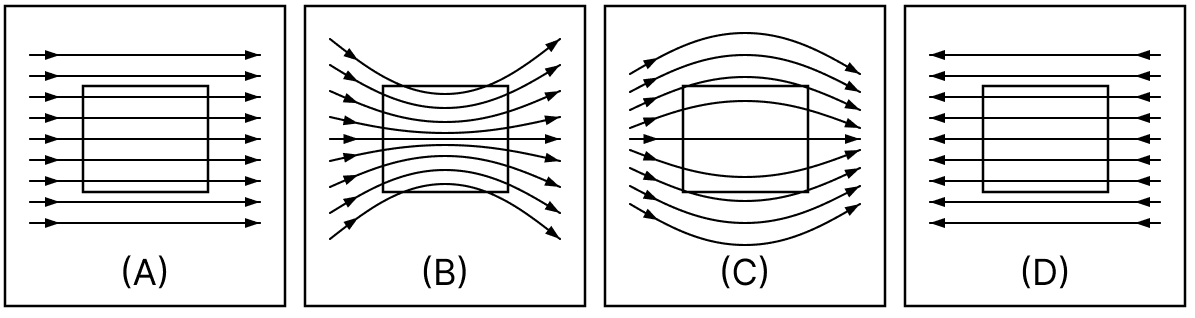
A uniform magnetic field exists in space in the plane of paper and is initially directed from left to right. When a bar of soft iron is placed in the field parallel to it, the lines of force passing through it will be represented by :
- Fig. A
- Fig. B
- Fig. C
- Fig. D
Answer
Fig. B
Reason — Soft iron is ferromagnetic and is strongly magnetised in the direction of the field. Inside the bar its own field adds to the original field, so the lines of force are drawn into the bar and become concentrated within it, as shown in Fig. B.
When a ferromagnetic substance is heated above its Curie temperature, then :
- it is demagnetised
- it becomes diamagnetic
- it becomes paramagnetic
- it remains unaffected
Answer
it becomes paramagnetic
Reason — Above the Curie temperature, thermal agitation destroys the alignment within the domains. The ferromagnetic property suddenly disappears and the substance behaves as a paramagnetic substance.
The relative permeability of a substance X is slightly less than unity and that of a substance Y is slightly more than unity, then :
- X is paramagnetic and Y is ferromagnetic
- X is diamagnetic and Y is ferromagnetic
- X is paramagnetic and Y is diamagnetic
- X is diamagnetic and Y is paramagnetic
Answer
X is diamagnetic and Y is paramagnetic
Reason — The relative permeability μr is slightly less than 1 for diamagnetic substances and slightly more than 1 for paramagnetic substances, whereas it is very large for ferromagnetic substances.
Assertion (A): In a ferromagnetic material, all the atomic magnets have dipole moments in the same direction.
Reason (R): It is due to strong exchange coupling between neighbouring atoms in a domain.
- Both Assertion and Reason are true, and Reason is the correct explanation for Assertion.
- Both Assertion and Reason are true, but Reason is not the correct explanation for Assertion.
- Assertion is false, and Reason is true.
- Both Assertion and Reason are false.
Answer
Assertion is false, and Reason is true.
Reason — Due to the strong mutual (exchange) interaction between neighbouring atoms, the atomic magnets are aligned in the same direction only within a domain. Different domains are randomly oriented, so in the material as a whole all the atomic magnets do not have their dipole moments in the same direction.
Which one of the following has relative magnetic permeability between 0 and 1?
- Aluminium
- Alnico
- Water
- Sodium
Answer
Water
Reason — A relative permeability between 0 and 1 (slightly less than 1) is a property of diamagnetic substances. Water is diamagnetic.
Which of the following has its permeability less than that of free space?
- Copper
- Aluminium
- Copper chloride
- Nickel
Answer
Copper
Reason — Permeability less than μ0 means μr < 1, which is the case for diamagnetic substances. Copper is diamagnetic.
What is the difference between the atoms of diamagnetic and paramagnetic materials?
Answer
The atoms of a paramagnetic material have a net non-zero (permanent) magnetic dipole moment of their own. In the atoms of a diamagnetic material, the electrons form pairs with opposite spins, so the net magnetic dipole moment of each atom is zero.
How can paramagnetic and diamagnetic material rods be distinguished in a magnetic field?
Answer
Suspend each rod freely in a magnetic field. The paramagnetic rod sets itself with its axis parallel to the field, whereas the diamagnetic rod sets itself perpendicular to the field.
How does the intensity of magnetisation of a paramagnetic material vary with increasing applied magnetic field? With increasing temperature?
Answer
It increases with increasing applied magnetic field and decreases with increasing temperature.
Explanation:
By Curie's law, , so the magnetisation is directly proportional to the magnetic intensity H and inversely proportional to the kelvin temperature T, as long as H/T does not become too large.
How does the magnetic permeability differ for dia-, para- and ferromagnetic materials?
Answer
| Material | Permeability |
|---|---|
| Diamagnetic | μ is slightly less than μ0 (μr < 1) |
| Paramagnetic | μ is slightly greater than μ0 (μr > 1) |
| Ferromagnetic | μ is very much greater than μ0 (μr >> 1) |
If magnetic susceptibility of a certain magnetic material is 0.0001, find its relative permeability.
Answer
Given,
- Magnetic susceptibility, χm = 0.0001
The relative permeability is related to the magnetic susceptibility by
Hence, the relative permeability of the material is 1.0001.
Why is soft iron considered more suitable than steel for making the core of a transformer?
Answer
The area of the hysteresis loop of soft iron is smaller than that of steel, so the hysteresis loss in soft iron is smaller. As the core of a transformer goes through complete cycles of magnetisation continuously, a soft-iron core wastes less energy and is heated less.
The earth's core is known to contain iron. Yet geologists do not consider it as source of earth's magnetism. Why?
Answer
The iron in the earth's core is in the molten state, at a temperature far above its Curie temperature (770°C). Above the Curie temperature iron becomes paramagnetic and cannot retain magnetism, so it cannot be the source of the earth's magnetism.
A certain region of space is to be shielded from magnetic fields. How can this be done?
Answer
The region is surrounded by a soft-iron ring (or enclosure). Due to its high permeability, the lines of force of any external magnetic field are drawn into the soft iron and pass through it, leaving the enclosed region free from the field.
Define the terms magnetisation (M) and magnetic susceptibility (χm).
Answer
Magnetisation (M) : The magnetisation (intensity of magnetisation) of a magnetised substance is the magnetic moment per unit volume of the substance,
where is the magnetic moment of the substance of volume V. Its SI unit is A m-1.
Magnetic susceptibility (χm) : It is the ratio of the intensity of magnetisation M to the magnetic intensity H of the magnetising field,
It is a measure of how easily a substance is magnetised in a magnetising field, and is a dimensionless number.
Which amongst copper, platinum, silver, gold, aluminium, iron and nickel are ferromagnetic substances?
Answer
Iron and nickel.
Explanation:
Iron and nickel are strongly magnetised in the direction of the magnetising field. Of the others, copper, silver and gold are diamagnetic, while platinum and aluminium are paramagnetic.
Distinguish between paramagnetic and diamagnetic materials from their behaviour in a uniform magnetic field and in a non-uniform magnetic field.
Answer
| Field | Paramagnetic material | Diamagnetic material |
|---|---|---|
| Uniform magnetic field | Feebly magnetised in the direction of the field; the flux density inside it is slightly greater than outside, so the lines of force crowd into it. A freely suspended rod sets parallel to the field. | Feebly magnetised opposite to the field; the flux density inside it is slightly less than outside, so the lines of force are pushed out of it. A freely suspended rod sets perpendicular to the field. |
| Non-uniform magnetic field | Tends to move from the weaker to the stronger part of the field. | Tends to move from the stronger to the weaker part of the field. |
How does the intensity of magnetisation differ in dia-, para- and ferromagnetic materials, when they are placed in an external magnetic field?
Answer
| Material | Intensity of magnetisation |
|---|---|
| Diamagnetic | Small, and directed opposite to the magnetising field (χm small and negative). |
| Paramagnetic | Small, and directed along the magnetising field (χm small and positive). |
| Ferromagnetic | Large, and directed along the magnetising field even in relatively weak fields (χm large and positive). |
Define magnetic permeability.
Answer
The magnetic permeability of a substance is the ratio of the magnetic induction B inside the magnetised substance to the magnetic intensity H of the magnetising field,
It measures the conduction of magnetic lines of force through the substance. Its SI unit is N A-2 (or T m A-1).
What is relative permeability of a magnetic material? How is it related to magnetic susceptibility?
Answer
The relative permeability of a substance is the ratio of the magnetic permeability μ of the substance to the permeability of free space μ0,
It is a dimensionless quantity. It is related to the magnetic susceptibility by
The susceptibility of a magnetic material is −0.085. Identify the magnetic type of the material. A specimen of this material is kept in a uniform magnetic field. Draw the modified field pattern. What will be its behaviour in a non-uniform magnetic field?
Answer
As the susceptibility is small and negative, the material is diamagnetic.
In a uniform magnetic field the specimen is feebly magnetised opposite to the field, so the lines of force are pushed out and become less dense inside it than outside, as shown.
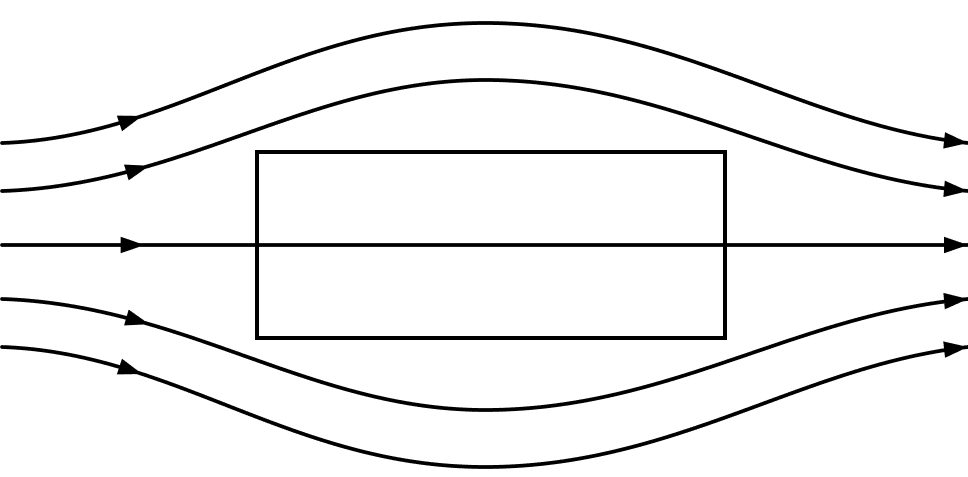
In a non-uniform magnetic field, the specimen tends to move from the stronger to the weaker part of the field.
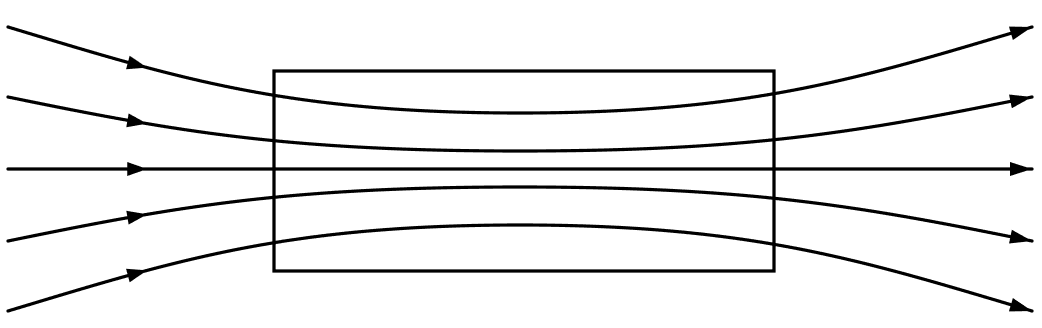
A paramagnetic material is placed in a uniform magnetic field. Draw the modified field pattern.
Answer
A paramagnetic material is feebly magnetised in the direction of the field, so the lines of force crowd into it and become slightly more dense inside it than outside, as shown.
Explain from atomic model of magnetism why a soft-iron rod placed inside a current-carrying solenoid along its axis is magnetised.
Answer
Each atom of iron has a net magnetic moment and behaves like a tiny magnet. Due to strong mutual interaction, these atomic magnets form domains, each magnetised to saturation. Normally the domains are randomly oriented, so their external effects cancel.
When the rod is placed along the axis of the solenoid, its magnetic field acts on the domains. The domains favourably oriented with respect to the field grow in size at the expense of others, and the remaining domains rotate until their magnetisation lies along the field. Hence, the rod is magnetised along the axis of the solenoid.
Does the magnetisation of a paramagnetic salt depend on temperature? Explain.
Answer
Yes. The atoms (or ions) of a paramagnetic salt are tiny magnetic dipoles. In a magnetic field they tend to align with the field, but thermal agitation disturbs this alignment. Higher the temperature, greater the agitation and smaller the magnetisation; on cooling, the alignment improves and the magnetisation increases. By Curie's law, .
Why is diamagnetism almost independent of temperature?
Answer
In a diamagnetic substance the electrons form pairs whose magnetic moments cancel, so its atoms have no permanent magnetic moment to be aligned. In a magnetising field, one electron of each pair is accelerated and the other slowed down, inducing a small moment opposite to the field. This induced moment does not depend on the alignment of atomic magnets, so thermal agitation, and hence temperature, has no effect on it.
An iron bar magnet is heated to 1000°C and then cooled in a magnetic field free space. Will it retain its magnetism?
Answer
No.
Explanation:
The Curie temperature of iron is 770°C. At 1000°C the violent thermal agitation destroys the domain alignment and the iron becomes paramagnetic, losing its magnetism. On cooling in a field-free space, the domains form again but are randomly oriented, as no external field is present to align them. So the iron is not magnetised.
The susceptibility of iron is greater than that of aluminium. What do you infer from this?
Answer
Since χm = M/H, for a given magnetising field the intensity of magnetisation of iron is much greater than that of aluminium. Thus, iron is magnetised much more easily than aluminium: iron is ferromagnetic, while aluminium is only paramagnetic.
A ferromagnetic material may be used as a device for storing memory. Explain it.
Answer
The magnetisation of a ferromagnetic material is not completely reversible. In a magnetising field it is magnetised by the motion of the domain boundaries and the rotation of the domains. When the field is reduced to zero, the domains do not return completely to their original state, so some residual magnetisation remains (hysteresis). The material thus keeps a "memory" of its magnetisation, which is used for the magnetic storage of information, as on magnetic tapes and computer discs.
Why should the material used for making permanent magnets have high coercivity?
Answer
A high coercivity means that a large reverse magnetising field is needed to destroy the residual magnetism. Hence, the magnetisation of a permanent magnet is not wiped out by stray external fields, mechanical ill-treatment or temperature changes.
Write three characteristics a ferromagnetic substance should possess, if it is to be used to make a permanent magnet. Give one example of such material.
Answer
The substance should have:
(i) high retentivity, so that the magnet is strong;
(ii) high coercivity, so that its magnetisation is not easily wiped out;
(iii) high permeability.
Example : Steel (cobalt steel), or alloys such as alnico (Al + Ni + Co).
Distinguish between diamagnetic, paramagnetic and ferromagnetic substances. Give two examples of each.
Answer
| Property | Diamagnetic | Paramagnetic | Ferromagnetic |
|---|---|---|---|
| Behaviour near a magnet | Feebly repelled | Feebly attracted | Strongly attracted |
| Magnetisation in a field | Feeble, opposite to the field | Feeble, along the field | Strong, along the field |
| Susceptibility χm | Small and negative | Small and positive | Very large and positive |
| Relative permeability μr | Slightly less than 1 | Slightly more than 1 | Very large (hundreds to thousands) |
| Freely suspended rod in a field | Sets perpendicular to the field | Sets parallel to the field | Readily sets parallel to the field |
| Effect of temperature | χm independent of temperature | χm ∝ 1/T (Curie's law) | Becomes paramagnetic above Curie temperature |
| Examples | Bismuth, copper | Aluminium, platinum | Iron, nickel |
Classify materials on the basis of their behaviour in a magnetic field. Under what category does iron come?
(i) How does the magnetic property of iron change with rise in temperature?
(ii) Why does the magnetisation of a paramagnetic salt increase on cooling?
Answer
On the basis of their behaviour in a magnetic field, materials are classified as :
(a) Diamagnetic — feebly magnetised opposite to the magnetising field and feebly repelled by a magnet (e.g. bismuth, copper).
(b) Paramagnetic — feebly magnetised in the direction of the field and feebly attracted by a magnet (e.g. aluminium, platinum).
(c) Ferromagnetic — strongly magnetised in the direction of the field and strongly attracted by a magnet (e.g. iron, nickel).
Iron is a ferromagnetic substance.
(i) As the temperature rises, the ferromagnetism of iron decreases. At its Curie temperature, 770°C, the ferromagnetic property suddenly disappears and iron becomes paramagnetic.
(ii) The atoms of a paramagnetic salt are tiny magnetic dipoles which tend to align along the applied field, while thermal agitation disturbs this alignment. On cooling, the thermal agitation decreases, so more dipoles align with the field and the magnetisation increases, in accordance with Curie's law, .
Distinguish between diamagnetism and paramagnetism. Why is the magnetism of a paramagnetic substance lost on heating?
Answer
| Diamagnetism | Paramagnetism |
|---|---|
| The atoms have no net magnetic moment, as the electrons form pairs with opposite spins. | The atoms have a net non-zero magnetic moment of their own. |
| The substance is feebly magnetised opposite to the magnetising field. | The substance is feebly magnetised in the direction of the magnetising field. |
| χm is small and negative; μr is slightly less than 1. | χm is small and positive; μr is slightly more than 1. |
| It is independent of temperature. | It depends on temperature (χm ∝ 1/T). |
The magnetism of a paramagnetic substance is due to the alignment of its atomic magnets along the magnetising field. On heating, the thermal agitation of the atoms increases and disturbs this alignment, so the magnetisation decreases (M ∝ 1/T). Hence, its magnetism is lost on heating.
Discuss atomic model of magnetism. Explain on the basis of this model the difference in ferromagnetic, paramagnetic and diamagnetic substances.
Answer
Atomic model of magnetism : Every atom has a positively charged nucleus around which electrons revolve in discrete orbits. Each revolving electron is equivalent to a tiny current loop and gives a magnetic dipole moment to the atom. Each electron also spins about its own axis, and this spin too produces a magnetic dipole moment. Most of the magnetic moment of an atom is due to electron spin; the contribution of orbital revolution is very small.
Diamagnetic substances : The electrons form pairs with opposite spins, so the net magnetic moment of each atom is zero. In an external field , one electron of each pair is slowed down and the other accelerated, so a small moment is induced opposite to . The substance is feebly magnetised opposite to the field.
Paramagnetic substances : The atoms have an excess of electrons spinning in the same direction, so each atom has a net magnetic moment. Normally these atomic magnets are randomly oriented and the net moment is zero. In an external field each experiences a torque and tends to align along the field, but thermal agitation opposes this. The substance is feebly magnetised along the field.
Ferromagnetic substances : The atoms have net magnetic moments, and due to strong mutual interaction groups of atoms form domains in which all the atomic moments are aligned. Each domain is magnetically saturated. In an external field the domains grow and rotate into the field direction, so the substance is strongly magnetised along the field.
An experiment for measuring the susceptibility of paramagnetic solution is performed by a student. The examiner gives the following instructions to the student. State whether the responses of the student, in each case, are correct or incorrect. Give a reason for your answer.
(i) EXAMINER : How is the susceptibility related to relative permeability? Give mathematical relation.
STUDENT : χ = μr − 1
(ii) EXAMINER : Decrease the susceptibility of paramagnetic solution.
STUDENT : Decreases the temperature of the solution.
(iii) EXAMINER : Fill the paramagnetic solution in a U-tube and place one arm of this tube between two strong magnetic poles. Observe the change (if any) in the level of the solution in that arm.
STUDENT : Observe the rise in the level of solution in that arm.
Answer
(i) Correct.
Since μr = 1 + χ, the susceptibility is
(ii) Incorrect.
For a paramagnetic substance, χ ∝ 1/T (Curie's law). Decreasing the temperature increases the susceptibility. To decrease it, the temperature of the solution should be increased.
(iii) Correct.
A paramagnetic substance tends to move from the weaker to the stronger part of a magnetic field. The field is strongest between the poles, so the solution is drawn into that region and its level in that arm rises.
What is law of Curie? Draw diagram for magnetic susceptibility of dia, para and ferromagnetic material with the rise in temperature.
Answer
Curie's law : The magnetisation M of a paramagnetic substance is directly proportional to the magnetic intensity H of the magnetising field and inversely proportional to the kelvin temperature T,
where C is the Curie constant. Since ,
that is, the susceptibility of a paramagnetic substance varies inversely as its kelvin temperature. The law holds as long as H/T is not too large.
Variation of χm with temperature :
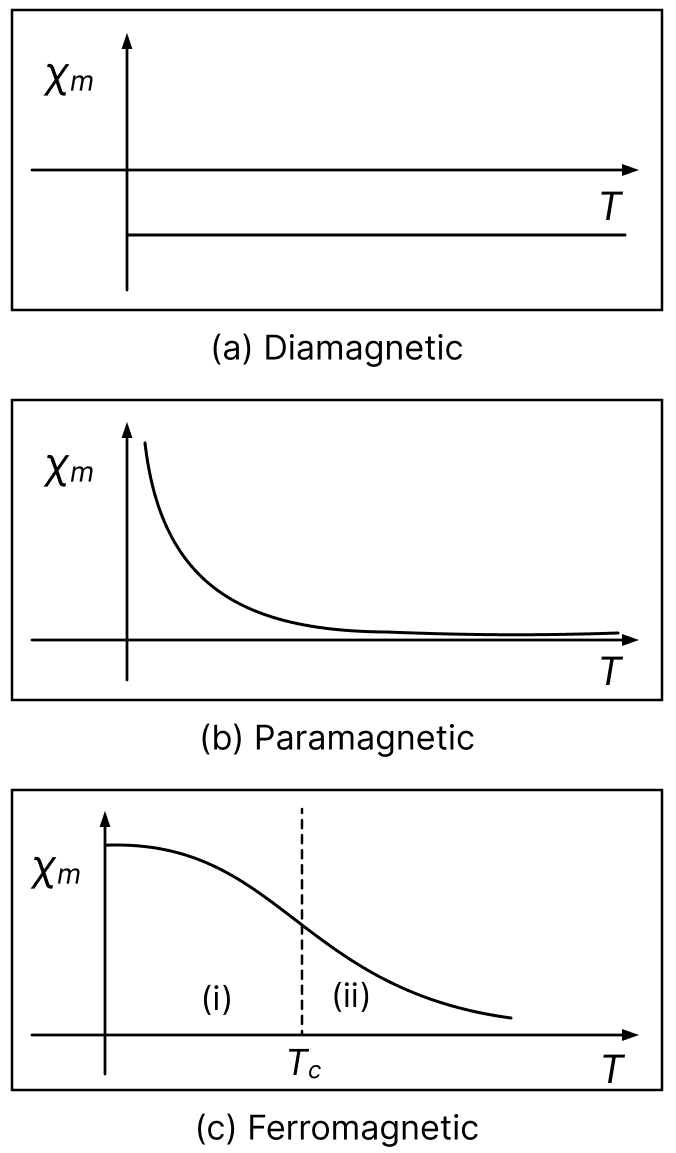
(a) Diamagnetic : χm is negative and does not change with temperature; the graph is a straight line parallel to the T-axis, below it.
(b) Paramagnetic : χm is positive and varies as 1/T; the graph is a rectangular hyperbola.
(c) Ferromagnetic : χm is very large and decreases with temperature in a complex way up to the Curie temperature TC (ferromagnetic region). Above TC the substance becomes paramagnetic and follows the Curie-Weiss law,
Distinguish between dia, para and ferromagnetic materials on the basis of relative permeability and magnetic susceptibility. Define intensity of magnetisation and magnetic intensity.
Answer
| Property | Diamagnetic | Paramagnetic | Ferromagnetic |
|---|---|---|---|
| Relative permeability μr | Slightly less than 1 | Slightly more than 1 | Very large (μr >> 1) |
| Magnetic susceptibility χm | Small and negative | Small and positive | Very large and positive |
Intensity of magnetisation (M) : It is the magnetic moment per unit volume of a magnetised substance,
Its SI unit is A m-1.
Magnetic intensity (H) : It expresses the capability of the magnetising field to magnetise a substance, and is defined by the vector relation
where is the magnetic induction inside the substance and μ0 is the permeability of free space. Its SI unit is A m-1.
Derive the relation,
χ = (μr − 1)
where χ is magnetic susceptibility and μr is relative permeability. Show that
1 oersted = 80 ampere/metre.
Answer
Relation χ = (μr − 1) :
By definition of the magnetic intensity H of the magnetising field,
For a substance of magnetic susceptibility χ,
Substituting Eq. (ii) in Eq. (i),
But B = μH, where μ is the permeability of the substance. Comparing with Eq. (iii),
Since is the relative permeability μr,
1 oersted = 80 A m-1 :
The oersted is the CGS unit of H. From the relation , with 1 gauss = 10-4 T and μ0 = 4π × 10-7 T m A-1,
Hence, 1 oersted = 80 ampere/metre.
Draw a neat sketch of a cycle of magnetisation (B-H loop/hysteresis loop) and explain the following terms :
(i) magnetic saturation
(ii) residual magnetisation (retentivity)
(iii) coercive force
(iv) hysteresis.
Answer
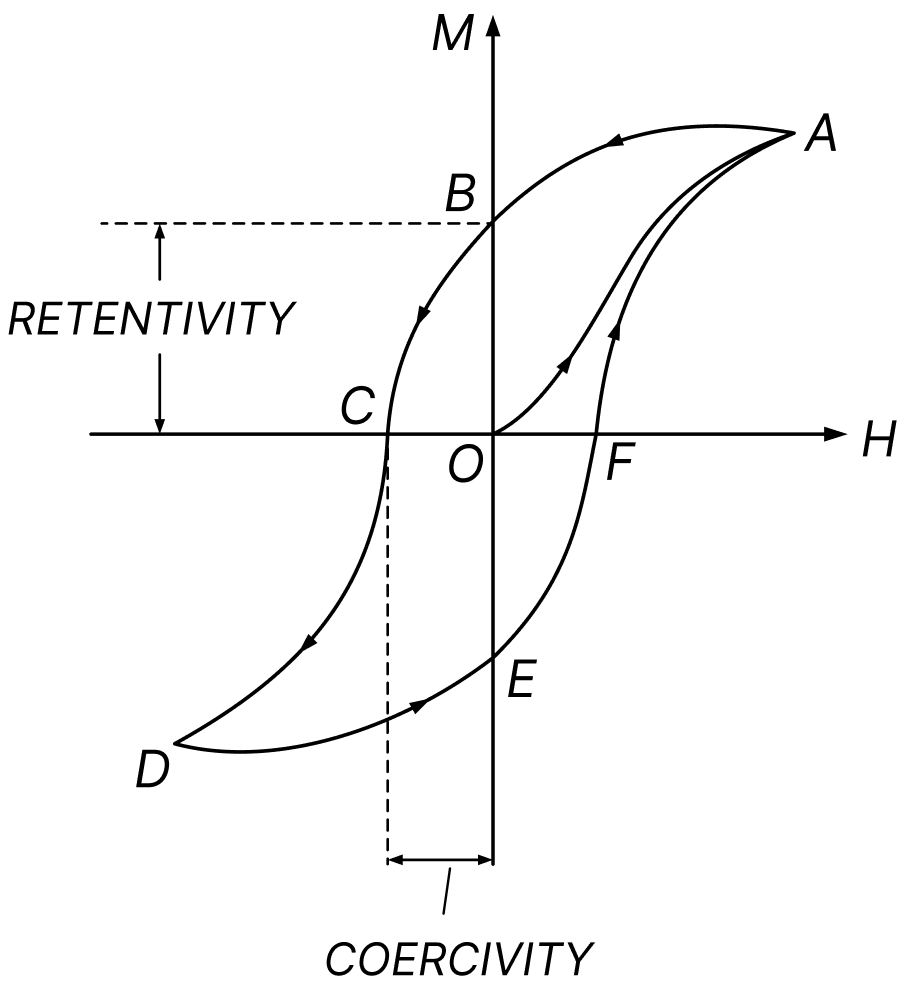
The figure shows the variation of the magnetisation M (or the flux density B) of a ferromagnetic substance with the magnetic intensity H. The point O represents the unmagnetised state.
(i) Magnetic saturation : As H is increased from zero, M increases non-uniformly along OA. At A the substance reaches a state in which any further increase in H produces no increase in M. This state is called magnetic saturation.
(ii) Residual magnetisation (retentivity) : When H is decreased, M decreases along a new path AB, not along AO. When H becomes zero, a magnetisation OB still remains; this is the residual magnetism. The retentivity of a substance is a measure of the magnetisation remaining in it when the magnetising field is removed.
(iii) Coercive force : When H is increased in the reverse direction, M decreases along BC and becomes zero at C. The reverse magnetising field OC needed to reduce the magnetisation to zero is the coercive force (coercivity). It is a measure of the reverse magnetising field required to destroy the residual magnetism.
(iv) Hysteresis : On increasing H further in the reverse direction, the substance saturates at D, and on taking H back to its positive maximum the curve DEFA is traced. Throughout the cycle, M (or B) lags behind H. This lagging of M (or B) behind H is called hysteresis, and the closed curve ABCDEFA is the hysteresis loop. The energy lost per unit volume of the substance in one complete cycle of magnetisation is equal to the area of the loop.
Explain the terms magnetisation, magnetising field intensity, permeability, relative permeability and magnetic susceptibility. Write the relation between permeability and susceptibility.
Answer
Magnetisation (M) : The magnetic moment per unit volume of a magnetised substance, . It represents the extent to which the substance is magnetised; SI unit A m-1.
Magnetising field intensity (H) : The capability of the magnetising field to magnetise a substance, defined by ; SI unit A m-1.
Permeability (μ) : The ratio of the magnetic induction B inside the magnetised substance to the magnetic intensity H of the magnetising field, . It measures the conduction of magnetic lines of force through the substance; SI unit N A-2.
Relative permeability (μr) : The ratio of the permeability μ of the substance to the permeability of free space μ0, . It is dimensionless and equal to 1 for vacuum.
Magnetic susceptibility (χm) : The ratio of the intensity of magnetisation to the magnetic intensity of the magnetising field, . It is dimensionless and measures how easily a substance is magnetised.
Relation between permeability and susceptibility :
From the definition of H, B = μ0(H + M). Putting M = χmH,
Since B = μH,
Discuss in detail the domain theory of ferromagnetism.
Answer
Origin of domains : In a ferromagnetic substance, as in a paramagnetic one, each atom has a net non-zero magnetic moment and behaves like a tiny magnet. But due to a strong mutual interaction, the atoms form a large number of small effective regions called domains. Each domain contains about 1017 to 1021 atoms whose magnetic axes are aligned in the same direction. Thus, even without any external field, each domain is magnetically saturated and is a strong magnet.
Unmagnetised state : In the normal state, the different domains are randomly oriented [Fig. (a)], so their resultant magnetic moment in any direction is zero. This is why every piece of iron is not a magnet.
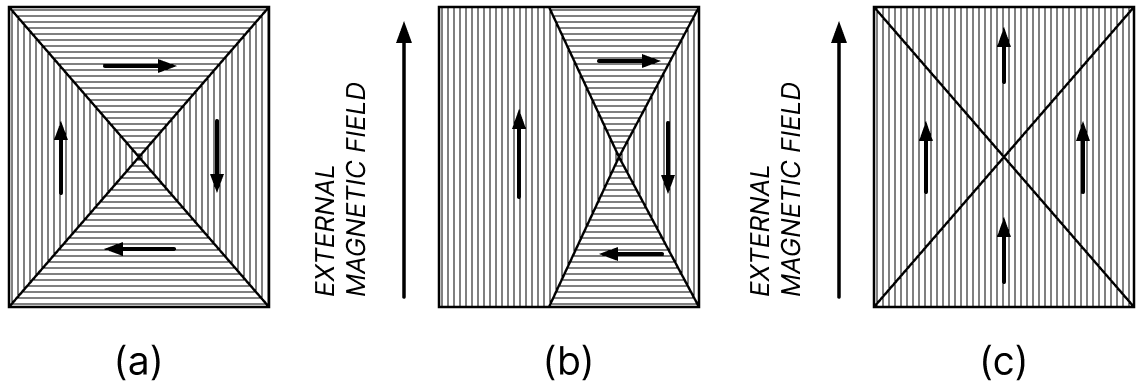
Magnetisation in an external field : When the substance is placed in an external magnetic field, its magnetic moment increases in two ways :
(i) Displacement of domain boundaries — the domains oriented favourably with respect to the field grow in size, while those oriented opposite to it shrink [Fig. (b)]. This is the main process in weak fields.
(ii) Rotation of domains — the domains rotate until their magnetic moments are aligned more or less along the field [Fig. (c)]. This is the main process in strong fields.
The field lines inside the substance therefore become much more dense than outside, and the substance is strongly magnetised.
Residual magnetism : When the external field is removed, the domain boundaries do not move completely back to their original positions, so the substance is not completely demagnetised and some residual magnetism remains (hysteresis).
Demagnetisation : If the magnet is heated above its Curie temperature or hammered, the thermal agitation of the atoms becomes so vigorous that the domains are totally disturbed. The resultant magnetic moment becomes almost zero and the substance behaves as a paramagnetic substance above the Curie temperature.