
A point-object is placed in air at 60 cm from a convex spherical refracting surface of refractive index 1.5. The radius of curvature of the surface is 25 cm. Find the position of the image.
Answer
Given,
- n1 = 1 (air), n2 = 1.5
- Object distance, u = −60 cm
- Radius of curvature, R = +25 cm (convex surface)
For refraction at a spherical surface,
where n1 is the refractive index of the medium in which the object lies and n2 that of the medium into which the light is refracted. Distances are measured from the pole, positive in the direction of the incident light.
Substituting the values,
Hence, the image is formed at 450 cm from the pole inside the surface (in the medium of refractive index 1.5), and it is real.
A convex spherical refracting surface of refractive index 1.5 forms the image of an object distant 10 cm from it at a distance of 40 cm on the same side as the object. What is the radius of curvature of the surface?
Answer
Given,
- n1 = 1 (air), n2 = 1.5
- Object distance, u = −10 cm
- Image distance, v = −40 cm (image on the same side as the object)
For refraction at a spherical surface,
where n1 is the refractive index of the medium in which the object lies and n2 that of the medium into which the light is refracted. Distances are measured from the pole, positive in the direction of the incident light.
Substituting the values,
Hence, the radius of curvature of the surface is + 8 cm.
An empty spherical flask of diameter 100 cm is placed in water (n = ). A parallel beam of light strikes the flask. Where will it appear to come from to an observer within the flask?
Answer
Given,
- n1 = (water), n2 = 1 (air inside the flask)
- Object distance, u = (parallel beam)
- Radius of curvature, R = = +50 cm (the centre of the flask lies on the side of the refracted light)
For refraction at a spherical surface,
where n1 is the refractive index of the medium in which the object lies and n2 that of the medium into which the light is refracted. Distances are measured from the pole, positive in the direction of the incident light.
Substituting the values,
The negative sign shows that the image is virtual and lies on the side of the incident light, that is, in the water outside the flask.
Hence, to an observer within the flask the beam appears to come from a point 150 cm from the flask.
A point-object is placed in air at 40 cm from a concave spherical surface of radius of curvature 20 cm and refractive index 1.5. Locate the image.
Answer
Given,
- n1 = 1 (air), n2 = 1.5
- Object distance, u = −40 cm
- Radius of curvature, R = −20 cm (concave surface)
For refraction at a spherical surface,
where n1 is the refractive index of the medium in which the object lies and n2 that of the medium into which the light is refracted. Distances are measured from the pole, positive in the direction of the incident light.
Substituting the values,
Hence, the image is formed at 30 cm from the pole on the same side as the object, and it is virtual.
A point-object is 2.0 cm below the concave meniscus of water (n = ) of radius of curvature 0.5 cm. Locate the image.
Answer
Given,
- n1 = (water, in which the object lies), n2 = 1 (air)
- Object distance, u = −2.0 cm (light travels upwards, which is taken as positive)
- Radius of curvature, R = +0.5 cm (the meniscus is concave towards air, so its centre of curvature lies above, in air)
For refraction at a spherical surface,
where n1 is the refractive index of the medium in which the object lies and n2 that of the medium into which the light is refracted. Distances are measured from the pole, positive in the direction of the incident light.
Substituting the values,
Hence, a virtual image is formed 0.75 cm below the meniscus, in water.
A glass sphere of radius 5 cm has a small bubble 2 cm from its centre. The bubble is viewed along a diameter of the sphere, from the side on which it lies. How far from the surface will it appear? Refractive index of glass is 1.5.
Answer
Given,
- n1 = 1.5 (glass, in which the bubble lies), n2 = 1 (air)
- Distance of the bubble from the nearer surface = 5 − 2 = 3 cm, so u = −3 cm (light travels from the bubble towards the observer, which is taken as positive)
- Radius of curvature, R = −5 cm (the centre lies on the side of the bubble)
For refraction at a spherical surface,
where n1 is the refractive index of the medium in which the object lies and n2 that of the medium into which the light is refracted. Distances are measured from the pole, positive in the direction of the incident light.
Substituting the values,
Hence, the bubble appears at 2.5 cm from the surface of the sphere (inside the glass).
An air bubble is seen inside a solid sphere of glass (n = 1.5) of 4.0 cm diameter at a distance of 1.0 cm from the surface of the sphere (on seeing along the diameter). Determine the real position of the bubble inside the sphere.
Answer
Given,
- n1 = 1.5 (glass, in which the bubble lies), n2 = 1 (air)
- Radius of the sphere = = 2.0 cm, so R = −2.0 cm (the centre lies on the side of the bubble)
- Image (apparent position) distance, v = −1.0 cm
For refraction at a spherical surface,
where n1 is the refractive index of the medium in which the object lies and n2 that of the medium into which the light is refracted. Distances are measured from the pole, positive in the direction of the incident light.
Substituting the values,
Hence, the bubble is actually at a distance of 1.2 cm from the surface of the sphere.
One end of a cylindrical rod of glass (n = 1.5) shown in the figure is given hemi-spherical shape of radius 2.0 cm. On the left-side of this end is placed an object O at a distance of 12 cm. Find out the distance (v) of the image.
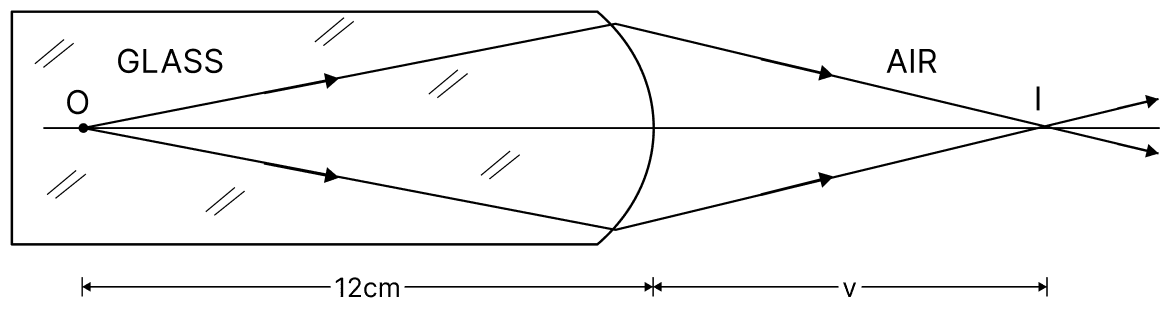
Answer
Given,
- n1 = 1.5 (glass, in which the object lies), n2 = 1 (air)
- Object distance, u = −12 cm
- Radius of curvature, R = −2.0 cm (the hemispherical end bulges into air, so its centre lies inside the glass)
For refraction at a spherical surface,
where n1 is the refractive index of the medium in which the object lies and n2 that of the medium into which the light is refracted. Distances are measured from the pole, positive in the direction of the incident light.
Substituting the values,
Hence, the image is formed in air at a distance v = 8 cm from the curved end, and it is real.
A small object is 2 cm below the concave meniscus of water. The radius of meniscus is 10 mm and refractive index (n) of water is . Find the nature and position of image.
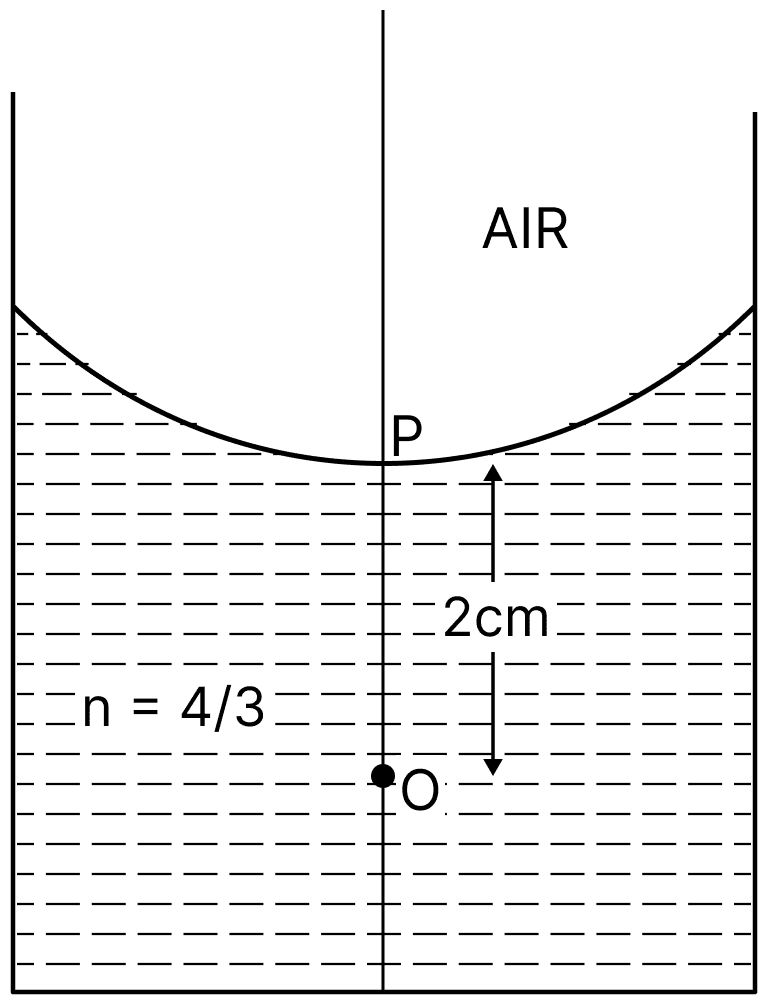
Answer
Given,
- n1 = (water, in which the object lies), n2 = 1 (air)
- Object distance, u = −2 cm (light travels upwards, which is taken as positive)
- Radius of curvature, R = 10 mm = +1.0 cm (the meniscus is concave towards air, so its centre of curvature lies above, in air)
For refraction at a spherical surface,
where n1 is the refractive index of the medium in which the object lies and n2 that of the medium into which the light is refracted. Distances are measured from the pole, positive in the direction of the incident light.
Substituting the values,
Hence, v = −1.0 cm: a virtual image is formed at 1.0 cm below the concave meniscus.
A ray of light falls on a transparent sphere of n = at an angle of incidence 60° with the diameter AB of the sphere having centre C. The ray emerges out from the sphere parallel to the line BD. Find the angle of emergence.
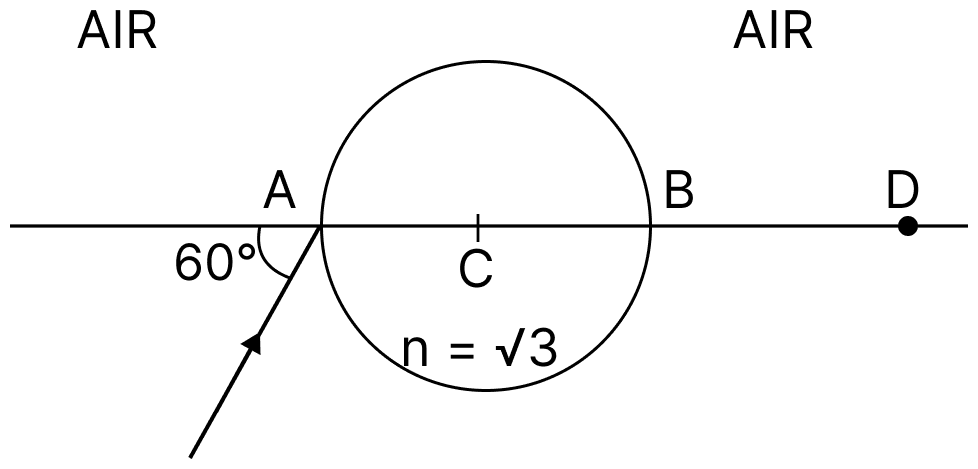
Answer
Given,
- Refractive index of the sphere, n =
- Angle of incidence at A, i = 60°
The diameter AB passes through the centre C, so it is the normal to the surface at A.
Refraction at A : By Snell's law,
Refraction at the point of emergence : Let the refracted ray meet the sphere again at Q. As CA = CQ (radii), the triangle ACQ is isosceles, so the ray strikes the surface at Q at the same angle, r' = r = 30°. Going from the sphere into air,
The total deviation is (i − r) + (e − r') = 30° + 30° = 60°, which equals the angle the incident ray makes with AB. So the emergent ray is parallel to AB, that is, to BD, as stated.
Hence, the angle of emergence is 60°.
A glass sphere, refractive index 1.5 and radius 10 cm, has a spherical cavity of radius 5 cm concentric with it. A narrow beam of parallel light falls on the sphere as shown in the fig. Find the position of final image from surface S1.
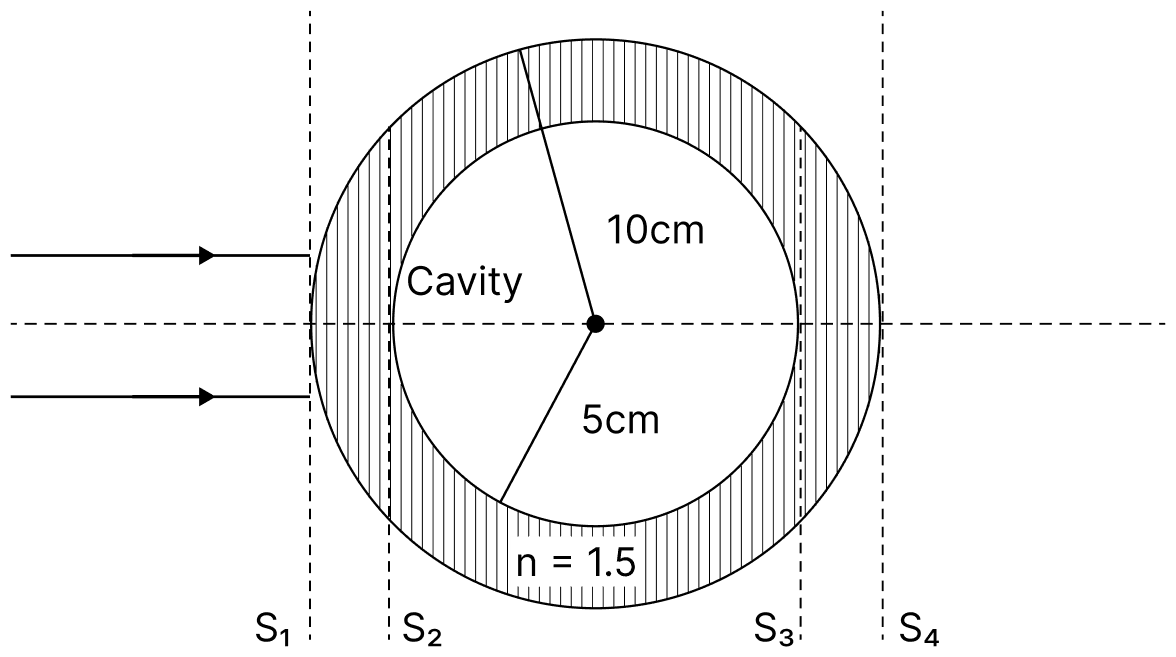
Answer
Given,
- Refractive index of glass, n = 1.5; the cavity contains air
- Outer radius = 10 cm, cavity radius = 5 cm; S1S2 = 5 cm, S2S3 = 10 cm, S3S4 = 5 cm
- Light travels from left to right, which is taken as positive; distances are measured from each surface in turn
The image formed by each surface serves as the object for the next. At every surface,
Surface S1 (air to glass) : u = , R = +10 cm, n1 = 1, n2 = 1.5
This image lies 30 − 5 = 25 cm to the right of S2.
Surface S2 (glass to air) : u = +25 cm (virtual object), R = +5 cm, n1 = 1.5, n2 = 1
This image lies 25 + 10 = 35 cm to the left of S3.
Surface S3 (air to glass) : u = −35 cm, R = −5 cm, n1 = 1, n2 = 1.5
This image lies cm to the left of S4.
Surface S4 (glass to air) : u = cm, R = −10 cm, n1 = 1.5, n2 = 1
The final image is 25 cm to the left of S4. Since S1S4 = 20 cm, it lies 25 − 20 = 5 cm to the left of S1.
Hence, the final image is formed 5 cm to the left of the surface S1.
The image of an object, formed by a plano-convex lens at a distance of 8 m behind the lens, is real and is one-third the size of the object. The wavelength of light inside the lens is times the wavelength in free space. Calculate the radius of the curved surface of the lens.
Answer
Given,
- Image distance, v = +8 m (real image behind the lens)
- Magnification, m = (real image, one-third the size of the object)
- Wavelength in the lens, λ = λ0
Object distance : The linear magnification is m = , so
Focal length : By the lens formula,
Refractive index : The frequency of light does not change on refraction, so
Radius of curvature : For the plano-convex lens, R1 = and R2 = −R. By the lens maker's formula,
Hence, the radius of the curved surface of the lens is 3 m.
The radii of curvature of a double convex lens are 15 cm and 30 cm and the refractive index of its glass is 1.5. Calculate the focal length of the lens.
Answer
Given,
- R1 = +15 cm, R2 = −30 cm (double convex lens)
- n = 1.5
By the lens maker's formula,
Substituting the values,
Hence, the focal length of the lens is 20 cm.
The radii of curvature of a double concave lens are 30 cm and 60 cm and the refractive index of its glass is 1.5. Calculate the focal length of the lens.
Answer
Given,
- R1 = −30 cm, R2 = +60 cm (double concave lens)
- n = 1.5
By the lens maker's formula,
Substituting the values,
Hence, the focal length of the lens is − 40 cm (concave lens).
The radius of curvature of the convex face of a plano-convex lens is 55 cm and the refractive index of its material is 1.55. Find the focal length of the lens.
Answer
Given,
- R1 = (plane face), R2 = −55 cm (convex face)
- n = 1.55
By the lens maker's formula,
Substituting the values,
Hence, the focal length of the lens is 100 cm.
The radii of curvature of the two faces of a convex lens are 0.10 m and 0.15 m respectively. If the focal length of the lens is 0.12 m, find the refractive index of the material of the lens.
Answer
Given,
- R1 = +0.10 m, R2 = −0.15 m (convex lens)
- f = 0.12 m
By the lens maker's formula,
Substituting the values,
Hence, the refractive index of the material of the lens is 1.5.
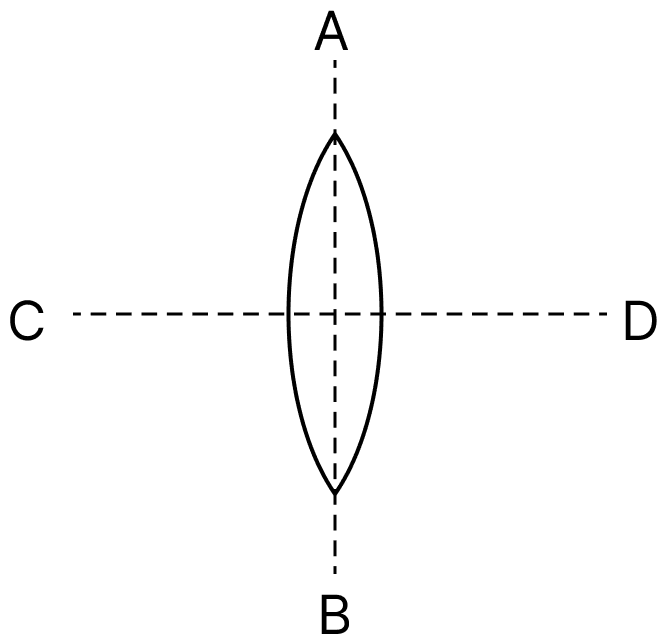
(a) A bi-convex spherical lens has a focal length of 20 cm. If it is split along a plane AB into two halves to form two plano-convex lenses, then what will be the focal length of each plano-convex lens?
(b) What if the lens be cut along CD?
Answer
Given,
- Focal length of the bi-convex lens, f = 20 cm
(a) Cut along AB : AB is perpendicular to the principal axis, so the lens splits into two identical plano-convex lenses, each of focal length f1. Placed back in contact they form the original lens, so
(b) Cut along CD : CD is the principal axis. Each half still has both curved surfaces with the same radii R1 and R2 and the same material, so by the lens maker's formula its focal length is unchanged. Only half the light passes through each part, so the intensity of the image decreases.
Hence, (a) the focal length of each plano-convex lens is 40 cm; (b) the focal length of each part remains 20 cm, but the intensity of the image decreases.
The radii of curvature of a convexo-convex lens of glass (n = 1.50) are in the ratio 1 : 2. This lens renders the rays coming from an illuminated filament at a distance of 6.0 cm parallel. Calculate the radii of curvature of its surfaces.
Answer
Given,
- n = 1.50
- R1 = +R, R2 = −2R (convexo-convex lens, radii in the ratio 1 : 2)
- The rays from the filament become parallel, so the filament is at the focus: f = 6.0 cm
By the lens maker's formula,
Substituting the values,
Therefore, 2R = 9.0 cm.
Hence, the radii of curvature of the surfaces are 4.5 cm and 9.0 cm.
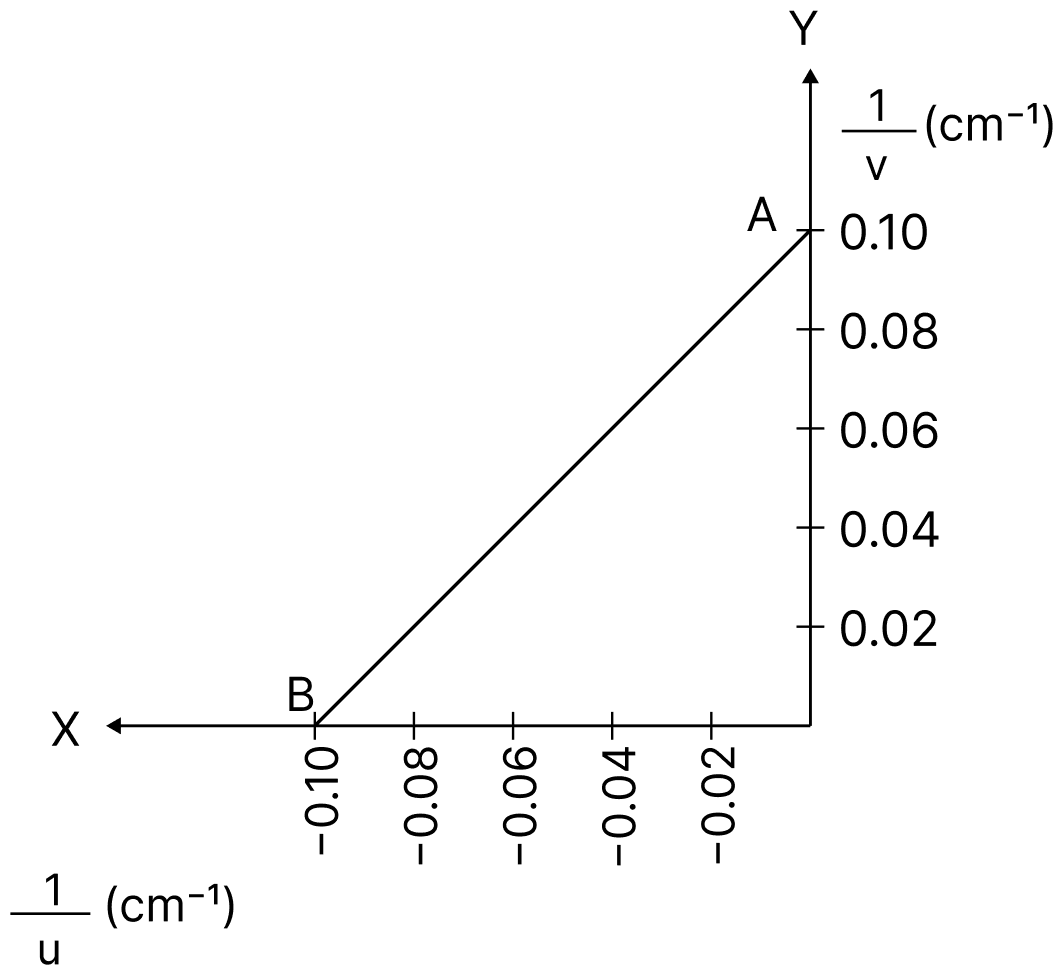
The graph between and for a thin convex lens in order to determine its focal length is plotted as shown in the figure. The refractive index of lens is 1.5 and its both the surfaces have same radius of curvature R.
Answer
Given,
- n = 1.5
- R1 = +R, R2 = −R (both surfaces of the same radius of curvature)
- From the graph: at A, = 0 and = 0.10 cm-1; at B, = 0 and = −0.10 cm-1
Focal length : By the lens formula,
At the point A, where = 0,
The point B gives the same value, since cm-1.
Radius of curvature : By the lens maker's formula,
Hence, the focal length of the lens is 10 cm and the radius of curvature of each surface is R = 10 cm.
Note: The question does not state what is to be found; the printed answer gives R = 10 cm, so both f and R are worked out.
The refractive index of glass with respect to air is and that of water is . The radii of curvature of a glass convex lens are 20 cm and 30 cm respectively. What will be the focal length of the lens (i) in air, (ii) in water?
Answer
Given,
- ang = , anw =
- R1 = +20 cm, R2 = −30 cm (convex lens)
When a lens is immersed in a liquid, the lens maker's formula uses the refractive index of glass with respect to the liquid, lng = . Thus
(i) In air : From Eq. (i),
(ii) In water : The refractive index of glass with respect to water is
From Eq. (ii),
Hence, the focal length of the lens is (i) 24 cm in air and (ii) 96 cm in water.
The focal length of a convex lens of glass (n = 1.50) in air is 40 cm. Calculate the focal length of the lens when it is immersed in a liquid of refractive index (i) 1.30, (ii) 1.50, (iii) 1.70.
Answer
Given,
- ang = 1.50
- Focal length in air, fa = 40 cm
When a lens is immersed in a liquid, the lens maker's formula uses lng = . The factor is the same in air and in the liquid, so dividing the two forms of the formula,
(i) Liquid of refractive index 1.30 :
(ii) Liquid of refractive index 1.50 :
so fl is infinite. The lens behaves like a plane transparent plate and becomes invisible in the liquid.
(iii) Liquid of refractive index 1.70 :
The focal length is negative, so the lens behaves like a concave (diverging) lens.
Hence, the focal length is (i) 130 cm, (ii) infinite, (iii) − 170 cm (the lens behaves like a concave lens).
The radii of curvature for spherical surfaces of a bi-convex lens are 20 cm and 30 cm. The refractive index of the material of the lens with respect to air is 1.5. If the lens is dipped in a liquid of refractive index 1.65 with respect to air, calculate its effective focal length and state the nature of the lens.
Answer
Given,
- R1 = +20 cm, R2 = −30 cm (bi-convex lens)
- ang = 1.5, anl = 1.65
In the liquid, the lens maker's formula uses the refractive index of the lens material with respect to the liquid,
Then,
The focal length in the liquid is negative because the liquid is optically denser than the lens material, so the lens behaves as a concave (diverging) lens.
Hence, the effective focal length is − 132 cm and the lens behaves as a concave lens.
An object is placed at 0.06 m from a convex lens of focal length 0.10 m. Find the position of the image.
Answer
Given,
- Object distance, u = −0.06 m
- Focal length, f = +0.10 m (convex lens)
By the lens formula,
Substituting the values,
The negative sign shows that the image is on the same side as the object, and it is virtual.
Hence, the image is formed at 0.15 m in front of the lens (on the side of the object).
A convergent beam of light passes through a diverging lens of focal length 0.2 m and comes to a focus on the axis 0.3 m behind the lens. Where would the beam have been focussed in the absence of the lens?
Answer
Given,
- Focal length of the diverging lens, f = −0.2 m
- The beam comes to a focus 0.3 m behind the lens, so v = +0.3 m
In the absence of the lens the beam would have converged to a point behind the lens. For the lens, this point serves as a virtual object at distance u.
By the lens formula,
Substituting the values,
Hence, in the absence of the lens the beam would have been focussed at 0.12 m behind the position of the lens.
A double convex lens has 10 cm and 15 cm as its two radii of curvature. The image of an object, placed 30 cm from the lens, is formed at 20 cm from the lens on the other side. Find the focal length and the refractive index of the material of the lens. What will be the focal length of the lens, if it is immersed in water of refractive index 1.33?
Answer
Given,
- R1 = +10 cm, R2 = −15 cm (double convex lens)
- Object distance, u = −30 cm; image distance, v = +20 cm
- Refractive index of water, nw = 1.33
Focal length : By the lens formula,
Refractive index : By the lens maker's formula,
Focal length in water : The refractive index of glass with respect to water is
Since is unchanged,
Hence, the focal length of the lens is 12 cm, the refractive index of its material is 1.5, and its focal length in water is about 47 cm.
A thin convex lens forms the distinct image of an object on a screen placed at a distance of 30 cm from the lens. When the lens is displaced 5 cm towards the screen, then in order to obtain distinct image the screen is displaced 5 cm towards the lens. Find the focal length of the lens.
Answer
Given,
- Initial image distance, v1 = +30 cm
- The lens moves 5 cm towards the screen and the screen moves 5 cm towards the lens; the object stays fixed
Let the initial distance of the object from the lens be x, so u1 = −x.
After the shift, the object is (x + 5) cm from the lens, and the screen is 30 − 5 − 5 = 20 cm from the lens. So u2 = −(x + 5) and v2 = +20 cm.
By the lens formula,
For the two positions,
Equating Eqs. (i) and (ii),
(the negative root is rejected). Putting x = 15 cm in Eq. (i),
Hence, the focal length of the lens is 10 cm.
An illuminated object and a screen are 90 cm apart. Find the nature and focal length of a lens required to produce a clear image on the screen, twice the size of the object.
Answer
Given,
- Distance between the object and the screen = 90 cm
- The image is real (formed on the screen) and twice the size of the object, so m = −2
A real image on a screen can be formed only by a convex lens.
Let the lens be at a distance x from the object. Then u = −x and v = +(90 − x). The linear magnification is
So u = −30 cm and v = +60 cm. By the lens formula,
Hence, the lens is convex and its focal length is 20 cm.
What can you tell about the image of a 3 cm long object placed at a distance of 15 cm from a lens, if the magnification is known to be -2?
Answer
Given,
- Size of the object, y1 = 3 cm
- Object distance, u = −15 cm
- Linear magnification, m = −2
Position of the image :
Size of the image :
The magnification is negative, so the image is real and inverted.
Hence, the image is formed at a distance of 30 cm on the other side of the lens; it is 6 cm long, real and inverted.
The diameter of the sun is 1.4 × 10⁹ m. Find the diameter of the image of the sun formed by a convex lens of focal length 1.0 m. The distance of the sun from the earth is 1.0 × 10¹¹ m.
Answer
Given,
- Diameter of the sun, y1 = 1.4 × 10⁹ m
- Object distance, u = −1.0 × 10¹¹ m
- Focal length, f = +1.0 m
The sun is practically at infinity, so its image is formed at the focus of the lens: v = f = +1.0 m.
The linear magnification is
Therefore,
The negative sign shows that the image is inverted.
Hence, the diameter of the image of the sun is 1.4 cm.
A double convex lens of glass (n = 1.5) has radii of curvature, each 20 cm. An object 2 cm high is placed at 10 cm from the lens. Find the position, size and nature of the image.
Answer
Given,
- n = 1.5; R1 = +20 cm, R2 = −20 cm (double convex lens)
- Object height, y1 = 2 cm; object distance, u = −10 cm
Focal length : By the lens maker's formula,
Position of the image : By the lens formula,
Size of the image :
The magnification is positive, so the image is virtual and erect.
Hence, the image is formed at 20 cm from the lens on the same side as the object; it is 4 cm high, virtual and erect.
A double concave lens of glass (n = 1.5) has both radii of curvature of magnitude 40 cm. An object 2 cm high is placed at 10 cm from the lens. Find the position, size and nature of the image.
Answer
Given,
- n = 1.5; R1 = −40 cm, R2 = +40 cm (double concave lens)
- Object height, y1 = 2 cm; object distance, u = −10 cm
Focal length : By the lens maker's formula,
Position of the image : By the lens formula,
Size of the image :
The magnification is positive, so the image is virtual and erect.
Hence, the image is formed at 8 cm from the lens on the same side as the object; it is 1.6 cm high, virtual and erect.
An object 10 cm high is placed at the principal focus of a concave lens of focal length 20 cm. Find the position, size and nature of the image.
Answer
Given,
- Focal length, f = −20 cm (concave lens)
- Object at the principal focus, so u = −20 cm
- Object height, y1 = 10 cm
Position of the image : By the lens formula,
Size of the image :
The magnification is positive, so the image is virtual and erect.
Hence, the image is formed at 10 cm from the lens on the same side as the object (midway between the lens and its focus); it is 5.0 cm high, virtual and erect.
A lens produces a virtual image of size that of the object placed at 20 cm from the lens. Find the position of the image, nature and focal length of the lens.
Answer
Given,
- Object distance, u = −20 cm
- The image is virtual (erect) and the size of the object, so m =
A lens that forms a virtual, diminished image is a concave lens.
Position of the image :
Focal length : By the lens formula,
Hence, the image is at cm from the lens on the same side as the object; the lens is concave and its focal length is − 40 cm.
A concave lens forms the image of an object such that the distance between the object and its image is 15 cm and the magnification produced is . What is the focal length of concave lens?
Answer
Given,
- Linear magnification, m = (a concave lens always forms a virtual, erect image)
- Distance between the object and its image = 15 cm
The image formed by a concave lens lies on the same side as the object, between the lens and the object. From m = ,
As both u and v are negative, the distance between the object and the image is
So u = −30 cm and v = −15 cm. By the lens formula,
Hence, the focal length of the concave lens is − 30 cm.
A convex lens of focal length 12 cm produces an image on a screen three times in size than the object. What is the distance of the object from the lens?
Answer
Given,
- Focal length, f = +12 cm (convex lens)
- The image is formed on a screen (real) and is three times the size of the object, so m = −3
From m = , v = −3u. By the lens formula,
Substituting v = −3u,
Hence, the object is at a distance of 16 cm from the lens.
A 10 cm long pin lies along the principal axis of a convex lens of focal length 10 cm such that the nearer end of the pin is at a distance of 15 cm from the lens. Find the length of the image of the pin formed by the lens.
Answer
Given,
- Focal length, f = +10 cm (convex lens)
- Length of the pin = 10 cm, lying along the principal axis
- Nearer end : u1 = −15 cm; farther end : u2 = −(15 + 10) = −25 cm
The image of each end is found separately from the lens formula, .
Image of the nearer end :
Image of the farther end :
Length of the image :
Hence, the length of the image of the pin is 13.33 cm.
An object is placed in front of a convex lens at such a distance that its real image of the same size is formed. When the object is displaced 16 cm towards the lens, still a real image is formed but now its size is 3 times the size of the object. Calculate the focal length of the lens.
Answer
Given,
- First position : real image of the same size, so m1 = −1
- Second position : the object is 16 cm nearer to the lens and the real image is 3 times the size, so m2 = −3
From the lens formula, the linear magnification can also be written as
First position : With m1 = −1,
Second position : u2 = −(2f − 16). With m2 = −3,
Hence, the focal length of the lens is 24 cm.
A convex lens of focal length 10 cm produces images of the same magnification 2 when an object is kept at two distances x1 and x2 (x1 > x2) from the lens. Find the ratio of x1 and x2.
Answer
Given,
- Focal length, f = +10 cm (convex lens)
- The magnitude of the magnification is 2 in both cases
A convex lens gives a magnified image of magnification 2 in two ways: a real image (m = −2) when the object is farther from the lens, and a virtual image (m = +2) when the object is within the focal length. Since x1 > x2, the distance x1 gives the real image.
From the lens formula, the linear magnification can also be written as
Real image (m = −2) :
So x1 = 15 cm.
Virtual image (m = +2) :
So x2 = 5 cm.
Hence, x1 : x2 = 3 : 1.
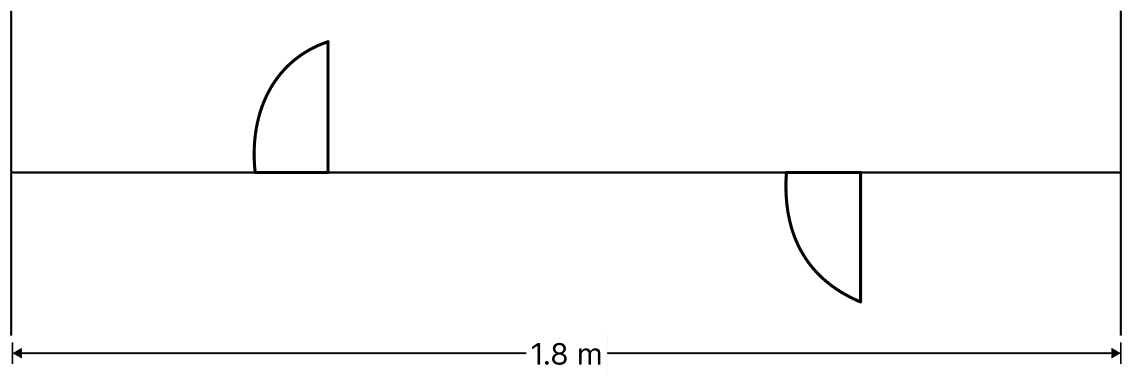
A thin plano-convex lens of focal length f is split into two halves. One of the halves is shifted along the optical axis. The separation between the object and image planes is 1.8 m. The magnification of the image formed by one of the half lenses is 2.
Find the focal length of the lens used.
Answer
Given,
- Separation between the object and image planes = 1.8 m
- Magnification produced by one half lens = 2; the image is real (formed on the image plane), so m = −2
Each half of the lens has the same focal length f as the whole lens. For the half lens producing magnification 2, let the object distance be u.
Since the object and the image are on opposite sides of the lens,
So u = −0.6 m and v = +1.2 m. By the lens formula,
Hence, the focal length of the lens used is 0.4 m.
A convex lens of 20 cm focal length is placed in contact with a concave lens of 25 cm focal length. Find the position and nature of the image of an object placed at a distance of 2 m from this combination.
Answer
Given,
- f1 = +20 cm (convex lens), f2 = −25 cm (concave lens)
- Object distance, u = −2 m = −200 cm
For two thin lenses placed in contact, the focal length F of the combination is given by
Position of the image : By the lens formula,
Nature of the image :
Hence, the image is formed on the other side of the combination at a distance of 2 m; it is real, inverted and of the same size as the object.
A convex lens forms the image of the same size of an object placed at a distance of 20 cm. If another lens is placed in contact with the first, the image is formed at a distance of 5 cm from the combination on the other side. What are the focal lengths of the lenses used?
Answer
Given,
- With the first (convex) lens alone, the image is of the same size as the object placed at 20 cm
- With the second lens in contact, the image is at v = +5 cm for the same object
Focal length of the first lens : A convex lens forms a real image of the same size when the object is at 2f1. So
Focal length of the combination : With u = −20 cm and v = +5 cm, By the lens formula,
Focal length of the second lens : For two thin lenses placed in contact, the focal length F of the combination is given by
Hence, the focal lengths of the lenses are 10 cm and cm (≈ 6.67 cm), both convex.
Rays coming from an object situated at infinity, fall on a convex lens and an image is formed at a distance of 16 cm from the lens. When a concave lens is kept in contact with the convex lens, the image is formed at a distance of 20 cm from the lens combination. Calculate the focal length of the concave lens.
Answer
Given,
- Rays from infinity are focussed by the convex lens at 16 cm, so f1 = +16 cm
- With the concave lens in contact, the image is at 20 cm, so the focal length of the combination is F = +20 cm
For two thin lenses placed in contact, the focal length F of the combination is given by
Hence, the focal length of the concave lens is − 80 cm.
A thin convex lens of focal length 20 cm is kept in coaxial contact with another thin lens so that the combination becomes a converging lens of focal length 100 cm. What is the focal length of the second lens?
Answer
Given,
- f1 = +20 cm (convex lens)
- Focal length of the combination, F = +100 cm (converging)
For two thin lenses placed in contact, the focal length F of the combination is given by
Hence, the focal length of the second lens is − 25 cm; it is a concave lens.
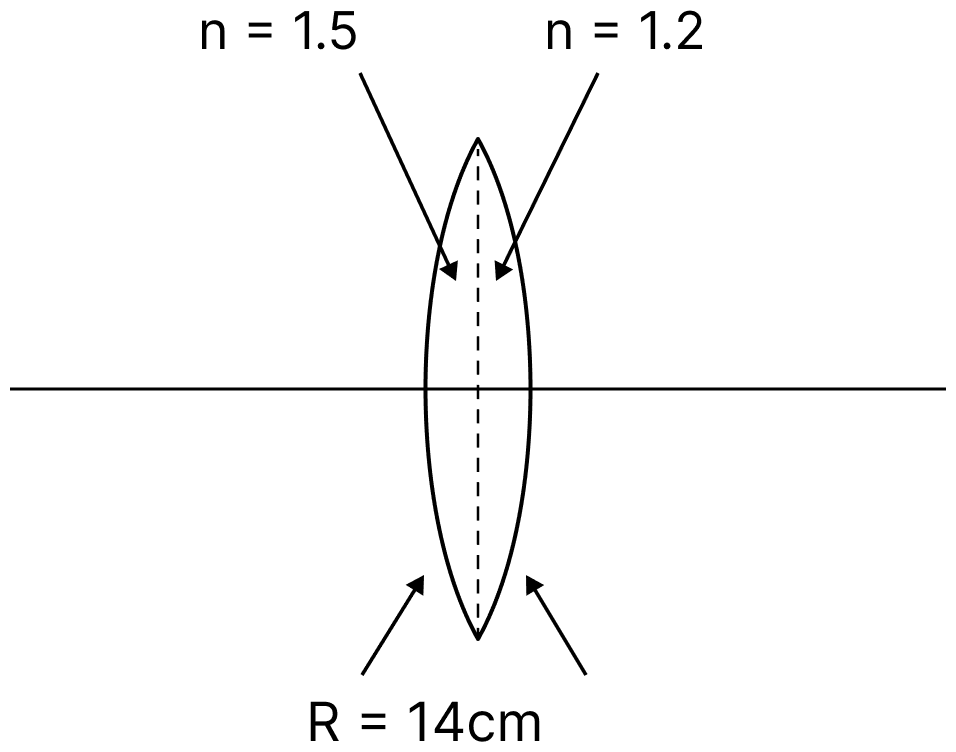
A bi-convex lens is formed with two thin plano-convex lenses as shown in the figure. Refractive index n of the first lens is 1.5 and that of the second lens is 1.2. Both the curved surfaces are of the same radius of curvature R = 14 cm. For this bi-convex lens, for an object distance of 40 cm, what will be the image distance?
Answer
Given,
- First plano-convex lens : n1 = 1.5; second : n2 = 1.2
- Radius of each curved surface, R = 14 cm
- Object distance, u = −40 cm
For a plano-convex lens, the lens maker's formula with one face plane gives .
Focal lengths of the two lenses :
Focal length of the bi-convex lens : The two lenses are in contact, so
Image distance : By the lens formula,
Hence, the image distance is 40.0 cm, on the other side of the lens.
The focal length of a lens is -50 cm. What is its power?
Answer
Given,
- Focal length, f = −50 cm = −0.5 m
The power of a lens is the reciprocal of its focal length measured in metre,
Hence, the power of the lens is − 2 D (concave lens).
The radius of curvature of each surface of a convex lens of refractive index 1.5 is 40 cm. Calculate its power.
Answer
Given,
- n = 1.5
- R1 = +40 cm, R2 = −40 cm (convex lens)
Focal length : By the lens maker's formula,
Power : The power of a lens is the reciprocal of its focal length measured in metre,
Hence, the power of the lens is + 2.5 D.
A person uses spectacles of power -0.5 D for distant vision. How far is the far point of the person?
Answer
Given,
- Power of the spectacle lens, P = −0.5 D
Focal length :
For distant vision, the concave spectacle lens must form the image of a distant object (u = ) at the far point of the eye. By the lens formula,
The image is virtual, 200 cm in front of the lens. This point is the far point of the person (neglecting the distance between the lens and the eye).
Hence, the far point of the person is at 200 cm.
A lens has a power of + 5D in air. What will be its power when immersed deep in water? ang = , anw = .
Answer
Given,
- Power in air, Pa = +5 D
- ang = , anw =
Focal length in air :
Focal length in water : The refractive index of glass with respect to water is
Since is the same in air and in water, the lens maker's formula gives
Power in water :
Hence, the power of the lens in water is + 1.25 D.
Two thin lenses of focal lengths 15 cm and 30 cm are placed in contact. What is the power of the system?
Answer
Given,
- f1 = +15 cm = 0.15 m, f2 = +30 cm = 0.30 m
The power of a lens is the reciprocal of its focal length measured in metre,
For lenses placed in contact, the powers add up,
Hence, the power of the system is + 10 D.
A convex lens of focal length 30 cm is placed in contact with a concave lens of focal length 20 cm. Find the focal length and power of the combination. Is the combination converging or diverging?
Answer
Given,
- f1 = +30 cm (convex lens), f2 = −20 cm (concave lens)
Focal length : For two thin lenses placed in contact, the focal length F of the combination is given by
Power :
The focal length and power are negative, so the combination behaves as a concave lens.
Hence, the focal length of the combination is − 60 cm, its power is − 1.67 D, and the combination is diverging.
Lenses of powers + 3 D and - 5 D are combined to form a compound lens. An object is placed at a distance of 50 cm from this lens. Calculate the position of its image.
Answer
Given,
- P1 = +3 D, P2 = −5 D
- Object distance, u = −50 cm
Power and focal length of the compound lens :
Position of the image : By the lens formula,
The image is virtual.
Hence, the image is formed at 25 cm from the compound lens on the same side as the object.
A combination consisting of a concave lens in contact of a convex lens of focal length 25 cm produces a real image at a distance of 80 cm when an object is placed at a distance of 40 cm from the combination. Find the focal length and power of the concave lens.
Answer
Given,
- f1 = +25 cm (convex lens)
- For the combination : u = −40 cm, v = +80 cm (real image)
Focal length of the combination : By the lens formula,
Focal length of the concave lens : For two thin lenses placed in contact, the focal length F of the combination is given by
Power of the concave lens :
Hence, the focal length of the concave lens is − 4 m and its power is − 0.25 D.
Find the focal length and power of a convex lens which, when put in contact with a concave lens of focal length 25 cm forms a real image 5 times the size of an object placed 20 cm from the combination.
Answer
Given,
- f2 = −25 cm (concave lens)
- Object distance, u = −20 cm
- Real image 5 times the size of the object, so m = −5
Image distance :
Focal length of the combination : By the lens formula,
Focal length of the convex lens : For two thin lenses placed in contact, the focal length F of the combination is given by
Power of the convex lens :
Hence, the focal length of the convex lens is 10 cm and its power is + 10 D.
A compound lens is formed with two lenses of powers + 15.5 D and - 5.5 D kept in contact. An object of height 3 cm is placed at a distance of 30 cm from the lens. What is the height of the image?
Answer
Given,
- P1 = +15.5 D, P2 = −5.5 D
- Object height, y1 = 3 cm; object distance, u = −30 cm
Power and focal length of the compound lens :
Image distance : By the lens formula,
Height of the image :
The negative sign shows that the image is inverted (real).
Hence, the height of the image is − 1.5 cm, that is, 1.5 cm and inverted.
Parallel rays of sun fall upon a concave lens of 10 cm focal length. At a distance of 20 cm from this lens, a convex lens of 15 cm focal length is placed. Where should the screen be placed to get the image of the sun?
Answer
Given,
- Concave lens : f1 = −10 cm
- Convex lens : f2 = +15 cm, placed 20 cm from the concave lens
- Rays from the sun are parallel, so u1 =
The image formed by the first lens serves as the object for the second lens.
Image by the concave lens : Parallel rays are diverged as if coming from its focus, so v1 = f1 = −10 cm. This virtual image lies 10 cm in front of the concave lens.
Image by the convex lens : The image is 20 + 10 = 30 cm in front of the convex lens, so u2 = −30 cm. By the lens formula,
Hence, the screen should be placed 30 cm behind the convex lens.
A thin convex lens (L1) of focal length 60 cm and a thin concave lens (L2) of focal length f are kept co-axially, 15 cm apart as shown in figure below. When a narrow and parallel beam of light is incident on the convex lens, beam emerging from the concave lens is also a parallel beam. Find f.
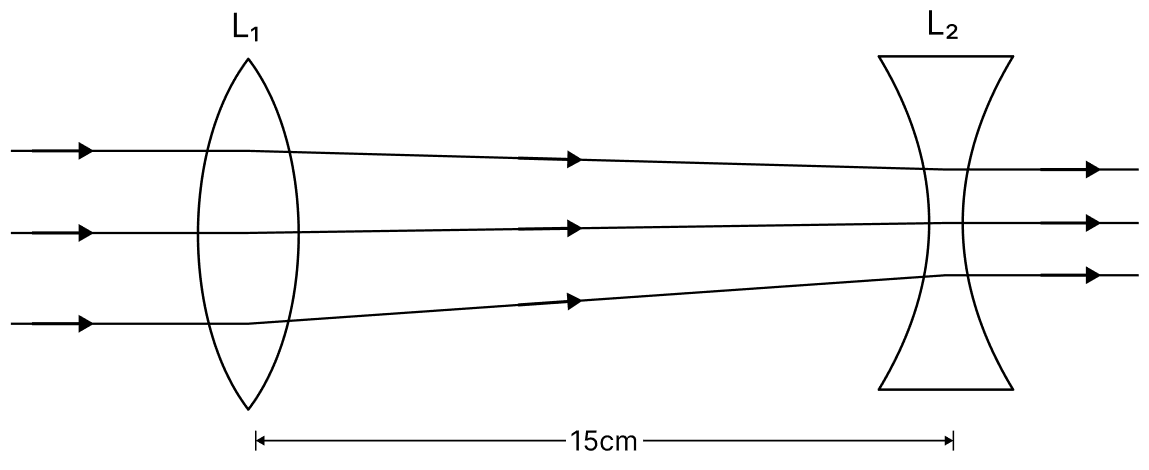
Answer
Given,
- L1 : convex lens, f1 = +60 cm
- L2 : concave lens of focal length f, 15 cm from L1
- Incident and emergent beams are both parallel
Image by L1 : The parallel beam would converge at the focus of L1, 60 cm from it. This point is 60 − 15 = 45 cm beyond L2, so for L2 it serves as a virtual object : u2 = +45 cm.
Refraction at L2 : The emergent beam is parallel, so v2 = . By the lens formula,
Hence, f = − 45 cm.
Three lenses L1, L2 and L3 each of focal length 20 cm are placed co-axially as shown in figure. An object is held at 40 cm from the optic centre of lens L1. The final real image is formed at the focus I of L3. Calculate the separation between :
(i) L1 and L2 and
(ii) L2 and L3.
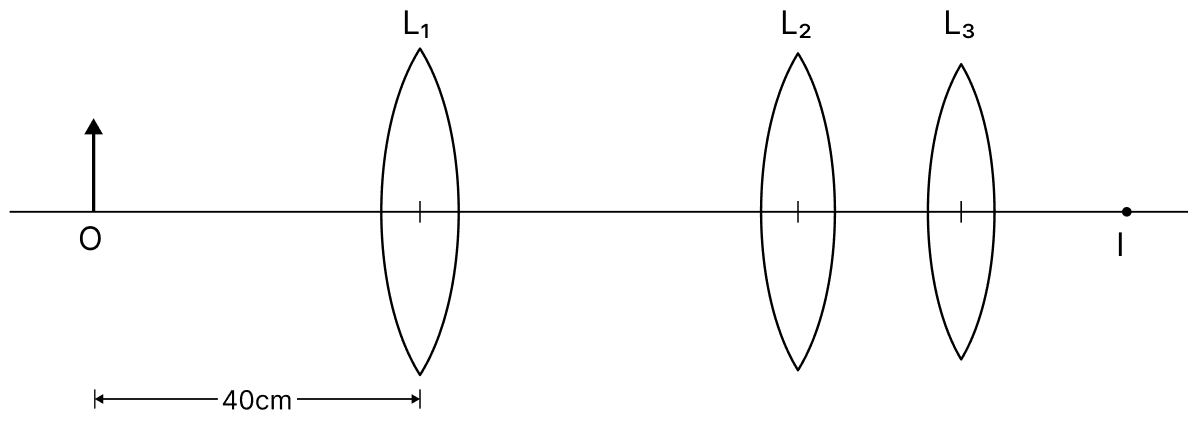
Answer
Given,
- f1 = f2 = f3 = +20 cm
- Object distance from L1, u1 = −40 cm
- The final real image is at the focus I of L3
The final image is formed at the focus of L3, so the rays falling on L3 must be parallel. The rays leaving L2 are parallel only if the image formed by L1 lies at the first focus of L2.
Image by L1 : By the lens formula,
Object for L2 : For parallel emergent rays, v2 = ,
(i) Separation between L1 and L2 :
(ii) Separation between L2 and L3 : The rays between L2 and L3 are parallel to the axis, so L3 brings them to its focus wherever it is placed.
Hence, (i) the distance between L1 and L2 is 60 cm; (ii) the distance between L2 and L3 can be any finite distance.
A plano-convex lens of radius of curvature 5 cm is placed at a distance of 'd2' from a concave lens of focal length 30 cm.
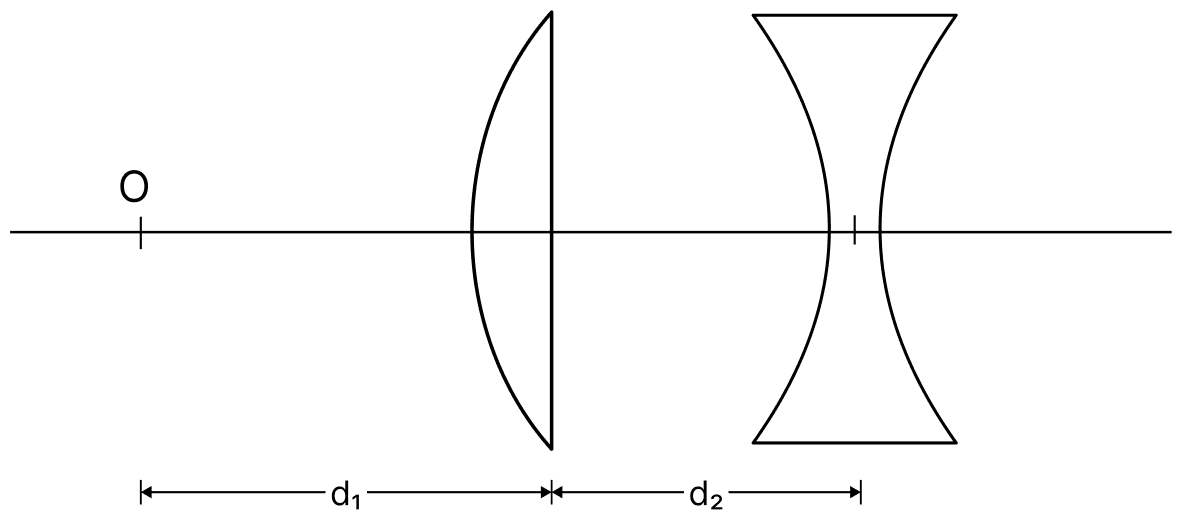
What should be the distance 'd1' of a point-object 'O' from the plano-convex lens so that the position of final image is independent of 'd2'? Also find the nature and position of final image from concave lens.
Answer
Given,
- Plano-convex lens : n = , R = 5 cm
- Concave lens : f2 = −30 cm, at a distance d2 from the plano-convex lens
Focal length of the plano-convex lens : With R1 = and R2 = −5 cm, the lens maker's formula gives
Value of d1 : The position of the final image will not depend on d2 only if the rays travelling from the plano-convex lens to the concave lens are parallel to the axis. This needs the object O to be at the first focus of the plano-convex lens, so
Final image : Parallel rays fall on the concave lens, u2 = , so by the lens formula,
Hence, d1 = 10 cm (the object is at the first focus of the plano-convex lens). The final image is virtual and is formed at the second focus of the concave lens, 30 cm to its left.
The following figure represents two biconvex lenses L1 and L2 having focal lengths 10 cm and 15 cm respectively. Find the distance between L1 and L2.
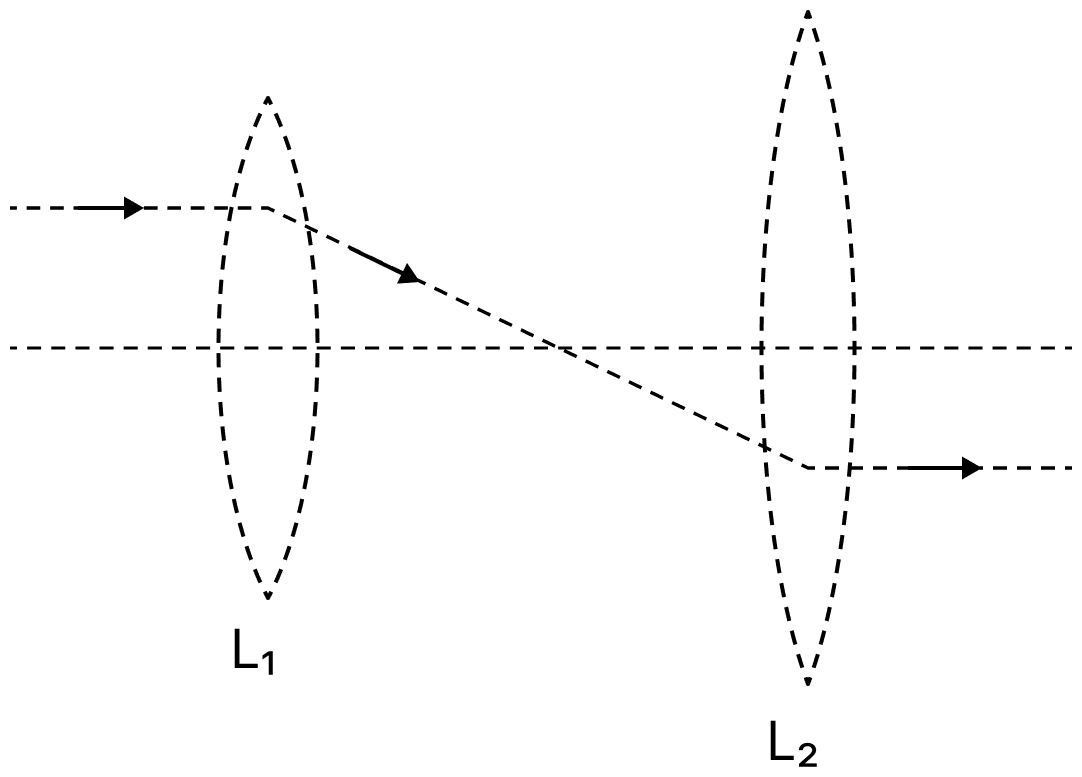
Answer
Given,
- f1 = 10 cm (L1), f2 = 15 cm (L2)
In the figure, a ray parallel to the principal axis falls on L1, passes through the axis between the lenses, and emerges from L2 parallel to the axis again.
After refraction through L1, a ray parallel to the axis passes through the second focus of L1. A ray emerges from L2 parallel to the axis only if it passes through the first focus of L2. So the second focus of L1 must coincide with the first focus of L2, and the distance between the lenses is
Hence, the distance between L1 and L2 is 25 cm.
A point object O is placed at a distance of 0.3 m from a convex lens (f = 0.2 m) cut into two halves each of which is displaced by 0.0005 m as shown in the figure.
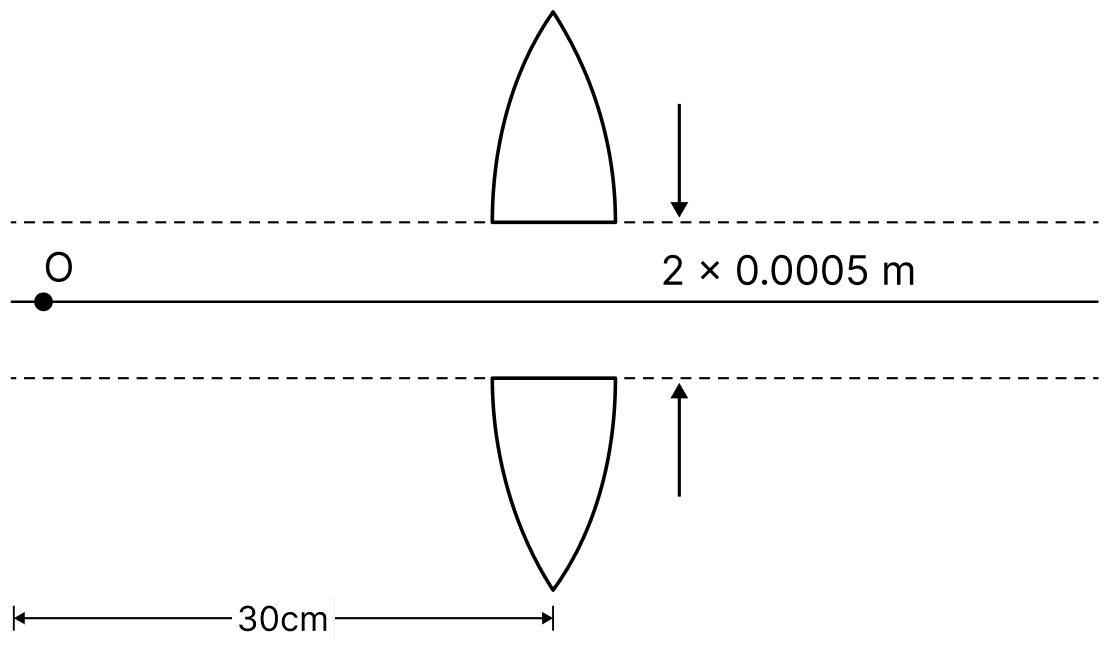
Find the distance between the images so formed.
Answer
Given,
- Object distance, u = −0.3 m; focal length of each half, f = +0.2 m
- Each half is displaced by 0.0005 m from the principal axis, one upwards and one downwards
Each half lens behaves as a complete lens of focal length 0.2 m with its own optic centre, displaced 0.0005 m from the axis.
Image distance : By the lens formula,
Magnification :
Position of each image : For the upper half, the object O lies 0.0005 m below its own axis, so y1 = −0.0005 m. Its image is at
that is, 0.001 m above the axis of the upper half. As that axis is itself 0.0005 m above the principal axis, the image is 0.0005 + 0.001 = 0.0015 m above the principal axis. By symmetry, the image formed by the lower half is 0.0015 m below the principal axis.
Distance between the images :
Hence, the two images are 0.3 cm apart.
The teacher is demonstrating the experiment of the focal length of a convex lens using the u-v method. After the teacher takes readings P and Q, he/she assigns two students (Student 1 and Student 2) to take the subsequent readings, assuming that the teacher is right.
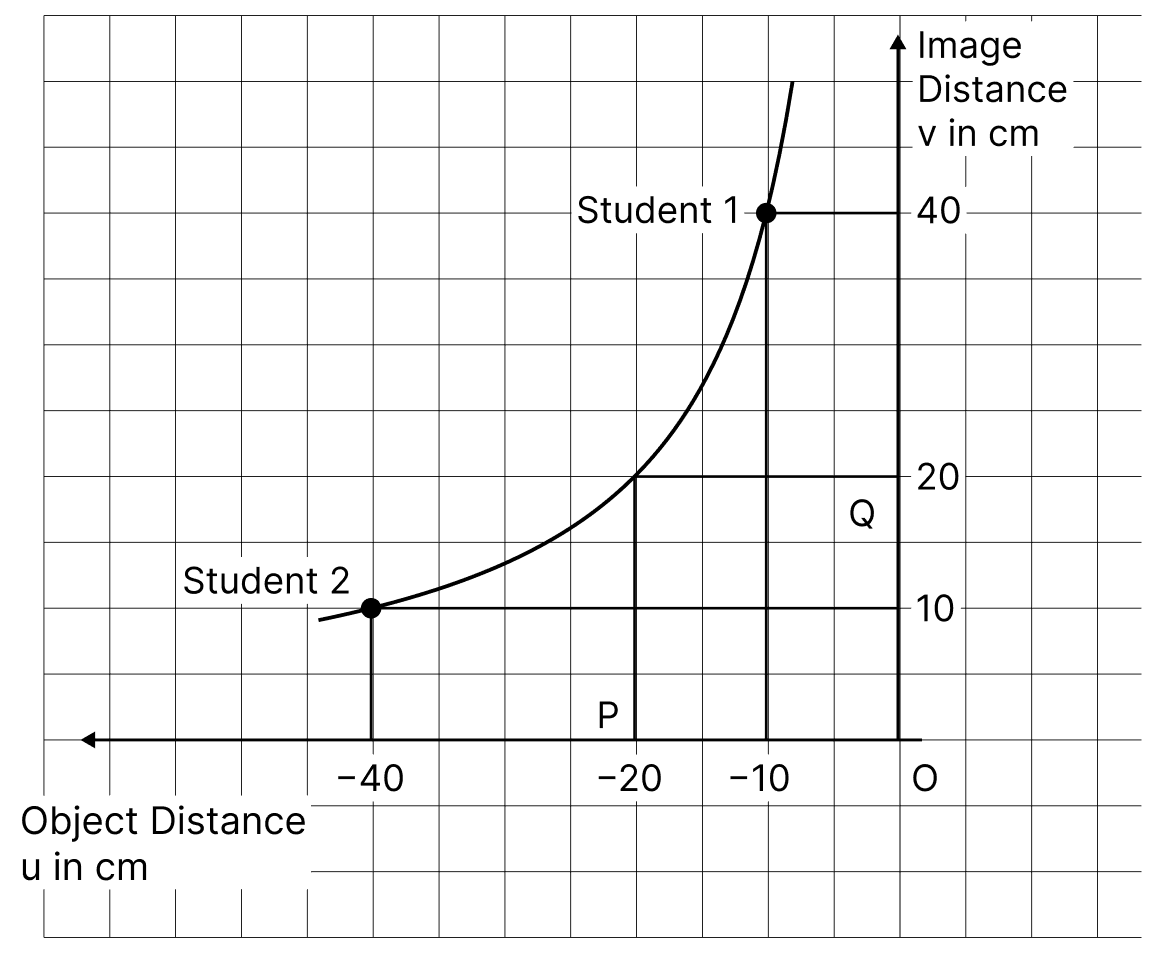
(i) What is the focal length of the given lens?
(ii) How should student 2 adjust the screen to obtain an accurate reading?
(iii) What error do you observe in the readings of student 1?
Answer
Given,
- Teacher's reading (P, Q) : u = −20 cm, v = +20 cm
- Student 2's reading : u = −40 cm, v = +10 cm
- Student 1's reading : u = −10 cm, v = +40 cm
(i) Focal length of the lens : Using the teacher's reading in the lens formula,
(ii) Adjustment by student 2 : For u = −40 cm, the correct image distance is
Student 2 recorded v = 10 cm, so the screen must be moved 13.3 − 10 ≈ 3.3 cm farther from the lens.
(iii) Error of student 1 : With u = −10 cm = −f, the object is at the focus of the lens.
The image is formed at infinity, so no image can be obtained on a screen and the reading v = 40 cm is wrong.
Hence, (i) f = 10 cm; (ii) student 2 should move the screen about 3.3 cm farther from the lens; (iii) student 1 kept the object at the focus F, where the image would be at infinity, so his reading is not possible.
Note: The textbook prints "3 cm" in (ii); the exact shift is cm.
A convex lens of focal length 15 cm, has a point-object placed on its principal axis at a distance of 30 cm from it. A plane mirror is placed 20 cm behind the convex lens. Locate the position of image formed by this combination.
Answer
Given,
- Focal length of the convex lens, f = +15 cm
- Object distance, u = −30 cm
- A plane mirror is 20 cm behind the lens
Image by the lens : By the lens formula,
Reflection at the plane mirror : The rays converging towards a point 30 cm behind the lens meet the mirror first. This point lies 30 − 20 = 10 cm behind the mirror and acts as a virtual object for it. A plane mirror forms the image as far in front of it as the object is behind it, so the converging rays, after reflection, meet at a point 10 cm in front of the mirror.
As the lens and the mirror are 20 cm apart, this point is 20 − 10 = 10 cm from the lens.
Hence, the image is formed on the principal axis just in the middle of the lens and the mirror, that is, at 10 cm behind the lens; it is real.
In the given figure are shown the positions of the object O, image I, two lenses and a plane mirror. The focal length of the convex lens is 20 cm. Calculate the focal length of the other lens.
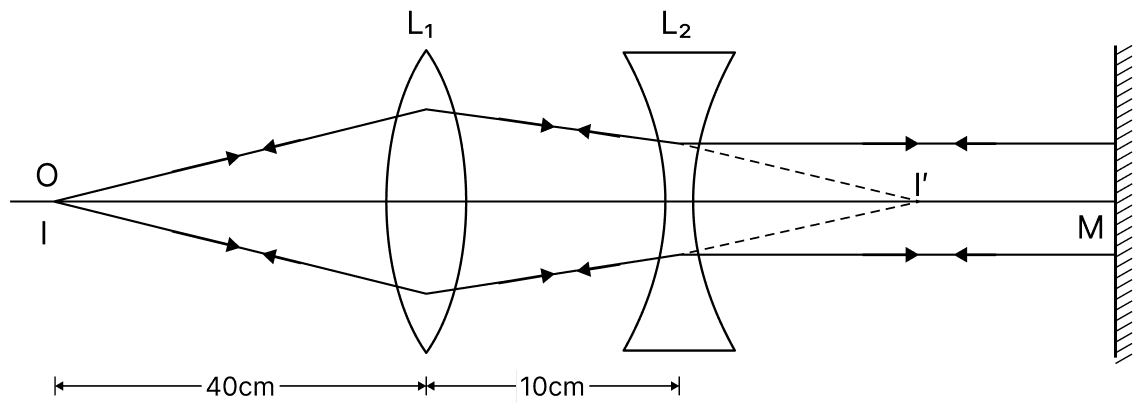
Answer
Given,
- Focal length of the convex lens L1, f1 = +20 cm
- Object O is 40 cm from L1, so u1 = −40 cm
- The concave lens L2 is 10 cm from L1
- The final image I coincides with O
The rays retrace their path only if they fall normally on the plane mirror, that is, if they leave L2 parallel to the principal axis.
Image by L1 : By the lens formula,
This image I' lies 40 − 10 = 30 cm beyond L2 and acts as a virtual object for it : u2 = +30 cm.
Refraction at L2 : The emergent rays are parallel, so v2 = ,
Hence, the focal length of the other (concave) lens is − 30 cm.
A convex lens of focal length 20 cm is placed 10 cm in front of a convex mirror of radius of curvature 15 cm. Where should a point-object be placed in front of the lens so that its image is formed at the position of object itself.
Answer
Given,
- Focal length of the convex lens, f = +20 cm
- Radius of curvature of the convex mirror, R = 15 cm; the mirror is 10 cm behind the lens
The image coincides with the object only if the rays retrace their path after reflection. This happens when the rays fall on the mirror at right angles to its surface, that is, when they converge towards its centre of curvature C. The point C lies 15 cm behind the mirror, so it is 10 + 15 = 25 cm from the lens. The lens must therefore form its image at v = +25 cm.
By the lens formula,
Hence, the point-object should be placed 100 cm in front of the lens (u = − 100 cm).
A convex lens and a convex mirror (R = 20 cm) are placed co-axially with the convex mirror placed at a distance of 30 cm from convex lens. For a point-object at a distance 25 cm from the lens, final image due to this combination coincides with the object itself. What is the focal length of the convex lens?
Answer
Given,
- Radius of curvature of the convex mirror, R = 20 cm; the mirror is 30 cm from the lens
- Object distance, u = −25 cm
The final image coincides with the object only if the rays from the lens fall normally on the mirror, that is, converge towards its centre of curvature C. The point C lies 20 cm behind the mirror, so it is 30 + 20 = 50 cm from the lens. Hence, for the lens v = +50 cm.
By the lens formula,
Hence, the focal length of the convex lens is 16.7 cm.
A concave lens of focal length f and a concave mirror of focal length 15 cm are placed co-axially 10 cm apart from each other. An incident beam parallel to principal axis is incident on the concave lens, after refraction from the lens rays fall on mirror and retrace their path after reflection. Find the focal length of concave lens.
Answer
Given,
- Focal length of the concave mirror = 15 cm, so its radius of curvature R = 30 cm
- The concave lens and the mirror are 10 cm apart
- The incident beam is parallel to the principal axis (u = )
The rays retrace their path only if they fall on the mirror normally, that is, along lines passing through its centre of curvature C. So the rays leaving the concave lens must appear to diverge from C.
The point C is 30 cm from the mirror on the side of the lens, so it lies 30 − 10 = 20 cm in front of the concave lens. Parallel rays diverge from a concave lens as if coming from its focus, so the image formed by the lens is at v = −20 cm.
By the lens formula,
Hence, the focal length of the concave lens is f = − 20 cm.
Calculate the distance 'd', so that a real image of an object O, 30 cm in front of the convex lens of focal length 15 cm can be formed at the same point O. Focal length of the mirror is 10 cm. Will the image be inverted or erect? Draw complete ray diagram.
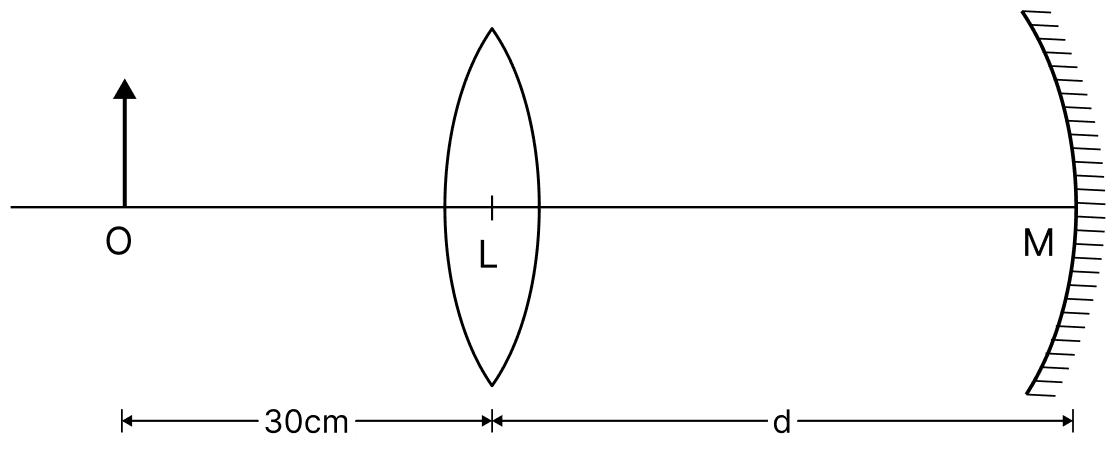
Answer
Given,
- Focal length of the convex lens, f = +15 cm
- Object distance, u = −30 cm
- Focal length of the concave mirror = 10 cm, so its radius of curvature R = 20 cm
Image by the lens : By the lens formula,
The lens forms a real, inverted image I' of the same size, 30 cm behind it.
Distance d : For the final image to form at O, the rays from the point of O on the principal axis must fall normally on the mirror and retrace their path after reflection. This needs the axial image point formed by the lens to be at the centre of curvature of the mirror, so that I' lies in the plane through the centre of curvature. Hence,
Nature of the final image : The lens inverts the object at I' (m = −1). The mirror forms an inverted image I'' of I' in the same plane (m = −1). On the return journey, the lens forms an inverted image at O (m = −1). The overall magnification is
so the final image is real, inverted and of the same size as the object.
Ray diagram :
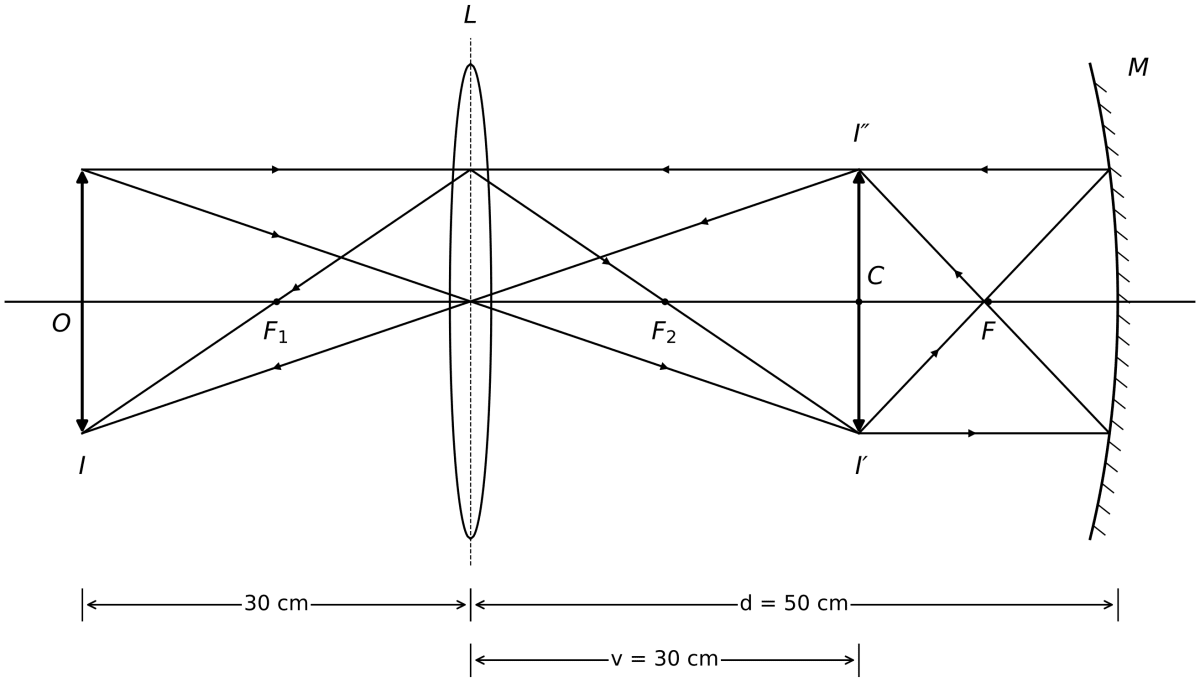
Rays from the tip of O pass through the lens L and meet at the tip of I', below the axis in the plane through the centre of curvature of the mirror. The concave mirror forms the inverted image I'' of I' in the same plane, above the axis. Rays from I'' pass back through the lens and meet at the final image tip I, below the axis in the plane of O.
Hence, d = 50 cm and the final image formed at O will be inverted.