
What is the locus of an electron, projected perpendicular to a uniform electric field?
Answer
A parabola.
Explanation:
The electron enters the field at right angles to it, so its velocity along the original direction remains constant while it is uniformly accelerated along the field. This is exactly the condition of projectile motion.
Taking the initial velocity along the x-direction and the acceleration a = eE/m along the y-direction,
Since y ∝ x2, the locus of the electron is a parabola.
An electric dipole is placed in a uniform external electric field . Show that the torque acting on the dipole is given by , where is the dipole moment.
Answer
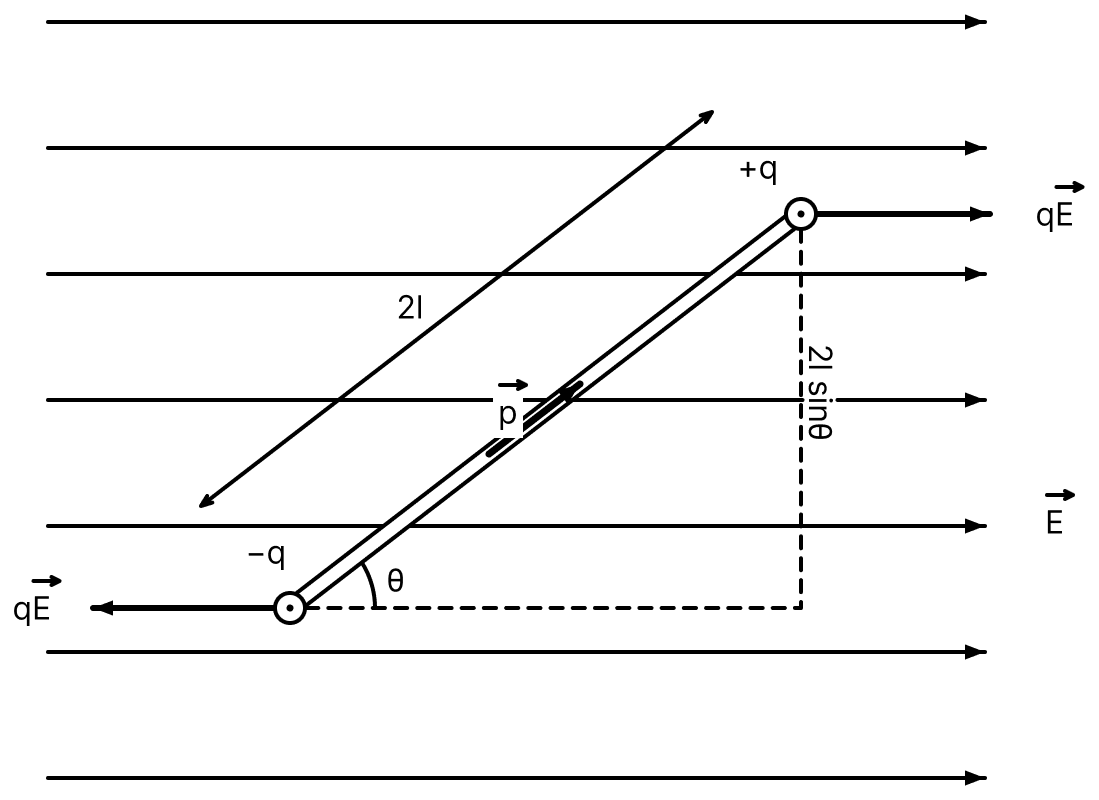
Let the dipole consist of charges − q and + q separated by a distance 2l, placed in a uniform electric field with its dipole moment vector making an angle θ with the field.
Due to the electric field, the charge + q experiences a force qE in the direction of the field and the charge − q experiences an equal and opposite force qE. Since these two forces are equal and opposite, the net translatory force on the dipole is zero.
However, the two forces act at different points and hence form a couple. The moment of this couple is the torque on the dipole. Its magnitude is force multiplied by the perpendicular distance between the lines of action of the two forces,
But 2ql = p, the magnitude of the dipole moment,
The torque is perpendicular to the plane containing and , its sense being given by the right-hand screw rule. Both the magnitude and the direction are therefore correctly given by the vector product,
Hence, the torque acting on the dipole is .
Can 8.6 × 10⁻¹⁹ C of charge be given to a conductor? Explain.
Answer
No, this charge cannot be given to a conductor.
By the quantisation of charge, the charge on a body must be an integral multiple of the elementary charge, q = ± ne with e = 1.6 × 10⁻¹⁹ C. Here
Since n is not an integer, the given charge is not an integral multiple of e and hence cannot exist on a conductor.
What will be the net electric force acting on an electric dipole placed in a uniform electric field?
Answer
Zero.
Explanation:
In a uniform electric field the charge + q of the dipole experiences a force qE in the direction of the field and the charge − q experiences an equal force qE opposite to the field. These two forces are equal in magnitude and opposite in direction, so their resultant is zero.
Hence there is no net translatory force on the dipole, and it undergoes no translatory motion in a uniform electric field; only a torque pE sin θ acts on it.
Write Coulomb's law in vector form.
Answer
Explanation:
Let two charges q1 and q2 be placed at points with position vectors and , a distance r apart. Let be the unit vector pointing from q2 towards q1, and that pointing from q1 towards q2. Then is the force on q1 due to q2, and the force on q2 due to q1 is
Since , it follows that , so that Newton's third law of motion is obeyed.
(i) Explain the statement 'Relative permittivity of water is 81'.
(ii) Draw (at least three) electric lines of force due to an electric dipole.
Answer
(i) Relative permittivity of water is 81 :
The relative permittivity, or dielectric constant, of a medium is the ratio of the force between two given charges placed a certain distance apart in vacuum to the force between the same charges placed the same distance apart in the medium.
The statement therefore means that the absolute permittivity of water is 81 times the permittivity of free space, εw = 81ε0, so that the electrostatic force between two charges placed in water is of the force between the same charges at the same separation in vacuum.
(ii) Electric lines of force due to an electric dipole :
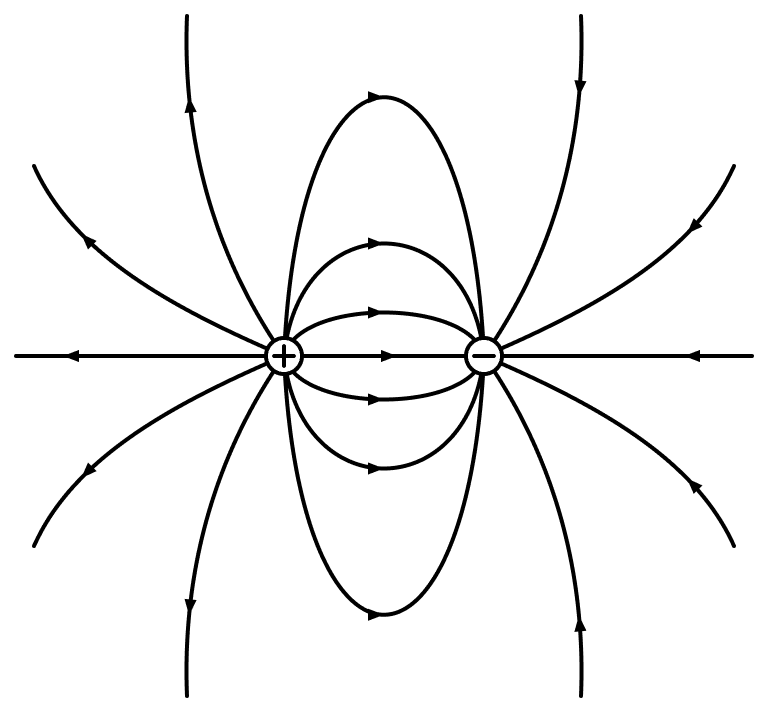
The lines of force originate on the positive charge and terminate on the negative charge. Their concentration is greatest in the region between the charges, where the electric field is strongest.
A point charge q is placed at the origin. How does the electric field due to the charge vary with distance r from the origin?
Answer
The intensity of the electric field due to a point-charge q at a distance r from it is
that is,
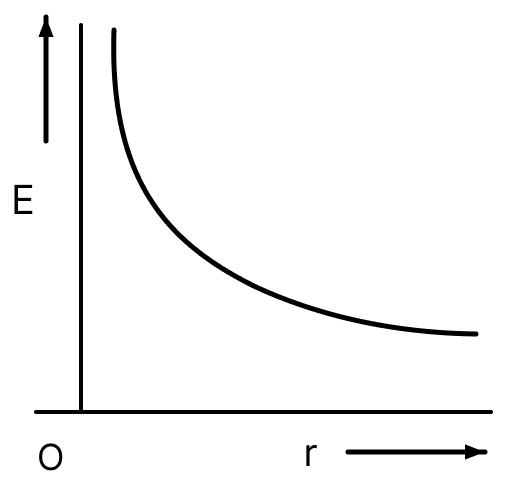
Hence, the electric field varies inversely as the square of the distance from the origin. The graph of E against r is therefore a curve which falls off rapidly as r increases and approaches the r-axis asymptotically.
With the help of a labelled diagram, obtain an expression for the electric field intensity 'E' at a point P in broad side-on position (i.e., equatorial plane) of an electric dipole.
Answer
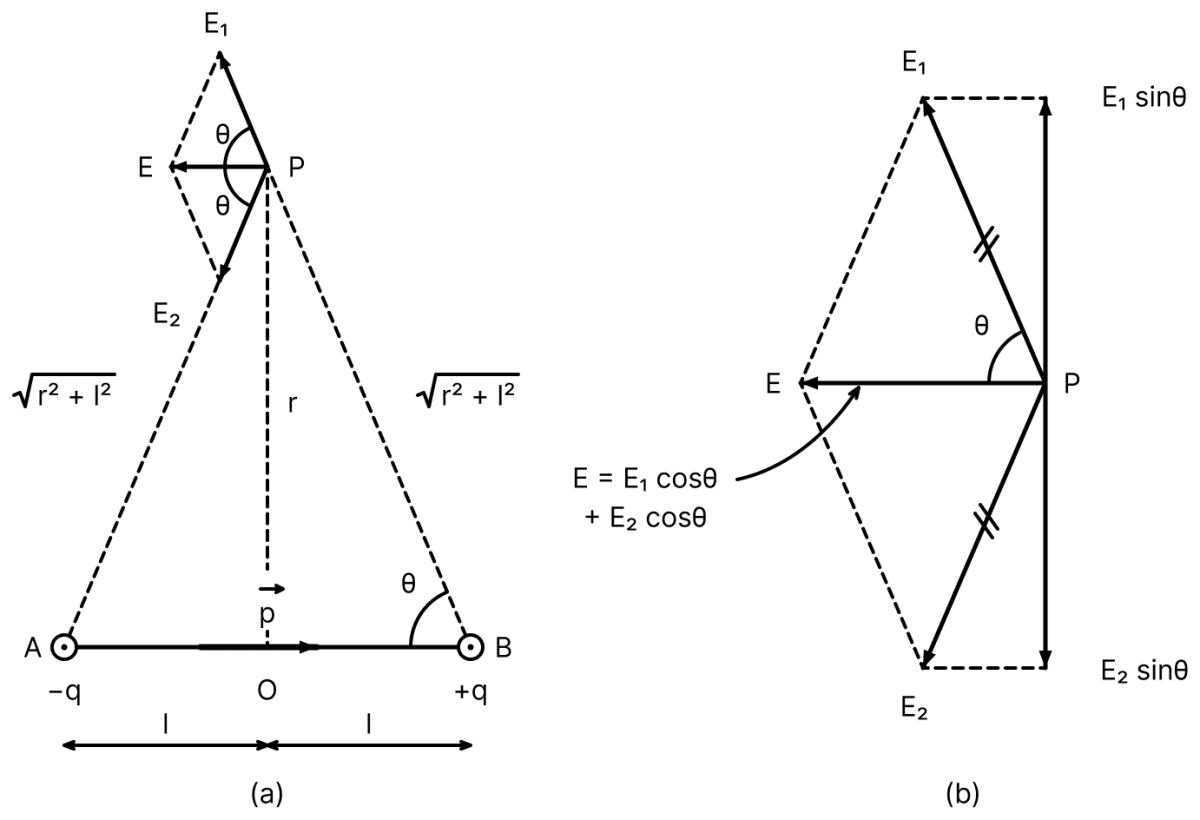
Let the dipole AB consist of charges − q and + q separated by a distance 2l, and let P be a point in the broad-side-on position, that is, on the right bisector of the dipole at a distance r from its mid-point O.
The distance of P from each charge is , so the magnitudes of the two intensities are
Resolving each into components parallel and perpendicular to AB, the perpendicular components E1 sin θ and E2 sin θ are equal and opposite and cancel each other, while the parallel components E1 cos θ and E2 cos θ are in the same direction and add up.
From the figure, ,
since p = 2ql. For a short dipole (r >> l),
The direction of at every point of the equatorial line is antiparallel to the dipole axis.
Draw electric lines of force due to : (i) two equal positive point charges and (ii) an electric dipole.
Answer
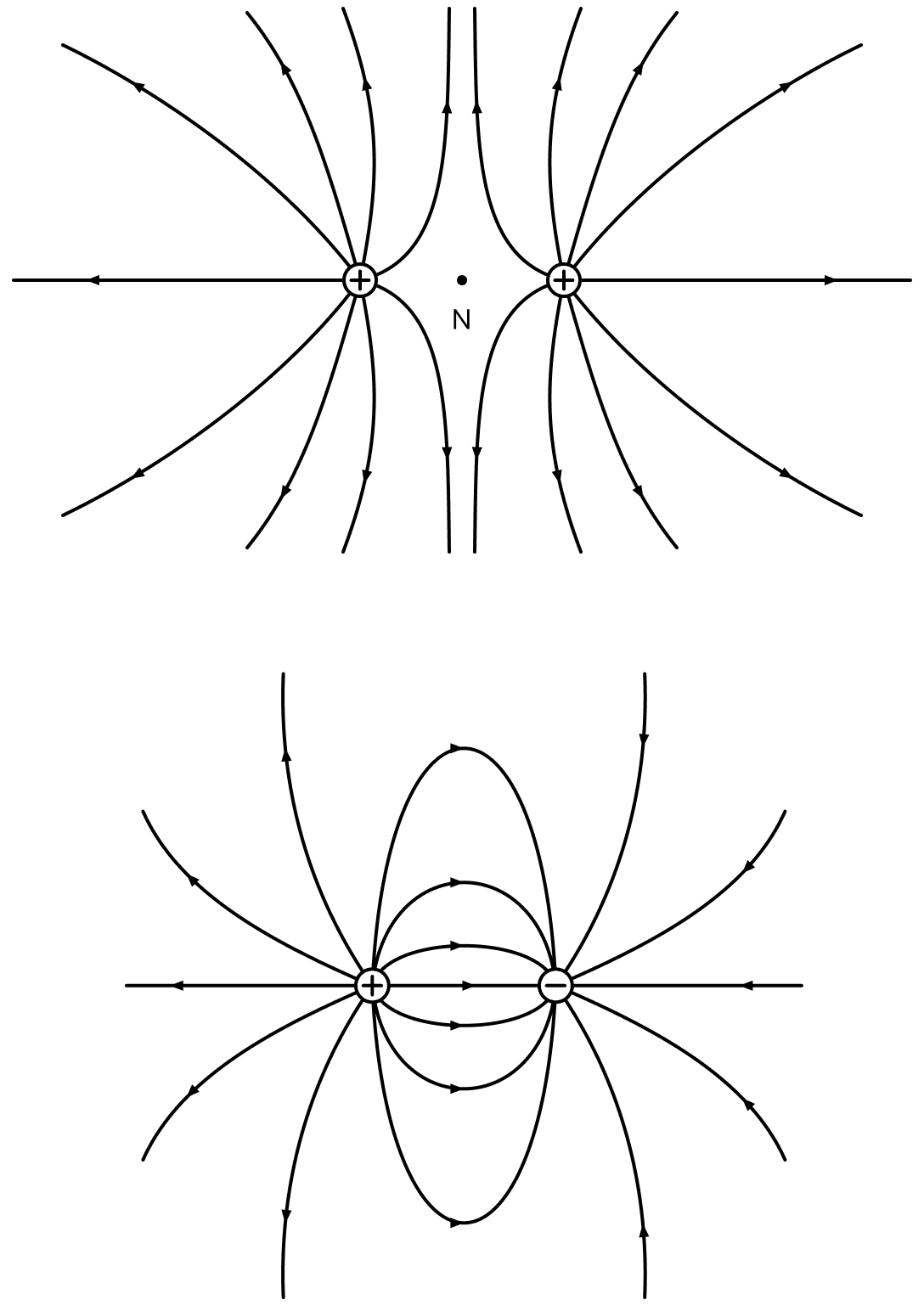
(i) Two equal positive point charges : The lines of force start on both the charges and spread outwards. At the mid-point N of the line joining the charges the field due to one charge is equal and opposite to that due to the other, so the resultant field is zero. This point, shown by the absence of lines of force around it, is called the neutral point. Far from the charges the lines of force become nearly radial, characteristic of a single charge.
(ii) An electric dipole : The lines of force originate on the positive charge and terminate on the negative charge. The concentration of the lines is greatest in the region between the two charges, showing that the electric field is strongest there.
A body has a positive charge of 8 × 10-19 C. It has :
- an excess of 5 electrons
- a deficiency of 5 electrons
- an excess of 8 electrons
- a deficiency of 8 electrons
Answer
a deficiency of 5 electrons
Reason — The body carries a positive charge, which means a deficiency of electrons. By the quantisation of charge, q = ne,
Hence the body has a deficiency of 5 electrons.
A point-charge of 5 × 10⁻⁶ C experiences a force of 2 × 10⁻³ N when kept in a uniform electric field of intensity E. Find E.
Answer
Given,
- Charge, q = 5 × 10⁻⁶ C
- Force, F = 2 × 10⁻³ N
The force on a charge placed in an electric field is F = qE, so that
Substituting the values,
Hence, the intensity of the electric field is 400 N C-1.
Relative permittivity of water is 81. If εw and ε0 are permittivities of water and vacuum, respectively, then :
- ε0 = 9εw
- ε0 = 81εw
- εw = 9ε0
- εw = 81ε0
Answer
εw = 81ε0
Reason — The relative permittivity, or dielectric constant, of a medium is defined as
For water K = 81, so that
(i) Write an expression (derivation not required) for intensity of electric field in :
(1) axial position.
(2) broad side-on position of an electric dipole, in terms of its length (2a), dipole moment (p) and distance (r).
(ii) What is the ratio of these two intensities, i.e., E1 : E2, for a short electric dipole?
Answer
(i) Expressions for the intensity of the electric field :
For a dipole of charges − q and + q separated by a distance 2a, so that the dipole moment is p = q × 2a, and for a point at a distance r from the centre of the dipole :
(1) Axial position (end-on position) :
directed along the dipole axis, from − q towards + q.
(2) Broad side-on position (equatorial position) :
directed antiparallel to the dipole axis.
(ii) Ratio of the two intensities for a short dipole :
For a short dipole, a2 may be neglected in comparison with r2, so that
Hence, E1 : E2 = 2 : 1.
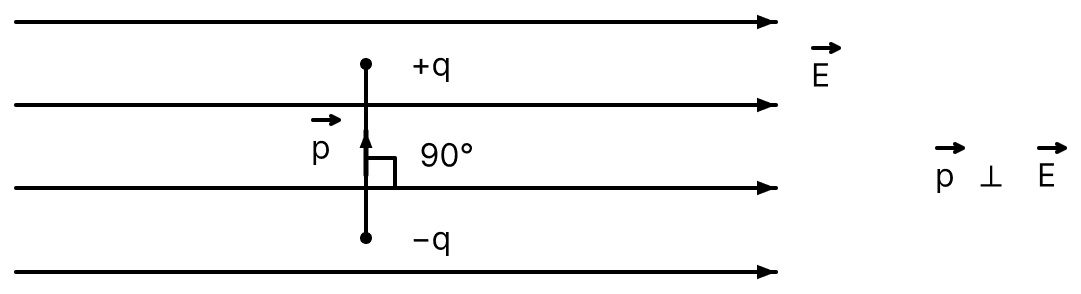
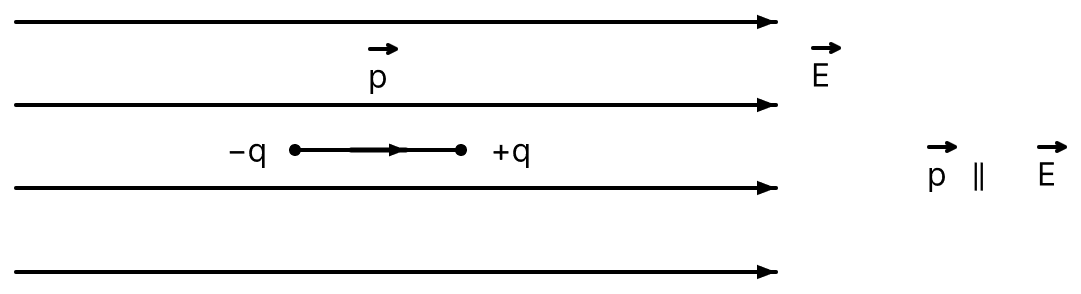
An electric dipole of dipole moment is placed in a uniform electric field with its axis inclined to the field, write an expression for the torque experienced by the dipole in vector form. Show diagrammatically how the dipole should be kept with electric field so that torque acts on it is : (i) maximum and (ii) zero.
Answer
Torque on the dipole : When a dipole of moment is placed in a uniform electric field with its axis inclined at an angle θ to the field, the two forces qE on its charges are equal and opposite and form a couple. The magnitude of the torque is
and in vector form,
(i) For maximum torque : τ = pE sin θ is maximum when sin θ = 1, that is, θ = 90°. The dipole must therefore be kept perpendicular to the electric field, , and then τmax = pE.
(ii) For zero torque : τ = 0 when sin θ = 0, that is, θ = 0°. The dipole must therefore be kept parallel to the electric field, . This is the position of stable equilibrium.
What is meant by quantization of charge?
Answer
Quantisation of charge means that the electric charge on a body is not continuous but exists in the form of discrete packets. In nature all charges are found to be integral multiples of a smallest amount of charge, the elementary charge e = 1.6 × 10⁻¹⁹ C, which is the magnitude of the charge on an electron.
Hence the charge q on any body must be
No charge is found in a fraction of e, such as 0.7e or 2.5e; that is, electric charge cannot be divided indefinitely.
A charged oil drop weighing 1.6 × 10⁻¹⁵ N is found to remain suspended in a uniform electric field of intensity 2 × 10³ NC-1. Find the charge on the drop.
Answer
Given,
- Weight of the oil drop, mg = 1.6 × 10⁻¹⁵ N
- Electric field, E = 2 × 10³ N C-1
The drop remains suspended, so the upward electric force on it balances its weight,
Substituting the values,
Hence, the charge on the drop is 8.0 × 10⁻¹⁹ C.
Maximum torque acting on an electric dipole of moment 3 × 10-29 C-m in a uniform electric field E is 6 × 10-25 Nm. Find E.
Answer
Given,
- Electric dipole moment, p = 3 × 10-29 C-m
- Maximum torque, τmax = 6 × 10-25 N-m
The torque on a dipole is τ = pE sin θ, which is maximum when θ = 90°, that is, when the dipole is perpendicular to the field,
Substituting the values,
Hence, the electric field is 2 × 10⁴ N/C.
Show that intensity of electric field E at a point in broadside on position is given by
where the terms have their usual meaning.
Answer
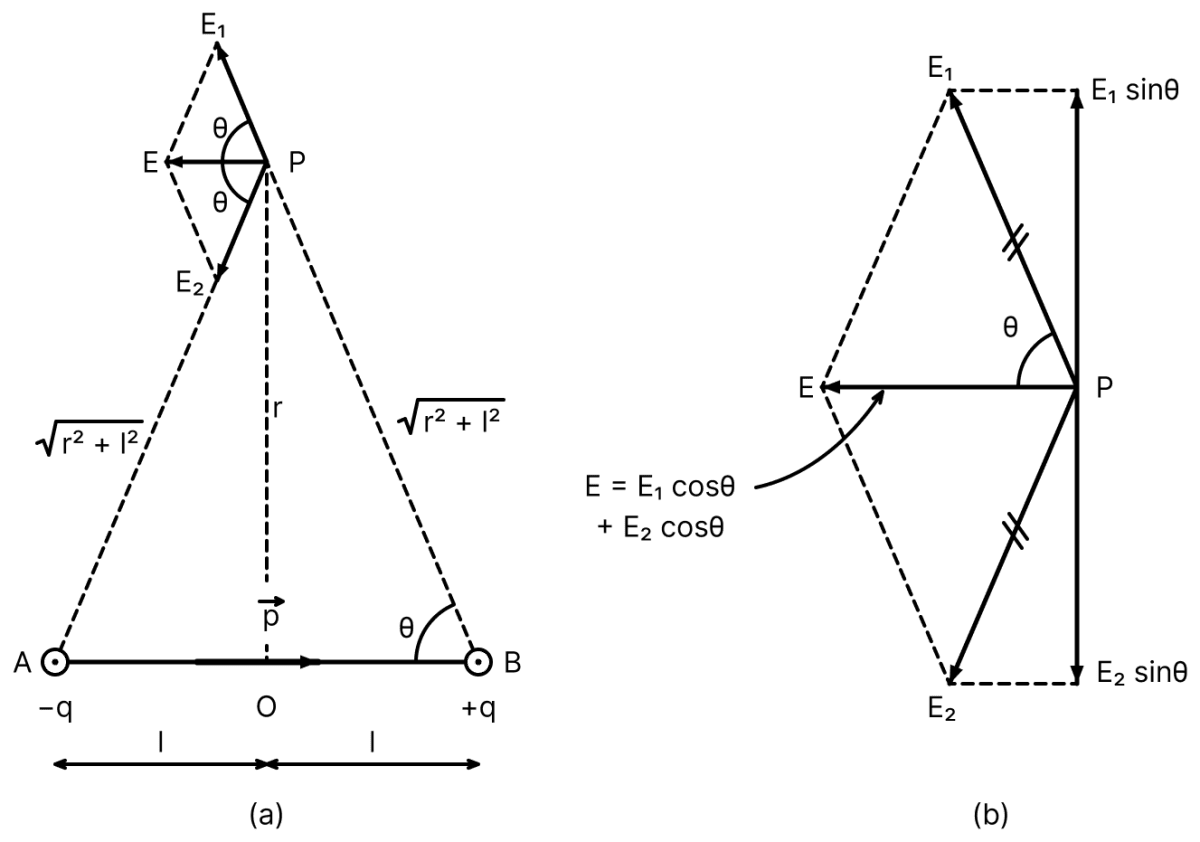
Let the dipole consist of charges − q and + q separated by a distance 2l, and let P be a point in the broadside on position at a distance r from the mid-point O of the dipole.
The distance of P from each charge is , so the magnitudes of the intensities at P due to the two charges are equal,
Resolving each intensity into components parallel and perpendicular to the dipole axis, the perpendicular components are equal and opposite and cancel out, while the parallel components add up. Hence
From the figure,
Substituting,
But 2ql = p, the electric dipole moment,
Hence the required result is proved.
Obtain an expression for intensity of electric field at a point in end-on position, i.e., axial position of an electric dipole.
Answer
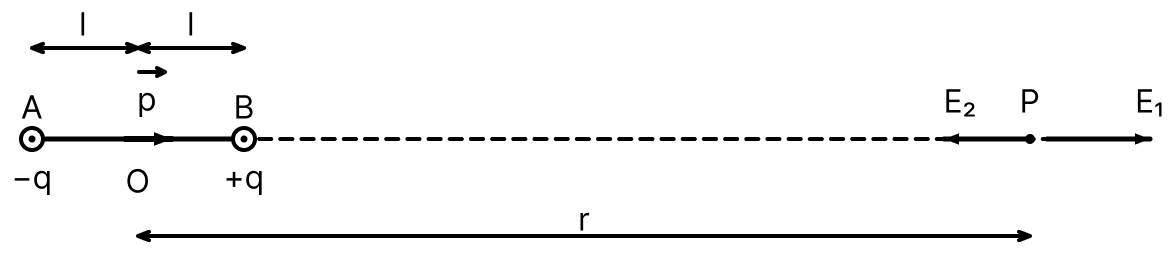
Let the dipole AB be made up of charges − q and + q separated by a distance 2l, and let P be a point in the end-on position, that is, on the axis of the dipole at a distance r from its mid-point O.
The distance of P from the charge + q is (r − l) and from the charge − q is (r + l). Hence the magnitudes of the two intensities are
The two intensities are along the same line in opposite directions, and E1 > E2. Hence the resultant intensity is their difference, directed along the dipole axis,
Putting p = 2ql,
For a short dipole, l2 may be neglected in comparison with r2,
directed along the dipole axis, from the negative charge towards the positive charge.
Two point charges +80 μC and +20 μC are kept in vacuum at a distance of 6 m from each other. Calculate the resultant electric field intensity at the mid-point of the line joining the two charges.
Answer
Given,
- q1 = + 80 μC = 80 × 10-6 C, q2 = + 20 μC = 20 × 10-6 C
- Separation = 6 m, so the mid-point is at r = 3 m from each charge
Both the charges are positive, so their fields at the mid-point are oppositely directed.
Field due to the 80 μC charge :
Field due to the 20 μC charge :
Resultant intensity :
Hence, the resultant electric field intensity at the mid-point is 6 × 10⁴ N/C, directed from the 80 μC charge towards the 20 μC charge.
Force between two charges separated by a certain distance is F. If each of the two charges be halved and the distance between them be also halved, the new force would be :
- F
- 2F
- 3F
- 4F
Answer
F
Reason — By Coulomb's law the initial force is
When each charge is halved and the distance is also halved,
Hence the new force is the same as the original force.
Which one of the following is not a property of electric lines of force?
- They originate at the positive charge.
- They terminate at the negative charge.
- They intersect each other.
- A tangent drawn to a line of force gives the direction of electric field intensity at that point.
Answer
They intersect each other.
Reason — The tangent drawn at any point on a line of force gives the direction of the electric field there. If two lines of force intersected, two tangents could be drawn at the point of intersection, which would mean two different directions of the electric field at the same point. This is impossible, so lines of force never intersect each other.
The other three statements are genuine properties of electric lines of force.
An electric dipole consists of two point charges +2 mC and −2 mC separated by a distance 4 cm. It is kept at an angle of 30° with an electric field of intensity 1 × 10⁵ NC-1. The torque experienced by the dipole is :
- 1 N-m
- 2 N-m
- 3 N-m
- 4 N-m
Answer
4 N-m
Reason — Given, q = 2 mC = 2 × 10⁻³ C, separation 2l = 4 cm = 4 × 10⁻² m, E = 1 × 10⁵ N C-1 and θ = 30°.
Electric dipole moment :
Torque :
(i) Can a body be given a charge of 2.2 × 10⁻¹⁹ C? Give a reason for your answer.
(ii) When is torque acting on an electric dipole kept in a uniform electric field E, maximum?
Answer
(i) No, a body cannot be given a charge of 2.2 × 10⁻¹⁹ C.
By the quantisation of charge, the charge on a body must be an integral multiple of the elementary charge e = 1.6 × 10⁻¹⁹ C. Here
Since n is not an integer, the given charge is not an integral multiple of e and hence is not possible.
(ii) The torque on an electric dipole placed in a uniform electric field is
This is maximum when sin θ = 1, that is, when θ = 90°.
Hence, the torque is maximum when the dipole is placed perpendicular to the electric field, and then τmax = pE.
A is a point in the axial position of a short electric dipole and B is a point at the same distance but in the broad side position. What is the ratio EA : EB where EA and EB are intensities of electric field at points A and B respectively?
Answer
2 : 1.
Explanation:
For a short electric dipole of moment p, at a distance r from its centre :
At the point A in the axial position :
At the point B in the broad side position :
Dividing one by the other,
Hence, EA : EB = 2 : 1.