The refractive index of air is 1.0003. The thickness of air column which will contain one more wavelength of yellow light (6000 Å) than in the same thickness of vacuum is :
- 2 mm
- 2 cm
- 2 m
- 2 km
Answer
2 mm
Given,
Refractive index of air, n = 1.0003
Wavelength of yellow light in vacuum, λ = 6000 Å
The air column contains one wavelength more than the same thickness of vacuum
Reason — Let a column of thickness t contain p wavelengths of the light in vacuum, where λ = 6000 Å = 6 × 10⁻⁷ m. In air the wavelength is , and the same thickness must contain (p + 1) wavelengths.
Therefore,
On a hot summer night, the refractive index of air is smallest near the ground and increases with height from the ground. When a light beam is directed horizontally, the Huygens' principle leads us to conclude that as it travels, the light beam :
- becomes narrower
- goes horizontally without any deflection
- bends downwards
- bends upwards
Answer
bends upwards
Reason — Since v = , light travels faster near the ground, where the refractive index is smaller. The secondary wavelets from the lower part of a vertical wavefront therefore advance farther than those from the upper part, so the new wavefront tilts upwards. The rays, being normal to the wavefront, bend upwards.
Which colour of the light has the longest wavelength?
- Green
- Violet
- Red
- Blue
Answer
Red
Reason — Different colours of light have different wavelengths. In the visible spectrum the wavelength increases from violet to red (violet < blue < green < red), so red light has the longest wavelength.
Speed of light in two media of refractive index μA and μB is vA and vB respectively. The ratio of μA and μB is 1 : 2. If the time taken by the light to travel same distance in both media is t1 and t2 respectively such that t2 - t1 = 5 × 10⁻¹⁰ s, calculate the distance travelled by the light.
- vB (10-9)
- vB (15-9)
- vB (20-9)
- vB (30-9)
Answer
vB (10-9)
Given,
μA : μB = 1 : 2
Light travels the same distance s in the two media, in times t1 and t2
t2 - t1 = 5 × 10⁻¹⁰ s
Reason — For the same distance s, s = vAt1 = vBt2. Also μ = , so
Hence t1 = , and
Therefore, the distance travelled is s = vBt2 = vB (10-9).
The difference of speed of light in the two media A and B (vA - vB) is 2.6 × 10⁷ m/s. If the refractive index of medium B is 1.47, then the ratio of refractive index of medium B to medium A is :
- 1.303
- 1.318
- 1.13
- 0.12
Answer
1.13
Given,
vA - vB = 2.6 × 10⁷ m/s
Refractive index of medium B, nB = 1.47
Reason — Since n = ,
Therefore,
Given here are two statements : one is labelled as Assertion A and the other is labelled as Reason R.
Assertion A : The phase difference of two light waves change if they travel through different media having same thickness, but different indices of refraction.
Reason R : The wavelengths of waves are different in different media.
In the light of the above statements, choose the most appropriate answer from the options given below.
- Both A and R are correct but R is not the correct explanation of A.
- A is not correct but R is correct.
- Both A and R are correct and R is the correct explanation of A.
- A is correct but R is not correct.
Answer
Both A and R are correct and R is the correct explanation of A.
Reason — The wavelength of light in a medium depends on its refractive index, and the phase acquired over a given thickness depends on that wavelength.
Explanation
Assertion (A) is correct: On entering a medium of refractive index n, light keeps its frequency but its wavelength becomes , where λ is the wavelength in vacuum. A thickness t of the medium therefore holds waves, and the light acquires a phase change in crossing it. For two media of the same thickness but different refractive indices these phase changes are unequal, so the phase difference between the two light waves changes.
Reason (R) is correct and explains A: Since the wavelength in a medium is , waves have different wavelengths in media of different refractive indices. It is this difference that makes equal thicknesses hold different numbers of waves, and hence changes the phase difference as stated in A.
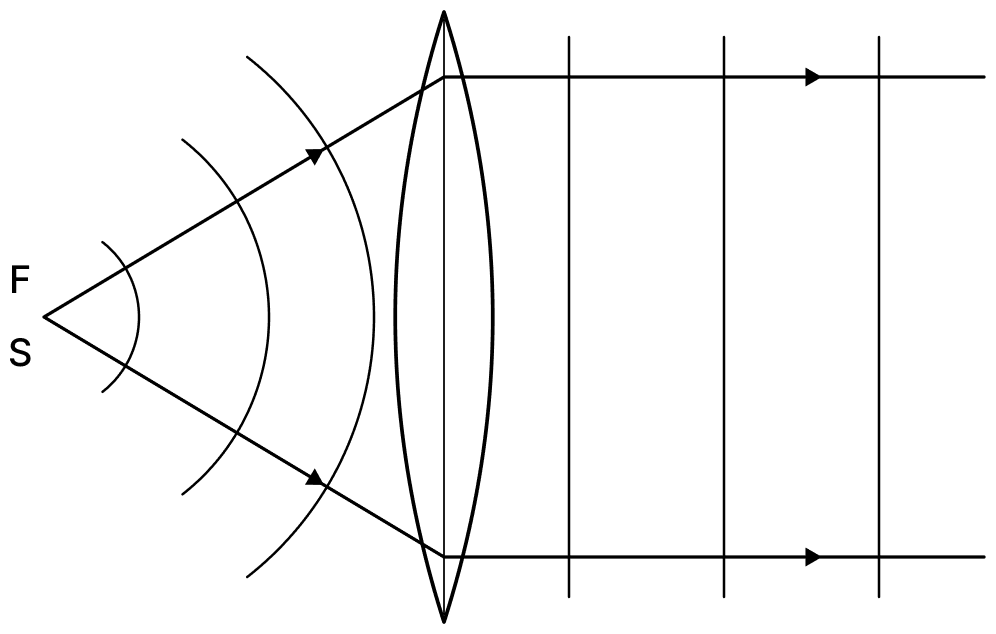
Light emerges out of a convex lens when a point source of light is kept at its focus. The shape of wavefront of the light which emerges out of convex lens is :
- spherical
- cylindrical
- plane
- circular
Answer
plane
Reason — Light from a point source placed at the focus of a convex lens emerges as a parallel beam. Since the wavefront is normal to the rays, the emergent wavefront is plane.