KnowledgeBoat Logo
|
OPEN IN APP

Chapter 17

Refraction and Dispersion of Light through a Prism — Numericals

Class 12 - Nootan Physics


Numericals

Question 1

A ray of light is incident on a 60° prism of glass of refractive index 1.5 at an angle of 40°. Find the angle of emergence of the ray.

Answer

Given,

  • Angle of prism, A = 60°
  • Refractive index of glass, n = 1.5
  • Angle of incidence at the first face, i = 40°

Let r be the angle of refraction at the first face, r' the angle of incidence at the second face and e the angle of emergence.

At the first face :

By Snell's law, n=sin⁡isin⁡r\text n = \dfrac{\sin \text i}{\sin \text r}, so

sin⁡r=sin⁡40∘1.5=0.64281.5=0.4285r=sin⁡−1(0.4285)r=25.37∘\sin \text r = \dfrac{\sin 40^\circ}{1.5} \\[1em] = \dfrac{0.6428}{1.5} \\[1em] = 0.4285 \\[1em] \text r = \sin^{-1}(0.4285) \\[1em] \text r = 25.37^\circ

At the second face :

For a prism, r + r' = A. Hence,

r′=60∘−25.37∘r′=34.63∘\text r' = 60^\circ - 25.37^\circ \\[1em] \text r' = 34.63^\circ

The ray passes from glass into air at the second face, so n=sin⁡esin⁡r′\text n = \dfrac{\sin \text e}{\sin \text r'}. Therefore,

sin⁡e=1.5×sin⁡34.63∘=1.5×0.5683=0.8525e=sin⁡−1(0.8525)e≈58.5∘\sin \text e = 1.5 \times \sin 34.63^\circ \\[1em] = 1.5 \times 0.5683 \\[1em] = 0.8525 \\[1em] \text e = \sin^{-1}(0.8525) \\[1em] \text e \approx 58.5^\circ

Hence, the angle of emergence of the ray is about 58.5°.

Question 2

The refracting angle of a glass prism of refractive index 1.45 is 60°. At what angle should a light ray be incident at the first face of the prism so that it emerges at the second face just parallel to the face?

Answer

Given,

  • Refracting angle of prism, A = 60°
  • Refractive index of glass, n = 1.45

For the ray to emerge just parallel to the second face (grazing emergence), the angle of emergence must be 90°. The angle of incidence r2 at the second face is then equal to the critical angle C of glass.

Critical angle :

sin⁡C=1n=11.45=0.6897C=sin⁡−1(0.6897)C=43.60∘\sin \text C = \dfrac{1}{\text n} \\[1em] = \dfrac{1}{1.45} \\[1em] = 0.6897 \\[1em] \text C = \sin^{-1}(0.6897) \\[1em] \text C = 43.60^\circ

Angle of refraction at the first face :

Since r1 + r2 = A and r2 = C,

r1=A−C=60∘−43.60∘r1=16.40∘\text r_1 = \text A - \text C \\[1em] = 60^\circ - 43.60^\circ \\[1em] \text r_1 = 16.40^\circ

Angle of incidence :

By Snell's law at the first face,

sin⁡i=nsin⁡r1=1.45×sin⁡16.40∘=1.45×0.2823=0.4093i=sin⁡−1(0.4093)i≈24.2∘\sin \text i = \text n \sin \text r_1 \\[1em] = 1.45 \times \sin 16.40^\circ \\[1em] = 1.45 \times 0.2823 \\[1em] = 0.4093 \\[1em] \text i = \sin^{-1}(0.4093) \\[1em] \text i \approx 24.2^\circ

Hence, the light ray should be incident on the first face at an angle of about 24.2°.

Note: The textbook prints 24.1°; the calculated angle is 24.16°, which rounds to 24.2°.

Question 3

The angle of a prism is 60° and the angle of minimum deviation is 39°. What is the refractive index of the material of the prism? (sin 49.5° = 0.76)

Answer

Given,

  • Angle of prism, A = 60°
  • Angle of minimum deviation, δm = 39°
  • sin 49.5° = 0.76

The refractive index of the material of the prism is

n=sin⁡(A+δm2)sin⁡(A2)=sin⁡(60∘+39∘2)sin⁡(60∘2)=sin⁡49.5∘sin⁡30∘=0.760.5n=1.52\text n = \dfrac{\sin\left(\dfrac{\text A + \delta_\text m}{2}\right)}{\sin\left(\dfrac{\text A}{2}\right)} \\[1em] = \dfrac{\sin\left(\dfrac{60^\circ + 39^\circ}{2}\right)}{\sin\left(\dfrac{60^\circ}{2}\right)} \\[1em] = \dfrac{\sin 49.5^\circ}{\sin 30^\circ} \\[1em] = \dfrac{0.76}{0.5} \\[1em] \text n = 1.52

Hence, the refractive index of the material of the prism is 1.52.

Question 4

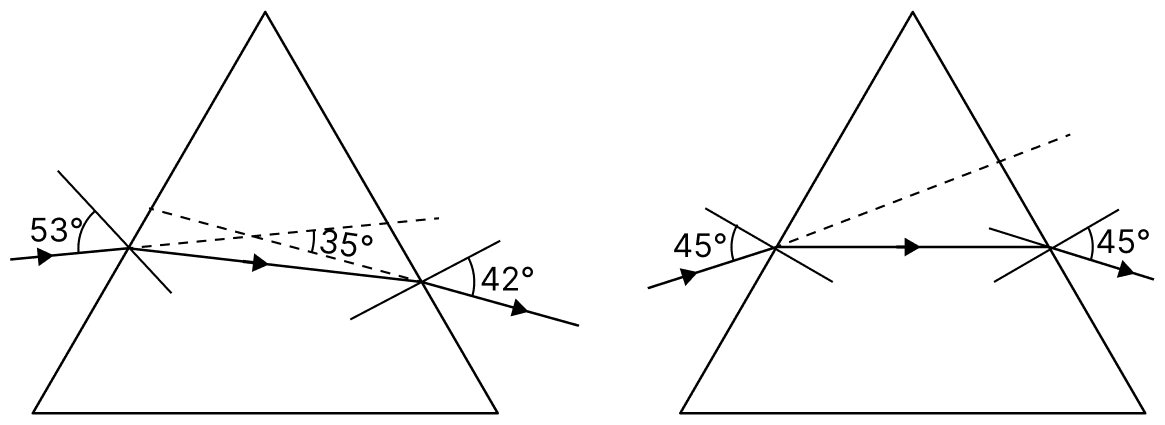
Calculate the refractive index of the material of the prism on the basis of fig. shown above. Refraction and Dispersion of Light through a Prism, Nootan Physics Solutions ICS Class 12.

Calculate the refractive index of the material of the prism on the basis of fig. shown above.

Answer

Given,

  • First diagram : angle of incidence i = 53°, angle of emergence e = 42°, angle of deviation δ = 35°
  • Second diagram : angle of incidence i = 45°, angle of emergence e = 45°

The first diagram gives the angle of the prism A, and the second diagram gives the condition of minimum deviation.

Angle of the prism :

For the first diagram, using δ=i+e−A\delta = \text i + \text e - \text A,

A=i+e−δ=53∘+42∘−35∘A=60∘\text A = \text i + \text e - \delta \\[1em] = 53^\circ + 42^\circ - 35^\circ \\[1em] \text A = 60^\circ

Refractive index :

In the second diagram the angle of incidence is equal to the angle of emergence, so the prism is in the position of minimum deviation. Hence,

δm=2i−A=2×45∘−60∘δm=30∘\delta_\text m = 2\text i - \text A \\[1em] = 2 \times 45^\circ - 60^\circ \\[1em] \delta_\text m = 30^\circ

Therefore,

n=sin⁡(A+δm2)sin⁡(A2)=sin⁡45∘sin⁡30∘=1212=2n≈1.414\text n = \dfrac{\sin\left(\dfrac{\text A + \delta_\text m}{2}\right)}{\sin\left(\dfrac{\text A}{2}\right)} \\[1em] = \dfrac{\sin 45^\circ}{\sin 30^\circ} \\[1em] = \dfrac{\dfrac{1}{\sqrt{2}}}{\dfrac{1}{2}} \\[1em] = \sqrt{2} \\[1em] \text n \approx 1.414

Hence, the refractive index of the material of the prism is 2\sqrt{2} ≈ 1.414.

Note: Taken as exact, the angles 53° and 42° of the first diagram correspond to n ≈ 1.47, not 2\sqrt{2}; that diagram is used only to obtain A = 60°.

Question 5

A ray of light is incident at an angle of 60° on one face of a prism which has prism angle of 30°. The ray emerging out of the prism makes an angle of 30° with the incident ray. Show that the emergent ray is perpendicular to the face through which it emerges and calculate the refractive index of the material of the prism.

Answer

Given,

  • Angle of incidence, i = 60°
  • Angle of prism, A = 30°
  • Angle of deviation, δ = 30°

Let r be the angle of refraction at the first face, r' the angle of incidence at the second face and e the angle of emergence.

Emergent ray is normal to the second face :

The deviation produced by a prism is δ=i+e−A\delta = \text i + \text e - \text A. Hence,

e=δ−i+A=30∘−60∘+30∘e=0∘\text e = \delta - \text i + \text A \\[1em] = 30^\circ - 60^\circ + 30^\circ \\[1em] \text e = 0^\circ

As the angle of emergence is zero, the emergent ray travels along the normal to the second face, that is, it is perpendicular to the face through which it emerges.

Refractive index :

Since e = 0°, the ray inside the prism also meets the second face along the normal, so r' = 0°. From r + r' = A, we get r = A = 30°.

By Snell's law at the first face,

n=sin⁡isin⁡r=sin⁡60∘sin⁡30∘=3212=3n≈1.732\text n = \dfrac{\sin \text i}{\sin \text r} \\[1em] = \dfrac{\sin 60^\circ}{\sin 30^\circ} \\[1em] = \dfrac{\dfrac{\sqrt{3}}{2}}{\dfrac{1}{2}} \\[1em] = \sqrt{3} \\[1em] \text n \approx 1.732

Hence, the emergent ray is normal to the second face, and the refractive index of the material of the prism is 3\sqrt{3} ≈ 1.732.

Question 6

Calculate the angle of minimum deviation for a glass prism of angle 60°, the refractive index of glass being 1.658. What is the corresponding angle of incidence? Given : sin 56° = 0.829.

Answer

Given,

  • Angle of prism, A = 60°
  • Refractive index of glass, n = 1.658
  • sin 56° = 0.829

Angle of minimum deviation :

Using n=sin⁡(A+δm2)sin⁡(A2)\text n = \dfrac{\sin\left(\dfrac{\text A + \delta_\text m}{2}\right)}{\sin\left(\dfrac{\text A}{2}\right)},

sin⁡(60∘+δm2)=1.658×sin⁡30∘=1.658×0.5=0.829sin⁡(60∘+δm2)=sin⁡56∘60∘+δm2=56∘δm=112∘−60∘δm=52∘\sin\left(\dfrac{60^\circ + \delta_\text m}{2}\right) = 1.658 \times \sin 30^\circ \\[1em] = 1.658 \times 0.5 \\[1em] = 0.829 \\[1em] \sin\left(\dfrac{60^\circ + \delta_\text m}{2}\right) = \sin 56^\circ \\[1em] \dfrac{60^\circ + \delta_\text m}{2} = 56^\circ \\[1em] \delta_\text m = 112^\circ - 60^\circ \\[1em] \delta_\text m = 52^\circ

Angle of incidence :

In the position of minimum deviation,

i=A+δm2=60∘+52∘2i=56∘\text i = \dfrac{\text A + \delta_\text m}{2} \\[1em] = \dfrac{60^\circ + 52^\circ}{2} \\[1em] \text i = 56^\circ

Hence, the angle of minimum deviation is 52° and the corresponding angle of incidence is 56°.

Question 7

A regular 60° glass prism has refractive index 2\sqrt{2} for a given wavelength. Calculate the angle of minimum deviation δm. At what angle of incidence should a monochromatic light of this wavelength fall on the face of the prism so as to get a minimum deviation?

(use sin 30° = 12\dfrac{1}{2} and sin 45° = 12\dfrac{1}{\sqrt{2}})

Answer

Given,

  • Angle of prism, A = 60°
  • Refractive index, n = 2\sqrt{2}

Angle of minimum deviation :

Using n=sin⁡(A+δm2)sin⁡(A2)\text n = \dfrac{\sin\left(\dfrac{\text A + \delta_\text m}{2}\right)}{\sin\left(\dfrac{\text A}{2}\right)},

sin⁡(60∘+δm2)=2×sin⁡30∘=2×12=12sin⁡(60∘+δm2)=sin⁡45∘60∘+δm2=45∘δm=90∘−60∘δm=30∘\sin\left(\dfrac{60^\circ + \delta_\text m}{2}\right) = \sqrt{2} \times \sin 30^\circ \\[1em] = \sqrt{2} \times \dfrac{1}{2} \\[1em] = \dfrac{1}{\sqrt{2}} \\[1em] \sin\left(\dfrac{60^\circ + \delta_\text m}{2}\right) = \sin 45^\circ \\[1em] \dfrac{60^\circ + \delta_\text m}{2} = 45^\circ \\[1em] \delta_\text m = 90^\circ - 60^\circ \\[1em] \delta_\text m = 30^\circ

Angle of incidence :

For minimum deviation,

i=A+δm2=60∘+30∘2i=45∘\text i = \dfrac{\text A + \delta_\text m}{2} \\[1em] = \dfrac{60^\circ + 30^\circ}{2} \\[1em] \text i = 45^\circ

Hence, the angle of minimum deviation is 30° and the light must be incident at 45°.

Question 8

What should be the refracting angle of a prism of refractive index 1.5 so that a light ray incident on the prism at an angle of 50° suffers minimum deviation?

Answer

Given,

  • Refractive index, n = 1.5
  • Angle of incidence, i = 50°
  • The ray suffers minimum deviation

In the position of minimum deviation, the angle of refraction at the first face is r=A2\text r = \dfrac{\text A}{2}. By Snell's law, sin⁡r=sin⁡in\sin \text r = \dfrac{\sin \text i}{\text n}, so

sin⁡r=sin⁡50∘1.5=0.76601.5=0.5107r=sin⁡−1(0.5107)r=30.71∘\sin \text r = \dfrac{\sin 50^\circ}{1.5} \\[1em] = \dfrac{0.7660}{1.5} \\[1em] = 0.5107 \\[1em] \text r = \sin^{-1}(0.5107) \\[1em] \text r = 30.71^\circ

Therefore,

A=2r=2×30.71∘A≈61.4∘\text A = 2\text r \\[1em] = 2 \times 30.71^\circ \\[1em] \text A \approx 61.4^\circ

Hence, the refracting angle of the prism should be about 61.4°.

Question 9

A ray of light incident at 50° on a 60° prism suffers minimum deviation. Find the angle of minimum deviation and the refractive index of the material of the prism.

Answer

Given,

  • Angle of incidence, i = 50°
  • Angle of prism, A = 60°
  • The ray suffers minimum deviation

Angle of minimum deviation :

In the position of minimum deviation, i=A+δm2\text i = \dfrac{\text A + \delta_\text m}{2}. Hence,

δm=2i−A=2×50∘−60∘δm=40∘\delta_\text m = 2\text i - \text A \\[1em] = 2 \times 50^\circ - 60^\circ \\[1em] \delta_\text m = 40^\circ

Refractive index :

n=sin⁡(A+δm2)sin⁡(A2)=sin⁡50∘sin⁡30∘=0.76600.5n=1.532\text n = \dfrac{\sin\left(\dfrac{\text A + \delta_\text m}{2}\right)}{\sin\left(\dfrac{\text A}{2}\right)} \\[1em] = \dfrac{\sin 50^\circ}{\sin 30^\circ} \\[1em] = \dfrac{0.7660}{0.5} \\[1em] \text n = 1.532

Hence, the angle of minimum deviation is 40° and the refractive index of the material of the prism is 1.532.

Question 10

A ray of light falls on an equilateral prism in the position of minimum deviation. If the angle of incidence is 34\dfrac{3}{4} times angle of prism, then calculate angle of minimum deviation and refractive index of the material of the prism.

Answer

Given,

  • Equilateral prism, A = 60°
  • Angle of incidence, i = 34\dfrac{3}{4} A
  • The prism is in the position of minimum deviation

Angle of incidence :

i=34×60∘i=45∘\text i = \dfrac{3}{4} \times 60^\circ \\[1em] \text i = 45^\circ

Angle of minimum deviation :

δm=2i−A=2×45∘−60∘δm=30∘\delta_\text m = 2\text i - \text A \\[1em] = 2 \times 45^\circ - 60^\circ \\[1em] \delta_\text m = 30^\circ

Refractive index :

n=sin⁡(A+δm2)sin⁡(A2)=sin⁡45∘sin⁡30∘=1212=2n≈1.41\text n = \dfrac{\sin\left(\dfrac{\text A + \delta_\text m}{2}\right)}{\sin\left(\dfrac{\text A}{2}\right)} \\[1em] = \dfrac{\sin 45^\circ}{\sin 30^\circ} \\[1em] = \dfrac{\dfrac{1}{\sqrt{2}}}{\dfrac{1}{2}} \\[1em] = \sqrt{2} \\[1em] \text n \approx 1.41

Hence, the angle of minimum deviation is 30° and the refractive index of the material of the prism is 2\sqrt{2} ≈ 1.41.

Question 11

Refracting angle of a prism is A and refractive index of material of prism is 2cos⁡(A2)2\cos\left(\dfrac{\text{A}}{2}\right). Find the angle of minimum deviation for prism in terms of prism angle A.

Answer

Given,

  • Refracting angle of prism = A
  • Refractive index, n = 2cos⁡(A2)2\cos\left(\dfrac{\text A}{2}\right)

The refractive index of the prism material is related to the angle of minimum deviation δm by

n=sin⁡(A+δm2)sin⁡(A2)\text n = \dfrac{\sin\left(\dfrac{\text A + \delta_\text m}{2}\right)}{\sin\left(\dfrac{\text A}{2}\right)}

Substituting the given value of n and using 2sin⁡θcos⁡θ=sin⁡2θ2\sin\theta\cos\theta = \sin 2\theta,

sin⁡(A+δm2)=2cos⁡(A2)sin⁡(A2)sin⁡(A+δm2)=sin⁡AA+δm2=Aδm=2A−Aδm=A\sin\left(\dfrac{\text A + \delta_\text m}{2}\right) = 2\cos\left(\dfrac{\text A}{2}\right)\sin\left(\dfrac{\text A}{2}\right) \\[1em] \sin\left(\dfrac{\text A + \delta_\text m}{2}\right) = \sin \text A \\[1em] \dfrac{\text A + \delta_\text m}{2} = \text A \\[1em] \delta_\text m = 2\text A - \text A \\[1em] \delta_\text m = \text A

Hence, the angle of minimum deviation is equal to the prism angle, δm = A.

Question 12

Find out the relation between the refractive index (n) of the glass prism and prism angle A for the case, when the angle of prism A is equal to the angle of minimum deviation δm. Hence, obtain the value of the refractive index if prism is an equilateral prism.

Answer

Given,

  • Angle of minimum deviation, δm = A

Relation between n and A :

Putting δm = A in the formula for the refractive index of a prism,

n=sin⁡(A+A2)sin⁡(A2)=sin⁡Asin⁡(A2)=2sin⁡(A2)cos⁡(A2)sin⁡(A2)n=2cos⁡(A2)\text n = \dfrac{\sin\left(\dfrac{\text A + \text A}{2}\right)}{\sin\left(\dfrac{\text A}{2}\right)} \\[1em] = \dfrac{\sin \text A}{\sin\left(\dfrac{\text A}{2}\right)} \\[1em] = \dfrac{2\sin\left(\dfrac{\text A}{2}\right)\cos\left(\dfrac{\text A}{2}\right)}{\sin\left(\dfrac{\text A}{2}\right)} \\[1em] \text n = 2\cos\left(\dfrac{\text A}{2}\right)

Equilateral prism :

For an equilateral prism, A = 60°. Hence,

n=2cos⁡30∘=2×32=3n≈1.732\text n = 2\cos 30^\circ \\[1em] = 2 \times \dfrac{\sqrt{3}}{2} \\[1em] = \sqrt{3} \\[1em] \text n \approx 1.732

Hence, the required relation is n=2cos⁡(A2)\text n = 2\cos\left(\dfrac{\text A}{2}\right), and for an equilateral prism n = 3\sqrt{3} ≈ 1.732.

Question 13

A thin prism of refracting angle 10° produces a deviation of 5° in a ray of light passing through it. Find the refractive index of the prism material and the velocity of light in it.

Answer

Given,

  • Refracting angle of thin prism, A = 10°
  • Angle of deviation, δ = 5°
  • Speed of light in vacuum, c = 3 × 10⁸ m s-1

Refractive index :

For a thin prism, δ=(n−1)A\delta = (\text n - 1)\text A. Hence,

n−1=δA=5∘10∘=0.5n=1.5\text n - 1 = \dfrac{\delta}{\text A} \\[1em] = \dfrac{5^\circ}{10^\circ} \\[1em] = 0.5 \\[1em] \text n = 1.5

Velocity of light in the prism :

v=cn=3×1081.5v=2.0×10⁸ m s−1\text v = \dfrac{\text c}{\text n} \\[1em] = \dfrac{3 \times 10^8}{1.5} \\[1em] \text v = 2.0 \times 10^8\ \text{m s}^{-1}

Hence, the refractive index of the prism material is 1.5 and the velocity of light in it is 2.0 × 10⁸ m s-1.

Question 14

A 'thin' prism of glass placed in air produces a deviation of 4° in a light ray. If the prism be placed in water, what would be the new deviation? ang = 32\dfrac{3}{2}, anw = 43\dfrac{4}{3}.

Answer

Given,

  • Deviation in air, δair = 4°
  • ang = 32\dfrac{3}{2}, anw = 43\dfrac{4}{3}

For a thin prism, δ=(n−1)A\delta = (\text n - 1)\text A, where n is the refractive index of the prism material with respect to the surroundings.

Prism in air :

δair=(ang−1)A4∘=(32−1)A4∘=12AA=8∘\delta_\text{air} = \left({}_\text a\text n_\text g - 1\right)\text A \\[1em] 4^\circ = \left(\dfrac{3}{2} - 1\right)\text A \\[1em] 4^\circ = \dfrac{1}{2}\text A \\[1em] \text A = 8^\circ

Prism in water :

The refractive index of glass with respect to water is

wng=anganw=3243wng=98{}_\text w\text n_\text g = \dfrac{{}_\text a\text n_\text g}{{}_\text a\text n_\text w} \\[1em] = \dfrac{\dfrac{3}{2}}{\dfrac{4}{3}} \\[1em] {}_\text w\text n_\text g = \dfrac{9}{8}

Therefore,

δwater=(wng−1)A=(98−1)×8∘=18×8∘δwater=1∘\delta_\text{water} = \left({}_\text w\text n_\text g - 1\right)\text A \\[1em] = \left(\dfrac{9}{8} - 1\right) \times 8^\circ \\[1em] = \dfrac{1}{8} \times 8^\circ \\[1em] \delta_\text{water} = 1^\circ

Hence, the new deviation produced in water is 1°.

Question 15

Calculate the angular dispersion of a 10° prism of glass. The refractive indices of glass for violet and red lights are 1.66 and 1.64 respectively.

Answer

Given,

  • Angle of prism, A = 10°
  • Refractive index for violet light, nV = 1.66
  • Refractive index for red light, nR = 1.64

The angular dispersion produced by a thin prism is

θ=(nV−nR)A=(1.66−1.64)×10∘=0.02×10∘θ=0.20∘\theta = \left(\text n_\text V - \text n_\text R\right)\text A \\[1em] = (1.66 - 1.64) \times 10^\circ \\[1em] = 0.02 \times 10^\circ \\[1em] \theta = 0.20^\circ

Hence, the angular dispersion produced by the prism is 0.20°.

Question 16

Find the angular dispersion between red and blue rays of light produced by a flint glass prism of refracting angle 6°. The refractive indices of flint glass for red and blue light are 1.644 and 1.664 respectively.

Answer

Given,

  • Refracting angle of flint glass prism, A = 6°
  • Refractive index for red light, nR = 1.644
  • Refractive index for blue light, nB = 1.664

The angular dispersion between the red and the blue rays produced by a thin prism is

θ=(nB−nR)A=(1.664−1.644)×6∘=0.020×6∘θ=0.12∘\theta = \left(\text n_\text B - \text n_\text R\right)\text A \\[1em] = (1.664 - 1.644) \times 6^\circ \\[1em] = 0.020 \times 6^\circ \\[1em] \theta = 0.12^\circ

Hence, the angular dispersion between the red and the blue rays is 0.12°.

Question 17

A glass prism whose refracting angle is 72° and refractive index 1.66 is kept in a liquid of refractive index 1.33. Calculate the angle of minimum deviation for the parallel beam passing through the prism. (Given : sin 36° = 0.5878, sin 47.2° = 0.7336)

Answer

Given,

  • Refracting angle of prism, A = 72°
  • Refractive index of glass, ang = 1.66
  • Refractive index of liquid, anl = 1.33
  • sin 36° = 0.5878, sin 47.2° = 0.7336

As the prism is kept in the liquid, its refractive index relative to the liquid is

lng=anganl=1.661.33lng=1.248{}_\text l\text n_\text g = \dfrac{{}_\text a\text n_\text g}{{}_\text a\text n_\text l} \\[1em] = \dfrac{1.66}{1.33} \\[1em] {}_\text l\text n_\text g = 1.248

If δm is the angle of minimum deviation in the liquid,

lng=sin⁡(A+δm2)sin⁡(A2)sin⁡(72∘+δm2)=1.248×sin⁡36∘=1.248×0.5878=0.7336sin⁡(72∘+δm2)=sin⁡47.2∘72∘+δm2=47.2∘δm=94.4∘−72∘δm=22.4∘{}_\text l\text n_\text g = \dfrac{\sin\left(\dfrac{\text A + \delta_\text m}{2}\right)}{\sin\left(\dfrac{\text A}{2}\right)} \\[1em] \sin\left(\dfrac{72^\circ + \delta_\text m}{2}\right) = 1.248 \times \sin 36^\circ \\[1em] = 1.248 \times 0.5878 \\[1em] = 0.7336 \\[1em] \sin\left(\dfrac{72^\circ + \delta_\text m}{2}\right) = \sin 47.2^\circ \\[1em] \dfrac{72^\circ + \delta_\text m}{2} = 47.2^\circ \\[1em] \delta_\text m = 94.4^\circ - 72^\circ \\[1em] \delta_\text m = 22.4^\circ

Hence, the angle of minimum deviation for the beam in the liquid is 22.4°.

Question 18

A parallel beam of light is incident on a face of a 60° prism. By rotating the prism, the minimum angle of deviation is measured to be 40°. Find the refractive index of the prism material. If the prism is placed in water (refractive index 1.33), then what would be the new minimum angle of deviation?

Answer

Given,

  • Angle of prism, A = 60°
  • Angle of minimum deviation in air, δm = 40°
  • Refractive index of water, nw = 1.33

Refractive index of the prism material :

ng=sin⁡(A+δm2)sin⁡(A2)=sin⁡(60∘+40∘2)sin⁡30∘=sin⁡50∘sin⁡30∘=0.76600.5ng=1.532≈1.53\text n_\text g = \dfrac{\sin\left(\dfrac{\text A + \delta_\text m}{2}\right)}{\sin\left(\dfrac{\text A}{2}\right)} \\[1em] = \dfrac{\sin\left(\dfrac{60^\circ + 40^\circ}{2}\right)}{\sin 30^\circ} \\[1em] = \dfrac{\sin 50^\circ}{\sin 30^\circ} \\[1em] = \dfrac{0.7660}{0.5} \\[1em] \text n_\text g = 1.532 \approx 1.53

Minimum deviation in water :

The refractive index of the prism material relative to water is

wng=ngnw=1.5321.33wng=1.152{}_\text w\text n_\text g = \dfrac{\text n_\text g}{\text n_\text w} \\[1em] = \dfrac{1.532}{1.33} \\[1em] {}_\text w\text n_\text g = 1.152

If δm' is the new angle of minimum deviation,

wng=sin⁡(60∘+δm′2)sin⁡30∘sin⁡(60∘+δm′2)=1.152×0.5=0.57660∘+δm′2=sin⁡−1(0.576)=35.17∘δm′=70.34∘−60∘δm′≈10∘{}_\text w\text n_\text g = \dfrac{\sin\left(\dfrac{60^\circ + \delta_\text m'}{2}\right)}{\sin 30^\circ} \\[1em] \sin\left(\dfrac{60^\circ + \delta_\text m'}{2}\right) = 1.152 \times 0.5 \\[1em] = 0.576 \\[1em] \dfrac{60^\circ + \delta_\text m'}{2} = \sin^{-1}(0.576) \\[1em] = 35.17^\circ \\[1em] \delta_\text m' = 70.34^\circ - 60^\circ \\[1em] \delta_\text m' \approx 10^\circ

Hence, the refractive index of the prism material is 1.53, and in water the minimum angle of deviation becomes about 10°.

Question 19

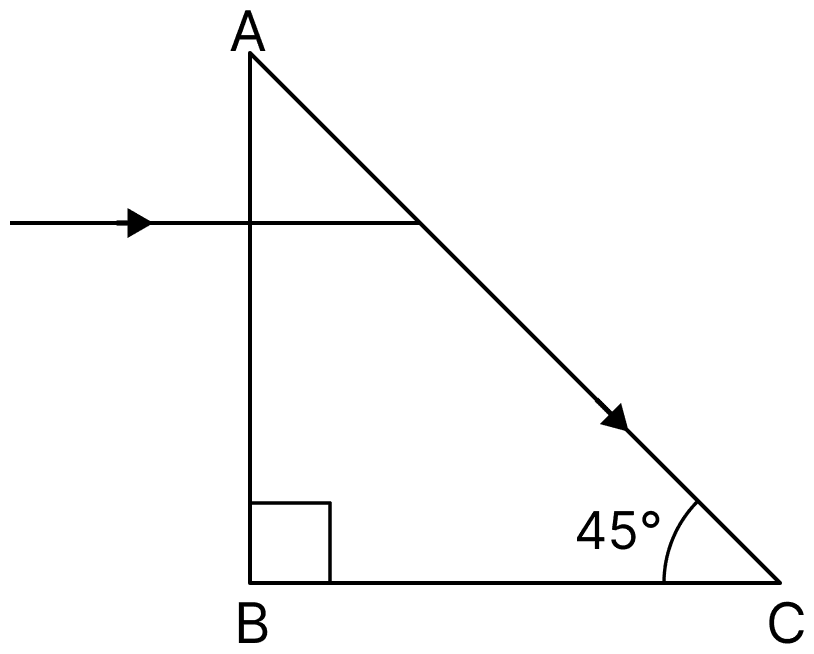
A light ray entering a right-angled prism undergoes refraction at the face AC as shown in figure.

A light ray entering a right-angled prism undergoes refraction at the face AC as shown in figure. Refraction and Dispersion of Light through a Prism, Nootan Physics Solutions ICS Class 12.

I. What is the refractive index of the material of the prism in Fig.?

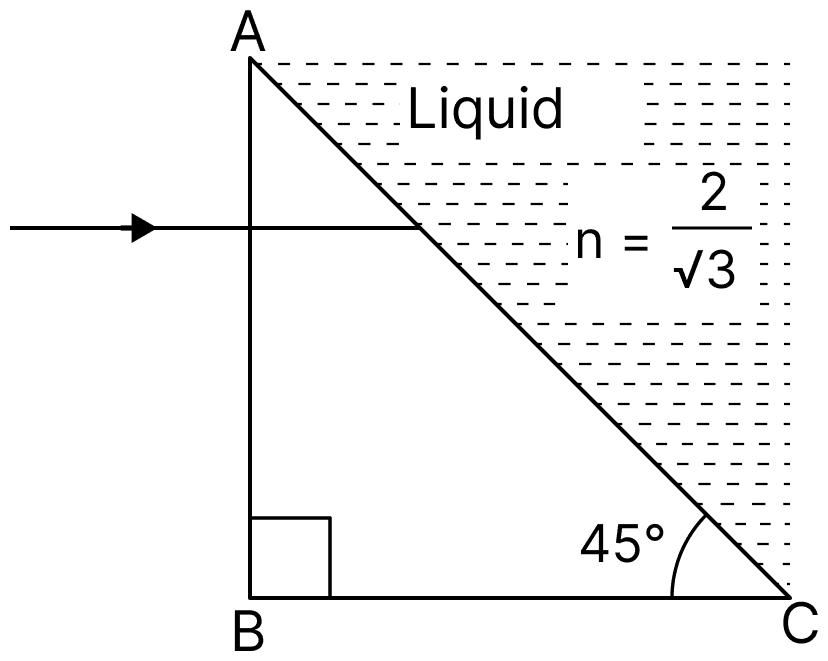
II. (a) If the side AC of the above prism is now surrounded by a liquid of refractive index 23\dfrac{2}{\sqrt{3}} as shown in Fig., determine if the light ray continues to graze along the interface AC or undergoes total internal reflection or undergoes refraction into the liquid.

A light ray entering a right-angled prism undergoes refraction at the face AC as shown in figure. Refraction and Dispersion of Light through a Prism, Nootan Physics Solutions ICS Class 12.

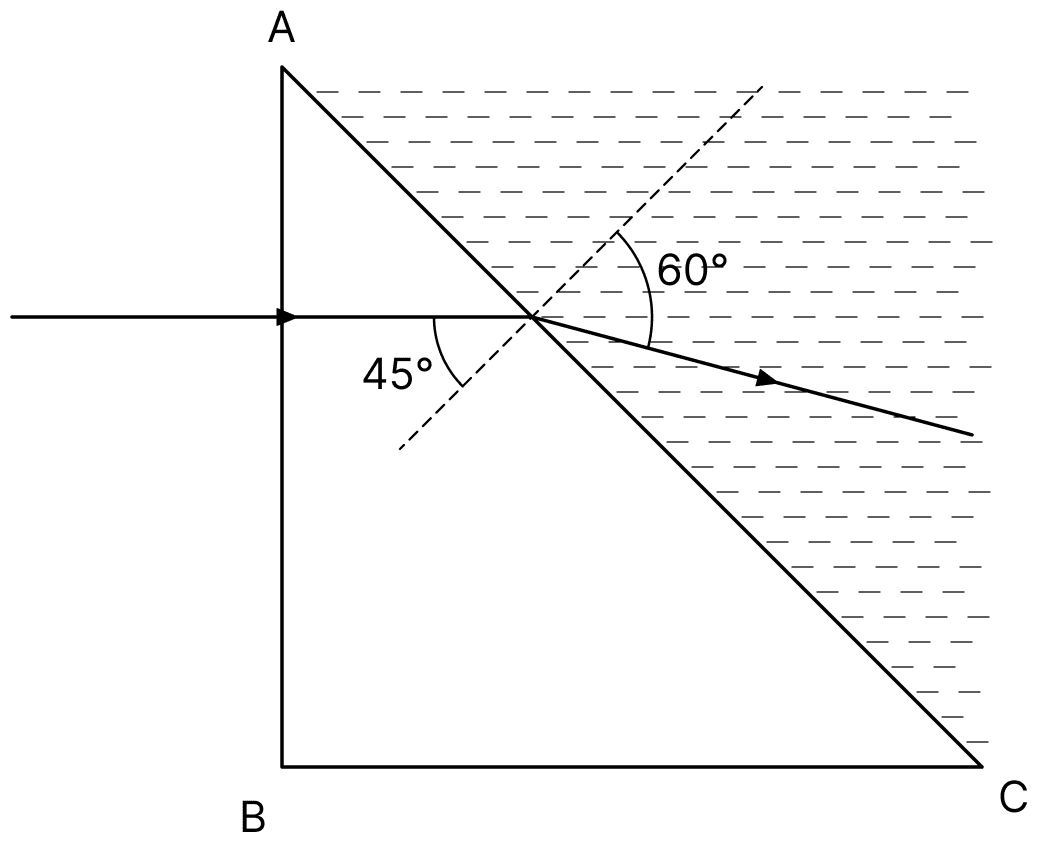
(b) Draw the ray diagram to represent the path followed by the incident ray with the corresponding angle values.

(Given, sin⁡−1(23)\sin^{-1}\left(\dfrac{\sqrt{2}}{\sqrt{3}}\right) = 54.6°)

Answer

I. Refractive index of the prism :

The ray enters face AB along the normal, so it passes into the prism undeviated and travels parallel to BC. As face AC is inclined at 45° to BC, the ray meets AC at an angle of incidence of 45°.

From the figure, the ray then grazes along AC, so the angle of refraction is 90°. The angle of incidence 45° is therefore the critical angle C for the glass–air interface.

n=1sin⁡C=1sin⁡45∘=112n=2\text n = \dfrac{1}{\sin \text C} \\[1em] = \dfrac{1}{\sin 45^\circ} \\[1em] = \dfrac{1}{\dfrac{1}{\sqrt{2}}} \\[1em] \text n = \sqrt{2}

II. (a) Prism with liquid on face AC :

Given,

  • Refractive index of glass, ng = 2\sqrt{2}
  • Refractive index of liquid, nl = 23\dfrac{2}{\sqrt{3}}
  • Angle of incidence at AC, i = 45°

The critical angle C' for the glass–liquid interface is given by

sin⁡C′=nlng=232=23C′=sin⁡−1(23)C′=54.6∘\sin \text C' = \dfrac{\text n_\text l}{\text n_\text g} \\[1em] = \dfrac{\dfrac{2}{\sqrt{3}}}{\sqrt{2}} \\[1em] = \dfrac{\sqrt{2}}{\sqrt{3}} \\[1em] \text C' = \sin^{-1}\left(\dfrac{\sqrt{2}}{\sqrt{3}}\right) \\[1em] \text C' = 54.6^\circ

The angle of incidence at AC (45°) is less than the critical angle C' (54.6°). Hence the ray neither grazes along AC nor suffers total internal reflection; it undergoes refraction into the liquid.

If r is the angle of refraction in the liquid, by Snell's law at AC,

ngsin⁡i=nlsin⁡r2×sin⁡45∘=23sin⁡r1=23sin⁡rsin⁡r=32r=60∘\text n_\text g \sin \text i = \text n_\text l \sin \text r \\[1em] \sqrt{2} \times \sin 45^\circ = \dfrac{2}{\sqrt{3}} \sin \text r \\[1em] 1 = \dfrac{2}{\sqrt{3}} \sin \text r \\[1em] \sin \text r = \dfrac{\sqrt{3}}{2} \\[1em] \text r = 60^\circ

(b) Ray diagram :

A light ray entering a right-angled prism undergoes refraction at the face AC as shown in figure. Refraction and Dispersion of Light through a Prism, Nootan Physics Solutions ICS Class 12.

The ray enters face AB along the normal without deviation, strikes face AC at an angle of incidence of 45°, and passes into the liquid bending away from the normal at an angle of refraction of 60°.

Hence, the refractive index of the prism is 2\sqrt{2}, and with the liquid on face AC the ray is refracted into the liquid at 60° to the normal.

Note: The question gives sin⁡−1(23)\sin^{-1}\left(\dfrac{\sqrt{2}}{\sqrt{3}}\right) = 54.6°; its value is 54.7°. The conclusion is unaffected, since 45° is less than either value.

Question 20

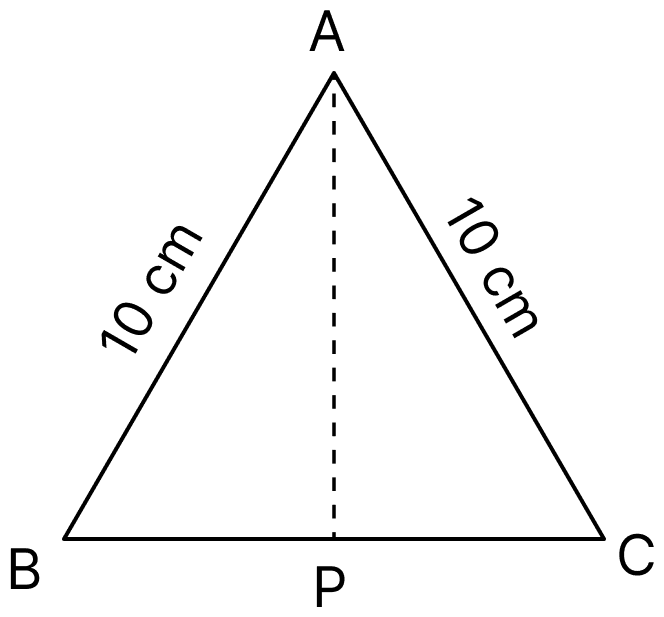
Cross-section view of a prism is the equilateral triangle ABC in the figure. The minimum deviation is observed using this prism when the angle of incidence is equal to the prism angle. Calculate the time taken by light to travel from P (mid point of BC) to A.

(Given, speed of light in vacuum = 3 × 10⁸ m/s and cos 30° = 32\dfrac{\sqrt{3}}{2})

Cross-section view of a prism is the equilateral triangle ABC in the figure. The minimum deviation is observed using this prism when the angle of incidence is equal to the prism angle. Calculate the time taken by light to travel from P (mid point of BC) to A. (Given, speed of light in vacuum = 3 × 10 8 m/s and cos 30° = dfrac√(3)2 ). Refraction and Dispersion of Light through a Prism, Nootan Physics Solutions ICS Class 12.

Answer

Given,

  • Equilateral prism, A = 60°
  • Side of the prism, AB = AC = 10 cm
  • Angle of incidence for minimum deviation, i = A = 60°
  • Speed of light in vacuum, c = 3 × 10⁸ m/s

Refractive index :

In the position of minimum deviation, r=A2=30∘\text r = \dfrac{\text A}{2} = 30^\circ. By Snell's law,

n=sin⁡isin⁡r=sin⁡60∘sin⁡30∘=3212n=3\text n = \dfrac{\sin \text i}{\sin \text r} \\[1em] = \dfrac{\sin 60^\circ}{\sin 30^\circ} \\[1em] = \dfrac{\dfrac{\sqrt{3}}{2}}{\dfrac{1}{2}} \\[1em] \text n = \sqrt{3}

Speed of light in the prism :

v=cn=3×1083v=3×10⁸ m/s\text v = \dfrac{\text c}{\text n} \\[1em] = \dfrac{3 \times 10^8}{\sqrt{3}} \\[1em] \text v = \sqrt{3} \times 10^8\ \text{m/s}

Distance AP :

As ABC is equilateral and P is the mid-point of BC, AP is perpendicular to BC and ∠BAP = 30°. Hence,

AP=ABcos⁡30∘=10×32=53 cmAP=53×10−2 m\text{AP} = \text{AB} \cos 30^\circ \\[1em] = 10 \times \dfrac{\sqrt{3}}{2} \\[1em] = 5\sqrt{3}\ \text{cm} \\[1em] \text{AP} = 5\sqrt{3} \times 10^{-2}\ \text m

Time taken :

t=APv=53×10−23×108t=5×10⁻¹⁰ s\text t = \dfrac{\text{AP}}{\text v} \\[1em] = \dfrac{5\sqrt{3} \times 10^{-2}}{\sqrt{3} \times 10^8} \\[1em] \text t = 5 \times 10^{-10}\ \text s

Hence, light takes 5 × 10⁻¹⁰ s to travel from P to A.

PrevNext