
Charge is distributed within a sphere of radius R with a volume charge density , where A and a are constants. If Q is the total charge of this charge distribution, the radius R is :
Answer
Reason —
Given,
- Volume charge density,
- Total charge of the distribution = Q, radius of the sphere = R
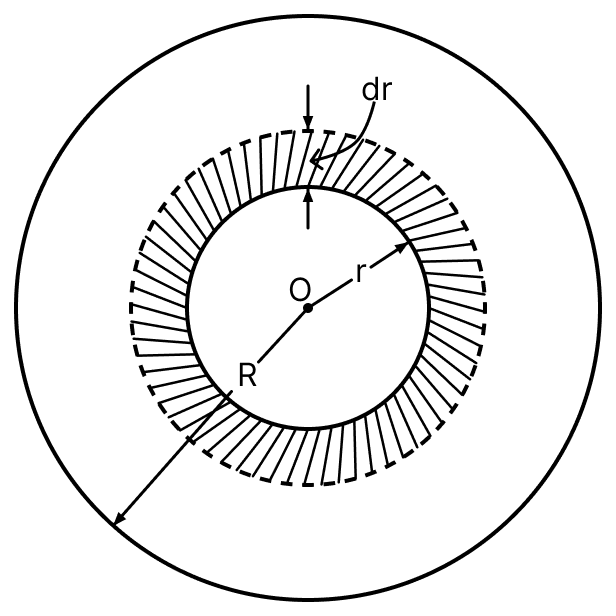
Consider a thin spherical shell of radius r and thickness dr inside the distribution. Its volume is
The charge on this shell element is
Integrating from r = 0 to r = R to obtain the total charge,
Rearranging for the exponential term,
Taking logarithms on both sides,
Shown in the figure is a shell made of a conductor. It has inner radius a and outer radius b, and carries charge Q. At its centre is a dipole as shown. In this case :
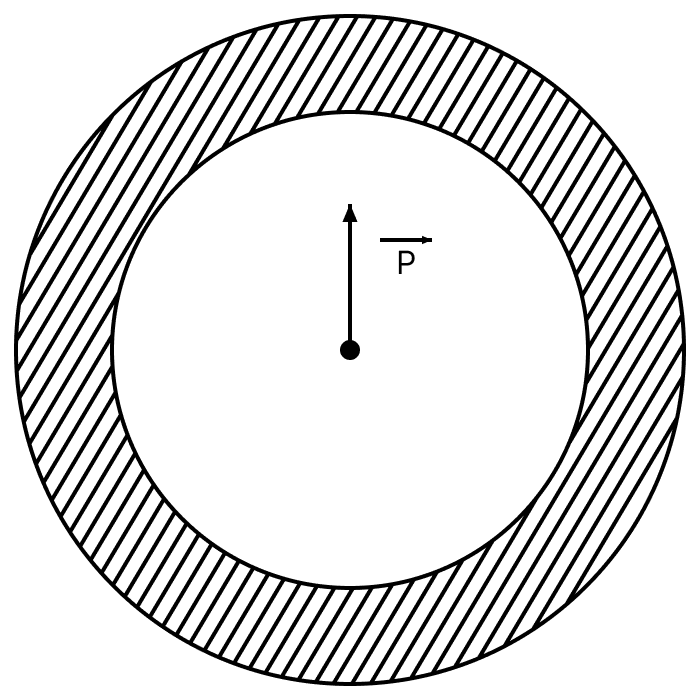
- surface charge density on the inner surface is uniform and equal to
- surface charge density on the outer surface depends on
- surface charge density on the inner surface of the shell is zero everywhere
- electric field outside the shell is the same as that of a point-charge at the centre of the shell
Answer
electric field outside the shell is the same as that of a point-charge at the centre of the shell
Reason —
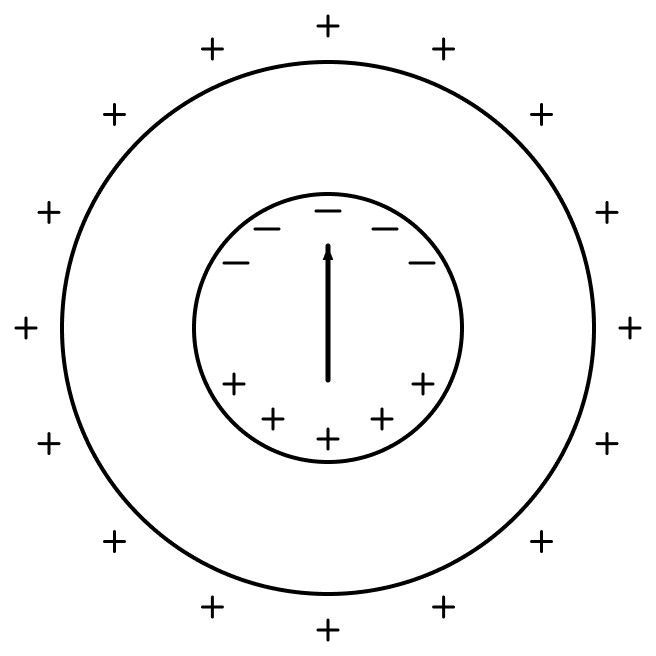
The dipole at the centre has zero net charge, so the total charge induced on the inner surface of the shell is zero and the net charge on the outer surface is Q. For any point outside the shell, the resultant electric field is therefore due to Q uniformly distributed on the outer surface only, which behaves as if it were concentrated at the centre,
which is the field of a point-charge placed at the centre of the shell.
Let a total charge 2Q be distributed in a sphere of radius R, with the charge density given by ρ(r) = kr, where r is the distance from the centre. Two charges A and B, of − Q each, are placed on diametrically opposite points, at equal distance, a from the centre. If A and B do not experience any force, then :
- a = 8-1/4 R
- a = 2-1/4 R
Answer
a = 8-1/4 R
Reason —
Given,
- Total charge distributed in the sphere of radius R = 2Q
- Charge density, ρ(r) = kr
- Two charges of − Q each placed at diametrically opposite points, at a distance a from the centre
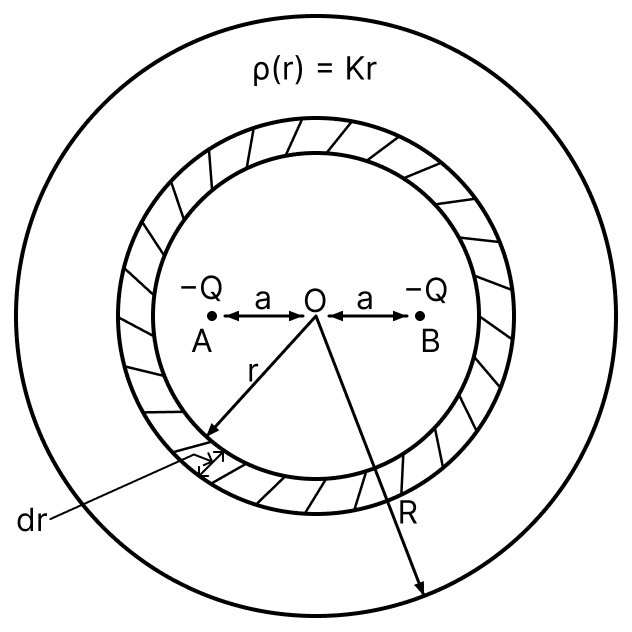
Step 1 — Determination of k :
Consider a thin shell of radius r and thickness dr. Its volume is 4πr2 dr, so the charge on it is
Integrating over the whole sphere,
Step 2 — Charge enclosed within radius a :
Since the two charges experience no force, they must lie inside the sphere, so a < R. The charge enclosed within a sphere of radius a is
Step 3 — Condition for zero net force :
The force on the charge at A due to the enclosed charge of the sphere is attractive,
The two charges A and B are of the same sign and are separated by a distance 2a, so the force between them is repulsive,
For no net force on A and B, these two must be equal,
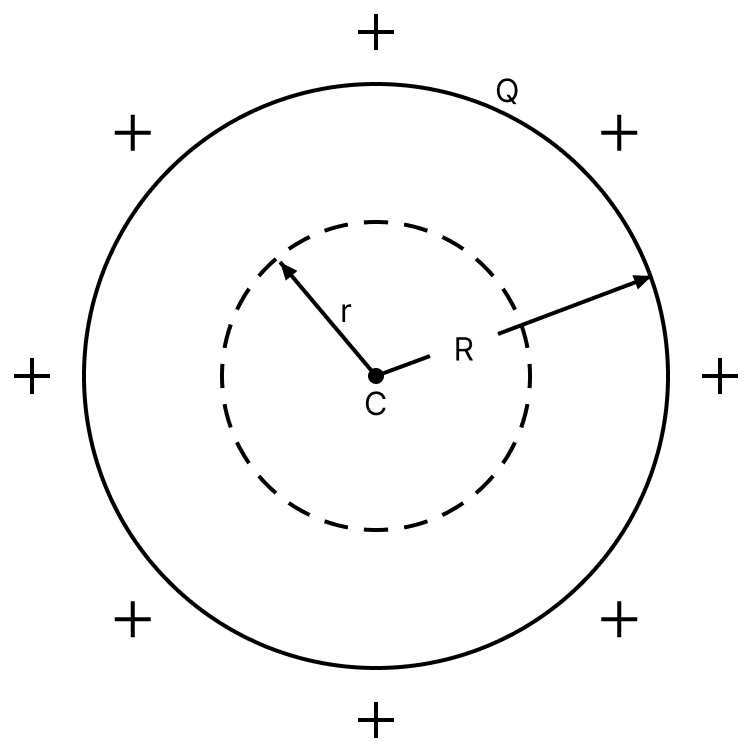
A hollow metal sphere of radius R is uniformly charged shown in figure. The electric field due to the sphere at a distance r from the centre :
- zero as r increases for r < R, increases as r increases for r > R
- decrease as r increases for r < R and for r > R
- increases as r increases for r < R and for r > R
- zero as r increases for r < R, decreases as r increases for r > R
Answer
zero as r increases for r < R, decreases as r increases for r > R
Reason —
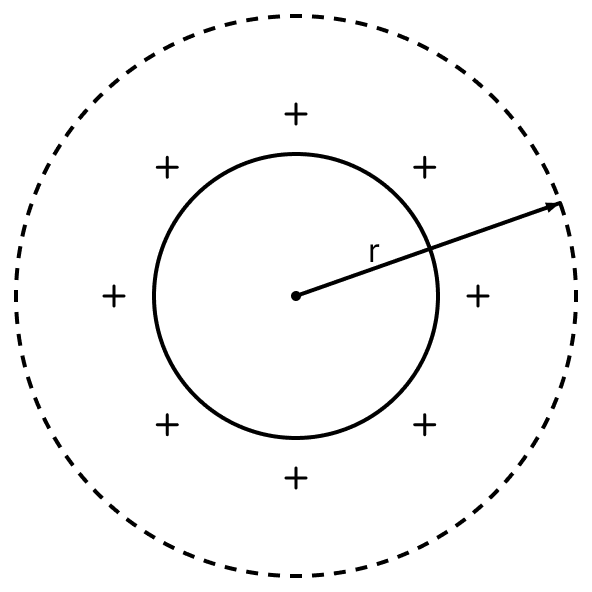
In a hollow metal sphere the entire charge Q resides on its surface, so it behaves just like a uniformly charged thin spherical shell.
For r < R (inside the sphere) : A Gaussian surface of radius r drawn inside encloses no charge. Hence by Gauss' theorem,
The field remains zero as r increases, right up to the surface.
For r > R (outside the sphere) : The Gaussian surface now encloses the whole charge Q, so
Since , the field decreases as r increases.
Two parallel infinite line charges with linear densities + λ C/m and − λ C/m are placed at a distance of 2R in free space. What is the electric field mid-way between the two line charges?
- N/C
- N/C
- Zero
- N/C
Answer
N/C
Reason —
Given,
- Linear charge densities of the two parallel infinite line charges, + λ C/m and − λ C/m
- Separation between them = 2R
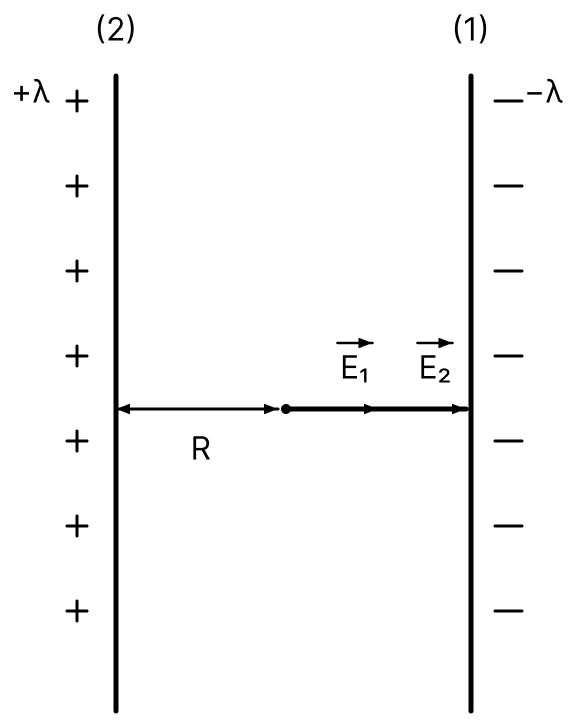
The mid-point lies at a perpendicular distance R from each line charge. The intensity due to an infinite line charge at a perpendicular distance R is
The field due to the positive line charge is directed away from it, that is, towards the negative line charge. The field due to the negative line charge is directed towards it, again in the same direction. Hence the two fields are in the same direction and they add up,
Given below are two statements:
Statement I : An electric dipole is placed at the centre of a hollow sphere. The flux of electric field through the sphere is zero but the electric field is not zero anywhere in the sphere.
Statement II : If R is the radius of a solid metallic sphere and Q be the total charge on it. The electric field at any point on the spherical surface of radius r (< R) is zero but the electric flux passing through this closed spherical surface of radius r is not zero.
In the light of the above statements, choose the correct answer from the options given below.
- Both Statement I and Statement II are true.
- Statement I is true but Statement II is false.
- Both Statement I and Statement II are false.
- Statement I is false but Statement II is true.
Answer
Statement I is true but Statement II is false.
Reason —
Statement I is true : An electric dipole consists of two equal and opposite charges, so the net charge enclosed by the hollow sphere is zero, and by Gauss' theorem the flux through the sphere is zero,
However, in a Gaussian surface, flux = 0 does not imply E = 0. The two charges of the dipole produce fields which do not cancel at any point of the sphere, so the electric field is not zero anywhere in the sphere.
Statement II is false : In a solid metallic sphere the entire charge Q resides on its outer surface. A spherical surface of radius r (< R) drawn inside the metal encloses no charge, so the electric field at every point on it is zero. This part of the statement is correct.
But then, by Gauss' theorem, the flux through this closed spherical surface is
So the electric flux through the surface of radius r is also zero, and not non-zero as claimed. This follows from the property that E = 0 implies = 0.
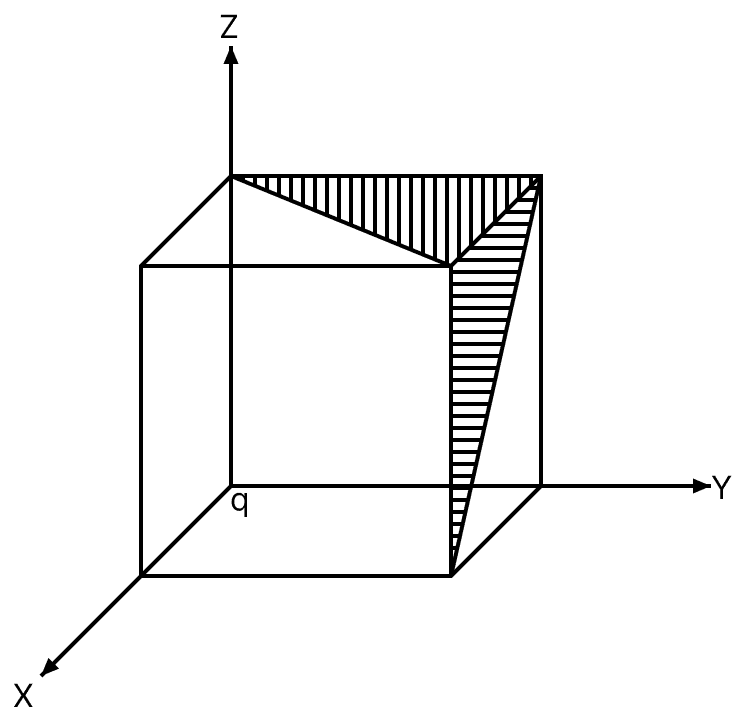
A charge q is placed at one corner of a cube as shown in figure. The flux of electrostatic field E through the shaded area is :
Answer
Reason —
The charge q is placed at one corner of the cube. A charge at a corner is shared by eight such cubes, so the flux through the whole of the given cube is
The cube has six faces. The three faces which meet at the corner where the charge is placed contain the charge in their own planes, so for every area element of these faces the electric field is parallel to the surface and the flux through them is zero.
Hence the whole of the flux passes through the remaining three faces, which are symmetrically situated with respect to the charge. The flux through each of these faces is therefore
The shaded area shown in the figure is made up of halves of two such faces, so the flux through it is
Find out the surface charge density at the intersection of point x = 3 m plane and x-axis, in the region of uniform line charge of 8 nC/m lying along the z-axis in free space.
- 47.88 C/m
- 0.424 nCm-2
- 0.07 nCm-2
- 4.0 nCm-2
Answer
0.424 nCm-2
Reason —
Given,
- Linear charge density of the line charge along the z-axis, λ = 8 nC/m = 8 × 10⁻⁹ C/m
- Distance of the point of intersection from the z-axis, r = 3 m
- = 9.0 × 10⁹ N-m2/C2, ε0 = 8.85 × 10⁻¹² C2/N-m2
The electric field at a perpendicular distance r from an infinite line charge is
Substituting the values,
The surface charge density at this location is obtained from the electric flux density, which for a surface normal to the field is
Substituting the values,
If over a surface, then :
- all the charges must necessarily be inside the surface
- the electric field inside the surface is necessarily uniform
- the number of flux lines entering the surface must be equal to the number of flux lines leaving it
- the magnitude of electric field on the surface is constant
Answer
the number of flux lines entering the surface must be equal to the number of flux lines leaving it
Reason — The electric flux is a measure of the number of lines of force passing through a surface. It is positive for the lines of force leaving the surface and negative for those entering the surface.
If
then the positive and the negative contributions cancel exactly. This means that the number of flux lines entering the surface must be equal to the number of flux lines leaving it.
A particle of charge '− q' and mass 'm' moves in a circle of radius 'r' around an infinitely long line charge of linear density '+ λ'. Then time period will be given as: (Consider k as coulomb's constant)
Answer
Reason —
Given,
- Charge on the particle = − q, mass = m
- Radius of the circular path = r
- Linear charge density of the infinitely long line charge = + λ
- k is Coulomb's constant, so
The electric field at a perpendicular distance r from the infinite line charge is
The line charge is positive and the particle is negative, so the electrostatic force on the particle is directed towards the line charge and provides the necessary centripetal force,
Substituting the value of E,
The speed is independent of r. The time period of the circular motion is
A small electric dipole , having a moment of inertia I about its centre, is kept at a distance r from the centre of a spherical shell of radius R. The surface charge density σ is uniformly distributed on the spherical shell. The dipole is initially oriented at a small angle θ as shown in the figure. While staying at a distance r, the dipole is free to rotate about its centre. If released from rest, then which of the following statement(s) is (are) correct? [ε0 is the permittivity of free space.]
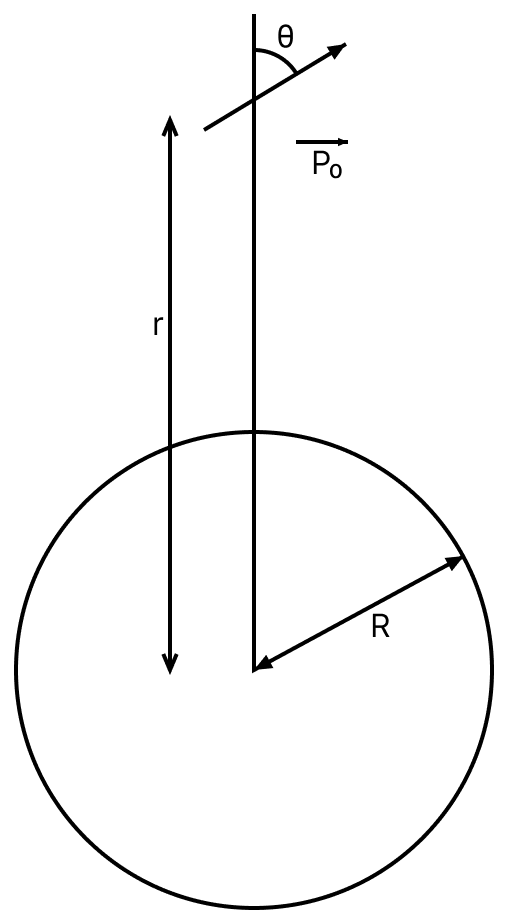
- The dipole will undergo small oscillations at any finite value of r.
- The dipole will undergo small oscillations at any finite value of r > R.
- The dipole will undergo small oscillations with an angular frequency of at r = 2R.
- The dipole will undergo small oscillations with an angular frequency of at r = 10R.
Answer
The dipole will undergo small oscillations at any finite value of r > R.
The dipole will undergo small oscillations with an angular frequency of at r = 10R.
Reason —
Given,
- Dipole moment = P0, moment of inertia about its centre = I
- Radius of the spherical shell = R, uniform surface charge density = σ
- Distance of the dipole from the centre of the shell = r
The total charge on the shell is
Field due to the shell : For an external point (r > R) the shell behaves as if its entire charge were concentrated at its centre,
For an internal point (r < R) the field is zero, so no torque acts on the dipole and it cannot oscillate. Hence the first option is incorrect and the second option is correct — oscillations occur for any finite value of r > R.
Angular frequency of small oscillations : The restoring torque on a dipole inclined at a small angle θ to the field is
At r = 2R :
This does not agree with the third option, so that option is incorrect.
At r = 10R :
which agrees with the fourth option.
Note: This question has more than one correct option; the printed answer key gives both option 2 and option 4.
Two charges of 5Q and − 2Q are situated at the points (3a, 0) and (− 5a, 0) respectively. The electric flux through a sphere of radius 4a having centre at origin is :
Answer
Reason —
Given,
- Charge 5Q at the point (3a, 0) and charge − 2Q at the point (− 5a, 0)
- Radius of the sphere = 4a, with its centre at the origin
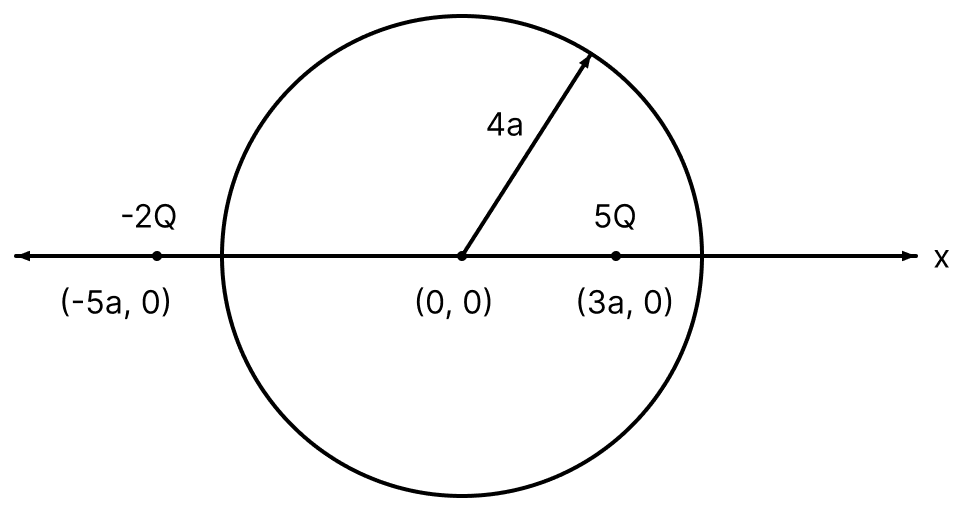
The distance of each charge from the centre of the sphere is measured to decide whether it lies inside the sphere.
For the charge 5Q : Its distance from the origin is 3a. Since 3a < 4a, this charge lies inside the sphere.
For the charge − 2Q : Its distance from the origin is 5a. Since 5a > 4a, this charge lies outside the sphere. The net electric flux through a closed surface due to a charge outside the surface is zero, so it makes no contribution.
Hence the net charge enclosed by the sphere is 5Q, and by Gauss' theorem
The total charge enclosed in an incremental volume of 2 × 10⁻⁹ m3 located at the origin is ............... nC, if electric flux density of its field is found as C/m2.
Answer
Given,
- Incremental volume located at the origin, dV = 2 × 10⁻⁹ m3
- Electric flux density, C/m2
The volume charge density is obtained from the differential form of Gauss' theorem,
Differentiating each component :
Adding these,
The charge density is a constant, so its value at the origin is also 2 C/m3. The charge enclosed in the incremental volume is
Hence the total charge enclosed is 4 nC.
The electric field in a region is given by with E0 = 4.0 × 10³ N/C. The flux of this field through a rectangular surface area 0.4 m2 parallel to the yz-plane is ............... N-m2C-1.
Answer
Given,
- Electric field, , with E0 = 4.0 × 10³ N/C
- Area of the rectangular surface, A = 0.4 m2, parallel to the yz-plane
Since the surface is parallel to the yz-plane, the normal to it is along the X-axis. Hence the area vector is
Only the x-component of the field contributes to the flux,
Substituting E0 = 4.0 × 10³ N/C,
Hence the flux of the field through the rectangular surface is 640 N-m2C-1.
The electric field in a region is given . The ratio of flux of reported field through the rectangular surface of area 0.2 m2 (parallel to YZ-plane) to that of the surface of area 0.3 m2 (parallel to XZ-plane) is a : b, where a = ............... .
[Here and are unit vectors along X, Y and Z-axes, respectively]
Answer
Given,
- Electric field, N/C
- Rectangular surface of area 0.2 m2, parallel to the YZ-plane
- Rectangular surface of area 0.3 m2, parallel to the XZ-plane
Flux through the surface parallel to the YZ-plane :
The normal to this surface is along the X-axis, so its area vector is m2. Only the x-component of the field contributes,
Flux through the surface parallel to the XZ-plane :
The normal to this surface is along the Y-axis, so its area vector is m2. Only the y-component of the field contributes,
Ratio of the two fluxes :
Comparing with the given ratio a : b, we get a = 1 and b = 2.
Hence the value of a is 1.
A point-charge of + 12 μC is at a distance 6 cm vertically above the centre of a square of side 12 cm as shown in figure. The magnitude of the electric flux through the square will be ............... × 103 N-m2/C.
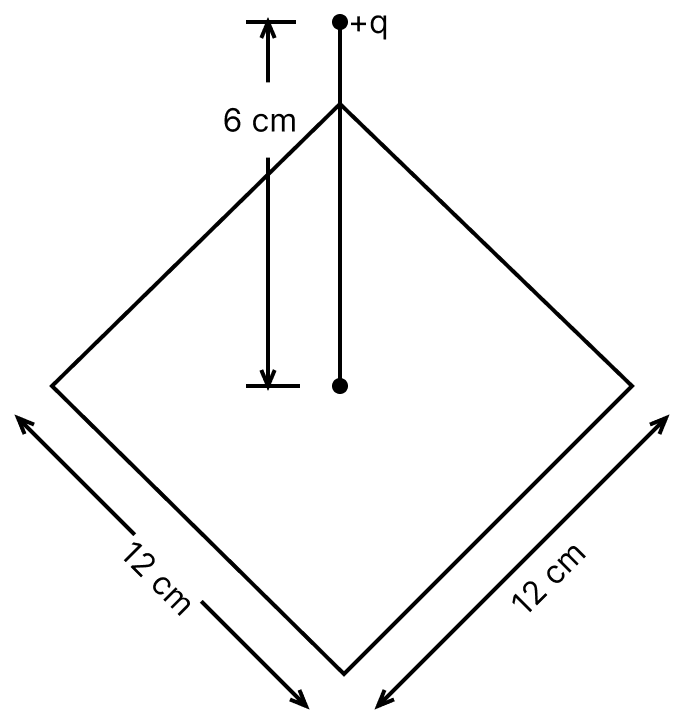
Answer
Given,
- Point-charge, q = + 12 μC = 12 × 10-6 C
- Perpendicular distance of the charge above the centre of the square = 6 cm
- Side of the square = 12 cm
- ε0 = 8.85 × 10⁻¹² C2/N-m2
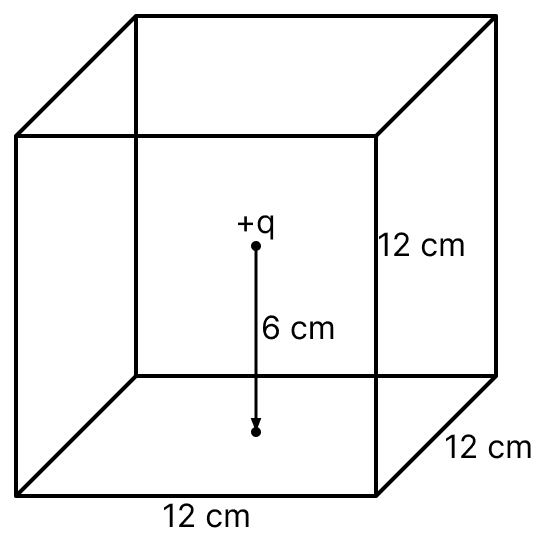
The charge lies at a height of 6 cm above the centre of a square of side 12 cm. Since 6 cm is exactly half of 12 cm, the square can be regarded as one face of a cube of edge 12 cm having the charge q at its centre.
By Gauss' theorem, the total flux through the closed surface of this cube is
All the six faces of the cube are symmetrically situated with respect to the point-charge at the centre, so the flux through each face is of the total flux,
Substituting the values,
Hence the magnitude of the electric flux through the square is 226 × 103 N-m2/C.
A charge q is surrounded by a closed surface consisting of an inverted cone of height h and base radius R, and a hemisphere of radius R as shown in the figure. The electric flux through the conical surface is (in SI units). The value of n is ............... .
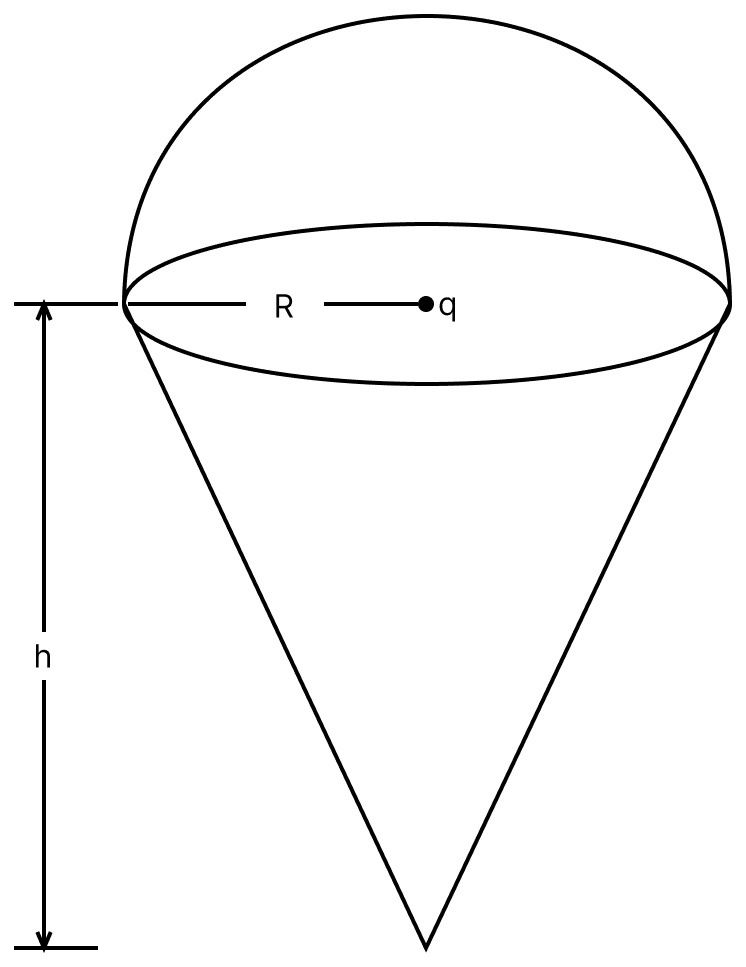
Answer
Given,
- Charge q surrounded by a closed surface consisting of an inverted cone of height h and base radius R, and a hemisphere of radius R
- Electric flux through the conical surface =
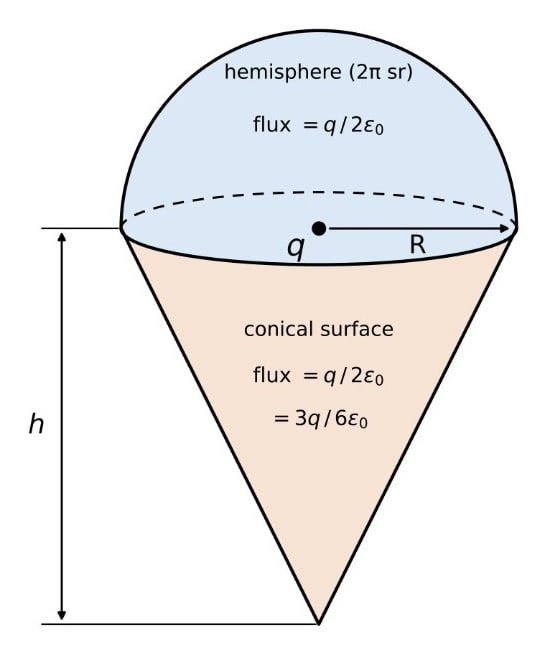
From the figure, the charge q lies at the centre of the circular rim of radius R, which is the common boundary of the hemisphere and the cone. This point is therefore the centre of the sphere of which the given hemisphere is one half.
The cone and the hemisphere together form a closed surface enclosing the charge q. By Gauss' theorem, the total flux through this closed surface is
The solid angle subtended by a closed surface at a point inside it is 4π steradian. The hemispherical surface subtends half of this, that is 2π steradian, at the charge. Hence the flux through the hemispherical surface is half of the total flux,
The flux through the conical surface is therefore
Comparing with the given form ,
Hence the value of n is 3.
As shown in figure, a cuboid lies in a region with electric field N/C. The magnitude of charge within the cuboid is nε0 C. The value of n is ............... (if dimension of cuboid is 1 × 2 × 3 m3).
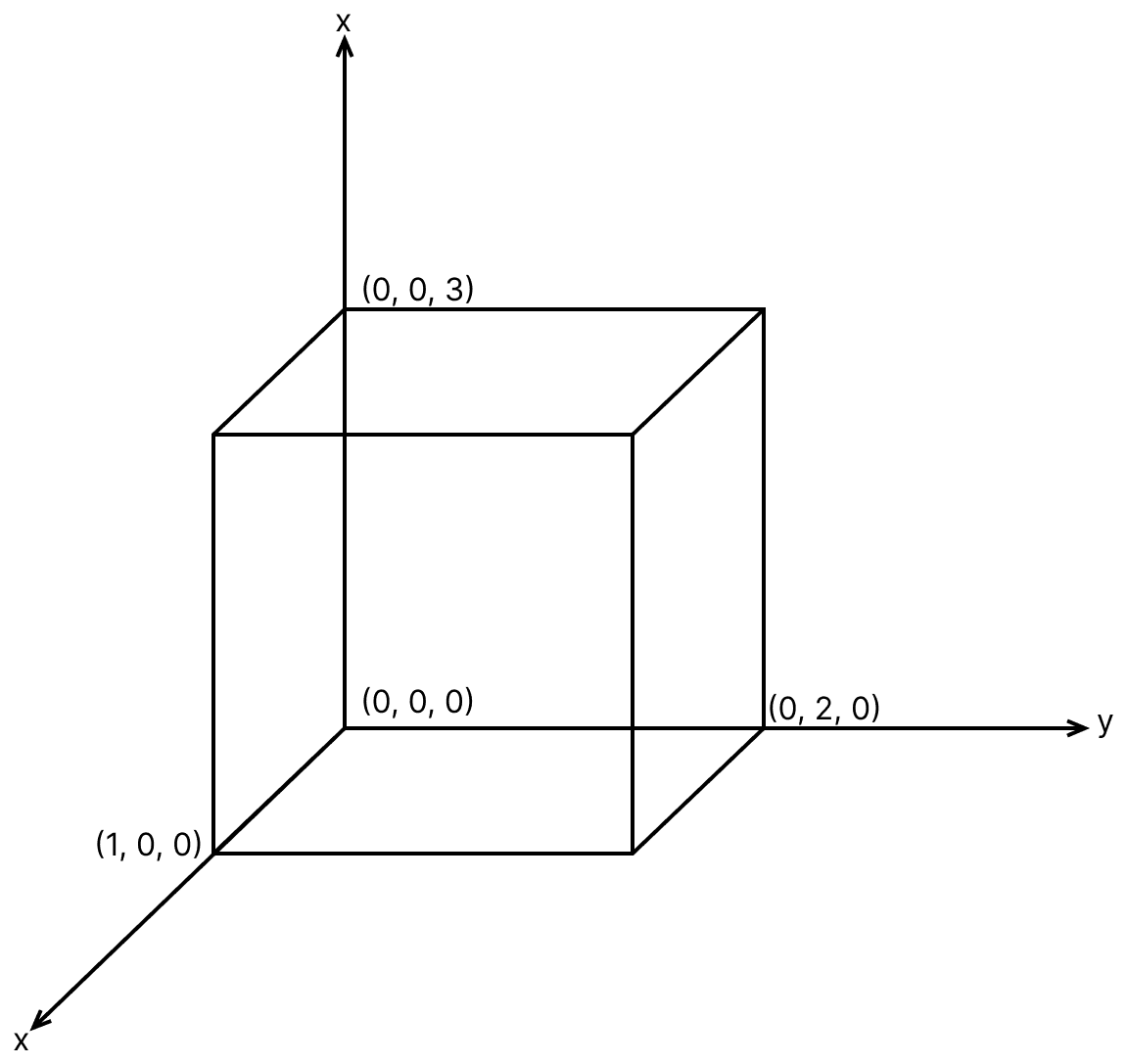
Answer
Given,
- Electric field, N/C
- Dimensions of the cuboid = 1 × 2 × 3 m3
- Magnitude of the charge within the cuboid = nε0 C
From the figure, the cuboid extends from x = 0 to x = 1 m, from y = 0 to y = 2 m and from z = 0 to z = 3 m.
Flux through the faces perpendicular to the X-axis :
Area of each such face = 2 × 3 = 6 m2.
At x = 1, Ex = 2(1)2 = 2 N/C and the outward normal is along + x,
At x = 0, Ex = 2(0)2 = 0, so
Flux through the faces perpendicular to the Y-axis :
Area of each such face = 1 × 3 = 3 m2.
At y = 2, Ey = − 4(2) = − 8 N/C and the outward normal is along + y,
At y = 0, Ey = − 4(0) = 0, so
Flux through the faces perpendicular to the Z-axis :
Area of each such face = 1 × 2 = 2 m2. Here Ez = 6 N/C is the same at both faces, while their outward normals are oppositely directed,
Net flux through the cuboid :
By Gauss' theorem, the charge within the cuboid is
Its magnitude is 12ε0 C. Comparing with nε0 C,
Hence the value of n is 12.
Note: The printed solution writes φ = 2(1)2 − 4(2) + 6(3) = 12, adding field components without face areas or outward-normal signs; the net flux is actually − 12 N-m2C-1 (charge − 12ε0 C), although its magnitude still gives n = 12.
An electron revolves around an infinite cylindrical wire having uniform linear charge density 2 × 10⁻⁸ Cm-1 in circular path under the influence of attractive electrostatic field as shown in figure. The velocity of electron with which it is revolving is ............... × 106 ms-1. (Given mass of electron = 9 × 10-31 kg)
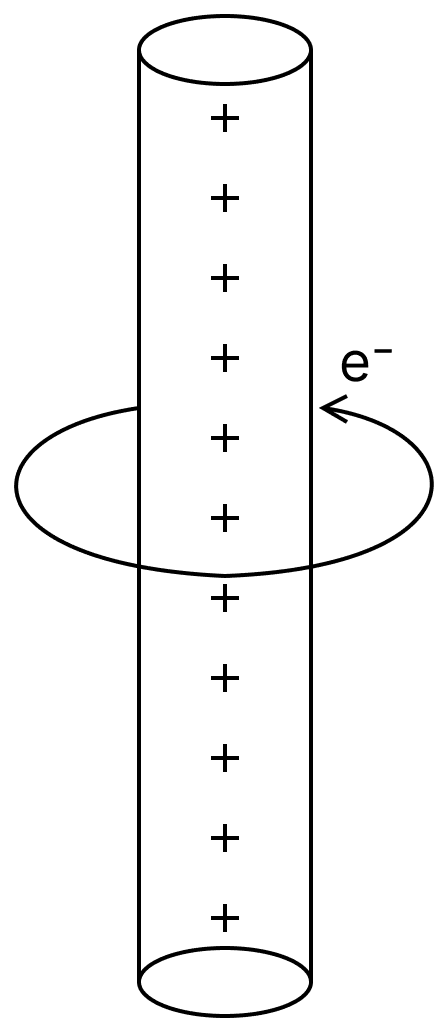
Answer
Given,
- Uniform linear charge density of the infinite cylindrical wire, λ = 2 × 10⁻⁸ Cm-1
- Mass of the electron, m = 9 × 10-31 kg
- Charge on the electron, e = 1.6 × 10⁻¹⁹ C
- = 9.0 × 10⁹ N-m2/C2
The electric field at a perpendicular distance r from the infinite line charge is
The wire is positively charged and the electron is negative, so the electrostatic force on the electron is directed towards the wire and supplies the necessary centripetal force for the circular path,
Substituting the value of E,
The radius r cancels from both sides, so
Substituting the values,
Hence the velocity of the electron is 8 × 10⁶ ms-1.
An electron is moving under the influence of the electric field of a uniformly charged infinite plane sheet S having surface charge density + σ. The electron at t = 0 is at a distance of 1 m from S and has a speed of 1 m/s. The maximum value of σ if the electron strikes S at t = 1 s is . The value of α is ............... .
Answer
Given,
- Surface charge density of the uniformly charged infinite plane sheet S = + σ
- Initial distance of the electron from S at t = 0 is 1 m
- Initial speed of the electron, u = 1 m/s
- Time taken to strike the sheet, t = 1 s
- Maximum value of σ is C/m2
The electric field due to a uniformly charged infinite plane sheet is
The sheet is positively charged and the electron carries a negative charge, so the force on the electron is directed towards the sheet. The magnitude of its acceleration is
This acceleration is independent of the distance from the sheet, so the motion is uniformly accelerated.
For σ to be maximum, the electron must take the longest possible route before striking the sheet. This happens when the electron initially moves away from the sheet with the speed of 1 m/s, is retarded, returns and then strikes the sheet at t = 1 s.
Taking the direction away from the sheet as positive, the displacement in 1 s must be − 1 m. Using
Substituting this in the expression for the acceleration,
Comparing with ,
Hence the value of α is 8.
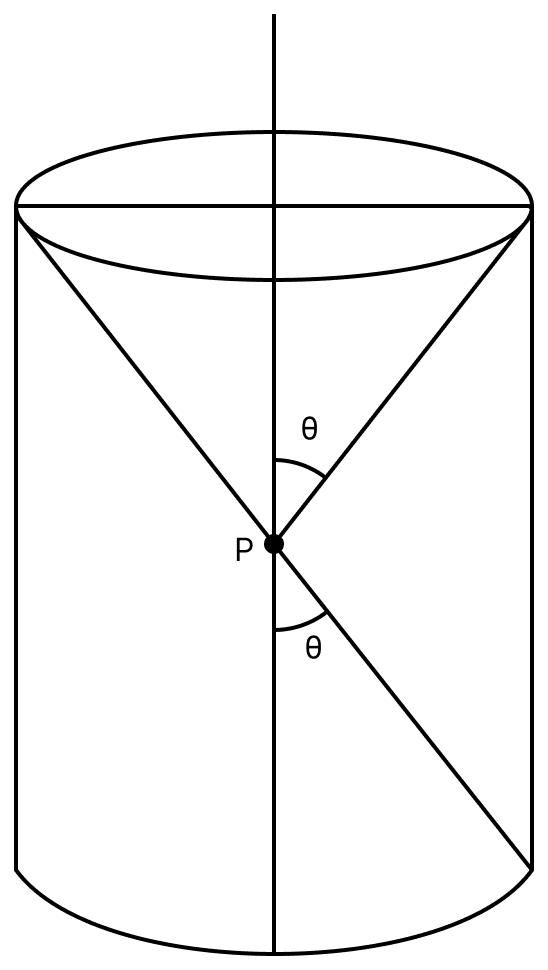
A charge is kept at the central point P of a cylindrical region. The two edges subtend a half-angle θ at P, as shown in the figure. When θ = 30°, then the electric flux through the curved surface of the cylinder is Φ. If θ = 60°, then the electric flux through the curved surface becomes , where the value of n is ............... .
Answer
Given,
- A charge is kept at the central point P of a cylindrical region
- The two edges subtend a half-angle θ at P
- Electric flux through the curved surface is when θ = 30°, and when θ = 60°
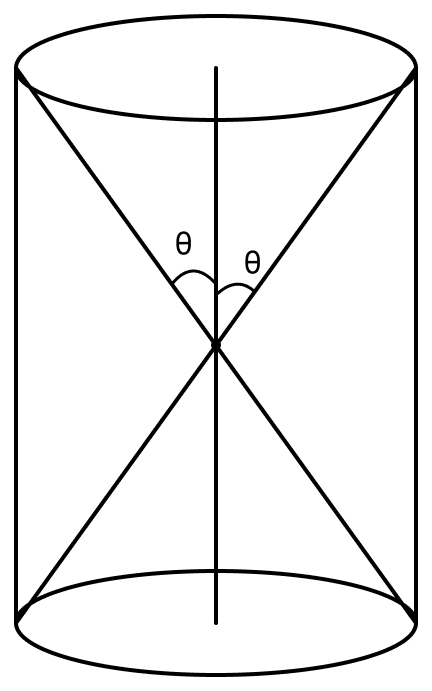
The solid angle subtended by a disc at a point on its axis, the semi-vertex angle of the cone so formed being θ, is
The charge q at P lies inside the closed cylinder, so the total flux through the whole cylinder is , corresponding to the total solid angle of 4π steradian.
The two plane ends of the cylinder together subtend a solid angle
The flux through the two plane ends is therefore
Hence the flux through the curved surface is
When θ = 30° :
When θ = 60° :
Taking the ratio,
Comparing with ,
Hence the value of n is 3.