
Refractive index of a transparent material is :
- same for all colours
- maximum for violet colour
- minimum for violet colour
- maximum for red colour
Answer
maximum for violet colour
Reason — Of all the colours of white light, violet has the least velocity in a transparent material. Since
the refractive index of the material is maximum for violet colour.
When monochromatic light passes from vacuum to a material medium, and vice-versa, which of the following characteristics of the light-beam does not change?
- Velocity
- Intensity
- Wavelength
- Frequency
Answer
Frequency
Reason — When light passes from one medium to another, its velocity, wavelength and intensity change, but its frequency remains unchanged.
A diver from inside water (n = ) looks at an object in air whose natural colour is green. He sees the object as :
- green
- blue
- yellow
- red
Answer
green
Reason — The colour of light is decided by its frequency, and the frequency of light remains unchanged when light passes from air into water; only its velocity and wavelength change. Hence the diver sees the object in its natural colour, green.
Note: The textbook's answer key gives (b) blue, which is incorrect — the frequency (and hence the colour) of light does not change on refraction.
Monochromatic light is refracted from air into a medium of refractive index n. The ratio of the wavelengths of the incident and the refracted waves is :
- 1 : 1
- 1 : n
- n : 1
- n2 : 1
Answer
n : 1
Reason — The frequency ν of light remains unchanged on refraction, so
Hence, λa : λm = n : 1.
A light ray passes from vacuum into a medium of refractive index n. The angle of refraction is found to be half the angle of incidence. The angle of incidence is :
Answer
Reason — Here r = . By Snell's law,
So, , or .
A piece of glass immersed in a colourless liquid is not visible. It is so because :
- glass and liquid are both colourless
- both are of same density
- both are of same refractive index
- glass reflects the light transmitted by the liquid
Answer
both are of same refractive index
Reason — When the glass and the liquid have the same refractive index, light passes from the liquid into the glass without any bending at their boundary. The boundary of the glass therefore cannot be distinguished, and the glass is not visible.
The refractive indices of glass and water with respect to air are respectively. The refractive index of glass with respect to water will be :
- none of these
Answer
Reason — The refractive index of glass with respect to water is
Note: The question (as printed in the textbook too) omits the refractive index of water; the chapter's standard value anw = 4/3 has been used.
When a glass slab of refractive index 1.5 is placed on a cross marked on paper, the cross appears to be raised by 2 cm. The thickness of the slab is :
- 3 cm
- 4 cm
- 6 cm
- 8 cm
Answer
6 cm
Reason — The apparent rise (normal displacement) of the cross is , where t is the thickness of the slab.
It is possible to observe total internal reflection when light travels from :
- air to water
- air to glass
- water to glass
- glass to water
Answer
glass to water
Reason — Total internal reflection can occur only when light travels from a denser medium to a rarer medium. Among the given pairs, only glass (n = 1.5) to water (n = 1.33) is from denser to rarer.
The velocity of light in a medium is 1.5 × 10⁸ ms-1. The critical angle C for a ray going from the medium into air is :
- 30°
- 45°
- 60°
- 90°
Answer
30°
Reason — The refractive index of the medium is
For the critical angle,
The critical angle will be largest when light goes from :
- water to air
- glass to air
- glass to water
- diamond to air
Answer
glass to water
Reason — Since , where 1n2 is the refractive index of the denser medium relative to the rarer, the critical angle is largest when this relative refractive index is smallest. For glass to water it is , which is smaller than 1.33 (water-air), 1.5 (glass-air) and 2.42 (diamond-air).
A swimmer inside water looks up at the sky through the surface of water. The sky is bright due to daylight. He can see :
- nothing but darkness
- the entire top surface of water bright
- a small illuminated patch directly above his head, whose angular size depends upon the depth of the swimmer in water
- a small illuminated patch directly above his head, whose angular size is independent of the depth of the swimmer
Answer
a small illuminated patch directly above his head, whose angular size is independent of the depth of the swimmer
Reason — Light from the sky, incident on the water surface at all angles up to 90°, is refracted into the water within a cone of semi-vertical angle C, the critical angle for water-air interface. The swimmer therefore sees the sky only through a circular patch above his head, which subtends an angle 2C at his eye. As C depends only on the refractive index of water, the angular size of the patch does not depend on the depth of the swimmer.
Light passes from air to glass and is deviated 3.5°. When the angle of incidence is 10°, refractive index of the material of the glass is :
- 1.33
- 1.50
- 1.52
- 1.54
Answer
1.54
Reason — The deviation is (i − r), so r = 10° − 3.5° = 6.5°. By Snell's law,
which is nearest to 1.54.
A bird in air looks at a fish vertically below it and inside water in a tank. If the distance of the fish as estimated by the bird is x1 and that of bird estimated by the fish is x2, then refractive index of water is :
Answer
Reason — Let the bird be at height h above the water surface and the fish at depth d below it. The bird sees the fish at an apparent depth , while the fish sees the bird at an apparent height nh (an object in a rarer medium seen from a denser medium appears farther away).
Hence, .
Why does refraction of light occur when light passes from one medium to another?
Answer
Refraction occurs because the speed of light is different in different media. When light passes obliquely from one medium to another, this change in speed makes it bend at the interface.
Do frequency and wavelength change when light passes from one medium to another?
Answer
The frequency does not change, but the wavelength changes.
Explanation:
On refraction the velocity of light changes while its frequency ν stays the same. As v = νλ, the wavelength changes in proportion to the velocity; in a medium of refractive index n, .
Define refractive index of glass in terms of the speed of light.
Answer
The (absolute) refractive index of glass is the ratio of the speed of light in vacuum to the speed of light in glass,
Can absolute refractive index of a medium be less than 1?
Answer
No.
Explanation:
The absolute refractive index is . The velocity of light is maximum in vacuum, so c > v for every material medium and n is always greater than 1 (it equals 1 for vacuum).
Can refractive index of a medium relative to another medium be less than 1?
Answer
Yes.
Explanation:
The refractive index of medium 2 relative to medium 1 is , which is less than 1 when medium 2 is optically rarer than medium 1. For example, the refractive index of water relative to glass is
A microscope is focussed on a dot at the bottom of a beaker. Oil is poured into the beaker to a height of y cm. Now, the microscope is to be raised through a vertical distance of x cm to bring the dot again into focus. Express refractive index of oil in terms of x and y.
Answer
Explanation:
The dot appears raised by the normal displacement of the oil layer, and the microscope is raised by the same amount. So, with thickness of oil y,
Does critical angle depend upon the colour (wavelength) of light used?
Answer
Yes.
Explanation:
The critical angle is given by , and the refractive index of a medium depends upon the wavelength (colour) of light. Hence the critical angle is different for different colours.
Is critical angle for a given interface greater for red light or for blue light?
Answer
Red light.
Explanation:
Since nR < nB, the value of is greater for red light. Hence the critical angle is greater for red light than for blue light.
What is the critical angle for a material of refractive index relative to air?
Answer
45°
Explanation:
Will the critical angle for glass-water interface smaller or larger than that for glass-air interface?
Answer
Larger.
Explanation:
For glass-air interface , and for glass-water interface . Since is less than ang, sin C' > sin C, so C' > C (about 62.5° against about 42°).
What is the refractive index and critical angle of diamond?
Answer
Refractive index of diamond = 2.42; critical angle ≈ 24.4°.
Explanation:
Which has a larger critical angle, water or diamond?
Answer
Water.
Explanation:
As , a medium of smaller refractive index has a larger critical angle. For water (n = 4/3), and C ≈ 48.6°; for diamond (n = 2.42), C ≈ 24.4°.
Name the phenomenon responsible for mirage.
Answer
Total internal reflection.
Explanation:
On a hot day the air near the ground is hotter and rarer than the layers above it. An oblique ray from a distant object, passing from denser to rarer layers, bends away from the normal until its angle of incidence exceeds the critical angle at some layer; it is then totally reflected upward, and the observer sees an inverted image of the object, as if reflected from a pool of water.
Discuss refraction through a glass slab and show that emergent ray is parallel to the incident ray but displaced.
Answer
Let ABCD be a rectangular glass slab of thickness t. A ray PQ is incident on the face AB at Q at an angle i, is refracted along QR at an angle r1, and emerges from the face DC at R along RS at an angle e. Let r2 be the angle of incidence at R.
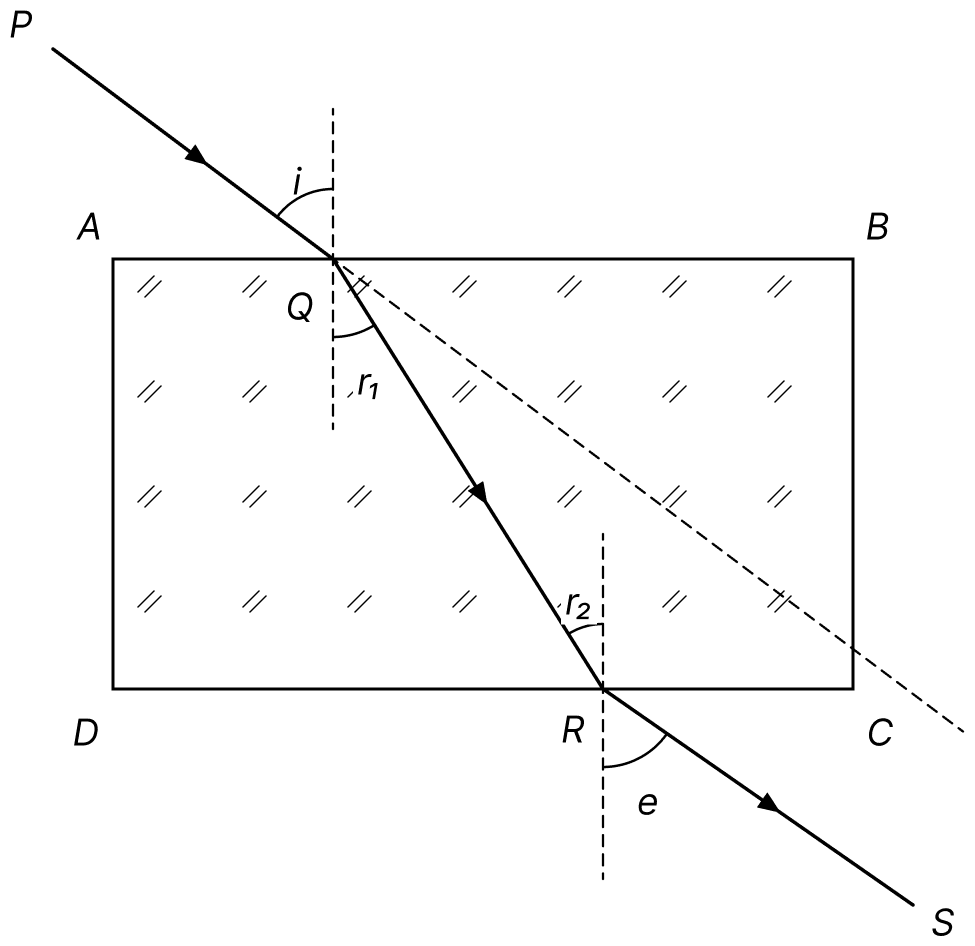
At Q, by Snell's law,
At R,
As the faces AB and DC are parallel, the normals at Q and R are parallel, so r2 = r1. Then from Eqs. (i) and (ii),
Since the angle of emergence equals the angle of incidence, the emergent ray RS is parallel to the incident ray PQ. It is, however, displaced sideways. The perpendicular distance RM between RS and the direction of PQ is the lateral shift,
For what angle of incidence, the lateral displacement is maximum? Can it be zero?
Answer
The lateral displacement is
Maximum : For grazing incidence, i = 90°,
So the lateral displacement is maximum for i = 90° and is then equal to the thickness of the slab.
Zero : Yes. For normal incidence, i = 0 gives r = 0, so x = 0.
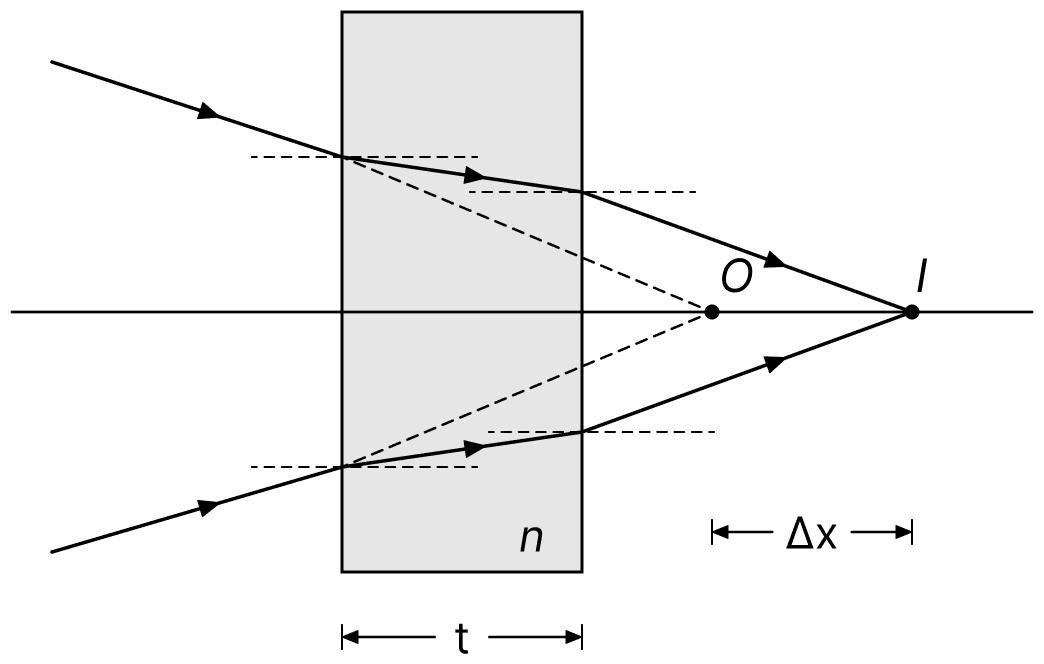
A beam of light is converging towards a point. A parallel-sided glass slab is introduced in the path of this beam. How will the point of convergence be shifted? Draw the ray-diagram.
Answer
The point of convergence shifts away from the slab, i.e., farther in the direction of the beam.
Let the beam converge towards a point O in the absence of the slab. On introducing the slab, each ray is refracted at both faces and emerges parallel to its original direction but laterally shifted, as discussed for a glass slab. The emergent rays therefore meet at a point I beyond O. For a slab of thickness t and refractive index n, the shift OI = for nearly normal rays.
Define critical angle for an interface of two media.
Answer
The critical angle for two given media is that angle of incidence in the denser medium for which the angle of refraction in the rarer medium is 90°. Its value depends upon the nature of the two media and the colour of light.
Explain total internal reflection of light.
Answer
When a ray travels from a denser medium to a rarer medium, it bends away from the normal, and the angle of refraction increases as the angle of incidence increases. For one particular angle of incidence, the critical angle C, the refracted ray grazes along the interface (angle of refraction 90°).
If the angle of incidence in the denser medium is increased even slightly beyond C, no refraction takes place and the whole of the light is reflected back into the denser medium according to the laws of reflection. This is called total internal reflection — 'total' because all the light is reflected.
Write the two conditions for total internal reflection of light.
Answer
(i) The ray of light should travel from the denser medium towards the rarer medium.
(ii) The angle of incidence in the denser medium should be greater than the critical angle for the two media.
Can total internal reflection occur when light travels from rarer to denser medium?
Answer
No.
Explanation:
When light passes from a rarer to a denser medium, it bends towards the normal and the angle of refraction is smaller than the angle of incidence. Even for the largest angle of incidence, 90°, the angle of refraction stays below 90°, so a refracted ray always exists and total internal reflection cannot occur.
What is critical angle? Give one application of total internal reflection.
Answer
Critical angle : It is the angle of incidence in the denser medium for which the angle of refraction in the rarer medium is 90°.
Application : Optical fibres transmit light signals from one end to the other through repeated total internal reflections at the core-cladding interface; they are used in telecommunication and in endoscopy.
What are optical fibres? Give their one use.
Answer
An optical fibre is a device through which light entering at one end is transmitted to the other end, even along a curved path, with very little loss through its sides. It consists of a very thin central core of high-quality glass or quartz, clad by a material of slightly lower refractive index, and works on the principle of total internal reflection.
Use : In medical examination (endoscopy), a bundle of optical fibres is used to view the interior of the stomach and the intestine.
Show, with a diagram, how an image is produced in a totally-reflecting prism.
Answer
Let ABC be a right-angled isosceles glass prism with ∠A = 90° and ∠B = ∠C = 45°. Rays from the two ends of an object enter the face AB normally and go undeviated. They strike the hypotenuse face BC at an angle of incidence of 45°, which is greater than the critical angle for glass-air (about 42°), and are totally reflected. They then fall normally on the face AC and emerge undeviated, turned through 90°.
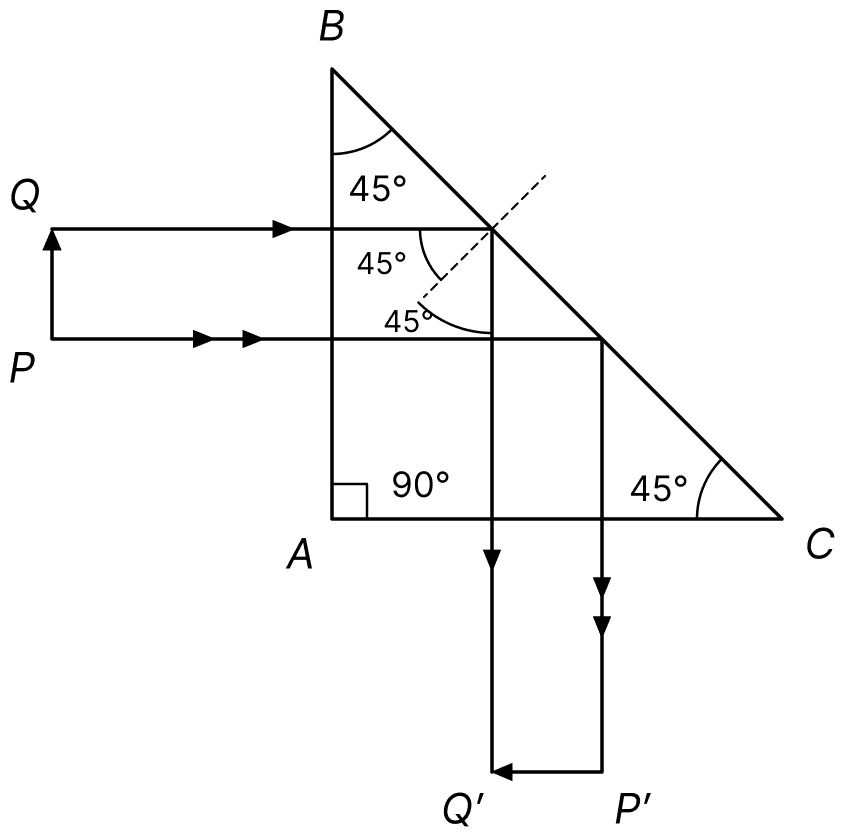
The hypotenuse face thus acts as a plane mirror. The emergent rays, produced backwards, meet behind BC and form a virtual image of the same size as the object; the rays from the two ends of the object interchange their relative positions, so the image is inverted with respect to the object, just as in a plane mirror.
What are the advantages of totally-reflecting prism over plane mirror?
Answer
(i) Since reflection takes place at a single surface only, no multiple images are formed.
(ii) Almost 100% of the light is reflected, whereas a silvered glass mirror reflects only about 80%.
(iii) No silvering is needed, so tarnishing of the reflecting surface cannot occur.
(iv) The prism is unlikely to get bent or distorted, so it gives a high-quality image.
For the same angle of incidence, the angles of refraction in three different media A, B and C are 15°, 25° and 35° respectively. In which medium will the velocity of light be minimum?
Answer
Medium A.
Explanation:
The (absolute) refractive index of a medium is
so, for the same angle of incidence, . The velocity is minimum where the angle of refraction is minimum, i.e., in medium A (r = 15°).
To a fish under water viewing obliquely, does a fisherman standing on the bank of a lake appear taller or shorter than his actual height?
Answer
Taller.
Explanation:
An object in a rarer medium (air), viewed from a denser medium (water), appears farther from the interface than it actually is. Every point of the fisherman appears raised, the higher points more so, and for near-normal viewing his apparent height is anw × (actual height) = × (actual height). Hence he appears taller than his actual height.
A rod immersed partially and obliquely in water appears to be bent. Explain.
Answer
Let OAB be the rod, with the part AB under water and A at the water surface. Each point of the immersed part appears raised by a normal displacement that is proportional to its real depth. The point B, being the deepest, appears raised the most, to B', while A is not raised at all. The intermediate points are raised by intermediate amounts, so the immersed part appears along AB' instead of AB.
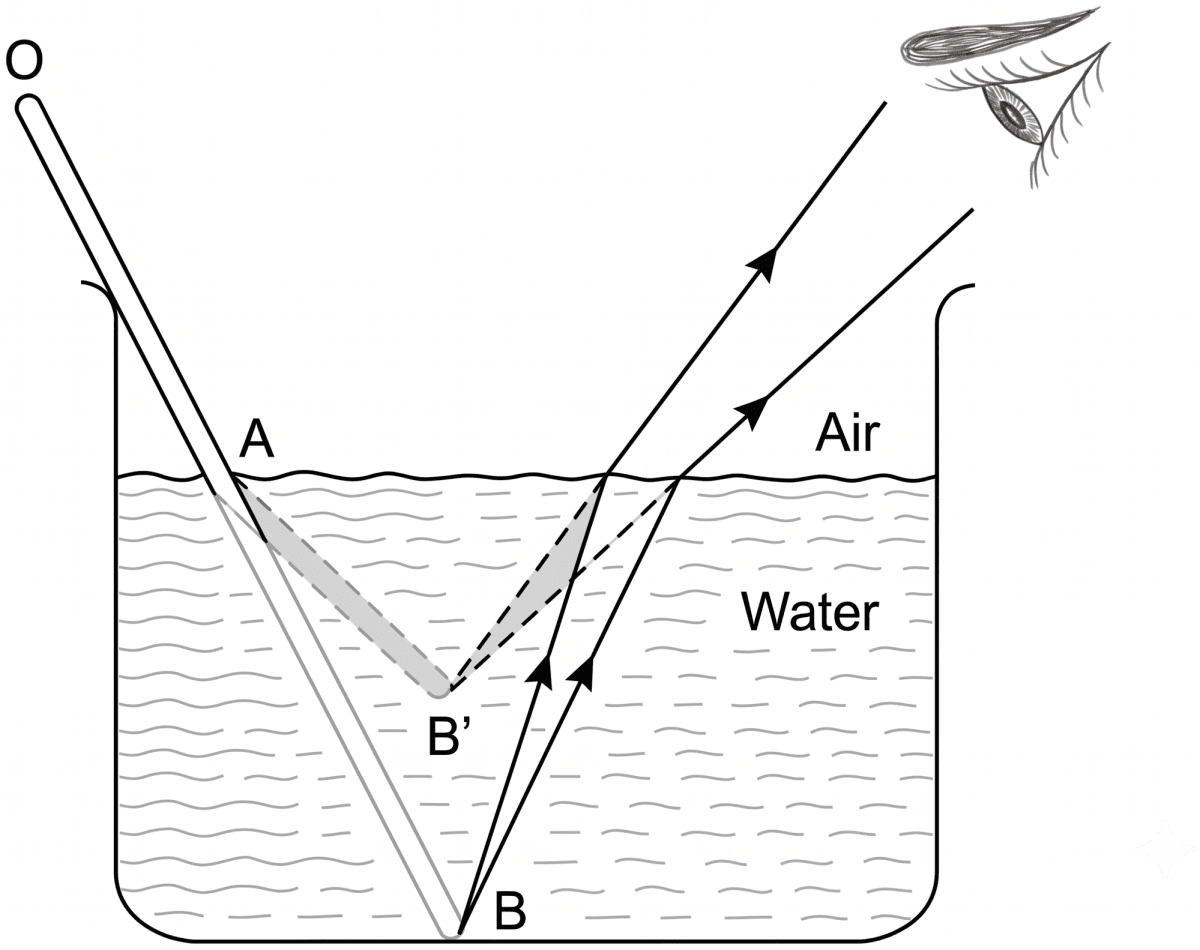
Hence the rod appears bent as OAB' at the water surface.
The sun begins to be seen a little before it rises and continues to be seen for several minutes after it has actually set. Explain.
Answer
This happens due to atmospheric refraction of light.
The density, and hence the refractive index, of air decreases with height. The atmosphere may be regarded as a series of concentric layers whose refractive index increases downwards. A ray from the sun at S entering the atmosphere passes into denser and denser layers and bends towards the normal, so it reaches the observer O on the earth as if coming from S', above S.
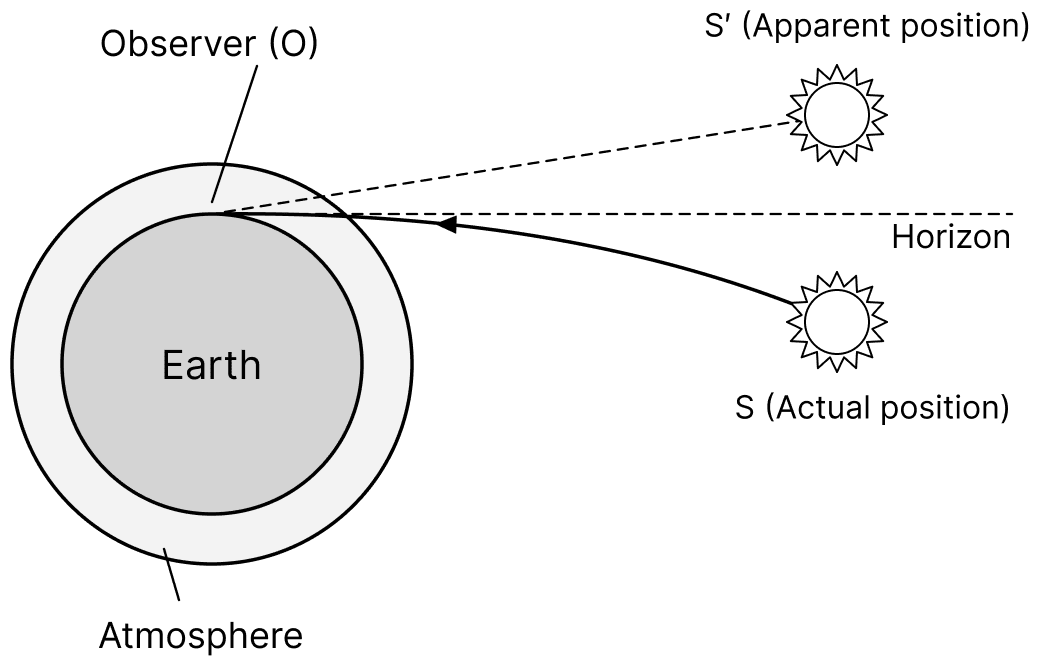
The effect is greatest near the horizon, where the rays fall on the layers most obliquely. When the sun is actually slightly below the horizon, it is apparently raised by about 33' (more than its angular diameter of 32') and is seen just above the horizon. So the sun is seen a few minutes before actual sunrise, and for the same reason remains visible for a few minutes after actual sunset.
Sun (or moon), when near the horizon, appears elliptical and not circular. Explain why?
Answer
Near sunrise or sunset the sun is just above the horizon, and its lower edge is nearer the horizon than its upper edge. Rays from the lower edge therefore suffer more atmospheric refraction, and the lower edge is apparently raised more than the upper edge. This reduces the apparent vertical diameter of the sun, while the horizontal diameter is unaffected, so the sun (or moon) appears elliptical.
Why do stars appear twinkling?
Answer
The atmosphere consists of layers of different densities and hence different refractive indices. Due to convection currents in air (caused by wind, temperature changes, etc.), the densities and refractive indices of these layers keep changing continuously. Light from a star, which is effectively a point source, therefore changes its path continuously, and the number of rays entering the observer's eye keeps changing. Hence the star appears twinkling.
An empty test-tube dipped obliquely into water appears silvery, when viewed in a suitable direction. Why?
Answer
When an empty thin-glass test-tube is held obliquely in water (at about 50° or more with the vertical), light coming through the sides of the beaker falls on the inner surface of the thin-walled test-tube, which acts as a water-air interface, at an angle of incidence of 50° or more. This exceeds the critical angle for water-air interface (about 49°), so the light is totally reflected towards the eye instead of entering the air inside the tube. Hence the tube appears silvery. If water is poured into the test-tube, the water-air interface disappears and so does the effect.
The refractive index of diamond is much greater than that of glass. Does diamond cutter use this fact?
Answer
Yes.
Explanation:
The refractive index of diamond (2.42) is much greater than that of glass (1.5), so its critical angle, , is only about 24° against about 42° for glass. Total internal reflection inside diamond is thus possible for the wide range of angles of incidence from 24° to 90°. A skilled diamond cutter cuts the faces so that light entering the diamond suffers total internal reflection at many faces before coming out, which makes the diamond sparkle.
State the laws of refraction. Distinguish between absolute refractive index and refractive index of a medium. Show that n = , where letters have usual meanings.
Answer
Laws of refraction :
(i) The incident ray, the refracted ray and the normal to the interface at the point of incidence all lie in the same plane.
(ii) For a given pair of media and for light of a given colour (wavelength), the ratio of the sine of the angle of incidence to the sine of the angle of refraction is a constant,
This is Snell's law; the constant 1n2 is the refractive index of medium 2 with respect to medium 1.
Absolute and relative refractive index :
| Absolute refractive index | Refractive index of a medium relative to another |
|---|---|
| It compares the speed of light in vacuum with that in the medium: . | It compares the speeds of light in two media: . |
| The reference medium is always vacuum. | The reference medium may be any medium. |
| It is always greater than 1 (equal to 1 for vacuum). | It may be greater or less than 1. |
To show n = c/v : Refraction occurs because light travels with different speeds v1 and v2 in the two media, and
When medium 1 is vacuum, v1 = c, and for the medium v2 = v. The refractive index of the medium with respect to vacuum, i.e., its absolute refractive index, is then
Explain why does a swimming pool appears shallower than it actually is. Obtain an expression for the normal displacement of an object immersed in water.
Answer
An object in a denser medium, seen from a rarer medium, appears at a depth smaller than its real depth, due to refraction of light at the interface.
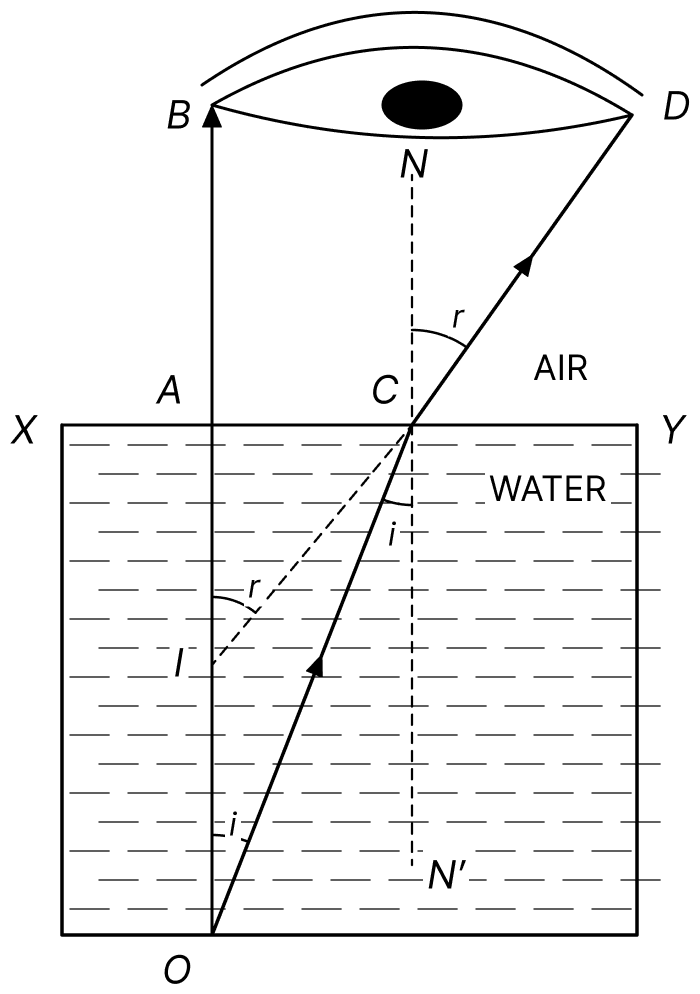
Let XY be the water-air surface and O a point at the bottom of the pool. A ray OA along the normal emerges undeviated along AB. Another ray OC, incident at C at angle i, bends away from the normal NN' and emerges along CD at angle r. The rays AB and CD, produced backwards, meet at I, the virtual image of O. So the bottom appears at I, and AO is the real depth while AI is the apparent depth.
Since ∠NCD = ∠AIC (corresponding angles) and ∠OCN' = ∠AOC (alternate angles),
For an eye viewing nearly normally, C is very close to A, so CO ≃ AO and CI ≃ AI. Thus,
As anw > 1, AI < AO; hence a swimming pool appears shallower than it actually is.
Normal displacement : The normal displacement of the object is OI. Taking AO = t (thickness of water),
Explain, with ray-diagram, total internal reflection of light. Give two conditions for it to take place. Obtain relation between critical angle and refractive index of the denser medium.
Answer
Total internal reflection : When a ray passes from a denser medium (glass) to a rarer medium (air), it bends away from the normal.
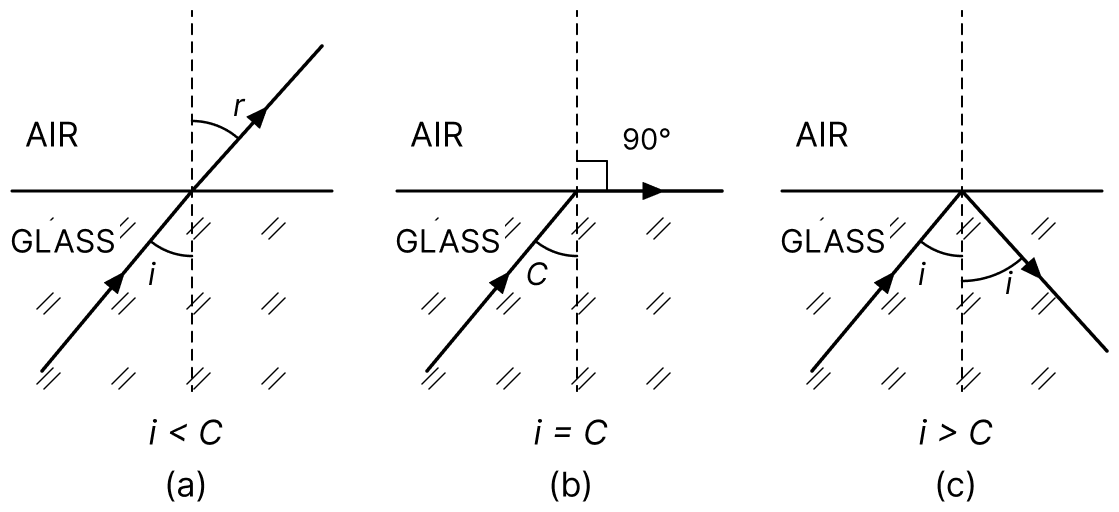
(a) For an angle of incidence i < C, the ray is refracted into air, along with a weak reflected ray.
(b) As i increases, the angle of refraction increases. When i = C, the critical angle, the refracted ray grazes along the interface (angle of refraction 90°).
(c) When i is increased even slightly beyond C, the whole of the light is reflected back into the denser medium in accordance with the laws of reflection. This is total internal reflection.
Conditions :
(i) The ray should travel from the denser medium towards the rarer medium.
(ii) The angle of incidence should be greater than the critical angle for the two media.
Relation between critical angle and refractive index : Let 1 be the rarer and 2 the denser medium. For i = C in medium 2, the angle of refraction in medium 1 is 90°. By Snell's law,
But , where 1n2 is the refractive index of the denser medium with respect to the rarer. Hence,
Show, by ray-diagrams, how a totally reflecting glass prism can be used to deviate a ray through : (i) 90°, (ii) 180°.
Answer
A totally reflecting prism is a right-angled isosceles glass prism ABC, with ∠A = 90° and ∠B = ∠C = 45°. The critical angle for glass-air is about 42°.
(i) Deviation through 90° :
A ray falls normally on the face AB and enters undeviated. It strikes the hypotenuse face BC at an angle of incidence of 45°. As 45° > 42°, it is totally reflected and falls normally on the face AC, from which it emerges undeviated. The ray is thus turned through 90°.
(ii) Deviation through 180° :
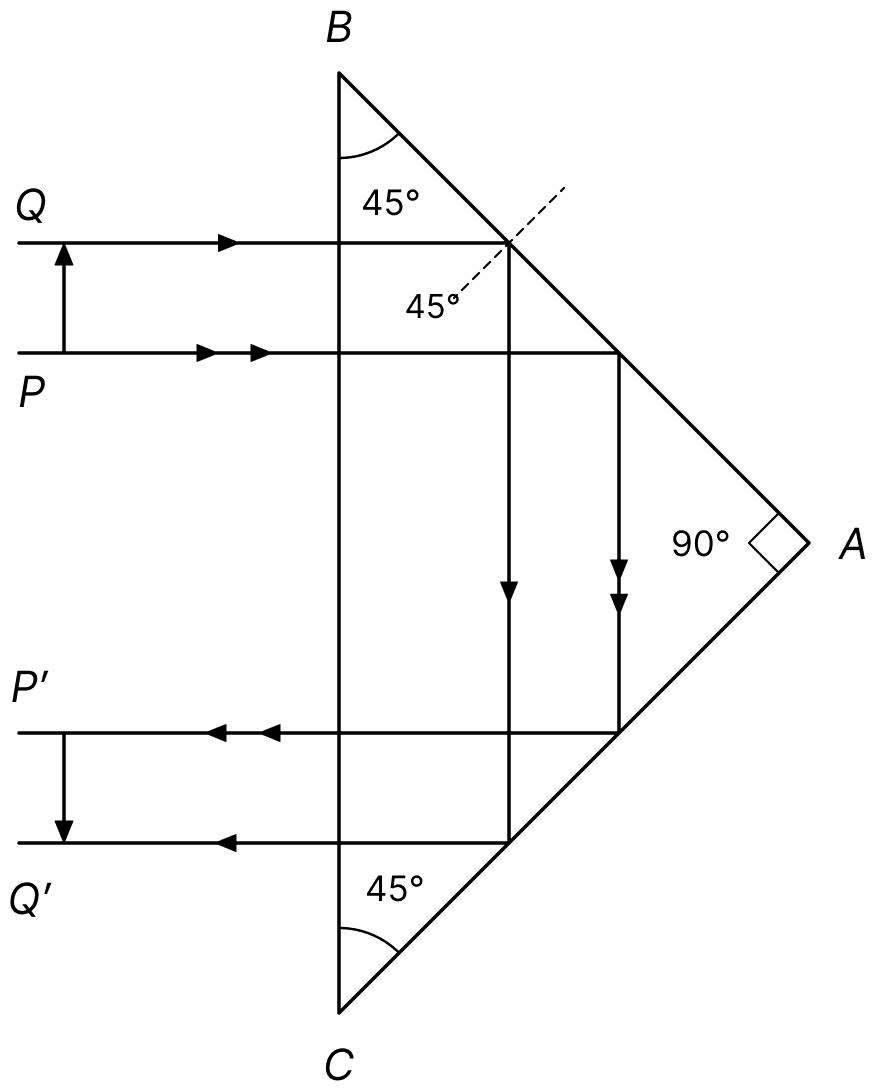
A ray falls normally on the hypotenuse face BC and enters undeviated. It strikes the face AB at 45° and is totally reflected towards AC. It strikes AC also at 45°, is again totally reflected, and falls normally on BC, emerging undeviated. The emergent ray is antiparallel to the incident ray, so the ray is turned through 180°.
For total reflection at 45° in both cases, sin 45° > , i.e., the prism material must have n > (≈ 1.414), which crown glass satisfies.
What is an optical fibre? On what principle does it work? Explain by ray-diagram, how optical fibres transmit signals. Mention one practical application of optical fibres.
Answer
Optical fibre : An optical fibre transmits light fed into one of its ends right through to the other end, with very little of the light lost through its sides. It consists of a very thin cylindrical core of high-quality glass or quartz (diameter a few micrometres) of refractive index n1, surrounded by a cladding of slightly lower refractive index n2.
Principle : It works on the principle of total internal reflection of light.
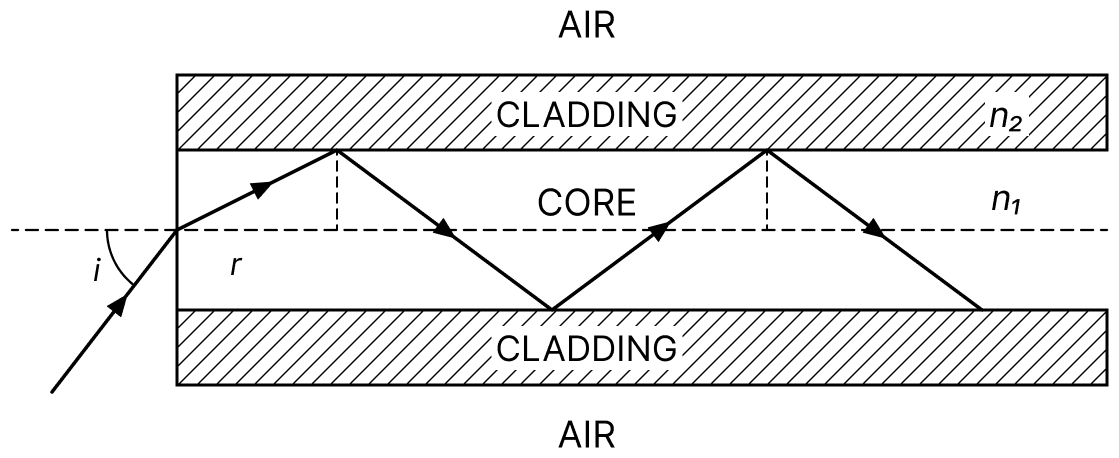
Transmission of signals : Light entering one end of the fibre at a small angle is refracted into the core and falls on the core-cladding interface. Its angle of incidence there is greater than the critical angle for the core-cladding interface, so it is totally reflected. Due to the cylindrical symmetry it strikes the opposite interface also at the same angle and is again totally reflected. The light is thus guided through the core by repeated total internal reflections, even when the fibre is bent, and comes out at the other end with little loss of intensity.
Application : Optical fibres are used in telecommunication, for carrying telephone and other signals as light signals; a single fibre can carry about 2000 telephone conversations without much loss.
Examiner alloted an experiment to a student. In this experiment, he has to find the refractive index of the glass slab by using travelling microscope. After giving instructions, examiner asks some questions to the student. State whether the responses of the student, in each case, are correct or incorrect. Give a reason for your answer.
(i) EXAMINER: What causes a normal shift when viewed through glass slab?
STUDENT: Normal shift is caused due to refraction of light.
(ii) EXAMINER: Focusses the microscope on a ink mark, marked on a piece of paper and then put a slab of glass of thickness 3 cm and refractive index 1.5 over the mark. Now he asks the student to focus the microscope again on the same mark.
STUDENT: Lowers the microscope downward by 1 cm.
(iii) EXAMINER: Lower-half of a vessel of depth 2d is filled with a liquid of refractive index n1 and the upper-half with a liquid of refractive index n2. Find the apparent depth of the vessel when seen perpendicularly.
STUDENT: Apparent depth =
Answer
(i) Correct.
Rays from the object, travelling from the denser medium (glass) into the rarer medium (air), bend away from the normal at the surface. Produced backwards, they appear to come from a point I above the object O. This normal shift is thus caused by refraction of light.
(ii) Incorrect.
Given,
- Thickness of slab, t = 3 cm
- Refractive index, n = 1.5
The mark appears raised by the normal shift,
As the mark appears raised, the microscope must be shifted 1 cm upward, not lowered.
(iii) Correct.
When viewed normally, each layer contributes to the apparent depth its real thickness divided by its own refractive index. With each layer of thickness d,
Explain the refraction of light, write its laws and also write the basic cause of refraction of light. Derive the relation n = . What form it takes when object is viewed through several media?
Answer
Refraction of light : When a ray of light passes obliquely from one transparent medium to another, it deviates from its original path at the interface of the two media. This bending of light in passing from one medium to another is called refraction of light. If the ray bends towards the normal, the second medium is optically denser; if it bends away from the normal, it is rarer.
Laws of refraction :
(i) The incident ray, the refracted ray and the normal to the interface at the point of incidence all lie in the same plane.
(ii) For a given pair of media and light of a given colour, = constant = 1n2 (Snell's law).
Basic cause : Refraction occurs because the speed of light is different in different media. The greater the change in speed, the more the bending.
Relation n = Real depth / Apparent depth :
Let XY be the surface separating water (below) from air (above), and O a point-object in water. The ray OA, along the normal, emerges undeviated along AB. The ray OC, incident at C at angle i, bends away from the normal NN' and emerges along CD at angle r. Produced backwards, AB and CD meet at I, the virtual image of O. AO is the real depth and AI the apparent depth.
By Snell's law at C,
As NN' is parallel to AO, ∠NCD = ∠AIC (corresponding angles) = r and ∠OCN' = ∠AOC (alternate angles) = i. From triangles AIC and AOC,
Substituting in Eq. (i),
For normal viewing the aperture of the eye is small, so C is very close to A; then CO ≃ AO and CI ≃ AI. Hence,
Viewing through several media : If the object is seen normally through several parallel layers of thicknesses d1, d2, d3, … and refractive indices n1, n2, n3, …, each layer contributes its own apparent thickness, so
and the effective refractive index of the combination is
Define reversibility of light, refractive index and absolute refractive index. Prove that 1n2 × 2n3 × 3n1 = 1. Can the value of absolute refractive index be lesser than 1?
Answer
Reversibility of light : When a ray of light, after suffering any number of reflections and refractions, has its final path reversed, it travels back along its entire initial path. This is the principle of reversibility of light.
Refractive index : The refractive index of medium 2 with respect to medium 1 is the ratio of the sine of the angle of incidence in medium 1 to the sine of the angle of refraction in medium 2, ; it also equals , the ratio of the speeds of light in the two media.
Absolute refractive index : It is the ratio of the speed of light in vacuum to the speed of light in the medium, .
To prove 1n2 × 2n3 × 3n1 = 1 :
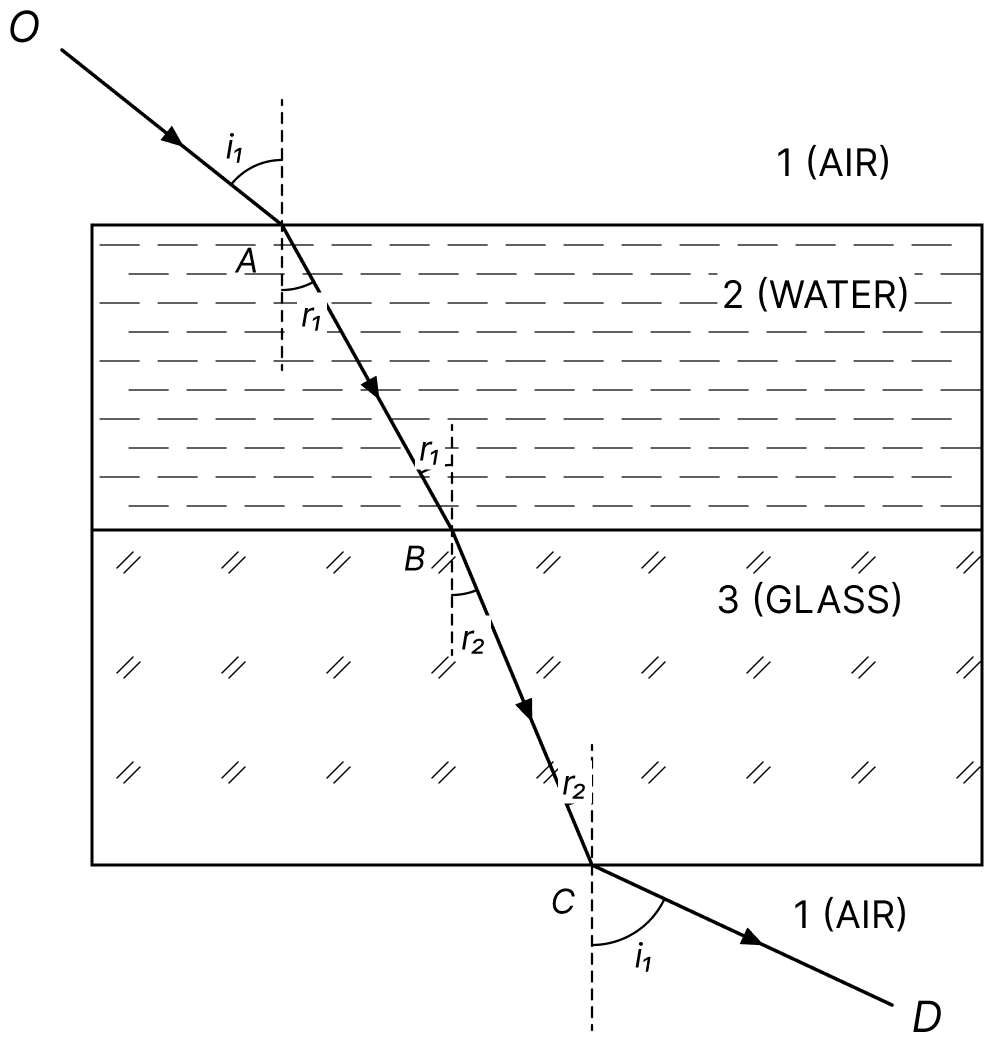
Let a ray OA in medium 1 (air) be incident at A at angle i1 on a layer of medium 2 (water), which rests on a parallel layer of medium 3 (glass), with medium 1 again below it. The ray is refracted along AB at angle r1, then along BC at angle r2, and finally emerges into medium 1 along CD.
At A,
At B, the angle of incidence is r1 (the interfaces are parallel), so
At C, the angle of incidence is r2. As the ray returns to medium 1 and all the interfaces are parallel, the emergent ray CD is parallel to OA and the angle of emergence is i1. So
Multiplying Eqs. (i), (ii) and (iii),
Can absolute refractive index be less than 1? No. Light travels fastest in vacuum, so c > v in every material medium and is always greater than 1 (it is 1 for vacuum).
A vessel of depth d is filled up to a depth of d1 by a liquid of refractive index n1, up to a depth d2 by a liquid of refractive index n2 and up to a depth d3 by a liquid of refractive index n3. Show that the apparent depth of the vessel when viewed normally is given by
[here d = d1 + d2 + d3 and n1 > n2 > n3]
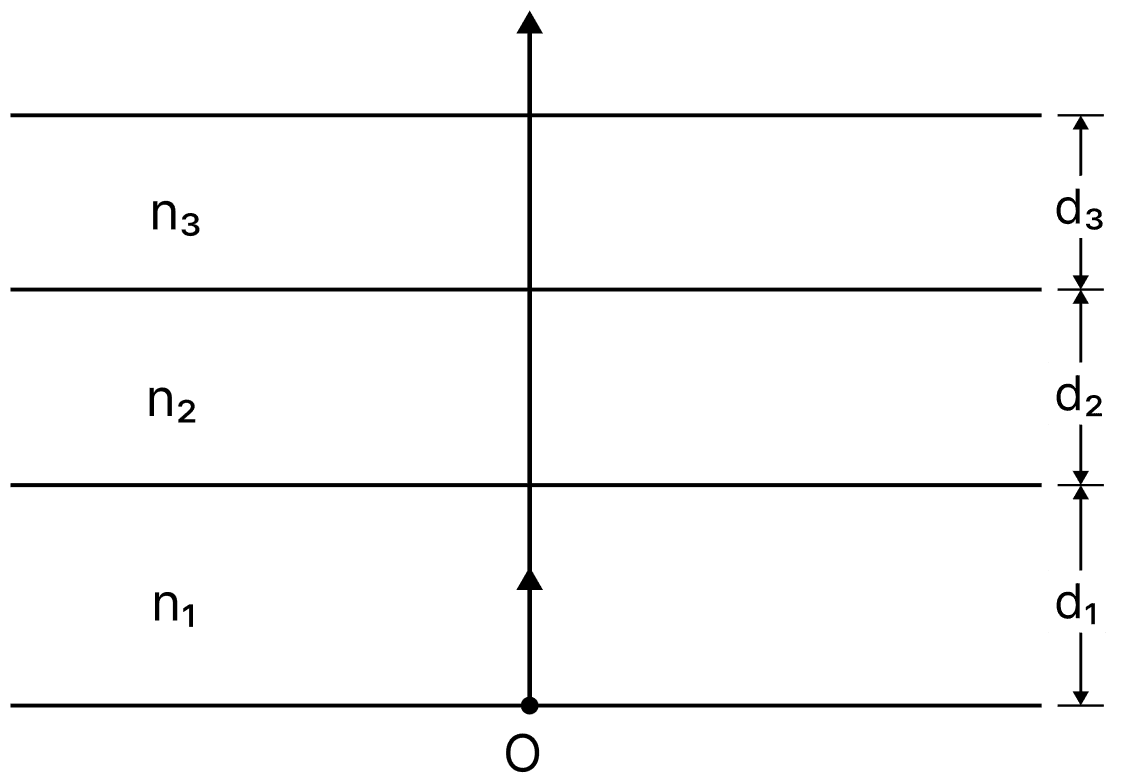
Answer
Given,
- Thicknesses of the layers (from the bottom) = d1, d2, d3, with d = d1 + d2 + d3
- Refractive indices of the layers = n1, n2, n3, with n1 > n2 > n3
- Object O at the bottom, viewed normally from air
When an object in a denser medium is viewed normally from a rarer medium, the refractive index of the denser medium relative to the rarer equals . Since n1 > n2 > n3 > 1, at each interface light passes from a denser to a rarer medium, so this relation applies at every interface, taken from the bottom up.
At the n1–n2 interface : O is at depth d1 below it. Seen from medium 2, its image I1 is at depth x1, where
At the n2–n3 interface : I1 acts as the object, at depth (d2 + x1) below this interface. Seen from medium 3, its image I2 is at depth x2, where
At the n3–air surface : I2 is at depth (d3 + x2) below the free surface. Seen from air (refractive index 1), the final image is at depth happ, where
Hence, the apparent depth of the vessel when viewed normally is .
Read the passage(s) and answer the following questions :
When a ray of light travelling from a denser medium to a rarer medium is incident at the interface of the two media at an angle greater than critical angle for the two media, the ray is 'totally' reflected back into the denser medium. Since, refractive index depends upon the wavelength of light, the critical angle for a given pair of media is different for different wavelengths (colours) of light.
Critical angle for glass-air interface can be written as
(i) Name the principle on the basis of which optical fibres work.
(ii) Calculate the critical angle for glass and water pair. Given refractive index of glass is 1.62 and that of water is 1.33.
(iii) A small bulb is placed at the bottom of a tank containing water to a depth of 80 cm. What is the area of the surface of water through which light from the bulb can emerge out? Refractive index of water is (π = 3.14).
(iv) Light rays of blue, green and red colours are incident on a right-angled prism, as shown. Green ray makes a grazing emergence. Out of red and blue light, which one comes out of the prism without suffering total internal reflection?
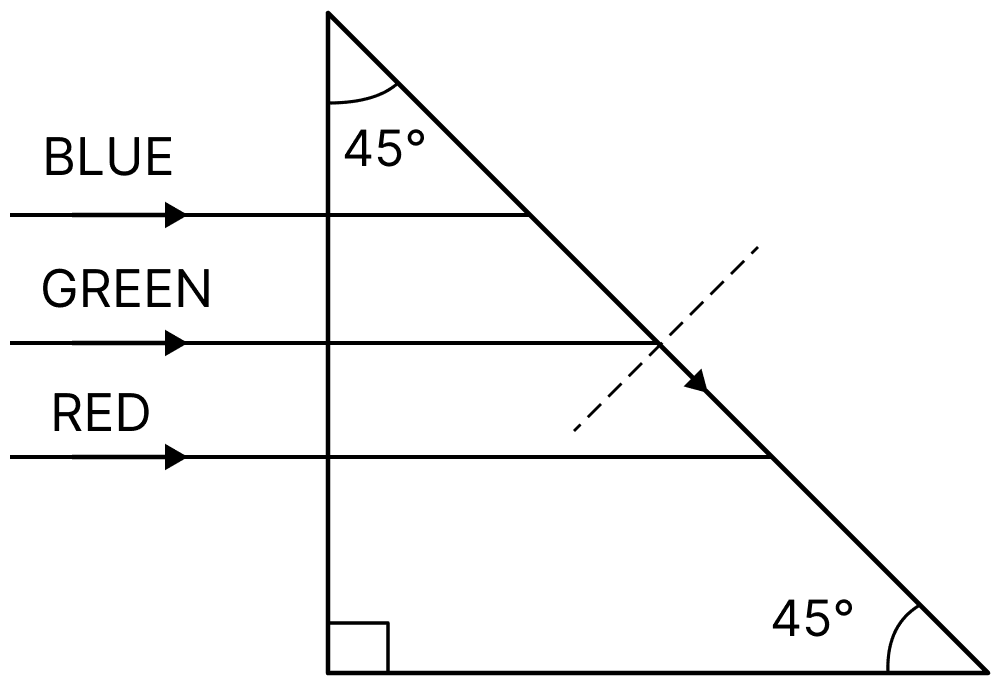
Answer
(i) Optical fibres work on the principle of total internal reflection of light.
(ii) Given,
- Refractive index of glass, ng = 1.62
- Refractive index of water, nw = 1.33
For the glass-water pair (glass denser), the critical angle ic is given by
Hence, the critical angle for the glass-water pair is about 55°.
(iii) Given,
- Depth of bulb below the surface, h = 80 cm = 0.80 m
- Refractive index of water, anw =
- π = 3.14
Light from the bulb can pass out through the surface only where its angle of incidence at the surface does not exceed the critical angle ic for water-air interface; rays striking the surface at larger angles are totally reflected. So light emerges through a circle of radius r centred vertically above the bulb, with
For the critical angle,
so, in a right-angled triangle with hypotenuse 4 and opposite side 3, the adjacent side is , and
The area of the circular patch is
Hence, light from the bulb emerges through an area of about 2.6 m2 of the water surface.
(iv) The rays enter the vertical face normally and strike the hypotenuse face at an angle of incidence of 45°. The green ray makes a grazing emergence, so the critical angle for green light at the prism-air interface is 45°.
As and nred < ngreen < nblue,
For red light, the angle of incidence (45°) is less than its critical angle, so it is refracted out; for blue light it exceeds the critical angle, so blue is totally reflected.
Hence, red light comes out of the prism without suffering total internal reflection.