KnowledgeBoat Logo
|
OPEN IN APP

Chapter 3

Electric Potential — Numericals

Class 12 - Nootan Physics


Numericals

Question 1

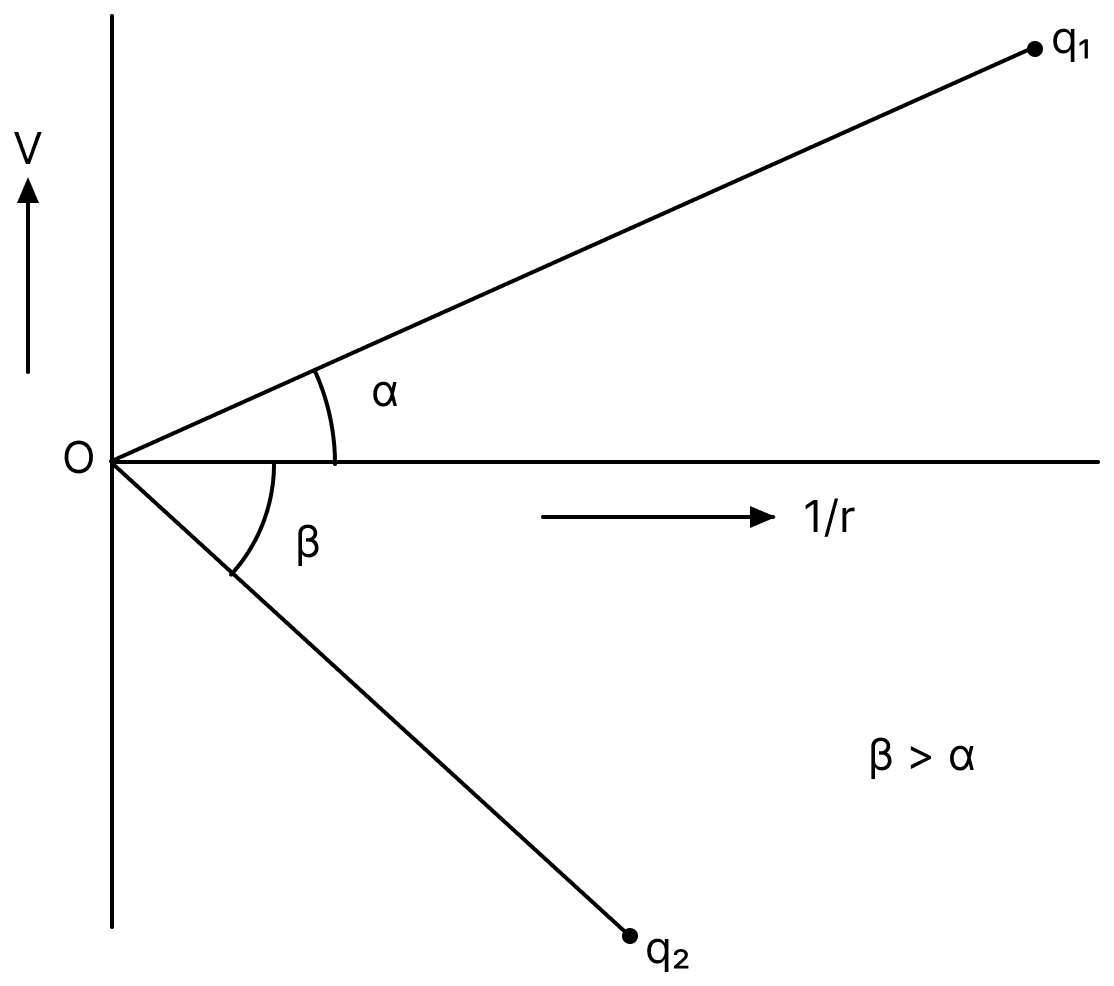
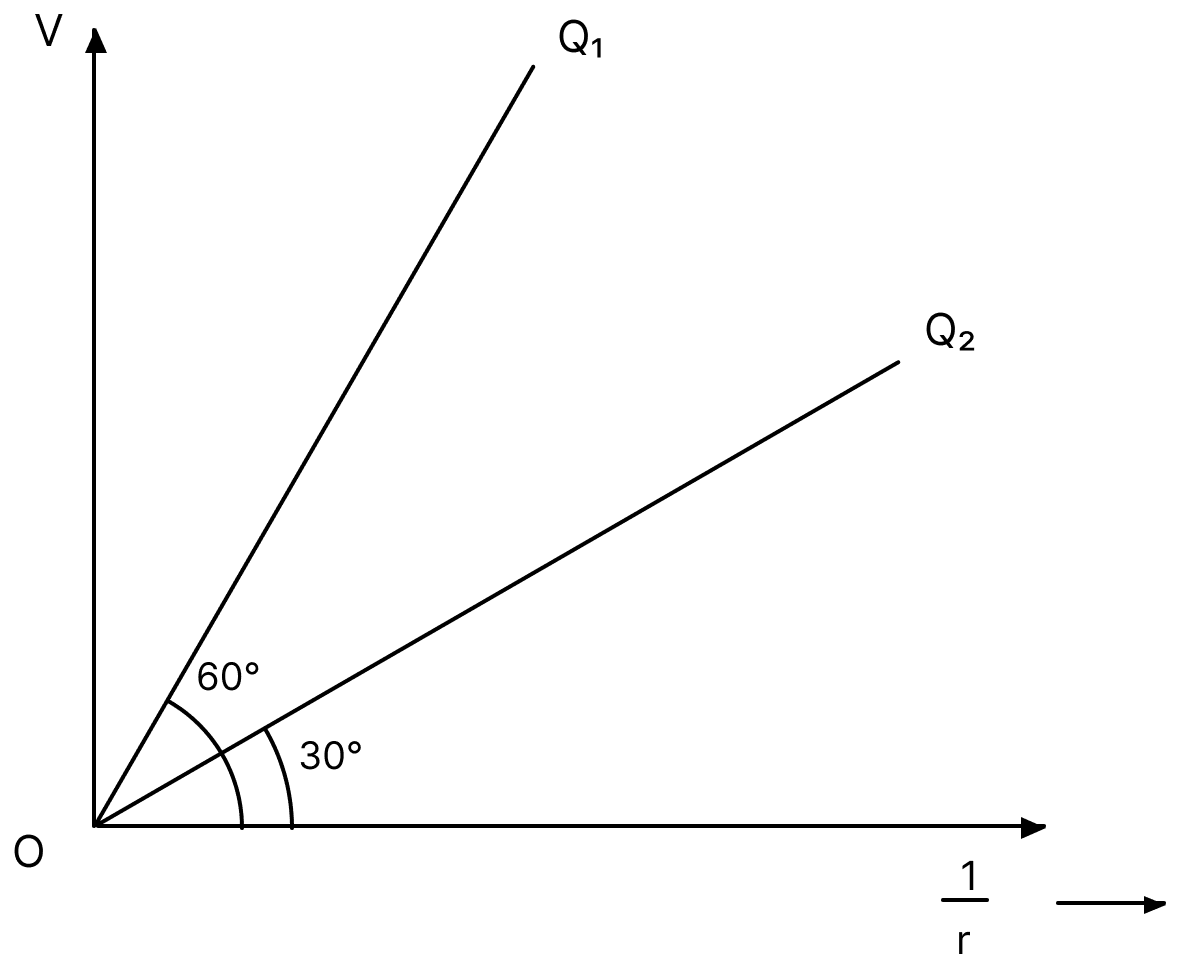
The figure shows the variation of potential V with 1r\dfrac{1}{\text r} for two point charges Q1 and Q2, where V is the potential at a distance 'r' due to a point charge. Find Q1Q2\dfrac{\text Q_1}{\text Q_2}.

The figure shows the variation of potential V with 1/ text r for two point charges Q 1 and Q 2, where V is the potential at a distance r due to a point charge. Find text Q_1/ text Q_2. Electric Potential, Nootan Physics Solutions ICS Class 12

Answer

Given,

  • The line for Q1 makes an angle of 60° with the 1r\dfrac{1}{\text r} axis
  • The line for Q2 makes an angle of 30° with the 1r\dfrac{1}{\text r} axis

The potential at a distance r due to a point charge Q is

V=14πϵ0QrV=(Q4πϵ0)1r\text V = \dfrac{1}{4\pi\epsilon_0}\dfrac{\text Q}{\text r} \\[1em] \text V = \left(\dfrac{\text Q}{4\pi\epsilon_0}\right)\dfrac{1}{\text r}

This is a straight line through the origin when V is plotted against 1r\dfrac{1}{\text r}, whose slope is Q4πϵ0\dfrac{\text Q}{4\pi\epsilon_0}. Hence the slope is directly proportional to the charge,

Q1Q2=tan⁡60°tan⁡30°=313=3×3Q1Q2=3\dfrac{\text Q_1}{\text Q_2} = \dfrac{\tan 60°}{\tan 30°} \\[1em] = \dfrac{\sqrt3}{\dfrac{1}{\sqrt3}} \\[1em] = \sqrt3 \times \sqrt3 \\[1em] \dfrac{\text Q_1}{\text Q_2} = 3

Hence, Q1Q2\dfrac{\text Q_1}{\text Q_2} = 3 : 1.

Question 2

The amount of work done in bringing a charge of 1.3 × 10⁻⁷ C from infinity to a point in an electric field is 6.5 × 10⁻⁵ J. Find the electric potential at the point.

Answer

Given,

  • Charge, q0 = 1.3 × 10⁻⁷ C
  • Work done, W = 6.5 × 10⁻⁵ J

By the definition of electric potential,

V=Wq0=6.5×10−51.3×10−7=5×10²V=500 V\text V = \dfrac{\text W}{\text q_0} \\[1em] = \dfrac{6.5\times10^{-5}}{1.3\times10^{-7}} \\[1em] = 5 \times 10^2 \\[1em] \text V = 500\ \text V

Hence, the electric potential at the point is 500 V.

Question 3

5 J work is done in moving a positive charge of 0.5 C between two points. Find the PD between the points.

Answer

Given,

  • Work done, W = 5 J
  • Charge, q0 = 0.5 C

By the definition of potential difference,

VA−VB=Wq0=5 J0.5 CVA−VB=10 V\text V_\text A - \text V_\text B = \dfrac{\text W}{\text q_0} \\[1em] = \dfrac{5\ \text J}{0.5\ \text C} \\[1em] \text V_\text A - \text V_\text B = 10\ \text V

Hence, the potential difference between the points is 10 V.

Question 4

A wire is bent in a circle of radius 10 cm. It is given a charge of 250 μC which spreads on it uniformly. What is the electric potential and intensity of field at its centre?

Answer

Given,

  • Radius of the circle, r = 10 cm = 0.10 m
  • Charge on the wire, q = 250 μC = 250 × 10-6 C

Electric potential at the centre : Every element of the charged wire is at the same distance r from the centre, and potential is a scalar quantity. Hence

V=14πϵ0qr=(9.0×10⁹)(250×10−6)0.10=2.25×1060.10V=2.25×10⁷ V\text V = \dfrac{1}{4\pi\epsilon_0}\dfrac{\text q}{\text r} \\[1em] = \dfrac{(9.0\times10^9)(250\times10^{-6})}{0.10} \\[1em] = \dfrac{2.25\times10^6}{0.10} \\[1em] \text V = 2.25\times10^7\ \text V

Intensity of electric field at the centre : The field is a vector quantity. For every small element of the ring there is a diametrically opposite element which produces an equal and opposite field at the centre. Hence all the contributions cancel in pairs and

E=0\text E = 0

Hence, the electric potential at the centre is 2.25 × 10⁷ V and the intensity of the electric field is zero.

Question 5

Calculate in the given figure : (i) electric potentials at points A and B, (ii) work done in taking the same amount of negative charge from A to B, (OA = 0.10 m, OB = 0.20 m).

Calculate in the given figure: (i) electric potentials at points A and B, (ii) work done in taking the same amount of negative charge from A to B, (OA = 0.10 m, OB = 0.20 m). Electric Potential, Nootan Physics Solutions ICS Class 12

Answer

Given,

  • Charge at O, q = + 10 μμC = 10 × 10-12 C
  • OA = 0.10 m, OB = 0.20 m

(i) Electric potentials at A and B :

VA=14πϵ0qOA=(9.0×10⁹)(10×10−12)0.10=9×10−20.10VA=0.90 VVB=14πϵ0qOB=(9.0×10⁹)(10×10−12)0.20=9×10−20.20VB=0.45 V\text V_\text A = \dfrac{1}{4\pi\epsilon_0}\dfrac{\text q}{\text{OA}} \\[1em] = \dfrac{(9.0\times10^9)(10\times10^{-12})}{0.10} \\[1em] = \dfrac{9\times10^{-2}}{0.10} \\[1em] \text V_\text A = 0.90\ \text V \\[1em] \text V_\text B = \dfrac{1}{4\pi\epsilon_0}\dfrac{\text q}{\text{OB}} \\[1em] = \dfrac{(9.0\times10^9)(10\times10^{-12})}{0.20} \\[1em] = \dfrac{9\times10^{-2}}{0.20} \\[1em] \text V_\text B = 0.45\ \text V

(ii) Work done in taking a charge of − 10 μμC from A to B :

W=q0(VB−VA)=(−10×10−12)(0.45−0.90)=(−10×10−12)(−0.45)W=4.5×10⁻¹² J\text W = \text q_0(\text V_\text B - \text V_\text A) \\[1em] = (-10\times10^{-12})(0.45 - 0.90) \\[1em] = (-10\times10^{-12})(-0.45) \\[1em] \text W = 4.5\times10^{-12}\ \text J

Hence, VA = 0.90 V, VB = 0.45 V and the work done is 4.5 × 10⁻¹² J.

Question 6

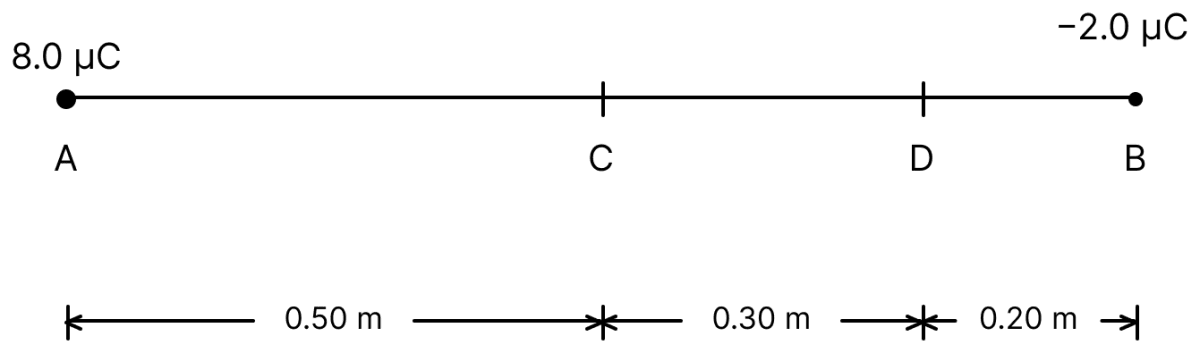
A charge A of 8.0 μC is situated at a distance of 1.00 m from a charge B of −2.0 μC, as shown in figure. Calculate the potential at the mid-point C between A and B. Also calculate the potential at D which is at a distance of 0.80 m from A and 0.20 m from B. How much work will be done in taking 0.02 μC of charge from D to C?

A charge A of 8.0 μC is situated at a distance of 1.00 m from a charge B of −2.0 μC, as shown in figure. Calculate the potential at the mid-point C between A and B. Also calculate the potential at D which is at a distance of 0.80 m from A and 0.20 m from B. How much work will be done in taking 0.02 μC of charge from D to C? Electric Potential, Nootan Physics Solutions ICS Class 12

Answer

Given,

  • qA = 8.0 μC = 8.0 × 10⁻⁶ C, qB = − 2.0 μC = − 2.0 × 10⁻⁶ C
  • AB = 1.00 m, so AC = CB = 0.50 m
  • AD = 0.80 m, DB = 0.20 m
  • Charge to be moved, q0 = 0.02 μC = 0.02 × 10⁻⁶ C

Potential at the mid-point C : Potential is a scalar, so the contributions add algebraically,

VC=14πϵ0[qAAC+qBCB]=(9.0×10⁹)[8.0×10−60.50+−2.0×10−60.50]=(9.0×10⁹)[6.0×10−60.50]=(9.0×10⁹)(1.2×10⁻⁵)VC=1.08×10⁵ V\text V_\text C = \dfrac{1}{4\pi\epsilon_0}\left[\dfrac{\text q_\text A}{\text{AC}} + \dfrac{\text q_\text B}{\text{CB}}\right] \\[1em] = (9.0\times10^9)\left[\dfrac{8.0\times10^{-6}}{0.50} + \dfrac{-2.0\times10^{-6}}{0.50}\right] \\[1em] = (9.0\times10^9)\left[\dfrac{6.0\times10^{-6}}{0.50}\right] \\[1em] = (9.0\times10^9)(1.2\times10^{-5}) \\[1em] \text V_\text C = 1.08\times10^5\ \text V

Potential at D :

VD=(9.0×10⁹)[8.0×10−60.80+−2.0×10−60.20]=(9.0×10⁹)[1.0×10⁻⁵−1.0×10⁻⁵]VD=0\text V_\text D = (9.0\times10^9)\left[\dfrac{8.0\times10^{-6}}{0.80} + \dfrac{-2.0\times10^{-6}}{0.20}\right] \\[1em] = (9.0\times10^9)\left[1.0\times10^{-5} - 1.0\times10^{-5}\right] \\[1em] \text V_\text D = 0

Work done in taking 0.02 μC from D to C :

W=q0(VC−VD)=(0.02×10⁻⁶)(1.08×10⁵−0)W=2.16×10⁻³ J\text W = \text q_0(\text V_\text C - \text V_\text D) \\[1em] = (0.02\times10^{-6})(1.08\times10^5 - 0) \\[1em] \text W = 2.16\times10^{-3}\ \text J

Hence, VC = 1.08 × 10⁵ V, VD = zero and the work done is 2.16 × 10⁻³ J.

Question 7

Two charges +20 μC and −10 μC are 6 cm apart. Find electric potential at a point distant 4 cm on the right bisector of the line joining the charges.

Answer

Given,

  • q1 = + 20 μC = 20 × 10-6 C, q2 = − 10 μC = − 10 × 10-6 C
  • Separation between the charges = 6 cm, so half the separation = 3 cm = 0.03 m
  • Distance of the point from the mid-point along the right bisector = 4 cm = 0.04 m

The point on the right bisector is equidistant from both the charges,

r=(0.03)2+(0.04)2=0.0009+0.0016=0.0025r=0.05 m\text r = \sqrt{(0.03)^2 + (0.04)^2} \\[1em] = \sqrt{0.0009 + 0.0016} \\[1em] = \sqrt{0.0025} \\[1em] \text r = 0.05\ \text m

Since potential is a scalar,

V=14πϵ0q1+q2r=(9.0×10⁹)(20×10−6−10×10−6)0.05=(9.0×10⁹)(10×10−6)0.05=9×1040.05V=1.8×10⁶ V\text V = \dfrac{1}{4\pi\epsilon_0}\dfrac{\text q_1 + \text q_2}{\text r} \\[1em] = \dfrac{(9.0\times10^9)(20\times10^{-6} - 10\times10^{-6})}{0.05} \\[1em] = \dfrac{(9.0\times10^9)(10\times10^{-6})}{0.05} \\[1em] = \dfrac{9\times10^4}{0.05} \\[1em] \text V = 1.8\times10^6\ \text V

Hence, the electric potential at the point is 1.8 × 10⁶ V.

Question 8

The potential due to a point charge at a distance of 0.3 m is 103 V. What will be the electric field intensity due to the same charge at a distance of 0.4 m?

Answer

Given,

  • V = 103 V at r1 = 0.3 m
  • Distance at which E is required, r2 = 0.4 m

For a point charge,

V=14πϵ0qr1⇒q4πϵ0=Vr1=103×0.3q4πϵ0=300 N-m2C−1\text V = \dfrac{1}{4\pi\epsilon_0}\dfrac{\text q}{\text r_1} \\[1em] \Rightarrow \quad \dfrac{\text q}{4\pi\epsilon_0} = \text V\text r_1 \\[1em] = 10^3 \times 0.3 \\[1em] \dfrac{\text q}{4\pi\epsilon_0} = 300\ \text N\text{-m}^2\text C^{-1}

The electric field intensity at a distance r2 is

E=14πϵ0qr22=300(0.4)2=3000.16E=1875 V-m−1\text E = \dfrac{1}{4\pi\epsilon_0}\dfrac{\text q}{\text r_2^2} \\[1em] = \dfrac{300}{(0.4)^2} \\[1em] = \dfrac{300}{0.16} \\[1em] \text E = 1875\ \text V\text{-m}^{-1}

Hence, the electric field intensity at 0.4 m is 1875 V-m-1.

Question 9

The electric field at a point due to a point charge is 20 N-C-1 and the electric potential at that point is 10 J-C-1. Calculate the distance of the point from the charge and the magnitude of the charge.

Answer

Given,

  • E = 20 N-C-1
  • V = 10 J-C-1

For a point charge,

E=14πϵ0qr2,V=14πϵ0qr\text E = \dfrac{1}{4\pi\epsilon_0}\dfrac{\text q}{\text r^2}, \qquad \text V = \dfrac{1}{4\pi\epsilon_0}\dfrac{\text q}{\text r}

Dividing the second by the first,

VE=r⇒r=1020r=0.5 m\dfrac{\text V}{\text E} = \text r \\[1em] \Rightarrow \quad \text r = \dfrac{10}{20} \\[1em] \text r = 0.5\ \text m

The magnitude of the charge is

q=Vr(14πϵ0)=10×0.59.0×109q=0.55×10⁻⁹ C\text q = \dfrac{\text V\text r}{\left(\dfrac{1}{4\pi\epsilon_0}\right)} \\[1em] = \dfrac{10 \times 0.5}{9.0\times10^9} \\[1em] \text q = 0.55\times10^{-9}\ \text C

Hence, the point is 0.5 m from the charge and the magnitude of the charge is 0.55 × 10⁻⁹ C.

Question 10

A point charge of 6.0 × 10⁻⁸ C is situated at the coordinate origin. How much work will be done in taking an electron from the point x = 3 m to x = 6 m?

Answer

Given,

  • Source charge, q = 6.0 × 10⁻⁸ C at the origin
  • Initial position of the electron, r1 = 3 m; final position, r2 = 6 m
  • Charge on the electron, q0 = − 1.6 × 10⁻¹⁹ C

The potentials at the two points are

V1=(9.0×10⁹)(6.0×10⁻⁸)3=5403V1=180 VV2=(9.0×10⁹)(6.0×10⁻⁸)6=5406V2=90 V\text V_1 = \dfrac{(9.0\times10^9)(6.0\times10^{-8})}{3} \\[1em] = \dfrac{540}{3} \\[1em] \text V_1 = 180\ \text V \\[1em] \text V_2 = \dfrac{(9.0\times10^9)(6.0\times10^{-8})}{6} \\[1em] = \dfrac{540}{6} \\[1em] \text V_2 = 90\ \text V

The work done is

W=q0(V2−V1)=(−1.6×10⁻¹⁹)(90−180)=(−1.6×10⁻¹⁹)(−90)W=1.44×10⁻¹⁷ J\text W = \text q_0(\text V_2 - \text V_1) \\[1em] = (-1.6\times10^{-19})(90 - 180) \\[1em] = (-1.6\times10^{-19})(-90) \\[1em] \text W = 1.44\times10^{-17}\ \text J

Hence, the work done is 1.44 × 10⁻¹⁷ J.

Question 11

At each corner of an equilateral triangle charges of +250 μC are placed in air. What will be the resultant electric potential at the centroid of the triangle whose distance from each corner is 18 cm?

Answer

Given,

  • Charge at each corner, q = 250 μC = 250 × 10-6 C
  • Distance of the centroid from each corner, r = 18 cm = 0.18 m

Potential is a scalar quantity, so the potentials due to the three charges add algebraically,

V=3×14πϵ0qr=3×(9.0×109)(250×10−6)0.18=3×2.25×1060.18=3×1.25×107V=3.75×10⁷ V\text V = 3 \times \dfrac{1}{4\pi\epsilon_0}\dfrac{\text q}{\text r} \\[1em] = 3 \times \dfrac{(9.0\times10^9)(250\times10^{-6})}{0.18} \\[1em] = 3 \times \dfrac{2.25\times10^6}{0.18} \\[1em] = 3 \times 1.25\times10^7 \\[1em] \text V = 3.75\times10^7\ \text V

Hence, the resultant electric potential at the centroid is 3.75 × 10⁷ V.

Question 12

How much kinetic energy is gained by an electron, initially at rest, when it moves through a potential difference of 1000 V? Leave your answer in Joule.

Answer

Given,

  • Charge on the electron, e = 1.6 × 10⁻¹⁹ C
  • Potential difference, V = 1000 V

The kinetic energy gained by a charge accelerated from rest through a potential difference V is

K=qV=(1.6×10⁻¹⁹)(1000)K=1.6×10⁻¹⁶ J\text K = \text q\text V \\[1em] = (1.6\times10^{-19})(1000) \\[1em] \text K = 1.6\times10^{-16}\ \text J

Hence, the kinetic energy gained by the electron is 1.6 × 10⁻¹⁶ J.

Question 13

An α-particle at rest is accelerated through 106 V. (i) What will be its kinetic energy? (ii) If a proton be accelerated through the same potential difference, then how much kinetic energy will it gain? (iii) Which particle will gain more velocity if both start from rest?

Answer

Given,

  • Potential difference, V = 106 V
  • Charge on α-particle = 3.2 × 10⁻¹⁹ C, mass = 6.6 × 10⁻²⁷ kg
  • Charge on proton = 1.6 × 10⁻¹⁹ C, mass = 1.7 × 10⁻²⁷ kg

(i) Kinetic energy of the α-particle :

Kα=qαV=(3.2×10⁻¹⁹)(106)Kα=3.2×10⁻¹³ J\text K_\alpha = \text q_\alpha\text V \\[1em] = (3.2\times10^{-19})(10^6) \\[1em] \text K_\alpha = 3.2\times10^{-13}\ \text J

(ii) Kinetic energy of the proton :

Kp=qpV=(1.6×10⁻¹⁹)(106)Kp=1.6×10⁻¹³ J\text K_\text p = \text q_\text p\text V \\[1em] = (1.6\times10^{-19})(10^6) \\[1em] \text K_\text p = 1.6\times10^{-13}\ \text J

(iii) Comparison of velocities : Since K=12mv2\text K = \dfrac{1}{2}\text m\text v^2,

v=2Kmvαvp=KαKp×mpmα=3.2×10−131.6×10−13×1.7×10−276.6×10−27=2×0.258=0.515vαvp=0.72\text v = \sqrt{\dfrac{2\text K}{\text m}} \\[1em] \dfrac{\text v_\alpha}{\text v_\text p} = \sqrt{\dfrac{\text K_\alpha}{\text K_\text p} \times \dfrac{\text m_\text p}{\text m_\alpha}} \\[1em] = \sqrt{\dfrac{3.2\times10^{-13}}{1.6\times10^{-13}} \times \dfrac{1.7\times10^{-27}}{6.6\times10^{-27}}} \\[1em] = \sqrt{2 \times 0.258} \\[1em] = \sqrt{0.515} \\[1em] \dfrac{\text v_\alpha}{\text v_\text p} = 0.72

Since this ratio is less than 1, vp > vα.

Hence, Kα = 3.2 × 10⁻¹³ J, Kp = 1.6 × 10⁻¹³ J and the proton will gain more velocity.

Question 14

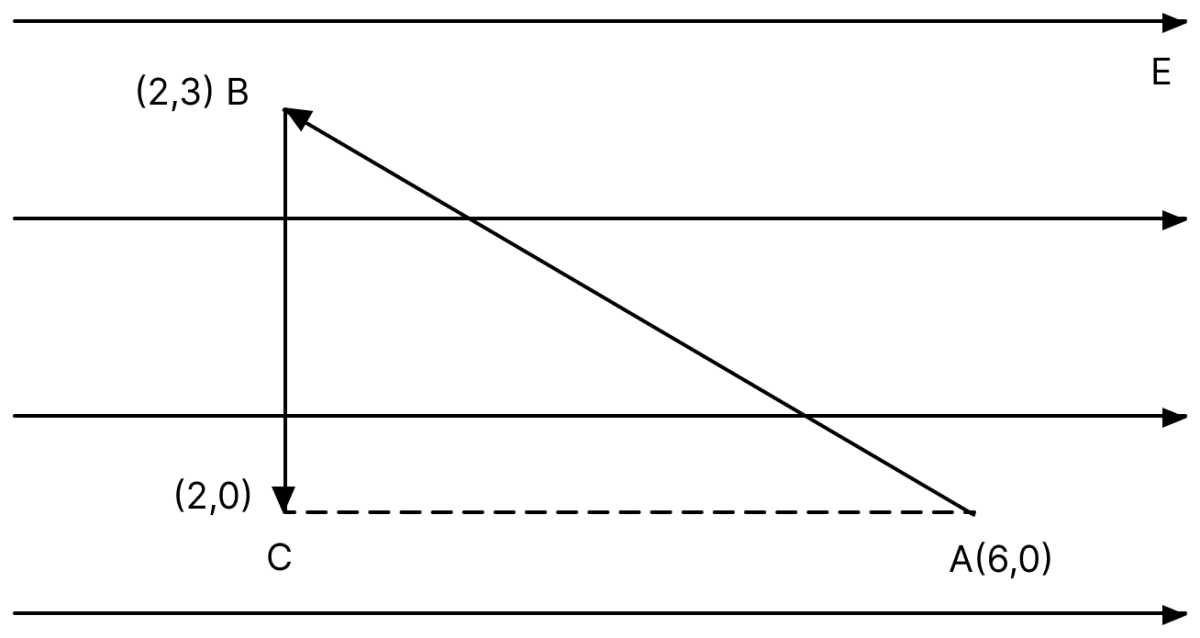
A test charge 'q' is moved without acceleration from A to C along the path from A to B and then from B to C in electric field E as shown in the figure. (i) Calculate the potential difference between A and C. (ii) At which point (A or C) is the electric potential more and why?

A test charge q is moved without acceleration from A to C along the path from A to B and then from B to C in electric field E as shown in the figure. (i) Calculate the potential difference between A and C. (ii) At which point (A or C) is the electric potential more and why? Electric Potential, Nootan Physics Solutions ICS Class 12

Answer

Given,

  • The uniform field E is directed along the positive X-axis
  • A is the point (6, 0) and C is the point (2, 0)

(i) Potential difference between A and C :

The electrostatic field is conservative, so the work done depends only on the initial and final positions and not on the path A → B → C. Since C and A both lie on the X-axis, only the displacement along the field matters,

AC=6−2AC=4 units\text{AC} = 6 - 2 \\[1em] \text{AC} = 4\ \text{units}

In a uniform electric field the potential difference between two points separated by a distance d along the field is

VC−VA=E×ACVC−VA=4E\text V_\text C - \text V_\text A = \text E \times \text{AC} \\[1em] \text V_\text C - \text V_\text A = 4\text E

(ii) The electric potential is more at C, because the potential always decreases in the direction of the electric field. Since the field points from C towards A, C is at the higher potential.

Question 15

The graph shows the variations of electrostatic potential (V) with 1r\dfrac{1}{\text r} (r being the distance of field point from the point charge) for two point charges q1 and q2.

The graph shows the variations of electrostatic potential (V) with 1/ text r (r being the distance of field point from the point charge) for two point charges q 1 and q 2. Electric Potential, Nootan Physics Solutions ICS Class 12

(i) What are the signs of the two charges?

(ii) Which of the two charges has the larger magnitude and why?

Answer

The potential at a distance r due to a point charge q is

V=(q4πϵ0)1r\text V = \left(\dfrac{\text q}{4\pi\epsilon_0}\right)\dfrac{1}{\text r}

which is a straight line through the origin of slope q4πϵ0\dfrac{\text q}{4\pi\epsilon_0} when V is plotted against 1r\dfrac{1}{\text r}.

(i) The line for q1 has a positive slope and the line for q2 has a negative slope. Hence q1 is positive and q2 is negative.

(ii) The magnitude of the slope of a line is proportional to the magnitude of the charge. From the graph the angle β made by the line of q2 is greater than the angle α made by the line of q1, so the magnitude of the slope for q2 is greater.

Hence |q2| > |q1|, that is, q2 has the larger magnitude.

Question 16

The magnitude of electric field (in NC-1) in a region varies with the distance r (in m) as

E = 10r + 5

By how much does the electric potential increase in moving from point at r = 1 m to a point at r = 10 m?

Answer

Given,

  • E = 10r + 5 N C-1
  • r1 = 1 m, r2 = 10 m

The change in potential is obtained from

dV=−E drV2−V1=−∫110(10r+5) dr\text{dV} = -\text E\ \text{dr} \\[1em] \text V_2 - \text V_1 = -\displaystyle\int_{1}^{10}(10\text r + 5)\ \text{dr}

Integrating term by term,

=−[10r22+5r]110=−[5r2+5r]110= -\left[\dfrac{10\text r^2}{2} + 5\text r\right]_{1}^{10} \\[1em] = -\left[5\text r^2 + 5\text r\right]_{1}^{10}

Evaluating the limits,

=−[(5(10)2+5(10))−(5(1)2+5(1))]=−[(500+50)−(5+5)]=−[550−10]V2−V1=−540 V= -\left[\left(5(10)^2 + 5(10)\right) - \left(5(1)^2 + 5(1)\right)\right] \\[1em] = -\left[(500 + 50) - (5 + 5)\right] \\[1em] = -\left[550 - 10\right] \\[1em] \text V_2 - \text V_1 = -540\ \text V

Hence, the change in electric potential is − 540 V; the potential decreases by 540 V.

Question 17

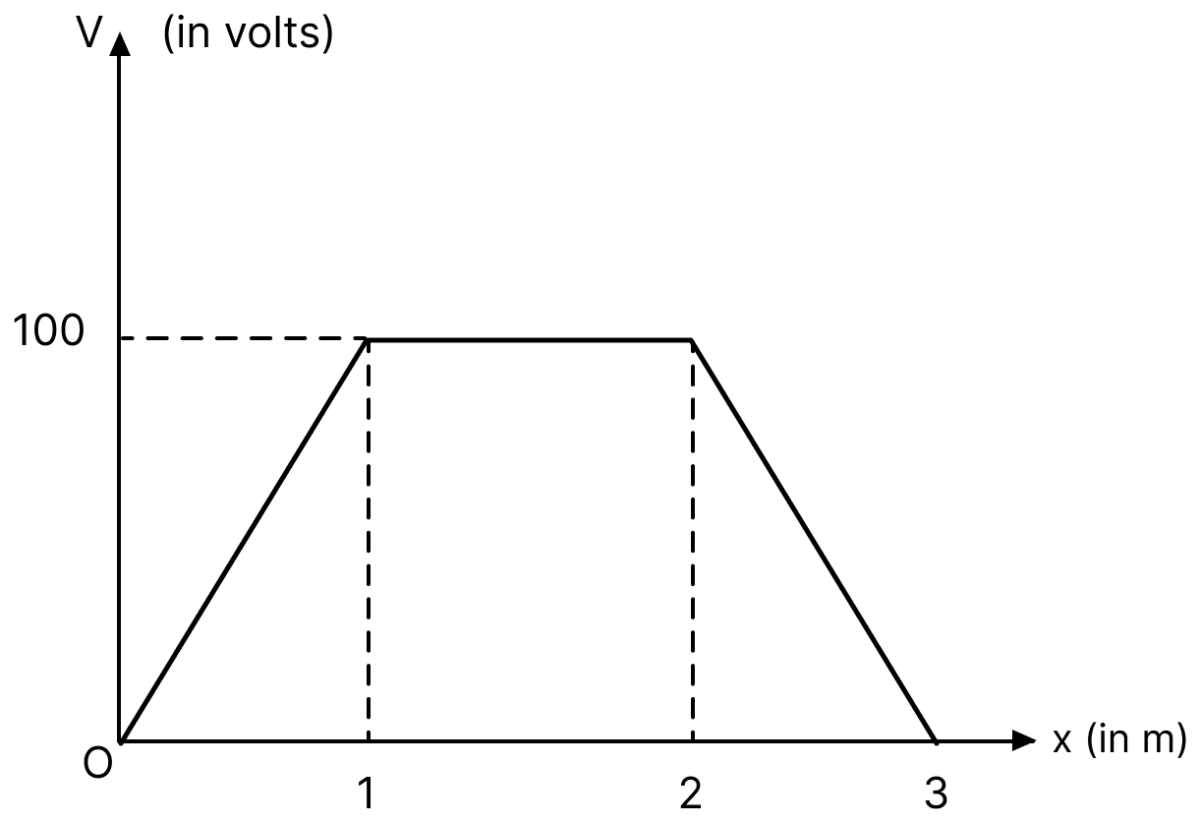
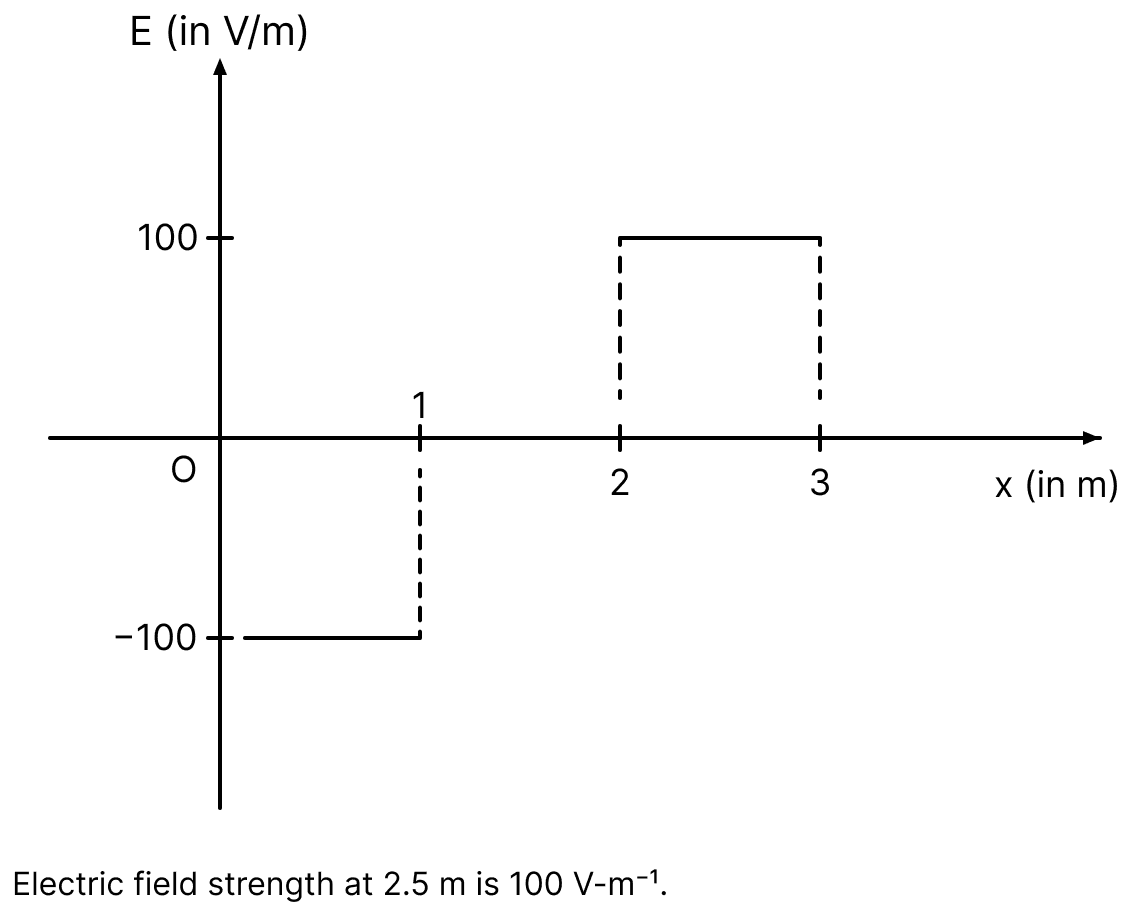
The electric potential as a function of distance 'x' is shown in the figure. Draw a graph of the electric field E as a function of x. Also, find electric field strength at x = 2.5 m.

The electric potential as a function of distance x is shown in the figure. Draw a graph of the electric field E as a function of x. Also, find electric field strength at x = 2.5 m. Electric Potential, Nootan Physics Solutions ICS Class 12

Answer

The electric field is the negative slope of the V-x graph,

E=−dVdx\text E = -\dfrac{\text{dV}}{\text{dx}}

From x = 0 to x = 1 m : V rises uniformly from 0 to 100 V, so the slope is 100−01−0=100\dfrac{100 - 0}{1 - 0} = 100 V m-1 and

E=−100 V-m−1\text E = -100\ \text V\text{-m}^{-1}

From x = 1 m to x = 2 m : V is constant at 100 V, so the slope is zero and

E=0\text E = 0

From x = 2 m to x = 3 m : V falls uniformly from 100 V to 0, so the slope is 0−1003−2=−100\dfrac{0 - 100}{3 - 2} = -100 V m-1 and

E=+100 V-m−1\text E = +100\ \text V\text{-m}^{-1}

The graph of E against x is therefore a step graph, with E = − 100 V-m-1 for 0 < x < 1, E = 0 for 1 < x < 2 and E = + 100 V-m-1 for 2 < x < 3.

The electric potential as a function of distance x is shown in the figure. Draw a graph of the electric field E as a function of x. Also, find electric field strength at x = 2.5 m. Electric Potential, Nootan Physics Solutions ICS Class 12

The point x = 2.5 m lies in the third region.

Hence, the electric field strength at x = 2.5 m is 100 V-m-1.

Question 18

The electric potential V at any point (x, y, z) is given by V = 3x2, where x is in metres and V in volts. Find electric field at the point (1 m, 0, 2 m).

Answer

Given, V = 3x2 volt.

Since V depends only on x, the electric field has only an x-component,

E⃗=−dVdxi^\vec{\text E} = -\dfrac{\text{dV}}{\text{dx}}\hat{\text i}

Differentiating,

dVdx=ddx(3x2)dVdx=6x\dfrac{\text{dV}}{\text{dx}} = \dfrac{\text d}{\text{dx}}(3\text x^2) \\[1em] \dfrac{\text{dV}}{\text{dx}} = 6\text x

Therefore

E⃗=−6x i^\vec{\text E} = -6\text x\ \hat{\text i}

At the point (1 m, 0, 2 m), x = 1 m,

E⃗=−6 i^ V-m−1\vec{\text E} = -6\ \hat{\text i}\ \text V\text{-m}^{-1}

Hence, the electric field at the given point is 6 V-m-1, directed along the negative x-axis.

Note: The printed answer gives 6 V-m-1 along the x-axis. Since E⃗=−dVdxi^\vec{\text E} = -\dfrac{\text{dV}}{\text{dx}}\hat{\text i}, the field is 6 V-m-1 along the negative x-axis.

Question 19

The potential at any point is given by V = x(y2 − 5x). Calculate the Cartesian components of the electric field at that point.

Answer

Given,

V=x(y2−5x)V=xy2−5x2\text V = \text x(\text y^2 - 5\text x) \\[1em] \text V = \text x\text y^2 - 5\text x^2

The Cartesian components of the field are the negative partial derivatives of V,

Ex=−∂V∂x,Ey=−∂V∂y,Ez=−∂V∂z\text E_\text x = -\dfrac{\partial \text V}{\partial \text x}, \qquad \text E_\text y = -\dfrac{\partial \text V}{\partial \text y}, \qquad \text E_\text z = -\dfrac{\partial \text V}{\partial \text z}

x-component : Differentiating partially with respect to x, treating y as constant,

∂V∂x=y2−10x⇒Ex=−(y2−10x)Ex=10x−y2\dfrac{\partial \text V}{\partial \text x} = \text y^2 - 10\text x \\[1em] \Rightarrow \quad \text E_\text x = -(\text y^2 - 10\text x) \\[1em] \text E_\text x = 10\text x - \text y^2

y-component : Differentiating partially with respect to y, treating x as constant,

∂V∂y=2xy⇒Ey=−2xy\dfrac{\partial \text V}{\partial \text y} = 2\text x\text y \\[1em] \Rightarrow \quad \text E_\text y = -2\text x\text y

z-component : V does not contain z, so

∂V∂z=0⇒Ez=0\dfrac{\partial \text V}{\partial \text z} = 0 \\[1em] \Rightarrow \quad \text E_\text z = 0

Hence, Ex = 10x − y2, Ey = − 2xy and Ez = 0.

Question 20

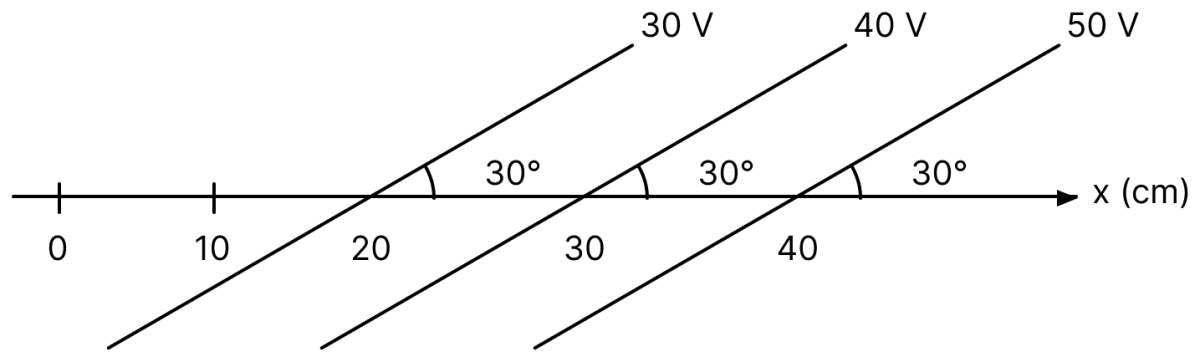
Some equipotential surfaces are shown in the figure. given below. Find the magnitude of electric field and show its direction in the diagram.

Some equipotential surfaces are shown in the figure. given below. Find the magnitude of electric field and show its direction in the diagram. Electric Potential, Nootan Physics Solutions ICS Class 12

Answer

Given,

  • The equipotential surfaces are of 30 V, 40 V and 50 V
  • They cut the x-axis at x = 20 cm, 30 cm and 40 cm, each making an angle of 30° with the x-axis

The distance between two successive surfaces measured along the x-axis is 10 cm. The perpendicular distance between them is therefore

d=10sin⁡30°=10×12=5 cmd=0.05 m\text d = 10\sin 30° \\[1em] = 10 \times \dfrac{1}{2} \\[1em] = 5\ \text{cm} \\[1em] \text d = 0.05\ \text m

The potential difference between two successive surfaces is

ΔV=40−30ΔV=10 V\Delta \text V = 40 - 30 \\[1em] \Delta \text V = 10\ \text V

Hence the magnitude of the electric field is

E=ΔVd=100.05E=200 V-m−1\text E = \dfrac{\Delta \text V}{\text d} \\[1em] = \dfrac{10}{0.05} \\[1em] \text E = 200\ \text V\text{-m}^{-1}

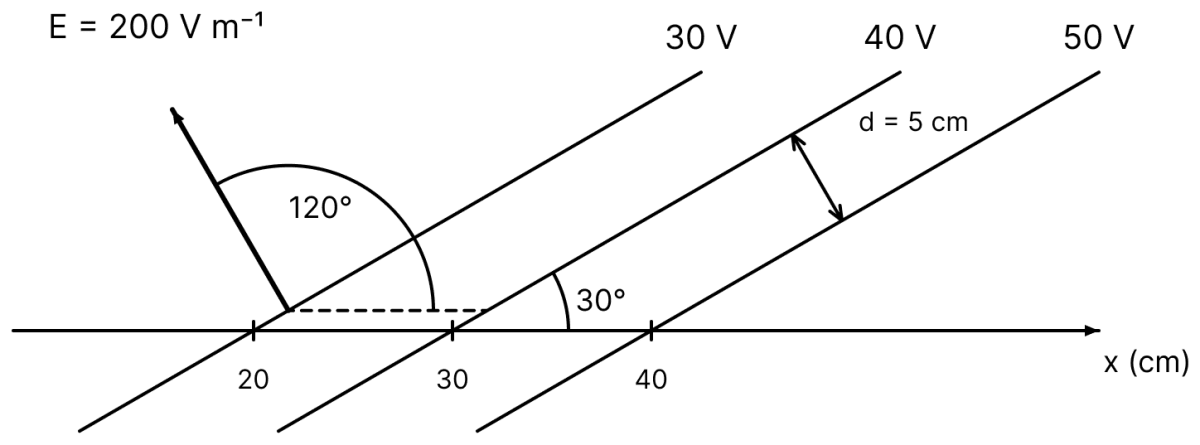
The field is normal to the equipotential surfaces and directed from the higher potential surface towards the lower potential surface, that is, towards the region of decreasing x.

Some equipotential surfaces are shown in the figure. given below. Find the magnitude of electric field and show its direction in the diagram. Electric Potential, Nootan Physics Solutions ICS Class 12

Hence, the magnitude of the electric field is 200 V-m-1, making an angle of 120° with the x-axis.

Question 21

An electric field E⃗=Cxi^\vec{\text E} = \text C\text x\hat{\text i} exists in space, where C = 10 V/m2. Taking the potential at (10 m, 20 m) to be zero, find the potential at the origin.

Answer

Given,

  • E⃗=Cxi^\vec{\text E} = \text C\text x\hat{\text i} with C = 10 V/m2
  • V = 0 at the point (10 m, 20 m)

The field has only an x-component, so only the x-coordinate matters. Using

dV=−Ex dx∫0VdV=−∫x=10x=0Cx dx\text{dV} = -\text E_\text x\ \text{dx} \\[1em] \displaystyle\int_{0}^{\text V}\text{dV} = -\displaystyle\int_{\text x = 10}^{\text x = 0}\text C\text x\ \text{dx}

Integrating,

V=−C[x22]100=−10(022−1022)=−10(0−50)V=500 V\text V = -\text C\left[\dfrac{\text x^2}{2}\right]_{10}^{0} \\[1em] = -10\left(\dfrac{0^2}{2} - \dfrac{10^2}{2}\right) \\[1em] = -10(0 - 50) \\[1em] \text V = 500\ \text V

Hence, the potential at the origin is 500 V.

Question 22

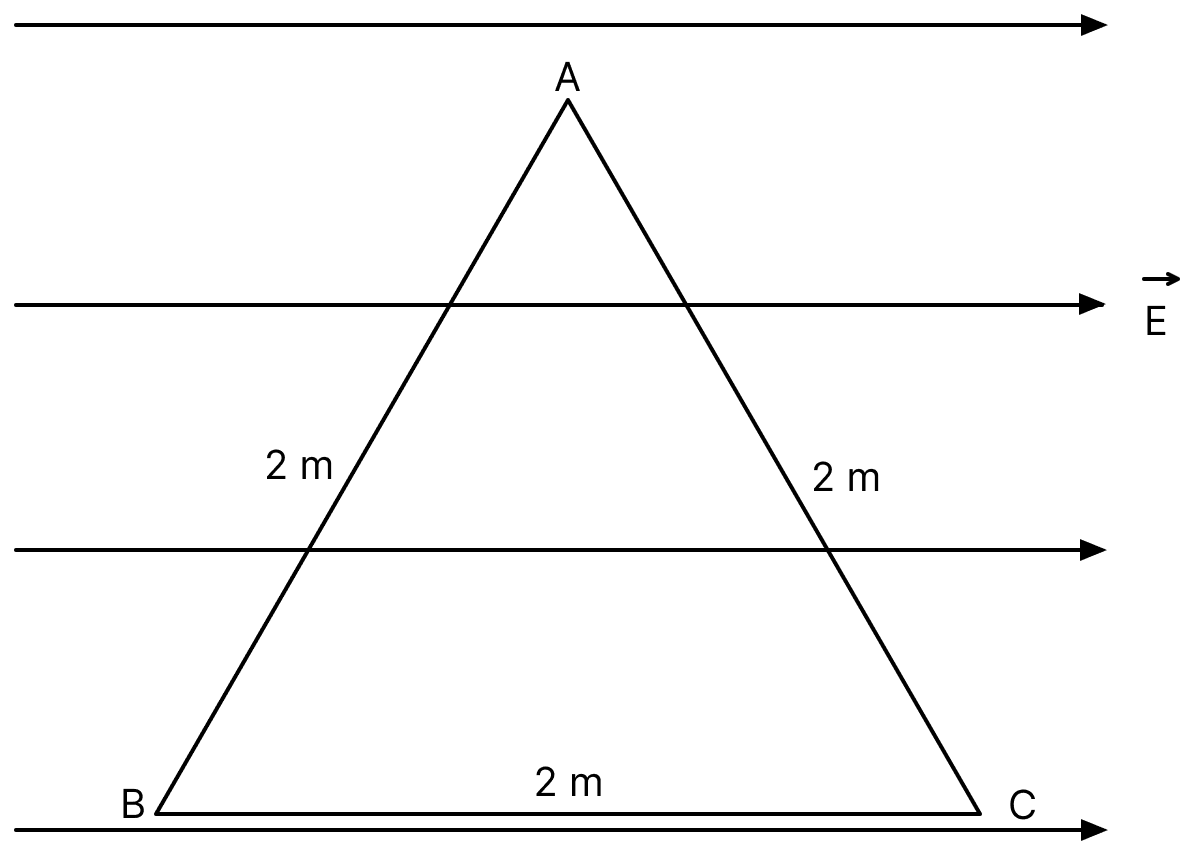
In a uniform electric field E = 10 N/C as shown in figure, find VA − VB.

In a uniform electric field E = 10 N/C as shown in figure, find V A &minus; V B. Electric Potential, Nootan Physics Solutions ICS Class 12

Answer

Given,

  • Uniform electric field, E = 10 N/C directed horizontally
  • The triangle ABC is equilateral with each side 2 m, B and C at the base and A at the apex

In a uniform electric field only the displacement measured along the direction of the field is effective,

VA−VB=−E(xA−xB)\text V_\text A - \text V_\text B = -\text E(\text x_\text A - \text x_\text B)

where xA and xB are the positions of A and B measured along the direction of the field. Since the triangle is equilateral with side 2 m, the foot of the perpendicular from A to BC is at the mid-point of BC, so the horizontal separation between B and A is

xA−xB=22xA−xB=1 m\text x_\text A - \text x_\text B = \dfrac{2}{2} \\[1em] \text x_\text A - \text x_\text B = 1\ \text m

Moving from A to B is a displacement of 1 m opposite to the field direction, hence

VA−VB=−E(xA−xB)=−10×1VA−VB=−10 V\text V_\text A - \text V_\text B = -\text E(\text x_\text A - \text x_\text B) \\[1em] = -10 \times 1 \\[1em] \text V_\text A - \text V_\text B = -10\ \text V

Hence, VA − VB = − 10 V.

Question 23

10 J of work is required to move a charge of − 200 C from point A to B. (i) Which of the two points is at higher potential? (ii) What is the PD between them? (iii) If the points are 4 cm apart, what is the component of the electric field parallel to the line joining A and B?

Answer

Given,

  • Work done, W = 10 J
  • Charge, q = − 200 C
  • Separation between the points, d = 4 cm = 0.04 m

(i) and (ii) Potential difference :

VB−VA=Wq=10−200VB−VA=−0.05 V\text V_\text B - \text V_\text A = \dfrac{\text W}{\text q} \\[1em] = \dfrac{10}{-200} \\[1em] \text V_\text B - \text V_\text A = -0.05\ \text V

Since VB − VA is negative, VA > VB. Hence A is at the higher potential and the magnitude of the potential difference is 0.05 V.

(iii) Component of the electric field along AB :

E=VA−VBd=0.050.04E=1.25 V-m−1\text E = \dfrac{\text V_\text A - \text V_\text B}{\text d} \\[1em] = \dfrac{0.05}{0.04} \\[1em] \text E = 1.25\ \text V\text{-m}^{-1}

Hence, A is at the higher potential, the PD is 0.05 V and the component of the field parallel to AB is 1.25 V-m-1.

Question 24

Two plane metallic plates are at a distance of 2 cm. These are connected to a battery of 1000 V. A proton is placed between these plates. Find out (i) intensity of electric field between the plates, (ii) force on the proton. Will the proton experience different forces at different places between the two plates?

Answer

Given,

  • Separation between the plates, d = 2 cm = 2 × 10⁻² m
  • Potential difference, V = 1000 V
  • Charge on the proton, q = 1.6 × 10⁻¹⁹ C

(i) Intensity of the electric field : The plates are long and close together, so the field between them is uniform,

E=Vd=10002×10−2E=50000 V-m−1\text E = \dfrac{\text V}{\text d} \\[1em] = \dfrac{1000}{2\times10^{-2}} \\[1em] \text E = 50000\ \text V\text{-m}^{-1}

(ii) Force on the proton :

F=qE=(1.6×10⁻¹⁹)(5×10⁴)F=8.0×10⁻¹⁵ N\text F = \text q\text E \\[1em] = (1.6\times10^{-19})(5\times10^4) \\[1em] \text F = 8.0\times10^{-15}\ \text N

Since the electric field between the plates is uniform at all places, the proton will experience the same force at each place between the plates.

Hence, E = 50000 V-m-1 and F = 8.0 × 10⁻¹⁵ N.

Question 25

The distance between two horizontal parallel plates is 2.0 cm and the potential difference between them is 120 V. Calculate : (i) electric field between the plates, (ii) force on an electron passing in between the plates, (iii) increase in electrical energy of the electron in moving from one plate to the other.

Answer

Given,

  • Separation between the plates, d = 2.0 cm = 2.0 × 10⁻² m
  • Potential difference, V = 120 V
  • Charge on the electron, e = 1.6 × 10⁻¹⁹ C

(i) Electric field between the plates :

E=Vd=1202.0×10−2E=6.0×10³ V-m−1\text E = \dfrac{\text V}{\text d} \\[1em] = \dfrac{120}{2.0\times10^{-2}} \\[1em] \text E = 6.0\times10^3\ \text V\text{-m}^{-1}

(ii) Force on the electron :

F=eE=(1.6×10⁻¹⁹)(6.0×10³)F=9.6×10⁻¹⁶ N\text F = \text e\text E \\[1em] = (1.6\times10^{-19})(6.0\times10^3) \\[1em] \text F = 9.6\times10^{-16}\ \text N

(iii) Increase in electrical energy :

W=eV=(1.6×10⁻¹⁹)(120)W=1.92×10⁻¹⁷ J\text W = \text e\text V \\[1em] = (1.6\times10^{-19})(120) \\[1em] \text W = 1.92\times10^{-17}\ \text J

Hence, E = 6.0 × 10³ V-m-1, F = 9.6 × 10⁻¹⁶ N and the increase in electrical energy is 1.92 × 10⁻¹⁷ J.

Question 26

The mutual electric potential energy between two protons in a uranium nucleus is 2.4 × 10⁵ eV. Find the distance between the protons.

Answer

Given,

  • Mutual potential energy, U = 2.4 × 10⁵ eV
  • Charge on each proton, e = 1.6 × 10⁻¹⁹ C

Converting the energy into joule,

U=(2.4×10⁵)(1.6×10⁻¹⁹)U=3.84×10⁻¹⁴ J\text U = (2.4\times10^5)(1.6\times10^{-19}) \\[1em] \text U = 3.84\times10^{-14}\ \text J

The potential energy of the two-proton system is

U=14πϵ0e2r⇒r=14πϵ0e2U\text U = \dfrac{1}{4\pi\epsilon_0}\dfrac{\text e^2}{\text r} \\[1em] \Rightarrow \quad \text r = \dfrac{1}{4\pi\epsilon_0}\dfrac{\text e^2}{\text U}

Substituting the values,

r=(9.0×10⁹)(1.6×10⁻¹⁹)23.84×10−14=(9.0×10⁹)(2.56×10−38)3.84×10−14=2.304×10−283.84×10⁻¹⁴r=6.0×10⁻¹⁵ m\text r = \dfrac{(9.0\times10^9)(1.6\times10^{-19})^2}{3.84\times10^{-14}} \\[1em] = \dfrac{(9.0\times10^9)(2.56\times10^{-38})}{3.84\times10^{-14}} \\[1em] = \dfrac{2.304\times10^{-28}}{3.84\times10^{-14}} \\[1em] \text r = 6.0\times10^{-15}\ \text m

Hence, the distance between the protons is 6.0 × 10⁻¹⁵ m.

Question 27

An electron is circulating around the nucleus of a hydrogen atom in a circular orbit of radius 5.3 × 10⁻¹¹ m. Calculate the electric potential at this radius and electric potential energy of the atom in eV. What would be the electric potential due to a helium nucleus at the same radius?

Answer

Given,

  • Radius of the orbit, r = 5.3 × 10⁻¹¹ m
  • Charge on the hydrogen nucleus = + 1.6 × 10⁻¹⁹ C (Z = 1)
  • Charge on the electron = − 1.6 × 10⁻¹⁹ C

Electric potential at this radius :

V=14πϵ0Zer=(9.0×10⁹)(1.6×10⁻¹⁹)5.3×10−11=1.44×10−95.3×10−11V=27.2 V\text V = \dfrac{1}{4\pi\epsilon_0}\dfrac{\text{Ze}}{\text r} \\[1em] = \dfrac{(9.0\times10^9)(1.6\times10^{-19})}{5.3\times10^{-11}} \\[1em] = \dfrac{1.44\times10^{-9}}{5.3\times10^{-11}} \\[1em] \text V = 27.2\ \text V

Electric potential energy of the atom :

U=(−e)V=(−1.6×10⁻¹⁹ C)(27.2 V)U=−4.35×10⁻¹⁸ J\text U = (-\text e)\text V \\[1em] = (-1.6\times10^{-19}\ \text C)(27.2\ \text V) \\[1em] \text U = -4.35\times10^{-18}\ \text J

Expressed in electron-volt, since U = charge × potential and the charge is one electronic charge,

U=−27.2 eV\text U = -27.2\ \text{eV}

Potential due to a helium nucleus at the same radius : For helium Z = 2, so the charge on the nucleus is doubled and

V′=2×27.2V′=54.4 V\text V' = 2 \times 27.2 \\[1em] \text V' = 54.4\ \text V

Hence, V = 27.2 V, U = − 27.2 eV and the potential due to a helium nucleus is 54.4 V.

Question 28

Three point-charges q1 (= −1 μC), q2 (= +2 μC) and q3 (= −1 μC) are placed in air in a line. The distance between q1 and q2 is 1 m and that between q2 and q3 is also 1 m. Calculate the electrostatic energy of the system.

Answer

Given,

  • q1 = − 1 μC = − 1 × 10⁻⁶ C, q2 = + 2 μC = 2 × 10⁻⁶ C, q3 = − 1 μC = − 1 × 10⁻⁶ C
  • r12 = 1 m, r23 = 1 m, and hence r13 = 2 m

The number of pairs is n(n−1)2=3×22=3\dfrac{\text n(\text n - 1)}{2} = \dfrac{3 \times 2}{2} = 3. The electrostatic energy of the system is the algebraic sum of the potential energies of all the pairs,

U=14πϵ0[q1q2r12+q2q3r23+q1q3r13]\text U = \dfrac{1}{4\pi\epsilon_0}\left[\dfrac{\text q_1\text q_2}{\text r_{12}} + \dfrac{\text q_2\text q_3}{\text r_{23}} + \dfrac{\text q_1\text q_3}{\text r_{13}}\right]

Substituting the values,

=(9.0×10⁹)[(−1×10⁻⁶)(2×10⁻⁶)1+(2×10⁻⁶)(−1×10⁻⁶)1+(−1×10⁻⁶)(−1×10⁻⁶)2]=(9.0×10⁹)[−2×10⁻¹²−2×10⁻¹²+0.5×10⁻¹²]=(9.0×10⁹)(−3.5×10⁻¹²)U=−3.15×10⁻² J= (9.0\times10^9)\Bigg[\dfrac{(-1\times10^{-6})(2\times10^{-6})}{1} \\[1em] + \dfrac{(2\times10^{-6})(-1\times10^{-6})}{1} \\[1em] + \dfrac{(-1\times10^{-6})(-1\times10^{-6})}{2}\Bigg] \\[1em] = (9.0\times10^9)\left[-2\times10^{-12} - 2\times10^{-12} + 0.5\times10^{-12}\right] \\[1em] = (9.0\times10^9)(-3.5\times10^{-12}) \\[1em] \text U = -3.15\times10^{-2}\ \text J

Hence, the electrostatic energy of the system is − 31.5 mJ.

Question 29

In a quark model of elementary particles, a neutron is made of one up quark of charge 23\dfrac{2}{3} e and two down quarks each of charge −13-\dfrac{1}{3} e. If they have a triangular configuration with side length of the order of 10-15 m, find the electrostatic potential energy of neutron in MeV.

Answer

Given,

  • Charge on the up quark, qu=23e\text q_\text u = \dfrac{2}{3}\text e
  • Charge on each down quark, qd=−13e\text q_\text d = -\dfrac{1}{3}\text e
  • Side of the triangle, a = 10-15 m

There are three pairs of quarks, all separated by the same distance a. Hence

U=14πϵ0a[quqd1+quqd2+qd1qd2]\text U = \dfrac{1}{4\pi\epsilon_0 \text a}\left[\text q_\text u\text q_{\text d1} + \text q_\text u\text q_{\text d2} + \text q_{\text d1}\text q_{\text d2}\right]

Substituting the quark charges,

=e24πϵ0a[(23)(−13)+(23)(−13)+(−13)(−13)]=e24πϵ0a[−29−29+19]U=−13e24πϵ0a= \dfrac{\text e^2}{4\pi\epsilon_0 \text a}\left[\left(\dfrac{2}{3}\right)\left(-\dfrac{1}{3}\right) + \left(\dfrac{2}{3}\right)\left(-\dfrac{1}{3}\right) + \left(-\dfrac{1}{3}\right)\left(-\dfrac{1}{3}\right)\right] \\[1em] = \dfrac{\text e^2}{4\pi\epsilon_0 \text a}\left[-\dfrac{2}{9} - \dfrac{2}{9} + \dfrac{1}{9}\right] \\[1em] \text U = -\dfrac{1}{3}\dfrac{\text e^2}{4\pi\epsilon_0 \text a}

Substituting the numerical values,

U=−13×(9.0×109)(1.6×10⁻¹⁹)210−15=−13×2.304×10−2810−15=−2.304×10−133U=−7.68×10⁻¹⁴ J\text U = -\dfrac{1}{3} \times \dfrac{(9.0\times10^9)(1.6\times10^{-19})^2}{10^{-15}} \\[1em] = -\dfrac{1}{3} \times \dfrac{2.304\times10^{-28}}{10^{-15}} \\[1em] = -\dfrac{2.304\times10^{-13}}{3} \\[1em] \text U = -7.68\times10^{-14}\ \text J

Converting into MeV, using 1 MeV = 1.6 × 10⁻¹³ J,

U=−7.68×10−141.6×10⁻¹³U=−0.48 MeV\text U = -\dfrac{7.68\times10^{-14}}{1.6\times10^{-13}} \\[1em] \text U = -0.48\ \text{MeV}

Hence, the electrostatic potential energy of the neutron is − 0.48 MeV.

Question 30

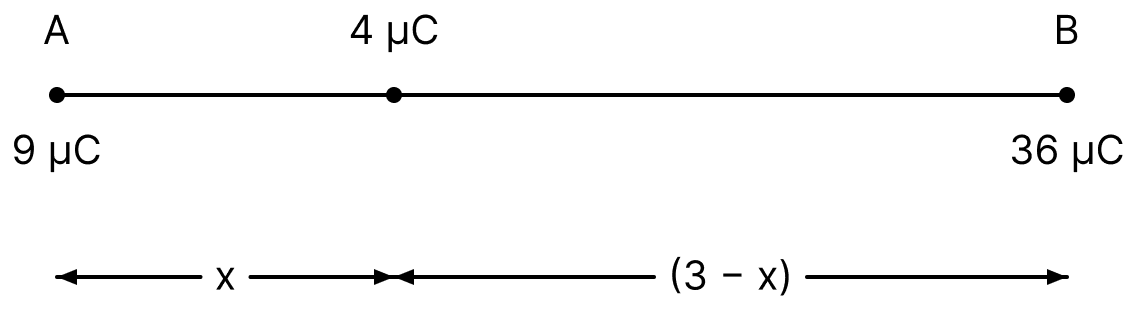
Three point charges 4 μC, 9 μC and 36 μC are to be placed on a line AB of length 3 m. Locate the positions of these charges on line AB for electrostatic potential energy of the system to be minimum.

Answer

Three point charges 4 μC, 9 μC and 36 μC are to be placed on a line AB of length 3 m. Locate the positions of these charges on line AB for electrostatic potential energy of the system to be minimum. Electric Potential, Nootan Physics Solutions ICS Class 12

Given,

  • Charges of 4 μC, 9 μC and 36 μC on a line AB of length 3 m

For minimum potential energy, the two charges of largest magnitude must be farthest apart. Hence 9 μC is placed at A and 36 μC at B, and 4 μC is placed in between, at a distance x metre from A and (3 − x) metre from B.

The potential energy of the system is

U=k[9×4x+4×36(3−x)+9×363]×10−12\text U = \text k\left[\dfrac{9 \times 4}{\text x} + \dfrac{4 \times 36}{(3 - \text x)} + \dfrac{9 \times 36}{3}\right]\times10^{-12}

where k=14πϵ0\text k = \dfrac{1}{4\pi\epsilon_0}.

For U to be minimum, dUdx=0\dfrac{\text{dU}}{\text{dx}} = 0. Differentiating,

dUdx=k[−36x2+144(3−x)2]×10−12=0⇒144(3−x)2=36x2⇒4x2=(3−x)2\dfrac{\text{dU}}{\text{dx}} = \text k\left[-\dfrac{36}{\text x^2} + \dfrac{144}{(3 - \text x)^2}\right]\times10^{-12} = 0 \\[1em] \Rightarrow \quad \dfrac{144}{(3 - \text x)^2} = \dfrac{36}{\text x^2} \\[1em] \Rightarrow \quad 4\text x^2 = (3 - \text x)^2

Taking the square root,

2x=3−x⇒3x=3⇒x=1 m2\text x = 3 - \text x \\[1em] \Rightarrow \quad 3\text x = 3 \\[1em] \Rightarrow \quad \text x = 1\ \text m

Hence, 9 μC is placed at A, 36 μC at B, and 4 μC is placed on AB at a distance of 1 m from the 9 μC charge (that is, 2 m from the 36 μC charge).

Question 31

(i) Calculate the work required to assemble each of the systems of charges (which is same as the electrostatic potential energy of the system) shown in Fig. (a) and (b). (ii) A charge q0 is brought from infinity to the centre of the square, the four charges being held fixed at its corners. How much extra work is needed to do this?

Question 31. Electric Potential, Nootan Physics Solutions ICS Class 12

Answer

Given, a square of side a with charges of magnitude q at its corners, the diagonal being a2\text a\sqrt2.

(i) Figure (a) : Here the charges + q and − q alternate around the square, so the four sides join unlike charges and the two diagonals join like charges,

Ua=14πϵ0[4(−q2a)+2(+q2a2)]=q24πϵ0a[−4+22]=q24πϵ0a[−4+2]Ua=−q24πϵ0a(4−2)\text U_\text a = \dfrac{1}{4\pi\epsilon_0}\left[4\left(\dfrac{-\text q^2}{\text a}\right) + 2\left(\dfrac{+\text q^2}{\text a\sqrt2}\right)\right] \\[1em] = \dfrac{\text q^2}{4\pi\epsilon_0\text a}\left[-4 + \dfrac{2}{\sqrt2}\right] \\[1em] = \dfrac{\text q^2}{4\pi\epsilon_0\text a}\left[-4 + \sqrt2\right] \\[1em] \text U_\text a = -\dfrac{\text q^2}{4\pi\epsilon_0\text a}(4 - \sqrt2)

Figure (b) : Here the two charges + q lie on one side of the square and the two charges − q on the other. Of the four sides, two join like charges and two join unlike charges, so their contributions cancel. Both diagonals join unlike charges,

Ub=14πϵ0[(2q2a−2q2a)+2(−q2a2)]=−q24πϵ0a(22)Ub=−q24πϵ0a(2)\text U_\text b = \dfrac{1}{4\pi\epsilon_0}\left[\left(\dfrac{2\text q^2}{\text a} - \dfrac{2\text q^2}{\text a}\right) + 2\left(\dfrac{-\text q^2}{\text a\sqrt2}\right)\right] \\[1em] = -\dfrac{\text q^2}{4\pi\epsilon_0\text a}\left(\dfrac{2}{\sqrt2}\right) \\[1em] \text U_\text b = -\dfrac{\text q^2}{4\pi\epsilon_0\text a}(\sqrt2)

(ii) All the four corners are equidistant from the centre of the square, and the algebraic sum of the four charges is zero in each case. Since potential is a scalar,

Vcentre=14πϵ0(q−q+q−q)a/2Vcentre=0\text V_{\text{centre}} = \dfrac{1}{4\pi\epsilon_0}\dfrac{(\text q - \text q + \text q - \text q)}{\text a/\sqrt2} \\[1em] \text V_{\text{centre}} = 0

Therefore the extra work needed is

W=q0VcentreW=0\text W = \text q_0 \text V_{\text{centre}} \\[1em] \text W = 0

Hence, Ua=−q24πϵ0a(4−2)\text U_\text a = -\dfrac{\text q^2}{4\pi\epsilon_0\text a}(4 - \sqrt2), Ub=−q24πϵ0a(2)\text U_\text b = -\dfrac{\text q^2}{4\pi\epsilon_0\text a}(\sqrt2) and no extra work is needed in bringing q0 to the centre.

Question 32

The distance between two protons is 1.0 × 10⁻¹⁰ m. If they are made free, what will be the kinetic energy of each when they are away at a very large distance from each other? If one proton is kept fixed and only other is freed then what will be its kinetic energy?

Answer

Given,

  • Separation between the protons, r = 1.0 × 10⁻¹⁰ m
  • Charge on each proton, e = 1.6 × 10⁻¹⁹ C

The potential energy of the two-proton system is

U=14πϵ0e2r=(9.0×10⁹)(1.6×10⁻¹⁹)21.0×10−10=2.304×10−281.0×10⁻¹⁰U=2.304×10⁻¹⁸ J\text U = \dfrac{1}{4\pi\epsilon_0}\dfrac{\text e^2}{\text r} \\[1em] = \dfrac{(9.0\times10^9)(1.6\times10^{-19})^2}{1.0\times10^{-10}} \\[1em] = \dfrac{2.304\times10^{-28}}{1.0\times10^{-10}} \\[1em] \text U = 2.304\times10^{-18}\ \text J

When the protons are far apart their potential energy becomes zero, so this entire energy appears as kinetic energy.

Case 1 — both protons free : By symmetry the two protons have equal masses and equal charges, so the potential energy is equally divided between them,

K=2.304×10−182K=1.15×10⁻¹⁸ J\text K = \dfrac{2.304\times10^{-18}}{2} \\[1em] \text K = 1.15\times10^{-18}\ \text J

Case 2 — one proton fixed : The whole of the potential energy appears as the kinetic energy of the freed proton,

K=2.30×10⁻¹⁸ J\text K = 2.30\times10^{-18}\ \text J

Hence, each proton acquires 1.15 × 10⁻¹⁸ J in the first case, and the freed proton acquires 2.30 × 10⁻¹⁸ J in the second case.

Question 33

Two electrons are released towards each other with equal velocities of 106 m s-1. What will be the closest approach between them?

Answer

Given,

  • Speed of each electron, v = 106 m s-1
  • Mass of electron, m = 9.0 × 10⁻³¹ kg
  • Charge on electron, e = 1.6 × 10⁻¹⁹ C

At the distance of closest approach both electrons come momentarily to rest, so the whole of the initial kinetic energy is converted into the potential energy of the system.

Total initial kinetic energy,

K=2×12mv2=mv2=(9.0×10⁻³¹)(106)2K=9.0×10⁻¹⁹ J\text K = 2 \times \dfrac{1}{2}\text m\text v^2 \\[1em] = \text m\text v^2 \\[1em] = (9.0\times10^{-31})(10^6)^2 \\[1em] \text K = 9.0\times10^{-19}\ \text J

At the closest approach r,

14πϵ0e2r=Kr=(9.0×10⁹)(1.6×10⁻¹⁹)29.0×10−19=2.304×10−289.0×10⁻¹⁹r=2.56×10⁻¹⁰ m\dfrac{1}{4\pi\epsilon_0}\dfrac{\text e^2}{\text r} = \text K \\[1em] \text r = \dfrac{(9.0\times10^9)(1.6\times10^{-19})^2}{9.0\times10^{-19}} \\[1em] = \dfrac{2.304\times10^{-28}}{9.0\times10^{-19}} \\[1em] \text r = 2.56\times10^{-10}\ \text m

Hence, the closest approach between the electrons is 2.56 × 10⁻¹⁰ m.

Question 34

Two point charges of +1.0 × 10⁻⁶ C and −1.0 × 10⁻⁶ C are 2.0 cm apart from each other. This electric dipole is situated in a uniform electric field of 1.0 × 10⁵ V-m-1. What will be the maximum torque acting on it due to the field? What will be the work done for rotating it through 180° from the equilibrium position?

Answer

Given,

  • Charge, q = 1.0 × 10⁻⁶ C
  • Separation, 2l = 2.0 cm = 2.0 × 10⁻² m
  • Electric field, E = 1.0 × 10⁵ V-m-1

The electric dipole moment is

p=q×2l=(1.0×10⁻⁶)(2.0×10⁻²)p=2.0×10⁻⁸ C-m\text p = \text q \times 2\text l \\[1em] = (1.0\times10^{-6})(2.0\times10^{-2}) \\[1em] \text p = 2.0\times10^{-8}\ \text C\text{-m}

Maximum torque : The torque on a dipole is τ = pE sin θ, which is maximum when θ = 90°,

τmax=pE=(2.0×10⁻⁸)(1.0×10⁵)τmax=2.0×10⁻³ N-m\tau_{\text{max}} = \text p\text E \\[1em] = (2.0\times10^{-8})(1.0\times10^5) \\[1em] \tau_{\text{max}} = 2.0\times10^{-3}\ \text N\text{-m}

Work done in rotating it through 180° :

W=pE(1−cos⁡180°)=2pE=2×2.0×10−3W=4.0×10⁻³ J\text W = \text p\text E(1 - \cos 180°) \\[1em] = 2\text p\text E \\[1em] = 2 \times 2.0\times10^{-3} \\[1em] \text W = 4.0\times10^{-3}\ \text J

Hence, the maximum torque is 2.0 × 10⁻³ N-m and the work done is 4.0 × 10⁻³ J.

Question 35

An electric dipole of length 2 cm is placed with its axis making an angle of 60° to a uniform electric field of 105 N-C-1. If it experiences a torque of 838\sqrt{3} N-m, calculate (i) magnitude of the charge on the dipole and (ii) potential energy of the dipole.

Answer

Given,

  • Length of the dipole, 2l = 2 cm = 2 × 10⁻² m
  • Angle with the field, θ = 60°
  • Electric field, E = 105 N-C-1
  • Torque, τ=83\tau = 8\sqrt3 N-m

(i) Magnitude of the charge : The torque on a dipole is

τ=pEsin⁡θ83=p×105×sin⁡60°=p×105×32⇒p=83×23×105=16105p=1.6×10⁻⁴ C-m\tau = \text p\text E\sin\theta \\[1em] 8\sqrt3 = \text p \times 10^5 \times \sin 60° \\[1em] = \text p \times 10^5 \times \dfrac{\sqrt3}{2} \\[1em] \Rightarrow \quad \text p = \dfrac{8\sqrt3 \times 2}{\sqrt3 \times 10^5} \\[1em] = \dfrac{16}{10^5} \\[1em] \text p = 1.6\times10^{-4}\ \text C\text{-m}

Since p = q × 2l,

q=p2l=1.6×10−42×10−2q=8×10⁻³ C\text q = \dfrac{\text p}{2\text l} \\[1em] = \dfrac{1.6\times10^{-4}}{2\times10^{-2}} \\[1em] \text q = 8\times10^{-3}\ \text C

(ii) Potential energy of the dipole :

U=−pEcos⁡θ=−(1.6×10⁻⁴)(105)cos⁡60°=−(1.6×10⁻⁴)(105)(0.5)U=−8 J\text U = -\text p\text E\cos\theta \\[1em] = -(1.6\times10^{-4})(10^5)\cos 60° \\[1em] = -(1.6\times10^{-4})(10^5)(0.5) \\[1em] \text U = -8\ \text J

Hence, the charge on the dipole is 8 × 10⁻³ C and its potential energy is − 8 J.

Question 36

Two point charges of +3 μC and −3 μC are at a distance 3 × 10⁻³ m apart from each other. Calculate (i) electric potential at a distance of 0.6 m from the dipole in broad-side-on position, (ii) electric potential at the same point after rotating the dipole through 90°.

Answer

Given,

  • Charge, q = 3 μC = 3 × 10⁻⁶ C
  • Separation, 2l = 3 × 10⁻³ m
  • Distance of the point, r = 0.6 m

The electric dipole moment is

p=q×2l=(3×10⁻⁶)(3×10⁻³)p=9×10⁻⁹ C-m\text p = \text q \times 2\text l \\[1em] = (3\times10^{-6})(3\times10^{-3}) \\[1em] \text p = 9\times10^{-9}\ \text C\text{-m}

(i) Broad-side-on (equatorial) position : A point on the equatorial line is equidistant from both the charges, so the potentials due to + q and − q are equal and opposite,

V=0\text V = 0

(ii) After rotating the dipole through 90° : The same point now lies on the axis of the dipole (end-on position), so

V=14πϵ0pr2=(9.0×10⁹)(9×10⁻⁹)(0.6)2=810.36V=225 V\text V = \dfrac{1}{4\pi\epsilon_0}\dfrac{\text p}{\text r^2} \\[1em] = \dfrac{(9.0\times10^9)(9\times10^{-9})}{(0.6)^2} \\[1em] = \dfrac{81}{0.36} \\[1em] \text V = 225\ \text V

Hence, the potential is zero in the broad-side-on position and 225 V after the dipole is rotated through 90°.

Question 37

A molecule of a substance has a permanent electric dipole moment of magnitude 10-30 C-m. A mole of this substance is polarised by applying a strong electric field of magnitude 107 Vm-1. The direction of field is changed by an angle 60°. Calculate the heat released by the substance in aligning its dipole along the new direction of the field. One mole contains 6 × 10²³ molecules.

Answer

Given,

  • Dipole moment of one molecule, p = 10-30 C-m
  • Electric field, E = 107 V m-1
  • Change in the direction of the field, θ = 60°
  • Number of molecules in one mole, N = 6 × 10²³

Initially every dipole is aligned along the field, that is at θ1 = 0. When the field direction is turned through 60°, each dipole momentarily makes an angle θ1 = 60° with the new direction and then realigns itself to θ2 = 0.

The energy released by one molecule in realigning is

W=pE(cos⁡θ1−cos⁡θ2)=pE(cos⁡60°−cos⁡0°)\text W = \text p\text E(\cos\theta_1 - \cos\theta_2) \\[1em] = \text p\text E(\cos 60° - \cos 0°)

Taking the magnitude of the energy given out,

∣W∣=pE(1−cos⁡60°)=(10−30)(107)(1−0.5)=(10−23)(0.5)∣W∣=5×10⁻²⁴ J|\text W| = \text p\text E(1 - \cos 60°) \\[1em] = (10^{-30})(10^7)(1 - 0.5) \\[1em] = (10^{-23})(0.5) \\[1em] |\text W| = 5\times10^{-24}\ \text J

For one mole the total energy released is

Q=N∣W∣=(6×10²³)(5×10⁻²⁴)Q=3 J\text Q = \text N|\text W| \\[1em] = (6\times10^{23})(5\times10^{-24}) \\[1em] \text Q = 3\ \text J

Hence, the heat released by the substance is 3 J.

Note: The printed answer gives −3 J, which is the change in potential energy. The heat released is its magnitude, 3 J.

Question 38

Compute the electric potential at the surface of the nucleus of a silver atom. The radius of the nucleus is 3.4 × 10⁻¹⁴ m and the atomic number of silver is 47.

Answer

Given,

  • Radius of the nucleus, R = 3.4 × 10⁻¹⁴ m
  • Atomic number, Z = 47
  • Charge on proton, e = 1.6 × 10⁻¹⁹ C

The charge on the nucleus is

q=Ze=47×1.6×10−19q=7.52×10⁻¹⁸ C\text q = \text{Ze} \\[1em] = 47 \times 1.6\times10^{-19} \\[1em] \text q = 7.52\times10^{-18}\ \text C

The potential at the surface of the nucleus is

V=14πϵ0qR=(9.0×10⁹)(7.52×10⁻¹⁸)3.4×10−14=6.768×10−83.4×10−14V=2.0×10⁶ V\text V = \dfrac{1}{4\pi\epsilon_0}\dfrac{\text q}{\text R} \\[1em] = \dfrac{(9.0\times10^9)(7.52\times10^{-18})}{3.4\times10^{-14}} \\[1em] = \dfrac{6.768\times10^{-8}}{3.4\times10^{-14}} \\[1em] \text V = 2.0\times10^6\ \text V

Hence, the electric potential at the surface of the silver nucleus is 2.0 × 10⁶ V.

Question 39

A hollow spherical conductor of radius 12 cm is given a charge of 2.4 × 10⁻⁹ C. (i) Calculate the potential on the surface of the conductor. (ii) Calculate the intensity of electric field in air at a distance of 4 m from the centre of the sphere.

Answer

Given,

  • Radius of the conductor, R = 12 cm = 0.12 m
  • Charge, q = 2.4 × 10⁻⁹ C

(i) Potential on the surface :

V=14πϵ0qR=(9.0×10⁹)(2.4×10⁻⁹)0.12=21.60.12V=180 V\text V = \dfrac{1}{4\pi\epsilon_0}\dfrac{\text q}{\text R} \\[1em] = \dfrac{(9.0\times10^9)(2.4\times10^{-9})}{0.12} \\[1em] = \dfrac{21.6}{0.12} \\[1em] \text V = 180\ \text V

(ii) Intensity of the electric field at 4 m : For an external point the charged sphere behaves as if the whole charge were placed at its centre,

E=14πϵ0qr2=(9.0×10⁹)(2.4×10⁻⁹)(4)2=21.616E=1.35 V-m−1\text E = \dfrac{1}{4\pi\epsilon_0}\dfrac{\text q}{\text r^2} \\[1em] = \dfrac{(9.0\times10^9)(2.4\times10^{-9})}{(4)^2} \\[1em] = \dfrac{21.6}{16} \\[1em] \text E = 1.35\ \text V\text{-m}^{-1}

Hence, the potential on the surface is 180 V and the intensity of the field at 4 m is 1.35 V-m-1.

Question 40

The electric potential due to a hollow, charged metallic sphere of radius 12 cm at a point distant 6.0 cm from its centre is 100 V. Calculate the potential at the surface of the sphere and at a point 20 cm from the centre.

Answer

Given,

  • Radius of the sphere, R = 12 cm = 0.12 m
  • Potential at r = 6.0 cm (a point inside the sphere) is 100 V

Potential at the surface : The point at 6.0 cm lies inside the hollow sphere, where the electric field is zero and therefore the potential is constant and equal to its value at the surface. Hence

Vsurface=100 V\text V_{\text{surface}} = 100\ \text V

From this,

14πϵ0q=Vsurface×R=100×0.1214πϵ0q=12 N-m2C−1\dfrac{1}{4\pi\epsilon_0}\text q = \text V_{\text{surface}} \times \text R \\[1em] = 100 \times 0.12 \\[1em] \dfrac{1}{4\pi\epsilon_0}\text q = 12\ \text N\text{-m}^2\text C^{-1}

Potential at 20 cm from the centre : This point is outside the sphere, so

V=14πϵ0qr=120.20V=60 V\text V = \dfrac{1}{4\pi\epsilon_0}\dfrac{\text q}{\text r} \\[1em] = \dfrac{12}{0.20} \\[1em] \text V = 60\ \text V

Hence, the potential at the surface is 100 V and that at 20 cm from the centre is 60 V.

Question 41

The electric potential due to a charged sphere of radius 2.0 cm is 400 V at a distance of 10 cm from the centre. What will be the electric field at a distance of 20 cm from the centre of the sphere?

Answer

Given,

  • Radius of the sphere = 2.0 cm
  • V = 400 V at r1 = 10 cm = 0.10 m
  • Distance at which E is required, r2 = 20 cm = 0.20 m

Both points lie outside the sphere, so the sphere behaves as if the whole charge were at its centre,

V=14πϵ0qr1⇒q4πϵ0=Vr1=400×0.10q4πϵ0=40 N-m2C−1\text V = \dfrac{1}{4\pi\epsilon_0}\dfrac{\text q}{\text r_1} \\[1em] \Rightarrow \quad \dfrac{\text q}{4\pi\epsilon_0} = \text V\text r_1 \\[1em] = 400 \times 0.10 \\[1em] \dfrac{\text q}{4\pi\epsilon_0} = 40\ \text N\text{-m}^2\text C^{-1}

The electric field at r2 is

E=14πϵ0qr22=40(0.20)2=400.04E=1000 V-m−1\text E = \dfrac{1}{4\pi\epsilon_0}\dfrac{\text q}{\text r_2^2} \\[1em] = \dfrac{40}{(0.20)^2} \\[1em] = \dfrac{40}{0.04} \\[1em] \text E = 1000\ \text V\text{-m}^{-1}

Hence, the electric field at 20 cm from the centre is 1000 V-m-1.

Question 42

Eight charged drops of water, each of radius 1 mm and having a charge of 10-10 C, combine to form a bigger drop. Determine the potential of the bigger drop.

Answer

Given,

  • Number of drops, n = 8
  • Radius of each small drop, r = 1 mm = 10-3 m
  • Charge on each small drop, q = 10-10 C

The volume of the bigger drop equals the total volume of the eight small drops,

43πR3=8×43πr3⇒R=(8)1/3r=2rR=2×10−3 m\dfrac{4}{3}\pi\text R^3 = 8 \times \dfrac{4}{3}\pi\text r^3 \\[1em] \Rightarrow \quad \text R = (8)^{1/3}\text r \\[1em] = 2\text r \\[1em] \text R = 2\times10^{-3}\ \text m

The charge on the bigger drop is

Q=8qQ=8×10⁻¹⁰ C\text Q = 8\text q \\[1em] \text Q = 8\times10^{-10}\ \text C

The potential at the surface of the bigger drop is

V=14πϵ0QR=(9.0×10⁹)(8×10⁻¹⁰)2×10−3=7.22×10⁻³V=3600 V\text V = \dfrac{1}{4\pi\epsilon_0}\dfrac{\text Q}{\text R} \\[1em] = \dfrac{(9.0\times10^9)(8\times10^{-10})}{2\times10^{-3}} \\[1em] = \dfrac{7.2}{2\times10^{-3}} \\[1em] \text V = 3600\ \text V

Hence, the potential of the bigger drop is 3600 V.

Question 43

27 identical drops of mercury are charged to the same potential of 10 V. What will be the potential if all the charged drops are made to combine to form one large drop? Assume the drops to be spherical.

Answer

Given,

  • Number of drops, n = 27
  • Potential of each small drop, V = 10 V

Let q be the charge and r the radius of each small drop, and Q and R those of the big drop. Since the volume remains the same,

43πR3=27×43πr3⇒R=3r\dfrac{4}{3}\pi\text R^3 = 27 \times \dfrac{4}{3}\pi\text r^3 \\[1em] \Rightarrow \quad \text R = 3\text r

The total charge is conserved, so Q = 27q.

For a small drop,

V=14πϵ0qr=10 V\text V = \dfrac{1}{4\pi\epsilon_0}\dfrac{\text q}{\text r} = 10\ \text V

For the big drop,

V′=14πϵ0QR=14πϵ027q3r=9×14πϵ0qr=9V=9×10V′=90 V\text V' = \dfrac{1}{4\pi\epsilon_0}\dfrac{\text Q}{\text R} \\[1em] = \dfrac{1}{4\pi\epsilon_0}\dfrac{27\text q}{3\text r} \\[1em] = 9 \times \dfrac{1}{4\pi\epsilon_0}\dfrac{\text q}{\text r} \\[1em] = 9\text V \\[1em] = 9 \times 10 \\[1em] \text V' = 90\ \text V

Hence, the potential of the large drop is 90 V.

Question 44

64 identical spherical drops of water combine to form a bigger drop. If this big drop has potential 64 V then determine the potential of each small drop?

Answer

Given,

  • Number of drops, n = 64
  • Potential of the bigger drop, Vb = 64 V

If r and q are the radius and charge of a small drop, and R and Q those of the big drop, then from the conservation of volume and charge,

43πR3=64×43πr3⇒R=4r,Q=64q\dfrac{4}{3}\pi\text R^3 = 64 \times \dfrac{4}{3}\pi\text r^3 \\[1em] \Rightarrow \quad \text R = 4\text r, \qquad \text Q = 64\text q

The potential of the big drop is

Vb=14πϵ064q4r=16×14πϵ0qrVb=16Vs\text V_\text b = \dfrac{1}{4\pi\epsilon_0}\dfrac{64\text q}{4\text r} \\[1em] = 16 \times \dfrac{1}{4\pi\epsilon_0}\dfrac{\text q}{\text r} \\[1em] \text V_\text b = 16\text V_\text s

where Vs is the potential of a small drop. Therefore

64 V=16Vs⇒Vs=4 V64\ \text V = 16\text V_\text s \\[1em] \Rightarrow \quad \text V_\text s = 4\ \text V

Hence, the potential of each small drop is 4 V.

Question 45

Calculate the voltage needed to balance an oil drop carrying 10 electrons between the plates of a capacitor 5 mm apart. The mass of the drop is 3 × 10-16 kg and g = 10 ms-2.

Answer

Given,

  • Number of electrons on the drop, n = 10, so q = 10 × 1.6 × 10-19 = 1.6 × 10⁻¹⁸ C
  • Separation between the plates, d = 5 mm = 5 × 10⁻³ m
  • Mass of the drop, m = 3 × 10-16 kg
  • g = 10 m s-2

For the drop to be balanced, the electric force on it must be equal to its weight,

qE=mg\text q\text E = \text{mg}

Since the field between the plates is uniform, E = V/d, so

qVd=mg⇒V=mgdq\text q\dfrac{\text V}{\text d} = \text{mg} \\[1em] \Rightarrow \quad \text V = \dfrac{\text{mgd}}{\text q}

Substituting the values,

V=(3×10⁻¹⁶)(10)(5×10⁻³)1.6×10−18=1.5×10−171.6×10⁻¹⁸V=9.375 V≈10 V\text V = \dfrac{(3\times10^{-16})(10)(5\times10^{-3})}{1.6\times10^{-18}} \\[1em] = \dfrac{1.5\times10^{-17}}{1.6\times10^{-18}} \\[1em] \text V = 9.375\ \text V \approx 10\ \text V

Hence, the voltage needed to balance the oil drop is about 10 V.

Question 46

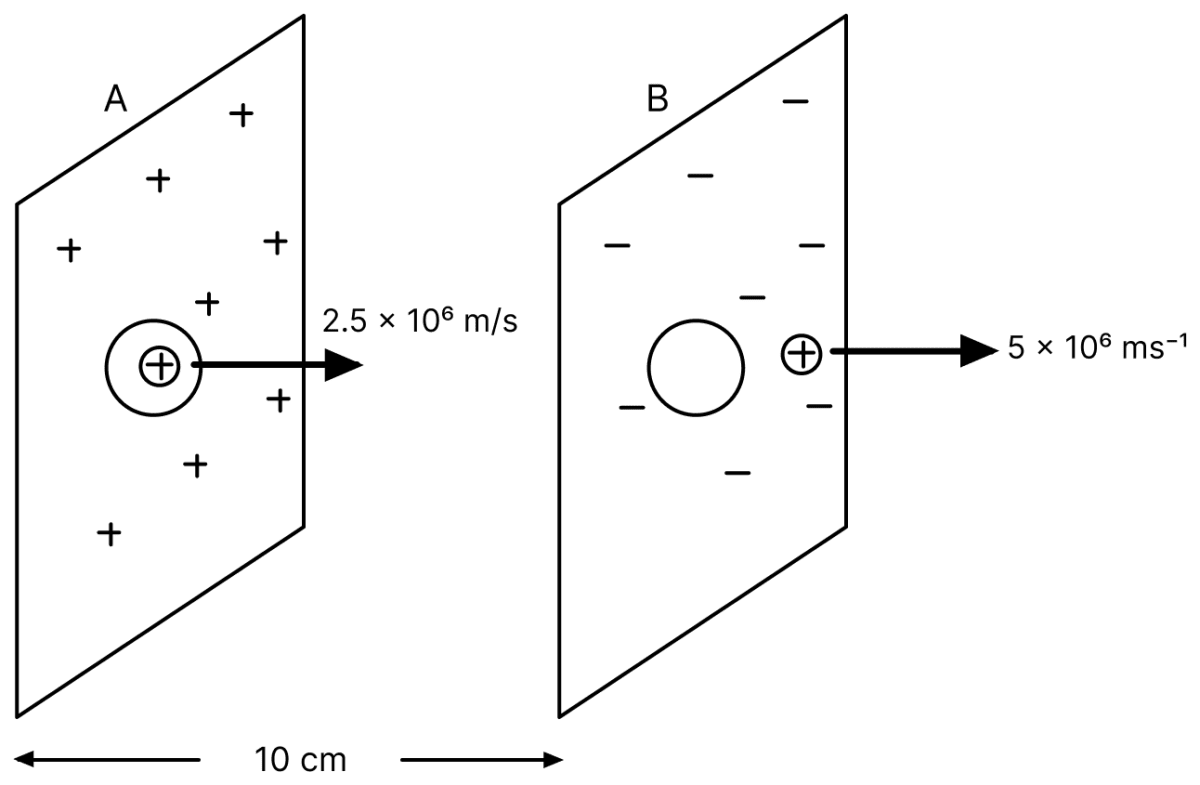
An alpha particle is made to move through two plates 10 cm apart. The speed with which it enters the gap in the first plate is 2.5 × 10⁶ ms-1. The particle exits the second plate with a velocity of 5 × 10⁶ ms-1.

An alpha particle is made to move through two plates 10 cm apart. The speed with which it enters the gap in the first plate is 2.5 × 10 6 ms -1. The particle exits the second plate with a velocity of 5 × 10 6 ms -1. Electric Potential, Nootan Physics Solutions ICS Class 12

(a) Calculate the potential difference between the plates. (mass of α particle = 6.64 × 10⁻²⁷ kg)

(b) Calculate the electric field between the plates.

(c) Name a device where this principle is used.

Answer

Given,

  • Initial speed, u = 2.5 × 10⁶ m s-1; final speed, v = 5 × 10⁶ m s-1
  • Mass of the α-particle, m = 6.64 × 10⁻²⁷ kg
  • Charge on the α-particle, q = 3.2 × 10⁻¹⁹ C
  • Separation between the plates, d = 10 cm = 0.1 m

(a) Potential difference between the plates :

By the conservation of energy, the change in kinetic energy plus the change in potential energy is zero,

ΔK+qΔV=0⇒ΔV=−ΔKq=−12m(v2−u2)q\Delta \text K + \text q\Delta \text V = 0 \\[1em] \Rightarrow \quad \Delta \text V = -\dfrac{\Delta \text K}{\text q} \\[1em] = -\dfrac{\dfrac{1}{2}\text m(\text v^2 - \text u^2)}{\text q}

Substituting the values,

VB−VA=−12(6.64×10⁻²⁷)[(5×10⁶)2−(2.5×10⁶)2]3.2×10−19=−12(6.64×10⁻²⁷)(18.75×10¹²)3.2×10−19=−6.225×10−143.2×10⁻¹⁹VB−VA=−1.95×10⁵ V\text V_\text B - \text V_\text A = -\dfrac{\dfrac{1}{2}(6.64\times10^{-27})\left[(5\times10^6)^2 - (2.5\times10^6)^2\right]}{3.2\times10^{-19}} \\[1em] = -\dfrac{\dfrac{1}{2}(6.64\times10^{-27})(18.75\times10^{12})}{3.2\times10^{-19}} \\[1em] = -\dfrac{6.225\times10^{-14}}{3.2\times10^{-19}} \\[1em] \text V_\text B - \text V_\text A = -1.95\times10^5\ \text V

(b) Electric field between the plates :

∣E∣=∣ΔV∣d=1.95×1050.1∣E∣=1.95×10⁶ V-m−1|\text E| = \dfrac{|\Delta \text V|}{\text d} \\[1em] = \dfrac{1.95\times10^5}{0.1} \\[1em] |\text E| = 1.95\times10^6\ \text V\text{-m}^{-1}

(c) This principle is used in a particle accelerator, such as a linear accelerator (atom smasher).

PrevNext