
When a magnet is placed in a uniform magnetic field, it experiences :
- a force but no torque
- a torque but no force
- a force and also a torque
- neither a force nor a torque
Answer
a torque but no force
Reason — In a uniform magnetic field the forces on the two poles of the magnet are equal, opposite and parallel, so the net force is zero. They form a couple, which gives a torque τ = mB sin θ tending to align the magnet along the field.
The angle between the magnetic meridian and geographical meridian is known as :
- magnetic dip
- magnetic declination
- magnetic moment
- magnetic field strength
Answer
magnetic declination
Reason — At any place, the acute angle between the magnetic meridian and the geographical meridian is called the angle of declination.
The lines of force due to horizontal component of earth's magnetic field are :
- straight and parallel
- concentric circles
- parabolic
- elliptical
Answer
straight and parallel
Reason — Over a small area the earth's magnetic field is uniform, so its horizontal component is the same in magnitude and direction everywhere. Its lines of force are therefore straight, parallel and equidistant, pointing towards north.
In a plane perpendicular to magnetic meridian the dip needle will be :
- vertical
- horizontal
- inclined equal to the angle of dip at that place
- pointing in any direction
Answer
vertical
Reason — In a vertical plane making an angle α with the magnetic meridian, the vertical component BV is unchanged but the horizontal component becomes BH cos α. For α = 90°,
so θ' = 90° and the dip needle stays vertical.
The vertical component of earth's magnetic field is zero at :
- magnetic poles
- geographical poles
- 45° latitude
- magnetic equator
Answer
magnetic equator
Reason — At the magnetic equator the angle of dip θ = 0°, so BV = BE sin 0° = 0 and the earth's field there is horizontal.
At a place the angle of dip is 30°. If the horizontal component of earth's magnetic field is BH, the total earth's field will be :
Answer
Reason — Since BH = BE cos θ, with θ = 30°,
The line on the earth's surface joining the points where the field is horizontal is called :
- magnetic meridian
- magnetic axis
- magnetic equator
- isogonic line
Answer
magnetic equator
Reason — At points on the magnetic equator the angle of dip is zero, so the earth's field is horizontal (parallel to the earth's surface). The circle joining all such points is the magnetic equator.
Write an expression of magnetic field 'B' at a point in end-on position or an axial position of a magnetic dipole. (Derivation not required).
Answer
Explanation:
Here m is the magnetic moment of the dipole, 2l is its magnetic length (distance between the poles), r is the distance of the axial point from the centre of the dipole and = 10-7 N A-2. The field is directed along the axis, from the south pole to the north pole.
Write the expression for the torque on a magnet placed in a uniform magnetic field.
Answer
or, in magnitude, τ = mB sin θ.
Explanation:
Here is the magnetic moment of the magnet, is the uniform magnetic field and θ is the angle between and . The torque tends to align the magnet along the field.
Write an expression for the potential energy of a magnet in a uniform magnetic field. When is the magnet in stable and unstable equilibrium?
Answer
The magnet is in stable equilibrium when is parallel to (θ = 0°, U = −mB) and in unstable equilibrium when is antiparallel to (θ = 180°, U = +mB).
Give the position of a magnet held in a magnetic field when its potential energy is minimum.
Answer
When its magnetic moment is directed along the magnetic field (θ = 0°).
Explanation:
Since U = −mB cos θ, the potential energy has its minimum value, −mB, at θ = 0°. This is the position of stable equilibrium.
Write down the formula for the magnitude of the magnetic field due to a small bar-magnet at a point in the end-on position. Write the meanings of the symbols used.
Answer
where m is the magnetic moment of the bar-magnet, r is the distance of the point from the centre of the magnet and μ0 is the permeability of free space ( = 10-7 N A-2).
Write an expression, explaining the meanings of symbols, for the magnitude of the magnetic field due to a small bar-magnet at a point in the broad-side-on position.
Answer
where m is the magnetic moment of the small bar-magnet, r is the distance of the point on the equatorial line from the centre of the magnet and μ0 is the permeability of free space ( = 10-7 N A-2). The field is parallel to the magnetic axis, directed from N to S.
Does the magnetic axis of a freely-suspended magnet exactly point in the geographic north-south direction?
Answer
No.
Explanation:
A freely-suspended magnet rests in the magnetic meridian, which makes an angle, the angle of declination, with the geographical meridian. The two do not coincide because the earth's magnetic axis is itself inclined at about 11.5° to its axis of rotation.
Write the relation connecting the angle of dip, horizontal and vertical components of magnetic field of earth at a place.
Answer
Explanation:
Here θ is the angle of dip, and BH and BV are the horizontal and vertical components of the earth's magnetic field at the place, so that BV = BH tan θ.
Do the earth's magnetic elements at a particular place vary as time passes?
Answer
Yes.
Explanation:
The angles of declination and dip change not only from place to place but also, irregularly, at the same place from time to time. The change becomes appreciable over a few hundred years.
Does the field of a bar-magnet exert a torque on the magnet itself?
Answer
No.
Explanation:
A magnet cannot exert a torque on itself; a torque on the magnet arises only from an external magnetic field.
A short bar-magnet placed with its axis making an angle θ with a uniform magnetic field experienced a torque . What is the magnitude of the magnetic moment of the magnet?
Answer
Explanation:
The torque on the magnet is τ = mB sin θ, where m is the magnitude of its magnetic moment.
Torques τ1 and τ2 are required for a magnetic needle to remain perpendicular to the magnetic fields at two different places. What is the ratio of magnetic fields at those places?
Answer
Explanation:
When the needle is held perpendicular to the field, θ = 90° and τ = mB sin 90° = mB. For the same needle at the two places, τ1 = mB1 and τ2 = mB2, so the fields are in the ratio of the torques.
A magnet of moment m is situated in the direction of a magnetic field . What is its potential energy? If it is rotated by 180°, then what amount of work will be done?
Answer
Potential energy = −mB; work done = 2mB.
Explanation:
With along , θ = 0°, so
After rotation through 180°, U180° = −mB cos 180° = +mB. The work done equals the change in potential energy,
What is the value of the angle of dip at the magnetic equator? What does it mean?
Answer
The angle of dip at the magnetic equator is zero. It means that the earth's magnetic field there is horizontal, that is, its vertical component is zero.
What is the maximum value of the angle of dip? Where is it? What does it mean?
Answer
The maximum value of the angle of dip is 90°. It occurs at the earth's magnetic poles, and it means that the earth's magnetic field at the poles is vertical (its horizontal component is zero).
If the horizontal and vertical components of the earth's magnetic field are equal at a certain place, what will be the angle of dip at that place?
Answer
45°.
Explanation:
Since tan θ = and BV = BH, tan θ = 1, so θ = 45°.
Give the magnitudes of earth's horizontal magnetic field component and angle of dip at the magnetic poles of earth.
Answer
Horizontal component BH = 0 and angle of dip θ = 90°.
Explanation:
At the magnetic poles the earth's field is vertical, so BH = BE cos 90° = 0 and BV = BE.
A small magnet is pivoted to move freely in the magnetic meridian. Where on the earth will the magnet be vertical?
Answer
At the earth's magnetic poles.
Explanation:
A magnet pivoted to move freely in the magnetic meridian is a dip needle. It sets along the earth's field, which is vertical at the magnetic poles (angle of dip 90°).
Explain the meanings of magnetic declination and angle of dip.
Answer
Magnetic declination : The vertical plane passing through the axis of a magnetic needle suspended freely through its centre of gravity and at rest under the earth's field is called the magnetic meridian. The vertical plane passing through the line joining the geographical north and south poles is called the geographical meridian. The acute angle between the magnetic meridian and the geographical meridian at a place is called the angle of declination (α) at that place.
Angle of dip : The angle between the direction of the earth's magnetic field and the horizontal in the magnetic meridian at a place is called the angle of dip (θ) at that place. It is the angle which a dip needle, free to rotate in a vertical plane in the magnetic meridian, makes with the horizontal.
Why cannot two magnetic lines of force due to a bar-magnet cross each other?
Answer
The tangent drawn at any point on a magnetic line of force gives the direction of the magnetic field at that point. If two lines of force crossed, there would be two tangents at the point of intersection, that is, two directions of the magnetic field at one point, which is impossible. Hence two magnetic lines of force cannot cross each other.
Does a small bar-magnet, experience a net force in an external uniform magnetic field? Does it experience a torque? What if the field be non-uniform?
Answer
In a uniform magnetic field the forces on the two poles of the bar-magnet are equal, opposite and parallel. So the magnet experiences no net force, but these forces form a couple and the magnet experiences a torque (τ = mB sin θ), unless its axis is along the field.
In a non-uniform magnetic field the forces on the two poles are unequal, so the magnet experiences a net force as well as a torque.
Define magnetic moment of a magnet (dipole) and give its SI unit. Is it a vector or a scalar quantity?
Answer
The magnetic moment of a magnet is the quantity m in the relation τ = mB sin θ for the torque acting on the magnet in a uniform magnetic field. It is numerically equal to the torque acting on the magnet when it is held perpendicular to a uniform magnetic field of unit magnitude.
Its SI unit is ampere-metre2 (A m2), which is the same as joule/tesla (J T-1).
It is a vector quantity, , directed along the axis of the magnet from its south pole to its north pole.
What is geomagnetic equator?
Answer
The plane perpendicular to the magnetic axis of the earth and passing through the centre of the earth intersects the earth's spherical surface in a circle. This circle is called the geomagnetic (magnetic) equator. At every point on it the magnetic needle is parallel to the earth's surface, so the angle of dip there is zero.
Name the parameters (magnetic elements) needed to completely specify earth's magnetic field at a point on earth's surface.
Answer
The three magnetic elements are :
(i) the angle of declination (α),
(ii) the angle of dip (θ),
(iii) the horizontal component of the earth's magnetic field (BH).
α and θ fix the direction of the earth's field BE, and BH together with θ gives its magnitude, BE = .
Two iron bars A and B are identical in appearance. One of these is definitely known to be magnetised (we do not know which one). How will you find whether the other one is magnetised or not? You are not to use anything other than the two bars.
Answer
Place one bar, say A, on the table. Bring one end of bar B near one end of A, and then near the other end of A.
If B experiences attraction in both cases, only one of the two bars is magnetised; the other is not.
If B experiences repulsion in any one case, both A and B are magnetised, since repulsion occurs only between like poles of two magnets.
Of the two identical iron bars A and B, one is magnetised and one is not. How will you ascertain which one is magnetised? You are not to use anything other than the two bars.
Answer
Place one bar, say A, on the table and bring one end of bar B to the middle of bar A.
If B experiences no force, then B is unmagnetised and A is magnetised. The middle of a magnet has practically no magnetic strength, so it cannot attract the unmagnetised bar B.
If B experiences attraction, then B is magnetised and A is unmagnetised. The pole of B attracts the iron bar A at any point, including its middle.
A magnetised needle in a uniform magnetic field experiences a torque but no net force. An iron nail near a bar-magnet, however, experiences a force of attraction in addition to a torque. Why?
Answer
In a uniform magnetic field the two poles of the magnetised needle experience equal, opposite and parallel forces. These forces give no resultant force, but they form a couple and produce a torque.
The field of a bar-magnet is non-uniform. The iron nail placed near it acquires induced magnetism, and the forces on its two induced poles are unequal. The attractive force on the induced pole nearer the bar-magnet, where the field is stronger, exceeds the repulsive force on the farther pole. The two unequal forces therefore give a resultant force of attraction as well as a torque.
The angle of dip at a place in South India is 18°. Will it be more or less in England?
Answer
It will be more in England.
As we go from the magnetic equator to a magnetic pole, the angle of dip increases from 0° to 90°. England is much closer to the magnetic north pole of the earth than South India, so the angle of dip there is larger (about 70°).
In which direction would a compass needle point to, if located right on the geomagnetic north or south pole?
Answer
It can point in any direction.
A compass needle moves in a horizontal plane under the influence of the horizontal component BH of the earth's magnetic field. At the geomagnetic poles the earth's field is vertical, so BH = 0. No horizontal field acts on the needle, and it can stay in any direction.
Cosmic rays are charged particles that strike our atmosphere from outer space. It is observed that north and south magnetic poles of earth receive more low-energy cosmic rays than the magnetic equator. Why?
Answer
The earth's magnetic field is vertical (perpendicular to the earth's surface) at the magnetic poles and horizontal (parallel to the earth's surface) at the magnetic equator.
The magnetic force on a charged particle is F = qvB sin θ. Particles arriving at the poles move nearly along the field (θ ≈ 0°), so F ≈ 0 and they are not deflected. Particles arriving at the equator move perpendicular to the field (θ = 90°), so they experience the maximum force and are deflected sideways. Hence only high-energy particles reach the equator, whereas even low-energy particles reach the poles.
Earth is a huge magnetic dipole.
(i) Is the magnetic pole in the northern hemisphere a north or a south magnetic pole?
(ii) In the northern hemisphere, do the magnetic lines of force associated with the earth's magnetic field point towards the earth's surface or away from it?
Answer
(i) It is a south magnetic pole. The north pole of a freely suspended magnetic needle points towards the earth's northern hemisphere, so the earth's magnet must have its south pole there.
(ii) The lines of force point towards the earth's surface. Magnetic lines of force enter a magnet at its south pole, and the earth's magnetic south pole lies in the northern hemisphere.
If you made a map of magnetic field lines of earth at Melbourne in Australia, would the lines seem to go into the earth or come out of the earth?
Answer
The lines would seem to come out of the earth.
Melbourne is in the southern hemisphere, where the north pole of the earth's magnet lies. Magnetic lines of force emerge from a north pole, so in the southern hemisphere they come out of the earth's surface.
The earth's field deviates from its dipole shape at distances larger than about 30000 km above the earth. Why?
Answer
Close to the earth, the earth's field is very nearly a dipole field. At large distances it is modified by the magnetic field produced by the motion of ions in the earth's ionosphere. This field is sensitive to extra-terrestrial disturbances such as the solar wind, so beyond about 30000 km the earth's field departs from its dipole shape.
Geologists claim that besides the main magnetic N-S poles, there are several local poles on the earth's surface oriented in different directions. How is it possible?
Answer
The earth's magnetic field is only approximately a dipole field. Magnetised mineral deposits within the earth's crust produce their own magnetic fields, which give rise to local N-S poles oriented in different directions.
Interstellar space has an extremely weak magnetic field (≈ 10-12 T). Can there be any significant consequence of such a weak field?
Answer
Yes. A charged particle moving in a magnetic field B follows a circular arc of radius
In such a weak field this radius is extremely large, so the bending is not noticeable over a small distance. Over the gigantic interstellar distances, however, the deflection becomes significant and can appreciably affect the passage of charged particles such as cosmic rays.
It is claimed that the earth's magnetic field approximates the field due to a magnetic dipole of moment 8 × 10²² J T-1 placed at the centre of the earth. Check the order of magnitude of the dipole moment.
Answer
Given,
- Magnetic moment of the dipole, m = 8 × 10²² J T-1 = 8 × 10²² A m2
- Radius of the earth, r = 6.4 × 10⁶ m
- = 10-7 N A-2
A point on the magnetic equator of the earth's surface is in the broad-side-on position of the dipole at its centre. The field there is
Substituting the values,
Hence, the field comes out to about 0.3 G, which is the actual order of the earth's magnetic field. So the dipole moment 8 × 10²² J T-1 is of the correct order of magnitude.
If it be assumed that earth's magnetism is due to the presence of a large current-loop within the earth, then how will the plane of this loop be situated and what will be the direction of current in it?
Answer
The earth behaves as if a powerful magnet were placed within it, with its south pole S towards the north of the earth and its north pole N towards the south.
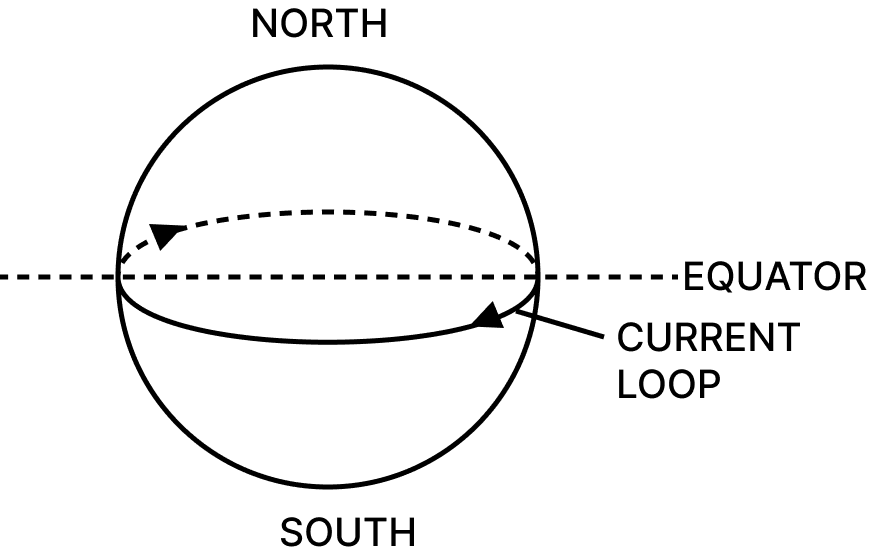
For a current-loop to produce this field :
Plane of the loop : The axis of the loop must lie along the earth's magnetic axis, so the loop lies in the east-west plane, that is, nearly in the equatorial plane of the earth.
Direction of current : Viewed from the north, the current must flow clockwise (from east to west). Then, by the end rule, the northern face of the loop behaves as a south pole and the southern face as a north pole, as the earth's field requires.
The charged currents in the outer conducting regions of the earth's core are thought to be responsible for earth's magnetism. What might be the battery (source of energy) to sustain these currents?
Answer
The exact source is not known. One possibility is the radioactivity in the interior of the earth. Radioactive materials produce charged particles, which rotate with the earth and so constitute currents that can sustain the earth's magnetism.
The earth may have even reversed the direction of its field several times during its history of 4 to 5 billion years. How geologists know this happening in such distant past?
Answer
The earth's magnetic field gets weakly recorded in certain rocks during their solidification, the rocks becoming magnetised along the field prevailing at that time. Analysis of the magnetism of such rocks of different ages reveals the direction of the earth's field in the distant past. Rocks showing magnetisation in opposite directions indicate that the earth's field has reversed its direction several times.
Obtain an expression for the torque acting on a bar-magnet placed in a uniform magnetic field and define magnetic moment. Write also its unit.
Answer
Consider a bar-magnet placed in a uniform magnetic field , with its magnetic axis making an angle θ with the direction of .
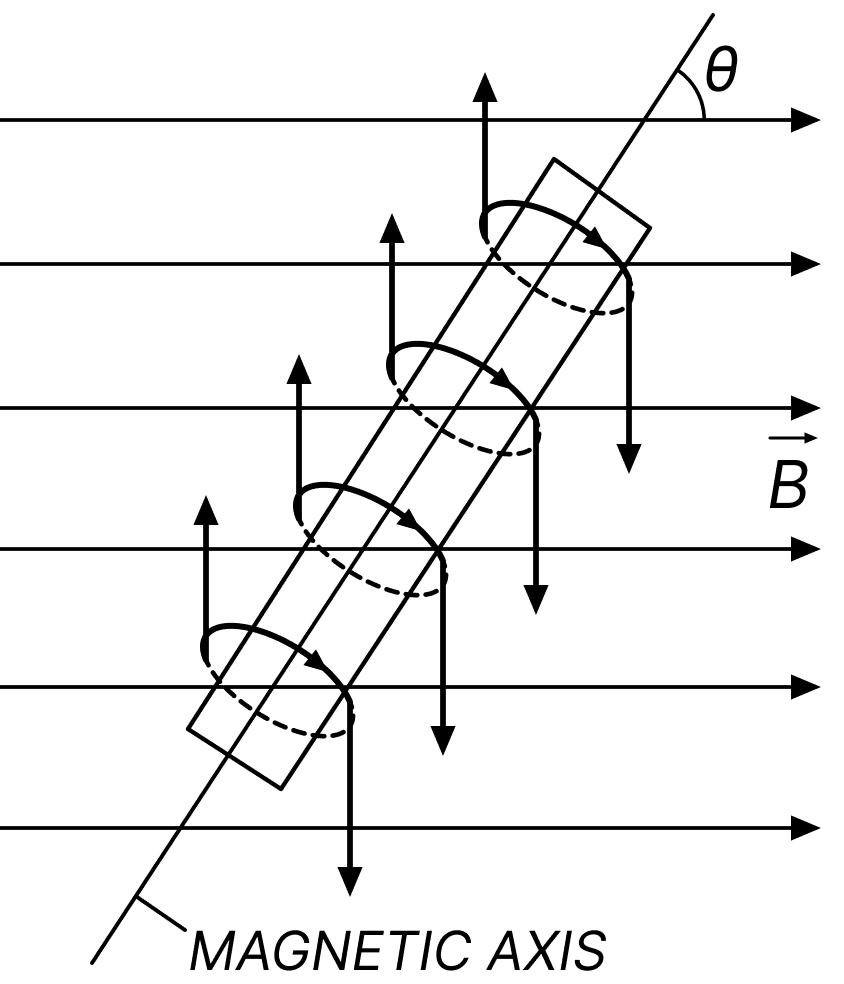
Torque : According to the modern view, each atom of the magnet is a tiny current-loop, and all these loops are aligned in the same direction, with their axes along the magnetic axis. The torque on one such loop of area A carrying current I is
If the magnet contains N such current-loops, the torques on all of them act in the same sense and add up. So the torque on the whole magnet is
The quantity NIA is defined as the magnitude of the magnetic dipole moment m of the magnet. Thus,
or, in vector form, . This torque tends to rotate the magnet so that its axis becomes parallel to the field.
Magnetic moment : Putting θ = 90° and B = 1 in Eq. (i) gives m = τ. Hence, the magnetic moment of a magnet is numerically equal to the torque acting on the magnet when it is held perpendicular to a uniform magnetic field of unit magnitude. It is a vector quantity directed from the south pole to the north pole of the magnet.
Unit : From Eq. (i),
so the SI unit of magnetic moment is = A m2, which is also written as J T-1.
Determine the expression for the magnetic field due to a short bar-magnet (magnetic dipole) at a point on the
(i) axis
(ii) equatorial line of the dipole.
Answer
Consider a short bar-magnet NS of magnetic length 2l, with poles of strength +qm (at N) and −qm (at S), so that its magnetic moment is m = qm × 2l. The magnetic field due to a pole of strength qm at a distance x from it is , directed away from a north pole and towards a south pole.
(i) Point on the axis (end-on position) :
Let P be a point on the axis of the magnet, at a distance r from its centre O, on the side of the north pole.

The distance of P from N is (r − l) and from S is (r + l). The field at P due to N is directed away from N, and that due to S is directed towards S, that is, the two fields are opposite to each other along the axis. Since N is nearer, the resultant field is
Putting qm × 2l = m,
For a short magnet (l << r), l2 may be neglected in comparison with r2, so
The field is along the axis, directed from S to N (along ).
(ii) Point on the equatorial line (broad-side-on position) :
Let P be a point on the equatorial line, at a distance r from the centre O. Each pole is at a distance from P.
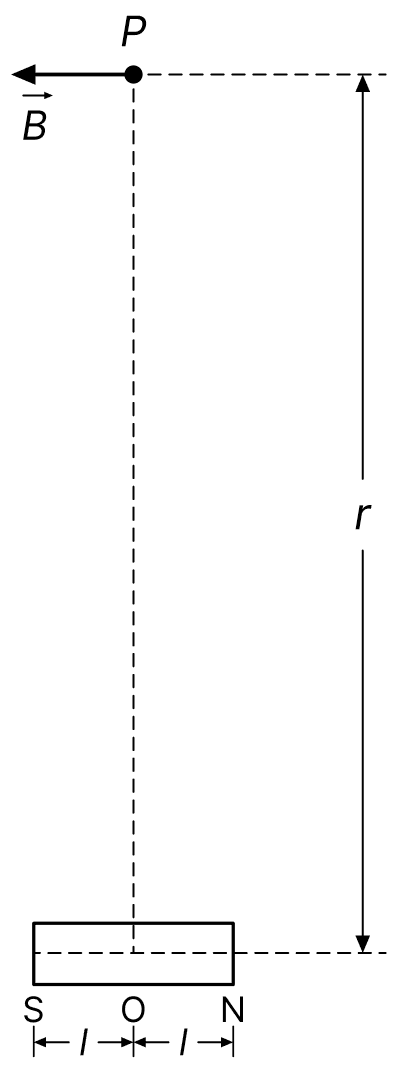
The magnitudes of the fields at P due to the two poles are equal,
BN is directed away from N along NP, and BS towards S along PS. Let each make an angle φ with the axis. Their components perpendicular to the axis are equal and opposite and cancel, while their components parallel to the axis add up, both pointing from N to S. Hence
For a short magnet (l << r),
The field is parallel to the axis, directed from N to S (opposite to ).
Hence, for a short bar-magnet, the field at an axial point is and at an equatorial point is ; at equal distances the axial field is twice the equatorial field.
What are the elements of earth's magnetic field? Show them in a labelled diagram. What is their importance? Write relations among them. How does the value of dip vary from equator to pole?
Answer
Elements : The three elements of the earth's magnetic field are :
(i) Angle of declination (α) — the acute angle between the magnetic meridian and the geographical meridian at a place.
(ii) Angle of dip (θ) — the angle between the direction of the earth's magnetic field and the horizontal in the magnetic meridian at a place.
(iii) Horizontal component (BH) — the component of the earth's magnetic field in the horizontal direction in the magnetic meridian.
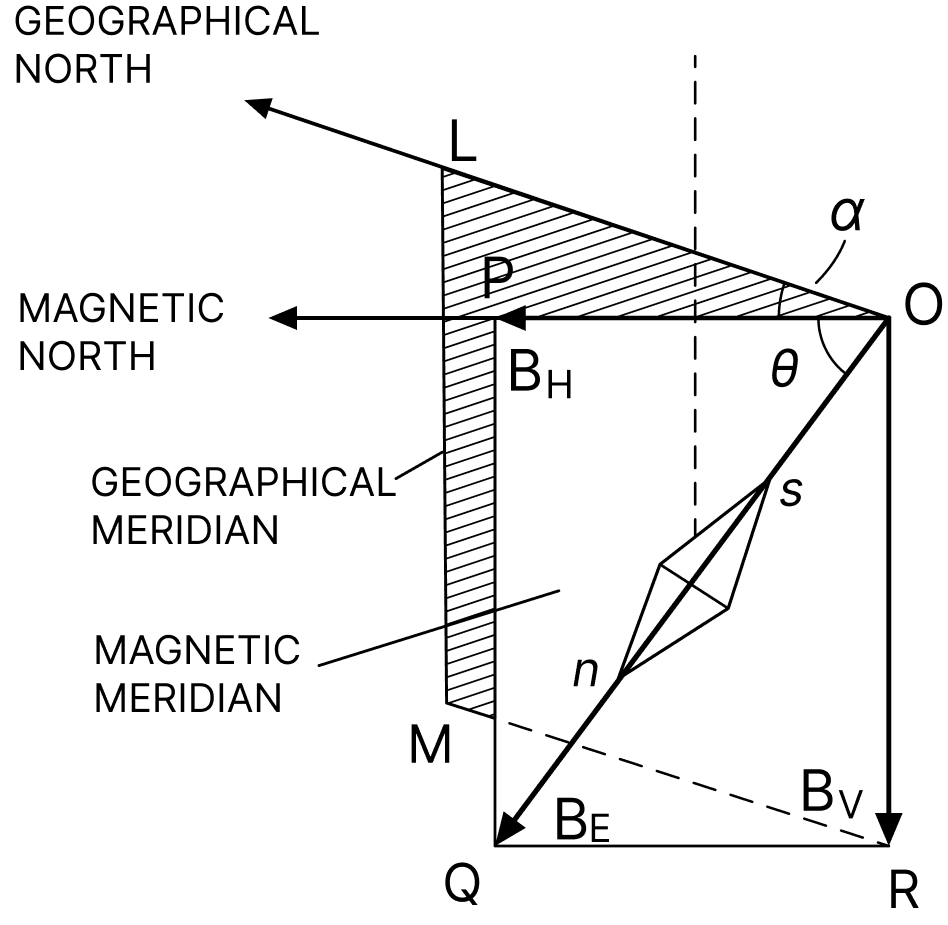
In the diagram, OPQR is the magnetic meridian and OLMR is the geographical meridian; the angle between them is α. OQ is the direction of the earth's field BE, making the angle θ with the horizontal OP. BE resolves into BH along OP and BV vertically downwards.
Importance : If α and θ are known at a place, the direction of the earth's field BE is fixed; if BH and θ are known, its magnitude can be found. Thus α, θ and BH together give full information about the earth's magnetic field at that place.
Relations :
Variation of dip : The angle of dip is zero at the magnetic equator, where the field is horizontal. It increases as we move towards a magnetic pole and becomes 90° at the magnetic poles, where the field is vertical.
What are magnetic lines of force? Give their properties and trace them for a bar-magnet.
Answer
Magnetic lines of force : A magnetic line of force is an imaginary curve in a magnetic field along which the direction of the field is represented continuously, so that the tangent at any point on it gives the direction of the magnetic field at that point.
Properties :
(i) Outside the magnet they emerge from the north pole and curve round into the south pole; inside the magnet they continue from the south pole back to the north pole. Each line is therefore a closed loop, whereas electric lines of force are not closed loops.
(ii) Lines of force do not intersect: a crossing would mean two tangents, and hence two directions of the magnetic field, at the same point.
(iii) The crowding of the lines indicates the strength of the field. They are close together near the poles, where the field is strong, and become rarer farther away, where it is weaker; a greater number of lines of force at a point means a stronger magnetic field there.
(iv) A uniform magnetic field is represented by parallel and equidistant lines of force.
(v) A neutral point has no line of force passing through it.
(vi) The angle at which a line of force enters or leaves a magnetic pole is not fixed; it can be any angle.
(vii) Lines of force running between opposite (N-S) poles behave like stretched strings trying to contract, which accounts for attraction; lines between similar (N-N or S-S) poles tend to repel one another, which accounts for repulsion.
Tracing the lines for a bar-magnet : Place the bar-magnet on a sheet of paper and a small compass needle near its north pole. Mark the positions of the two ends of the needle with dots. Shift the needle so that its south end lies at the dot marking its earlier north end, and mark the new position of the north end. Repeat this step until the needle reaches the south pole of the magnet. The smooth curve joining the dots is one line of force, its direction being from N to S outside the magnet. Repeat from different starting points near the north pole to trace more lines.
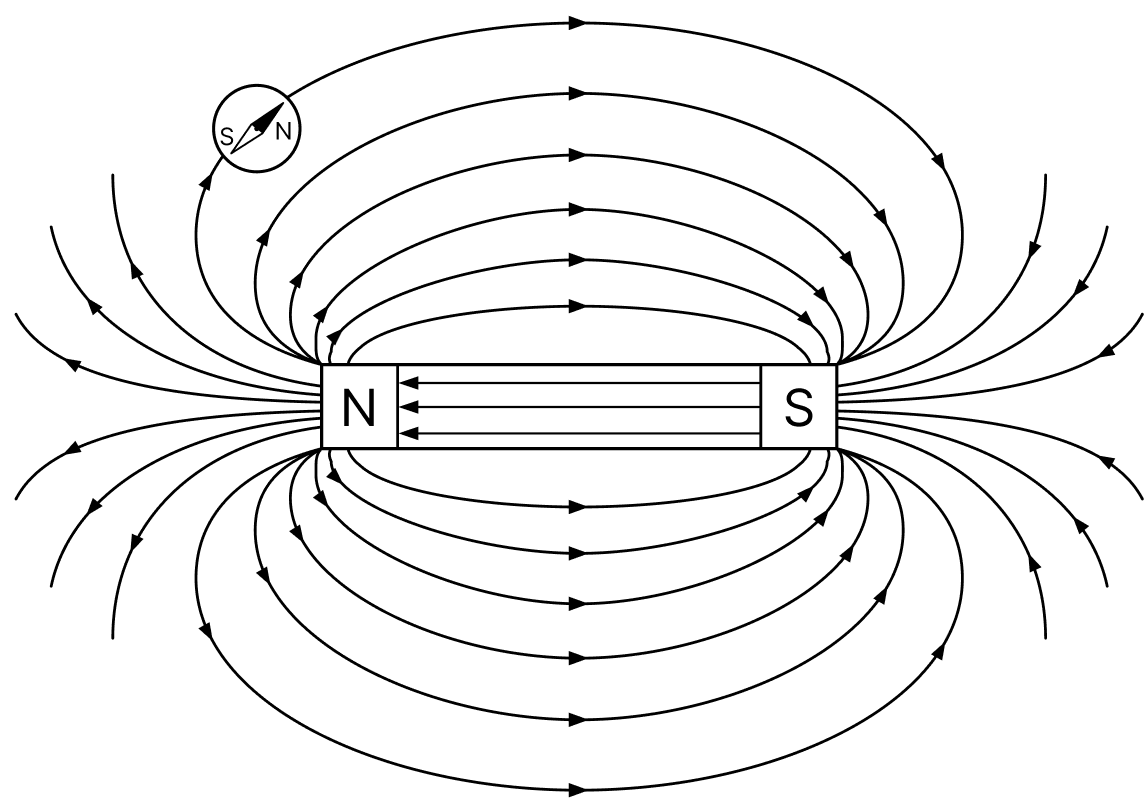
The lines of force of a bar-magnet emerge from its north pole and curve round to enter its south pole, as shown.
Define magnetic dipole moment in terms of current and area of a loop and in terms of pole strength of a magnetic dipole. Write unit of magnetic dipole and pole strength.
Answer
In terms of current and area of a loop : A current-loop of area A carrying a current I behaves as a magnetic dipole whose magnetic dipole moment is
that is, the magnetic dipole moment of a current-loop is the product of the current in the loop and the area of the loop. Its direction is perpendicular to the plane of the loop, given by the right-hand rule : if the fingers of the right hand curl around the loop in the direction of the current, the extended thumb points along . For a coil of N turns, = NI.
In terms of pole strength : A magnetic dipole (bar-magnet) has two equal and opposite poles of strength qm separated by its magnetic length 2l. Its magnetic dipole moment is
that is, the magnetic dipole moment is the product of the pole strength and the magnetic length. It is directed along the axis from the south pole to the north pole.
Units :
SI unit of magnetic dipole moment = ampere-metre2 (A m2), also written as J T-1.
SI unit of pole strength = = ampere-metre (A m).
Compare current carrying loop and a bar-magnet as a magnetic dipole. Obtain an expression for magnetic field due to a magnetic dipole at equatorial line.
Answer
Comparison of a current-carrying loop and a bar-magnet as magnetic dipoles :
| Current-carrying loop | Bar-magnet |
|---|---|
| Magnetic dipole moment m = IA (NIA for N turns), perpendicular to the plane of the loop. | Magnetic dipole moment m = qm × 2l, along the axis from S to N. |
| The face in which the current appears anti-clockwise is a north pole; the face in which it appears clockwise is a south pole. | The north and south poles lie near the two ends of the magnet. |
| Placed in a magnetic field, it sets itself with along ; the torque on it is . | Placed in a magnetic field, it sets itself with along ; the torque on it is . |
| Two freely suspended loops on a common axis attract when their dipole moments are in the same direction and repel when opposite. | Two freely suspended magnets attract (unlike poles facing) or repel (like poles facing). |
| Far field : on the axis, on the equatorial line. | Far field : on the axis, on the equatorial line. |
Thus both behave identically as magnetic dipoles; according to the modern view, a bar-magnet is itself an assembly of tiny aligned current-loops.
Magnetic field on the equatorial line :
Consider a magnetic dipole NS of magnetic length 2l with poles of strength +qm and −qm, so that m = qm × 2l. Let P be a point on its equatorial line at a distance r from the centre O. The field due to a pole of strength qm at a distance x from it is .
Each pole is at a distance from P, so the fields at P due to the two poles have equal magnitudes,
BN is directed away from N along NP, and BS towards S along PS. Let each make an angle φ with the axis of the dipole, where
Resolving the two fields, the components BN sin φ and BS sin φ perpendicular to the axis are equal and opposite and cancel. The components BN cos φ and BS cos φ parallel to the axis are in the same direction (from N to S) and add. Hence the resultant field at P is
Using Eqs. (i) and (ii),
For a short dipole (l << r), l2 may be neglected in comparison with r2, so
Hence, the magnetic field at a point on the equatorial line is (reducing to for a short dipole), directed parallel to the axis from N to S.
Draw diagram of Earth's magnetic field, showing horizontal, vertical component of Earth's magnetic field and angle of dip.
Answer
At a place, the earth's total magnetic field BE acts in the magnetic meridian, along the axis of a freely pivoted dip needle, making an angle θ with the horizontal. It is resolved into :
the horizontal component BH, along the horizontal line in the magnetic meridian (pointing towards magnetic north),
the vertical component BV, acting vertically (downwards in the northern hemisphere).
The angle θ between BE and BH is the angle of dip. From the diagram,
(i) Name the places on Earth where :
(a) horizontal and vertical components are minimum and maximum.
(b) angle of dip is maximum and minimum.
(ii) What is the reason for earth's magnetism?
Answer
(i)
(a)
The horizontal component BH is maximum at the magnetic equator (where BH = BE) and minimum (zero) at the magnetic poles.
The vertical component BV is maximum at the magnetic poles (where BV = BE) and minimum (zero) at the magnetic equator.
(b)
The angle of dip is maximum (90°) at the magnetic poles, where the earth's field is vertical.
The angle of dip is minimum (zero) at the magnetic equator, where the earth's field is horizontal.
These follow from BH = BE cos θ and BV = BE sin θ, with θ = 0° at the magnetic equator and θ = 90° at the magnetic poles.
(ii) The exact cause of the earth's magnetism is not yet known. The earth behaves as if a powerful magnet were placed within it, with its south pole towards the earth's north and its north pole towards the earth's south. This cannot be a permanent iron magnet, because the temperature of the earth's core is above the Curie temperature of iron, at which iron cannot retain its magnetism. The earth's magnetism is thought to be due to charged currents in the outer conducting regions of the earth's core. One possible source of energy sustaining these currents is radioactivity in the interior of the earth : the charged particles so produced rotate with the earth and constitute currents.
Define angle of dip, magnetic meridian, geographic meridian and angle of declination and obtain the relation,
where θ is angle of dip. BV and BH are vertical and horizontal components of Earth's magnetic field.
Answer
Angle of dip : The angle between the direction of the earth's magnetic field and the horizontal in the magnetic meridian at a place is called the angle of dip (θ) at that place.
Magnetic meridian : The vertical plane passing through the axis of a magnetic needle suspended freely through its centre of gravity and at rest under the earth's field is called the magnetic meridian.
Geographic meridian : The vertical plane passing through the line joining the geographical north and south poles of the earth is called the geographic meridian.
Angle of declination : The acute angle between the magnetic meridian and the geographic meridian at a place is called the angle of declination (α) at that place.
Relation tan θ = :
Let a dip needle ns be pivoted at O so that it is free to rotate in the vertical plane OPQR, the magnetic meridian. The axis OQ of the needle, in its steady state, gives the direction of the earth's total magnetic field BE, and the angle between OQ and the horizontal OP is the angle of dip θ.
Resolving BE into a horizontal component BH along OP and a vertical component BV along OR,
Dividing Eq. (ii) by Eq. (i),
Hence, tan θ = , where θ is the angle of dip.