
The interference phenomenon can take place :
- in all waves
- in transverse waves only
- in longitudinal waves only
- in standing waves only
Answer
in all waves
Reason — Interference is the result of the superposition of waves, and the principle of superposition holds for all types of waves — transverse or longitudinal, mechanical or electromagnetic. Hence interference can take place in all waves.
Two waves of equal amplitudes and wavelengths but differing in phases are superimposed. The amplitude of the resultant wave is maximum when phase difference is :
- zero
- π
Answer
zero
Reason — For two waves of amplitudes a1 and a2 superposed with a phase difference ϕ, the resultant amplitude R is given by
R is maximum when cos ϕ = +1, that is, when ϕ = 0, 2π, 4π, … . Hence the amplitude is maximum when the phase difference is zero.
For constructive interference to take place between two monochromatic light waves of wavelength λ, the path difference should be :
- nλ
where n is an integer.
Answer
nλ
Reason — Constructive interference occurs where the two waves meet in the same phase, ϕ = 2nπ. Since path difference = × phase difference, the path difference must be = nλ, an integral multiple of λ.
Young's double-slit arrangement is contained in a transparent chamber. If the chamber is evacuated, then :
- fringes will disappear
- fringe-width will slightly increase
- fringe-width will slightly decrease
- there will be no effect
Answer
fringe-width will slightly increase
Reason — The fringe-width is , so β ∝ λ. The refractive index of air is slightly greater than 1, so the wavelength of light in vacuum is slightly greater than in air. When the chamber is evacuated λ increases slightly, and hence the fringe-width increases slightly.
In Young's double-slit experiment, sodium lamp is replaced by a blue-light lamp. Then :
- the fringes will become brighter
- the fringes will become fainter
- the fringe-width will increase
- the fringe-width will decrease
Answer
the fringe-width will decrease
Reason — The fringe-width is directly proportional to λ. Blue light has a shorter wavelength than the yellow light of a sodium lamp, so the fringe-width decreases.
When sodium lamp in Young's double-slit experiment is replaced by an ordinary bulb (white light), then :
- all bright fringes become white
- all bright fringes have colours between red and violet
- fringes disappear
- only the central fringe is white, all others are coloured
Answer
only the central fringe is white, all others are coloured
Reason — At the centre of the pattern the path difference is zero for all wavelengths, so every colour forms a bright fringe there and their superposition makes the central fringe white. On either side, the fringe-width is different for different colours, so the fringes of different colours separate and the other fringes are coloured.
To produce constructive interference, two overlapping light waves must have :
(Take 'm' as an integer)
- path difference of
- path difference of (mλ)
- phase difference of
- phase difference
Answer
path difference of (mλ)
Reason — For constructive interference the waves must meet in the same phase, that is, phase difference = 2mπ. The corresponding path difference is = mλ.
In Young's double-slit experiment, 16 fringes are observed in a certain segment of the screen when light of wavelength 720 nm is used. When wavelength of light is changed to 480 nm, the number of fringes observed in the same segment of the screen would be :
- 18
- 20
- 24
- 30
Answer
24
Reason — For a segment of fixed length L, the number of fringes is . For the same arrangement Nλ is constant, so
In an interference experiment ratio of the amplitudes of coherent waves is . The ratio of maximum and minimum intensities of the fringes will be :
- 2 : 3
- 4 : 9
- 5 : 1
- 25 : 1
Answer
25 : 1
Reason — The maximum and minimum resultant amplitudes are (a1 + a2) and (a1 ~ a2). With ,
A beam of electrons is used in young's double-slit experiment. If the speed of electrons is decreased, then the fringe-width will :
- increase
- decrease
- remain same
- fringes will not be seen
Answer
increase
Reason — The de Broglie wavelength of the electrons is . When the speed v decreases, λ increases. Since the fringe-width is proportional to λ, the fringe-width increases.
The ratio of intensities at two points P and Q on the screen in a Young's double slit experiment where phase difference between two waves of same amplitude are and , respectively, are :
- 1 : 3
- 3 : 2
- 2 : 3
- 3 : 1
Answer
3 : 2
Reason — For two waves of the same amplitude, the resultant intensity is , where Im is the maximum intensity. Hence
The interference pattern is obtained with two coherent sources of light of intensity ratio 4 : 1 and the ratio . Then the value of x is :
- 3
- 4
- 2
- 1
Answer
4
Reason — Let I1 = 4I0 and I2 = I0. Then
Therefore,
Comparing with , x = 4.
In Young's double-slit experiment, one of the slit is wider than other, so that amplitude of the light from one slit is double of that from other slit. If Im be the maximum intensity, the resultant intensity I when they interfere at phase difference ϕ is given by :
Answer
Reason — Intensity is proportional to the square of the amplitude, so the intensities from the two slits are 4I' and I'. The maximum intensity is
At phase difference ϕ,
In Young's double-slit experiment, 16 fringes are observed in a certain segment of the screen when light of a wavelength of 700 nm is used. If the wavelength of light is changed to 400 nm, the number of fringes observed in the same segment of the screen would be :
- 28
- 24
- 30
- 18
Answer
28
Reason — For the same segment of the screen, the number of fringes N is inversely proportional to the fringe-width, and hence to λ. So Nλ is constant:
A mixture of light, consisting of wavelength 590 mm and an unknown wavelength, illuminates Young's double-slit and gives rise to two overlapping interference patterns on the screen. The central maximum of both lights coincide. Further, it is observed that the third bright fringe of known light coincides with the 4th bright fringe of the unknown light. From this data, the wavelength of the unknown light is :
- 776.8 nm
- 393.4 nm
- 885.0 nm
- 442.5 nm
Answer
442.5 nm
Reason — The distance of the mth bright fringe from the central maximum is . Since the 3rd bright fringe of the known light (λ1) coincides with the 4th bright fringe of the unknown light (λ2),
Note: The question prints the known wavelength as 590 mm; this is a misprint for 590 nm, the value used above.
Two ideal slits S1 and S2 are at a distance d apart, and illuminated by light of wavelength λ passing through an ideal source slit S placed on the line through S2 as shown in the figure. The distance between the planes of slits and the source slit is D. A screen is held at a distance D from the plane of the slits. The minimum value of d for which there is darkness on O is :
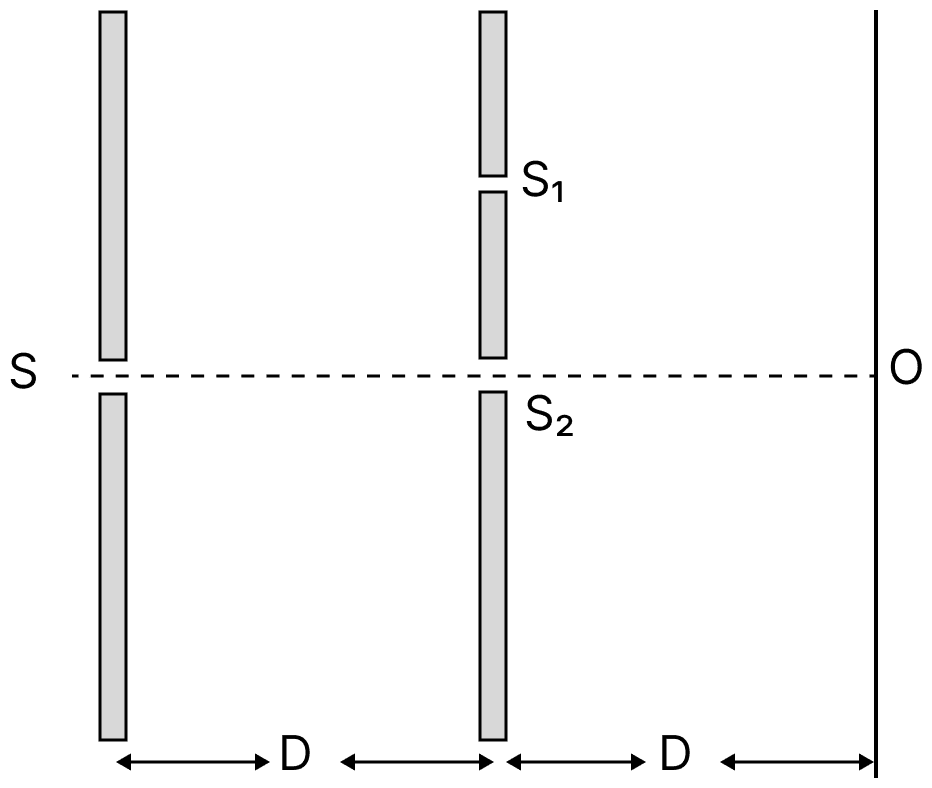
Answer
Reason — The source slit S lies on the line through S2 and O, so SS2 = S2O = D, while S1 is at a distance d from this line. Hence, for d ≪ D,
The path difference between the two waves reaching O is
For darkness at O with the minimum d, Δ = :
The figure shows a double-slit experiment where S1 and S2 are the slits. The path lengths S1P and S2P are nλ and (n + 2)λ respectively, where n is a whole number and λ is the wavelength. Taking the central fringe as zeroth fringe, what is formed at P?
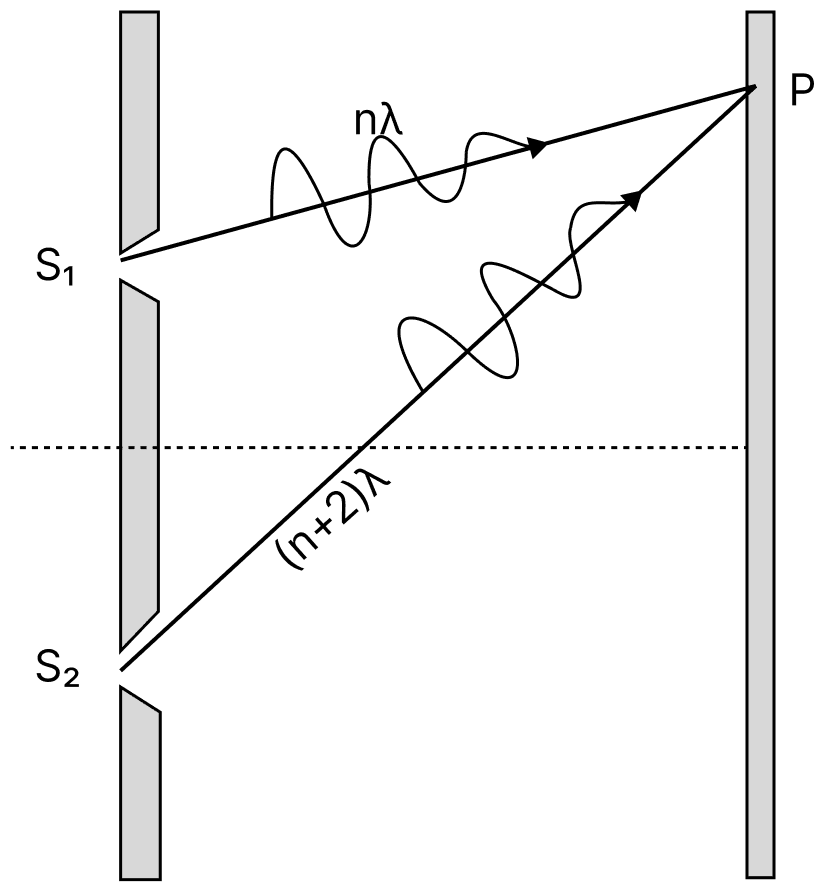
- First bright
- First dark
- Second bright
- Second dark
Answer
Second bright
Reason — The path difference at P is S2P − S1P = (n + 2)λ − nλ = 2λ. A path difference mλ gives a bright fringe of order m, so with m = 2 a second bright fringe is formed at P.
In a double slit experiment, when a thin film of thickness t having refractive index μ is introduced in front of one of the slits, the maximum at the centre of the fringe pattern shifts by one fringe width. The value of t is (λ is the wavelength of the light used) :
Answer
Reason — The film increases the optical path of one beam by (μ − 1)t, which shifts the fringe pattern by . For a shift of one fringe-width ,
Two light waves having the same wavelength λ in vacuum are in phase initially. Then the first wave travels a path L1 through a medium of refractive index n1 while the second wave travels a path of length L2 through a medium of refractive index n2. After this the phase difference between the two waves is :
Answer
Reason — A path L in a medium of refractive index n is equivalent to an optical path nL in vacuum. So the path difference between the waves is (n1L1 − n2L2), and
In YDSE, the intensity of light at a point of the screen where path difference is λ is I. If intensity at another point on the screen is , then possible path differences at this point are :
- ,
- ,
- ,
- ,
Answer
,
Reason — For two waves of equal intensity, . At path difference λ, ϕ = 2π, so the intensity there is the maximum intensity: Im = I. For intensity ,
Path difference = = and .
The intensity at the maximum in a Young's double-slit experiment is I0. Distance between two slits is d = 5λ, where λ is the wavelength of light used in the experiment. What will be the intensity in front of one of the slits on the screen placed at a distance D = 10 d?
- I0
Answer
Reason — A point directly in front of one slit is at a distance x = from the centre of the screen. The path difference there is
So the phase difference is , and
Consider a Young's double-slit experiment as shown in figure. What should be the slit separation d in terms of wavelength λ such that the first minima occurs directly in front of the slit (S1)?
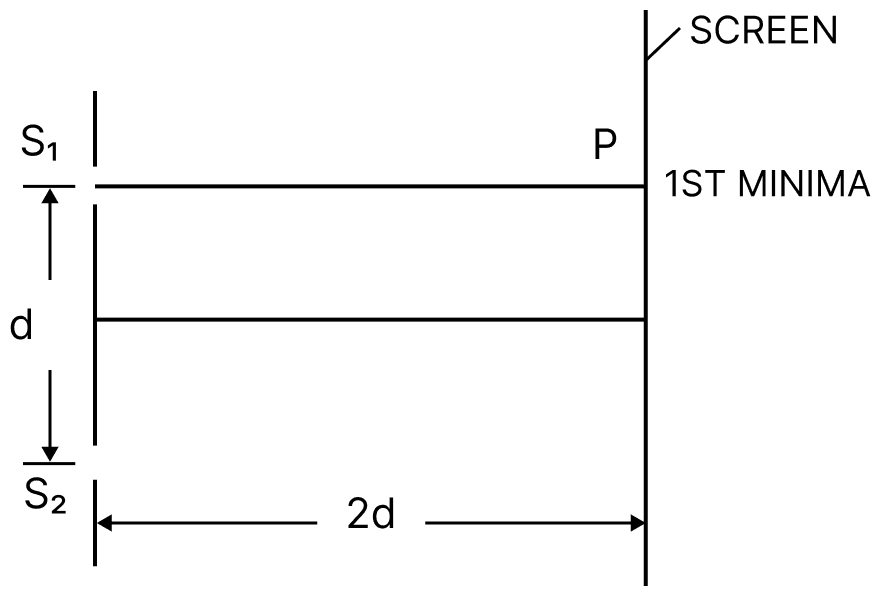
Answer
Reason — The screen is at a distance 2d from the slits and P is directly in front of S1, so S1P = 2d and
As D is not much larger than d here, the exact path difference is used. For the first minimum at P,
Can sound waves and the X-rays interfere?
Answer
Yes.
Explanation:
Interference is a property of all waves. Sound waves (longitudinal mechanical waves) interfere with sound waves, and X-rays (electromagnetic waves) interfere with X-rays. A sound wave cannot, however, interfere with an X-ray, since the two waves are of different nature and frequency.
Does the interference of light give information about the nature (transverse or longitudinal) of light waves?
Answer
No.
Explanation:
Interference takes place in both transverse and longitudinal waves, so it only shows that light behaves as a wave. The transverse nature of light is established by polarization experiments.
State the path difference between two waves reaching a point for
(i) constructive interference,
(ii) destructive interference.
Answer
(i) For constructive interference, path difference = mλ, where m = 0, 1, 2, …
(ii) For destructive interference, path difference = , that is, , where m = 1, 2, 3, …
Explain the statement 'light added to light can produce darkness.'
Answer
When two light waves of equal amplitudes meet at a point in opposite phase (path difference ), the resultant amplitude is (a − a) = 0. The resultant intensity at that point is zero, so light added to light produces darkness. This is destructive interference.
What is the phase difference corresponding to a path difference λ between two waves reaching a point?
Answer
2π radian.
Explanation:
When two light waves interfere, then there is darkness at some points. Is the light energy of these points lost?
Answer
No.
Explanation:
In interference the light energy is only redistributed. The energy that disappears from the points of minimum intensity is present at the points of maximum intensity.
Does energy conservation hold in interference?
Answer
Yes.
Explanation:
The average intensity in the interference pattern is
which equals the sum of the separate intensities of the two waves. Energy is neither created nor destroyed; it is simply redistributed.
What is fringe-width?
Answer
The distance between two consecutive bright or dark fringes on the screen is called the fringe-width. It is given by .
In a region illuminated by two light-sources 1 and 2, the intensity at each point is I1 + I2, where I1 and I2 are the intensities at the point due to sources 1 and 2 separately. Are the sources coherent?
Answer
No, the sources are incoherent.
Explanation:
For coherent sources the intensity is , which varies from point to point. An intensity of I1 + I2 at every point means the interference term averages to zero, because the phase difference between the waves changes randomly with time.
(i) Is there any phase change when a light wave going from a rarer medium to a denser medium suffers reflection at the interface?
(ii) When going from a denser to a rarer medium, then?
(iii) When undergoing refraction, then?
Answer
(i) Yes, the reflected wave suffers a phase change of π (180°).
(ii) No phase change.
(iii) No phase change.
Widths of the two slits in Young's experiment are in the ratio 4 : 1. What is the ratio of the amplitudes of light waves emitted from them?
Answer
2 : 1.
Explanation:
The intensity of light emitted from a slit is proportional to the width of the slit, so I1 : I2 = 4 : 1. Since intensity ∝ (amplitude)2,
Young's double-slit experiment was performed with monochromatic light of blue colour. The experiment was then repeated, first with light of red colour and then with light of yellow colour. Which colour produces interference pattern with maximum fringe separation (i.e., fringe-width)?
Answer
Red colour.
Explanation:
The fringe-width is proportional to λ, and among blue, yellow and red light, red light has the longest wavelength.
How is fringe-width of an interference pattern in Young's double-slit experiment affected if the two slits are brought closer to each other?
Answer
The fringe-width increases.
Explanation:
Since , the fringe-width is inversely proportional to the separation d between the slits.
In Young's double-slit experiment, the intensity of a bright fringe is I. What will be the intensity at the same place if one slit is closed?
Answer
.
Explanation:
With both slits open, a bright fringe has intensity I = K(a + a)2 = 4Ka2. With one slit closed, the intensity at that place is due to one slit only, Ka2 = .
In Young's double-slit experiment, what is the path difference between the two light waves forming 5th bright fringe on the screen?
Answer
5λ.
Explanation:
For a bright fringe the path difference is mλ. For the 5th bright fringe m = 5, so the path difference is 5λ, where λ is the wavelength of light used.
What is the principle of superposition of waves?
Answer
When two or more waves travel simultaneously in a medium, the resultant displacement of each point of the medium at any instant is the vector sum of the displacements produced at that point by the individual waves separately. Thus, if y1, y2, … are the separate displacements,
Each wave travels independently, as if the other waves were not present. The principle holds for all types of waves, mechanical as well as electromagnetic, except waves of very large amplitude.
What is interference of light waves?
Answer
When two light waves of the same frequency travel simultaneously in the same direction, the resultant intensity at a point is, because of their superposition, different from the sum of their separate intensities. This re-distribution of light intensity due to the superposition of two light waves is called interference of light.
The interference is constructive at points where the resultant intensity is maximum, and destructive at points where it is minimum or zero.
In Young's double-slit experiment with monochromatic light, how is the fringe-width affected, if
(i) the separation d between the two slits is doubled and the distance D of the screen from the slits is halved,
(ii) the widths of the two slits are increased,
(iii) one of the two slits is closed,
(iv) the Young's apparatus be immersed in water,
(v) The wavelength of the incident light is increased.
Answer
The fringe-width is .
(i) With d doubled and D halved,
The fringe-width reduces to one-fourth of its original value.
(ii) The fringe-width does not depend on the width of the slits, so it is unchanged. The fringes become brighter, but the patterns formed by different parts of the two slits overlap, so the contrast between bright and dark fringes becomes poorer. When the slit widths become comparable with the slit separation, the fringes are no longer seen.
(iii) The interference fringes disappear, because two coherent sources are no longer present. Only the single-slit diffraction pattern of the open slit is observed.
(iv) In water the wavelength becomes , where n is the refractive index of water. Hence ; the fringe-width decreases.
(v) Since β ∝ λ, the fringe-width increases with the increase in wavelength.
What is the effect of the following operations on the interference fringes in Young's double-slit experiment?
(i) The width of the source slit is increased.
(ii) The source slit is moved closer to the double-slit.
Answer
(i) The fringes become indistinct. A wide source slit behaves like many narrow sources, each producing its own fringe pattern, and these patterns are shifted relative to one another. Their overlapping reduces the contrast, and when the source slit is wide enough the fringes disappear.
(ii) Let x be the width of the source slit and y its distance from the plane of the two slits. For the fringes to be distinctly visible, the condition is
As the source slit is moved closer, y decreases and increases. The patterns due to different parts of the source slit overlap more, so the fringes become less distinct and finally vanish. The fringe-width is independent of y and remains unchanged.
If, in Young's experiment, the distance d between the slits is kept smaller than the wavelength λ of light, the interference pattern will not be seen. Why?
Answer
The fringe-width is , where D is the distance of the screen from the plane of the slits. If d < λ, then β > D, so a single fringe spreads over the entire screen and no pattern of alternate bright and dark fringes can be seen.
Also, the highest order of interference maximum is , which is less than 1 here. So, apart from the central maximum, no other maximum is formed.
When a thin transparent film is placed just in front one of the slits in the Young's double-slit experiment using white light, what change results in fringe-system?
Answer
A film of thickness t and refractive index n increases the optical path of the light from that slit by (n − 1)t. Hence the entire fringe-system shifts towards the covered slit by a distance , while the fringe-width remains unchanged.
With white light, n depends on λ: it is greater for shorter wavelengths. So the violet fringes shift farther than the red fringes, and the central white fringe becomes slightly coloured. There is a kind of dispersion in the central fringe.
The phase difference between the light-waves emerging from the slits of the Young's experiment is π radian. Will the central fringe be bright or dark? Explain with reason.
Answer
The central fringe will be dark.
The waves reaching the centre of the screen travel equal distances from the two slits, so there is no path difference between them. With an initial phase difference of π radian, they arrive at the centre in opposite phase and interfere destructively. Hence the central fringe is dark.
State with reason whether diffraction of light takes place at the two slits in the Young's interference experiment.
Answer
Yes, diffraction of light takes place at the two slits.
Each slit is very narrow, so the light arriving at it is diffracted and spreads out on the far side. Only because of this spreading do the waves from the two slits overlap on the screen and interfere. Thus the interference pattern is formed by the diffracted waves emerging from the two slits.
Suppose the two slits in Young's apparatus are illuminated by two identical but independent monochromatic light sources. Will you observe interference pattern on the screen?
Answer
No.
Explanation:
The light waves emitted by two independent sources do not have a constant phase difference, so the interference pattern is not sustained. The intensity at any point of the screen changes rapidly and continuously with time as the phase difference changes. The eye cannot follow this change because of persistence of vision, so the screen appears uniformly illuminated.
Define 'coherence' for light waves.
Answer
Two light waves are said to be coherent if they have a sharply defined phase difference that remains constant with time. This property of the waves, of maintaining a constant phase difference, is called coherence. Coherent waves form a stable, well-defined interference pattern.
State the conditions for two light waves to be coherent.
Answer
Two light waves are coherent if:
(i) they are of the same frequency (same wavelength),
(ii) they have a constant phase difference, which is ensured by deriving them from a single original source,
(iii) they are continuous waves,
(iv) they are preferably of the same amplitude, for good contrast of the fringes.
Can two independent sources of light be coherent?
Answer
No (for conventional sources).
Explanation:
Two independent conventional sources cannot be coherent. Light is emitted by innumerable atoms of a source in short wave-pulses, each lasting only about 10-8 s, with phases that vary randomly. So the phase difference between the waves from two independent sources does not remain constant.
However, two independent lasers can give coherent light waves, because in a laser a large number of atoms emit simultaneously with a constant phase difference over a long interval of time.
Why should we have narrow sources to produce good interference fringes?
Answer
A broad source is equivalent to a large number of narrow sources lying side by side. Each pair of narrow sources forms its own pattern of fringes, and these patterns are relatively shifted. The fringes therefore overlap, and the contrast between bright and dark fringes becomes poor. The greater the width of the sources, the greater the overlapping; if the width of the slits equals half the fringe-width, the fringes vanish.
Hence, for good contrast, the sources (slits) should be narrow, with widths considerably smaller than the fringe-width.
The frequencies of two wave-sources A and B shown in the figure are equal. What type of interference will occur at the points P, Q and R? The distance AB = (assume that the waves from A and B start in the same phase).
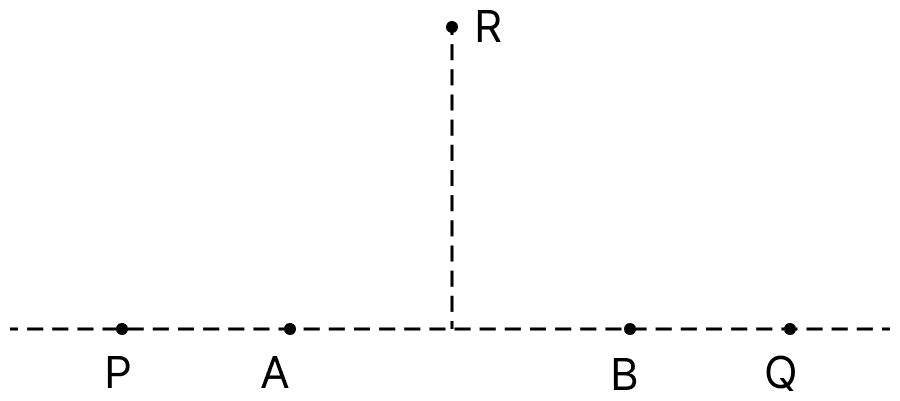
Answer
At P and Q : P lies on the line BA produced, so the path difference between the waves from A and B reaching P is PB − PA = AB = . Similarly at Q, QA − QB = AB = . As the waves start in the same phase, they meet at P and Q in opposite phase. The interference at P and Q is destructive.
At R : R is at equal distances from A and B, so the path difference is zero and the waves meet in the same phase. The interference at R is constructive.
Light from two coherent sources is reaching on a screen. If the path difference at a point on the screen for the yellow light be , then what will be the colour of the fringe at that point? Explain with necessary argument.
Answer
A path difference of is an odd multiple of , so the yellow waves meet at that point in opposite phase and interfere destructively.
If the sources emit yellow light only, there will be a dark fringe at that point.
If the sources emit white light, the yellow light is absent at that point while the other colours are not completely cancelled. The fringe is then coloured, with yellow and its neighbouring colours missing.
Why is no interference pattern observed when two coherent sources are
(i) infinitely close to each other
(ii) far apart from each other?
Answer
The fringe-width is , inversely proportional to the separation d between the sources.
(i) When d is negligibly small, β becomes too large; even a single fringe may occupy the whole screen. Hence no pattern of fringes is observed.
(ii) As d is increased, the fringe-width decreases. When d is very large, β becomes too small for the fringes to be seen separately, so no pattern is observed.
Consider interference between waves from two sources of intensities I and 4I. Find intensities at points where the phase difference is (a) 0, (b) , (c) π.
Answer
Given,
- I1 = I
- I2 = 4I
The resultant intensity at a point where the phase difference is ϕ is
(a) For ϕ = 0, cos ϕ = 1:
(b) For ϕ = , cos ϕ = 0:
(c) For ϕ = π, cos ϕ = −1:
Hence, the intensities are 9I, 5I and I respectively.
Find the maximum intensity in the interference pattern of Young's double-slit compared to the intensity due to one slit only.
Answer
Let a be the amplitude of the light wave from each slit. The intensity due to one slit only is
At a maximum the two waves meet in the same phase, so the resultant amplitude is (a + a) = 2a. Hence
Hence, the maximum intensity in the pattern is four times the intensity due to one slit only.
How will the interference pattern of Young's double- slit change, if one of the two slits is covered by a paper which transmits only half of the light intensity?
Answer
Let I be the intensity of the light wave from each slit initially. Then
When one slit is covered by the paper, the intensity of the wave from that slit becomes , while that from the other slit remains I. Now
Hence, the intensity of the maxima decreases from 4I to 2.914I and that of the minima increases from zero to 0.086I. The bright fringes become less bright and the dark fringes are no longer completely dark, so the contrast decreases. The fringe-width and the positions of the fringes remain unchanged.
Two coherent monochromatic light beams of intensity 4I and I are superposed. Find the ratio of maximum and minimum possible intensities in the resulting beam.
Answer
Given,
- I1 = 4I
- I2 = I
Hence, the ratio of maximum and minimum intensities is 9 : 1.
Find the ratio of intensities at two points on a screen in Young's double-slit experiment when waves from the two slits have a path difference of (i) 0 and (ii) .
Answer
Given,
- Path difference at the first point = 0
- Path difference at the second point =
The waves from the two slits have equal amplitudes, so the intensity at a point with phase difference ϕ is , where Im is the maximum intensity.
Phase difference = × path difference. So
Therefore,
Hence, the ratio of intensities is 2 : 1.
In Young's double-slit setup ratio of the width of the two slits is 4 : 9. Find the ratio of the :
(i) amplitude of the two waves emerging out of the slits.
(ii) Intensity of the two waves emitted from the slits.
Answer
Given,
- w1 : w2 = 4 : 9
The intensity of light from a slit is proportional to its width, and intensity is proportional to the square of the amplitude:
(i)
(ii)
Hence, the ratio of the amplitudes is 2 : 3 and the ratio of the intensities is 4 : 9.
The intensity at the central maxima (O) in Young's double-slit experiment is I0. If the distance OP equals one-third of the fringe width of the pattern, show that the intensity at point P would be .
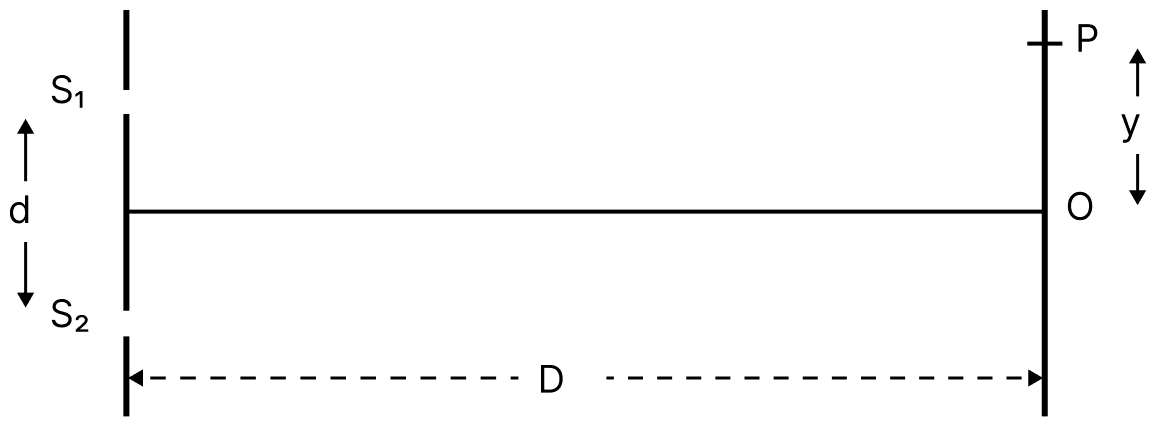
Answer
Given,
- Intensity at the central maximum O = I0
- OP = y = , where β is the fringe-width
Since ,
The path difference between the waves reaching P is
The phase difference is
Let I1 be the intensity due to each slit. The resultant intensity at P is
At the central maximum the intensity is 4I1, which is given as I0:
From Eq. (i),
Hence, the intensity at point P is .
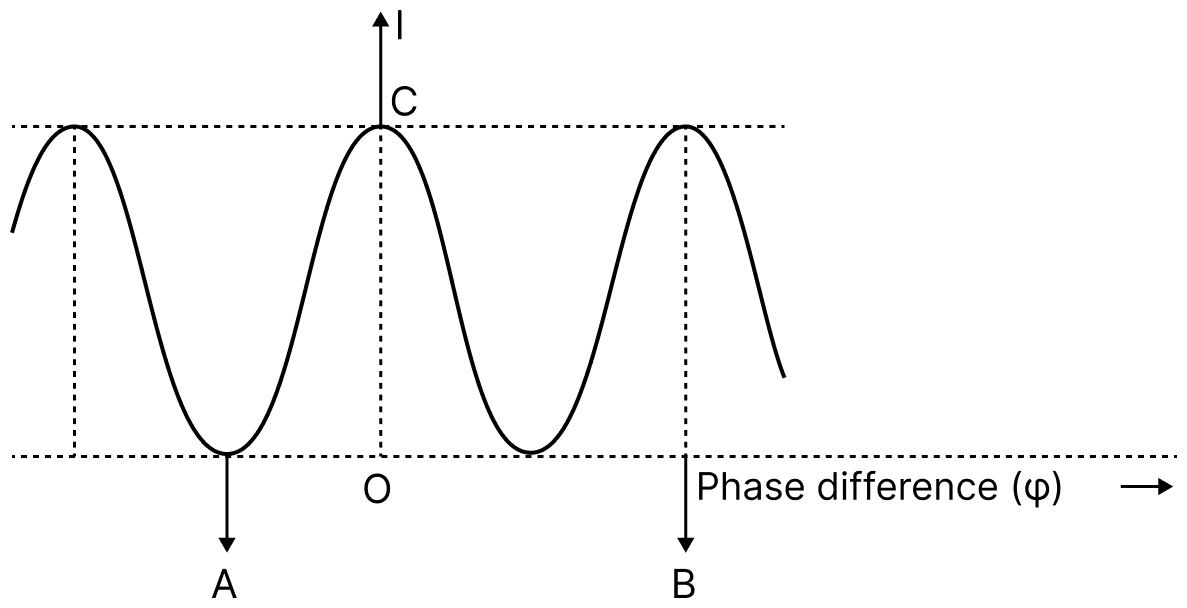
(a) If the graph depicts intensity versus phase difference for double-slit interference, what do points A and B symbolise?
(b) If the waves have amplitudes 1:3, then find the ratio of intensities at A and C.
Answer
(a) At A the intensity is minimum and the phase difference is −π, so A represents destructive interference (a dark fringe). At B the intensity is maximum and the phase difference is 2π, so B represents constructive interference (a bright fringe).
(b) Given,
- a1 : a2 = 1 : 3
At A (a minimum) the resultant amplitude is (a2 − a1), and at C (the central maximum, ϕ = 0) it is (a1 + a2). Therefore,
Hence, the ratio of intensities at A and C is 1 : 4.
What do you mean by interference of light? State and explain the conditions under which light from two sources can interfere.
Answer
Interference of light : When two light waves of the same frequency travel simultaneously in the same direction, their superposition makes the resultant intensity at a point different from the sum of their separate intensities. At some points the intensity is maximum (constructive interference) and at others it is minimum or zero (destructive interference). This re-distribution of light intensity due to the superposition of two light waves is called interference of light.
Conditions for sustained interference :
(i) The two sources must be coherent, that is, they must emit light waves having a sharply defined phase difference that remains constant with time. Otherwise the positions of maxima and minima keep changing and no steady pattern is seen.
(ii) The waves must have the same frequency. If the frequencies differ, the phase difference varies continuously and the intensity at any point changes with time.
(iii) The separation d between the sources should be small and the distance D of the screen should be large. Since and λ is extremely small, a large d or a small D makes the fringes too close to be seen separately.
(iv) The amplitudes of the two waves should be equal or nearly equal. Then the dark fringes are almost completely dark and the contrast is good.
(v) The sources should be narrow and the light monochromatic. A broad source, or light of many wavelengths, produces overlapping fringe patterns and the pattern loses its clarity.
What are coherent sources?
Answer
Two sources of light are said to be coherent if they emit light waves continuously, of the same wavelength and frequency, having a sharply defined phase difference that remains constant with time (the waves may be in the same phase). Coherent sources are obtained by deriving two sources from a single original source, so that any phase change in one is accompanied by the same phase change in the other.
For example, in Young's double-slit experiment the two slits S1 and S2 receive light from the same slit S and act as coherent sources. Lasers are highly coherent sources of light.
Draw a neat labelled diagram of Young's double-slit experiment. Show that (angular fringe width) θ = , where a is the distance between the slits (either for bright or dark fringe).
Answer
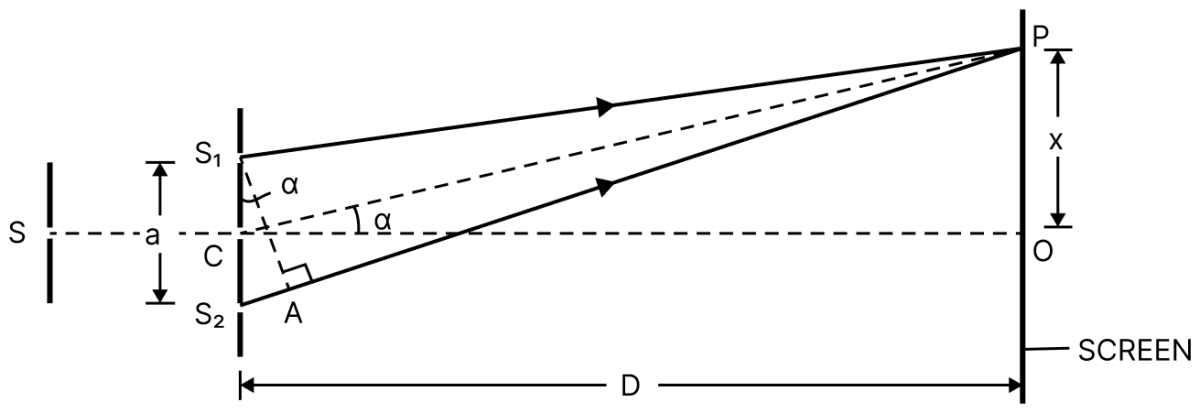
Let S be a narrow slit illuminated by monochromatic light of wavelength λ, and S1, S2 two parallel narrow slits, a distance a apart and equidistant from S. The interference pattern is observed on a screen placed at a distance D from the slits (D ≫ a). Let C be the mid-point of S1S2, and let the right bisector CO meet the screen at O, where the central bright fringe is formed.
Consider a point P on the screen at a distance x from O. Draw S1A perpendicular to S2P, and let α be the small angle that CP makes with CO. Since S1P = AP, the path difference between the waves reaching P is
From the right triangle S1AS2, , and from the right triangle POC, . For small α, sin α ≈ tan α, so
Bright fringes : The intensity is maximum where the path difference is mλ:
The angular position of the mth bright fringe, as seen from the slits, is
and that of the (m + 1)th bright fringe is . Hence the angular fringe-width is
Dark fringes : The intensity is minimum where the path difference is :
The angular separation between two consecutive dark fringes is
Hence, the angular fringe-width is , the same for bright and dark fringes. It is independent of the distance of the screen from the slits.
Young's double-slit experiment is performed by a student. The examiner gives the following instructions to the student. State whether the responses of the student, in each case, are correct or incorrect. Give a reason for your answer.
(i) EXAMINER : The fringes on the screen are too crowded. Increase the distance between the fringes.
STUDENT : Increases the distance between the two slits (thinking that distance between the fringes increases on increasing the distance between slits).
(ii) EXAMINER : Bright fringes are not very bright. Increase their brightness.
STUDENT : Increases the width of both the slits slightly.
(iii) EXAMINER : Compare the distance between central and first maxima with the distance between second and third maxima.
STUDENT : Measures and states that the distance between central and first maxima is more than that between second and third maxima.
Answer
(i) The response is incorrect.
The fringe-width is
so . On increasing the distance d between the slits, the fringe-width decreases and the fringes become more crowded. To increase the distance between the fringes, the student should decrease d (or increase D).
(ii) The response is correct.
The intensity of light coming out of a slit is proportional to the width of the slit. On increasing the width of both slits slightly, more light passes through them and the bright fringes become brighter.
(iii) The response is incorrect.
All the fringes in Young's double-slit experiment have the same width , which is independent of the order m. So the distance between the central and the first maxima is equal to the distance between the second and the third maxima.
What is interference of light? Name the interference happen at a place where intensity of light is maximum and minimum. Write four conditions to sustain interference.
Answer
Interference of light : When two light waves of the same frequency travel simultaneously in the same direction, the resultant intensity at a point, because of their superposition, is different from the sum of their separate intensities. This re-distribution of light intensity due to the superposition of two light waves is called interference of light.
Types of interference : At a place where the intensity of light is maximum, the interference is called constructive interference; there the two waves meet in the same phase. At a place where the intensity is minimum (or zero), the interference is called destructive interference; there the waves meet in opposite phase.
Conditions to sustain interference :
(i) The two sources must be coherent, that is, they must emit light waves having a sharply defined phase difference that remains constant with time. Two independent sources cannot give a sustained pattern, because their phase difference changes randomly.
(ii) The waves emitted by the two sources must have the same frequency. Otherwise the phase difference between them varies continuously and the intensity at any point changes with time.
(iii) The separation d between the sources should be small and the distance D of the screen from the sources should be large. As , this makes the fringes wide enough to be seen separately.
(iv) The amplitudes of the interfering waves should be equal or very nearly equal. Then the dark fringes have nearly zero intensity and the contrast between bright and dark fringes is good.
Write the relation between phase difference and path difference for two interfering light rays. If path difference between two waves is whole multiple of wavelength, find the corresponding path difference. Define visible/contrast interference.
Answer
Relation between phase difference and path difference : If x is the path difference between two interfering light waves of wavelength λ, the phase difference ϕ between them is
Phase difference for a path difference that is a whole multiple of λ : Let x = nλ, where n = 0, 1, 2, … . Then
So the corresponding phase difference is 0, 2π, 4π, …; the waves meet in the same phase and the interference is constructive (a bright fringe).
Visibility (contrast) of interference : The visibility or contrast of an interference pattern measures how distinctly the bright fringes stand out from the dark fringes. It is defined as
The interference is clearly visible (good contrast) when the amplitudes of the two waves are equal or nearly equal. For a1 = a2, Imin = 0 and the visibility has its maximum value 1. If the amplitudes are widely different, Imin is close to Imax and the contrast is poor.
Note: The question asks for the "corresponding path difference" when the path difference is a whole multiple of λ; the corresponding phase difference is intended and has been found above.
Describe Young's double-slit experiment and show that width of bright fringe is equal to width of dark fringe.
Answer
Young's double-slit experiment :
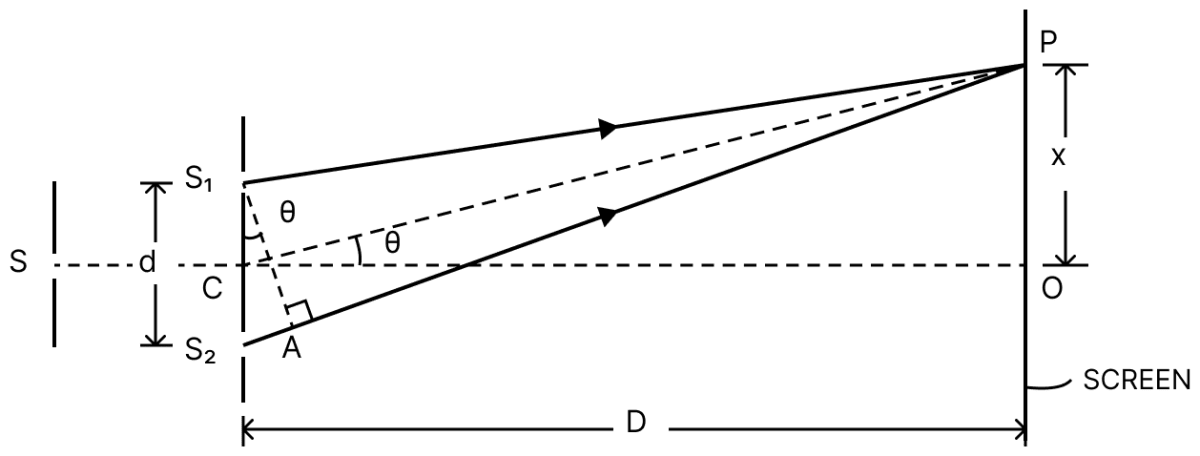
A narrow slit S is illuminated by monochromatic light of wavelength λ. In front of it is a screen carrying two parallel narrow slits S1 and S2, very close to each other, a distance d apart and equidistant from S. A screen is placed at a large distance D from the slits (D ≫ d).
The waves from S reach S1 and S2 in the same phase. According to Huygens' principle, S1 and S2 act as new light sources sending out secondary wavelets. As these originate from the same wavefront, S1 and S2 are coherent sources. Their wavelets superpose beyond the slits: where they meet in the same phase the intensity is maximum, and where they meet in opposite phase it is minimum. Hence alternate bright and dark fringes, parallel to the slits, are seen on the screen. The point O on the right bisector of S1S2 is equidistant from both slits, so the central bright fringe is formed there.
Path difference : For a point P on the screen at a distance x from O, the path difference between the waves from S1 and S2 is (as S1A ⊥ S2P and the angle is small)
Positions of bright fringes : For maximum intensity, the path difference is mλ:
Positions of dark fringes : For minimum intensity, the path difference is :
Width of a dark fringe : A dark fringe lies between two consecutive bright fringes, so its width is, from Eq. (i),
Width of a bright fringe : A bright fringe lies between two consecutive dark fringes, so its width is, from Eq. (ii),
Hence, the width of a bright fringe is equal to the width of a dark fringe, each being .
Obtain expression for path difference i.e., P.D. = , where d is distance between two sources, D is distance of screen from slit and x is distance of interfering point from the centre of the screen.
If Young's double-slit experiment set up is immersed in water, what would happen to width of fringe?
Answer
Expression for path difference :
Let S1 and S2 be two coherent sources a distance d apart, and let the screen be at a distance D from them (D ≫ d). C is the mid-point of S1S2 and the right bisector CO meets the screen at O, the centre of the screen. Let P be a point on the screen at a distance x from O, and let θ be the angle that CP makes with CO. Draw S1A perpendicular to S2P.
Since S1P = AP, the path difference between the waves reaching P is
From the right triangle S1AS2, with S1S2 = d,
From the right triangle POC, with OP = x and CO = D,
As θ is small, sin θ ≈ tan θ. So from Eqs. (i) and (ii),
Hence, the path difference is P.D. = .
Effect of immersing the set up in water : The fringe-width is . In water of refractive index n, the wavelength decreases to . Hence
Since n > 1, the fringe-width decreases; for water (n = ) it becomes of its value in air, and the fringes become narrower.
Define coherent sources and monochromatic light. Name a light which can be considered as monochromatic. Write three values of path difference and corresponding values of phase difference for destructive interference.
Answer
Coherent sources : Two sources of light are said to be coherent if they emit light waves of the same frequency having a sharply defined phase difference that remains constant with time. They are obtained by deriving two sources from a single original source, as the slits S1 and S2 in Young's double-slit experiment.
Monochromatic light : Light consisting of a single wavelength (single frequency), and hence of a single colour, is called monochromatic light.
Example : The yellow light of a sodium lamp (λ ≈ 5890 Å) can be considered monochromatic. Laser light is also monochromatic.
Path difference and phase difference for destructive interference : Destructive interference occurs when the path difference is an odd integral multiple of , that is, , and the corresponding phase difference is . Three such values are:
| Path difference | Phase difference |
|---|---|
| π | |
| 3π | |
| 5π |
In a Young's double-slit experiment, SS2 − SS1 = , where S1 and S2 are the two slits as shown in the figure. Find :
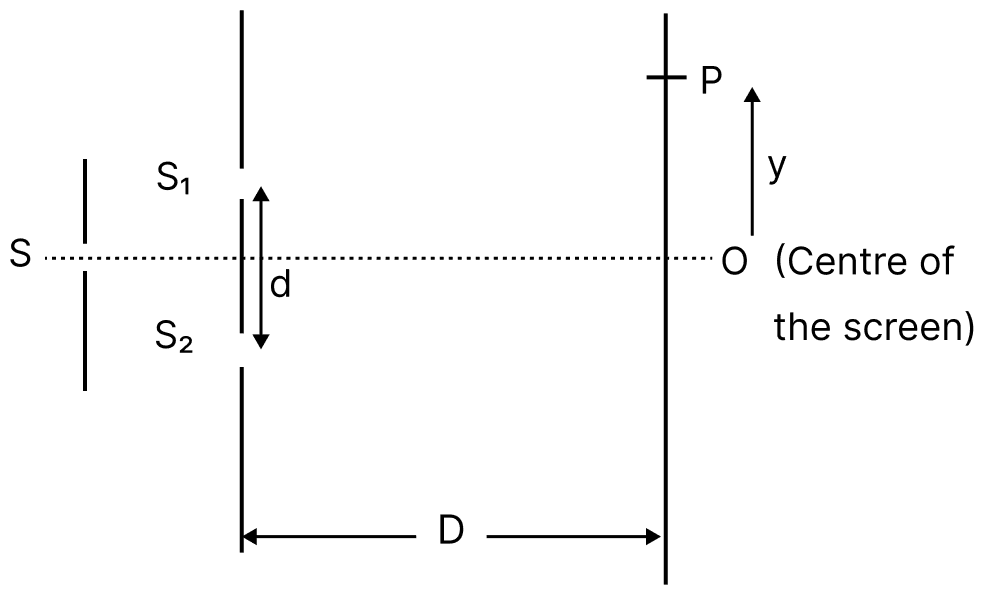
(i) Path difference (S2P − S1P) for constructive and destructive interference at P.
(ii) Expression for the distance of nth bright fringe from point O.
(iii) Expression for the distance of nth dark fringe from point O.
(iv) Position of central fringe from point O.
Answer
Given,
- SS2 − SS1 =
- Separation between the slits = d, distance of the screen = D
- P is at a distance y above O, on the side of S1
The total path difference between the waves reaching P via S2 and via S1 is
where .
(i) Path difference (S2P − S1P) :
For constructive interference at P, Δ = nλ:
For destructive interference at P, :
(ii) Distance of the nth bright fringe from O :
(iii) Distance of the nth dark fringe from O :
(iv) Position of the central fringe : At the central fringe the total path difference is zero:
Hence, the central fringe is formed at a distance below the point O.
Note: The textbook's answer to (i) gives the total path difference, , rather than the values of S2P − S1P for constructive and destructive interference found above.
Read the passage and answer the following questions :
In 1801, Thomas Young obtained evidence that light could produce wave effects. Very shortly, diffraction was explained by Fresnel and Fraunhofer, while the transverse nature of light was explained by polarization experiments. The subject of interference, diffraction and polarization is called physical optics or wave optics and should be explained by using the wave theory of light.
The phenomenon of interference of light has proved the validity of the wave theory of light. Sustained interference can never be obtained with two independent sources of light (even similar in all the manner). For this coherent sources are required. Two independent laser beams can produce sustained interference pattern because in laser sources, a large number of atoms during de-exitation process emit radiation simultaneously which has constant phase difference for a long interval of time as compared to ordinary sources. Therefore, laser beam is essentially monochromatic and spatially coherent.
(i) What are coherent sources?
(ii) Can two independent monochromatic sources of light be coherent? Give a brief reason.
(iii) On which conservation principle, phenomenon of interference is based?
(iv) Write any two conditions to observe interference in light waves.
(v) Name any experiment in which coherent sources are derived from a single source.
Answer
(i) Two sources are said to be coherent if they emit light waves of the same frequency having a sharply defined phase difference that remains constant with time.
(ii) No. Light from a source is emitted randomly by billions of atoms in short wave-pulses, so the phase difference between the light emitted by two independent sources keeps changing and can never remain constant. (Two independent lasers are an exception, as stated in the passage.)
(iii) The phenomenon of interference is based on the principle of conservation of energy; the energy missing from the minima appears at the maxima.
(iv) Two conditions to observe interference:
- The superposing waves must be of the same frequency.
- The waves must come from coherent sources.
(v) Young's double-slit experiment, in which the two slits S1 and S2 are illuminated by the same slit S. (Fresnel's biprism experiment is another example.)
Read the passage and answer the following questions :
Thomas Young's experiment with light was part of classical physics long before the development of quantum mechanics and concept of wave-particle duality. He believed it demonstrated that the wave theory of light was correct, and his experiment is sometimes referred to as Young's experiment or Young's slits.
The experiment belongs to a general class of "double path" experiments, in which a wave splits into two separate waves that later combine into a single wave. Changes in the path-lengths of both waves result in a phase shift, creating an interference pattern.
In the basic version of this experiment, a coherent light source, such as a laser beam, illuminates a plate pierced by two parallel slits, and the light passing through the slits is observed on a screen behind the plate. The wave nature of light causes the light waves passing through the slits to interfere, producing bright and dark bands on the screen.
(i) Young's double-slit experiment is based on which nature of light?
(ii) What is the essential condition for sustained interference?
(iii) On a screen behind the slits, bright and dark fringes are observed. To obtain bright fringe on the screen, what should be the path difference between the interfering waves? Give your answer in terms of wavelength λ.
(iv) Which type of sources are produced by Young's double-slit arrangement?
(v) A beam of electrons is used in Young's double-slit experiment. On increasing the speed of electrons will, the fringe-width increase or decrease?
Answer
(i) Young's double-slit experiment is based on the wave nature of light.
(ii) The essential condition for sustained interference is that the two sources must be coherent, that is, the phase difference between the waves from them must remain constant with time.
(iii) For a bright fringe, the path difference between the interfering waves must be an integral multiple of λ:
(iv) Young's double-slit arrangement produces two real coherent sources, the slits S1 and S2, both derived from the single slit S. They are not point sources.
(v) The fringe-width decreases. On increasing the speed of the electrons, their de Broglie wavelength decreases, and so the fringe-width decreases.