
The refractive index of diamond relative to air is 2.42 and that of glass is 1.51. How much faster does light travel in glass than in diamond?
Answer
Given,
- Refractive index of diamond relative to air, and = 2.42
- Refractive index of glass relative to air, ang = 1.51
The refractive index of a medium is , where v is the velocity of light in that medium. Thus the velocity of light in a medium is inversely proportional to its refractive index, so
Hence, light travels 1.60 times faster in glass than in diamond.
A ray of light in air is incident on a glass plate at 45°. The refractive index of glass is 1.5. What is angle of refraction?
Answer
Given,
- Angle of incidence in air, i = 45°
- Refractive index of glass, ang = 1.5
By Snell's law,
Therefore,
Hence, the angle of refraction is 28.1° (≈ 28°).
A ray of light which is incident in air on the surface of a glass block is deviated through 15°. The angle of incidence in air is 60°. What is the angle of refraction in glass? Also calculate the critical angle for glass-air interface.
Answer
Given,
- Angle of incidence in air, i = 60°
- Deviation of the ray, δ = 15°
Angle of refraction :
On passing from air into glass, the ray bends towards the normal, so its deviation is δ = i − r. Therefore,
Refractive index of glass :
By Snell's law,
Critical angle :
If C is the critical angle for the glass-air interface,
Hence, the angle of refraction in glass is 45° and the critical angle for the glass-air interface is 54.7°.
How deep will a 4 m deep tank appear when seen in air due to optical refraction? The refractive index of water is .
Answer
Given,
- Real depth of the tank = 4 m
- Refractive index of water, n =
For an object in a denser medium viewed normally from air,
Therefore,
Hence, the tank will appear to be 3 m deep.
A beaker is filled with water to a height of 12.5 cm. The apparent depth of a needle at the bottom of the beaker is 9.4 cm. Find refractive index of water.
Answer
Given,
- Real depth of the needle, hr = 12.5 cm
- Apparent depth of the needle, ha = 9.4 cm
The refractive index of water is given by
Hence, the refractive index of water is 1.33.
The apparent depth of an object at the bottom of a tank filled with a liquid of refractive index 1.3 is 7.7 cm. What is the actual depth?
Answer
Given,
- Refractive index of the liquid, n = 1.3
- Apparent depth of the object, ha = 7.7 cm
Since ,
Hence, the actual depth of the tank is 10 cm.
A needle lying on horizontal surface is viewed vertically from a distance of 100 cm. A glass slab of 12 cm thickness is placed on the needle. Find the distance of the vertical image of the needle from the eye, taking ang = 1.5.
Answer
Given,
- Distance of the needle from the eye = 100 cm
- Thickness of the glass slab, t = 12 cm
- ang = 1.5
When the needle is viewed normally through the slab, it appears raised towards the eye. The normal displacement of the needle is
Therefore, the distance of the image of the needle from the eye is
Hence, the vertical image of the needle is 96 cm from the eye.
A microscope focussed on a pin lying at the bottom of a beaker reads 3.965 cm. When a liquid is poured up to a height of 2.537 cm into the beaker, the microscope focussed again on the pin reads 3.348 cm. Find the refractive index of the liquid.
Answer
Given,
- Reading of the microscope focussed on the pin without liquid = 3.965 cm
- Reading of the microscope focussed on the pin through the liquid = 3.348 cm
- Height of the liquid, i.e. real depth of the pin, hr = 2.537 cm
The first reading locates the pin itself and the second locates its image. The difference between them is the normal displacement of the pin due to the liquid,
The apparent depth of the pin below the liquid surface is therefore
The refractive index of the liquid is
Hence, the refractive index of the liquid is 1.321.
A beaker is filled with a liquid to a height of 14 cm. The apparent depth of a needle fixed at the bottom of the beaker is measured to be 10 cm by a microscope. What is the refractive index of the liquid? The height of the liquid in the beaker is now raised to 21 cm. By what distance would the microscope have to be moved to focus on the needle again?
Answer
Given,
- Real depth of the needle, hr = 14 cm
- Apparent depth of the needle, ha = 10 cm
- New height of the liquid = 21 cm
Refractive index of the liquid :
Distance moved by the microscope :
The needle appears raised above its actual position by the normal displacement , where t is the height of the liquid.
For t = 14 cm,
For t = 21 cm,
The image of the needle therefore rises by
Hence, the refractive index of the liquid is 1.4, and the microscope has to be raised through 2 cm to focus on the needle again.
Note: The textbook prints 5.0 cm, which is only the change in apparent depth (15 cm − 10 cm) measured from the liquid surface; it ignores the 7 cm rise of the surface itself. The correct answer is 2 cm.
A beaker 20 cm high is half filled with an oil of refractive index 1.40 and the upper half filled with water of refractive index 1.33. What is the apparent depth of the beaker as observed normally?
Answer
Given,
- Thickness of the oil layer, d1 = 10 cm, refractive index n1 = 1.40
- Thickness of the water layer, d2 = 10 cm, refractive index n2 = 1.33
When there is more than one medium between the object and the viewer, the apparent depth is
Substituting the values,
Hence, the apparent depth of the beaker as observed normally is 14.66 cm.
A beaker is filled with water (n = 1.5) to a height h. Height of the beaker is 15 cm. When the bottom of the beaker is viewed vertically by an observer, beaker appears to be half filled. Find the value of h.
Answer
Given,
- Height of the beaker = 15 cm
- Refractive index, n = 1.5
- Height of water = h
When the bottom is viewed vertically, the water column of real depth h appears to have a depth , while the empty part of height (15 − h) above it is seen as it is. The beaker appears half filled when the apparent depth of the water equals the height of the empty part,
Substituting n = 1.5,
Hence, the value of h is 9.0 cm.
Note: The question calls the liquid water but gives n = 1.5 (the refractive index of water is about 1.33); the value given in the question has been used.
A container of uniform cross-section has a height of 14 m. Up to what height water of refractive index should be filled inside the container so that container seems to be half filled for normal viewing.
Answer
Given,
- Height of the container = 14 m
- Refractive index of water, n =
- Height of water = h
For normal viewing, the water column of real depth h appears to have a depth , while the empty part of height (14 − h) above it is seen as it is. The container seems half filled when the apparent depth of the water equals the height of the empty part,
Substituting ,
Hence, water should be filled up to a height of 8 m.
In total internal reflection when the angle of incidence is equal to the critical angle for the pair of media in contact, what will be angle of refraction?
Answer
90°
Explanation:
The critical angle C for a pair of media is that angle of incidence in the denser medium for which the angle of refraction in the rarer medium is 90°. The refracted ray then grazes along the interface of the two media.
Critical angle for total internal reflection from a medium to vacuum is 60°. Find the velocity of light in the given medium.
Answer
Given,
- Critical angle, C = 60°
- Velocity of light in vacuum, c = 3 × 10⁸ m s-1
The refractive index of the medium relative to vacuum is
Since , the velocity of light in the medium is
Hence, the velocity of light in the given medium is 2.6 × 10⁸ m s-1.
A ray of light falls normally on the face of a glass prism (n = 1.5). Find the angle of the prism, if the ray just fails to emerge from the second face.
Answer
Given,
- Refractive index of glass, n = 1.5
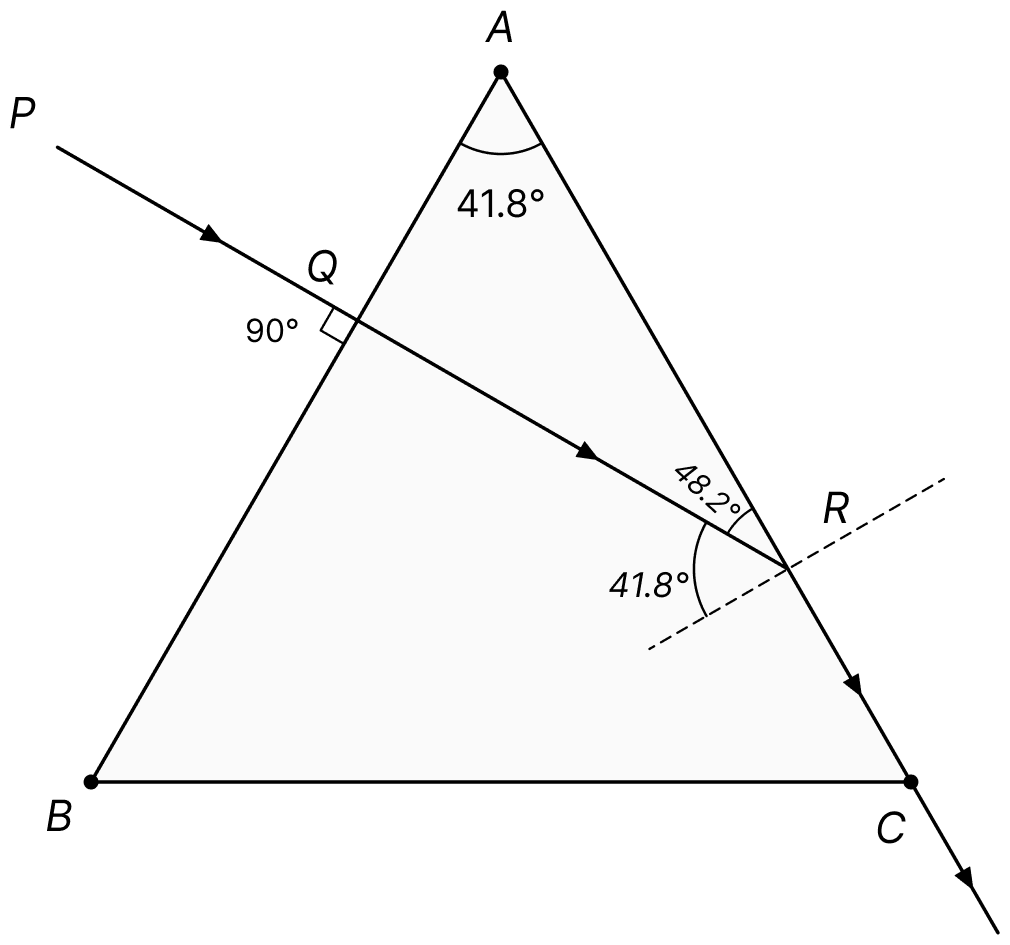
Let ABC be the prism, PQ the ray incident normally on the face AB at Q, and R the point where the ray meets the second face AC.
Since PQ falls normally on AB, it enters the prism undeviated. As QR is perpendicular to AB, the angle it makes with the normal to AC is equal to the angle between the faces AB and AC. Thus, the ray QR strikes the face AC at an angle of incidence equal to the angle A of the prism.
The ray just fails to emerge from AC when this angle of incidence equals the critical angle C. Hence, A = C, where
Hence, the angle of the prism is 41.8°.
A substance has a critical angle of 45° for yellow light. What is the refractive index of the substance?
Answer
Given,
- Critical angle, C = 45°
The refractive index of the substance is related to the critical angle by
Hence, the refractive index of the substance is 1.414.
The refractive index of glass relative to air is 1.5. What is critical angle for glass-air interface?
Answer
Given,
- Refractive index of glass relative to air, ang = 1.5
If C is the critical angle for the glass-air interface,
Hence, the critical angle for the glass-air interface is 41.8°.
What is the critical angle for a light ray going from dense glass into water? The refractive indices of dense glass and water relative to air are 1.62 and 1.33 respectively.
Answer
Given,
- Refractive index of dense glass relative to air, ang = 1.62
- Refractive index of water relative to air, anw = 1.33
The refractive index of glass relative to water is
If C is the critical angle at the glass-water interface,
Hence, the critical angle for a light ray going from dense glass into water is 55.2° (≈ 55°).
The absolute refractive indices of water and glycerine are 1.33 and 1.46 respectively. Find the critical angle for a ray travelling from glycerine into water.
Answer
Given,
- Absolute refractive index of water, nw = 1.33
- Absolute refractive index of glycerine, ngl = 1.46
The ray travels from glycerine (denser) into water (rarer). The refractive index of glycerine relative to water is
If C is the critical angle at the glycerine-water interface,
Hence, the critical angle for a ray travelling from glycerine into water is 65.6°.
Note: The textbook prints 65.5°; sin-1(0.9110) = 65.6° to one decimal place, so the printed value is a rounding slip.
An equilateral prism of glass of refractive index 1.45 is immersed in water of refractive index 1.33. A narrow beam of light falls normally on one face of the prism. Find the angle of emergence of the beam.
Answer
Given,
- Refractive index of glass, ng = 1.45
- Refractive index of water, nw = 1.33
- Angle of the equilateral prism, A = 60°
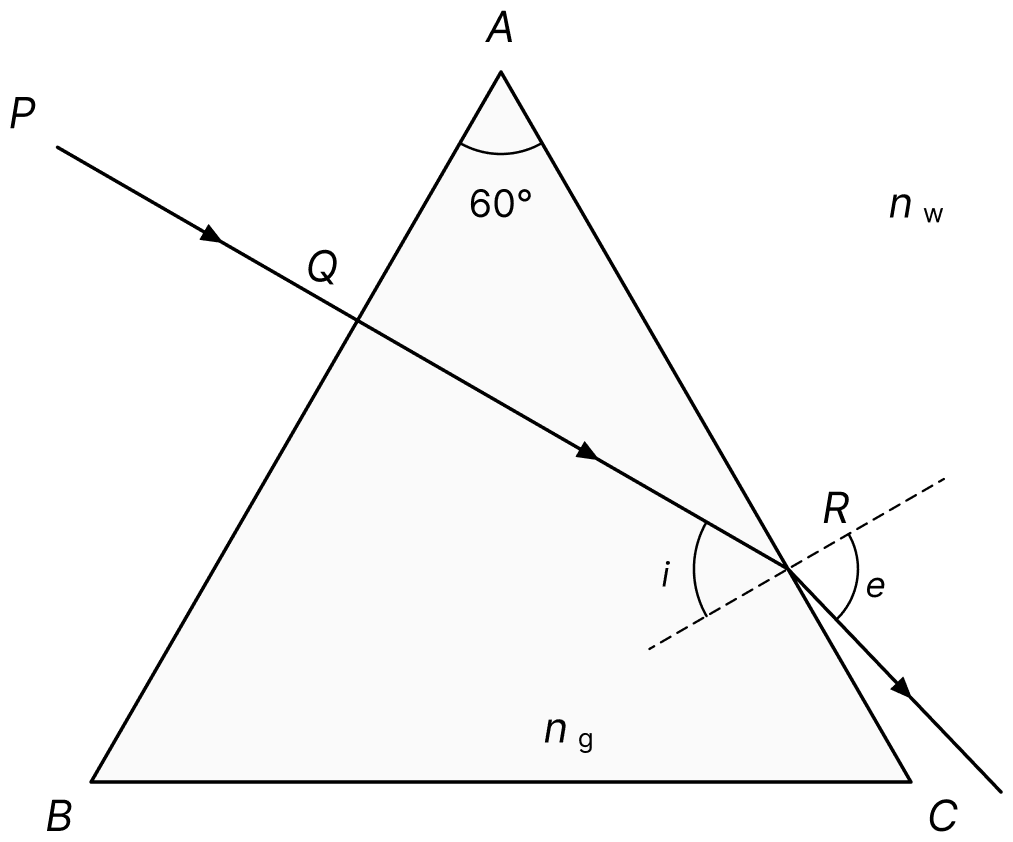
Let ABC be the prism, PQ the beam incident normally on the face AB at Q, and R the point where it meets the face AC.
Since the beam falls normally on AB, it enters the prism undeviated and strikes the face AC at R at an angle of incidence equal to the angle of the prism, i = 60°.
Checking for total internal reflection at AC :
If C is the critical angle at the glass-water interface,
Since i = 60° is less than C, total internal reflection does not occur and the beam emerges into the water from the face AC.
Angle of emergence :
Let e be the angle of emergence. Applying Snell's law at R, for refraction from glass into water,
Therefore,
Hence, the angle of emergence of the beam is 70.8°.
A small bulb is placed at the bottom of a tank containing water to a depth of 80 cm. What is the area of the surface of water through which light of the bulb can emerge out? Refractive index of water is 1.33. Consider the bulb to be a point-source.
Answer
Given,
- Depth of the bulb below the water surface, h = 80 cm = 0.80 m
- Refractive index of water, n = 1.33
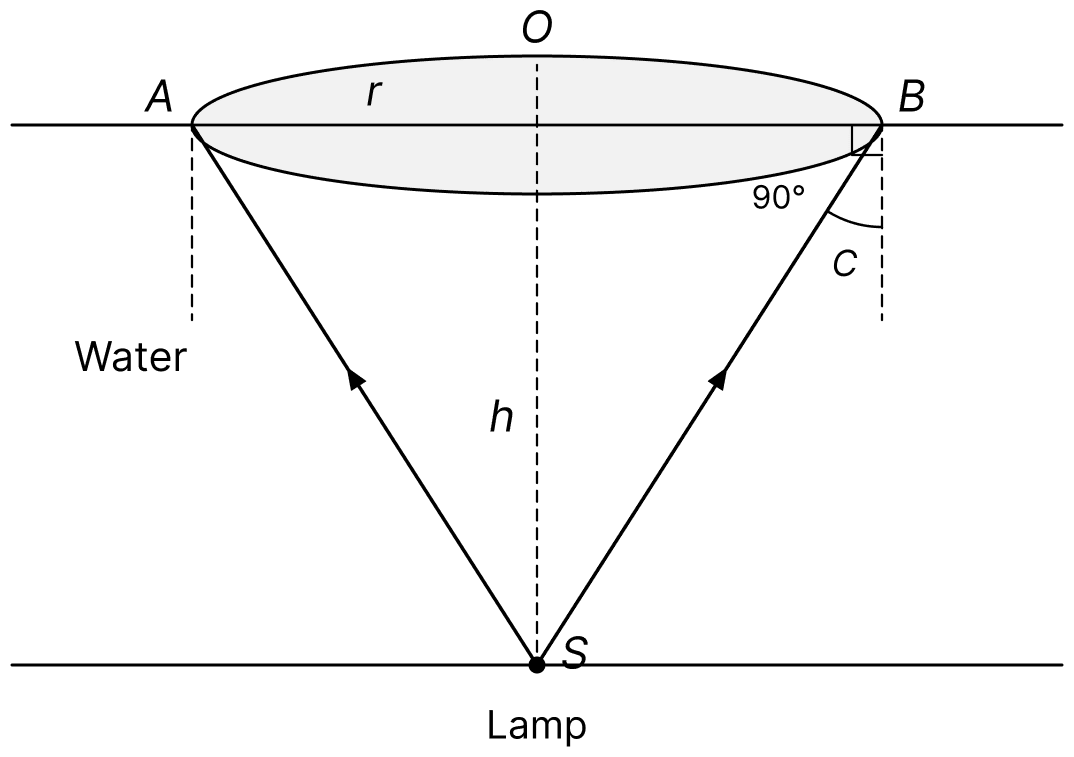
Let S be the bulb, O the point on the water surface vertically above it, and A a point on the boundary of the circle through which light emerges.
Rays from S that strike the surface at an angle of incidence greater than the critical angle C for the water-air interface are totally reflected back into the water. Light therefore emerges only through a circle of radius r = OA, where the ray SA is incident at exactly C. In the right-angled triangle SOA,
Critical angle :
In a right-angled triangle with hypotenuse 1.33 and the side opposite to C equal to 1, the side adjacent to C is . Therefore,
Radius of the circle :
Area of the circular surface :
Hence, the light of the bulb can emerge out through an area of about 2.6 m2 of the water surface.
A point-source of light is placed at the centre of the bottom of a jar having a liquid of refractive index . An opaque disc of radius 1.0 cm is placed on the liquid surface with its centre vertically above the source. What is the maximum height of the liquid for which the source is not visible from above?
Answer
Given,
- Refractive index of the liquid, n =
- Radius of the opaque disc = 1.0 cm
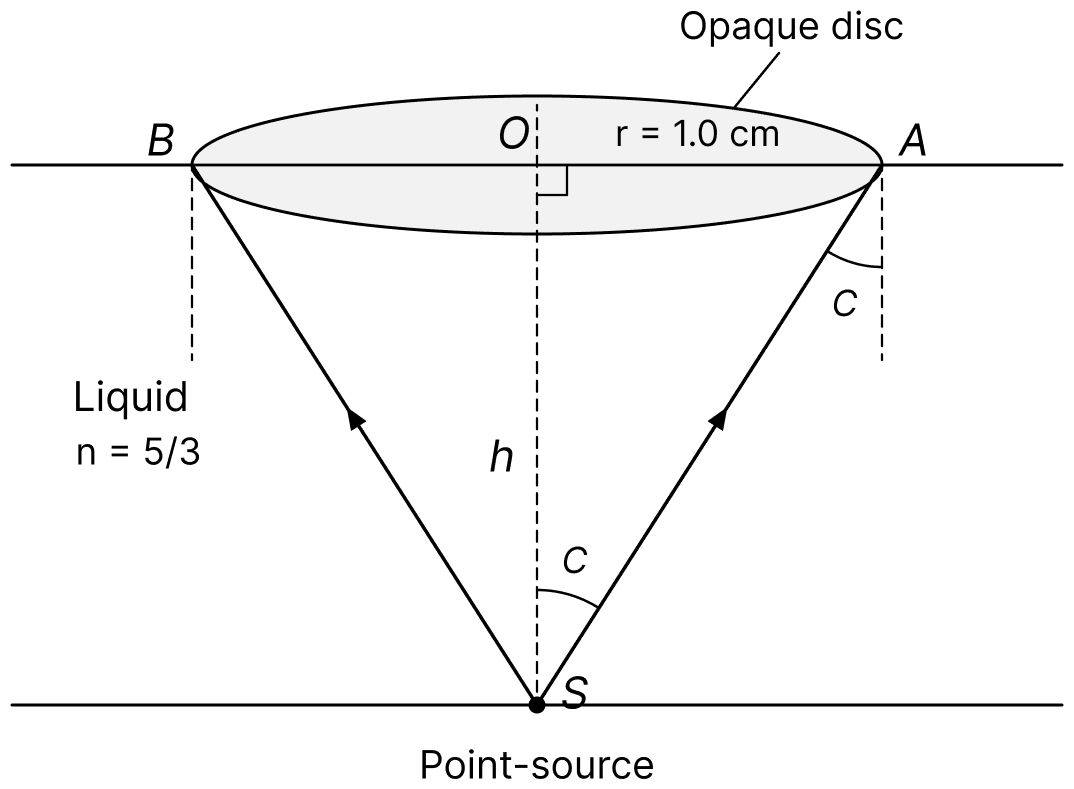
Let S be the point-source, O the centre of the disc vertically above S, h the height of the liquid, and A a point on the boundary of the circle through which light from S can emerge.
Rays from S that strike the surface at an angle of incidence greater than the critical angle C are totally reflected back into the liquid. Light can therefore leave the surface only through a circle of radius r = OA, where
The source is not visible from above if this circle is completely covered by the disc, that is, if r ≤ 1.0 cm. The maximum height of the liquid corresponds to r = 1.0 cm.
Critical angle :
In a right-angled triangle with hypotenuse 5 and the side opposite to C equal to 3, the side adjacent to C is . Therefore,
Maximum height :
Hence, the maximum height of the liquid for which the source is not visible from above is cm (≈ 1.33 cm).