α-particles of 5.0 MeV are being scattered by a thin copper (Z = 29) foil. Up to what closest distance can these particles reach the nucleus of copper? If there be protons of same energy, then?
Answer
Given,
Kinetic energy of α-particle, K = 5.0 MeV = 5.0 × 1.6 × 10-13 J = 8.0 × 10⁻¹³ J
Atomic number of copper, Z = 29
Charge on α-particle = +2e, charge on proton = +e
4πε01 = 9.0 × 10⁹ N m2 C-2, e = 1.6 × 10⁻¹⁹ C
At the distance of closest approach r0, the whole kinetic energy of the particle is converted into electrostatic potential energy. Hence,
K=4πε01r0(Ze)(2e)orr0=4πε01K2Ze2
For α-particles :
r0=8.0×10⁻¹³(9.0×109)×2×29×(1.6×10−19)2=8.0×10−139.0×109×58×2.56×10−38=8.0×10−131.336×10⁻²⁶r0=1.67×10⁻¹⁴ m
For protons :
The charge on a proton is +e, half that on an α-particle, so for the same kinetic energy
r0′=4πε01K(Ze)(e)=2r0=21.67×10⁻¹⁴r0′=0.835×10⁻¹⁴ m
Hence, the α-particles can reach up to 1.67 × 10⁻¹⁴ m from the copper nucleus, and protons of the same energy up to 0.835 × 10⁻¹⁴ m.
In a head-on collision between an α-particle and a gold nucleus (Z = 79), the distance of closest approach is 4.0 × 10⁻¹⁴ m. Calculate the energy of the particle.
Answer
Given,
Atomic number of gold, Z = 79
Distance of closest approach, r0 = 4.0 × 10⁻¹⁴ m
Charge on α-particle = +2e, e = 1.6 × 10⁻¹⁹ C
4πε01 = 9.0 × 10⁹ N m2 C-2
In a head-on collision, the whole kinetic energy K of the α-particle is converted into electrostatic potential energy at the distance of closest approach,
K=4πε01r0(Ze)(2e)
Substituting the values,
K=4.0×10⁻¹⁴(9.0×109)×2×79×(1.6×10−19)2=4.0×10−149.0×109×158×2.56×10−38=4.0×10−143.640×10⁻²⁶K=9.10×10⁻¹³ J
As 1 MeV = 1.6 × 10⁻¹³ J,
K=1.6×10−139.10×10⁻¹³K=5.69 MeV
Hence, the energy of the α-particle is 5.69 MeV.
The radius of the first orbit of the electron of a hydrogen atom is 5.3 × 10⁻¹¹ m. What is the radius of its second orbit?
Answer
Given,
- Radius of first orbit, r1 = 5.3 × 10⁻¹¹ m
The radii of Bohr's orbits are given by
rn=πme2ε0h2n2orrn∝n2
Therefore,
r1r2=(12)2r2=4r1=4×5.3×10−11r2=21.2×10⁻¹¹ m
Hence, the radius of the second orbit is 21.2 × 10⁻¹¹ m.
Show that the velocity of electron in the first orbit of hydrogen atom is (1/137) time the velocity of light.
Answer
Given,
e = 1.6 × 10⁻¹⁹ C, ε0 = 8.85 × 10⁻¹² C2 N-1 m-2
h = 6.6 × 10⁻³⁴ J s, c = 3.0 × 10⁸ ms-1
Let m and e be the mass and charge of the electron, v its velocity and r the radius of its orbit around a nucleus of charge Ze. By Bohr's first postulate, the centripetal force is provided by the electrostatic force of attraction,
rmv2=4πε01r2(Ze)×eormv2r=4πε0Ze2...(i)
By Bohr's quantisation condition,
mvr=n2πh...(ii)
Dividing Eq. (i) by Eq. (ii),
v=4πε0Ze2×nh2πv=2ε0hnZe2
For the first orbit (n = 1) of hydrogen atom (Z = 1), and multiplying and dividing by c,
v1=2ε0he2v1=(2ε0hce2)c
Substituting the values,
2ε0hce2=2×8.85×10−12×6.6×10−34×3.0×108(1.6×10⁻¹⁹)2=3.505×10−362.56×10−38=7.30×10⁻³²ε0hce2≈1371
This pure number is the fine structure constant α. Therefore,
v1=1371c
Hence, the velocity of electron in the first orbit of hydrogen atom is (1/137) times the velocity of light.
A negatively-charged pion (π−), whose mass is 273 times the mass of electron moves in a circular orbit around a proton. It is a pi-mesic hydrogen atom. How many revolutions will the pion make during its lifetime of 10-8 s in the ground state of the atom?
Answer
Given,
Mass of pion, mπ = 273 me
Lifetime of pion, t = 10-8 s
Ground state, n = 1; charge on nucleus (proton) = +e
Bohr radius of hydrogen atom, rH = 0.53 × 10⁻¹⁰ m
From Bohr's theory, the radius and the speed in the nth orbit are
r=πme2ε0h2n2andv=2ε0hne2
Thus r ∝ 1/m, while v does not depend on the mass of the orbiting particle.
Radius of the orbit :
rπ=273rH=2730.53×10−10rπ=1.941×10⁻¹³ m
Speed in the orbit : It is the same as that of the electron in the first orbit of hydrogen atom,
v=137c=1373.0×108v=2.19×10⁶ ms−1
Time period of revolution :
T=v2πrπ=2.19×1062×3.14×1.941×10−13T=5.57×10⁻¹⁹ s
Number of revolutions :
N=Tt=5.57×10−1910−8N=1.8×10¹⁰
Hence, the pion makes about 1.8 × 10¹⁰ revolutions during its lifetime.
The energy of electron in the first orbit in hydrogen atom is −13.6 eV. What will be the energy in the second orbit?
Answer
Given,
- Energy in first orbit, E1 = −13.6 eV
The energy of electron in the nth orbit is
En=n2E1
For the second orbit, n = 2,
E2=22−13.6E2=−3.4 eV
Hence, the energy in the second orbit is −3.4 eV.
Which level of the doubly-ionised lithium (Li++), with Z = 3, has the same energy as the ground-state energy of hydrogen atom (Z = 1). Compare the orbital radii of the two levels.
Answer
Given,
For Li++, Z = 3; for hydrogen, Z = 1
Ground state of hydrogen, n = 1
The energy and radius of the nth orbit of a hydrogen-like atom are
En=−Z2n213.6 eVandrn=(0.53)Zn2 A˚
Level of Li++ :
Ground-state energy of hydrogen atom, E1(H) = −13.6 eV. Equating the energy of the nth level of Li++ to it,
−n2(3)2×13.6=−13.6n2=9n=3
Ratio of the orbital radii :
r1(H)r3(Li++)=(0.53)×112(0.53)×332r1(H)r3(Li++)=3
Hence, the n = 3 level of Li++ has the same energy as the ground state of hydrogen, and its orbital radius is 3 times that of the hydrogen ground state.
The electron in a given Bohr orbit has a total energy of −1.5 eV. Calculate its (i) kinetic energy (ii) potential energy and (iii) wavelength of light emitted, when electron makes a transition to ground state. Ground state energy is −13.6 eV.
Answer
Given,
Total energy, E = −1.5 eV
Ground state energy, E1 = −13.6 eV
In a Bohr orbit, the kinetic energy K, potential energy U and total energy E of the electron are related as
K=−EandU=2E
(i) Kinetic energy :
K=−(−1.5)K=1.5 eV
(ii) Potential energy :
U=2×(−1.5)U=−3.0 eV
(iii) Wavelength of light emitted :
Energy of the photon emitted in the transition to the ground state,
ΔE=−1.5−(−13.6)ΔE=12.1 eV
The wavelength is given by
λ=ΔE (in eV)12375 A˚=12.112375λ=1022.7 A˚
Hence, the kinetic energy is 1.5 eV, the potential energy is −3.0 eV and the wavelength of the emitted light is 1022.7 Å.
The energy of an electron in the nth orbit of hydrogen atom is given by En = −(13.6 / n2) eV. Find energy required to take the electron from the ground state to the (i) first excited state, (ii) second excited state.
Answer
Given,
Energy of the ground state,
E1=−1213.6E1=−13.6 eV
(i) First excited state (n = 2) :
E2=−2213.6E2=−3.4 eV
Energy required,
ΔE=E2−E1=−3.4−(−13.6)ΔE=10.2 eV
(ii) Second excited state (n = 3) :
E3=−3213.6E3=−1.51 eV
Energy required,
ΔE=E3−E1=−1.51−(−13.6)ΔE=12.09 eV
Hence, the energy required is 10.2 eV for the first excited state and 12.09 eV for the second excited state.
Calculate the frequency of the photon, which can excite the electron to −3.4 eV from −13.6 eV.
Answer
Given,
Initial energy, E1 = −13.6 eV
Final energy, E2 = −3.4 eV
h = 6.6 × 10⁻³⁴ J s, 1 eV = 1.6 × 10⁻¹⁹ J
Energy of the photon required,
ΔE=E2−E1=−3.4−(−13.6)=10.2 eV=10.2×1.6×10−19 JΔE=16.32×10⁻¹⁹ J
From ΔE = hν, the frequency of the photon is
ν=hΔE=6.6×10−3416.32×10−19ν=2.47×10¹⁵ Hz
Hence, the frequency of the photon is 2.47 × 10¹⁵ Hz.
The energy of an electron in the nth state of hydrogen atom is given by En = −(13.6 / n2) eV. Calculate the energy and frequency of a photon radiated when the electron de-excites from the first excited state to the ground state. To which spectral series does this photon belong?
Answer
Given,
En = −(13.6 / n2) eV
First excited state, n = 2; ground state, n = 1
h = 6.6 × 10⁻³⁴ J s, 1 eV = 1.6 × 10⁻¹⁹ J
E2=−2213.6E2=−3.4 eVE1=−1213.6E1=−13.6 eV
Energy of the photon :
ΔE=E2−E1=−3.4−(−13.6)ΔE=10.2 eV
Frequency of the photon :
ν=hΔE=6.6×10−3410.2×1.6×10−19=6.6×10−3416.32×10−19ν=2.47×10¹⁵ Hz
Spectral series : The transition ends on the lowest energy level (n = 1), so the photon belongs to the Lyman series.
Hence, the photon has energy 10.2 eV and frequency 2.47 × 10¹⁵ Hz, and it belongs to the Lyman series.
The energy of the lowest level of hydrogen atom is −13.6 eV. Calculate the energy, frequency and wavelength of the photon emitted by transition from n = 4 to n = 2.
Answer
Given,
Energy of the lowest level, E1 = −13.6 eV
Transition from n = 4 to n = 2
h = 6.6 × 10⁻³⁴ J s, c = 3.0 × 10⁸ ms-1, 1 eV = 1.6 × 10⁻¹⁹ J
The energy of the nth level is En = E1 / n2. Therefore,
E4=−4213.6E4=−0.85 eVE2=−2213.6E2=−3.4 eV
Energy of the photon :
ΔE=E4−E2=−0.85−(−3.4)=2.55 eV=2.55×1.6×10−19 JΔE=4.08×10⁻¹⁹ J
Frequency of the photon :
ν=hΔE=6.6×10−344.08×10⁻¹⁹ν=6.182×10¹⁴ Hz
Wavelength of the photon :
λ=νc=6.182×10143.0×108=4.853×10⁻⁷ mλ=4853 A˚
Hence, the photon has energy 2.55 eV, frequency 6.18 × 10¹⁴ Hz and wavelength 4853 Å.
The energy of electron orbiting in the nth orbit of hydrogen atom is given by the expression En = −(13.6 / n2) eV. Calculate: (i) energy liberated when the electron jumps from the second to the first orbit, (ii) wavelength of the light emitted in this transition, (iii) the ionisation energy of the atom.
Answer
Given,
E1=−1213.6E1=−13.6 eVE2=−2213.6E2=−3.4 eV
(i) Energy liberated :
ΔE=E2−E1=−3.4−(−13.6)ΔE=10.2 eV
(ii) Wavelength of the light emitted :
λ=ΔE (in eV)12375 A˚=10.212375λ=1213 A˚
(iii) Ionisation energy : It is the energy required to take the electron from the ground state (n = 1) to n = ∞, where E∞ = 0.
Ionisation energy=E∞−E1=0−(−13.6)Ionisation energy=13.6 eV
Hence, the energy liberated is 10.2 eV, the wavelength of the emitted light is 1213 Å and the ionisation energy is 13.6 eV.
The energies of two energy-levels of hydrogen atom are −3.4 eV and −1.5 eV. If electron transition occurs from the higher to the lower level, how much energy will be emitted? What will be the wavelength of the emitted radiation?
Answer
Given,
Energy of higher level, E2 = −1.5 eV
Energy of lower level, E1 = −3.4 eV
Energy emitted :
ΔE=E2−E1=−1.5−(−3.4)ΔE=1.9 eV
Wavelength of the emitted radiation :
λ=ΔE (in eV)12375 A˚=1.912375λ=6513 A˚
Hence, 1.9 eV of energy is emitted and the wavelength of the emitted radiation is 6513 Å.
The energy of hydrogen atom in its ground state is −13.6 eV. The atom is given an energy of 10.2 eV. In which energy-state will it reach? What will be the wavelength of the absorbed photon in this process?
Answer
Given,
Ground state energy, E1 = −13.6 eV
Energy given to the atom, ΔE = 10.2 eV
Energy state reached :
Energy of the atom after absorbing 10.2 eV,
En=−13.6+10.2En=−3.4 eV
As En = −13.6 / n2 eV,
−n213.6=−3.4n2=3.413.6n2=4n=2
Wavelength of the absorbed photon :
λ=ΔE (in eV)12375 A˚=10.212375λ=1213 A˚
Hence, the atom reaches the n = 2 state (first excited state) and the wavelength of the absorbed photon is 1213 Å.
The wavelength of the first spectral line of sodium is 5896 Å. What is the first excitation potential of sodium atom?
Answer
Given,
Wavelength, λ = 5896 Å = 5896 × 10-10 m
h = 6.6 × 10⁻³⁴ J s, c = 3.0 × 10⁸ ms-1, 1 eV = 1.6 × 10⁻¹⁹ J
The first spectral line is emitted when the atom returns from the first excited state to the ground state. The energy of this photon equals the first excitation energy,
ΔE=λhc=5896×10−10(6.6×10−34)×(3.0×108)=3.358×10⁻¹⁹ J=1.6×10−193.358×10⁻¹⁹ eVΔE=2.1 eV
The minimum accelerating potential which gives an electron this energy is the first excitation potential.
Hence, the first excitation potential of sodium atom is 2.1 V.
The first excitation potential of mercury is 4.86 V. A mercury atom, after absorbing a photon, reaches in its first excited state. Find the wavelength of the absorbed photon.
Answer
Given,
- First excitation potential of mercury = 4.86 V
The photon absorbed must supply the first excitation energy,
ΔE=4.86 eV
The wavelength of the absorbed photon is
λ=ΔE (in eV)12375 A˚=4.8612375λ=2546 A˚
Hence, the wavelength of the absorbed photon is 2546 Å.
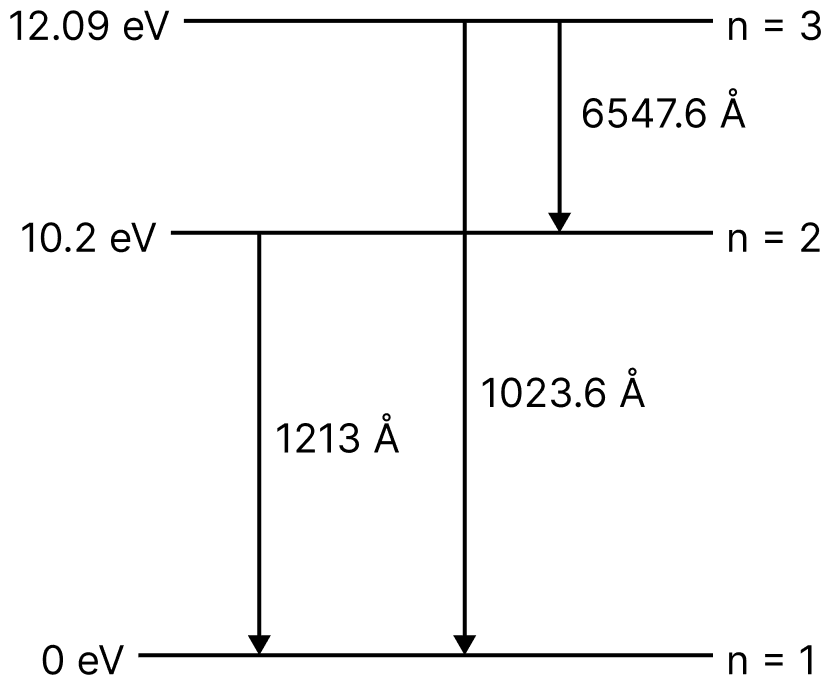
The first and second excitation potentials of hydrogen atom are respectively 10.2 and 12.09 V. Draw, on this basis, the energy-level diagram of the atom and show all possible emission transitions in it and mark their corresponding wavelengths.
Answer
Given,
Taking the energy of the ground state (n = 1) as zero, the first and second excited states (n = 2 and n = 3) lie at 10.2 eV and 12.09 eV above it.
With n = 3 energy levels, the number of possible emission transitions is
N=2n(n−1)=23×2N=3
These are 2 → 1, 3 → 1 and 3 → 2. The wavelength of each is given by
λ=ΔE (in eV)12375 A˚
Transition 2 → 1 :
ΔE=10.2−0ΔE=10.2 eVλ21=10.212375λ21=1213 A˚
Transition 3 → 1 :
ΔE=12.09−0ΔE=12.09 eVλ31=12.0912375λ31=1023.6 A˚
Transition 3 → 2 :
ΔE=12.09−10.2ΔE=1.89 eVλ32=1.8912375λ32=6547.6 A˚
Hence, the three possible emission lines have wavelengths 1213 Å (2 → 1), 1023.6 Å (3 → 1) and 6547.6 Å (3 → 2).
The ionisation potential of hydrogen atom is 13.6 V. In the lowest energy-level, this atom is ionised by absorbing a photon of 800 Å. What will be the kinetic energy of the released electron?
Answer
Given,
Ionisation potential of hydrogen atom = 13.6 V, so ionisation energy = 13.6 eV
Wavelength of photon, λ = 800 Å
Energy of the absorbed photon,
E=λ (in A˚)12375 eV=80012375E=15.47 eV
Out of this, 13.6 eV is used in ionising the atom from its lowest level. The remaining energy appears as the kinetic energy of the released electron,
K=15.47−13.6K=1.87 eV
Hence, the kinetic energy of the released electron is 1.87 eV.
The ionisation-potential of hydrogen atom is 13.6 V. Find out: (i) wavelength of Hβ line of Balmer series, (ii) shortest wavelength of Lyman series.
Answer
Given,
- Ionisation potential of hydrogen atom = 13.6 V
The ionisation energy is 13.6 eV, so the energy of the nth level is
En=−n213.6 eV
(i) Wavelength of Hβ line :
The Hβ line of the Balmer series arises from the transition n = 4 → n = 2.
ΔE=13.6(221−421)=13.6×163ΔE=2.55 eVλ=ΔE (in eV)12375 A˚=2.5512375λ=4853 A˚
(ii) Shortest wavelength of Lyman series :
The shortest wavelength corresponds to the transition n = ∞ → n = 1.
ΔE=13.6(121−∞1)ΔE=13.6 eVλmin=13.612375λmin=910 A˚
Hence, the wavelength of the Hβ line is 4853 Å and the shortest wavelength of the Lyman series is 910 Å.
Calculate the wavelength of the Hα line of hydrogen spectrum. The energy levels of hydrogen atom are given by the expression En = −(13.6 / n2) eV.
Answer
Given,
The Hα line of the hydrogen spectrum is the first line of the Balmer series, emitted in the transition n = 3 → n = 2.
E3=−3213.6E3=−1.51 eVE2=−2213.6E2=−3.4 eV
Energy of the emitted photon,
ΔE=E3−E2=−1.51−(−3.4)ΔE=1.89 eV
Wavelength of the line,
λ=ΔE (in eV)12375 A˚=1.8912375λ=6547.6 A˚
Hence, the wavelength of the Hα line is 6547.6 Å.
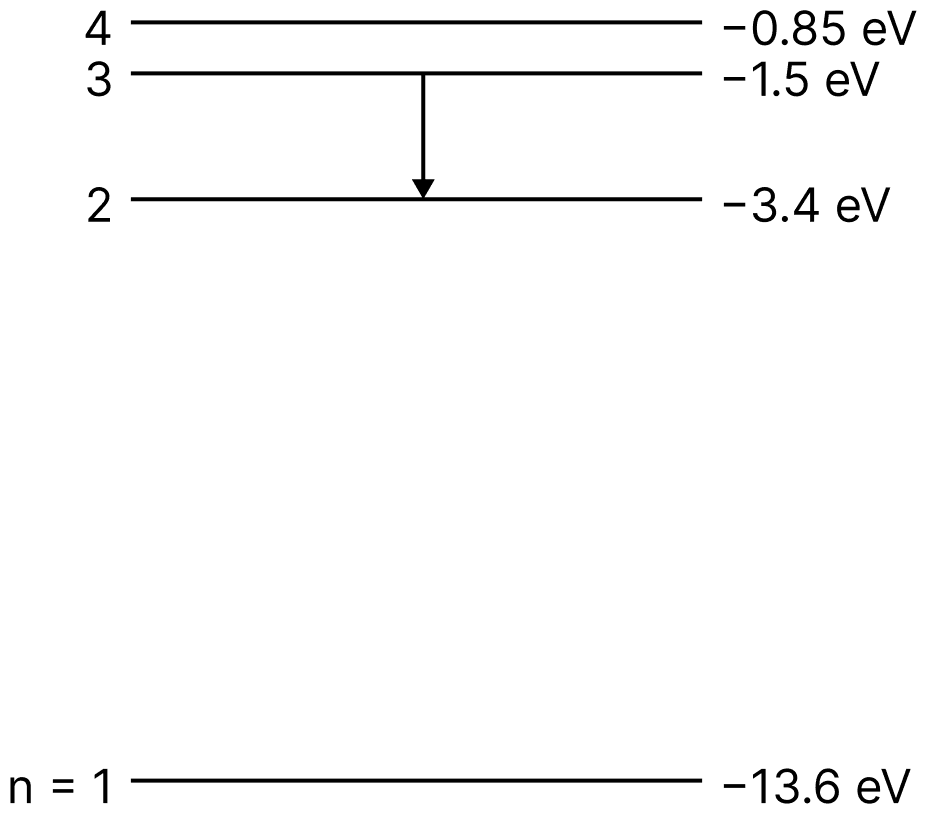
Calculate the wavelength of the first line of the Balmer series of hydrogen. Indicate the transition on an energy-level diagram. (i) What is this line called? (ii) Does it lie in the visible region of the electro-magnetic spectrum?
Answer
Given,
- Rydberg's constant, R = 1.097 × 10⁷ m-1
For the Balmer series,
λ1=R(221−n21),n=3,4,5,...
The first line arises from the transition n = 3 → n = 2,
λ1=R(221−321)λ1=365R
Therefore,
λ=5R36=5×1.097×10736=6.563×10⁻⁷ mλ=6563 A˚
The transition is shown in the energy-level diagram below.
(i) This line is called the Hα line.
(ii) Yes. Its wavelength 6563 Å lies in the visible region of the electromagnetic spectrum (red light).
Hence, the wavelength of the first line of the Balmer series is 6563 Å; it is the Hα line and it lies in the visible region.
Calculate the wavelengths of the third and the fifth spectral lines of Paschen series in hydrogen spectrum when E = −(2.18 × 10⁻¹⁸) / n2 joule.
Answer
Given,
The lines of the Paschen series are emitted when the electron comes down to n = 3 from n = 4, 5, 6, ... . Hence the third line is the transition 6 → 3 and the fifth line is the transition 8 → 3.
For a transition from n2 to n1 = 3,
ΔE=2.18×10⁻¹⁸(321−n221) Jandλ=ΔEhc
Third line (n2 = 6) :
ΔE=2.18×10⁻¹⁸(91−361)=2.18×10−18×363ΔE=1.8167×10⁻¹⁹ Jλ3=1.8167×10⁻¹⁹(6.6×10−34)×(3.0×108)=1.0899×10⁻⁶ mλ3=10899 A˚
Fifth line (n2 = 8) :
ΔE=2.18×10⁻¹⁸(91−641)=2.18×10−18×57655ΔE=2.0816×10⁻¹⁹ Jλ5=2.0816×10⁻¹⁹(6.6×10−34)×(3.0×108)=9.512×10⁻⁷ mλ5=9512 A˚
Hence, the wavelengths of the third and the fifth lines of the Paschen series are 10899 Å and 9512 Å.
Calculate the wavelengths of the first lines of Balmer, Lyman and Paschen series.
Answer
Given,
- Rydberg's constant, R = 1.097 × 10⁷ m-1
The wavelengths of the hydrogen spectrum are given by
λ1=R(n121−n221)
The first line of each series corresponds to n2 = n1 + 1.
Balmer series (n1 = 2, n2 = 3) :
λ1=R(221−321)λ1=365Rλ=5×1.097×10736=6.563×10⁻⁷ mλ=6563 A˚
Lyman series (n1 = 1, n2 = 2) :
λ1=R(121−221)λ1=43Rλ=3×1.097×1074=1.215×10⁻⁷ mλ=1215 A˚
Paschen series (n1 = 3, n2 = 4) :
λ1=R(321−421)λ1=1447Rλ=7×1.097×107144=1.8752×10⁻⁶ mλ=18752 A˚
Hence, the wavelengths of the first lines of the Balmer, Lyman and Paschen series are 6563 Å, 1215 Å and 18752 Å respectively.
The wavelength of the first line of the Lyman series is λ. What will be the wavelength of the first line of the Balmer series in terms of λ?
Answer
Given,
- Wavelength of the first line of Lyman series = λ
For the first line of the Lyman series (n = 2 → n = 1),
λ1=R(121−221)λ1=43R...(i)
For the first line of the Balmer series (n = 3 → n = 2), let the wavelength be λ',
λ′1=R(221−321)λ′1=365R...(ii)
Dividing Eq. (i) by Eq. (ii),
λλ′=43R×5R36λλ′=527λ′=527λ
Hence, the wavelength of the first line of the Balmer series is 527λ.
The wavelength of the first line of Balmer series is 6563 Å. Find the wavelength of the first line of the Lyman series.
Answer
Given,
- Wavelength of the first line of Balmer series, λB = 6563 Å
For the first line of the Balmer series (n = 3 → n = 2),
λB1=R(221−321)λB1=365R...(i)
For the first line of the Lyman series (n = 2 → n = 1),
λL1=R(121−221)λL1=43R...(ii)
Dividing Eq. (i) by Eq. (ii),
λBλL=365R×3R4λBλL=275λL=275×6563λL=1215 A˚
Hence, the wavelength of the first line of the Lyman series is 1215 Å.
The wavelength of the first member of the Balmer series is 6563 Å. Find the wavelengths of the second and the last member of the series.
Answer
Given,
- Wavelength of the first member of Balmer series, λ1 = 6563 Å
For the Balmer series,
λ1=R(221−n21),n=3,4,5,...,∞
For the first member (n = 3),
λ11=R(41−91)λ11=365R...(i)
Second member (n = 4) :
λ21=R(41−161)λ21=163R...(ii)
Dividing Eq. (i) by Eq. (ii),
λ1λ2=365×316λ1λ2=2720λ2=2720×6563λ2=4861 A˚
Last member (n = ∞) :
λ∞1=R(41−∞1)λ∞1=4R...(iii)
Dividing Eq. (i) by Eq. (iii),
λ1λ∞=365×4λ1λ∞=95λ∞=95×6563λ∞=3646 A˚
Hence, the wavelengths of the second and the last members of the Balmer series are 4861 Å and 3646 Å.
The wavelength of the first line of Balmer series is 6563 Å. Calculate (i) Rydberg's constant, (ii) ionisation potential of hydrogen atom.
Answer
Given,
Wavelength of the first line of Balmer series, λ = 6563 Å = 6563 × 10-10 m
h = 6.6 × 10⁻³⁴ J s, c = 3.0 × 10⁸ ms-1, 1 eV = 1.6 × 10⁻¹⁹ J
(i) Rydberg's constant :
For the first line of the Balmer series (n = 3 → n = 2),
λ1=R(221−321)λ1=365R
Therefore,
R=5λ36=5×6563×10−1036R=1.097×10⁷ m−1
(ii) Ionisation potential :
The energy of hydrogen atom in its lowest level (n = 1) is −Rhc, and in the ionised state (n = ∞) it is zero. So the ionisation energy is
E=Rhc=(1.097×107)×(6.6×10−34)×(3.0×108)=2.172×10⁻¹⁸ J=1.6×10−192.172×10⁻¹⁸ eV=13.58 eVE≈13.6 eV
As the ionisation energy is 13.6 eV, the ionisation potential is 13.6 V.
Hence, Rydberg's constant is 1.097 × 10⁷ m-1 and the ionisation potential of hydrogen atom is 13.6 V.
The ionisation energy of hydrogen atom is 13.6 eV. Calculate Rydberg's constant for hydrogen.
Answer
Given,
Ionisation energy of hydrogen atom, Rhc = 13.6 eV = 13.6 × 1.6 × 10-19 J
h = 6.6 × 10⁻³⁴ J s, c = 3.0 × 10⁸ ms-1
The ionisation energy of hydrogen atom is the energy needed to take the electron from n = 1 (energy −Rhc) to n = ∞ (energy zero), so it equals Rhc. Therefore,
R=hc13.6×1.6×10−19=(6.6×10−34)×(3.0×108)2.176×10−18=1.98×10−252.176×10⁻¹⁸R=1.099×10⁷ m−1
Hence, Rydberg's constant for hydrogen is 1.099 × 10⁷ m-1.
Note: The textbook prints 1.0956 × 10⁷ m-1, which corresponds to h ≈ 6.62 × 10⁻³⁴ J s; with the chapter's tabulated h = 6.6 × 10⁻³⁴ J s the value is 1.099 × 10⁷ m-1.
The energy transition in hydrogen atom takes place from energy-level n = 8 to n = 1. Calculate the wavelength of the emitted photon. To which spectral series will this photon belong? To which part of electromagnetic spectrum will this photon belong? (R = 1.09 × 10⁷ per metre.)
Answer
Given,
Wavelength of the emitted photon :
λ1=R(n121−n221)=1.09×10⁷(121−821)=1.09×107×6463λ1=1.073×10⁷ m−1λ=1.073×1071=9.32×10⁻⁸ mλ=932 A˚
Spectral series : The transition ends on the lowest level n1 = 1, so the photon belongs to the Lyman series.
Region of spectrum : The wavelength 932 Å is much shorter than that of visible light, so the photon lies in the ultraviolet region.
Hence, the wavelength of the photon is 932 Å; it belongs to the Lyman series and to the ultraviolet part of the electromagnetic spectrum.
The wavelength of a yellow line of sodium is 5896 Å. Give its wave number.
Answer
Given,
- Wavelength, λ = 5896 Å = 5896 × 10-8 cm
The wave number is the number of waves per unit length,
Wave number=λ1=5896×10−8 cm1=1.6961×104 cm−1Wave number=16961 per cm
Hence, the wave number of the yellow line of sodium is 16961 per cm.
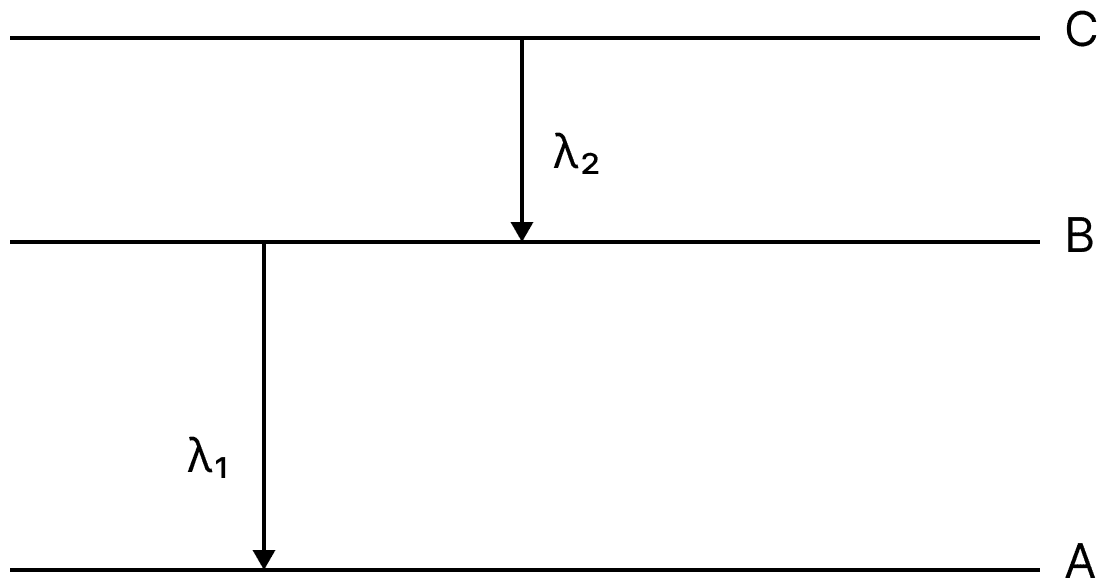
As per given figurer A, B and C are the first, second and third excited energy levels of hydrogen atom respectively. If the ratio of two wavelengths (i.e.,λ2λ1) is 4n7, find the value of n.
Answer
Given,
A, B and C are the first, second and third excited levels, i.e. n = 2, n = 3 and n = 4 respectively
λ1 is emitted in the transition B → A (n = 3 → n = 2), and λ2 in the transition C → B (n = 4 → n = 3)
λ2λ1=4n7
The wavelengths of the hydrogen spectrum are given by
λ1=R(n121−n221)
For λ1 (n = 3 → n = 2),
λ11=R(221−321)λ11=365R...(i)
For λ2 (n = 4 → n = 3),
λ21=R(321−421)λ21=1447R...(ii)
Dividing Eq. (ii) by Eq. (i),
λ2λ1=1447R×5R36λ2λ1=207
Equating with the given ratio,
4n7=2074n=20n=5
Hence, the value of n is 5.