
Rihan marked a point on a piece of paper. How many lines can he draw that pass through the point?
Sheetal marked two points on a piece of paper. How many different lines can she draw that pass through both of the points?
Can you help Rihan and Sheetal find their answers?
Answer
Rihan has marked only one point. A single point does not fix the direction of a line. Through that one point a line can be drawn in any direction, and every different direction gives a different line.
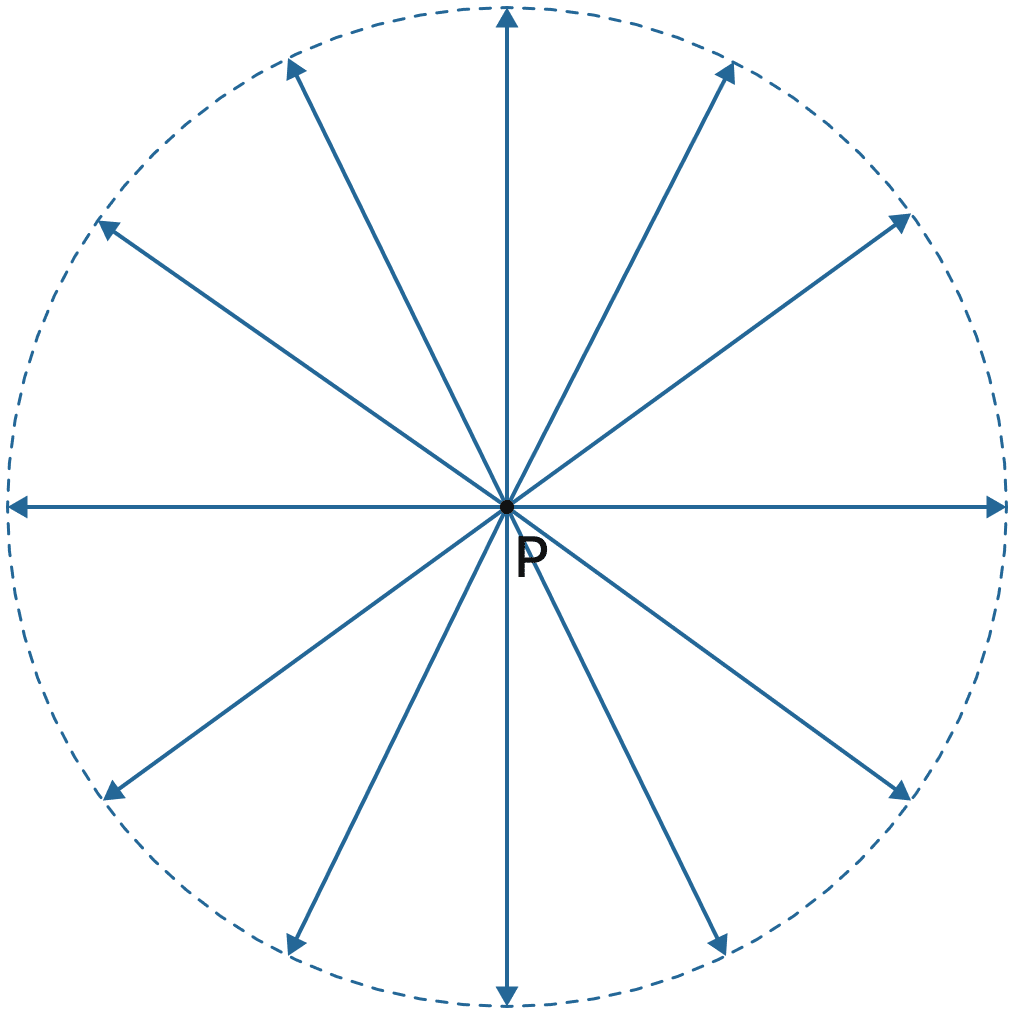
Hence, Rihan can draw an unlimited (infinite) number of lines through a single point.
Sheetal has marked two points. Joining the two points fixes the direction of the line completely, and this line can be extended endlessly on both sides. No second line can pass through both of the points.

Hence, Sheetal can draw only one line passing through both the points.
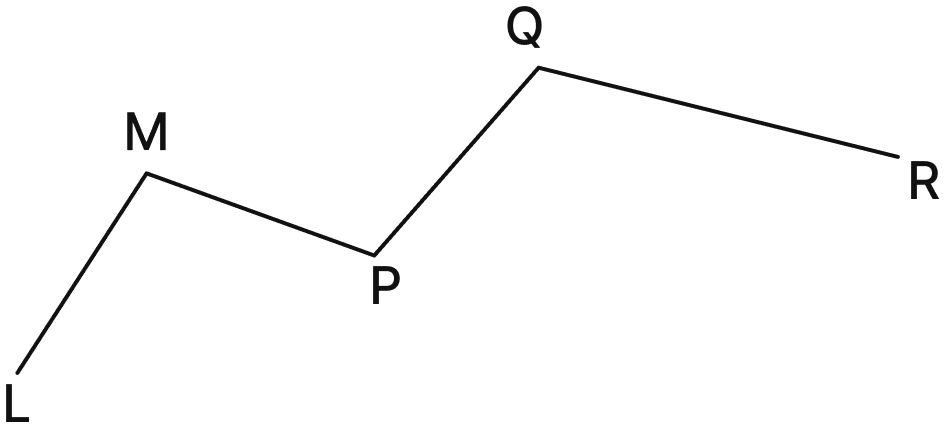
Name the line segments in Fig. 2.4. Which of the five marked points are on exactly one of the line segments? Which are on two of the line segments?
Answer
In this figure, the marked points are joined one after the other as L → M → P → Q → R. Each such join is the shortest path between two points, so each of them is a line segment.
Line segments:
, , and
Now let us check each marked point:
L is an end point of only.
M is an end point of and of .
P is an end point of and of .
Q is an end point of and of .
R is an end point of only.
Hence, the line segments are , , and . The points L and R lie on exactly one line segment, and the points M, P and Q lie on two line segments each.
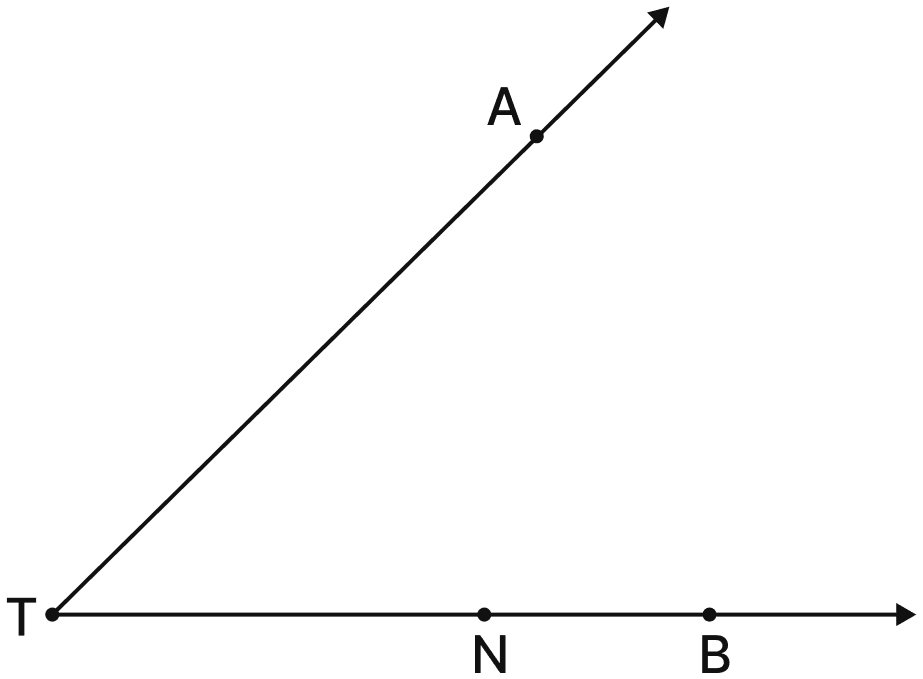
Name the rays shown in Fig. 2.5. Is T the starting point of each of these rays?
Answer
A ray is a portion of a line that starts at one point and goes on endlessly in one direction. It is named by writing its starting point first, followed by any other point lying on it.
In the above figure, both the arrows begin at the point T.
One ray starts at T and passes through A. So, it is named .
The other ray starts at T and passes through N and B. So, it is named . Since N also lies on this same ray, it may equally well be named .
In both the rays the arrow head shows that they go on endlessly away from T, and neither of them extends beyond T.
Hence, the rays shown are and (which may also be named ), and yes, T is the starting point of each of these rays.
Draw a rough figure and write labels appropriately to illustrate each of the following:
(a) and meet at O.
(b) and intersect at point M.
(c) Line l contains points E and F but not point D.
(d) Point P lies on AB.
Answer
(a) and meet at O.
Two lines are drawn, both passing through the common point O. The point P is marked on the first line and the point Q is marked on the second line. Arrow heads are put at both ends of each line to show that a line has no end points.
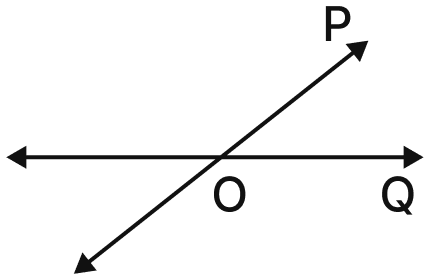
Hence, the two lines and meet at the point O.
(b) and intersect at point M.
A ray is drawn starting at X and passing through Y, so it carries an arrow head only at the Y end. A line is drawn through P and Q with arrow heads at both ends. The two are drawn so that they cross each other, and the crossing point is labelled M.
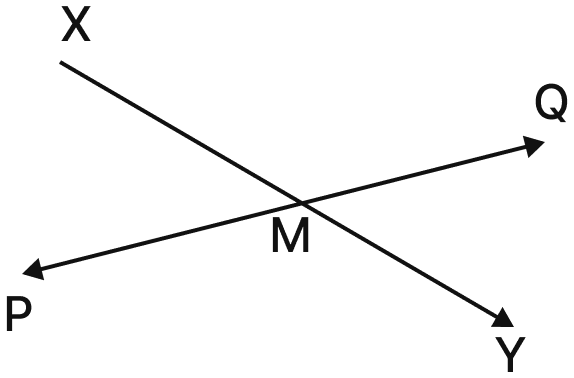
Hence, the ray and the line intersect at the point M.
(c) Line l contains points E and F but not point D.
A line with arrow heads at both ends is drawn and named l. The points E and F are marked on this line, and the point D is marked away from the line.
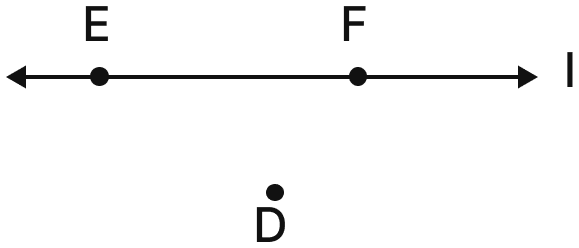
Hence, the line l passes through E and F, while D does not lie on l.
(d) Point P lies on AB.
A line segment with end points A and B is drawn, and the point P is marked somewhere between A and B on this segment.
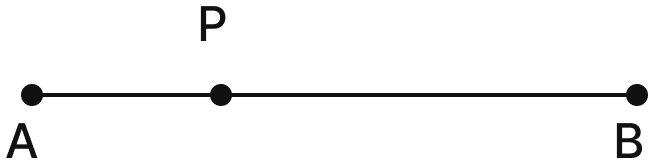
Hence, the point P lies on the line segment .
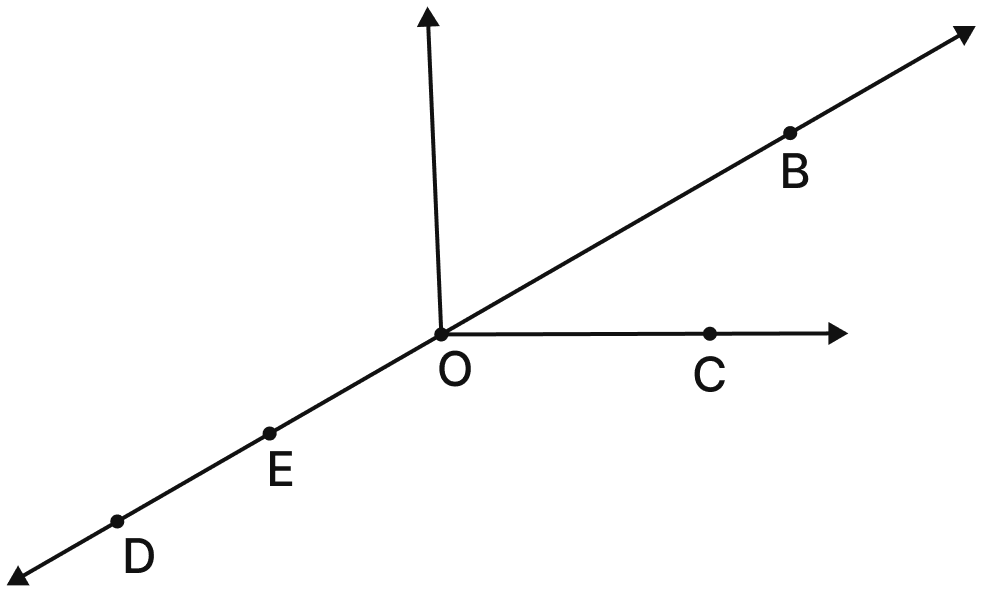
In Fig. 2.6, name:
(a) Five points
(b) A line
(c) Four rays
(d) Five line segments
Answer
(a) Five points
The dots marked in the figure give the points.
The five points are O, B, C, D and E.
(b) A line
The path through D, E, O and B has arrow heads at both of its ends, so it goes on endlessly in both directions. A line is named using any two points lying on it.
The line is . It may also be named , or .
(c) Four rays
A ray starts at one point and goes on endlessly in one direction, and it is named by writing the starting point first.
Starting at O, one part of the line runs endlessly through B, giving .
Starting at O, the opposite part runs endlessly through E and D, giving .
Starting at O, a separate arrow runs through C, giving .
Starting at E, the part of the line running endlessly through O and B gives .
The four rays are and .
(d) Five line segments
A line segment is the shortest path between two marked points, so we take pairs of marked points that lie on the same straight path.
The five line segments are and . The segments and can also be named.
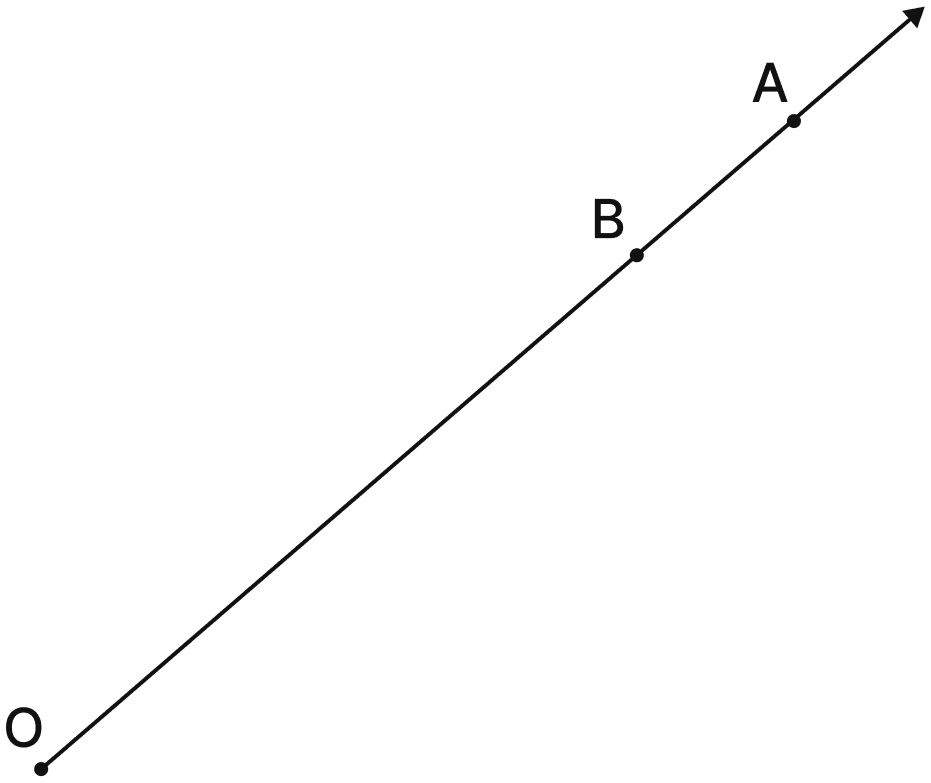
Here is a ray (Fig. 2.7). It starts at O and passes through the point A. It also passes through the point B.
(a) Can you also name it as ? Why?
(b) Can we write as ? Why or why not?
Answer
(a) Can you also name it as ? Why?
A ray is named by writing its starting point first, followed by any other point that lies on it.
Here the starting point of the ray is O, and the point B lies on the ray.
So, writing the starting point O first and the point B after it gives the same ray.
Yes, the ray can also be named as , because it starts at O and B is a point lying on it.
(b) Can we write as ? Why or why not?
In the name of a ray, the first letter must always be the starting point of the ray.
In , the starting point is O and the ray runs endlessly from O in the direction of A.
In , the starting point would be A and the ray would run from A in the direction of O, that is, in the opposite direction. Such a ray would not include the part of that lies beyond A.
So the two names stand for two different rays.
No, cannot be written as , because the starting point must be written first and would mean a different ray going in the opposite direction.
Can you find the angles in the given pictures? Draw the rays forming any one of the angles and name the vertex of the angle.
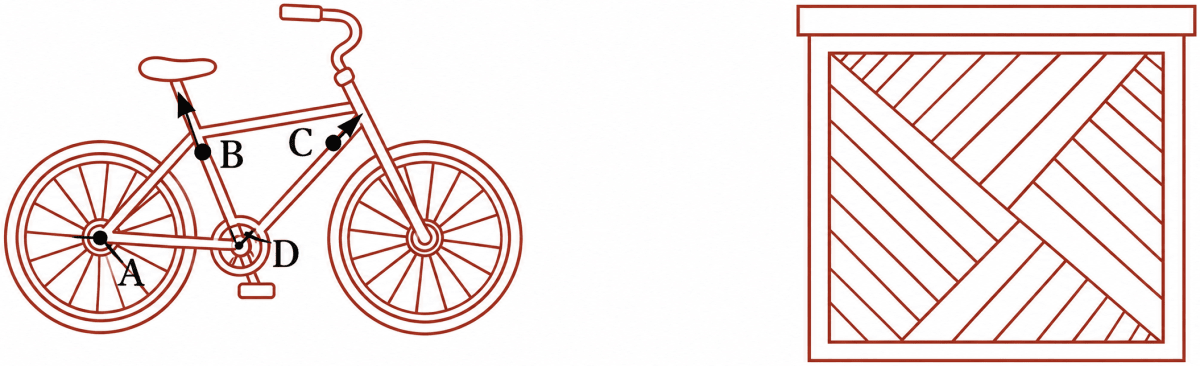
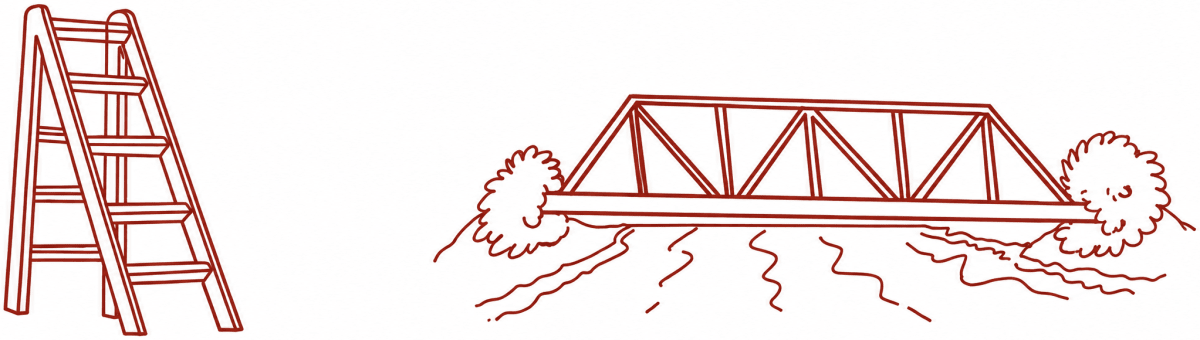
Answer
(i)
Yes, angles can be found in all four pictures.
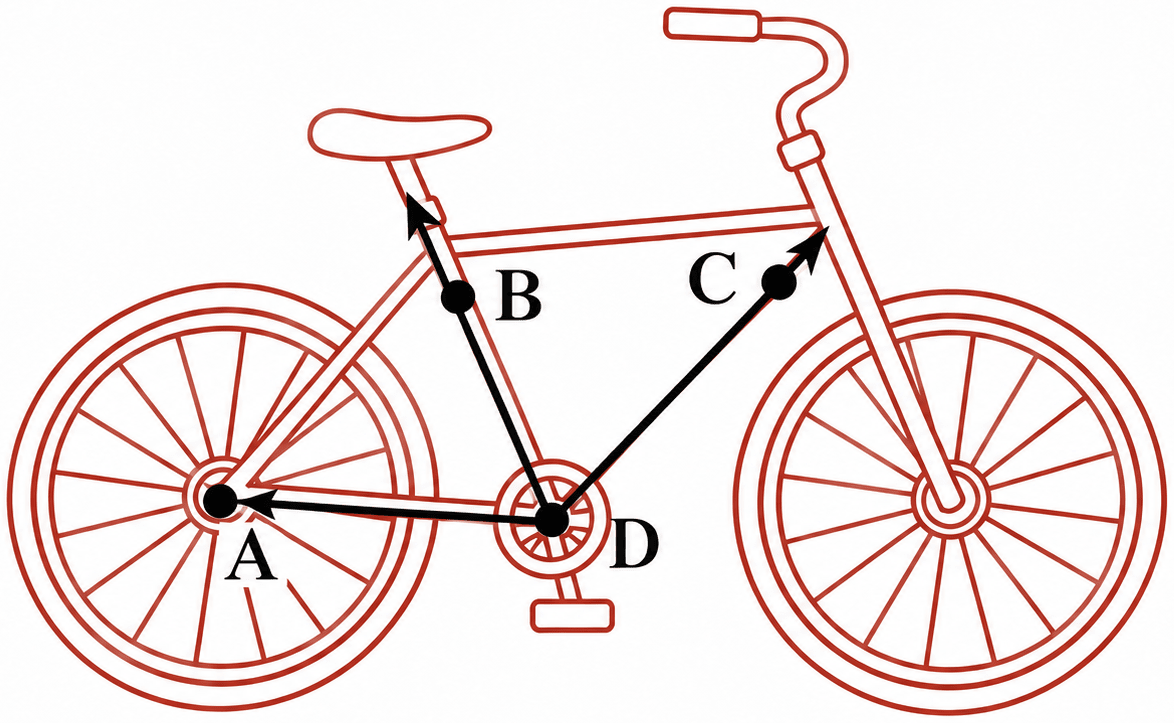
In the bicycle frame, the rods meet at point D.
Draw the rays DA, DB and DC along the rods of the frame.
The rays DA and DB form ∠ADB.
- Rays forming the angle: DA and DB
- Vertex of the angle: D
Other angles that can be seen are ∠BDC and ∠ADC.
(ii)
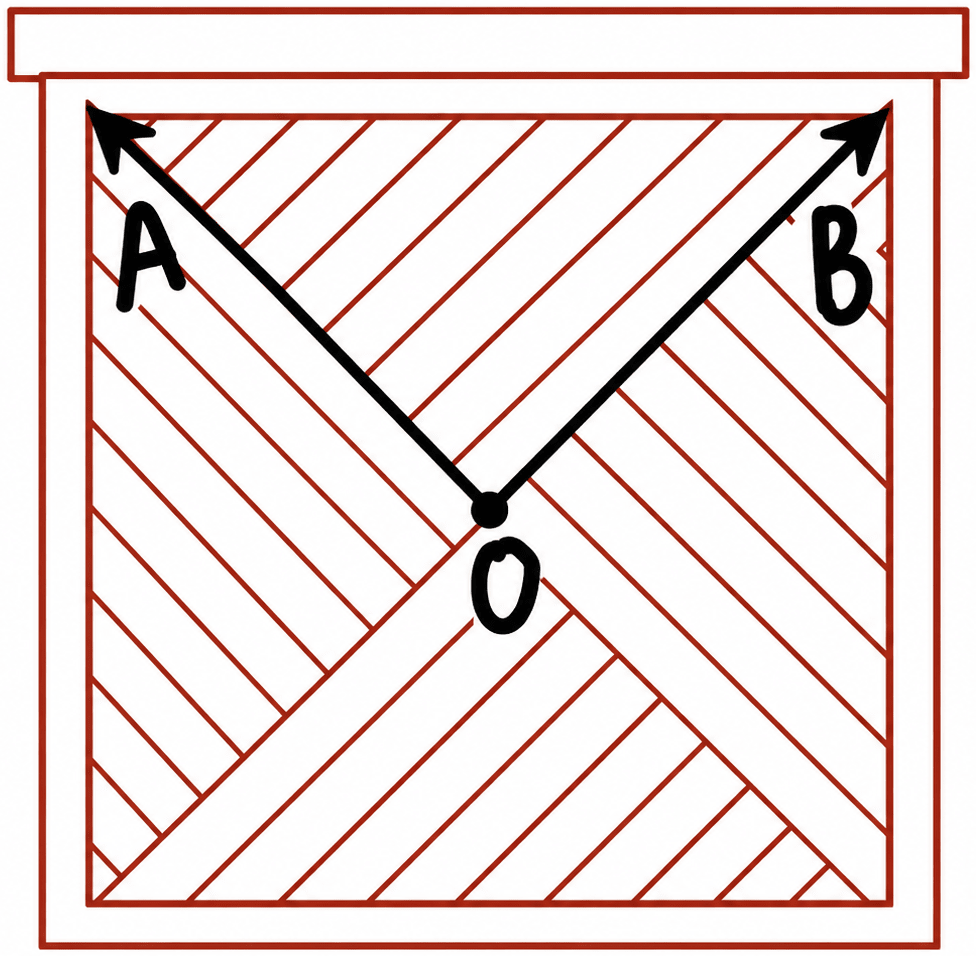
The wooden strips intersect each other inside the crate. Let O be one such point of intersection.
The rays OA and OB form ∠AOB.
- Rays forming the angle: OA and OB
- Vertex of the angle: O
Many other angles are also formed at the same intersection.
(iii)
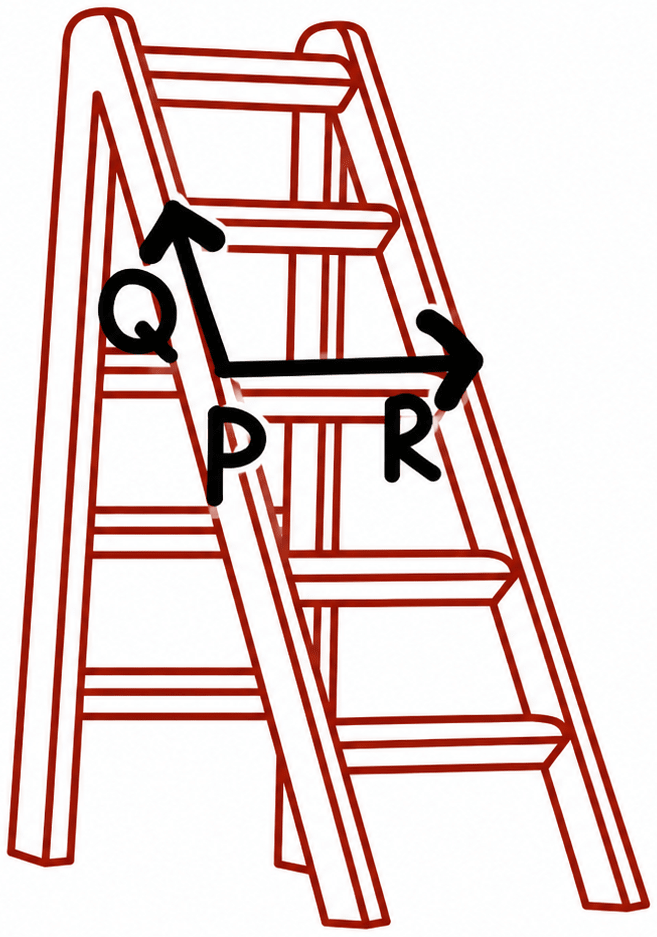
The side rails and the steps of the ladder meet at several points. Let P be one such point.
The rays PQ and PR form ∠QPR.
- Rays forming the angle: PQ and PR
- Vertex of the angle: P
(iv)
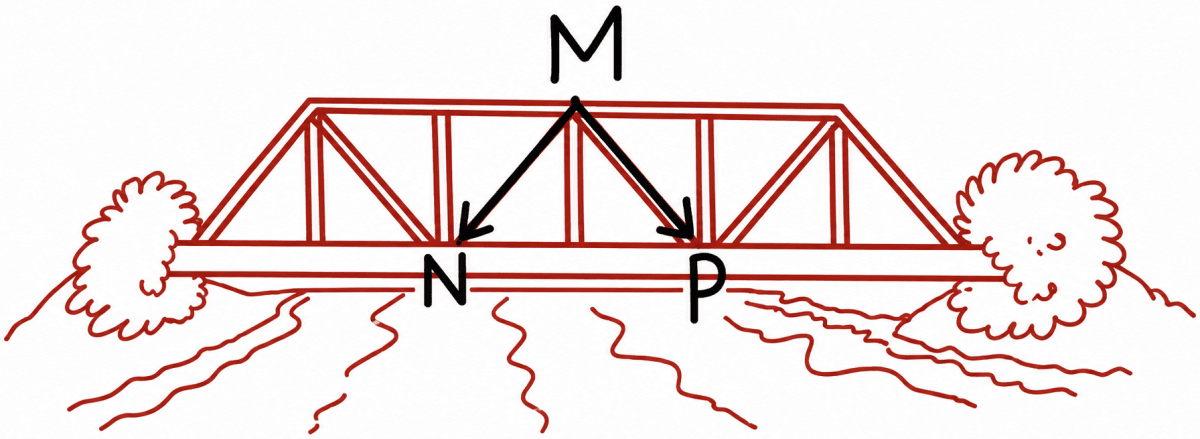
The rods of the bridge form triangular shapes. Let M be the top vertex of one triangle.
The rays MN and MP form ∠NMP.
- Rays forming the angle: MN and MP
- Vertex of the angle: M
Draw and label an angle with arms ST and SR.
Answer
An angle is formed by two rays having a common starting point.
Here the two arms are the rays ST and SR. The letter S is common to both the arms, so S is the common starting point.
∴ S is the vertex of the angle, and the rays ST and SR are the arms.
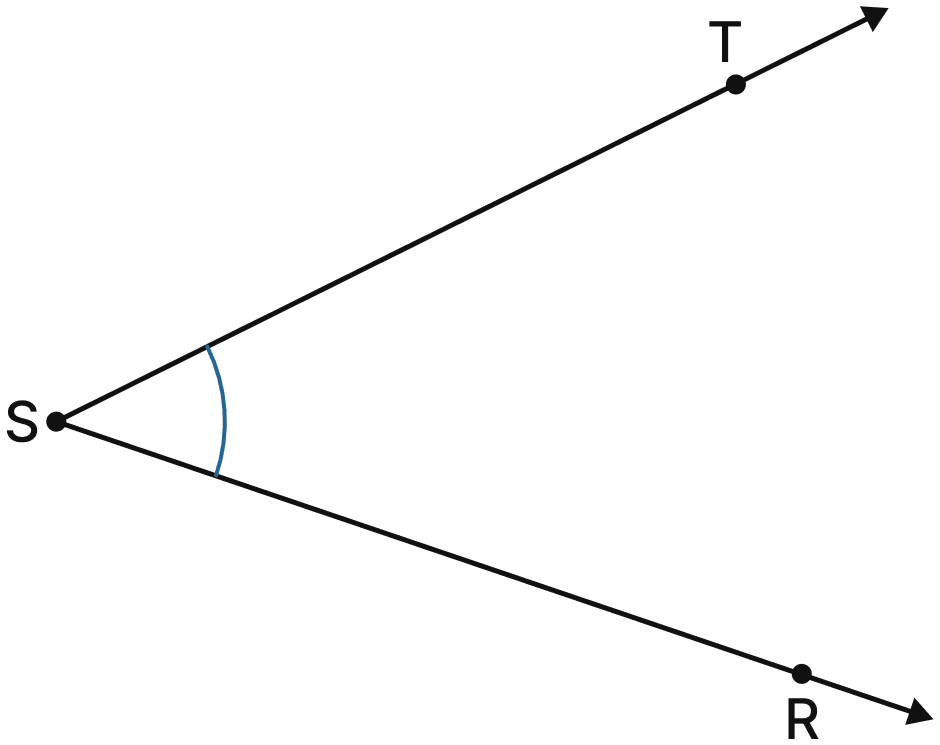
While naming the angle, the vertex is always written as the middle letter.
Hence, the required angle is ∠TSR (or ∠RST) with vertex S.
Explain why ∠APB cannot be labelled as ∠P.
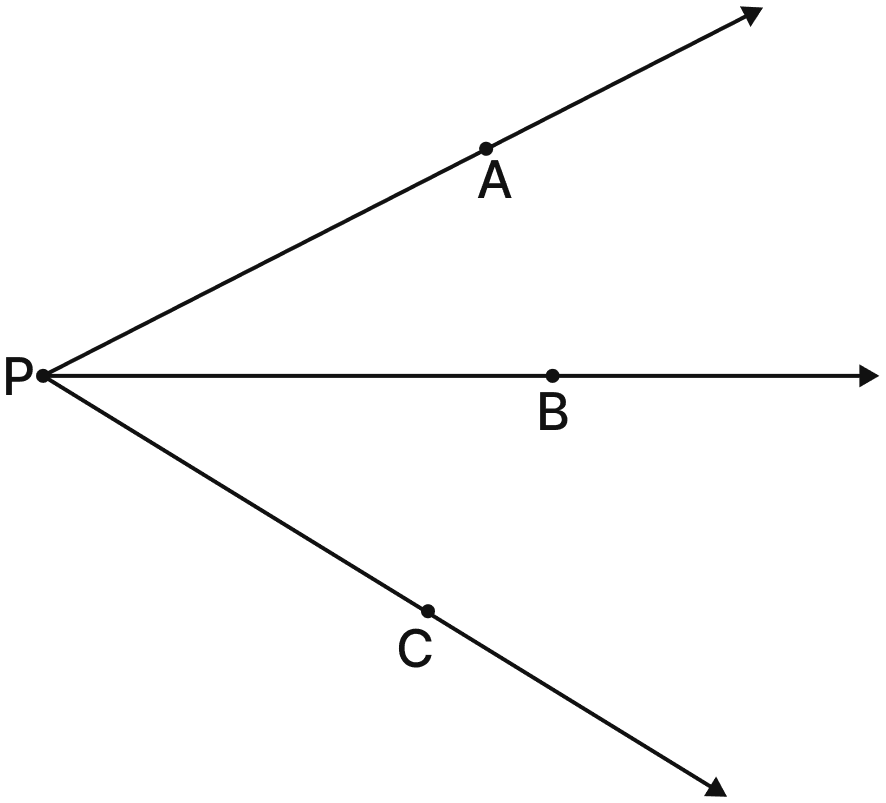
Answer
An angle can be named by its vertex alone only when exactly one angle is formed at that vertex.
In the given figure, three rays PA, PB and PC start from the point P.
These three rays form three different angles at P:
∠APB, ∠BPC and ∠APC
All three of these angles have P as their vertex. So, the name ∠P does not tell us which of these three angles is being referred to.
∴ The name ∠P is not clear, as it can mean any one of ∠APB, ∠BPC or ∠APC.
To avoid this confusion, we use a point on each of the arms along with the vertex, and write the vertex as the middle letter.
Hence, ∠APB cannot be labelled as ∠P because three angles are formed at the vertex P, and the single letter P does not specify which of them is meant.
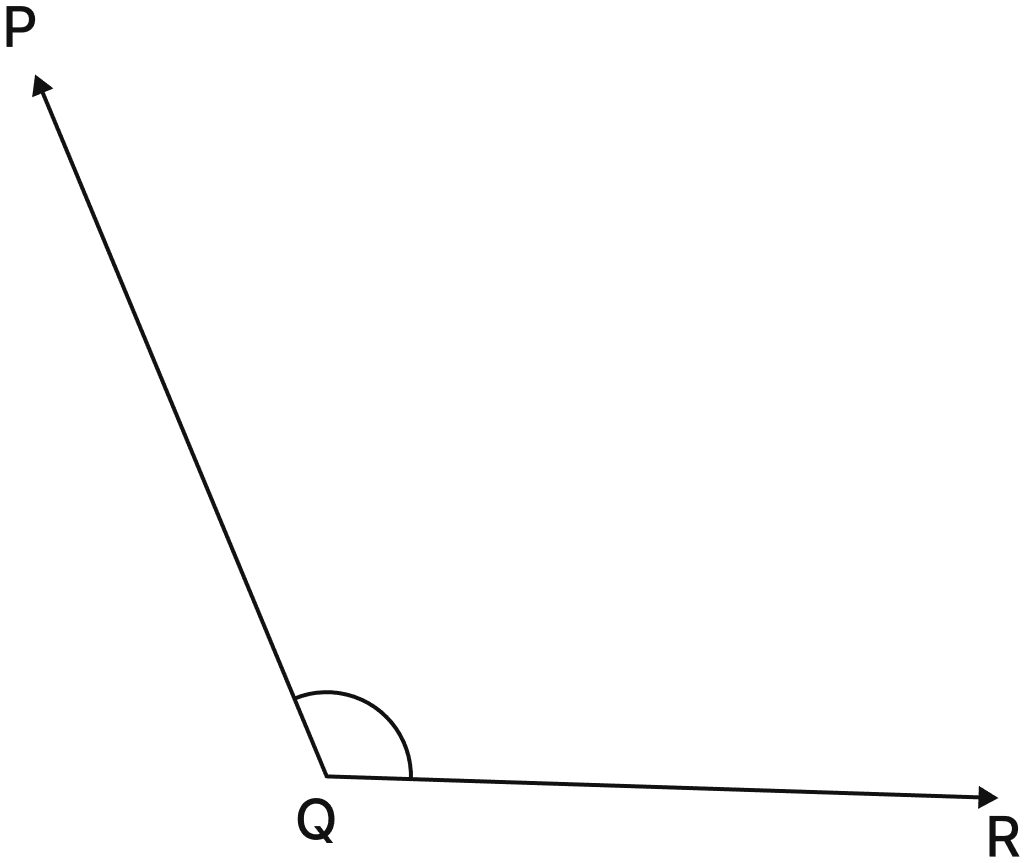
Name the angles marked in the given figure.
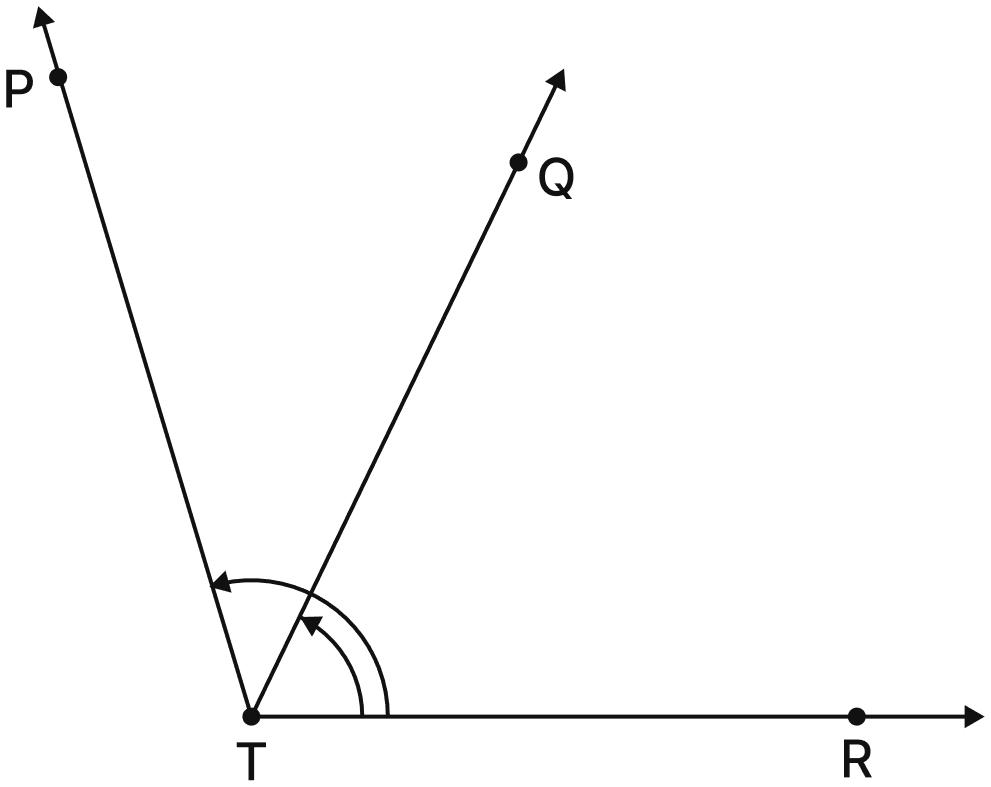
Answer
In the given figure, three rays TP, TQ and TR start from the common point T. So, T is the vertex of every angle formed here.
Two angles have been marked with curves in the figure.
The first curve turns from the ray TR to the ray TQ.
∴ This angle is ∠QTR (or ∠RTQ).
The second curve turns from the ray TR to the ray TP.
∴ This angle is ∠PTR (or ∠RTP).
In both the names, the vertex T is written as the middle letter.
Hence, the marked angles are ∠QTR and ∠PTR.
Mark any three points on your paper that are not on one line. Label them A, B, C. Draw all possible lines going through pairs of these points. How many lines do you get? Name them. How many angles can you name using A, B, C? Write them down, and mark each of them with a curve as in Fig. 2.9.
Answer
Three points A, B and C are marked so that they do not lie on one line.
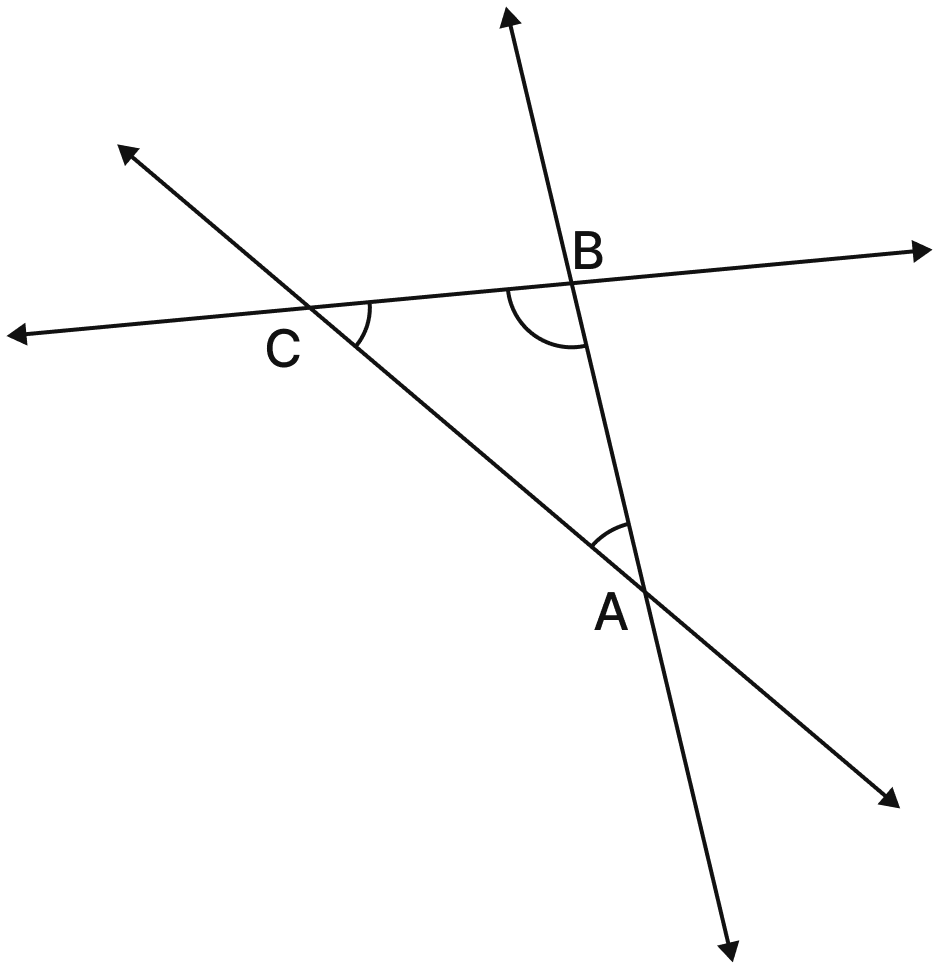
Number of lines:
Any two points determine exactly one line. So, we count the pairs that can be formed from the three points.
The pairs are: (A, B), (A, C) and (B, C)
∴ Number of lines = 3
These lines are named , and .
Number of angles:
An angle needs a vertex and one point on each of its two arms. So, we choose one point as the vertex and the remaining two points lie on the two arms.
Taking A as the vertex, we get ∠BAC.
Taking B as the vertex, we get ∠ABC.
Taking C as the vertex, we get ∠ACB.
∴ Number of angles = 3
The three angles are ∠BAC, ∠ABC and ∠ACB, and each of them is marked with a small curve at its vertex.
Hence, we get 3 lines — , and 3 angles — ∠BAC, ∠ABC and ∠ACB.
Now mark any four points on your paper so that no three of them are on one line. Label them A, B, C, D. Draw all possible lines going through pairs of these points. How many lines do you get? Name them. How many angles can you name using A, B, C, D? Write them all down, and mark each of them with a curve as in Fig. 2.9.
Answer
Four points A, B, C and D are marked so that no three of them lie on one line.
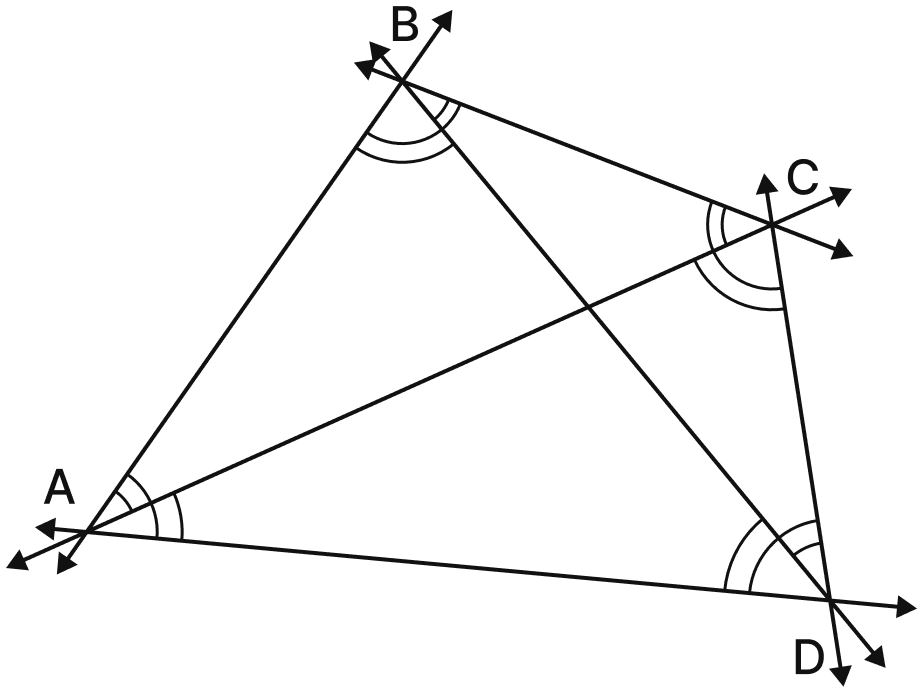
Number of lines:
Any two points determine exactly one line. So, we count the pairs that can be formed from the four points.
The pairs are: (A, B), (A, C), (A, D), (B, C), (B, D) and (C, D)
∴ Number of lines = 6
These lines are named , , , , and .
Number of angles:
An angle needs a vertex and one point on each of its two arms. So, we take each point as the vertex in turn, and choose two of the remaining three points for the arms.
Taking A as the vertex: ∠BAC, ∠BAD, ∠CAD
Taking B as the vertex: ∠ABC, ∠ABD, ∠CBD
Taking C as the vertex: ∠ACB, ∠ACD, ∠BCD
Taking D as the vertex: ∠ADB, ∠ADC, ∠BDC
Each of the four points gives 3 angles.
∴ Number of angles = 4 × 3 = 12
Each of these angles is marked with a small curve at its vertex.
Hence, we get 6 lines — and , and 12 angles — ∠BAC, ∠BAD, ∠CAD, ∠ABC, ∠ABD, ∠CBD, ∠ACB, ∠ACD, ∠BCD, ∠ADB, ∠ADC and ∠BDC.
Look at these animals opening their mouths. Do you see any angles here? If yes, mark the arms and vertex of each one. Some mouths are open wider than others; the more the turning of the jaws, the larger the angle! Can you arrange the angles in this picture from smallest to largest?

Answer
Yes, each animal's mouth forms an angle. The upper and lower jaws are the arms of the angle, and the point where they meet is the vertex.
Arranging the angles from smallest to largest:
Fish < Crocodile < Eel < Bird
Hence, the fish forms the smallest angle and the bird forms the largest angle.
Is it always easy to compare two angles? Here are some angles. Label each of the angles. How will you compare them?
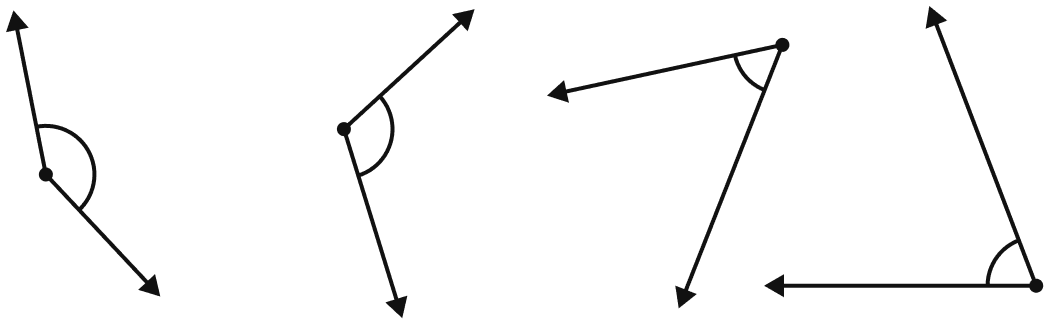
Answer
No, it is not always easy to compare two angles just by looking at them.
The angles in the picture are drawn at different places and are turned in different directions. Also, their arms are of different lengths. A longer arm may make an angle look larger even when it is not, because the size of an angle depends only on the amount of turning between the arms and not on the length of the arms.
The four angles may be labelled as ∠ABC, ∠DEF, ∠GHI and ∠JKL.
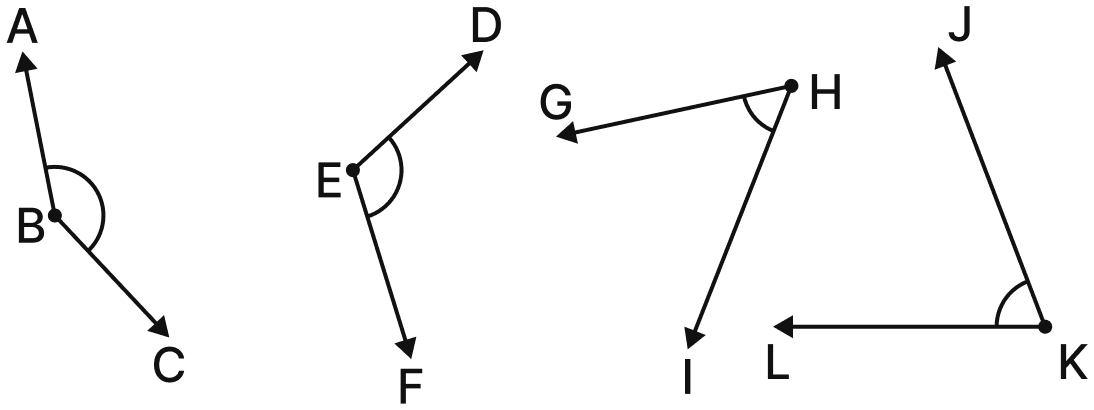
How to compare them:
The angles are compared by superimposition. We trace one angle on a piece of tracing paper and place it over the other angle so that the vertex of the traced angle falls exactly on the vertex of the other angle, and one arm of the traced angle falls along one arm of the other angle.
- If the second arm of the traced angle falls inside the other angle, then the traced angle is smaller.
- If the second arm falls outside the other angle, then the traced angle is larger.
- If the second arm falls exactly along the other arm, then the two angles are equal.
Where else do we use superimposition to compare?
Answer
Superimposition means placing one thing exactly over another to check whether they match.
A few examples where superimposition is used are line segments, squares, and circles.
Fold a rectangular sheet of paper, then draw a line along the fold created. Name and compare the angles formed between the fold and the sides of the paper. Make different angles by folding a rectangular sheet of paper and compare the angles. Which is the largest and smallest angle you made?
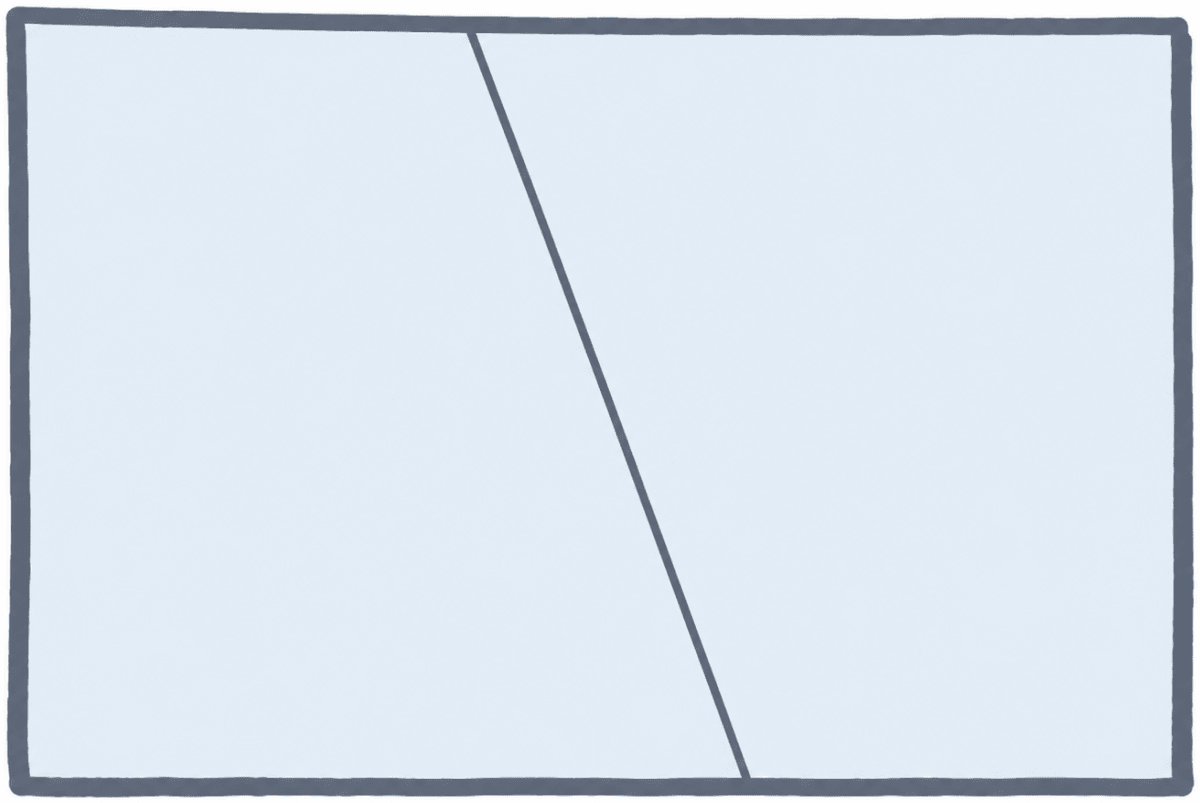
Answer
Take a rectangular sheet of paper and fold it so that the crease runs across the sheet. Open the sheet and draw a line along the fold.
The fold meets the sides of the paper. At each such meeting point, the fold and the side of the paper act as the two arms of an angle, and the meeting point is the vertex.
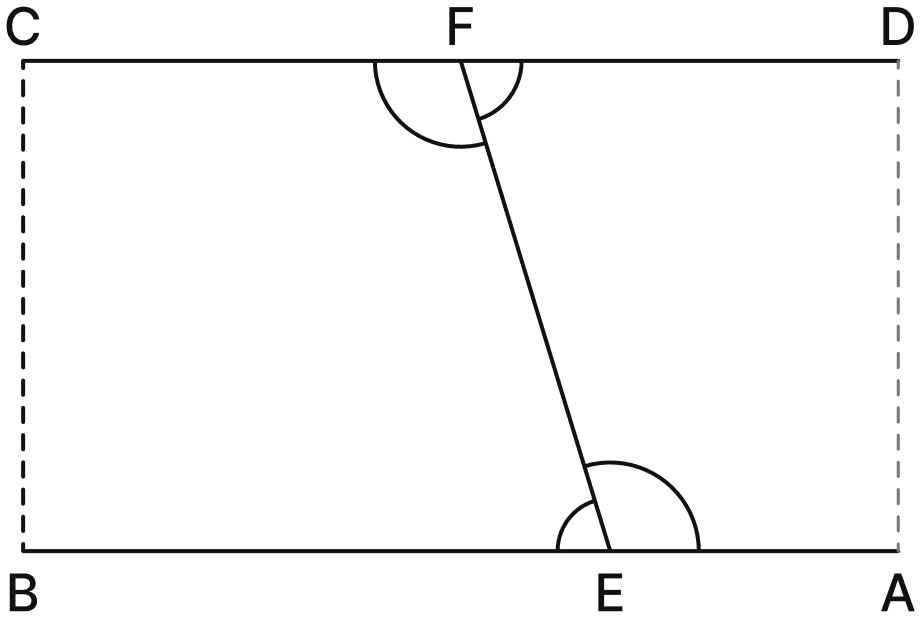
Mark the corners of the sheet and the points where the fold meets the sides, and name the angles so formed with the vertex as the middle letter.
Now compare these angles by tracing one of them on tracing paper and superimposing it on another, keeping the vertices together and one arm along one arm.
Angles formed: ∠AEF, ∠BEF, ∠DFE, ∠CFE
Here ∠AEF & ∠CFE are larger than ∠BEF & ∠DFE
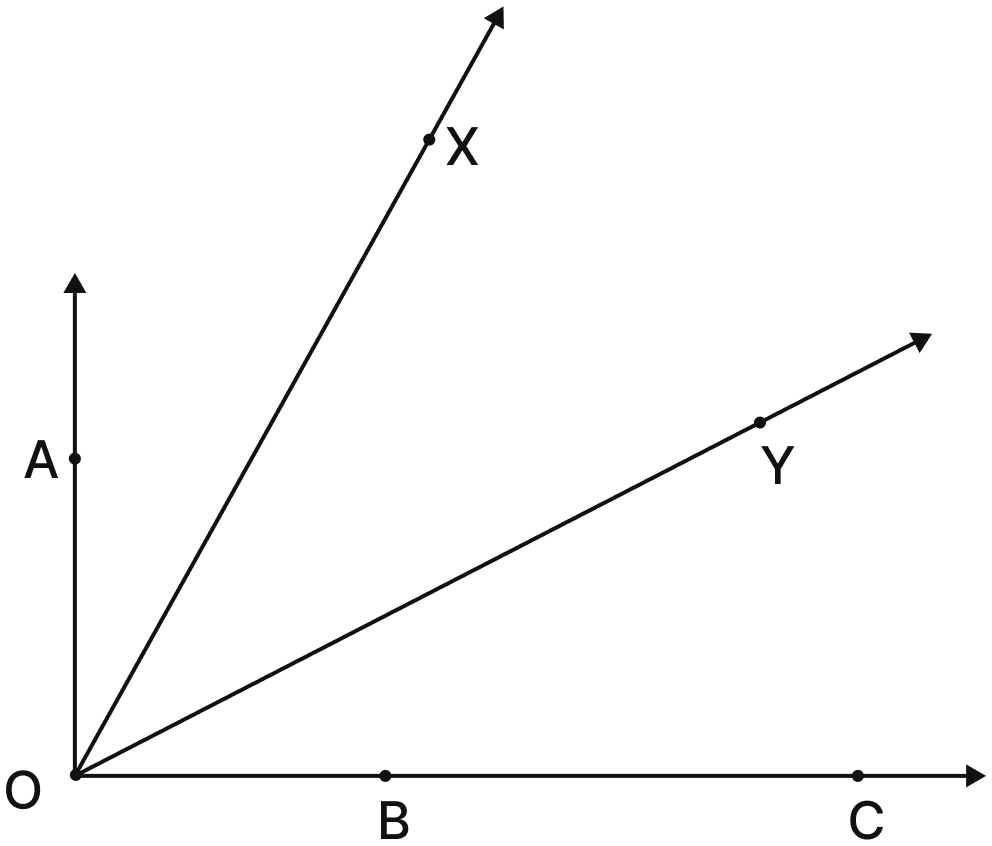
In each case, determine which angle is greater and why.
(a) ∠AOB or ∠XOY
(b) ∠AOB or ∠XOB
(c) ∠XOB or ∠XOC
Discuss with your friends on how you decided which one is greater.
Answer
In the given figure, all the rays OA, OX, OY, OB and OC start from the same point O. So, O is the vertex of each of these angles. Also, the points B and C both lie on the same ray drawn from O.
(a) ∠AOB or ∠XOY
Trace ∠XOY and place it over ∠AOB so that the vertex falls on O and the arm OY falls along the arm OB.
The arm OX then falls inside ∠AOB, that is, between the rays OB and OA.
So, less turning is needed to move OY to OX than to move OB to OA.
∴ ∠AOB > ∠XOY
Hence, ∠AOB is greater.
(b) ∠AOB or ∠XOB
Both these angles have the arm OB in common, and the arms OA and OX lie on the same side of OB.
Starting from the ray OB and turning towards OA, we pass through the ray OX on the way.
So, the ray OX lies inside ∠AOB, which means more turning is needed to move OB to OA than to move OB to OX.
∴ ∠AOB > ∠XOB
Hence, ∠AOB is greater.
(c) ∠XOB or ∠XOC
Here the points B and C lie on one and the same ray starting from O, with C farther from O than B.
So, the rays OB and OC are the same ray, and both the angles have exactly the same pair of arms.
The size of an angle is the amount of turning between its arms, and it does not depend on the lengths of the arms. Marking the point farther away does not change the turning.
∴ ∠XOB = ∠XOC
Hence, neither angle is greater; ∠XOB and ∠XOC are equal.
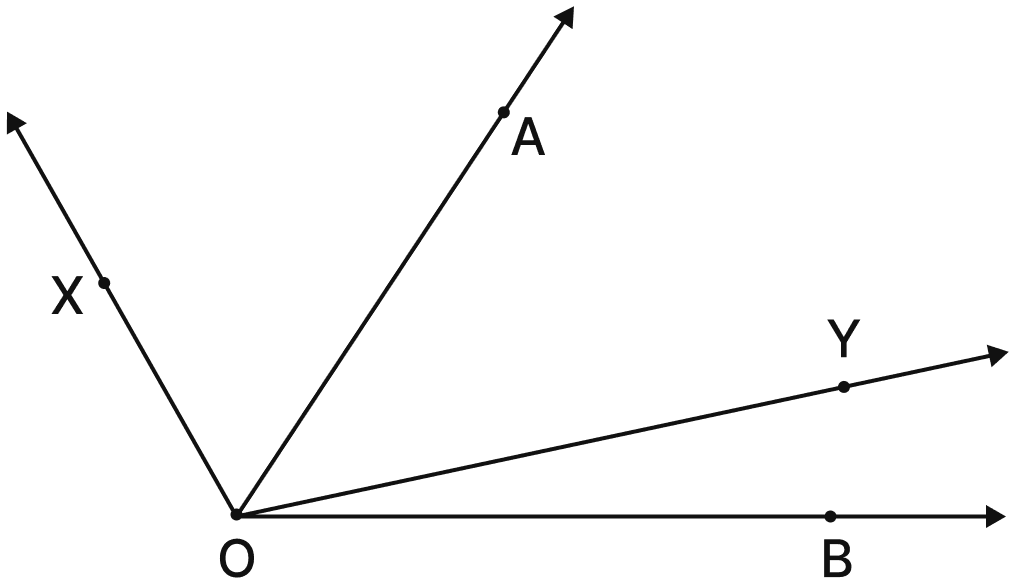
Which angle is greater: ∠XOY or ∠AOB? Give reasons.
Answer
In the given figure, the rays OX, OA, OY and OB all start from the same point O, so O is the vertex of both the angles.
Both the angles are drawn with arms of different lengths, so they cannot be compared just by looking at them. We compare them by superimposition.
Trace ∠AOB on a piece of tracing paper.
Place the tracing over the figure so that the vertex of the traced angle falls exactly on O, and the arm OB falls along the arm OY.
The arm OA then falls inside ∠XOY, that is, between the rays OY and OX.
So, the whole of ∠AOB fits inside ∠XOY, which means that less turning is needed to move OB to OA than to move OY to OX.
∴ ∠XOY > ∠AOB
Hence, ∠XOY is the greater angle, as ∠AOB fits completely inside it on superimposition.
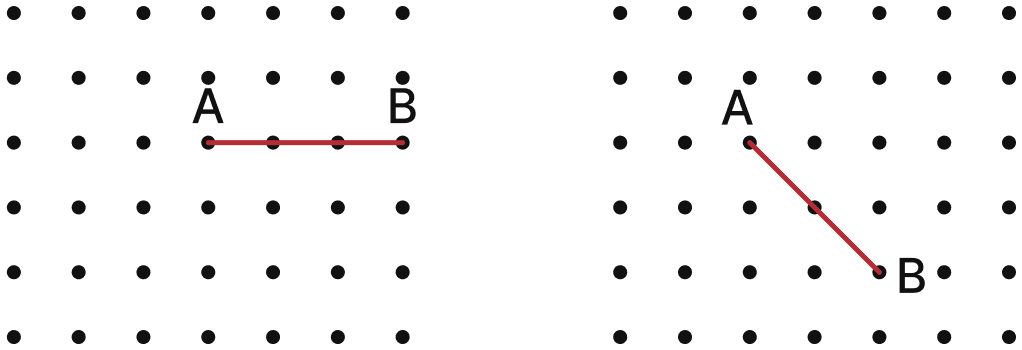
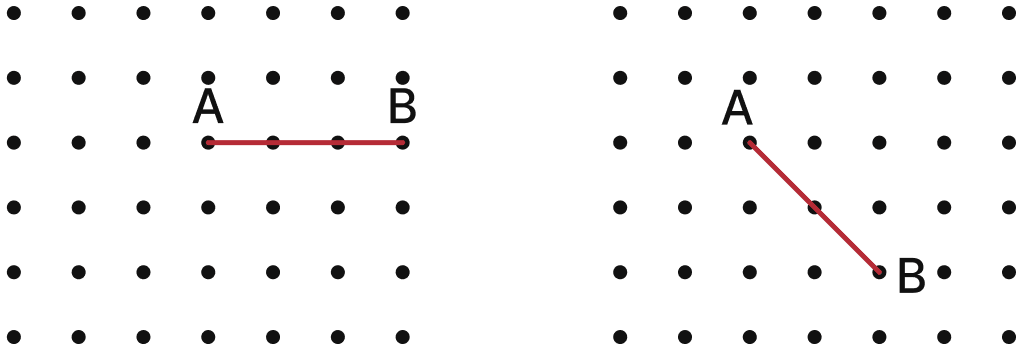
Join A to other grid points in the figure by a straight line to get a straight angle. What are all the different ways of doing it?
Answer
A straight angle measures 180°.
So, if AB is the line already drawn, then the new line AC must be drawn in exactly the opposite direction to AB, so that C, A and B lie on one straight line.
In other words, C must lie on AB extended beyond A.
First figure
Here A and B lie on the same horizontal row, with B to the right of A.
So, the required grid points are the ones lying on this same horizontal row but to the left of A.
There are 3 such grid points on the left of A.
∴ Number of ways = 3
Second figure
Here B is reached from A by moving 1 step to the right and 1 step down each time.
So, the required grid points are the ones reached from A by moving 1 step to the left and 1 step up each time.
There are 2 such grid points.
∴ Number of ways = 2
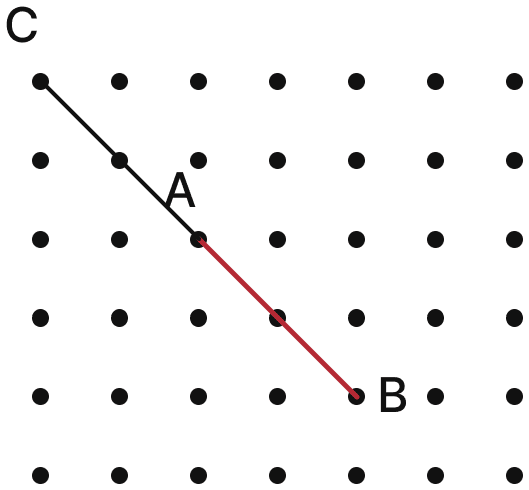
Hence, a straight angle can be formed in 3 different ways in the first figure and in 2 different ways in the second figure.
Now join A to other grid points in the figure by a straight line to get a right angle. What are all the different ways of doing it?
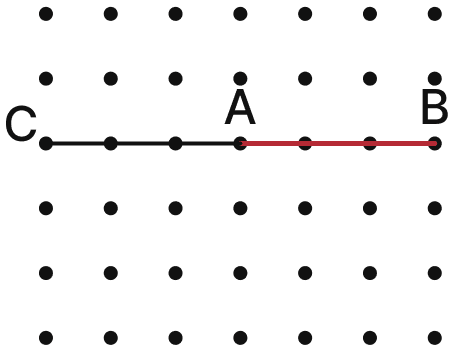
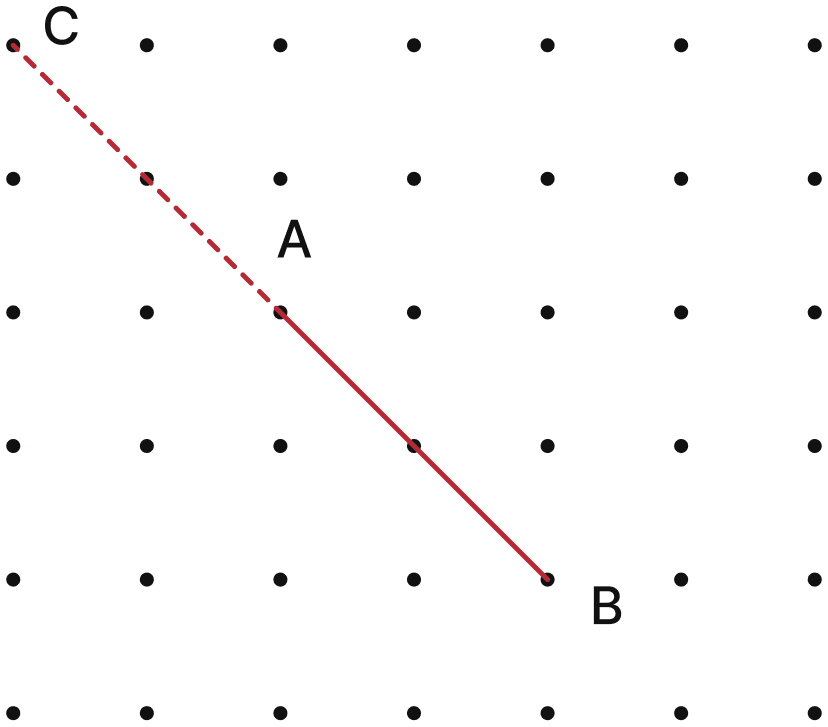
Hint: Extend the line further as shown in the figure below. To get a right angle at A, we need to draw a line through it that divides the straight angle CAB into two equal parts.
Answer
A right angle measures 90°.
As given in the hint, if the line BA is extended to C, then ∠CAB is a straight angle of 180°.
A line drawn through A that divides this straight angle into two equal parts gives
So, the required line through A must be perpendicular to AB.
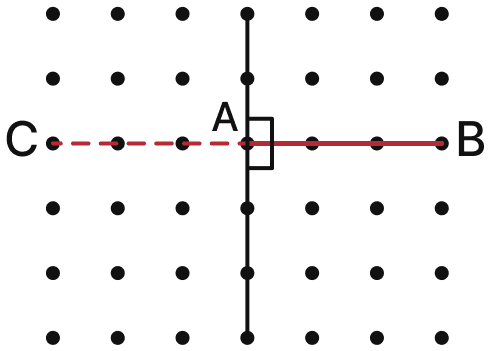
First figure
Here AB is horizontal, so the perpendicular through A is the vertical line passing through A.
Grid points above A on this vertical line = 2
Grid points below A on this vertical line = 3
∴ Number of ways = 2 + 3 = 5
Second figure
Here AB slopes 1 step right and 1 step down. So, the perpendicular through A slopes 1 step right and 1 step up (and, in the opposite direction, 1 step left and 1 step down).
Grid points along the right-and-up direction = 2
Grid points along the left-and-down direction = 2
∴ Number of ways = 2 + 2 = 4
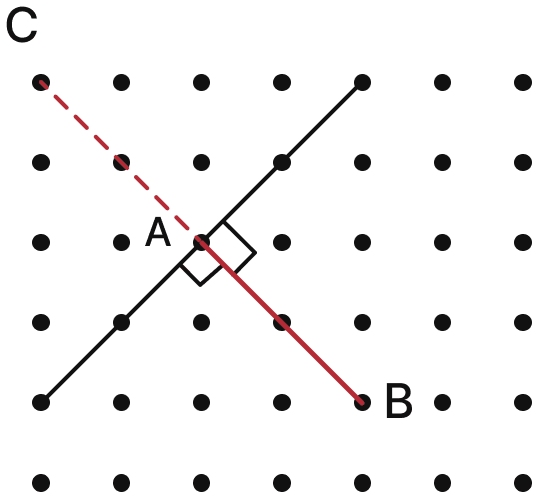
Hence, a right angle can be formed in 5 different ways in the first figure and in 4 different ways in the second figure.
Get a slanting crease on the paper. Now, try to get another crease that is perpendicular to the slanting crease.
(a) How many right angles do you have now? Justify why the angles are exact right angles.
(b) Describe how you folded the paper so that any other person who doesn't know the process can simply follow your description to get the right angle.
Answer
(a)
The two creases cross each other and form 4 angles around the point of crossing.
The complete angle around a point is 360°, and the second crease is folded so that all four of these angles are equal.
∴ Each angle =
Each angle is one-quarter of a complete angle, so each one is an exact right angle.
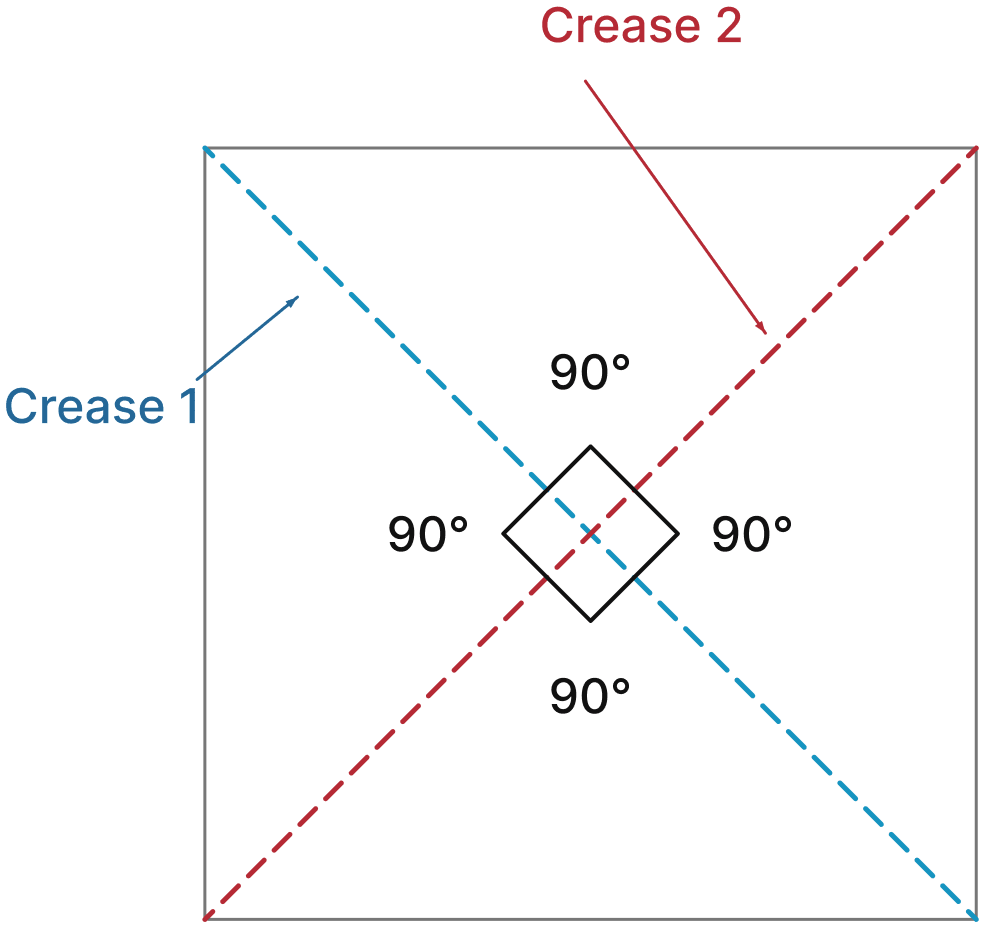
Hence, there are 4 right angles, and each is exact because each is of the complete angle of 360°.
(b)
The paper may be folded as follows :
Step 1 : Fold the sheet of paper once in any slanting direction and press it flat. Open it out. The mark left behind is the slanting crease.
Step 2 : Now fold the paper a second time, but this time bring one half of the slanting crease exactly on top of the other half of the same crease.
Step 3 : Press the paper flat while the two halves of the slanting crease lie one over the other, and then open the paper out.
The second crease so formed is perpendicular to the slanting crease, and the two creases together make 4 right angles.
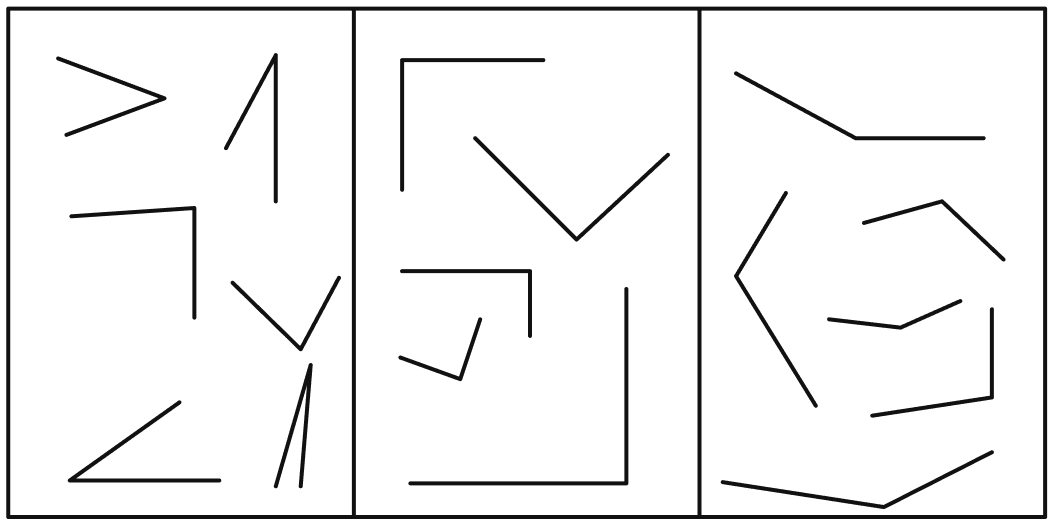
Identify acute, right, obtuse and straight angles in the previous figures.
Answer
The angles in the previous figures are classified by comparing each of them with a right angle :
An angle that is less than a right angle is an acute angle. All the angles shown in the first group are acute angles.
An angle that is exactly equal to 90° is a right angle. All the angles shown in the second group are right angles.
An angle that is greater than a right angle but less than a straight angle is an obtuse angle. All the angles shown in the third group are obtuse angles.
Make a few acute angles and a few obtuse angles. Draw them in different orientations.
Answer
An angle that is less than a right angle is an acute angle.
An angle that is greater than a right angle but less than a straight angle is an obtuse angle.
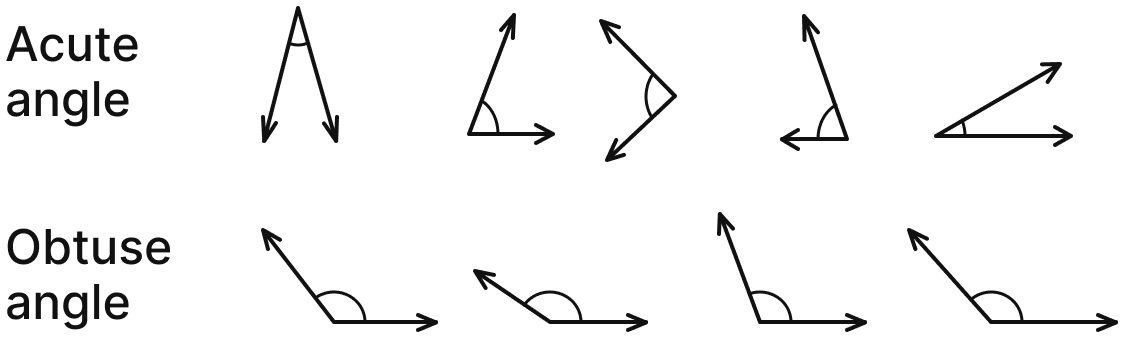
Do you know what the words acute and obtuse mean? Acute means sharp and obtuse means blunt. Why do you think these words have been chosen?
Answer
In an acute angle, the two arms are close to each other, so the opening between them is small.
This makes the corner at the vertex look narrow and pointed, just like the tip of a needle or a pin. Such a tip is described as sharp.
In an obtuse angle, the two arms are turned much further apart, so the opening between them is large.
This makes the corner at the vertex look wide and flat, not pointed at all. Such a corner is described as blunt.
Hence, the word acute (sharp) is used for angles with a small opening and the word obtuse (blunt) is used for angles with a large opening.
Find out the number of acute angles in each of the figures below.
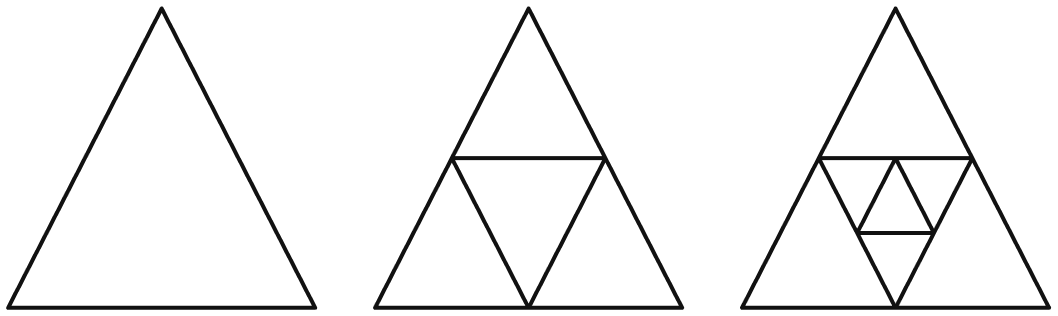
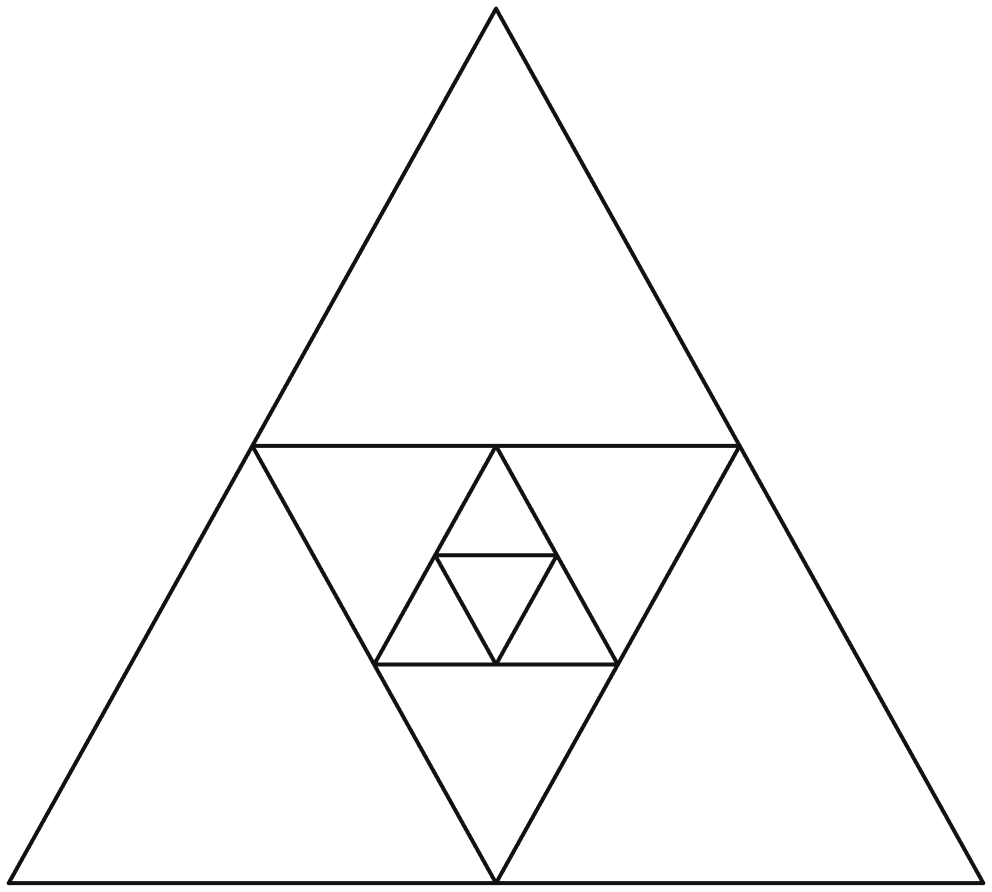
What will be the next figure and how many acute angles will it have? Do you notice any pattern in the numbers?
Answer
In each figure, every smallest triangle is an equilateral triangle, and each of its three angles measures 60°.
Since 60° is less than 90°, all three angles of every smallest triangle are acute angles.
So, in each figure :
Number of acute angles = 3 x (Number of smallest triangles)
First figure
There is no inner triangle drawn, so there is only 1 triangle.
∴ Number of acute angles = 3 × 1 = 3
Second figure
One inner triangle is drawn, which divides the figure into 4 smallest triangles.
∴ Number of acute angles = 3 × 4 = 12
Third figure
Two inner triangles are drawn, which divide the figure into 7 smallest triangles.
∴ Number of acute angles = 3 × 7 = 21
The next figure
The next figure is obtained by drawing one more inner triangle, that is, by joining the mid-points of the sides of the innermost inverted triangle of the third figure.
It will have 3 inner triangles, which divide the figure into 10 smallest triangles.
∴ Number of acute angles = 3 × 10 = 30
The pattern
If a figure has n inner triangles, then :
Number of smallest triangles = 3n + 1
∴ Number of acute angles = 3(3n + 1)
Putting n = 0, 1, 2, 3, … gives the numbers 3, 12, 21, 30, …
Each number is 9 more than the number before it, because every new inner triangle adds 3 more smallest triangles and hence 3 × 3 = 9 more acute angles.
Hence, the three figures have 3, 12 and 21 acute angles, the next figure will have 30 acute angles, and the numbers 3, 12, 21, 30, … increase by 9 each time.
The circle has been divided into 1, 2, 3, 4, 5, 6, 8, 9 10 and 12 parts below. What are the degree measures of the resulting angles? Write the degree measures down near the indicated angles.
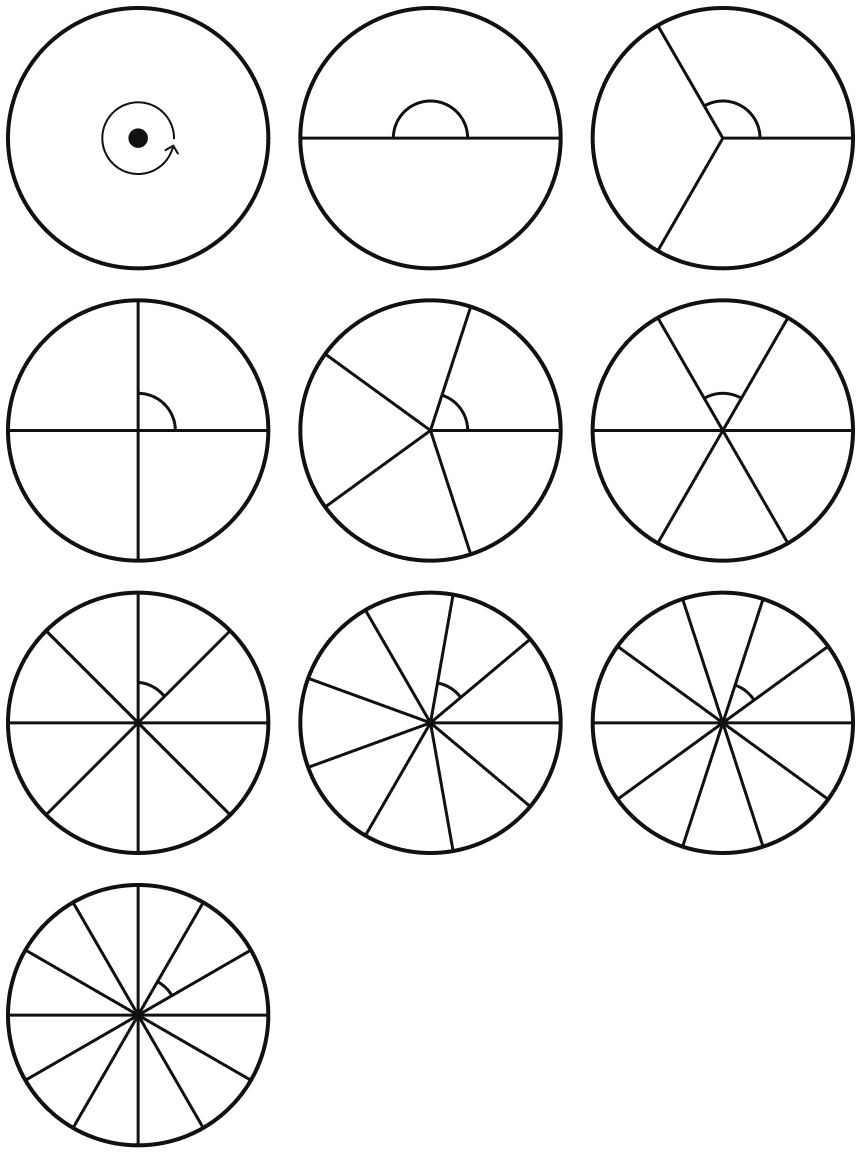
Answer
The angle at the centre of a circle is one full turn, which measures 360°.
When this angle is divided into equal parts, the measure of each part is obtained by dividing 360° by the number of parts.
Measure of each part =
Divided into 1 part :
Divided into 2 parts :
Divided into 3 parts :
Divided into 4 parts :
Divided into 5 parts :
Divided into 6 parts :
Divided into 8 parts :
Divided into 9 parts :
Divided into 10 parts :
Divided into 12 parts :
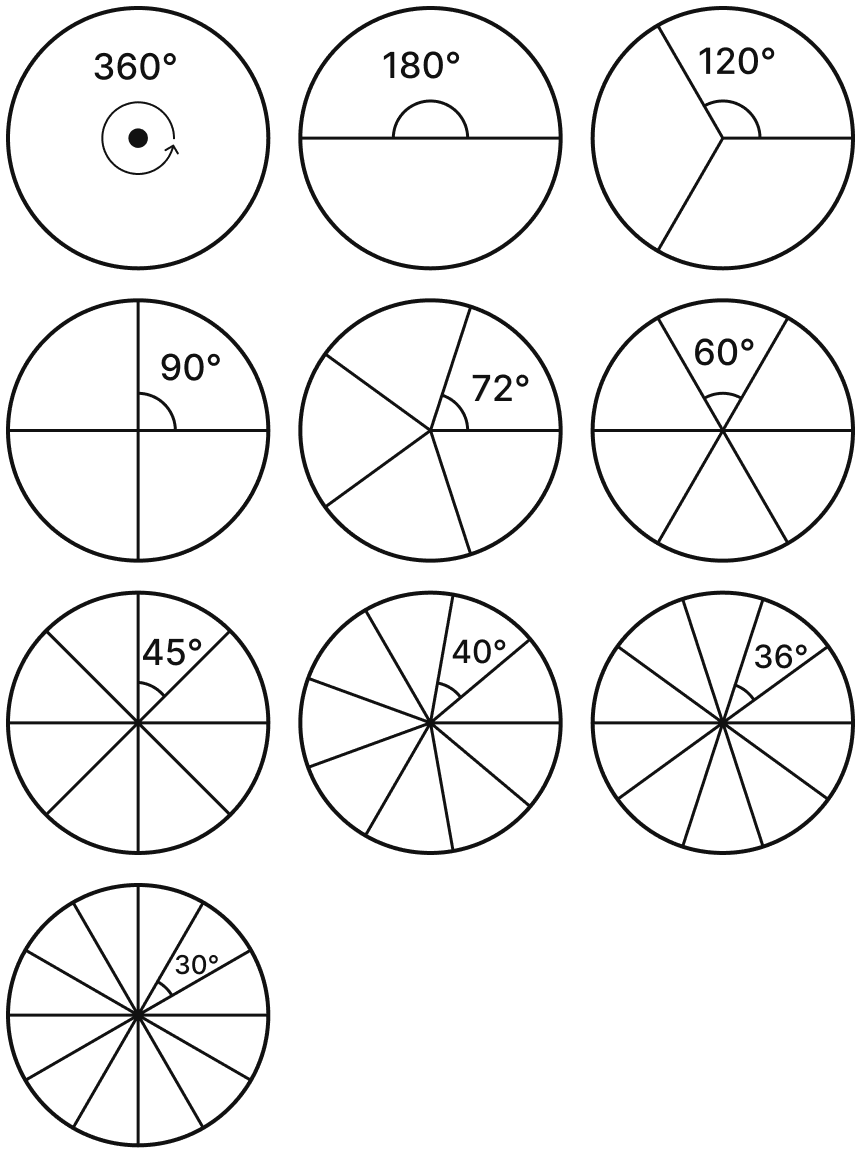
Hence, the degree measures of the resulting angles are 360°, 180°, 120°, 90°, 72°, 60°, 45°, 40°, 36° and 30° respectively.
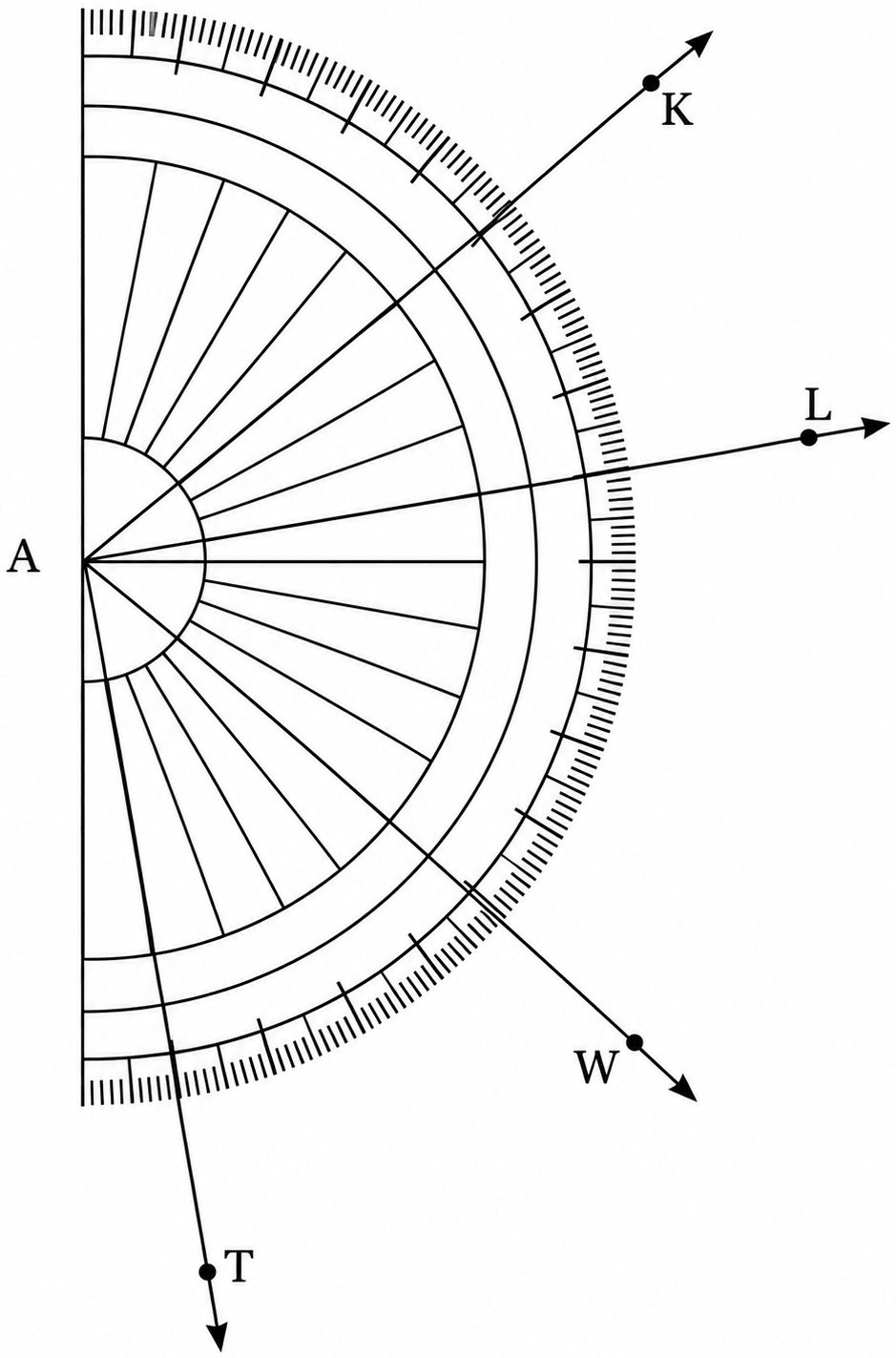
Write the measures of the following angles:
(a) ∠KAL
Notice that the vertex of this angle coincides with the centre of the protractor. So the number of units of 1 degree angle between KA and AL gives the measure of ∠KAL.
By counting, we get—
∠KAL = 30°
Making use of the medium sized and large sized marks, is it possible to count the number of units in 5s or 10s?
(b) ∠WAL
(c) ∠TAK
Answer
The vertex A of each of these angles lies at the centre of the protractor.
So, the measure of an angle is simply the number of 1° units contained between its two arms.
Counting from the mark at one end of the straight edge of the protractor, the arms are found at :
AK → 50 units
AL → 80 units
AW → 130 units
AT → 170 units
The number of units between two arms is then found by subtraction.
(a) ∠KAL
∠KAL = 80° - 50°
∴ ∠KAL = 30°
(b) ∠WAL
∠WAL = 130° - 80°
∴ ∠WAL = 50°
(c) ∠TAK
∠TAK = 170° - 50°
∴ ∠TAK = 120°
Counting in 5s or 10s
Yes, it is possible.
On the protractor, there is a large sized mark after every 10 units and a medium sized mark exactly halfway between two large sized marks, that is, after every 5 units.
So, instead of counting the 1° units one by one, we may count the large marks in 10s and the medium marks in 5s.
For example, from AK to AL there are 3 large sized marks, which gives 3 × 10 = 30 units, so ∠KAL = 30°.
Hence, the large sized marks let us count in 10s and the medium sized marks let us count in 5s, which makes the counting much quicker.
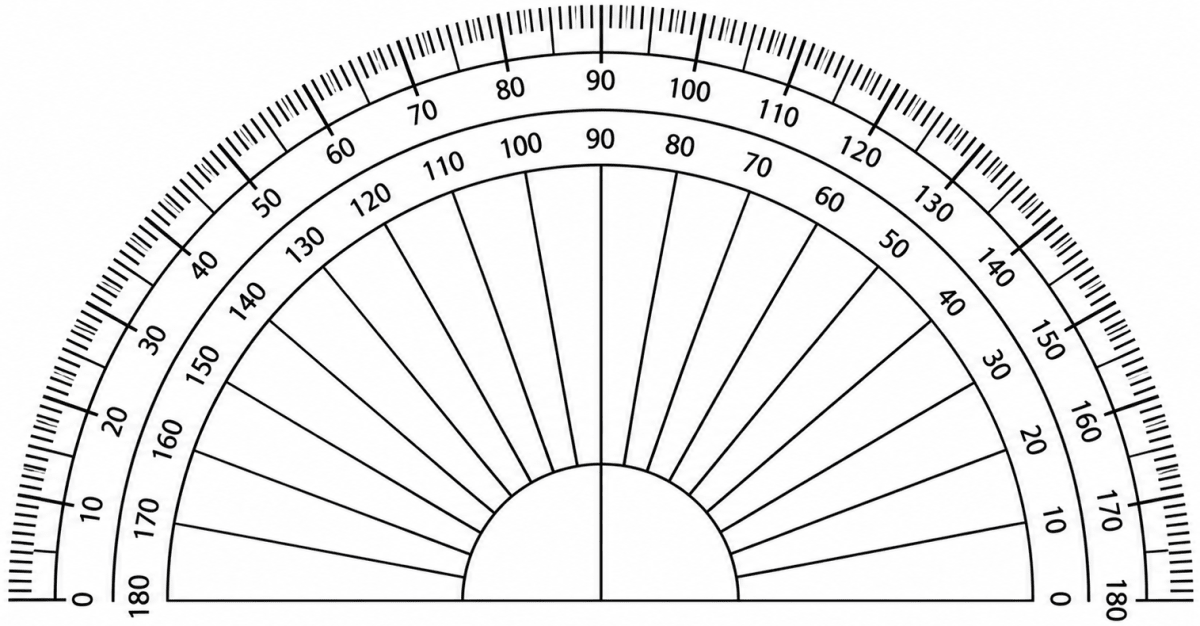
There are two sets of numbers on the protractor: one increasing from right to left and the other increasing from left to right. Why does it include two sets of numbers?
Answer
A protractor is a half circle whose straight angle of 180° has been divided into 180 equal parts of 1° each.
While measuring an angle, the centre of the protractor is placed on the vertex and one arm of the angle is aligned with the 0° mark.
This arm may lie either to the right of the vertex or to the left of the vertex.
If the arm lies to the right, the counting of degrees has to start from the right and move towards the left. For this, the set of numbers increasing from right to left is used.
If the arm lies to the left, the counting of degrees has to start from the left and move towards the right. For this, the set of numbers increasing from left to right is used.
∴ Two sets of numbers are marked so that an angle can be read directly, whichever way it is placed, without having to subtract or to turn the protractor around.
Hence, the two sets of numbers allow the angle to be measured directly from either side of the protractor.
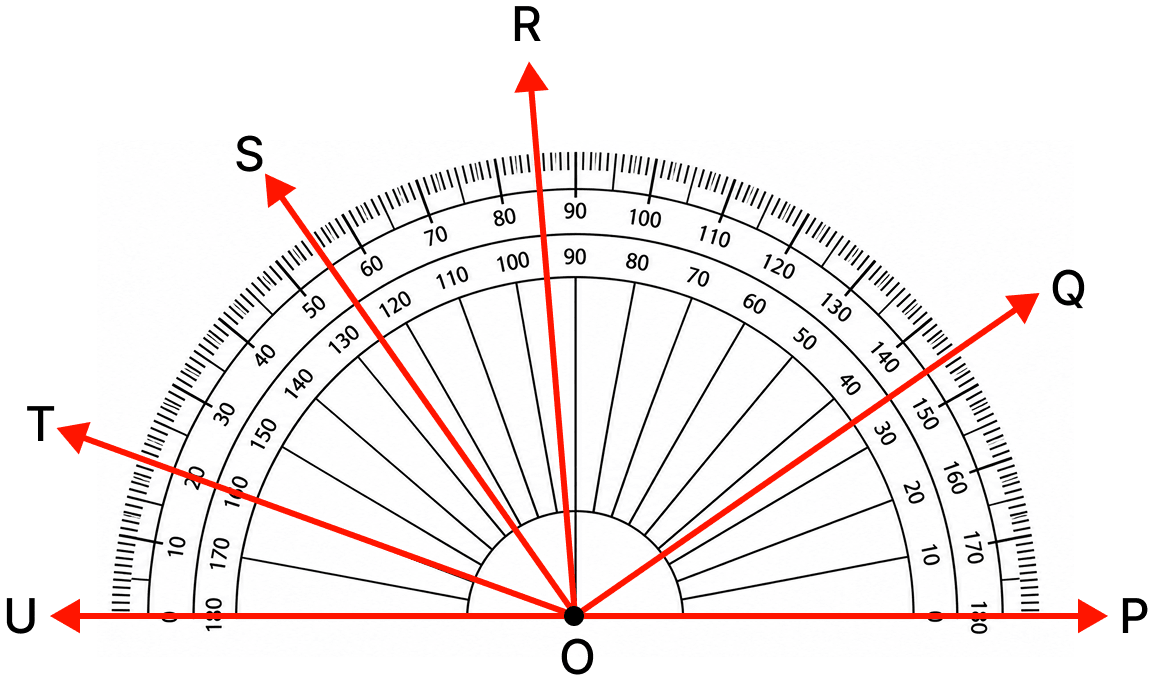
Name the different angles in the figure and write their measures.
Answer
The rays OP, OQ, OR, OS, OT and OU start from the common vertex O. Taking the rays two at a time, the angles formed and their measures are:
∠POQ = 35°
∠POR = 95°
∠POS = 125°
∠POT = 160°
∠QOR = 60°
∠QOS = 90°
∠QOT = 125°
∠QOU = 145°
∠ROS = 30°
∠ROT = 65°
∠ROU = 85°
∠SOT = 35°
∠SOU = 55°
∠TOU = 20°
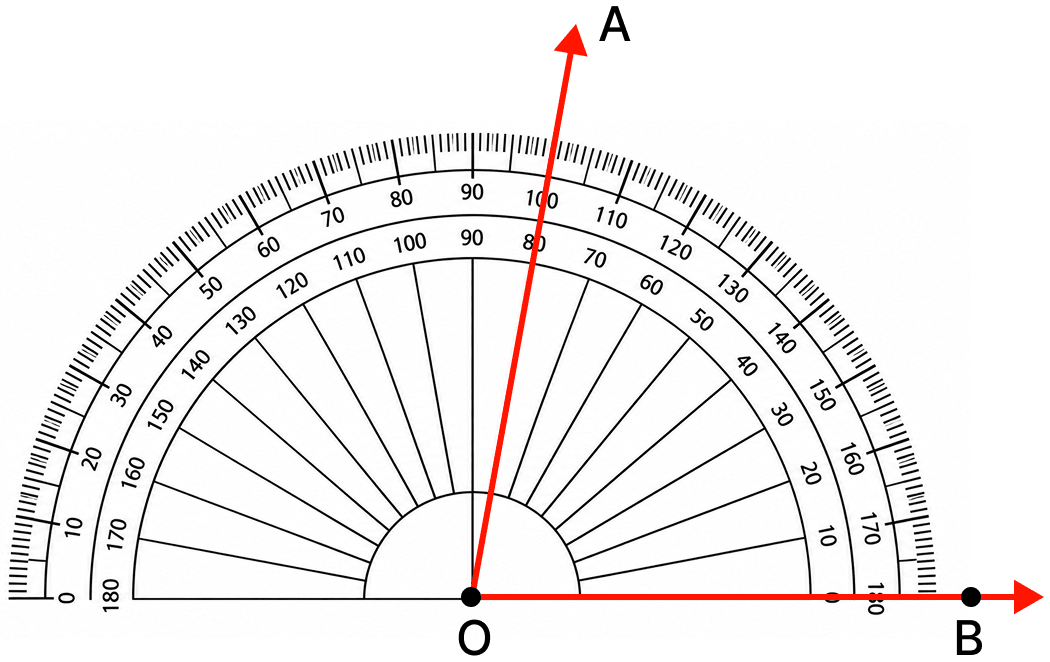
What is the degree measure of ∠AOB?
Answer
The centre of the protractor is placed on the vertex O and the arm OB is aligned with the 0° mark on the right.
The other arm OA passes through the mark 80 on the scale that increases from right to left.
∴ ∠AOB = 80°
Since 80° is less than 90°, ∠AOB is an acute angle.
Hence, the degree measure of ∠AOB is 80°.
In Fig. 2.19, we have ∠AOB = ∠BOC = ∠COD = ∠DOE = ∠EOF = ∠FOG = ∠GOH = ∠HOI = .......... . Why?
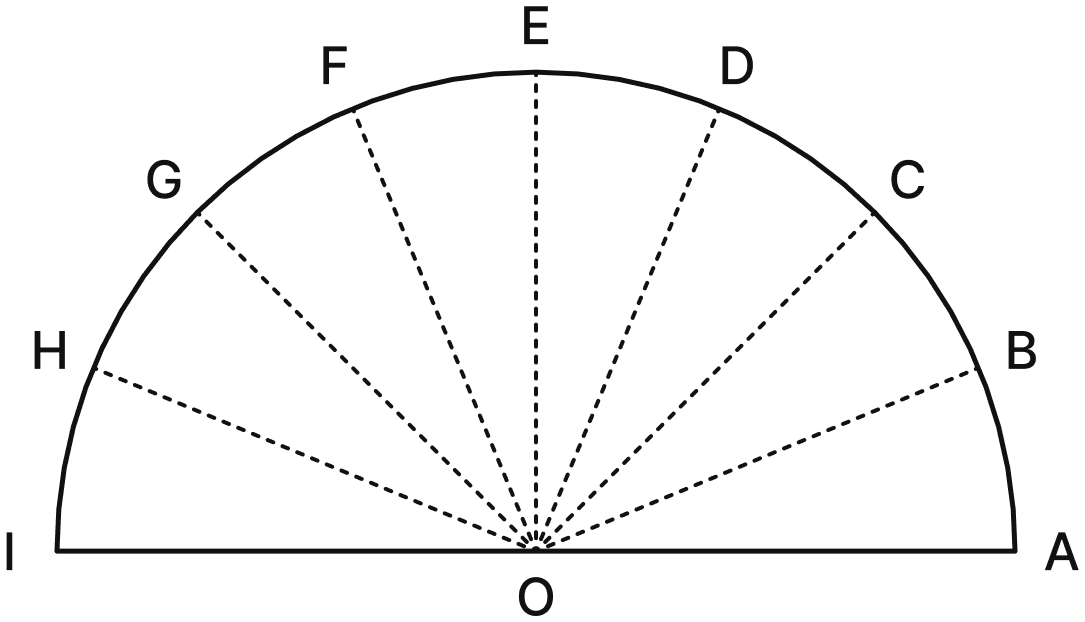
Answer
In the above figure, OA and OI are opposite rays, so ∠AOI is a straight angle.
∴ ∠AOI = 180°
The paper protractor was made by folding the semicircle in half again and again. Each fold bisects the angle, that is, it divides the angle into two equal parts.
The first fold gave 2 equal parts, the second fold gave 4 equal parts and the third fold gave 8 equal parts.
So the creases OB, OC, OD, OE, OF, OG and OH divide the straight angle ∠AOI into 8 equal angles.
∴ Each angle = = 22.5°
Hence, ∠AOB = ∠BOC = ∠COD = ∠DOE = ∠EOF = ∠FOG = ∠GOH = ∠HOI = 22.5°, because the straight angle of 180° has been divided by repeated bisection into 8 equal parts.
Find the degree measures of the following angles using your protractor.
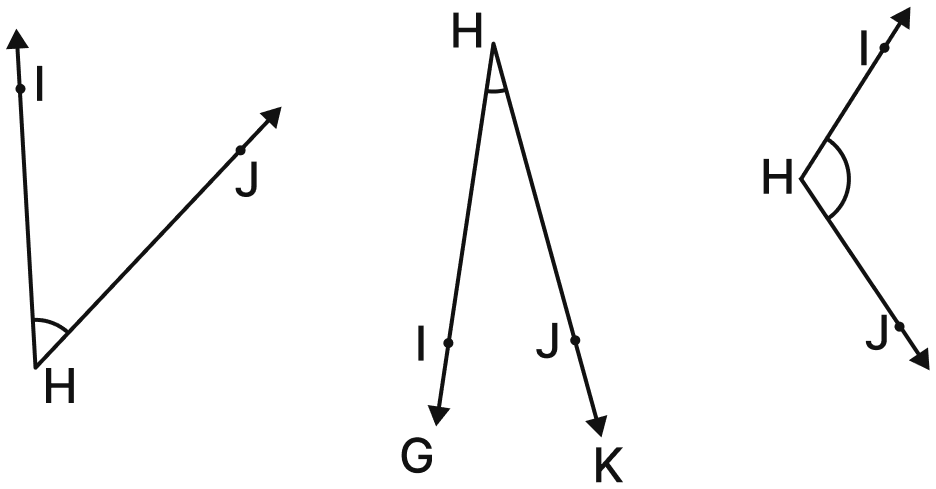
Answer
In each figure the centre of the protractor is placed on the vertex H and one arm is aligned with the 0° mark. The reading of the second arm gives the measure of the angle.
(i) The arms of the angle are HI and HJ.
∴ ∠IHJ = 47°
(ii) The arms of the angle are HG and HK, on which the points I and J lie.
∴ ∠GHK = ∠IHJ = 23°
(iii) The arms of the angle are HI and HJ.
∴ ∠IHJ = 108°
Find the degree measures for the angles given below. Check if your paper protractor can be used here!
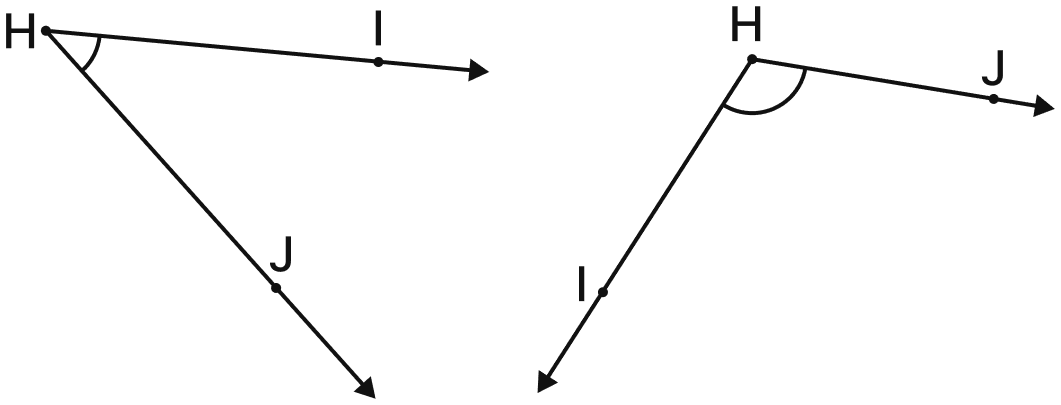
Answer
(i) The arms of the angle are HI and HJ.
∴ ∠IHJ = 42°
(ii) The arms of the angle are HI and HJ.
∴ ∠IHJ = 116°
The paper protractor made by folding carries only the marks 0°, 22.5°, 45°, 67.5°, 90°, 112.5°, 135°, 157.5° and 180°. It does not have markings for every 1°.
The angles here measure 42° and 116°, and neither of these is one of the marked measures.
Hence, the paper protractor cannot be used here; a standard protractor marked in degrees is needed.
How can you find the degree measure of the angle given below using a protractor?
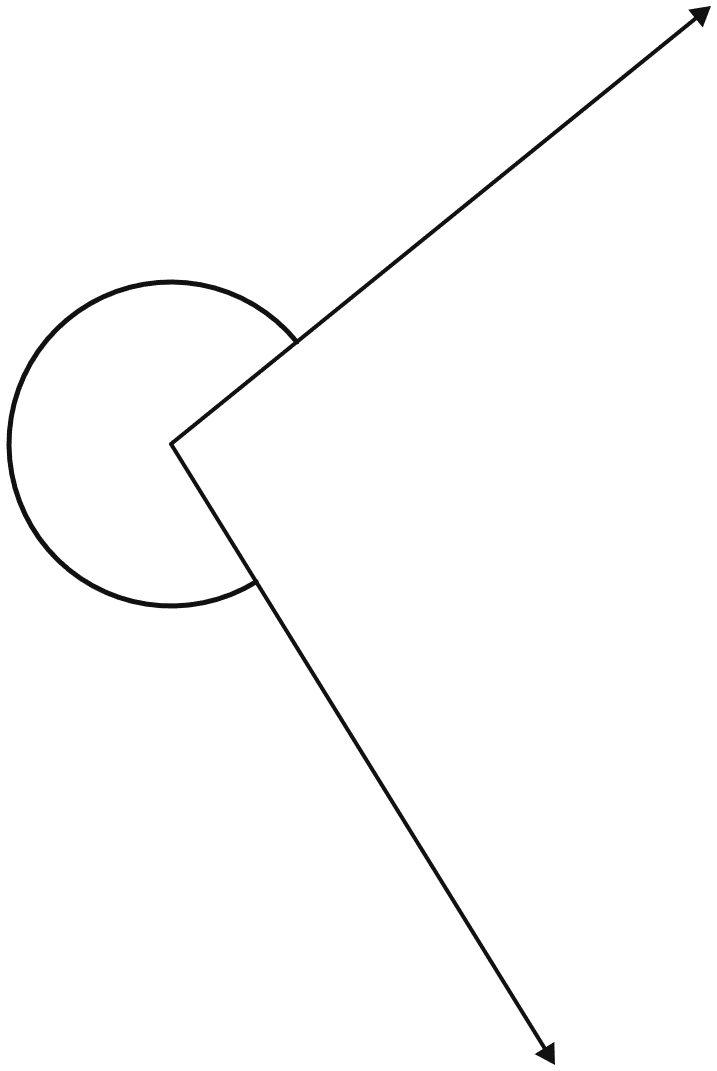
Answer
The angle marked in the figure is a reflex angle. A protractor can measure only up to 180°, so a reflex angle cannot be read directly.
The two arms of the angle also form an unmarked angle on the other side, and the marked angle together with the unmarked angle makes one complete turn.
So the unmarked angle is measured first with the protractor, and it is then subtracted from 360°.
Measure of the unmarked angle = 100°
∴ Measure of the marked angle = 360° − 100° = 260°
Hence, the degree measure of the marked angle is 260°.
Measure and write the degree measures for each of the following angles:
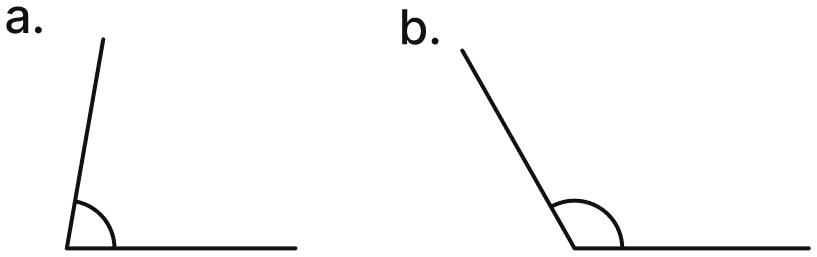
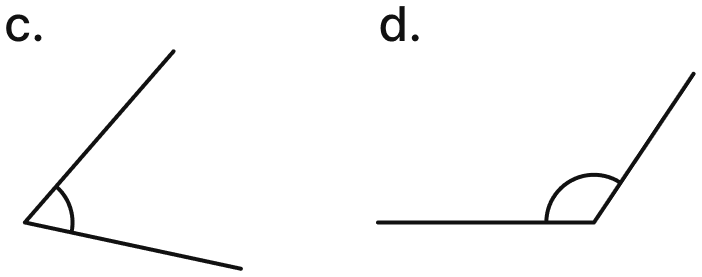
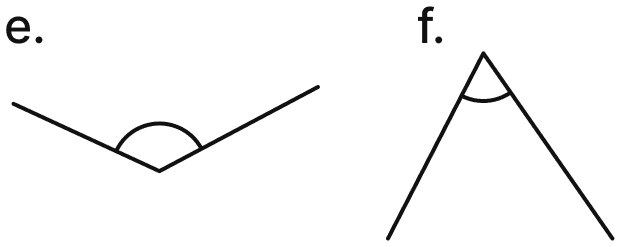
Answer
The centre of the protractor is placed on the vertex of each angle and one arm is aligned with the 0° mark. The reading of the other arm gives the measure of the angle.
(a) 80°
(b) 120°
(c) 60°
(d) 130°
(e) 130°
(f) 60°
Find the degree measures of ∠BXE, ∠CXE, ∠AXB and ∠BXC.
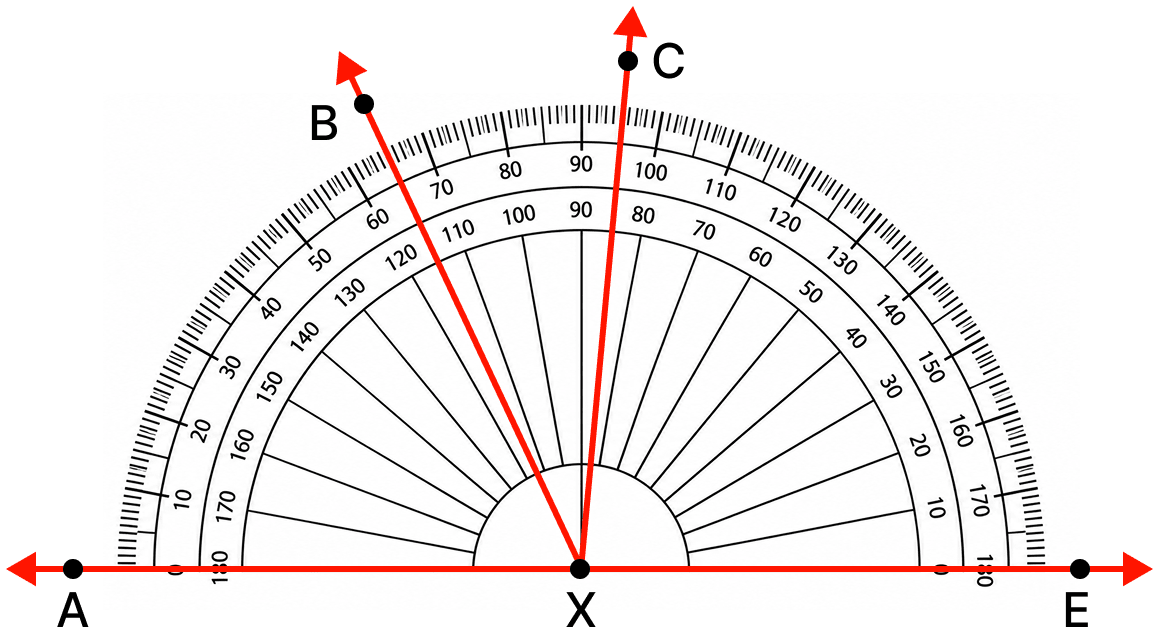
Answer
In the figure, A, X and E lie on a straight line, so XA and XE are opposite rays.
∴ ∠AXE = 180°
The centre of the protractor is placed on the vertex X and the arm XE is aligned with the 0° mark on the right.
∠BXE
The arm XB passes through the mark 115 on the scale that begins at XE.
∴ ∠BXE = 115°
∠CXE
The arm XC passes through the mark 85 on the same scale.
∴ ∠CXE = 85°
∠AXB
∠AXB and ∠BXE together form the straight angle ∠AXE.
∴ ∠AXB = 180° − ∠BXE
⇒ ∠AXB = 180° − 115° = 65°
∴ ∠AXB = 65°
∠BXC
The ray XC lies between the rays XB and XE.
∴ ∠BXC = ∠BXE − ∠CXE
⇒ ∠BXC = 115° − 85° = 30°
∴ ∠BXC = 30°
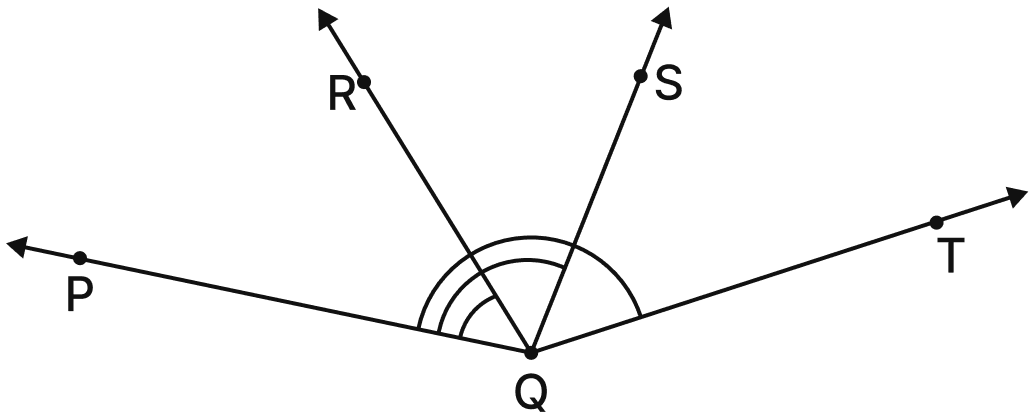
Find the degree measures of ∠PQR, ∠PQS and ∠PQT.
Answer
The three angles ∠PQR, ∠PQS and ∠PQT are all measured from the same arm QP.
Place the centre of the protractor at the vertex Q and align the arm QP with the 0° line. Then read off the mark at which each of the arms QR, QS and QT crosses the scale.
∠PQR
The arm QR crosses the scale at the 45° mark.
∴ ∠PQR = 45°
∠PQS
The arm QS crosses the scale at the 100° mark.
∴ ∠PQS = 100°
∠PQT
The arm QT crosses the scale at the 150° mark.
∴ ∠PQT = 150°
Hence, ∠PQR = 45°, ∠PQS = 100° and ∠PQT = 150°.
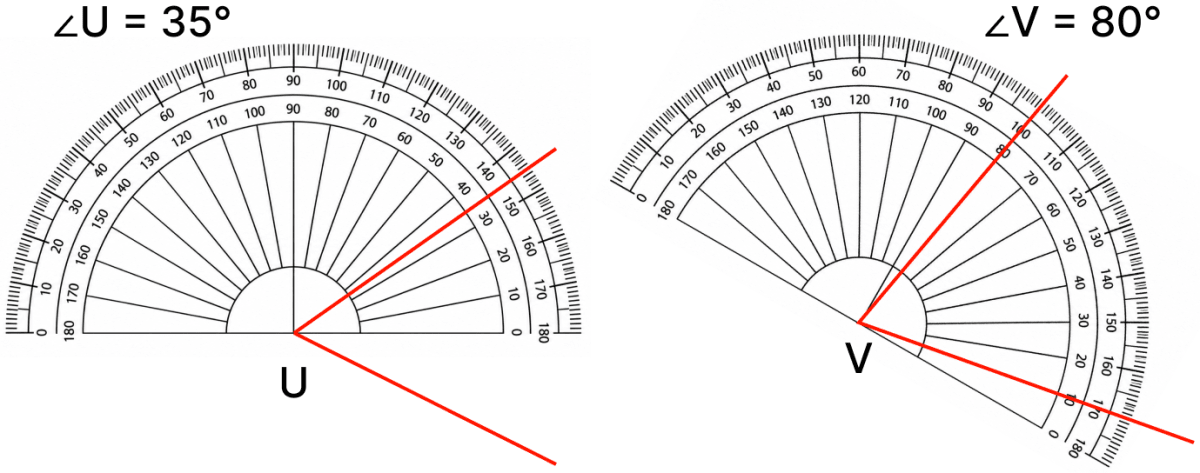
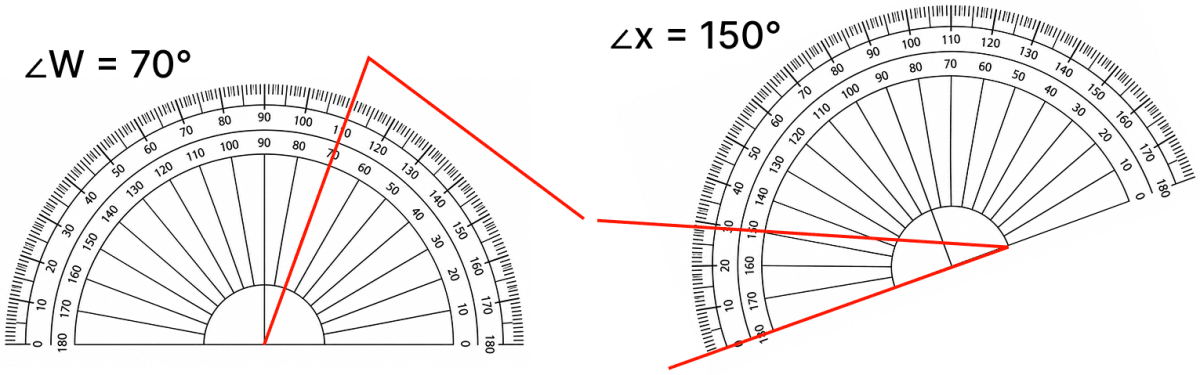
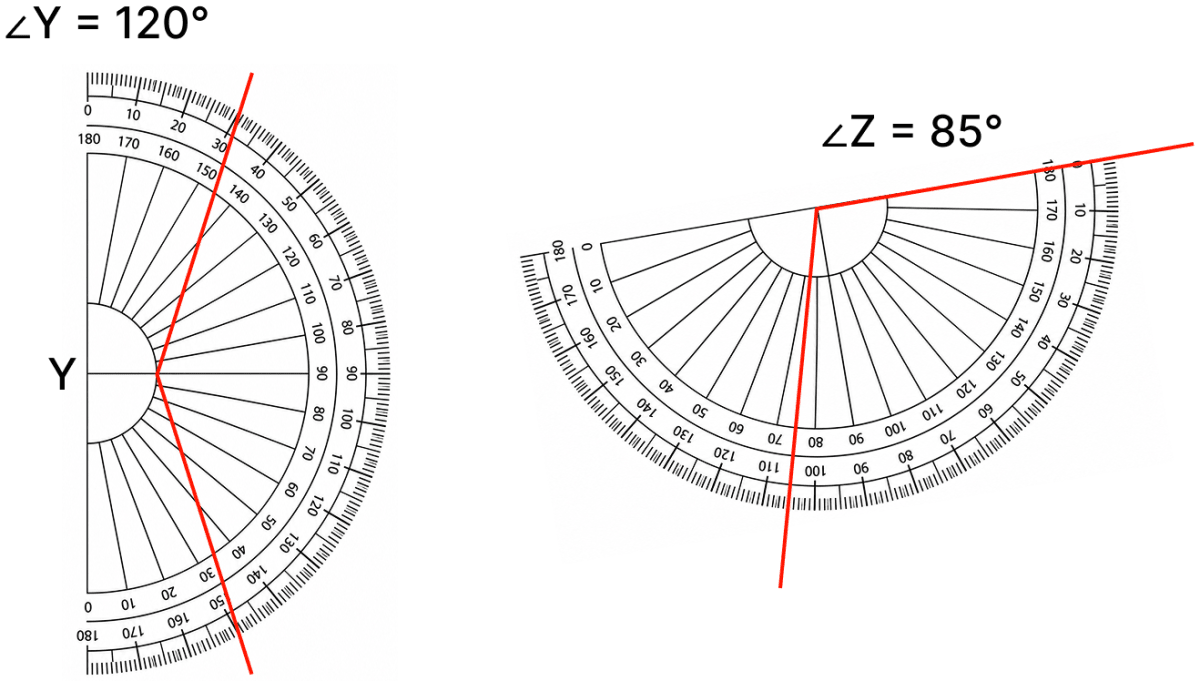
A student used a protractor to measure the angles as shown below. In each figure, identify the incorrect usage(s) of the protractor and discuss how the reading could have been made and think how it can be corrected.
Answer
The following rules must be followed while measuring an angle with a protractor:
- Place the centre mark of the protractor exactly on the vertex of the angle.
- Align one arm of the angle with the 0° line of the protractor.
- Read the scale that starts from 0° on the aligned arm.
- If the protractor is tilted, shifted or placed away from the vertex, reposition it before taking the reading.
In the figures for ∠U, ∠V, ∠W, ∠X, ∠Y and ∠Z, one or more of these conditions have not been followed. Therefore, the written readings should not be accepted directly. The protractor should first be centred and aligned correctly, and only then should the angle be read from the correct scale.
Where are the angles?
Angles in a clock:
(a) The hands of a clock make different angles at different times. At 1 o'clock, the angle between the hands is 30°. Why?
(b) What will be the angle at 2 o'clock? And at 4 o'clock? 6 o'clock?
(c) Explore other angles made by the hands of a clock.
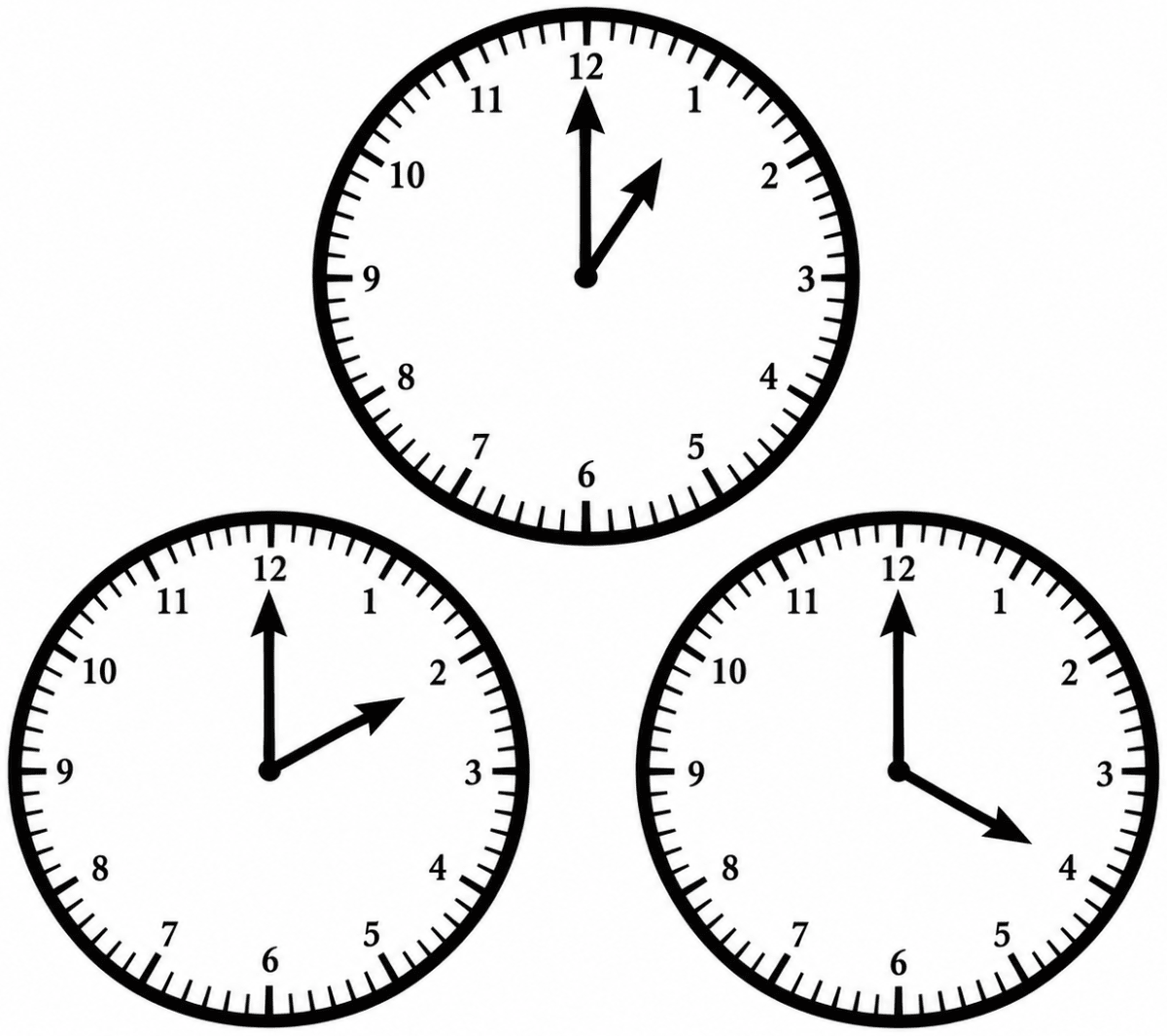
Answer
(a) The dial of a clock is a complete circle, so a full turn round the dial is 360°. This circle is divided into 12 equal hour marks. Therefore, the angle in one hour gap is:
At 1 o'clock the minute hand points at 12 and the hour hand points at 1, so there is exactly one hour gap between them.
∴ Angle at 1 o'clock = 1 × 30° = 30°
Hence, the angle between the hands at 1 o'clock is 30°.
(b) At 2 o'clock
The hands are 2 hour gaps apart (from 12 to 2).
∴ Angle = 2 × 30° = 60°
At 4 o'clock
The hands are 4 hour gaps apart (from 12 to 4).
∴ Angle = 4 × 30° = 120°
At 6 o'clock
The hands are 6 hour gaps apart (from 12 to 6).
∴ Angle = 6 × 30° = 180°
Hence, the angles are 60°, 120° and 180° respectively.
(c) Counting the hour gaps on the shorter side and multiplying by 30° gives the angle at every full hour:
| Time | Hour gaps | Angle |
|---|---|---|
| 12 o'clock | 0 | 0° |
| 1 o'clock | 1 | 30° |
| 2 o'clock | 2 | 60° |
| 3 o'clock | 3 | 90° |
| 4 o'clock | 4 | 120° |
| 5 o'clock | 5 | 150° |
| 6 o'clock | 6 | 180° |
| 7 o'clock | 5 | 150° |
| 8 o'clock | 4 | 120° |
| 9 o'clock | 3 | 90° |
| 10 o'clock | 2 | 60° |
| 11 o'clock | 1 | 30° |
At 3 o'clock and at 9 o'clock the hands make a right angle, at 6 o'clock they make a straight angle, and the reflex angle at any time is obtained by subtracting the above angle from 360°.
Hence, at every full hour the angle between the hands is a multiple of 30°.
The angle of a door:
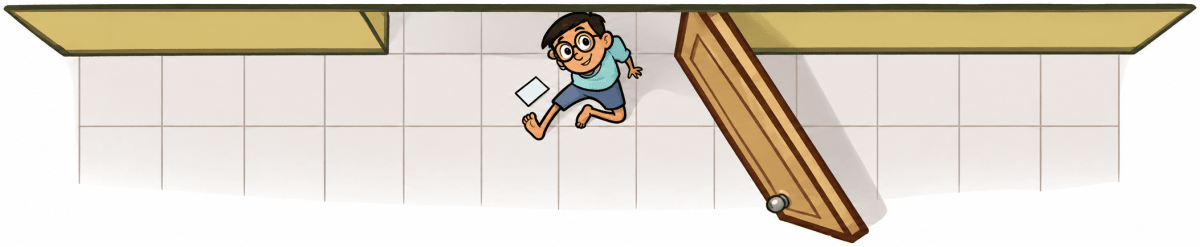
Is it possible to express the amount by which a door is opened using an angle? What will be the vertex of the angle and what will be the arms of the angle?
Answer
Yes, the amount by which a door is opened can be expressed as an angle.
A door turns about its hinges. The hinged edge stays fixed while the free edge of the door sweeps out a turn, and the amount of this turn is exactly what an angle measures.
Vertex: the hinged edge of the door, that is, the point where the door is joined to the door frame.
Arms: one arm is the door frame (the position of the closed door) and the other arm is the door in its opened position.
As the door is opened wider, the angle between these two arms becomes larger.
Hence, the opening of a door is an angle whose vertex is the hinge, with the door frame and the open door as its two arms.
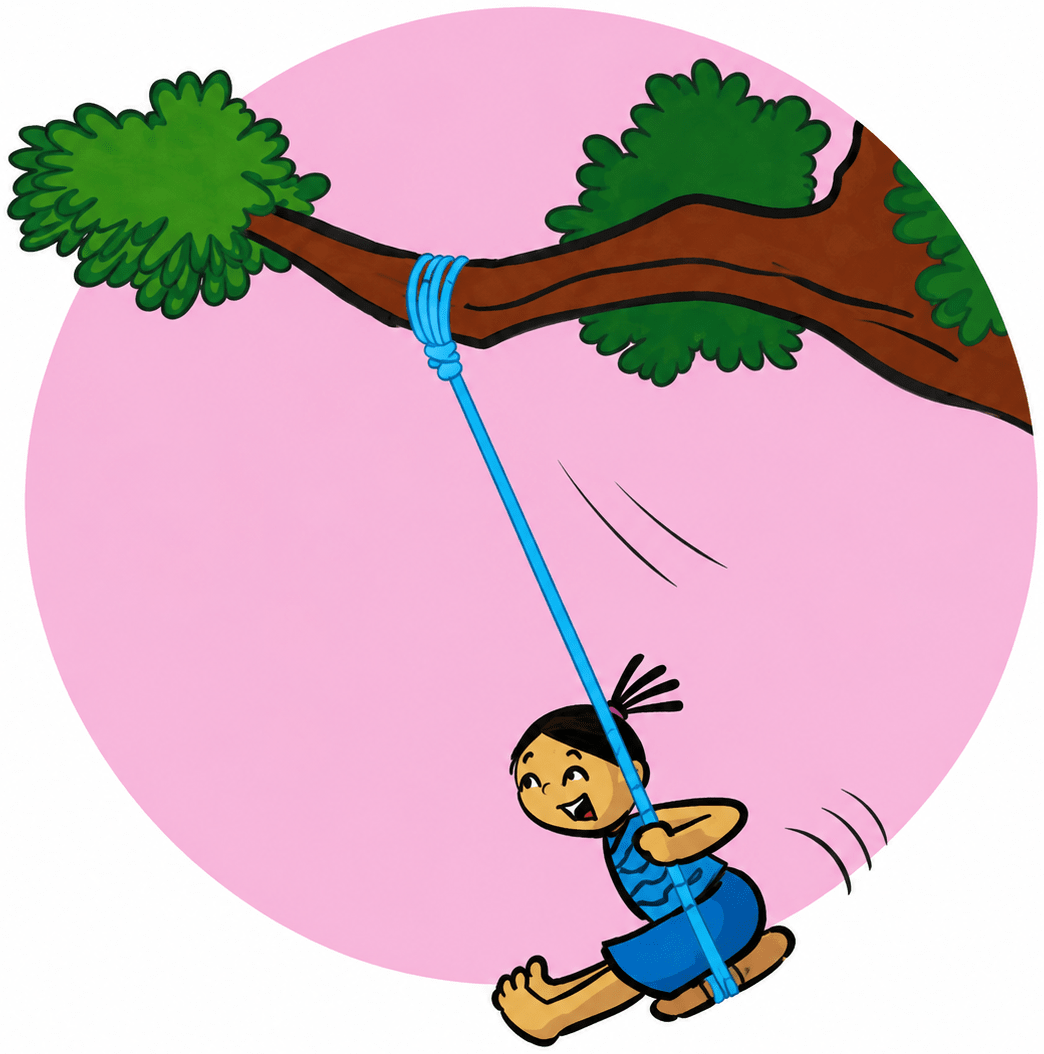
Vidya is enjoying her time on the swing. She notices that the greater the angle with which she starts the swinging, the greater is the speed she achieves on her swing. But where is the angle? Are you able to see any angle?
Answer
Yes, there is an angle, although only one of its arms can actually be seen.
The swing turns about the point where its ropes are tied to the top bar. When Vidya is pulled back before starting, the rope moves away from its resting position, and the turn made by the rope is the angle.
Vertex: the point at which the ropes of the swing are fixed to the horizontal bar.
Arms: one arm is the rope in its vertical resting position (this is an imaginary arm) and the other arm is the rope in the pulled back position (this is the visible arm).
The further back the swing is pulled, the greater this angle and hence the greater the speed achieved.
Hence, the starting position of the swing makes an angle at the point where the swing is hung.
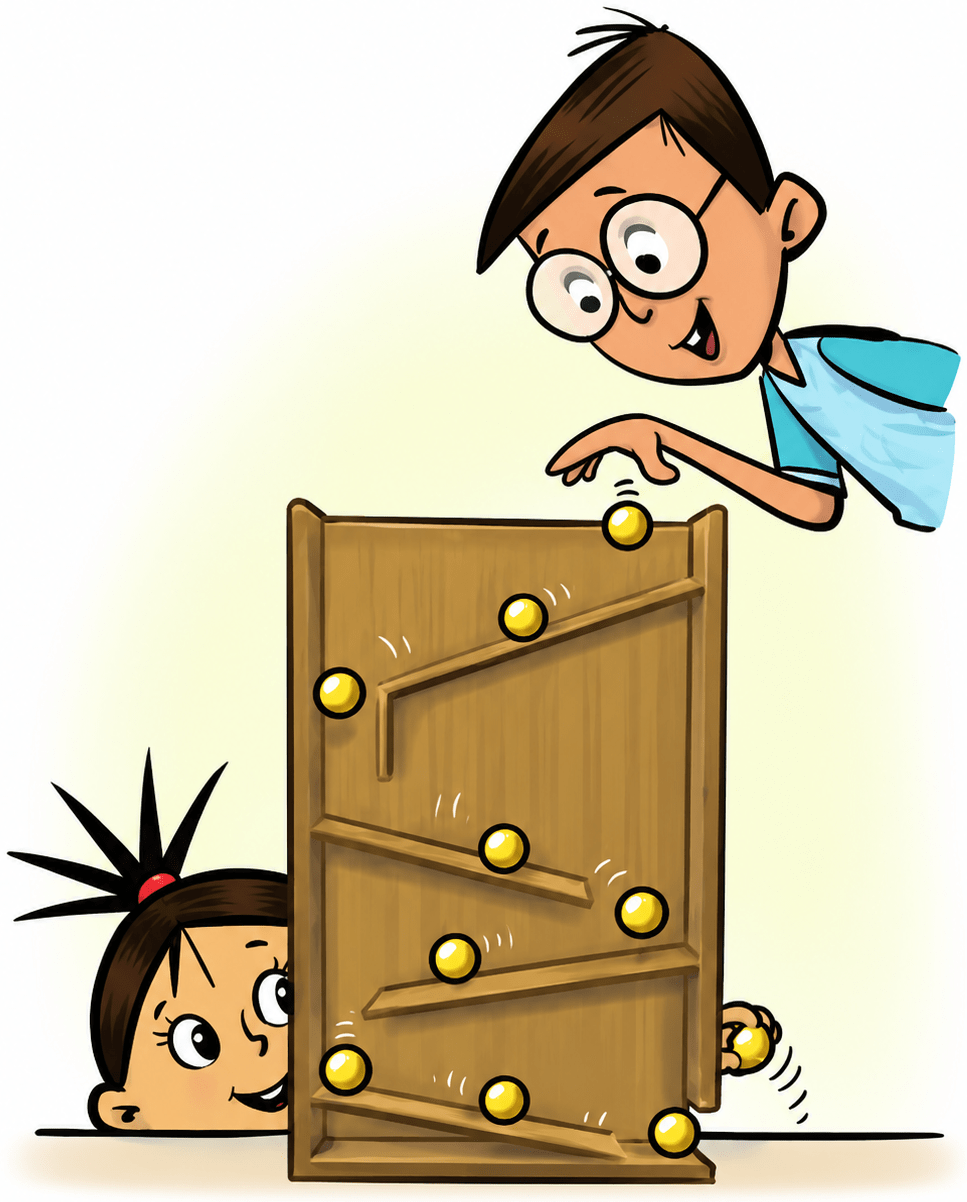
Here is a toy with slanting slabs attached to its sides; the greater the angles or slopes of the slabs, the faster the balls roll. Can angles be used to describe the slopes of the slabs? What are the arms of each angle? Which arm is visible and which is not?
Answer
Yes, angles can be used to describe the slopes of the slabs.
The slope of a slab tells us how much the slab is tilted away from the level, and this tilt is measured as an angle.
Vertex: the point where the slab meets the side of the toy.
Arms: one arm is the slanting slab itself and the other arm is the horizontal line drawn through that point.
The slanting slab is the visible arm, while the horizontal line is the invisible (imaginary) arm.
A slab with a greater angle is steeper, so the ball rolls down it faster.
Observe the images below where there is an insect and its rotated version. Can angles be used to describe the amount of rotation? How? What will be the arms of the angle and the vertex?
Hint: Observe the horizontal line touching the insects.
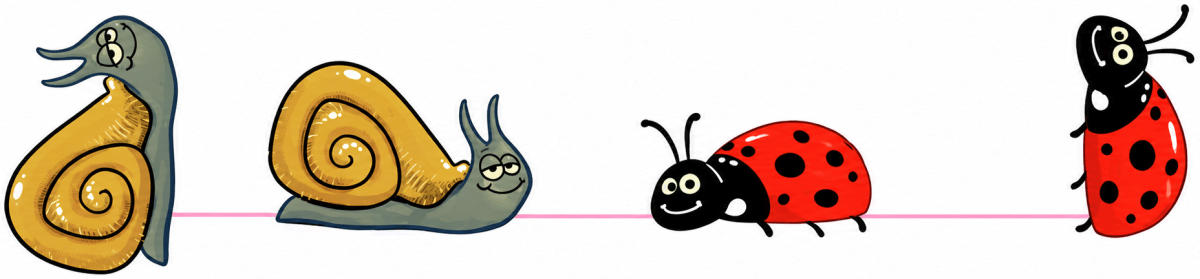
Answer
Yes, the amount of rotation can be described by an angle.
An angle measures the amount of turning, so the turn made by the insect from its first position to its rotated position is itself an angle.
Vertex: the fixed point about which the insect is rotated.
Arms: one arm is the horizontal line touching the insect in its original position and the other arm is the corresponding line touching the insect in its rotated position.
The angle between these two lines gives the amount of rotation. A larger angle means the insect has been turned by a greater amount.
Hence, the amount of rotation is the angle between the line in the original position and the same line in the rotated position, the vertex being the point of rotation.
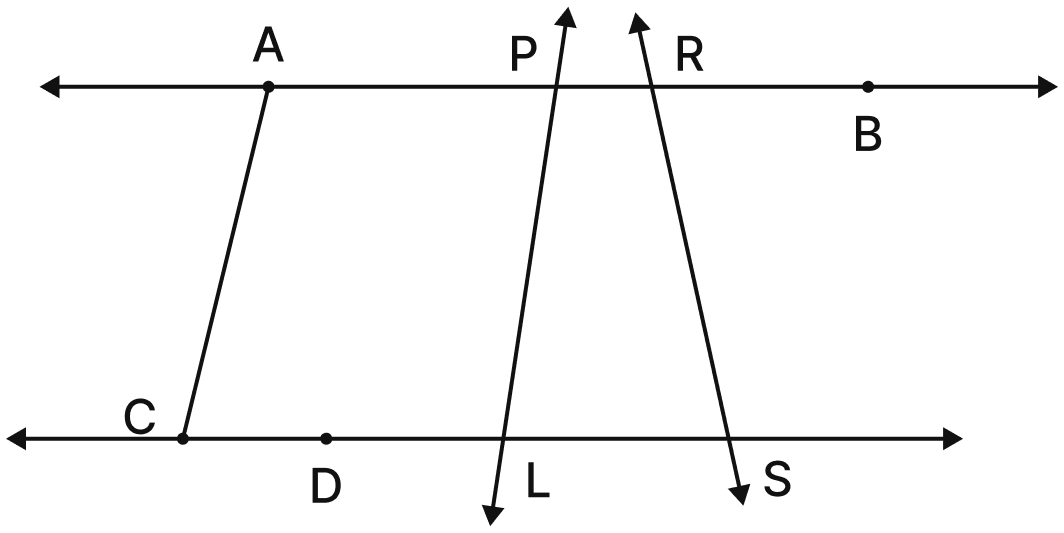
In Fig. 2.23, list all the angles possible. Did you find them all? Now, guess the measures of all the angles. Then, measure the angles with a protractor. Record all your numbers in a table. See how close your guesses are to the actual measures.
Answer
In the above figure, the two horizontal lines are cut by the segment AC and by the two lines PL and RS. An angle is formed at each of the six points A, C, P, L, R and S.
Angles at A: ∠CAP, ∠CAR, ∠CAB (all three names describe the same angle, since P, R and B lie on the same ray)
Angles at C: ∠ACD, ∠ACL, ∠ACS (again all the same angle)
Angles at P: ∠APL and ∠LPR (or ∠LPB)
Angles at L: ∠PLD (or ∠PLC) and ∠PLS
Angles at R: ∠ARS (or ∠PRS) and ∠SRB
Angles at S: ∠RSL (or ∠RSD, ∠RSC)
Besides these, the straight angles ∠APR, ∠ARB, ∠CLS, ∠CDL and so on each measure 180°.
Use a protractor to draw angles having the following degree measures:
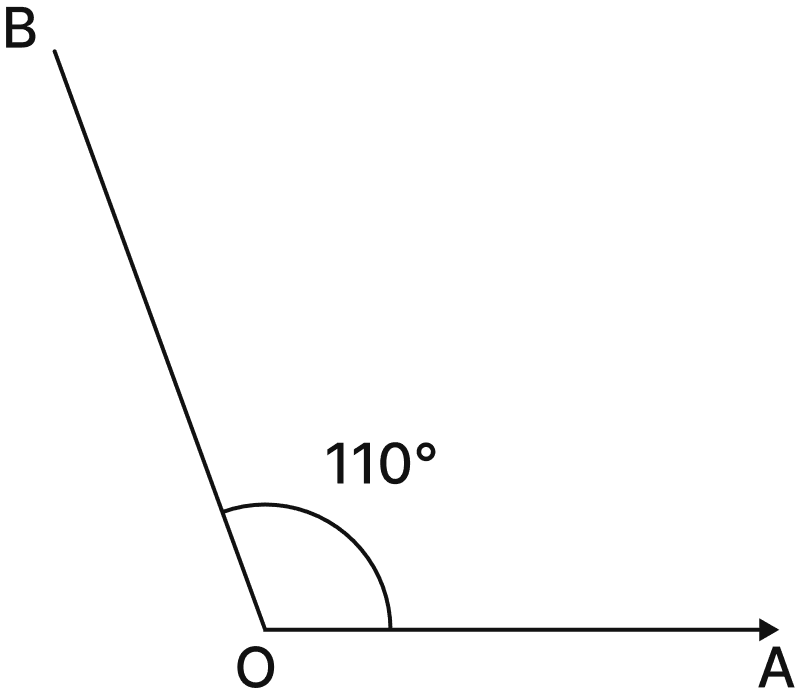
(a) 110°
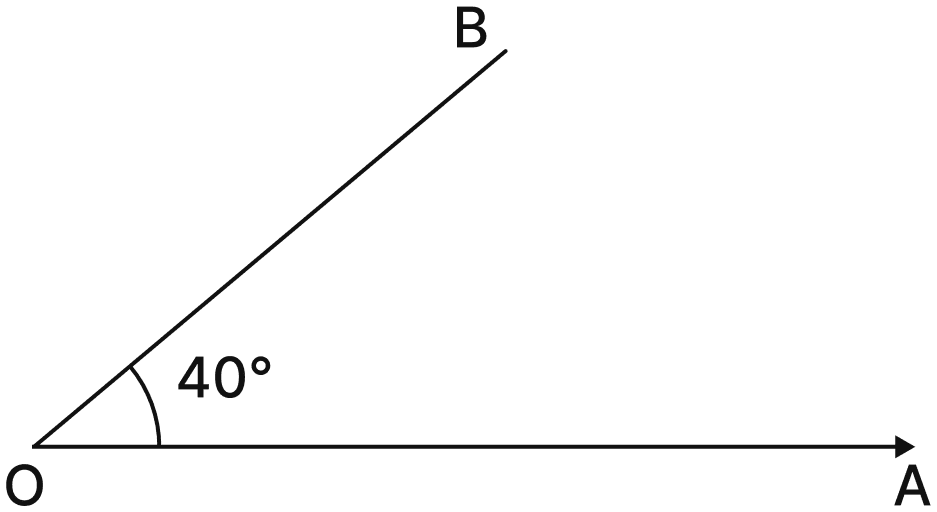
(b) 40°
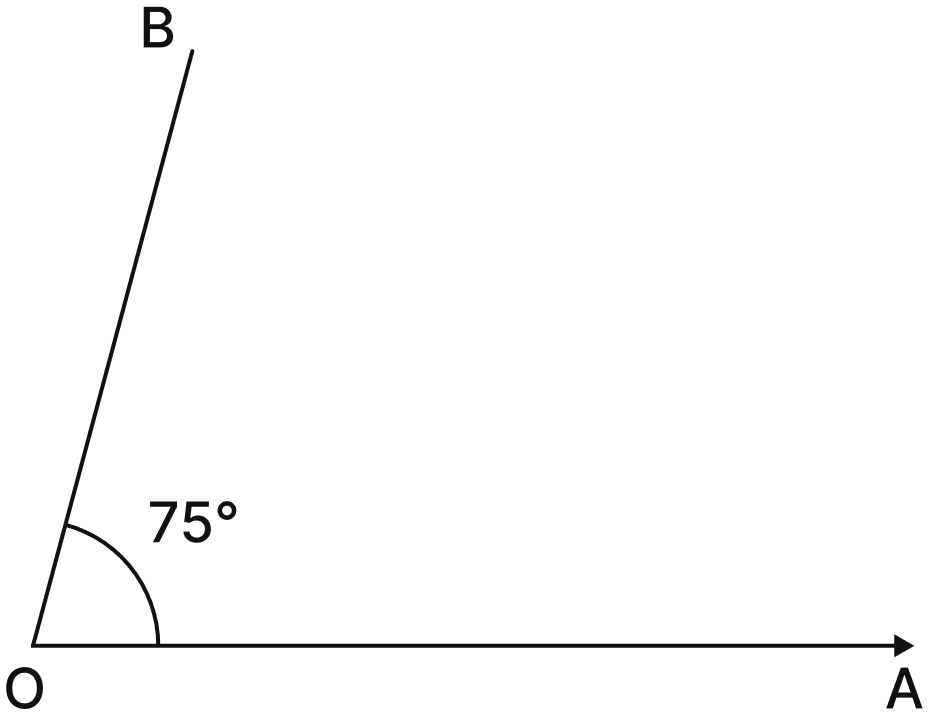
(c) 75°
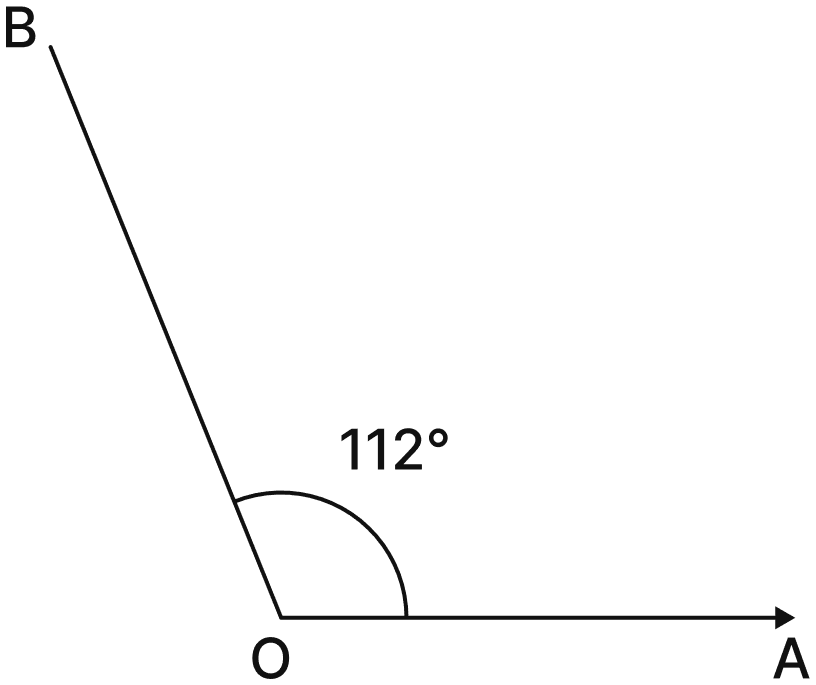
(d) 112°
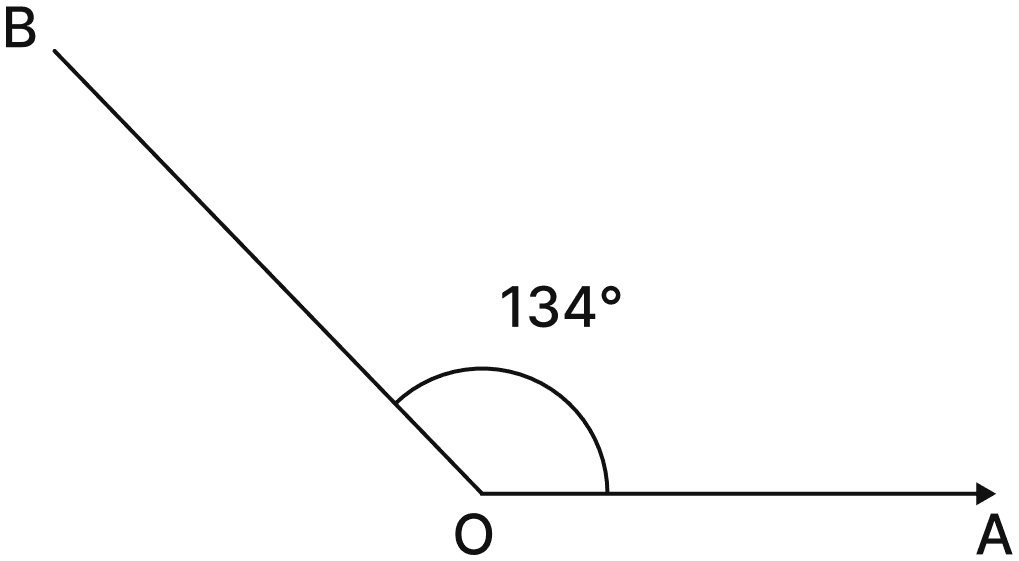
(e) 134°
Answer
The same four steps are used for every angle. To draw an angle of measure d°:
Step 1: Draw a ray OA with a ruler. This is the base arm of the angle.
Step 2: Place the centre point of the protractor exactly on O and align the ray OA with the 0° line of the protractor.
Step 3: Starting from 0 on the same side as OA, count the degrees up to d and mark a point B against that mark.
Step 4: Remove the protractor and join O to B with a ruler. Then ∠AOB = d° is the required angle.
(a) 110°
(b) 40°
(c) 75°
(d) 112°
(e) 134°
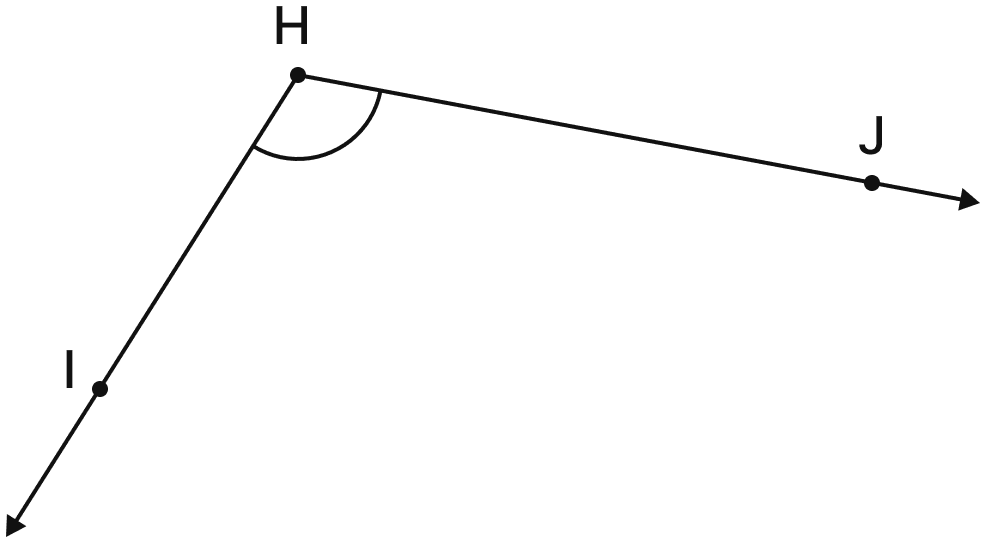
Draw an angle whose degree measure is the same as the angle given below:
Also, write down the steps you followed to draw the angle.
Answer
To draw an angle equal to the given angle ∠IHJ:
Step 1: Draw a ray QR of any convenient length.
Step 2: Place the centre of the protractor at the vertex H of the given angle and align one arm of the angle with the 0° line of the protractor.
Step 3: Note the reading on the protractor where the other arm of the angle passes. Let this measure be x°.
Step 4: Place the centre of the protractor at Q and align the ray QR with the 0° line of the protractor.
Step 5: Mark a point P at x° on the protractor scale.
Step 6: Remove the protractor and join Q to P.
Then ∠PQR = x° = ∠IHJ
Hence, ∠PQR is equal in measure to the given angle ∠IHJ.
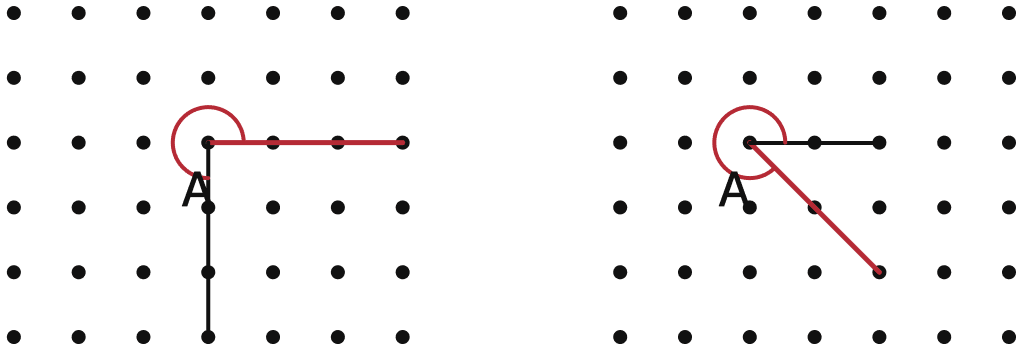
In each of the below grids, join A to other grid points in the figure by a straight line to get:
(a) An acute angle
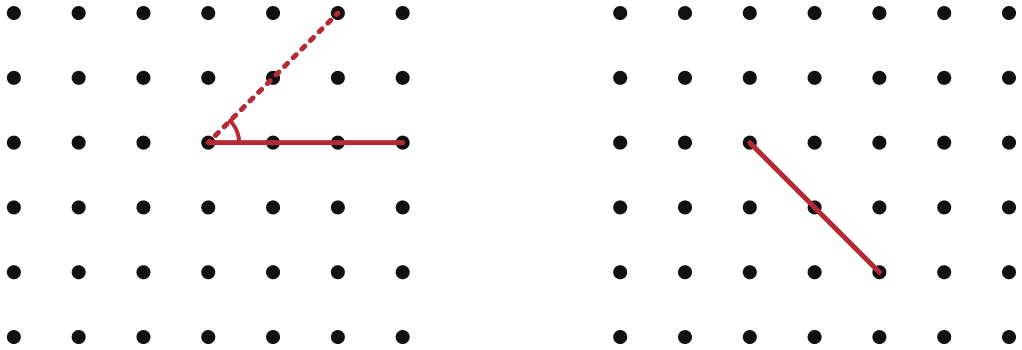
(b) An obtuse angle
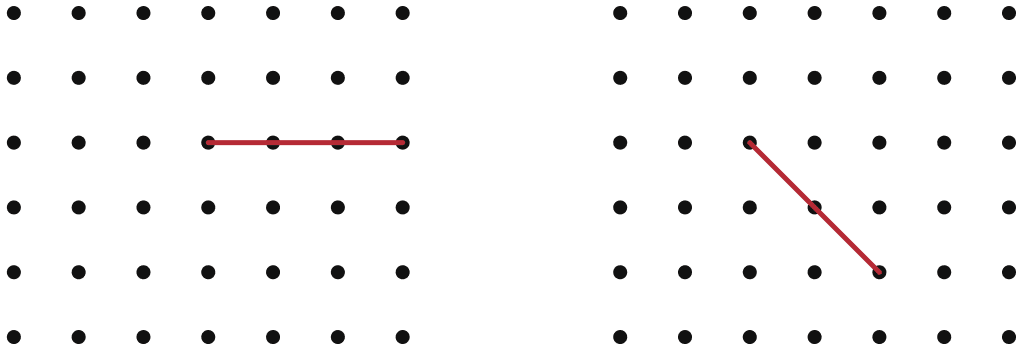
(c) A reflex angle
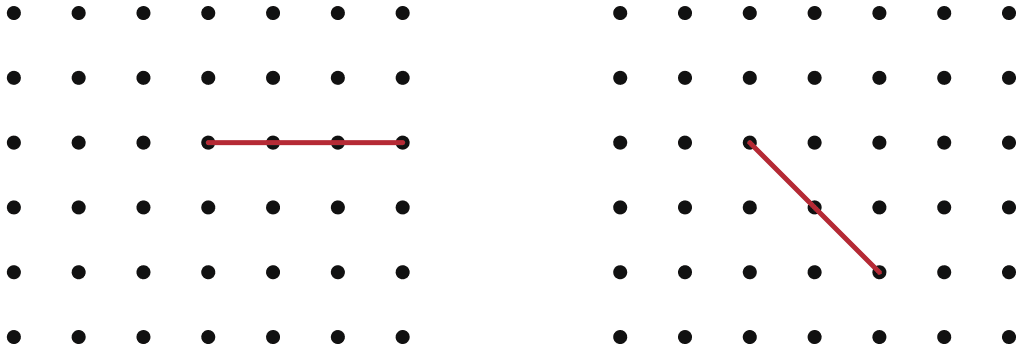
Mark the intended angles with curves to specify the angles. One has been done for you.
Answer
(a) An acute angle
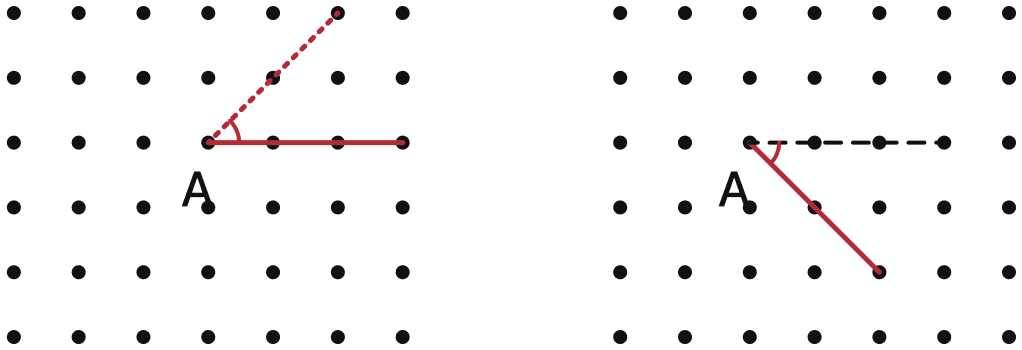
(b) An obtuse angle
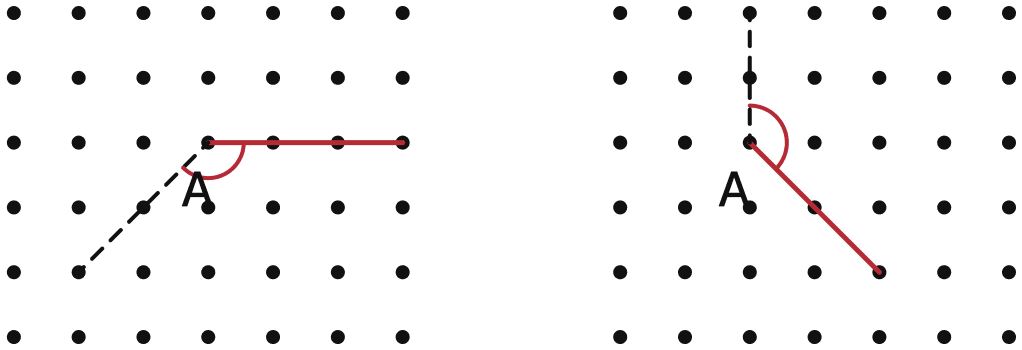
(c) A reflex angle
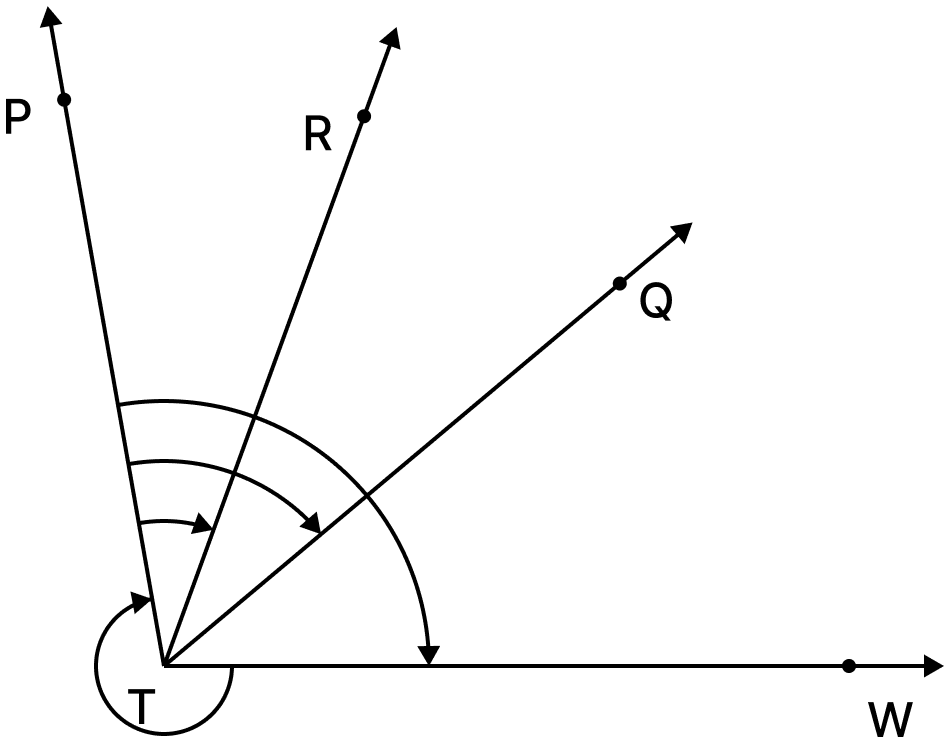
Use a protractor to find the measure of each angle. Then classify each angle as acute, obtuse, right, or reflex.
(a) ∠PTR
(b) ∠PTQ
(c) ∠PTW
(d) ∠WTP
Answer
Using a protractor, the measure of each angle is determined and the angle is classified accordingly.
(a) ∠PTR = 30° — Acute angle
(b) ∠PTQ = 60° — Acute angle
(c) ∠PTW = 102° — Obtuse angle
(d) ∠WTP = 360° − ∠PTW = 360° − 102° = 258° — Reflex angle
In this figure, ∠TER = 80°. What is the measure of ∠BET? What is the measure of ∠SET?
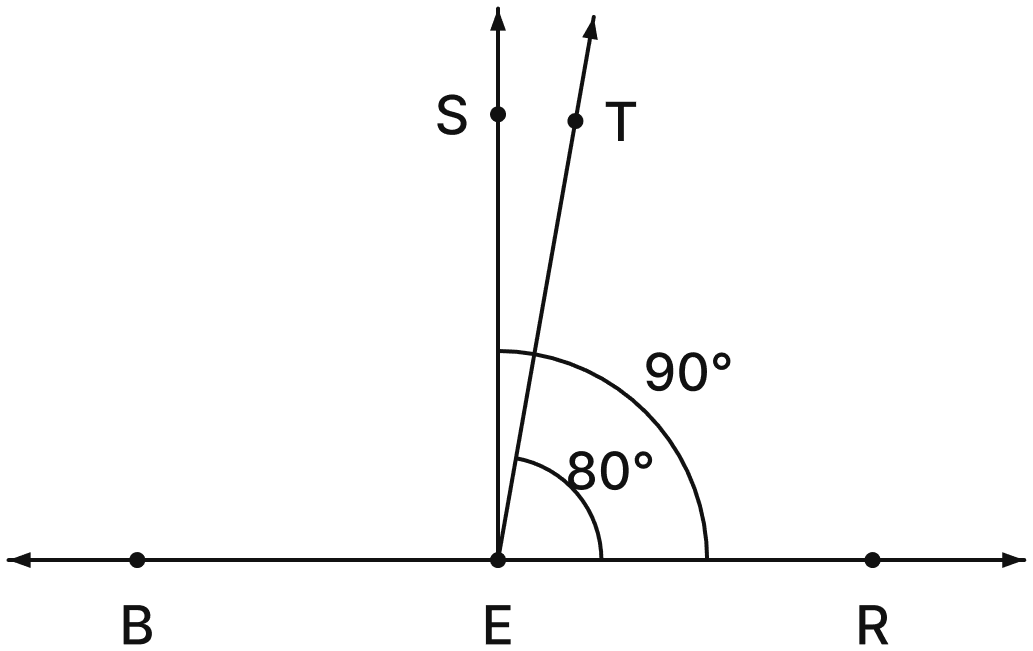
Hint: Observe that ∠REB is a straight angle. Hence, the degree measure of ∠REB = 180° of which 80° is covered by ∠TER. A similar argument can be applied to find the measure of ∠SET.
Answer
Measure of ∠BET:
B, E and R lie on the same straight line, so ∠REB is a straight angle.
∴ ∠REB = 180°
From the figure, ray ET lies between ray ER and ray EB.
∴ ∠TER + ∠BET = 180°
⇒ 80° + ∠BET = 180°
⇒ ∠BET = 180° − 80°
⇒ ∠BET = 100°
Measure of ∠SET:
From the figure, ES is perpendicular to BR, so ∠SER = 90°, and ray ET lies between ray ES and ray ER.
∴ ∠SET + ∠TER = 90°
⇒ ∠SET + 80° = 90°
⇒ ∠SET = 90° − 80°
⇒ ∠SET = 10°
Hence, ∠BET = 100° and ∠SET = 10°.
Draw angles with the following degree measures:
(a) 140°
(b) 82°
(c) 195°
(d) 70°
(e) 35°
Answer
For each angle, the same set of steps is followed:
Step 1: Draw a ray OB. This is the base arm of the angle.
Step 2: Place the centre of the protractor on O and align OB along the 0° line.
Step 3: Starting from 0°, count up to the required measure on that scale and mark a point A.
Step 4: Join O and A with a ruler. Then ∠AOB is the required angle.
(a) 140°
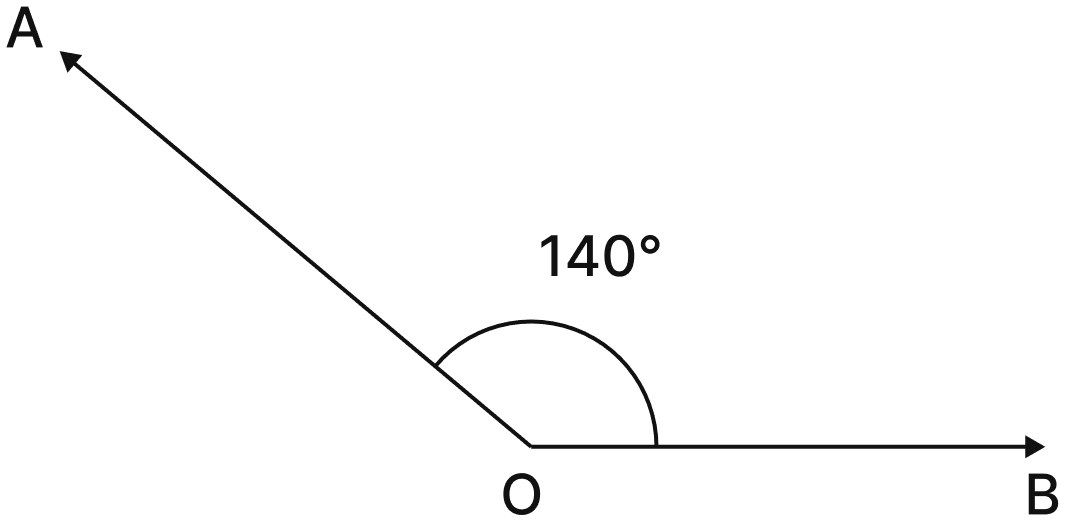
Here 90° < 140° < 180°, so it is an obtuse angle.
(b) 82°
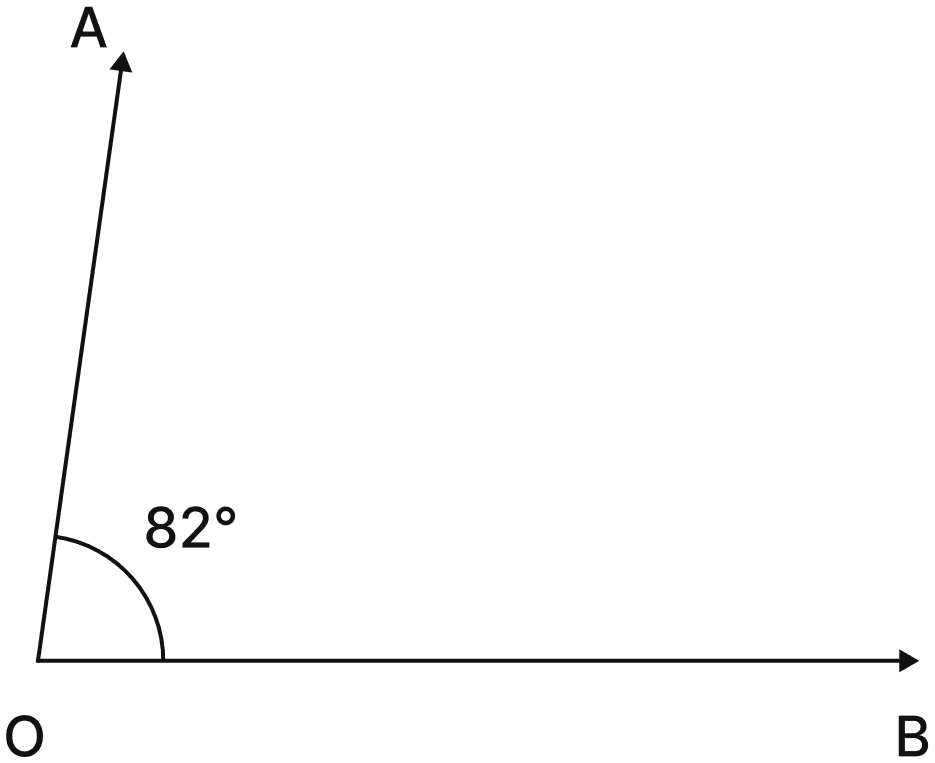
Here 82° < 90°, so it is an acute angle.
(c) 195°
An ordinary protractor measures only up to 180°, so this reflex angle is drawn in two turns.
∴ 195° = 180° + 15°
Draw ray OB and extend BO beyond O to a point C, so that ∠BOC = 180°. Now, taking OC as the base arm, measure a further 15° in the same sense of turning and mark A. Join OA and mark the required angle with a curve drawn on the outer side.
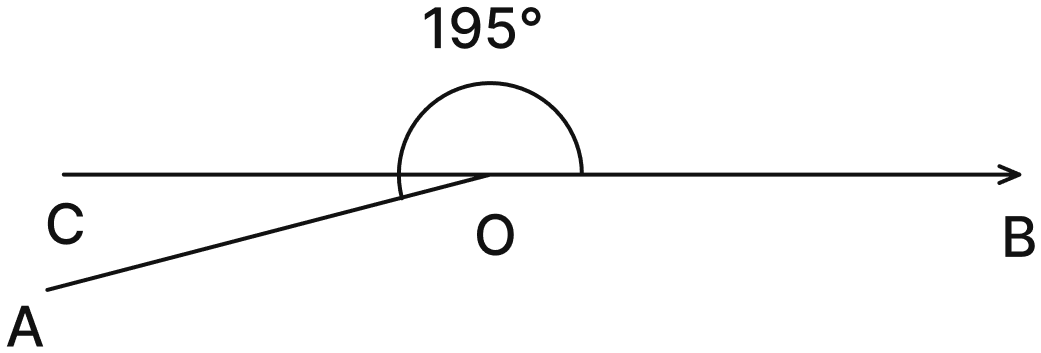
Here 180° < 195° < 360°, so it is a reflex angle.
(d) 70°
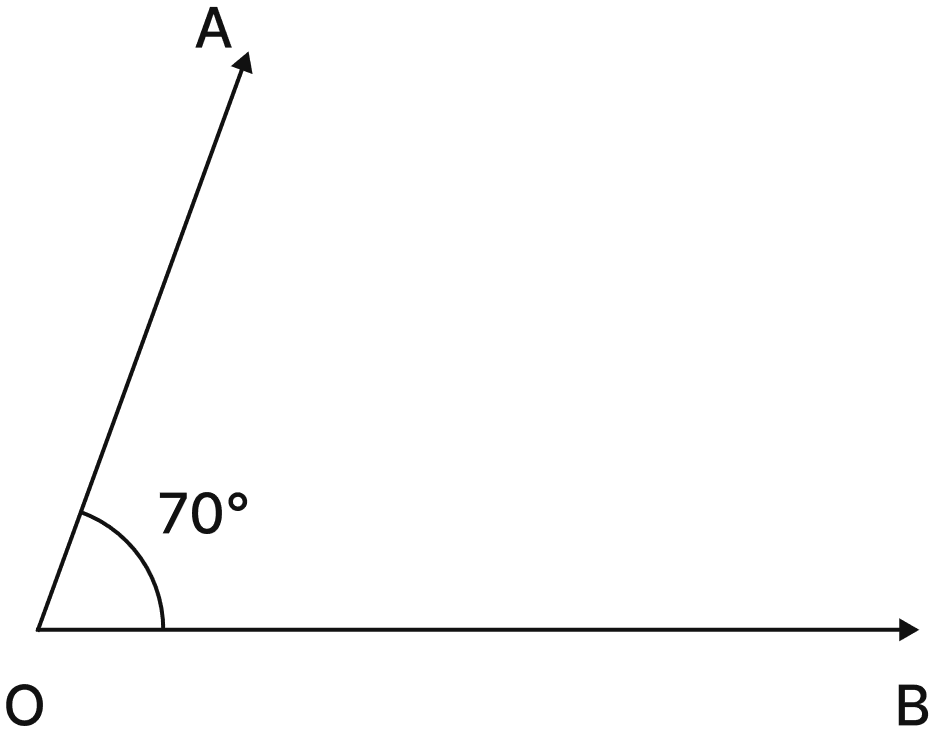
Here 70° < 90°, so it is an acute angle.
(e) 35°
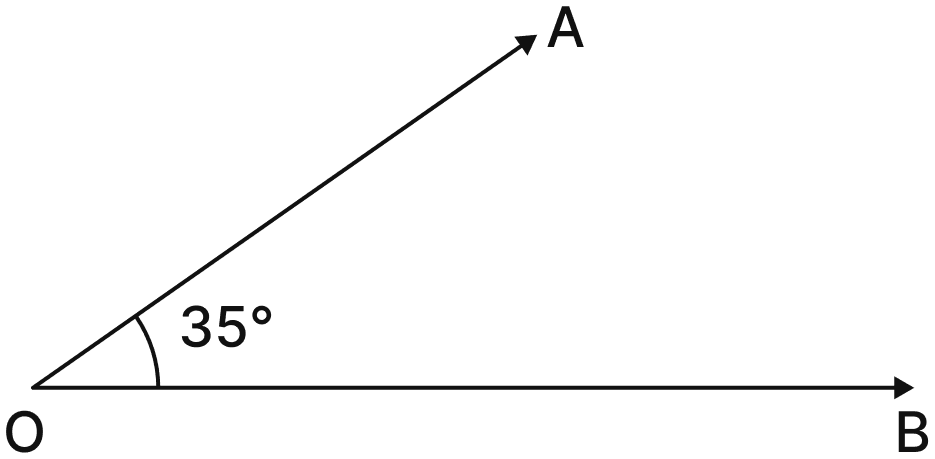
Here 35° < 90°, so it is an acute angle.
Estimate the size of each angle and then measure it with a protractor:
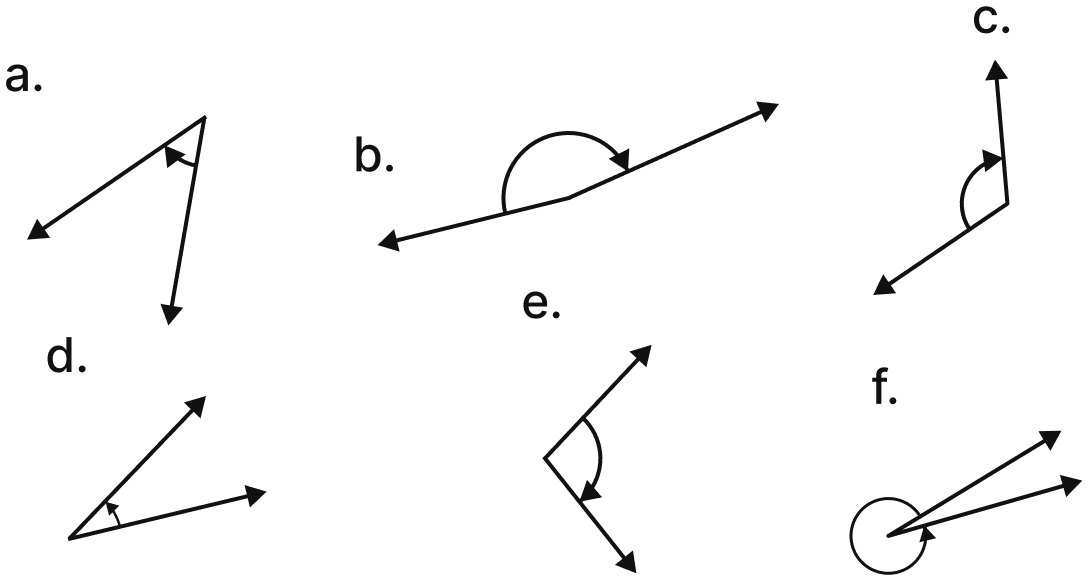
Classify these angles as acute, right, obtuse or reflex angles.
Answer
After estimating the angles, their measures were checked using a protractor. The results are:
(a) 45° — Acute angle
(b) 169° — Obtuse angle
(c) 120° — Obtuse angle
(d) 33° — Acute angle
(e) 99° — Obtuse angle
(f) 348° — Reflex angle
Make any figure with three acute angles, one right angle and two obtuse angles.
Answer
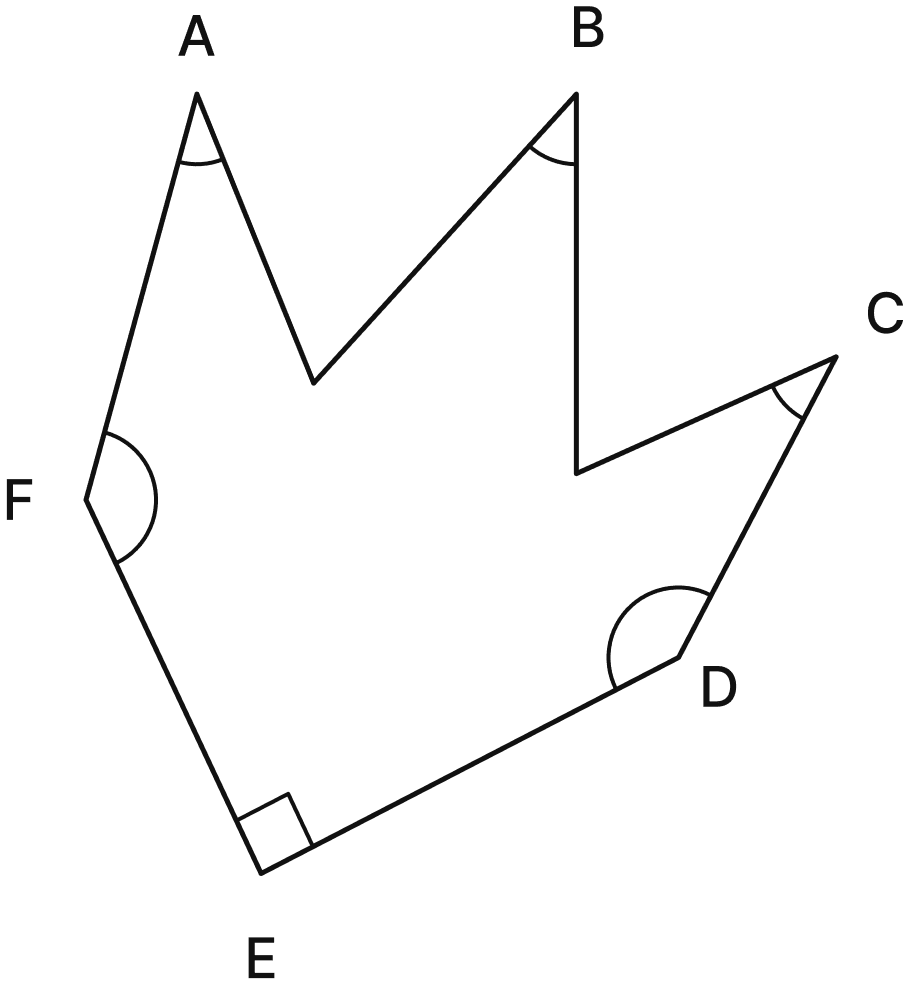
∠A, ∠B & ∠C are three acute angles
∠D and ∠F are obtuse angles
∠E is a right angle
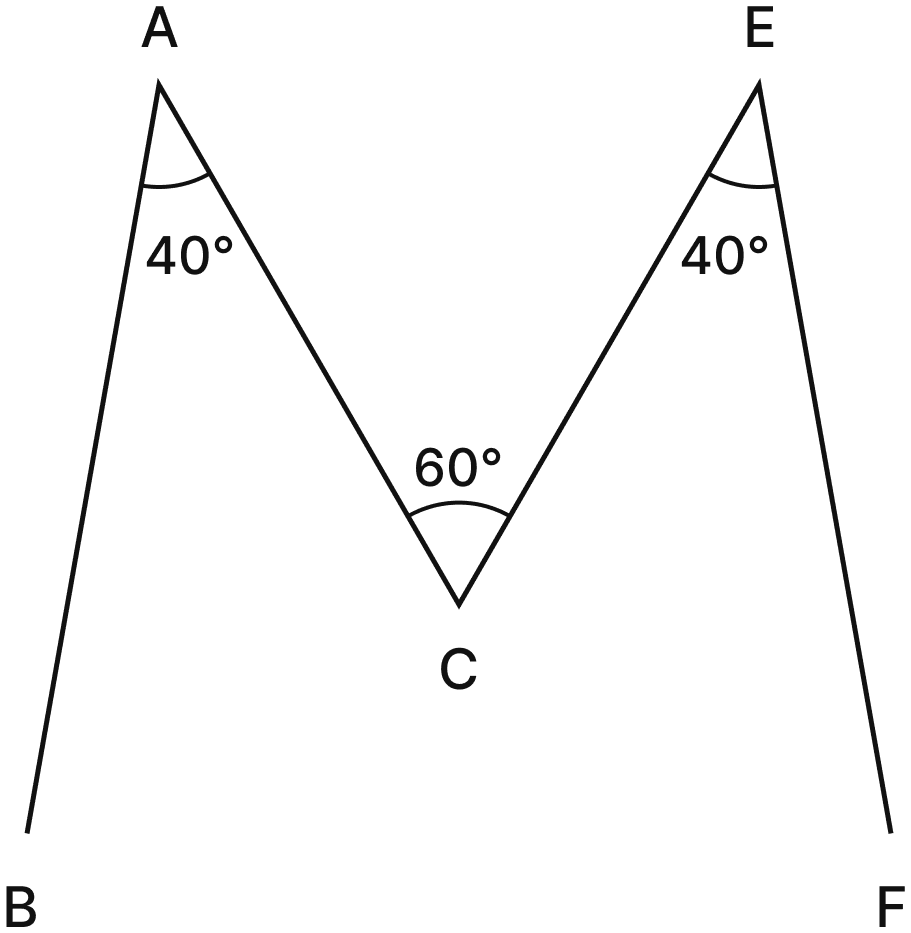
Draw the letter 'M' such that the angles on the sides are 40° each and the angle in the middle is 60°.
Answer
The letter 'M' is made of four strokes: two side strokes and two slanting strokes meeting in the middle.
Step 1: Mark a point C for the middle of the letter and draw two rays CA and CE going upwards such that ∠ACE = 60°.
Step 2: At A, draw a ray making an angle of 40° with AC, going downwards, and mark a point B on it. Then ∠BAC = 40°.
Step 3: At E, draw a ray making an angle of 40° with EC, going downwards, and mark a point F on it. Then ∠CEF = 40°.
Step 4: The strokes BA, AC, CE and EF together form the letter 'M'.
Draw the letter 'Y' such that the three angles formed are 150°, 60° and 150°.
Answer
Step 1: Mark a point O and draw a ray OA going upwards to the left.
Step 2: Using a protractor at O, draw a ray OB such that ∠AOB = 60°. OA and OB are the two upper arms of the letter.
Step 3: Again using the protractor at O, draw a ray OC downwards such that ∠BOC = 150°. Then the remaining angle is:
∴ ∠COA = 360° − (60° + 150°) = 150°
Step 4: OC is the stem of the letter, and OA, OB, OC together form the letter 'Y'.
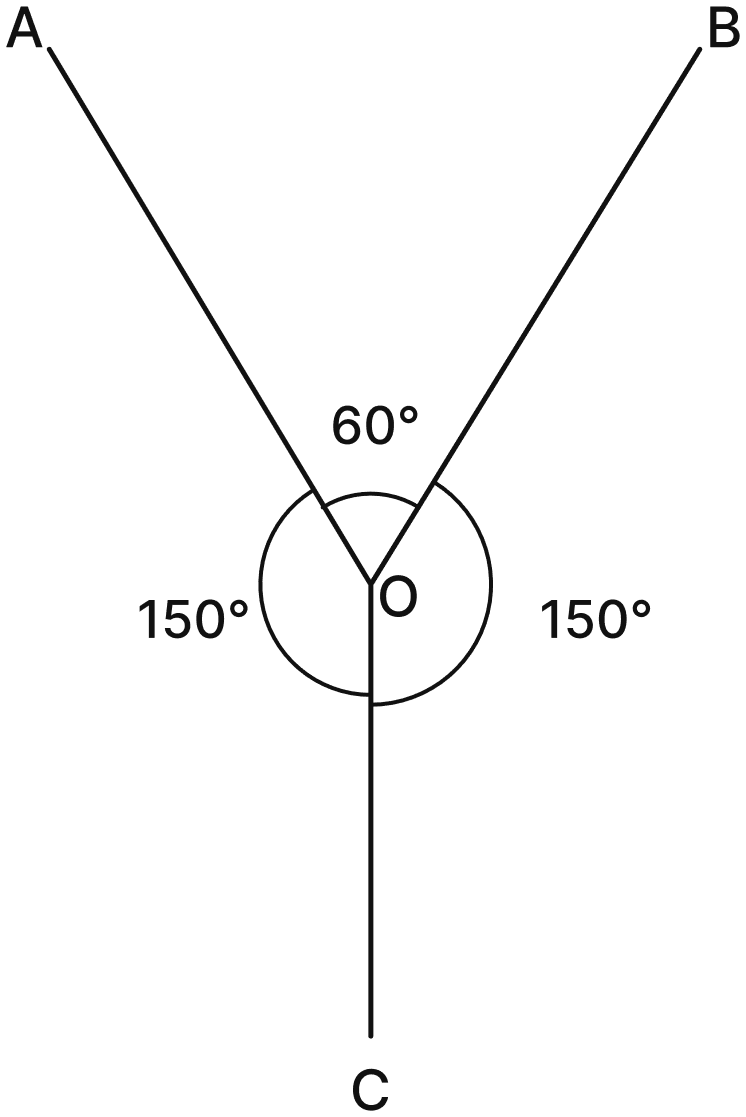
Hence, the letter 'Y' is drawn with the three angles 150°, 60° and 150°.
The Ashoka Chakra has 24 spokes. What is the degree measure of the angle between two spokes next to each other? What is the largest acute angle formed between two spokes?

Answer
Angle between two spokes next to each other:
The 24 spokes divide the complete turn at the centre into 24 equal parts, and a complete turn is 360°.
∴ Angle between two spokes next to each other =
= 15°
Largest acute angle between two spokes:
Every angle formed between two spokes is a multiple of 15°, that is, 15°, 30°, 45°, 60°, 75°, 90°, …
An acute angle must be less than 90°, so the possible acute angles are 15°, 30°, 45°, 60° and 75°.
∴ The largest of these is 75°.
Hence, the angle between two spokes next to each other is 15° and the largest acute angle formed between two spokes is 75°.
Puzzle: I am an acute angle. If you double my measure, you get an acute angle. If you triple my measure, you will get an acute angle again. If you quadruple (four times) my measure, you will get an acute angle yet again! But if you multiply my measure by 5, you will get an obtuse angle measure. What are the possibilities for my measure?
Answer
Let the measure of the angle be x°.
Four times the measure is still acute, so it is less than 90°.
∴ 4x° < 90°
⇒ x° <
⇒ x° < 22.5°
Note that if 4x° is less than 90°, then x°, 2x° and 3x° are automatically less than 90°, so those three conditions are already satisfied.
Five times the measure is obtuse, so it is greater than 90°.
∴ 5x° > 90°
⇒ x° >
⇒ x° > 18°
Combining both results:
∴ 18° < x° < 22.5°
For a whole number of degrees, the possible measures are 19°, 20°, 21° and 22°.
Check for x = 22: 4 × 22° = 88° (acute) and 5 × 22° = 110° (obtuse).
Hence, if the angle is required to have a whole-number degree measure, it can be 19°, 20°, 21° or 22°.