
Which is the first number for which the players should say, ‘idli-vada’? It is 15, which is a multiple of 3, and also a multiple of 5. Find out other such numbers that are multiples of both 3 and 5. These numbers are called ............... .
Answer
A player says ‘idli-vada’ only when the number is a multiple of 3 as well as a multiple of 5.
Multiples of 3 are:
3, 6, 9, 12, 15, 18, 21, 24, 27, 30, 33, 36, 39, 42, 45, ….
Multiples of 5 are:
5, 10, 15, 20, 25, 30, 35, 40, 45, ….
The numbers which appear in both the lists are:
15, 30, 45, 60, 75, 90, ….
Each of these numbers is a multiple of 3 × 5 = 15, so they can also be written as
15 × 1, 15 × 2, 15 × 3, 15 × 4, 15 × 5, 15 × 6, ….
∴ the numbers for which ‘idli-vada’ is said are 15, 30, 45, 60, 75, 90, ….
Hence, the other such numbers are 30, 45, 60, 75, 90, … and these numbers are called common multiples of 3 and 5.
At what number is ‘idli-vada’ said for the 10th time?
Answer
‘idli-vada’ is said at the common multiples of 3 and 5, that is, at the multiples of 15.
The numbers at which ‘idli-vada’ is said are:
15, 30, 45, 60, ….
So, the 1st time it is said at 15 × 1, the 2nd time at 15 × 2, the 3rd time at 15 × 3, and so on.
∴ the nth time ‘idli-vada’ is said at the number 15n.
Putting n = 10, we get
15 × 10 = 150.
Hence, ‘idli-vada’ is said for the 10th time at the number 150.
If the game is played for the numbers 1 to 90, find out:
(a) How many times would the children say ‘idli’ (including the times they say ‘idli-vada’)?
(b) How many times would the children say ‘vada’ (including the times they say ‘idli-vada’)?
(c) How many times would the children say ‘idli-vada’?
Answer
(a) The word ‘idli’ is said at every multiple of 3, and this also includes the numbers at which ‘idli-vada’ is said, since those numbers are multiples of 3 as well.
The multiples of 3 from 1 to 90 are:
3, 6, 9, 12, ……, 90.
Writing the last number as a multiple of 3,
90 = 3 × 30.
So, the list is 3 × 1, 3 × 2, 3 × 3, ……, 3 × 30, which contains 30 numbers.
∴ ‘idli’ is said 30 times.
(b) The word ‘vada’ is said at every multiple of 5, including the numbers at which ‘idli-vada’ is said.
The multiples of 5 from 1 to 90 are:
5, 10, 15, 20, ……, 90.
Writing the last number as a multiple of 5,
90 = 5 × 18.
So, the list is 5 × 1, 5 × 2, 5 × 3, ……, 5 × 18, which contains 18 numbers.
∴ ‘vada’ is said 18 times.
(c) The words ‘idli-vada’ are said at every common multiple of 3 and 5, that is, at every multiple of 15.
The multiples of 15 from 1 to 90 are:
15, 30, 45, 60, 75, 90.
Writing the last number as a multiple of 15,
90 = 15 × 6.
So, the list is 15 × 1, 15 × 2, ……, 15 × 6, which contains 6 numbers.
∴ ‘idli-vada’ is said 6 times.
Hence, ‘idli’ is said 30 times, ‘vada’ is said 18 times and ‘idli-vada’ is said 6 times.
What if the game was played till 900? How would your answers change?
Answer
The reasoning stays exactly the same as in the previous question; only the last number changes from 90 to 900.
‘idli’ is said at every multiple of 3 from 1 to 900.
Since 900 = 3 × 300, the multiples of 3 are 3 × 1, 3 × 2, ……, 3 × 300.
∴ ‘idli’ is said 300 times.
‘vada’ is said at every multiple of 5 from 1 to 900.
Since 900 = 5 × 180, the multiples of 5 are 5 × 1, 5 × 2, ……, 5 × 180.
∴ ‘vada’ is said 180 times.
‘idli-vada’ is said at every multiple of 15 from 1 to 900.
Since 900 = 15 × 60, the multiples of 15 are 15 × 1, 15 × 2, ……, 15 × 60.
∴ ‘idli-vada’ is said 60 times.
We may also note that 900 is 10 times 90, so each of the three counts becomes 10 times the corresponding count obtained for 90:
30 × 10 = 300, 18 × 10 = 180, 6 × 10 = 60.
Hence, if the game is played till 900, ‘idli’ is said 300 times, ‘vada’ is said 180 times and ‘idli-vada’ is said 60 times, each being 10 times the earlier answer.
Is this figure somehow related to the ‘idli-vada’ game?
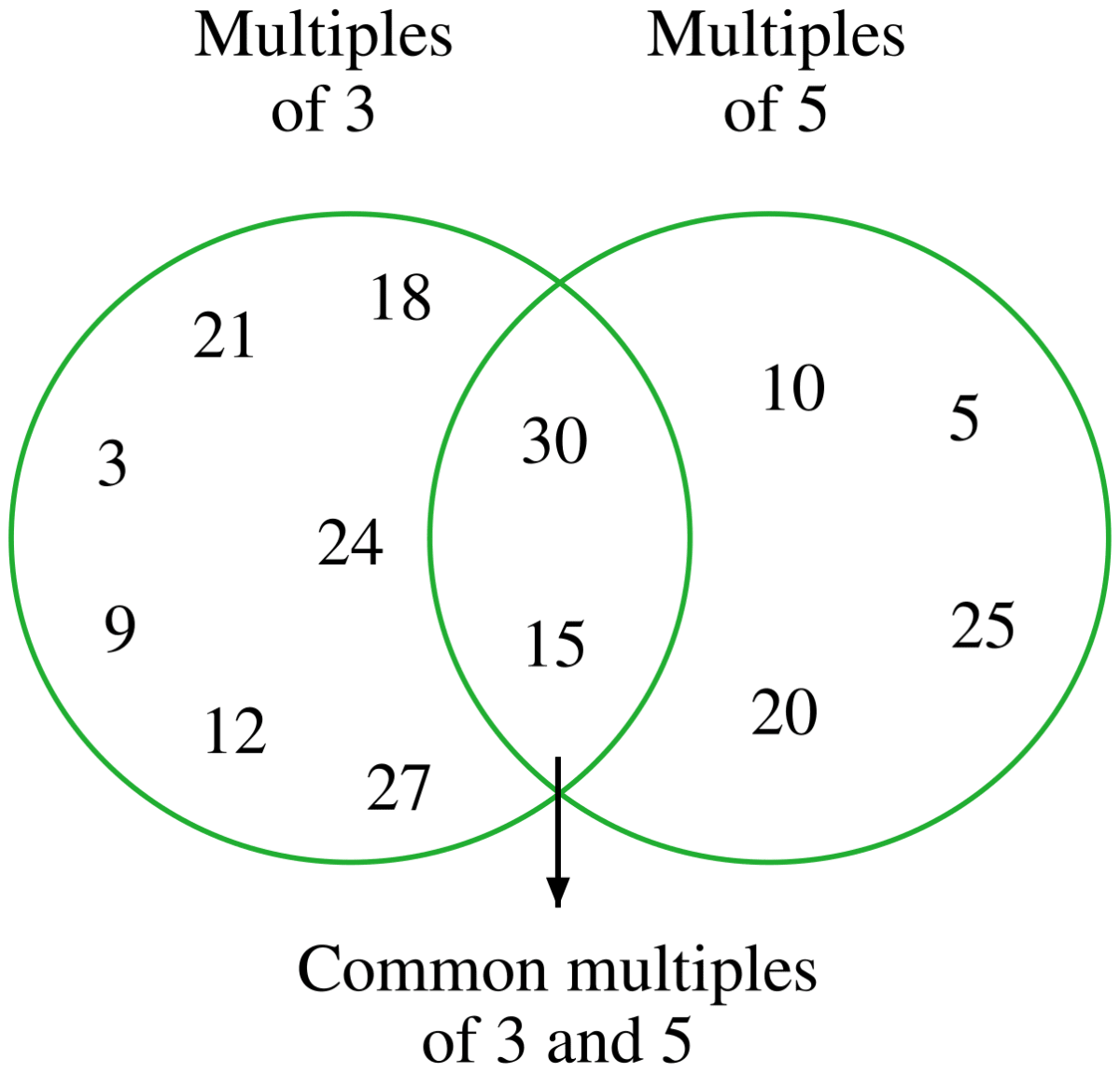
Hint: Imagine playing the game till 30. Draw the figure if the game is played till 60.
Answer
Yes, the figure is closely related to the ‘idli-vada’ game. It shows the game played till 30.
In the figure, the left circle collects the multiples of 3 and the right circle collects the multiples of 5. The two circles overlap, and the overlapping region collects the numbers that are multiples of 3 as well as multiples of 5, that is, the common multiples of 3 and 5.
So, reading the figure for the game played till 30:
Numbers lying only in the left circle → the players say ‘idli’ : 3, 6, 9, 12, 18, 21, 24, 27.
Numbers lying only in the right circle → the players say ‘vada’ : 5, 10, 20, 25.
Numbers lying in the overlapping region → the players say ‘idli-vada’ : 15, 30.
Now, if the game is played till 60, the same figure is drawn with the following numbers.
Multiples of 3 only (‘idli’ is said) :
3, 6, 9, 12, 18, 21, 24, 27, 33, 36, 39, 42, 48, 51, 54, 57.
Multiples of 5 only (‘vada’ is said) :
5, 10, 20, 25, 35, 40, 50, 55.
Common multiples of 3 and 5 (‘idli-vada’ is said) :
15, 30, 45, 60.
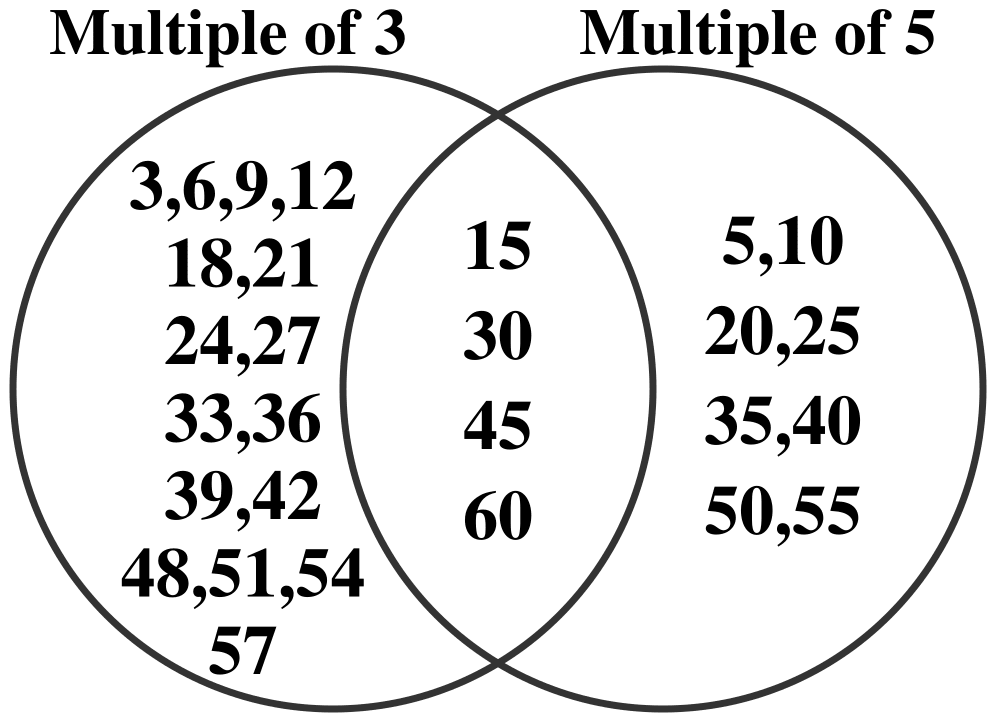
Hence, the figure is the picture of the ‘idli-vada’ game, with the overlapping region showing the common multiples at which ‘idli-vada’ is said; for the game played till 60 the overlapping region contains 15, 30, 45 and 60.
Let us now play the ‘idli-vada’ game with different pairs of numbers:
(a) 2 and 5,
(b) 3 and 7,
(c) 4 and 6.
We will say ‘idli’ for multiples of the smaller number, ‘vada’ for multiples of the larger number and ‘idli-vada’ for common multiples. Draw a figure similar to Fig. 5.1 if the game is played up to 60.
Answer
In each part we draw two overlapping circles, the left one for the multiples of the smaller number and the right one for the multiples of the larger number. The overlapping region holds the common multiples, at which ‘idli-vada’ is said.
(a) 2 and 5
Here ‘idli’ is said for multiples of 2 and ‘vada’ for multiples of 5. The common multiples of 2 and 5 are the multiples of 2 × 5 = 10.
Multiples of 2 only (‘idli’) :
2, 4, 6, 8, 12, 14, 16, 18, 22, 24, 26, 28, 32, 34, 36, 38, 42, 44, 46, 48, 52, 54, 56, 58.
Multiples of 5 only (‘vada’) :
5, 15, 25, 35, 45, 55.
Common multiples (‘idli-vada’) :
10, 20, 30, 40, 50, 60.
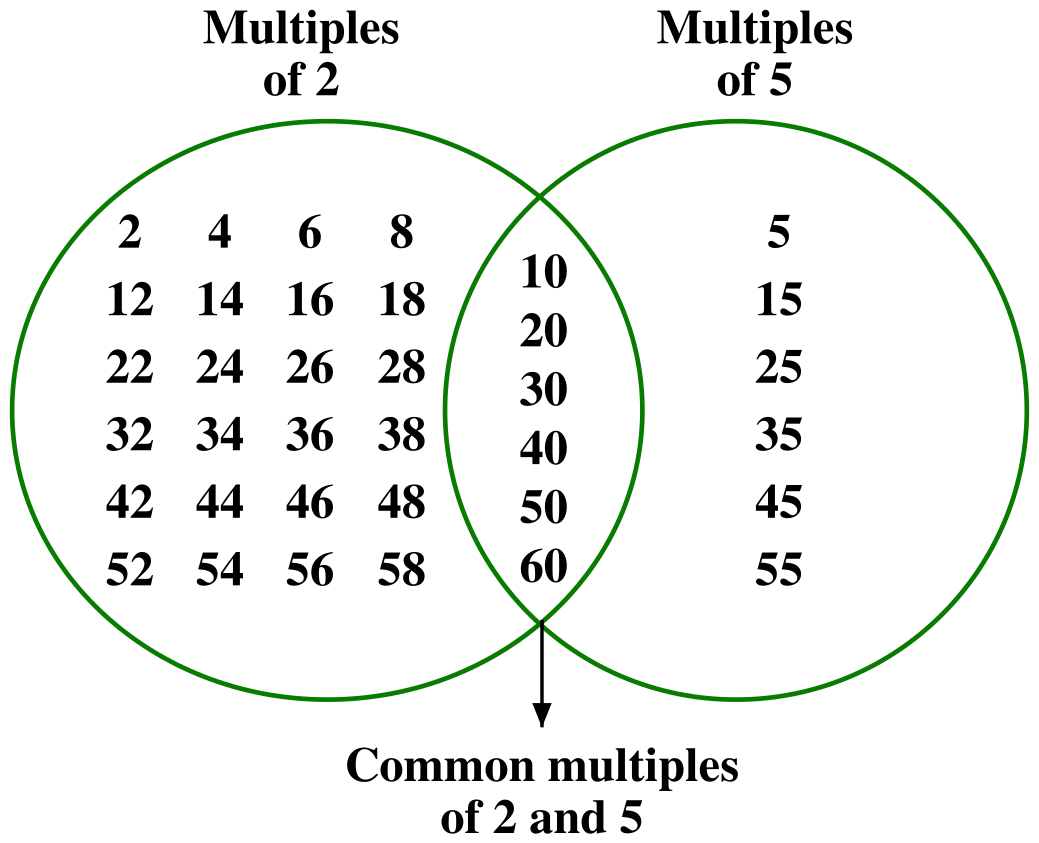
(b) 3 and 7
Here ‘idli’ is said for multiples of 3 and ‘vada’ for multiples of 7. The common multiples of 3 and 7 are the multiples of 3 × 7 = 21.
Multiples of 3 only (‘idli’) :
3, 6, 9, 12, 15, 18, 24, 27, 30, 33, 36, 39, 45, 48, 51, 54, 57, 60.
Multiples of 7 only (‘vada’) :
7, 14, 28, 35, 49, 56.
Common multiples (‘idli-vada’) :
21, 42.
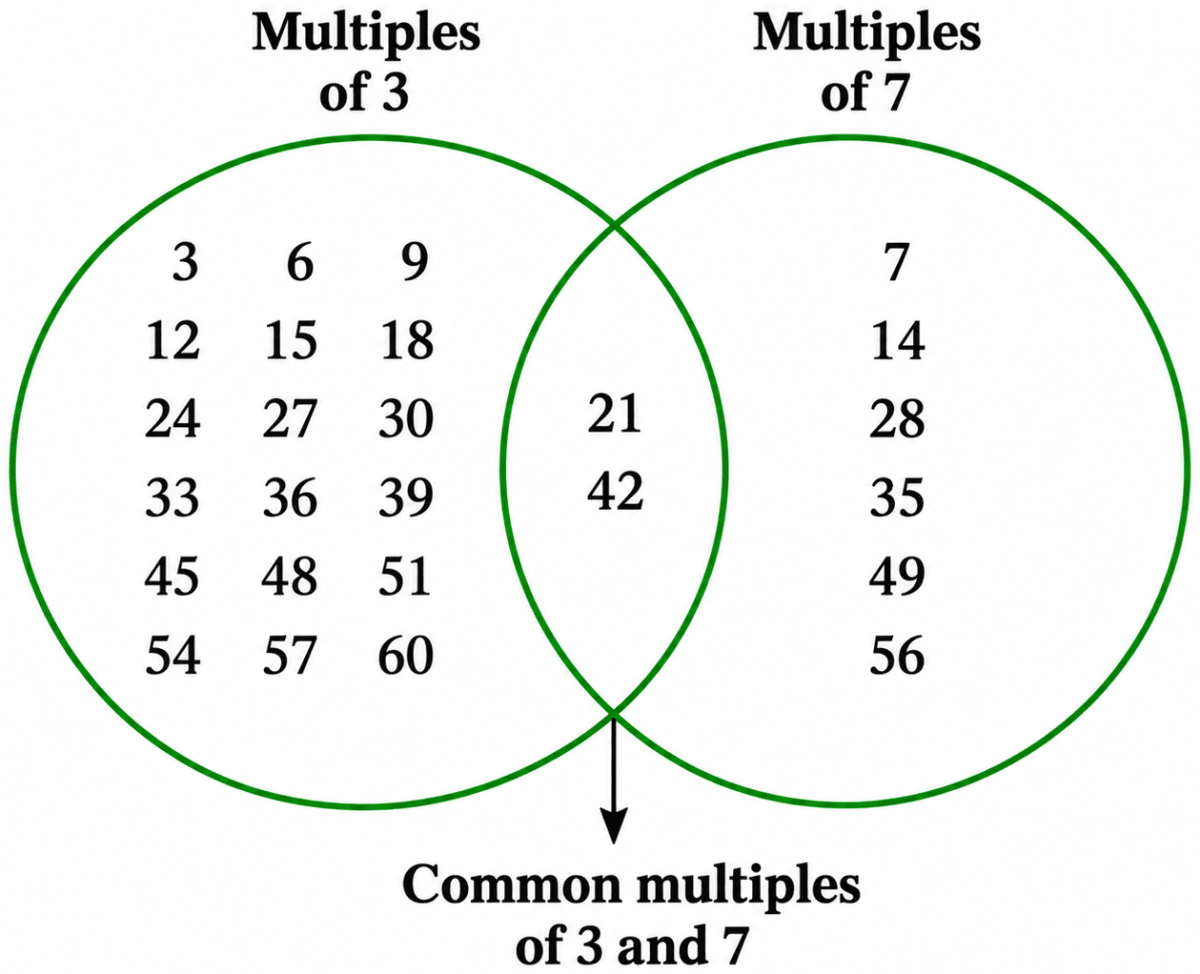
(c) 4 and 6
Here ‘idli’ is said for multiples of 4 and ‘vada’ for multiples of 6. The common multiples of 4 and 6 are the multiples of 12, and not of 4 × 6 = 24, because 4 and 6 share the common factor 2.
Multiples of 4 only (‘idli’) :
4, 8, 16, 20, 28, 32, 40, 44, 52, 56.
Multiples of 6 only (‘vada’) :
6, 18, 30, 42, 54.
Common multiples (‘idli-vada’) :
12, 24, 36, 48, 60.
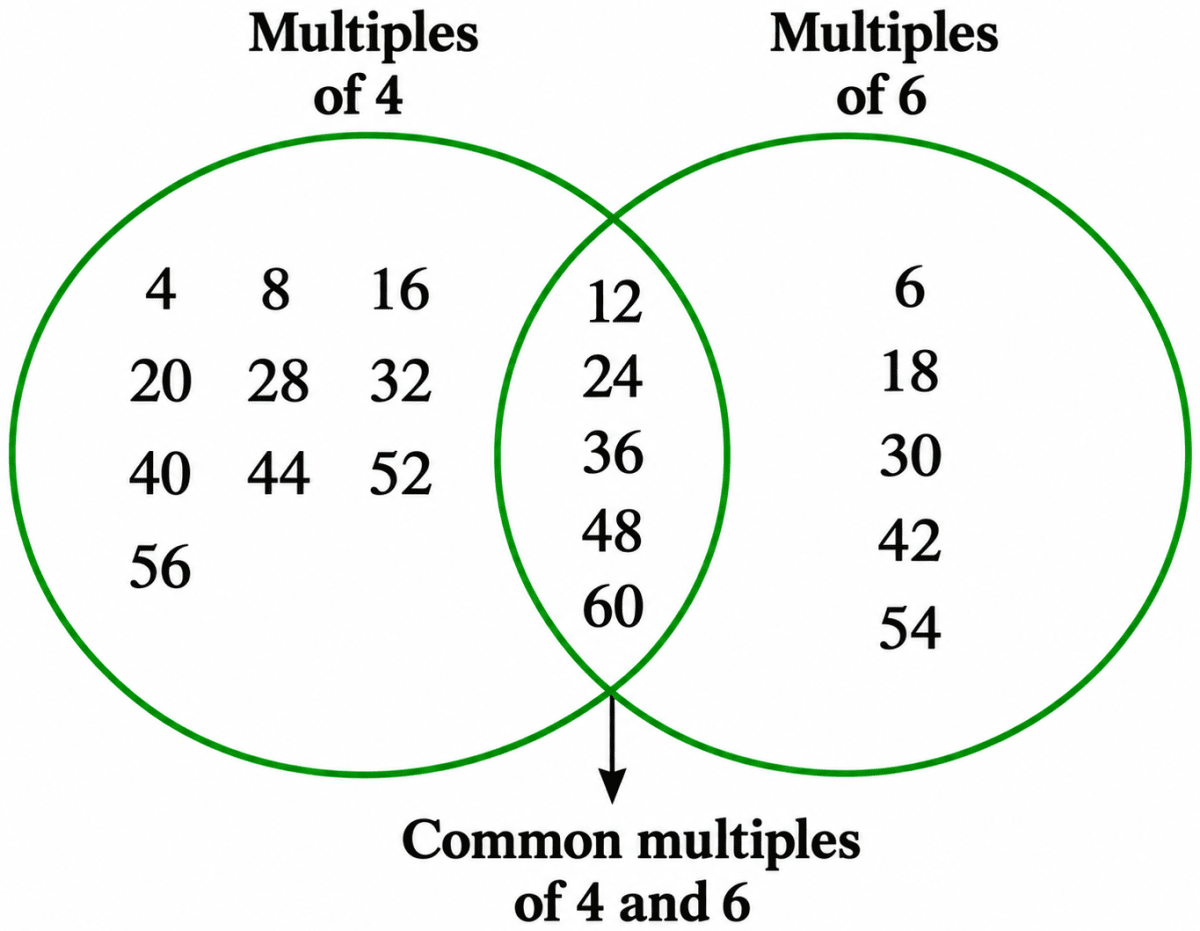
Hence, up to 60 the common multiples are 10, 20, 30, 40, 50, 60 for the pair 2 and 5; 21 and 42 for the pair 3 and 7; and 12, 24, 36, 48, 60 for the pair 4 and 6.
Yesterday, we played this game with two numbers. We ended up saying just ‘idli’ or ‘idli-vada’ and nobody said just ‘vada’! One of the numbers was 4. Which of the following could be the other number:
2, 3, 5, 8, 10?
Answer
‘vada’ alone is said at a number which is a multiple of the larger number but not a multiple of the smaller number.
Since nobody said just ‘vada’, there is no such number. This means every multiple of the larger number must also be a multiple of the smaller number, which happens only when the smaller number is a factor of the larger number.
So, of the two numbers, the smaller one must be a factor of the larger one.
Let us check each option along with 4.
Other number = 2: the smaller number is 2 and the larger is 4. Since 2 is a factor of 4, every multiple of 4 is also a multiple of 2. So ‘idli-vada’ is said at 4, 8, 12, … and nobody says just ‘vada’.
Other number = 3: the smaller number is 3 and the larger is 4. Since 3 is not a factor of 4, the number 4 is a multiple of 4 but not of 3, so ‘vada’ alone is said at 4.
Other number = 5: the smaller number is 4 and the larger is 5. Since 4 is not a factor of 5, the number 5 is a multiple of 5 but not of 4, so ‘vada’ alone is said at 5.
Other number = 8: the smaller number is 4 and the larger is 8. Since 4 is a factor of 8, every multiple of 8 is also a multiple of 4. So ‘idli-vada’ is said at 8, 16, 24, … and nobody says just ‘vada’.
Other number = 10: the smaller number is 4 and the larger is 10. Since 4 is not a factor of 10, the number 10 is a multiple of 10 but not of 4, so ‘vada’ alone is said at 10.
Hence, the other number could be 2 or 8.
What jump size can reach both 15 and 30? There are multiple jump sizes possible. Try to find them all.
Answer
Jumpy starts at 0 and lands only on the multiples of the jump size he chooses. So, a jump size lands on a number only when that jump size is a factor of the number.
To land on both 15 and 30, the jump size must be a factor of 15 as well as a factor of 30, that is, it must be a common factor of 15 and 30.
The factors of 15 are:
1, 3, 5, 15.
The factors of 30 are:
1, 2, 3, 5, 6, 10, 15, 30.
The numbers appearing in both the lists are:
1, 3, 5, 15.
Let us verify each of these jump sizes:
Jump size 1: 1 → 2 → 3 → …… → 15 → …… → 30. Lands on both.
Jump size 3: 3 → 6 → 9 → 12 → 15 → 18 → 21 → 24 → 27 → 30. Lands on both.
Jump size 5: 5 → 10 → 15 → 20 → 25 → 30. Lands on both.
Jump size 15: 15 → 30. Lands on both.
Hence, the jump sizes that can reach both 15 and 30 are 1, 3, 5 and 15, which are the common factors of 15 and 30.
Look at the table below. What do you notice?
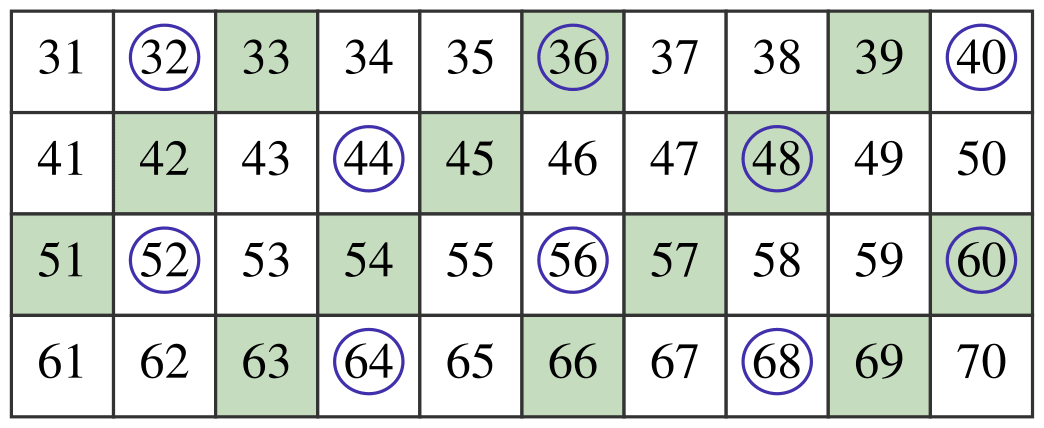
In the table,
- Is there anything common among the shaded numbers?
- Is there anything common among the circled numbers?
- Which numbers are both shaded and circled? What are these numbers called?
Answer
1. The shaded numbers in the table are:
33, 36, 39, 42, 45, 48, 51, 54, 57, 60, 63, 66, 69.
Writing each of them as a product with 3,
33 = 3 × 11, 36 = 3 × 12, 39 = 3 × 13, 42 = 3 × 14, 45 = 3 × 15,
48 = 3 × 16, 51 = 3 × 17, 54 = 3 × 18, 57 = 3 × 19, 60 = 3 × 20,
63 = 3 × 21, 66 = 3 × 22, 69 = 3 × 23.
So, every shaded number is a multiple of 3. Also, no multiple of 3 lying between 31 and 70 has been left unshaded.
∴ the shaded numbers are exactly the multiples of 3.
2. The circled numbers in the table are:
32, 36, 40, 44, 48, 52, 56, 60, 64, 68.
Writing each of them as a product with 4,
32 = 4 × 8, 36 = 4 × 9, 40 = 4 × 10, 44 = 4 × 11, 48 = 4 × 12,
52 = 4 × 13, 56 = 4 × 14, 60 = 4 × 15, 64 = 4 × 16, 68 = 4 × 17.
So, every circled number is a multiple of 4. Also, no multiple of 4 lying between 31 and 70 has been left uncircled.
∴ the circled numbers are exactly the multiples of 4.
3. The numbers which are shaded as well as circled appear in both the lists above. These are:
36, 48, 60.
Each of these is a multiple of 3 and also a multiple of 4, so each is a common multiple of 3 and 4.
Further, writing them as products with 12,
36 = 12 × 3, 48 = 12 × 4, 60 = 12 × 5.
So, they are precisely the multiples of 12 lying in the table.
Hence, the shaded numbers are the multiples of 3, the circled numbers are the multiples of 4, and the numbers 36, 48 and 60 which are both shaded and circled are called the common multiples of 3 and 4.
Find all multiples of 40 that lie between 310 and 410.
Answer
The multiples of 40 are obtained by multiplying 40 by 1, 2, 3, … successively.
40 × 1 = 40, 40 × 2 = 80, 40 × 3 = 120, 40 × 4 = 160, 40 × 5 = 200,
40 × 6 = 240, 40 × 7 = 280, 40 × 8 = 320, 40 × 9 = 360, 40 × 10 = 400,
40 × 11 = 440.
Out of these, the multiples lying between 310 and 410 are 320, 360 and 400.
Since 280 is less than 310 and 440 is greater than 410, no other multiple of 40 lies between 310 and 410.
Hence, the multiples of 40 lying between 310 and 410 are 320, 360 and 400.
Who am I?
(a) I am a number less than 40. One of my factors is 7. The sum of my digits is 8.
(b) I am a number less than 100. Two of my factors are 3 and 5. One of my digits is 1 more than the other.
Answer
(a) Since 7 is a factor of the number, the number is a multiple of 7.
The multiples of 7 which are less than 40 are:
7, 14, 21, 28, 35.
Now we find the sum of the digits of each of these numbers:
Sum of digits of 7 = 7,
Sum of digits of 14 = 1 + 4 = 5,
Sum of digits of 21 = 2 + 1 = 3,
Sum of digits of 28 = 2 + 8 = 10,
Sum of digits of 35 = 3 + 5 = 8.
Only 35 has the sum of its digits equal to 8.
Hence, the number is 35.
(b) Since 3 and 5 are both factors of the number, the number is a common multiple of 3 and 5.
The common multiples of 3 and 5 which are less than 100 are:
15, 30, 45, 60, 75, 90.
Now we compare the digits of each of these numbers:
In 15, the digits are 1 and 5. 5 is not 1 more than 1.
In 30, the digits are 3 and 0. 3 is not 1 more than 0.
In 45, the digits are 4 and 5. 5 is 1 more than 4.
In 60, the digits are 6 and 0. 6 is not 1 more than 0.
In 75, the digits are 7 and 5. 7 is not 1 more than 5.
In 90, the digits are 9 and 0. 9 is not 1 more than 0.
Only in 45 is one digit 1 more than the other.
Hence, the number is 45.
A number for which the sum of all its factors is equal to twice the number is called a perfect number. The number 28 is a perfect number. Its factors are 1, 2, 4, 7, 14 and 28. Their sum is 56 which is twice 28. Find a perfect number between 1 and 10.
Answer
We write down all the factors of each number between 1 and 10 and find their sum.
| Number | All its factors | Sum of the factors | Twice the number |
|---|---|---|---|
| 1 | 1 | 1 | 2 |
| 2 | 1, 2 | 3 | 4 |
| 3 | 1, 3 | 4 | 6 |
| 4 | 1, 2, 4 | 7 | 8 |
| 5 | 1, 5 | 6 | 10 |
| 6 | 1, 2, 3, 6 | 12 | 12 |
| 7 | 1, 7 | 8 | 14 |
| 8 | 1, 2, 4, 8 | 15 | 16 |
| 9 | 1, 3, 9 | 13 | 18 |
| 10 | 1, 2, 5, 10 | 18 | 20 |
Only for the number 6 is the sum of all its factors equal to twice the number, as
1 + 2 + 3 + 6 = 12 = 2 × 6.
Hence, 6 is the perfect number between 1 and 10.
Find the common factors of:
(a) 20 and 28
(b) 35 and 50
(c) 4, 8 and 12
(d) 5, 15 and 25
Answer
(a) Factors of 20 = 1, 2, 4, 5, 10, 20.
Factors of 28 = 1, 2, 4, 7, 14, 28.
The factors appearing in both the lists are 1, 2 and 4.
Hence, the common factors of 20 and 28 are 1, 2 and 4.
(b) Factors of 35 = 1, 5, 7, 35.
Factors of 50 = 1, 2, 5, 10, 25, 50.
The factors appearing in both the lists are 1 and 5.
Hence, the common factors of 35 and 50 are 1 and 5.
(c) Factors of 4 = 1, 2, 4.
Factors of 8 = 1, 2, 4, 8.
Factors of 12 = 1, 2, 3, 4, 6, 12.
The factors appearing in all the three lists are 1, 2 and 4.
Hence, the common factors of 4, 8 and 12 are 1, 2 and 4.
(d) Factors of 5 = 1, 5.
Factors of 15 = 1, 3, 5, 15.
Factors of 25 = 1, 5, 25.
The factors appearing in all the three lists are 1 and 5.
Hence, the common factors of 5, 15 and 25 are 1 and 5.
Find any three numbers that are multiples of 25 but not multiples of 50.
Answer
The multiples of 25 are:
25, 50, 75, 100, 125, 150, 175, 200, ….
The multiples of 50 are:
50, 100, 150, 200, ….
We observe that every second multiple of 25, that is 25 × 2, 25 × 4, 25 × 6, … is also a multiple of 50.
So, the multiples of 25 which are not multiples of 50 are those obtained by multiplying 25 by an odd number, namely
25 × 1 = 25, 25 × 3 = 75, 25 × 5 = 125, 25 × 7 = 175, ….
Taking any three of these, we get 25, 75 and 125.
Hence, 25, 75 and 125 are three numbers that are multiples of 25 but not multiples of 50.
Anshu and his friends play the ‘idli-vada’ game with two numbers, which are both smaller than 10. The first time anybody says ‘idli-vada’ is after the number 50. What could the two numbers be which are assigned ‘idli’ and ‘vada’?
Answer
In the ‘idli-vada’ game, the players say ‘idli-vada’ at the common multiples of the two chosen numbers.
So, the first time ‘idli-vada’ is said is at the smallest common multiple of the two numbers.
Given that this happens after the number 50, the smallest common multiple of the two numbers must be greater than 50.
Now, the smallest common multiple of two numbers is never greater than their product. So, the product of the two numbers must also be greater than 50.
Since both the numbers are smaller than 10, the pairs whose product is greater than 50 are:
6 and 9, since 6 × 9 = 54,
7 and 8, since 7 × 8 = 56,
7 and 9, since 7 × 9 = 63,
8 and 9, since 8 × 9 = 72.
We now check the smallest common multiple in each case.
For 6 and 9: multiples of 6 are 6, 12, 18, … and multiples of 9 are 9, 18, 27, ….
The smallest common multiple is 18, which is not greater than 50. So, this pair is rejected.
For 7 and 8: 7 and 8 have no common factor other than 1, so the smallest common multiple is 7 × 8 = 56, which is greater than 50. So, this pair is accepted.
For 7 and 9: 7 and 9 have no common factor other than 1, so the smallest common multiple is 7 × 9 = 63, which is greater than 50. So, this pair is accepted.
For 8 and 9: 8 and 9 have no common factor other than 1, so the smallest common multiple is 8 × 9 = 72, which is greater than 50. So, this pair is accepted.
Hence, the two numbers could be 7 and 8, or 7 and 9, or 8 and 9.
In the treasure hunting game, Grumpy has kept treasures on 28 and 70. What jump sizes will land on both the numbers?
Answer
Jumpy starts at 0 and lands only on the multiples of his chosen jump size.
So, a jump size will land on a number only if it is a factor of that number.
Therefore, the jump sizes that land on both 28 and 70 are the common factors of 28 and 70.
Factors of 28 = 1, 2, 4, 7, 14, 28.
Factors of 70 = 1, 2, 5, 7, 10, 14, 35, 70.
The factors appearing in both the lists are 1, 2, 7 and 14.
Hence, the jump sizes 1, 2, 7 and 14 will land on both 28 and 70.
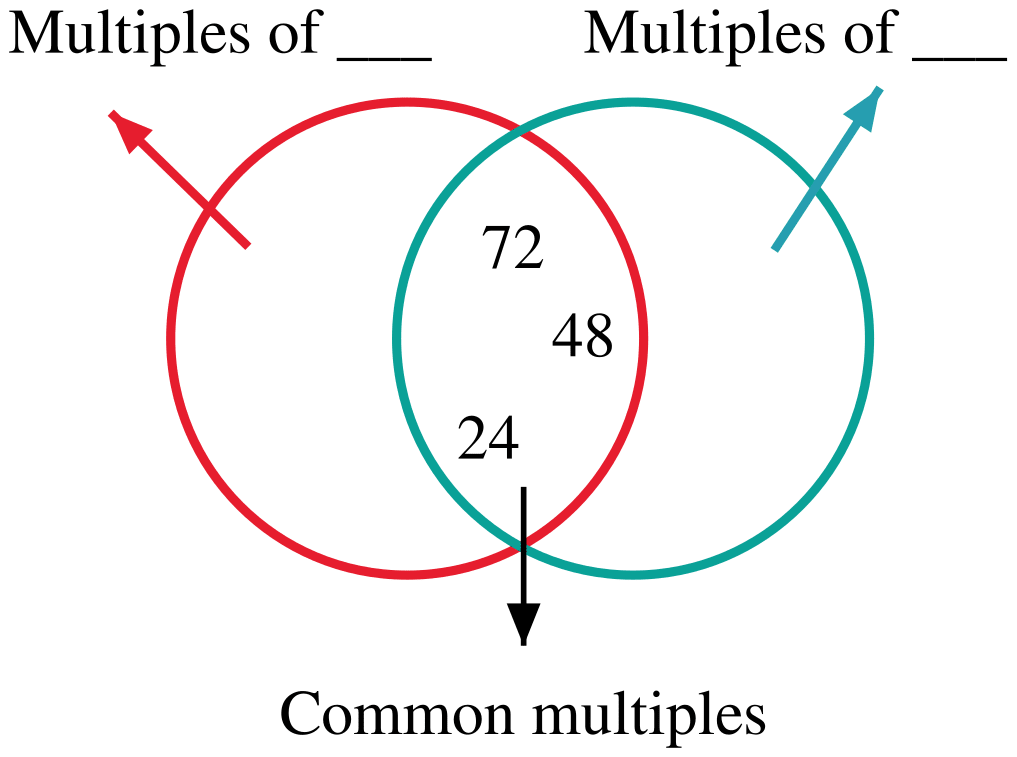
In the diagram below, Guna has erased all the numbers except the common multiples. Find out what those numbers could be and fill in the missing numbers in the empty regions.
Answer
The common multiples shown in the overlapping region of the diagram are 24, 48 and 72.
The smallest of these is 24, so the smallest common multiple of the two numbers must be 24.
Also, 48 = 24 × 2 and 72 = 24 × 3, so the common multiples are exactly the multiples of 24 up to 72.
Two numbers whose smallest common multiple is 24 are 8 and 12, because
multiples of 8 are 8, 16, 24, 32, 40, 48, 56, 64, 72, …
multiples of 12 are 12, 24, 36, 48, 60, 72, …
and the smallest number appearing in both the lists is 24.
So, the first blank can be filled with 8 and the second blank with 12.
Listing the multiples up to 72, we get:
Multiples of 8 which are not multiples of 12 = 8, 16, 32, 40, 56, 64.
Multiples of 12 which are not multiples of 8 = 12, 36, 60.
Common multiples of 8 and 12 = 24, 48, 72.
The completed diagram is shown below.
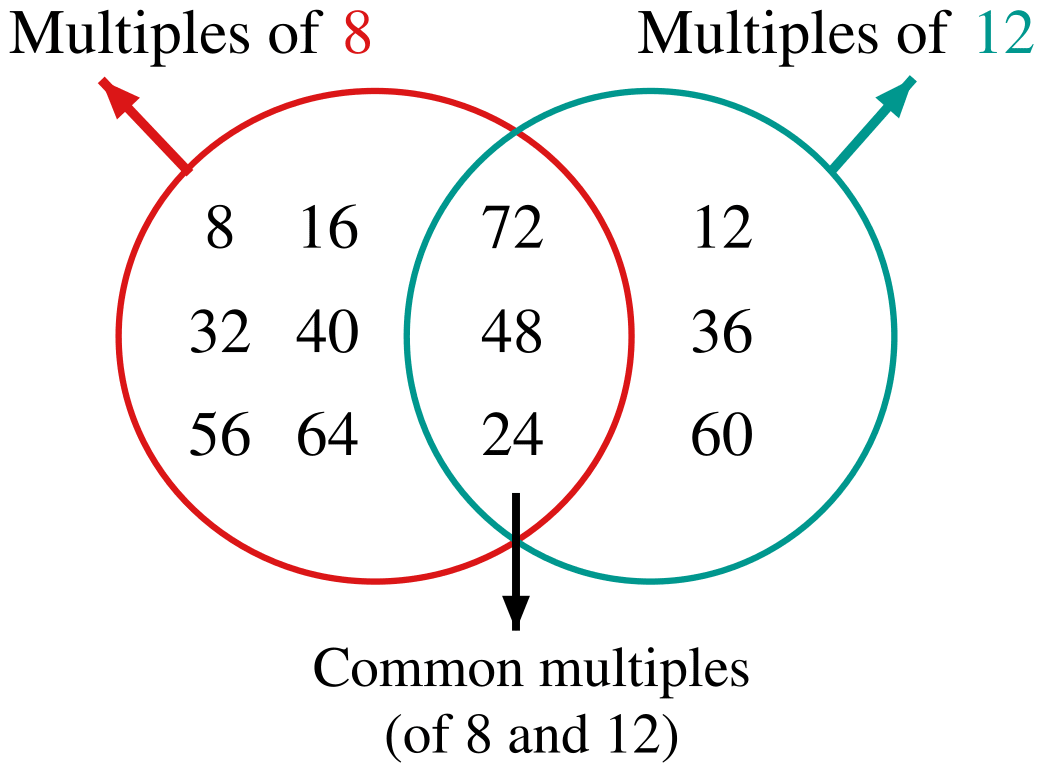
Hence, the two numbers could be 8 and 12. The region of multiples of 8 alone contains 8, 16, 32, 40, 56 and 64, the region of multiples of 12 alone contains 12, 36 and 60, and the common region contains 24, 48 and 72.
Find the smallest number that is a multiple of all the numbers from 1 to 10, except for 7.
Answer
The required number must be a multiple of 1, 2, 3, 4, 5, 6, 8, 9 and 10.
We write the prime factorisation of each of these numbers.
2 = 2
3 = 3
4 = 2 × 2
5 = 5
6 = 2 × 3
8 = 2 × 2 × 2
9 = 3 × 3
10 = 2 × 5
Every number is a multiple of 1, so 1 need not be considered.
For the required number to be a multiple of each of these numbers, its prime factorisation must include the prime factorisation of each of them.
The prime 2 occurs the greatest number of times in 8, where it occurs three times.
The prime 3 occurs the greatest number of times in 9, where it occurs two times.
The prime 5 occurs the greatest number of times in 5 and in 10, where it occurs once.
So, the smallest such number is
2 × 2 × 2 × 3 × 3 × 5
= 8 × 9 × 5
= 72 × 5
= 360.
Let us verify that 360 is divisible by each of the required numbers:
360 ÷ 2 = 180, 360 ÷ 3 = 120, 360 ÷ 4 = 90, 360 ÷ 5 = 72,
360 ÷ 6 = 60, 360 ÷ 8 = 45, 360 ÷ 9 = 40, 360 ÷ 10 = 36.
Hence, the smallest number that is a multiple of all the numbers from 1 to 10, except for 7, is 360.
Find the smallest number that is a multiple of all the numbers from 1 to 10.
Answer
The required number must be a multiple of 1, 2, 3, 4, 5, 6, 7, 8, 9 and 10.
From the previous question, the smallest number that is a multiple of all the numbers from 1 to 10, except 7, is
360 = 2 × 2 × 2 × 3 × 3 × 5.
Now the required number must also be a multiple of 7.
The prime factorisation of 7 is 7 itself, and 7 does not appear in the prime factorisation of 360.
So, the prime factorisation of the required number must include one more prime factor 7.
Therefore, the smallest such number is
2 × 2 × 2 × 3 × 3 × 5 × 7
= 360 × 7
= 2520.
Let us verify that 2520 is divisible by each of the required numbers:
2520 ÷ 2 = 1260, 2520 ÷ 3 = 840, 2520 ÷ 4 = 630, 2520 ÷ 5 = 504,
2520 ÷ 6 = 420, 2520 ÷ 7 = 360, 2520 ÷ 8 = 315, 2520 ÷ 9 = 280,
2520 ÷ 10 = 252.
Hence, the smallest number that is a multiple of all the numbers from 1 to 10 is 2520.
How many prime numbers are there from 21 to 30? How many composite numbers are there from 21 to 30?
Answer
A number that has only two factors, 1 and the number itself, is a prime number. A number that has more than two factors is a composite number.
Let us list the factors of each number from 21 to 30.
| Number | Factors | Number of factors | Prime / Composite |
|---|---|---|---|
| 21 | 1, 3, 7, 21 | 4 | Composite |
| 22 | 1, 2, 11, 22 | 4 | Composite |
| 23 | 1, 23 | 2 | Prime |
| 24 | 1, 2, 3, 4, 6, 8, 12, 24 | 8 | Composite |
| 25 | 1, 5, 25 | 3 | Composite |
| 26 | 1, 2, 13, 26 | 4 | Composite |
| 27 | 1, 3, 9, 27 | 4 | Composite |
| 28 | 1, 2, 4, 7, 14, 28 | 6 | Composite |
| 29 | 1, 29 | 2 | Prime |
| 30 | 1, 2, 3, 5, 6, 10, 15, 30 | 8 | Composite |
From the table, the prime numbers from 21 to 30 are 23 and 29. So, there are 2 prime numbers.
The composite numbers from 21 to 30 are 21, 22, 24, 25, 26, 27, 28 and 30. So, there are 8 composite numbers.
Hence, there are 2 prime numbers and 8 composite numbers from 21 to 30.
We see that 2 is a prime and also an even number. Is there any other even prime?
Answer
Every even number other than 2 is a multiple of 2, and so it is divisible by 2.
So, such a number has at least three factors — 1, 2 and the number itself.
For example, 4 has the factors 1, 2 and 4; 6 has the factors 1, 2, 3 and 6.
Since a prime number must have exactly two factors, no even number other than 2 can be prime.
Hence, 2 is the only even prime number.
Look at the list of primes till 100. What is the smallest difference between two successive primes? What is the largest difference?
Answer
The prime numbers till 100 are:
2, 3, 5, 7, 11, 13, 17, 19, 23, 29, 31, 37, 41, 43, 47, 53, 59, 61, 67, 71, 73, 79, 83, 89, 97.
The differences between successive primes are:
3 - 2 = 1
5 - 3 = 2
7 - 5 = 2
11 - 7 = 4
13 - 11 = 2
17 - 13 = 4
19 - 17 = 2
23 - 19 = 4
29 - 23 = 6
31 - 29 = 2
37 - 31 = 6
41 - 37 = 4
43 - 41 = 2
47 - 43 = 4
53 - 47 = 6
59 - 53 = 6
61 - 59 = 2
67 - 61 = 6
71 - 67 = 4
73 - 71 = 2
79 - 73 = 6
83 - 79 = 4
89 - 83 = 6
97 - 89 = 8
The smallest of these differences is 1, which occurs between the primes 2 and 3.
The largest of these differences is 8, which occurs between the primes 89 and 97.
Hence, the smallest difference between two successive primes is 1 and the largest difference is 8.
Are there an equal number of primes occurring in every row in the table on the previous page? Which decades have the least number of primes? Which have the most number of primes?
Answer
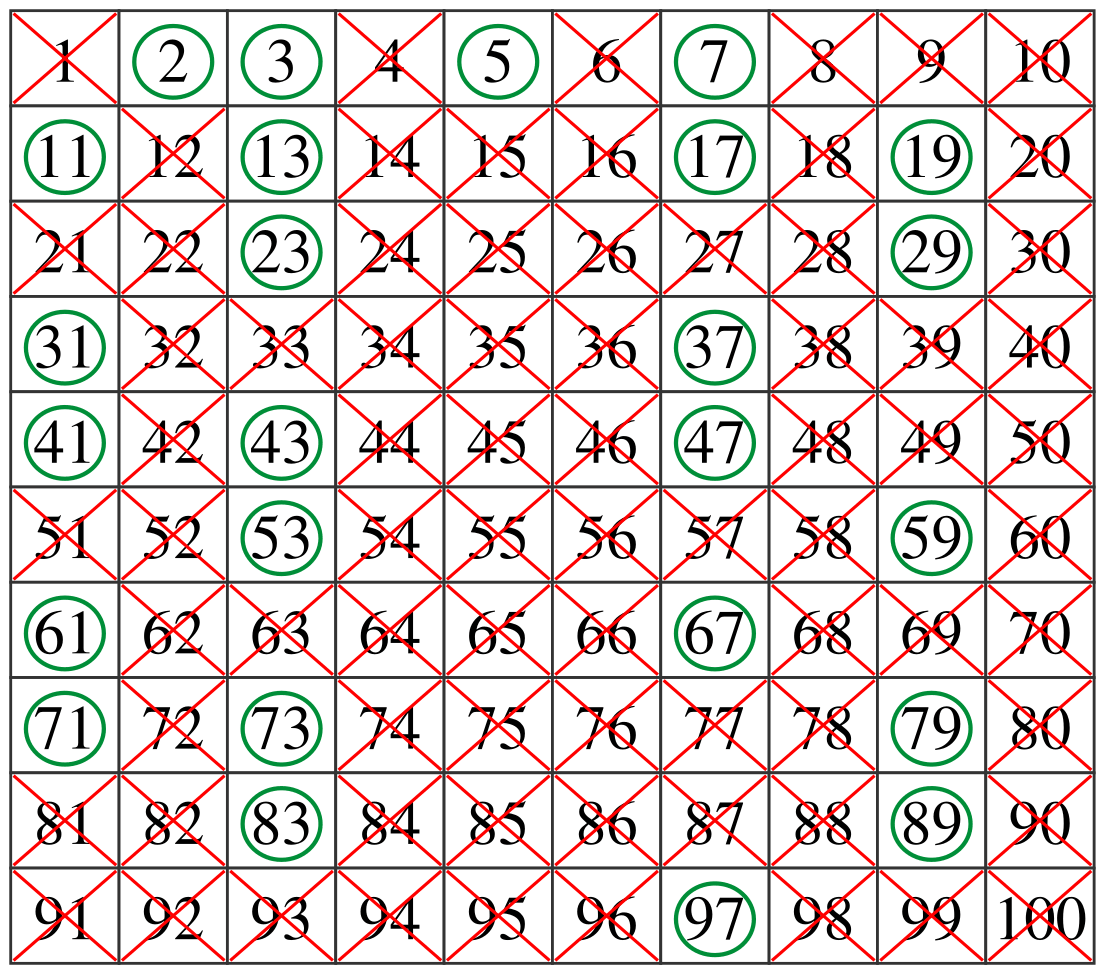
Each row of the table contains one decade, that is, ten consecutive numbers. Counting the primes in each row we get:
| Decade (row) | Primes in the row | Number of primes |
|---|---|---|
| 1 – 10 | 2, 3, 5, 7 | 4 |
| 11 – 20 | 11, 13, 17, 19 | 4 |
| 21 – 30 | 23, 29 | 2 |
| 31 – 40 | 31, 37 | 2 |
| 41 – 50 | 41, 43, 47 | 3 |
| 51 – 60 | 53, 59 | 2 |
| 61 – 70 | 61, 67 | 2 |
| 71 – 80 | 71, 73, 79 | 3 |
| 81 – 90 | 83, 89 | 2 |
| 91 – 100 | 97 | 1 |
The counts 4, 4, 2, 2, 3, 2, 2, 3, 2, 1 are not all the same. So, the number of primes is not the same in every row.
The smallest count is 1, which occurs in the decade 91 – 100.
The largest count is 4, which occurs in the decades 1 – 10 and 11 – 20.
Hence, the rows do not contain an equal number of primes. The decade 91 – 100 has the least number of primes (only 1), and the decades 1 – 10 and 11 – 20 have the most number of primes (4 each).
Which of the following numbers are prime: 23, 51, 37, 26?
Answer
We list the factors of each number.
Factors of 23 = 1, 23.
Since 23 has exactly two factors, 23 is a prime number.
Factors of 51 = 1, 3, 17, 51.
Since 51 has more than two factors, 51 is a composite number.
Factors of 37 = 1, 37.
Since 37 has exactly two factors, 37 is a prime number.
Factors of 26 = 1, 2, 13, 26.
Since 26 has more than two factors, 26 is a composite number.
Hence, among the given numbers, 23 and 37 are prime numbers.
Write three pairs of prime numbers less than 20 whose sum is a multiple of 5.
Answer
The prime numbers less than 20 are:
2, 3, 5, 7, 11, 13, 17, 19.
We choose pairs from this list whose sum is a multiple of 5.
2 + 3 = 5, and 5 = 5 × 1, which is a multiple of 5.
3 + 7 = 10, and 10 = 5 × 2, which is a multiple of 5.
2 + 13 = 15, and 15 = 5 × 3, which is a multiple of 5.
Hence, three such pairs are (2, 3), (3, 7) and (2, 13).
The numbers 13 and 31 are prime numbers. Both these numbers have same digits 1 and 3. Find such pairs of prime numbers up to 100.
Answer
We need pairs of two-digit prime numbers up to 100 such that reversing the digits of one gives the other.
The two-digit prime numbers up to 100 are:
11, 13, 17, 19, 23, 29, 31, 37, 41, 43, 47, 53, 59, 61, 67, 71, 73, 79, 83, 89, 97.
Reversing the digits of each and checking which reversals are also primes in the list, we get:
13 and 31 — both are prime,
17 and 71 — both are prime,
37 and 73 — both are prime,
79 and 97 — both are prime.
Hence, the required pairs are (13, 31), (17, 71), (37, 73) and (79, 97).
Find seven consecutive composite numbers between 1 and 100.
Answer
We look for a block of seven numbers in a row, each of which is composite, that is, none of which is prime.
Consider the numbers from 90 to 96.
90 = 2 × 45, so 90 is composite.
91 = 7 × 13, so 91 is composite.
92 = 2 × 46, so 92 is composite.
93 = 3 × 31, so 93 is composite.
94 = 2 × 47, so 94 is composite.
95 = 5 × 19, so 95 is composite.
96 = 2 × 48, so 96 is composite.
Since none of these seven numbers is prime, they are seven consecutive composite numbers.
Hence, 90, 91, 92, 93, 94, 95 and 96 are seven consecutive composite numbers between 1 and 100.
Twin primes are pairs of primes having a difference of 2. For example, 3 and 5 are twin primes. So are 17 and 19. Find the other twin primes between 1 and 100.
Answer
The prime numbers between 1 and 100 are:
2, 3, 5, 7, 11, 13, 17, 19, 23, 29, 31, 37, 41, 43, 47, 53, 59, 61, 67, 71, 73, 79, 83, 89, 97.
From this list we pick the pairs of primes whose difference is 2.
5 - 3 = 2, so (3, 5) are twin primes.
7 - 5 = 2, so (5, 7) are twin primes.
13 - 11 = 2, so (11, 13) are twin primes.
19 - 17 = 2, so (17, 19) are twin primes.
31 - 29 = 2, so (29, 31) are twin primes.
43 - 41 = 2, so (41, 43) are twin primes.
61 - 59 = 2, so (59, 61) are twin primes.
73 - 71 = 2, so (71, 73) are twin primes.
The pairs (3, 5) and (17, 19) are already given in the question.
Hence, the other twin primes between 1 and 100 are (5, 7), (11, 13), (29, 31), (41, 43), (59, 61) and (71, 73).
Identify whether each statement is true or false. Explain.
(a) There is no prime number whose units digit is 4.
(b) A product of primes can also be prime.
(c) Prime numbers do not have any factors.
(d) All even numbers are composite numbers.
(e) 2 is a prime and so is the next number, 3. For every other prime, the next number is composite.
Answer
(a) There is no prime number whose units digit is 4.
A number whose units digit is 4 is an even number, so it is divisible by 2.
Every such number is greater than 2, and hence has 1, 2 and itself as factors, that is, more than two factors.
So, no number ending in 4 can be prime.
∴ The statement is true.
(b) A product of primes can also be prime.
If we multiply two or more primes, say 2 × 3 = 6, then the product has 1, each of the primes and the product itself as factors.
Here 6 has the factors 1, 2, 3 and 6, which are more than two factors.
So, a product of two or more primes is always composite and never prime.
∴ The statement is false.
(c) Prime numbers do not have any factors.
A prime number has exactly two factors — 1 and the number itself.
For example, the factors of 7 are 1 and 7, and the factors of 13 are 1 and 13.
So, prime numbers do have factors; what is special is that they have only two of them.
∴ The statement is false.
(d) All even numbers are composite numbers.
The number 2 is an even number, but its only factors are 1 and 2.
Since 2 has exactly two factors, it is a prime number and not a composite number.
So, not every even number is composite.
∴ The statement is false.
(e) 2 is a prime and so is the next number, 3. For every other prime, the next number is composite.
Every prime number other than 2 is an odd number.
If p is an odd prime, then p + 1 is an even number, and p + 1 is greater than 2.
So, p + 1 has 1, 2 and itself as factors, that is, more than two factors, and hence p + 1 is composite.
For example, for the prime 5 the next number 6 is composite; for the prime 7 the next number 8 is composite.
∴ The statement is true.
Which of the following numbers is the product of exactly three distinct prime numbers: 45, 60, 91, 105, 330?
Answer
We write each of the given numbers as a product of prime numbers.
45 = 3 × 3 × 5.
Here only two distinct primes 3 and 5 occur, and 3 occurs twice.
60 = 2 × 2 × 3 × 5.
Here three distinct primes 2, 3 and 5 occur, but 2 occurs twice, so 60 is not the product of exactly three primes.
91 = 7 × 13.
Here only two distinct primes 7 and 13 occur.
105 = 3 × 5 × 7.
Here exactly three distinct primes 3, 5 and 7 occur, each exactly once.
330 = 2 × 3 × 5 × 11.
Here four distinct primes 2, 3, 5 and 11 occur.
So, only 105 is the product of exactly three distinct prime numbers.
Hence, 105 is the product of exactly three distinct prime numbers.
How many three-digit prime numbers can you make using each of 2, 4 and 5 once?
Answer
Using each of the digits 2, 4 and 5 exactly once, the three-digit numbers that can be formed are:
245, 254, 425, 452, 524 and 542.
The units digit of every such number is 2, 4 or 5.
A number ending in 2 or 4 is even, so it is divisible by 2.
A number ending in 5 is divisible by 5.
Since each of these numbers is a three-digit number, it is greater than the divisor found above, so each has more than two factors.
Checking each number:
245 = 5 × 49, so 245 is composite.
254 = 2 × 127, so 254 is composite.
425 = 5 × 85, so 425 is composite.
452 = 2 × 226, so 452 is composite.
524 = 2 × 262, so 524 is composite.
542 = 2 × 271, so 542 is composite.
So, none of these six numbers is prime.
Hence, no three-digit prime number can be made using each of 2, 4 and 5 once.
Observe that 3 is a prime number, and 2 × 3 + 1 = 7 is also a prime. Are there other primes for which doubling and adding 1 gives another prime? Find at least five such examples.
Answer
We take a prime number p, find 2 × p + 1, and check whether the result is also a prime.
For p = 2, 2 × 2 + 1 = 5, and 5 is a prime.
For p = 5, 2 × 5 + 1 = 11, and 11 is a prime.
For p = 11, 2 × 11 + 1 = 23, and 23 is a prime.
For p = 23, 2 × 23 + 1 = 47, and 47 is a prime.
For p = 29, 2 × 29 + 1 = 59, and 59 is a prime.
For p = 41, 2 × 41 + 1 = 83, and 83 is a prime.
So, there are many other primes for which doubling and adding 1 gives another prime.
Hence, five such examples are 2 (giving 5), 5 (giving 11), 11 (giving 23), 23 (giving 47) and 29 (giving 59).
Where should Grumpy place the treasures so that Jumpy cannot reach both the treasures?
Answer
Jumpy starts from 0 and moves forward in jumps of one fixed size, so the numbers he lands on are exactly the multiples of his jump size.
This means Jumpy reaches a treasure number only when his jump size is a factor of that number.
∴ Jumpy reaches both the treasures only when his jump size is a common factor of the two numbers on which the treasures are kept.
Since a jump size of 1 is not allowed, Jumpy fails whenever the two numbers have no common factor other than 1.
So, Grumpy should place the treasures on two numbers whose only common factor is 1, that is, on a pair of co-prime numbers.
For example, if the treasures are placed on 4 and 9, then
factors of 4 = 1, 2, 4
factors of 9 = 1, 3, 9.
The only common factor is 1, and a jump size of 1 is not allowed. So Jumpy can never reach both 4 and 9.
Hence, Grumpy should place the treasures on two numbers having no common factor other than 1, that is, on a pair of co-prime numbers such as 4 and 9.
Check if these pairs are safe:
(a) 15 and 39
(b) 4 and 15
(c) 18 and 29
(d) 20 and 55
Answer
A pair is safe only if the two numbers have no common factor other than 1, because a jump size of 1 is not allowed.
(a) 15 and 39
Factors of 15 = 1, 3, 5, 15
Factors of 39 = 1, 3, 13, 39.
Common factors = 1, 3.
Since 3 is a common factor other than 1, Jumpy can reach both 15 and 39 with a jump size of 3.
∴ The pair 15 and 39 is not safe.
(b) 4 and 15
Factors of 4 = 1, 2, 4
Factors of 15 = 1, 3, 5, 15.
The only common factor is 1.
∴ The pair 4 and 15 is safe.
(c) 18 and 29
Factors of 18 = 1, 2, 3, 6, 9, 18
Factors of 29 = 1, 29.
The only common factor is 1.
∴ The pair 18 and 29 is safe.
(d) 20 and 55
Factors of 20 = 1, 2, 4, 5, 10, 20
Factors of 55 = 1, 5, 11, 55.
Common factors = 1, 5.
Since 5 is a common factor other than 1, Jumpy can reach both 20 and 55 with a jump size of 5.
∴ The pair 20 and 55 is not safe.
Hence, the safe pairs are 4 and 15, and 18 and 29, while the pairs 15 and 39, and 20 and 55 are not safe.
Which of the following pairs of numbers are co-prime?
(a) 18 and 35
(b) 15 and 37
(c) 30 and 415
(d) 17 and 69
(e) 81 and 18
Answer
Two numbers are co-prime if they have no common factor other than 1.
(a) 18 and 35
Factors of 18 = 1, 2, 3, 6, 9, 18
Factors of 35 = 1, 5, 7, 35.
The only common factor is 1, so 18 and 35 are co-prime.
(b) 15 and 37
Factors of 15 = 1, 3, 5, 15
Factors of 37 = 1, 37.
The only common factor is 1, so 15 and 37 are co-prime.
(c) 30 and 415
Factors of 30 = 1, 2, 3, 5, 6, 10, 15, 30
Factors of 415 = 1, 5, 83, 415.
Common factors = 1, 5.
Since 5 is a common factor other than 1, 30 and 415 are not co-prime.
(d) 17 and 69
Factors of 17 = 1, 17
Factors of 69 = 1, 3, 23, 69.
The only common factor is 1, so 17 and 69 are co-prime.
(e) 81 and 18
Factors of 81 = 1, 3, 9, 27, 81
Factors of 18 = 1, 2, 3, 6, 9, 18.
Common factors = 1, 3, 9.
Since 3 and 9 are common factors other than 1, 81 and 18 are not co-prime.
Hence, the co-prime pairs are (a) 18 and 35, (b) 15 and 37, and (d) 17 and 69.
While playing the ‘idli-vada’ game with different number pairs, Anshu observed something interesting!
- Sometimes the first common multiple was the same as the product of the two numbers.
- At other times the first common multiple was less than the product of the two numbers.
Find examples for each of the above. How is it related to the number pair being co-prime?
Answer
1. First common multiple equal to the product
Take the pair 3 and 5.
Multiples of 3 = 3, 6, 9, 12, 15, …
Multiples of 5 = 5, 10, 15, …
The first common multiple is 15, and the product is 3 × 5 = 15.
Two more such pairs are given below.
| Number pair | First common multiple | Product |
|---|---|---|
| 3 and 5 | 15 | 15 |
| 3 and 7 | 21 | 21 |
| 4 and 9 | 36 | 36 |
In each of these pairs, the two numbers have no common factor other than 1, that is, they are co-prime.
2. First common multiple less than the product
Take the pair 3 and 6.
Multiples of 3 = 3, 6, 9, …
Multiples of 6 = 6, 12, 18, …
The first common multiple is 6, while the product is 3 × 6 = 18. So the first common multiple is less than the product.
Two more such pairs are given below.
| Number pair | First common multiple | Product |
|---|---|---|
| 3 and 6 | 6 | 18 |
| 3 and 12 | 12 | 36 |
| 6 and 15 | 30 | 90 |
In each of these pairs, the two numbers have a common factor greater than 1, that is, they are not co-prime.
So, when a pair is co-prime, nothing can be cancelled between the two numbers, and the smallest number that both divide is their full product. When the pair has a common factor greater than 1, that common factor is counted only once in the first common multiple, and so the first common multiple falls short of the product.
Hence, the first common multiple of a pair of numbers equals their product exactly when the pair is co-prime, and it is less than their product when the numbers have a common factor other than 1.
Find the prime factorisations of the following numbers: 64, 104, 105, 243, 320, 141, 1728, 729, 1024, 1331, 1000.
Answer
Each number is broken into factors repeatedly until only prime numbers are left.
64 = 2 × 32 = 2 × 2 × 16 = 2 × 2 × 2 × 8 = 2 × 2 × 2 × 2 × 4 = 2 × 2 × 2 × 2 × 2 × 2.
104 = 2 × 52 = 2 × 2 × 26 = 2 × 2 × 2 × 13.
105 = 5 × 21 = 3 × 5 × 7.
243 = 3 × 81 = 3 × 3 × 27 = 3 × 3 × 3 × 9 = 3 × 3 × 3 × 3 × 3.
320 = 64 × 5 = (2 × 2 × 2 × 2 × 2 × 2) × 5 = 2 × 2 × 2 × 2 × 2 × 2 × 5.
141 = 3 × 47, and 47 is a prime number.
1728 = 64 × 27 = (2 × 2 × 2 × 2 × 2 × 2) × (3 × 3 × 3) = 2 × 2 × 2 × 2 × 2 × 2 × 3 × 3 × 3.
729 = 3 × 243 = 3 × (3 × 3 × 3 × 3 × 3) = 3 × 3 × 3 × 3 × 3 × 3.
1024 = 2 × 512 = 2 × 2 × 256 = 2 × 2 × 2 × 128 = 2 × 2 × 2 × 2 × 64 = 2 × 2 × 2 × 2 × (2 × 2 × 2 × 2 × 2 × 2) = 2 × 2 × 2 × 2 × 2 × 2 × 2 × 2 × 2 × 2.
1331 = 11 × 121 = 11 × 11 × 11.
1000 = 8 × 125 = (2 × 2 × 2) × (5 × 5 × 5) = 2 × 2 × 2 × 5 × 5 × 5.
Hence, 64 = 2 × 2 × 2 × 2 × 2 × 2, 104 = 2 × 2 × 2 × 13, 105 = 3 × 5 × 7, 243 = 3 × 3 × 3 × 3 × 3, 320 = 2 × 2 × 2 × 2 × 2 × 2 × 5, 141 = 3 × 47, 1728 = 2 × 2 × 2 × 2 × 2 × 2 × 3 × 3 × 3, 729 = 3 × 3 × 3 × 3 × 3 × 3, 1024 = 2 × 2 × 2 × 2 × 2 × 2 × 2 × 2 × 2 × 2, 1331 = 11 × 11 × 11 and 1000 = 2 × 2 × 2 × 5 × 5 × 5.
The prime factorisation of a number has one 2, two 3s, and one 11. What is the number?
Answer
The number is obtained by multiplying together all the prime factors, each taken as many times as it occurs.
Here the prime factorisation is 2 × 3 × 3 × 11.
∴ The number = 2 × 3 × 3 × 11
= 2 × 9 × 11
= 18 × 11
= 198.
Hence, the number is 198, whose prime factorisation is 198 = 2 × 3 × 3 × 11.
Find three prime numbers, all less than 30, whose product is 1955.
Answer
The prime factorisation of 1955 has to be found.
Since 1955 ends in 5, it is divisible by 5.
Dividing by 5, we get = 391.
∴ 1955 = 5 × 391.
Now 391 has to be broken further.
391 is not divisible by 2 (it is odd), by 3 (the digit sum 3 + 9 + 1 = 13 is not a multiple of 3), by 5 (it does not end in 0 or 5), by 7 (7 × 55 = 385, leaving 6), by 11 (11 × 35 = 385, leaving 6) or by 13 (13 × 30 = 390, leaving 1).
Trying 17, we get 17 × 23 = 391.
∴ 391 = 17 × 23, where both 17 and 23 are prime numbers.
∴ 1955 = 5 × 17 × 23.
The three prime numbers 5, 17 and 23 are all less than 30.
Checking: 5 × 17 × 23 = 5 × 391 = 1955.
Hence, the three prime numbers are 5, 17 and 23, and 1955 = 5 × 17 × 23.
Find the prime factorisation of these numbers without multiplying first
(a) 56 × 25
(b) 108 × 75
(c) 1000 × 81
Answer
The prime factorisation of a product is obtained by putting together the prime factorisations of the two numbers.
(a) 56 × 25
56 = 2 × 28 = 2 × 2 × 14 = 2 × 2 × 2 × 7
25 = 5 × 5.
∴ 56 × 25 = 2 × 2 × 2 × 7 × 5 × 5
= 2 × 2 × 2 × 5 × 5 × 7.
(b) 108 × 75
108 = 2 × 54 = 2 × 2 × 27 = 2 × 2 × 3 × 3 × 3
75 = 3 × 25 = 3 × 5 × 5.
∴ 108 × 75 = 2 × 2 × 3 × 3 × 3 × 3 × 5 × 5.
(c) 1000 × 81
1000 = 8 × 125 = 2 × 2 × 2 × 5 × 5 × 5
81 = 9 × 9 = 3 × 3 × 3 × 3.
∴ 1000 × 81 = 2 × 2 × 2 × 5 × 5 × 5 × 3 × 3 × 3 × 3
= 2 × 2 × 2 × 3 × 3 × 3 × 3 × 5 × 5 × 5.
Hence, 56 × 25 = 2 × 2 × 2 × 5 × 5 × 7, 108 × 75 = 2 × 2 × 3 × 3 × 3 × 3 × 5 × 5 and 1000 × 81 = 2 × 2 × 2 × 3 × 3 × 3 × 3 × 5 × 5 × 5.
What is the smallest number whose prime factorisation has:
(a) three different prime numbers?
(b) four different prime numbers?
Answer
To keep the number as small as possible, each of the required prime numbers should be taken only once, and the smallest available prime numbers should be chosen.
(a) Three different prime numbers
The three smallest prime numbers are 2, 3 and 5.
∴ The smallest such number = 2 × 3 × 5
= 6 × 5
= 30.
(b) Four different prime numbers
The four smallest prime numbers are 2, 3, 5 and 7.
∴ The smallest such number = 2 × 3 × 5 × 7
= 30 × 7
= 210.
Hence, the smallest number whose prime factorisation has three different prime numbers is 30 = 2 × 3 × 5, and the smallest number whose prime factorisation has four different prime numbers is 210 = 2 × 3 × 5 × 7.
Are the following pairs of numbers co-prime? Guess first and then use prime factorisation to verify your answer.
(a) 30 and 45
(b) 57 and 85
(c) 121 and 1331
(d) 343 and 216
Answer
Two numbers are co-prime if they have no common factor other than 1. Using prime factorisation, two numbers are co-prime when they have no common prime factor.
(a) 30 and 45
30 = 2 × 3 × 5
45 = 3 × 3 × 5
Here, 3 and 5 are common prime factors of 30 and 45.
∴ 30 and 45 are not co-prime.
(b) 57 and 85
57 = 3 × 19
85 = 5 × 17
The prime factors of 57 are 3 and 19, while the prime factors of 85 are 5 and 17. There is no common prime factor.
∴ 57 and 85 are co-prime.
(c) 121 and 1331
121 = 11 × 11
1331 = 11 × 11 × 11
Here, 11 is a common prime factor of 121 and 1331.
∴ 121 and 1331 are not co-prime.
(d) 343 and 216
343 = 7 × 7 × 7
216 = 2 × 2 × 2 × 3 × 3 × 3
The only prime factor of 343 is 7, while the prime factors of 216 are 2 and 3. There is no common prime factor.
∴ 343 and 216 are co-prime.
Hence, (a) 30 and 45 are not co-prime, (b) 57 and 85 are co-prime, (c) 121 and 1331 are not co-prime and (d) 343 and 216 are co-prime.
Is the first number divisible by the second? Use prime factorisation.
(a) 225 and 27
(b) 96 and 24
(c) 343 and 17
(d) 999 and 99
Answer
One number is divisible by another only when the prime factorisation of the second number is completely included in the prime factorisation of the first number.
(a) 225 and 27
225 = 3 × 3 × 5 × 5
27 = 3 × 3 × 3
The prime 3 occurs three times in 27 but only twice in 225. So, the prime factorisation of 27 is not included in that of 225.
∴ 225 is not divisible by 27.
(b) 96 and 24
96 = 2 × 2 × 2 × 2 × 2 × 3
24 = 2 × 2 × 2 × 3
The prime factorisation of 24 is included in that of 96, as
96 = (2 × 2 × 2 × 3) × 2 × 2 = 24 × 4.
∴ 96 is divisible by 24.
(c) 343 and 17
343 = 7 × 7 × 7
17 = 17
The only prime factor of 343 is 7, and 17 does not occur in it.
∴ 343 is not divisible by 17.
(d) 999 and 99
999 = 3 × 3 × 3 × 37
99 = 3 × 3 × 11
The prime 11 is a prime factor of 99 but it is not a prime factor of 999. So, the prime factorisation of 99 is not included in that of 999.
∴ 999 is not divisible by 99.
Hence, only 96 is divisible by 24; in the other three cases the first number is not divisible by the second.
The first number has prime factorisation 2 × 3 × 7 and the second number has prime factorisation 3 × 7 × 11. Are they co-prime? Does one of them divide the other?
Answer
The first number is 2 × 3 × 7 = 42 and the second number is 3 × 7 × 11 = 231.
Here, 3 and 7 are common prime factors of both the numbers.
So, they have common factors other than 1, such as 3, 7 and 21.
∴ The two numbers are not co-prime.
Now, let us check divisibility.
The prime 11 occurs in the factorisation of the second number but not in the factorisation of the first number. So, the second number is not divisible by the first.
The prime 2 occurs in the factorisation of the first number but not in the factorisation of the second number. So, the first number is not divisible by the second.
Hence, the two numbers are not co-prime and neither of them divides the other.
Guna says, “Any two prime numbers are co-prime?”. Is he right?
Answer
A prime number has exactly two factors, 1 and the number itself.
So, if we take two different prime numbers, the only factor of the first number other than 1 is the number itself, and it cannot be a factor of the second prime number.
Therefore, the only common factor of two different prime numbers is 1, which means they are co-prime.
For example,
2 and 3: the only common factor is 1, so they are co-prime.
3 and 11: the only common factor is 1, so they are co-prime.
13 and 17: the only common factor is 1, so they are co-prime.
Hence, Guna is right — any two different prime numbers are co-prime.
Let us take 8560. Does it have any factors from 2 to 10 (2, 3, 4, 5, ..., 9, 10)? It is easy to check if some of these numbers are factors or not without doing long division. Can you find them?
Answer
Let us check each of the numbers from 2 to 10.
2: The last digit of 8560 is 0, which is even. So, 8560 is divisible by 2, and 8560 = 2 × 4280.
3: We have 3 × 2853 = 8559, which is 1 less than 8560. So, 8560 is not divisible by 3.
4: The number formed by the last two digits is 60, and 60 = 4 × 15 is divisible by 4. So, 8560 is divisible by 4, and 8560 = 4 × 2140.
5: The last digit of 8560 is 0. So, 8560 is divisible by 5, and 8560 = 5 × 1712.
6: We have 6 × 1426 = 8556, leaving a remainder of 4. So, 8560 is not divisible by 6.
7: We have 7 × 1222 = 8554, leaving a remainder of 6. So, 8560 is not divisible by 7.
8: The number formed by the last three digits is 560, and 560 = 8 × 70 is divisible by 8. So, 8560 is divisible by 8, and 8560 = 8 × 1070.
9: We have 9 × 951 = 8559, which is 1 less than 8560. So, 8560 is not divisible by 9.
10: The last digit of 8560 is 0. So, 8560 is divisible by 10, and 8560 = 10 × 856.
Hence, out of the numbers from 2 to 10, the factors of 8560 are 2, 4, 5, 8 and 10.
The first few multiples of 10 are: 10, 20, 30, 40, … Continue this sequence and observe the pattern. Is 125 a multiple of 10? Will this number appear in the previous sequence? Why or why not?
Answer
Continuing the sequence of multiples of 10, we get
10, 20, 30, 40, 50, 60, 70, 80, 90, 100, 110, 120, 130, 140, ….
Observing the pattern, we see that every multiple of 10 ends with the digit 0.
The number 125 ends with the digit 5 and not with 0. So, 125 is not a multiple of 10.
It will not appear in the sequence above, because the multiples of 10 near 125 are 120 and 130, and 125 lies between these two consecutive multiples.
Also, on dividing, 125 = 12 × 10 + 5, so the remainder is 5 and not 0.
Hence, 125 is not a multiple of 10 and it will not appear in the sequence, as it does not end with the digit 0.
Can you now answer if 8560 is divisible by 10?
Answer
The number 8560 ends with the digit 0.
From the pattern observed in the multiples of 10, every number ending with 0 is a multiple of 10.
Indeed, 8560 = 856 × 10.
∴ 8560 is divisible by 10, and the quotient is 856.
Hence, 8560 is divisible by 10.
Consider this statement:
Numbers that are divisible by 10 are those that end with ‘0’. Do you agree?
Answer
Yes, we agree with the statement.
Any number can be written as ten times the number formed by the digits before the units digit, plus the units digit. For example,
8560 = 856 × 10 + 0,
125 = 12 × 10 + 5.
Here, the part 856 × 10 (and in general, any multiple of 10) is always divisible by 10.
So, the number is divisible by 10 only when the units digit is divisible by 10.
The units digit is a single digit from 0 to 9, and out of these only 0 is divisible by 10.
∴ A number is divisible by 10 exactly when it ends with the digit 0.
Hence, we agree — numbers that are divisible by 10 are those that end with ‘0’.
Explore by listing down the multiples: 5, 10, 15, 20, 25, ... What do you observe about these numbers? Do you see a pattern in the last digit?
Answer
Listing down more multiples of 5, we get
5, 10, 15, 20, 25, 30, 35, 40, 45, 50, 55, 60, 65, 70, 75, 80, ….
We observe that the last digits of these numbers are
5, 0, 5, 0, 5, 0, 5, 0, ….
So, the last digit is alternately 5 and 0, and every multiple of 5 ends with either 5 or 0.
We also observe that every alternate multiple of 5 (that is, 10, 20, 30, 40, …) is a multiple of 10.
Hence, the multiples of 5 always end with the digit 5 or the digit 0, these two digits repeating alternately.
What is the largest number less than 399 that is divisible by 5? Is 8560 divisible by 5?
Answer
A number is divisible by 5 when it ends with 0 or 5.
The numbers just below 399 are 398, 397, 396, 395, ….
Out of these, 395 is the first number that ends with 5.
Indeed, 395 = 5 × 79.
So, the largest number less than 399 that is divisible by 5 is 395.
Now, the number 8560 ends with the digit 0.
∴ 8560 is divisible by 5, and 8560 = 5 × 1712.
Hence, the largest number less than 399 that is divisible by 5 is 395, and 8560 is divisible by 5.
Consider this statement:
Numbers that are divisible by 5 are those that end with either a ‘0’ or a ‘5’. Do you agree?
Answer
Yes, we agree with the statement.
Any number can be written as ten times the number formed by the digits before the units digit, plus the units digit. For example,
8560 = 856 × 10 + 0,
395 = 39 × 10 + 5,
398 = 39 × 10 + 8.
Since 10 = 5 × 2, every multiple of 10 is divisible by 5.
So, the number is divisible by 5 only when the units digit is divisible by 5.
Out of the digits 0, 1, 2, 3, 4, 5, 6, 7, 8 and 9, only 0 and 5 are divisible by 5.
∴ A number is divisible by 5 exactly when it ends with 0 or 5.
Hence, we agree — numbers that are divisible by 5 are those that end with either a ‘0’ or a ‘5’.
The first few multiples of 2 are 2, 4, 6, 8, 10, 12, 14, 16, 18, 20, ... What do you observe? Do you see a pattern in the last digit?
Answer
Listing down more multiples of 2, we get
2, 4, 6, 8, 10, 12, 14, 16, 18, 20, 22, 24, 26, 28, 30, ….
We observe that all these numbers are even numbers.
The last digits of these numbers are
2, 4, 6, 8, 0, 2, 4, 6, 8, 0, ….
So, the digits 2, 4, 6, 8 and 0 keep repeating in the same order, and every multiple of 2 ends with one of the digits 0, 2, 4, 6 or 8.
Hence, the multiples of 2 are the even numbers, and each of them ends with the digit 0, 2, 4, 6 or 8.
Is 682 divisible by 2? Can we answer this without doing the long division? Is 8560 divisible by 2? Why or why not?
Answer
Yes, we can answer this without doing long division, by looking only at the units digit.
Any number can be written as ten times the number formed by the digits before the units digit, plus the units digit. For example,
682 = 68 × 10 + 2.
Since 10 = 2 × 5, every multiple of 10 is divisible by 2. So, the number is divisible by 2 only when the units digit is divisible by 2.
The units digit of 682 is 2, which is divisible by 2.
∴ 682 is divisible by 2, and 682 = 2 × 341.
Similarly, the units digit of 8560 is 0, which is divisible by 2.
∴ 8560 is divisible by 2, and 8560 = 2 × 4280.
Hence, both 682 and 8560 are divisible by 2, since each of them ends with an even digit, and this can be decided without long division.
Consider this statement:
Numbers that are divisible by 2 are those that end with ‘0’, ‘2’, ‘4’, ‘6’ or ‘8’. Do you agree?
Answer
Yes, we agree with the statement.
Every number can be split into a multiple of 10 and its units digit. For example,
682 = 680 + 2,
8560 = 8560 + 0,
397 = 390 + 7.
Since 10 = 2 × 5, every multiple of 10 is divisible by 2.
∴ the first part of the split is always divisible by 2.
So the number is divisible by 2 exactly when its units digit is divisible by 2.
Among the digits 0, 1, 2, 3, 4, 5, 6, 7, 8, 9, the digits divisible by 2 are 0, 2, 4, 6 and 8.
Checking with the examples above:
682 ends with 2, so it is divisible by 2 (682 = 2 × 341),
8560 ends with 0, so it is divisible by 2 (8560 = 2 × 4280),
397 ends with 7, so it is not divisible by 2.
Hence, the statement is correct — a number is divisible by 2 if and only if it ends with ‘0’, ‘2’, ‘4’, ‘6’ or ‘8’.
What are all the multiples of 2 between 399 and 411?
Answer
A number is a multiple of 2 when its units digit is 0, 2, 4, 6 or 8.
The numbers lying between 399 and 411 are:
400, 401, 402, 403, 404, 405, 406, 407, 408, 409, 410.
Out of these, the numbers ending with 0, 2, 4, 6 or 8 are:
400, 402, 404, 406, 408 and 410.
Hence, the multiples of 2 between 399 and 411 are 400, 402, 404, 406, 408 and 410.
Make a list of multiples of 4 between 1 and 200 and search for a pattern.
Answer
The multiples of 4 between 1 and 200 are:
| 4 | 8 | 12 | 16 | 20 | 24 | 28 | 32 | 36 | 40 |
| 44 | 48 | 52 | 56 | 60 | 64 | 68 | 72 | 76 | 80 |
| 84 | 88 | 92 | 96 | 100 | 104 | 108 | 112 | 116 | 120 |
| 124 | 128 | 132 | 136 | 140 | 144 | 148 | 152 | 156 | 160 |
| 164 | 168 | 172 | 176 | 180 | 184 | 188 | 192 | 196 | 200 |
There are 50 such multiples.
The pattern:
Compare the multiples of 4 lying in the first hundred with those lying in the second hundred:
| First hundred | 4 | 8 | 12 | 16 | 20 | … | 92 | 96 | 100 |
|---|---|---|---|---|---|---|---|---|---|
| Second hundred | 104 | 108 | 112 | 116 | 120 | … | 192 | 196 | 200 |
Each number in the second row is exactly 100 more than the number just above it. So the two rows have exactly the same last two digits, namely
00, 04, 08, 12, 16, 20, 24, 28, 32, 36, 40, 44, 48, 52, 56, 60, 64, 68, 72, 76, 80, 84, 88, 92, 96.
This happens because 100 = 4 × 25 is itself a multiple of 4. Adding 100 to a multiple of 4 again gives a multiple of 4, and adding 100 to a non-multiple of 4 again gives a non-multiple of 4.
So the pattern of endings simply repeats in every block of hundred, which means that to test a number for divisibility by 4 we need to look only at the number formed by its last two digits.
Hence, there are 50 multiples of 4 between 1 and 200, and the pattern is that the same 25 two-digit endings (00, 04, 08, …, 96) repeat in every hundred, because 100 is itself a multiple of 4.
Find numbers between 330 and 340 that are divisible by 4. Also, find numbers between 1730 and 1740, and 2030 and 2040, that are divisible by 4. What do you observe?
Answer
Numbers between 330 and 340:
331, 332, 333, 334, 335, 336, 337, 338, 339.
Out of these, 332 = 4 × 83 and 336 = 4 × 84 are divisible by 4.
Numbers between 1730 and 1740:
Out of 1731, 1732, …, 1739, the numbers 1732 = 4 × 433 and 1736 = 4 × 434 are divisible by 4.
Numbers between 2030 and 2040:
Out of 2031, 2032, …, 2039, the numbers 2032 = 4 × 508 and 2036 = 4 × 509 are divisible by 4.
Observation:
| Range | Numbers divisible by 4 | Last two digits |
|---|---|---|
| 330 to 340 | 332, 336 | 32, 36 |
| 1730 to 1740 | 1732, 1736 | 32, 36 |
| 2030 to 2040 | 2032, 2036 | 32, 36 |
In all three ranges, the numbers divisible by 4 have the same last two digits, 32 and 36.
The reason is that 300, 1700 and 2000 are all multiples of 100, and 100 is a multiple of 4. So in each case only the number formed by the last two digits decides the divisibility by 4, and 32 and 36 are the only two-digit endings between 30 and 40 that are multiples of 4.
Hence, the required numbers are 332 and 336; 1732 and 1736; 2032 and 2036 — and we observe that in each range the last two digits are the same, showing that only the last two digits matter for divisibility by 4.
Is 8536 divisible by 4?
Answer
Split 8536 into a multiple of 100 and the number formed by its last two digits.
8536 = 8500 + 36.
Now, 8500 = 100 × 85 = 4 × 25 × 85 = 4 × 2125, so 8500 is divisible by 4.
Also, 36 = 4 × 9, so 36 is divisible by 4.
Since both parts are divisible by 4, their sum is also divisible by 4.
On checking, 8536 = 4 × 2134.
Hence, 8536 is divisible by 4.
Consider these statements:
- Only the last two digits matter when deciding if a given number is divisible by 4.
- If the number formed by the last two digits is divisible by 4, then the original number is divisible by 4.
- If the original number is divisible by 4, then the number formed by the last two digits is divisible by 4.
Do you agree? Why or why not?
Answer
Yes, we agree with all three statements.
Any number can be written as the sum of a multiple of 100 and the number formed by its last two digits. For example,
8536 = 8500 + 36,
1732 = 1700 + 32,
2042 = 2000 + 42.
Since 100 = 4 × 25, every multiple of 100 is divisible by 4.
∴ in the split above, the first part is always divisible by 4.
So the divisibility of the whole number by 4 depends only on the second part, that is, on the number formed by the last two digits. This is exactly what Statement 1 says.
Statement 2: If the number formed by the last two digits is divisible by 4, then both parts of the split are divisible by 4, and so their sum is divisible by 4.
For example, in 1732 = 1700 + 32, both 1700 and 32 are divisible by 4, so 1732 is divisible by 4.
Statement 3: If the original number is divisible by 4, then on subtracting the multiple of 100 (which is divisible by 4) from it, the remaining part — the number formed by the last two digits — must also be divisible by 4.
For example, 8536 is divisible by 4, and 8536 - 8500 = 36 is divisible by 4.
On the other hand, in 2042 = 2000 + 42, the number 42 is not divisible by 4, and so 2042 is not divisible by 4.
Hence, all three statements are correct — a number is divisible by 4 if and only if the number formed by its last two digits is divisible by 4, because 100 is itself a multiple of 4.
Find numbers between 120 and 140 that are divisible by 8. Also find numbers between 1120 and 1140, and 3120 and 3140, that are divisible by 8. What do you observe?
Answer
Numbers between 120 and 140:
The multiples of 8 are 8, 16, 24, …, 120, 128, 136, 144, ….
Out of the numbers between 120 and 140, the numbers 128 = 8 × 16 and 136 = 8 × 17 are divisible by 8.
Numbers between 1120 and 1140:
Here 1128 = 8 × 141 and 1136 = 8 × 142 are divisible by 8.
Numbers between 3120 and 3140:
Here 3128 = 8 × 391 and 3136 = 8 × 392 are divisible by 8.
Observation:
| Range | Numbers divisible by 8 | Last three digits |
|---|---|---|
| 120 to 140 | 128, 136 | 128, 136 |
| 1120 to 1140 | 1128, 1136 | 128, 136 |
| 3120 to 3140 | 3128, 3136 | 128, 136 |
In all three ranges, the numbers divisible by 8 have the same last three digits, 128 and 136.
The reason is that 1120 = 1000 + 120 and 3120 = 3000 + 120, and 1000 = 8 × 125 is a multiple of 8. So adding 1000 or 3000 does not change divisibility by 8, and only the number formed by the last three digits matters.
Hence, the required numbers are 128 and 136; 1128 and 1136; 3128 and 3136 — and we observe that in each range the last three digits are the same, showing that only the last three digits matter for divisibility by 8.
Change the last two digits of 8560 so that the resulting number is a multiple of 8.
Answer
Since 8000 = 8 × 1000 is a multiple of 8, only the number formed by the last three digits of 85 decides divisibility by 8.
Let the new number be 85ab, where 'ab' are the new last two digits.
Then, 85ab = 8000 + 500 + ab.
Now, 500 = 8 × 62 + 4, so 500 leaves remainder 4 on division by 8.
∴ For 85ab to be a multiple of 8, the two-digit number 'ab' must also leave remainder 4 on division by 8.
The two-digit endings that leave remainder 4 on division by 8 are:
04, 12, 20, 28, 36, 44, 52, 60, 68, 76, 84, 92.
These endings would give multiples of 8. However, because the question asks us to change the last two digits of 8560, we leave out 60 itself.
So the possible changed numbers are:
8504, 8512, 8520, 8528, 8536, 8544, 8552, 8568, 8576, 8584, 8592.
For example, changing the last two digits from 60 to 36 gives 8536, and
8536 = 8 × 1067, which is a multiple of 8.
It may also be noted that 8560 is itself already a multiple of 8, because 8560 = 8 × 1070.
Hence, the last two digits can be changed to any of 04, 12, 20, 28, 36, 44, 52, 68, 76, 84 or 92 — for example, 8536 = 8 × 1067 is a multiple of 8.
Consider these statements:
- Only the last three digits matter when deciding if a given number is divisible by 8.
- If the number formed by the last three digits is divisible by 8, then the original number is divisible by 8.
- If the original number is divisible by 8, then the number formed by the last three digits is divisible by 8.
Do you agree? Why or why not?
Answer
Yes, we agree with all three statements.
Any number can be written as the sum of a multiple of 1000 and the number formed by its last three digits. For example,
8560 = 8000 + 560,
3128 = 3000 + 128,
4250 = 4000 + 250.
Since 1000 = 8 × 125, every multiple of 1000 is divisible by 8.
∴ in the split above, the first part is always divisible by 8.
So the divisibility of the whole number by 8 depends only on the number formed by the last three digits. This is exactly what Statement 1 says.
Statement 2: If the number formed by the last three digits is divisible by 8, then both parts of the split are divisible by 8, and so their sum is divisible by 8.
For example, in 3128 = 3000 + 128, both 3000 and 128 = 8 × 16 are divisible by 8, so 3128 is divisible by 8.
Statement 3: If the original number is divisible by 8, then on subtracting the multiple of 1000 (which is divisible by 8) from it, the remaining part — the number formed by the last three digits — must also be divisible by 8.
For example, 8560 is divisible by 8, and 8560 - 8000 = 560 = 8 × 70 is divisible by 8.
On the other hand, in 4250 = 4000 + 250, the number 250 is not divisible by 8, and so 4250 is not divisible by 8.
Hence, all three statements are correct — a number is divisible by 8 if and only if the number formed by its last three digits is divisible by 8, because 1000 is itself a multiple of 8.
2024 is a leap year (as February has 29 days). Leap years occur in the years that are multiples of 4, except for those years that are evenly divisible by 100 but not 400.
(a) From the year you were born till now, which years were leap years?
(b) From the year 2024 till 2099, how many leap years are there?
Answer
(a)
This answer depends on the year in which the student was born, so each student will get a different list. The method is the same for everyone:
Step 1: Starting from the year of birth, write down all the years that are multiples of 4.
Step 2: From this list, remove those years that are divisible by 100 but not by 400.
Step 3: The years that remain are the leap years.
Illustration: Suppose a student was born in the year 2013. The multiples of 4 from 2013 up to 2026 are:
2016, 2020, 2024.
None of these is divisible by 100, so none of them has to be removed.
∴ For a student born in 2013, the leap years from birth till now are 2016, 2020 and 2024.
Hence, the leap years are all the multiples of 4 from the year of birth till now, leaving out any year that is divisible by 100 but not by 400 — for a student born in 2013 these are 2016, 2020 and 2024.
(b)
First, let us list the multiples of 4 from 2024 to 2099.
Since 2024 = 4 × 506, the first such year is 2024.
The multiples of 4 in this range are:
2024, 2028, 2032, 2036, 2040, 2044, 2048, 2052, 2056, 2060, 2064, 2068, 2072, 2076, 2080, 2084, 2088, 2092, 2096.
These numbers form a sequence in which each year is 4 more than the previous one, the first year being 2024 and the last year being 2096.
Number of years =
=
= 18 + 1
= 19.
Next, we must remove the years that are divisible by 100 but not by 400.
The only multiple of 100 near this range is 2100, and 2100 is greater than 2099, so it does not lie between 2024 and 2099.
∴ No year has to be removed from the list.
Hence, there are 19 leap years from the year 2024 till 2099.
Find the largest and smallest 4-digit numbers that are divisible by 4 and are also palindromes.
Answer
A 4-digit palindrome reads the same forwards and backwards, so it is of the form abba, where a is the thousands digit (a ≠ 0) and b is the hundreds digit.
A number is divisible by 4 when the number formed by its last two digits is divisible by 4.
Here the last two digits form the number "ba", i.e. 10b + a.
Since 10b is always even, 10b + a can be divisible by 4 only if a is even.
Largest such number
To make abba as large as possible, we take the largest possible even value of a.
a = 9 is not allowed as a must be even, so we take a = 8.
Now we need 10b + 8 to be divisible by 4, and we take b as large as possible.
Putting b = 9, we get 98, and 98 ÷ 4 leaves remainder 2, so it is not divisible by 4.
Putting b = 8, we get 88, and 88 = 4 × 22, which is divisible by 4.
∴ The number is 8888.
Check: 8888 ÷ 4 = 2222.
Smallest such number
To make abba as small as possible, we take the smallest possible even value of a.
a = 1 is not allowed as a must be even, so we take a = 2.
Now we need 10b + 2 to be divisible by 4, and we take b as small as possible.
Putting b = 0, we get 02, i.e. 2, which is not divisible by 4.
Putting b = 1, we get 12, and 12 = 4 × 3, which is divisible by 4.
∴ The number is 2112.
Check: 2112 ÷ 4 = 528.
Hence, the largest 4-digit palindrome divisible by 4 is 8888 and the smallest is 2112.
Explore and find out if each statement is always true, sometimes true or never true. You can give examples to support your reasoning.
(a) Sum of two even numbers gives a multiple of 4.
(b) Sum of two odd numbers gives a multiple of 4.
Answer
(a) Sum of two even numbers gives a multiple of 4.
This statement is sometimes true.
Example where it is true: 2 + 6 = 8, and 8 = 4 × 2 is a multiple of 4.
Example where it is not true: 2 + 4 = 6, and 6 is not a multiple of 4.
Reason: Every even number is either a multiple of 4 (such as 4, 8, 12, …) or leaves remainder 2 on division by 4 (such as 2, 6, 10, …). The sum of two even numbers is a multiple of 4 only when both of them belong to the same one of these two groups.
(b) Sum of two odd numbers gives a multiple of 4.
This statement is sometimes true.
Example where it is true: 1 + 3 = 4, and 4 = 4 × 1 is a multiple of 4.
Example where it is not true: 1 + 5 = 6, and 6 is not a multiple of 4.
Reason: Every odd number either leaves remainder 1 on division by 4 (such as 1, 5, 9, …) or leaves remainder 3 (such as 3, 7, 11, …). The sum of two odd numbers is a multiple of 4 only when one of them comes from each of these two groups.
Hence, both statements (a) and (b) are sometimes true.
Find the remainders obtained when each of the following numbers are divided by (a) 10
(b) 5
(c) 2
78, 99, 173, 572, 980, 1111, 2345
Answer
For division by 10, 5 and 2, only the units digit of the number matters.
When a number is divided by 10, the remainder is simply its units digit.
When a number is divided by 5, the remainder is the remainder left by its units digit on division by 5.
When a number is divided by 2, the remainder is 0 if the units digit is even and 1 if the units digit is odd.
Using these observations, we get the following table.
| Number | (a) Remainder when divided by 10 | (b) Remainder when divided by 5 | (c) Remainder when divided by 2 |
|---|---|---|---|
| 78 | 8 | 3 | 0 |
| 99 | 9 | 4 | 1 |
| 173 | 3 | 3 | 1 |
| 572 | 2 | 2 | 0 |
| 980 | 0 | 0 | 0 |
| 1111 | 1 | 1 | 1 |
| 2345 | 5 | 0 | 1 |
Hence, the remainders are as shown in the table above.
The teacher asked if 14560 is divisible by all of 2, 4, 5, 8 and 10. Guna checked for divisibility of 14560 by only two of these numbers and then declared that it was also divisible by all of them. What could those two numbers be?
Answer
The two numbers Guna checked are 8 and 5.
Let us see why checking these two is enough.
Divisibility by 8: The number formed by the last three digits of 14560 is 560.
Since 560 = 8 × 70, the number 560 is divisible by 8, and so 14560 is divisible by 8.
Divisibility by 5: The units digit of 14560 is 0, so 14560 is divisible by 5.
Now, the divisibility by the remaining three numbers follows automatically:
Since 8 = 4 × 2, every number divisible by 8 is also divisible by 4 and by 2.
∴ 14560 is divisible by 4 and by 2.
Since 10 = 5 × 2, and 14560 is divisible by both 5 and 2, it is also divisible by 10.
∴ 14560 is divisible by all of 2, 4, 5, 8 and 10.
Hence, the two numbers Guna checked could be 8 and 5.
Which of the following numbers are divisible by all of 2, 4, 5, 8 and 10: 572, 2352, 5600, 6000, 77622160.
Answer
A number is divisible by all of 2, 4, 5, 8 and 10 exactly when it is divisible by 8 and by 5.
So, for each number we check whether the number formed by its last three digits is divisible by 8, and whether its units digit is 0 or 5.
572: The units digit is 2, which is neither 0 nor 5.
∴ 572 is not divisible by 5, and hence not by 10.
2352: The units digit is 2, which is neither 0 nor 5.
∴ 2352 is not divisible by 5, and hence not by 10.
5600: The units digit is 0, so it is divisible by 5 and by 2.
The last three digits form 600, and 600 = 8 × 75, so 5600 is divisible by 8.
∴ 5600 is divisible by all of 2, 4, 5, 8 and 10.
6000: The units digit is 0, so it is divisible by 5 and by 2.
The last three digits form 000, i.e. 0, which is divisible by 8, so 6000 is divisible by 8.
∴ 6000 is divisible by all of 2, 4, 5, 8 and 10.
77622160: The units digit is 0, so it is divisible by 5 and by 2.
The last three digits form 160, and 160 = 8 × 20, so 77622160 is divisible by 8.
∴ 77622160 is divisible by all of 2, 4, 5, 8 and 10.
Hence, the numbers divisible by all of 2, 4, 5, 8 and 10 are 5600, 6000 and 77622160.
Write two numbers whose product is 10000. The two numbers should not have 0 as the units digit.
Answer
The two numbers are 16 and 625.
Let us see how they are obtained.
The prime factorisation of 10000 is
10000 = 2 × 2 × 2 × 2 × 5 × 5 × 5 × 5.
A number has 0 as its units digit only when it is a multiple of 10, that is, only when it has both 2 and 5 in its prime factorisation.
So, to make sure that neither number ends in 0, all the 2s must go into one number and all the 5s must go into the other number.
∴ First number = 2 × 2 × 2 × 2 = 16
and second number = 5 × 5 × 5 × 5 = 625.
Check: 16 × 625 = 10000, and neither 16 nor 625 has 0 as its units digit.
Hence, the two numbers are 16 and 625.
There are four numbers in this box. Which number looks special to you? Why do you say so?
| 9 | 16 |
| 25 | 43 |
Answer
Each of the four numbers can be called special for a different reason. Some of the reasons are given below.
9 is special because:
It is the only single-digit number, all the others being 2-digit numbers, and
It is the only number that is a multiple of 3.
16 is special because:
It is the only even number, and
It is the only number that is a multiple of 4.
25 is special because:
It is the only number that is a multiple of 5.
43 is special because:
It is the only prime number, the others being composite, and
It is the only number that is not a perfect square, since 9 = 3 × 3, 16 = 4 × 4 and 25 = 5 × 5.
Hence, every number in the box can be shown to be special in its own way, depending on the property we choose to look at.
Below are some boxes with four numbers in each box. Within each box try to say how each number is special compared to the rest. Share with your classmates and find out who else gave the same reasons as you did. Did anyone give different reasons that may not have occurred to you?
| 5 | 7 |
| 12 | 35 |
| 3 | 8 |
| 11 | 24 |
| 27 | 3 |
| 123 | 31 |
| 17 | 27 |
| 44 | 65 |
Answer
Box 1: 5, 7, 12, 35
5 is special because it is the only number that is a factor of 10.
7 is special because it is the only number that is not a multiple of 2, of 3 or of 5.
12 is special because it is the only even number; it is also the only multiple of 3 and the only multiple of 4. Further, it is the only number that is the sum of two other numbers in the box, since 5 + 7 = 12.
35 is special because it is the only number that is the product of two other numbers in the box, since 5 × 7 = 35. It is also the only number having exactly four factors, namely 1, 5, 7 and 35.
Box 2: 3, 8, 11, 24
3 is special because it is the only odd single-digit number.
8 is special because it is the only even single-digit number; it is also the only number that is a perfect cube, since 8 = 2 × 2 × 2.
11 is special because it is the only number that is neither a factor nor a multiple of any other number in the box. It is also the only number that is the sum of two other numbers in the box, since 3 + 8 = 11.
24 is special because it is the only number that is a multiple of two other numbers in the box, since 24 = 3 × 8. It is also the number with the most factors, namely 1, 2, 3, 4, 6, 8, 12 and 24.
Box 3: 27, 3, 123, 31
27 is special because it is the only number that is a perfect cube, since 27 = 3 × 3 × 3.
3 is special because it is the only single-digit number, all the others being 2-digit or 3-digit numbers.
123 is special because it is the only 3-digit number.
31 is special because it is the only number that is not a multiple of 3, since 3 = 3 × 1, 27 = 3 × 9 and 123 = 3 × 41.
Box 4: 17, 27, 44, 65
17 is special because it is the only prime number, the others being composite.
27 is special because it is the only multiple of 3; it is also the only perfect cube, since 27 = 3 × 3 × 3.
44 is special because it is the only even number; it is also the only number whose two digits are the same, and the only multiple of 4.
65 is special because it is the only multiple of 5.
Hence, in each box every number can be shown to be special in some way, and different reasons may be given for the same number.
The figure on the left shows the puzzle. The figure on the right shows the solution of the puzzle. Think what the rules can be to solve the puzzle.
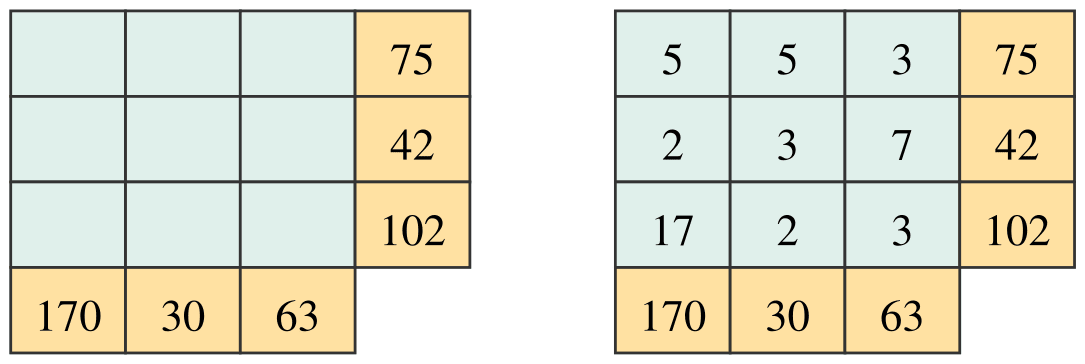
Answer
Let us look carefully at the solved puzzle on the right.
| 5 | 5 | 3 | 75 |
| 2 | 3 | 7 | 42 |
| 17 | 2 | 3 | 102 |
| 170 | 30 | 63 |
We observe the following.
Observation 1: Every number filled into the grid, namely 5, 5, 3, 2, 3, 7, 17, 2 and 3, is a prime number.
Observation 2: Multiplying the three numbers in each row gives the number written to the right of that row.
Row 1: 5 × 5 × 3 = 75.
Row 2: 2 × 3 × 7 = 42.
Row 3: 17 × 2 × 3 = 102.
Observation 3: Multiplying the three numbers in each column gives the number written below that column.
Column 1: 5 × 2 × 17 = 170.
Column 2: 5 × 3 × 2 = 30.
Column 3: 3 × 7 × 3 = 63.
So, the rules of the puzzle are:
Rule 1: The grid must be filled with prime numbers only.
Rule 2: The product of the three numbers in each row must equal the number written to the right of that row.
Rule 3: The product of the three numbers in each column must equal the number written below that column.
Hence, the puzzle is solved by filling the grid with prime numbers only, so that the product of each row is the number to the right of the row and the product of each column is the number below the column.
Fill the grid with prime numbers only so that the product of each row is the number to the right of the row and the product of each column is the number below the column.
| 105 | |||
| 20 | |||
| 30 | |||
| 28 | 125 | 18 |
| 8 | |||
| 105 | |||
| 70 | |||
| 30 | 70 | 28 |
| 63 | |||
| 27 | |||
| 190 | |||
| 45 | 42 | 171 |
| 343 | |||
| 66 | |||
| 44 | |||
| 28 | 154 | 231 |
Answer
In each grid we first write the prime factorisation of every row product and every column product, and then place the primes so that all six products are satisfied.
Grid 1
The prime factorisations are:
105 = 3 × 5 × 7, 20 = 2 × 2 × 5, 30 = 2 × 3 × 5,
28 = 2 × 2 × 7, 125 = 5 × 5 × 5, 18 = 2 × 3 × 3.
Since the product of the second column is 125 = 5 × 5 × 5, all three entries of the second column must be 5.
Removing this 5 from each row, the remaining two entries of each row must multiply to:
Row 1: 105 ÷ 5 = 21 = 3 × 7.
Row 2: 20 ÷ 5 = 4 = 2 × 2.
Row 3: 30 ÷ 5 = 6 = 2 × 3.
The prime 7 occurs in row 1 only, and among the columns it occurs only in 28, which is the product of the first column.
∴ The entry in row 1, column 1 is 7, and the entry in row 1, column 3 is 3.
From row 2, both remaining entries are 2, so row 2 has 2 in column 1 and 2 in column 3.
Column 1 now gives 7 × 2 × (row 3 entry) = 28, so the row 3 entry in column 1 is 28 ÷ 14 = 2, and hence the row 3 entry in column 3 is 3.
Check for column 3: 3 × 2 × 3 = 18.
| 7 | 5 | 3 | 105 |
| 2 | 5 | 2 | 20 |
| 2 | 5 | 3 | 30 |
| 28 | 125 | 18 |
Grid 2
The prime factorisations are:
8 = 2 × 2 × 2, 105 = 3 × 5 × 7, 70 = 2 × 5 × 7,
30 = 2 × 3 × 5, 70 = 2 × 5 × 7, 28 = 2 × 2 × 7.
Since the product of the first row is 8 = 2 × 2 × 2, all three entries of the first row must be 2.
Removing this 2 from each column, the remaining two entries of each column must multiply to:
Column 1: 30 ÷ 2 = 15 = 3 × 5.
Column 2: 70 ÷ 2 = 35 = 5 × 7.
Column 3: 28 ÷ 2 = 14 = 2 × 7.
Row 3 has product 70 = 2 × 5 × 7, so it needs an entry 2. This 2 can come only from column 3, since columns 1 and 2 have no 2 left.
∴ The entry in row 3, column 3 is 2, and the entry in row 2, column 3 is 7.
Row 2 has product 105, so its entries in columns 1 and 2 multiply to 105 ÷ 7 = 15 = 3 × 5.
Column 2 has only 5 and 7 left, so the row 2 entry in column 2 is 5, and hence the row 2 entry in column 1 is 3.
∴ The row 3 entry in column 1 is 5 and the row 3 entry in column 2 is 7.
Check for row 3: 5 × 7 × 2 = 70.
| 2 | 2 | 2 | 8 |
| 3 | 5 | 7 | 105 |
| 5 | 7 | 2 | 70 |
| 30 | 70 | 28 |
Grid 3
The prime factorisations are:
63 = 3 × 3 × 7, 27 = 3 × 3 × 3, 190 = 2 × 5 × 19,
45 = 3 × 3 × 5, 42 = 2 × 3 × 7, 171 = 3 × 3 × 19.
Since the product of the second row is 27 = 3 × 3 × 3, all three entries of the second row must be 3.
Removing this 3 from each column, the remaining two entries of each column must multiply to:
Column 1: 45 ÷ 3 = 15 = 3 × 5.
Column 2: 42 ÷ 3 = 14 = 2 × 7.
Column 3: 171 ÷ 3 = 57 = 3 × 19.
Row 3 has product 190 = 2 × 5 × 19, so its three entries must be 2, 5 and 19 in some order.
The prime 5 is available only in column 1, the prime 2 only in column 2 and the prime 19 only in column 3.
∴ Row 3 has 5 in column 1, 2 in column 2 and 19 in column 3.
The remaining entries then belong to row 1, giving 3 in column 1, 7 in column 2 and 3 in column 3.
Check for row 1: 3 × 7 × 3 = 63.
| 3 | 7 | 3 | 63 |
| 3 | 3 | 3 | 27 |
| 5 | 2 | 19 | 190 |
| 45 | 42 | 171 |
Grid 4
The prime factorisations are:
343 = 7 × 7 × 7, 66 = 2 × 3 × 11, 44 = 2 × 2 × 11,
28 = 2 × 2 × 7, 154 = 2 × 7 × 11, 231 = 3 × 7 × 11.
Since the product of the first row is 343 = 7 × 7 × 7, all three entries of the first row must be 7.
Removing this 7 from each column, the remaining two entries of each column must multiply to:
Column 1: 28 ÷ 7 = 4 = 2 × 2.
Column 2: 154 ÷ 7 = 22 = 2 × 11.
Column 3: 231 ÷ 7 = 33 = 3 × 11.
From column 1, both remaining entries are 2, so rows 2 and 3 each have 2 in column 1.
Row 2 has product 66, so its entries in columns 2 and 3 multiply to 66 ÷ 2 = 33 = 3 × 11.
Column 3 is the only one containing the prime 3, so the row 2 entry in column 3 is 3, and hence the row 2 entry in column 2 is 11.
∴ The row 3 entry in column 2 is 2 and the row 3 entry in column 3 is 11.
Check for row 3: 2 × 2 × 11 = 44.
| 7 | 7 | 7 | 343 |
| 2 | 11 | 3 | 66 |
| 2 | 2 | 11 | 44 |
| 28 | 154 | 231 |
Hence, the four grids are filled as shown above.