
Use the figure given alongside to fill in the blanks:
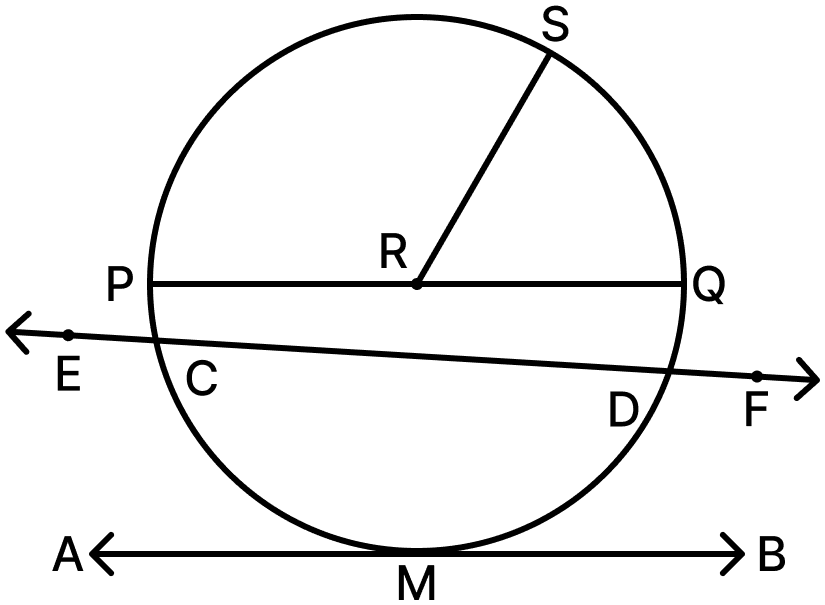
(i) R is the ...... of the circle.
(ii) Diameter of a circle is ...... .
(iii) Tangent to a circle is ...... .
(iv) EF is a ...... of the circle.
(v) ...... is a chord of the circle.
(vi) Diameter = 2 × ...... .
(vii) ...... is a radius of the circle.
(viii) If the length of RS is 5 cm, the length of PQ = ...... .
(ix) If PQ is 8 cm long, the length of RS = ...... .
(x) AB is a ...... of the circle.
Answer
(i) R is the centre of the circle.
(ii) Diameter of a circle is PQ.
(iii) Tangent to a circle is AB.
(iv) EF is a secant of the circle.
(v) CD is a chord of the circle.
(vi) Diameter = 2 × radius.
(vii) RS is a radius of the circle.
(viii) If the length of RS is 5 cm, the length of PQ = 10 cm.
(ix) If PQ is 8 cm long, the length of RS = 4 cm.
(x) AB is a tangent of the circle.
Draw a circle of radius 4.2 cm. Mark its centre as O. Take a point A on the circumference of the circle. Join AO and extend it till it meets point B on the circumference of the circle.
(i) Measure the length of AB.
(ii) Assign a special name to AB.
Answer
Steps of construction:
Mark a point O and with O as centre and radius 4.2 cm, draw a circle.
Take any point A on the circumference of the circle.
Join AO and extend it till it meets the circumference of the circle at the point B.
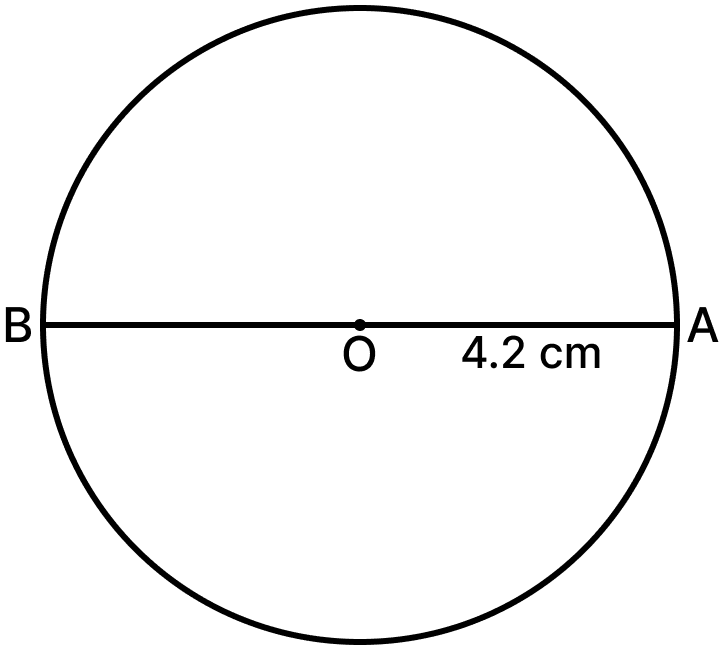
(i) Since, AB passes through the centre O and both its ends lie on the circumference of the circle, AB is the diameter of the circle.
We know that,
Diameter = 2 × Radius
⇒ AB = 2 × OA
⇒ AB = 2 × 4.2
⇒ AB = 8.4 cm
On measuring AB, we get AB = 8.4 cm.
Hence, the length of AB = 8.4 cm.
(ii) We know that,
A straight line passing through the centre of a circle with both its ends on the circumference of the circle is called the diameter of the circle.
Here, AB passes through the centre O and both its ends A and B lie on the circumference of the circle.
Hence, AB is the diameter of the circle.
Draw circle with diameter 6 cm. Measure the length of the radius of the circle drawn.
Answer
Steps of construction:
Draw a line segment AB = 6 cm.
Draw the perpendicular bisector of AB, which cuts AB at the point O.
With O as centre and radius OA, draw a circle. It passes through A as well as through B.
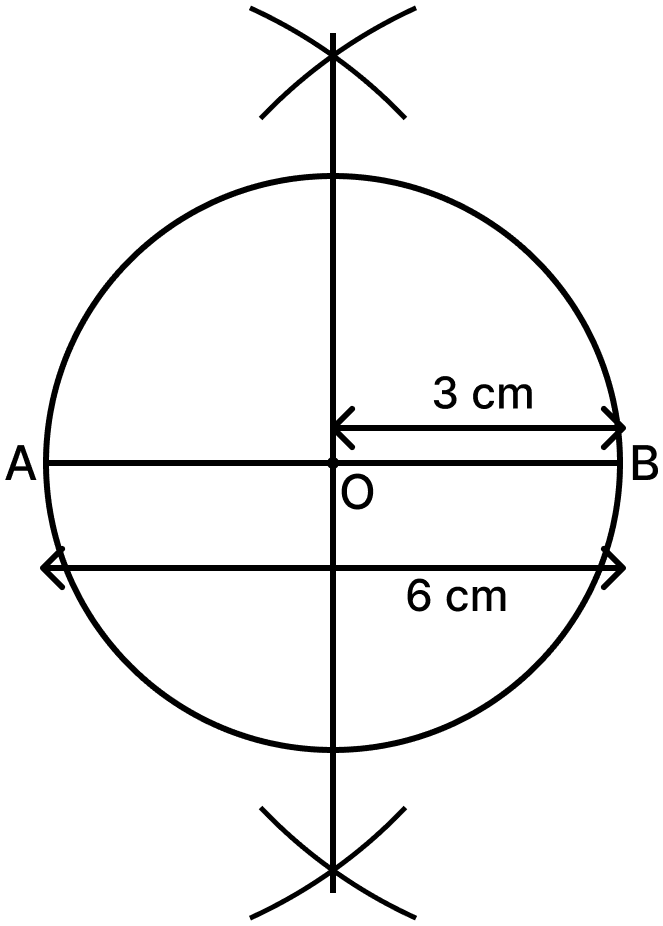
AB is the diameter and OA is the radius of the circle.
As we know that radius is half of the diameter.
⇒ OA =
⇒ OA = 3 cm
On measuring the radius OA, we get OA = 3 cm.
Hence, the radius of the circle = 3 cm.
Draw circle with diameter 8.4 cm. Measure the length of the radius of the circle drawn.
Answer
Steps of construction:
Draw a line segment AB = 8.4 cm.
Draw the perpendicular bisector of AB, which cuts AB at the point O.
With O as centre and radius OA, draw a circle. It passes through A as well as through B.
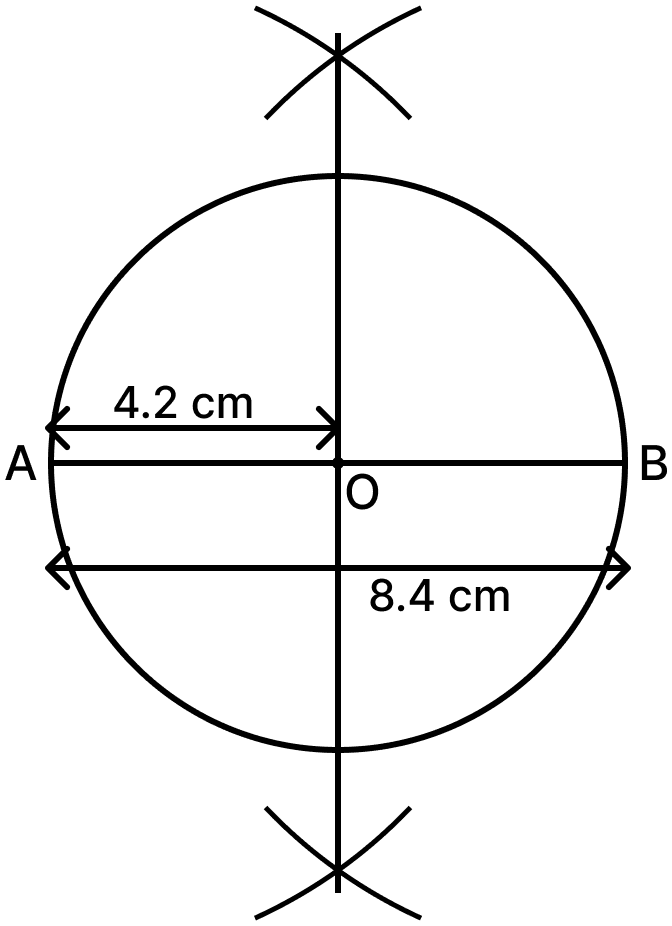
AB is the diameter and OA is the radius of the circle.
As we know that radius is half of the diameter.
⇒ OA =
⇒ OA = 4.2 cm
On measuring the radius OA, we get OA = 4.2 cm.
Hence, the radius of the circle = 4.2 cm.
Draw a circle of radius 6 cm. In the circle, draw a chord AB = 6 cm.
(i) If O is the centre of the circle, join OA and OB.
(ii) Assign a special name to ΔAOB.
(iii) Write the measure of angle AOB.
Answer
Steps of construction:
Mark a point O and with O as centre and radius 6 cm, draw a circle.
Take any point A on the circle.
With A as centre and radius 6 cm, draw an arc to meet the circle at B.
Join A and B. AB is the required chord.
Join OA and OB.
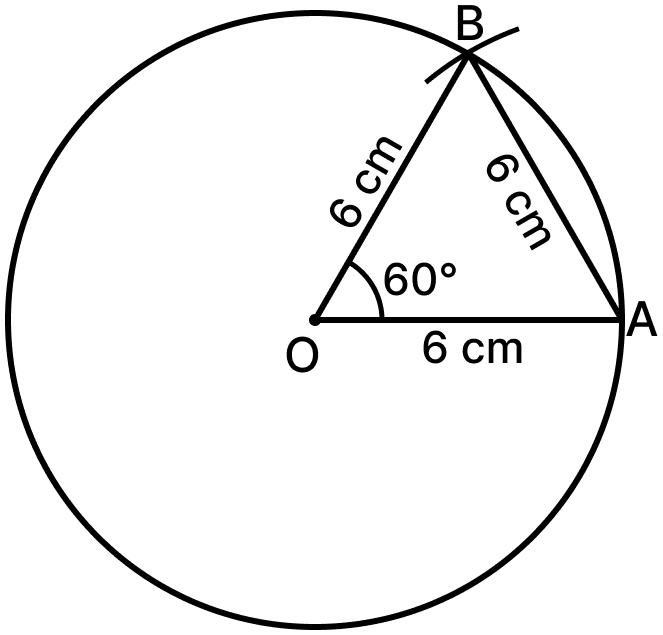
(i) OA and OB are joined as shown in the above figure. OA and OB are the radii of the circle.
(ii) In ∆AOB,
⇒ OA = OB = 6 cm (Radii of the circle)
⇒ AB = 6 cm (Given)
⇒ OA = OB = AB = 6 cm
Since, all the three sides of ∆AOB are equal, it is an equilateral triangle.
Hence, ∆AOB is an equilateral triangle.
(iii) We know that,
Each angle of an equilateral triangle is 60°.
⇒ ∠AOB = 60°
On measuring, we get ∠AOB = 60°.
Hence, ∠AOB = 60°.
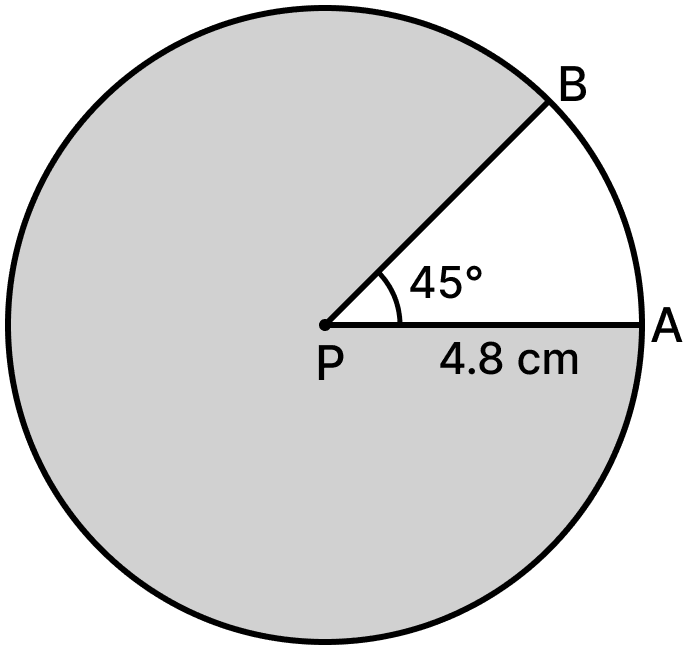
Draw a circle of radius 4.8 cm and mark its centre as P.
(i) Draw radii PA and PB such that ∠APB = 45°.
(ii) Shade the major sector of the circle.
Answer
Steps of construction:
Mark a point P and with P as centre and radius 4.8 cm, draw a circle.
Draw a radius PA of the circle.
Draw another radius PB such that ∠APB = 45°.
Shade the larger sector enclosed by the radii PA, PB and the major arc AB. It is the major sector of the circle.
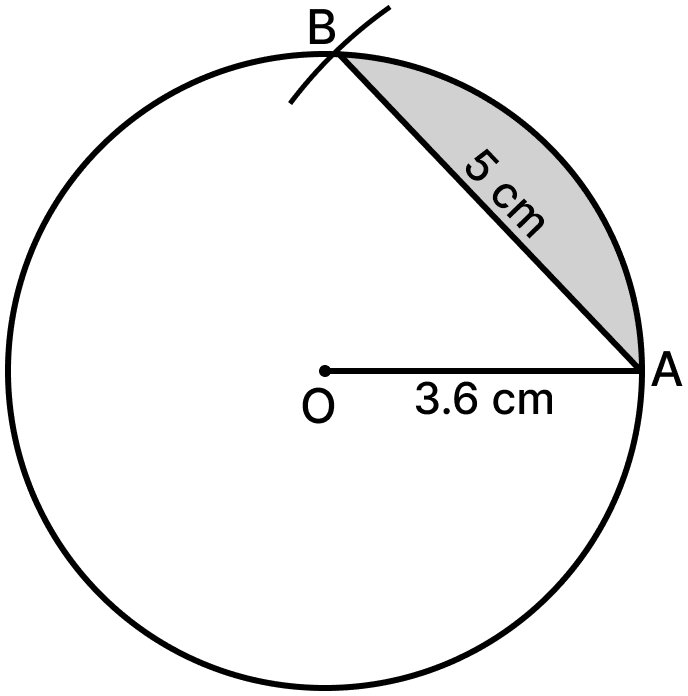
Draw a circle of radius 3.6 cm. In the circle, draw a chord AB = 5 cm. Now shade the minor segment of the circle.
Answer
Steps of construction:
Mark a point O and with O as centre and radius 3.6 cm, draw a circle.
Take any point A on the circle.
With A as centre and radius 5 cm, draw an arc to meet the circle at B.
Join A and B. AB is the required chord.
Shade the segment which does not contain the centre O. It is the minor segment of the circle.
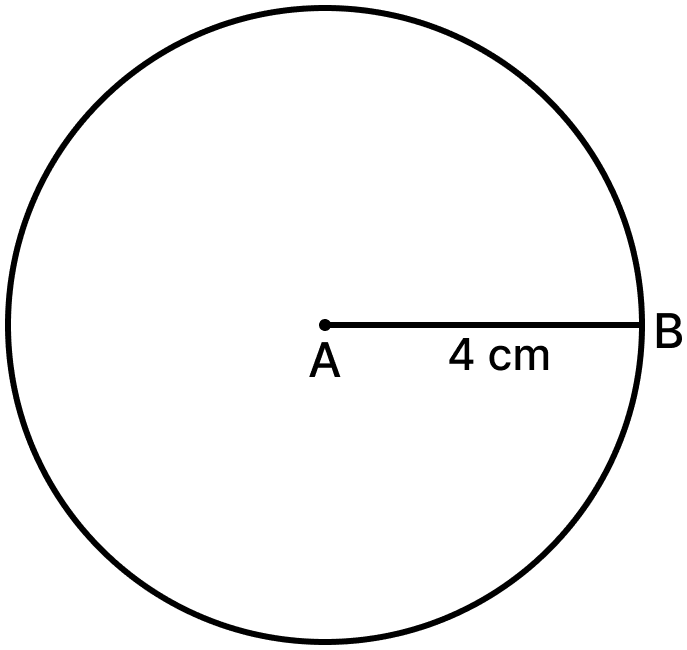
Mark two points A and B, 4 cm apart. Draw a circle passing through B and with A as centre.
Answer
Steps of construction:
Mark two points A and B such that AB = 4 cm.
With A as centre and radius AB = 4 cm, draw a circle. It passes through B.
Draw a line AB = 8.4 cm. Now draw a circle with AB as diameter. Mark a point C on the circumference of the circle. Measure angle ACB.
Answer
Steps of construction:
Draw a line segment AB = 8.4 cm.
Draw the perpendicular bisector of AB, which cuts AB at the point O.
With O as centre and radius OA, draw a circle. It passes through A as well as through B.
Take any point C on the circle and join AC and BC.
Measure ∠ACB.
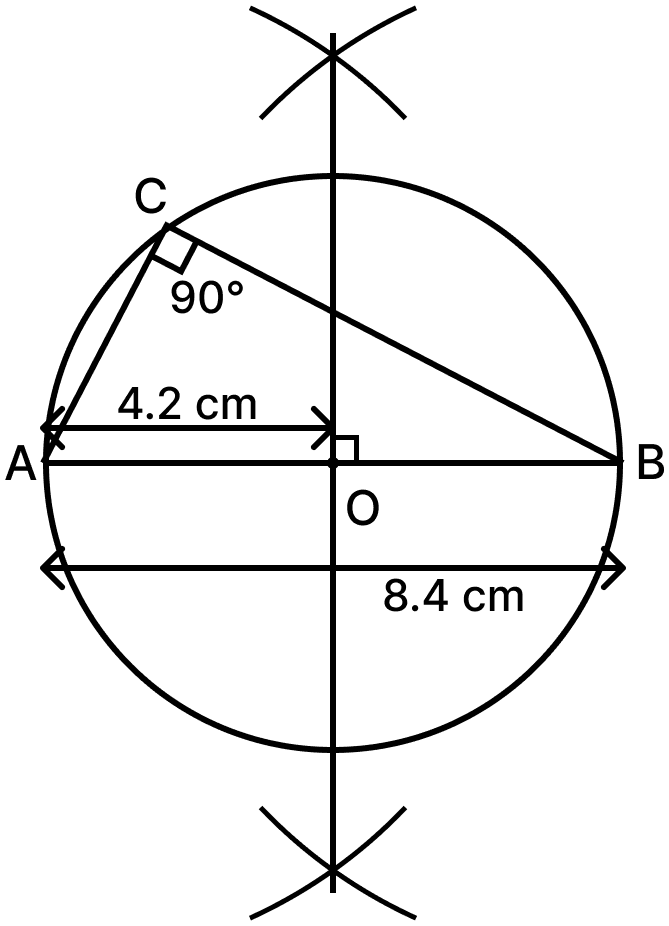
On measuring, we get ∠ACB = 90°.
Hence, ∠ACB = 90°.