
A part of the circle bounded by an arc and two radii is called a:
segment
sector
semi-circle
both (1) and (2)
Answer
We know that,
The part of a circle enclosed by any two radii and an arc is called a sector.
∴ A part of the circle bounded by an arc and two radii is called a sector.
Hence, option 2 is the correct option.
A part of a circle enclosed by an arc and two mutually perpendicular radii is a:
semi-circle
segment
quadrant
none of these
Answer
We know that,
The part of a circle enclosed by two mutually perpendicular radii is called a quadrant.
∴ A part of a circle enclosed by an arc and two mutually perpendicular radii is a quadrant.
Hence, option 3 is the correct option.
Chord of a circle divides the circle into two:
sectors
segments
semi-circles
equal parts
Answer
We know that,
Every chord divides a circle into two parts and these two parts of the circle are called its segments.
∴ Chord of a circle divides the circle into two segments.
Hence, option 2 is the correct option.
A straight line intersecting a circle at two points is a:
secant
chord
tangent
diameter
Answer
We know that,
A straight line intersecting a circle at two points is called a secant.
∴ A straight line intersecting a circle at two points is a secant.
Hence, option 1 is the correct option.
A line touching a given circle is called:
radius
diameter
chord
tangent
Answer
We know that,
A straight line touching a circle at one point only is called a tangent.
∴ A line touching a given circle is called a tangent.
Hence, option 4 is the correct option.
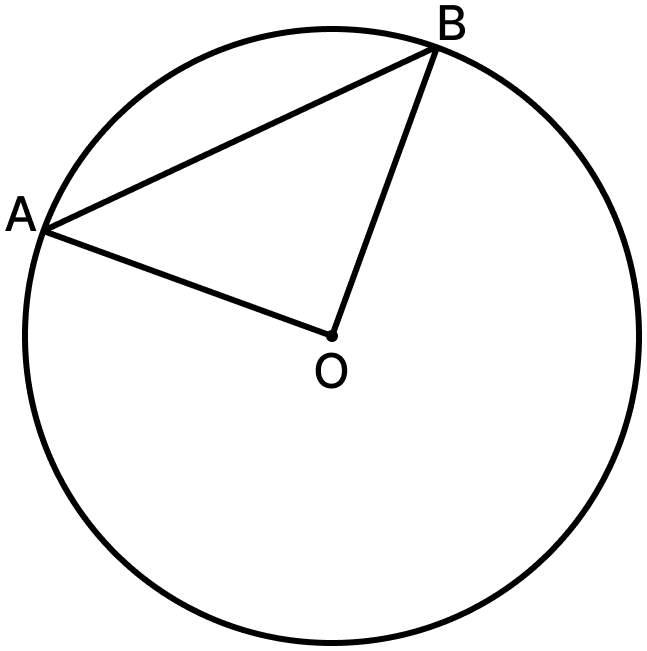
In the given figure, O is centre of the circle and chord AB = radius of the circle, angle AOB is equal to:
30°
60°
90°
120°
Answer
Given, O is the centre of the circle and chord AB = radius of the circle.
In ∆AOB,
⇒ OA = OB (Radii of the circle)
⇒ AB = OA = OB (Given, AB = radius of the circle)
Since, all the three sides of ∆AOB are equal, it is an equilateral triangle.
We know that,
Each angle of an equilateral triangle is 60°.
⇒ ∠AOB = 60°
Hence, option 2 is the correct option.
A chord of a circle can be its:
radius
diameter
tangent
none of these
Answer
We know that,
A chord passing through the centre of a circle is also its diameter.
∴ A chord of a circle can be its diameter.
Hence, option 2 is the correct option.