
Draw a line segment OA = 5 cm. Use set-squares to construct angle AOB = 60° such that OB = 3 cm. Join A and B; then measure the length of AB.
Answer
Given, OA = 5 cm, ∠AOB = 60° and OB = 3 cm.
Steps of construction :
Draw a line segment OA = 5 cm.
Place the 60°-90°-30° set-square in such a way that its 60° angle is at O and the edge containing this angle coincides with OA.
Draw a line OX along the other edge of the set-square containing the 60° angle. Then, ∠AOX = 60°.
From OX, cut off OB = 3 cm.
Join A and B.
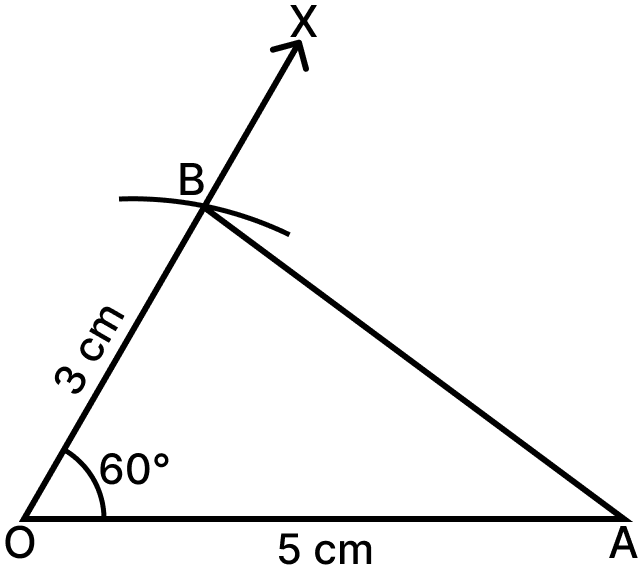
On measuring, we get :
AB = 4.4 cm (approx.)
Hence, ∠AOB = 60° is the required angle and AB = 4.4 cm (approx.).
Draw a line segment OP = 8 cm. Use set-squares to construct ∠POQ = 90° such that OQ = 6 cm. Join P and Q; then measure the length of PQ.
Answer
Given, OP = 8 cm, ∠POQ = 90° and OQ = 6 cm.
Steps of construction :
Draw a line segment OP = 8 cm.
Place a set-square in such a way that its 90° angle is at O and one of the edges containing this angle coincides with OP.
Draw a line OX along the other edge of the set-square containing the 90° angle. Then, ∠POX = 90°.
From OX, cut off OQ = 6 cm.
Join P and Q.
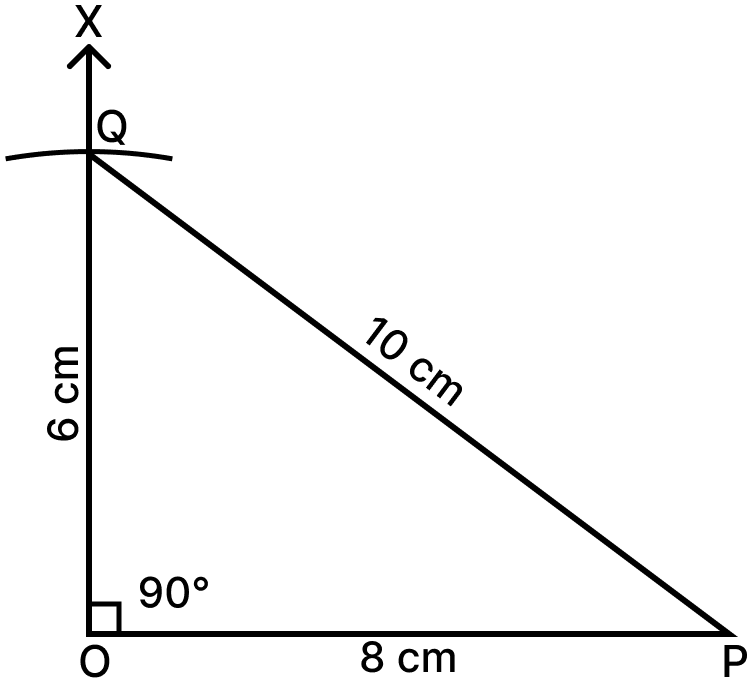
On measuring, we get :
PQ = 10 cm
Hence, ∠POQ = 90° is the required angle and PQ = 10 cm.
Draw ∠ABC = 120°. Bisect the angle using ruler and compass. Measure each angle so obtained and check whether or not the new angles obtained on bisecting ∠ABC are equal.
Answer
Steps of construction :
Draw a line segment BC of any suitable length.
With B as centre, draw an arc to cut BC at P.
With P as centre, draw an arc of the same radius (as taken in Step 2) to cut the first arc at Q.
With Q as centre, draw one more arc of the same radius which cuts the first arc at R.
Join BR and produce it upto any point A. Then, ∠ABC = 120°.
With P as centre and radius more than half of PR, draw an arc.
With R as centre and the same radius as taken in Step 6, draw another arc which meets the previous arc at D.
Join B and D. Then, BD is the bisector of ∠ABC.
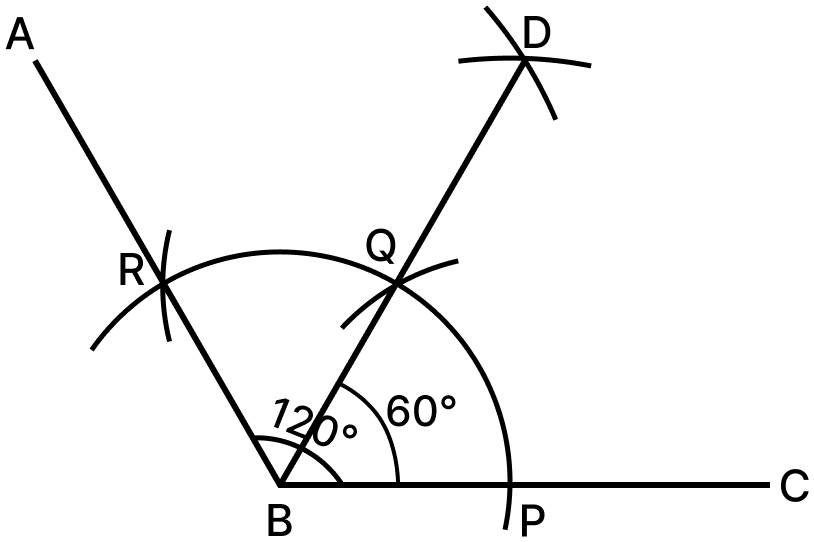
On measuring, we get :
∠ABD = 60° and ∠DBC = 60°
⇒ ∠ABD = ∠DBC
Hence, the angles obtained on bisecting ∠ABC are equal, each being 60°.
Draw ∠PQR = 75° by using set-squares. On PQ mark a point M such that MQ = 3 cm. On QR mark a point N such that QN = 4 cm. Join M and N. Measure the length of MN.
Answer
As, 75° = 45° + 30°
Steps of construction :
Draw a line segment QX of any suitable length.
Place the 45°-90°-45° set-square in such a way that its 45° angle is at Q and the edge containing this angle coincides with QX. Draw a line QR along the other edge containing the 45° angle. Then, ∠XQR = 45°.
Now place the 60°-90°-30° set-square in such a way that its 30° angle is at Q and the edge containing this angle coincides with QX, on the side of QX opposite to that of R. Draw a line QP along the other edge containing the 30° angle. Then, ∠PQX = 30°.
From QP, cut off QM = 3 cm.
From QR, cut off QN = 4 cm.
Join M and N.
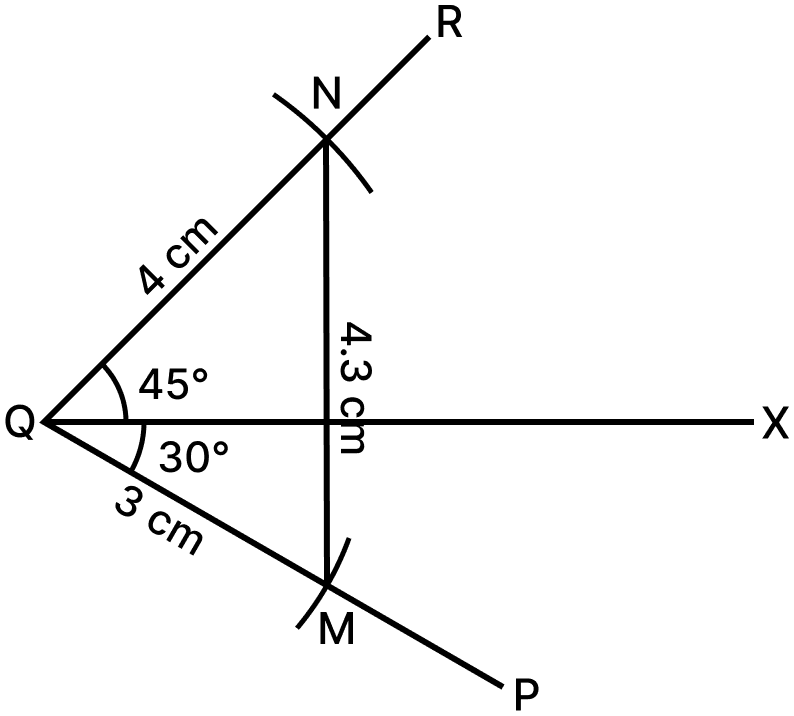
∠PQR = ∠PQX + ∠XQR = 30° + 45° = 75°
On measuring, we get :
MN = 4.3 cm (approx.)
Hence, ∠PQR = 75° is the required angle and MN = 4.3 cm (approx.).