
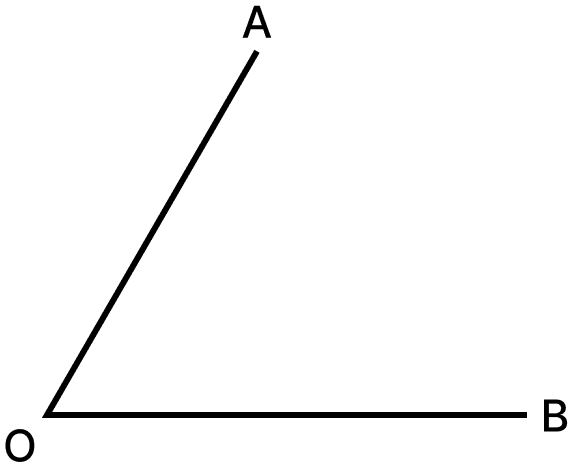
Draw in your notebook the following angle using a ruler and a compass only.
Answer
Let ∠AOB be the given angle which is to be copied.
Steps of construction :
Draw a line segment QR of any suitable length.
With O as centre, draw an arc of any suitable radius to cut the arms OA and OB of the given angle at C and D respectively.
With Q as centre and the same radius (as taken in Step 2), draw an arc to cut QR at T.
With T as centre and radius equal to CD, draw an arc to cut the previous arc at S.
Join QS and produce it to any point P.
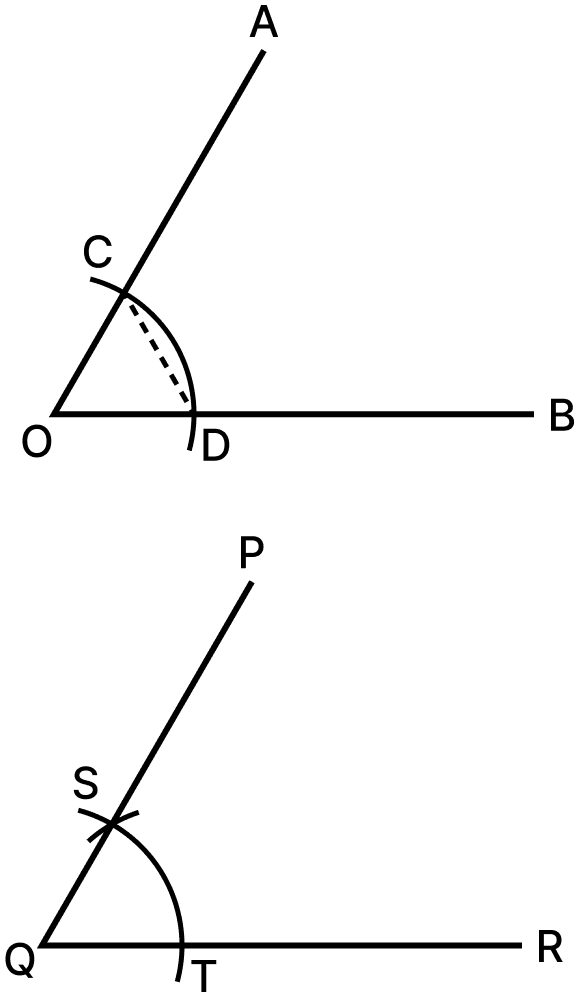
Hence, ∠PQR is the required angle equal to the given ∠AOB.
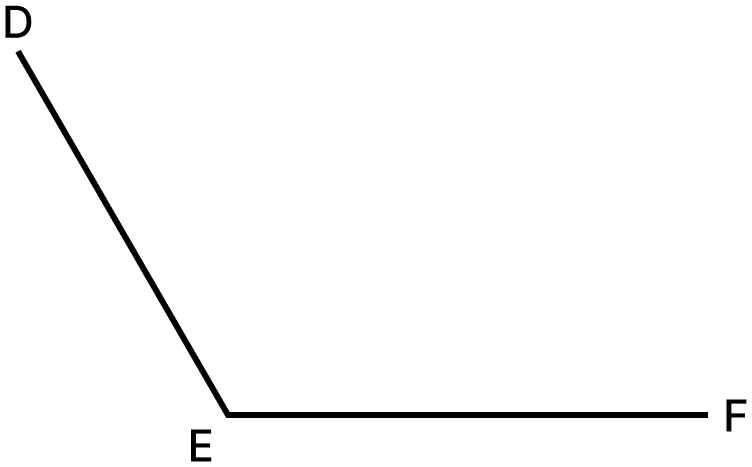
Draw in your notebook the following angle using a ruler and a compass only.
Answer
Let ∠DEF be the given angle which is to be copied.
Steps of construction :
Draw a line segment QR of any suitable length.
With E as centre, draw an arc of any suitable radius to cut the arms ED and EF of the given angle at C and G respectively.
With Q as centre and the same radius (as taken in Step 2), draw an arc to cut QR at T.
With T as centre and radius equal to CG, draw an arc to cut the previous arc at S.
Join QS and produce it to any point P.
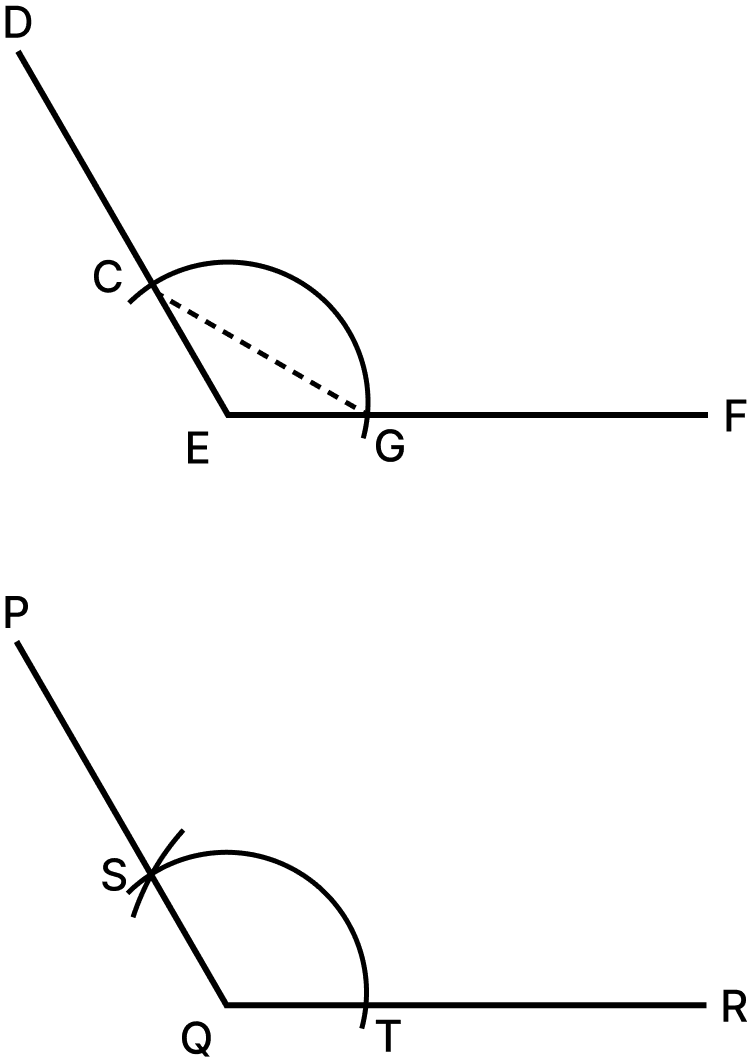
Hence, ∠PQR is the required angle equal to the given ∠DEF.
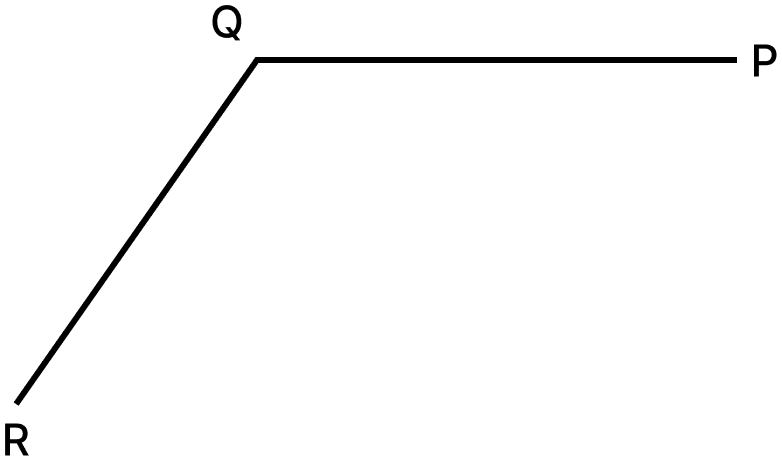
Draw in your notebook the following angle using a ruler and a compass only.
Answer
Let ∠PQR be the given angle which is to be copied.
Steps of construction :
Draw a line segment XY of any suitable length.
With Q as centre, draw an arc of any suitable radius to cut the arms QR and QP of the given angle at C and D respectively.
With X as centre and the same radius (as taken in Step 2), draw an arc to cut XY at T.
With T as centre and radius equal to CD, draw an arc to cut the previous arc at S.
Join XS and produce it to any point Z.
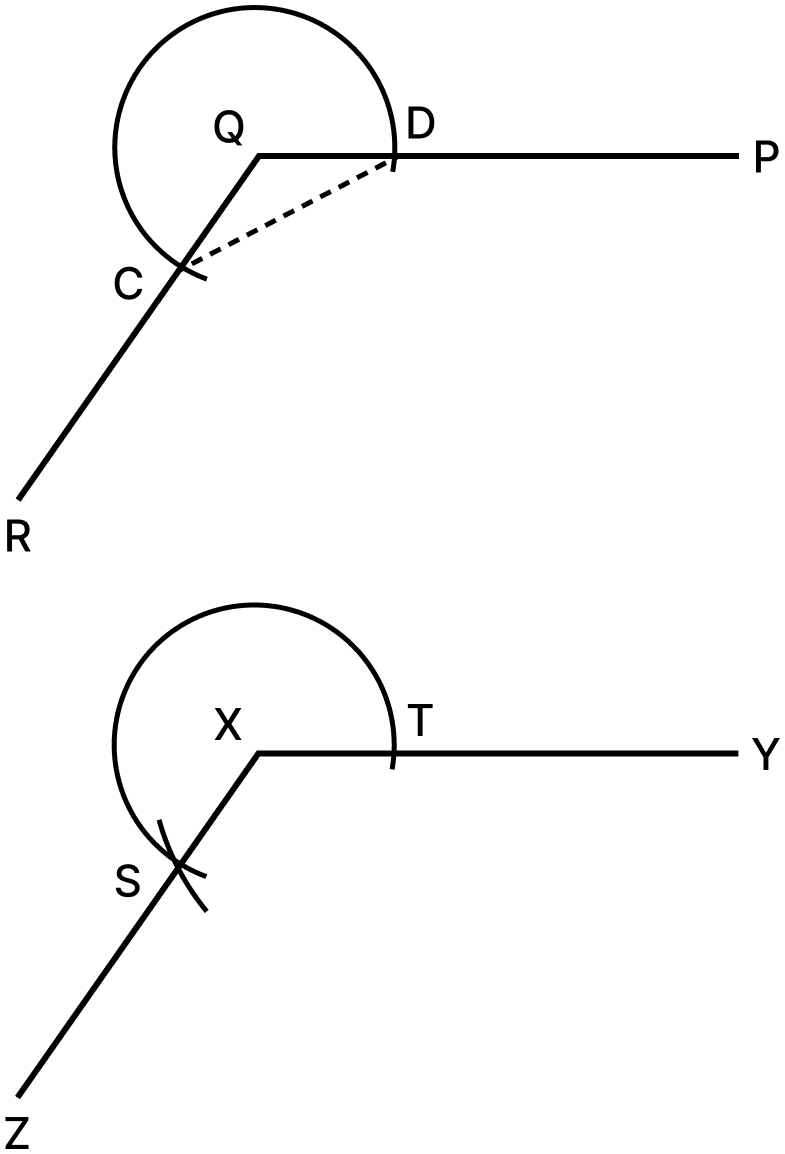
Hence, ∠ZXY is the required angle equal to the given ∠PQR.
Construct the following angle, using a ruler and a compass only: 60°
Answer
Steps of construction :
Draw a line segment OA of any suitable length.
With O as centre, draw an arc of any suitable radius to cut OA at B.
With B as centre and the same radius, draw another arc to cut the previous arc at C.
Join OC and produce it to any point D.
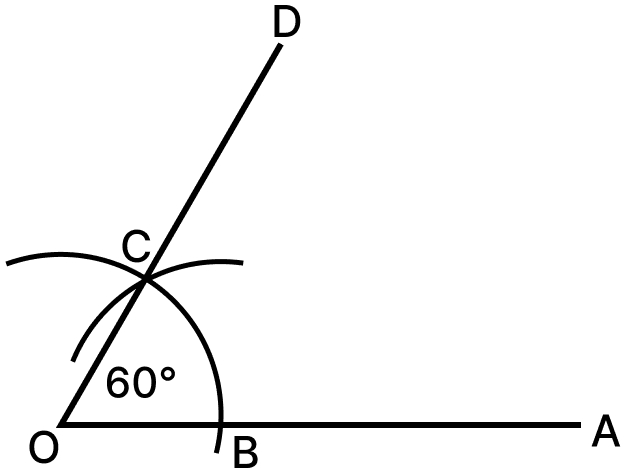
Hence, ∠DOA is the required angle of 60°.
Construct the following angle, using a ruler and a compass only: 90°
Answer
Steps of construction :
Draw a line segment OA of any suitable length.
With O as centre, draw an arc of any suitable radius to cut OA at B.
With B as centre and the same radius, draw another arc to cut the previous arc at C.
Again with C as centre and the same radius, draw one more arc to cut the first arc at D.
With C and D as centres, draw two arcs of equal radii (more than half of CD) to cut each other at E.
Join OE.
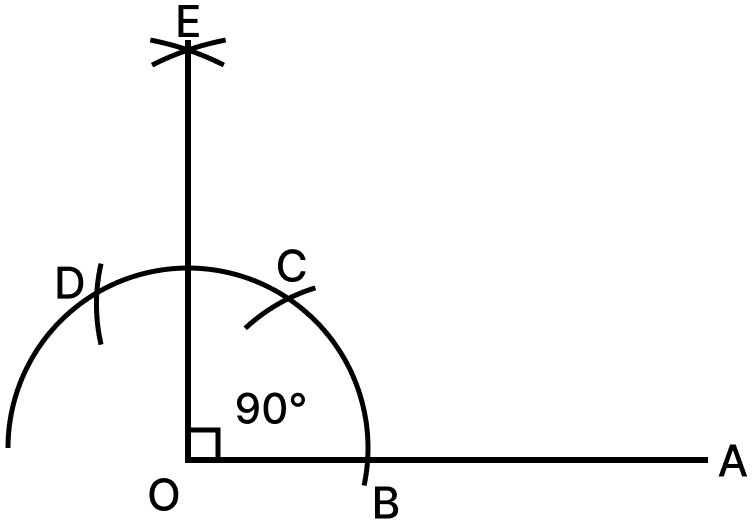
Hence, ∠AOE is the required angle of 90°.
Construct the following angle, using a ruler and a compass only: 45°
Answer
As, 45° = × 90°
Steps of construction :
Draw a line segment OA of any suitable length.
With O as centre, draw an arc of any suitable radius to cut OA at B.
With B as centre and the same radius, draw another arc to cut the previous arc at C.
Again with C as centre and the same radius, draw one more arc to cut the first arc at D.
With C and D as centres, draw two arcs of equal radii (more than half of CD) to cut each other at E.
Join OE. Then, ∠AOE = 90°.
Let OE cut the first arc at F.
With B and F as centres and radius more than half of BF, draw two arcs which cut each other at G.
Join OG.
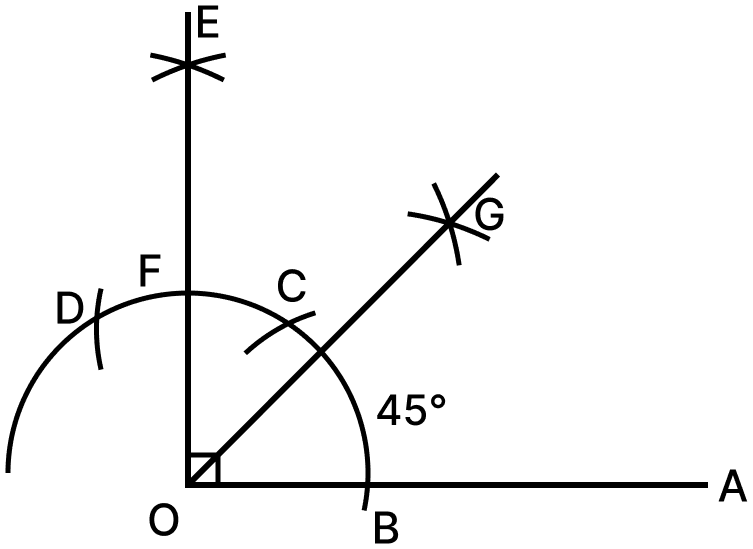
∠AOG = ∠AOE = × 90° = 45°
Hence, ∠AOG is the required angle of 45°.
Construct the following angle, using a ruler and a compass only: 30°
Answer
As, 30° = × 60°
Steps of construction :
Draw a line segment OA of any suitable length.
With O as centre, draw an arc of any suitable radius to cut OA at B.
With B as centre and the same radius, draw another arc to cut the previous arc at C.
Join OC and produce it to any point D. Then, ∠DOA = 60°.
With B as centre and radius more than half of BC, draw an arc.
With C as centre and the same radius as taken in Step 5, draw another arc which meets the previous arc at E.
Join OE.
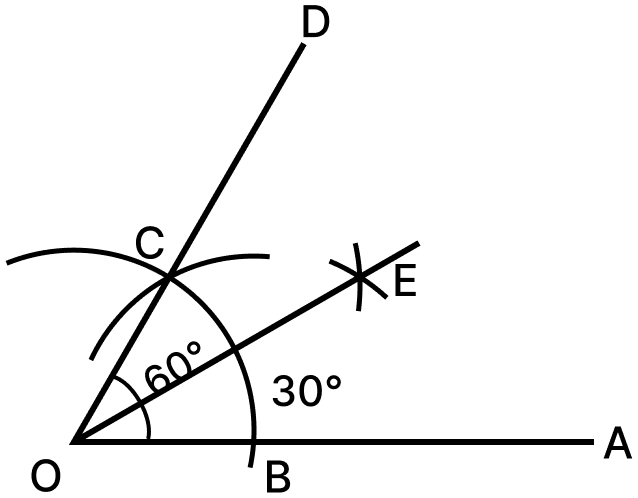
∠EOA = ∠DOA = × 60° = 30°
Hence, ∠EOA is the required angle of 30°.
Construct the following angle, using a ruler and a compass only: 120°
Answer
Steps of construction :
Draw a line segment OA of any suitable length.
With O as centre, draw an arc of any suitable radius to cut OA at C.
With C as centre and the same radius, draw one more arc to cut the first arc at D.
With D as centre and the same radius, draw one more arc to cut the first arc at E.
Join OE and produce it to any point B.
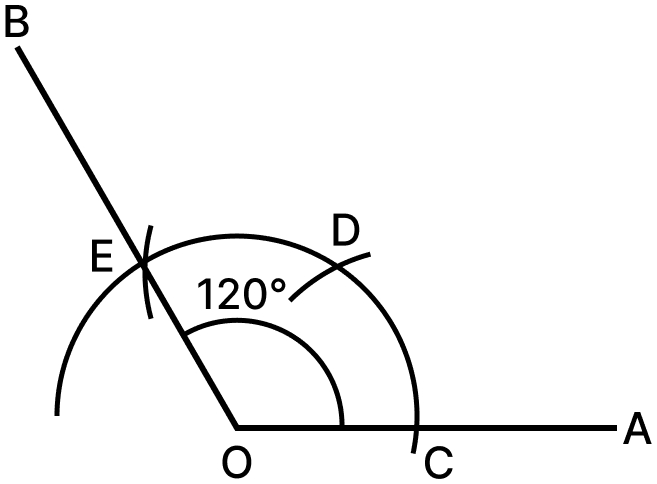
Hence, ∠AOB is the required angle of 120°.
Construct the following angle, using a ruler and a compass only: 135°
Answer
As, 135° = 90° + 45°
Steps of construction :
Draw a straight line AC and mark a point O on it.
With O as centre, draw an arc of any suitable radius to cut OA at P.
With P as centre and the same radius, draw another arc to cut the first arc at R.
Again with R as centre and the same radius, draw one more arc to cut the first arc at S.
With R and S as centres, draw two arcs of equal radii (more than half of RS) to cut each other at B.
Join OB. Then, ∠AOB = ∠BOC = 90°.
Let OB cut the first arc at T.
With P and T as centres and radius more than half of PT, draw two arcs which cut each other at D.
Join OD. Then, OD is the bisector of ∠AOB.
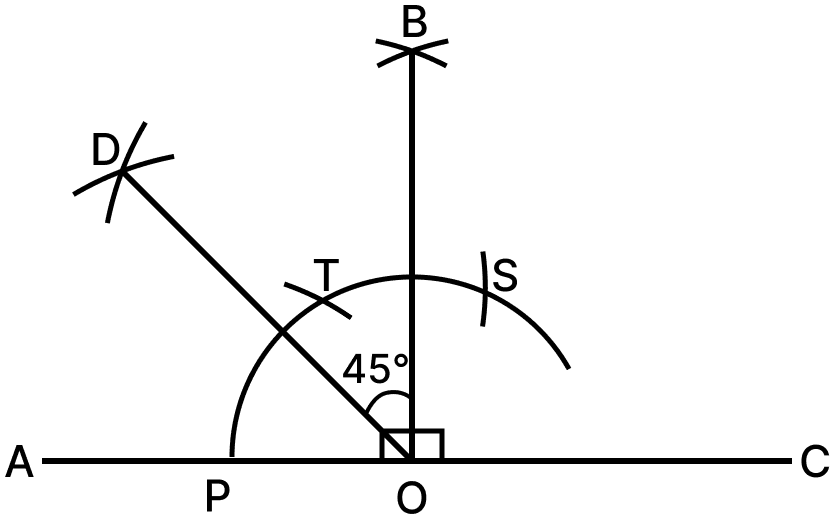
∠BOD = ∠AOD = ∠AOB = × 90° = 45°
∠COD = ∠COB + ∠BOD = 90° + 45° = 135°
Hence, ∠COD is the required angle of 135°.
Draw line AB = 6 cm. Construct angle ABC = 60°. Then draw the bisector of angle ABC.
Answer
Given, AB = 6 cm.
Steps of construction :
Draw a line segment AB = 6 cm.
With B as centre, draw an arc of any suitable radius to cut BA at P.
With P as centre and the same radius, draw another arc to cut the previous arc at Q.
Join BQ and produce it to any point C. Then, ∠ABC = 60°.
With P and Q as centres and radius more than half of PQ, draw two arcs which cut each other at D.
Join BD.
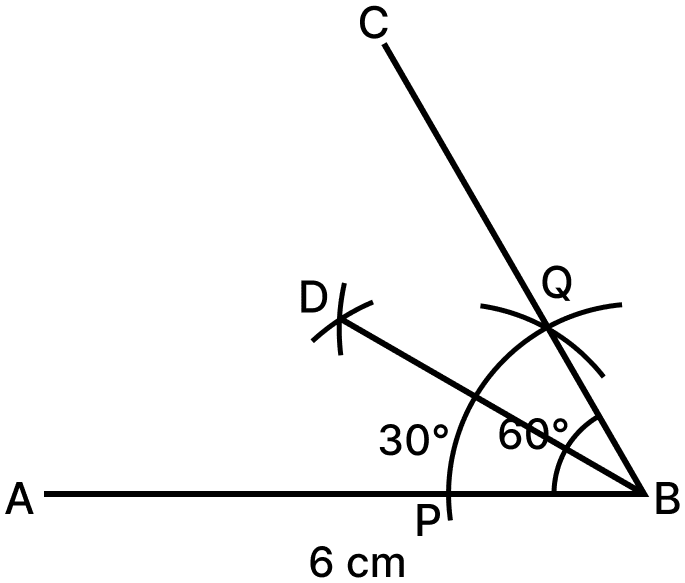
∠ABD = ∠DBC = ∠ABC = × 60° = 30°
Hence, ∠ABC is the required angle of 60° and BD is its bisector.
Draw a line segment PQ = 8 cm. Construct the perpendicular bisector of the line segment PQ. Let the perpendicular bisector drawn meets PQ at point R. Measure the lengths of PR and QR. Is PR = QR ?
Answer
Given, PQ = 8 cm.
Steps of construction :
Draw a line segment PQ = 8 cm.
Taking any suitable radius, which must be more than half of PQ (i.e., more than 4 cm), draw arcs with centres at points P and Q on both the sides of PQ.
Let the arcs drawn intersect each other at points C and D.
Draw a line through the points C and D, which cuts PQ at R.
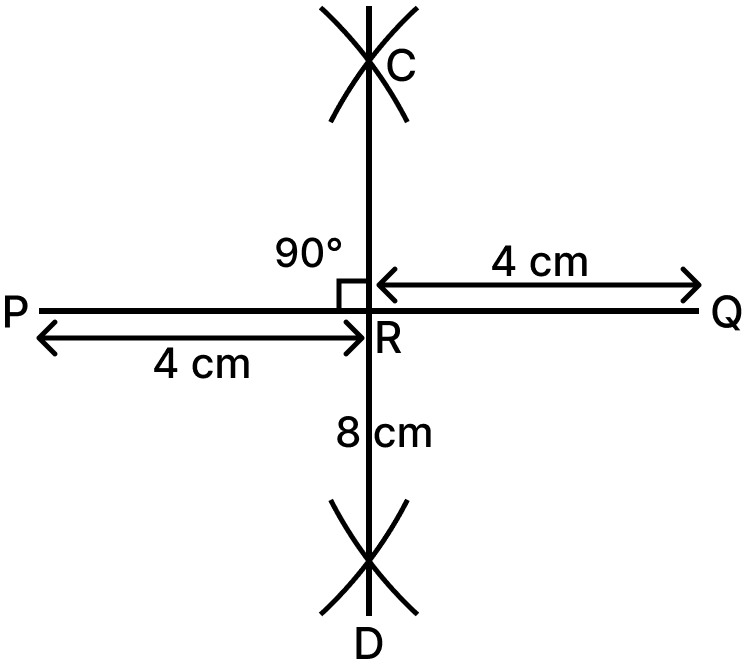
Here, CD is the required perpendicular bisector of PQ and ∠PRC = 90°.
On measuring, we get :
PR = 4 cm and QR = 4 cm
⇒ PR = QR
Hence, yes, PR = QR, each being 4 cm.
Draw a line segment AB = 7 cm. Mark a point P on AB such that AP = 3 cm. Draw perpendicular on to AB at point P.
Answer
Given, AB = 7 cm and AP = 3 cm.
Steps of construction :
Draw a line segment AB = 7 cm.
From AB, cut off AP = 3 cm.
With P as centre, draw an arc of any suitable radius to cut PB at C.
With C as centre and radius as taken in Step 3, draw the arc to cut the previous arc at D.
Again with D as centre and with the same radius, draw one more arc to cut the first arc at E.
With D and E as centres, draw two arcs of equal radii (more than half of DE) to cut each other at Q.
Join PQ.
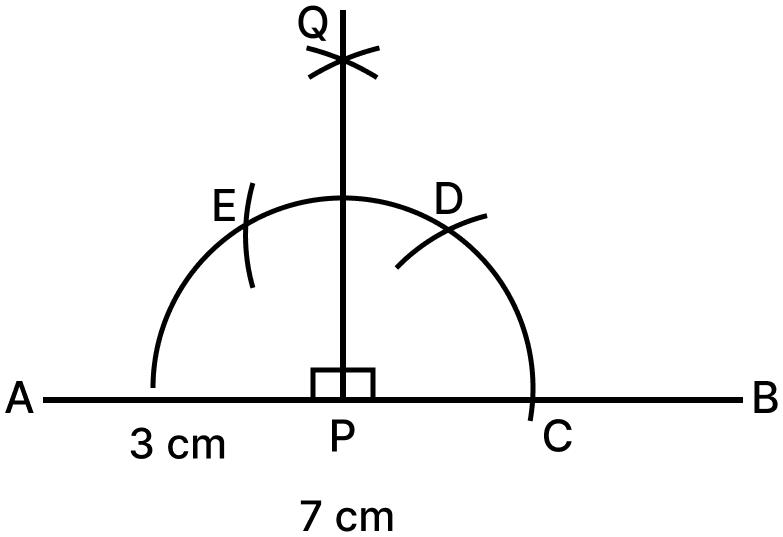
Here, ∠QPB = ∠QPA = 90°.
Hence, PQ is the required perpendicular to AB at point P.
Draw a line segment AB = 6.5 cm. Locate a point P that is 5 cm from A and 4.6 cm from B. Through the point P, draw a perpendicular on to the line segment AB.
Answer
Given, AB = 6.5 cm, AP = 5 cm and BP = 4.6 cm.
Steps of construction :
Draw a line segment AB = 6.5 cm.
With A as centre, draw an arc of radius 5 cm and with B as centre draw another arc with radius 4.6 cm. Let these arcs meet at P.
With P as centre, draw an arc of a suitable radius, which cuts AB at the two points C and D.
With C and D as centres, draw two arcs of equal radii (more than half of CD) intersecting each other at point Q on the other side of AB.
Join P and Q. Let PQ cut AB at point M.
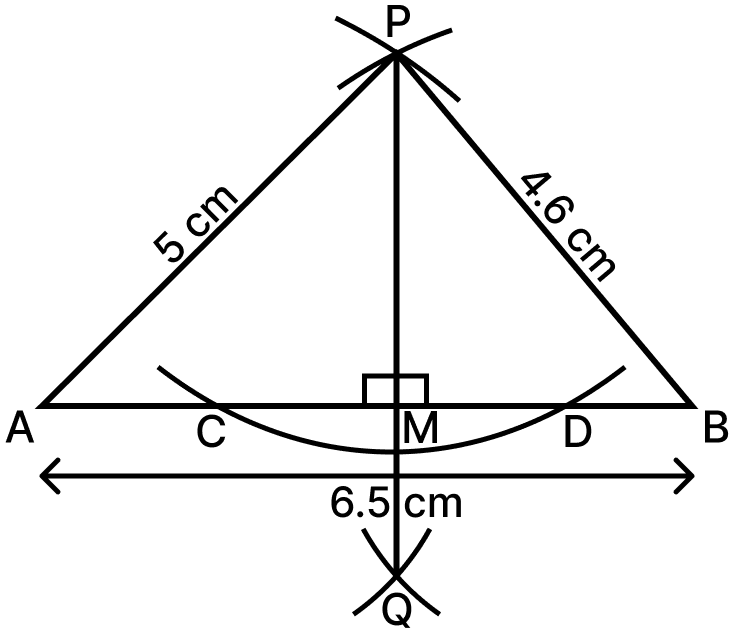
Here, ∠PMA = ∠PMB = 90°.
Hence, PM is the required perpendicular from the point P on to the line segment AB.