
Three angles of a quadrilateral are 94°, 106° and 60°. The fourth angle is :
60°
80°
100°
120°
Answer
Let the fourth angle of the quadrilateral be .
We know that,
The sum of the angles of a quadrilateral is 360°.
∴ The fourth angle = 100°
Hence, option 3 is the correct option.
Two angles of a quadrilateral are 100° each and the other two angles are also equal. Each of these two equal angles is :
100°
80°
120°
90°
Answer
Let the measure of each of the other two equal angles be .
We know that,
The sum of the angles of a quadrilateral is 360°.
∴ Each of the two equal angles = 80°
Hence, option 2 is the correct option.
Number of pairs of adjacent angles, a quadrilateral has :
6
4
3
1
Answer
In a quadrilateral ABCD, the pairs of adjacent angles are :
∠A and ∠B; ∠B and ∠C; ∠C and ∠D; ∠D and ∠A.
∴ A quadrilateral has 4 pairs of adjacent angles.
Hence, option 2 is the correct option.
A quadrilateral has :
2-diagonals
4-diagonals
3-diagonals
no diagonal
Answer
In a quadrilateral ABCD, the diagonals are AC and BD.
∴ A quadrilateral has 2 diagonals.
Hence, option 1 is the correct option.
The number of pairs of opposite angles of quadrilateral is :
4
1
2
3
Answer
In a quadrilateral ABCD, the pairs of opposite angles are :
∠A and ∠C; ∠B and ∠D.
∴ A quadrilateral has 2 pairs of opposite angles.
Hence, option 3 is the correct option.
In a parallelogram, the opposite sides are :
equal
parallel
neither equal nor parallel
equal and parallel.
Answer
A parallelogram is a quadrilateral in which both the pairs of opposite sides are parallel.
Also, in a parallelogram, the opposite sides are equal.
∴ In a parallelogram, the opposite sides are equal and parallel.
Hence, option 4 is the correct option.
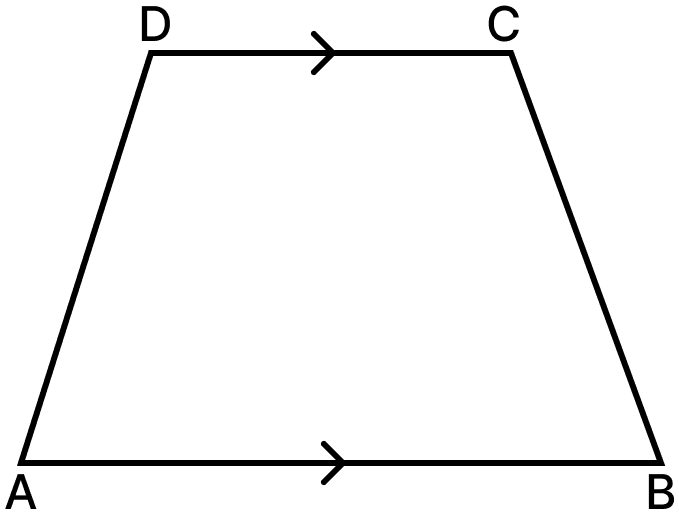
The given figure shows an isosceles trapezium ABCD. Then :
DC = AB
∠A + ∠B = 180°
∠C + ∠D = 180°
none of these
Answer
Given, ABCD is an isosceles trapezium in which AB ∥ DC and AD = BC.
In a trapezium, the parallel sides AB and DC are not equal, so DC ≠ AB.
In an isosceles trapezium, ∠A = ∠B and ∠C = ∠D.
If ∠A + ∠B = 180°, then ∠A = ∠B = 90°, which would make AD ∥ BC. This is not possible in a trapezium, so ∠A + ∠B ≠ 180°.
Similarly, ∠C + ∠D ≠ 180°.
The co-interior angles give ∠A + ∠D = 180° and ∠B + ∠C = 180°, which are not among the given options.
Hence, option 4 is the correct option.
The diagonals of a quadrilateral are equal, the quadrilateral is :
trapezium
parallelogram
rhombus
none of these
Answer
The diagonals of a rectangle, a square and an isosceles trapezium are equal.
So, a quadrilateral with equal diagonals may be a rectangle, a square or an isosceles trapezium; it cannot be said to be a trapezium, a parallelogram or a rhombus in general.
Also, the diagonals of a rhombus are not equal (unless it is a square).
Hence, option 4 is the correct option.
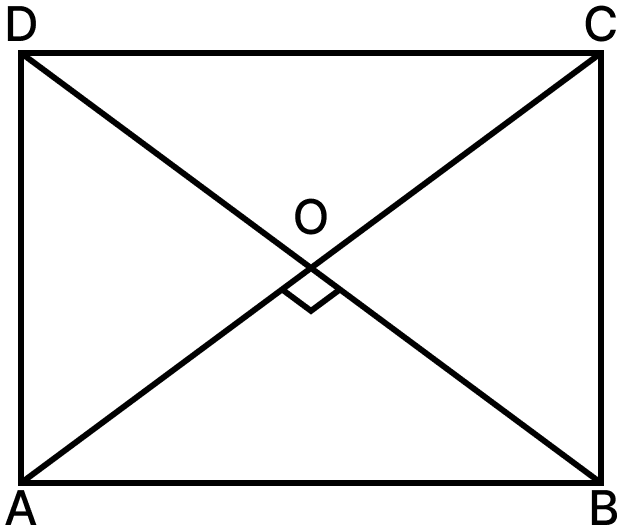
In parallelogram ABCD, diagonal AC is equal to diagonal BD and ∠AOB = 90°, ABCD is :
parallelogram
rectangle
rhombus
square
Answer
Given, in parallelogram ABCD, diagonal AC = diagonal BD and ∠AOB = 90°.
The diagonals of a parallelogram bisect each other. Here, they are also equal and intersect at 90°.
The diagonals of a square are equal and bisect each other at 90°.
∴ ABCD is a square.
Hence, option 4 is the correct option.
The diagonals of a parallelogram are perpendicular to each other, the parallelogram is a :
rectangle
rhombus
square
none of these
Answer
The diagonals of a parallelogram bisect each other. If they are also perpendicular to each other, then the diagonals bisect each other at 90°.
The diagonals of a rhombus bisect each other at 90°.
∴ The parallelogram is a rhombus.
Hence, option 2 is the correct option.