
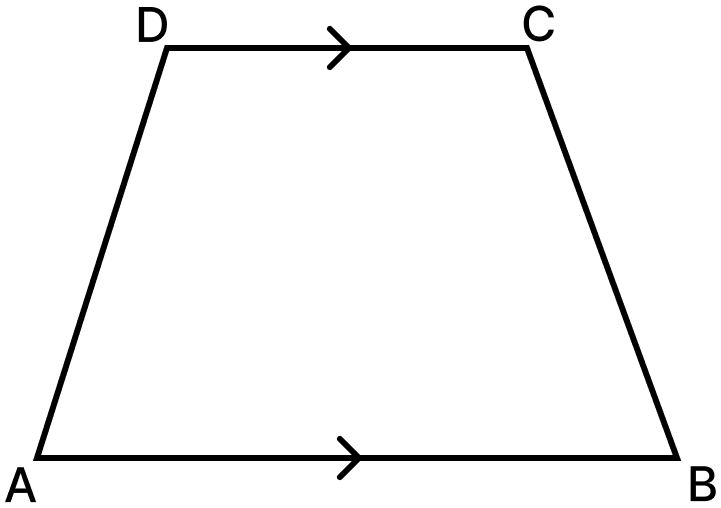
In a trapezium ABCD, side AB is parallel to side DC. If ∠A = 78° and ∠C = 120°, find angles B and D.
Answer
Given, in trapezium ABCD, AB ∥ DC, ∠A = 78° and ∠C = 120°.
As AB ∥ DC and AD is a transversal, ∠A and ∠D are co-interior angles with their sum = 180°.
⇒ ∠A + ∠D = 180°
⇒ 78° + ∠D = 180°
⇒ ∠D = (180° − 78°) = 102°
As AB ∥ DC and BC is a transversal, ∠B and ∠C are co-interior angles with their sum = 180°.
⇒ ∠B + ∠C = 180°
⇒ ∠B + 120° = 180°
⇒ ∠B = (180° − 120°) = 60°
Hence, ∠B = 60° and ∠D = 102°.
In a trapezium ABCD, side AB is parallel to side DC. If ; find the value of .
Answer
Given, in trapezium ABCD, AB ∥ DC, .
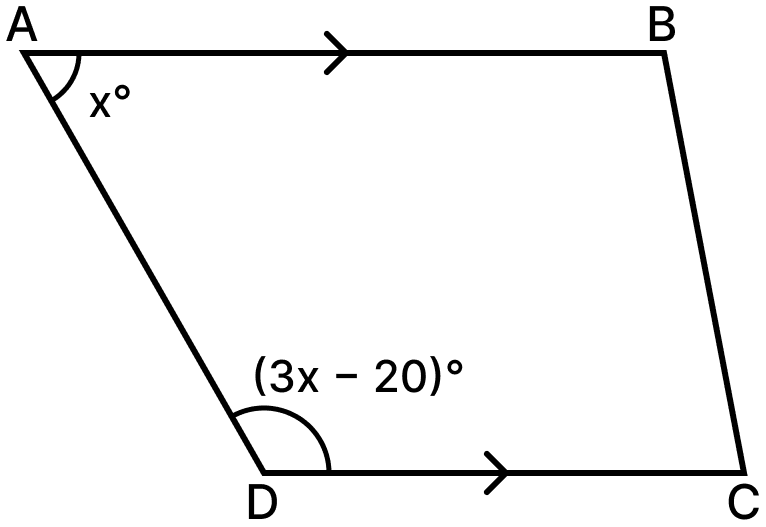
As AB ∥ DC and AD is a transversal, ∠A and ∠D are co-interior angles with their sum = 180°.
⇒ ∠A + ∠D = 180°
Hence,
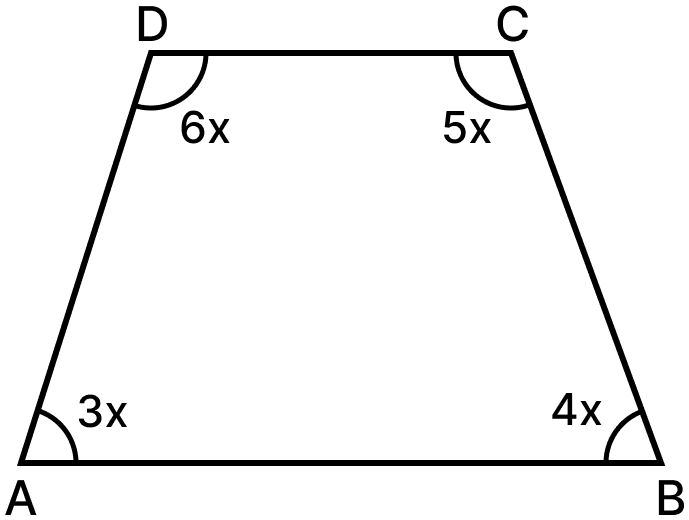
The angles A, B, C and D of a trapezium ABCD are in the ratio 3 : 4 : 5 : 6, i.e. ∠A : ∠B : ∠C : ∠D = 3 : 4 : 5 : 6. Find all the angles of the trapezium. Also, name the two sides of this trapezium which are parallel to each other. Give reason for your answer.
Answer
Let the measures of the angles ∠A, ∠B, ∠C and ∠D be and respectively.
We know that,
The sum of the angles of a quadrilateral is 360°.
∴ ∠A = = 3 × 20° = 60°
∠B = = 4 × 20° = 80°
∠C = = 5 × 20° = 100°
∠D = = 6 × 20° = 120°
Now, ∠A + ∠D = (60° + 120°) = 180°
As ∠A and ∠D are co-interior angles formed by the transversal AD and their sum is 180°, we get AB ∥ DC.
Also, ∠A + ∠B = (60° + 80°) = 140° ≠ 180°, so AD is not parallel to BC.
Hence, ∠A = 60°, ∠B = 80°, ∠C = 100°, ∠D = 120° and AB is parallel to DC.
In an isosceles trapezium, one pair of opposite sides are ...... to each other and the other pair of opposite sides are ...... to each other.
Answer
In an isosceles trapezium, one pair of opposite sides are parallel to each other and the other pair of opposite sides are equal to each other.
Two diagonals of an isosceles trapezium are cm and cm. Find the value of .
Answer
Given, the diagonals of an isosceles trapezium are cm and cm.
We know that the diagonals of an isosceles trapezium are equal.
Hence,
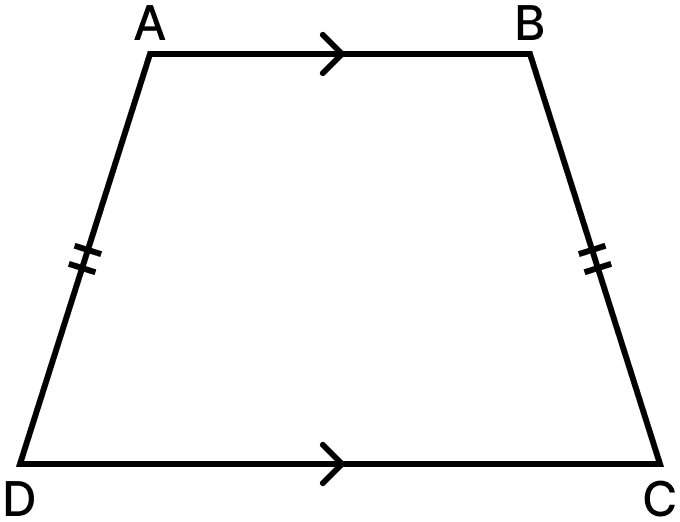
Angle A of an isosceles trapezium ABCD is 115°; find the angles B, C and D.
Answer
Given, ABCD is an isosceles trapezium in which AB ∥ DC, AD = BC and ∠A = 115°.
We know that the angles on the same base of an isosceles trapezium are equal.
⇒ ∠B = ∠A = 115°
As AB ∥ DC and BC is a transversal, ∠B and ∠C are co-interior angles with their sum = 180°.
⇒ ∠B + ∠C = 180°
⇒ 115° + ∠C = 180°
⇒ ∠C = (180° − 115°) = 65°
Also, ∠D = ∠C = 65°
Hence, ∠B = 115°, ∠C = 65° and ∠D = 65°.
Two opposite angles of a parallelogram are 100° each. Find the other two opposite angles.
Answer
Let ABCD be a parallelogram in which ∠A = ∠C = 100°.
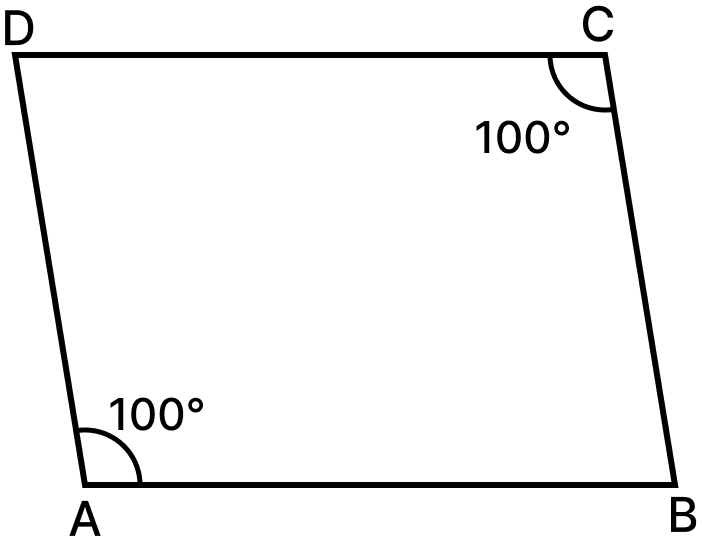
∵ Adjacent angles of a parallelogram are supplementary,
⇒ ∠A + ∠B = 180°
⇒ 100° + ∠B = 180°
⇒ ∠B = (180° − 100°) = 80°
Opposite angles of a parallelogram are equal,
⇒ ∠D = ∠B = 80°
Hence, the other two opposite angles are 80° each.
Two adjacent angles of a parallelogram are 70° and 110° respectively. Find the other two angles.
Answer
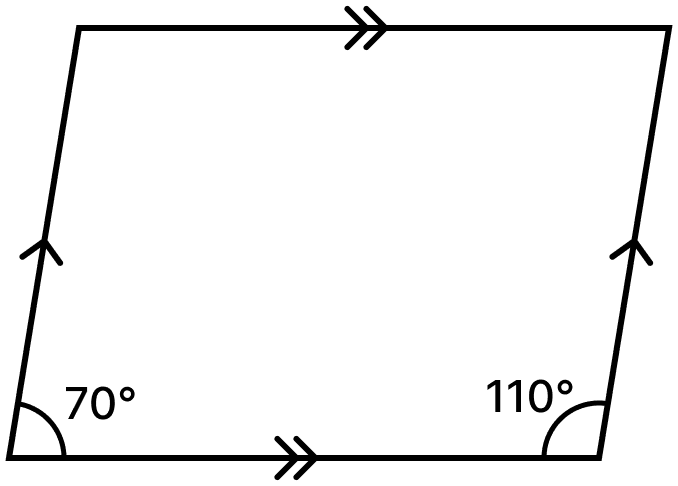
Let ABCD be the given parallelogram in which ∠A = 70° and ∠B = 110°.
Opposite angles of a parallelogram are equal,
⇒ ∠C = ∠A = 70° and ∠D = ∠B = 110°
Hence, the other two angles are 70° and 110°.
The angles A, B, C and D of a quadrilateral are in the ratio 2 : 3 : 2 : 3. Show that this quadrilateral is a parallelogram.
Answer
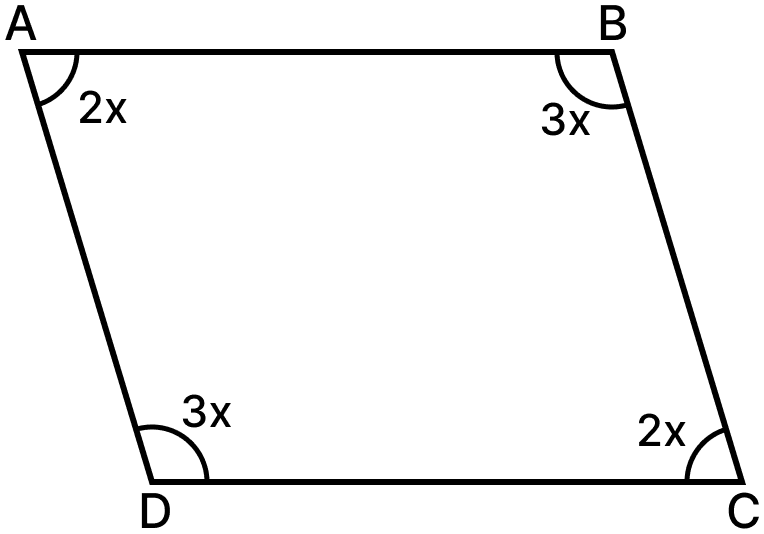
Let the measures of the angles ∠A, ∠B, ∠C and ∠D be and respectively.
We know that,
The sum of the angles of a quadrilateral is 360°.
∴ ∠A =
∠B =
∠C =
∠D =
Now, ∠A + ∠B = (72° + 108°) = 180°
As ∠A and ∠B are co-interior angles formed by the transversal AB and their sum is 180°, we get AD ∥ BC.
Also, ∠A + ∠D = (72° + 108°) = 180°
As ∠A and ∠D are co-interior angles formed by the transversal AD and their sum is 180°, we get AB ∥ DC.
Thus, both the pairs of opposite sides of quadrilateral ABCD are parallel and its opposite angles are equal, i.e. ∠A = ∠C = 72° and ∠B = ∠D = 108°.
Hence, the given quadrilateral is a parallelogram.
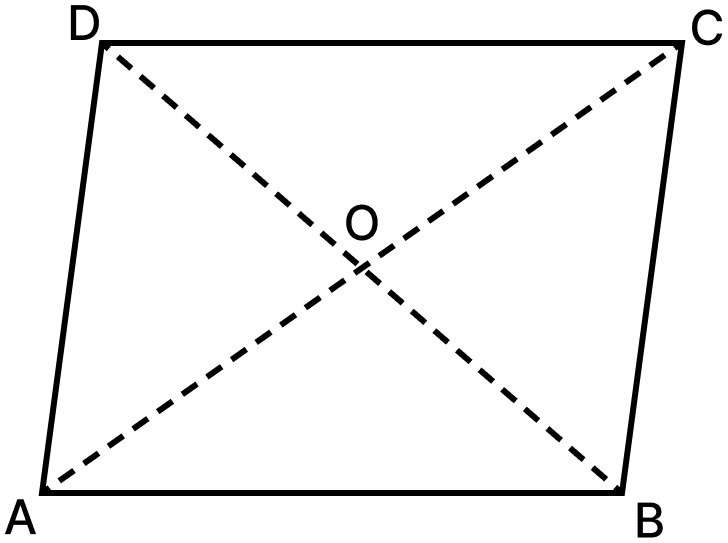
In a parallelogram ABCD, its diagonals AC and BD intersect each other at point O.
If AC = 12 cm and BD = 9 cm; find the lengths of OA and OD.
Answer
Given, ABCD is a parallelogram whose diagonals AC and BD intersect each other at O, AC = 12 cm and BD = 9 cm.
We know that the diagonals of a parallelogram bisect each other.
⇒ OA = OC = AC and OB = OD = BD
∴ OA = × 12 cm = 6 cm
OD = × 9 cm = 4.5 cm
Hence, OA = 6 cm and OD = 4.5 cm.
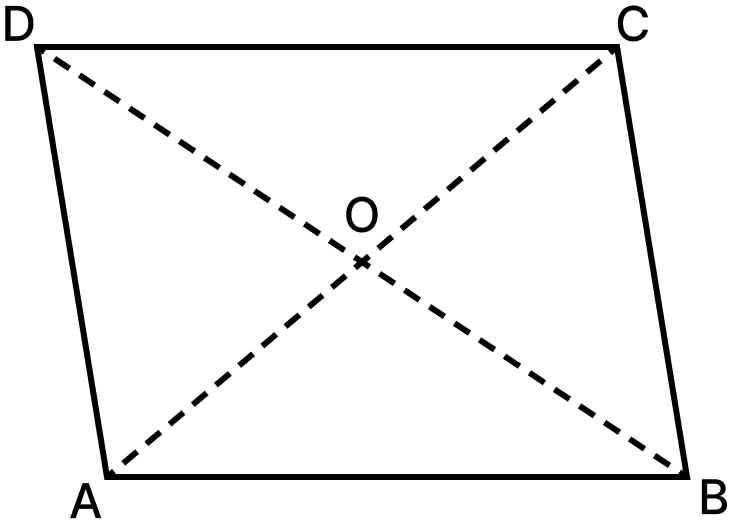
In parallelogram ABCD, its diagonals intersect at point O.
If OA = 6 cm and OB = 7.5 cm, find the lengths of AC and BD.
Answer
Given, ABCD is a parallelogram whose diagonals AC and BD intersect at O, OA = 6 cm and OB = 7.5 cm.
We know that the diagonals of a parallelogram bisect each other.
⇒ OA = OC = AC and OB = OD = BD
∴ AC = 2 × OA = (2 × 6) cm = 12 cm
BD = 2 × OB = (2 × 7.5) cm = 15 cm
Hence, AC = 12 cm and BD = 15 cm.
In a parallelogram ABCD, ∠A = 90°
(i) what is the measure of angle B?
(ii) write the special name of the parallelogram.
Answer
Given, ABCD is a parallelogram in which ∠A = 90°.
(i) ∵ Adjacent angles of a parallelogram are supplementary,
⇒ ∠A + ∠B = 180°
⇒ 90° + ∠B = 180°
⇒ ∠B = (180° − 90°) = 90°
Hence, ∠B = 90°.
(ii) Opposite angles of a parallelogram are equal,
⇒ ∠C = ∠A = 90° and ∠D = ∠B = 90°
Thus, each angle of the parallelogram is 90°, so it is a rectangle.
Hence, the special name of the parallelogram is rectangle.
One diagonal of a rectangle is 18 cm. What is the length of its other diagonal?
Answer
Let ABCD be a rectangle in which diagonal AC = 18 cm.
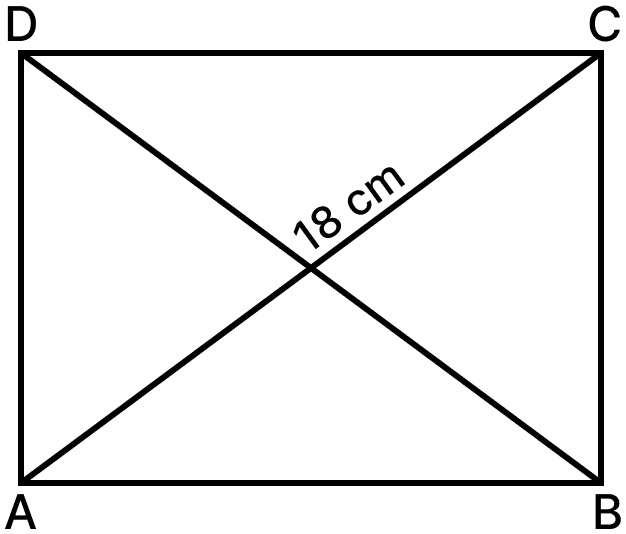
We know that the diagonals of a rectangle are equal.
⇒ BD = AC = 18 cm
Hence, the length of the other diagonal is 18 cm.
Each angle of a quadrilateral is . Find :
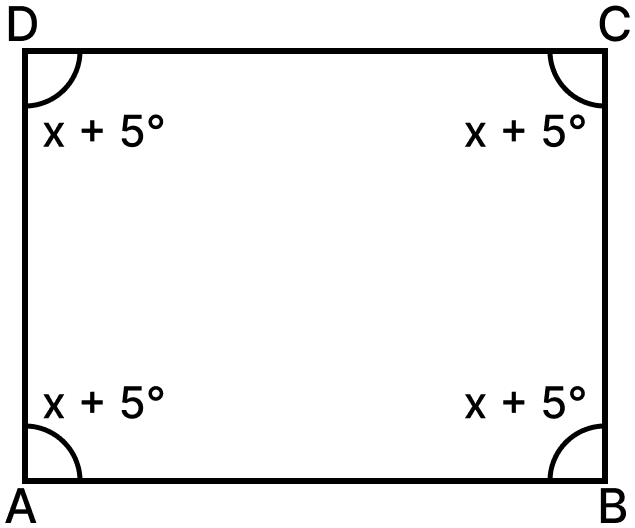
(i) the value of .
(ii) each angle of the quadrilateral.
Give the special name of the quadrilateral taken.
Answer
Given, each angle of quadrilateral ABCD is .
(i) Since, the sum of interior angles of a quadrilateral is 360°
Hence,
(ii) Each angle of the quadrilateral =
Hence, each angle of the quadrilateral is 90°.
Since each angle of the quadrilateral is 90°, the quadrilateral is a rectangle.
Hence, the special name of the quadrilateral is rectangle.
If three angles of a quadrilateral are 90° each, show that the given quadrilateral is a rectangle.
Answer
Let ABCD be a quadrilateral in which ∠A = ∠B = ∠C = 90°.
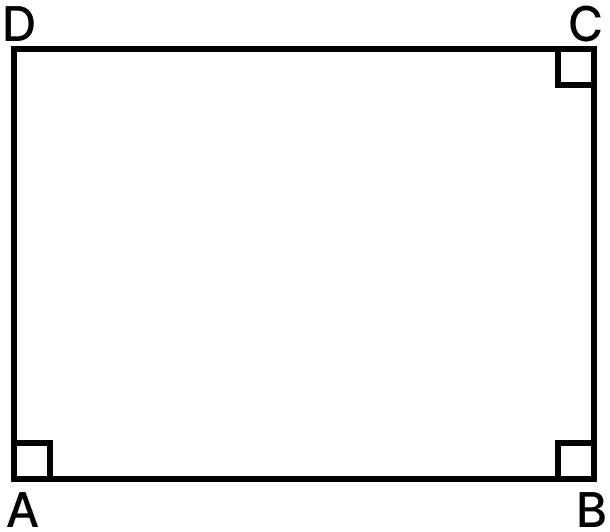
Since, the sum of interior angles of a quadrilateral is 360°
⇒ ∠A + ∠B + ∠C + ∠D = 360°
⇒ 90° + 90° + 90° + ∠D = 360°
⇒ 270° + ∠D = 360°
⇒ ∠D = (360° − 270°) = 90°
Thus, each angle of the quadrilateral is 90°.
Hence, the given quadrilateral is a rectangle.
The diagonals of a rhombus are 6 cm and 8 cm. State the type of angles these diagonals make when they intersect.
Answer
Let ABCD be a rhombus whose diagonals AC = 6 cm and BD = 8 cm intersect each other at O.
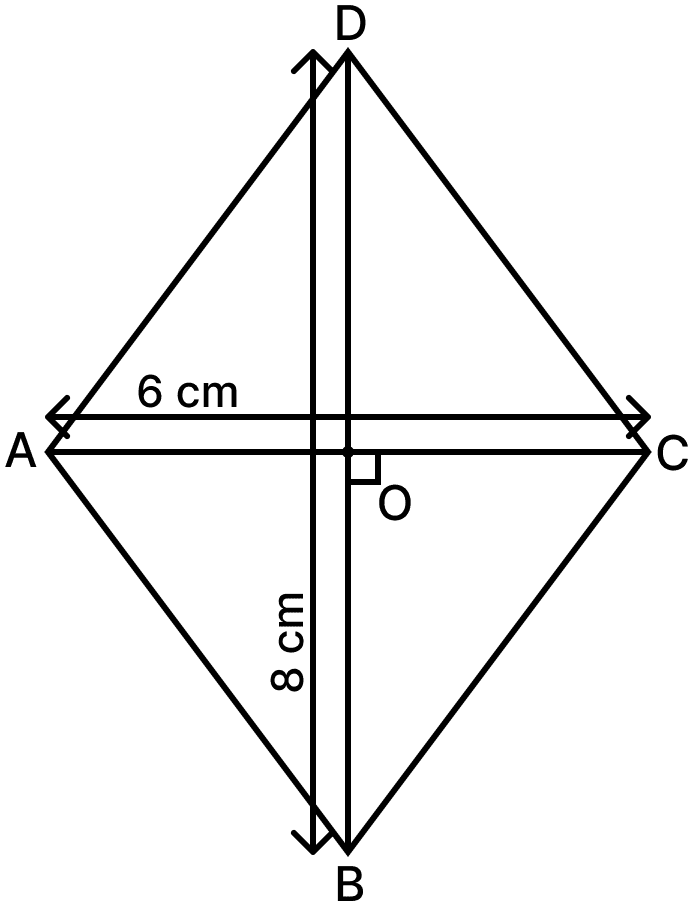
We know that the diagonals of a rhombus bisect each other at 90°.
⇒ ∠AOB = ∠BOC = ∠COD = ∠DOA = 90°
Hence, the diagonals make right angles (90°) when they intersect.
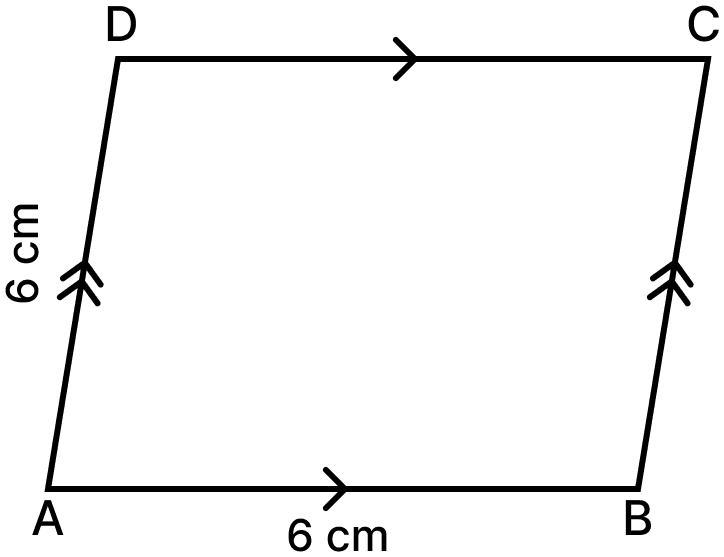
Write, giving reason, the name of the figure drawn alongside. Under what condition will this figure be a square?
Answer
Given, in quadrilateral ABCD, AB ∥ DC, AD ∥ BC, AB = 6 cm and AD = 6 cm.
As both the pairs of opposite sides are parallel, ABCD is a parallelogram.
Since the opposite sides of a parallelogram are equal, we have :
⇒ DC = AB = 6 cm and BC = AD = 6 cm
⇒ AB = BC = CD = DA = 6 cm
Thus, all the four sides of the quadrilateral are equal, so it is a rhombus.
Hence, the given figure is a rhombus, as all its four sides are equal.
A square is a quadrilateral in which all the sides are equal and each angle is 90°.
If any one angle of the rhombus is 90°, then each of its angles will be 90° [Opposite angles are equal and adjacent angles are supplementary]
Hence, the given figure will be a square when any angle of it is 90°.
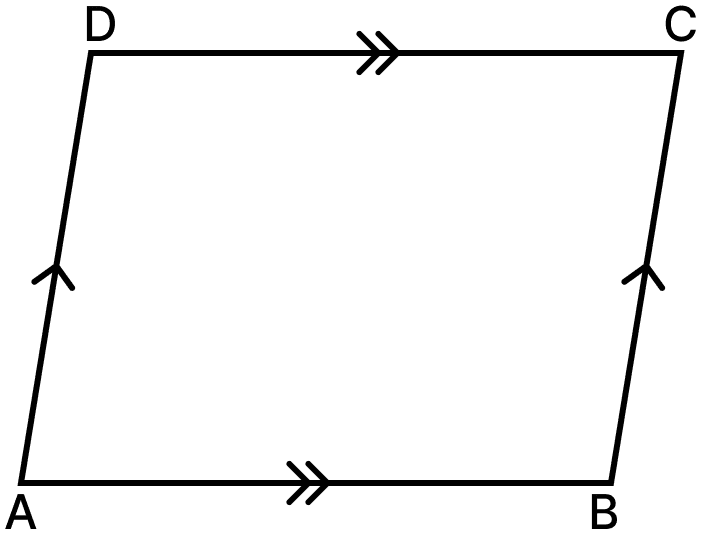
Write two conditions that will make the adjoining figure a square.
Answer
In the adjoining figure, AB ∥ DC and AD ∥ BC, so ABCD is a parallelogram.
A square is a quadrilateral in which all the sides are equal and each angle is 90°.
First condition : All the sides must be equal, i.e. AB = BC = CD = DA.
Second condition : Any one angle is 90°.
If any one angle of a parallelogram is 90°, then each of its angles will be 90°.
Hence, the two conditions are : all the sides must be equal and any angle is 90°.