Two angles of a quadrilateral are 89° and 113°. If the other two angles are equal, find the equal angles.
Answer
Let the measure of each of the equal angles be x.
We know that,
The sum of the angles of a quadrilateral is 360°.
∴89°+113°+x+x=360°⇒2x+202°=360°⇒2x=360°−202°⇒2x=158°⇒x=2158°⇒x=79°
Hence, the measure of each of the equal angles is 79°.
Two angles of a quadrilateral are 68° and 76°. If the other two angles are in the ratio 5 : 7, find the measure of each of them.
Answer
Let the measures of the other two angles of the given quadrilateral be 5x and 7x respectively.
We know that,
The sum of the angles of a quadrilateral is 360°.
∴68°+76°+5x+7x=360°⇒12x+144°=360°⇒12x=360°−144°⇒12x=216°⇒x=12216°⇒x=18°
∴ Third angle = 5x=5×18°=90°
Fourth angle = 7x=7×18°=126°
Hence, the other two angles of the quadrilateral are 90° and 126°.
Angles of a quadrilateral are (4x)°,5(x+2)°,(7x−20)° and 6(x+3)°. Find :
(i) the value of x.
(ii) each angle of the quadrilateral.
Answer
We know that the sum of the angles of a quadrilateral is 360°.
(i) (4x)°+5(x+2)°+(7x−20)°+6(x+3)°=360°
⇒(4x+5x+10+7x−20+6x+18)°=360°⇒(22x+8)°=360°⇒22x=360°−8°=352°⇒x=22352⇒x=16
Hence, x=16
(ii) First angle = (4x)°=(4×16)°=64°
Second angle = 5(x+2)°=5(16+2)°=90°
Third angle = (7x−20)°=(7×16−20)°=92°
Fourth angle = 6(x+3)°=6(16+3)°=114°
Hence, the angles of the quadrilateral are 64°, 90°, 92° and 114°.
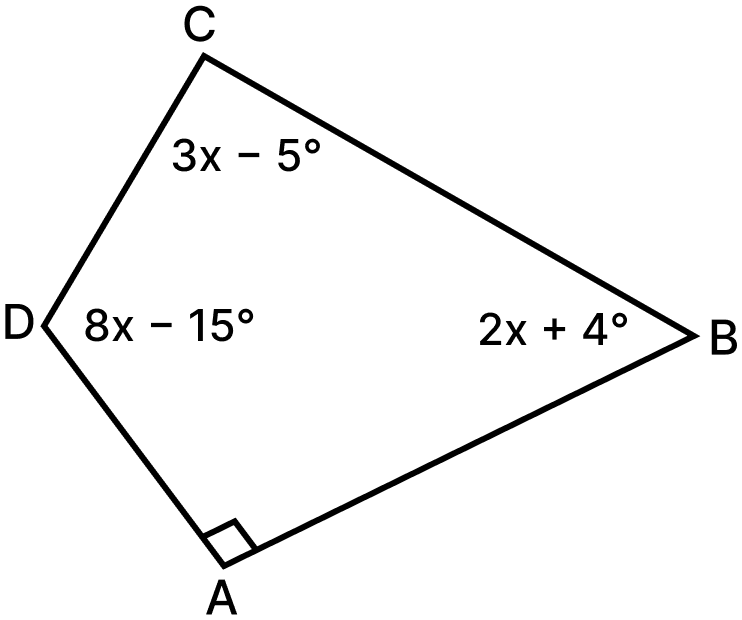
Use the information given in the following figure to find :
(i) x.
(ii) ∠B and ∠C.
Answer
In quadrilateral ABCD,
∠A=90°,∠B=2x+4°,∠C=3x−5° and ∠D=8x−15°
(i) ∠A + ∠B + ∠C + ∠D = 360° [Sum of the angles of a quadrilateral is 360°]
⇒90°+2x+4°+3x−5°+8x−15°=360°⇒13x+74°=360°⇒13x=360°−74°=286°⇒x=13286°⇒x=22°
Hence, x=22°
(ii) ∠B = 2x+4°=2×22°+4°=48°
∠C = 3x−5°=3×22°−5°=61°
Hence, ∠B = 48° and ∠C = 61°.
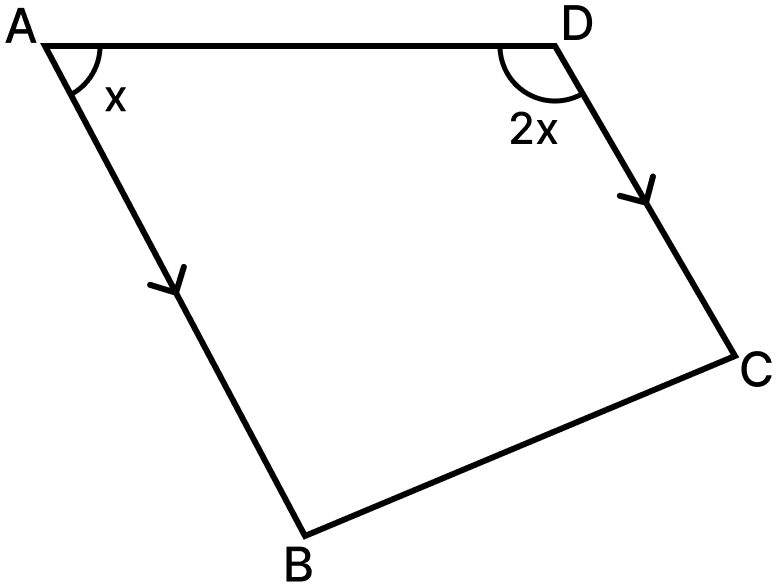
In quadrilateral ABCD, side AB is parallel to side DC. If ∠A : ∠D = 1 : 2 and ∠C : ∠B = 4 : 5. Calculate each angle of the quadrilateral.
Answer
Given, in quadrilateral ABCD, AB ∥ DC, ∠A : ∠D = 1 : 2 and ∠C : ∠B = 4 : 5.
Let ∠A=x and ∠D=2x.
As AB ∥ DC and AD is a transversal, ∠A and ∠D are co-interior angles.
⇒ ∠A + ∠D = 180°
⇒x+2x=180°⇒3x=180°⇒x=3180°⇒x=60°
∴ ∠A = 60° and ∠D = 2×60°=120°
Again, let ∠C=4y and ∠B=5y.
As AB ∥ DC and BC is a transversal, ∠B and ∠C are co-interior angles.
⇒ ∠B + ∠C = 180°
⇒5y+4y=180°⇒9y=180°⇒y=9180°⇒y=20°
∴ ∠C = 4×20°=80°
∠B = 5×20°=100°
Hence, ∠A = 60°, ∠B = 100°, ∠C = 80° and ∠D = 120°.
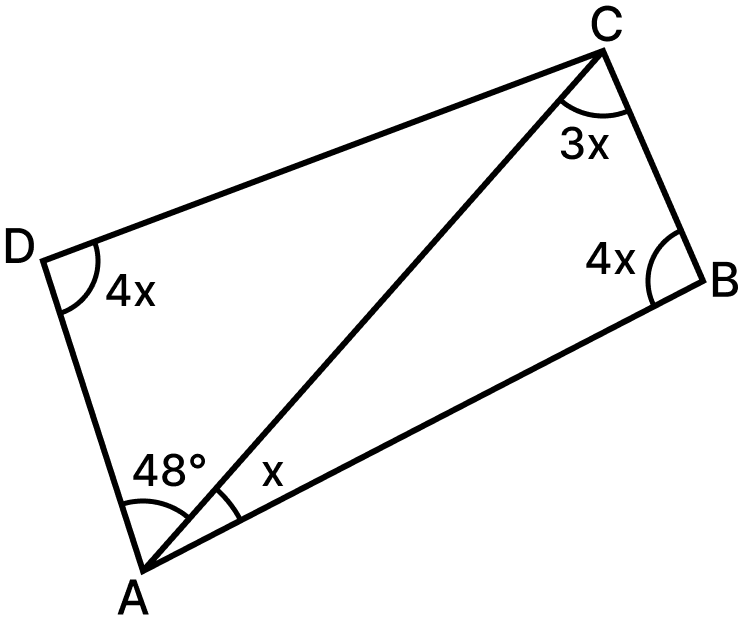
From the following figure find,
(i) x
(ii) ∠ABC
(iii) ∠ACD
Answer
Given, in quadrilateral ABCD, ∠DAC=48°,∠CAB=x,∠ABC=4x,∠BCD=3x and ∠CDA=4x.
(i) ∠DAB = ∠DAC + ∠CAB = 48°+x
Now, ∠DAB + ∠ABC + ∠BCD + ∠CDA = 360° [Sum of the angles of a quadrilateral is 360°]
⇒48°+x+4x+3x+4x=360°⇒12x+48°=360°⇒12x=360°−48°=312°⇒x=12312°⇒x=26°
Hence, x=26°
(ii) ∠ABC = 4x=4×26°=104°
Hence, ∠ABC = 104°.
(iii) ∠CDA = 4x=4×26°=104°
In ΔACD, we have :
⇒ ∠DAC + ∠CDA + ∠ACD = 180° [Sum of the angles of a triangle is 180°]
⇒ 48° + 104° + ∠ACD = 180°
⇒ ∠ACD = (180° − 152°) = 28°
Hence, ∠ACD = 28°.
In quadrilateral ABCD, ∠C=64°,∠D=∠C−8°;∠A=5(a+2)° and ∠B=2(2a+7)°. Calculate ∠A.
Answer
Given, in quadrilateral ABCD, ∠C=64°,∠D=∠C−8°,∠A=5(a+2)° and ∠B=2(2a+7)°.
⇒ ∠D = (64° − 8°) = 56°
We know that,
The sum of the angles of a quadrilateral is 360°.
∴5(a+2)°+2(2a+7)°+64°+56°=360°⇒(5a+10)°+(4a+14)°+120°=360°⇒(9a+144)°=360°⇒9a=360°−144°⇒9a=216°⇒a=9216⇒a=24
∴ ∠A = 5(a+2)°=5(24+2)°=130°
Hence, ∠A = 130°.
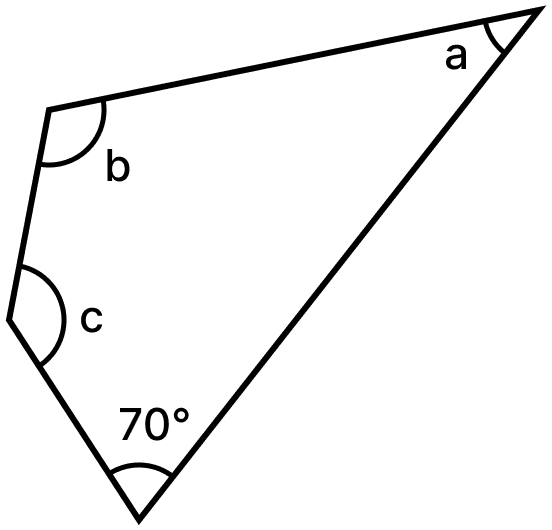
In the given figure :
b=2a+15° and
c=3a+5°,
find the values of b and c.
Answer
Given, a,b,c and 70° are the angles of the quadrilateral, b=2a+15° and c=3a+5°.
We know that,
The sum of the angles of a quadrilateral is 360°.
∴a+b+c+70°=360°⇒a+2a+15°+3a+5°+70°=360°⇒6a+90°=360°⇒6a=360°−90°⇒6a=270°⇒a=6270°⇒a=45°
∴ b=2a+15°=2×45°+15°=105°
c=3a+5°=3×45°+5°=140°
Hence, b=105° and c=140°
Three angles of a quadrilateral are equal. If the fourth angle is 69°, find the measure of equal angles.
Answer
Let the measure of each of the three equal angles be x.
We know that,
The sum of the angles of a quadrilateral is 360°.
∴x+x+x+69°=360°⇒3x+69°=360°⇒3x=360°−69°⇒3x=291°⇒x=3291°⇒x=97°
Hence, the measure of each of the equal angles is 97°.
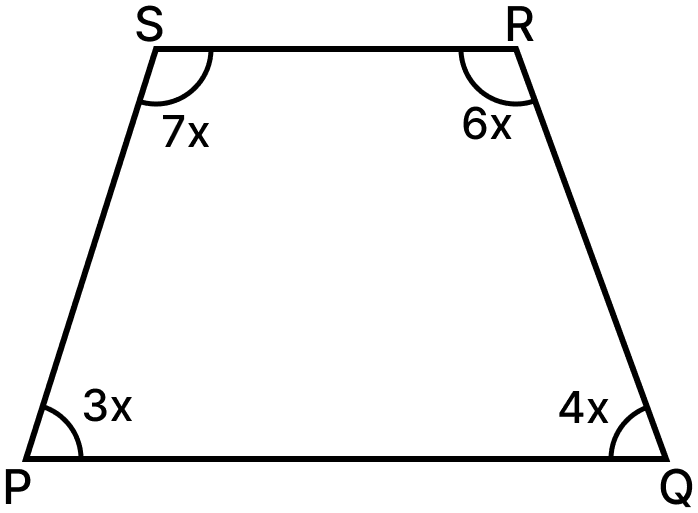
In quadrilateral PQRS, ∠P : ∠Q : ∠R : ∠S = 3 : 4 : 6 : 7. Calculate each angle of the quadrilateral and then prove that PQ and SR are parallel to each other.
Is PS also parallel to QR?
Answer
Let the measures of the angles ∠P, ∠Q, ∠R and ∠S be 3x,4x,6x and 7x respectively.
We know that,
The sum of the angles of a quadrilateral is 360°.
∴3x+4x+6x+7x=360°⇒20x=360°⇒x=20360°⇒x=18°
∴ ∠P = 3x = 3 × 18° = 54°
∠Q = 4x = 4 × 18° = 72°
∠R = 6x = 6 × 18° = 108°
∠S = 7x = 7 × 18° = 126°
Now, ∠P + ∠S = (54° + 126°) = 180°
As ∠P and ∠S are co-interior angles formed by the transversal PS and their sum is 180°, we get PQ ∥ SR.
Also, ∠P + ∠Q = (54° + 72°) = 126° ≠ 180°
As ∠P and ∠Q are co-interior angles formed by the transversal PQ and their sum is not 180°, PS is not parallel to QR.
Hence, ∠P = 54°, ∠Q = 72°, ∠R = 108°, ∠S = 126°, PQ ∥ SR and PS is not parallel to QR.
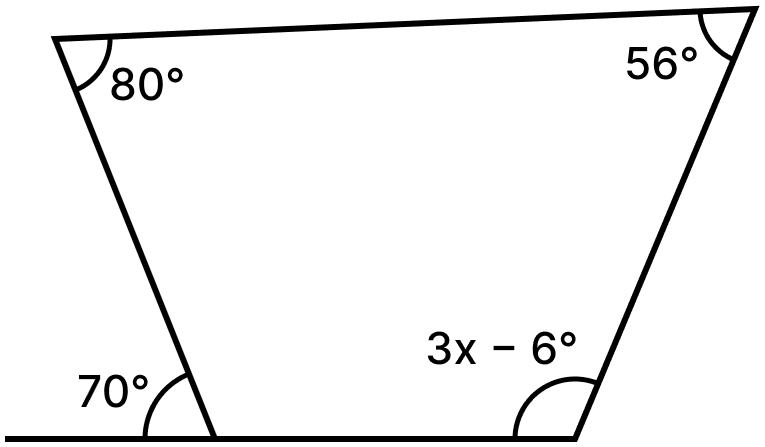
Use the information given in the following figure to find the value of x.
Answer
Given, the interior angles of the quadrilateral at the top two vertices are 80° and 56°, the interior angle at the bottom-right vertex is 3x−6° and the exterior angle at the bottom-left vertex is 70°.
The interior angle at the bottom-left vertex and the exterior angle 70° form a linear pair.
⇒ Interior angle at the bottom-left vertex = (180° − 70°) = 110°
We know that,
The sum of the angles of a quadrilateral is 360°.
∴80°+56°+110°+3x−6°=360°⇒3x+240°=360°⇒3x=360°−240°⇒3x=120°⇒x=3120°⇒x=40°
Hence, x=40°
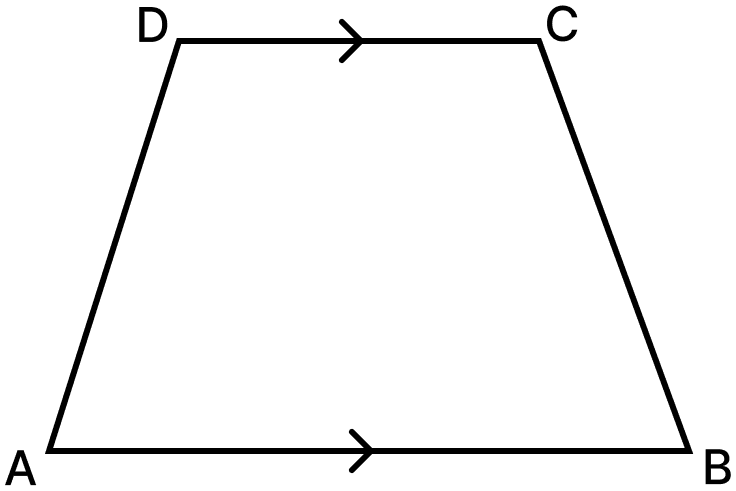
The following figure shows a quadrilateral in which sides AB and DC are parallel. If ∠A:∠D=4:5,∠B=(3x−15)° and ∠C=(4x+20)°, find each angle of the quadrilateral ABCD.
Answer
Given, in quadrilateral ABCD, AB ∥ DC, ∠A:∠D=4:5,∠B=(3x−15)° and ∠C=(4x+20)°.
Let ∠A=(4y)° and ∠D=(5y)°.
As AB ∥ DC and AD is a transversal, ∠A and ∠D are co-interior angles.
⇒ ∠A + ∠D = 180°
⇒4y+5y=180°⇒9y=180°⇒y=9180⇒y=20
∴ ∠A = (4 × 20)° = 80°
∠D = (5 × 20)° = 100°
As AB ∥ DC and BC is a transversal, ∠B and ∠C are co-interior angles.
⇒ ∠B + ∠C = 180°
⇒(3x−15)°+(4x+20)°=180°⇒(7x+5)°=180°⇒7x=180°−5°=175°⇒x=7175⇒x=25
∴ ∠B = (3x−15)°=(3×25−15)°=60°
∠C = (4x+20)°=(4×25+20)°=120°
Hence, ∠A = 80°, ∠B = 60°, ∠C = 120° and ∠D = 100°.