
Which of the following has neither length nor width nor thickness?
Line
Surface
Plane
Point
Answer
A point is only a mark of position; it has neither length nor width nor thickness.
Hence, option 4 is the correct option.
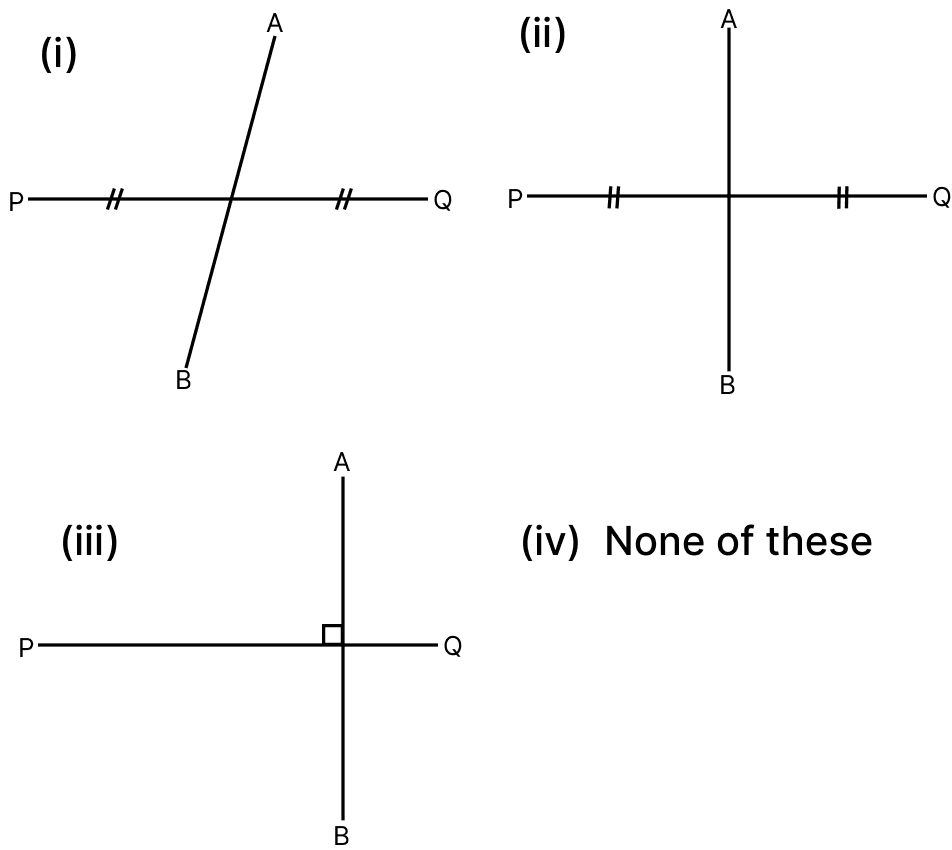
In which of the following figures, AB is perpendicular bisector of line segment PQ?
Answer
AB is the perpendicular bisector of PQ only when AB is perpendicular to PQ and also cuts it into two equal parts.
This condition is satisfied only in the second figure.
Hence, option 2 is the correct option.
Which of the following statements is incorrect?
Ray has one fixed point.
Ray can be extended in only one direction.
Ray has a definite length.
All of these.
Answer
A ray extends endlessly in one direction, so it does not have a definite length.
Hence, option 3 is the correct option.
The number of line(s) passing through two fixed points is:
1
2
0
3
Answer
Through two fixed points, one and only one line can be drawn.
Hence, option 1 is the correct option.
The complement of (x - y)° is:
(90 - x - y)°
(90 - x + y)°
(90 + x - y)°
(x - y - 90)°
Answer
The complement of an angle = 90° − the angle.
Complement of (x − y)° = 90° − (x − y)°
= (90 − x + y)°
Hence, option 2 is the correct option.
The supplement of of 60° is:
52°
132°
40°
80°
Answer
Since,
The supplement of an angle = 180° − the angle.
Supplement of 48° = 180° − 48° = 132°
Hence, option 2 is the correct option.
Reflex angle measures:
more than 90° and less than 180°
more than 180° and less than 270°
more than 180° and less than 360°
more than 90° and less than 360°
Answer
A reflex angle is an angle whose measure is more than 180° and less than 360°.
Hence, option 3 is the correct option.
When two parallel lines are cut by a transversal then which one of following is not true?
Interior alternate angles are equal.
Exterior alternate angles are complementary.
Co-interior angles are supplementary.
Corresponding angles are equal.
Answer
When two parallel lines are cut by a transversal, alternate exterior angles are equal. They are not necessarily complementary, so “exterior alternate angles are complementary” is not a general property.
Hence, option 2 is the correct option.
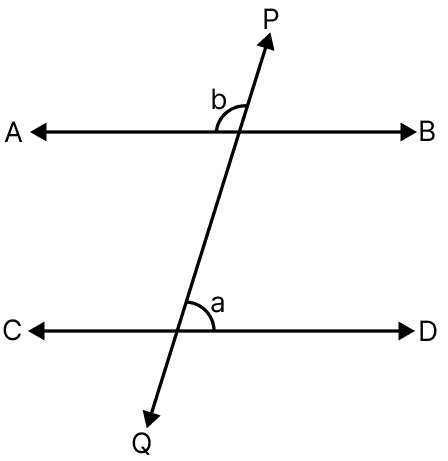
In the given figure, lines AB and CD are parallel to each other and ∠a : ∠b = 7 : 11, then ∠b is equal to:
70°
110°
100°
none of these
Answer
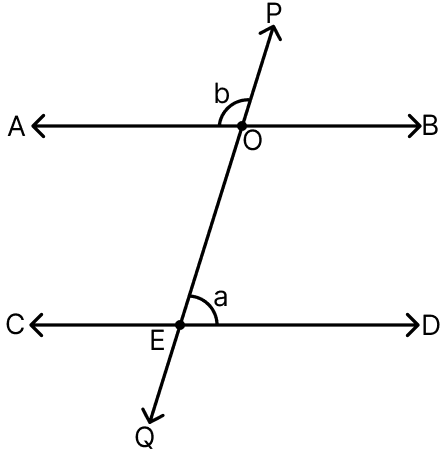
Given,
∠a : ∠b = 7 : 11
Let ∠a = 7x and ∠b = 11x.
Since AB ∥ CD,
∠BOE = ∠AOP = b [vertically opposite angles are equal]
∠BOE and ∠DEO are co-interior angles.
⇒ ∠BOE + ∠DEO = 180° [co-interior angles are supplementary]
⇒ ∠a + ∠b = 180°
⇒ 7x + 11x = 180°
⇒ 18x = 180°
⇒ x =
⇒ x = 10°
⇒ ∠b = 11x = 11 × 10° = 110°
Hence, option 2 is the correct option.
Two parallel lines are cut by a transversal, then which of the following can not be true?
Corresponding angles are equal.
Co-interior angles are complementary.
Co-interior angles are supplementary.
Alternate angles are equal.
Answer
When two parallel lines are cut by a transversal, the co-interior angles are supplementary (sum = 180°); they can never be complementary (sum = 90°).
Hence, option 2 is the correct option.