
Each figure given below shows a pair of parallel lines cut by a transversal. For each case, find a and b, giving reasons.
Answer
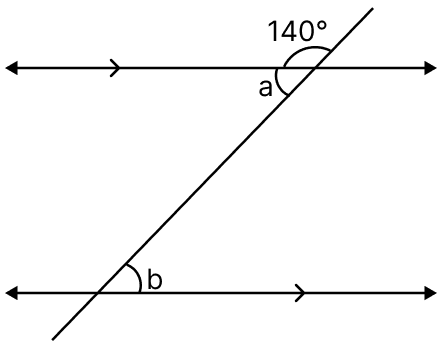
The angle 140° and ∠a form a linear pair.
⇒ a + 140° = 180° [linear pair]
⇒ a = 40°
⇒ b = a = 40° [alternate interior angles are equal]
Hence, a = 40° and b = 40°.
Each figure given below shows a pair of parallel lines cut by a transversal. For each case, find a and b, giving reasons.
Answer
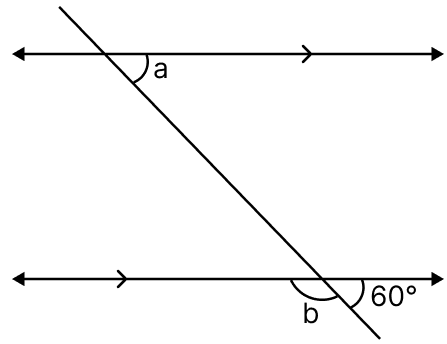
∠a and the 60° angle are corresponding angles.
⇒ a = 60° [corresponding angles are equal]
The 60° angle and ∠b form a linear pair.
⇒ b + 60° = 180° [linear pair]
⇒ b = 120°
Hence, a = 60° and b = 120°.
Each figure given below shows a pair of parallel lines cut by a transversal. For each case, find a and b, giving reasons.
Answer
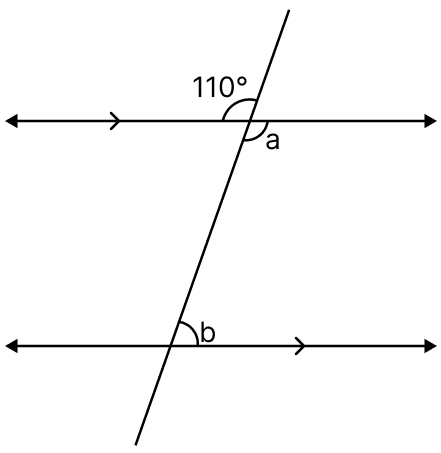
∠a and the 110° angle are vertically opposite angles.
⇒ a = 110° [vertically opposite angles are equal]
∠a and ∠b are co-interior angles.
⇒ a + b = 180° [co-interior angles are supplementary]
⇒ 110° + b = 180°
⇒ b = 70°
Hence, a = 110° and b = 70°.
Each figure given below shows a pair of parallel lines cut by a transversal. For each case, find a and b, giving reasons.
Answer
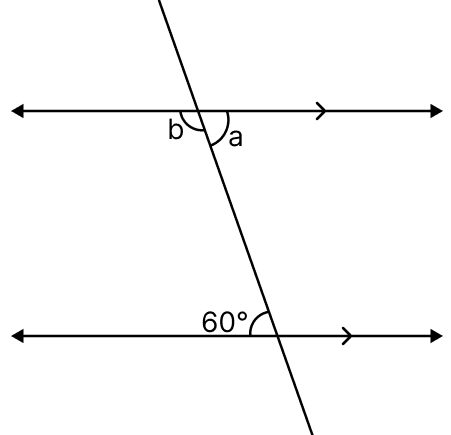
∠a and the 60° angle are alternate angles.
⇒ a = 60° [alternate interior angles are equal]
As, ∠a and ∠b form a linear pair.
⇒ a + b = 180° [linear pair]
⇒ 60° + b = 180°
⇒ b = 120°
Hence, a = 60° and b = 120°.
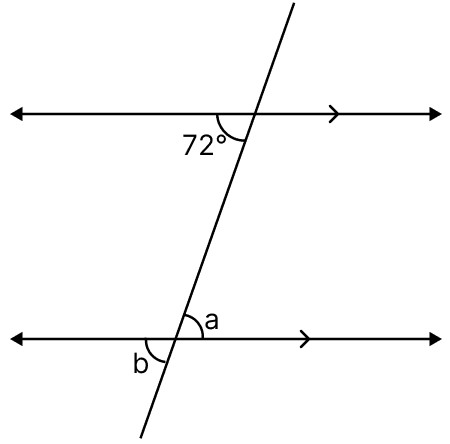
Each figure given below shows a pair of parallel lines cut by a transversal. For each case, find a and b, giving reasons.
Answer
∠a and the 72° angle are alternate interior angles.
⇒ a = 72° [alternate interior angles are equal]
∠b and ∠a are vertically opposite angles.
⇒ b = a = 72° [vertically opposite angles are equal]
Hence, a = 72° and b = 72°.
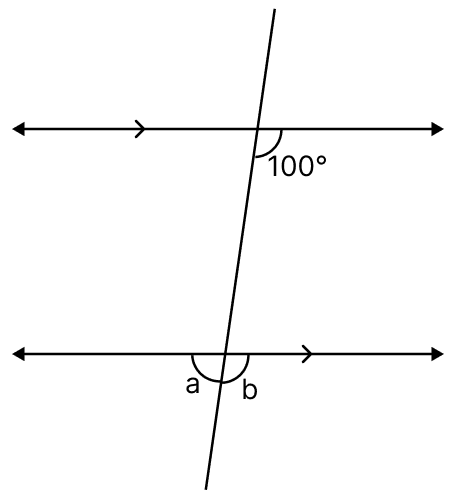
Each figure given below shows a pair of parallel lines cut by a transversal. For each case, find a and b, giving reasons.
Answer
From figure,
b = 100° [corresponding angles are equal]
a and b lie on a straight line and forms a linear pair.
⇒ a + b = 180°
⇒ a + 100° = 180°
⇒ a = 180° - 100° = 80°
Hence, a = 80° and b = 100°.
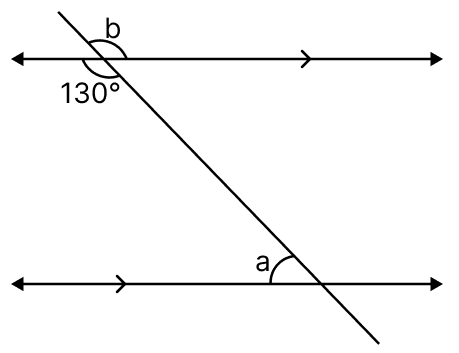
Each figure given below shows a pair of parallel lines cut by a transversal. For each case, find a and b, giving reasons.
Answer
∠b and the 130° angle are vertically opposite angles.
⇒ ∠b = 130° [vertically opposite angles are equal]
∠a and the 130° angle are co-interior angles.
⇒ a + 130° = 180° [co-interior angles are supplementary]
⇒ a = 50°
Hence, a = 50° and b = 130°.
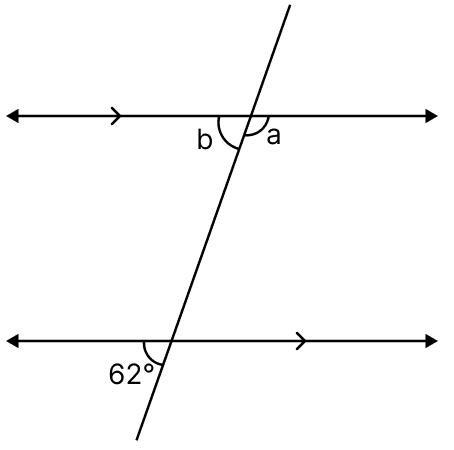
Each figure given below shows a pair of parallel lines cut by a transversal. For each case, find a and b, giving reasons.
Answer
From figure,
b = 62° [corresponding angles are equal]
a and b lie on a straight line and form a linear pair.
⇒ a + b = 180°
⇒ a + 62° = 180°
⇒ a = 180° - 62° = 118°
Hence, a = 118° and b = 62°.
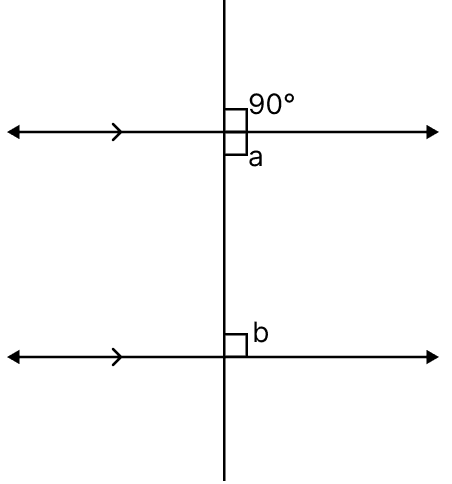
Each figure given below shows a pair of parallel lines cut by a transversal. For each case, find a and b, giving reasons.
Answer
∠a and the 90° angle form a linear pair.
⇒ a + 90° = 180°
⇒ a = 180° - 90°
⇒ a = 90°
∠b and the 90° angle are corresponding angles.
⇒ b = 90° [corresponding angles are equal]
Hence, a = 90° and b = 90°.
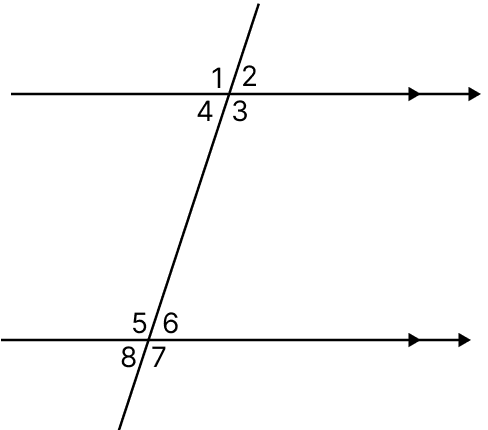
If ∠1 = 120°, find the measures of ∠2, ∠3, ∠4, ∠5, ∠6, ∠7 and ∠8. Give reasons.
Answer
Given,
∠1 = 120°.
∠1 and ∠2 form a linear pair.
⇒ ∠2 = 180° − ∠1 = 180° − 120° = 60°
∠3 and ∠1 are vertically opposite angles.
⇒ ∠3 = ∠1 = 120° [vertically opposite angles are equal]
∠4 and ∠2 are vertically opposite angles.
⇒ ∠4 = ∠2 = 60° [vertically opposite angles are equal]
∠5 and ∠1 are corresponding angles.
⇒ ∠5 = ∠1 = 120° [corresponding angles are equal]
∠6 and ∠2 are corresponding angles.
⇒ ∠6 = ∠2 = 60° [corresponding angles are equal]
∠7 and ∠3 are corresponding angles.
⇒ ∠7 = ∠3 = 120° [corresponding angles are equal]
∠8 and ∠4 are corresponding angles.
⇒ ∠8 = ∠4 = 60° [corresponding angles are equal]
Hence, ∠2 = 60°, ∠3 = 120°, ∠4 = 60°, ∠5 = 120°, ∠6 = 60°, ∠7 = 120° and ∠8 = 60°.
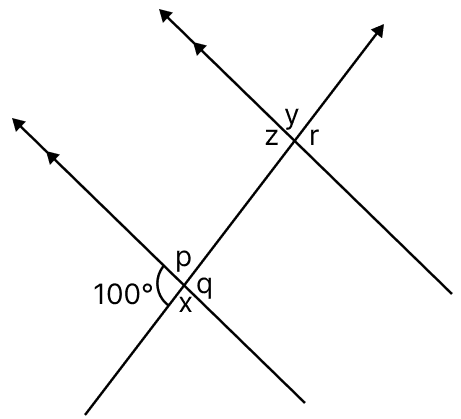
In the figure given alongside, find the measure of the angles denoted by x, y, z, p, q and r.
Answer
From the figure, the given angle is 100°.
The 100° angle and ∠x form a linear pair.
⇒ x + 100° = 180° [linear pair]
⇒ x = 180° - 100°
⇒ x = 80°
∠q and the 100° angle are vertically opposite angles.
⇒ q = 100° [vertically opposite angles are equal]
∠x and ∠p are vertically opposite angles.
⇒ ∠p = 80° [vertically opposite angles are equal]
∠y and ∠p are corresponding angles.
⇒ y = p = 80° [corresponding angles are equal]
∠z and the 100° angle are corresponding angles.
⇒ z = 100° [corresponding angles are equal]
∠r and ∠q are corresponding angles.
⇒ r = q = 100° [corresponding angles are equal]
Hence, x = 80°, y = 80°, z = 100°, p = 80°, q = 100° and r = 100°.
Using the figure given alongside, fill in the blanks:
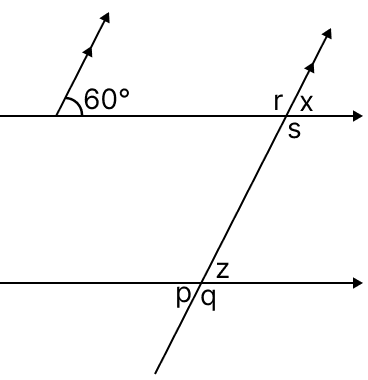
∠x = ..............; ∠z = ..............;
∠p = ..............; ∠q = ..............;
∠r = ..............; ∠s = ..............;
Answer
From the figure, the given angle is 60°.
∠x and the 60° angle are corresponding angles.
⇒ x = 60° [corresponding angles are equal]
∠z and ∠x are corresponding angles.
⇒ ∠z = 60° [corresponding angles are equal]
∠p and ∠z are vertically opposite angles.
⇒ ∠p = ∠z = 60° [vertically opposite angles are equal]
∠q and ∠p form a linear pair.
⇒ ∠q + ∠p = 180° [linear pair]
⇒ q + 60° = 180°
⇒ q = 120°
∠r and ∠x form linear pair.
⇒ ∠r + ∠x = 180° [linear pair]
⇒ ∠r + 60° = 180°
⇒ ∠r = 120°
∠s and ∠r are vertically opposite angles.
⇒ ∠s = ∠r = 120° [vertically opposite angles are equal]
Hence, ∠x = 60°, ∠z = 60°, ∠p = 60°, ∠q = 120°, ∠r = 120° and ∠s = 120°.
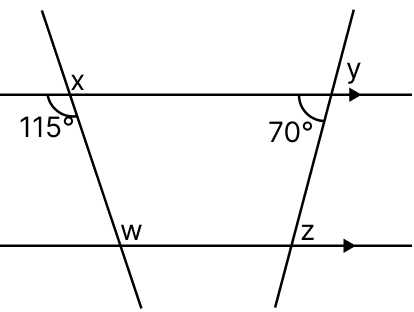
In the figure given alongside, find the angles shown by x, y, z and w. Give reasons.
Answer
From the figure, the given angles are 115° and 70°.
∠x and the 115° angle are vertically opposite angles.
⇒ x = 115° [vertically opposite angles are equal]
∠w and ∠x are corresponding angles.
⇒ w = x = 115° [corresponding angles are equal]
∠y and the 70° angle are vertically opposite angles.
⇒ y = 70° [vertically opposite angles are equal]
∠z and ∠y are corresponding angles.
⇒ z = y = 70° [corresponding angles are equal]
Hence, x = 115°, y = 70°, z = 70° and w = 115°.
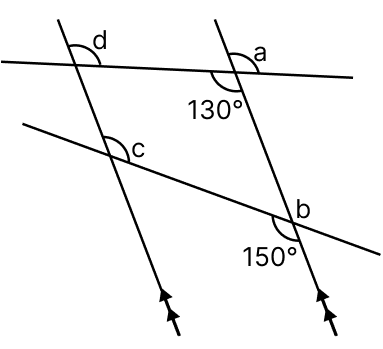
Find a, b, c and d in the figure given below:
Answer
From the figure, the given angles are 130° and 150°.
∠a and the 130° angle are vertically opposite angles.
⇒ a = 130° [vertically opposite angles are equal]
∠d and the 130° angle are alternate interior angles.
⇒ d = 130° [alternate interior angles are equal]
∠b and the 150° angle are vertically opposite angles.
⇒ b = 150° [vertically opposite angles are equal]
∠c and the 150° angle are alternate interior angles.
⇒ c = 150° [alternate interior angles are equal]
Hence, a = 130°, b = 150°, c = 150° and d = 130°.
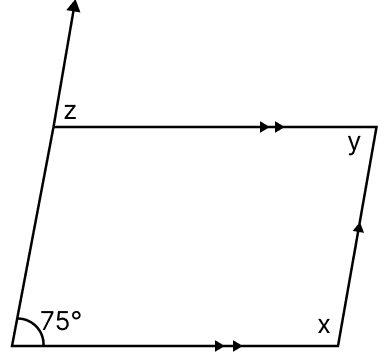
Find x, y and z in the figure given below:
Answer
From the figure,
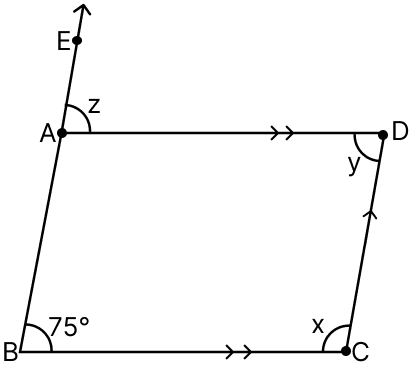
∠ABC = 75°.
As, BE is parallel to CD and BC is a transversal.
⇒ ∠BCD and ∠ABC are co-interior angles.
⇒ x + 75° = 180° [co-interior angles are supplementary]
⇒ x = 180° - 75°
⇒ x = 105°
Now, AD is parallel to BC and CD is a transversal.
⇒ ∠BCD and ∠ADC are co-interior angles.
⇒ ∠BCD + ∠ADC = 180° [co-interior angles are supplementary]
⇒ x + y = 180°
⇒ 105° + y = 180°
⇒ y = 180° - 105°
⇒ y = 75°
Since BE is parallel to CD and AD is a transversal.
⇒ z = y = 75° [alternate interior angles are equal]
Hence, x = 105°, y = 75° and z = 75°.