
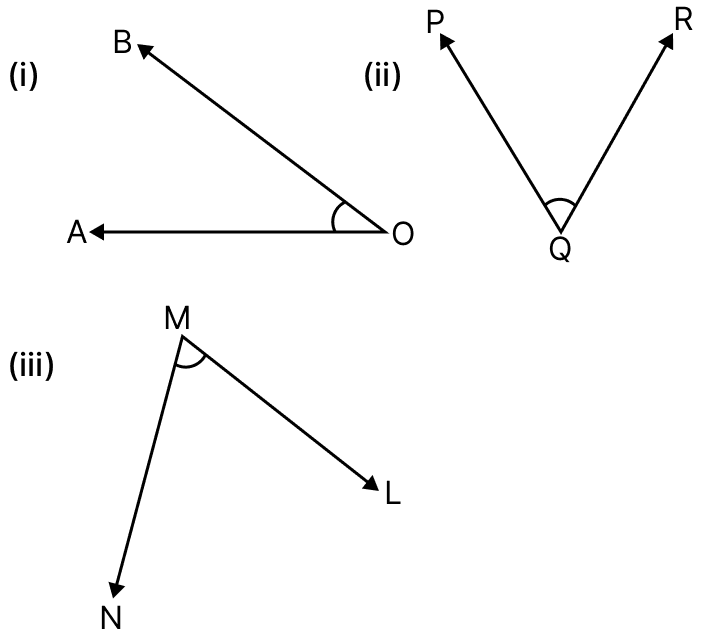
For each angle given below, write the name of the vertex, the names of the arms and the name of the angle.
Answer
(i) From figure,
Vertex is O;
Arms are OA and OB;
The angle is written as angle AOB or ∠AOB or ∠O.
(ii) From figure,
Vertex is Q;
Arms are QP and QR;
The angle is written as angle PQR or ∠PQR or ∠Q.
(iii) From figure,
Vertex is M;
Arms are MN and ML;
The angle is written as angle NML or ∠LMN or ∠M.
Name the points:
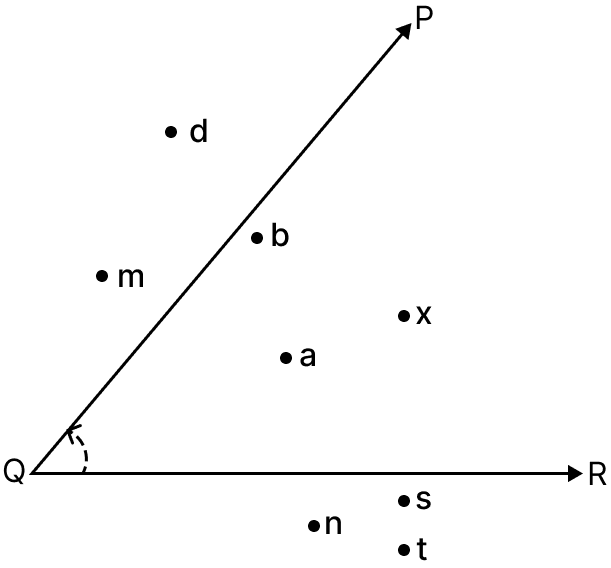
(i) in the interior of the angle PQR.
(ii) in the exterior of the angle PQR.
Answer
(i) The points a, b and x lie in the interior of the angle PQR.
(ii) The points d, m, n, s and t lie in the exterior of the angle PQR.
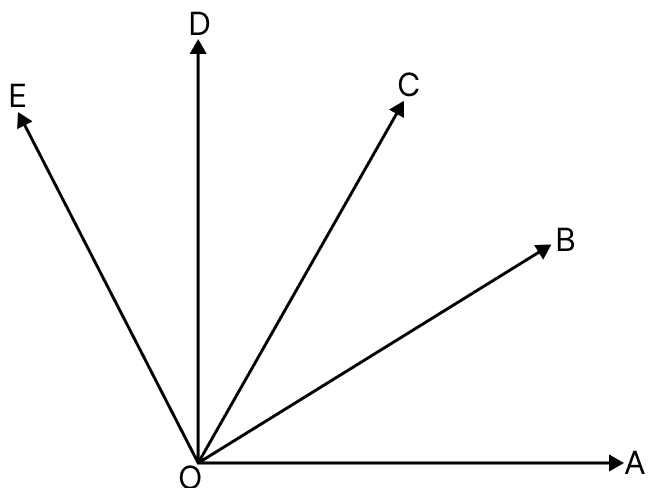
In the adjoining figure, write all possible angles formed. Neglect reflex angle(s).
Answer
Taking the rays OA, OB, OC, OD and OE two at a time, the possible angles formed are :
∠AOB, ∠AOC, ∠AOD, ∠AOE, ∠BOC, ∠BOD, ∠BOE, ∠COD, ∠COE and ∠DOE.
Add:
29° 16' 23" and 8° 27' 12"
Answer
Adding the seconds, minutes and degrees separately :
Hence, the sum is 37° 43' 35".
Add:
9° 45' 56" and 73° 8' 15"
Answer
Adding the seconds, minutes and degrees separately :
As 60" = 1', we have 71" = 1' 11". Carrying 1' over to the minutes :
⇒ 82° 53' 71" = 82° 54' 11"
Hence, the sum is 82° 54' 11".
Add:
56° 38' and 27° 42' 30"
Answer
Adding the seconds, minutes and degrees separately :
As 60' = 1°, we have 80' = 1° 20'. Carrying 1° over to the degrees :
⇒ 83° 80' 30" = 84° 20' 30"
Hence, the sum is 84° 20' 30".
Add:
47° and 61° 17' 4"
Answer
Adding the seconds, minutes and degrees separately :
Hence, the sum is 108° 17' 4".
In the figure given alongside, name:
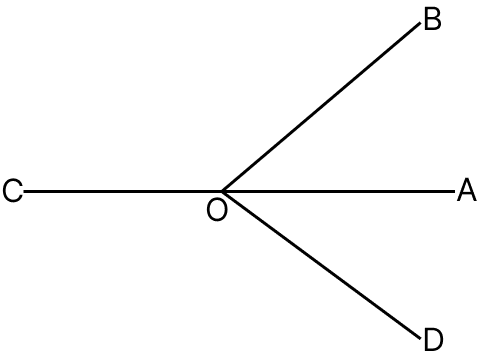
(i) three pairs of adjacent angles.
(ii) two acute angles.
(iii) two obtuse angles.
(iv) two reflex angles.
Answer
(i) ∠AOB and ∠BOC; ∠BOC and ∠COD; ∠COD and ∠DOA.
(ii) ∠AOB and ∠AOD.
(iii) ∠BOC and ∠COD.
(iv) Reflex ∠AOB and reflex ∠COD.
In the given figure, PQR is a straight line. If:
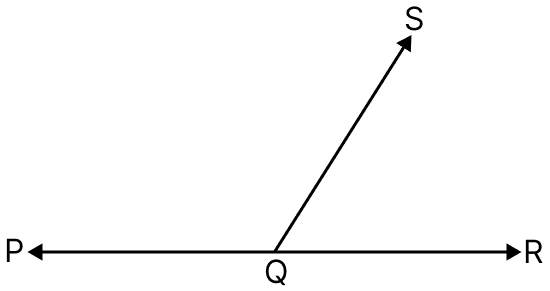
(i) ∠SQR = 75°; find ∠PQS.
(ii) ∠PQS = 110°; find ∠RQS.
Answer
Since PQR is a straight line, ∠PQS and ∠SQR form a linear pair.
⇒ ∠PQS + ∠SQR = 180°
(i) Given, ∠SQR = 75°
⇒ ∠PQS + 75° = 180°
⇒ ∠PQS = 180° − 75° = 105°
Hence, ∠PQS = 105°.
(ii) Given, ∠PQS = 110°
⇒ 110° + ∠RQS = 180°
⇒ ∠RQS = 180° − 110° = 70°
Hence, ∠RQS = 70°.
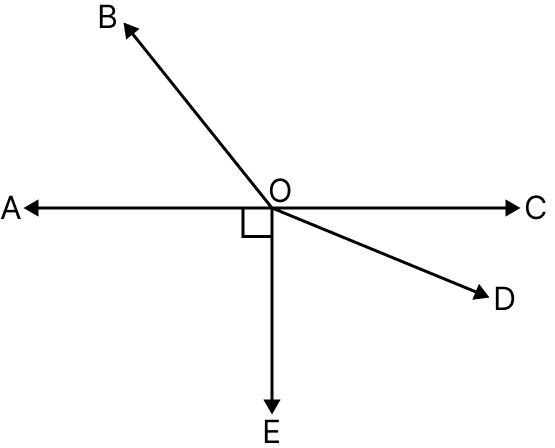
In the given figure, AOC is a straight line. If angle AOB = 50°, angle AOE = 90° and angle COD = 25°, find the measure of:
(i) angle BOC
(ii) angle EOD
(iii) obtuse angle BOD
(iv) reflex angle BOD
(v) reflex angle COE.
Answer
From the figure, AOC is a straight line. With ∠AOB = 50°, ∠AOE = 90° and ∠COD = 25°.
(i) Since AOC is a straight line, ∠AOB and ∠BOC form a linear pair.
⇒ ∠AOB + ∠BOC = 180°
⇒ 50° + ∠BOC = 180°
⇒ ∠BOC = 180° − 50° = 130°
Hence, ∠BOC = 130°.
(ii) Since AOC is a straight line, ∠AOE and ∠COE form a linear pair.
⇒ ∠AOE + ∠COE = 180°
⇒ 90° + ∠COE = 180°
⇒ ∠COE = 180° − ∠AOE = 180° − 90° = 90°
⇒ ∠EOD = ∠EOC − ∠COD = 90° − 25° = 65° (given ∠COD = 25°)
Hence, ∠EOD = 65°.
(iii) As OB and OD lie on opposite sides of the line AOC,
⇒ ∠BOD = ∠BOC + ∠COD = 130° + 25° = 155°
Hence, obtuse ∠BOD = 155°.
(iv) Reflex ∠BOD = 360° − ∠BOD = 360° − 155° = 205°
Hence, reflex ∠BOD = 205°.
(v) ∠COE = ∠AOC − ∠AOE = 180° − 90° = 90°
Reflex ∠COE = 360° − ∠COE = 360° − 90° = 270°
Hence, reflex ∠COE = 270°.
In the given figure, if:
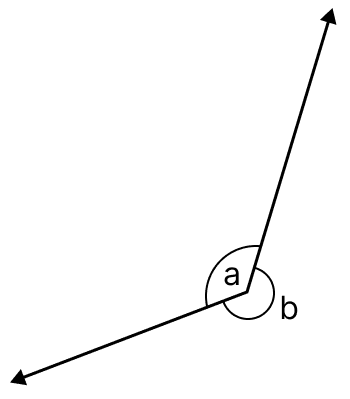
(i) a = 130°, find b.
(ii) b = 200°, find a.
(iii) a = right angle, find b.
Answer
From the figure, ∠a and ∠b are the angles at the point O, and the sum of the angles at a point is 360°.
⇒ a + b = 360°
(i) Given,
a = 130°
⇒ 130° + b = 360°
⇒ b = 360° − 130° = 230°
Hence, b = 230°.
(ii) Given,
b = 200°
⇒ a + 200° = 360°
⇒ a = 360° − 200° = 160°
Hence, a = 160°.
(iii) Given,
a = right angle =
⇒ 150° + b = 360°
⇒ b = 360° − 150° = 210°
Hence, b = 210°.
In the figure given alongside, ABC is a straight line.
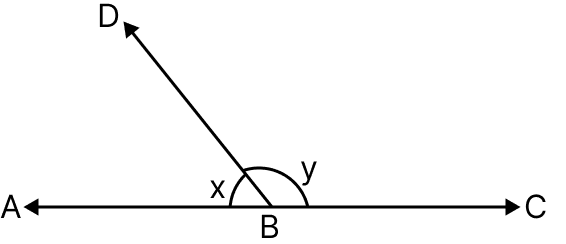
(i) If x = 53°, find y.
(ii) If y = right angles, find x.
Answer
Since ABC is a straight line, x and y form a linear pair.
⇒ x + y = 180°
(i) Given,
x = 53°
⇒ 53° + y = 180°
⇒ y = 180° − 53° = 127°
Hence, y = 127°.
(ii) Given,
y = right angles =
⇒ x + 135° = 180°
⇒ x = 180° − 135° = 45°
Hence, x = 45°.
In the figure given alongside, AOB is a straight line. Find the value of x and also answer each of the following:
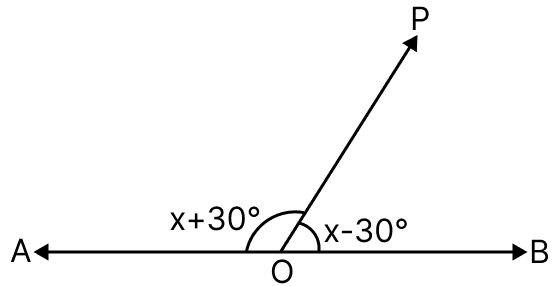
(i) ∠AOP = ..............
(ii) ∠BOP = ..............
(iii) which angle is obtuse?
(iv) which angle is acute?
Answer
From the figure, ∠AOP = (x + 30)° and ∠BOP = (x − 30)°.
Since AOB is a straight line, ∠AOP and ∠BOP form a linear pair.
⇒ ∠AOP + ∠BOP = 180°
⇒ (x + 30°) + (x − 30°) = 180°
⇒ 2x = 180°
⇒ x =
⇒ x = 90°
Hence, x = 90°.
(i) ∠AOP = x + 30° = 90° + 30° = 120°
Hence, ∠AOP = 120°.
(ii) ∠BOP = x − 30° = 90° − 30° = 60°
Hence, ∠BOP = 60°.
(iii) Since ∠AOP = 120° lies between 90° and 180°, it is obtuse.
Hence, ∠AOP is the obtuse angle.
(iv) Since ∠BOP = 60° is less than 90°, it is acute.
Hence, ∠BOP is the acute angle.
In the figure given alongside, PQR is a straight line. Find x. Then complete the following:
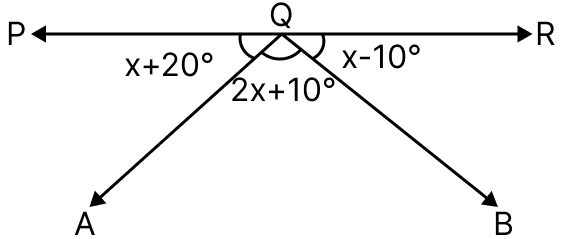
(i) ∠AQB = ..............
(ii) ∠BQP = ..............
(iii) ∠AQR = ..............
Answer
From the figure,
∠PQA = (x + 20°), ∠AQB = (2x + 10°) and ∠BQR = (x − 10°).
Since PQR is a straight line, these three angles lie on one side of it.
⇒ ∠PQA + ∠AQB + ∠BQR = 180°
⇒ (x + 20°) + (2x + 10°) + (x − 10°) = 180°
⇒ 4x + 20° = 180°
⇒ 4x = 160°
⇒ x =
⇒ x = 40°
Hence, x = 40°.
(i) ∠AQB = 2x + 10°
= 2 × 40° + 10°
= 80° + 10° = 90°
Hence, ∠AQB = 90°.
(ii) ∠BQP = ∠PQA + ∠AQB
= (x + 20°) + 90° = (40° + 20°) + 90°
= 60° + 90° = 150°
Hence, ∠BQP = 150°.
(iii) ∠AQR = ∠AQB + ∠BQR
= 90° + (x − 10°) = 90° + (40° − 10°)
= 90° + 30° = 120°
Hence, ∠AQR = 120°.
In the figure given alongside, lines AB and CD intersect at point O.
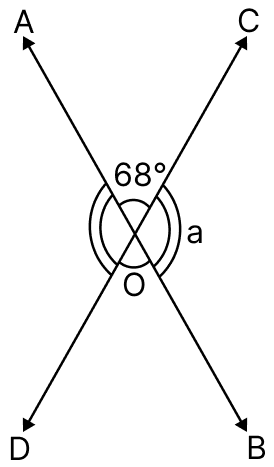
(i) Find the value of ∠a.
(ii) Name all the pairs of vertically opposite angles.
(iii) Name all the pairs of adjacent angles.
(iv) Name all the reflex angles formed and write the measure of each.
Answer
(i) From the figure, ∠AOC = 68° and ∠a = ∠BOC.
Since AB is a straight line, ∠AOC and ∠BOC form a linear pair.
⇒ ∠AOC + ∠BOC = 180°
⇒ 68° + ∠a = 180°
⇒ ∠a = 180° − 68° = 112°
Hence, ∠a = 112°.
(ii) When two lines intersect, the angles opposite to each other at the point of intersection are vertically opposite angles.
Hence, the pairs of vertically opposite angles are ∠AOC and ∠BOD; ∠AOD and ∠BOC.
(iii) Two angles with a common vertex and a common arm, lying on opposite sides of the common arm, are adjacent angles.
Hence, the pairs of adjacent angles are ∠AOC and ∠BOC; ∠BOC and ∠BOD; ∠BOD and ∠DOA; ∠DOA and ∠AOC.
(iv) Here, ∠AOC = ∠BOD = 68° and ∠BOC = ∠AOD = 112°.
Reflex ∠BOC = 360° − ∠BOC = 360° − 112° = 248°
Reflex ∠AOC = 360° − ∠AOC = 360° − 68° = 292°
Reflex ∠AOD = 360° − ∠AOD = 360° − 112° = 248°
Reflex ∠BOD = 360° − ∠BOD = 360° − 68° = 292°
Hence, reflex ∠BOC = 248°, reflex ∠AOC = 292°, reflex ∠AOD = 248° and reflex ∠BOD = 292°.
In the figure given alongside:
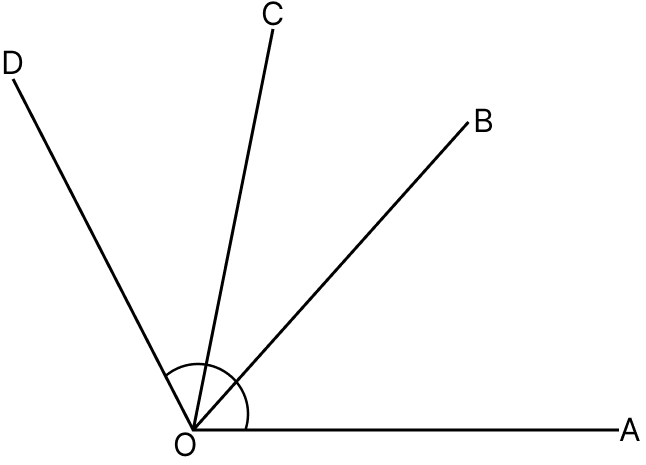
(i) if ∠AOB = 45°, ∠BOC = 30° and ∠AOD = 110°; find angles COD and BOD.
(ii) if ∠BOC = ∠DOC = 34° and ∠AOD = 120°; find angle AOB and angle AOC.
(iii) if ∠AOB = ∠BOC = ∠COD = 38°; find reflex angle AOC and reflex angle AOD.
Answer
(i) From the figure,
∠AOD = ∠AOB + ∠BOC + ∠COD.
⇒ 110° = 45° + 30° + ∠COD
⇒ 110° = 75° + ∠COD
⇒ ∠COD = 110° − 75° = 35°
Now, ∠BOD = ∠BOC + ∠COD = 30° + 35° = 65°
Hence, ∠COD = 35° and ∠BOD = 65°.
(ii) From the figure,
∠AOC = ∠AOD − ∠DOC.
⇒ ∠AOC = 120° − 34° = 86°
Now, ∠AOB = ∠AOC − ∠BOC = 86° − 34° = 52°
Hence, ∠AOB = 52° and ∠AOC = 86°.
(iii) From the figure,
∠AOC = ∠AOB + ∠BOC = 38° + 38° = 76°.
Reflex ∠AOC = 360° − ∠AOC = 360° − 76° = 284°
Also, ∠AOD = ∠AOB + ∠BOC + ∠COD = 38° + 38° + 38° = 114°
Reflex ∠AOD = 360° − ∠AOD = 360° − 114° = 246°
Hence, reflex ∠AOC = 284° and reflex ∠AOD = 246°.