
State which of the following is a plane closed figure:
Answer
A plane closed figure is a figure drawn in a plane whose boundary starts and ends at the same point, leaving no gap.
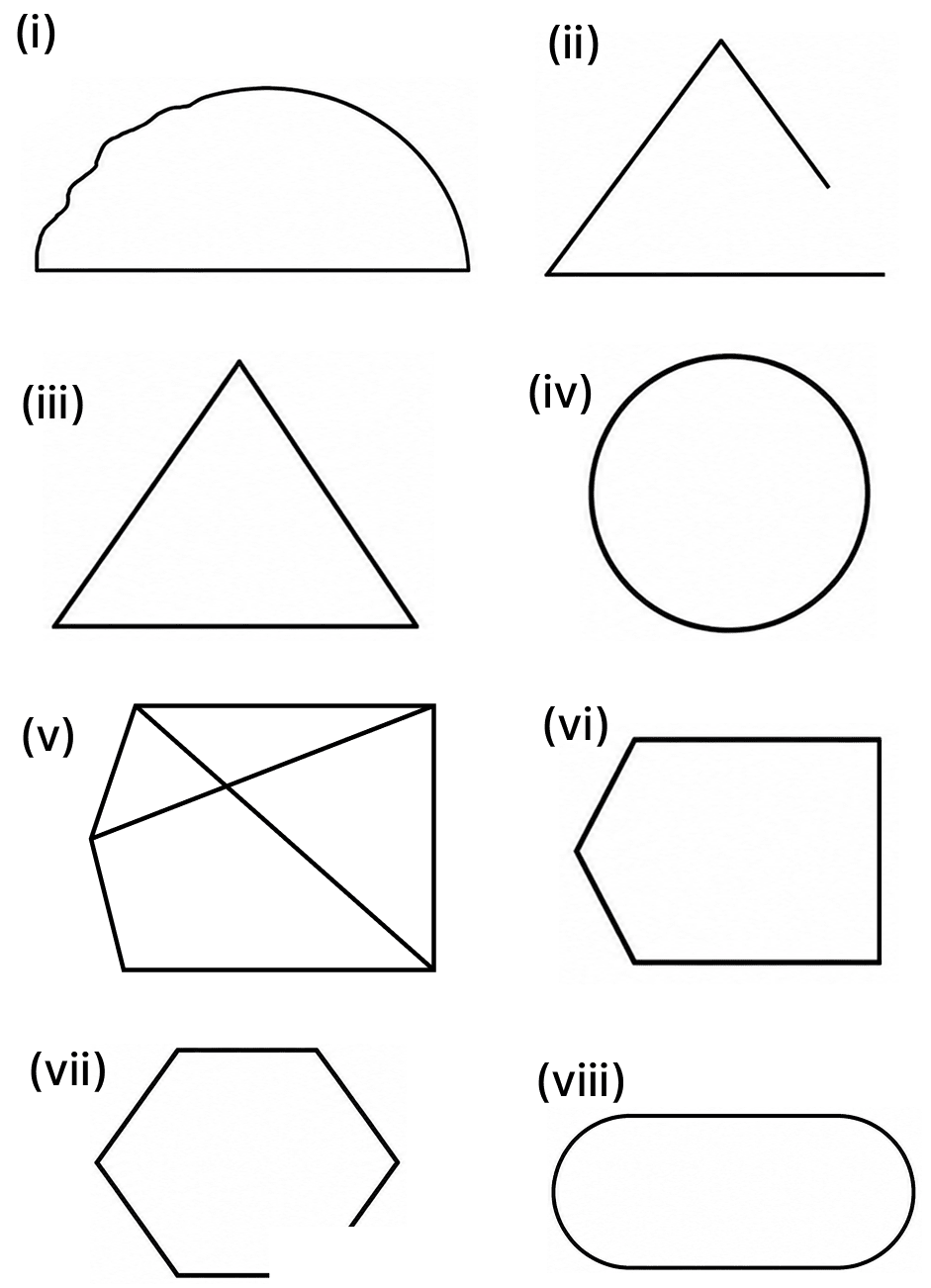
(i) The boundary is completely closed with no gap, so it is a plane closed figure.
(ii) The boundary is not closed, as it has open ends, so it is not a plane closed figure.
(iii) The boundary starts and ends at the same point leaving no gap, so it is a plane closed figure.
(iv) The boundary starts and ends at the same point leaving no gap, so it is a plane closed figure.
(v) It is not a plane closed figure because it contains intersecting line segments inside the figure.
(vi) The boundary starts and ends at the same point leaving no gap, so it is a plane closed figure.
(vii) The boundary is not closed, as it has open ends, so it is not a plane closed figure.
(viii) The boundary starts and ends at the same point leaving no gap, so it is a plane closed figure.
Hence, the figures (i), (iii), (iv), (vi) and (viii) are plane closed figures.
State which of the lines/line-segments are perpendicular to the line PQ:
Answer
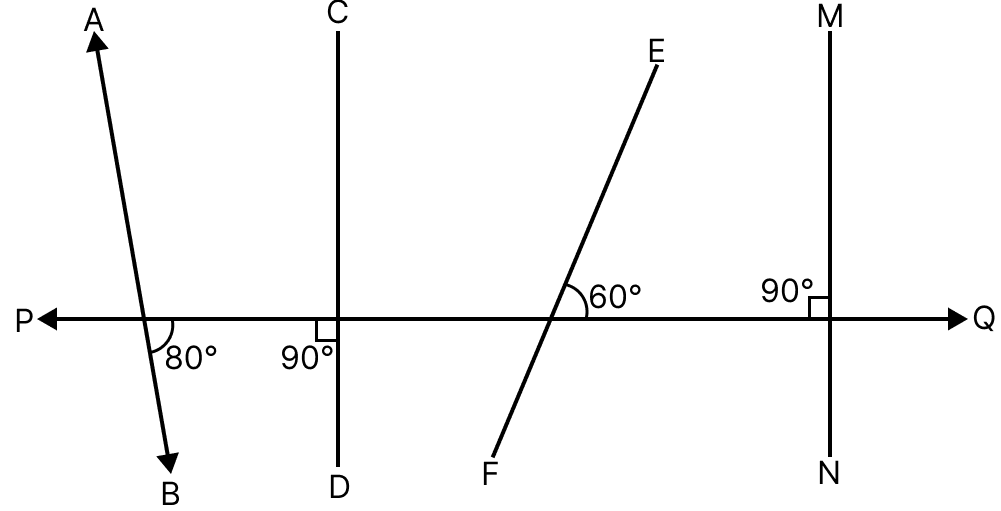
Two lines are perpendicular when they meet at an angle of 90°.
Hence, CD and MN are perpendicular to the line PQ.
Which of the following figures shows two mutually perpendicular lines:
Answer
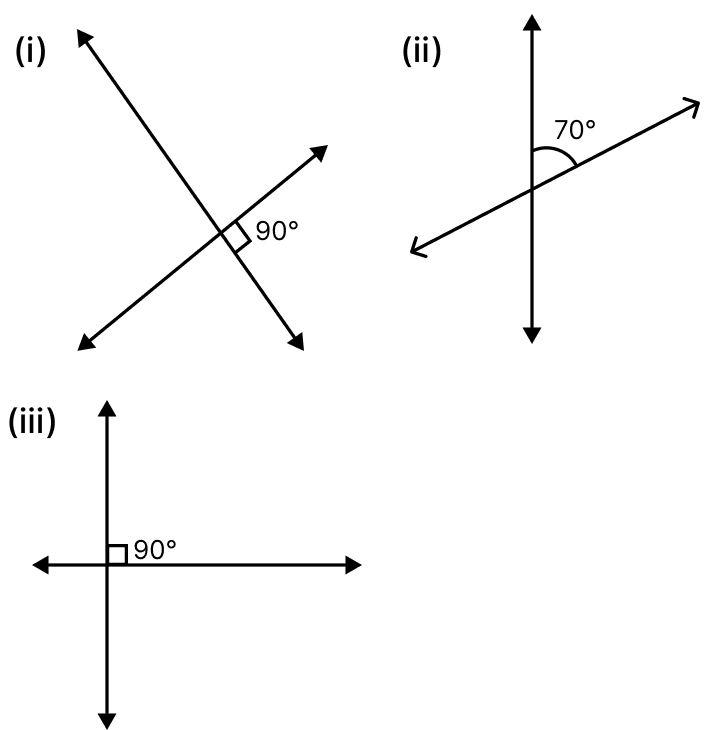
Two lines are mutually perpendicular when they intersect each other at a right angle (90°).
Hence, the figures (i) and (iii) show two mutually perpendicular lines.
For each figure given below name the line segment that is perpendicular bisector of the other:
Answer
The perpendicular bisector of a line segment is a line that passes through its midpoint and is perpendicular to it.
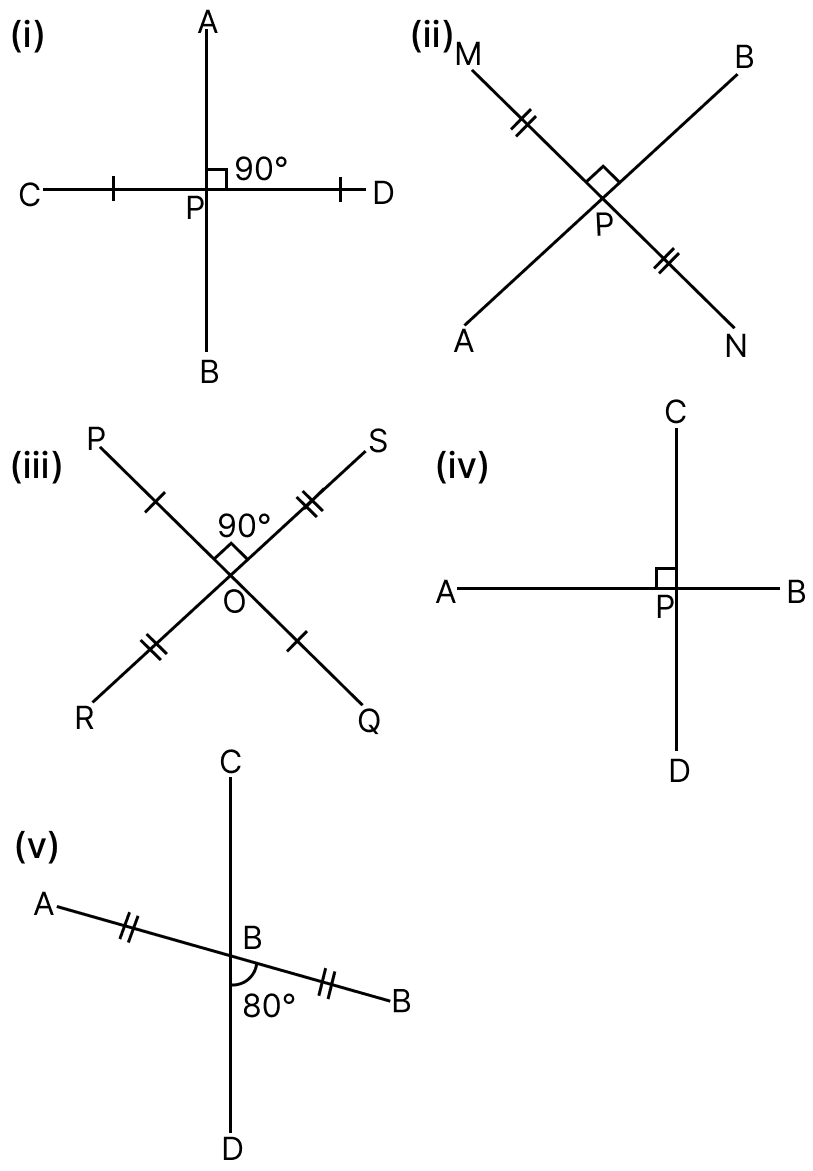
(i) AB meets CD at a right angle and divides it into two equal parts.
AB is the perpendicular bisector of CD.
(ii) AB meets MN at a right angle and divides it into two equal parts.
AB is the perpendicular bisector of MN.
(iii) PQ and RS cut each other at a right angle and each divides the other into two equal parts.
PQ is the perpendicular bisector of RS and RS is the perpendicular bisector of PQ, i.e. PQ and RS are perpendicular bisectors of each other.
(iv) The two line segments meet at a right angle but do not divide each other into two equal parts, so neither is the perpendicular bisector of the other.
None.
(v) The two line segments do not meet at a right angle, and AB does not divide CD into two equal parts, so neither is the perpendicular bisector of the other.
None.
Name three objects from your surroundings that contain perpendicular edges.
Answer
Hence, a classroom, a textbook and a ruler contain perpendicular edges.
Place a scale (ruler) on a sheet of paper and hold it firmly with one hand. Now draw two line segments AB and CD along the longer edges of the scale. State whether segment AB is parallel to or perpendicular to segment CD.
Answer

The two longer edges of a scale are always at the same distance apart and never meet.
Hence, segment AB is parallel to segment CD.
Check your textbook:
(i) How many pairs of its edges are parallel to each other?
(ii) How many pairs of its edges are perpendicular to each other?
Answer
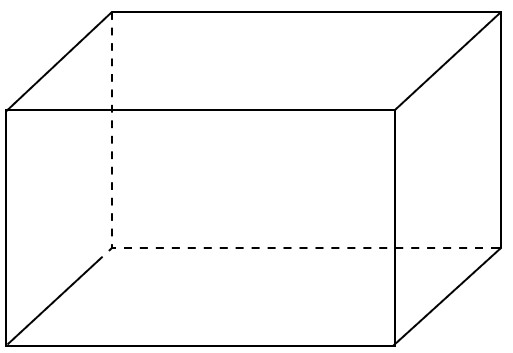
A textbook is shaped like a cuboid and has 12 edges.
(i) Its edges form three groups:
4 edges along its length,
4 edges along its breadth,
4 edges along its height.
The four edges in each group are parallel to one another.
Among four parallel edges, the number of pairs is:
3 + 2 + 1 = 6
Therefore, the total number of pairs of parallel edges is:
6 + 6 + 6 = 18
Hence, a textbook has 18 pairs of parallel edges.
(ii) A cuboid has 8 corners. At each corner, three edges meet at right angles.
These three edges form 3 pairs of perpendicular edges.
Therefore,
8 × 3 = 24
Hence, a textbook has 24 pairs of perpendicular edges.
Give two examples from your surroundings for each of the following:
(i) intersecting lines
(ii) parallel lines
(iii) perpendicular lines.
Answer
(i) The two edges of a book meeting through any one corner of it.
The two roads crossing each other at a road crossing.
(ii) The opposite edges of a book.
The two rails of a railway track.
(iii) The two adjacent edges meeting at a corner of a book.
The two edges meeting at a corner of a window.
State true or false, if false, give the correct statement:
(i) The maximum number of lines passing through three collinear points is three.
(ii) The maximum number of lines passing through three non-collinear points is three.
(iii) Two parallel lines always lie in the same plane.
(iv) Concurrent lines always meet at the same point.
(v) A surface can be plane or curved.
(vi) There are infinite number of points in a line segment of length 10 cm.
(vii) There are infinite number of points in a line.
(viii) A plane has infinite number of lines.
(ix) A plane has infinite number of points.
Answer
(i) False. Only one line passes through three collinear points.
(ii) False. No line passes through all the three non-collinear points.
(iii) True.
(iv) True.
(v) True.
(vi) True.
(vii) True.
(viii) True.
(ix) True.