
State true or false, if false, correct the statement:
(i) A dot has width but no length.
(ii) A ray has an infinite length only on one side of it.
(iii) A line segment PQ is written as .
(iv) represents a straight line.
(v) Three points are said to be collinear, if they lie in the same plane.
(vi) Three or more points, all lying in the same line, are called collinear points.
Answer
(i) False. A dot has no length and no width.
(ii) True. A ray extends endlessly on one side of its end point, so it has an infinite length only on one side of it.
(iii) False. A line segment PQ is written as .
(iv) True. has arrow heads on both sides and so it represents a straight line.
(v) False. Three points are said to be collinear if they lie in the same straight line.
(vi) True. Three or more points that all lie on the same line are called collinear points.
Write how many lines can be drawn, passing through:
(i) a given point?
(ii) two given fixed points?
(iii) three collinear points?
(iv) three non-collinear points?
Answer
(i) Through a single given point an unlimited number of lines can be drawn.
Hence, infinite lines can be drawn through a given point.
(ii) Through two given fixed points one and only one line can be drawn.
Hence, only one line can be drawn through two given fixed points.
(iii) Since three collinear points lie on the same straight line, that single line passes through all of them.
Hence, only one line can be drawn through three collinear points.
(iv) Three non-collinear points do not lie on one line, so no single line can pass through all three of them.
Hence, no line can be drawn through three non-collinear points.
The shaded region of the given figure shows a plane:
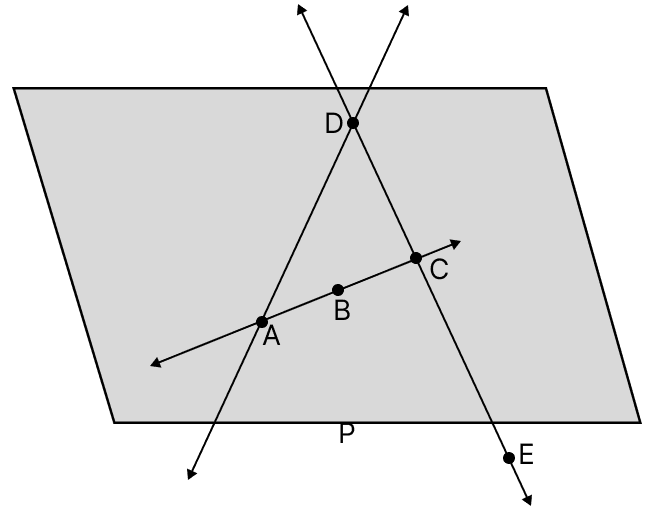
(a) Name:
(i) three collinear points.
(ii) three non-collinear points.
(iii) a pair of intersecting lines.
(b) State whether true or false:
(i) Line DE is contained in the given plane P.
(ii) Lines AB and DE intersect at point C.
(iii) Points D, B and C are collinear.
(iv) Points D, B and E are collinear.
Answer
(a) (i) A, B and C lie on the same straight line, so they are three collinear points.
(ii) A, D and C do not lie on the same straight line, so they are three non-collinear points.
(iii) AC and DC are a pair of intersecting lines.
(b) (i) True.
(ii) True.
(iii) False.
(iv) False.
Correct the statement, if it is wrong:
(i) A ray can be extended infinitely on either side.
(ii) A ray has a definite length.
(iii) A line segment has a definite length.
(iv) A line has two end points.
(v) A ray has only one end point.
Answer
(i) A ray can be extended infinitely on only one side of it.
(ii) A ray has an indefinite length.
(iii) Correct. A line segment has a definite length.
(iv) A line has no end point.
(v) Correct. A ray has only one end point.
State true or false, if false, give the correct statement:
(i) A line has a countable number of points in it.
(ii) Only one line can pass through a given point.
(iii) The intersection of two planes is a straight line.
Answer
(i) False. A line has an infinite number of points on it.
(ii) False. An infinite number of lines can pass through a given point.
(iii) True.
State whether the following pairs of lines or rays appear to be parallel or intersecting.
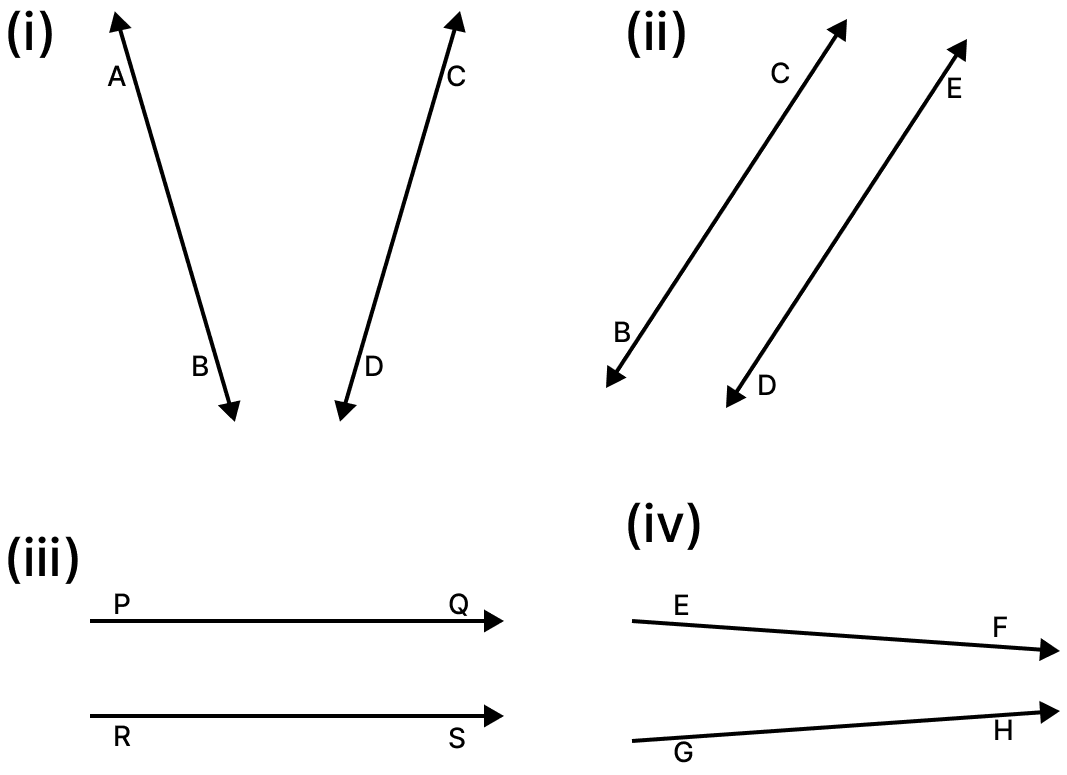
Answer
Two lines or rays are said to be parallel if they never meet however far they are produced, and intersecting if they meet (or would meet) at a point.
(i) The two rays in the figure appear that they will meet at a point.
Hence, the pair of lines are intersecting.
(ii) The two lines in the figure are the same distance apart everywhere and never meet.
Hence, the pair of lines are parallel.
(iii) The two lines in the figure remain the same distance apart and never meet however far they are extended.
Hence, the pair of lines are parallel.
(iv) The two lines in the figure appear that they will meet at a point.
Hence, the pair of lines are intersecting.
Give two examples, from your surroundings, for each of the following:
(i) points
(ii) line segments
(iii) plane surfaces
(iv) curved surfaces.
Answer
(i) Tip of your pencil and tip of a nail.
(ii) Lines printed on your note-book and edge of your table-top.
(iii) Top of your study table and a wall of your class-room.
(iv) Surface of a cricket-ball and surface of your pen.
Under what condition will two straight lines in the same plane have:
(i) no point in common.
(ii) only one point in common.
(iii) an infinite number of points in common.
If possible, draw diagrams in support of your answer.
Answer
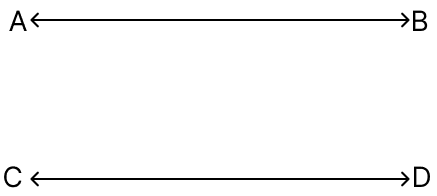
(i) When the two lines are parallel to each other, they have no point in common.
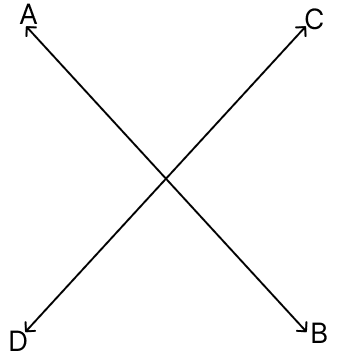
(ii) When the two lines intersect each other, they have only one point in common.
(iii) When the two lines coincide (lie exactly one over the other), they have an infinite number of points in common.

Mark two points A and B on a page of your exercise book. Mark a third point P such that:
(i) P lies between A and B and the three points A, P and B are collinear.
(ii) P does not lie between A and B yet the three points are collinear.
(iii) the three points do not lie in a line.
Answer
(i)

(ii)

(iii)
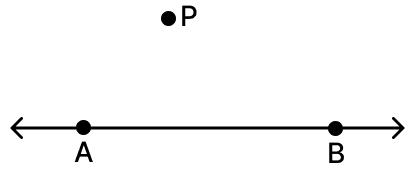
Mark two points P and Q on a piece of paper. How many lines can you draw:
(i) passing through both the points P and Q?
(ii) passing through the point P?
(iii) passing through the point Q?
Answer
(i) Through two given points only one line can be drawn.

Hence, only one line can be drawn passing through both the points P and Q.
(ii) Through a single point an unlimited number of lines can be drawn.
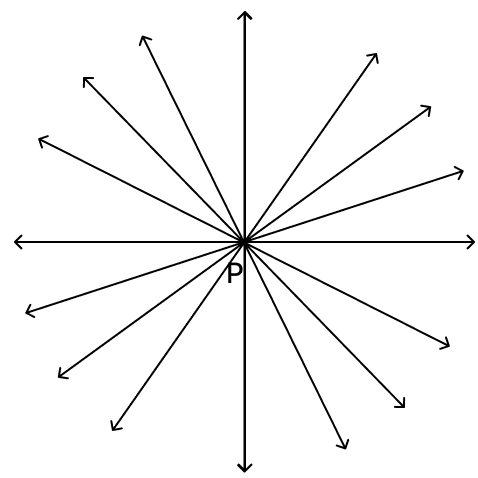
Hence, infinite lines can be drawn passing through the point P.
(iii) Through a single point an unlimited number of lines can be drawn.
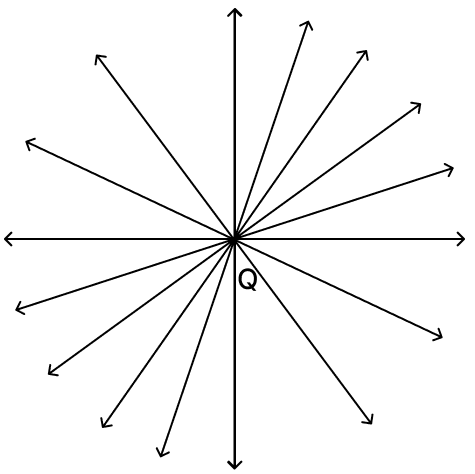
Hence, infinite lines can be drawn passing through the point Q.
The adjoining figure shows a line AB. Draw figures to represent:

(i) ray AB, i.e.
(ii) ray BA, i.e.
(iii) line segment AB.
Answer
(i)

(ii)

(iii)

The adjoining figure shows a ray AB. Draw figures to show:

(i) ray BA, i.e.
(ii) line AB
(iii) line segment BA.
Answer
(i)
(ii)
(iii)
The adjoining figure shows a line segment AB. Draw figures to represent:
(i) ray AB, i.e.
(ii) line AB, i.e.
(iii) ray BA.
Answer
(i)
(ii)

(iii)
Use a ruler and find whether the points in the given figure are collinear or not:
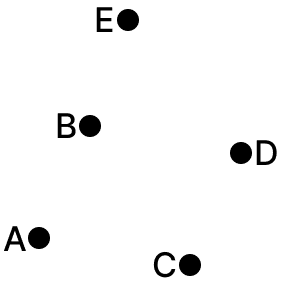
(i) D, A and C
(ii) A, B and C
(iii) A, B and E
(iv) B, C and E
Answer
(i) No, the points D, A and C are not collinear.
(ii) No, the points A, B and C are not collinear.
(iii) Yes, the points A, B and E are collinear.
(iv) No, the points B, C and E are not collinear.
From the adjoining figure, write:
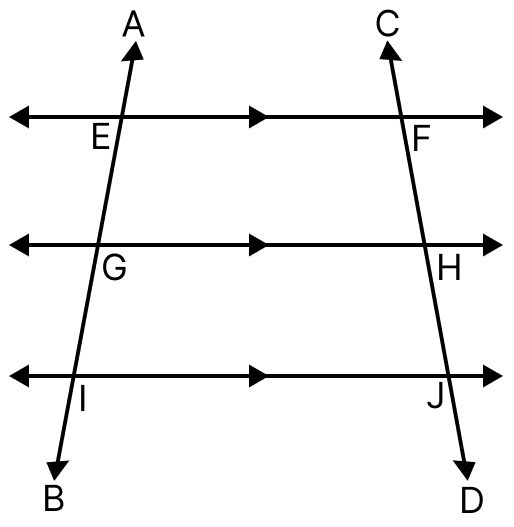
(i) all pairs of parallel lines.
(ii) all the lines which intersect EF.
(iii) lines whose point of intersection is G.
Answer
(i) EF ∥ GH, EF ∥ IJ and GH ∥ IJ.
(ii) AB and CD are the lines which intersect EF.
(iii) AB and GH are the lines whose point of intersection is G.