
The symbol of degree celsius is :
- °C
- °F
- K
- °K
Answer
°C
Reason — The symbol of degree celsius is °C.
10 mm is equal to :
- 1 cm
- 1 m
- 10 dm
- 10 cm
Answer
1 cm
Reason — As,
1 m = 100 cm [Equation 1]
and
1 m = 1000 mm [Equation 2]
From equation 1 and 2
100 cm = 1000 mm
⟹ 1 cm = 10 mm
The amount of surface occupied by an object is called its :
- volume
- area
- mass
- length
Answer
area
Reason — The total surface occupied by an object is called its surface area or simply the area.
A metre ruler is graduated in :
- m
- cm
- mm
- km
Answer
mm
Reason — A metre ruler is 1 metre long and is divided into 100 equal parts where each part is a centimetre and each centimetre is further divided into 10 equal parts where each small part is a millimetre. Thus, a metre ruler is marked in centimetre and millimetre and has a small division of 1 mm so it can measure a length correct up to 1 mm.
A thermometer is graduated in
- kelvin
- °C
- g
- cm
Answer
°C
Reason — Mostly laboratory and clinical thermometers use °C scale for commercial purposes.
Out of the following which one unit does not belong to S.I.?
- Metre
- Pound
- Second
- Kilogram
Answer
Pound
Reason — In S.I. system, unit of length is metre, for time it is second and for mass it is kilogram but pound is a unit of mass in FPS system.
1 square yard is equal to :
- 1 yard x 1 yard
- 1 yard × 1 square ft
- 1 yard × 1 acre
- none of these
Answer
1 yard x 1 yard
Reason — 1 square yard = 1 yard x 1 yard
1 acre is equal to :
- 0.09290 m2
- 0.836 m2
- 4046.856 m2
- none of these
Answer
4046.856 m2
Reason — 1 acre = 4046.856 m2
Assertion (A): Stopwatch can measure intervals shorter than one second.
Reason (R): Stopwatch counts seconds using the standard unit of time.
- Both A and R are true and R is the correct explanation of A
- Both A and R are true and R is not the correct explanation of A
- A is true but R is false
- A is false but R is true
Answer
Both A and R are true and R is not the correct explanation of A
Explanation
Assertion (A) is true because a stopwatch can measure time intervals shorter than one second as it is designed to record time with smaller divisions such as milliseconds or fractions of a second.
Reason (R) is true because a stopwatch measures time based on the standard unit second, but it can also measure smaller subdivisions of a second.
Here, the Reason (R) does not fully explain the Assertion (A) as it does not mention the ability of the stopwatch to measure fractions of a second.
Therefore, both A and R are true and R is not the correct explanation of A.
Assertion (A): A beam balance is used to measure mass.
Reason (R): It compares the unknown mass with a known standard mass.
- Both A and R are true and R is the correct explanation of A
- Both A and R are true and R is not the correct explanation of A
- A is true but R is false
- A is false but R is true
Answer
Both A and R are true and R is the correct explanation of A
Explanation
Assertion (A) is true because a beam balance is used to measure the mass of an object by using the known standard mass.
Reason (R) is true because a beam balance works by comparing the unknown mass with known standard masses placed on the other pan.
The Reason justifies the Assertion because a beam balance measures mass by direct comparison.
Therefore, both A and R are true and R is the correct explanation of A.
Fill in the blanks :
(a) The S.I. unit of length is ..............., of time is ..............., of mass is ............... .
(b) °C is the unit of ............... .
(c) 1 metric tonne = ............... kg.
(d) The zero mark in Celsius thermometer is the melting point of ............... .
(e) The thermometer used to measure the human body temperature is called the ............... thermometer.
(f) The normal temperature of human body is ............... °C or ............... °F.
(g) The ............... of an object is measured with the help of a beam balance.
Answer
(a) The S.I. unit of length is metre, of time is second, of mass is kilogram.
(b) °C is the unit of temperature.
(c) 1 metric tonne = 1000 kg.
(d) The zero mark in Celsius thermometer is the melting point of ice.
(e) The thermometer used to measure the human body temperature is called the clinical thermometer.
(f) The normal temperature of human body is 37 °C or 98.6 °F.
(g) The mass of an object is measured with the help of a beam balance.
Write true or false for each statement :
(a) S.I. unit of temperature is fahrenheit.
(b) Every measurement involves two things - a number and a unit.
(c) Mass is the measure of quantity of matter.
(d) The S.I. unit of time is hour.
(e) Area can be expressed as the product of lengths of two sides.
Answer
(a) False because S.I. unit of temperature is kelvin (K).
(b) True as a measurement needs two things :
- The unit u, and
- The number n which tells us how many times that unit is contained in that quantity.
Thus, a measurement is expressed as :
Measurement = n х u = nu
(c) True since mass of a body is the quantity of matter contained in it.
(d) False as the S.I. unit of time is second (s).
(e) True because area can be expressed in terms of the product of two measurements in length.
Match the following columns :
| Column A | Column B | ||
|---|---|---|---|
| (a) | Length of a housing plot | (i) | Clock |
| (b) | Breadth of a book | (ii) | Beam balance |
| (c) | Mass of an apple | (iii) | Thermometer |
| (d) | Period of time for study | (iv) | Measuring tape |
| (e) | Temperature of a body | (v) | Graph paper |
| (f) | Surface area of a leaf | (vi) | Metre ruler |
Answer
| Column A | Column B | ||
|---|---|---|---|
| (a) | Length of a housing plot | (iv) | Measuring tape |
| (b) | Breadth of a book | (vi) | Metre ruler |
| (c) | Mass of an apple | (ii) | Beam balance |
| (d) | Period of time for study | (i) | Clock |
| (e) | Temperature of a body | (iii) | Thermometer |
| (f) | Surface area of a leaf | (v) | Graph paper |
What is measurement ? How is a measurement expressed?
Answer
Measurement is a comparison of an unknown quantity with a known fixed quantity of the same kind. A measurement needs two things to express itself :
- The unit u, and
- The number n which tells us how many times that unit is contained in that quantity.
Thus, a measurement is expressed as :
Measurement = n х u = nu
State two characteristics of a unit.
Answer
A unit must have the following characteristics :
- It should be of convenient size, and
- It must be universally accepted, i.e. its value must remain same at all places and at all times. It should not change with the change of place or time.
Name four basic measurements in our daily life.
Answer
Four basic measurements in our daily life are:
- Length
- Mass
- Time
- Temperature
What are the S.I. units of (i) mass (ii) length (iii) time and (iv) temperature ? Write their names and symbols.
Answer
| Physical Quantity | S.I. Unit | Symbol for S.I. unit | |
|---|---|---|---|
| (i) | Length | metre | m |
| (ii) | Mass | Kilogram | kg |
| (iii) | Time | second | s |
| (iv) | Temperature | Kelvin | K |
Define one metre, the S.I. unit of length. State its one multiple and one sub multiple.
Answer
One metre is defined as the distance travelled by light in air in of a second.
Multiple : Kilometre (symbol km)
1 km = 1000 m
Submultiple : Centimetre (symbol cm)
1 cm =
The diagram below shows a stick placed along a metre ruler. The length of the stick is measured keeping the eye at positions A, B and C.

(a) Write the length of stick PQ as observed, for each position of the eye. Are they all same ?
(b) Which is the correct position of the eye? Write the correct length of the stick.
Answer
(a) For A position :
PQ = 3.4 cm
For B position :
PQ = 3.2 cm
For C position :
PQ = 3.0 cm
No, length of PQ observed from positions A, B and C are not same.
(b) The correct position for the eye is position B due to low parallax error. The correct length of PQ is 3.2 cm.
Define mass. State its (i) S.I. (ii) C.G.S and (iii) F.P.S units. How are they related?
Answer
The mass of a body is the quantity of matter contained in it.
(i) S.I. Unit — Kilogram (kg)
(ii) C.G.S unit — Gram (g)
(iii) F.P.S unit — Pound (lb)
Relationship between kilogram, gram and pound
1 kg = 1000 g = 2.20462 lb,
1 g = 10-3 kg = 2.20462 10-3 lb
1 lb = 453.59 g = 0.45359 kg
Name the instrument which is commonly used to measure the mass of a body. State how it is used.
Answer
The instrument commonly used to measure the mass of a body is a beam balance.
To use it, the body is placed on one pan and standard weights on the other until the beam becomes horizontal again. The total weight on the right pan gives the mass of the body.
Define one kilogram, the S.I. unit of mass. How is it related to (i) quintal (ii) metric tonne and (iii) gram?
Answer
1 kilogram is the mass of 1 litre (= 1000 ml) of water at 4°C.
(i) 1 quintal = 100 kilogram
(ii) 1 metric tonne = 1000 kilogram
(iii) 1 gram = 10-3 kilogram
Name and define the S.I. unit of time. How is it related to (i) minute (ii) hour, (iii) day and (iv) year?
Answer
The S.I. unit of time is second (s). One second is defined as part of a mean solar day.
(i) 1 minute = 60 seconds
(ii) 1 hour = 3600 seconds
(iii) 1 day = 86400 seconds
(iv) 1 year = 3.15 x 10⁷ seconds
Name two devices used to measure the short time interval of an event.
Answer
- Stop clock
- Stop watch.
What does the temperature measure ?
Answer
The temperature is the measure of degree of hotness or coldness of an object.
Name the (i) S.I. unit and (ii) one common unit of temperature. Write their symbols also.
Answer
(i) S.I. unit : kelvin (symbol : K)
(ii) Common unit : Degree fahrenheit (symbol : °F)
Write the temperature of (i) melting ice (ii) boiling water.
Answer
(i) Temperature of melting ice : 0°C
(ii) Temperature of boiling water : 100°C
What is the normal temperature of the human body? How is it indicated in a clinical thermometer?
Answer
Normal temperature of human body is 37°C or 98.6°F. In a clinical thermometer the red arrow indicates the temperature (i.e, 37°C or 98.6°F) of a normal healthy person.
Can a clinical thermometer be used to measure the temperature of boiling water ? Give reason for your answer.
Answer
No, a clinical thermometer can not be used to measure the temperature of boiling water (i.e. 100 °C) because it can measure only up to 42 °С.
Explain the term 'area of a surface'.
Answer
The total surface occupied by an object is called area of a surface or simply the area.
Name the S.I. unit of area and define it.
Answer
The S.I. unit of area is square metre or metre2 which in short form is written as m2.
One square metre is the area of a square of each side length of 1 metre.
How are the units (i) square yard (ii) hectare (iii) km2, (iv) cm2 (v) mm2 related to the S.I. unit of area?
Answer
S.I. unit of area is m2
(i) 1 square yard = 1 yard × 1 yard = 0.9144 m × 0.9144 m = 0.836 m2
(ii) 1 hectare = 100 m × 100 m = 10000 m2 = 104 m2
(iii) 1 km2 = 1 km × 1 km = 1000 m × 1000 m = 106 m2
(iv) 1 cm2 = 1 cm × 1 cm =
(v) 1 mm2 = 1 mm × 1 mm =
(a) Describe in steps how would you measure the length of a pencil using a metre ruler. Draw a diagram if necessary.
(b) Explain with an example how you will use the metre ruler in part (a) if the ends of the ruler are broken.
Answer
(a) Following are the steps to measure the length of a pencil :
- To measure the length of a pencil with a metre ruler, the ruler is placed with its markings close to the object.
- Then the zero mark on the ruler is made to coincide with one end of the object which is point P.
- Now the position of the other end (which is Q) of the object is read on the ruler from vertically above position to minimize parallax error as it can be seen from figure below.
- This reading gives the length (PQ) of the pencil.
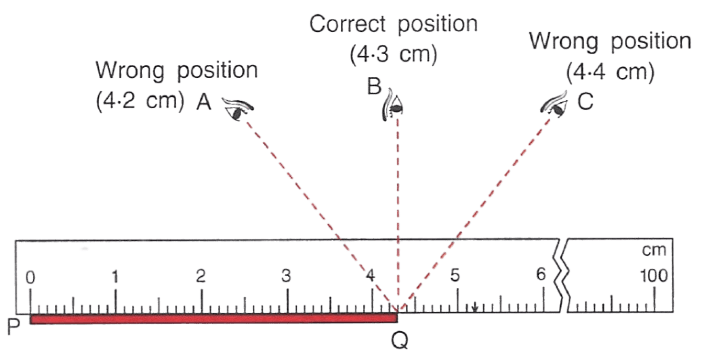
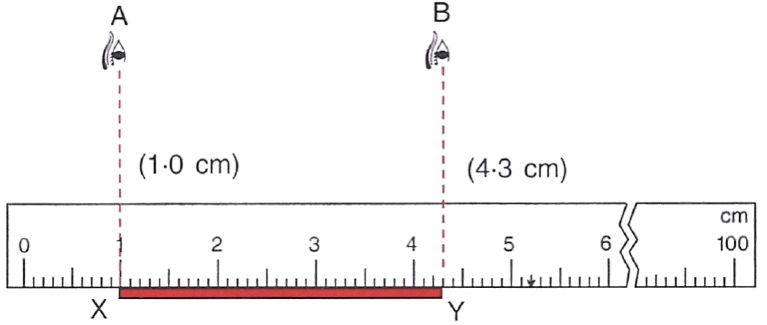
(b) When the ends of the ruler get damaged with use and its zero mark may not be visible then to measure the length of an object with such a ruler, the object is placed close to a specific marking on the ruler and positions of both ends of the object are read on the ruler. The difference of the two readings gives the length of the object which you can see from below image.
Name the instrument used for measuring the temperature of a person. Draw its neat labelled diagram.
Answer
A clinical thermometer is used for measuring the temperature of a person.
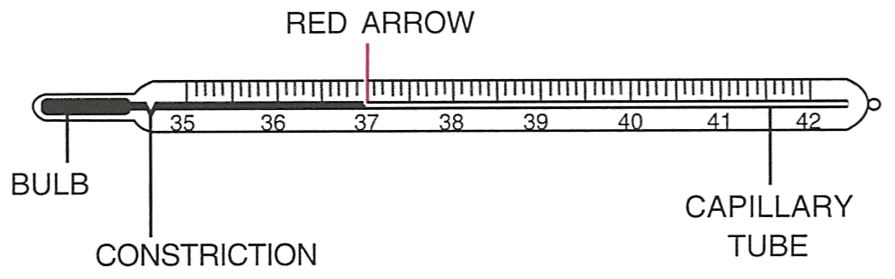
What is a clinical thermometer? State its special features. Draw a neat labelled diagram of a clinical thermometer showing the range of temperature marked on it.
Answer
Clinical thermometer is a special thermometer used by doctors for measuring the temperature of a patient's body.
Features of clinical thermometer :
- A clinical thermometer has markings from 35°C to 42°C.
- It has a slight bend or kink in the stem just above the bulb which is called constriction.
- The constriction prevents the mercury from falling back all by itself.
- In clinical thermometer, the temperature of a healthy person (i.e., 37°C) is marked by a red arrow.
Explain how you will measure the area of
(a) a square
(b) a leaf?
Answer
(a) Measurement of area of a square : As the area of a regular shape can be expressed in terms of the product of it's two measurements in length and since square has all side length equal then the area of a square can be calculated by using the following formulae :
Area of a square of side l = side x side = l × l = l2
(b) Measurement of area of a leaf : The area of an irregular surface like a leaf can be measured using graph paper. We count the squares of each side 1 cm, the area of which is 1 cm × 1 cm = 1 cm2. This therefore gives an approximate area of the given surface.
Procedure :
- Place the leaf on a graph paper.
- Draw its outline on the paper and remove it.
- Now count the number of complete squares.
- To this add the number of incomplete squares which are half or more than half (within the outline).
- Ignore the squares which are less than half (within the outline).
- This number when multiplied by the area of one square gives the approximate area of the given surface. Thus,
Approximate area of a leaf = (No. of complete squares + No. of half or more than half of incomplete squares) × Area of one square
Name the device which you will use to measure the perimeter of your play ground. Describe in steps how you will use it.
Answer
The device used to measure the perimeter of a playground is a measuring tape.
Procedure to measure the perimeter of play ground:
Select a Starting Point:
Choose one corner of the playground as your starting point.Secure the Tape:
Place the end of the measuring tape at this point. You can secure it with a peg, weight, or ask a helper to hold it firmly.Measure the First Side:
Stretch the tape tightly along the first side of the boundary, making sure it is straight and does not sag or twist.Note the Length:
When you reach the end of the side, record the measured length in your notebook.Mark the Endpoint:
Use chalk, a stone, or a stick to mark the spot where the tape ends.Continue Measuring:
From the marked point, measure the next side in the same way.Repeat for All Sides:
Continue this process until you have measured all sides of the playground.Verify Alignment:
At each corner, ensure the tape aligns properly so that no extra length or gap is included.Record All Measurements:
Write down the lengths of all sides clearly.Calculate the Perimeter:
Add together the lengths of all the sides to get the total perimeter of the playground.
Convert the following quantities as indicated :
(a) 12 inch = ............... ft
(b) 1 ft = ............... cm
(c) 20 cm = ............... m
(d) 4.2 m = ............... cm
(e) 0.2 km = ............... m
(f) 0.2 cm = ............... mm
(g) 1 yard = ............... m
Answer
(a) 12 inch = 1 ft
(b) 1 ft = 30.48 cm
(c) As,
1 cm = 10-2 m
⇒ 20 cm = 20 x 1 cm
= 20 x 10-2 m
⇒ 20 cm
= 0.2 m
(d) As,
1 m = 100 cm
⇒ 4.2 m = 4.2 x 100 cm = 420 cm
(e) 1 km = 1000 m
⇒ 0.2 km = 0.2 x 1000 m = 200 m
(f) 1 cm = 10 mm
⇒ 0.2 cm = 0.2 x 10 mm = 2 mm
(g) 1 yard = 0.91 m
Express in second
(i) 3 minute 15 second, and
(ii) 5 hour 2 minute 5 second.
Answer
(i) As,
1 minute = 60 seconds
Then,
3 minute 15 second = 3 minutes + 15 seconds
= 3 x 60 seconds + 15 seconds
= (180 + 15) seconds
= 195 seconds
(ii) As,
1 hour = 3600 seconds
and
1 minute = 60 seconds
then,
5 hour 2 minute 5 second = 5 x 3600 seconds + 2 x 60 seconds + 5 seconds
= (18000 + 120 + 5) seconds
= 18125 seconds
Convert the following quantities as indicated :
(a) 2500 kg = ............... metric tonne
(b) 150 kg = ............... quintal
(c) 10 lb = ............... kg
(d) 2500 g = ............... kg
(e) 0.01 kg = ............... g
(f) 5 mg = ............... kg
Answer
(a) 1 kg = 10-3 metric tonne
⇒ 2500 kg = 2500 x 10-3 metric tonne
= metric tonne
= 2.5 metric tonne
(b) 1 kg = 10-2 quintal
⇒ 150 kg = 150 x 10-2 quintal
= quintal
= 1.5 quintal
(c) 1 lb = 0.45359 kg
⇒ 10 lb = 10 x 0.45359 kg = 4.5359 kg
(d) 1 g = 10-3 kg
⇒ 2500 g = 2500 x 10-3 kg
⇒ 2500 g = kg = 2.5 kg
(e) 1 kg = 1000 g
⇒ 0.01 kg = 0.01 x 1000 g = 10 g
(f) 1 mg = 1 x 10⁻⁶ kg
5 mg = 5 x 10⁻⁶ kg
Aryan decided to help his mother set up a small vegetable patch in their backyard. They marked out a rectangular section that was 10 m long and 6 m wide. Aryan wanted to put a simple wire fence around it to keep stray animals away, so he measured all sides carefully. Later, he wanted to calculate the area of the patch. He used a sheet of graph paper to draw it, but he forgot to check the scale of the graph.
In the evening, he accompanied his mother to buy wire and pulses from a local shop. The shopkeeper used a balance with standard metal weights in grams and kilograms.
Answer the following :
(i) How much fencing wire does Aryan need for the vegetable patch? Which unit should the shopkeeper use to measure it?
(ii) Which unit is best suited to express the area of the patch?
(iii) What error did Aryan make while using the graph paper?
(iv) If the shopkeeper has weights of 50 g, 100 g, 500 g, 1 kg and 2 kg, which weights should he use if Aryan wanted to buy 250 g of lentils ?
Answer
(i) Given,
- Length of the rectangular section = 10 m
- Breadth of the rectangular section = 6 m
Now,
The fencing required = Perimeter of the rectangular section
= 2(l + b)
= 2(10 + 6)
= 2 x 16
= 32 m
So, Aryan needs 32 m of wire and the appropriate unit for measuring it is metre (m).
(ii) The area of the patch is best expressed in square metres (m2), since the dimensions are given in metres.
(iii) Aryan did not check the scale of the graph paper, which could lead to incorrect measurement or representation of the area.
(iv) Given,
- Weights = 50 g, 100 g, 500 g, 1 kg and 2 kg
- Mass of lentils = 250 g
To measure 250 g, the shopkeeper can use:
100 g + 100 g + 50 g = 250 g
Hence, the shopkeeper should use two weights of 100 g and another weight of 50 g to measure the 250 g lentils.