
Explain the term 'matter'. One kind of matter can be distinguished from another by its physical properties and chemical properties. State the main physical properties of matter.
Answer
Matter is anything that can be perceived by the senses. It occupies space, has mass and can neither be created nor destroyed.
The main physical properties of matter are:
- Colour — Different substances can be distinguished by their varied colours.
- Odour — Matter shows variation in odour or smell.
- Solubility — Matter may vary in its solubility in water or other solvents.
- Melting and boiling points — Substances show variation in their melting and boiling points.
The three main states of matter are - solids, liquids & gases. Compare the three states with reference to the following characteristics of matter -
(a) volume
(b) shape
(c) compressibility
(d) diffusion
Answer
| Characteristic | Solids | Liquids | Gases |
|---|---|---|---|
| Volume | Have a definite volume | Have a definite volume | Have no definite volume |
| Shape | Have a definite shape | Have no definite shape | Have no definite shape |
| Compressibility | Have no compressibility | Have slight compressibility | Have high compressibility |
| Diffusion | Diffusion is negligible | Diffusion is slow | Diffusion is rapid |
Matter in any state is composed of particles. Compare the three states of matter i.e. solids, liquids & gases with reference to:
(a) intermolecular space
(b) intermolecular force of attraction
(c) movement of particles
Answer
| Characteristic | Solids | Liquids | Gases |
|---|---|---|---|
| Intermolecular space | Minimum space | More than solids | Maximum space |
| Intermolecular force of attraction | Very strong | Less strong | Very weak |
| Movement of particles | Vibrate about their fixed positions | Move continuously | Move continuously in random directions |
Describe simple experiments to show that - solids
(a) occupy space
(b) have mass
(c) have a definite volume
Answer
(a) Solids occupy space
Procedure — Take a measuring cylinder and fill it to the 100 cc mark with water. A solid is slowly immersed inside the cylinder.
Observation — The water level rises above the 100 cc mark and if the solid is removed, the water level comes back to the 100 cc mark.
Conclusion — The solid occupies space and displaces some water, causing the water level to rise. Therefore, all solids occupy space.
(b) Solids have mass
Procedure — On one side of the scale, a solid is placed.
Observation — The scale tilts to the side where the solid is placed.
Conclusion — Therefore, all solids have mass.
(c) Solids have a definite volume
Procedure — A solid is taken and placed in containers of different shapes.
Observation — The solid retains the same volume irrespective of the shape of the container.
Conclusion — Therefore, all solids have a definite volume.
Describe simple experiments to prove that liquids
(a) have mass
(b) have a definite volume
(c) have no definite shape
Answer
(a) Liquids have mass
Procedure — On one side of the scale, a liquid in a beaker is placed.
Observation — The scale tilts to the side where the liquid is placed.
Conclusion — The mass of the liquid in the beaker causes the scale to tilt. Therefore, all liquids have mass.
(b) Liquids have a definite volume
Procedure — Liquid in a measuring cylinder is poured into another container.
Observation — The volume of the liquid in the container is the same as that in the measuring cylinder.
Conclusion — Liquids retain their own volume in any shaped container. Therefore, all liquids have a definite volume.
(c) Liquids have no definite shape
Procedure — Liquid in a measuring cylinder is poured into different containers.
Observation — The liquid takes the shape of each container.
Conclusion — Therefore, liquids have no definite shape.
Describe simple experiments to prove that - gases
(a) occupy space
(b) have mass
(c) have no definite volume or shape
Answer
(a) Gases occupy space
Procedure — An empty glass tumbler is lowered into a beaker of water.
Observation — On tilting the tumbler to one side, bubbles of air are seen coming out from the lower end of the tumbler.
Conclusion — The air inside the tumbler is displaced and bubbles are pushed out. Therefore, all gases occupy space.
(b) Gases have mass
Procedure — A balloon is inflated with air and placed on one side of the scale.
Observation — The scale tilts to the side where the balloon is placed.
Conclusion — The mass of the gas i.e. air in the balloon causes the scale to tilt. Therefore, all gases have mass.
(c) Gases have no definite volume or shape
Procedure — A gas jar filled with a coloured gas, e.g. brown nitrogen dioxide, is inverted over an empty beaker.
Observation — The coloured gas empties out from the gas jar and completely takes up the volume and shape of the beaker.
Conclusion — Therefore, gases have no definite volume or shape.
Explain the term 'Interconversion of matter'. With reference to ice, water & water vapour - show diagrammatically the change of state of matter from solid to liquid to gaseous & back to its original state.
Answer
Interconversion of matter involves the change of state of matter from one state to another state and back to its original state. The change is brought about by changes in temperature and pressure.
The change of state of matter with reference to ice, water and water vapour is shown below:
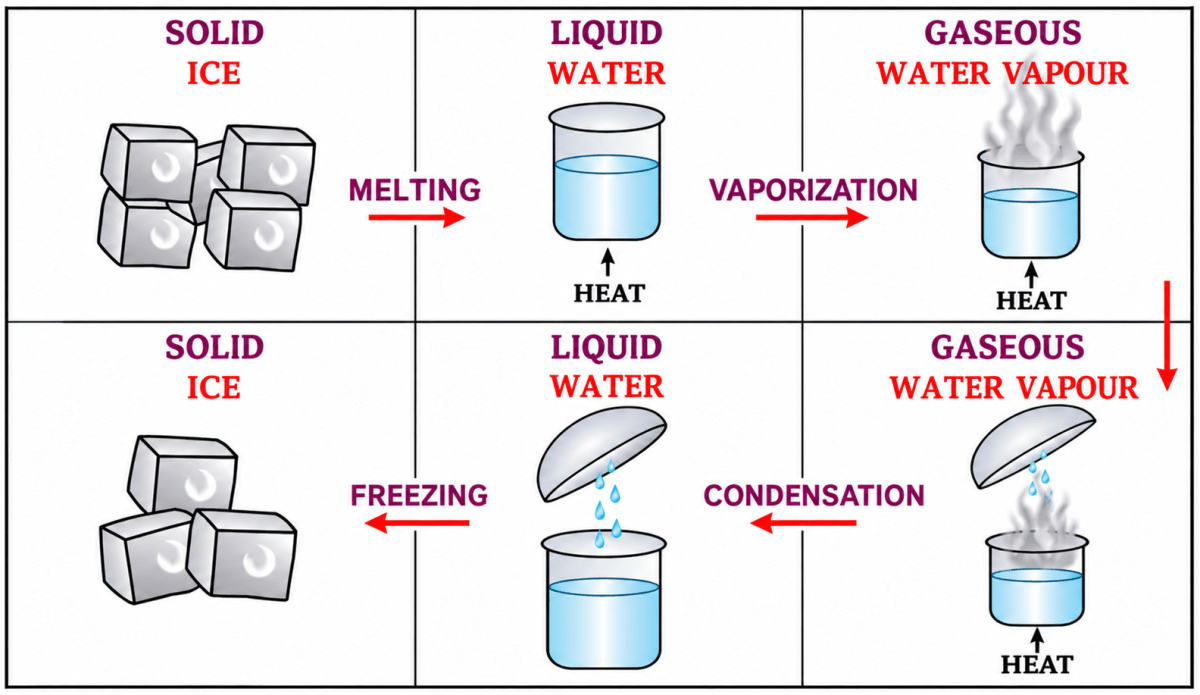
- Ice (solid) changes to water (liquid) on heating — Melting
- Water (liquid) changes to water vapour (gas) on heating — Vaporization
- Water vapour (gas) changes back to water (liquid) on cooling — Condensation
- Water (liquid) changes back to ice (solid) on cooling — Freezing
Explain the terms
(a) melting
(b) vaporization
(c) condensation
(d) freezing
(e) melting point
(f) boiling point.
Answer
(a) Melting — The process of conversion of a solid into a liquid on heating. (e.g. ice to water)
(b) Vaporization — The process of conversion of a liquid into a vapour on heating. (e.g. water to water vapour)
(c) Condensation — The process of conversion of a vapour (or gas) into a liquid(e.g. water vapour to water)
(d) Freezing — The process of conversion of a liquid into a solid(e.g. water to ice)
(e) Melting point — The constant temperature at which a solid melts into a liquid(m.p. of ice = 0°C)
(f) Boiling point — The constant temperature at which a liquid starts boiling. (b.p. of water = 100°C)
State what would you observe if
(a) sugar is added to pebbles taken in a plastic beaker
(b) sand is added to glass balls in a beaker. What would you conclude from this imaginative demonstration.
Answer
Observation — The sugar or the sand goes into the space between the pebbles and the glass balls respectively.
Conclusion — This imaginative demonstration shows that there are intermolecular spaces between particles and that smaller particles can occupy these spaces.
With the help of a simple experiment how would you show that solids expand on heating.
Answer
Experiment (Ball and ring apparatus)
Procedure — A simple ball and ring apparatus is taken, which consists of a metal ball which can just pass through the circular metal ring. The metal ball is then heated for a certain period of time.
Observation — After heating, the metal ball does not pass through the ring because it has expanded in size on heating.
Conclusion — All solids expand on heating.
Give reasons for the following:
(a) Solids have a definite shape & are highly rigid, while gases have no definite shape & are least rigid
(b) Sugar can be distinguished from talcum powder using water.
(c) Water on freezing turns into ice.
(d) A bottle of perfume on opening evolves an odour which can be sensed over a long distance.
Answer
(a) In solids, the particles have minimum intermolecular space and a very strong force of attraction between them. They are closely packed and can only vibrate about their fixed positions. Hence, solids have a definite shape and are highly rigid. In gases, the particles have maximum intermolecular space and a very weak force of attraction between them, so they move freely in random directions. Hence, gases have no definite shape and are the least rigid.
(b) Sugar dissolves in water (it is soluble), while talcum powder does not dissolve in water (it is insoluble). On the basis of this difference in solubility, sugar can be distinguished from talcum powder using water.
(c) Freezing is the process of conversion of a liquid into a solid. When water is cooled below 0°C, it loses heat and changes into the solid state. Hence, water on freezing turns into ice.
(d) When a bottle of perfume is opened, the perfume evaporates and its vapour particles diffuse rapidly through the air. Since diffusion is very fast in gases, the odour spreads and can be sensed over a long distance.
Complete the statements given below by selecting the correct word/s.
(a) Solids and liquids have a definite ............... but gases do not. [mass, shape, volume]
(b) The space between atoms in ............... is maximum while in ............... is minimum. [solids, liquids, gases]
(c) Conversion of a vapour into a liquid is called ............... [vaporization, condensation, freezing]
(d) ............... is an example of a crystalline substance. [wax, sugar, tea]
Answer
(a) Solids and liquids have a definite volume but gases do not.
(b) The space between atoms in gases is maximum while in solids is minimum.
(c) Conversion of a vapour into a liquid is called condensation.
(d) Sugar is an example of a crystalline substance.
State which of the following statements are false. If false write the correct statement.
(a) Solids are highly compressible and rigid.
(b) Atoms/molecules in gases move only about their own positions.
(c) The conversion of water to ice is called - freezing.
Answer
(a) False
Correct Statement — Solids are not compressible (incompressible) but are highly rigid.
(b) False
Correct Statement — Atoms/molecules in gases move continuously in random directions. It is the atoms/molecules in solids that vibrate about their fixed positions.
(c) True
Fill in the blanks with the correct word/s from the bracket.
(i) From the three states of matter, ............... [solids/ liquids/gases] expand the least.
(ii) Brownian movement is maximum in ............... [gases / solids/ liquids]
(iii) Cohesive forces are negligible in ............... [liquids / solids/ gases]
(iv) Matter can change from one state to another by change in ............... [temperature or pressure / temperature only]
(v) The space between atoms [molecules] of solids is ............... [minimum / maximum]
(vi) Intermingling of molecules is called ............... [perforation / diffusion]
(vii) Ice on absorption of heat converts to 'X' a process called ............... [vaporization / melting]. 'X' changes to water vapour on ............... [heating / cooling]. Water vapour changes back to 'X' on ............... [freezing / condensation]. The constant temperature at which ice changes into 'X' is called its ............... [fusion point / melting point / boiling point]
Answer
(i) From the three states of matter, solids expand the least.
(ii) Brownian movement is maximum in gases.
(iii) Cohesive forces are negligible in gases.
(iv) Matter can change from one state to another by change in temperature or pressure.
(v) The space between atoms [molecules] of solids is minimum.
(vi) Intermingling of molecules is called diffusion.
(vii) Ice on absorption of heat converts to 'X' by a process called melting. 'X' changes to water vapour on heating. Water vapour changes back to 'X' on condensation. The constant temperature at which ice changes into 'X' is called its melting point.
State which of the following are physical properties of a substance.
(i) Chlorine gas has a - strong irritating odour.
(ii) Sodium nitrate is soluble in water, but calcium carbonate is not.
(iii) Magnesium reacts with dilute hydrochloric acid, liberating hydrogen gas.
(iv) Manganese dioxide, a catalyst which alters the rate of a chemical reaction, is black in colour.
(v) The melting point of ice is 0°C.
(vi) Lead chloride reacts with barium sulphate to give a white precipitate of lead sulphate.
(vii) Water acidified with dilute sulphuric acid - is a good conductor of electricity.
(viii) Naphthalene on heating directly turns into vapour.
(ix) Hydrogen sulphide gas has a - strong rotten egg odour.
(x) Sulphur is a yellow amorphous powder - insoluble in water.
Answer
The following are physical properties of a substance:
(i) Chlorine gas has a strong irritating odour. — (odour)
(ii) Sodium nitrate is soluble in water, but calcium carbonate is not. — (solubility)
(iv) Manganese dioxide is black in colour. — (colour)
(v) The melting point of ice is 0°C. — (melting point)
(vii) Water acidified with dilute sulphuric acid is a good conductor of electricity. — (electrical conductivity)
(viii) Naphthalene on heating directly turns into vapour. — (change of state / sublimation)
(ix) Hydrogen sulphide gas has a strong rotten egg odour. — (odour)
(x) Sulphur is a yellow amorphous powder, insoluble in water. — (colour and solubility)
Explanation
Statements (iii) and (vi) are chemical properties as they involve chemical reactions.
Match the characteristics of the three states of matter in List I with their correct answer from List II.
| List I | List II |
|---|---|
| 1. Are highly rigid & have a definite shape | A. Solids and gases only |
| 2. Have no definite shape | B. Solids only |
| 3. Have a definite volume but no definite shape | C. Liquids and gases only |
| 4. Are highly compressible and least rigid | D. Gases only |
| 5. Have no definite volume | E. Solids, liquids & gases |
| 6. Have no definite shape and volume | F. Liquids only |
| 7. Occupy space | G. Solids and liquids only |
| 8. Are not compressible | |
| 9. Are slightly compressible | |
| 10. Have mass |
Answer
| List I | List II |
|---|---|
| 1. Are highly rigid & have a definite shape | B. Solids only |
| 2. Have no definite shape | C. Liquids and gases only |
| 3. Have a definite volume but no definite shape | F. Liquids only |
| 4. Are highly compressible and least rigid | D. Gases only |
| 5. Have no definite volume | D. Gases only |
| 6. Have no definite shape and volume | D. Gases only |
| 7. Occupy space | E. Solids, liquids & gases |
| 8. Are not compressible | B. Solids only |
| 9. Are slightly compressible | F. Liquids only |
| 10. Have mass | E. Solids, liquids & gases |
Match the arrangement of atoms in the three states of matter in List I with the correct state in List II.
| List I | List II |
|---|---|
| 1. Arrangement of atoms is far apart | A. Solids |
| 2. Force of attraction between atoms is very strong | B. Liquids |
| 3. Movement of atoms is in any random direction | C. Gases |
| 4. Particles diffuse very easily | |
| 5. Particles show movement about their own position |
Answer
| List I | List II |
|---|---|
| 1. Arrangement of atoms is far apart | C. Gases |
| 2. Force of attraction between atoms is very strong | A. Solids |
| 3. Movement of atoms is in any random direction | C. Gases |
| 4. Particles diffuse very easily | C. Gases |
| 5. Particles show movement about their own position | A. Solids |
State the correct term from A, B, C, D, E or F in List II which represents the change of state of matter or its relevant property from List I
| List I | List II |
|---|---|
| 1. Solid 'X' to a Liquid 'Y' | A. Condensation |
| 2. Liquid 'Y' to its vapour 'Z' | B. Vaporization |
| 3. 'Z' to 'Y' | C. Melting |
| 4. 'Y' to 'X' | D. Freezing |
| 5. The temperature at which 'Y' changes to 'Z' | E. Melting point |
| F. Boiling point |
Answer
| List I | List II |
|---|---|
| 1. Solid 'X' to a Liquid 'Y' | C. Melting |
| 2. Liquid 'Y' to its vapour 'Z' | B. Vaporization |
| 3. 'Z' to 'Y' | A. Condensation |
| 4. 'Y' to 'X' | D. Freezing |
| 5. The temperature at which 'Y' changes to 'Z' | F. Boiling point |