
Explain the term mixtures. Give an example of mixtures of - a. two elements b. two compounds c. elements and compounds.
Answer
A mixture is an impure substance made up of two or more elements or compounds mechanically mixed together in any proportion.
a. Two elements — Iron and Sulphur.
b. Two compounds — Potassium chloride and Water [potassium chloride solution].
c. Elements and compounds — Sulphur [element], Carbon [element] and Potassium nitrate [compound] mixed together to form gun powder.
Differentiate between homogeneous & heterogeneous mixtures with suitable examples.
Answer
| Homogeneous mixtures | Heterogeneous mixtures |
|---|---|
| Mixtures which have same composition & properties throughout the mixture. | Mixtures which have different composition & properties throughout the mixture. |
| The constituents mix easily [miscible]. | The constituents do not mix easily [immiscible]. |
| E.g., alcohol & water, salt & water, sugar & water. | E.g., oil & water, salt & sand, chalk & water. |
With reference to the mixture of iron and sulphur, state the main characteristics of mixture.
Answer
The main characteristics of a mixture, with reference to the mixture of iron and sulphur, are:
(i) Components in a mixture are present in varying proportions. — The mixture of iron & sulphur may contain iron & sulphur in varying proportions.
(ii) Mixtures have no definite set of properties. — The components, i.e. elements or compounds in a mixture, retain their original properties. The properties of both iron and sulphur are retained in the mixture of iron & sulphur.
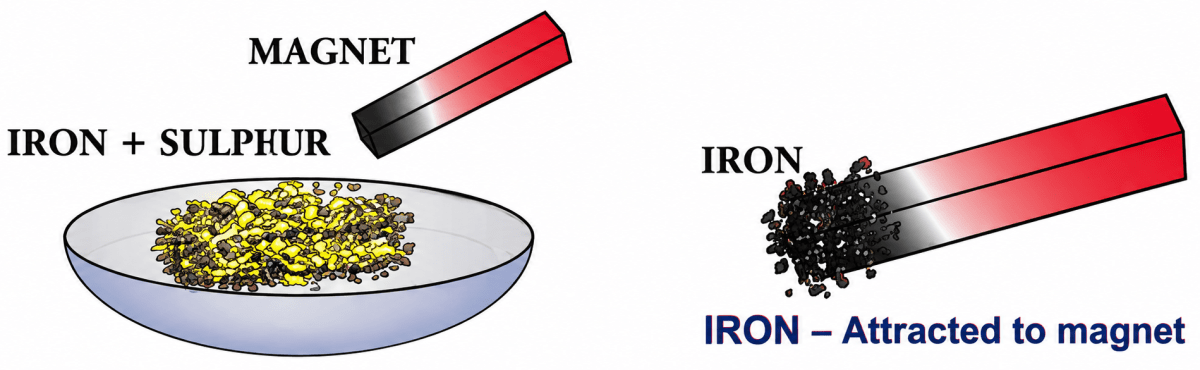
(iii) Components in a mixture can be separated by physical methods. — A mixture of the two elements iron & sulphur can be separated by using a magnet, since iron is attracted to the magnet, which is a physical method.
Tabulate a comparative chart - to differentiate between elements, compounds & mixtures. Differentiate them with reference to - a. the term b. existence c. properties d. separation of components.
Answer
| Elements | Compounds | Mixtures | |
|---|---|---|---|
| Term | Pure substance made up of one kind of atoms only. | Pure substance made up of two or more different elements. | Impure substance made up of two or more elements or compounds. |
| Existence | Elements are present on their own. | Components are present in a definite proportion. | Components are present in any proportion. |
| Properties | Elements have a definite set of properties. | Compounds have a definite set of properties. | Mixtures do not have a definite set of properties. |
| Separation of components | Elements can be separated by chemical & physical methods. | Elements in a compound can be separated by chemical methods only. | Components in a mixture can be separated by physical methods only. |
| Examples | Iron | Iron sulphide | Iron + Sulphur |
State the principle involved in separation of solid-solid mixtures by -
(a) sieving
(b) magnetic separation
(c) sublimation.
Answer
a. Sieving — Based on the difference in size of the solid particles.
b. Magnetic separation — Based on the difference in magnetic & non-magnetic nature of the particles.
c. Sublimation — Based on the difference in sublimable & non-sublimable nature of the solids.
State the principle involved in separation of solid-liquid mixtures by -
(a) sedimentation & decantation
(b) filtration
(c) evaporation.
Answer
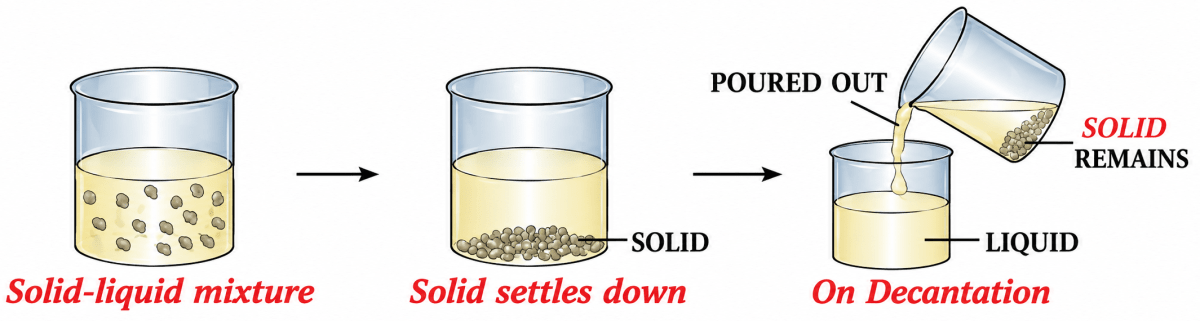
a. Sedimentation & decantation — Based on the settling down by gravity of the insoluble solid particles in an insoluble solid-liquid mixture, followed by pouring out of the liquid.
b. Filtration — Based on the filtration of insoluble solid particles in a solid-liquid mixture.
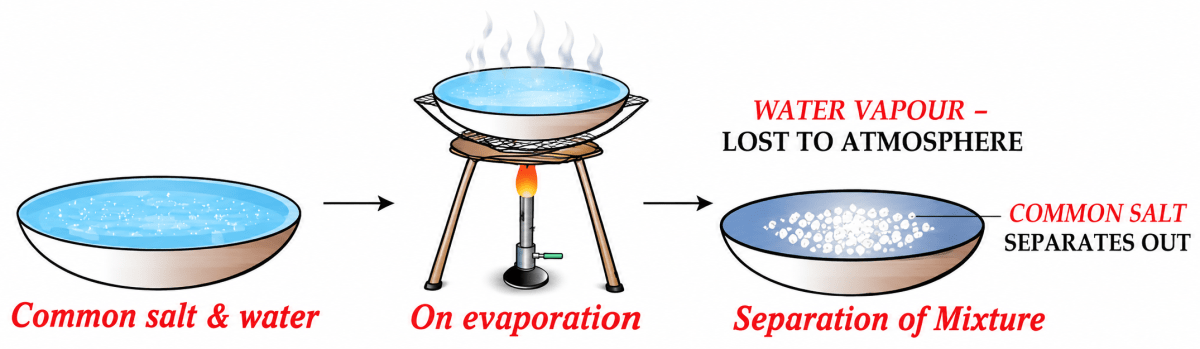
c. Evaporation — Based on the evaporation of the liquid component in a soluble solid-liquid mixture.
Explain the term 'sieving'. State the structure of a sieve and explain the separation of different sized particles by sieving.
Answer
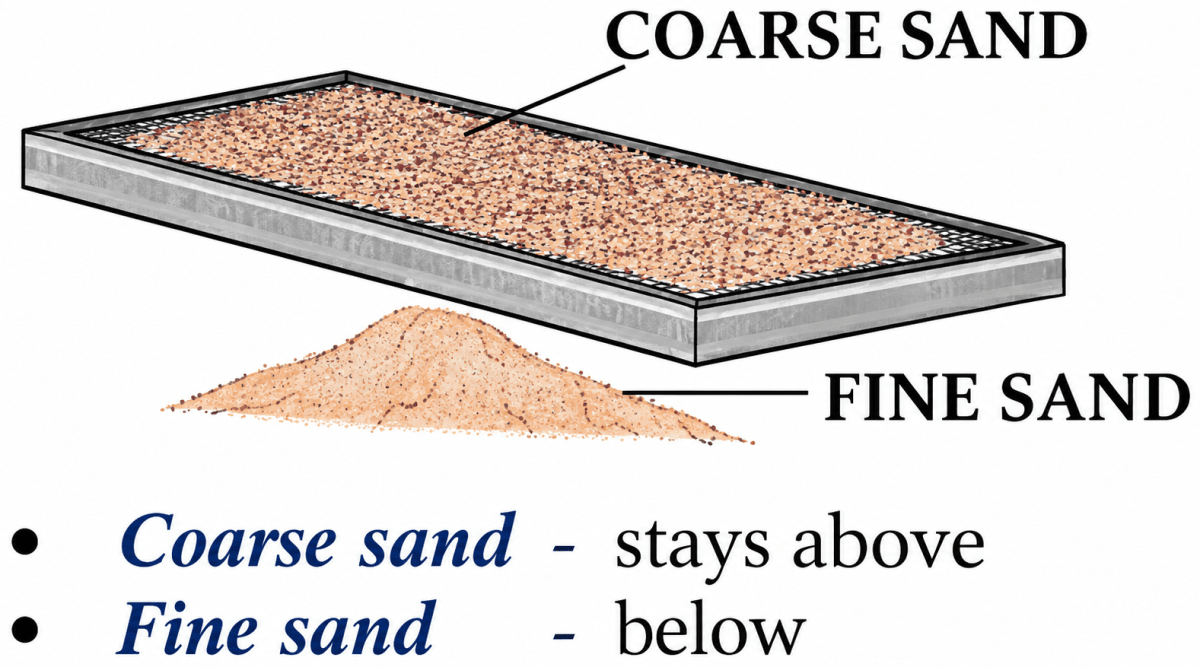
Sieving — It is a method of separating a solid-solid mixture, based on the difference in the size of the solid particles.
Structure of a sieve — A sieve is a wooden frame with a metal mesh.
Separation of different sized particles by sieving — The large sized particles are separated from the small or finer particles by passing the mixture through a sieve. On shaking the sieve, the larger particles stay above while the finer particles pass through and collect below it.
State what is meant by 'magnetic separation of two mixtures'. Explain how iron particles can be separated from sulphur particles.
Answer
Magnetic separation — It is a method of separating a solid-solid mixture, based on the difference in the magnetic & non-magnetic nature of the particles.
Separation of iron from sulphur — The magnetic particles of iron are separated from the non-magnetic particles of sulphur by utilizing the magnetic properties of iron. When a magnet is moved over the mixture, the iron gets attracted to the magnet and separates out from the non-magnetic sulphur, which remains behind.
Give a reason why sublimable & non-sublimable substances can be separated easily, but two sublimable substances cannot.
Answer
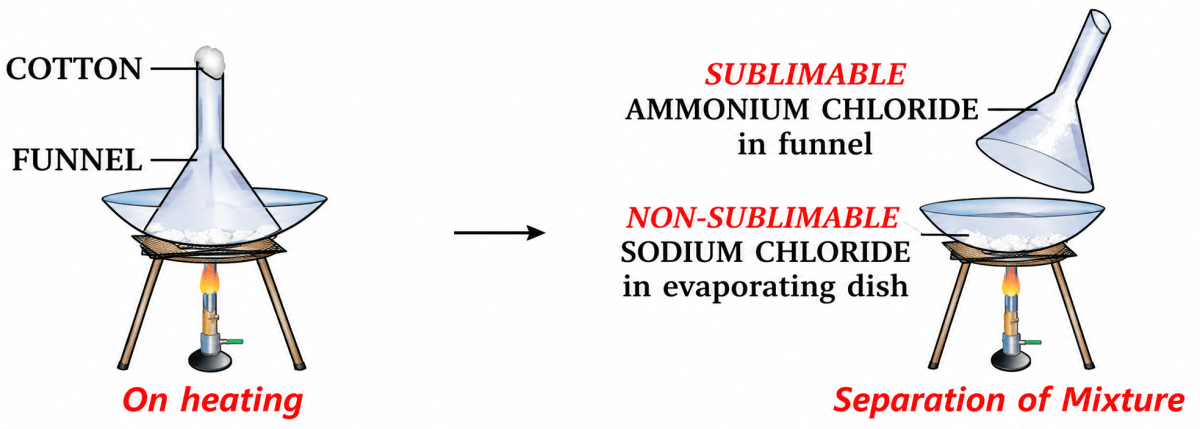
Sublimation is based on the difference in the sublimable & non-sublimable nature of the solids. When a mixture of a sublimable and a non-sublimable substance is heated, the sublimable solid sublimes i.e. turns directly into vapour and condenses elsewhere, while the non-sublimable solid remains behind. Hence, they can be separated easily.
However, when two sublimable substances are heated together, both turn into vapour on heating and condense together. As neither remains behind, two sublimable substances cannot be separated by sublimation.
Explain the technique for separating insoluble solid particles in a solid-liquid mixture.
Answer
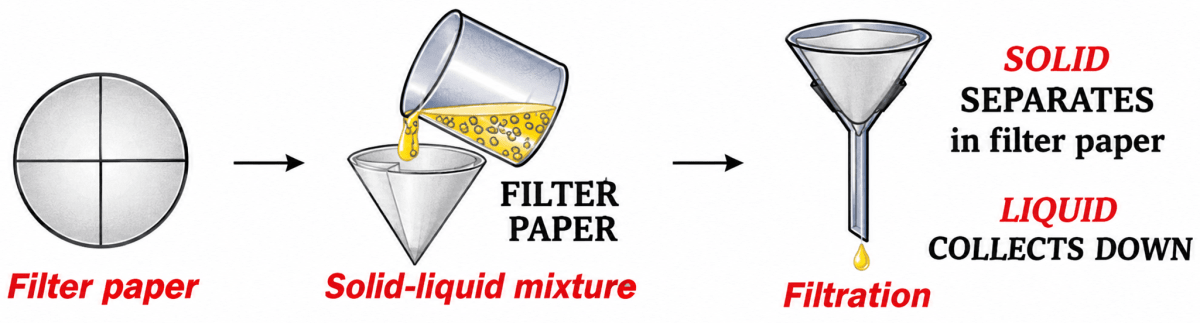
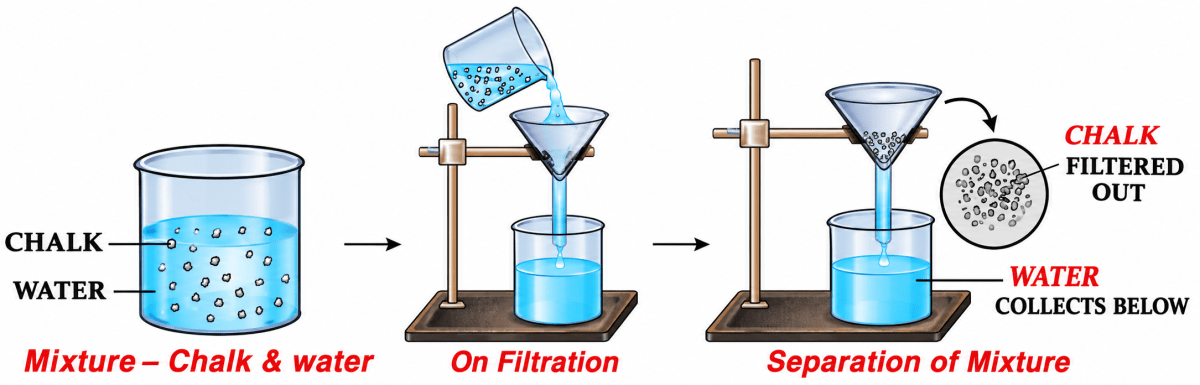
Insoluble solid particles in a solid-liquid mixture are separated by filtration.
Technique — A filter paper is made into a cone & placed in a funnel. The solid-liquid mixture is poured through it. The solid particles remain behind on the filter paper while the liquid passes through and collects below.
Differentiate between the terms - sedimentation & decantation with a suitable experimental technique.
Answer
| Sedimentation | Decantation |
|---|---|
| It is the process of settling down by gravity of the insoluble solid component in a solid-liquid mixture, on standing for some time. | It is the process of pouring out of the liquid, such that the solid that has settled down remains behind. |
Experimental technique — The insoluble solid component in the solid-liquid mixture settles down on standing in a beaker [sedimentation]. The liquid which collects above it is then carefully poured out, leaving the solid behind in the beaker [decantation].
Explain how a solid component is separated in a soluble solid-liquid mixture.
Answer
A solid component in a soluble solid-liquid mixture is separated by evaporation.
Technique — The soluble solid is separated from its liquid component by allowing the liquid component to evaporate either on its own or by heating. During evaporation, the liquid component is lost to the atmosphere as vapour and the soluble solid remains behind.
Draw a neat labelled diagram for separation of the following mixtures.
a. Coarse sand from fine sand
b. A magnetic particle from a non-magnetic particle
c. Naphthalene from sodium chloride
d. Chalk & water using a filter paper
e. Sand & water without using a filter paper
f. Common salt from a solution of common salt & water
Answer
a. Coarse sand from fine sand — by sieving.
b. A magnetic particle from a non-magnetic particle — by magnetic separation.
c. Naphthalene from sodium chloride — by sublimation.
d. Chalk & water using a filter paper — by filtration.
e. Sand & water without using a filter paper — by sedimentation & decantation.
f. Common salt from a solution of common salt & water — by evaporation.
State the technique involved in separating the following:
a. Iodine crystals & potassium chloride
b. Iron & chalk powder
c. Potassium chloride from an aqueous solution of potassium chloride
d. Rice powder from soil particles
e. Iron filings from pieces of copper wire
f. Large diamonds from very small diamonds
Answer
a. Iodine crystals & potassium chloride — Sublimation
b. Iron & chalk powder — Magnetic separation
c. Potassium chloride from an aqueous solution of potassium chloride — Evaporation
d. Rice powder from soil particles — Sieving
e. Iron filings from pieces of copper wire — Magnetic separation
f. Large diamonds from very small diamonds — Sieving
Match the statements in List I with the correct answer in List II.
| List I | List II |
|---|---|
| 1. Purification of water by adding alum | A. Sublimation |
| 2. Sea water leaving behind common salt | B. Sieving |
| 3. Separation of camphor & potassium chloride | C. Filtration |
| 4. Separation of charcoal from a charcoal-water mixture | D. Sedimentation |
| 5. Separation of bran & wheat flour | E. Evaporation |
Answer
| List I | List II |
|---|---|
| 1. Purification of water by adding alum | D. Sedimentation |
| 2. Sea water leaving behind common salt | E. Evaporation |
| 3. Separation of camphor & potassium chloride | A. Sublimation |
| 4. Separation of charcoal from a charcoal-water mixture | C. Filtration |
| 5. Separation of bran & wheat flour | B. Sieving |
State whether the following statements are true or false. If false write the correct statement.
(i) Components in a mixture are present in a definite proportion.
(ii) Mixtures have no definite set of properties.
(iii) Components in a mixture can be separated by physical & chemical methods.
(iv) Sodium chloride and water - is an example of a mixture of elements & compounds.
(v) Heterogeneous mixtures have different composition & properties throughout the mixture.
Answer
(i) False.
Correct Statement — Components in a mixture are present in any [varying] proportion.
(ii) True.
(iii) False.
Correct Statement — Components in a mixture can be separated by physical methods only.
(iv) False.
Correct Statement — Sodium chloride and water is an example of a mixture of two compounds.
(v) True.
Name the following
(i) A black non-metallic component of the mixture - gunpowder
(ii) A physical method of separating iron from an iron-sulphur mixture.
(iii) The component of the soluble solid-liquid mixture, which is lost to the atmosphere on heating.
(iv) The component of a naphthalene-sodium chloride mixture, which remains in the evaporating dish when heated together, covered with a funnel.
(v) A mixture of two immiscible liquids.
Answer
(i) Carbon [charcoal]
(ii) Magnetic separation
(iii) The liquid component [water]
(iv) Sodium chloride [the non-sublimable component]
(v) Oil & water
Give reasons for the following
(i) Naphthalene & camphor cannot be separated by sublimation.
(ii) Sodium chloride cannot be separated out from its aqueous solution by filtration.
(iii) Two varieties of wheat flour cannot be separated by sieving.
(iv) Sulphur and charcoal powder cannot be separated by magnetic separation.
(v) Both components of a soluble solid-liquid mixture cannot be recovered by evaporation.
Answer
(i) Both naphthalene & camphor are sublimable substances. On heating, both sublime and turn into vapour together, so neither remains behind. Hence, they cannot be separated by sublimation.
(ii) Sodium chloride is soluble in water and forms a solution. The dissolved salt particles pass through the pores of the filter paper along with the water. Hence, sodium chloride cannot be separated out from its aqueous solution by filtration.
(iii) Sieving is based on the difference in the size of the solid particles. Two varieties of wheat flour have particles of nearly the same size, so both pass through the sieve together. Hence, they cannot be separated by sieving.
(iv) Magnetic separation is based on the difference in the magnetic & non-magnetic nature of the particles. Both sulphur and charcoal powder are non-magnetic and neither is attracted to the magnet. Hence, they cannot be separated by magnetic separation.
(v) During evaporation, the liquid component is lost to the atmosphere as vapour and only the soluble solid remains behind. As the liquid component is not recovered, both components of a soluble solid-liquid mixture cannot be recovered by evaporation.