
Classify substances into pure & impure substances in the form of a chart or tabulation.
Answer
Substances are classified into pure substances and impure substances as shown below:
| Pure substances | Impure substances |
|---|---|
| They contain only one kind of particle and have a fixed composition with definite properties. | They contain two or more kinds of particles mixed together with no fixed composition. |
| Types: Elements and Compounds | Type: Mixtures (homogeneous and heterogeneous) |
| Examples — Iron, oxygen, water, common salt | Examples — Air, sea water, soil, milk |
Differentiate between the terms elements, compounds & mixtures.
Answer
The differences between elements, compounds and mixtures are given below:
| Elements | Compounds | Mixtures |
|---|---|---|
| They are made up of only one kind of atom. | They are made up of two or more elements combined chemically in a fixed proportion. | They are made up of two or more substances mixed physically in any proportion. |
| They cannot be broken down into simpler substances by physical or chemical means. | They can be broken down into their constituent elements by chemical means. | They can be separated into their constituents by physical means. |
| They are pure substances. | They are pure substances. | They are impure substances. |
| Examples — Hydrogen, gold, sulphur. | Examples — Water, carbon dioxide, common salt. | Examples — Air, brass, soil. |
The important physical properties of substances are colour, odour, nature, density & solubility in water. Name - a. two coloured gases [with their colours] b. a gas with a pungent, choking odour which is lighter than air c. a poisonous gas almost as heavy as air.
Answer
a. Two coloured gases :
- Chlorine — greenish-yellow
- Nitrogen dioxide — reddish-brown
b. Ammonia (NH3) — a gas with a pungent, choking odour which is lighter than air.
c. Carbon monoxide (CO) — a poisonous gas almost as heavy as air.
Complete the statement - an element is a pure substance made up of ............... [identical/ different] atoms.
Answer
An element is a pure substance made up of identical atoms.
Draw a labelled diagram of an atom including its nucleus, orbits & their contents.
Answer
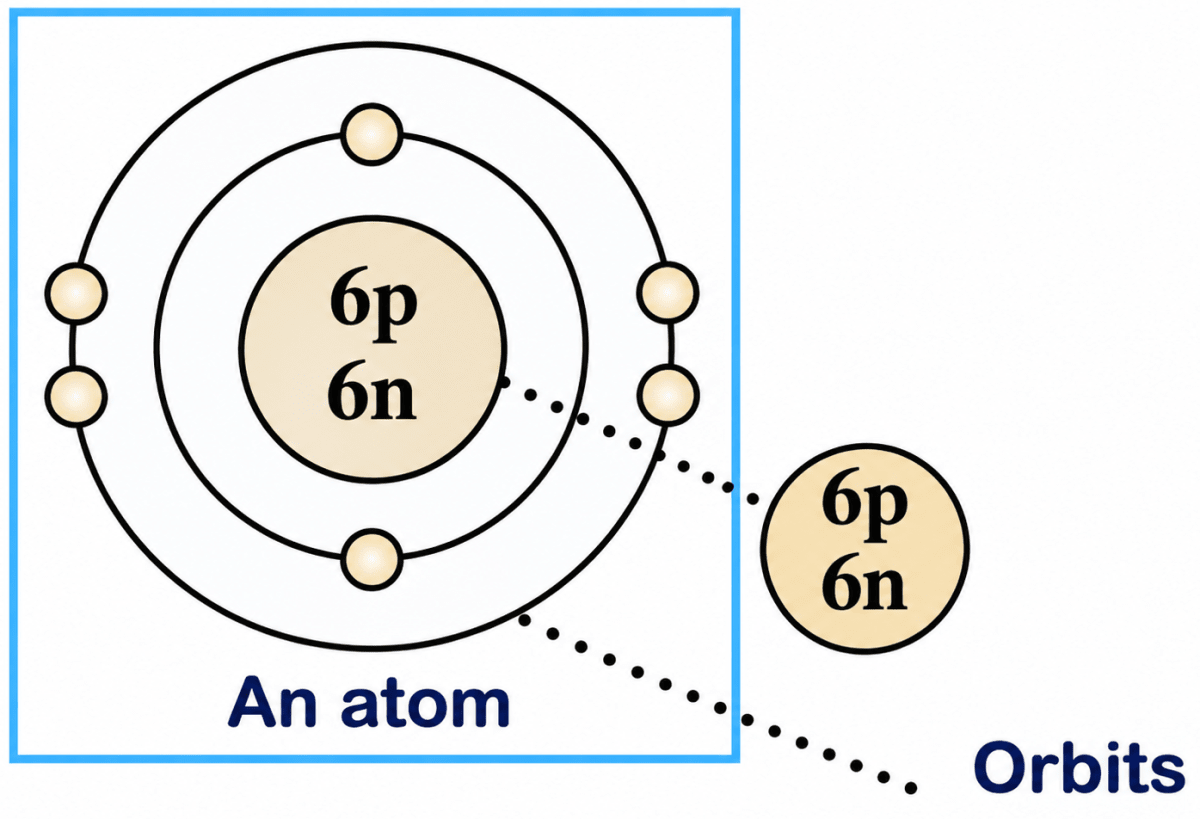
A labelled diagram of an atom shows a central nucleus containing positively charged protons and neutral neutrons, around which negatively charged electrons revolve in fixed orbits (shells).
Elements are classified into - Metals - Non-metals - Metalloids - Noble gases. State which of A, B, C, D is a - i. Metallic element ii. Non-metallic element iii. Metalloid iv. Noble gas.
A : Is non-malleable, non-ductile & a poor conductor of electricity ...............
B : Has lustre, is malleable and ductile & a good conductor of heat ...............
C : Is unreactive and inert and present in traces in air ...............
D : Shows properties of both metals and non-metals ...............
Answer
i. Metallic element — B
ii. Non-metallic element — A
iii. Metalloid — D
iv. Noble gas — C
An atom of an element is denoted by a 'symbol'. Explain the meaning of the term 'symbol'. State a reason for representing the following elements by their symbols. a. Hydrogen by 'H', b. Helium by 'He', c. Copper by 'Cu'.
Answer
A symbol is the abbreviated form used to represent an atom of an element. It distinguishes one element from another and is characteristic of that element. A symbol is generally derived from the first letter, the first two letters, or the Latin name of the element.
a. Hydrogen is represented by 'H' — it is the first letter of its name (written in capital).
b. Helium is represented by 'He' — its first letter 'H' is already used for hydrogen, so the first two letters are taken (first letter capital, second small).
c. Copper is represented by 'Cu' — it is taken from the first two letters of its Latin name "Cuprum".
Match the metallic elements - with their correct symbols.
| Metallic elements | Symbols |
|---|---|
| a. Potassium | 1. Ca |
| b. Sodium | 2. Zn |
| c. Calcium | 3. Pb |
| d. Magnesium | 4. Hg |
| e. Zinc | 5. Cu |
| f. Aluminium | 6. Au |
| g. Iron | 7. K |
| h. Lead | 8. Fe |
| i. Copper | 9. Al |
| j. Mercury | 10. Na |
| k. Silver | 11. Mg |
| l. Platinum | 12. Pt |
| m. Gold | 13. Ag |
Answer
| Metallic elements | Symbols |
|---|---|
| a. Potassium | 7. K |
| b. Sodium | 10. Na |
| c. Calcium | 1. Ca |
| d. Magnesium | 11. Mg |
| e. Zinc | 2. Zn |
| f. Aluminium | 9. Al |
| g. Iron | 8. Fe |
| h. Lead | 3. Pb |
| i. Copper | 5. Cu |
| j. Mercury | 4. Hg |
| k. Silver | 13. Ag |
| l. Platinum | 12. Pt |
| m. Gold | 6. Au |
Match the non-metallic elements - with their correct symbols.
| Non-metallic elements | Symbols |
|---|---|
| a. Carbon | 1. O |
| b. Chlorine | 2. I |
| c. Oxygen | 3. Si |
| d. Phosphorus | 4. C |
| e. Hydrogen | 5. Cl |
| f. Nitrogen | 6. P |
| g. Iodine | 7. F |
| h. Bromine | 8. H |
| i. Fluorine | 9. S |
| j. Silicon | 10. Br |
| k. Sulphur | 11. N |
Answer
| Non-metallic elements | Symbols |
|---|---|
| a. Carbon | 4. C |
| b. Chlorine | 5. Cl |
| c. Oxygen | 1. O |
| d. Phosphorus | 6. P |
| e. Hydrogen | 8. H |
| f. Nitrogen | 11. N |
| g. Iodine | 2. I |
| h. Bromine | 10. Br |
| i. Fluorine | 7. F |
| j. Silicon | 3. Si |
| k. Sulphur | 9. S |
Match the noble gases - with their correct symbols.
| Noble gases | Symbols |
|---|---|
| a. Helium | 1. Ar |
| b. Neon | 2. Xe |
| c. Argon | 3. Rn |
| d. Krypton | 4. He |
| e. Xenon | 5. Kr |
| f. Radon | 6. Ne |
Answer
| Noble gases | Symbols |
|---|---|
| a. Helium | 4. He |
| b. Neon | 6. Ne |
| c. Argon | 1. Ar |
| d. Krypton | 5. Kr |
| e. Xenon | 2. Xe |
| f. Radon | 3. Rn |
Give a reason why elements are tabulated in a table called the 'Periodic table'.
Answer
Elements are tabulated in the Periodic table because it arranges all the elements in a systematic order (in increasing order of their atomic number), grouping elements with similar properties together. This makes the study of the large number of elements and their properties simple and convenient.
Give the names and symbols of the first twenty elements of the periodic table. Differentiate them into metals, non-metals, metalloids & noble gases.
Answer
The names, symbols and classification of the first twenty elements are given below:
| Atomic number | Element | Symbol | Classification |
|---|---|---|---|
| 1 | Hydrogen | H | Non-metal |
| 2 | Helium | He | Noble gas |
| 3 | Lithium | Li | Metal |
| 4 | Beryllium | Be | Metal |
| 5 | Boron | B | Metalloid |
| 6 | Carbon | C | Non-metal |
| 7 | Nitrogen | N | Non-metal |
| 8 | Oxygen | O | Non-metal |
| 9 | Fluorine | F | Non-metal |
| 10 | Neon | Ne | Noble gas |
| 11 | Sodium | Na | Metal |
| 12 | Magnesium | Mg | Metal |
| 13 | Aluminium | Al | Metal |
| 14 | Silicon | Si | Metalloid |
| 15 | Phosphorus | P | Non-metal |
| 16 | Sulphur | S | Non-metal |
| 17 | Chlorine | Cl | Non-metal |
| 18 | Argon | Ar | Noble gas |
| 19 | Potassium | K | Metal |
| 20 | Calcium | Ca | Metal |
On differentiating:
- Metals — Lithium, Beryllium, Sodium, Magnesium, Aluminium, Potassium, Calcium
- Non-metals — Hydrogen, Carbon, Nitrogen, Oxygen, Fluorine, Phosphorus, Sulphur, Chlorine
- Metalloids — Boron, Silicon
- Noble gases — Helium, Neon, Argon
Explain the term molecules. Give three examples of atoms of the same element forming a molecule. State the atomicity of the same.
Answer
A molecule is the smallest particle of an element or a compound that can exist independently and shows all the properties of that substance. The number of atoms present in one molecule of an element is called its atomicity.
Three examples of atoms of the same element forming a molecule, with their atomicity:
- Hydrogen (H2) — atomicity 2 (diatomic)
- Ozone (O3) — atomicity 3 (triatomic)
- Phosphorus (P4) — atomicity 4 (tetratomic)
Give one example of - a. a triatomic molecule, b. a polyatomic molecule.
Answer
a. Triatomic molecule — Ozone (O3)
b. Polyatomic molecule — Phosphorus (P4)
Explain the term compounds. Give the example of a compound containing - a. hydrogen & oxygen, b. carbon & oxygen, c. nitrogen & oxygen, d. calcium & oxygen.
Answer
A compound is a pure substance formed by the chemical combination of two or more different elements in a fixed proportion. Its properties are different from those of its constituent elements.
a. Hydrogen & oxygen — Water (H2O)
b. Carbon & oxygen — Carbon dioxide (CO2)
c. Nitrogen & oxygen — Nitrogen dioxide (NO2)
d. Calcium & oxygen — Calcium oxide (CaO)
State two characteristics of water which prove that it is a compound.
Answer
- Water is made up of two elements, hydrogen and oxygen, which are always combined in a fixed proportion (two atoms of hydrogen to one atom of oxygen).
- The properties of water are different from those of its constituent elements — hydrogen and oxygen are gases, whereas water is a liquid; hydrogen is combustible and oxygen supports combustion, but water is non-combustible and does not support combustion.
Explain the term 'chemical formula'. State what a chemical formula denotes.
Answer
A chemical formula is the representation of a compound by means of the symbols of the elements present in it.
A chemical formula denotes:
- The elements present in the compound.
- The number of atoms of each element present in one molecule of the compound.
Give the symbols and the number of atoms of each element present in - a. sodium chloride b. water c. carbon dioxide d. zinc chloride.
Answer
a. Sodium chloride (NaCl)
- Sodium (Na) — 1 atom
- Chlorine (Cl) — 1 atom
b. Water (H2O)
- Hydrogen (H) — 2 atoms
- Oxygen (O) — 1 atom
c. Carbon dioxide (CO2)
- Carbon (C) — 1 atom
- Oxygen (O) — 2 atoms
d. Zinc chloride (ZnCl2)
- Zinc (Zn) — 1 atom
- Chlorine (Cl) — 2 atoms
For writing a chemical formula 'symbols' & combining capacity of an element with hydrogen should be known. Explain the term - combining capacity of an element.
Answer
The combining capacity of an element is the number of hydrogen atoms with which one atom of that element combines or which it replaces while forming a compound. The combining capacity of an element is also called its valency.
State what are radicals. Give the names of any three radicals, containing the element oxygen.
Answer
A radical is an atom or a group of atoms of different elements that has a charge and behaves as a single unit.
Three radicals containing the element oxygen :
- Hydroxide (OH−)
- Nitrate (NO3−)
- Carbonate (CO32−)
Match the symbols of - radicals - with their correct names.
| Radicals | Names |
|---|---|
| a. OH | A. Sulphate |
| b. SO4 | B. Carbonate |
| c. NO3 | C. Hydroxide |
| d. CO3 | D. Nitrate |
Answer
| Radicals | Names |
|---|---|
| a. OH | C. Hydroxide |
| b. SO4 | A. Sulphate |
| c. NO3 | D. Nitrate |
| d. CO3 | B. Carbonate |
If one atom of chlorine combines with one atom of hydrogen to give hydrogen chloride, then state the combining capacity of chlorine.
Answer
Since one atom of chlorine combines with one atom of hydrogen to form hydrogen chloride (HCl), the combining capacity (valency) of chlorine is 1.
If one atom of oxygen combines with two atoms of hydrogen to give water, then state the combining capacity of oxygen.
Answer
Since one atom of oxygen combines with two atoms of hydrogen to form water (H2O), the combining capacity (valency) of oxygen is 2.
Write the names of the following compounds.
a. CaO
b. KNO3
c. CaCO3
Answer
a. CaO — Calcium oxide
b. KNO3 — Potassium nitrate
c. CaCO3 — Calcium carbonate
Match the formulas of the following - gases - with their correct names.
| Gases | Names |
|---|---|
| a. H2 | 1. Ammonia |
| b. N2 | 2. Nitrogen dioxide |
| c. O2 | 3. Oxygen |
| d. Cl2 | 4. Hydrogen |
| e. HCl | 5. Nitrogen |
| f. NH3 | 6. Chlorine |
| g. CO | 7. Carbon monoxide |
| h. CO2 | 8. Sulphur dioxide |
| i. SO2 | 9. Nitrogen monoxide |
| j. NO | 10. Carbon dioxide |
| k. NO2 | 11. Hydrogen chloride |
Answer
| Gases | Names |
|---|---|
| a. H2 | 4. Hydrogen |
| b. N2 | 5. Nitrogen |
| c. O2 | 3. Oxygen |
| d. Cl2 | 6. Chlorine |
| e. HCl | 11. Hydrogen chloride |
| f. NH3 | 1. Ammonia |
| g. CO | 7. Carbon monoxide |
| h. CO2 | 10. Carbon dioxide |
| i. SO2 | 8. Sulphur dioxide |
| j. NO | 9. Nitrogen monoxide |
| k. NO2 | 2. Nitrogen dioxide |
Match the formulas of the following - acids - with their correct names.
| Acids | Names |
|---|---|
| a. HCl | 1. Carbonic acid |
| b. HNO3 | 2. Sulphuric acid |
| c. H2SO4 | 3. Hydrochloric acid |
| d. H2CO3 | 4. Nitric acid |
Answer
| Acids | Names |
|---|---|
| a. HCl | 3. Hydrochloric acid |
| b. HNO3 | 4. Nitric acid |
| c. H2SO4 | 2. Sulphuric acid |
| d. H2CO3 | 1. Carbonic acid |
Match the formulas of the following - bases - with their correct names.
| Bases | Names |
|---|---|
| a. NaOH | 1. Potassium hydroxide |
| b. KOH | 2. Zinc hydroxide |
| c. Ca(OH)2 | 3. Calcium hydroxide |
| d. Zn(OH)2 | 4. Sodium hydroxide |
Answer
| Bases | Names |
|---|---|
| a. NaOH | 4. Sodium hydroxide |
| b. KOH | 1. Potassium hydroxide |
| c. Ca(OH)2 | 3. Calcium hydroxide |
| d. Zn(OH)2 | 2. Zinc hydroxide |
Complete the statements with the correct words.
a. Acids are chemicals which are ............... in taste & derived from plants & ................
b. Bases are chemicals which are hydroxides [or oxides] of ............... eg. sodium hydroxide.
c. Salts are chemicals formed on reaction of a base with an ............... giving salt & water.
Answer
a. Acids are chemicals which are sour in taste & derived from plants & minerals.
b. Bases are chemicals which are hydroxides [or oxides] of metals eg. sodium hydroxide.
c. Salts are chemicals formed on reaction of a base with an acid giving salt & water.
In the chemical word equation - Zinc + Sulphuric acid ⟶ Zinc sulphate + Hydrogen
a. State the reactants & products of the above reaction. What does the arrow indicate?
b. The molecular equation is : Zn + H2SO4 ⟶ ZnSO4 + H2 [g]. State what [g] represents.
Answer
a. Reactants — Zinc and Sulphuric acid (the substances that take part in the reaction).
Products — Zinc sulphate and Hydrogen (the substances formed as a result of the reaction).
The arrow (⟶) indicates the direction of the reaction; it means "gives" or "yields", showing that the reactants change into the products.
b. The [g] represents that hydrogen is given off (evolved) in the form of a gas.
Complete the statements given below by filling in the blank with the correct word/s.
(i) An element is a pure substance which cannot be broken down by physical or ............... methods.
(ii) The basic unit of an element is a/an ............... [molecule/ atom/ ion]
(iii) Atom contains ............... [neutron/ nucleus], with positively charged ............... [protons/ neutrons].
(iv) Element ............... [silver/ copper/ carbon] has the symbol derived from its Latin name 'argentum'.
(v) From the elements - He, Br, Pt & O; the element which is metallic is ..............., an inert element is ..............., forms a triatomic molecule is ..............., is liquid at room temperature is ................
(vi) From the elements nitrogen, chlorine, bromine, the element present in the atmosphere is ................
Answer
(i) An element is a pure substance which cannot be broken down by physical or chemical methods.
(ii) The basic unit of an element is a/an atom.
(iii) Atom contains nucleus, with positively charged protons.
(iv) Element silver has the symbol derived from its Latin name 'argentum'.
(v) The element which is metallic is Pt, an inert element is He, forms a triatomic molecule is O, is liquid at room temperature is Br.
(vi) From the elements nitrogen, chlorine, bromine, the element present in the atmosphere is nitrogen.
Match the statements in List I - 1 to 10 with their correct answers in List II - A to J.
| List I | List II |
|---|---|
| 1. Fluorine & chlorine | A. Nitrogen |
| 2. A diatomic molecule | B. Boron |
| 3. A molecule containing the elements hydrogen and oxygen | C. Reactants |
| 4. A metalloid - showing properties of both metals & non-metals | D. Chemical formula |
| 5. The term used for the substances which take part in the chemical reaction | E. Halogens |
| 6. The term which represents a substance by means of symbols | F. Water |
| 7. The term used for substances formed as a result of a chemical reaction | G. Nitric oxide |
| 8. A compound containing one atom of zinc & two atoms of chlorine | H. Products |
| 9. The chemical name for nitrogen monoxide | I. Phosphorus |
| 10. A polyatomic molecule | J. Zinc chloride |
Answer
| List I | List II |
|---|---|
| 1. Fluorine & chlorine | E. Halogens |
| 2. A diatomic molecule | A. Nitrogen |
| 3. A molecule containing the elements hydrogen and oxygen | F. Water |
| 4. A metalloid - showing properties of both metals & non-metals | B. Boron |
| 5. The term used for the substances which take part in the chemical reaction | C. Reactants |
| 6. The term which represents a substance by means of symbols | D. Chemical formula |
| 7. The term used for substances formed as a result of a chemical reaction | H. Products |
| 8. A compound containing one atom of zinc & two atoms of chlorine | J. Zinc chloride |
| 9. The chemical name for nitrogen monoxide | G. Nitric oxide |
| 10. A polyatomic molecule | I. Phosphorus |
Select the correct answer from the choice in brackets.
(i) The symbol of mercury [Mg / Hg / Ag]
(ii) The type of element phosphorus [metallic / non-metallic / noble gas]
(iii) The type of molecule bromine [monoatomic / diatomic / triatomic]
(iv) A compound [nitrogen / ozone / zinc chloride]
(v) The unreactive non-metallic element [chlorine / argon / sulphur]
(vi) The negatively charged particles in an atom [protons / neutrons / electrons]
(vii) The element which is malleable [sulphur / carbon / iron]
(viii) An impure substance [element / mixture / compound]
(ix) An element which is a poor conductor of heat [copper / carbon / aluminium]
(x) A group of atoms of elements [ion / radical / combining power]
Answer
(i) The symbol of mercury — Hg
(ii) The type of element phosphorus — non-metallic
(iii) The type of molecule bromine — diatomic
(iv) A compound — zinc chloride
(v) The unreactive non-metallic element — argon
(vi) The negatively charged particles in an atom — electrons
(vii) The element which is malleable — iron
(viii) An impure substance — mixture
(ix) An element which is a poor conductor of heat — carbon
(x) A group of atoms of elements — radical
Match the compounds in List I - 1 to 20 with their correct formulas in List II - A to T.
| List I | List II |
|---|---|
| 1. Hydrochloric acid | A. NaCl |
| 2. Potassium hydroxide | B. NaOH |
| 3. Sulphuric acid | C. KCl |
| 4. Zinc hydroxide | D. Ca(OH)2 |
| 5. Sodium chloride | E. CaS |
| 6. Nitric acid | F. CuSO4 |
| 7. Calcium hydroxide | G. CaCO3 |
| 8. Carbonic acid | H. NH4Cl |
| 9. Sodium hydroxide | I. HCl |
| 10. Copper sulphate | J. ZnO |
| 11. Potassium chloride | K. HNO3 |
| 12. Calcium carbonate | L. H2CO3 |
| 13. Magnesium sulphide | M. MgS |
| 14. Zinc sulphate | N. MgO |
| 15. Aluminium hydroxide | O. KOH |
| 16. Sodium carbonate | P. ZnSO4 |
| 17. Calcium sulphide | Q. Na2CO3 |
| 18. Magnesium oxide | R. H2SO4 |
| 19. Zinc oxide | S. Al(OH)3 |
| 20. Ammonium chloride | T. Zn(OH)2 |
Answer
| List I | List II |
|---|---|
| 1. Hydrochloric acid | I. HCl |
| 2. Potassium hydroxide | O. KOH |
| 3. Sulphuric acid | R. H2SO4 |
| 4. Zinc hydroxide | T. Zn(OH)2 |
| 5. Sodium chloride | A. NaCl |
| 6. Nitric acid | K. HNO3 |
| 7. Calcium hydroxide | D. Ca(OH)2 |
| 8. Carbonic acid | L. H2CO3 |
| 9. Sodium hydroxide | B. NaOH |
| 10. Copper sulphate | F. CuSO4 |
| 11. Potassium chloride | C. KCl |
| 12. Calcium carbonate | G. CaCO3 |
| 13. Magnesium sulphide | M. MgS |
| 14. Zinc sulphate | P. ZnSO4 |
| 15. Aluminium hydroxide | S. Al(OH)3 |
| 16. Sodium carbonate | Q. Na2CO3 |
| 17. Calcium sulphide | E. CaS |
| 18. Magnesium oxide | N. MgO |
| 19. Zinc oxide | J. ZnO |
| 20. Ammonium chloride | H. NH4Cl |