
State what is Science & give the basic bifurcation of Science with reasons.
Answer
Science is the systematic accumulation of observations and experiments carried out by scientists, whose intensive research paves the way for the progress of mankind.
Science is bifurcated into three main branches:
- Physics — It deals with different forms of energy such as light, sound, heat and electrical energy, and with physical changes correlated with energy changes.
- Chemistry — It deals with the study of substances, their composition and properties, their interaction with other substances and the chemical changes they undergo.
- Biology — It deals with the study of living organisms, e.g. plants (Botany) and animals (Zoology).
Give the basic difference between Inorganic Chemistry & Organic Chemistry.
Answer
| Inorganic Chemistry | Organic Chemistry |
|---|---|
| It includes the study of innumerable elements and compounds, including metals and non-metals. | It includes the study of specific carbon compounds built up mainly of carbon and hydrogen. |
State the functions of the following basic glass apparatus:
a. Glass test tube
b. Hard glass boiling tube
c. Beaker
d. Round bottom flask
e. Retort
Answer
a. Glass test tube — It is a special glass tube with one open and one closed end, used for heating chemicals and studying reactions in solution.
b. Hard glass boiling tube — It is a hard glass test tube made of pyrex, which is resistant to chemicals and is used for heating chemicals for special purposes.
c. Beaker — It is a glass container with a lip, used for holding, pouring and mixing solutions.
d. Round bottom flask — It is used for the preparation of gases where heating is required, since the round bottom distributes heat uniformly throughout on heating.
e. Retort — It is used for carrying out distillation experiments, which include the distillation of acids.
State why a round bottom flask is preferred to a flat bottom flask during preparation of gases.
Answer
A round bottom flask is preferred to a flat bottom flask during the preparation of gases because the round bottom distributes heat uniformly throughout on heating. A flat bottom flask is used only where heating is not required, as uniform heat distribution is not necessary in that case.
State the function of —
a. The wooden handle at the end of the test tube holder.
b. The asbestos fixed at the centre of the wire gauze.
c. The clamp mounted on the rod of a retort stand.
d. The air regulator in a bunsen burner.
e. The tap at the base of a burette.
Answer
a. The wooden handle at the end of the test tube holder — The wooden handle, being a poor conductor of heat, makes holding the test tube holder easy and safe when the substance is heated.
b. The asbestos fixed at the centre of the wire gauze — It prevents the glass apparatus from cracking when heated from below and helps in the even distribution of heat to the bottom of the apparatus.
c. The clamp mounted on the rod of a retort stand — It holds the apparatus (e.g. flasks) used during chemical reactions and can be adjusted upwards or downwards.
d. The air regulator in a bunsen burner — It is a metal cylinder with holes used for regulating the flame.
e. The tap at the base of a burette — The measured liquid is removed dropwise by opening the tap below.
State the method used for collecting the following gases —
a. Oxygen — a gas slightly soluble in water.
b. Ammonia — a gas highly soluble in water and lighter than air.
c. Sulphur dioxide — a gas highly soluble in water and heavier than air.
Answer
a. Oxygen — Collected by downward displacement of water, since it is insoluble or only slightly soluble in water.
b. Ammonia — Collected by downward displacement of air, since it is soluble in water and lighter than air.
c. Sulphur dioxide — Collected by upward displacement of air, since it is soluble in water and heavier than air.
Explain in brief the importance of Chemistry in agriculture & production of various products.
Answer
Importance of Chemistry in agriculture:
- Fertilizers — Chemistry has helped produce fertilizers that improve fertility and supply plant nutrients essential for growth. Examples: ammonium nitrate, urea, phosphatic fertilizer.
- Pesticides — Chemicals added to the soil to kill unwanted plants and harmful insects, e.g. herbicides (kill unwanted plants) and insecticides (destroy harmful insects).
Importance of Chemistry in the production of various products:
Knowledge of Chemistry has initiated the production of different products obtained through chemical reactions, such as:
- Food — Refined oils, butter and cheese.
- Construction — Mortar, cement and glass.
- Clothing — Natural fabrics such as silk.
- Household — Cooking gas (LPG) and food preservatives.
- Daily usage — Paints, dyes, perfumes, paper and ink.
- Industrial — Metals and alloys used in machines and metallic structures like automobiles.
- Petroleum — Petrol, kerosene and diesel oil.
'Alchemists are older words for Chemists'. Discuss the statement in brief.
Answer
Alchemists were the predecessors of modern chemists. Alchemy and alchemists are older words for Chemistry and chemists. Alchemists transformed or created substances through processes that appeared magical.
They were largely discredited by the scientific community since their work included occult and religion. For example, Nicolas Flamel, an alchemist around the 14th century, claimed to transform metals into gold. Although alchemy is today considered a pseudoscience, alchemists were successful in developing processes to extract metals and prepare alloys, which helped later chemists develop path-breaking avenues in Chemistry.
In the medieval ages, philosopher's stone was connected with all transformations. Explain.
Answer
The philosopher's stone was a legendary substance believed to be capable of turning inexpensive metals like lead or mercury into gold and silver. It was not literally a stone, but a powder or potion. It was also believed to be the elixir of life and, for a long time, was the most sought-after goal in Western alchemy.
From the Middle Ages to the 17th century, the philosopher's stone remained one of the main goals of alchemy. During this period, alchemists developed processes that later helped chemists to extract metals and develop new avenues in Chemistry.
State the contributions of the following towards the development of Chemistry —
a. Dimitri Mendeleev
b. Antoine Lavoisier
c. John Dalton
Answer
a. Dimitri Mendeleev — He was a Russian scientist who formulated the Periodic Table of elements. He systematically arranged the dozens of known elements and could even predict the properties of the still unknown elements. He is best known for his discovery of the Periodic Law.
b. Antoine Lavoisier — He was a French scientist who recognised and named Oxygen in 1778 and later Hydrogen in 1783. He wrote the first extensive list of elements and, through his famous combustion experiment (heating pure mercury in a swan-necked retort), led to the discovery of Oxygen.
c. John Dalton — He was an English scientist who compiled Dalton's atomic theory in 1803. Its main postulate is that matter consists of particles called atoms, which are indivisible and cannot be created or destroyed. The theory was later contradicted in certain aspects by the modern atomic theory.
Differentiate between the terms — food preservatives & food processing with appropriate examples.
Answer
| Food Preservatives | Food Processing |
|---|---|
| They are substances or chemicals added to food or beverages to prevent decomposition by bacteria or microbes, reduce the risk of food borne infections and preserve the nutritional quality of food. | It involves physical or chemical processes to transform or change the raw ingredients in food into easy usable, marketable forms. |
| Examples: benzoic acid, nitrates, sulphur compounds. | Examples: mincing, cooking, pickling, canning, packaging. |
Explain the term 'cosmetics' & 'talc'. Name two main ingredients in cosmetics & the role they play.
Answer
Cosmetics — Cosmetics are products that enhance or alter the appearance or fragrance of an individual. They are mixtures of chemical compounds obtained from natural or synthetic sources.
Talc — Talcum powder is made from talc, a mineral made up of the elements magnesium, silicon and oxygen. Talc absorbs moisture, cuts down on friction, keeps the skin dry and prevents rashes.
Two main ingredients in cosmetics and their roles:
- Water — It forms the base of almost all cosmetic products and acts as a solvent for water soluble ingredients.
- Oxide of titanium — It is a natural pigment powder which gives mild sun protection.
Differentiate between natural fibres & synthetic fibres. State what is Terylene & give some of its characteristic properties.
Answer
| Natural Fibres | Synthetic Fibres |
|---|---|
| They are obtained from natural sources such as cotton and wool and are directly converted into clothing material. | They are man-made fibres such as terylene, nylon and rayon and are used in expensive clothing. |
Terylene — It is a synthetic polyester fibre or fabric formed generally by the addition of polyester to the natural fibre cotton.
Characteristic properties of Terylene:
- It is a strong fabric.
- It is elastic in nature and resistant to friction.
- It suffers little loss in strength.
- It is crease resistant.
- It is easily washable and dries quickly.
Explain how medicines are a boon to mankind. State the positive & negative effects of medicines like aspirin & paracetamol.
Answer
Medicines are natural or synthetic substances which, when taken in a living body, affect its functioning and treat or prevent a disease. Chemistry allows researchers to create drugs that combat illness, helping to cure and prevent diseases and increasing the life span of human beings. In this way, medicines are a boon to mankind.
Aspirin
- Positive effects: It treats pain, fever and inflammation. Given shortly after a heart attack, it may decrease the risk of death, and long-term use may reduce blood clots in people who are at high risk.
- Negative effects: Its side effects may include upset stomach and stomach ulcers.
Paracetamol
- Positive effects: It treats mild to moderate pain and fever, and may also be used for low back pain, headaches and dental use. It is safe at recommended doses.
- Negative effects: Too high a dose may result in liver problems.
Give a comparative difference between soaps & detergents. Give a reason why detergents have an advantage over soap.
Answer
| Soaps | Detergents |
|---|---|
| They are substances used with water for cleaning and washing. | They are synthetic water soluble cleaning agents. |
| They are made from vegetable oils or animal fats. | They are prepared from petroleum products along with sodium or potassium hydroxide. |
Advantage of detergents over soap: Ordinary soap, when rubbed in hard water, is wasted and lather forms only after all the insoluble salts in hard water are removed as scum. Synthetic detergents, on the other hand, do not form scum and lather even in hard water.
State what are 'stain removals'. Name three important stain removers & give their prime functions.
Answer
Stain removal — It is the process of removing a mark or stain left by one substance on a specific surface, such as fabric. Most stains are removed by dissolving them with a solvent.
Three important stain removers and their prime functions:
- Lemon juice — It is used for removing stains from fabrics.
- Sodium hydroxide — It dissolves grease and oil and is preferred as a drain cleaner.
- Boiling water — It softens fruit juice stains on a fabric.
The branch of Science which deals with the different forms of energy e.g. light & sound.
- Chemistry
- Physics
- Biology
Answer
Physics
Reason — Physics deals with the different forms of energy such as light, sound, heat and electrical, and the physical changes correlated with energy changes. Chemistry deals with the study of substances, their composition and properties. Biology deals with the study of living organisms.
The branch of Chemistry which includes study of specific carbon compounds built up of mainly carbon and hydrogen.
- Inorganic Chemistry
- Physical Chemistry
- Organic Chemistry
Answer
Organic Chemistry
Reason — Organic Chemistry includes the study of specific carbon compounds built up mainly of carbon and hydrogen. Inorganic Chemistry includes the study of elements and compounds including metals and non-metals. Physical Chemistry deals with the study of the physical properties of substances and the laws and principles governing chemical reactions and changes.
The scientist who formulated the Periodic Table.
- John Dalton
- Daniel Rutherford
- Demitri Mendeleev
Answer
Demitri Mendeleev
Reason — Demitri Mendeleev formulated the Periodic Table of elements and is best known for his discovery of the Periodic Law. John Dalton compiled Dalton's atomic theory. Daniel Rutherford is known for the discovery of nitrogen.
Predecessors to the modern Chemist who created the 'Philosopher's stone'.
- Botanists
- Alchemists
- Physicists
Answer
Alchemists
Reason — Alchemists were the predecessors to the modern chemist who created the legendary philosopher's stone. Botanists study plants and physicists study energy and physical changes; neither created the philosopher's stone.
A synthetic fibre used in clothing.
- Cotton
- Jute
- Terylene
Answer
Terylene
Reason — Terylene is a synthetic polyester fibre used in clothing. Cotton and jute are natural fibres, not synthetic.
A medicine to treat pain, fever & inflammation.
- Anaesthetic
- Aspirin
- Antacid
Answer
Aspirin
Reason — Aspirin is a medicine used to treat pain, fever and inflammation. An anaesthetic is used to cause loss of sensation, and an antacid is used to treat acidity and upset stomach.
A water soluble cleaning agent — not inactivated by hard water.
- Soap
- Detergent
- Cleanser
Answer
Detergent
Reason — A detergent is a synthetic water soluble cleaning agent that does not form scum and lathers even in hard water. Soap is wasted in hard water as it forms scum. A cleanser is a general cleaning agent and not the specific answer here.
A substance which absorbs moisture & keeps the skin dry and free from rashes.
- Talc
- Preservative
- Emulsifier
Answer
Talc
Reason — Talc absorbs moisture, cuts down on friction, keeps the skin dry and prevents rashes. A preservative extends shelf life, and an emulsifier gives an even texture to creams and lotions.
A chemical used as a preservative for jams, pickles etc.
- Titanium dioxide
- Rayon
- Benzoic acid
Answer
Benzoic acid
Reason — Benzoic acid is used as a food preservative for jams, pickles and carbonated drinks. Titanium dioxide is a cosmetic ingredient and rayon is a synthetic fibre.
A substance which dissolves grease & oil and is preferred as a drain cleaner.
- Glycerine
- Sodium hydroxide
- Hydrogen peroxide
Answer
Sodium hydroxide
Reason — Sodium hydroxide dissolves grease and oil and is preferred as a drain cleaner. Glycerine and hydrogen peroxide are not used for this specific purpose.
Match the apparatus A to J shown below with their correct names 1 to 10 given below:
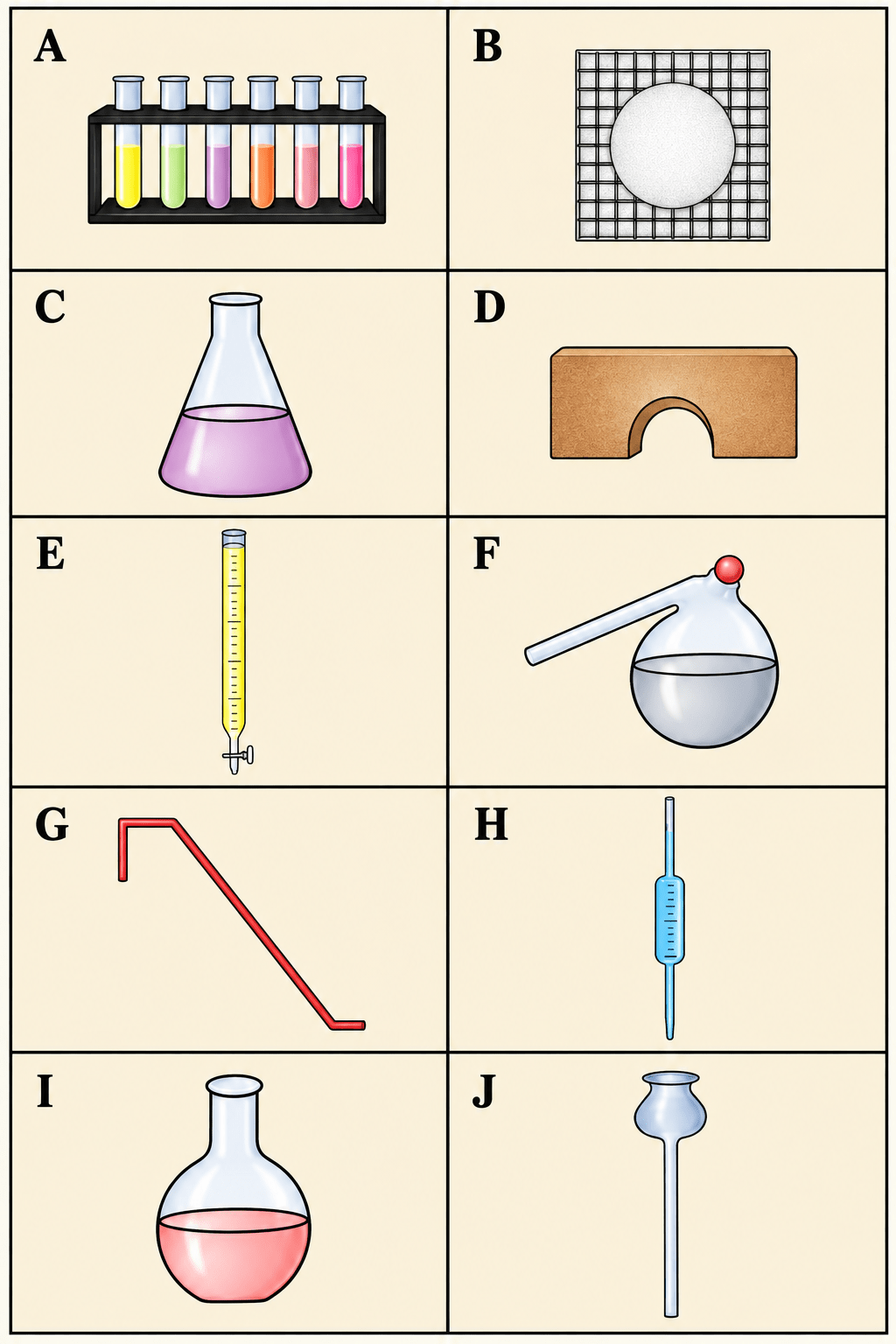
- Delivery Tube
- Pipette
- Wire gauze
- Bee-hive shelf
- Thistle funnel
- Flat bottom flask
- Test tube stand
- Burette
- Retort
- Conical flask
Answer
| Apparatus | Name |
|---|---|
| A | 7. Test tube stand |
| B | 3. Wire gauze |
| C | 10. Conical flask |
| D | 4. Bee-hive shelf |
| E | 8. Burette |
| F | 9. Retort |
| G | 1. Delivery Tube |
| H | 2. Pipette |
| I | 6. Flat bottom flask |
| J | 5. Thistle funnel |
Select the correct apparatus — For gas preparations where heating is required.
- Flat bottom flask
- Retort
- Round bottom flask
Answer
Round bottom flask
Reason — A round bottom flask is used for gas preparations where heating is required, as its round bottom distributes heat uniformly throughout on heating.
Select the correct apparatus — For holding washed test tubes.
- Test tube holder
- Test tube stand
- Retort stand
Answer
Test tube stand
Reason — A test tube stand has holes and upright pegs on which washed test tubes can be inverted and held.
Select the correct apparatus — A glass apparatus resistant to chemicals, made of pyrex and used for heating specific liquids.
- Beaker
- Retort
- Boiling Tube
Answer
Boiling Tube
Reason — A boiling tube is a hard glass test tube made of pyrex, which is resistant to chemicals and used for heating specific liquids for special purposes.
Select the correct apparatus — A metallic apparatus which supports the wire gauze.
- A Tripod stand
- Retort stand
- Test tube stand
Answer
A Tripod stand
Reason — A tripod stand is a metallic apparatus made of an iron triangle on three iron legs, which supports the glass apparatus and the wire gauze placed on it.
Select the correct apparatus — A long glass apparatus closed at one end used for collecting gases.
- Measuring cylinder
- Gas jar
- Beehive shelf
Answer
Gas jar
Reason — A gas jar is a long glass jar that is closed at one end and open at the other, used for collecting gases by different methods.
Select the correct apparatus — A glass apparatus which measures liquid by sucking the liquid at one end upto the marked level.
- Burette
- Measuring cylinder
- Pipette
Answer
Pipette
Reason — A pipette measures liquid by sucking the liquid up to the marked level and closing the open end; the measured liquid is then poured out by removing the thumb.
Select the correct apparatus — A long glass tube with a broad inlet at the top, which allows entry of the reactants into the round bottom flask, during laboratory preparations of gases.
- Thistle funnel
- Delivery tube
- Funnel
Answer
Thistle funnel
Reason — A thistle funnel is a long glass tube with a broad inlet at the top, which allows the entry of reactants into the round bottom flask during the preparation of gases.
Select the correct apparatus — A clay vessel kept in a trough of water during collection of a gas by downward displacement of water.
- Retort
- Beehive shelf
- Burette
Answer
Beehive shelf
Reason — A beehive shelf is a clay vessel with two outlets, kept in a trough of water during the collection of a gas by the downward displacement of water.
Select the correct apparatus — A modern apparatus with an air regulator, used for heating purposes.
- Spirit lamp
- Bunsen burner
- Electric stove
Answer
Bunsen burner
Reason — A bunsen burner is a modern apparatus consisting of a burner tube, an air regulator and a base, used for heating purposes.
Select the correct apparatus — A rectangular mesh with an asbestos at its centre.
- Tripod stand
- Wire gauze
- Retort stand
Answer
Wire gauze
Reason — A wire gauze is a rectangular wire mesh with asbestos at its centre, placed between the tripod stand and the glass apparatus to prevent cracking on heating.
Give reason — Alchemy was considered a pseudoscience.
Answer
Alchemy was considered a pseudoscience because it included occult and religious practices. Towards the end of the 17th century, scientific processes involving modern Chemistry began to develop, and Chemistry gained recognition as a scientific field.
Give reason — Preservatives are added to food or beverages.
Answer
Preservatives are added to food or beverages to prevent decomposition by bacteria or microbes, to reduce the risk of food borne infections and to preserve the nutritional quality of food.
Give reason — Titanium dioxide is an important ingredient in cosmetics.
Answer
Titanium dioxide is an important ingredient in cosmetics because it is a natural pigment powder which gives mild sun protection.
Give reason — Aspirin is one of the most widely used medication globally.
Answer
Aspirin is one of the most widely used medications globally because it treats pain, fever and inflammation. Given shortly after a heart attack, it may decrease the risk of death, and its long-term use may reduce blood clots in people who are at high risk.
Give reason — Ordinary soap is wasted in hard water.
Answer
Ordinary soap is wasted in hard water because hard water does not lather with soap. When rubbed in hard water, the soap forms lather only after all the insoluble salts in the hard water are removed as scum, so a large amount of soap is wasted.
Give reason — A philosopher's stone is not exactly a stone.
Answer
A philosopher's stone is not exactly a stone because it was not literally a stone, but a powder or potion believed to turn inexpensive metals into gold and silver.
Give reason — Food processing is an important procedure for obtaining marketable food products.
Answer
Food processing is an important procedure for obtaining marketable food products because it transforms or changes the raw ingredients in food into easy usable forms through processes like mincing, cooking, canning and packaging, thereby making them suitable for the market.
Give reason — Cosmetics may contain preservatives, as one of their ingredients.
Answer
Cosmetics may contain preservatives because preservatives extend the shelf life of a cosmetic and may prevent the growth of microorganisms in it.
Give reason — Polyester is added to natural fibre cotton, to give terylene.
Answer
Polyester is added to the natural fibre cotton to give terylene because this combination makes the fabric strong, crease resistant, easily washable and quick drying.
Give reason — All medicines must be taken under proper doctors supervision and in the correct dose.
Answer
All medicines must be taken under a doctor's supervision and in the correct dose because an incorrect or excessive dose may cause harmful side effects. For example, aspirin may cause an upset stomach and stomach ulcers, while too high a dose of paracetamol may result in liver problems.