
State the sources of water
(a) on the earth's surface
(b) below the earth's surface.
Answer
(a) The sources of water on the earth's surface are :
- Snow and frost
- Rain water
- River water
- Lake water
- Sea water
(b) The sources of water below the earth's surface are :
- Well water
- Spring water
Give the importance of water in
(a) life processes
(b) household purpose
(c) fire fighting
(d) transportation.
Answer
(a) Life processes — Water is used by all plants, animals and humans for carrying out life processes such as photosynthesis by plants and excretion by animals and humans.
(b) Household purpose — Water finds numerous household applications such as washing clothes, cooking and bathing.
(c) Fire fighting — Water is used for extinguishing fires, either directly or by using it in fire extinguishers.
(d) Transportation — Water serves as a means for transporting goods, via ships.
Explain how water plays an important role in -
(a) industry
(b) agriculture.
Answer
(a) Industry — Water generates electricity in hydroelectric power stations. It also generates steam in boilers, which is used for various industries.
(b) Agriculture — Water finds importance in irrigation, production of crops and as a medium for spraying pesticides.
Give the occurrence of water in the three different states i.e. solid, liquid & gaseous.
Answer
- Solid state — Water occurs as snow and frost.
- Liquid state — Water occurs in sea water, river water and lake water.
- Gaseous state — Water occurs as water vapour in air, the amount depending on climatic conditions.
Draw a labelled diagram to show the change of state of water from solid state to liquid state to gaseous state - starting from ice.
Answer
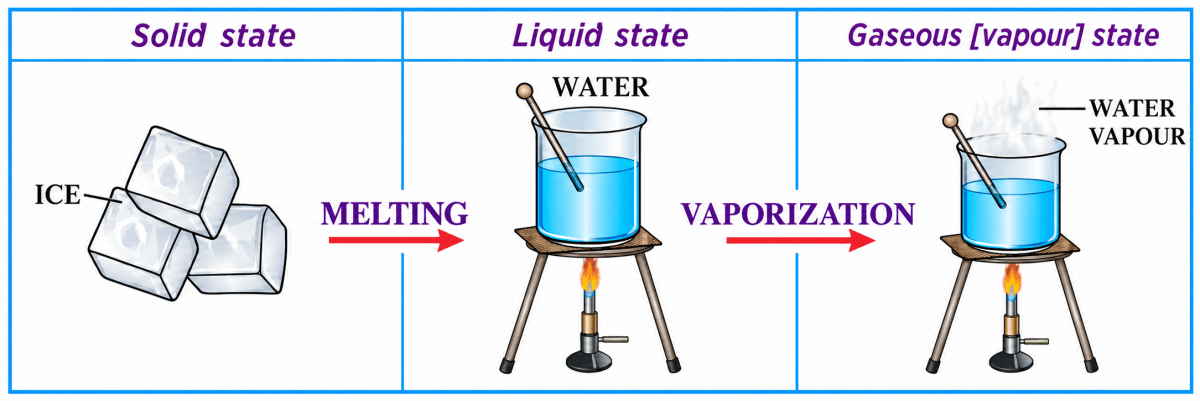
The interchange of states starting from ice is :
- Solid state to liquid state — Ice [solid state] on melting changes to water [liquid state].
- Liquid state to gaseous state — Water [liquid state] on heating (vaporization) changes to steam or water vapour [gaseous state].
Explain the term - water cycle. State the main points to show how water moves from the earth's surface to the atmosphere and back to the earth's surface as rain.
Answer
The water cycle is a natural process by which the circulation of water takes place from the earth's surface to the atmosphere and back to the earth's surface as rain water.
From the earth's surface to the atmosphere :
- Evaporation — The sun's rays fall on the earth and warm its surface and the air above it. This heat evaporates the water from the streams, rivers and the sea.
- Respiration by living organisms and burning of fossil fuels also add water to the atmosphere.
- The water vapour, along with the warm air, rises upwards where, at higher altitudes, it condenses into small droplets of water, forming clouds.
Back to the earth's surface as rain water :
- The clouds float in the atmosphere and when the size of the water droplets increases, they fall down on the earth as rain water.
- The rain water is absorbed by the soil, collects underground and flows into streams.
- The stream water finds its outlets into rivers and later enters into the seas and oceans.
- River water and sea water again evaporate, forming clouds, thus continuing the water cycle.
Give a reason why water is considered - a universal solvent.
Answer
A large number of substances such as sugar and salts dissolve in water. A large number of gases such as ammonia and hydrogen chloride also dissolve in water. Hence, water dissolves almost every common substance and is therefore called a universal solvent.
Define the terms
(a) solute
(b) solvent
(c) solution - with reference to addition of sodium chloride to water.
Answer
(a) Solute — The substance which dissolves or disappears in the solvent (i.e. liquid) to form a solution is called a solute. Here, sodium chloride is the solute.
(b) Solvent — The liquid or medium of dissolution which allows the solute to dissolve in it, so as to form a solution, is called a solvent. Here, water is the solvent.
(c) Solution — A homogeneous mixture of a solute in a solvent is called a solution. Here, the aqueous solution of sodium chloride is the solution.
Draw a neat labelled diagram of addition of copper sulphate to water. Label the solute, solvent & solution in the same.
Answer
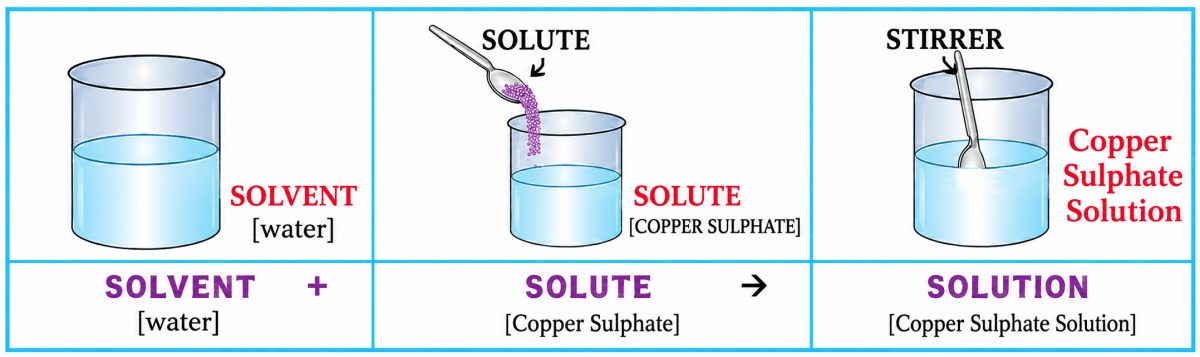
- Solute — Copper sulphate
- Solvent — Water
- Solution — Copper sulphate solution
From the following substances given below - state which will form a homogeneous solution with water.
(a) sodium carbonate
(b) calcium carbonate
(c) charcoal powder
(d) sodium sulphate
(e) table salt
(f) powdered particles of lead from a lead pencil
(g) iron powder
(h) copper filings
(i) sand particles
(j) honey
Answer
The following substances will form a homogeneous solution with water :
- Sodium carbonate
- Sodium sulphate
- Table salt
- Honey
The remaining substances — calcium carbonate, charcoal powder, powdered particles of lead, iron powder, copper filings and sand particles — are insoluble in water and do not form a homogeneous solution.
Name two gases each -
(a) which are soluble in water
(b) which are almost insoluble in water.
Answer
(a) Two gases which are soluble in water :
- Ammonia
- Hydrogen chloride
(b) Two gases which are almost insoluble in water :
- Hydrogen
- Oxygen
If 'X' g. of potassium nitrate is added to 100 g. of water at 60°C and the salt dissolves completely then -
(a) is 'X' g. the solubility of potassium nitrate at 60°C.
(b) is the solution formed - saturated or unsaturated
(c) if on adding 'X' + 'Y' g. of potassium nitrate to the same amount of water at the same temperature & the solute now just remains behind after stirring then
(d) is the solution now - saturated or unsaturated
(e) is 'X' + 'Y' g. the solubility of potassium nitrate.
Answer
(a) No, 'X' g. is not the solubility of potassium nitrate at 60°C, because the solution can still dissolve more of the solute at that temperature.
(b) The solution formed is unsaturated, as it can dissolve more of the solute at the given temperature.
(d) The solution is now saturated, as it cannot dissolve any more of the solute at the given temperature.
(e) Yes, 'X' + 'Y' g. is the solubility of potassium nitrate, since it is the maximum amount of solute that saturates 100 g. of water at 60°C.
State whether the following statements are true or false. If false write the correct statement.
(a) Solubility of most solids - decrease with increase in temperature.
(b) Distilled water is potable water.
(c) The process to remove germs in water is also called sterilization.
Answer
(a) False
Correct Statement — Solubility of most solids increases with increase in temperature of water.
(b) False
Correct Statement — Distilled water is non-potable water because it is completely free from dissolved salts and, when consumed, may lead to a deficiency of essential salts in the body.
(c) True
Differentiate between chemical pollution and thermal pollution.
Answer
| Chemical pollution | Thermal pollution |
|---|---|
| It is caused when industrial chemicals from paint, textile and dyestuff industries enter water as industrial wastes. | It is caused when industries such as the iron and steel industry and chemical plants discharge hot waste water into water bodies. |
| The chemical pollutants include metallic salt solutions of mercury and lead, and agricultural wastes like pesticides. | The discharged waste water is rendered hot, which enhances the growth of harmful organisms. |
| It causes heavy devastation of marine and plant life. | It leads to the death of organisms. |
State some important steps to avoid pollution of water.
Answer
The important steps to avoid pollution of water are :
- Harmful wastes such as oils and chemicals should not enter into the water.
- Proper toilets and sewage systems should be used to prevent human excreta from entering the water.
- Washing of clothes and bathing should be avoided near water sources.
- Planting of trees near water sources, including river banks, should be done as it minimizes pollution.
- Water should be cooled before being discharged as a waste.
- Awareness programmes should be conducted through various media to inform people about the harmful effects of water pollution and ways to control it.
State what is meant by the term 'conservation of water'. State a few water saving methods, which may be used in the home to conserve water.
Answer
Conservation of water is the means of preventing wastage of water, so that clean water can be obtained by preventing pollution of water.
A few water saving methods which may be used in the home are :
- Water saving devices must be used in homes.
- Running taps should be closed when not in use.
- All leakages in household pipes should be checked and repaired.
- Less electricity should be used, as power plants consume a substantial amount of water.
Give a reason why:
(a) Conservation of water is essential in spite of the fact that three fourth of the earth's surface is covered by water.
(b) Polluted water causes disease.
(c) Drip irrigation - helps in conservation of water.
Answer
(a) In spite of the large quantities of water on the earth's surface, only a small percentage of it is potable water, which is fit for human consumption. As the need for water is ever increasing, conservation of water is essential.
(b) When human and animal excreta are washed by rain water, they contaminate water, increasing the number of bacteria and harmful micro-organisms in it. This polluted water acts as a carrier for germs and causes water-borne diseases such as typhoid, cholera, dysentery and gastroenteritis.
(c) Drip irrigation helps in conservation of water because it utilizes the supply of water in small quantities, thus preventing wastage of water.
Complete the statements by filling in the blanks with the correct word/s.
(i) ............... is the purest form of water. It may dissolve gases like ............... forming weak acids. [sea water/lake water/ rain water; chlorine/ammonia/carbon dioxide]
(ii) Water generates ............... in hydroelectric power stations and ............... in boilers for industrial applications. [carbon dioxide/steam/heat/electricity]
(iii) Water is added to the atmosphere by ............... & ............... [burning of fossil fuels/condensation of vapour/respiration by living organisms/photosynthesis]
(iv) If potassium nitrate is added to water in a beaker to give a homogeneous mixture, then potassium nitrate is referred to as the ..............., water as the ............... and the homogeneous mixture as the ............... [solution/solute/solvent/saturated solution]
(v) Water fit for human consumption & drinking purposes is called ............... [distilled water/potable water/rain harvested water]
Answer
(i) Rain water is the purest form of water. It may dissolve gases like carbon dioxide forming weak acids.
(ii) Water generates electricity in hydroelectric power stations and steam in boilers for industrial applications.
(iii) Water is added to the atmosphere by respiration by living organisms & burning of fossil fuels.
(iv) If potassium nitrate is added to water in a beaker to give a homogeneous mixture, then potassium nitrate is referred to as the solute, water as the solvent and the homogeneous mixture as the solution.
(v) Water fit for human consumption & drinking purposes is called potable water.
State whether the following statements are true or false. If false, write the correct statement.
(i) Sea water contains salts of calcium & magnesium.
(ii) Water finds application as a means of transporting goods.
(iii) On boiling - water exists in the liquid state.
(iv) Respiration uses up water from the atmosphere.
(v) Well water exists below the impervious rocky layers of earth.
(vi) Sodium carbonate & sodium sulphate - do not form an aqueous solution.
(vii) If 'X' g. of solute is added to 100 g. of water at t°C and the solution formed is a saturated solution, then 'X' g. is the solubility of the solute.
(viii) Purification of water is carried out to remove - dissolved gases e.g. carbon dioxide & dissolved minerals like magnesium salts.
(ix) Water from rivers & lakes is - potable water.
(x) Chemical pollutants include metallic salt solution of mercury & lead.
Answer
(i) True
(ii) True
(iii) False
Correct Statement — On boiling, water turns into steam or water vapour and thus exists in the gaseous state.
(iv) False
Correct Statement — Respiration by living organisms adds water to the atmosphere.
(v) False
Correct Statement — Well water occurs above the impervious rocky layers of the earth's surface.
(vi) False
Correct Statement — Sodium carbonate and sodium sulphate dissolve in water to form aqueous solutions.
(vii) True
(viii) True
(ix) False
Correct Statement — Water from rivers and lakes is an impure form of water and is not potable; it must be purified before it becomes potable.
(x) True
Match the statements in List I, 1-10 with their correct answer in List II, A to J.
| List I | List II |
|---|---|
| 1. Sodium carbonate & water | A. Sea water |
| 2. Chemical used in sedimentation during purification of water | B. Preferred place for an organism |
| 3. Vapourisation | C. Liquid state |
| 4. Kerosene and water | D. Aqueous solution |
| 5. A solution which can dissolve more of solute at a given temperature | E. Dissolved gases & minerals |
| 6. Water as a habitat for marine life | F. Unsaturated solution |
| 7. A water-borne disease | G. Immiscible mixture |
| 8. Existence of water between 0°C & 100°C | H. Liquid to gaseous state |
| 9. Taste in water is due to - | I. Dysentery |
| 10. The most impure form of water | J. Alum |
Answer
| List I | List II |
|---|---|
| 1. Sodium carbonate & water | D. Aqueous solution |
| 2. Chemical used in sedimentation during purification of water | J. Alum |
| 3. Vapourisation | H. Liquid to gaseous state |
| 4. Kerosene and water | G. Immiscible mixture |
| 5. A solution which can dissolve more of solute at a given temperature | F. Unsaturated solution |
| 6. Water as a habitat for marine life | B. Preferred place for an organism |
| 7. A water-borne disease | I. Dysentery |
| 8. Existence of water between 0°C & 100°C | C. Liquid state |
| 9. Taste in water is due to - | E. Dissolved gases & minerals |
| 10. The most impure form of water | A. Sea water |
Explain the meaning of the following terms:
(i) Rain water harvesting
(ii) Drip irrigation in agriculture
(iii) Saturated solution
(iv) Conservation of water
(v) Gaseous state of water in air
Answer
(i) Rain water harvesting — It is a means of utilizing rain water, instead of allowing it to be wasted. It is done by building tanks and collecting roof top rain water through pipes into the tanks.
(ii) Drip irrigation in agriculture — It is a method of irrigation which utilizes the supply of water in small quantities, thus helping in the conservation of water.
(iii) Saturated solution — It is a solution which cannot dissolve more of the solute in a solvent at a given temperature.
(iv) Conservation of water — It is the means of preventing wastage of water, so that clean water can be obtained by preventing pollution of water.
(v) Gaseous state of water in air — Water is present as water vapour in air in the gaseous state, the amount depending on climatic conditions.
Name the following:
(i) A chemical used during chlorination of water.
(ii) An agricultural pollutant in water.
(iii) A solid, 'natural form of water'.
(iv) The natural process by which circulation of water takes place from earth's surface to atmosphere & back to earth's surface.
(v) The liquid or medium of dissolution which allows the solute to dissolve in it.
Answer
(i) Chlorine (or bleaching powder)
(ii) Pesticides (fungicides and insecticides)
(iii) Snow (or frost)
(iv) Water cycle
(v) Solvent