
Chandragupta I received Pataliputra as a part of his dowry from the:
- Nagas.
- Lichchavis.
- Vakatakas.
Answer
Lichchavis.
The most important source about the conquest of Samudragupta is the:
- Aihole Inscription.
- Prayag Prashasti.
- Hathi Gumpha Inscription.
Answer
Prayag Prashasti.
The Chinese pilgrim who visited India during the reign of Chandragupta Il:
- Fa-hsien
- Heiun-Tsang
- I-Tsing
Answer
Fa-hsien
The paintings on the caves of Ajanta can most appropriately be called:
- frescoes.
- landscapes
- Portraits.
Answer
frescoes.
Which of the following statements does not apply to the lyrical poem Meghaduta?
- It was written by Kalidasa.
- It was written in Sanskrit.
- It was written by Vishnusharman.
Answer
It was written by Vishnusharman.
Gupta Age is commonly called the Golden Age of ancient Indian history. Which of the following statements best supports this claim? You may choose more than one option.
- Samudragupta issued eight different types of coins, most of them in gold.
- Chandragupta II controlled a vast empire, which extended from the Ganga to the Indus, and from north Pakistan to the Narmada.
- Chandragupta II was a great patron of literature and numerous scholars adorned his court—the most prominent being the legendary Kalidasa.
- Fa-hsien described people as honest, prosperous and happy. Corporal punishments were also rare.
Answer
The statements which best support the claim of Gupta Age being the Golden Age of ancient Indian history are:
1. Samudragupta issued eight different types of coins, most of them in gold.
3. Chandragupta II was a great patron of literature and numerous scholars adorned his court—the most prominent being the legendary Kalidasa.
4. Fa-hsien described people as honest, prosperous and happy. Corporal punishments were also rare.
Number the following statements to put them in the correct chronological order.
- Chandragupta II controlled a vast empire, which extended from the Ganga to the Indus, and from north Pakistan to the Narmada.
- Chandragupta I succeeded his father Ghatotkacha.
- Samudragupta granted permission to the king of Ceylon (Sri Lanka) to build a Buddhist temple in Gaya.
- The beginning of Samudragupta's reign was marked by the defeat of his immediate neighbours.
Answer
- Chandragupta I succeeded his father Ghatotkacha.
- The beginning of Samudragupta's reign was marked by the defeat of his immediate neighbours.
- Samudragupta granted permission to the king of Ceylon (Sri Lanka) to build a Buddhist temple in Gaya.
- Chandragupta II controlled a vast empire, which extended from the Ganga to the Indus, and from north Pakistan to the Narmada.
List the areas that formed a part of the kingdom of Chandragupta I.
Answer
The areas that formed a part of the kingdom of Chandragupta I included areas of modern Bihar, parts of Uttar Pradesh and Bengal, and Magadha along with its capital city, Pataliputra.
What is the most important source of information regarding the reign of Samudragupta?
Answer
Prayaga Prashasti, an inscription in Sanskrit engraved on a stone pillar at Allahabad written by Samudragupta's court poet, Harishena is the most important source of information regarding his reign.
Outline the main points of Fa-hsien's accounts on the reign of Chandragupta II.
Answer
Fa-hsien gave a general description of north India at that time. Fa-hsien described people as honest, prosperous and happy. Corporal punishments were also rare.
What was the administrative structure during the Gupta Age?
Answer
The administrative structure during the Gupta Age was as follows:
- The Guptas had a strong central government, but they also allowed a certain degree of local control.
- The king was at the head of the administrative system.
- The empire was divided into provinces, which were subdivided into districts or vishayas headed by vishayapatis. Councils in each district helped the vishayapatis in administration.
- Members of the royal family were appointed as governors of provinces and were assisted by officials called kumaramatyas.
- The Gupta system of urban and rural administration was based on the principle of encouraging as much of local participation as possible.
Write a feature of temple architecture during the Gupta Age.
Answer
The Dasavatara Temple at Deogarh is a fine example of Gupta architecture. The roof and pillars of the temple were artistically decorated with fine sculptures and exquisitely carved designs.
What were the scientific achievements of Aryabhata?
Answer
Aryabhata, a great mathematician and astronomer, wrote the Aryabhatiya. He accurately calculated the value of π (pi), explained the Earth’s rotation and revolution, and gave scientific reasons for solar and lunar eclipses. The decimal system gave the world a counting system.
The Gupta rulers were great conquerors and administrators. In this context, enumerate the following:
- The reign of Chandragupta I
- Samudragupta as the Indian Napoleon
- Rule of Chandragupta II
Answer
The Reign of Chandragupta I —
- Chandragupta I was the first important ruler ofthe Gupta dynasty. He succeeded his father Ghatotkacha in c. 319 CE.
- Chandragupta married Kumaradevi, a princess of the Lichchhavi tribe—a powerful tribe with political control over the regions near Magadha. He received Magadha with its capital city, Pataliputra, as part of his dowry.
- With the help of the Lichchhavis, Chandragupta conquered a number of surrounding territories.
- His kingdom included areas of modern Bihar and parts of Uttar Pradesh and Bengal.
- He assumed the title of Maharajadhiraja.
Samudragupta as the Indian Napoleon —
- Samudragupta is considered to be one of the many great military geniuses in Indian history, and is also referred to as the 'Napoleon of India'.
- His achievements are recorded in the Prayaga Prashasti (inscription on a stone pillar at Allahabad), composed by his court poet Harishena.
- He began his reign by defeating neighbouring rulers and expanded his empire in the Ganga–Yamuna valley up to Mathura.
- He launched a southern campaign reaching as far as Kanchipuram but allowed southern rulers to remain as tributaries.
- His direct control covered most of northern India, excluding regions like Kashmir, western Punjab, parts of Rajasthan, Sind and Gujarat.
- Samudragupta issued eight different types of coins, most of them in gold. He was also a patron of learning, a celebrated poet and a musician. He patronised poets and scholars of Sanskrit literature.
- He granted permission to the king of Ceylon (Sri Lanka) to build a Buddhist temple in Gaya.
Rule of Chandragupta II —
- Chandragupta II or Vikramaditya was one of the most powerful kings of ancient India. He ruled from c. 380—412 CE. During this time the Gupta Empire reached its zenith.
- His greatest victory was over the Shaka-Kshatrapas, gaining control of Gujarat and its seaports, boosting overseas trade.
- His empire stretched from the Ganga to the Indus and north Pakistan to the Narmada.
- Chandragupta II was a great patron of literature and numerous scholars adorned his court—the most prominent being the legendary Kalidasa.
- Fa-hsien, a Chinese pilgrim, who visited India during the reign of Chandragupta II, described people as honest, prosperous and happy. Corporal punishments were also rare.
The Gupta Age is considered to be the Golden Age of ancient history. In this context, explain the following:
- Development in the field of literature
- Scientific discoveries and education
Answer
Sanskrit literature owes much to the Gupta rulers who patronised this language. The greatest among the Sanskrit scholars was Kalidasa, who wrote the lyrical poem Meghaduta and great dramas such as Abhijnanashakuntalam. Many of the early Puranas were written down during the Gupta period. The Panchatantra was compiled by Vishnusharman. Mrichchhakatika, a drama, was written by Shudraka. The Mahabharata was almost completed by 4th century CE.
Scientific Discoveries — There was great progress made in science during the Gupta age. Advances were made in the field of ayurvedic medicine. Aryabhata, a great mathematician and astronomer, wrote the Aryabhatiya. He calculated the value of π (pi). Moreover, he discussed the rotation and revolution of the Earth, and the causes for lunar and solar eclipses. The decimal system gave the world a counting system.
Education — The Gupta period was known for the importance that was given to education. The Guptas founded and patronised several universities of higher learning. Subjects such as medicine, astronomy, philosophy, Vedic literature and grammar were given importance.
This is the painting of a scene from a drama written during the Gupta Age.
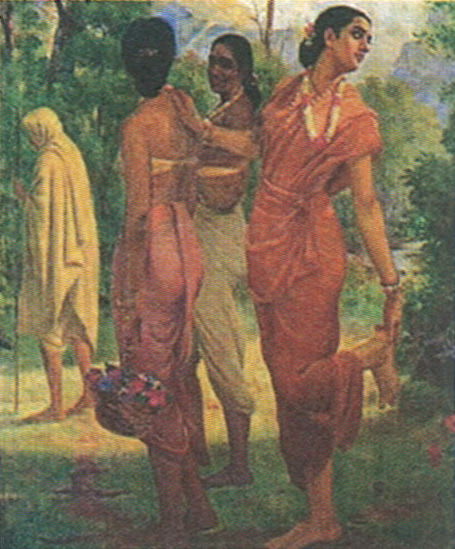
(a) Can you name this great playwright?
(b) Whose patronage did he enjoy?
(c) What were his other contributions to Sanskrit literature?
Answer
(a) Kalidasa.
(b) Kalidasa enjoyed the patronage of Chandragupta II or Vikramaditya.
(c) Some of the other contributions of Kalidasa to Sanskrit literature are the lyrical poem Meghaduta and plays like Malavikagnimitram, Vikramorvasiyam.