
Chandragupta Maurya was trained to be a great king by:
- Chanakya.
- Seleucus.
- Bindusara.
Answer
Chanakya.
Bindusara developed a ............... relation with the Greeks. Choose the most appropriate option.
- friendly.
- diplomatic.
- hostile.
Answer
diplomatic.
Battle that brought a drastic change in the life of Ashoka was the ............... war.
- Hastinapur
- Kalinga
- Avanti
Answer
Kalinga
Most of the Ashokan Edicts were written in ............... script.
- Brahmi
- Kharosthi
- Aramaic
Answer
Brahmi
The last Mauryan ruler was ............... .
- Ashoka
- Bindusara
- Brihadratha
Answer
Brihadratha
Complete the given analogy.
Chandragupta : Maurya : : ? : Sunga
Answer
Chandragupta : Maurya : : Pushyamitra : Sunga
Copy the given table in your notebook and write the similarities that you can observe between the Buddha's teachings and Emperor Ashoka's principles of Dhamma.
| The Buddha's Teachings | Ashoka's Dhamma |
|---|---|
Answer
| The Buddha's Teachings | Ashoka's Dhamma |
|---|---|
| Emphasised ahimsa or non-violence towards all living beings | Promoted ahimsa or non-violence towards all living beings |
| Taught love, kindness and compassion | Encouraged generosity towards all |
| Opposed caste discrimination and promoted equality | Treated all subjects equally regardless of caste |
| Urged people to live a simple and moral life | Encouraged moral living and good conduct |
| Believed in tolerance and understanding | Advocated religious tolerance and harmony |
Read this statement and answer the questions that follow:
'Emperor Ashoka was greatly inspired by the teachings of the Buddha, therefore, he asked all his subjects to convert to Buddhism through his edicts.'
(a) What is the one assumption that is made in the statement given above?
(b) Explain why this assumption may be incorrect.
Answer
(a) The assumption is that Emperor Ashoka wanted everyone in his empire to convert to Buddhism because he was inspired by the Buddha’s teachings.
(b) This assumption is incorrect because Emperor Ashoka did not force his subjects to convert to Buddhism. Instead, through his edicts, he promoted the idea of Dhamma, which included values like non-violence, compassion, tolerance, and respect for all religions. He encouraged moral behavior, not religious conversion.
Name two main sources of Mauryan history.
Answer
The Arthashastra by Kautilya and the Indica by the Greek envoy, Megasthenes, are two books that provide information about the Mauryan period.
What did Chandragupta gain from the battle with Seleucus I Nicator?
Answer
After Chandragupta defeated Seleucus I Nicator in a battle, Seleucus I had to give Chandragupta the areas west of the Indus, including Baluchistan and some parts of Afghanistan. He also gave his daughter in marriage to Chandragupta.
What impact did the war with Kalinga have on Ashoka's life?
Answer
The Kalinga War deeply affected Ashoka. Moved by the suffering, death and destruction caused by the war, he gave up violence and adopted Buddhism. Inspired by Buddha’s teachings, he followed the policy of dhamma and worked for peace and the well-being of his people.
What was the system of Mauryan administration?
Answer
The system of Mauran administration was based on these guidelines:
- The king was all powerful.
- A council of ministers, called the mantriparishad, advised him.
- There were different departments, such as the treasury, security, revenue, industry, and so on.
- Officials were appointed by the king to look after each department. Mahamatas looked after various aspects of administration.
- The empire was divided into four provinces, with the capital at Pataliputra.
- The expansion and defence of the empire was made possible by the largest standing army of its time.
- A vast espionage (spy) system worked for both internal and external security. The spy system also kept the king informed about the conduct of the officials.
State some examples of the Mauryan architecture.
Answer
Some examples of the Mauryan architecture are the Lion Capital of Ashoka at Sarnath, the Stupa at Sanchi and Ashokan edicts.
The word dhamma is derived from the Sanskrit word dharma, which means religious and moral duty. In this context, answer the following questions:
- What was Ashoka's dhamma? State its salient features.
- How did Ashoka spread the principles of dhamma within and outside India?
- What are edicts? Why are Ashokan edicts important?
- Mention some of the steps taken by Ashoka for the welfare of his people.
Answer
The word dhamma is derived from the Sanskrit word dharma, which means religious and moral duty. Ashoka defined the main principles of dhamma as follows:
- Non-violence or ahimsa: He urged his subjects to practise non-violence towards all living beings.
- Acceptance of all sects: He advocated a policy of tolerance towards all religions.
- Obedience to parents and elders: He advised that elders were to be respected, and children treated with understanding.
- Generosity towards all: He encouraged charity towards all.
Ashoka spread the principles of dhamma within and outside India in the following ways:
- Emperor Ashoka strictly followed the principles of dhamma which inspired others to do the same. He treated his people as his children.
- He built and supported stupas, viharas, and chaityas for Buddhist monks.
- He sent Buddhist scholars, including his son Mahendra and daughter Sanghamitra, to spread dhamma abroad, especially to Sri Lanka.
- He set up edicts across the empire promoting Buddhist values like dhamma, ahimsa, and moral conduct.
Edicts are official/royal proclamations or commands. Ashoka had them engraved on rocks, polished stone pillars, and caves across his empire. Written mostly in Prakrit and Brahmi script, they also appeared in Greek, Kharoshti, and Aramaic in the northwest. Ashokan edicts are important as they promoted the Buddhist moral code, encouraged dhamma and ahimsa, and serve as key sources of information about the Mauryan Empire.
Some of the facilities built by Ashoka for the welfare of his people are as follows:
- Wide roads with shady trees on both sides.
- Rest houses and wells along the roads for travellers.
- Hospitals for the care of people and animals.
- Waterways and canals for irrigation and transport.
This is an impression of the greatest Mauryan emperor's rock inscription at Girnar.
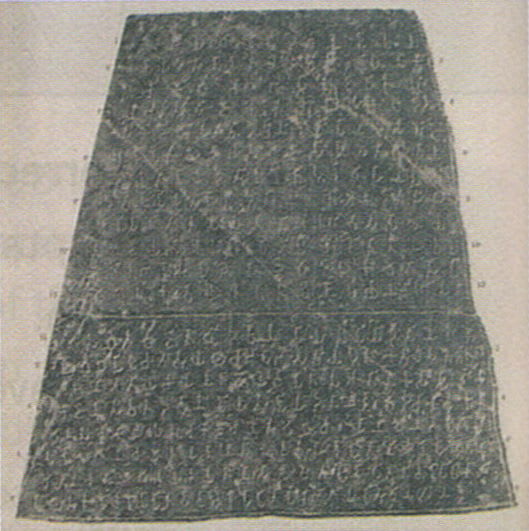
(a) Which emperor ordered the inscription to be engraved?
(b) What kind of information is obtained from such inscriptions?
Answer
(a) Emperor Ashoka ordered the inscription to be engraved.
(b) These inscriptions are called Ashokan edicts. From these inscriptions, we obtain important information like:
- Ashoka's Dhamma (moral code) and how he wanted his people to live.
- His policies of governance, such as kindness to animals, tolerance of all religions, and non-violence.
- His efforts to spread Buddhism and maintain peace and welfare across his empire.
- These inscriptions are crucial sources for understanding Mauryan administration, philosophy, and society.
Number the following statements to put them in the correct chronological order.
- Brihadratha was killed by his commander-in-chief, Pushyamitra Sunga.
- Chanakya trained young Chandragupta, and together they planned the conquest of the Nanda kingdom.
- The Kalinga War was a turning point in Ashoka's life.
- Bindusara extended the Mauryan Empire southwards, as far as Karnataka.
Answer
- Chanakya trained young Chandragupta, and together they planned the conquest of the Nanda kingdom.
- Bindusara extended the Mauryan Empire southwards, as far as Karnataka.
- The Kalinga War was a turning point in Ashoka's life.
- Brihadratha was killed by his commander-in-chief, Pushyamitra Sunga.