
In the Later Vedic Age, the Indo-Aryans migrated to the:
- Gangetic Plains.
- Sindh.
- Caspian Sea.
Answer
Gangetic Plains.
Which of these was not a ruler of Magadha?
- Alexander.
- Bimbisara.
- Ajatasatru.
Answer
Alexander.
The Battle of Hydaspes was fought between Alexander and:
- Porus.
- Bimbisara.
- Chandragupta.
Answer
Porus.
The structure of government followed by the people of Vrijji can most appropriately be termed as:
- monarchical.
- democratic.
- republican.
Answer
republican.
Replace the underlined year to correct the statement. Alexander died in Babylon in the year 341 BCE.
- 336 BCE.
- 323 BCE.
- 321 BCE.
Answer
323 BCE.
Tick on 'Yes' or 'No' as per your understanding of why Magadha grew into a major mahajanapada.
| Is this a significant factor in the development of Magadha? | Yes | No |
|---|---|---|
| fertile soil | ||
| deposits of iron ore | ||
| physical features | ||
| good leadership |
Answer
| Is this a significant factor in the development of Magadha? | Yes | No |
|---|---|---|
| fertile soil | ✓ | |
| deposits of iron ore | ✓ | |
| physical features | ✓ | |
| good leadership | ✓ |
Give one reason for each of the answers that you chose in the table above.
Answer
Fertile Soil — The fertile soil of the plains allowed for cultivation of surplus crops.
Deposits of Iron ore — Iron ore found in the plateau region could be used to make weapons and tools.
Physical features — Presence of rivers and hills provided natural protection and trade opportunities to Magadha.
Good leadership — Magadha was also ruled by ambitious kings who fought wars to expand and strengthen their kingdom.
Number the following rulers in the correct chronological order of their rule based on what you have read in the chapter.
- Mahapadma Nanda
- Ajatashatru
- Bimbisara
- Dhana Nanda
- Chandragupta Maurya
Answer
The rulers in the correct chronological order of their rule are as follows:
- Bimbisara
- Ajatashatru
- Mahapadma Nanda
- Dhana Nanda
- Chandragupta Maurya
Which kingdom developed as the most powerful amongst the mahajanapadas?
Answer
The kingdom of Magadha developed as the most powerful amongst the mahajanapadas due to presence of rich natural resources, fertile soil, Ganga river, iron ore that was used to make weapons, and ambitious kings who fought wars to expand and strengthen the kingdom.
Describe Magadha under the rule of Bimbisara.
Answer
Magadha under the rule of Bimbisara:
- Bimbisara was the first significant ruler of Magadha with his capital at Rajagriha.
- He annexed Anga, gaining control of Champa, a key city on the Ganga, which boosted maritime trade.
- This led to economic prosperity and gave Magadha an advantage over other kingdoms.
- Art and education flourished under his rule.
- He established an efficient administrative system.
- Bimbisara was a patron of Buddhism.
- He used diplomacy to avoid conflict with Avanti by sending his royal physician to its king.
What was the condition of India on the eve of Alexander's invasion?
Answer
At the time of Alexander's invasion northwest India was divided into many kingdoms. There was constant rivalry and warfare among these kingdoms.
Why did Alexander set Porus free? Describe this incident in your own words.
Answer
Alexander set Porus free because he was deeply impressed by his courage and bravery during the Battle of Hydaspes. After Porus was defeated, Alexander asked him how he wished to be treated. With great dignity, Porus replied, "Treat me, O Alexander, like a king." Struck by his fearless and noble response, Alexander not only returned his territory but also granted him additional conquered states to rule.
Study the given picture. Answer the questions that follow.
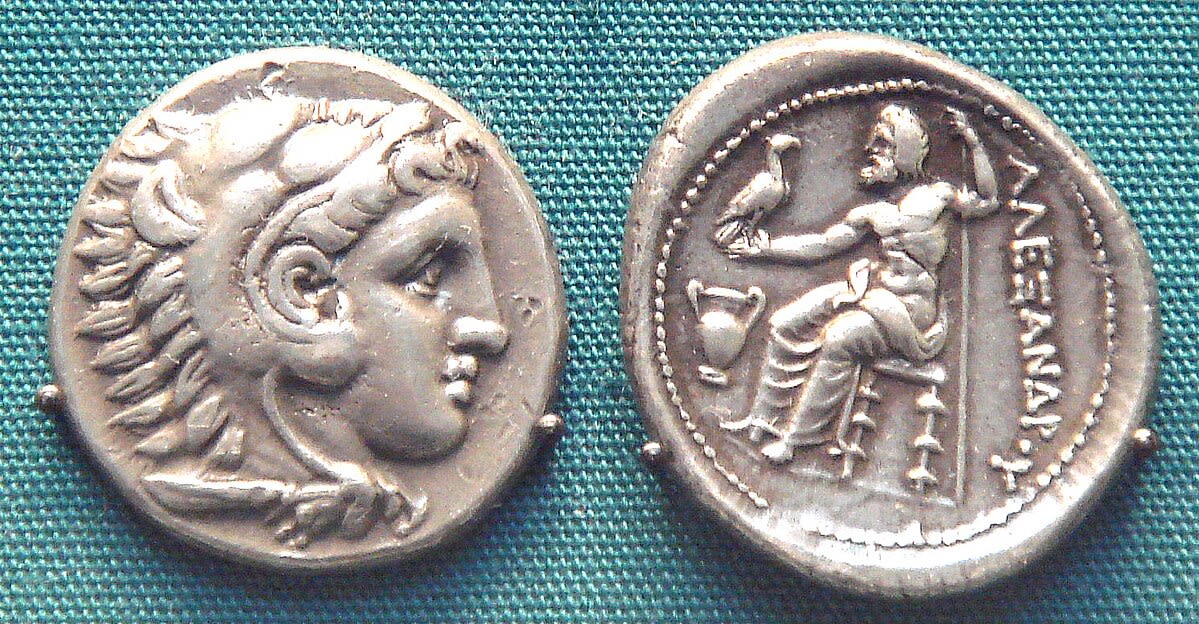
The images on the coins are of the king of Macedonia who invaded India.
(a) What is the name of the invader?
(b) When did he invade India?
(c) The valour of which Indian king impressed him?
Answer
(a) Alexander
(b) He invaded India in 326 BCE
(c) King Porus
There were constant conflicts between the rulers of the mahajanapadas and finally, the kingdom of Magadha developed as the most powerful among them. In this context, answer the following questions:
- What were mahajanapadas? How many were there?
- Where is Magadha situated?
- Why did Magadha become most powerful?
Answer
Mahajanapadas were large territorial states that emerged from the janapadas around 600 BCE as tribes (janas) settled and expanded. Buddhist and Jaina texts mention sixteen such mahajanapadas.
Magadha roughly corresponds to the present day Patna and Gaya districts in Bihar.
Magadha developed as the most powerful amongst all mahajanapadas due to the following reasons:
- Magadha was a reservoir of rich natural resources.
- The fertile soil of the plains allowed for cultivation of surplus crops.
- Iron ore found in the plateau region could be used to make weapons and tools.
- Rajagriha, the earlier capital of Magadha enjoyed natural protection from invaders as it was surrounded by five hills.
- The mighty Ganga flowed through the kingdom of Magadha. It helped to facilitate communication and the carrying of goods from one place to another.
- Magadha was also ruled by ambitious kings who fought wars to expand and strengthen their kingdom.
Though the king from Macedonia did not conquer Magadha, his invasion of some parts of India had a great impact. In this context, answer the following questions:
A significant political impact of his invasion was:
(a) Bimbisara could strengthen his hold over Magadha.
(b) The small states in north-west India lost their power.
(c) Ajatashatru was able to demonstrate his prowess by defeating the invader.Which were the other effects of his invasion? You can choose multiple options.
(a) Close contact between Europe and India was established.
(b) New routes for trade were opened.
(c) The Graeco-Buddhist School of Art developed.
Answer
(b) The small states in north-west India lost their power.
Reason — Alexander's invasion weakened many small states in the north-west India, making it easier for the later powers like the Mauryas to rise and expand.(a) Close contact between Europe and India was established.
(b) New routes for trade were opened.
(c) The Graeco-Buddhist School of Art developed.
Reason — All three are correct. Alexander's campaign created cultural exchange, opened trade routes, and eventually lead to new art syles like the Graeco-Buddhist School of Art or the Gandhara School of Art in the north-west of India.