Write the following division as fractions:
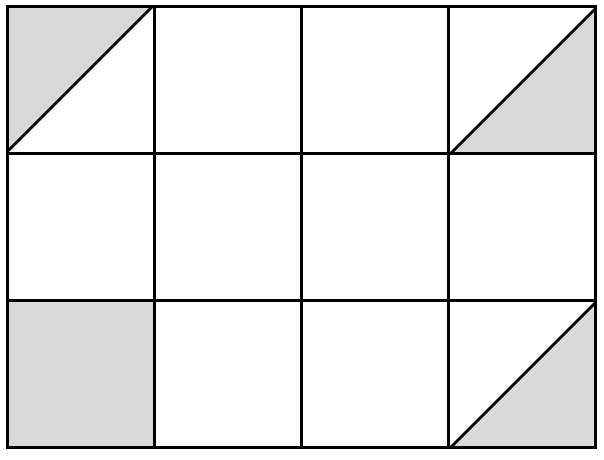
(i) 3 ÷ 7
(ii) 11 ÷ 78
(iii) 113 ÷ 128
Answer
(i) 3 ÷ 7
A division a ÷ b can be written as the fraction ba.
So, 3 ÷ 7 = 73.
Hence, 3 ÷ 7 = 73.
(ii) 11 ÷ 78
A division a ÷ b can be written as the fraction ba.
So, 11 ÷ 78 = 7811.
Hence, 11 ÷ 78 = 7811.
(iii) 113 ÷ 128
A division a ÷ b can be written as the fraction ba.
So, 113 ÷ 128 = 128113.
Hence, 113 ÷ 128 = 128113.
Write the following fractions in words:
(i) 72
(ii) 103
(iii) 2815
Answer
(i) 72
Hence, 72 in words is two-seventh.
(ii) 103
Hence, 103 in words is three-tenth.
(iii) 2815
Hence, 2815 in words is fifteen-twenty eighth.
Write the following fractions in number form:
(i) one-sixth
(ii) three-eleventh
(iii) seven-fortieth
(iv) thirteen-one hundred twenty fifth
Answer
(i) one-sixth
Hence, one-sixth in number form is 61.
(ii) three-eleventh
Hence, three-eleventh in number form is 113.
(iii) seven-fortieth
Hence, seven-fortieth in number form is 407.
(iv) thirteen-one hundred twenty fifth
Hence, thirteen-one hundred twenty fifth in number form is 12513.
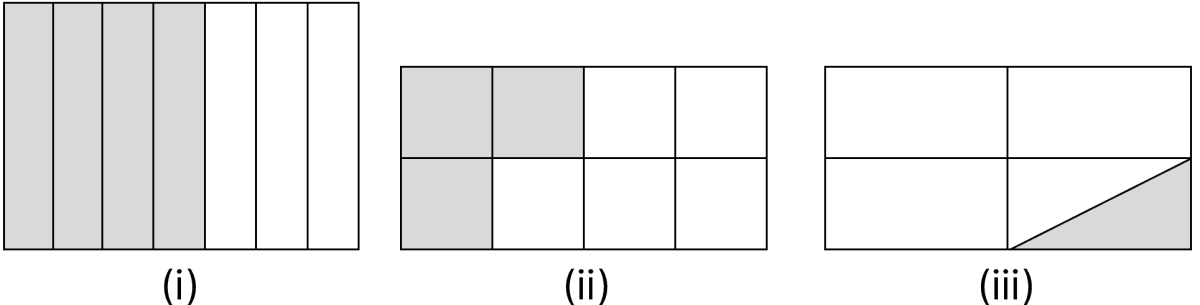
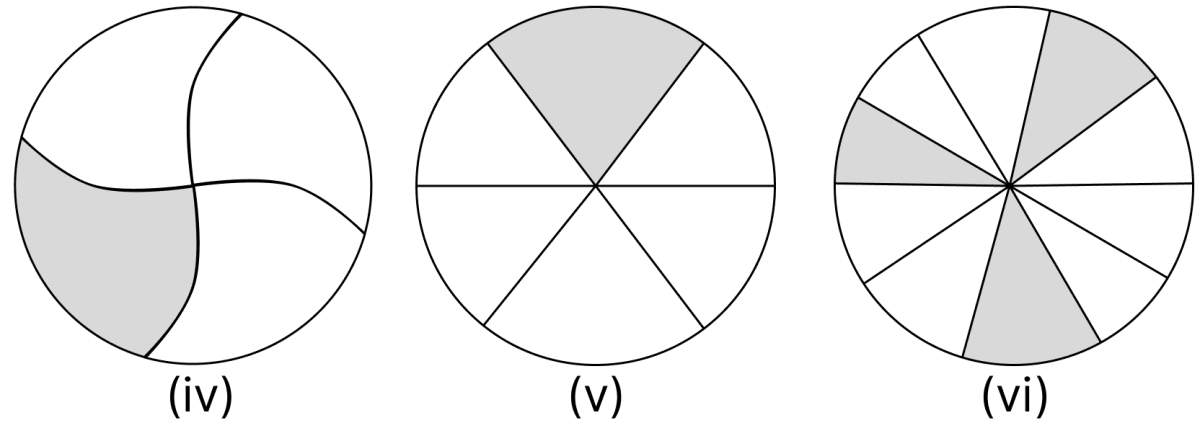
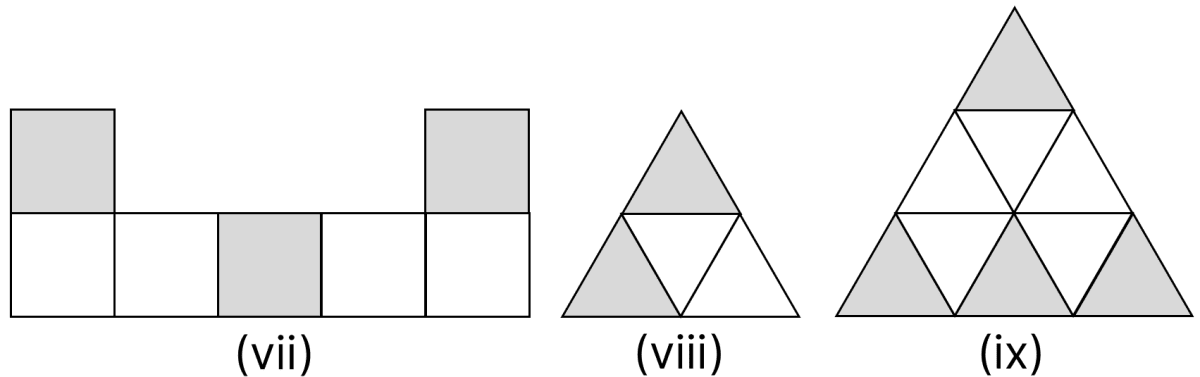
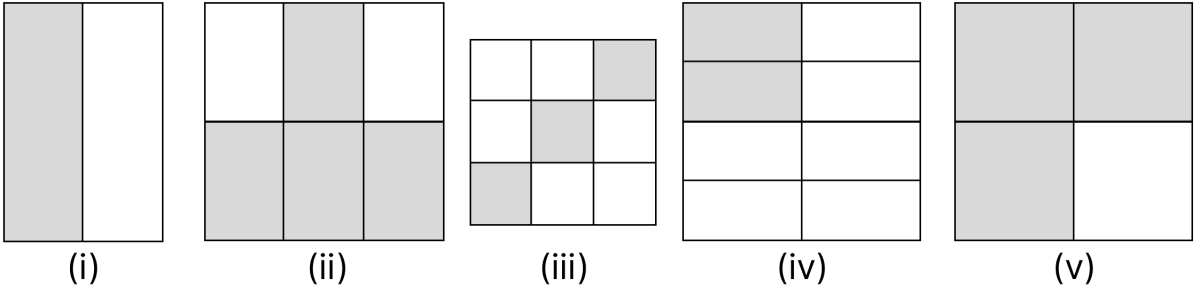
What fraction of each of the following figures is shaded part?
Answer
(i) Total parts = 7
Shaded parts = 4
Fraction = Total partsShaded parts=74.
Hence, fraction = 74.
(ii) Total parts = 8
Shaded parts = 3
Fraction = Total partsShaded parts=83.
Hence, fraction = 83.
(iii) Total parts = 4
Shaded parts = 21
Fraction = Total partsShaded parts=421=2×41=81.
Hence, fraction = 81.
(iv) Total parts = 4
Shaded parts = 1
Fraction = Total partsShaded parts=41.
Hence, fraction = 41.
(v) Total parts = 6
Shaded parts = 1
Fraction = Total partsShaded parts=61.
Hence, fraction = 61.
(vi) Total parts = 10
Shaded parts = 3
Fraction = Total partsShaded parts=103.
Hence, fraction = 103.
(vii) Total parts = 7
Shaded parts = 3
Fraction = Total partsShaded parts=73.
Hence, fraction = 73.
(viii) Total parts = 4
Shaded parts = 2
Fraction = Total partsShaded parts=42.
Hence, fraction = 42.
(ix) Total parts = 9
Shaded parts = 4
Fraction = Total partsShaded parts=94.
Hence, fraction = 94.
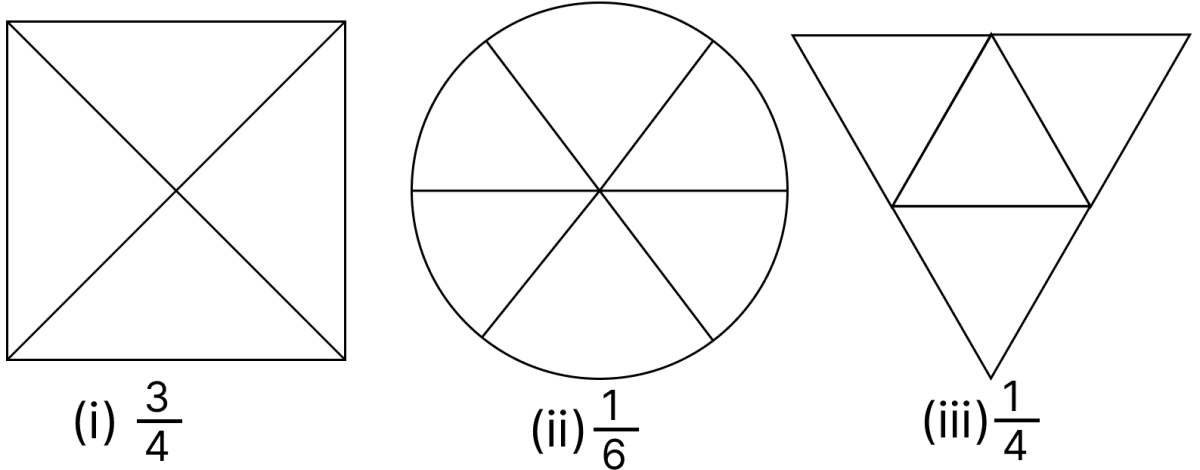
Shade the parts of the following figures according to given fractions:
Answer
(i) 43
The figure (square) is divided into 4 equal parts. Shade 3 parts out of 4.
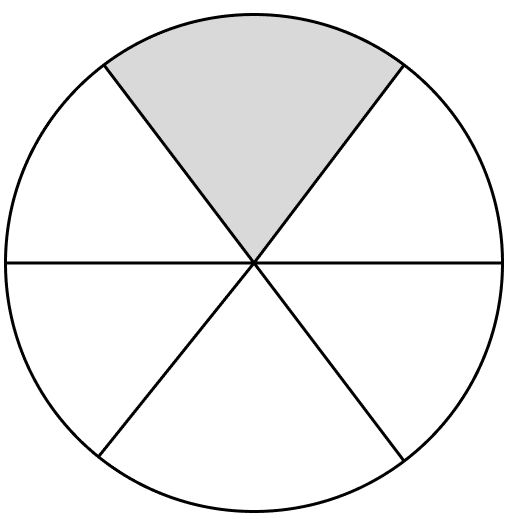
(ii) 61
The figure (circle) is divided into 6 equal parts. Shade 1 part out of 6.
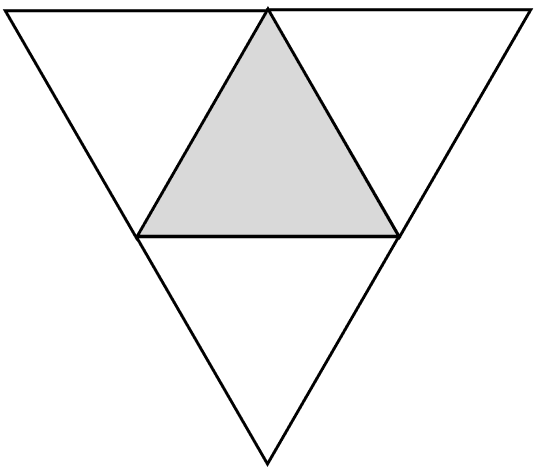
(iii) 41
The figure (triangle) is divided into 4 equal parts. Shade 1 part out of 4.
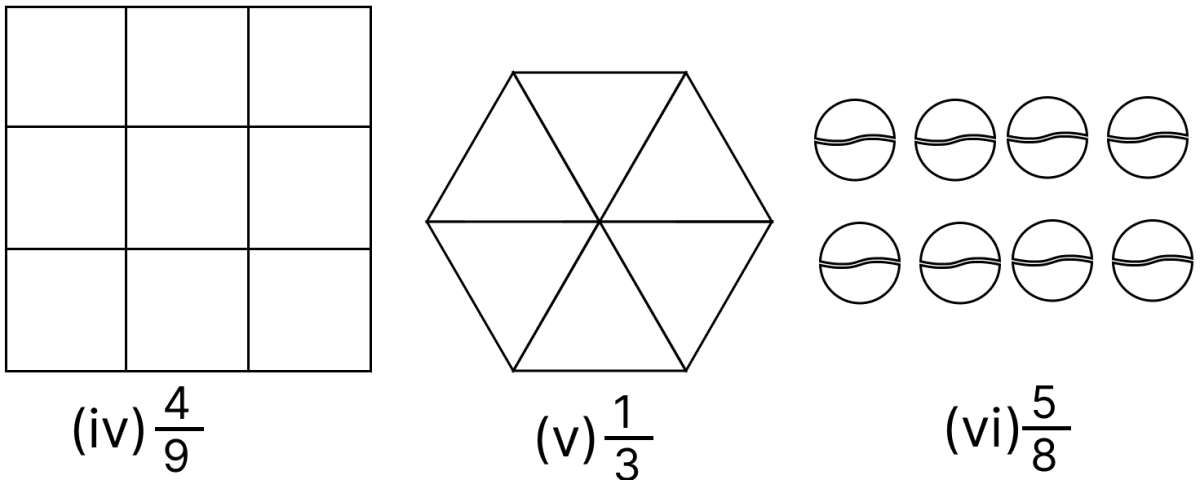
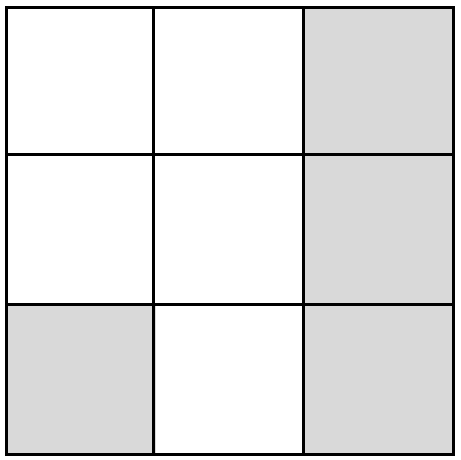
(iv) 94
The figure (square) is divided into 9 equal parts. Shade 4 parts out of 9.
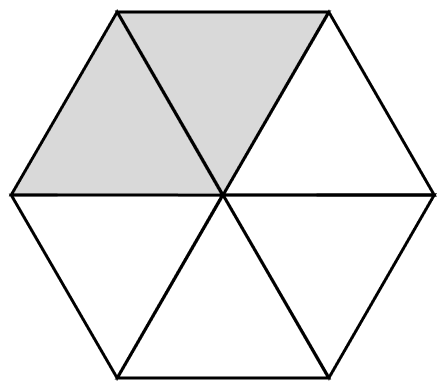
(v) 31
The figure (hexagon) is divided into 6 equal parts (i.e., 2 parts make 31). Shade 2 parts out of 6.
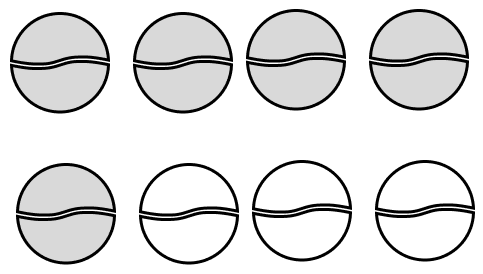
(vi) 85
The figure (8 circles) shows 8 equal parts. Shade 5 circles out of 8.
Write the fraction in which
(i) numerator = 5 and denominator = 13
(ii) denominator = 23 and numerator = 17
Answer
(i) numerator = 5 and denominator = 13
Fraction = denominatornumerator=135.
Hence, the required fraction = 135.
(ii) denominator = 23 and numerator = 17
Fraction = denominatornumerator=2317.
Hence, the required fraction = 2317.
Shabana has to stitch 35 dresses. So far, she has stitched 21 dresses. What fraction of dresses has she stitched?
Answer
Total number of dresses to be stitched = 35
Number of dresses stitched so far = 21
Fraction of dresses stitched = Total dressesDresses stitched
= 3521
Hence, the required fraction = 3521.
What fraction of a day is 8 hours?
Answer
We know, 1 day = 24 hours.
Fraction = 24 hours8 hours
= 248
Hence, the required fraction = 248.
What fraction of an hour is 45 minutes?
Answer
We know, 1 hour = 60 minutes.
Fraction = 60 minutes45 minutes
= 6045
Hence, the required fraction = 6045.
How many natural numbers are there from 87 to 97? What fraction of them are prime numbers?
Answer
Natural numbers from 87 to 97 are :
87, 88, 89, 90, 91, 92, 93, 94, 95, 96, 97 and their number = 11.
Out of these, the prime numbers are 89, 97.
Fraction of prime numbers = Total numbersNumber of primes=112.
Hence, total natural numbers = 11 and fraction of prime numbers = 112.
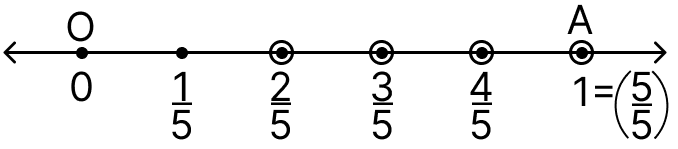
Show the fractions 52,53,54 and 55 on a number line.
Answer
Draw a straight line and mark a point O on it representing 0. Mark a point A on the right of O at unit length so that OA represents 1.
Now divide the line segment OA into 5 equal parts. Each part represents 51.
Starting from O, mark the points at 51,52,53,54 and 55 (= 1).
Hence, the fractions 52,53,54 and 55 are represented on the number line as shown above.
Show 81,82,83 and 87 on a number line.
Answer
Draw a straight line and mark a point O on it representing 0. Mark a point A on the right of O at unit length so that OA represents 1.
Now divide the line segment OA into 8 equal parts. Each part represents 81.
Starting from O, mark the points at 81,82,83 and 87.
Hence, the fractions 81,82,83 and 87 are represented on the number line as shown above.
Show 100,101,103,105,107 and 1010 on a number line.
Answer
Draw a straight line and mark a point O on it representing 0. Mark a point A on the right of O at unit length so that OA represents 1.
Now divide the line segment OA into 10 equal parts. Each part represents 101.
Starting from O, mark the points at 100 (= 0), 101,103,105,107 and 1010 (= 1).
Hence, the fractions 100,101,103,105,107 and 1010 are represented on the number line as shown above.
State which of the following fractions are proper, improper or mixed:
(i) 2615
(ii) 1217
(iii) 532
(iv) 86
(v) 1175
(vi) 8117
(vii) 333222
(viii) 247531
Answer
(i) 2615
Here, numerator (15) < denominator (26).
Hence, 2615 is a proper fraction.
(ii) 1217
Here, numerator (17) > denominator (12).
Hence, 1217 is an improper fraction.
(iii) 532
It consists of a natural number 5 and a proper fraction 32.
Hence, 532 is a mixed fraction.
(iv) 86
Here, numerator (6) < denominator (8).
Hence, 86 is a proper fraction.
(v) 1175
It consists of a natural number 11 and a proper fraction 75.
Hence, 1175 is a mixed fraction.
(vi) 8117
Here, numerator (117) > denominator (8).
Hence, 8117 is an improper fraction.
(vii) 333222
Here, numerator (222) < denominator (333).
Hence, 333222 is a proper fraction.
(viii) 247531
Here, numerator (531) > denominator (247).
Hence, 247531 is an improper fraction.
Convert the following improper fractions into mixed numbers:
(i) 317
(ii) 15119
(iii) 13961
(iv) 32117
Answer
(i) 317
Dividing 17 by 3, we get quotient = 5 and remainder = 2.
⇒317=532.
Hence, 317=532.
(ii) 15119
Dividing 119 by 15, we get quotient = 7 and remainder = 14.
⇒15119=71514.
Hence, 15119=71514.
(iii) 13961
Dividing 961 by 13, we get quotient = 73 and remainder = 12.
⇒13961=731312.
Hence, 13961=731312.
(iv) 32117
Dividing 117 by 32, we get quotient = 3 and remainder = 21.
⇒32117=33221.
Hence, 32117=33221.
Convert the following mixed fractions into improper fractions:
(i) 7112
(ii) 3485
(iii) 13647
(iv) 732
Answer
We use the rule: improper fraction = denominator(natural number×denominator)+numerator.
(i) 7112
⇒7112=117×11+2=1177+2=1179.
Hence, the required fraction is 7112=1179.
(ii) 3485
⇒3485=483×48+5=48144+5=48149.
Hence, the required fraction is 3485=48149.
(iii) 13647
⇒13647=6413×64+7=64832+7=64839.
Hence, the required fraction is 13647=64839.
(iv) 732
⇒732=37×3+2=321+2=323.
Hence, the required fraction is 732=323.
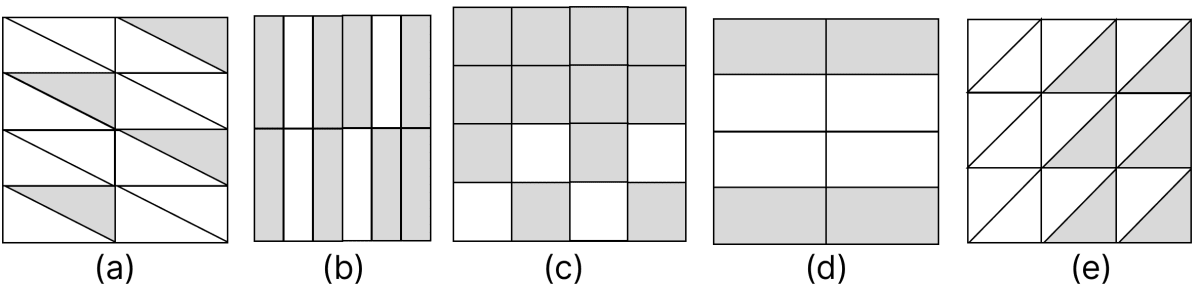
Write the fractions representing the shaded regions and pair up the equivalent fractions from each row:
Answer
The fractions representing the shaded regions are:
(i) Total parts = 2
Shaded parts = 1
Fraction = Total partsShaded parts=21.
Hence, fraction = 21
(ii) Total parts = 6
Shaded parts = 4
Fraction = Total partsShaded parts=64.
Hence, fraction = 64
(iii) Total parts = 9
Shaded parts = 3
Fraction = Total partsShaded parts=93.
Hence, fraction = 93
(iv) Total parts = 8
Shaded parts = 2
Fraction = Total partsShaded parts=82.
Hence, fraction = 82
(v) Total parts = 4
Shaded parts = 3
Fraction = Total partsShaded parts=43.
Hence, fraction = 43
(a) Total parts = 8
Shaded parts = 2
Fraction = Total partsShaded parts=82.
Hence, fraction = 82
(b) Total parts = 12
Shaded parts = 8
Fraction = Total partsShaded parts=128.
Hence, fraction = 128
(c) Total parts = 16
Shaded parts = 12
Fraction = Total partsShaded parts=1612=43.
Hence, fraction = 43
(d) Total parts = 8
Shaded parts = 4
Fraction = Total partsShaded parts=84.
Hence, fraction = 84
(e) Total parts = 9
Shaded parts = 3
Fraction = Total partsShaded parts=93.
Hence, fraction = 93
Hence, the equivalent pairs are:
(i) ↔ (d), (ii) ↔ (b), (iii) ↔ (e), (iv) ↔ (a), (v) ↔ (c).
(i) Find the equivalent fraction of 3515 with denominator 7
(ii) Find the equivalent fraction of 92 with denominator 63
Answer
(i) Equivalent fraction of 3515 with denominator 7
To get 7 from 35, we have to divide 35 by 5.
So, divide both numerator and denominator by 5.
⇒3515=35÷515÷5=73.
Hence, the required equivalent fraction = 73.
(ii) Equivalent fraction of 92 with denominator 63
To get 63 from 9, we have to multiply 9 by 7.
So, multiply both numerator and denominator by 7.
⇒92=9×72×7=6314.
Hence, the required equivalent fraction = 6314.
Find the equivalent fraction of 53 having
(i) denominator 30
(ii) numerator 27
Answer
(i) Equivalent fraction of 53 with denominator 30
To get 30 from 5, we have to multiply 5 by 6.
So, multiply both numerator and denominator by 6.
⇒53=5×63×6=3018.
Hence, the required equivalent fraction = 3018.
(ii) Equivalent fraction of 53 with numerator 27
To get 27 from 3, we have to multiply 3 by 9.
So, multiply both numerator and denominator by 9.
⇒53=5×93×9=4527.
Hence, the required equivalent fraction = 4527.
Replace '653' in each of the following by the correct number:
(i) 32=15653
(ii) 187=65342
(iii) 6534=1512
(iv) 11653=15470
Answer
(i) 32=15653
To get 15 from 3, we have to multiply 3 by 5.
So, multiply both numerator and denominator by 5.
⇒32=3×52×5=1510.
Hence, replace 653 by 10.
(ii) 187=65342
To get 42 from 7, we have to multiply 7 by 6.
So, multiply both numerator and denominator by 6.
⇒187=18×67×6=10842.
Hence, replace 653 by 108.
(iii) 6534=1512
To get 4 from 12, we have to divide 12 by 3.
So, divide both numerator and denominator by 3.
⇒1512=15÷312÷3=54.
Hence, replace 653 by 5.
(iv) 11653=15470
To get 11 from 154, we have to divide 154 by 14.
So, divide both numerator and denominator by 14.
⇒15470=154÷1470÷14=115.
Hence, replace 653 by 5.
Check whether the given pairs of fractions are equivalent:
(i) 103,4012
(ii) 85,4830
(iii) 64,2030
(iv) 137,115
Answer
(i) 103,4012
By cross multiplication,
3 × 40 = 120 and 10 × 12 = 120
Here, the cross products are equal.
Hence, 103 and 4012 are equivalent fractions.
(ii) 85,4830
By cross multiplication,
5 × 48 = 240 and 8 × 30 = 240
Here, the cross products are equal.
Hence, 85 and 4830 are equivalent fractions.
(iii) 64,2030
By cross multiplication,
4 × 20 = 80 and 6 × 30 = 180
Here, the cross products are not equal.
Hence, 64 and 2030 are not equivalent fractions.
(iv) 137,115
By cross multiplication,
7 × 11 = 77 and 13 × 5 = 65
Here, the cross products are not equal.
Hence, 137 and 115 are not equivalent fractions.
Reduce the following fractions to simplest form:
(i) 2712
(ii) 350150
(iii) 8118
(iv) 115276
Answer
(i) 2712
By prime factorisation,
⇒2712=3×3×32×2×3=3×32×2=94.
Hence, 2712 in simplest form is 94.
(ii) 350150
By prime factorisation,
⇒350150=2×5×5×72×3×5×5=73.
Hence, 350150 in simplest form is 73.
(iii) 8118
By prime factorisation,
⇒8118=3×3×3×32×3×3=3×32=92.
Hence, 8118 in simplest form is 92.
(iv) 115276
By prime factorisation,
⇒115276=5×232×2×3×23=52×2×3=512=252.
Hence, 115276 in simplest form is 512 or 252.
Convert the following fractions into equivalent like fractions:
(i) 87,145
(ii) 65,167
(iii) 43,65,87
Answer
(i) 87,145
L.C.M. of 8 and 14 is :
| 2 | 8, 14 |
|---|
| 2 | 4, 7 |
| 2 | 2, 7 |
| 7 | 1, 7 |
| 1, 1 |
LCM of 8 and 14 = 2 x 2 x 2 x 7 = 56
⇒87=8×77×7=5649⇒145=14×45×4=5620
Hence, the equivalent like fractions are 5649 and 5620.
(ii) 65,167
L.C.M. of 6 and 16 is :
| 2 | 6, 16 |
|---|
| 2 | 3, 8 |
| 2 | 3, 4 |
| 2 | 3, 2 |
| 3 | 3, 1 |
| 1, 1 |
LCM of 6 and 16 = 2 x 2 x 2 x 2 x 3 = 48.
⇒65=6×85×8=4840⇒167=16×37×3=4821
Hence, the equivalent like fractions are 4840 and 4821.
(iii) 43,65,87
L.C.M. of 4, 6 and 8 is :
| 2 | 4, 6, 8 |
|---|
| 2 | 2, 3, 4 |
| 2 | 1, 3, 2 |
| 3 | 1, 3, 1 |
| 1, 1, 1 |
LCM of 4, 6 and 8 = 2 x 2 x 2 x 3 = 24.
⇒43=4×63×6=2418⇒65=6×45×4=2420⇒87=8×37×3=2421
Hence, the equivalent like fractions are 2418,2420 and 2421.
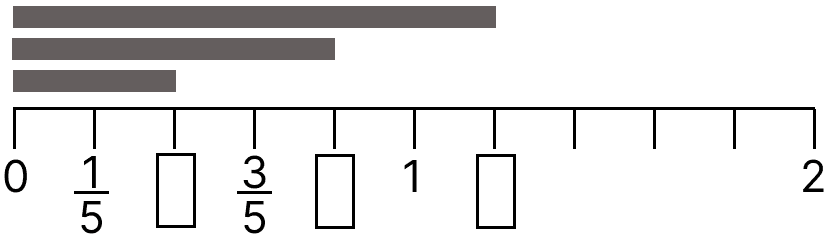
Here, a unit is divided into 5 equal parts. Write the fraction that gives the length of the black bold lines in the respective boxes or in your notebook.
Answer
Each unit is divided into 5 equal parts, so each part represents 51.
The bold line shown in the figure starts from 0 and goes up to a length of 2 parts, so it represents 52.
The remaining boxes are filled as follows (counting parts from 0 to the end of bold line):
The fraction in the first box (after 51) = 52.
The fraction in the second box (after 53) = 54.
The fraction in the third box (after 1) = 56 or 151.
Hence, the missing fractions are 52,54 and 56 (i.e. 151).
Find the missing numbers:
(i) 3 glasses of juice shared equally among 4 friends is the same as _____ glasses of juice shared equally among 8 friends.
So, 43=8653
(ii) 4 kg of sugar divided equally in 3 bags is the same as 12 kg of sugar divided equally in _____ bags.
So, 34=65312
(iii) 7 gulabjamuns divided among 5 children is the same as _____ gulabjamuns divided among _____ children.
So, 57=653653
Answer
(i) 43=8653
To get 8 from 4, we have to multiply 4 by 2.
So, multiply numerator and denominator by 2.
⇒43=4×23×2=86.
Hence, the missing number is 6 i.e. 6 glasses of juice shared equally among 8 friends.
(ii) 34=65312
To get 12 from 4, we have to multiply 4 by 3.
So, multiply numerator and denominator by 3.
⇒34=3×34×3=912.
Hence, the missing number is 9 i.e. 12 kg of sugar divided equally in 9 bags.
(iii) 57=653653
We can multiply both numerator and denominator by 2.
⇒57=5×27×2=1014.
Hence, the missing numbers are 14 and 10 i.e. 14 gulabjamuns divided among 10 children.
Raghu got a job at the age of 24 years and got retired from the job at the age of 60 years. What fraction of his age till retirement was he in job?
Answer
Age at which Raghu got the job = 24 years.
Age of retirement = 60 years.
Number of years he was in job = 60 - 24 = 36 years.
Total age till retirement = 60 years.
Fraction of his age in job = Total ageYears in job
=6036=53.
Hence, the required fraction = 53.
Compare the given fractions and replace '653' by an appropriate sign '< or >':
(i) 6365365
(ii) 7265352
(iii) 5365354
(iv) 7465394
Answer
(i) 63 and 65
These are like fractions (same denominator 6).
In like fractions, the fraction with greater numerator is greater.
Since 3 < 5, therefore, 63<65.
Hence, 63<65.
(ii) 72 and 52
These are unlike fractions with same numerator 2.
In fractions with same numerator, the fraction with smaller denominator is greater.
Since 7 > 5, therefore, 72<52.
Hence, 72<52.
(iii) 53 and 54
These are like fractions (same denominator 5).
In like fractions, the fraction with greater numerator is greater.
Since 3 < 4, therefore, 53<54.
Hence, 53<54.
(iv) 74 and 94
These are unlike fractions with same numerator 4.
In fractions with same numerator, the fraction with smaller denominator is greater.
Since 7 < 9, therefore, 74>94.
Hence, 74>94.
Replace '653' by an appropriate sign '< , = or >' between the given fractions:
(i) 2165351
(ii) 4265363
(iii) 9765393
(iv) 4365382
Answer
(i) 21 and 51
These are unlike fractions with same numerator 1.
In fractions with same numerator, the fraction with smaller denominator is greater.
Since 2 < 5, therefore, 21>51.
Hence, 21>51.
(ii) 42 and 63
By cross multiplication,
2 × 6 = 12 and 4 × 3 = 12
The cross products are equal.
Hence, 42=63.
(iii) 97 and 93
These are like fractions (same denominator 9).
In like fractions, the fraction with greater numerator is greater.
Since 7 > 3, therefore, 97>93.
Hence, 97>93.
(iv) 43 and 82
By cross multiplication,
3 × 8 = 24 and 4 × 2 = 8
Since 24 > 8, therefore, 43>82.
Hence, 43>82.
Compare the following pairs of fractions:
(i) 95 and 54
(ii) 169 and 95
Answer
(i) 95 and 54
LCM of 9 and 5 = 45.
Write the given fractions as equivalent like fractions.
⇒95=9×55×5=4525⇒54=5×94×9=4536
As 25 < 36, 4525<4536⇒95<54.
Hence, 95<54.
(ii) 169 and 95
LCM of 16 and 9 = 144.
Write the given fractions as equivalent like fractions.
⇒169=16×99×9=14481⇒95=9×165×16=14480
As 81 > 80, 14481>14480⇒169>95.
Hence, 169>95.
Fill in the boxes by the symbol < or > to make the given statements true:
(i) 11565373
(ii) 158 653 53
(iii) 1411 653 3529
(iv) 2713 653 4815
Answer
(i) 115 and 73
By cross multiplication,
5 × 7 = 35 and 11 × 3 = 33
Since 35 > 33, therefore, 115>73.
Hence, 115>73.
(ii) 158 and 53
By cross multiplication,
8 × 5 = 40 and 15 × 3 = 45
Since 40 < 45, therefore, 158<53.
Hence, 158<53.
(iii) 1411 and 3529
LCM of 14 and 35 = 70.
⇒1411=14×511×5=7055⇒3529=35×229×2=7058
As 55 < 58,
7055<7058⇒1411<3529.
Hence, 1411<3529.
(iv) 2713 and 4815
By cross multiplication,
13 × 48 = 624 and 27 × 15 = 405
Since 624 > 405, therefore, 2713>4815.
Hence, 2713>4815.
Arrange the given fractions in descending order:
(i) 175,94,127
(ii) 127,3611,7237
Answer
(i) 175,94,127
LCM of 17, 9 and 12 = 612.
Write the given fractions as equivalent like fractions.
⇒175=17×365×36=612180⇒94=9×684×68=612272⇒127=12×517×51=612357
As 357 > 272 > 180,
612357>612272>612180⇒127>94>175.
Hence, the given fractions in descending order are 127,94,175.
(ii) 127,3611,7237
LCM of 12, 36 and 72 = 72.
Write the given fractions as equivalent like fractions.
⇒127=12×67×6=7242⇒3611=36×211×2=7222⇒7237=7237
As 42 > 37 > 22,
7242>7237>7222⇒127>7237>3611.
Hence, the given fractions in descending order are 127,7237,3611.
Arrange the given fractions in ascending order:
(i) 87,1615,65
(ii) 43,2215,3326
(iii) 125,41,87,65
Answer
(i) 87,1615,65
LCM of 8, 16 and 6 = 48.
Write the given fractions as equivalent like fractions.
⇒87=8×67×6=4842⇒1615=16×315×3=4845⇒65=6×85×8=4840
As 40 < 42 < 45,
4840<4842<4845⇒65<87<1615.
Hence, the given fractions in ascending order are 65,87,1615.
(ii) 43,2215,3326
LCM of 4, 22 and 33 = 132.
Write the given fractions as equivalent like fractions.
⇒43=4×333×33=13299⇒2215=22×615×6=13290⇒3326=33×426×4=132104
As 90 < 99 < 104,
13290<13299<132104⇒2215<43<3326.
Hence, the given fractions in ascending order are 2215,43,3326.
(iii) 125,41,87,65
LCM of 12, 4, 8 and 6 = 24.
Write the given fractions as equivalent like fractions.
⇒125=12×25×2=2410⇒41=4×61×6=246⇒87=8×37×3=2421⇒65=6×45×4=2420
As 6 < 10 < 20 < 21,
246<2410<2420<2421⇒41<125<65<87.
Hence, the given fractions in ascending order are 41,125,65,87.
Calculate the following:
(i) 158+153
(ii) 1512−157
(iii) 1−32
(iv) 137+132−135
(v) 254+353
(vi) 372−174
Answer
(i) 158+153
⇒158+3⇒1511
Hence, 158+153=1511.
(ii) 1512−157
⇒1512−7⇒155⇒31
Hence, 1512−157=31.
(iii) 1−32
⇒33−32⇒33−2⇒31
Hence, 1−32=31.
(iv) 137+132−135
⇒137+2−5⇒134
Hence, 137+132−135=134.
(v) 254+353
⇒514+518⇒514+18⇒532⇒652
Hence, 254+353=652.
(vi) 372−174
⇒723−711⇒723−11⇒712⇒175
Hence, 372−174=175.
Calculate the following:
(i) 32+43
(ii) 75−94
(iii) 21+53
(iv) 194+3125
(v) 241−1107
(vi) 365−2157
Answer
(i) 32+43
LCM of 3 and 4 = 12.
⇒3×42×4+4×33×3⇒128+129⇒128+9⇒1217⇒1125
Hence, 32+43=1125.
(ii) 75−94
LCM of 7 and 9 = 63.
⇒7×95×9−9×74×7⇒6345−6328⇒6345−28⇒6317
Hence, 75−94=6317.
(iii) 21+53
LCM of 2 and 5 = 10.
⇒2×51×5+5×23×2⇒105+106⇒105+6⇒1011⇒1101
Hence, 21+53=1101.
(iv) 194+3125
LCM of 9 and 12 = 36.
⇒913+1241⇒9×413×4+12×341×3⇒3652+36123⇒3652+123⇒36175⇒43631
Hence, 194+3125=43631.
(v) 241−1107
LCM of 4 and 10 = 20.
⇒49−1017⇒4×59×5−10×217×2⇒2045−2034⇒2045−34⇒2011
Hence, 241−1107=2011.
(vi) 365−2157
LCM of 6 and 15 = 30.
⇒623−1537⇒6×523×5−15×237×2⇒30115−3074⇒30115−74⇒3041⇒13011
Hence, 365−2157=13011.
Simplify the following:
(i) 132+221+43
(ii) 392+231+2127
(iii) 127+98−65
(iv) 1253+207−52
(v) 11413−265+176
(vi) 3−161−157
Answer
(i) 132+221+43
LCM of 3, 2 and 4 = 12.
⇒35+25+43⇒3×45×4+2×65×6+4×33×3⇒1220+1230+129⇒1220+30+9⇒1259⇒41211
Hence, 132+221+43=41211.
(ii) 392+231+2127
LCM of 9, 3 and 12 = 36.
⇒929+37+1231⇒9×429×4+3×127×12+12×331×3⇒36116+3684+3693⇒36116+84+93⇒36293⇒8365
Hence, 392+231+2127=8365.
(iii) 127+98−65
LCM of 12, 9 and 6 = 36.
⇒12×37×3+9×48×4−6×65×6⇒3621+3632−3630⇒3621+32−30⇒3623
Hence, 127+98−65=3623.
(iv) 1253+207−52
LCM of 25, 20 and 5 = 100.
⇒2528+207−52⇒25×428×4+20×57×5−5×202×20⇒100112+10035−10040⇒100112+35−40⇒100107⇒11007
Hence, 1253+207−52=11007.
(v) 11413−265+176
LCM of 14, 6 and 7 = 42.
⇒1427−617+713⇒14×327×3−6×717×7+7×613×6⇒4281−42119+4278⇒4281−119+78⇒4240⇒2120
Hence, 11413−265+176=2120.
(vi) 3−161−157
LCM of 1, 6 and 15 = 30.
⇒13−67−157⇒1×303×30−6×57×5−15×27×2⇒3090−3035−3014⇒3090−35−14⇒3041⇒13011
Hence, 3−161−157=13011.
(i) What number should be added to 125 to get 283?
(ii) What number should be subtracted from 5 to get 1135?
Answer
(i) Required number = 283−125
LCM of 8 and 12 = 24.
⇒819−125⇒8×319×3−12×25×2⇒2457−2410⇒2457−10⇒2447⇒12423
Hence, the required number = 12423.
(ii) Required number = 5−1135
⇒15−1318⇒1×135×13−1318⇒1365−1318⇒1365−18⇒1347⇒3138
Hence, the required number = 3138.
Evaluate the following:
(i) 52×73
(ii) 53×98
(iii) 7×132
Answer
(i) 52×73
⇒5×72×3⇒356
Hence, 52×73=356.
(ii) 53×98
⇒5×93×8⇒93×58⇒31×58⇒3×51×8⇒158
Hence, 53×98=158.
(iii) 7×132
⇒7×35⇒37×5⇒335⇒1132
Hence, 7×132=1132.
Evaluate the following:
(i) 32×60
(ii) 74×280
(iii) 32 of 194
Answer
(i) 32×60
⇒32×60⇒2×20⇒40
Hence, 32×60=40.
(ii) 74×280
⇒74×280⇒4×40⇒160
Hence, 74×280=160.
(iii) 32 of 194
⇒32×194⇒32×913⇒3×92×13⇒2726
Hence, 32 of 194=2726.
Find the reciprocal of each of the following fractions:
(i) 139
(ii) 283
Answer
(i) 139
The reciprocal of a fraction ba is ab.
So, the reciprocal of 139 is 913.
Hence, the reciprocal of 139 is 913.
(ii) 283
First, convert the mixed fraction into improper fraction.
⇒283=82×8+3=819
The reciprocal of 819 is 198.
Hence, the reciprocal of 283 is 198.
Evaluate the following:
(i) 218÷4
(ii) 154÷52
(iii) 8÷65
(iv) 541÷87
(v) 531÷191
Answer
(i) 218÷4
⇒218÷14⇒218×41⇒48×211⇒2×211⇒212
Hence, 218÷4=212.
(ii) 154÷52
⇒154×25⇒24×155⇒2×31⇒32
Hence, 154÷52=32.
(iii) 8÷65
⇒18÷65⇒18×56⇒1×58×6⇒548⇒953
Hence, 8÷65=953.
(iv) 541÷87
⇒421÷87⇒421×78⇒721×48⇒3×2⇒6
Hence, 541÷87=6.
(v) 531÷191
⇒316÷910⇒316×109⇒1016×39⇒58×3⇒524⇒454
Hence, 531÷191=454.
Find the following:
(i) 112 of ₹ 715
(ii) 94 of 405 kg
(iii) 73 of 4 hours 40 minutes
Answer
(i) 112 of ₹ 715
⇒112×715⇒112×715⇒2×65⇒₹130
Hence, 112 of ₹ 715 = ₹ 130.
(ii) 94 of 405 kg
⇒94×405⇒94×405⇒4×45⇒180 kg
Hence, 94 of 405 kg = 180 kg.
(iii) 73 of 4 hours 40 minutes
4 hours 40 minutes = (4 × 60 + 40) minutes = (240 + 40) minutes = 280 minutes.
⇒73×280 minutes⇒73×280 minutes⇒3×40 minutes⇒120 minutes⇒2 hours
Hence, 73 of 4 hours 40 minutes = 2 hours.
Find the value of the following:
(i) 93
(ii) 84
(iii) (53)3
(iv) 33 × 52
Answer
(i) 93
⇒9×9×9⇒729
Hence, 93 = 729.
(ii) 84
⇒8×8×8×8⇒4096
Hence, 84 = 4096.
(iii) (53)3
⇒53×53×53⇒5×5×53×3×3⇒12527
Hence, (53)3=12527.
(iv) 33 × 52
⇒(3×3×3)×(5×5)⇒27×25⇒675
Hence, 33 × 52 = 675.
Nayamat bought 52 metre of ribbon and Amanat bought 43 metre of ribbon. What is the total length of the ribbon they bought?
Answer
Length of ribbon bought by Nayamat = 52 metre.
Length of ribbon bought by Amanat = 43 metre.
Total length of ribbon = 52+43
LCM of 5 and 4 = 20.
⇒5×42×4+4×53×5⇒208+2015⇒208+15⇒2023⇒1203 metre
Hence, the total length of ribbon they bought = 1203 metre.
A bamboo of length 243 metre broke into two pieces. One piece was 87 metre long. How long is the other piece?
Answer
Total length of bamboo = 243 metre.
Length of one piece = 87 metre.
Length of other piece = 243−87
LCM of 4 and 8 = 8.
⇒411−87⇒4×211×2−87⇒822−87⇒822−7⇒815⇒187 metre
Hence, the length of the other piece = 187 metre.
Nidhi's house is 1109 km from her school. She walked some distance and then took a bus for 121 km to reach the school. How far did she walk?
Answer
Total distance from house to school = 1109 km.
Distance travelled by bus = 121 km.
Distance walked = 1109−121
LCM of 10 and 2 = 10.
⇒1019−23⇒1019−2×53×5⇒1019−1015⇒1019−15⇒104⇒52 km
Hence, Nidhi walked 52 km.
From a rope of length 2021 m, a piece of length 385 m is cut off. Find the length of the remaining rope.
Answer
Total length of rope = 2021 m.
Length of piece cut off = 385 m.
Length of remaining rope = 2021−385
LCM of 2 and 8 = 8.
⇒241−829⇒2×441×4−829⇒8164−829⇒8164−29⇒8135⇒1687 m
Hence, the length of the remaining rope = 1687 m.
The weights of three packets are 243 kg, 331 kg and 552 kg. Find the total weight of all the three packets.
Answer
Weights of three packets = 243 kg, 331 kg and 552 kg.
Total weight = 243+331+552
LCM of 4, 3 and 5 = 60.
⇒411+310+527⇒4×1511×15+3×2010×20+5×1227×12⇒60165+60200+60324⇒60165+200+324⇒60689⇒116029 kg
Hence, the total weight of the three packets = 116029 kg.
Shivani read 25 pages of a book containing 100 pages. Nandini read 52 of the same book. Who read less?
Answer
Total pages of book = 100.
Fraction of book read by Shivani = 10025=41.
Fraction of book read by Nandini = 52.
Now, compare 41 and 52.
By cross multiplication,
1 × 5 = 5 and 4 × 2 = 8.
Since 5 < 8, therefore, 41<52.
So, Shivani read less than Nandini.
Hence, Shivani read less.
Ajay exercised for 63 of an hour, while Vijay exercised for 43 of an hour. Who exercised for a longer time and by what fraction of an hour?
Answer
Time for which Ajay exercised = 63 hour.
Time for which Vijay exercised = 43 hour.
Compare 63 and 43.
These are unlike fractions with same numerator 3.
In fractions with same numerator, the fraction with smaller denominator is greater.
Since 4 < 6, therefore, 43>63.
So, Vijay exercised for a longer time.
Difference = 43−63
LCM of 4 and 6 = 12.
⇒4×33×3−6×23×2⇒129−126⇒129−6⇒123⇒41 hour
Hence, Vijay exercised for a longer time by 41 hour.
Objective Type Questions - Mental Maths
Fill in the following blanks:
(i) A fraction is a number which represent a ..... of whole.
(ii) A proper fraction lies between 0 and .....
(iii) A mixed fraction can be converted into ..... fraction.
(iv) Fractions having different denominators are called .....
(v) 13518 and 54072 are proper, unlike and ...... fractions.
(vi) In two like fractions, the fraction having smaller numerator is .....
(vii) 180144 reduced to simplest form is .....
(viii) 752 + .... = 12
(ix) 5642=...6
Answer
(i) A fraction is a number which represent a part of whole.
(ii) A proper fraction lies between 0 and 1.
(iii) A mixed fraction can be converted into an improper fraction.
(iv) Fractions having different denominators are called unlike fractions.
(v) Check by cross multiplication: 18 × 540 = 9720 and 135 × 72 = 9720.
Since cross products are equal, the fractions are equivalent.
So, 13518 and 54072 are proper, unlike and equivalent fractions.
(vi) In two like fractions, the fraction having smaller numerator is smaller.
(vii) 180144
By prime factorisation,
⇒180144=2×2×3×3×52×2×2×2×3×3=52×2=54.
So, 180144 reduced to simplest form is 54.
(viii) 752 + .... = 12
Required number = 12−752=112−537=560−537=560−37=523=453.
So, 752 + 453 = 12.
(ix) 5642=...6
To get 6 from 42, we have to divide 42 by 7. So, divide 56 by 7.
5642=56÷742÷7=86.
So, 5642=86.
State whether the following statements are true (T) or false (F):
(i) Two fractions with same numerator are called like fractions.
(ii) A fraction in which the numerator is greater than its denominator is called an improper fraction.
(iii) Every improper fraction can be converted into a mixed fraction.
(iv) Every fraction can be represented by a point on a number line.
(v) In two unlike fractions with same numerator, the fraction having greater denominator is greater.
(vi) 21,31 and 41 are like fractions.
Answer
(i) False.
Reason: Two fractions with same denominator are called like fractions, not same numerator.
(ii) True.
Reason: A fraction in which the numerator is greater than (or equal to) its denominator is called an improper fraction.
(iii) True.
Reason: Every improper fraction can be converted into a mixed fraction by dividing the numerator by the denominator.
(iv) True.
Reason: Every fraction has a unique position on the number line.
(v) False.
Reason: In two unlike fractions with same numerator, the fraction having smaller denominator is greater (not greater denominator).
(vi) False.
Reason: 21,31 and 41 have different denominators (2, 3, 4), so they are unlike fractions, not like fractions.
Multiple Choice Questions
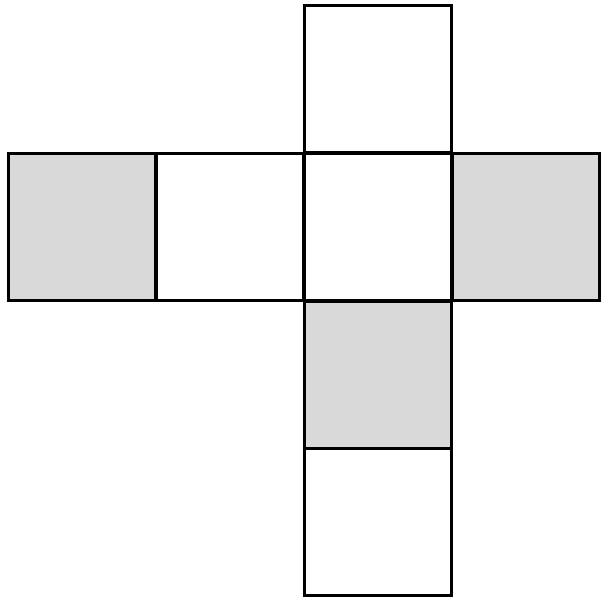
In the adjoining figure, the shaded part is represented by the fraction:
83
73
84
63
Answer
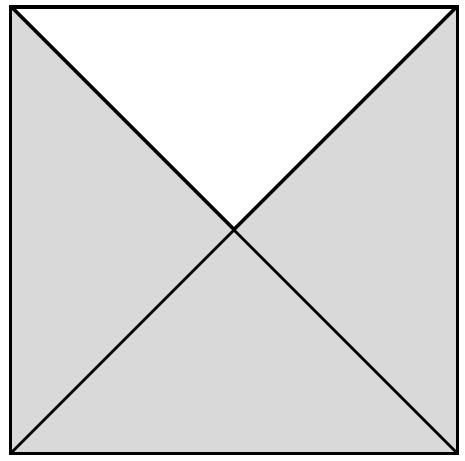
Total parts = 7
Shaded parts = 3
Fraction = Total partsNo. of shaded parts=73.
Hence, option 2 is the correct option.
In the adjoining figure, the shaded region is represented by the fraction:
124
125
245
244
Answer
Total parts = 12
Shaded parts = 1+21+21=25
Fraction = Total partsShaded parts=1225=2×125=245.
Hence, option 3 is the correct option.
The two consecutive integers between which the fraction 75 lies are
5 and 7
5 and 6
6 and 7
0 and 1
Answer
The fraction 75 is a proper fraction (numerator < denominator).
All proper fractions lie between 0 and 1.
Hence, option 4 is the correct option.
Which of the following pairs of fractions are not equivalent?
43,2015
2114,64
108,1512
146,2510
Answer
Check each option using cross multiplication:
3 × 20 = 60 and 4 × 15 = 60. Equal, so equivalent.
14 × 6 = 84 and 21 × 4 = 84. Equal, so equivalent.
8 × 15 = 120 and 10 × 12 = 120. Equal, so equivalent.
6 × 25 = 150 and 14 × 10 = 140. Not equal, so not equivalent.
Hence, option 4 is the correct option.
The fraction equivalent to 8145 is
24390
915
275
95
Answer
By prime factorisation,
⇒8145=3×3×3×33×3×5=3×35=95.
Hence, option 4 is the correct option.
The fraction which is not equal to 54 is
5040
159
1512
4032
Answer
Check each option using cross multiplication with 54:
4 × 50 = 200 and 5 × 40 = 200. Equal, so equivalent.
4 × 15 = 60 and 5 × 9 = 45. Not equal, so not equivalent.
4 × 15 = 60 and 5 × 12 = 60. Equal, so equivalent.
4 × 40 = 160 and 5 × 32 = 160. Equal, so equivalent.
Hence, option 2 is the correct option.
Which of the following fractions is not in the simplest form?
2827
3313
8739
914
Answer
A fraction is in simplest form if HCF of numerator and denominator is 1.
HCF of 27 and 28 = 1. So, simplest form.
HCF of 13 and 33 = 1. So, simplest form.
HCF of 39 and 87 = 3. So, not in simplest form.
8739=87÷339÷3=2913.
- HCF of 14 and 9 = 1. So, simplest form.
Hence, option 3 is the correct option.
A pair of like fractions is
43,53
73,716
65,56
32,52
Answer
Like fractions have the same denominator.
In option 2, 73 and 716 have the same denominator 7.
Hence, option 2 is the correct option.
Which of the following fractions is the greatest?
65
75
85
95
Answer
These are unlike fractions with same numerator 5.
In fractions with same numerator, the fraction with smaller denominator is greater.
The smallest denominator is 6.
So, 65 is the greatest.
Hence, option 1 is the correct option.
Which of the following fractions is the smallest?
711
911
1011
611
Answer
These are unlike fractions with same numerator 11.
In fractions with same numerator, the fraction with greater denominator is smaller.
The greatest denominator is 10.
So, 1011 is the smallest.
Hence, option 3 is the correct option.
Which of the following is a false statement?
71<143
85=2415
43=166
125>62
Answer
Check each option:
Cross multiplication: 1 × 14 = 14 and 7 × 3 = 21. Since 14 < 21, 71<143. True.
Cross multiplication: 5 × 24 = 120 and 8 × 15 = 120. Equal, so 85=2415. True.
Cross multiplication: 3 × 16 = 48 and 4 × 6 = 24. Not equal, so 43=166. False.
Cross multiplication: 5 × 6 = 30 and 12 × 2 = 24. Since 30 > 24, 125>62. True.
Hence, option 3 is the correct option.
71+144 is equal to
145
75
143
73
Answer
LCM of 7 and 14 = 14.
⇒7×21×2+144⇒142+144⇒142+4⇒146⇒73
Hence, option 4 is the correct option.
97−185 is equal to
182
92
21
1811
Answer
LCM of 9 and 18 = 18.
⇒9×27×2−185⇒1814−185⇒1814−5⇒189⇒21
Hence, option 3 is the correct option.
Anshul eats 74 of a pizza. The fraction of the pizza left is
73
72
75
71
Answer
Fraction of pizza eaten = 74.
Fraction of pizza left = 1−74
⇒77−74⇒77−4⇒73
Hence, option 1 is the correct option.
The fraction whose numerator is the smallest odd prime number and denominator is the smallest composite number is
43
42
34
24
Answer
Smallest odd prime number = 3.
Smallest composite number = 4.
So, the required fraction = 43.
Hence, option 1 is the correct option.
Statement I-II Type Questions
Statement I: 374 is a mixed fraction.
Statement II: A natural number added to a proper fraction forms an improper fraction.
Statement I is true but statement II is false.
Statement I is false but statement II is true.
Both Statement I and statement II are true.
Both Statement I and statement II are false.
Answer
According to Statement I, 374 consists of a natural number 3 and a proper fraction 74.
So, 374 is a mixed fraction.
∴ Statement I is true.
According to Statement II, a natural number added to a proper fraction forms a mixed fraction (which can also be written as an improper fraction).
For example, 3+74=374=725, which is an improper fraction.
∴ Statement II is true.
Both Statement I and Statement II are true.
Hence, option 3 is the correct option.
Statement I: An orchard has a total area of 1000 m2. Given that 200 m2 of the orchard has been used for mango trees, 500 m2 has been used for apple trees and the remaining area is unused. The fraction of the orchard that is unused is 103.
Statement II: All natural numbers can be written as improper fractions.
Statement I is true but statement II is false.
Statement I is false but statement II is true.
Both Statement I and statement II are true.
Both Statement I and statement II are false.
Answer
According to Statement I,
Total area = 1000 m2
Area used = 200 + 500 = 700 m2
Unused area = 1000 - 700 = 300 m2
Fraction of unused area = 1000300=103.
∴ Statement I is true.
According to Statement II, every natural number can be written with denominator 1.
For example, 5=15, 21=121, etc., which are improper fractions (numerator ≥ denominator).
∴ Statement II is true.
Both Statement I and Statement II are true.
Hence, option 3 is the correct option.
Statement I: Karishma earns a monthly salary of ₹50,000. She donates ₹5000 to charity and spends ₹6000 for groceries. The reciprocal of the fraction corresponding to her savings is =3950.
Statement II: As 3950×5039=1, therefore, 3950 and 5039 are reciprocals of each other.
Statement I is true but statement II is false.
Statement I is false but statement II is true.
Both Statement I and statement II are true.
Both Statement I and statement II are false.
Answer
According to Statement I,
Total salary = ₹50,000.
Total spent = 5000 + 6000 = ₹11,000.
Savings = 50,000 - 11,000 = ₹39,000.
Fraction of savings = 50,00039,000=5039.
Reciprocal of 5039 = 3950.
∴ Statement I is true.
According to Statement II, two numbers are reciprocals of each other if their product is 1.
3950×5039=39×5050×39=1.
So, 3950 and 5039 are reciprocals of each other.
∴ Statement II is true.
Both Statement I and Statement II are true.
Hence, option 3 is the correct option.
State whether the following statements are true (T) or false (F):
(i) The fraction 32 lies between 2 and 3
(ii) To find an equivalent fraction to a given fraction, we may add or subtract the same (non-zero) number to its numerator and denominator.
Answer
(i) False.
Reason: 32 is a proper fraction (numerator < denominator), so it lies between 0 and 1, not between 2 and 3.
(ii) False.
Reason: To find an equivalent fraction, we must multiply or divide the numerator and denominator by the same non-zero number, not add or subtract.
How many natural numbers are there between 102 and 112? What fraction of them are prime numbers?
Answer
Natural numbers between 102 and 112 are:
103, 104, 105, 106, 107, 108, 109, 110, 111 and their number = 9.
Out of these, the prime numbers are:
103, 107, 109 and their number = 3.
Fraction of prime numbers = Total numbersNumber of primes=93=31.
Hence, total natural numbers = 9 and fraction of prime numbers = 31.
Find the numbers p and q in: 85=p20=104q
Answer
To find p:
85=p20
To get 20 from 5, we have to multiply 5 by 4.
So, multiply both numerator and denominator by 4.
⇒85=8×45×4=3220.
So, p = 32.
To find q:
85=104q
To get 104 from 8, we have to multiply 8 by 13.
So, multiply both numerator and denominator by 13.
⇒85=8×135×13=10465.
So, q = 65.
Hence, p = 32 and q = 65.
Match the equivalent fractions from each row:
(i) 400250
(ii) 200180
(iii) 990660
(iv) 360180
(v) 550220
(a) 32
(b) 52
(c) 21
(d) 85
(e) 109
Answer
Reduce each fraction to its simplest form:
(i) 400250=400÷50250÷50=85. Matches with (d).
(ii) 200180=200÷20180÷20=109. Matches with (e).
(iii) 990660=990÷330660÷330=32. Matches with (a).
(iv) 360180=360÷180180÷180=21. Matches with (c).
(v) 550220=550÷110220÷110=52. Matches with (b).
Hence, the matches are:
(i) ↔ (d), (ii) ↔ (e), (iii) ↔ (a), (iv) ↔ (c), (v) ↔ (b).
Replace '653' by an appropriate symbol '< or >' between the given fractions:
(i) 656531513
(ii) 54 653 97
(iii) 1211 653 1413
Answer
(i) 65 and 1513
By cross multiplication,
5 × 15 = 75 and 6 × 13 = 78.
Since 75 < 78, therefore, 65<1513.
Hence, 65<1513.
(ii) 54 and 97
By cross multiplication,
4 × 9 = 36 and 5 × 7 = 35.
Since 36 > 35, therefore, 54>97.
Hence, 54>97.
(iii) 1211 and 1413
By cross multiplication,
11 × 14 = 154 and 12 × 13 = 156.
Since 154 < 156, therefore, 1211<1413.
Hence, 1211<1413.
Arrange the following fractions in descending order: 307,1513,109,53
Answer
LCM of 30, 15, 10 and 5 = 30.
Write the given fractions as equivalent like fractions.
⇒307=307⇒1513=15×213×2=3026⇒109=10×39×3=3027⇒53=5×63×6=3018
As 27 > 26 > 18 > 7,
3027>3026>3018>307⇒109>1513>53>307.
Hence, the given fractions in descending order are 109,1513,53,307.
Simplify: 221−341+565
Answer
LCM of 2, 4 and 6 = 12.
⇒25−413+635⇒2×65×6−4×313×3+6×235×2⇒1230−1239+1270⇒1230−39+70⇒1261⇒5121
Hence, 221−341+565=5121.
Evaluate the following:
(i) 53×180
(ii) 73 of 565
(iii) 185÷32
Answer
(i) 53×180
⇒53×180⇒3×36⇒108
Hence, 53×180=108.
(ii) 73 of 565
⇒73×635⇒63×735⇒21×5⇒25⇒221
Hence, 73 of 565=221.
(iii) 185÷32
⇒185×23⇒25×183⇒25×61⇒125
Hence, 185÷32=125.
Asha and Samuel have bookshelves of the same size partly filled with books. Asha's shelf is 65 full and Samuel's shelf is 53 full. Whose bookshelf is more full and by what fraction?
Answer
Asha's shelf = 65 full.
Samuel's shelf = 53 full.
Compare 65 and 53 by cross multiplication:
5 × 5 = 25 and 6 × 3 = 18.
Since 25 > 18, therefore, 65>53.
So, Asha's bookshelf is more full.
Difference = 65−53
LCM of 6 and 5 = 30.
⇒6×55×5−5×63×6⇒3025−3018⇒3025−18⇒307
Hence, Asha's bookshelf is more full by 307.
A farmer uses four out of five equal strips of his land for wheat crop and 71 of his land for cereal crop. What fraction of his land is available for other crops?
Answer
Fraction of land used for wheat crop = 54.
Fraction of land used for cereal crop = 71.
Total fraction used = 54+71
LCM of 5 and 7 = 35.
⇒5×74×7+7×51×5⇒3528+355⇒3528+5⇒3533
Fraction of land available for other crops = 1−3533
⇒3535−3533⇒3535−33⇒352
Hence, the fraction of land available for other crops = 352.
A rectangle is divided into a certain number of equal parts. If 16 of the parts so formed represents the fraction 52, find the number of parts in which the rectangle has been divided.
Answer
Let the total number of parts be x.
Given, 16 parts represent the fraction 52.
⇒x16=52⇒16×5=2×x⇒80=2x⇒x=280⇒x=40
Hence, the rectangle is divided into 40 equal parts.
Find the value of the following:
(i) 55
(ii) (43)4
Answer
(i) 55
⇒5×5×5×5×5⇒3125
Hence, 55 = 3125.
(ii) (43)4
⇒43×43×43×43⇒4×4×4×43×3×3×3⇒25681
Hence, (43)4=25681.
Write all proper fractions whose sum of numerator and denominator is 12.
Answer
A proper fraction has numerator less than denominator.
We need pairs of (numerator, denominator) such that numerator + denominator = 12 and numerator < denominator.
Numerator + denominator = 12 with numerator < denominator means numerator < 6.
The possible fractions are:
If numerator = 1, denominator = 11 → 111.
If numerator = 2, denominator = 10 → 102.
If numerator = 3, denominator = 9 → 93.
If numerator = 4, denominator = 8 → 84.
If numerator = 5, denominator = 7 → 75.
Hence, the proper fractions are: 111,102,93,84 and 75.
Find the value of x if 412x+131=543
Answer
⇒412x+131=543⇒412x=543−131⇒412x=423−34
LCM of 4 and 3 = 12.
⇒412x=4×323×3−3×44×4⇒412x=1269−1216⇒412x=1269−16⇒412x=1253⇒412x=4125
Comparing both sides, x = 5.
Hence, x = 5.
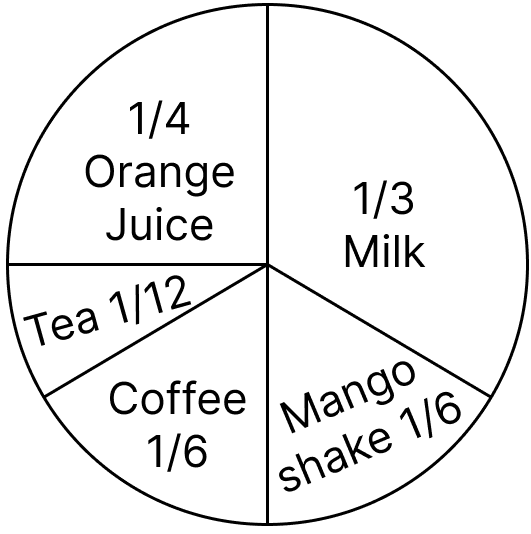
The adjoining figure represents the preferences of the students during breakfast in a hostel mess. If the total number of students in the mess is 540, then with reference to the given figure, answer the following questions:
(i) What is the number of students who prefer coffee?
(ii) Whose number is greater, milk drinkers or orange juice drinkers and by what number?
(iii) What is the total number of students who drink mango shake or coffee? Is it equal to milk drinker?
(iv) Is the sum of all fractions in the given figure equal to 1?
Answer
Total number of students = 540.
From the figure, the fractions are:
Orange juice = 41, Milk = 31, Tea = 121, Coffee = 61, Mango shake = 61.
(i) Number of students who prefer coffee = 61×540
⇒6540⇒90
Hence, the number of students who prefer coffee = 90.
(ii) Number of milk drinkers = 31×540=3540=180.
Number of orange juice drinkers = 41×540=4540=135.
Since 180 > 135, milk drinkers are more than orange juice drinkers.
Difference = 180 - 135 = 45.
Hence, milk drinkers are greater than orange juice drinkers by 45.
(iii) Number of mango shake drinkers = 61×540=90.
Number of coffee drinkers = 90.
Total = 90 + 90 = 180.
Number of milk drinkers = 180.
Yes, total of mango shake and coffee drinkers (180) is equal to milk drinkers (180).
Hence, the total number of students who drink mango shake or coffee = 180, which is equal to the number of milk drinkers.
(iv) Sum of all fractions = 41+31+121+61+61
LCM of 4, 3, 12, 6 = 12.
⇒4×31×3+3×41×4+121+6×21×2+6×21×2⇒123+124+121+122+122⇒123+4+1+2+2⇒1212⇒1
Hence, yes, the sum of all fractions in the given figure is equal to 1.