
Which of the following are simple closed figures?
Answer
A closed figure which does not intersect itself is called a simple closed figure.
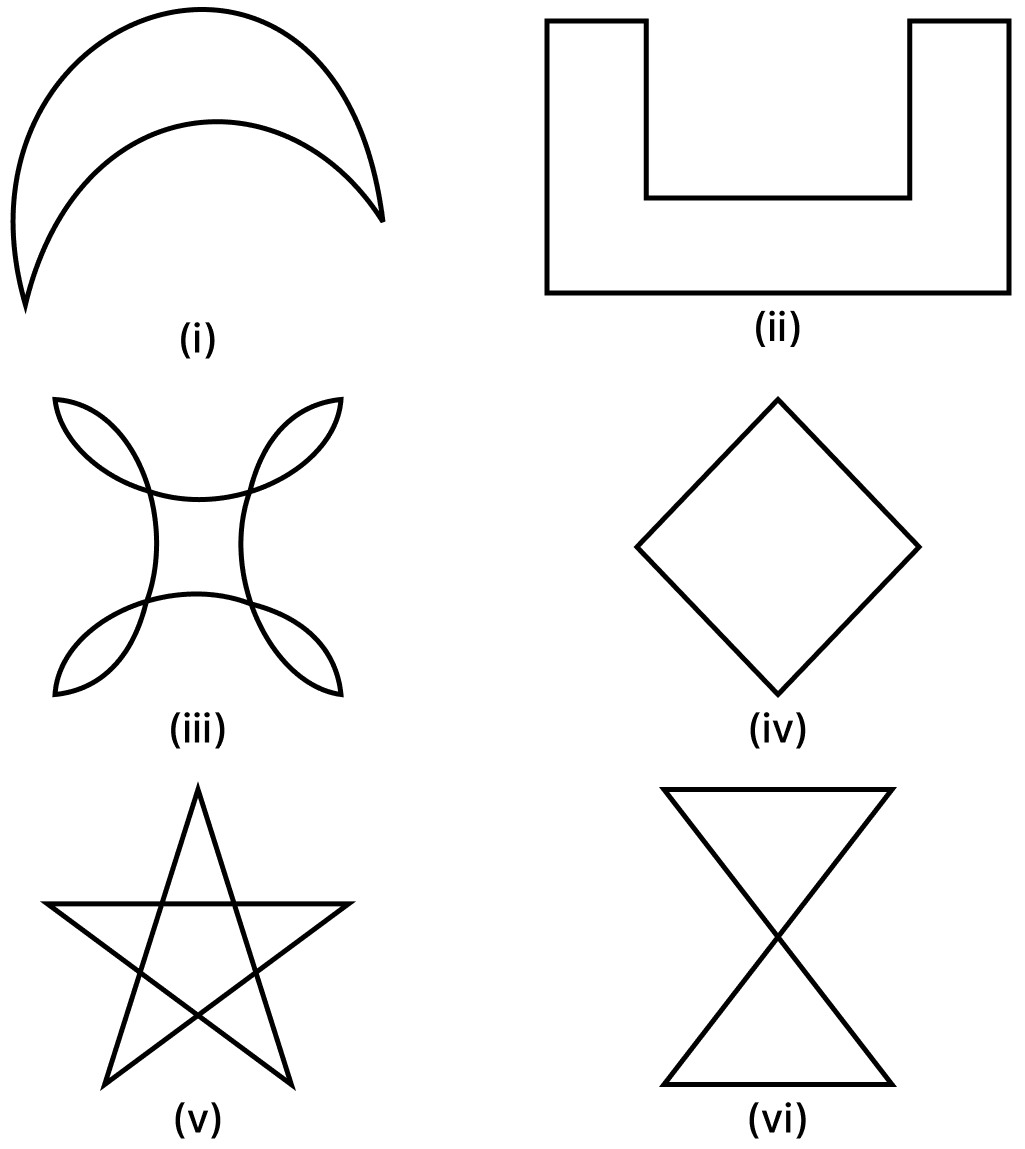
(i) The figure begins and ends at the same point and does not intersect itself.
Hence, the given figure is a simple closed figure.
(ii) The figure begins and ends at the same point and does not intersect itself.
Hence, the given figure is a simple closed figure.
(iii) The figure intersects itself.
Hence, the given figure is not a simple closed figure.
(iv) The figure begins and ends at the same point and does not intersect itself.
Hence, the given figure is a simple closed figure.
(v) The figure intersects itself.
Hence, the given figure is not a simple closed figure.
(vi) The figure intersects itself.
Hence, the given figure is not a simple closed figure.
Which of the following figures are polygons? Name them, if any.
Answer
A simple closed figure bounded by three or more line segments is called a polygon.
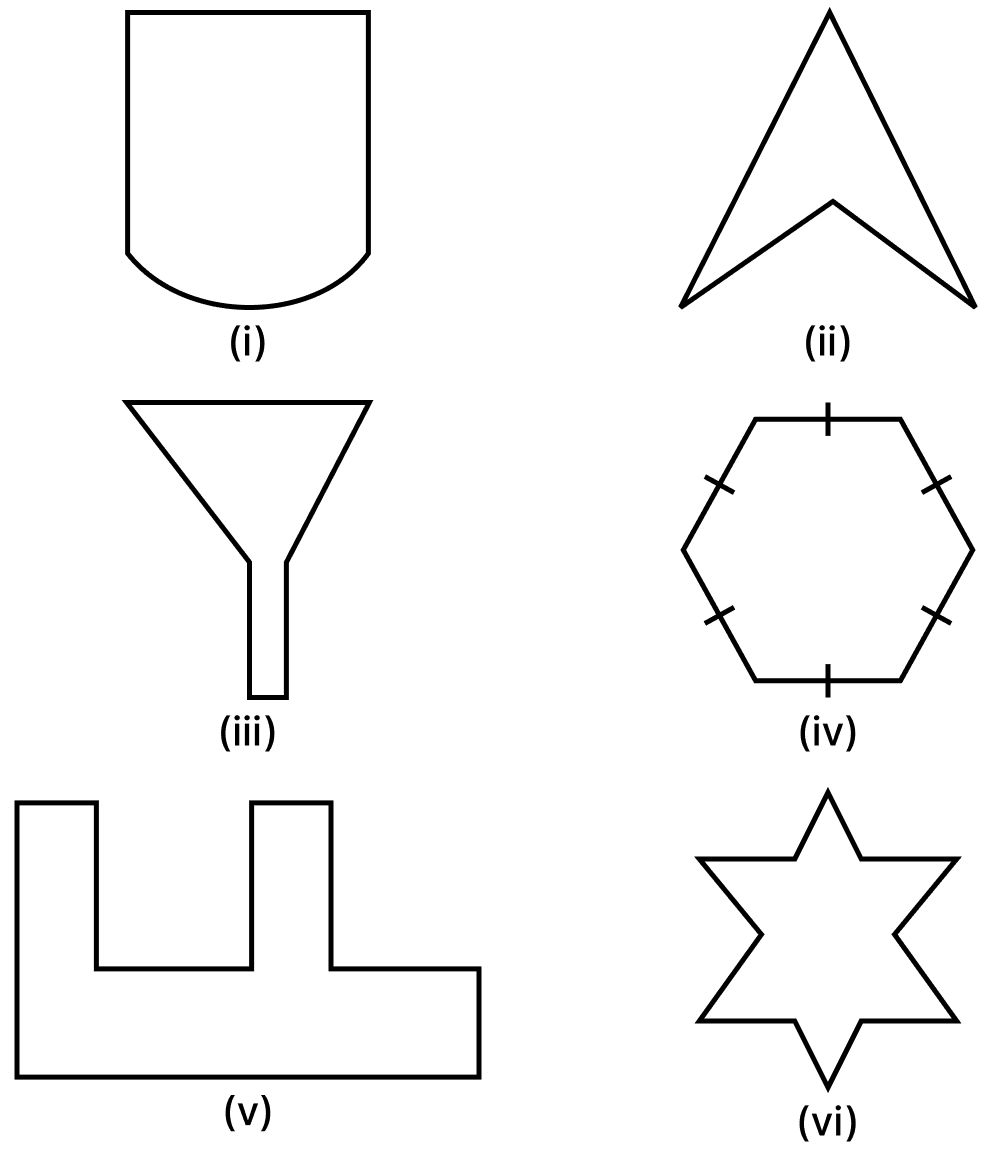
(i) The figure is bounded by line segments and a curved line.
Hence, the given figure is not a polygon.
(ii) The figure is a simple closed figure bounded by 4 line segments and one of its angles is more than 180°.
Hence, the given figure is a polygon, namely a concave quadrilateral.
(iii) The figure is a simple closed figure bounded by 6 line segments and at least one of its angles is more than 180°.
Hence, the given figure is a polygon, namely a concave hexagon.
(iv) The figure is a simple closed figure bounded by 6 line segments, having all sides equal and all angles equal.
Hence, the given figure is a polygon, namely a regular hexagon.
(v) The figure is a simple closed figure bounded by 10 line segments and at least one of its angles is more than 180°.
Hence, the given figure is a polygon, namely a concave decagon.
(vi) The figure is a simple closed figure bounded by 12 line segments and at least one of its angles is more than 180°.
Hence, the given figure is a polygon, namely a concave 12-gon.
Find the sum of the interior angles of a nonagon.
Answer
We know that the sum of the interior angles of a polygon of sides = right angles.
A nonagon has 9 sides, so .
Sum of interior angles of a nonagon = (2 × 9 - 4) right angles
= 14 right angles
= 14 × 90°
= 1260°
Hence, the sum of the interior angles of a nonagon is 1260°.
Find the sum of the interior angles of a 16-sided polygon.
Answer
We know that the sum of the interior angles of a polygon of sides = right angles.
Here, .
Sum of interior angles of a 16-sided polygon = (2 × 16 - 4) right angles
= 28 right angles
= 28 × 90°
= 2520°
Hence, the sum of the interior angles of a 16-sided polygon is 2520°.
Find the measure of each interior angle of a regular decagon.
Answer
We know that the sum of the interior angles of a polygon of sides = right angles.
Since the interior angles of a regular polygon are of the same measure, each interior angle is obtained by dividing the sum of the interior angles by the number of sides.
A decagon has 10 sides, so .
Sum of interior angles of a decagon = (2 × 10 - 4) right angles
= 16 × 90°
= 1440°
Each interior angle of a regular decagon =
= 144°
Hence, each interior angle of a regular decagon is 144°.
Find the measure of each interior angle of a regular 18-sided polygon.
Answer
We know that the sum of the interior angles of a polygon of sides = right angles.
Since the interior angles of a regular polygon are of the same measure, each interior angle is obtained by dividing the sum of the interior angles by the number of sides.
Here, .
Sum of interior angles of an 18-sided polygon = (2 × 18 - 4) right angles
= 32 × 90°
= 2880°
Each interior angle of a regular 18-sided polygon =
= 160°
Hence, each interior angle of a regular 18-sided polygon is 160°.
Five of the angles of a hexagon are each 115°. Calculate the measure of the sixth angle.
Answer
It is given that five of the angles of a hexagon are each 115°.
We know that the sum of the interior angles of a polygon of sides = right angles.
A hexagon has 6 sides, so .
Sum of interior angles of a hexagon = (2 × 6 - 4) right angles
= 8 × 90°
= 720°
Sum of the five given angles = 5 × 115° = 575°
So,
Sixth angle = 720° - 575°
= 145°
Hence, the measure of the sixth angle is 145°.
The angles of a heptagon are and . Calculate .
Answer
It is given that the angles of a heptagon are and .
We know that the sum of the interior angles of a polygon of sides = right angles.
A heptagon has 7 sides, so .
Sum of interior angles of a heptagon = (2 × 7 - 4) right angles
= 10 × 90°
= 900°
So,
Hence, the value of .
An octagon has three equal angles each of measure 115°. If all the remaining angles have equal measure, find the measure of each of these remaining angles.
Answer
It is given that an octagon has three equal angles each of measure 115° and all the remaining angles have equal measure.
We know that the sum of the interior angles of a polygon of sides = right angles.
An octagon has 8 sides, so .
Sum of interior angles of an octagon = (2 × 8 - 4) right angles
= 12 × 90°
= 1080°
Sum of the three equal angles = 3 × 115° = 345°
Number of remaining angles = 8 - 3 = 5
Let the measure of each of the remaining angles be .
So,
Hence, the measure of each of the remaining angles is 147°.
The sum of the interior angles of a polygon is 2160°. How many sides does this polygon have?
Answer
It is given that the sum of the interior angles of a polygon is 2160°.
Let the number of sides of the polygon be .
Then, sum of interior angles of the polygon = right angles = × 90°.
So,
Hence, the polygon has 14 sides.
Find the number of sides of a regular polygon if each of its interior angles measures 140°.
Answer
Let the number of sides of the regular polygon be .
Then, sum of its interior angles = right angles = × 90°.
Measure of each interior angle =
Hence, the number of sides is 9.
Find the number of sides of a regular polygon if each of its interior angles measures 162°.
Answer
Let the number of sides of the regular polygon be .
Then, sum of its interior angles = right angles = × 90°.
Measure of each interior angle =
Hence, the number of sides is 20.
Find the number of sides of a regular polygon if each of its interior angles measures 150°.
Answer
Let the number of sides of the regular polygon be .
Then, sum of its interior angles = right angles = × 90°.
Measure of each interior angle =
Hence, the number of sides is 12.
Find the measure of each exterior angle of a regular decagon.
Answer
A decagon has 10 sides, so .
As an exterior angle and the adjacent interior angle together form a linear pair,
Each exterior angle = 180° - Each interior angle
= 180° - 144°
= 36°
Hence, each exterior angle of a regular decagon is 36°.