
Construct the angle 36° using protractor.
Answer
Steps of construction :
Draw a ray OA.
Keep the protractor with its central point at O and the horizontal edge along OA.
Look at the scale with 0° mark of the protractor lying on OA.
On this scale, mark a point B against 36° mark and remove the protractor.
Join O and B.
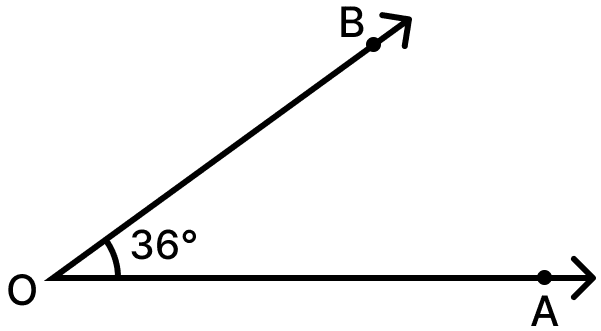
Hence, ∠AOB is the required angle of 36°.
Construct the angle 58° using protractor.
Answer
Steps of construction :
Draw a ray OA.
Keep the protractor with its central point at O and the horizontal edge along OA.
Look at the scale with 0° mark of the protractor lying on OA.
On this scale, mark a point B against 58° mark and remove the protractor.
Join O and B.
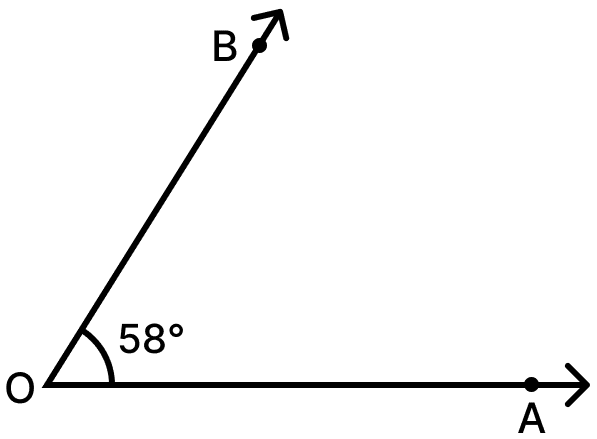
Hence, ∠AOB is the required angle of 58°.
Construct the angle 90° using protractor.
Answer
Steps of construction :
Draw a ray OA.
Keep the protractor with its central point at O and the horizontal edge along OA.
Look at the scale with 0° mark of the protractor lying on OA.
On this scale, mark a point B against 90° mark and remove the protractor.
Join O and B.
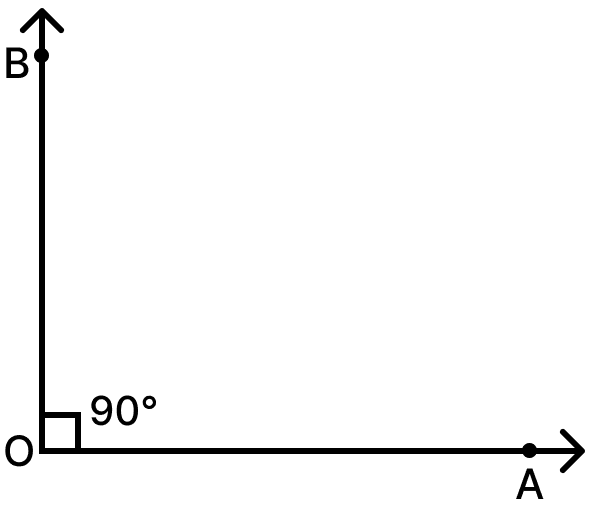
Hence, ∠AOB is the required angle of 90°.
Construct the angle 105° using protractor.
Answer
Steps of construction :
Draw a ray OA and extend it on the left of O to a point A′.
Keep the protractor with its central point at O and the horizontal edge along A′OA.
Look at the scale with 0° mark of the protractor lying on OA.
Move from right to left, starting with 0°, and mark a point B against 105° mark. Remove the protractor.
Join O and B.
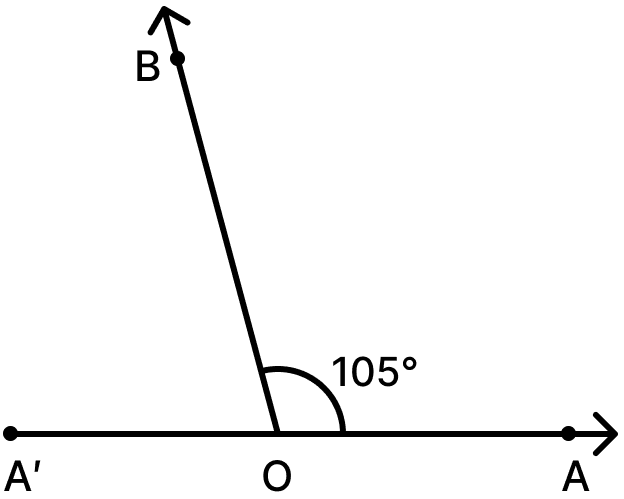
Hence, ∠AOB is the required angle of 105°.
Construct the angle 45° using protractor.
Answer
Steps of construction :
Draw a ray OA.
Keep the protractor with its central point at O and the horizontal edge along OA.
Look at the scale with 0° mark of the protractor lying on OA.
On this scale, mark a point B against 45° mark and remove the protractor.
Join O and B.
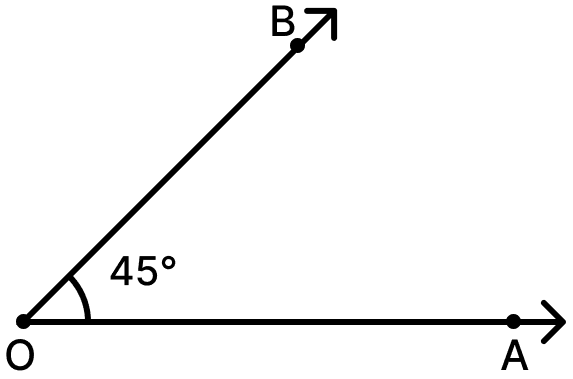
Hence, ∠AOB is the required angle of 45°.
Construct the angle 125° using protractor.
Answer
Steps of construction :
Draw a ray OA and extend it on the left of O to a point A′.
Keep the protractor with its central point at O and the horizontal edge along A′OA.
Look at the scale with 0° mark of the protractor lying on OA.
Move from right to left, starting with 0°, and mark a point B against 125° mark. Remove the protractor.
Join O and B.
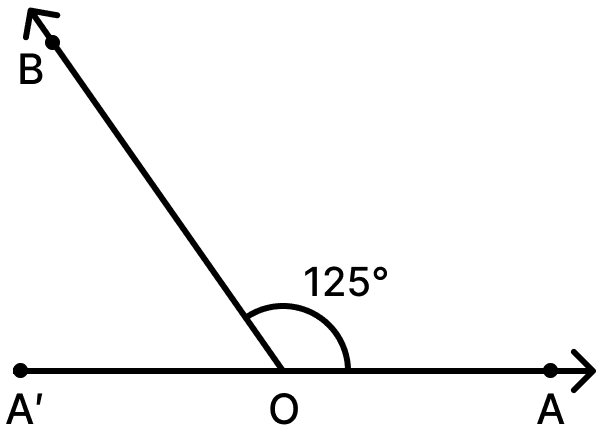
Hence, ∠AOB is the required angle of 125°.
Construct the angle 20° using protractor.
Answer
Steps of construction :
Draw a ray OA.
Keep the protractor with its central point at O and the horizontal edge along OA.
Look at the scale with 0° mark of the protractor lying on OA.
On this scale, mark a point B against 20° mark and remove the protractor.
Join O and B.
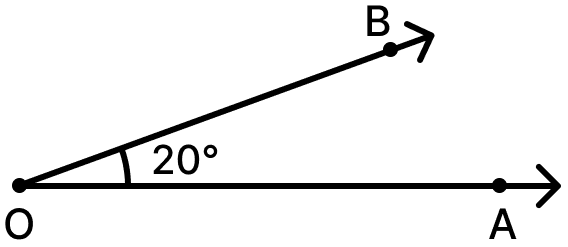
Hence, ∠AOB is the required angle of 20°.
Construct the angle 140° using protractor.
Answer
Steps of construction :
Draw a ray OA and extend it on the left of O to a point A′.
Keep the protractor with its central point at O and the horizontal edge along A′OA.
Look at the scale with 0° mark of the protractor lying on OA.
Move from right to left, starting with 0°, and mark a point B against 140° mark. Remove the protractor.
Join O and B.
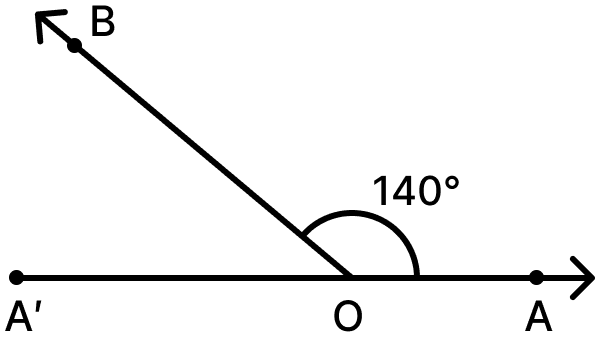
Hence, ∠AOB is the required angle of 140°.
Draw ∠AOB = 65° using a protractor. Now, using ruler and compasses, construct ∠XOY = ∠AOB.
Answer
Steps of construction :
Draw a ray OA.
Keep the protractor with its central point at O and the horizontal edge along OA.
Look at the scale with 0° mark of the protractor lying on OA.
On this scale, mark a point B against 65° mark and remove the protractor.
Join O and B. Then, ∠AOB = 65°.
With O as centre and any radius, draw an arc, cutting OA and OB at P and Q respectively.
Draw any ray OX.
With O as centre and radius equal to OP, draw an arc LM, cutting OX at M.
With M as centre and radius equal to PQ, draw an arc, cutting LM at N.
Join O and N and produce it to make the ray OY.
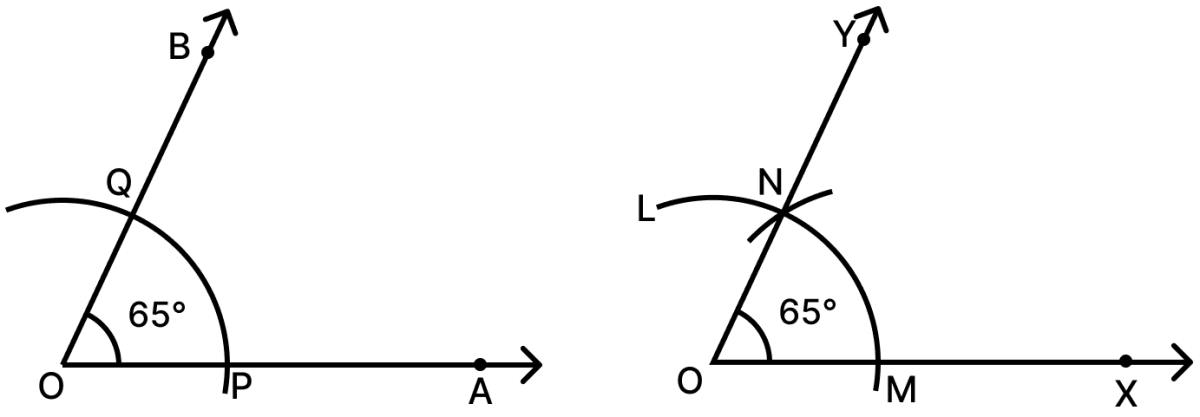
∠XOY = ∠AOB = 65°
Hence, ∠XOY is the required angle equal to ∠AOB.
Draw ∠XOY = 53° using a protractor. Bisect ∠XOY using ruler and compasses.
Answer
Steps of construction :
Draw a ray OX.
Keep the protractor with its central point at O and the horizontal edge along OX.
Look at the scale with 0° mark of the protractor lying on OX.
On this scale, mark a point Y against 53° mark and remove the protractor.
Join O and Y. Then, ∠XOY = 53°.
With O as centre and any convenient radius, draw an arc, cutting OX and OY at P and Q respectively.
With P as centre and radius slightly more than PQ, draw an arc in the interior of ∠XOY.
With Q as centre and the same radius (as in step 7), draw another arc, cutting the previous arc at Z.
Draw OZ.
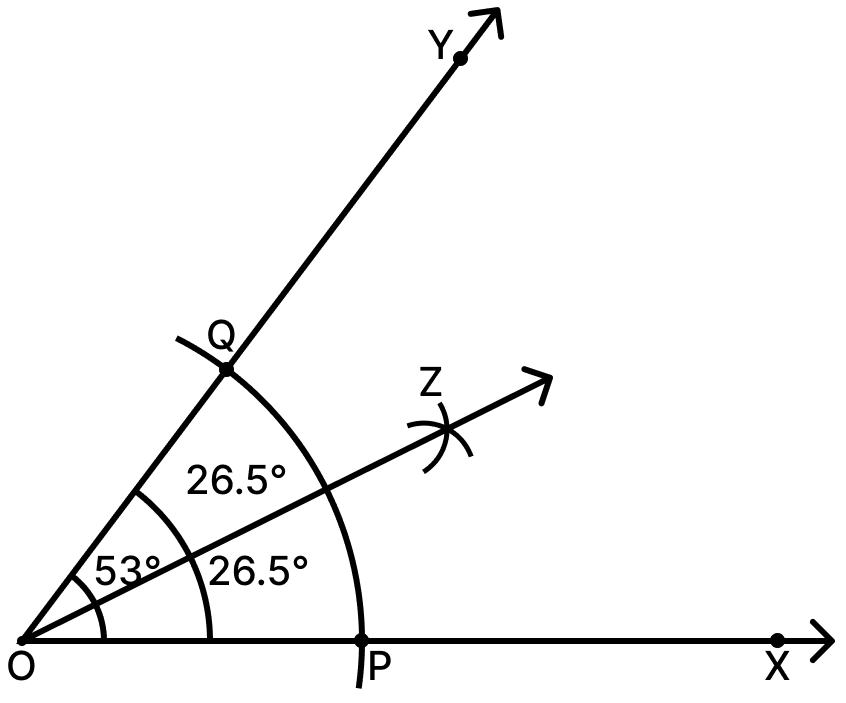
∠XOZ = ∠YOZ = ∠XOY = × 53° = 26.5°
Hence, OZ is the required bisector of ∠XOY.
Draw ∠POQ = 110° using a protractor. Bisect ∠POQ using ruler and compasses.
Answer
Steps of construction :
Draw a ray OP and extend it on the left of O to a point P′.
Keep the protractor with its central point at O and the horizontal edge along P′OP.
Look at the scale with 0° mark of the protractor lying on OP.
Move from right to left, starting with 0°, and mark a point Q against 110° mark. Remove the protractor.
Join O and Q. Then, ∠POQ = 110°.
With O as centre and any convenient radius, draw an arc, cutting OP and OQ at M and N respectively.
With M as centre and radius slightly more than MN, draw an arc in the interior of ∠POQ.
With N as centre and the same radius (as in step 7), draw an arc cutting the previous arc at R.
Draw OR.
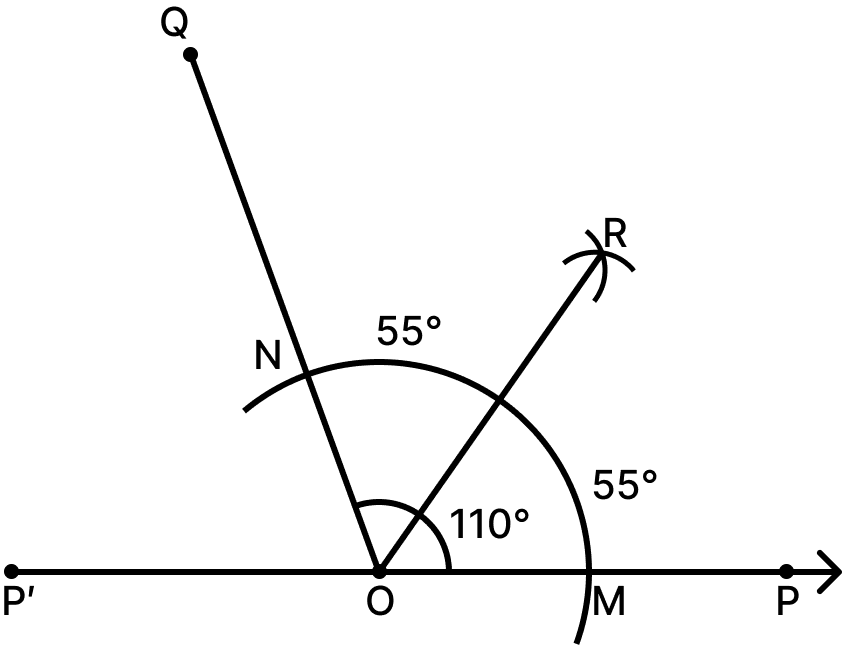
∠POR = ∠QOR = ∠POQ = × 110° = 55°
Hence, OR is the required bisector of ∠POQ.
Draw a line segment AB = 5.3 cm. Using ruler and compasses, draw the perpendicular bisector of AB.
Answer
Steps of construction :
Draw a line segment AB = 5.3 cm.
With A as centre and radius more than AB, draw one arc above AB and one arc below AB.
With B as centre and the same radius as in step 2, draw other arcs, cutting the previous arcs at M and N.
Join M and N, cutting AB at P.
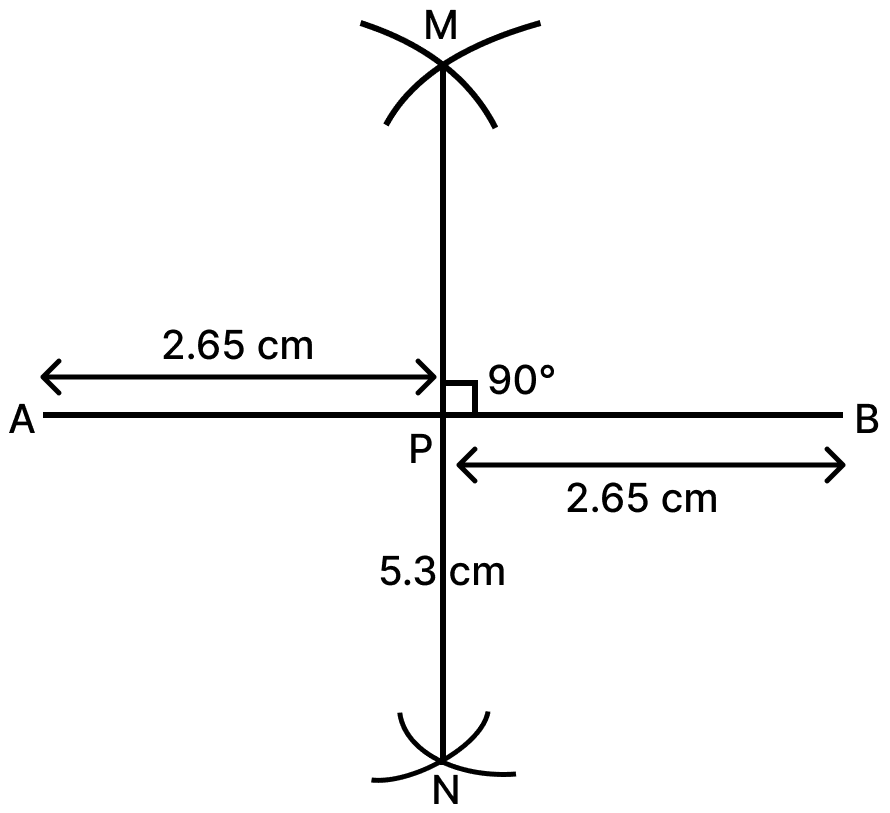
Here, AP = PB = AB = 2.65 cm and ∠MPB = 90°.
Hence, MPN is the required perpendicular bisector of the given line segment AB.
Draw a line segment AB = 4.8 cm. Take a point P outside AB. From P, draw PQ ⊥ AB, using ruler and compasses.
Answer
Steps of construction :
Draw a line segment AB = 4.8 cm.
Take a point P outside AB.
With P as centre and any convenient radius, draw an arc, cutting AB at M and N.
With M as centre and radius more than MN, draw an arc, below the line AB.
With N as centre and the same radius (as in step 4), draw another arc, cutting the first arc at Q.
Join P and Q, meeting AB at X.
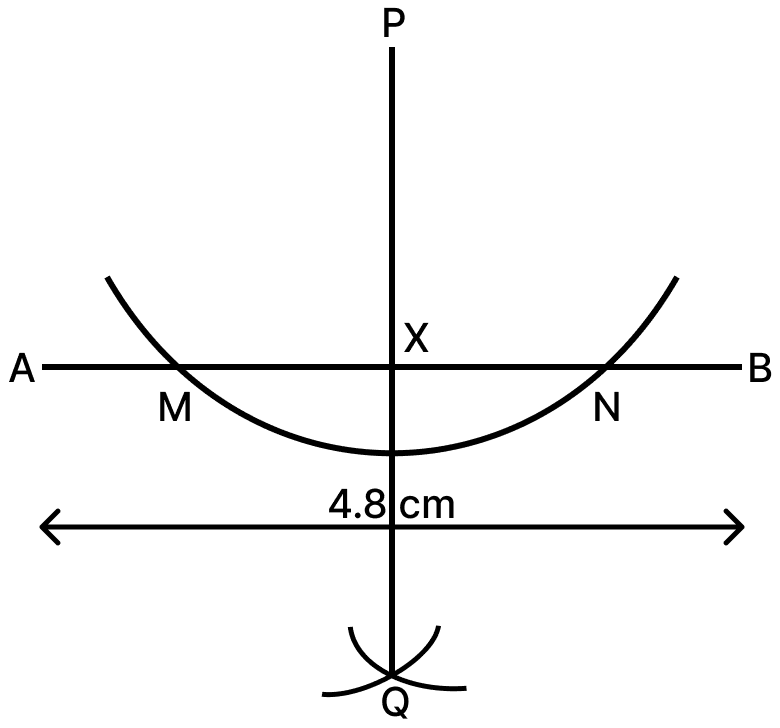
Hence, PQ is the required perpendicular from P to AB.
Draw a line segment AB = 5.2 cm. Take a point C on AB such that AC = 3 cm. From C, draw CD ⊥ AB using ruler and compasses.
Answer
Given, AB = 5.2 cm and AC = 3 cm.
Steps of construction :
Draw a line segment AB = 5.2 cm.
From AB, cut off AC = 3 cm.
With C as centre and a convenient radius, draw a semi-circle, cutting AB at M and N.
With M as centre and radius more than MN, draw an arc.
With N as centre and the same radius (as in step 4), draw another arc, cutting the previous arc at D.
Join D and C.
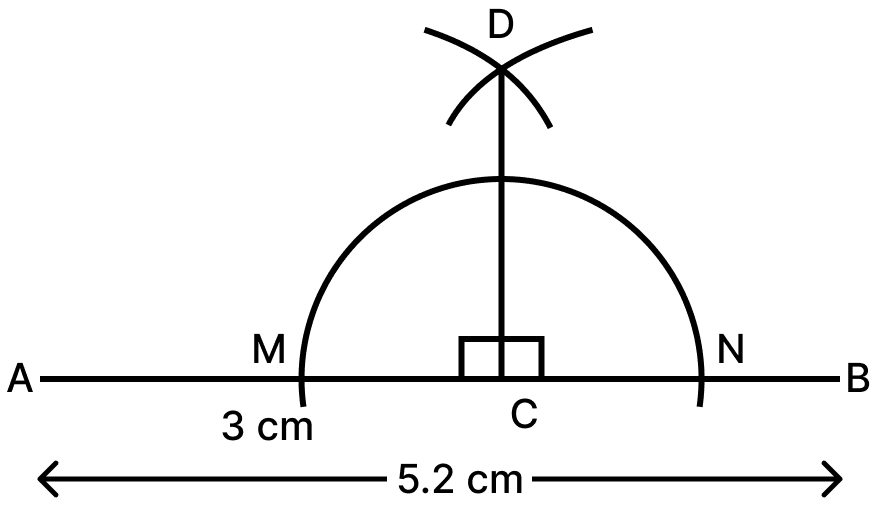
Here, ∠DCA = ∠DCB = 90°.
Hence, CD is the required perpendicular to AB at the point C.
Using ruler and compasses, construct an angle of 60°.
Answer
Steps of construction :
Draw any ray OA.
With O as centre and any convenient radius, draw an arc MN, cutting OA at M.
With M as centre and the same radius (as in step 2), draw an arc, cutting the arc MN at P.
Join O and P and produce it to B.
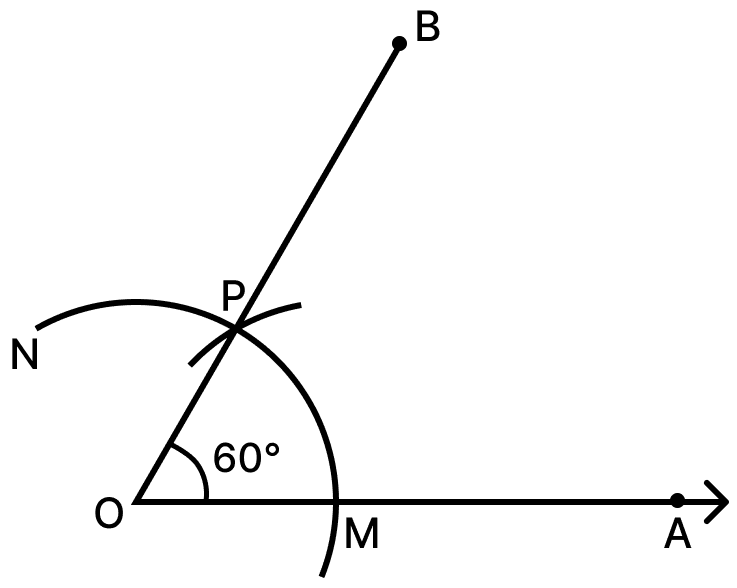
Hence, ∠AOB is the required angle of measure 60°.
Using ruler and compasses, construct an angle of 120°.
Answer
Steps of construction :
Draw any ray OA.
With O as centre and any convenient radius, draw an arc MN (nearly a semi-circle), cutting OA at M.
With M as centre and the same radius (as in step 2), draw an arc, cutting arc MN at P.
With P as centre and the same radius (as in step 2), draw an arc, cutting arc MN at Q.
Join O and Q and produce it to D.
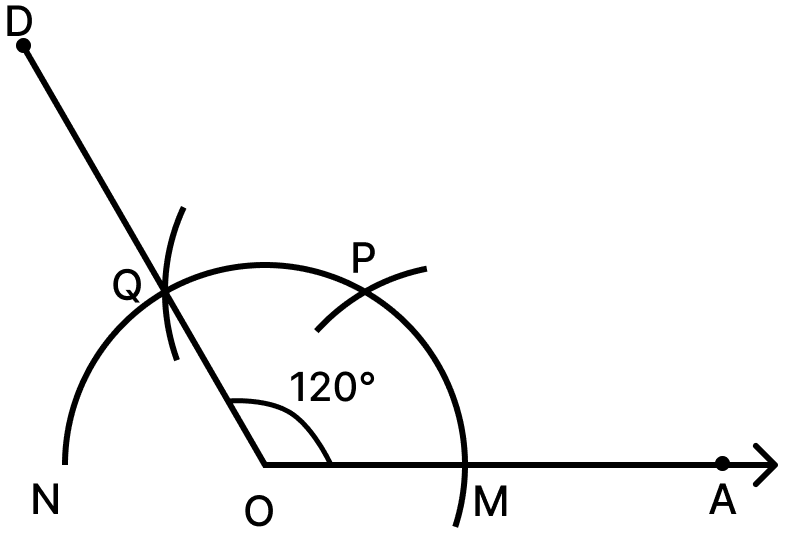
Hence, ∠AOD is the required angle whose measure is 120°.
Using ruler and compasses, construct an angle of 30°.
Answer
As, 30° = × 60°
Steps of construction :
Draw any ray OA.
With O as centre and any convenient radius, draw an arc MN, cutting OA at M.
With M as centre and the same radius (as in step 2), draw an arc, cutting arc MN at P.
Join O and P and produce it to B. Then, ∠AOB = 60°.
With M as centre and radius slightly more than MP, draw an arc in the interior of ∠AOB.
With P as centre and the same radius (as in step 5), draw another arc, cutting the previous arc at C.
Draw ray OC.
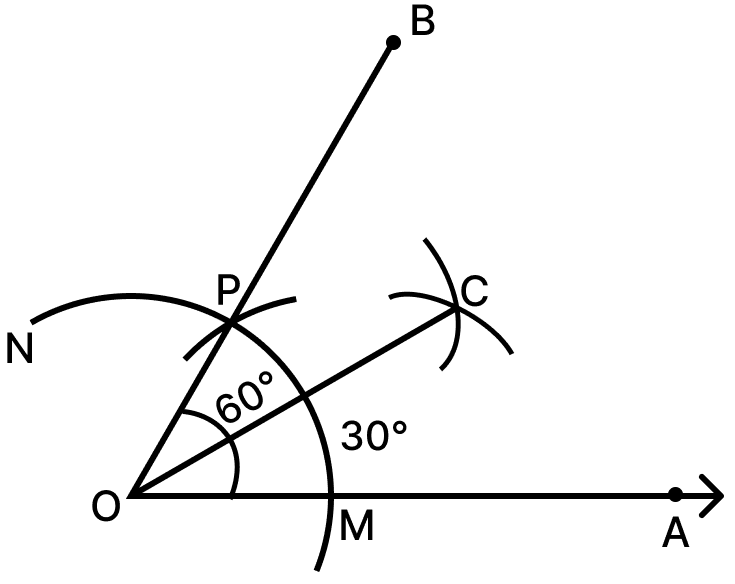
∠AOC = ∠AOB = × 60° = 30°
Hence, ∠AOC is the required angle whose measure is 30°.
Using ruler and compasses, construct an angle of 90°.
Answer
Steps of construction :
Draw any ray OA.
With O as centre and any convenient radius, draw an arc MN (nearly a semi-circle), cutting OA at M.
With M as centre and the same radius (as in step 2), draw an arc, cutting arc MN at P.
With P as centre and the same radius (as in step 2), draw an arc, cutting arc MN at Q.
With P as centre and radius slightly more than PQ, draw an arc above arc MN.
With Q as centre and the same radius (as in step 5), draw another arc, cutting the previous arc at B.
Draw ray OB.
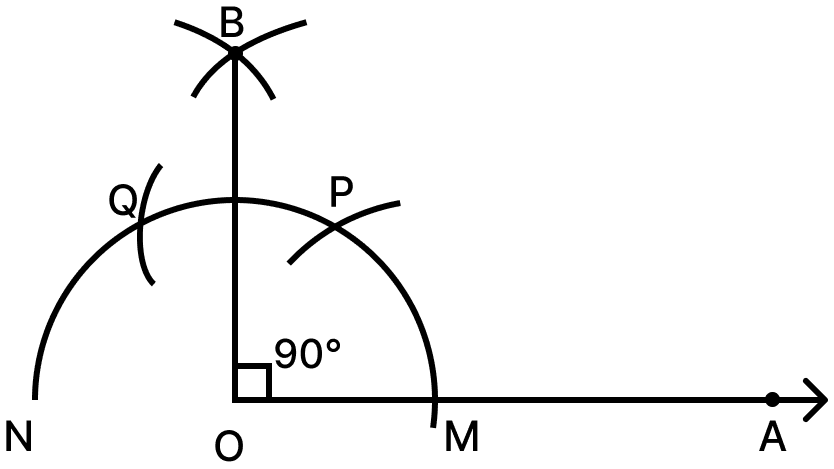
Hence, ∠AOB is the desired angle whose measure is 90°.
Using ruler and compasses, construct an angle of 45°.
Answer
As, 45° = × 90°
Steps of construction :
Draw any ray OA.
With O as centre and any convenient radius, draw an arc MN (nearly a semi-circle), cutting OA at M.
With M as centre and the same radius (as in step 2), draw an arc, cutting arc MN at P.
With P as centre and the same radius (as in step 2), draw an arc, cutting arc MN at Q.
With P as centre and radius slightly more than PQ, draw an arc above arc MN.
With Q as centre and the same radius (as in step 5), draw another arc, cutting the previous arc at B.
Draw ray OB. Then, ∠AOB = 90°.
Let OB cut the arc MN at R.
With M and R as centres and radius more than MR, draw two arcs which cut each other at C.
Draw ray OC. Then, OC is the bisector of ∠AOB.
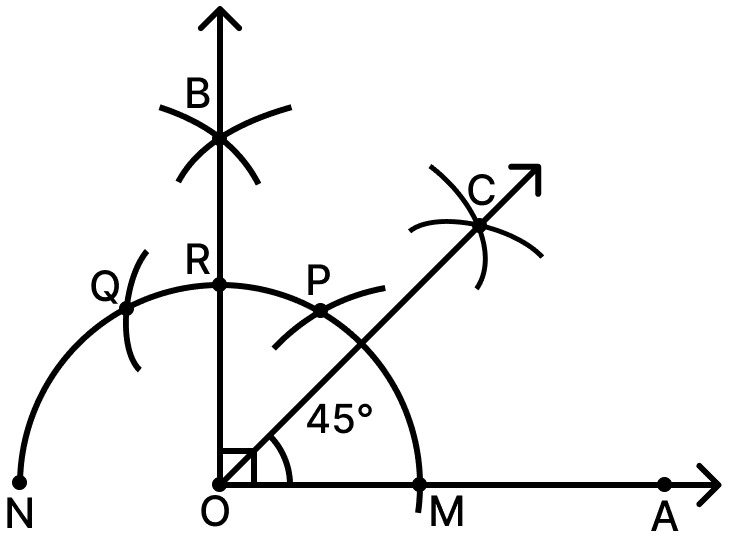
∠AOC = ∠AOB = × 90° = 45°
Hence, ∠AOC is the desired angle of measure 45°.
Draw a line segment AB = 4.6 cm. Construct ∠BAC = 30° and ∠ABC = 60°. Measure ∠ACB.
Answer
Given, AB = 4.6 cm, ∠BAC = 30° and ∠ABC = 60°.
Steps of construction :
Draw a line segment AB = 4.6 cm.
With A as centre and any convenient radius, draw an arc, cutting AB at M.
With M as centre and the same radius (as in step 2), draw an arc, cutting the previous arc at P. Then, ray AP makes an angle of 60° with AB.
With M as centre and radius slightly more than MP, draw an arc in the interior of the angle.
With P as centre and the same radius (as in step 4), draw another arc, cutting the previous arc at R.
Draw ray AR. Then, ∠BAR = × 60° = 30°.
With B as centre and any convenient radius, draw an arc, cutting BA at N.
With N as centre and the same radius (as in step 7), draw an arc, cutting the previous arc at S.
Join B and S and produce it to meet AR at C. Then, ∠ABC = 60°.
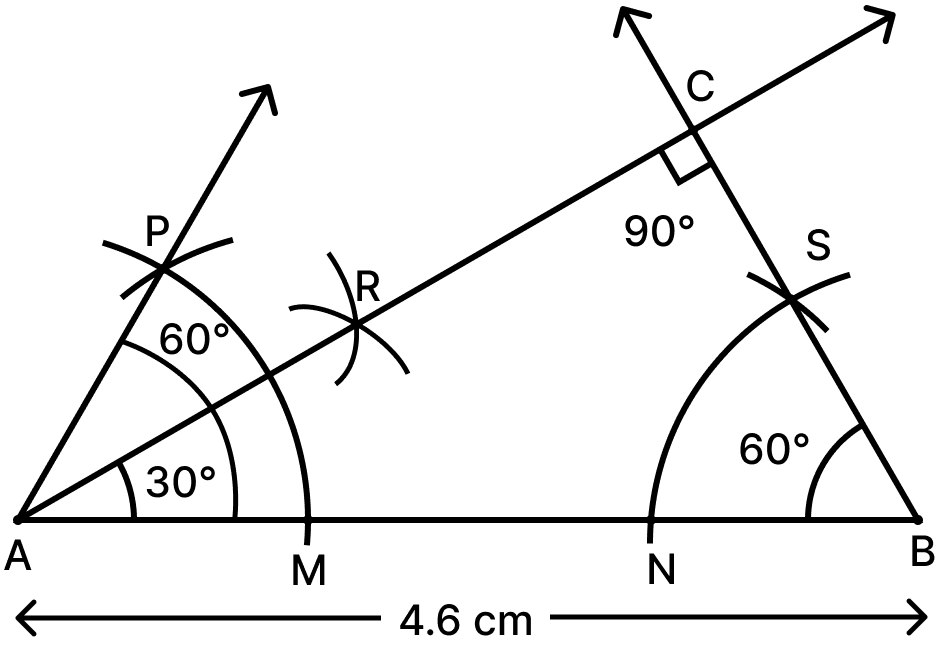
On measuring, we get :
∠ACB = 90°
Hence, ABC is the required triangle with ∠BAC = 30° and ∠ABC = 60°.
Draw a circle of radius 5 cm using compasses.
Answer
Steps of construction :
Fix a sharp pencil in the pencil-holding arm of the compasses in such a way that the metal tip of the compasses and the sharp end of the pencil are in the same level.
Put the metal tip of the compasses at 0 cm mark of the scale and open the other arm in such a way that the pencil end touches the 5 cm mark on the scale. Now, remove the open compasses from the scale.
Mark a point O on the plane of the paper.
Rest the metal tip of the compasses at O and hold the head of the compasses firmly such that the pencil end touches the paper.
Move the pencil around so that it traces a circle.
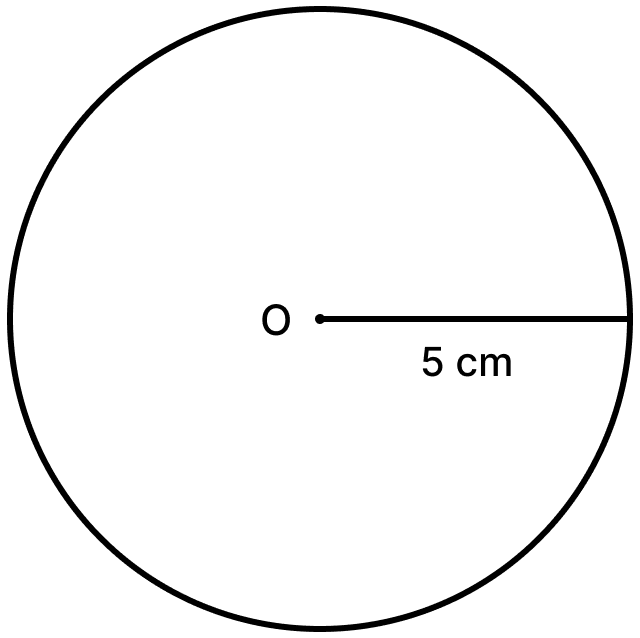
Hence, the circle so obtained is the required circle with centre O and radius 5 cm.
Take a point O on a paper. Draw a circle with centre O and radius 4.3 cm.
Answer
Steps of construction :
Fix a sharp pencil in the pencil-holding arm of the compasses in such a way that the metal tip of the compasses and the sharp end of the pencil are in the same level.
Put the metal tip of the compasses at 0 cm mark of the scale and open the other arm in such a way that the pencil end touches the 4.3 cm mark on the scale. Now, remove the open compasses from the scale.
Mark a point O on the plane of the paper.
Rest the metal tip of the compasses at O and hold the head of the compasses firmly such that the pencil end touches the paper.
Move the pencil around so that it traces a circle.
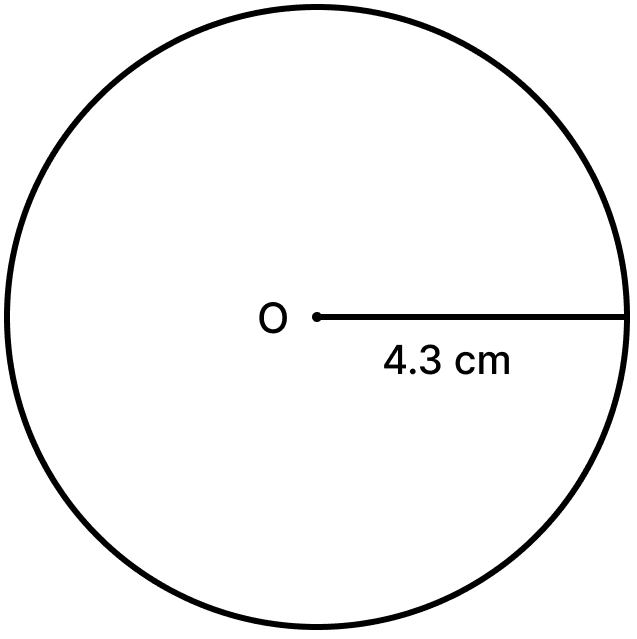
Hence, the circle so obtained is the required circle with centre O and radius 4.3 cm.
Mark any two points P and Q on a paper. Using compasses, draw a circle with centre P and passing through Q.
Answer
Steps of construction :
Mark any two points P and Q on the paper.
Put the metal tip of the compasses at P and open the other arm in such a way that the pencil end touches the point Q. Then, the radius taken is PQ.
Rest the metal tip of the compasses at P and hold the head of the compasses firmly such that the pencil end touches the paper at Q.
Move the pencil around so that it traces a circle.
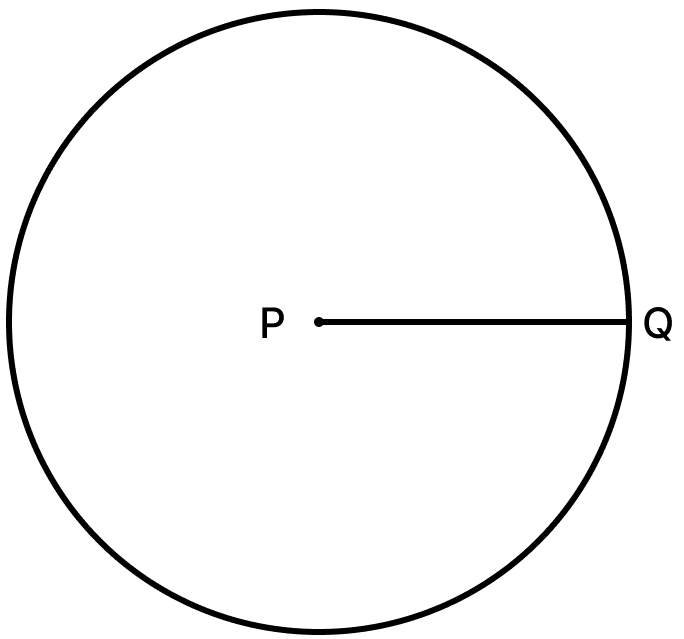
Since the radius of the circle is PQ, the point Q lies on the circle.
Hence, the circle so obtained is the required circle with centre P and passing through Q.
Mark any three points O, P, Q. Draw a circle with centre O and which contains P in its interior and Q in its exterior.
Answer
Steps of construction :
Mark any three points O, P and Q on the paper such that OP < OQ.
Measure OP and OQ.
Open the compasses to a radius r which is greater than OP and smaller than OQ, i.e., OP < r < OQ.
Rest the metal tip of the compasses at O and hold the head of the compasses firmly such that the pencil end touches the paper.
Move the pencil around so that it traces a circle.
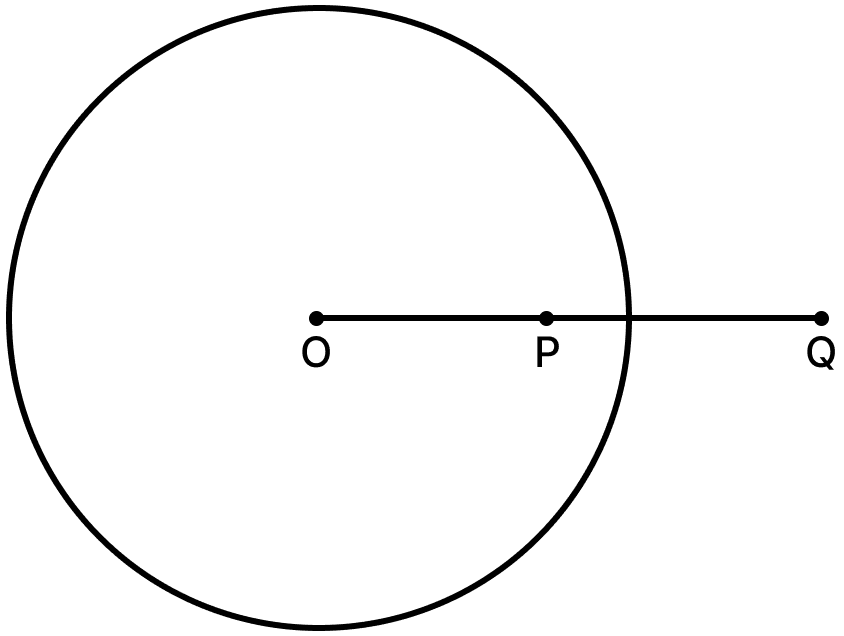
Since OP < r, the point P lies in the interior of the circle.
Since OQ > r, the point Q lies in the exterior of the circle.
Hence, the circle so obtained is the required circle with centre O, containing P in its interior and Q in its exterior.
Draw a line segment AB of length 6 cm. Draw a circle with AB as diameter. In this circle draw a chord of length 4 cm. Shade the minor segment of the circle.
Answer
Steps of construction :
Draw a line segment AB = 6 cm.
With A as centre and radius more than AB, draw one arc above AB and one arc below AB.
With B as centre and the same radius as in step 2, draw other arcs, cutting the previous arcs at M and N.
Join M and N, cutting AB at C. Then, C is the mid-point of AB and CA = CB = 3 cm.
With C as centre and radius CA, draw a circle. This circle has AB as its diameter.
Take a point P on the circle.
With P as centre and radius 4 cm, draw an arc to cut the circle at Q.
Join P and Q. Then, PQ is a chord of length 4 cm.
Shade the smaller region bounded by the chord PQ and the minor arc PQ.
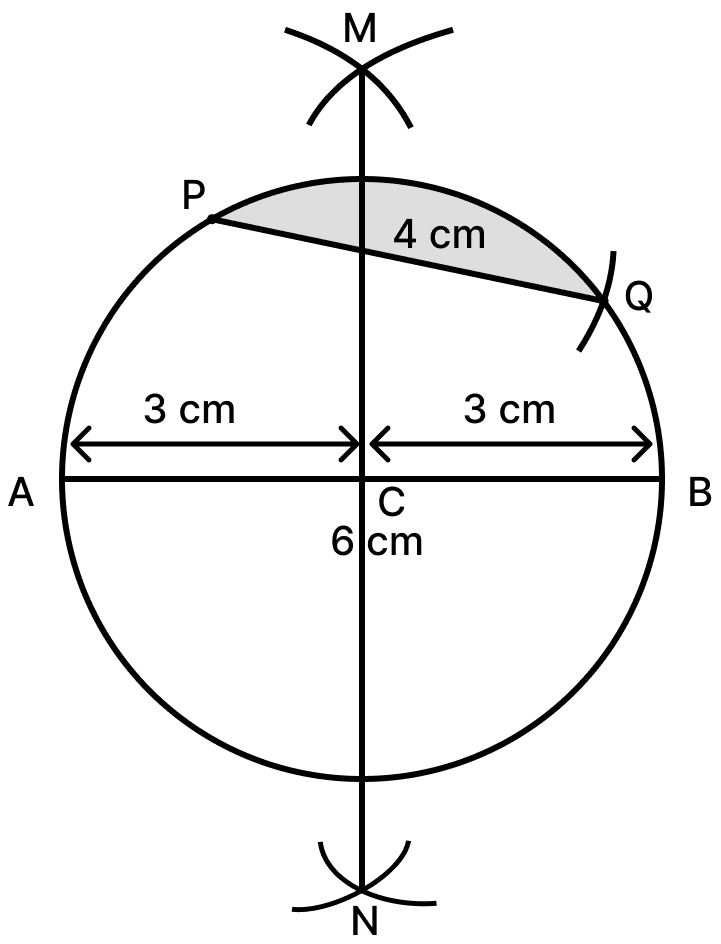
Hence, PQ is the required chord of length 4 cm and the shaded region is the minor segment of the circle.