
A solution turns the red litmus paper to blue. Excess addition of which of the following solution would reverse the change?
- Lime water
- Baking soda
- Vinegar
- Common salt solution
Answer
Vinegar
Reason — The solution is basic because it turns red litmus paper blue. Vinegar is acidic. On adding vinegar in excess, it neutralises the base and makes the solution acidic, thereby reversing the litmus colour change.
You are provided with three unknown solutions labelled A, B, and C, but you do not know which of these are acidic, basic, or neutral. Upon adding a few drops of red litmus solution to solution A, it turns blue. When a few drops of turmeric solution are added to solution B, it turns red. Finally, after adding a few drops of red rose extract to solution C, it turns green.
Based on the observations, which of the following is the correct sequence for the nature of solutions A, B, and C?
- Acidic, acidic, and acidic
- Neutral, basic, and basic
- Basic, basic, and acidic
- Basic, basic, and basic
Answer
Basic, basic, and basic
Reason — Red litmus turns blue in solution A, so A is basic. Turmeric turns red in solution B, so B is basic. Red rose extract turns green in solution C, so C is also basic. Hence, A, B, and C are basic in nature.
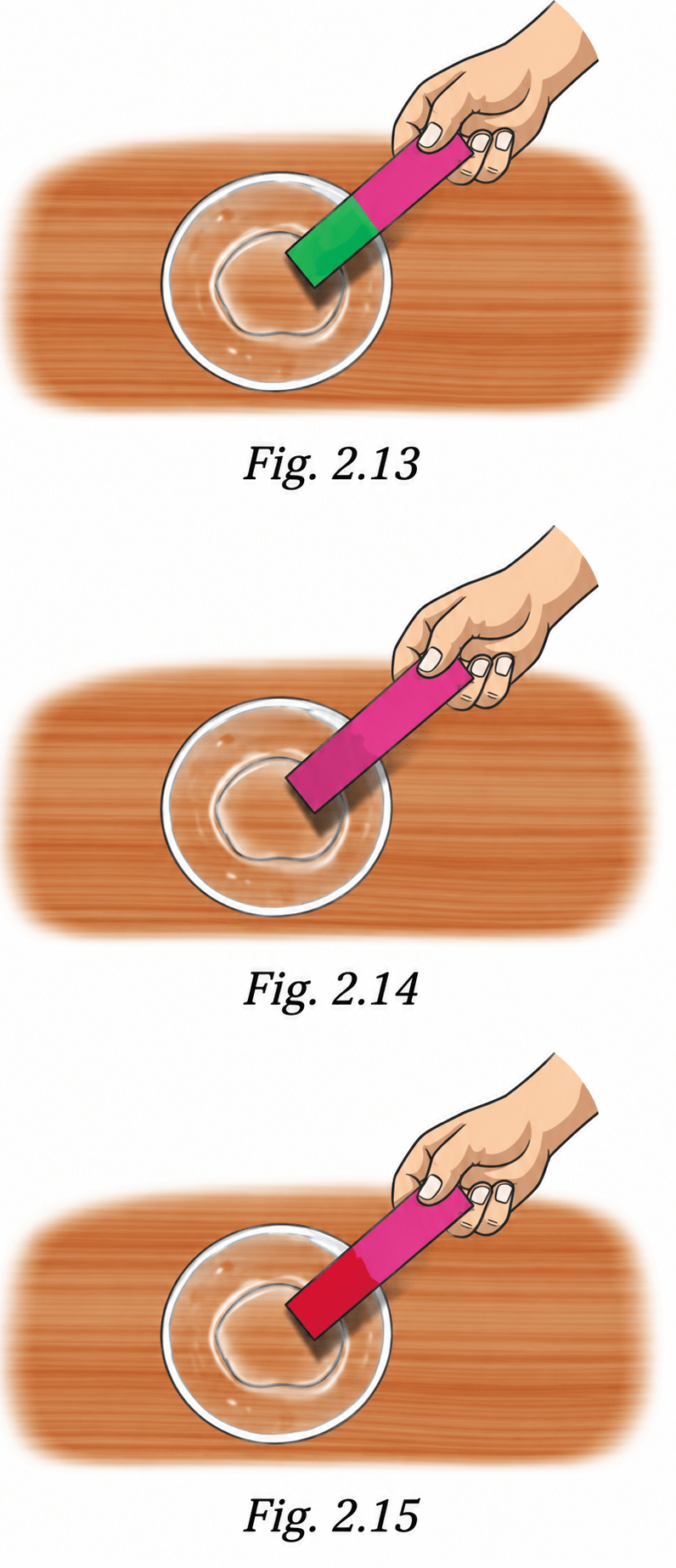
Observe and analyse Figs. 2.13, 2.14, and 2.15, in which red rose extract paper strips are used. Label the nature of solutions present in each of the containers.
Answer
Red rose extract gives a red colour in acidic solutions, a green colour in basic solutions, and shows no change in neutral solutions.
Fig. 2.13 — The strip turns green, so the solution is basic in nature.
Fig. 2.14 — The strip shows no change in colour, so the solution is neutral in nature.
Fig. 2.15 — The strip turns red, so the solution is acidic in nature.
A liquid sample from the laboratory was tested using various indicators:
| Indicator | Red litmus | Blue litmus | Turmeric |
|---|---|---|---|
| Change | No change | Turned red | No change in colour |
Based on the tests, identify the acidic or basic nature of the liquid and justify your answer.
Answer
The liquid is acidic in nature.
Justification — The blue litmus turned red, which shows that the liquid is acidic. The red litmus showed no change, which is also expected for an acidic liquid as acids do not affect red litmus. Turmeric did not change colour, because turmeric turns red only in basic solutions and stays unchanged in acidic and neutral solutions. All three observations confirm that the liquid is acidic.
Manya is blindfolded. She is given two unknown solutions to test and determine whether they are acidic or basic. Which indicator should Manya use to test the solutions and why?
Answer
Manya should use an olfactory indicator, such as onion. Since she is blindfolded, she cannot observe colour changes. The characteristic smell of onion remains in an acidic medium but is not detected in a basic medium. Thus, she can distinguish between the acidic and basic solutions by observing the change in odour.
Could you suggest various materials which can be used for writing the message on the white sheet of paper (given at the beginning of the chapter) and what could be in the spray bottle? Make a table of various possible combinations and the colour of the writing obtained.
Answer
The message can be written using an acidic or basic solution, while the spray bottle can contain a suitable indicator. Some possible combinations are:
| Material used for writing | Liquid in the spray bottle | Colour of the writing obtained |
|---|---|---|
| Soap solution (basic) | Turmeric solution | Red |
| Baking soda solution (basic) | Turmeric solution | Red |
| Soap solution (basic) | Red rose extract | Green |
| Lemon juice (acidic) | Red rose extract | Red |
| Lemon juice (acidic) | Blue litmus solution | Red |
Grape juice was mixed with red rose extract; the mixture got a tint of red colour. What will happen if baking soda is added to this mixture? Justify your answer.
Answer
The red tint shows that grape juice is acidic. Baking soda is basic, so it neutralises the acid present in the mixture. If sufficient baking soda is added to make the mixture basic, the red rose extract changes from red to green.
Keerthi wrote a secret message to her grandmother on her birthday using orange juice. Can you assist her grandmother in revealing the message? Which indicator would you use to make it visible?
Answer
Orange juice is acidic. Blue litmus solution can be sprayed on the paper. The portions containing orange juice will turn the blue litmus red, making the secret message visible.
How can natural indicators be prepared? Explain by giving an example.
Answer
Natural indicators can be prepared from coloured flowers, vegetables, or fruits. For example, red rose extract can be prepared as follows:
- Collect some fallen red rose petals and wash them with water.
- Crush the petals using a mortar and pestle.
- Place the crushed petals in a glass tumbler and pour some hot water over them so that the petals are completely immersed.
- Cover the tumbler with a lid and wait for 5–10 minutes till the water becomes coloured.
- Filter the liquid. The filtrate obtained is the red rose extract, which can be used as an acid-base indicator.
Three liquids are given to you. One is vinegar, another is a baking soda solution, and the third is a sugar solution. Can you identify them only using turmeric paper? Explain.
Answer
No, all three liquids cannot be identified using only turmeric paper.
Turmeric paper turns red in a basic solution but shows no change in acidic and neutral solutions. Therefore, baking soda solution can be identified because it turns the turmeric paper red. Vinegar and sugar solution do not change its colour, so they cannot be distinguished from each other using only turmeric paper.
The extract of red rose turns the liquid X to green. What will the nature of liquid X be? What will happen when excess of amla juice is added to liquid X?
Answer
Liquid X is basic in nature because red rose extract turns green in a basic solution.
Amla juice is acidic. When it is added in excess, it first neutralises the base and then makes the solution acidic. Therefore, the colour of the red rose extract changes from green to red.
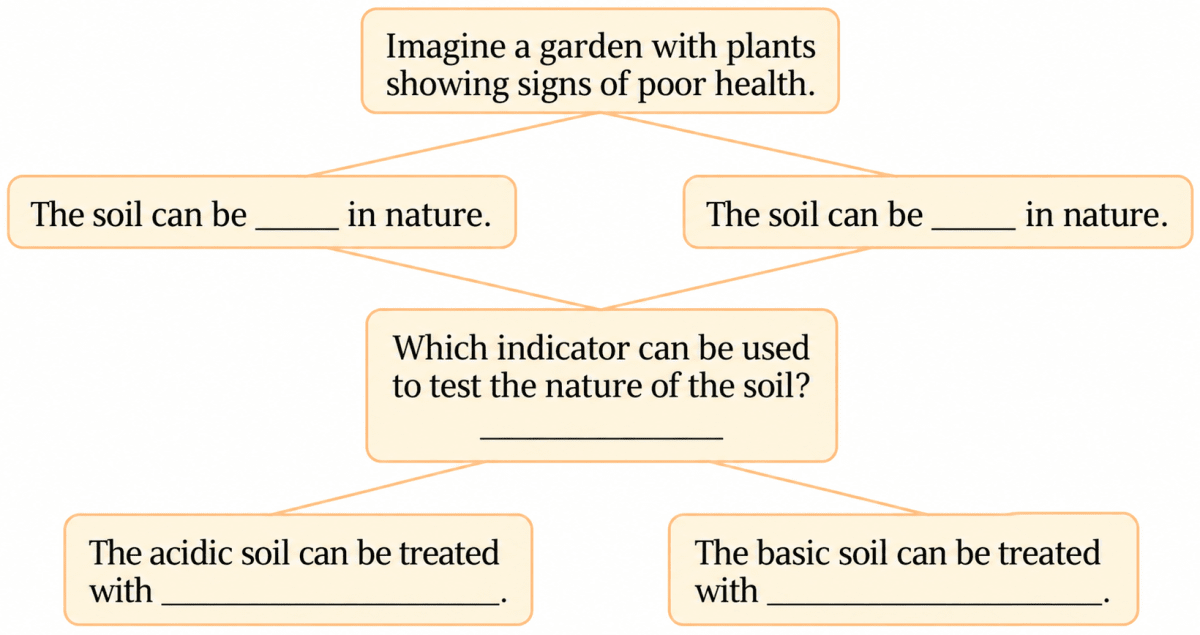
Observe and analyse the information given in the following flowchart. Complete the missing information.
Answer
The completed flowchart information is given below:
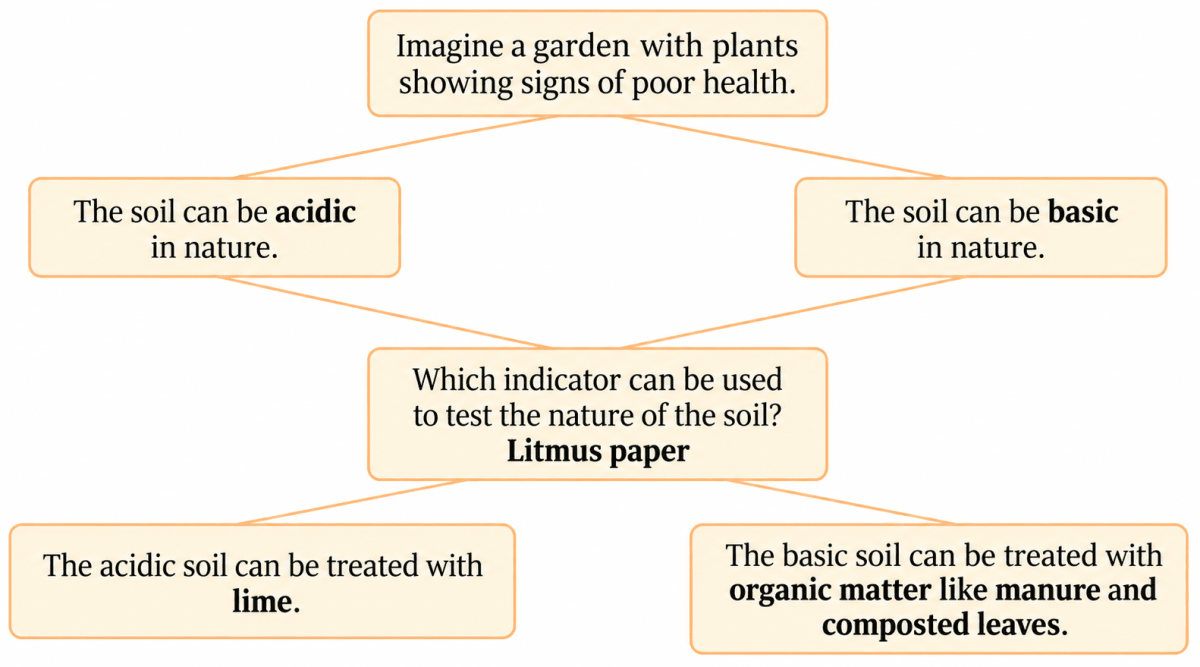
The soil can be acidic in nature. The soil can be basic in nature.
Which indicator can be used to test the nature of the soil? Litmus paper.
The acidic soil can be treated with lime.
The basic soil can be treated with organic matter like manure and composted leaves.