Choose the incorrect statement.
- A switch is the source of electric current in a circuit.
- A switch helps to complete or break the circuit.
- A switch helps us to use electricity as per our requirement.
- When the switch is in 'OFF' position, there is an air gap between its terminals.
Answer
A switch is the source of electric current in a circuit.
Reason — A switch is not a source of electric current; it is a simple device that only completes or breaks a circuit. The actual source of electric current in a circuit is the electric cell or battery. The other three statements are correct, as a switch does help to complete or break the circuit, lets us use electricity as per our requirement, and leaves an air gap between its terminals in the 'OFF' position. Hence, statement 1 is incorrect.
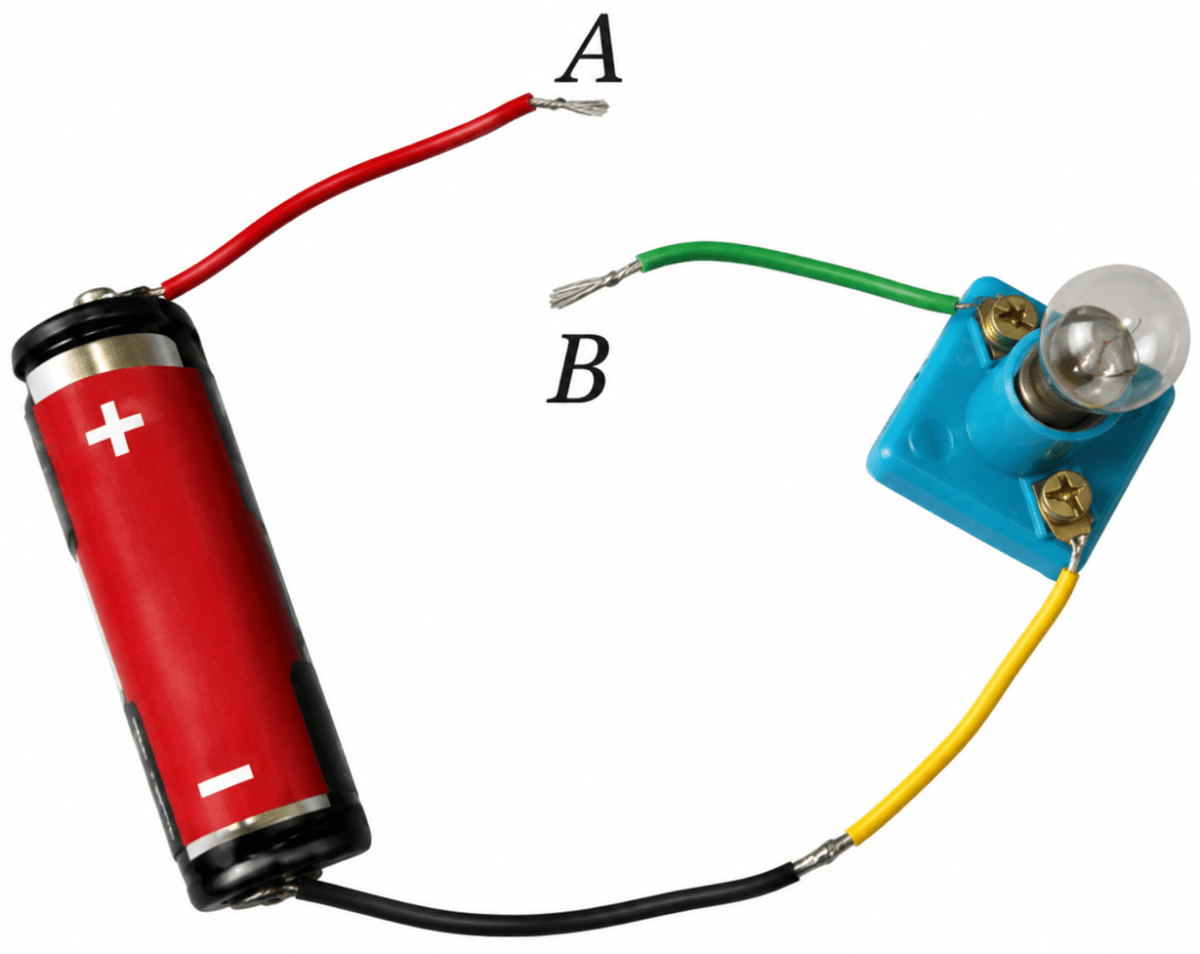
Observe Fig. 3.16. With which material connected between the ends A and B, the lamp will not glow?
Answer
The lamp will not glow when an insulator is connected between the ends A and B.
Insulators do not allow electric current to pass through them, so the circuit remains incomplete and the lamp does not glow. Examples of such materials are rubber, plastic, glass, wood, paper, and wax.
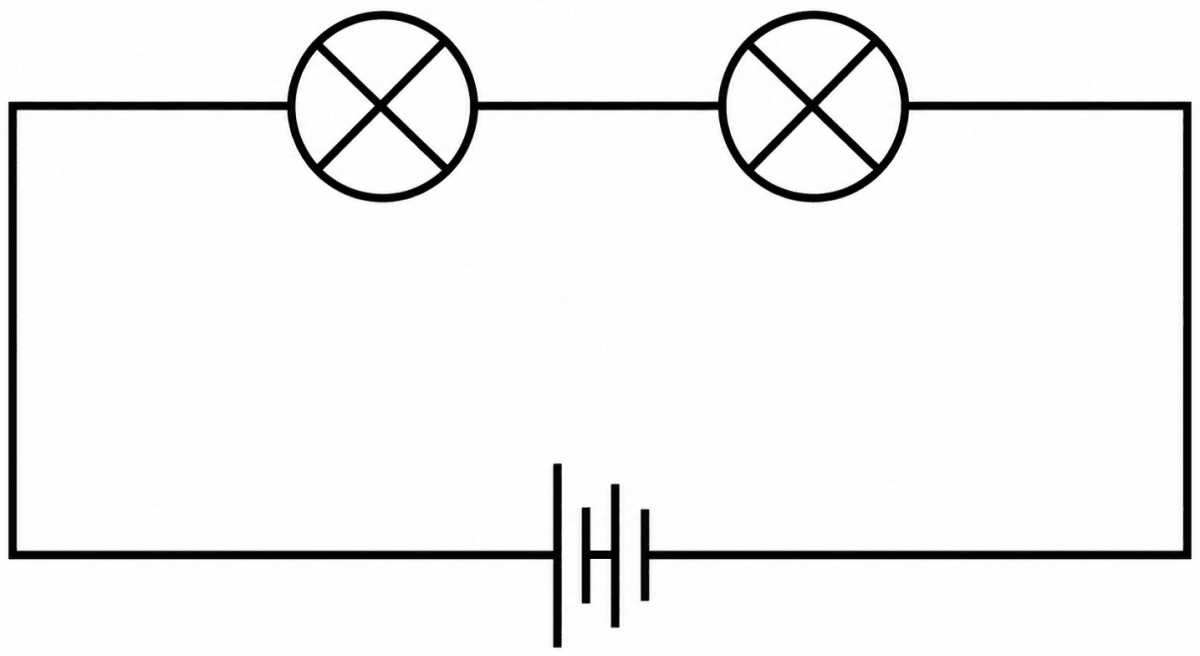
In Fig. 3.17, if the filament of one of the lamps is broken, will the other glow? Justify your answer.
Answer
No, the other lamp will not glow.
Both lamps are connected in a single path. If the filament of one lamp is broken, the circuit becomes open and electric current cannot flow through it. Therefore, the other lamp will also not glow.
A student forgot to remove the insulator covering from the connecting wires while making a circuit. If the lamp and the cell are working properly, will the lamp glow?
Answer
No, the lamp will not glow.
The insulating covering must be removed from the ends of the connecting wires to expose the metal. If it is not removed, proper electrical contact is not made and current cannot flow through the circuit.
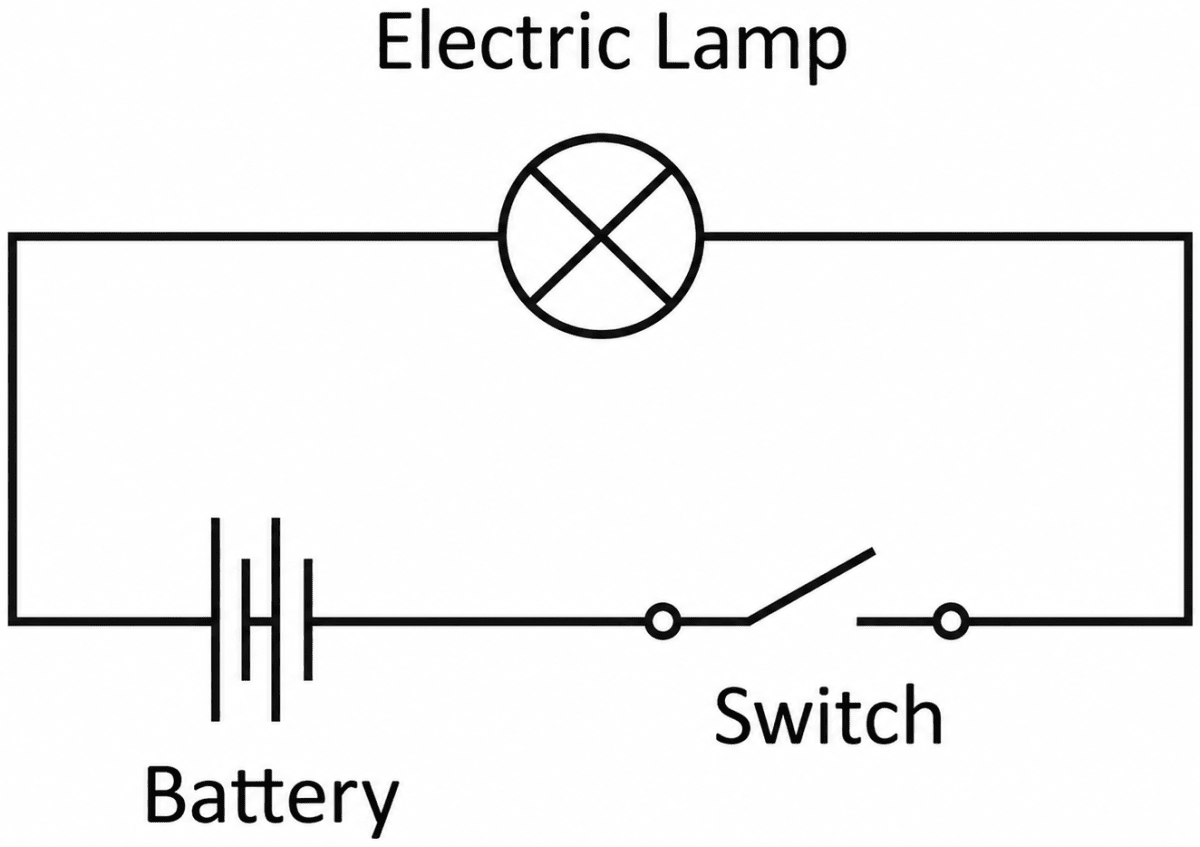
Draw a circuit diagram for a simple torch using symbols for electric components.
Answer
A simple torch consists of a battery, an electric lamp, a switch, and connecting wires. Using the standard symbols for these components, the circuit diagram of a simple torch is drawn as shown below.
In Fig. 3.18:
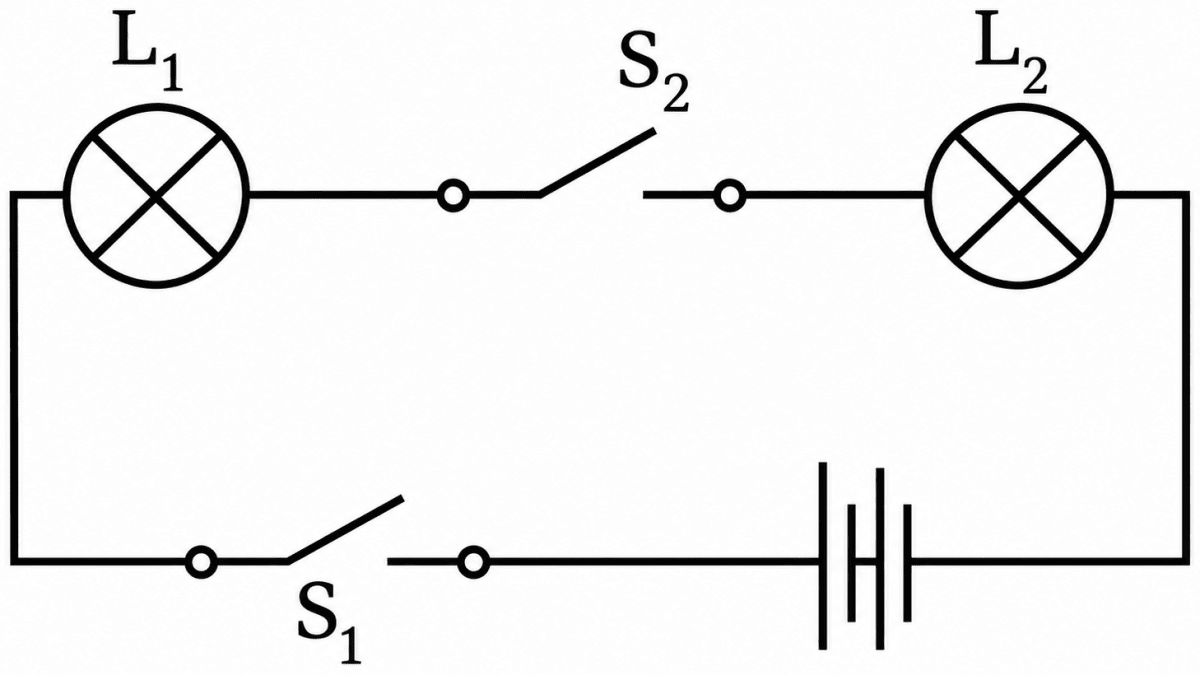
- If S2 is in 'ON' position, S1 is in 'OFF' position, which lamp(s) will glow?
- If S2 is in 'OFF' position, S1 is in 'ON' position, which lamp(s) will glow?
- If S1 and S2 both are in 'ON' position, which lamp(s) will glow?
- If both S1 and S2 are in 'OFF' position, which lamp(s) will glow?
Answer
- Neither L1 nor L2 will glow.
- Neither L1 nor L2 will glow.
- Both L1 and L2 will glow.
- Neither L1 nor L2 will glow.
The lamps and switches form a single path. Current can flow only when both S1 and S2 are in the 'ON' position. Hence, both lamps glow only in case (iii).
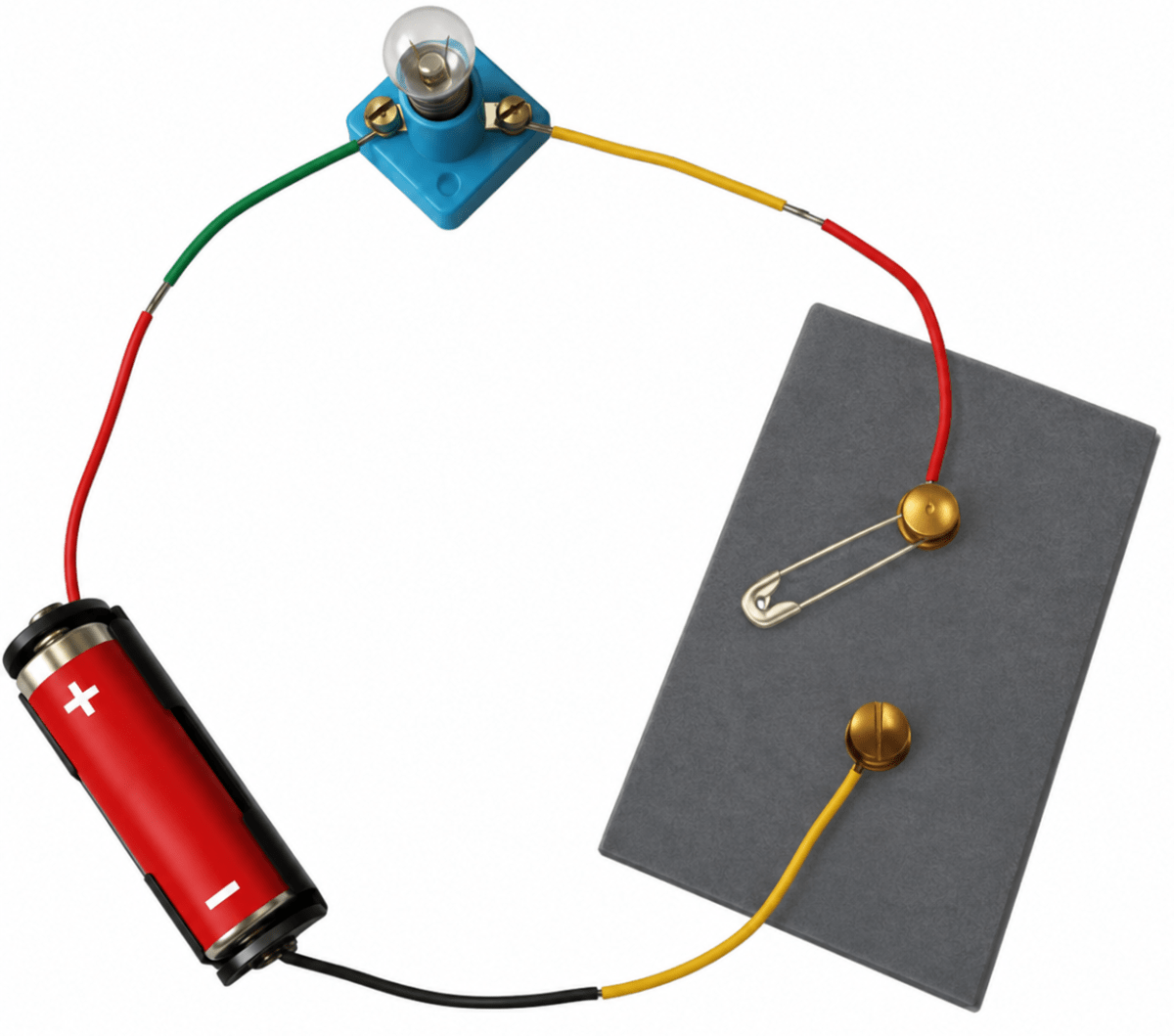
Vidyut has made the circuit as shown in Fig. 3.19. Even after closing the circuit, the lamp does not glow. What can be the possible reasons? List as many possible reasons as you can for this faulty operation. What will you do to find out why the lamp did not glow?
Answer
The possible reasons are:
- The electric cell may be dead or used up, so it does not supply current.
- The lamp may be fused, that is, its filament may be broken.
- The plastic covering may not have been removed from the ends of the connecting wires, so the metal is not exposed at the joints.
- One or more connections (at the cell, the lamp holder, or the switch) may be loose.
- A connecting wire may be broken somewhere inside its covering.
- The switch may not be making proper contact even when it appears to be closed.
To find the fault, check the circuit one component at a time. Replace the cell with a known working cell and the lamp with a known working lamp. Also check that the wire ends are properly stripped, all connections are tight, and the switch makes proper contact. This will help identify the faulty component or connection.
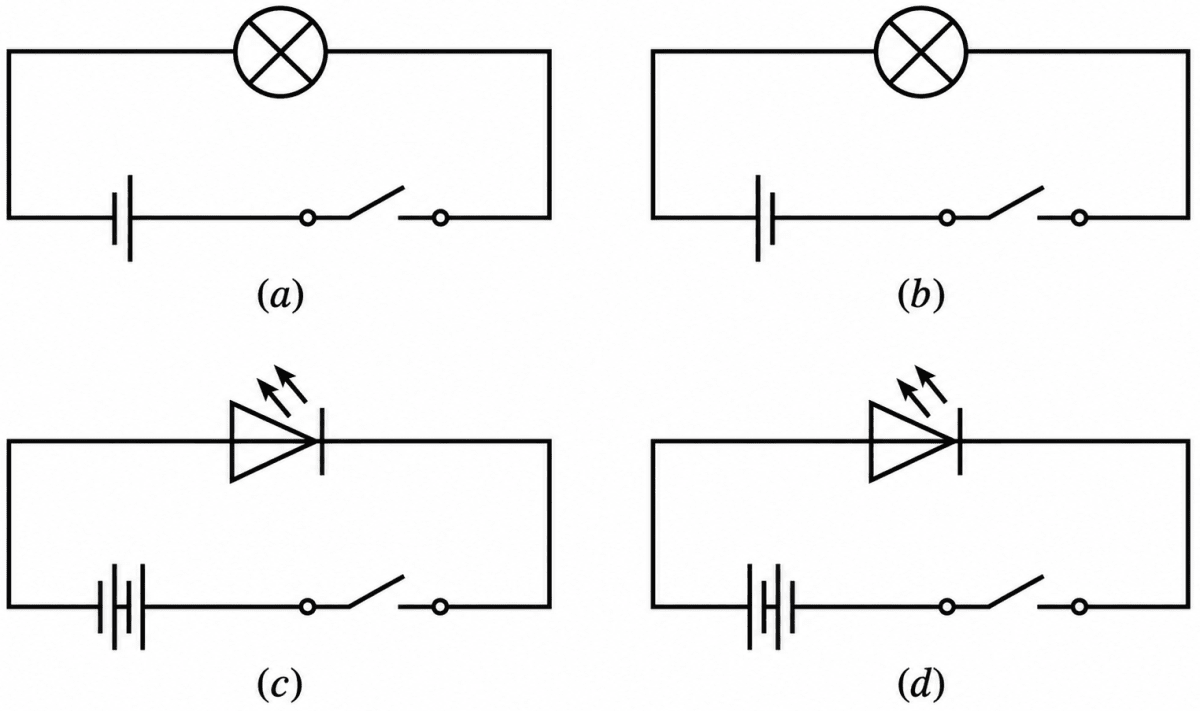
In Fig. 3.20, in which case(s) the lamp/LED will not glow when the switch is closed?
Answer
The lamp/LED will not glow in case (c).
In cases (a) and (b), the incandescent lamp glows regardless of which terminal is connected to the positive or negative terminal of the cell, provided the circuit is complete. In case (c), the LED is connected in the reverse direction, so current cannot pass through it. In case (d), the LED is connected with the correct polarity and will glow.
Suppose the '+' and '–' symbols cannot be read on a battery. Suggest a method to identify the two terminals of this battery.
Answer
An LED can be used to identify the two terminals of the battery.
Connect the longer wire (positive terminal) and the shorter wire (negative terminal) of the LED to the two terminals of the battery. If the LED glows, the battery terminal connected to the longer wire is the positive terminal and the other is the negative terminal. If it does not glow, interchange the connections. When the LED glows, the terminal connected to its longer wire is positive and the other terminal is negative.
You are given six cells marked A, B, C, D, E, and F. Some of these are working and some are not. Design an activity to identify which of them are working.
- List the items that you require.
- Write the procedure that you will follow.
- With the items, carry out the activity to identify the cells that are working.
Answer
- Items required — the six cells A, B, C, D, E, and F, an incandescent torch lamp with a lamp holder, a cell holder, and a few connecting wires with about 1 cm of covering removed from both ends.
- Procedure — Connect the lamp holder and the cell holder with the connecting wires to make a simple circuit. Place one cell at a time in the cell holder so that the circuit is complete, and observe whether the lamp glows.
- Carry out the activity — Test the cells A to F one by one in this circuit. For each cell, if the lamp glows, that cell is working; if the lamp does not glow, that cell is not working. In this way, the working cells can be separated from the cells that are not working.
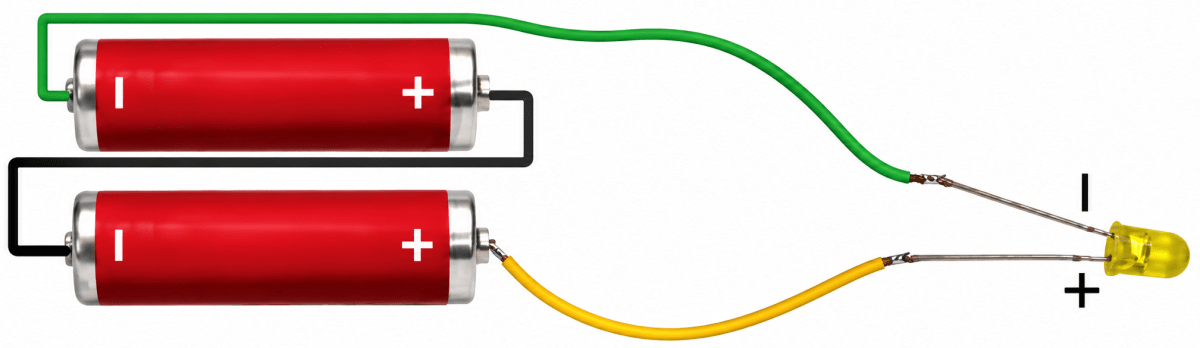
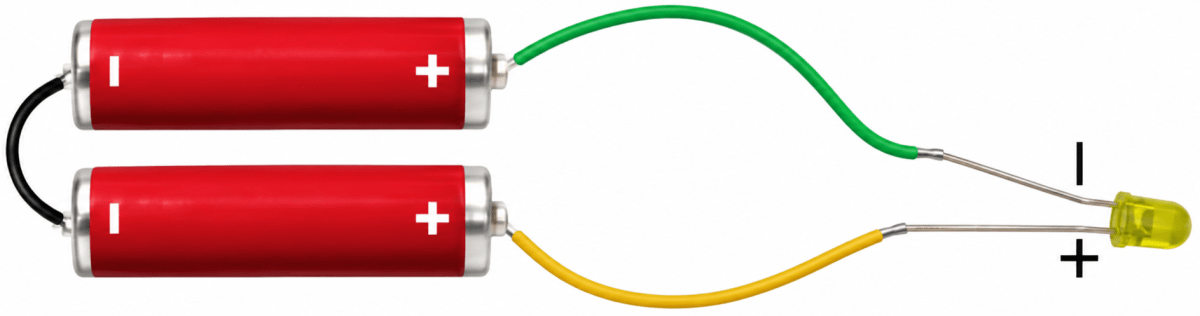
Using an LED that requires two cells in series to glow, Tanya made the circuit as shown in Fig. 3.21. Will the lamp glow? If not, draw the wires for correct connections.
Answer
No, the LED will not glow.
In Tanya's circuit, the two cells are not connected properly to form a battery. To make a battery, the positive terminal of one cell must be connected to the negative terminal of the other cell. Also, the positive terminal of the battery must be connected to the longer wire (positive terminal) of the LED and the negative terminal of the battery to the shorter wire (negative terminal) of the LED, because the LED glows only when it is connected in the correct direction. The corrected connections are shown below.