
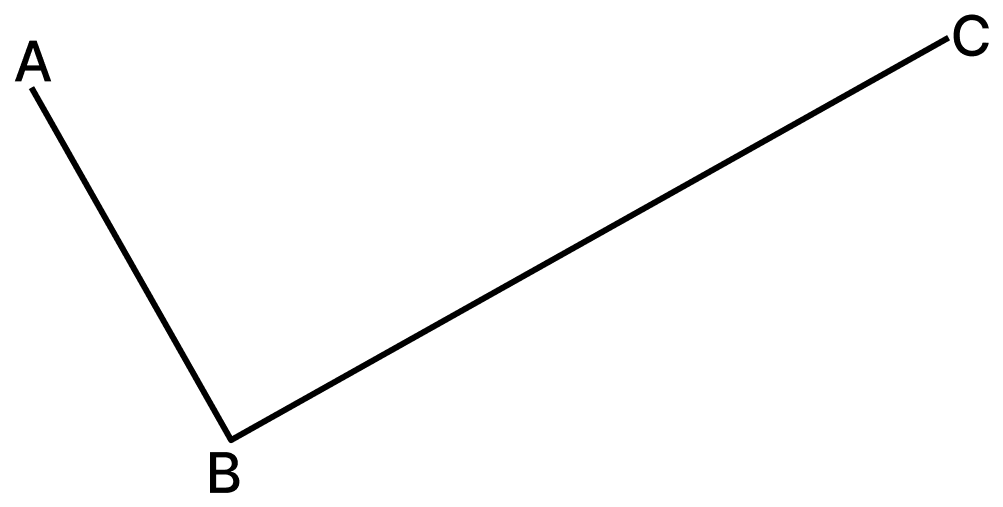
Are the arm lengths AB and BC sufficient to exactly recreate this figure?
Answer
No, the arm lengths AB and BC are not sufficient to exactly recreate the figure.
For example, let AB = 4 cm and BC = 8 cm. Several different figures can be drawn with these same arm lengths by changing the angle ∠ABC. Thus, figures with the same arm lengths may have different shapes.
Therefore, the lengths AB and BC alone do not determine the figure completely. We also need the measure of ∠ABC to recreate the figure exactly.
∴ The arm lengths AB and BC alone are not sufficient to recreate the figure.
Can you draw the symbol if it is known that AB = 4 cm, BC = 8 cm, and ∠ABC = 80°?
Answer
Yes, the symbol can be drawn with these three measurements.
The steps of construction are:
Step 1: Draw a line segment BC of length 8 cm.
Step 2: At the point B, use a protractor to draw a ray BX making an angle of 80° with BC.
Step 3: From B, cut off a length of 4 cm along the ray BX and mark this point as A.
BA and BC are the two arms of the required symbol.
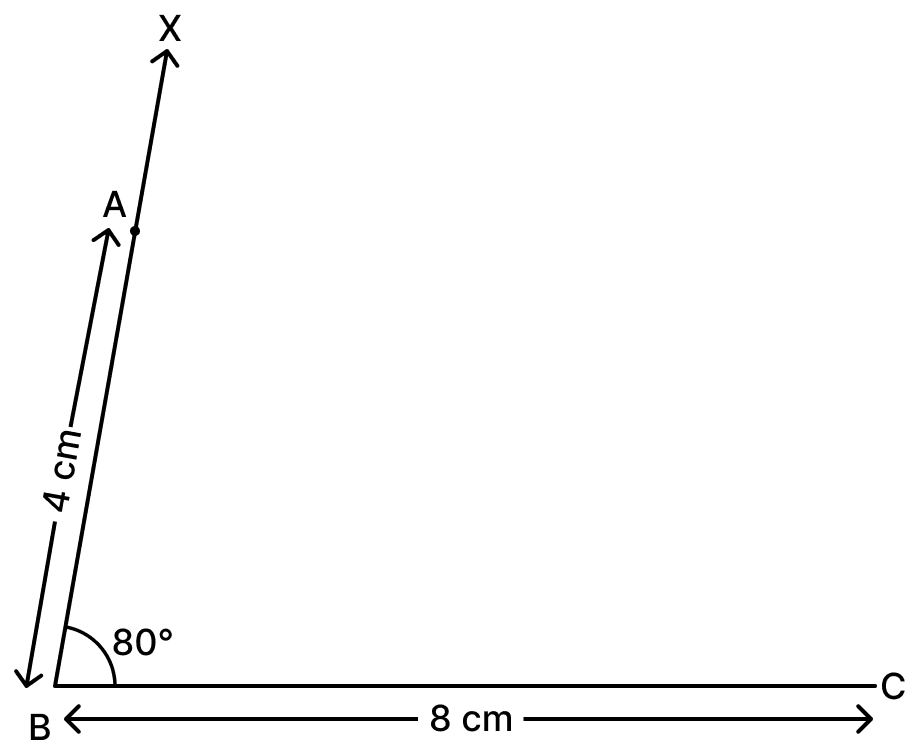
∴ The symbol with AB = 4 cm, BC = 8 cm and ∠ABC = 80° can be drawn, and every symbol drawn with these measurements is an exact replica (a congruent copy) of the given symbol.
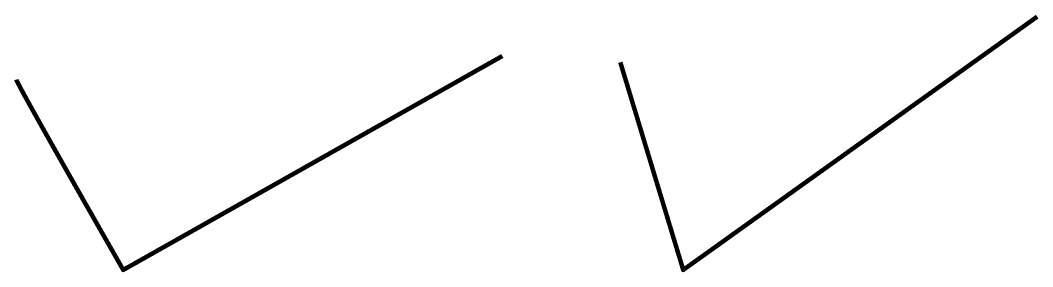
Check if the two figures are congruent.
Answer
Each figure is made up of two arms meeting at a corner point.
On comparing the figures, the lengths of the arms of the first figure match the lengths of the corresponding arms of the second figure, but the angles between the corresponding arms are different.
Therefore, one figure cannot be superimposed exactly on the other, even after rotating or flipping it.
∴ The two figures are not congruent.
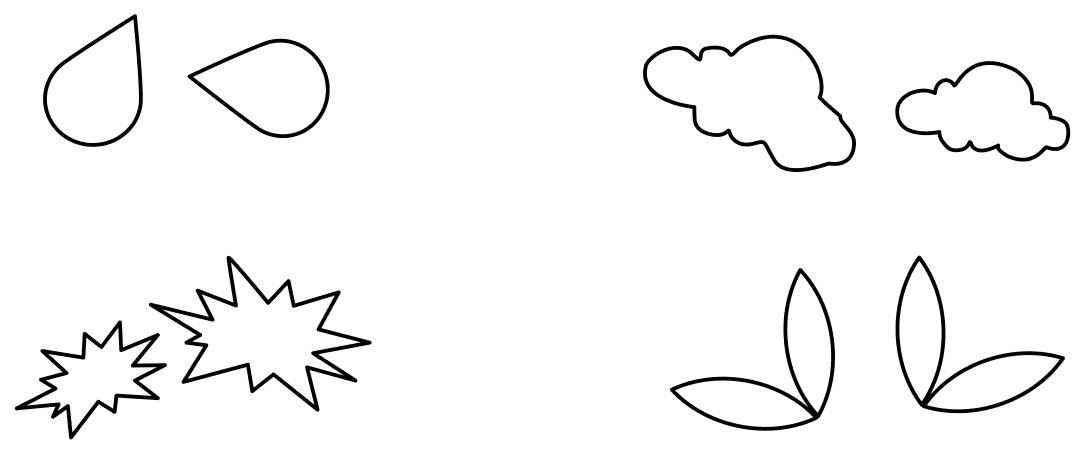
Circle the pairs that appear congruent.
Answer
A pair is congruent if one figure of the pair can be placed exactly over the other after rotating or flipping it.
(i) The two drops have the same shape and the same size; one is only a turned (rotated) copy of the other. ∴ The two figures are congruent.
(ii) Both clouds have the same shape, but the second cloud is clearly smaller than the first. ∴ The two figures are not congruent.
(iii) Both stars have the same shape, but the second star is clearly bigger than the first. ∴ The two figures are not congruent.
(iv) The two leaf figures have the same shape and the same size; one is a flipped (mirror) copy of the other. ∴ The two figures are congruent.
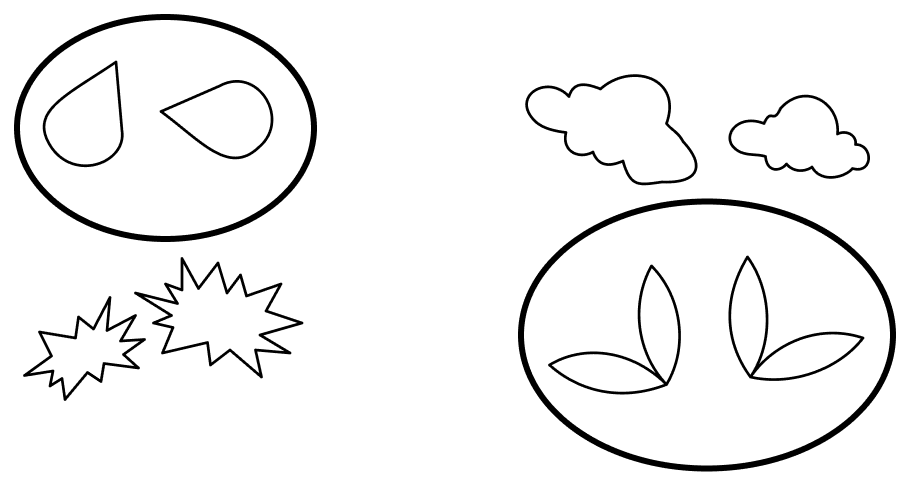
Hence, the pairs to be circled are the pair of water-drop shapes and the pair of leaf shapes.
What measurements would you take to create a figure congruent to a given:
(a) Circle
(b) Rectangle
Using this, state how would you check if two —
(a) Circles are congruent?
(b) Rectangles are congruent?
Answer
(a) Circle
The shape of every circle is the same; only its size can change. The size of a circle is fixed by its radius (or, equivalently, by its diameter).
So, only one measurement is needed — the radius of the given circle.
Checking congruence: If the two radii are equal, the circles can be placed exactly one over the other.
(b) Rectangle
In a rectangle, all the angles are right angles. So, only the lengths of the sides can change, and the adjacent sides fix all the four sides.
So, two measurements are needed — the length and the breadth of the given rectangle.
Checking congruence: Measure the length and the breadth of both the rectangles. If their corresponding lengths are equal and their corresponding breadths are equal, then one rectangle can be placed exactly over the other (rotating it, if needed).
∴ Two rectangles are congruent if and only if their lengths are equal and their breadths are equal.
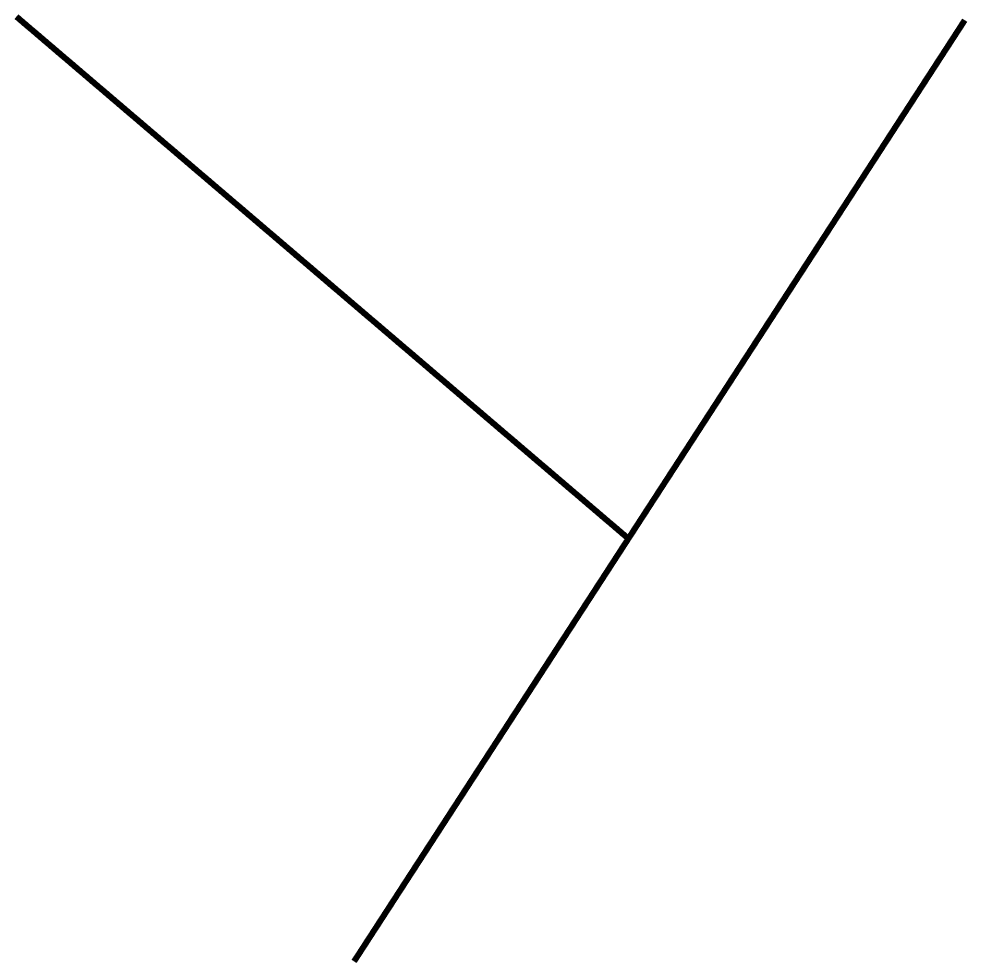
How would we check if two figures like the one below are congruent?
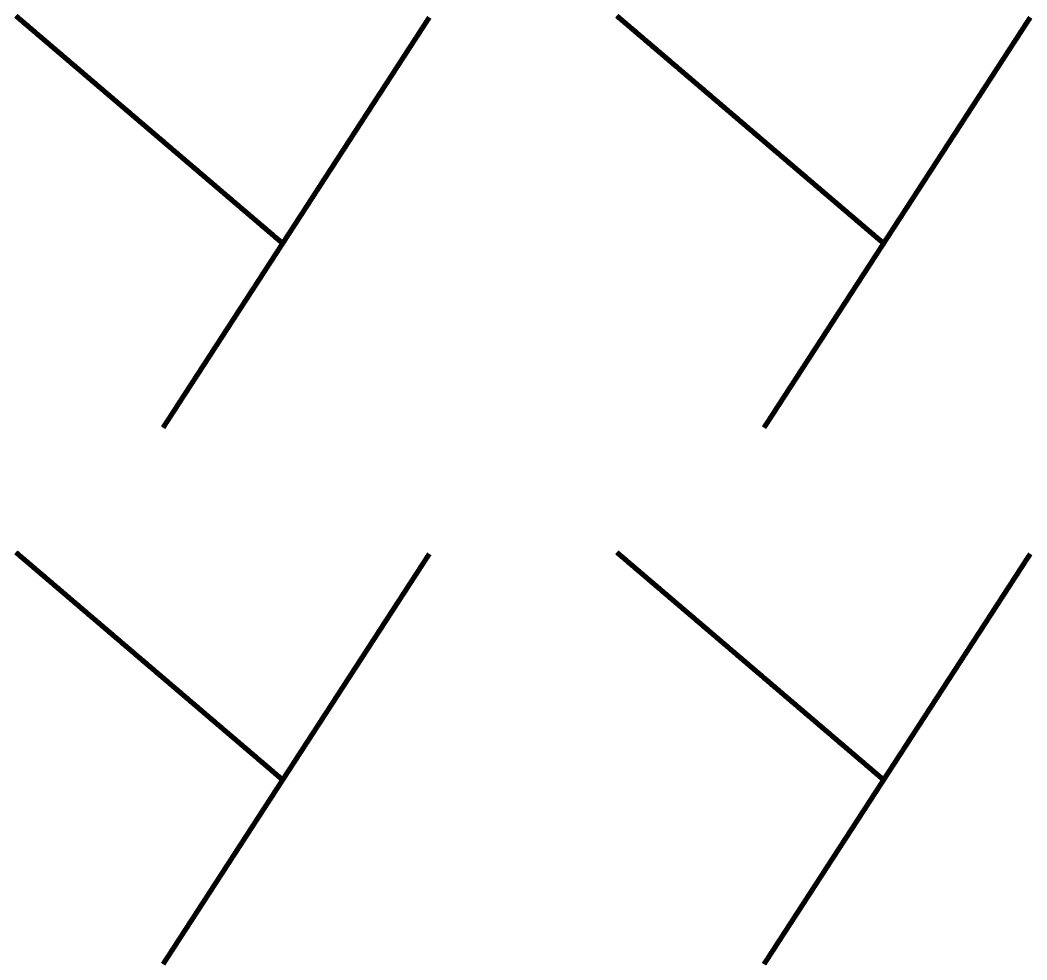
Use this to identify whether each of the following pairs are congruent.
Answer
How to check:
The figure is fixed by the lengths of its three arms and the angles between them at the common meeting point.
Two such figures are congruent if their corresponding arm lengths and corresponding angles are equal. In that case, one figure can be rotated or flipped and placed exactly over the other.
First pair:
The two figures have the same shape and size. One can be rotated to fit exactly over the other.
∴ The figures in the first pair are congruent.
Second pair:
The two figures also have the same shape and size. One can be rotated to fit exactly over the other.
∴ The figures in the second pair are congruent.
Meera and Rabia have been asked to make a cardboard cutout identical to a triangular frame they have in school. They see that the frame is too big to be traced on a paper and replicated.
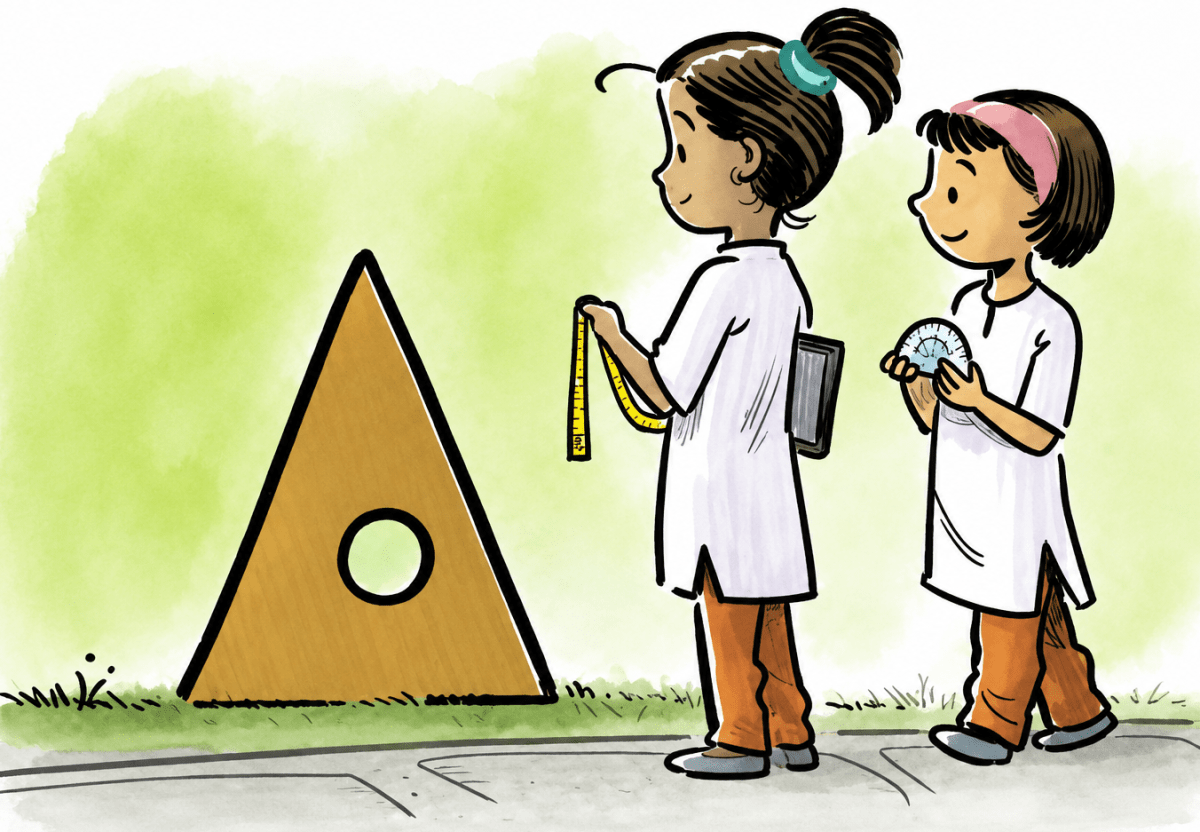
(i) What do you think they can do?
(ii) Meera says that the three sidelengths 40 cm, 60 cm and 80 cm are enough, and that the angles need not be measured. Do you agree with Meera?
Answer
(i)
Since the triangular frame is too large to be traced, Meera and Rabia can measure the triangle and use those measurements to construct an identical triangle on the cardboard.
They can use a measuring tape (and, if required, a protractor) to record the necessary measurements and then recreate the triangle with the same shape and size.
(ii)
Yes, I agree with Meera.
If the three side lengths of a triangle are known, a triangle can be constructed using those lengths. Any triangle constructed with the same three side lengths will have the same shape and size and can be superimposed exactly on the original triangle.
Therefore, the three side lengths are sufficient to determine the triangle completely, and the angles need not be measured separately.
Instead of the lengths being 40 cm, 60 cm, and 80 cm, suppose the sidelengths had been 4 cm, 6 cm, 8 cm (this triangle can fit on our page). Is this information sufficient to replicate the triangle with the same size and shape? If yes, can you do so?
Answer
Yes, the three sidelengths are sufficient. The triangle can be constructed as follows:
Step 1: Draw a line segment AB of length 6 cm.
Step 2: With A as centre, draw an arc of radius 4 cm.
Step 3: With B as centre, draw an arc of radius 8 cm, cutting the previous arc at a point E.
Step 4: Join AE and BE.
△ABE is the required triangle, with AB = 6 cm, AE = 4 cm and BE = 8 cm.
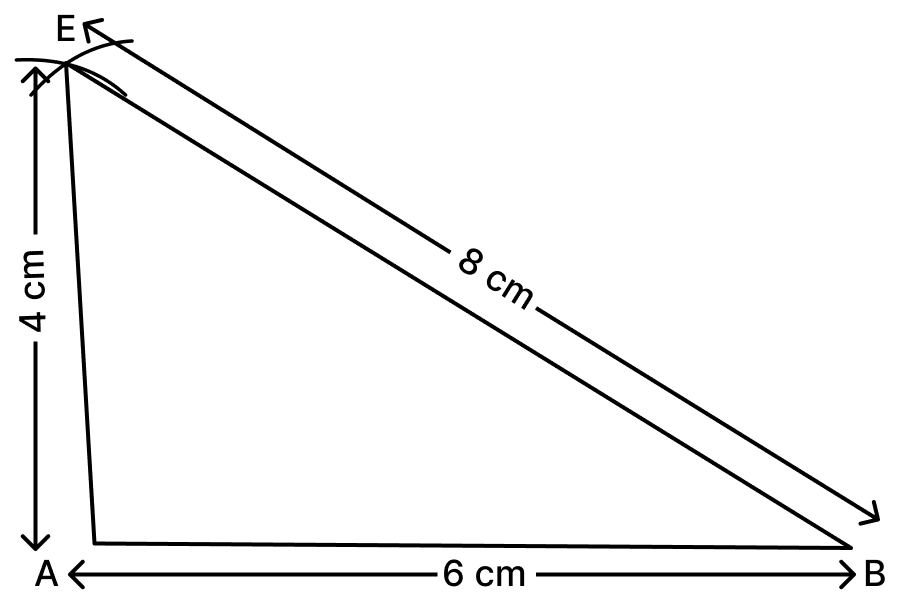
The arcs may also intersect at a point F on the other side of AB, giving another triangle △ABF. However, △ABE and △ABF are congruent, so they have the same shape and size.
∴ The three sidelengths 4 cm, 6 cm and 8 cm are sufficient to construct a triangle congruent to the given triangle.
Are there other ways of overlapping the vertices so that the triangles fit exactly over each other?
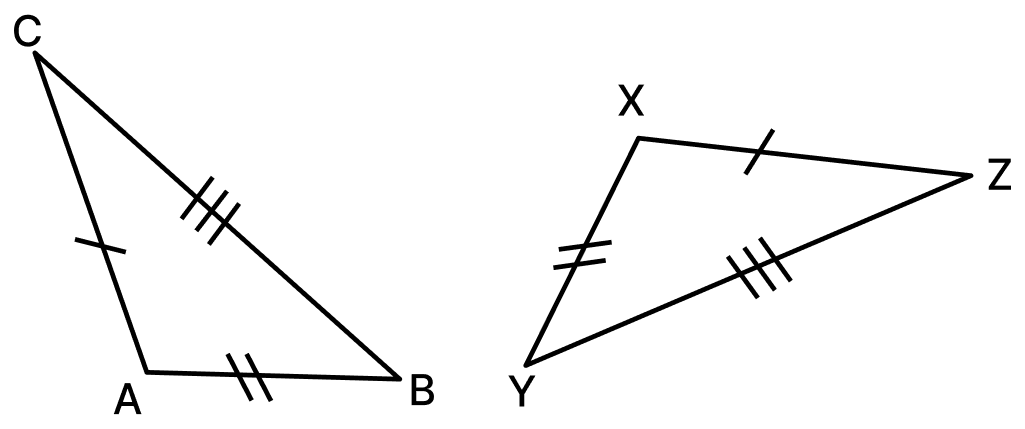
Answer
The three sides of △ABC have different lengths. Each side of △ABC can therefore fall on only one particular side of △XYZ — the one equal to it.
If, for example, vertex A were placed over vertex Y, then side AB would fall along a side of △XYZ that is not equal to AB, and the triangles would not fit exactly over each other.
∴ No, A over X, B over Y and C over Z is the only way of overlapping the vertices here.
Can you identify a pair of congruent triangles below? Why are they congruent?
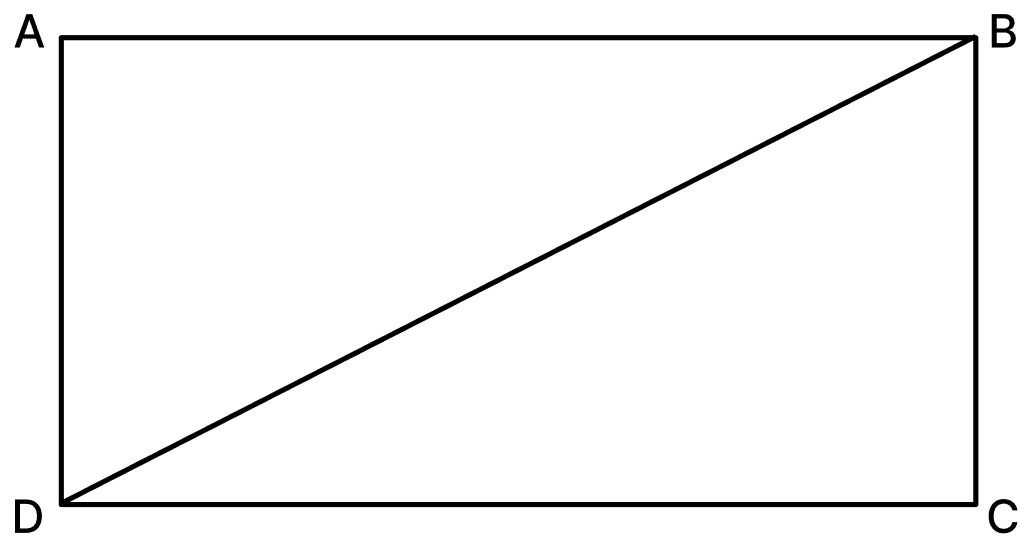
Answer
Consider △ABD and △CDB, formed by the diagonal BD of the rectangle ABCD.
Since ABCD is a rectangle, its opposite sides are equal:
AB = CD [Opposite sides of a rectangle]
AD = CB [Opposite sides of a rectangle]
BD = DB [Common side]
The three sides of △ABD are equal to the three sides of △CDB.
∴ △ABD ≅ △CDB by the SSS condition of congruence.
Identify the correct correspondence of vertices and express the congruence between the two triangles.
Answer
The corresponding sides must be the equal sides:
AB = CD, AD = CB, BD = DB
Side AB must fall on CD, so A ↔ C and B ↔ D.
Side AD must fall on CB, so A ↔ C and D ↔ B.
Thus the correct correspondence of vertices is:
△ABD ↔ △CDB
A ↔ C
B ↔ D
D ↔ B
∴ △ABD ≅ △CDB.
Suppose △HEN is congruent to △BIG. List all the other correct ways of expressing this congruence.
Answer
Given:
△HEN ≅ △BIG
By the convention of writing congruence, the corresponding vertices are:
H and B, E and I, N and G
Any way of writing the congruence in which these vertices remain matched with each other is correct.
Keeping the correspondence H ↔ B, E ↔ I, N ↔ G unchanged, the other correct ways of expressing this congruence are:
△HNE ≅ △BGI
△EHN ≅ △IBG
△ENH ≅ △IGB
△NHE ≅ △GBI
△NEH ≅ △GIB
Determine whether the triangles are congruent. If yes, express the congruence.
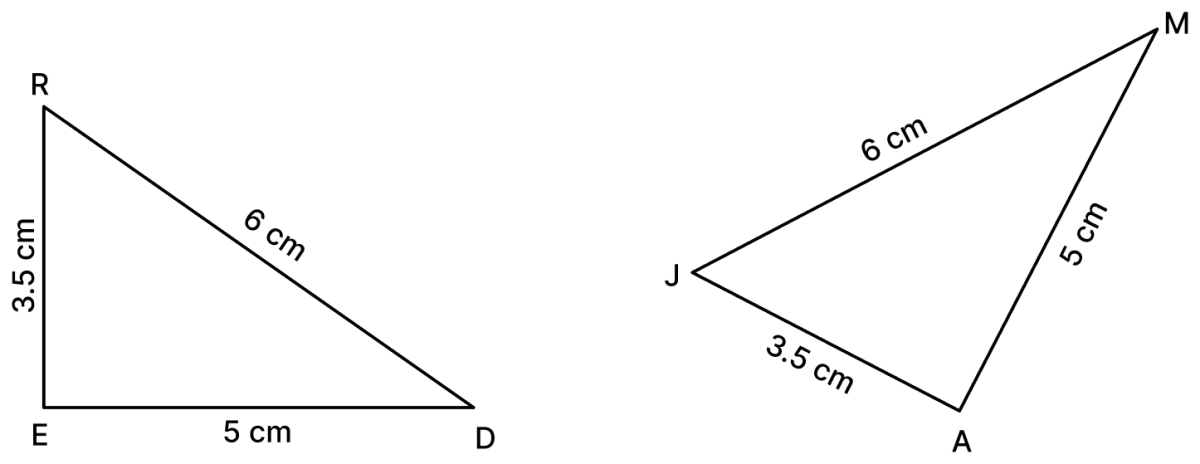
Answer
From the figure:
In △RED:
RE = 3.5 cm, ED = 5 cm, RD = 6 cm
In △JAM:
JA = 3.5 cm, AM = 5 cm, JM = 6 cm
Comparing the sidelengths of the two triangles:
RE = JA = 3.5 cm [Side]
ED = AM = 5 cm [Side]
RD = JM = 6 cm [Side]
All the three sides of one triangle are equal to the corresponding three sides of the other triangle, so the SSS condition is satisfied.
The corresponding vertices are R and J, E and A, D and M.
∴ △RED ≅ △JAM by SSS condition of congruence.
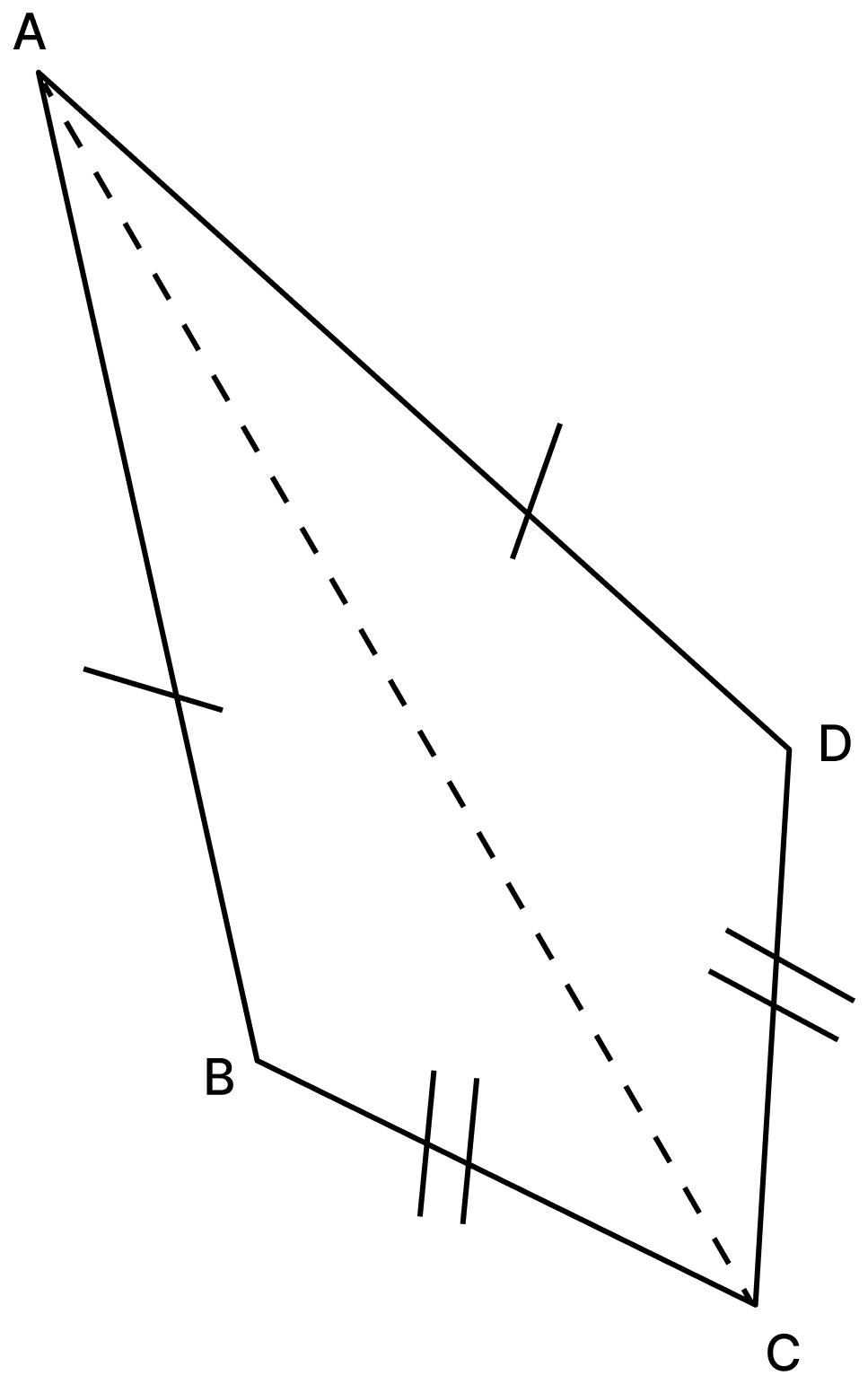
In the figure below, AB = AD, CB = CD.
Can you identify any pair of congruent triangles? If yes, explain why they are congruent.
Does AC divide ∠BAD and ∠BCD into two equal parts? Give reasons.
Answer
Join AC. It divides the figure into the two triangles △ABC and △ADC.
In △ABC and △ADC:
AB = AD [Given]
CB = CD [Given]
AC = AC [Common side]
Since the three sides of △ABC are equal to the corresponding three sides of △ADC, the SSS condition is satisfied.
∴ △ABC ≅ △ADC by SSS condition of congruence.
As corresponding parts of congruent triangles are equal, we get:
∠BAC = ∠DAC [Corresponding angles of congruent triangles]
∠BCA = ∠DCA [Corresponding angles of congruent triangles]
⇒ AC divides ∠BAD into the two equal parts ∠BAC and ∠DAC.
⇒ AC divides ∠BCD into the two equal parts ∠BCA and ∠DCA.
∴ AC divides both ∠BAD and ∠BCD into two equal parts.
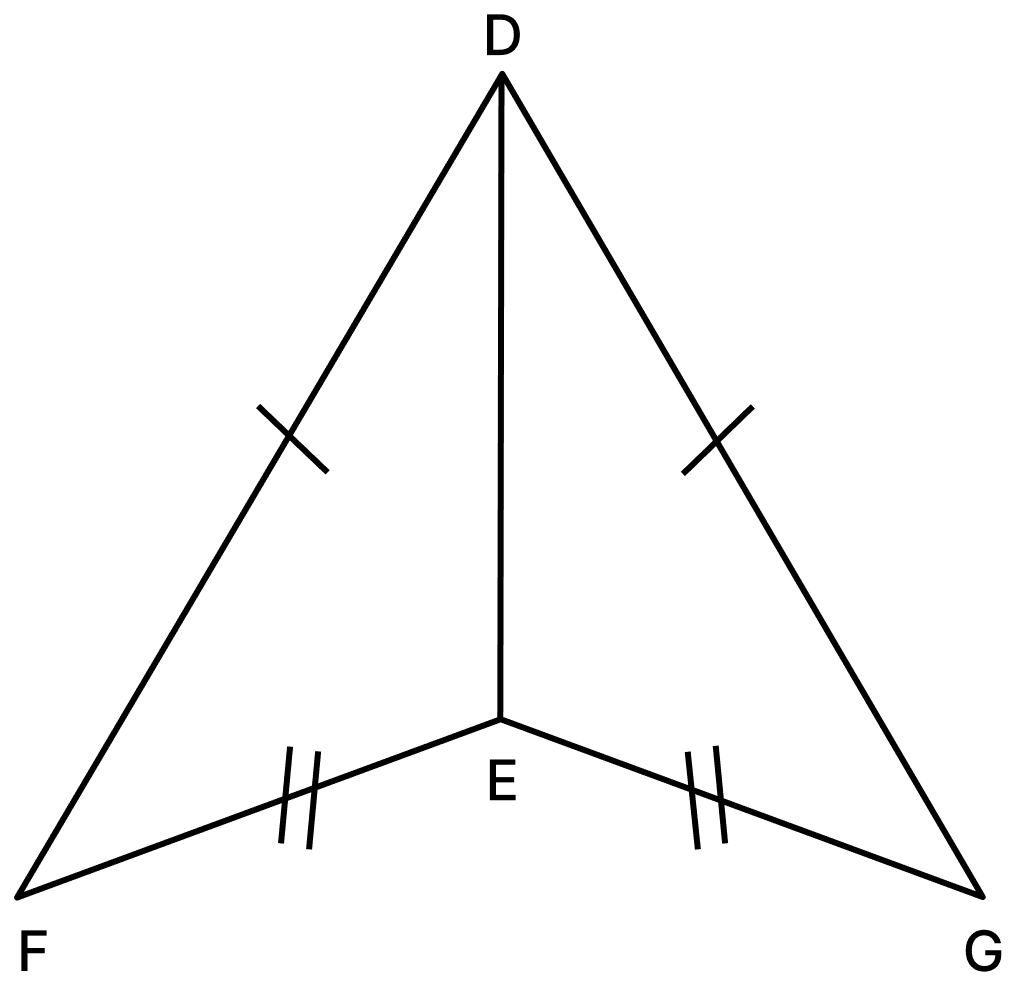
In the figure below, are △DFE and △GED congruent to each other? It is given that DF = DG and FE = GE.
Answer
The two triangles in the figure are △DFE and △DGE.
In △DFE and △DGE:
DF = DG [Given]
FE = GE [Given]
DE = DE [Common side]
Since the three sides of △DFE are equal to the corresponding three sides of △DGE, the SSS condition is satisfied.
So the two triangles are congruent, and the correct way of expressing this congruence is:
△DFE ≅ △DGE
Now, the statement △DFE ≅ △GED would mean the correspondence:
D ↔ G, F ↔ E, E ↔ D
Under this correspondence, DF would have to be equal to GE, FE would have to be equal to ED, and DE would have to be equal to GD. These sides need not be equal.
∴ The triangles are congruent, but not in the correspondence given. The correct congruence is △DFE ≅ △DGE.
△ABC and △XYZ are two triangles such that, AB = XY = 6 cm, AC = XZ = 5 cm, and ∠A = ∠X = 30°.
(i) Are they congruent?
(ii) Construct a triangle having the above measurements. Are the triangles all congruent? Explain why all such triangles with these measurements are congruent.
Answer
(i)
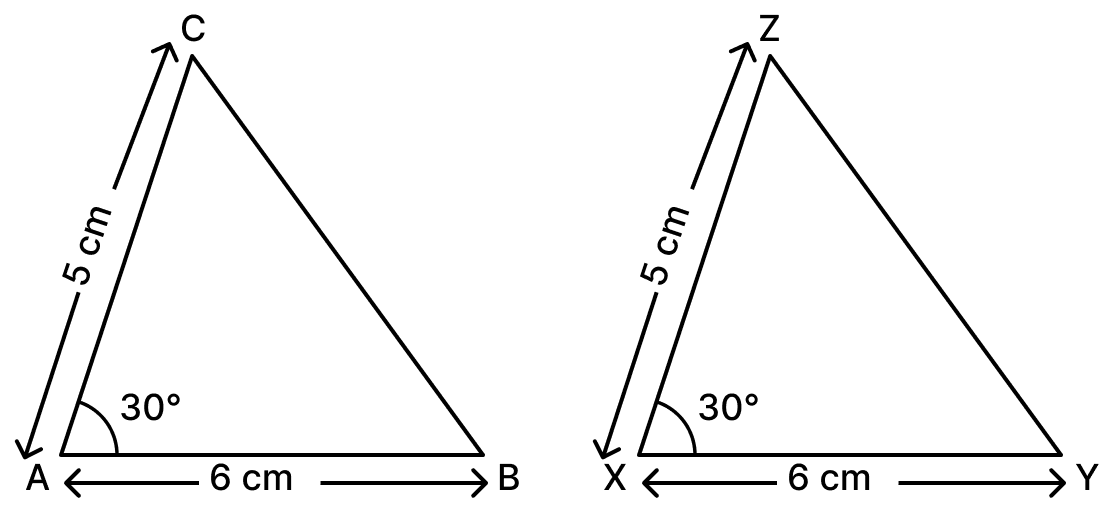
In △ABC, ∠A is the angle included between the sides AB and AC.
In △XYZ, ∠X is the angle included between the sides XY and XZ.
In △ABC and △XYZ:
AB = XY = 6 cm [Side]
∠A = ∠X = 30° [Included angle]
AC = XZ = 5 cm [Side]
Two sides and the included angle of one triangle are equal to the two sides and the included angle of the other triangle, so the SAS condition is satisfied.
∴ Yes, △ABC ≅ △XYZ by SAS condition of congruence.
(ii)
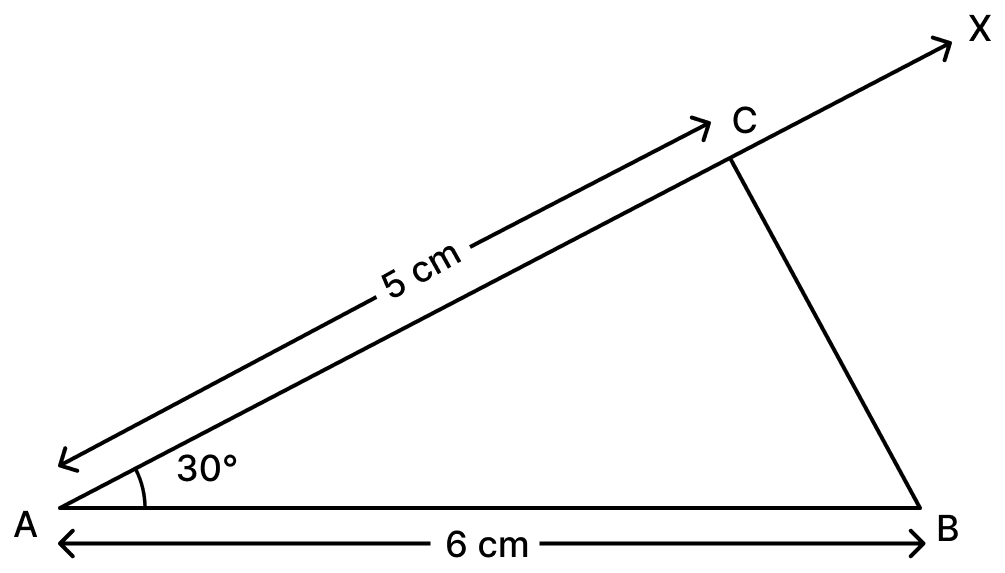
The triangle with AB = 6 cm, AC = 5 cm and ∠A = 30° can be constructed as follows:
Step 1: Draw the base AB of length 6 cm.
Step 2: At the point A, draw a ray AX making an angle of 30° with AB.
Step 3: From A, cut off a length of 5 cm along the ray AX and mark this point as C.
Step 4: Join B and C. △ABC is the required triangle.
Once the base AB is fixed, a ray making an angle of 30° with AB can be drawn on either side of AB. On either chosen ray, the point C is fixed at a distance of 5 cm from A.
The two possible constructions lie on opposite sides of AB and are mirror images of each other. Hence, they have the same shape and size and are congruent.
∴ All such triangles are congruent, as two sides and the included angle fix the shape and size of the triangle (SAS condition).
△ABC and △XYZ are two triangles such that, AB = XY = 6 cm, AC = XZ = 4 cm, and ∠B = ∠Y = 30°
(i) Are they congruent?
(ii) Can there exist non-congruent triangles having these measurements? Construct and find out.
Answer
(i)
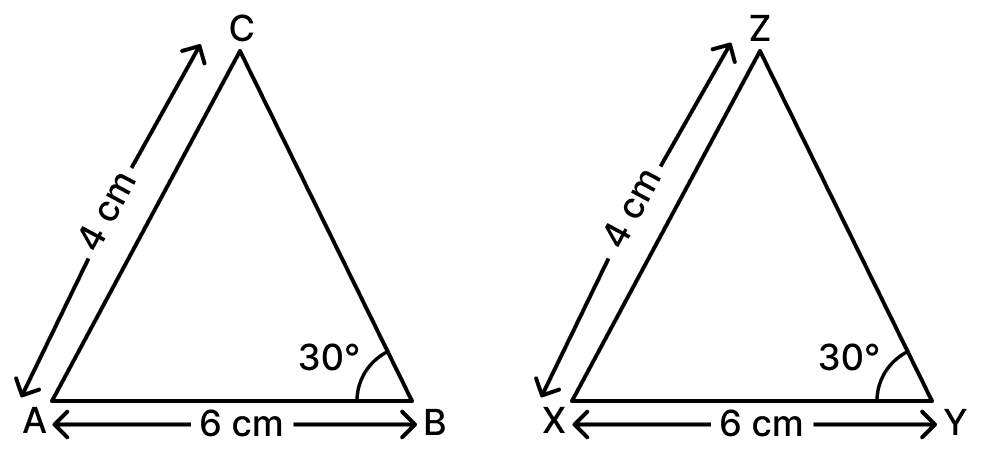
In △ABC and △XYZ:
AB = XY = 6 cm [Side]
AC = XZ = 4 cm [Side]
∠B = ∠Y = 30° [Angle]
Here, ∠B is the angle between the sides AB and BC, and not between the two given sides AB and AC.
So the given angle is a non-included angle, and these measurements correspond to the SSA (Side Side Angle) condition.
The SSA condition does not guarantee congruence, as two different (non-congruent) triangles can be drawn with these measurements.
∴ △ABC and △XYZ need not be congruent.
(ii)
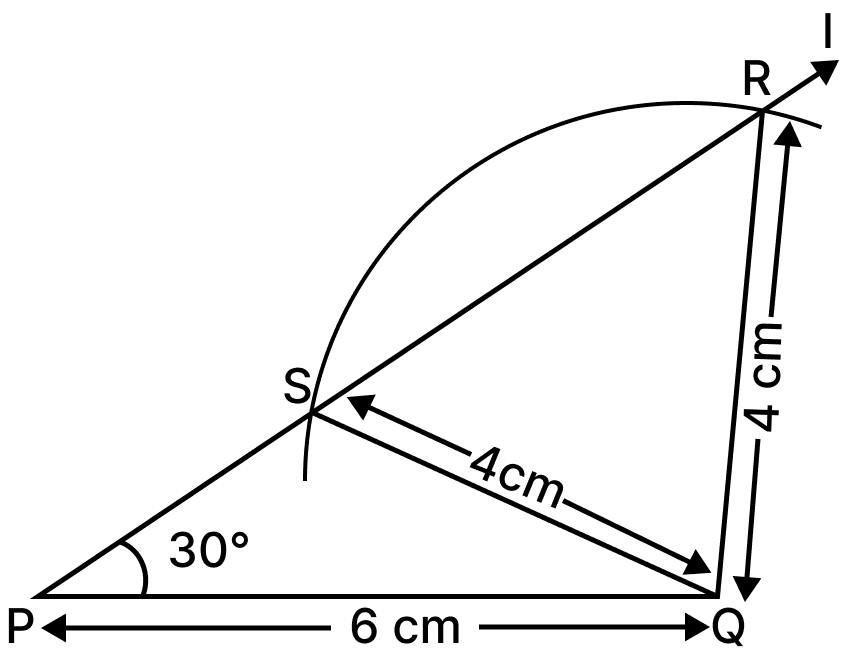
The construction is carried out as follows:
Step 1: Draw the base PQ of length 6 cm.
Step 2: Draw a line l from P that makes an angle of 30° with PQ.
Step 3: With Q as the centre, draw a sufficiently long arc of radius 4 cm cutting the line l.
The arc cuts the line l at two different points, R and S.
⇒ Both △PQR and △PQS have PQ = 6 cm, ∠P = 30° and the third side (QR or QS) equal to 4 cm.
⇒ Both the triangles satisfy the given measurements, but they are of different shapes and sizes.
∴ Yes, two non-congruent triangles can be drawn with these measurements. Hence, the SSA condition does not guarantee congruence.
△ABC and △XYZ are two triangles with, BC = YZ = 5 cm, ∠B = ∠Y = 50° and ∠C = ∠Z = 30°.
(i) Are they congruent?
(ii) Can there exist non-congruent triangles having these measurements? Construct and find out.
Answer
(i)
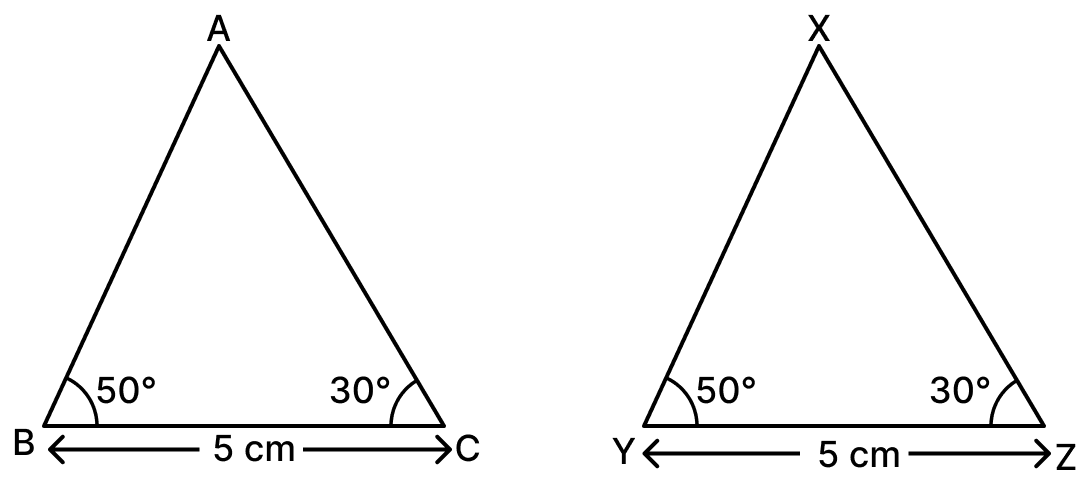
In △ABC and △XYZ:
∠B = ∠Y = 50° [Angle]
BC = YZ = 5 cm [Side]
∠C = ∠Z = 30° [Angle]
Here, the side BC lies between the angles ∠B and ∠C, and the side YZ lies between the angles ∠Y and ∠Z.
Since two angles and the included side of one triangle are equal to the two angles and the included side of the other triangle, the ASA condition is satisfied.
∴ △ABC ≅ △XYZ by the ASA condition of congruence.
(ii)
Let us construct a triangle with BC = 5 cm, ∠B = 50° and ∠C = 30°.
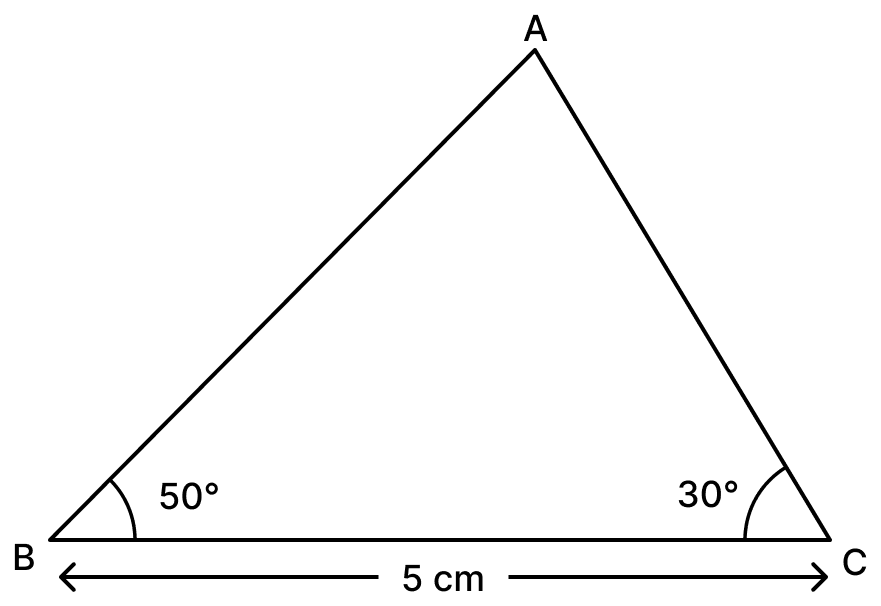
Step 1: Draw the base BC of length 5 cm.
Step 2: At B, draw a ray making an angle of 50° with BC.
Step 3: At C, draw a ray making an angle of 30° with BC, on the same side of BC.
Step 4: The two rays meet at exactly one point. Name this point A. △ABC is the required triangle.
Once the base BC is fixed, the ray from B and the ray from C are each completely determined by the given angles. Two such rays can meet at only one point, so the third vertex A gets fixed. Hence, only one triangle is possible with these measurements (up to superimposition).
∴ No non-congruent triangles can exist with these measurements — all triangles having BC = 5 cm, ∠B = 50° and ∠C = 30° are congruent to each other.
In the figure, Point O is the midpoint of AD and BC. What can one say about the lengths AB and CD?
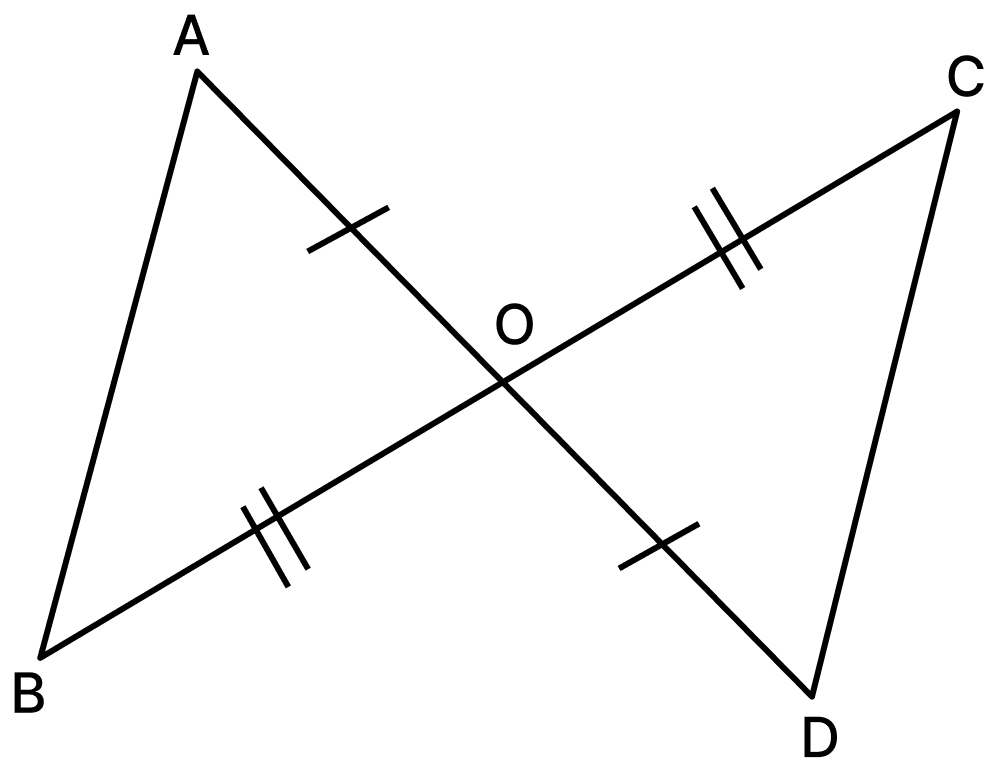
(i) Are there any other equal sides or angles?
Answer
In △AOB and △DOC:
AO = OD [Side, as O is the midpoint of AD]
∠AOB = ∠DOC [Angle, vertically opposite angles]
BO = OC [Side, as O is the midpoint of BC]
Since two sides and the included angle match, the SAS condition is satisfied.
⇒ △AOB ≅ △DOC [SAS condition of congruence]
AB and DC are corresponding sides of these congruent triangles, as they overlap when the triangles are superimposed.
∴ AB = CD, that is, the lengths AB and CD are equal.
(i)
Apart from AO = OD and BO = OC, we also have:
∠AOB = ∠DOC [Vertically opposite angles]
This gives the SAS condition, so △AOB ≅ △DOC.
Once the triangles are known to be congruent, the remaining corresponding parts are also equal:
AB = DC [Corresponding sides]
∠OAB = ∠ODC and ∠OBA = ∠OCD [Corresponding angles]
Hence, ∠AOB = ∠DOC are equal angles, and the congruence further gives AB = DC, ∠OAB = ∠ODC and ∠OBA = ∠OCD.
Identify whether the triangles below are congruent. What conditions did you use to establish their congruence? Express the congruence.
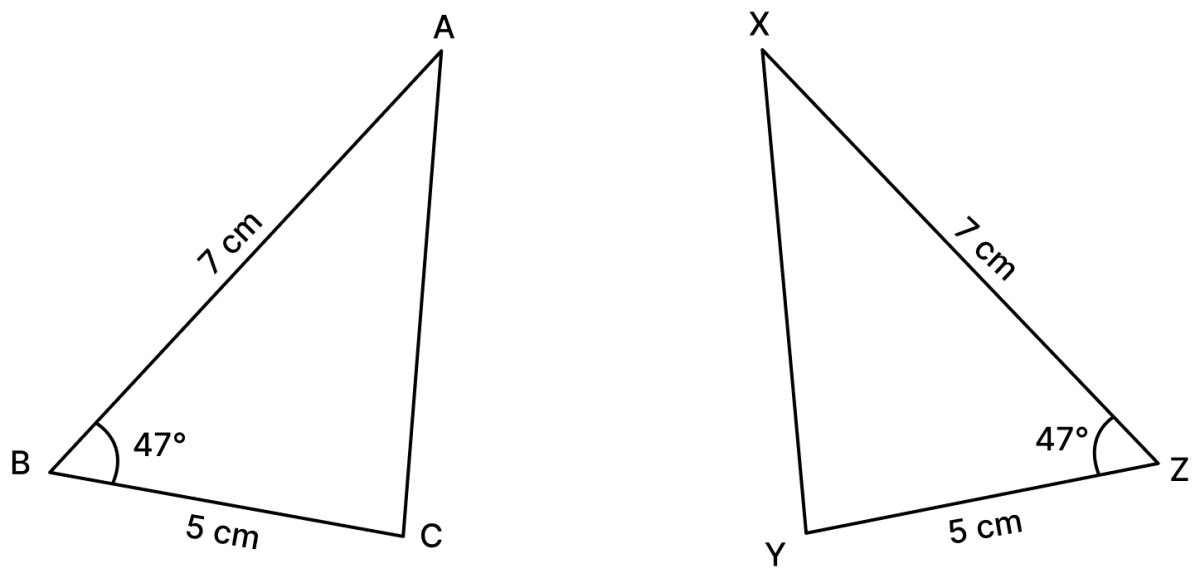
Answer
From the figure:
In △ABC,
AB = 7 cm, ∠B = 47°, BC = 5 cm
In △XYZ,
XZ = 7 cm, ∠Z = 47°, ZY = 5 cm
In △ABC and △XZY:
AB = XZ = 7 cm [Side]
∠B = ∠Z = 47° [Angle]
BC = ZY = 5 cm [Side]
In △ABC, the angle of 47° lies between the sides AB and BC, and in △XZY, the angle of 47° lies between the sides XZ and ZY. So the equal angle is the included angle in both the triangles.
Since two sides and the included angle match, the SAS condition is satisfied.
∴ △ABC ≅ △XZY by the SAS condition of congruence.
Given that CD and AB are parallel, and AB = CD, what are the other equal parts in this figure? (Hint: When the lines are parallel, the alternate angles are equal. Are the two resulting triangles congruent? If so, express the congruence.)
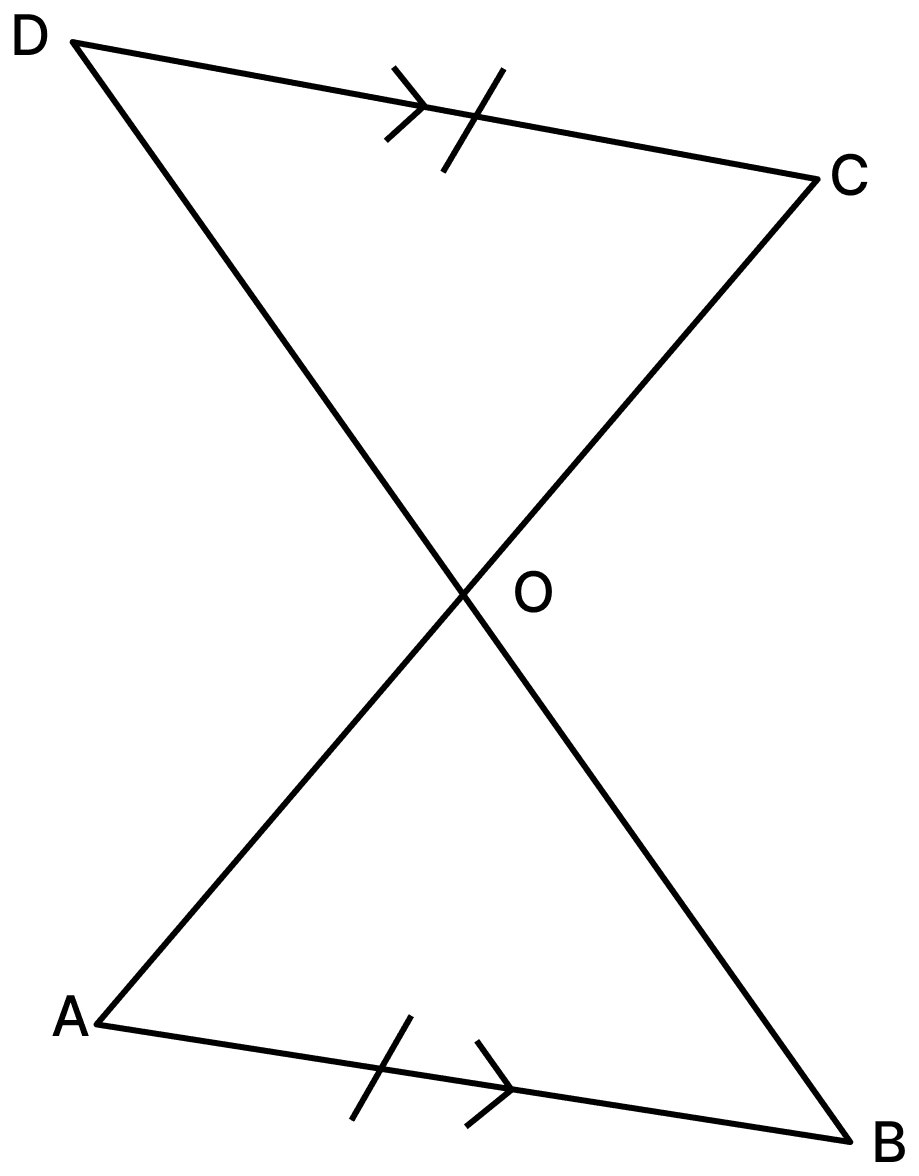
Answer
The two lines AB and CD are cut by the transversals AC and BD, which meet at the point O.
In △AOB and △COD:
∠BAO = ∠DCO [alternate angles as AB ∥ CD and AC is the transversal]
AB = CD [Given]
∠ABO = ∠CDO [alternate angles as AB ∥ CD and BD is the transversal]
Here AB is the side included between ∠A and ∠B, and CD is the side included between ∠C and ∠D.
Since two angles and the included side match, the ASA condition is satisfied.
⇒ △AOB ≅ △COD by the ASA condition of congruence.
The other equal parts are the remaining corresponding parts of these congruent triangles:
OA = OC [Corresponding sides]
OB = OD [Corresponding sides]
∠AOB = ∠COD [Corresponding angles — also vertically opposite angles]
Given that ∠ABC = ∠DBC and ∠ACB = ∠DCB, show that ∠BAC = ∠BDC. Are the two triangles congruent?
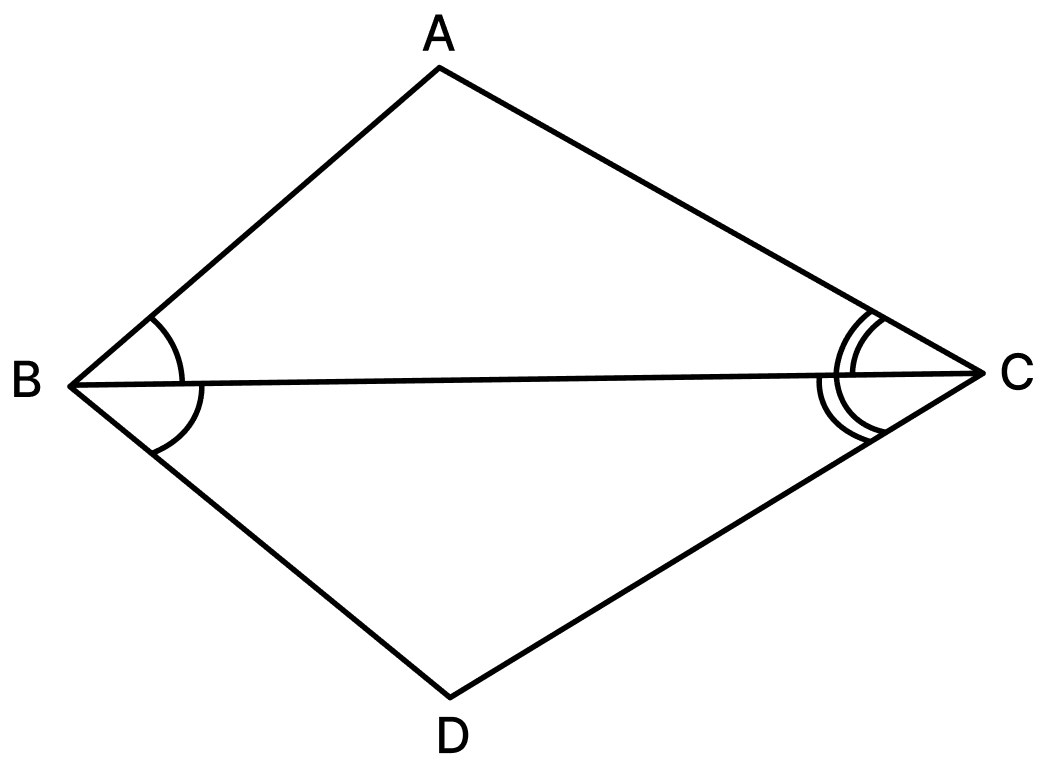
Answer
In △ABC,
∠BAC + ∠ABC + ∠ACB = 180°
⇒ ∠BAC = 180° − (∠ABC + ∠ACB) .....(1)
In △DBC,
∠BDC + ∠DBC + ∠DCB = 180°
⇒ ∠BDC = 180° − (∠DBC + ∠DCB) .....(2)
Let ∠ABC = ∠DBC = x
and
∠ACB = ∠DCB = y
From (1), ∠BAC = 180° − (x + y)
From (2), ∠BDC = 180° − (x + y)
∴ ∠BAC = ∠BDC.
In △ABC and △DBC:
∠ABC = ∠DBC [Given]
BC = BC [common side]
∠ACB = ∠DCB [Given]
The side BC is the side included between the two angles in both the triangles.
Since two angles and the included side match, the ASA condition is satisfied.
⇒ △ABC ≅ △DBC by the ASA condition of congruence.
∠BAC and ∠BDC are corresponding angles of these congruent triangles.
∴ ∠BAC = ∠BDC.
Identify the equal parts in the following figure, given that ∠ABD = ∠DCA and ∠ACB = ∠DBC.
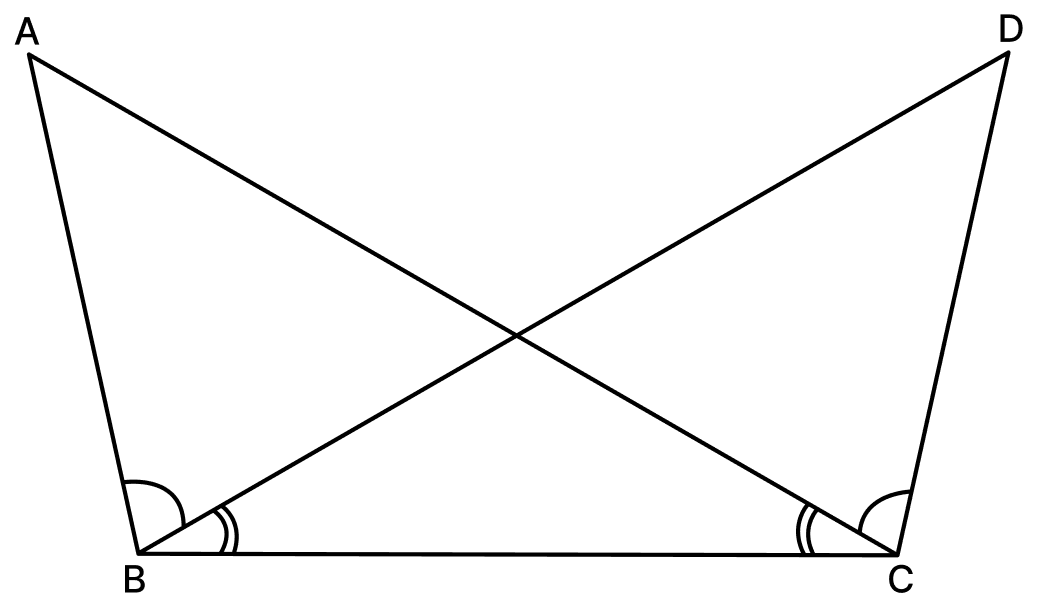
Answer
From the figure,
∠ABC = ∠ABD + ∠DBC [Ray BD lies inside ∠ABC]
∠DCB = ∠DCA + ∠ACB [Ray CA lies inside ∠DCB]
Given, ∠ABD = ∠DCA and ∠DBC = ∠ACB.
Adding these two equalities,
⇒ ∠ABD + ∠DBC = ∠DCA + ∠ACB
⇒ ∠ABC = ∠DCB
Now, in △ABC and △DCB:
∠ABC = ∠DCB [Angle, proved above]
BC = CB [common side]
∠ACB = ∠DBC [Given]
Since two angles and the included side match, the ASA condition is satisfied.
⇒ △ABC ≅ △DCB by the ASA condition of congruence.
The equal parts of the figure are therefore:
AB = DC [Corresponding sides]
AC = DB [Corresponding sides]
∠BAC = ∠CDB [Corresponding angles]
The following triangles △ABC and △XYZ are such that ∠A = ∠X = 35°, ∠C = ∠Z = 75°, and BC = YZ = 4 cm. Are the triangles congruent? Give a reason.
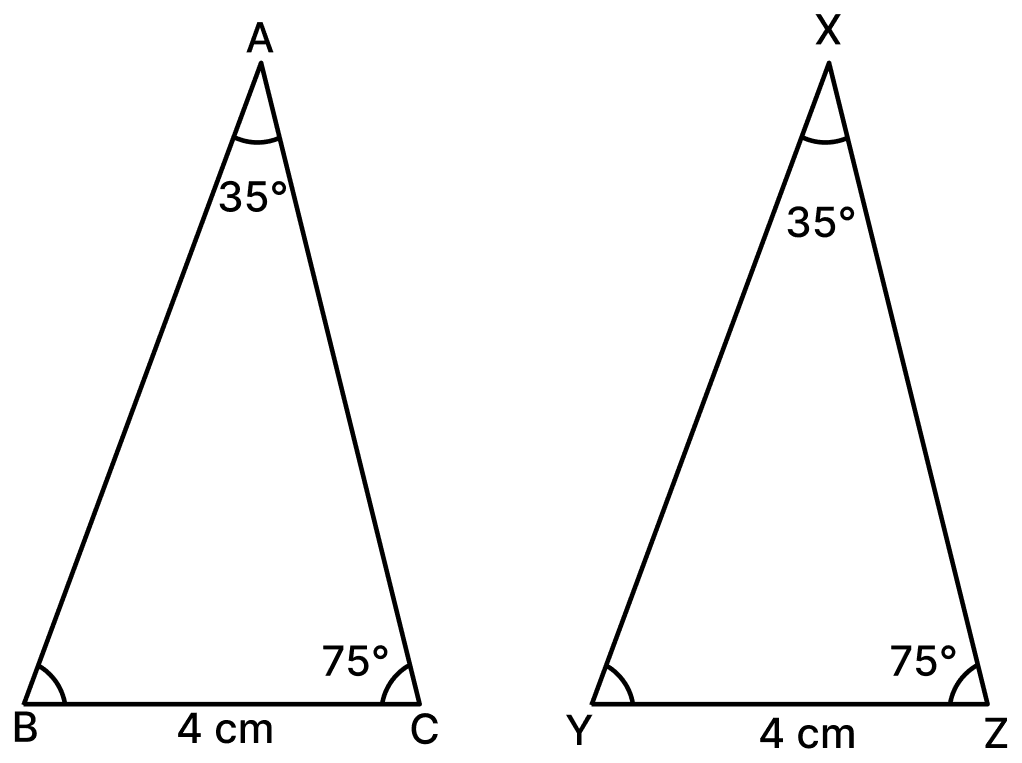
Answer
Given:
∠A = ∠X = 35°, ∠C = ∠Z = 75° and BC = YZ = 4 cm
Using the angle sum property of a triangle,
In △ABC: ∠B = 180° - (35° + 75°) = 180° - 110° = 70°
In △XYZ: ∠Y = 180° - (35° + 75°) = 180° - 110° = 70°
⇒ ∠B = ∠Y = 70°
Now, in △ABC and △XYZ:
∠B = ∠Y = 70° [Angle]
BC = YZ = 4 cm [Side]
∠C = ∠Z = 75° [Angle]
Since two angles and the included side match, the ASA condition is satisfied.
∴ Yes, the triangles are congruent. △ABC ≅ △XYZ by the AAS condition of congruence (the AAS condition reduces to the ASA condition using the angle sum property).
(i) What are the measures of ∠B and ∠Y?
(ii) Does this help in showing that △ABC and △XYZ are congruent?
Answer
(i)
We know that the sum of the angles of a triangle is 180°.
In △ABC:
∠B + ∠A + ∠C = 180° [Angle sum property of a triangle]
⇒ ∠B + 35° + 75° = 180°
⇒ ∠B + 110° = 180°
⇒ ∠B = 180° − 110°
⇒ ∠B = 70°
Similarly, in △XYZ:
∠Y + ∠X + ∠Z = 180° [Angle sum property of a triangle]
⇒ ∠Y + 35° + 75° = 180°
⇒ ∠Y = 180° − 110°
⇒ ∠Y = 70°
∴ ∠B = 70° and ∠Y = 70°, that is, ∠B = ∠Y.
(ii)
Answer
Given:
∠A = ∠X = 35°, ∠C = ∠Z = 75° and BC = YZ = 4 cm.
Consider △ABC,
∠B = 180° - (35° + 75°) = 180° - 110° = 70°.
Consider △XYZ,
∠Y = 180° - (35° + 75°) = 180° - 110° = 70°.
In △ABC and △XYZ:
∠B = ∠Y = 70° [Angle]
BC = YZ = 4 cm [Side]
∠C = ∠Z = 75° [Angle]
Since two angles and the included side match, they are congruent by ASA condition of congruence.
Yes, finding the third angles helps. Once ∠B = ∠Y is known, the given measurements become two angles and the included side.
∴ △ABC ≅ △XYZ by ASA condition of congruence.
△ABC and △XYZ are right-angled triangles such that BC = YZ = 4 cm, ∠B = ∠Y = 90° and AC = XZ = 5 cm.
(i) Are they congruent?
(ii) Can there exist non-congruent triangles having these measurements? Construct and find out.
Answer
(i)
Given:
∠B = ∠Y = 90°, BC = YZ = 4 cm and AC = XZ = 5 cm.
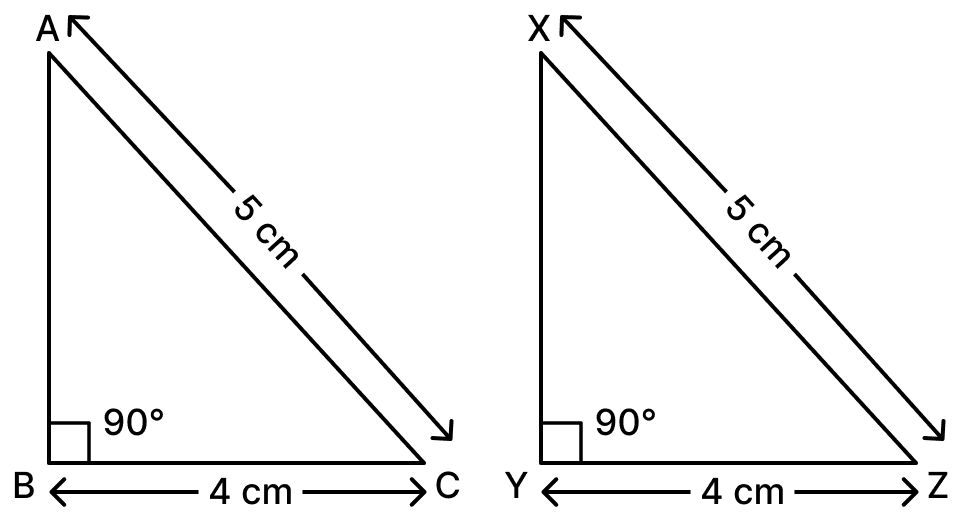
Here, AC and XZ are the sides opposite to the right angles. So they are the hypotenuses of the two triangles.
In △ABC and △XYZ:
∠B = ∠Y = 90° [Right angle]
AC = XZ = 5 cm [Hypotenuse]
BC = YZ = 4 cm [Side]
Since the right angle, the hypotenuse and one side match, they are congruent by RHS condition of congruence.
∴ △ABC ≅ △XYZ by RHS condition of congruence.
(ii)
Let us construct a triangle PQR with QR = 4 cm, ∠Q = 90° and PR = 5 cm.
Step 1: Draw the base QR of length 4 cm.
Step 2: Draw a line l perpendicular to QR at Q.
Step 3: From R, cut an arc on the line l of radius 5 cm.
Step 4: Let P be the point at which the arc intersects the line l. Join PR.
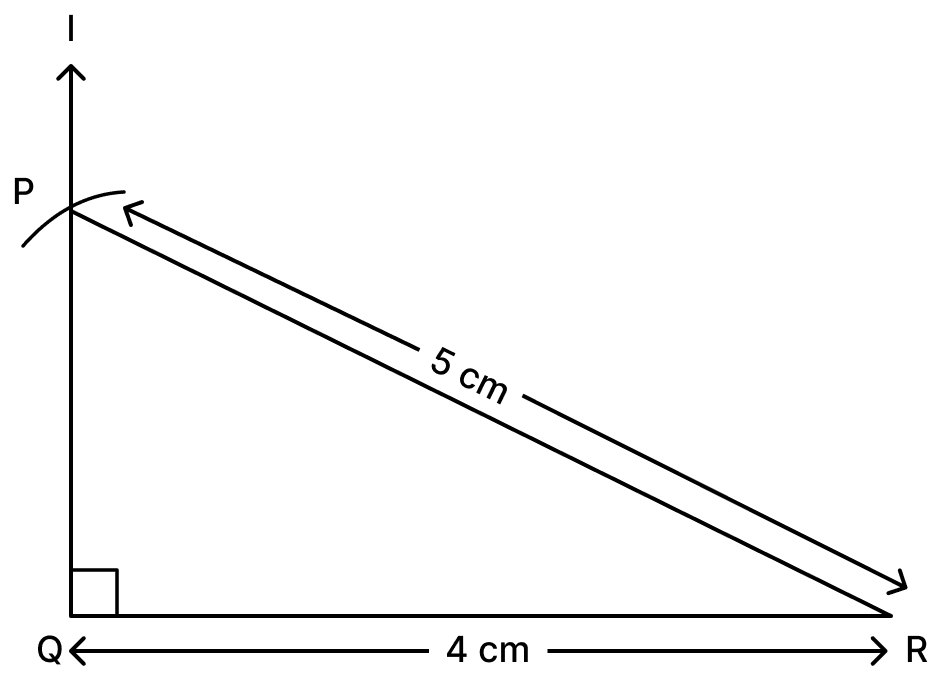
△PQR is the required triangle.
The arc drawn from R cuts the line l at exactly one point above QR, so the third vertex P is fixed. Hence, every triangle drawn with these measurements turns out to be an exact copy of △PQR.
On comparing the triangles constructed by different students (by tracing and superimposing), all of them fit exactly one over the other.
∴ No non-congruent triangles can exist with these measurements. All such triangles are congruent (RHS condition).
Consider the downward extension of line l below QR. Would the arc from R meet this line downwards as well (as in the case of triangle construction when the sidelengths are given)? If so, would this lead to a triangle whose size and shape are different from △PQR, and yet has the given measurements?
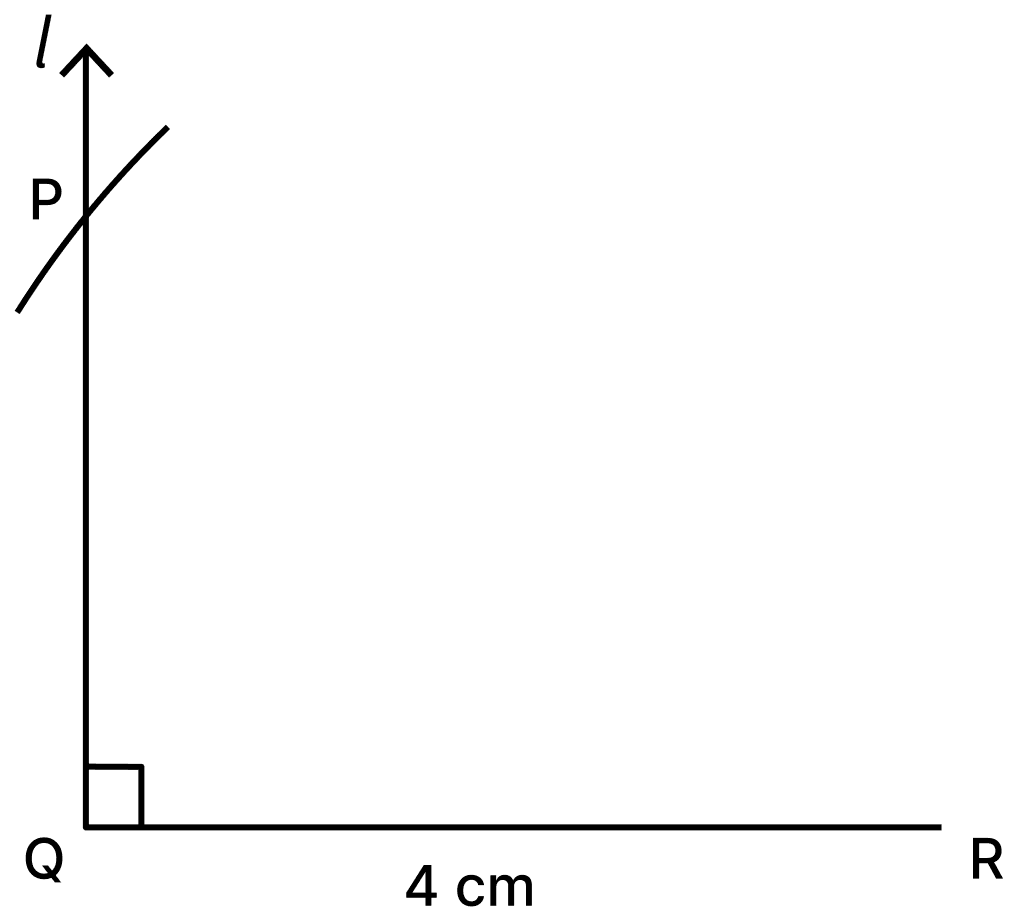
Answer
Yes, the arc drawn from R with radius 5 cm meets the downward extension of the line l as well, say at the point P′.
So we get a second triangle △P′QR with QR = 4 cm, ∠Q = 90° and P′R = 5 cm.
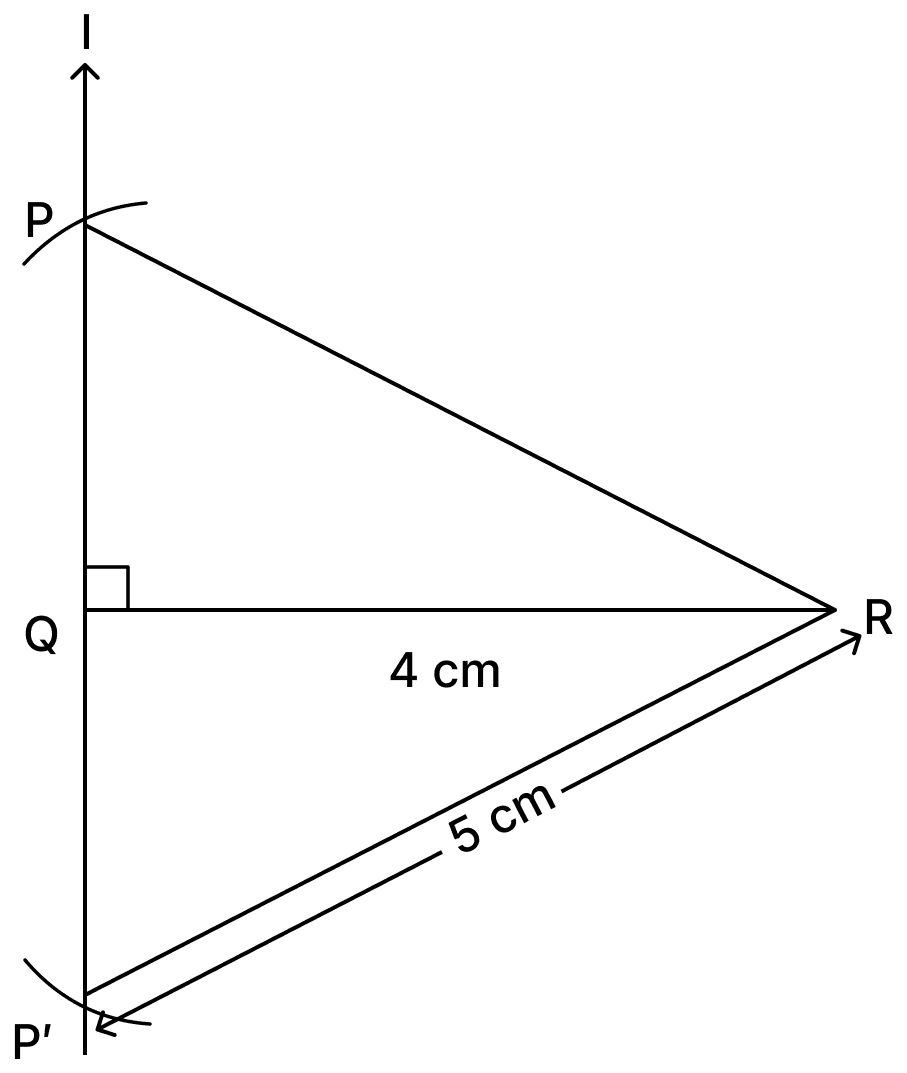
But this triangle is not of a different size and shape.
In △PQR and △P′QR:
QR = QR [Common side]
∠PQR = ∠P′QR = 90° [Perpendicular at Q]
PR = P′R = 5 cm [Radius of the same arc]
Since the right angle, the hypotenuse and one side match, △PQR ≅ △P′QR by RHS condition of congruence.
In fact, QR acts as a line of symmetry, since the same construction is repeated above and below QR. So △P′QR is just a flipped copy of △PQR.
∴ The arc meets the downward extension of l, but the triangle obtained is congruent to △PQR. Hence, all triangles having these measurements are congruent to each other.
Can you use the fact that angles opposite equal sides are equal to find ∠B and ∠C?
Answer
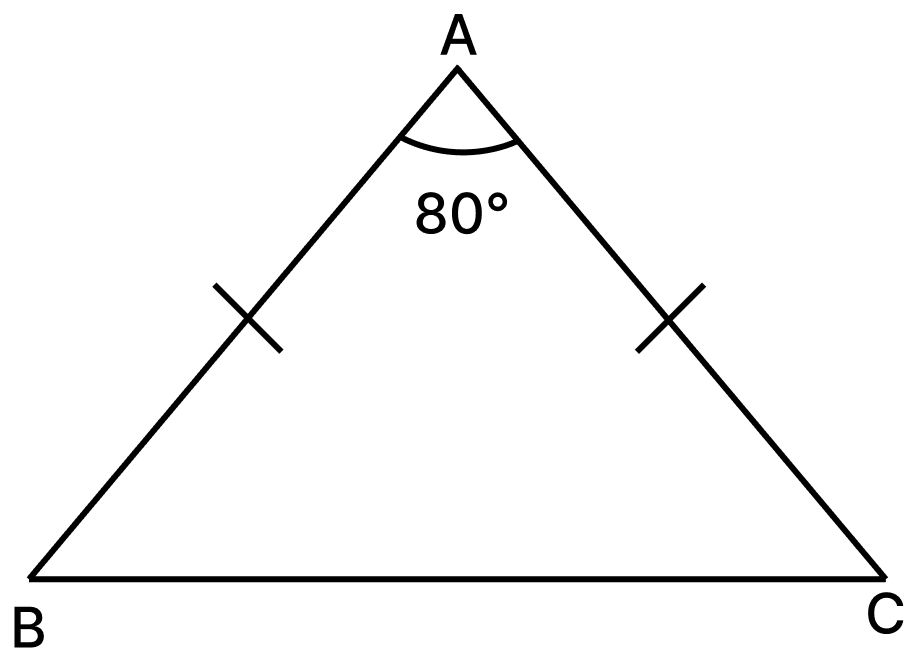
Since AB = AC, the angles opposite these equal sides are equal
∠B = ∠C
Also the sum of the angles of a triangle is 180°.
∠A + ∠B + ∠C = 180°
⇒ 80° + ∠B + ∠B = 180° [As ∠C = ∠B]
⇒ 2∠B = 180° − 80°
⇒ 2∠B = 100°
⇒ ∠B =
∠B = 50°
∴ ∠C = 50°
Equilateral triangles are those in which all the sides have equal lengths. What can we say about their angles?
(i) What could be their measures?
Answer
Let △ABC be an equilateral triangle. So AB = BC = AC.
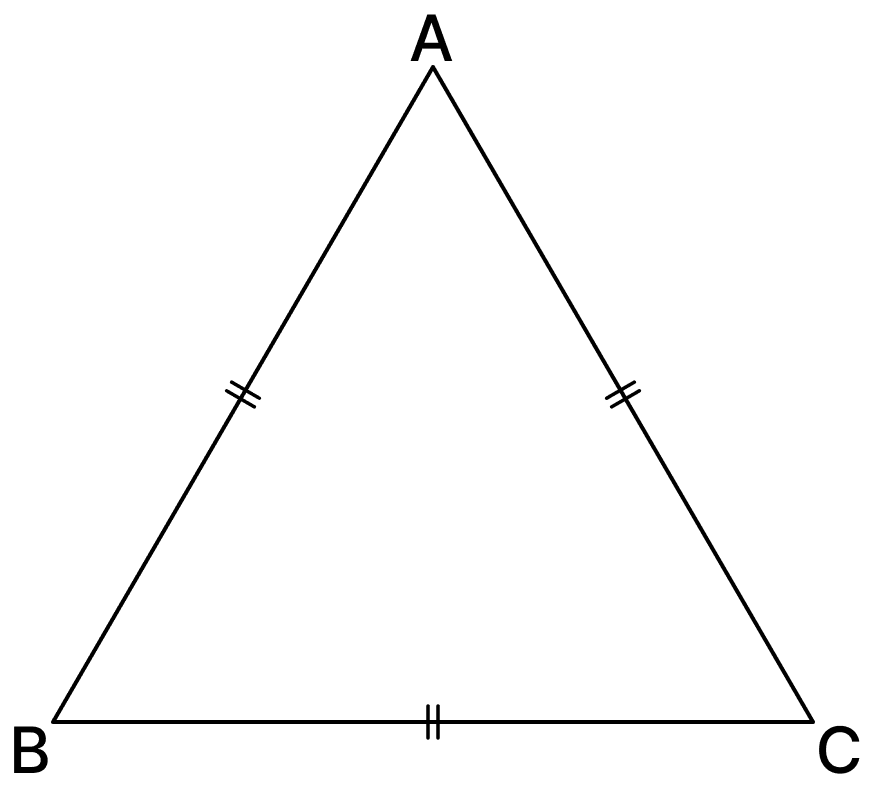
We use the fact that angles opposite to equal sides are equal.
The sides AB and AC are equal.
⇒ ∠B = ∠C [Angles opposite to equal sides AC and AB]
Similarly, the sides AB and BC are equal.
⇒ ∠A = ∠C [Angles opposite to equal sides BC and AB]
⇒ ∠A = ∠B = ∠C
∴ All the three angles of an equilateral triangle are equal, just like its sides.
(i)
Let each angle of the equilateral triangle measure x.
We know that the sum of the angles of a triangle is 180°.
3 × (angle in an equilateral triangle) = 180°
⇒ 3x = 180°
⇒ x =
⇒ x = 60°
∴ Each angle of an equilateral triangle measures 60°.
△AIR ≅ △FLY. Identify the corresponding vertices, sides and angles.
Answer
By the convention of writing a congruence, the first, second and third vertices of △AIR correspond to the first, second and third vertices of △FLY respectively.
(a) Corresponding Vertices:
A and F, I and L, R and Y
(b) Corresponding Sides:
AI and FL, IR and LY, AR and FY
(c) Corresponding Angles:
∠A and ∠F, ∠I and ∠L, ∠R and ∠Y
Each of the following cases contains certain measurements taken from two triangles. Identify the pairs in which the triangles are congruent to each other, with reason. Express the congruence whenever they are congruent.
(a) AB = DE
BC = EF
CA = DF
(b) AB = EF
∠A = ∠E
AC = ED
(c) AB = DF
∠B = ∠D = 90°
AC = FE
(d) ∠A = ∠D
∠B = ∠E
AC = DF
(e) AB = DF
∠B = ∠F
AC = DE
Answer
(a)
In △ABC and △DEF:
AB = DE [Side]
BC = EF [Side]
CA = FD [Side]
Since all three sides match, the triangles are congruent by the SSS condition of congruence.
△ABC ≅ △DEF
(b)
Here ∠A is the angle included between the sides AB and AC of △ABC, and ∠E is the angle included between the sides EF and ED of △EFD.
In △ABC and △EFD:
AB = EF [Side]
∠A = ∠E [Included angle]
AC = ED [Side]
Since two sides and the included angle match, the triangles are congruent by the SAS condition of congruence.
△ABC ≅ △EFD
(c)
In △ABC, the right angle is at B, so AC is the hypotenuse.
In △DEF, the right angle is at D, so EF is the hypotenuse.
In △ABC and △FDE:
∠B = ∠D = 90° [Right angle]
AC = FE [Hypotenuse]
AB = FD [Side]
Since the right angle, the hypotenuse and one side match, the triangles are congruent by the RHS condition of congruence.
△ABC ≅ △FDE
(d)
Here AC is the side opposite to ∠B in △ABC, and DF is the side opposite to ∠E in △DEF. So the given side is a non-included side in both the triangles.
In △ABC and △DEF:
∠A = ∠D [Angle]
∠B = ∠E [Angle]
AC = DF [Non-included side]
Since two angles and a non-included side match, the triangles are congruent by the AAS condition of congruence.
△ABC ≅ △DEF
(e)
Taking the correspondence A ↔ D, B ↔ F, C ↔ E, we have AB = DF, ∠B = ∠F and AC = DE.
The two sides given are AB and AC, and the angle given is ∠B.
∠B is not the angle included between AB and AC (the included angle would be ∠A). Similarly, ∠F is not the angle included between DF and DE.
So only two sides and a non-included angle are equal. This is the SSA condition, which does not guarantee congruence.
∴ The triangles need not be congruent.
It is given that OB = OC, and OA = OD. Show that AB is parallel to CD.
[Hint: AD is a transversal for these two lines. Are there any equal alternate angles?]
Answer
In △AOB and △DOC:
OA = OD [Side, given]
∠AOB = ∠DOC [Included angle, vertically opposite angles]
OB = OC [Side, given]
Since two sides and the included angle match, the triangles are congruent by the SAS condition of congruence.
△AOB ≅ △DOC
⇒ ∠OAB = ∠ODC [Corresponding parts of congruent triangles]
Now, AD is a transversal cutting the lines AB and CD.
∠OAB and ∠ODC are the angles that AB and CD make with the transversal AD on opposite sides of it. Hence, they form a pair of alternate angles.
As this pair of alternate angles is equal,
∴ AB is parallel to CD.
ABCD is a square. Show that △ABC ≅ △ADC. Is △ABC also congruent to △CDA?
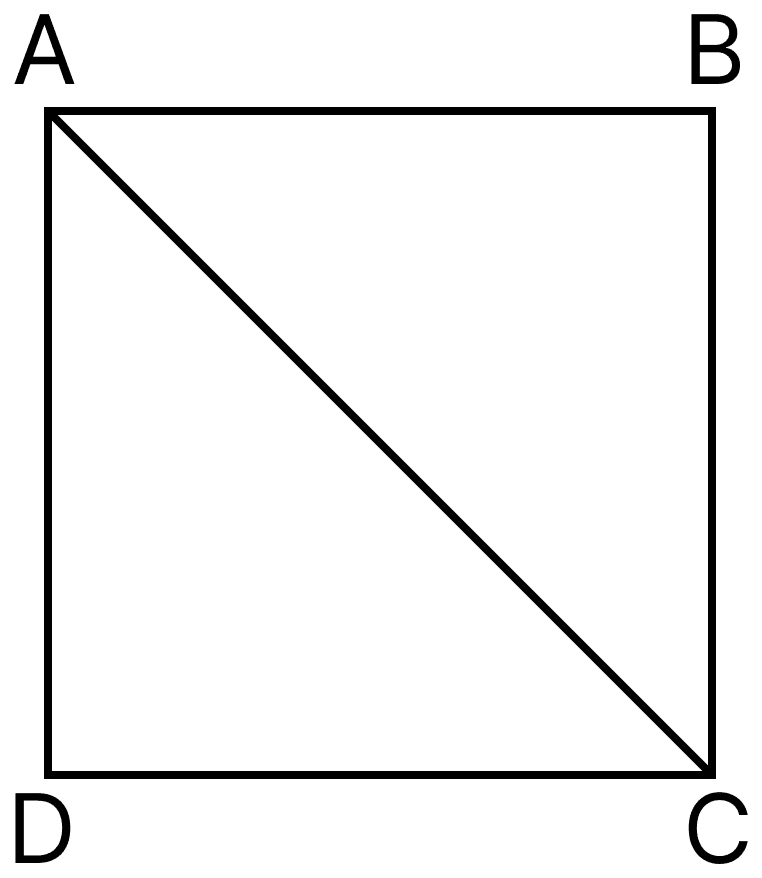
Give more examples of two triangles where one triangle is congruent to the other in two different ways, as in the case above. Can you give an example of two triangles where one is congruent to the other in six different ways?
Answer
Since ABCD is a square, all its four sides are equal. So,
AB = BC = CD = DA
In △ABC and △ADC:
AB = AD [sides of a square]
BC = DC [sides of a square]
AC = AC [common side]
Since all three sides match, they are congruent by the SSS condition of congruence.
∴ △ABC ≅ △ADC
Is △ABC ≅ △CDA?
Now take the correspondence A ↔ C, B ↔ D, C ↔ A.
In △ABC and △CDA:
AB = CD [sides of a square]
BC = DA [sides of a square]
CA = AC [common side]
Since all three sides match under this correspondence too, they are congruent by the SSS condition of congruence.
∴ △ABC ≅ △CDA as well. So △ABC is congruent to the same triangle in two different ways.
More examples of a congruence that holds in two different ways
Such multiple correspondences occur when the triangles have symmetry. In particular, for two congruent isosceles triangles, the two equal sides can be interchanged while matching the triangles.
Example 1: Let △PQR be isosceles with PQ = PR, and let △XYZ be a triangle with XY = PQ, XZ = PR and YZ = QR.
Then by SSS, △PQR ≅ △XYZ, and also △PQR ≅ △XZY.
Example 2: Take an isosceles triangle ABC with AB = AC and let D be the midpoint of BC. Then △ABD ≅ △ACD, and also △ABD ≅ △ACD read with the flipped correspondence gives the same pair of triangles fitting in a second way.
An example with six different ways
Take two equilateral triangles △ABC and △PQR having the same side length.
Every side of one is equal to every side of the other, so the SSS condition is satisfied for all the six ways of matching the vertices:
△ABC ≅ △PQR, △ABC ≅ △PRQ, △ABC ≅ △QPR, △ABC ≅ △QRP, △ABC ≅ △RPQ, △ABC ≅ △RQP
∴ Two equilateral triangles of the same side length are congruent to each other in six different ways.
Find ∠B and ∠C, if A is the centre of the circle.
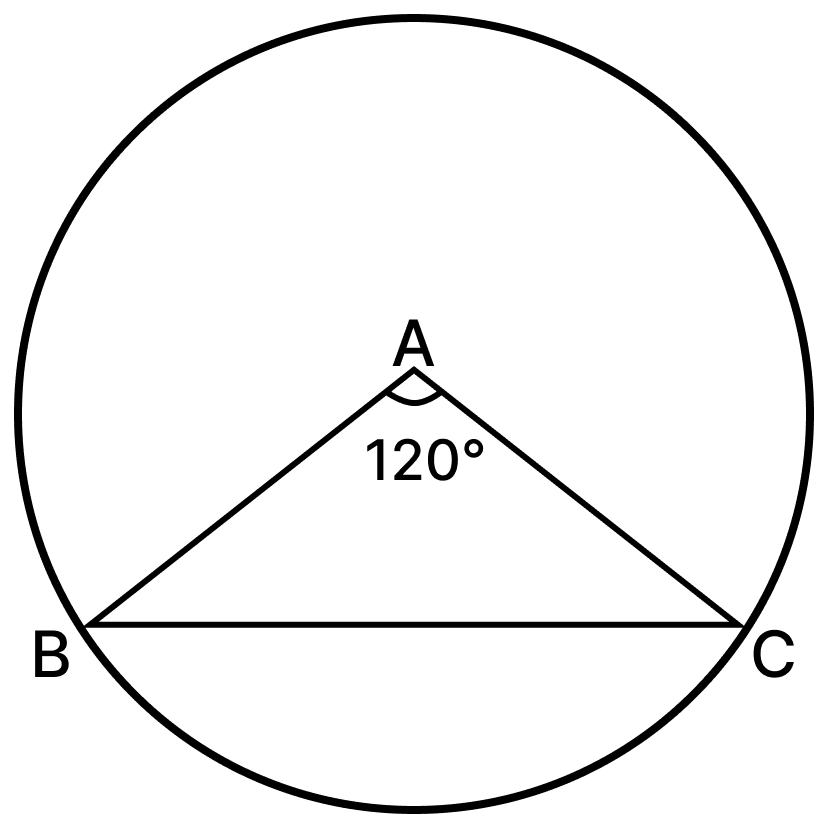
Answer
Given:
A is the centre of the circle, B and C lie on the circle, and ∠A = 120°.
AB and AC are radii of the same circle.
AB = AC [Radii of the same circle]
⇒ ∠B = ∠C [Angles opposite to equal sides are equal]
Consider △ABC,
∠A + ∠B + ∠C = 180° [Angle sum property of a triangle]
⇒ 120° + ∠B + ∠B = 180° [As ∠B = ∠C]
⇒ 2∠B = 180° − 120°
⇒ 2∠B = 60°
⇒ ∠B =
⇒ ∠B = 30°
∴ ∠C = 30°
∴ ∠B = 30° and ∠C = 30°.
Find the missing angles. As per the convention that we have been following, all line segments marked with a single '|' are equal to each other and those marked with a double '|' are equal to each other, etc.
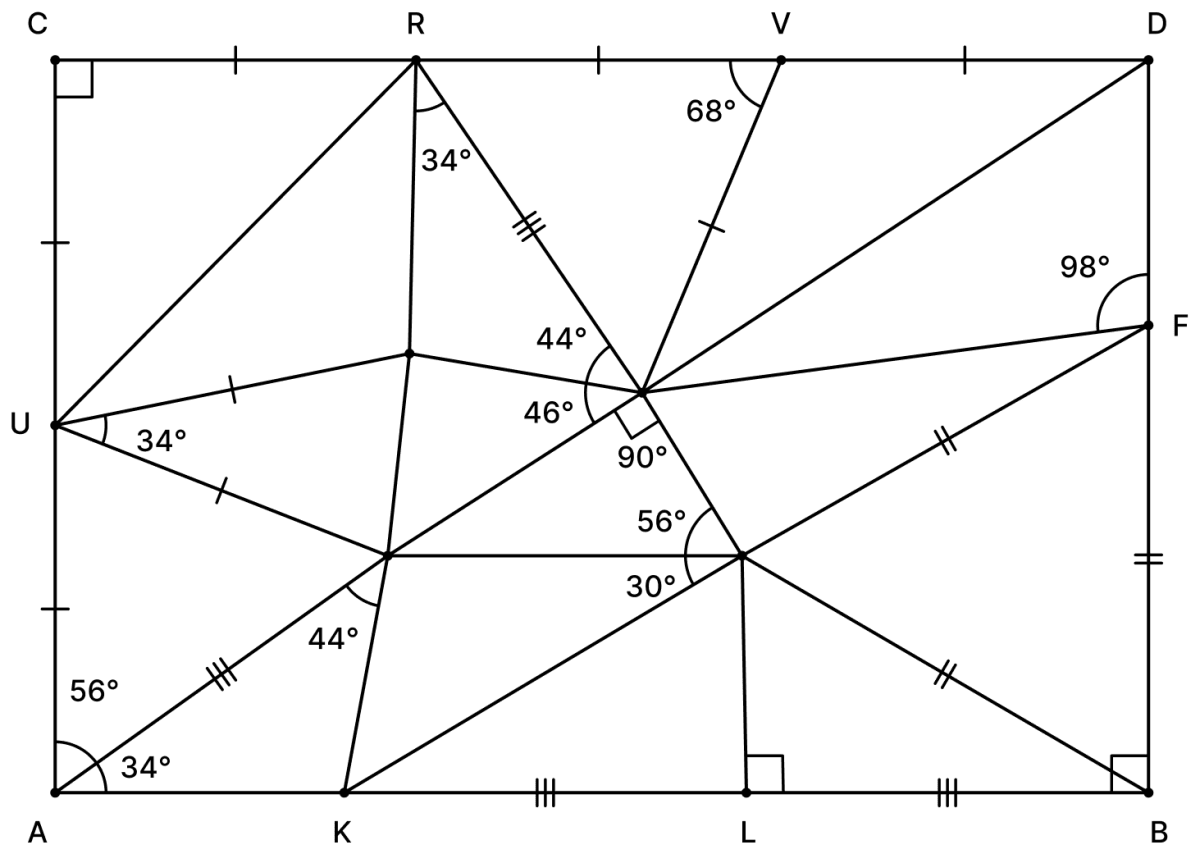
Answer
Let the four unlabelled interior points be named as follows:
P — the point joined to R, U, M and N.
M — the point at which the angles 44°, 46° and 90° are marked.
N — the point at which the angle 44° is marked.
T — the point at which the angles 56° and 30° are marked.
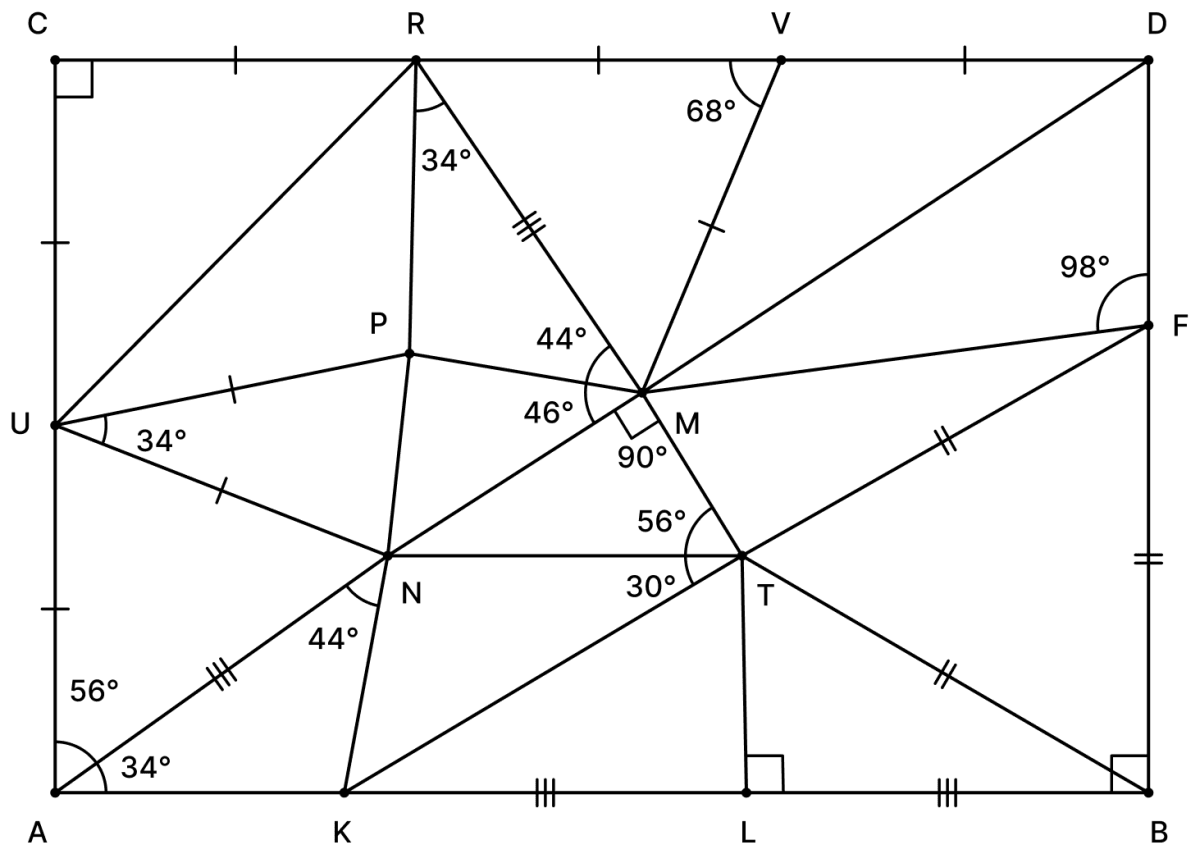
Reading the figure
From the tick marks,
Single '|': CR = RV = VD = CU = UA = UP = UN = VM
Double '||': FB = FT = TB
Triple '|||': AN = RM = KL = LB
Also note that A, N, M, D lie on one straight line (the diagonal AD) and R, M, T lie on one straight line.
Step 1: The right isosceles triangle CUR
In △CUR,
CU = CR [Single tick marks]
∠UCR = 90° [Angle of the rectangle]
⇒ ∠CUR = ∠CRU [Angles opposite to equal sides are equal]
⇒ ∠CUR + ∠CRU = 180° − 90°
= 2∠CUR = 90° [Since ∠CUR = ∠CRU]
⇒ ∠CUR =
⇒ ∠CUR = 45°
∴ ∠CRU = 45°
∴ ∠CUR = 45° and ∠CRU = 45°
Step 2: The angles at A and at D
At the corner A, the diagonal AD divides the right angle into ∠UAN = 56° and ∠NAK = 34°.
Now AD is a transversal of the parallel lines AB and CD. Hence,
∠MDV = ∠NAK = 34° [Alternate interior angles]
∠ADV = ∠DAK = 34° [Alternate angles]
⇒ ∠ADF = ∠DAU = 56° [Alternate angles]
∴ ∠MDV = 34° and ∠MDF = 56°
Step 3: The isosceles triangle AUN
In △AUN,
UA = UN [Single tick marks]
⇒ ∠ANU = ∠UAN = 56° [Angles opposite to equal sides are equal]
⇒ ∠NUA = 180° − 56° − 56° [Angle sum property]
⇒ ∠NUA = 68°
∴ ∠ANU = 56° and ∠NUA = 68°
Step 4: The angles at U
C, U and A lie on a straight line. So,
∠CUR + ∠RUP + ∠PUN + ∠NUA = 180°
⇒ 45° + ∠RUP + 34° + 68° = 180°
⇒ 147° + ∠RUP = 180°
⇒ ∠RUP = 180° − 147°
⇒ ∠RUP = 33°
∴ ∠RUP = 33°
Step 5: The isosceles triangle RVM
In △RVM,
RV = VM [Single tick marks]
⇒ ∠VRM = ∠VMR [Angles opposite to equal sides are equal]
⇒ ∠VRM + ∠VMR + ∠RVM = 180°
⇒ ∠VRM + ∠VRM + ∠RVM = 180°
⇒ 2∠VRM + 68° = 180° [Since, ∠VRM = ∠VMR]
⇒ 2∠VRM = 180° − 68°
⇒ ∠VRM = 56°
∴ ∠VMR = 56°
Also, ∠MVD = 180° − 68° = 112° [Linear pair, C–V–D is a straight line]
∴ ∠VRM = 56°, ∠VMR = 56° and ∠MVD = 112°
(As a check, in △DVM: 34° + 112° + 34° = 180°, so ∠DMV = 34°.)
Step 6: The angles at R
C, R and V lie on a straight line. So,
∠CRU + ∠URP + ∠PRM + ∠MRV = 180°
⇒ 45° + ∠URP + 34° + 56° = 180°
⇒ ∠URP = 180° − 135°
⇒ ∠URP = 45°
∴ ∠URP = 45°
Step 7: The angles at M and the line RMT
At M, ∠RMP = 44° and ∠PMN = 46°.
∠RMN = 44° + 46° = 90°
∠NMT = 90° [Given]
⇒ ∠RMT = 90° + 90° = 180°
∴ R, M and T lie on one straight line, and RM ⊥ AD.
Since ∠RMN = 90° and A, N, M, D are collinear, ∠RMD = 90°.
∠RMV + ∠VMD = 90°
⇒ 56° + ∠VMD = 90°
⇒ ∠VMD = 34°
∴ ∠VMD = 34°
Step 8: Triangle DMF
In △DMF,
∠MDF + ∠DFM + ∠FMD = 180° [Angle sum property]
⇒ 56° + 98° + ∠FMD = 180°
⇒ ∠FMD = 26°
Since ∠DMT = 90° [As ∠NMT = 90° and A–N–M–D is a straight line]
∠FMD + ∠TMF = 90°
⇒ 26° + ∠TMF = 90°
⇒ ∠TMF = 64°
∴ ∠FMD = 26° and ∠TMF = 64°
Step 9: The angles at F, and the equilateral triangle TFB
In △TFB,
FB = FT = TB [Double tick marks]
⇒ △TFB is equilateral
⇒ ∠TFB = ∠FTB = ∠TBF = 60° [Angles of an equilateral triangle]
D, F and B lie on a straight line. So,
∠DFM + ∠MFT + ∠TFB = 180°
⇒ 98° + ∠MFT + 60° = 180°
⇒ ∠MFT = 22°
At the corner B, ∠TBF = 60°, so ∠LBT = 90° − 60° = 30°.
∴ ∠TFB = 60°, ∠MFT = 22°, ∠FTB = 60° and ∠LBT = 30°
Step 10: Triangle MFT
In △MFT,
∠TMF + ∠MFT + ∠FTM = 180° [Angle sum property]
⇒ 64° + 22° + ∠FTM = 180°
⇒ ∠FTM = 94°
∴ ∠FTM = 94°
Step 11: The angles at P
In △URP,
∠RUP + ∠URP + ∠UPR = 180° [Angle sum property]
⇒ 33° + 45° + ∠UPR = 180°
⇒ ∠UPR = 102°
In △RPM,
∠PRM + ∠RMP + ∠MPR = 180° [Angle sum property]
⇒ 34° + 44° + ∠MPR = 180°
⇒ ∠MPR = 102°
In △UPN,
UP = UN [Single tick marks]
⇒ ∠UPN = ∠UNP [Angles opposite to equal sides are equal]
⇒ ∠UPN + ∠UNP = 180° − 34° [As ∠PUN = 34°]
⇒ ∠UPN = ∠UNP = 73°
The four angles at P go all the way round the point P. So,
∠UPR + ∠MPR + ∠UPN + ∠NPM = 360°
⇒ 102° + 102° + 73° + ∠NPM = 360°
⇒ ∠NPM = 83°
∴ ∠UPR = 102°, ∠MPR = 102°, ∠UPN = 73° and ∠NPM = 83°
Step 12: The angles at N
A, N and M lie on a straight line. Taking the angles on the side of P,
∠ANU + ∠UNP + ∠PNM = 180°
⇒ 56° + 73° + ∠PNM = 180°
⇒ ∠PNM = 51°
In △NMT,
∠NMT + ∠MTN + ∠MNT = 180° [Angle sum property]
⇒ 90° + 56° + ∠MNT = 180°
⇒ ∠MNT = 34°
Taking the angles at N on the side of K,
∠MNT + ∠TNK + ∠KNA = 180°
⇒ 34° + ∠TNK + 44° = 180°
⇒ ∠TNK = 102°
∴ ∠PNM = 51°, ∠MNT = 34° and ∠TNK = 102°
Step 13: The angles at K
In △ANK,
∠NAK + ∠KNA + ∠AKN = 180° [Angle sum property]
⇒ 34° + 44° + ∠AKN = 180°
⇒ ∠AKN = 102°
In △NKT,
∠TNK + ∠NTK + ∠NKT = 180° [Angle sum property]
⇒ 102° + 30° + ∠NKT = 180°
⇒ ∠NKT = 48°
A, K and L lie on a straight line. So,
∠AKN + ∠NKT + ∠TKL = 180°
⇒ 102° + 48° + ∠TKL = 180°
⇒ ∠TKL = 30°
∴ ∠AKN = 102°, ∠NKT = 48° and ∠TKL = 30°
Step 14: The angles at L and at T
TL ⊥ AB, so ∠KLT = ∠TLB = 90°.
In △KLT,
∠TKL + ∠KLT + ∠KTL = 180° [Angle sum property]
⇒ 30° + 90° + ∠KTL = 180°
⇒ ∠KTL = 60°
In △TLB,
∠LBT + ∠TLB + ∠LTB = 180° [Angle sum property]
⇒ 30° + 90° + ∠LTB = 180°
⇒ ∠LTB = 60°
∴ ∠KLT = ∠TLB = 90°, ∠KTL = 60° and ∠LTB = 60°
As a check, the six angles at T add up to a complete angle:
∠MTN + ∠NTK + ∠KTL + ∠LTB + ∠BTF + ∠FTM = 56° + 30° + 60° + 60° + 60° + 94° = 360° ✓
All the missing angles
At C: ∠UCR = 90°
At R: ∠CRU = 45°, ∠URP = 45°, ∠PRM = 34°, ∠MRV = 56°
At V: ∠RVM = 68°, ∠MVD = 112°
At D: ∠MDV = 34°, ∠MDF = 56°
At U: ∠CUR = 45°, ∠RUP = 33°, ∠PUN = 34°, ∠NUA = 68°
At A: ∠UAN = 56°, ∠NAK = 34°
At F: ∠DFM = 98°, ∠MFT = 22°, ∠TFB = 60°
At B: ∠LBT = 30°, ∠TBF = 60°
At K: ∠AKN = 102°, ∠NKT = 48°, ∠TKL = 30°
At L: ∠KLT = 90°, ∠TLB = 90°
At P: ∠UPR = 102°, ∠MPR = 102°, ∠UPN = 73°, ∠NPM = 83°
At M: ∠RMP = 44°, ∠PMN = 46°, ∠NMT = 90°, ∠TMF = 64°, ∠FMD = 26°, ∠DMV = 34°, ∠VMR = 56°
At N: ∠ANU = 56°, ∠UNP = 73°, ∠PNM = 51°, ∠MNT = 34°, ∠TNK = 102°, ∠KNA = 44°
At T: ∠MTN = 56°, ∠NTK = 30°, ∠KTL = 60°, ∠LTB = 60°, ∠BTF = 60°, ∠FTM = 94°