
Based on this new model, answer the following questions:
(i) If the first movement is −4 and the final position is 5, what is the second movement?
(ii) If there are multiple strikes causing movements in the order 1, −2, 3, −4, …, −10, what is the final position of the coin?
Answer
(i)
We know that
Final Position = First Movement + Second Movement
Let the second movement be b.
5 = (−4) + b
Adding 4 to both sides,
⇒ b = 5 + 4
⇒ b = 9
∴ The second movement is 9 units.
Since 9 is positive, the coin moves 9 units to the right.
(ii)
When the coin is struck many times, the final position is the sum of all the movements.
Final position = 1 + (−2) + 3 + (−4) + 5 + (−6) + 7 + (−8) + 9 + (−10)
Grouping the movements in pairs:
= [1 + (−2)] + [3 + (−4)] + [5 + (−6)] + [7 + (−8)] + [9 + (−10)]
= (−1) + (−1) + (−1) + (−1) + (−1)
= −5
∴ The final position of the coin is −5, that is, 5 units to the left of 0.
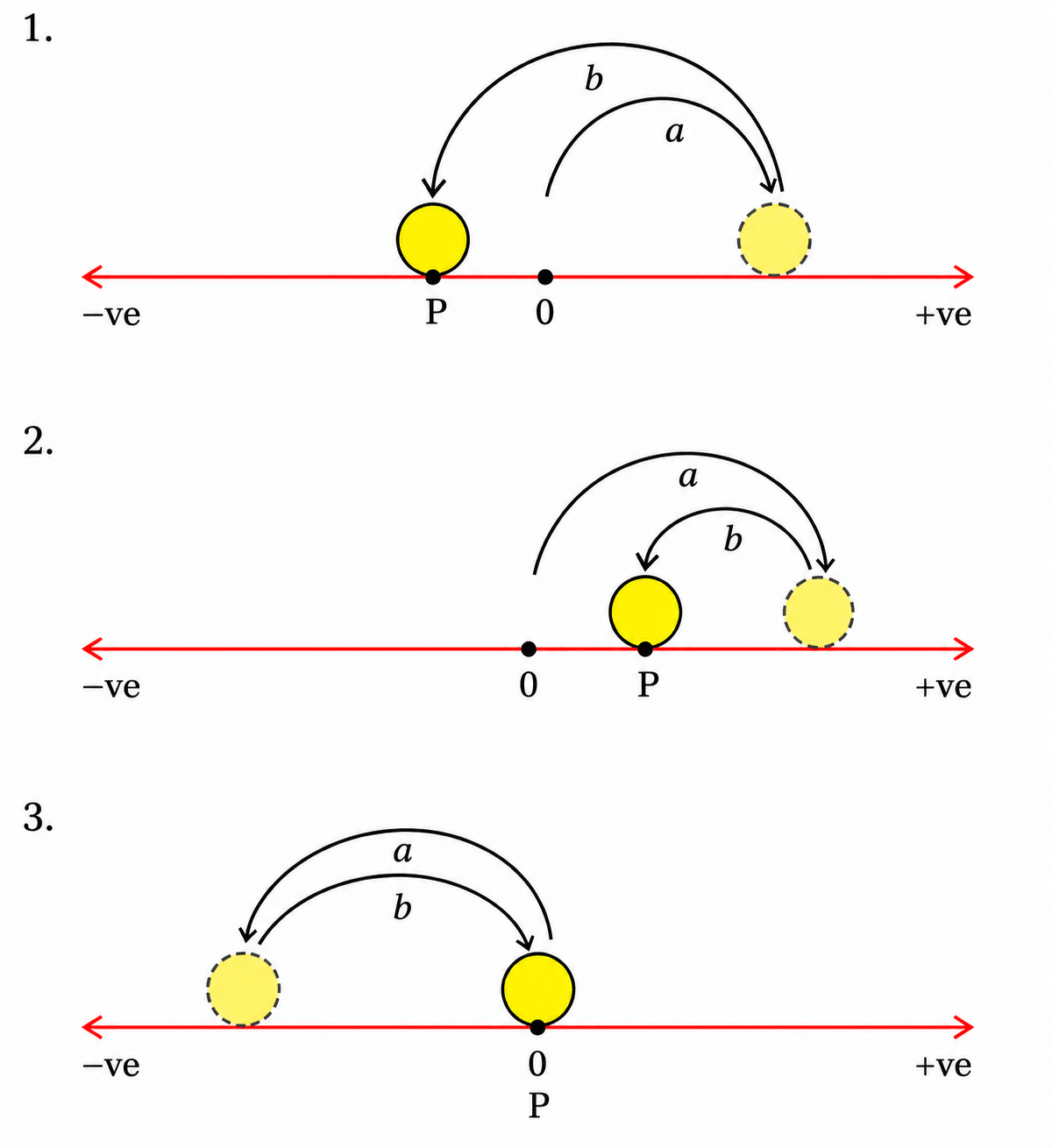
From the figures below, what can you conclude about the magnitudes of a and b compared to each other, and what are their directions? Remember to start from 0.
Answer
Figure 1:
Starting from 0:
− The movement a takes the coin from 0 to a point on the right of 0. − The movement b then takes the coin from that point to P, which is on the left of 0.
Therefore:
− a is rightward (positive). − b is leftward (negative). − Since the coin finally reaches a point left of 0, the leftward movement must be greater in magnitude than the rightward movement.
∴ a is positive, b is negative, and magnitude of b > magnitude of a.
Figure 2:
Starting from 0:
− The movement a takes the coin from 0 to a point on the right of 0.
− The movement b then takes the coin leftward to P.
Therefore:
− a is rightward (positive).
− b is leftward (negative).
− Since the final position P is still to the right of 0, the rightward movement is greater in magnitude.
∴ a is positive, b is negative, and magnitude of a > magnitude of b.
Figure 3:
Starting from 0:
− The movement a takes the coin from 0 to a point on the left of 0.
− The movement b takes the coin back to 0.
Therefore:
− a is leftward (negative).
− b is rightward (positive).
− Since the final position is exactly 0, the two movements cancel each other.
a + b = 0
Hence their magnitudes are equal.
∴ a is negative, b is positive, and magnitude of a = magnitude of b.
Using tokens, argue out the following statements.
(a) 7 − 18 = 7 + (−18) (additive inverse of 18 is −18)
(b) 4 − (−12) = 4 + 12 (additive inverse of −12 is 12)
Answer
(a) 7 − 18 = 7 + (−18)
Left side (removing tokens): Start with 7 green tokens. To remove 18 greens we first add 11 zero pairs, giving 18 greens and 11 reds. Removing the 18 greens leaves 11 reds, that is, −11.
Right side (adding tokens): Start with 7 green tokens and add 18 red tokens. Each red token cancels one green token, so 7 zero pairs are formed and cancel out. The tokens left over are 18 − 7 = 11 reds, that is, −11.
Both actions leave 11 red tokens in the bag.
∴ 7 − 18 = 7 + (−18) = −11.
(b) 4 − (−12) = 4 + 12
Left side (removing tokens): Start with 4 green tokens. There are no red tokens to remove, so we put in 12 zero pairs. Now we have 4 + 12 = 16 greens and 12 reds, and the value is still 4. Removing the 12 reds leaves 16 greens, that is, +16.
Right side (adding tokens): Start with 4 green tokens and add 12 more green tokens. This gives 16 greens, that is, +16.
Both actions leave 16 green tokens in the bag.
∴ 4 − (−12) = 4 + 12 = 16.
Hence, subtracting a number is the same as adding its additive inverse.
Similarly find the values of 4 × (−6) and 9 × (−7)? How can we interpret (−4) × 2?
Answer
4 × (−6):
The multiplier 4 is positive, so we place tokens into the bag.
The multiplicand is −6, so we place 6 red tokens into the empty bag 4 times.
Number of red tokens in the bag = 4 × 6 = 24 negatives.
∴ 4 × (−6) = −24.
9 × (−7):
The multiplier 9 is positive, so we place tokens into the bag.
The multiplicand is −7, so we place 7 negative (red) tokens into the bag 9 times.
Number of red tokens in the bag = 9 × 7 = 63 negatives.
∴ 9 × (−7) = −63.
Interpretation of (−4) × 2:
When the multiplier is negative, we remove tokens from the bag.
Therefore, (−4) × 2 means removing 2 positive (green) tokens from the bag 4 times.
Since the bag is initially empty, we first place 2 zero pairs in the bag and then remove the 2 positive tokens. Repeating this process 4 times leaves 8 negative (red) tokens in the bag.
8 negative tokens represent −8.
∴ (−4) × 2 = −8.
Why are we trying to remove green tokens and not red tokens?
Answer
In the product (−4) × 2, the multiplicand is 2, which is a positive number, and a positive number is represented by green tokens.
The multiplier −4 is negative, and a negative multiplier tells us to remove the multiplicand from the bag, 4 times.
So the tokens to be removed must be the tokens that represent the multiplicand 2, that is, 2 green tokens each time. Red tokens would represent a negative multiplicand, which is not the case here.
∴ We remove green tokens because the multiplicand 2 is positive.
Using the token interpretation, find the values of:
(a) 3 × (−2)
(b) (−5) × (−2)
(c) (−4) × (−1)
(d) (−7) × 3
Answer
(a) 3 × (−2)
The multiplier 3 is positive, so we place 2 negative (red) tokens into the bag 3 times.
Number of red tokens in the bag = 3 × 2 = 6
Thus, the bag contains 6 negative tokens.
∴ 3 × (−2) = −6.
(b) (−5) × (−2)
The multiplier −5 is negative, so we remove 2 red tokens from the bag 5 times.
Since the bag is empty, we first place 2 zero pairs in the bag and then remove the 2 red tokens. Repeating this process 5 times leaves 10 positive (green) tokens in the bag.
∴ (−5) × (−2) = 10.
(c) (−4) × (−1)
The multiplier −4 is negative, so we remove 1 red token from the bag 4 times.
Since the bag is empty, we first place 1 zero pair in the bag and then remove the red token. Repeating this process 4 times leaves 4 positive (green) tokens in the bag.
∴ (−4) × (−1) = 4.
(d) (−7) × 3
The multiplier −7 is negative, so we remove 3 green tokens from the bag 7 times.
Since the bag is empty, we first place 3 zero pairs in the bag and then remove the 3 green tokens. Repeating this process 7 times leaves 21 negative (red) tokens in the bag.
∴ (−7) × 3 = −21.
If 123 × 456 = 56088, without calculating, find the value of:
(a) (−123) × 456
(b) (−123) × (−456)
(c) (123) × (−456)
Answer
(a) (−123) × 456
The magnitude of the product remains 56088.
Since one number is negative and the other is positive, the product is negative.
∴ (−123) × 456 = −56088.
(b) (−123) × (−456)
The magnitude of the product remains 56088.
Since both numbers are negative, the product is positive.
∴ (−123) × (−456) = 56088.
(c) (123) × (−456)
The magnitude of the product remains 56088.
Since one number is positive and the other is negative, the product is negative.
∴ (123) × (−456) = −56088.
Try to frame a simple rule to multiply two integers.
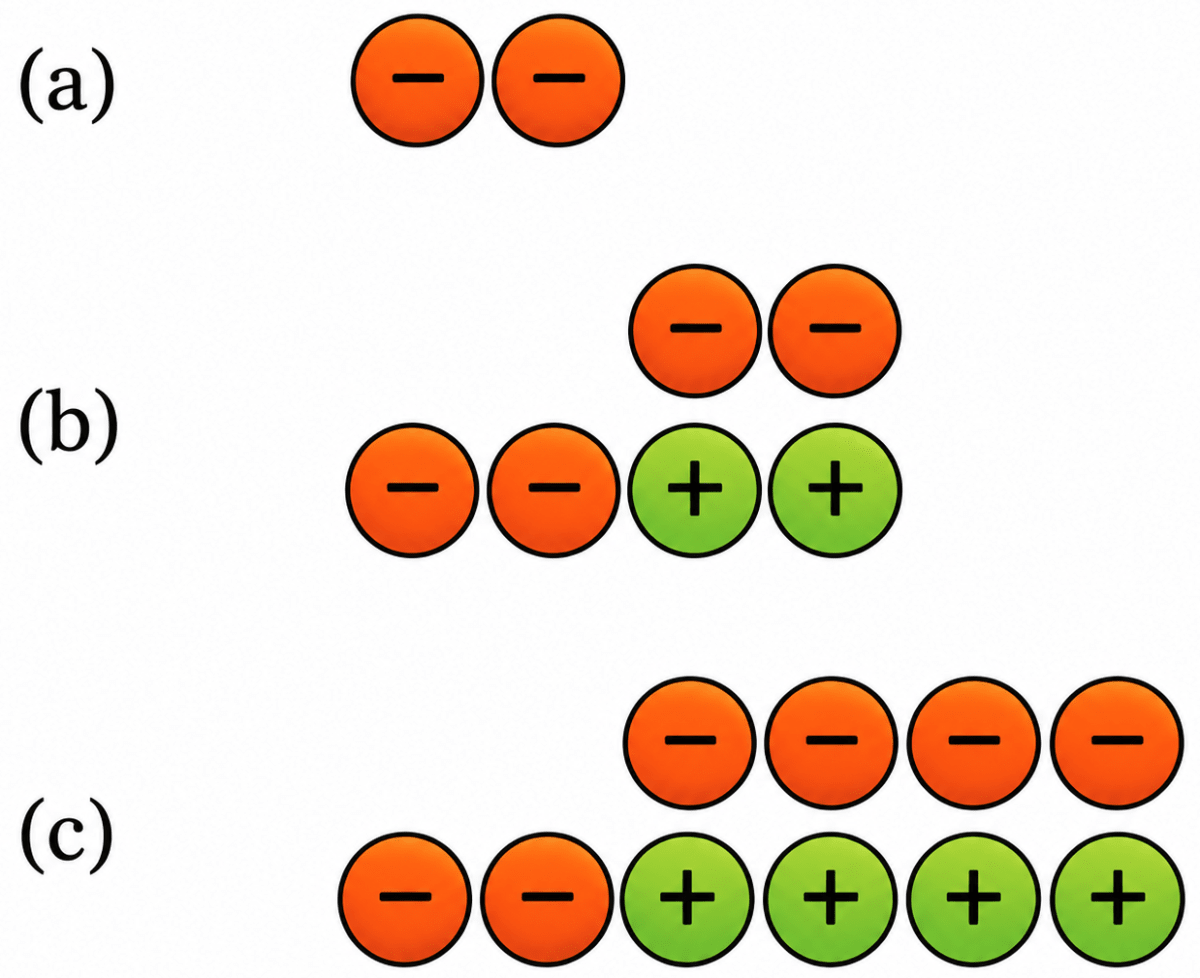
Consider the numbers represented by the following token sets. Each set represents −2. Take each token set 4 times. What integer do we get as the final answer in each case? Do we get different answers because the sets look different, or the same answer because they all represent −2?
Answer
To multiply two integers, first multiply their magnitudes.
- If the two integers have the same sign, their product is positive.
- If the two integers have different signs, their product is negative.
Each of the three token sets represents −2:
- In (a), there are 2 red tokens, so the value is −2.
- In (b), 2 green tokens cancel 2 of the 4 red tokens, leaving 2 red tokens. So the value is −2.
- In (c), 4 green tokens cancel 4 of the 6 red tokens, leaving 2 red tokens. So the value is −2.
Now take each set 4 times.
Case (a):
4 groups of 2 red tokens give 8 red tokens.
4 × (−2) = −8
Case (b):
Taking the set 4 times gives 16 red tokens and 8 green tokens. The 8 green tokens cancel 8 red tokens, leaving 8 red tokens.
4 × (−2) = −8
Case (c):
Taking the set 4 times gives 24 red tokens and 16 green tokens. The 16 green tokens cancel 16 red tokens, leaving 8 red tokens.
4 × (−2) = −8
Hence, the final answer is −8 in each case because all three token sets represent the same integer, −2.
Check this for 5 × 4 by taking different token sets corresponding to 4.
Answer
Take different token sets that represent 4:
- (a) 4 green tokens represent 4.
- (b) 6 green tokens and 2 red tokens represent 6 + (−2) = 4.
- (c) 8 green tokens and 4 red tokens represent 8 + (−4) = 4.
Now take each set 5 times.
Case (a):
5 groups of 4 green tokens give 20 green tokens.
5 × 4 = 20
Case (b):
Taking the set 5 times gives 30 green tokens and 10 red tokens. The 10 red tokens cancel 10 green tokens, leaving 20 green tokens.
5 × 4 = 20
Case (c):
Taking the set 5 times gives 40 green tokens and 20 red tokens. The 20 red tokens cancel 20 green tokens, leaving 20 green tokens.
5 × 4 = 20
Hence, each token set gives the same product, 5 × 4 = 20, because all the sets represent the same integer, 4.
We know that removing or subtracting a number is the same as adding its inverse.
Using this, can −4 × 2 be defined through a process of addition of tokens instead of removal of tokens?
Answer
Yes.
We know that removing a number is the same as adding its additive inverse.
So, removing 2 green tokens (that is, removing +2) is the same as adding 2 red tokens (that is, adding −2).
For −4 × 2, instead of removing 2 green tokens from the empty bag 4 times, we may simply add 2 red tokens to the empty bag 4 times.
After doing this 4 times, the bag contains 8 red tokens.
⇒ −4 × 2 = (−2) + (−2) + (−2) + (−2) = −8
∴ −4 × 2 = −8, and it can indeed be defined by adding 2 negative tokens 4 times.
Find the following products.
(a) 4 × (−3)
(b) (−6) × (−3)
(c) (−5) × (−1)
(d) (−8) × 4
(e) (−9) × 10
(f) 10 × (−17)
Answer
(a) 4 × (−3)
One integer is positive and the other is negative, so the product is negative.
4 × (−3) = −(4 × 3) = −12
∴ 4 × (−3) = −12
(b) (−6) × (−3)
Both integers are negative, so the product is positive.
(−6) × (−3) = 6 × 3 = 18
∴ (−6) × (−3) = 18
(c) (−5) × (−1)
Both integers are negative, so the product is positive.
(−5) × (−1) = 5 × 1 = 5
∴ (−5) × (−1) = 5
(d) (−8) × 4
One integer is negative and the other is positive, so the product is negative.
(−8) × 4 = −(8 × 4) = −32
∴ (−8) × 4 = −32
(e) (−9) × 10
One integer is negative and the other is positive, so the product is negative.
(−9) × 10 = −(9 × 10) = −90
∴ (−9) × 10 = −90
(f) 10 × (−17)
One integer is positive and the other is negative, so the product is negative.
10 × (−17) = −(10 × 17) = −170
∴ 10 × (−17) = −170
In the case of integers, is the product the same when we swap the multiplier and the multiplicand? Try this for some numbers.
Observe the following pairs of multiplications (fill in the blanks where needed):
| 3 × −4 = −12 | −4 × 3 = −12 |
| −30 × 12 = ....... | 12 × −30 = ....... |
| −15 × −8 = 120 | −8 × −15 = 120 |
| 14 × −5 = −70 | −5 × ....... = −70 |
Answer
−30 × 12 = −(30 × 12) = −360
12 × −30 = −(12 × 30) = −360
14 × − 5 = −70, and since the product must remain −70 after swapping, the missing number is 14.
⇒ −5 × 14 = −70
The completed table is:
| 3 × −4 = −12 | −4 × 3 = −12 |
| −30 × 12 = −360 | 12 × −30 = −360 |
| −15 × −8 = 120 | −8 × −15 = 120 |
| 14 × −5 = −70 | −5 × 14 = −70 |
In each pair, the two products are equal. The magnitude of the product depends only on the magnitudes of the two integers, and the sign depends only on whether the two signs are alike or unlike. Neither of these changes on swapping.
∴ The product is the same when the multiplier and the multiplicand are swapped, that is, multiplication of integers is commutative: a × b = b × a.
An exam has 50 multiple choice questions. 5 marks are given for every correct answer and 2 negative marks for every wrong answer. What are the maximum possible marks in the exam? What are the minimum possible marks?
Answer
The exam has 50 multiple choice questions, with +5 marks for every correct answer and −2 marks for every wrong answer.
For the maximum marks, all 50 answers must be correct.
⇒ Maximum marks = 50 × 5 = 250
For the minimum marks, all 50 answers must be wrong.
⇒ Minimum marks = 50 × (−2) = −100
∴ The maximum possible marks are 250 and the minimum possible marks are −100.
Find the values of:
(a) 14 × (−15)
(b) −16 × (−5)
(c) 36 ÷ (−18)
(d) (−46) ÷ (−23)
Answer
(a) 14 × (−15)
We have 14 × (−15)
Here one integer is positive and the other is negative, so the product is negative.
14 × 15 = 210
∴ 14 × (−15) = −210
(b) −16 × (−5)
We have −16 × (−5)
Here both the integers are negative, so the product is positive.
16 × 5 = 80
∴ −16 × (−5) = 80
(c) 36 ÷ (−18)
We have 36 ÷ (−18)
Here the dividend is positive and the divisor is negative, so the quotient is negative.
36 ÷ 18 = 2
∴ 36 ÷ (−18) = −2
(d) (−46) ÷ (−23)
We have (−46) ÷ (−23)
Here both the dividend and the divisor are negative, so the quotient is positive.
46 ÷ 23 = 2
∴ (−46) ÷ (−23) = 2
A freezing process requires that the room temperature be lowered from 32°C at the rate of 5°C every hour. What will be the room temperature 10 hours after the process begins?
Answer
The temperature decreases by 5°C every hour.
So, the change in temperature per hour is represented by the integer −5.
Starting temperature = 32°C
Change in temperature in 10 hours = 10 × (−5) = −50°C
∴ Temperature after 10 hours = 32 + (−50)
= −(50 − 32)
= −18
∴ The room temperature 10 hours after the process begins is −18°C.
A cement company earns a profit of ₹8 per bag of white cement sold and a loss of ₹5 per bag of grey cement sold. [Represent the profit/loss as integers.]
(a) The company sells 3,000 bags of white cement and 5,000 bags of grey cement in a month. What is its profit or loss?
(b) If the number of bags of grey cement sold is 6,400 bags, what is the number of bags of white cement the company must sell to have neither profit nor loss.
Answer
Profit is represented by a positive integer and loss by a negative integer.
Profit on one bag of white cement = ₹8
Loss on one bag of grey cement = ₹(−5)
(a) Amount earned on 3,000 bags of white cement = 3000 × 8 = ₹24,000
Amount lost on 5,000 bags of grey cement = 5000 × (−5) = ₹(−25,000)
Total profit or loss = 24000 + (−25000)
= −(25000 − 24000)
= −1000
The answer is a negative integer, so it is a loss.
∴ The company makes a loss of ₹1,000.
(b) Loss on 6,400 bags of grey cement = 6400 × (−5) = ₹(−32,000)
For neither profit nor loss, the profit must be ₹32,000.
Let the number of bags of white cement sold be n.
⇒ n × 8 = 32000
⇒ n =
⇒ n = 4000
∴ The company must sell 4,000 bags of white cement to have neither profit nor loss.
Replace the blank with an integer to make a true statement.
(a) (−3) × ........ = 27
(b) 5 × ........ = (−35)
(c) ........ × (−8) = (−56)
(d) ........ × (−12) = 132
(e) ........ ÷ (−8) = 7
(f) ........ ÷ 12 = −11
Answer
(a) (−3) × ........ = 27
The product is positive and the multiplier is negative, so the missing integer must be negative.
⇒ 27 ÷ (−3) = −9
∴ (−3) × (−9) = 27
(b) 5 × ........ = (−35)
The product is negative and the multiplier is positive, so the missing integer must be negative.
⇒ (−35) ÷ 5 = −7
∴ 5 × (−7) = −35
(c) ........ × (−8) = (−56)
The product is negative and the multiplicand is negative, so the missing integer must be positive.
⇒ (−56) ÷ (−8) = 7
∴ 7 × (−8) = −56
(d) ........ × (−12) = 132
The product is positive and the multiplicand is negative, so the missing integer must be negative.
⇒ 132 ÷ (−12) = −11
∴ (−11) × (−12) = 132
(e) ........ ÷ (−8) = 7
Multiply both sides by −8.
⇒ 7 × (−8) = −56
∴ (−56) ÷ (−8) = 7
(f) ........ ÷ 12 = −11
Multiply both sides by 12.
⇒ (−11) × 12 = −132
∴ (−132) ÷ 12 = −11
Are there orders in which 5 × −3 × 4 can be evaluated? Will the product be the same in all these cases?
Answer
Yes. The expression can be evaluated in different orders.
(5 × (−3)) × 4 = (−15) × 4 = −60
5 × ((−3) × 4) = 5 × (−12) = −60
(5 × 4) × (−3) = 20 × (−3) = −60
((−3) × 4) × 5 = (−12) × 5 = −60
((−3) × 5) × 4 = (−15) × 4 = −60
(4 × 5) × (−3) = 20 × (−3) = −60
∴ The expression can be evaluated in different orders, and the product is the same in every case.
Multiply the expression 25 × −6 × 12 in all the different orders and check if the product is the same in all cases.
Answer
(25 × (−6)) × 12 = (−150) × 12 = −1800
25 × ((−6) × 12) = 25 × (−72) = −1800
(25 × 12) × (−6) = 300 × (−6) = −1800
((−6) × 12) × 25 = (−72) × 25 = −1800
((−6) × 25) × 12 = (−150) × 12 = −1800
(12 × 25) × (−6) = 300 × (−6) = −1800
∴ In every order the product is −1800. The product remains the same when three or more integers are multiplied in any order.
Look at the following series of multiplications:
−1 × −1 = 1
−1 × −1 × −1 = −1
−1 × −1 × −1 × −1 = 1
−1 × −1 × −1 × −1 × −1 = −1
When −1 is multiplied 2 or 4 times the product is positive. When it is multiplied 3 or 5 times the product is negative.
Can you generalise these statements further?
Answer
Continuing the series:
(−1) × (−1) = 1
(−1) × (−1) × (−1) = −1
(−1) × (−1) × (−1) × (−1) = 1
(−1) × (−1) × (−1) × (−1) × (−1) = −1
(−1) × (−1) × (−1) × (−1) × (−1) × (−1) = 1
Each time a further (−1) is multiplied, the sign of the product flips.
We can generalise as follows:
⇒ When (−1) is multiplied an even number of times, the product is 1 (positive).
⇒ When (−1) is multiplied an odd number of times, the product is −1 (negative).
∴ The product of n factors, each equal to (−1), is 1 if n is even and −1 if n is odd.
Using this understanding of multiplication of many integers, can you give a simple rule to find the sign of the product of many integers?
Answer
The sign of the product depends on the number of negative factors.
⇒ If the number of negative factors is even, the product is positive.
⇒ If the number of negative factors is odd, the product is negative.
⇒ If any one of the factors is 0, the product is 0.
Example:
(−2) × 3 × (−4) × (−5) has three negative factors, an odd number, so the product is negative.
Indeed, (−2) × 3 × (−4) × (−5) = −120.
∴ To find the sign of the product of many integers, count the negative factors. An even number of negative factors gives a positive product, and an odd number of negative factors gives a negative product.
Check if the distributive property holds for (−2) × (4 + (−3)) (that is, if this expression equals (−2) × 4 + (−2) × (−3)), and for a few other such expressions of your choice.
Answer
We check whether a × (b + c) = (a × b) + (a × c).
For (−2) × (4 + (−3)):
LHS = (−2) × (4 + (−3))
= (−2) × 1
= −2
RHS = (−2) × 4 + (−2) × (−3)
= −8 + 6
= −2
Since LHS = RHS, the distributive property holds.
Another example: 3 × ((−5) + 2)
LHS = 3 × ((−5) + 2) = 3 × (−3) = −9
RHS = 3 × (−5) + 3 × 2 = −15 + 6 = −9
Another example: (−4) × ((−6) + (−1))
LHS = (−4) × ((−6) + (−1)) = (−4) × (−7) = 28
RHS = (−4) × (−6) + (−4) × (−1) = 24 + 4 = 28
In each case LHS = RHS.
∴ The distributive property a × (b + c) = (a × b) + (a × c) holds for integers.
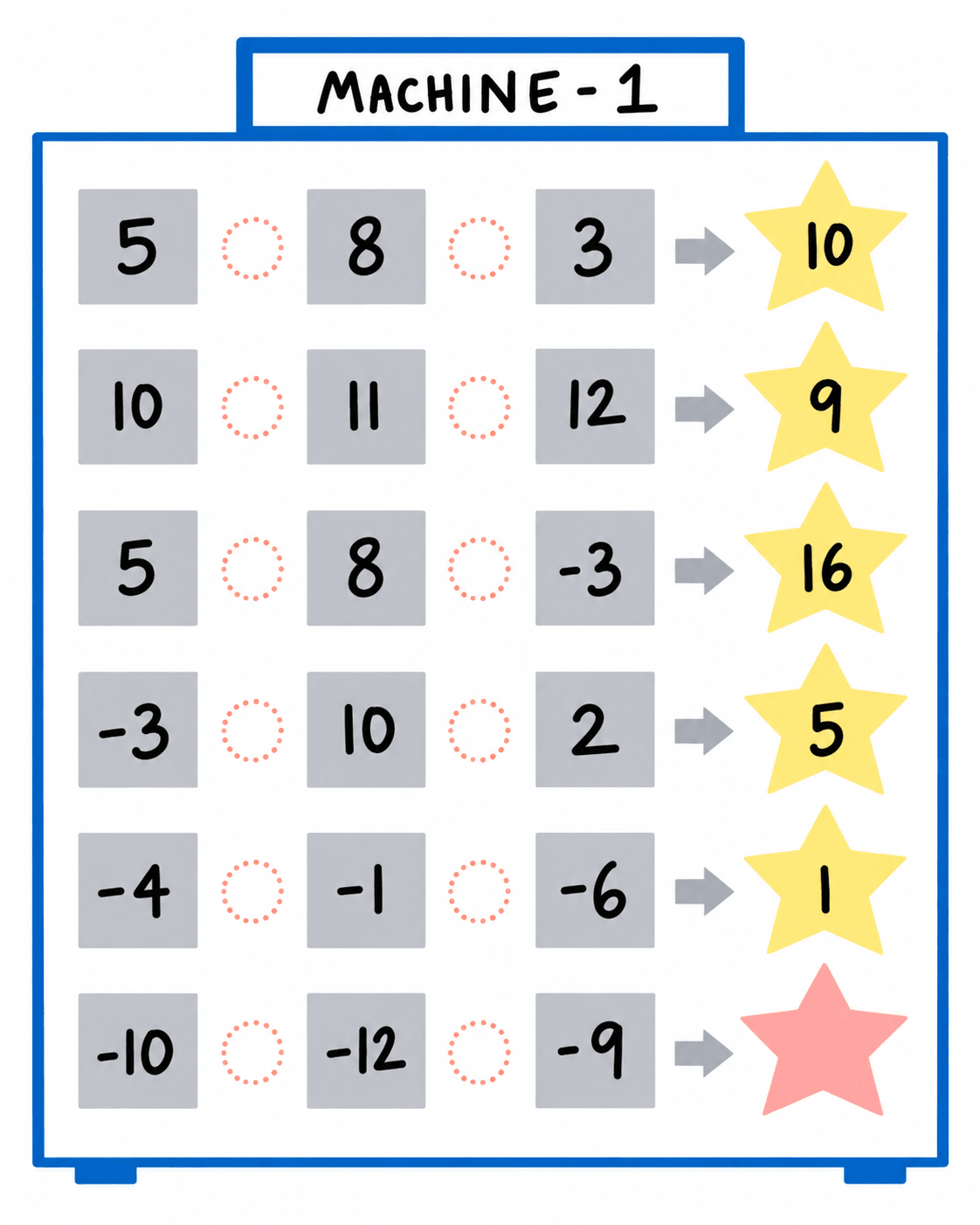
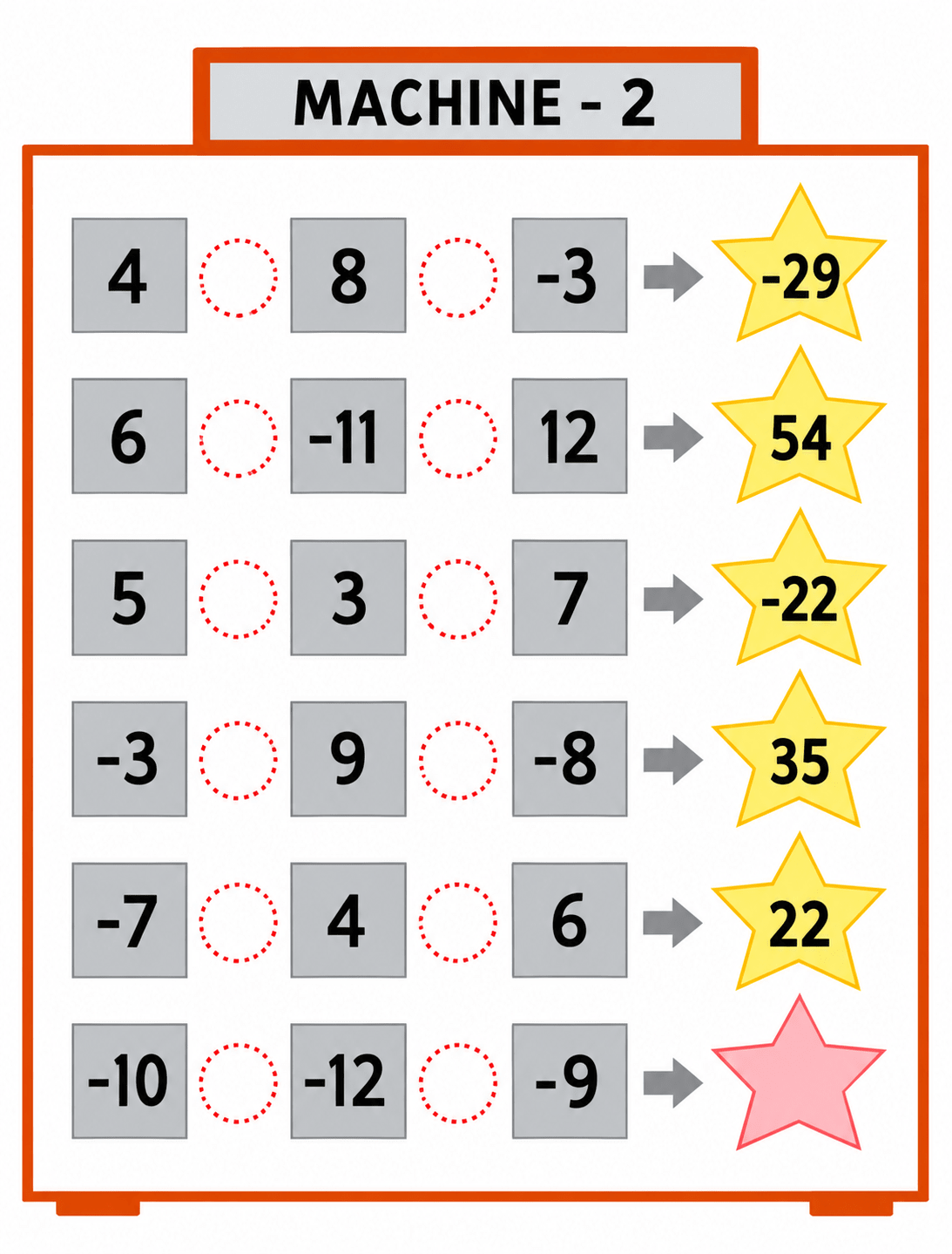
Two pattern machines are given below. Each machine takes 3 numbers, does some operations and gives out the result.
(a) Find the operations being done by Machine 1.
(b) Find the operations being done by Machine 2 and fill in the blank.
Answer
(a)
The operation done by Machine 1 is
(first number) + (second number) – (third number).
Written as an expression, this will be a + b – c, where a is the first number, b is the second number, and c is the third number.
For example, 5 + 8 – 3 = 10, and (– 4) + (– 1) – (– 6) = 1.
So, the result of the last group will be, (– 10) + (– 12) – (– 9) = -13
(b)
Let the three input numbers be a, b and c (in order).
Machine 2 takes the product of the first two numbers, changes its sign, and then subtracts the third number. That is, the operation is
−(first number × second number) − (third number)
Written as an expression, this is −(a × b) − c.
Let us check this with the given groups:
−(4 × 8) − (−3) = −32 + 3 = −29 [first group]
−(6 × (−11)) − 12 = 66 − 12 = 54 [second group]
−(5 × 3) − 7 = −15 − 7 = −22 [third group]
−((−3) × 9) − (−8) = 27 + 8 = 35 [fourth group]
−((−7) × 4) − 6 = 28 − 6 = 22 [fifth group]
The rule works for every group.
Now, for the last group (−10), (−12), (−9):
−((−10) × (−12)) − (−9)
= −(120) + 9
= −111
∴ The operation done by Machine 2 is −(a × b) − c, and the missing result is −111.
Find the values of the following expressions:
(a) (−5) × (18 + (−3))
(b) (−7) × 4 × (−1)
(c) (−2) × (−1) × (−5) × (−3)
Answer
(a) We first simplify inside the bracket.
(−5) × (18 + (−3))
= (−5) × 15
Here one integer is negative and the other is positive, so the product is negative.
∴ (−5) × (18 + (−3)) = −75
(b) (−7) × 4 × (−1)
= ((−7) × 4) × (−1)
= (−28) × (−1)
Since −1 × a = −a, the product is the additive inverse of −28.
∴ (−7) × 4 × (−1) = 28
(c) (−2) × (−1) × (−5) × (−3)
= ((−2) × (−1)) × ((−5) × (−3))
= 2 × 15
Here there are four negative integers, an even number of them, so the product is positive.
∴ (−2) × (−1) × (−5) × (−3) = 30
Find the values of the following expressions:
(a) (−27) ÷ 9
(b) 84 ÷ (−4)
(c) (−56) ÷ (−2)
Answer
(a) (−27) ÷ 9
We know that 9 × (−3) = −27.
Also, −a ÷ b = −(a ÷ b).
∴ (−27) ÷ 9 = −(27 ÷ 9) = −3
(b) 84 ÷ (−4)
We know that (−4) × (−21) = 84, and a ÷ (−b) = −(a ÷ b).
∴ 84 ÷ (−4) = −(84 ÷ 4) = −21
(c) (−56) ÷ (−2)
Both the dividend and the divisor are negative, so the quotient is positive, since (−a) ÷ (−b) = a ÷ b.
∴ (−56) ÷ (−2) = 56 ÷ 2 = 28
Find the integer whose product with (−1) is:
(a) 27
(b) −31
(c) −1
(d) 1
(e) 0
Answer
We know that −1 × a = −a for all integers a.
So, the required integer is the additive inverse of the given number.
(a) The additive inverse of 27 is −27.
Check: (−1) × (−27) = 27
∴ The integer is −27.
(b) The additive inverse of −31 is 31.
Check: (−1) × 31 = −31
∴ The integer is 31.
(c) The additive inverse of −1 is 1.
Check: (−1) × 1 = −1
∴ The integer is 1.
(d) The additive inverse of 1 is −1.
Check: (−1) × (−1) = 1
∴ The integer is −1.
(e) The additive inverse of 0 is 0.
Check: (−1) × 0 = 0
∴ The integer is 0.
If 47 − 56 + 14 − 8 + 2 − 8 + 5 = −4, then find the value of −47 + 56 − 14 + 8 − 2 + 8 − 5 without calculating the full expression.
Answer
Observe that in the second expression, every term of the first expression has been replaced by its additive inverse.
So, the second expression is obtained by multiplying the first expression by − 1:
−47 + 56 − 14 + 8 − 2 + 8 − 5
= (−1) × (47 − 56 + 14 − 8 + 2 − 8 + 5) [taking out −1]
= (−1) × (−4) [given value]
= 4
∴ −47 + 56 − 14 + 8 − 2 + 8 − 5 = 4
Do you remember the Collatz Conjecture from last year? Try a modified version with integers. The rule is — start with any number; if the number is even, take half of it; if the number is odd, multiply it by −3 and add 1; repeat. An example sequence is shown below.
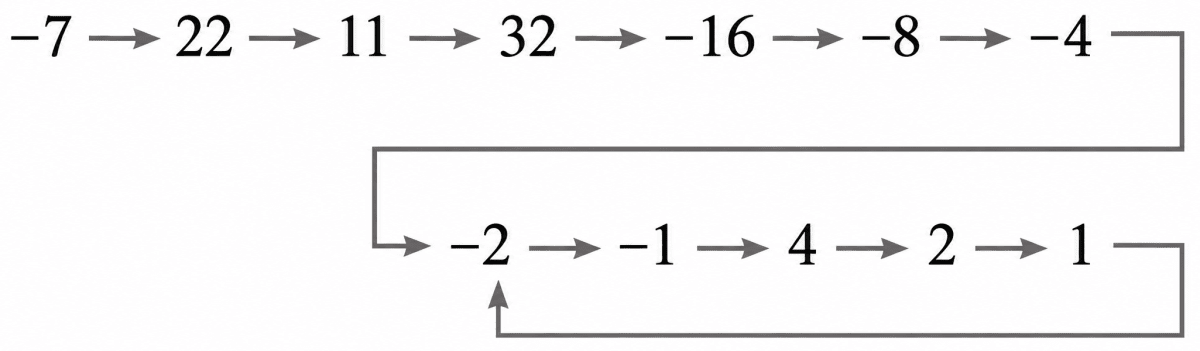
Try this with different starting numbers: (−21), (−6), and so on. Describe the patterns you observe.
Answer
The rule is:
• if the number is even, take half of it,
• if the number is odd, multiply it by −3 and add 1.
Starting with −21:
−21 is odd ⇒ (−21) × (−3) + 1 = 63 + 1 = 64
64 is even ⇒ 64 ÷ 2 = 32, and we keep halving.

(1 is odd ⇒ 1 × (−3) + 1 = −2; −2 is even ⇒ −1; −1 is odd ⇒ (−1) × (−3) + 1 = 4.)
Starting with − 6:
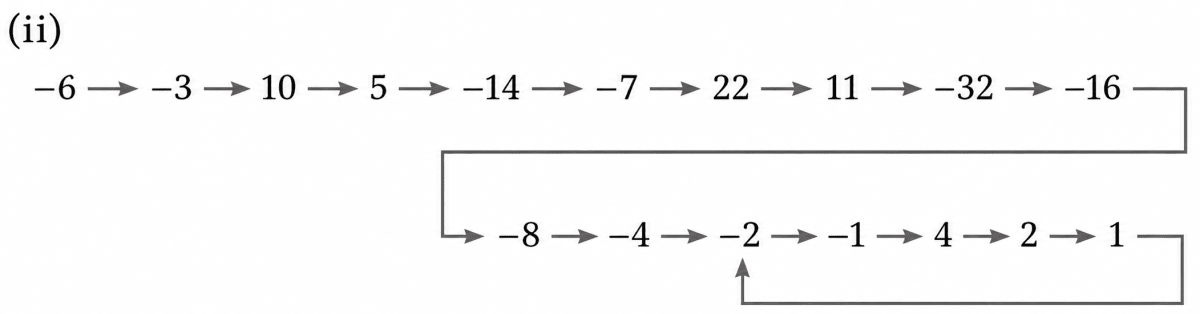
(− 6 is even ⇒ −3; −3 is odd ⇒ (−3) × (−3) + 1 = 10; 5 is odd ⇒ 5 × (−3) + 1 = −14; 11 is odd ⇒ 11 × (−3) + 1 = −32, and so on.)
Patterns observed:
• For both the tested starting numbers, −21 and −6, the sequence eventually enters the repeating cycle:
4 → 2 → 1 → −2 → −1 → 4 → …
• This cycle contains five numbers and repeats indefinitely.
• An odd positive integer becomes negative in the next step, whereas an odd negative integer becomes positive. A non−zero even integer is halved without changing its sign.
Hence, for the tested starting numbers −21 and −6, the sequences eventually enter the repeating cycle 4 → 2 → 1 → −2 → −1 → 4 → … . This observation should not be generalised to every integer.
In a test, (+4) marks are given for every correct answer and (−2) marks are given for every incorrect answer.
(a) Anita answered all the questions in the test. She scored 40 marks even though 15 of her answers were correct. How many of her answers were incorrect? How many questions are in the test?
(b) Anil scored (−10) marks even though he had 5 correct answers. How many of his answers were incorrect? Did he leave any questions unanswered?
Answer
Given:
Marks for correct answer = +4
Marks for incorrect answer = −2
(a) Marks for 15 correct answers = 15 × 4 = 60.
Anita scored 40 marks in all.
So, marks obtained from the incorrect answers = 40 − 60 = −20.
Each incorrect answer gives (−2) marks.
Number of incorrect answers = (−20) ÷ (−2) = 10.
Since Anita answered all the questions,
Total questions = 15 + 10 = 25.
∴ Anita had 10 incorrect answers, and there are 25 questions in the test.
(b) Marks for 5 correct answers = 5 × 4 = 20.
Anil scored (−10) marks in all.
So, marks obtained from the incorrect answers = (−10) − 20 = −30.
Number of incorrect answers = (−30) ÷ (−2) = 15.
Number of questions Anil attempted = 5 + 15 = 20.
The test has 25 questions (from part (a)).
Questions left unanswered = 25 − 20 = 5.
∴ Anil had 15 incorrect answers, and he left 5 questions unanswered.
Pick the pattern — find the operations done by the machine shown below.
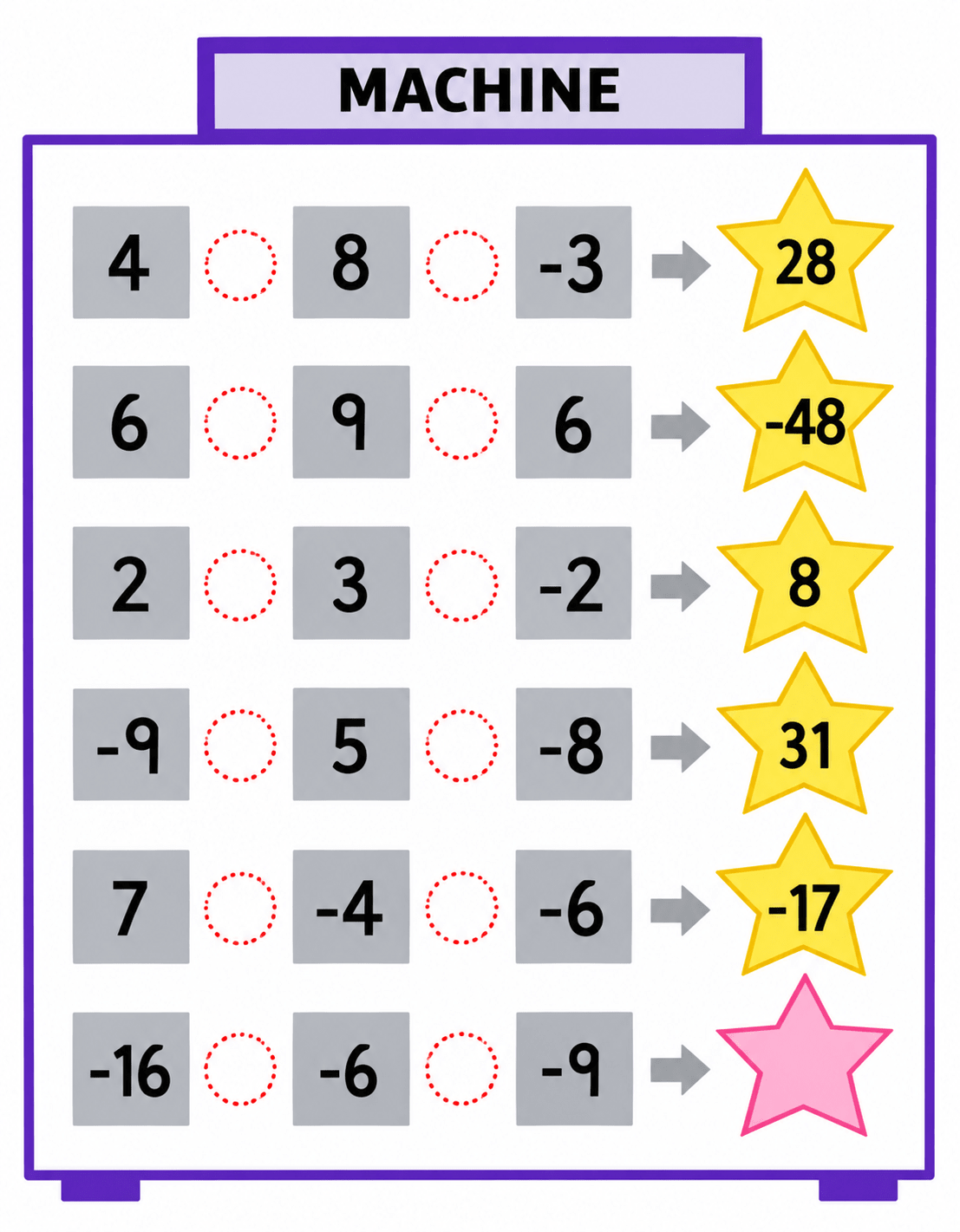
Answer
Let the three input numbers be a, b and c (in order).
The machine multiplies the second and third numbers and subtracts this product from the first number. That is, the operation is
(first number) − (second number × third number)
Written as an expression, this is a − (b × c).
Let us check this with the given groups:
4 − (8 × (−3)) = 4 + 24 = 28 [first group]
6 − (9 × 6) = 6 − 54 = −48 [second group]
2 − (3 × (−2)) = 2 + 6 = 8 [third group]
−9 − (5 × (−8)) = −9 + 40 = 31 [fourth group]
7 − ((−4) × (−6)) = 7 − 24 = −17 [fifth group]
The rule works for every group.
Now, for the last group (−16), (−6), (−9):
(−16) − ((−6) × (−9))
= −16 − 54
= −70
∴ The operation done by the machine is a − (b × c), and the missing result is −70.
Imagine you're in a place where the temperature drops by 5°C each hour. If the temperature is currently at 8°C, write an expression which denotes the temperature after 4 hours.
Answer
A drop of 5°C in one hour is represented by the integer (−5) °C per hour.
In 4 hours, the change in temperature = 4 × (−5) = −20 °C.
Starting temperature = 8 °C.
The required expression is
8 + 4 × (−5)
= 8 + (−20)
= −12
∴ The temperature after 4 hours is given by the expression 8 + 4 × (−5), which equals −12 °C.
Find 3 consecutive numbers with a product of (a) −6, (b) 120.
Answer
(a) Product = −6.
Since the product is negative, the three consecutive numbers cannot all be positive.
Let us try the negative numbers just below 0:
(−3) × (−2) × (−1) = 6 × (−1) = −6
∴ The three consecutive numbers are −3, −2 and −1.
(b) Product = 120.
Since 120 is positive and fairly large, let us try consecutive positive numbers around , that is, around 5:
4 × 5 × 6 = 20 × 6 = 120
∴ The three consecutive numbers are 4, 5 and 6.
An alien society uses a peculiar currency called 'pibs' with just two denominations of coins — a +13 pibs coin and a − 9 pibs coin. You have several of these coins. Is it possible to purchase an item that costs + 85 pibs?
Using the two denominations, try to get the following totals:
(a) +20
(b) +40
(c) −50
(d) +8
(e) +10
(f) −2
(g) +1
[Hint: Writing down a few multiples of 13 and 9 can help.]
(h) Is it possible to purchase an item that costs 1568 pibs?
Answer
Let us use m coins of +13 pibs and n coins of −9 pibs, where m and n are whole numbers.
Then the total amount is
13 × m + (−9) × n = 13m − 9n
So, for each required total, we look for whole numbers m and n such that 13m − 9n equals that total.
Writing a few multiples helps:
Multiples of 13: 13, 26, 39, 52, 65, 78, 91, 104, 117, 130, …
Multiples of 9: 9, 18, 27, 36, 45, 54, 63, 72, 81, 90, …
Yes, an item costing +85 pibs can be purchased, since 10 coins of +13 pibs and 5 coins of −9 pibs give
130 − 45 = 85.
(a) +20
Take m = 5 and n = 5.
13 × 5 − 9 × 5 = 65 − 45 = 20
∴ 5 coins of +13 pibs and 5 coins of −9 pibs give +20 pibs.
(b) +40
Take m = 10 and n = 10.
13 × 10 − 9 × 10 = 130 − 90 = 40
∴ 10 coins of +13 pibs and 10 coins of −9 pibs give +40 pibs.
(c) −50
Take m = 1 and n = 7.
13 × 1 − 9 × 7 = 13 − 63 = −50
∴ 1 coin of +13 pibs and 7 coins of −9 pibs give −50 pibs.
(d) +8
Take m = 2 and n = 2.
13 × 2 − 9 × 2 = 26 − 18 = 8
∴ 2 coins of +13 pibs and 2 coins of −9 pibs give +8 pibs.
(e) +10
Take m = 7 and n = 9.
13 × 7 − 9 × 9 = 91 − 81 = 10
∴ 7 coins of +13 pibs and 9 coins of −9 pibs give +10 pibs.
(f) −2
Take m = 4 and n = 6.
13 × 4 − 9 × 6 = 52 − 54 = −2
∴ 4 coins of +13 pibs and 6 coins of −9 pibs give −2 pibs.
(g) +1
Take m = 7 and n = 10.
13 × 7 − 9 × 10 = 91 − 90 = 1
∴ 7 coins of +13 pibs and 10 coins of −9 pibs give +1 pib.
(h) 1568 pibs
Yes, it is possible.
Take m = 122 and n = 2.
13 × 122 − 9 × 2 = 1586 − 18 = 1568
∴ 122 coins of +13 pibs and 2 coins of −9 pibs give +1568 pibs.
Find the values of:
(a) (32 × (−18)) ÷ (−36)
(b) 32 ÷ ((−36) × (−18))
(c) (25 × (−12)) ÷ (45 × (−27))
(d) (280 × (−7)) ÷ ((−8) × (−35))
Answer
(a) (32 × (−18)) ÷ (−36)
32 × (−18) = −576 [one positive, one negative ⇒ product negative]
(−576) ÷ (−36) = 576 ÷ 36 = 16 [both negative ⇒ quotient positive]
∴ (32 × (−18)) ÷ (−36) = 16
(b) 32 ÷ ((−36) × (−18))
(−36) × (−18) = 648 [both negative ⇒ product positive]
32 ÷ 648 =
∴ 32 ÷ ((−36) × (−18)) =
(c) (25 × (−12)) ÷ ((45) × (−27))
25 × (−12) = −300
45 × (−27) = −1215
(−300) ÷ (−1215) = [both negative ⇒ quotient positive]
∴ (25 × (−12)) ÷ (45 × (−27)) =
(d) (280 × (−7)) ÷ ((−8) × (−35))
280 × (−7) = −1960
(−8) × (−35) = 280
(−1960) ÷ 280 = −(1960 ÷ 280) = −7 [one negative ⇒ quotient negative]
∴ (280 × (−7)) ÷ ((−8) × (−35)) = −7
Arrange the expressions given below in increasing order.
(a) (−348) + (−1064)
(b) (−348) − (−1064)
(c) 348 − (−1064)
(d) (−348) × (−1064)
(e) 348 × (−1064)
(f) 348 × 964
Answer
Let us first find the value of each expression.
(a) (−348) + (−1064) = −(348 + 1064) = −1412
(b) (−348) − (−1064) = −348 + 1064 = 716
(c) 348 − (−1064) = 348 + 1064 = 1412
(d) (−348) × (−1064) = 370272 [both negative ⇒ product positive]
(e) 348 × (−1064) = −370272 [one negative ⇒ product negative]
(f) 348 × 964 = 335472
Arranging these values from the smallest to the largest:
−370272 < −1412 < 716 < 1412 < 335472 < 370272
∴ The increasing order is (e), (a), (b), (c), (f), (d).
That is,
348 × (−1064) < (−348) + (−1064) < (−348) − (−1064) < 348 − (−1064) < 348 × 964 < (−348) × (−1064)
Given that (−548) × 972 = −532656, write the values of:
(a) (−547) × 972
(b) (−548) × 971
(c) (−547) × 971
Answer
We use the distributive property along with the given product
(−548) × 972 = −532656.
(a) (−547) × 972
Here −547 = (−548) + 1.
(−547) × 972
= [(−548) + 1] × 972
= (−548) × 972 + 1 × 972 [distributive property]
= −532656 + 972
= −531684
∴ (−547) × 972 = −531684
(b) (−548) × 971
Here 971 = 972 − 1.
(−548) × 971
= (−548) × (972 − 1)
= (−548) × 972 − (−548) × 1 [distributive property]
= −532656 + 548
= −532108
∴ (−548) × 971 = −532108
(c) (−547) × 971
Using the result of part (a), (−547) × 972 = −531684.
(−547) × 971
= (−547) × (972 − 1)
= (−547) × 972 − (−547) × 1
= −531684 + 547
= −531137
∴ (−547) × 971 = −531137
Given that 207 × (−33 + 7) = −5382, write the value of −207 × (33 − 7) = .......... .
Answer
We are given
207 × (−33 + 7) = −5382
Now, notice that
−33 + 7 = −(33 − 7)
⇒ 207 × (−33 + 7) = 207 × [−(33 − 7)]
⇒ 207 × (−33 + 7) = −207 × (33 − 7) [multiplying by −1 gives the additive inverse]
So the expression −207 × (33 − 7) has exactly the same value as 207 × (−33 + 7).
∴ −207 × (33 − 7) = −5382
Check: 33 − 7 = 26, and (−207) × 26 = −5382.
Use the numbers 3, −2, 5, −6 exactly once and the operations '+', '−', and '×' exactly once and brackets as necessary to write an expression such that —
(a) the result is the maximum possible
(b) the result is the minimum possible
Answer
Each number and each of the three operations must be used exactly once. Checking the valid placements of the operations shows that the greatest possible magnitude is obtained by forming 10 from 3, 5 and −2, and then multiplying by −6.
(a) Maximum possible result
To obtain the maximum positive value, form −10 and multiply it by −6:
(−2 − (3 + 5)) × (−6)
= (−2 − 8) × (−6)
= (−10) × (−6)
= 60
Hence, the maximum possible result is 60, obtained from (−2 − (3 + 5)) × (−6).
(b) Minimum possible result
To obtain the minimum value, form 10 and multiply it by −6:
((3 + 5) − (−2)) × (−6)
= (8 + 2) × (−6)
= 10 × (−6)
= −60
Hence, the minimum possible result is −60, obtained from ((3 + 5) − (−2)) × (−6).
Fill in the blanks in at least 5 different ways with integers:
(a)
(b)
(c)
Answer
(a)
Remember that multiplication is done before addition. So we need a number added to a product that totals −36.
0 + 6 × (−6) = 0 + (−36) = −36
4 + (−8) × 5 = 4 + (−40) = −36
(−6) + (−5) × 6 = −6 + (−30) = −36
(−16) + (−4) × 5 = −16 + (−20) = −36
2 + (−2) × 19 = 2 + (−38) = −36
(−36) + 1 × 0 = −36 + 0 = −36
(b)
Here the bracket is evaluated first, and its value is then multiplied by the third number.
(5 − 1) × 3 = 4 × 3 = 12
(2 − 6) × (−3) = (−4) × (−3) = 12
(−1 − 2) × (−4) = (−3) × (−4) = 12
(7 − 1) × 2 = 6 × 2 = 12
(0 − 6) × (−2) = (−6) × (−2) = 12
(4 − (−2)) × 2 = 6 × 2 = 12
(c)
Here the inner bracket is evaluated first, and the result is subtracted from the first number.
2 − (5 − 2) = 2 − 3 = −1
0 − (3 − 2) = 0 − 1 = −1
1 − (4 − 2) = 1 − 2 = −1
(−5) − (−1 − 3) = −5 − (−4) = −5 + 4 = −1
(−3) − (0 − 2) = −3 − (−2) = −3 + 2 = −1
10 − (15 − 4) = 10 − 11 = −1